
Jiujiang Slate FAQ: The 22 Questions New Buyers Ask — in the Order They Arrive
Quick answers to the questions new buyers ask about origin, quality and sourcing.
There is no new question in this FAQ. Every question below has been asked to our faces, down a phone line, across a trade-fair table or by email — and for a long time before email, by fax. What changes over the years is the wording. What almost never changes is the order in which the questions arrive.
The order matters. A buyer meeting Chinese slate for the first time asks about the name first — what is this stone, and whose stone is it? Then the stone itself. Then the proof. Only then the money, and finally the mechanics of doing business with a factory half a world away. Trust builds in that order whether the buyer notices it or not, so this page answers in that order.
Three promises. Each answer is short, because a good first reply does not bury a question under an essay. Each links to the page that answers it fully. And where a question really belongs to a product rather than the region — tile sizes, table tolerances, roof installation — the answer here is one sentence and a link. The reply is short; the full answer lives one click away.
Quick Answer — the whole page in one breath
Jiujiang slate is natural metamorphic stone from the Jiujiang region of Jiangxi, China — one rock that leaves the same belt as thin roofing tiles and as machined billiard table beds. The tested material shows 0.1–0.2% water absorption and around 60 MPa flexural strength, which is why it competes on evidence rather than adjectives. It is usually competitive with Spanish or Welsh slate per square metre, but only a landed-cost comparison against the same specification tells the truth. You can buy factory-direct, you can visit the factory near Lushan — about a forty-minute drive from Nanchang — and a full container is the honest economic unit — roughly 1,130–1,450 m² of roofing slate, or a full programme of table slate, though smaller trial loads can often be consolidated for shipment. The 22 answers below add the detail behind each of those sentences.
FIRST, THE NAME
What exactly is Jiujiang slate?
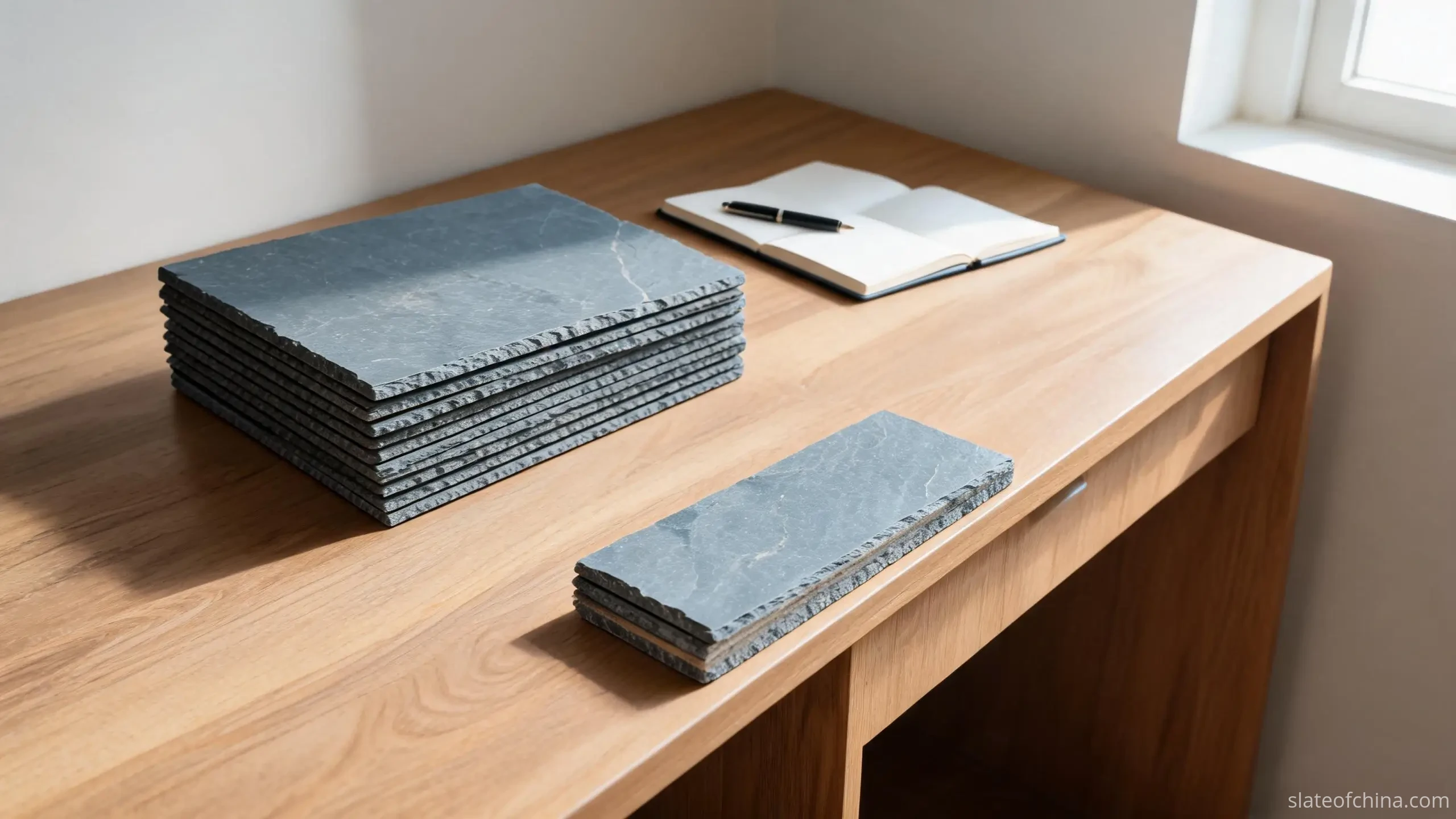
Natural slate — metamorphic rock — quarried and finished in and around Jiujiang, a prefecture-level city in Jiangxi Province on the Yangtze. It is a place, not a brand: several producers work the same belt, and we are one of them. The same rock leaves the region in two very different forms: split thin into roofing tiles, and sawn, ground and CNC-machined into billiard table beds. If you are meeting it for the first time, the full introduction is in What Is Jiujiang Slate? — this page keeps every answer short.
Where does Jiujiang slate come from — and are "Lushan slate" and "Xingzi slate" the same stone?
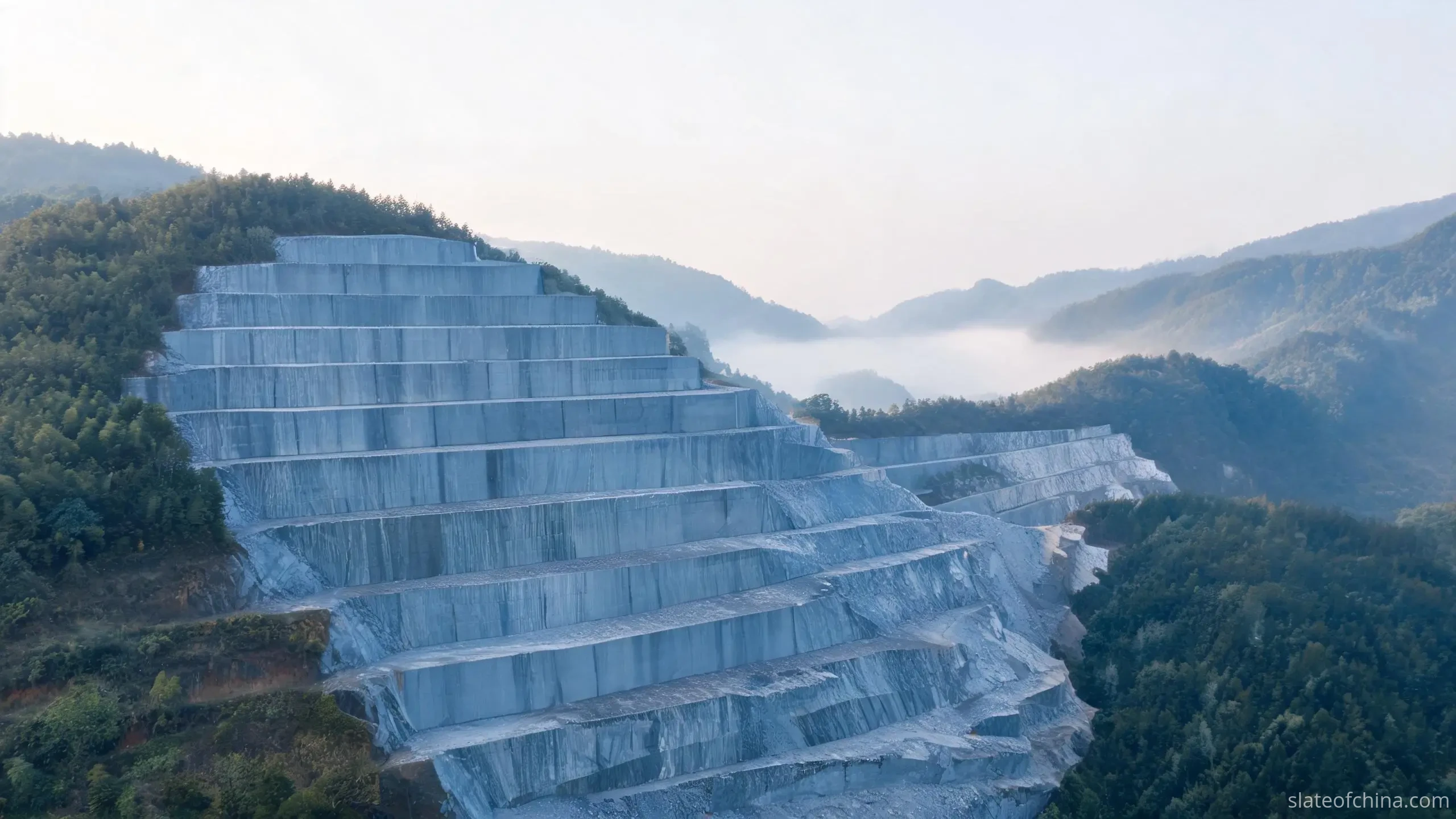
Jiujiang is the city; the quarries sit in the belt along the southern foot of the Lushan mountains, around what used to be Xingzi County — it became Lushan City in 2016 — and our factory is there. So the three names usually point to the same producing belt, and the differences between them are administrative, not geological. What matters commercially is what your documents say: the origin line on the invoice, the sample name on the test report. The geography is walked through in Where Is Jiujiang Slate From?, the naming question is settled — with paperwork examples — in Jiujiang, Lushan or Xingzi Slate: What's in a Name?, and the whole region is drawn in the Jiujiang Slate Map.
Is Jiujiang slate natural stone or a manufactured product?
Natural. The rock began as sediment, was buried, compressed and re-crystallised into slate deep in the crust, and is now split along its natural cleavage or sawn and machined — nothing pressed, bonded or resin-added at any point. If a "slate" product is ground stone glued back together, that is an agglomerate: a different product with different durability rules, and it should be sold as such. How the rock formed is told in The Geology of Jiujiang Slate, and the hand-splitting craft that turns blocks into tiles is described in The Art of Splitting Slate by Hand.
THEN, THE STONE
What is Jiujiang slate used for?
Two export flagships: roofing slate — thin tiles for pitched roofs — and billiard slate, the playing beds under the cloth of snooker, pool and Chinese 8-ball tables. The same belt also supplies paving, wall cladding and small craft products, but roofing and billiards are what the region is known for internationally. The two trades demand opposite things from the same rock: roofing needs clean cleavage and weathering performance; billiards needs flatness and machining precision. Both journeys are followed end to end in From Quarry to Roofing Slate and From Quarry to Billiard Slate.
What colours does Jiujiang slate come in — and will they fade?
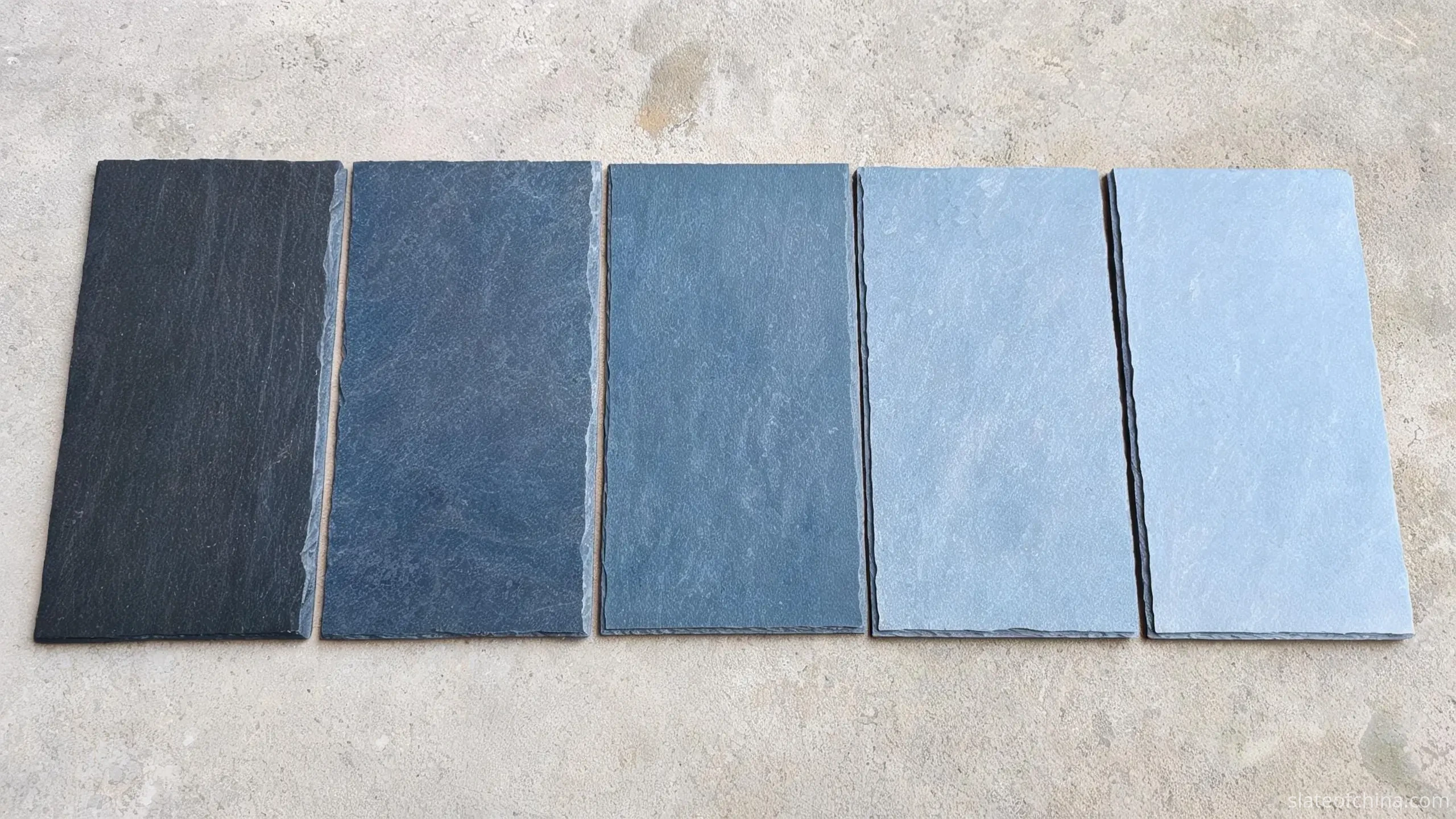
The roofing grades run in cool blue-grey and charcoal tones; green-grey and near-black tones also occur. Colour stability is decided by mineral content — this stone carries very little carbonate (well under 1% calcium oxide in published analyses), so acid rain finds little to react with — and the tested grades hold their tone for decades. Slate does weather, but on good stone that means a slow, even maturing over generations, not a faded roof in five years. Natural variation between tiles is normal and is managed by grading; the honest, detailed answer is Jiujiang Roofing Slate: Colour and Weathering.
What sizes and thicknesses are available?
Roofing: common export formats include 500×250, 500×300 and 600×300 mm, with commercial thicknesses typically in the 5–9 mm range depending on grade and market; larger formats and custom cuts are regular work. Billiard: panels are cut to the table maker's drawing — sizes and piece counts follow the table type, and thickness follows the design. Rather than repeat the full size tables here, we keep them where they belong: the Roofing Slate Guide and the Billiard Slate Guide.
NOW, THE PROOF
Is Jiujiang slate good quality?
It can be excellent — and the name alone guarantees nothing, which is exactly why this page exists. The tested material from this belt shows 0.1–0.2% water absorption, flexural strength around 60 MPa dry, density of 2.7–2.8 g/cm³, and 92.7% of its flexural strength retained after 120 freeze–thaw cycles. Those are strong numbers under EN 12326 or ASTM C406. But a region is a shortlist, not a certificate: the quarry face, the selected grade and the factory's inspection decide what actually ships. Judge evidence, not adjectives: every figure above goes back to a dated report on a named batch — the published set sits on our test results page, and the property-by-property reading is in Jiujiang Slate Properties Explained, and the four differences buyers actually notice are in What Makes Jiujiang Slate Different?
Will Jiujiang slate survive freezing winters?
The frost question is really a water question. Tested absorption runs 0.1–0.2% across different labs and methods — deep inside EN 12326's toughest A1 class, which stops at 0.6% — so ice has little water to work with. In the laboratory, 120 freeze–thaw cycles left 92.7% of the flexural strength in place. In the field, gravestones cut from local slate have stood through roughly two hundred Jiangxi winters, a climate that alternates damp chill with hard frost — a natural freeze–thaw test no laboratory can afford. One caveat, always: those numbers belong to the tested material, so ask for the report that matches your batch — and no single number settles durability on its own; absorption, flexural strength and freeze–thaw results each answer a different part of the question. Start with Jiujiang Slate Water Absorption and Freeze–Thaw Resistance of Jiujiang Slate.
Does Jiujiang slate meet EN 12326 and ASTM C406?
The material has been tested to both standards and passed the relevant classifications — but "Jiujiang slate meets EN 12326" is not a sentence any honest supplier can say about a whole region. Compliance belongs to a tested product grade, from a tested sample, on a dated report. The two systems also differ in method — absorption is measured by soaking in one and boiling in the other — and a result under one system is not automatically a result under the other. The useful questions are which standard, which method, which product. The two standards are compared side by side in EN 12326 and ASTM C406: What They Test, reports are decoded in How to Read a Slate Test Report, and our own published figures sit on the test results page.
How do I know a test report is genuine — and about the right stone?
Five checks. A named laboratory and a date. The standard and method used. The product or batch the sample represents. Whether the material offered to you is the same grade that was tested. And whether the supplier can carry that traceability through to your order — the batch number should appear consistently on the quotation, the packing list and the crate labels. Remember what a report actually is: a record of one batch on one date, not a permanent property of a region. The answer that should worry you is the smooth one — "all our slate meets all standards", with no numbers and no dates. The full evidence request list is in Slate Testing: What Buyers Should Ask For.
Is all slate from the Jiujiang region the same quality?
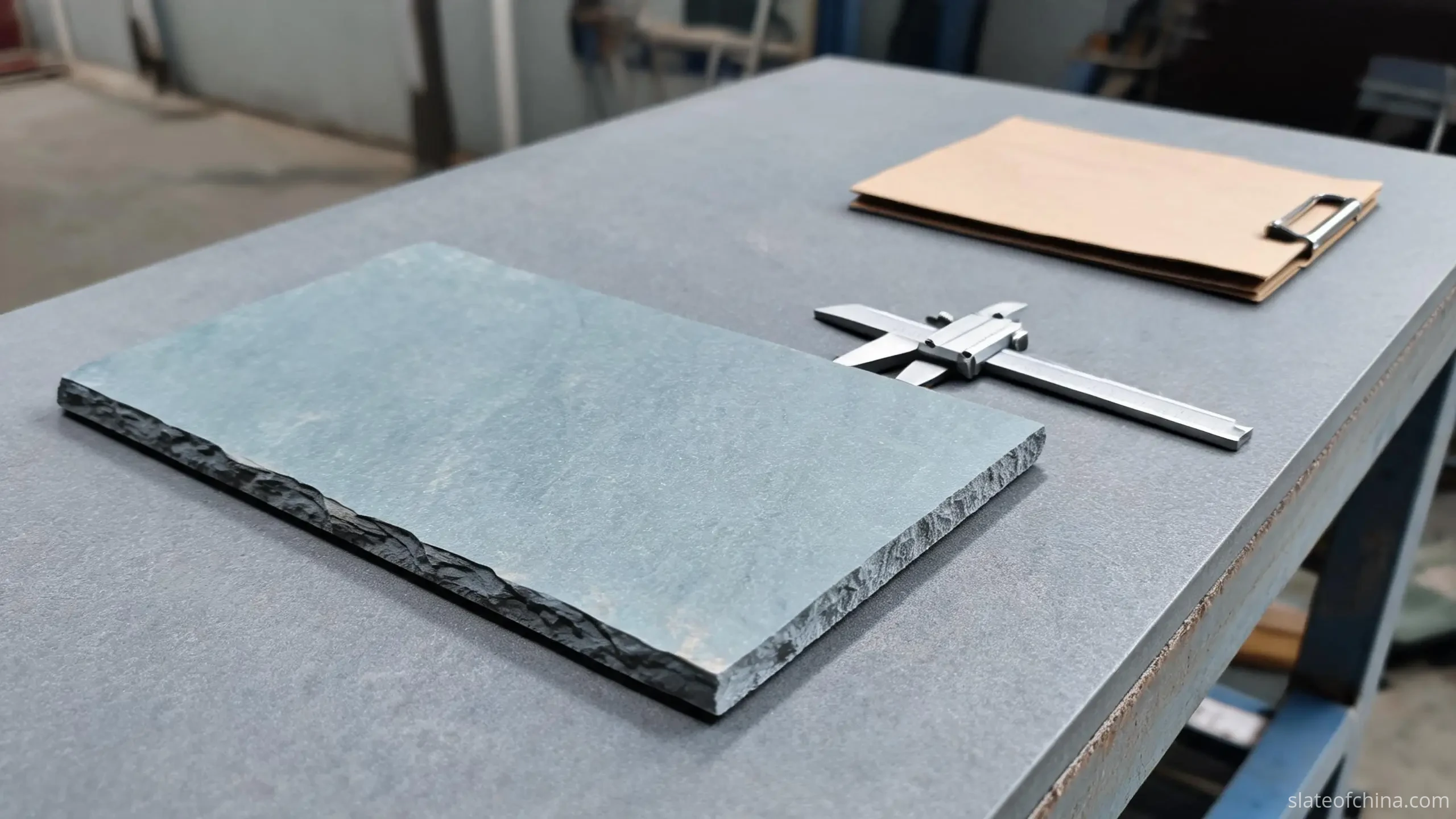
No — and be suspicious of anyone who implies otherwise. Quality varies between deposits, between quarry faces and between blocks; the same mountain yields a minority of billiard-grade stone and a large volume of commercial roofing stone, and the two are worth different money. What protects you is not the regional name but traceability: which quarry area, which batch, what inspection. Our position has not changed in years — origin is a starting point, not a quality certificate. How we grade and check every piece is documented in 100% Inspection: How We Check Every Piece, and the honest regional verdict is Is Jiujiang the Best Slate in China?
THEN, THE MONEY
Is Jiujiang slate cheaper than Spanish or Welsh slate?
Often yes at the ex-works stage — but "cheaper" is a claim you test, not accept. The honest comparison is landed cost against an identical specification: same size, same thickness, same grade rules, same test evidence. Thickness consistency, breakage, waste factor, freight and duty can each move the total more than the tile price does. The head-to-heads do this properly: Jiujiang Slate vs Spanish Slate, Jiujiang Slate vs Welsh Slate, and the four-origin overview for importers comparing everything at once.
Why choose Jiujiang slate over other Chinese slate regions?
Because of what the belt demonstrably does well — dense, low-absorption stone; hand-splitting and CNC machining under one roof; and the river port at Jiujiang, forty minutes from the factory — not because a map redraws itself for marketing. Other Chinese provinces produce good slate for other applications, and some stone sold as "Jiujiang" is even re-routed from elsewhere, which is why document-level verification matters more than regional loyalty. Compare evidence across regions, not slogans. The regional audit — including how to spot a re-labelled stone — is Jiujiang Slate vs Other Chinese Slate Regions, and the roofing-focused decision path is Jiujiang Slate for Roofing vs Other Origins.
What does Jiujiang slate cost?
There is no single number, and a supplier who quotes one without your specification is guessing. Price follows size, thickness, grade, quantity, machining content and destination. Two honest generalisations: slate travels efficiently by container — a 20 ft load carries roughly 1,130–1,450 m² of 7–9 mm roofing slate, so freight per square metre stays modest when the load is planned — and for table slate, the drawing and machining content move quotes as much as the stone does. Formats and machining options are listed on the roofing slate and billiard slate product pages; send a specification and you will have a real number, usually with the arithmetic shown.
Is there a minimum order?
For roofing slate, a full container is generally the most economical way to ship — but it is not a hard minimum. Smaller trial orders may be possible through consolidated shipments, depending on the product, the quantity and the sailing. For billiard slate, the practical order size follows the table specification, the number of sets and the packing. What is true either way: below a couple of pallets the freight starts winning the argument, so say what your project actually needs — a competent supplier should tell you plainly whether the economics work. The freight arithmetic behind that honesty is laid out in Containers, Freight and Delivery from Jiujiang.
FINALLY, THE DEAL
How do I find a reliable Jiujiang slate manufacturer?
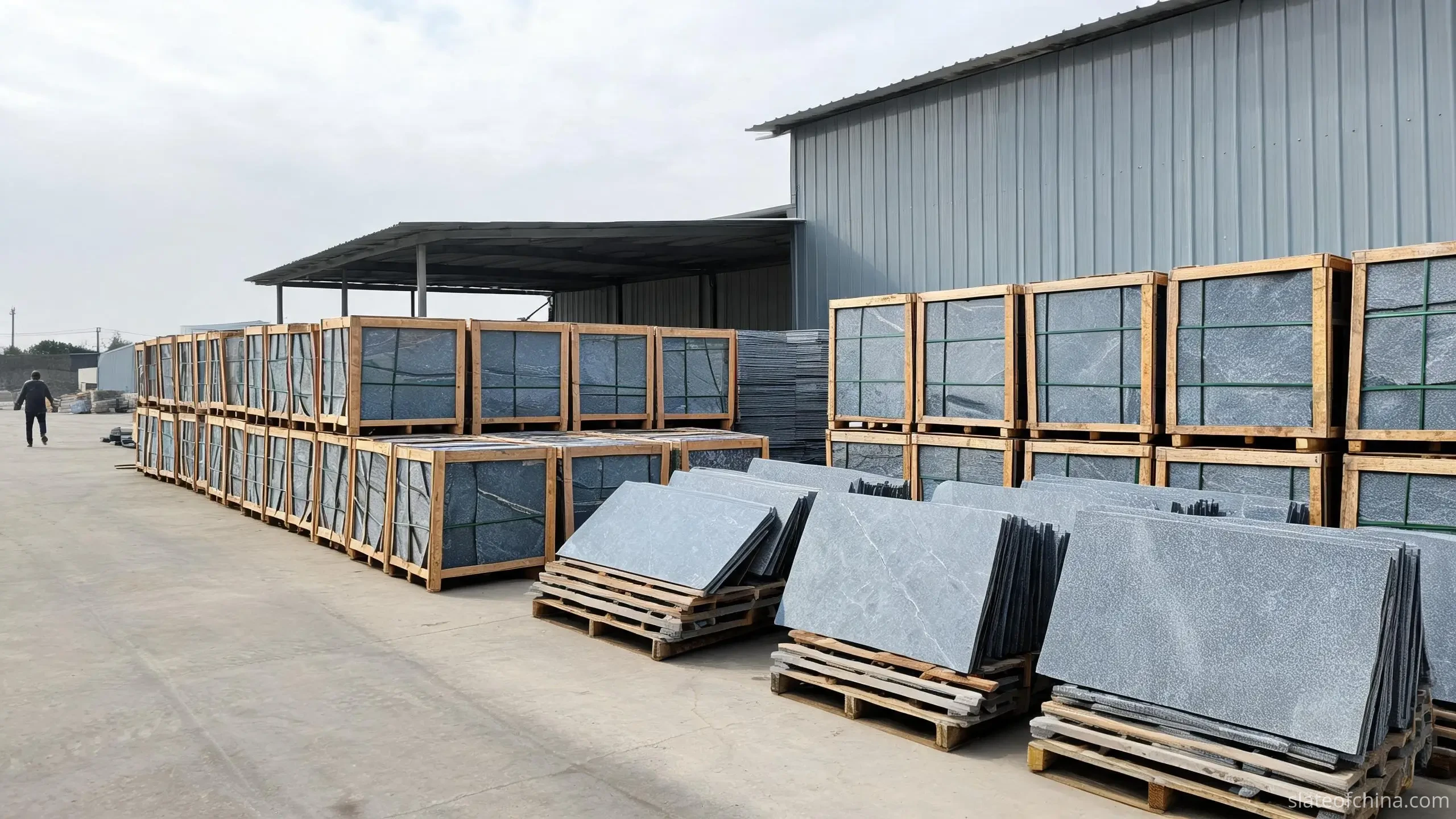
First work out who you are actually talking to: a quarry-linked manufacturer, a processing factory, or a trading company. All three can be legitimate; what differs is who controls production, who inspects, and who answers when something goes wrong. Then run the checks that cut through websites: a factory address you can visit or video-call, production photographs tied to your order rather than a brochure, batch-level traceability, and plain answers about what a supplier cannot do. The identity question is settled in Factory vs Trading Company: How to Tell the Difference, and the full verification method is Questions to Ask Before You Buy.
Can I buy Jiujiang slate directly from a factory?
Yes — we sell direct, and so do other producers in the belt. What direct sourcing buys you is control and clarity: your specification spoken to the people who cut the stone, your packing standard, your inspection arrangements, one accountable pair of hands. It does not automatically buy a lower price or better quality — those still come from the factory's real capability. The routes into the region, and what each is worth, are mapped in How to Source Jiujiang Slate Directly.
Can I visit the factory before ordering?
Yes, and we would rather you came. Overseas buyers fly into Nanchang, and roughly a forty-minute drive brings you to the factory near Lushan. A walk through the yard, a splitting bench, the machining line and — with luck — a loading day settles more in one afternoon than ten emails ever will; over the years we have regularly hosted overseas buyers for exactly this reason. What a visit should cover, and what each stop proves, is written in How to Verify a Jiujiang Slate Supplier.
Can I get samples before placing an order?
Yes — samples are the cheapest risk reduction in this trade. Roofing samples show colour, cleavage and workmanship; ask for a small range rather than one flattering tile, because production will look like the range, not the star. For billiard slate, a hand sample cannot prove a bed's flatness — ask instead for inspection records and process evidence on full panels, or a pre-shipment inspection for large orders. Approve a reference sample and tie it to the order documents; the full process is in Samples and Sample Approval.
What information should I send for an accurate quotation?
For roofing: tile format, thickness, colour and grade, quantity, destination port, and any standard the project cites. For billiard: table type, an approved drawing — which beats a product name every time — thickness, panel count, machining details, quantity and destination. The more complete the first email, the shorter the quote cycle and the fewer surprises later; half-specified enquiries get generic prices, and generic prices are where projects go wrong. The complete enquiry template is in Questions to Ask Before You Buy, the roofing-side checklist is in the Roofing Slate Buying Guide, and the table-side specifics are collected in How to Request a Billiard Slate Quotation.
How is Jiujiang slate packed and shipped?
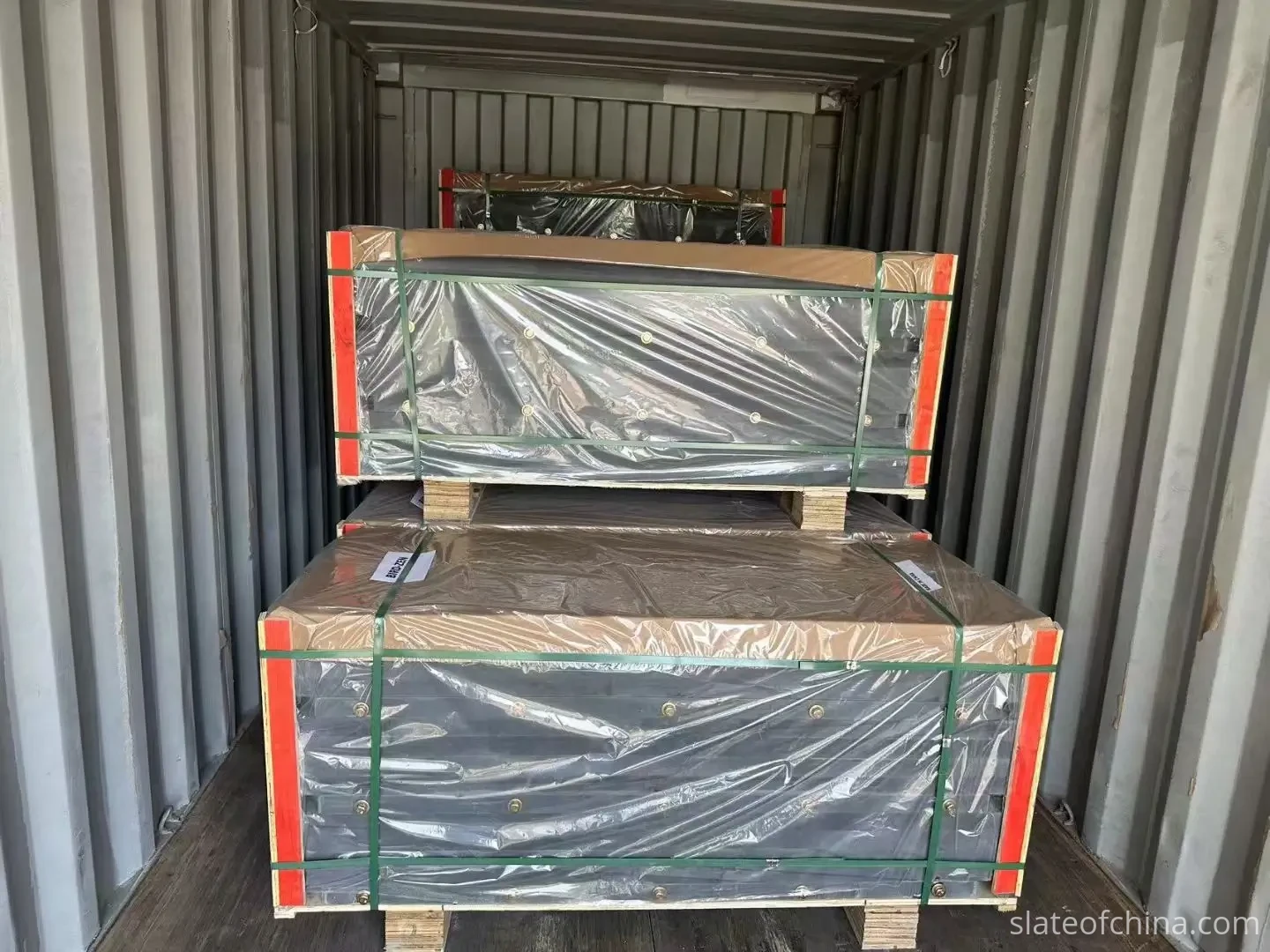
Roofing slate travels in wooden export crates; billiard panels in full containers ride heat-treated, wood-framed pallets — with reinforced crates when a shared container demands more protection, and A-frames for oversized slabs. The container is brought to the factory, we load it ourselves, and it returns to the river port at Jiujiang — roughly forty minutes away — before the water and ocean legs begin. Whatever the product, ask any supplier for a written packing standard and loading photographs rather than an improvised promise. The method is documented in How Jiujiang Slate Is Packed and Shipped, and the paperwork that travels with the stone is listed in Documents for Importing Slate from China.
AND WHEN YOU WANT MORE
Which guide should I read next?
Whichever question keeps you up at night. This page sits inside the Jiujiang Slate Guide, which owns the region — geology, production, testing, comparisons and sourcing. Product questions live in the sister guides, and each has its own FAQ for the product side. A short routing map:
| If your next question is… | Start with |
|---|---|
| Where the stone comes from — geology, production, testing, sourcing | The Jiujiang Slate Guide — this page's parent hub |
| Which tile size, thickness or grade for my roof | The Roofing Slate FAQ — product-side questions, answered short |
| Which bed, which drawing, which tolerance for my table | The Billiard Slate FAQ — the 28 questions table builders ask most |
Beyond the 22: Six Questions That Come Next
How long has Jiujiang been producing slate?
Local use goes back over a thousand years — the same rock family has been cut into inkstones since the Song dynasty, and village roofs and gravestones around Lushan have used local slate for generations. Organised export is younger: the industry turned to international trade in the 1990s and has not stopped since. The full story, from inkstone to container, is in History of Slate Production in Jiujiang.
Is the slate under my pool or snooker table likely from Jiujiang?
If the table was built in China, it is a real possibility — much of the world's table slate is machined in this region. The way to know is to ask the table maker for the bed's origin; serious builders know their slate supplier. What the region's stone delivers on a table, and why builders choose it, is explained in Why Jiujiang Slate Works for Billiard Tables.
Can Jiujiang slate be used for flooring, paving or wall cladding?
Yes — it is dense, barely absorbs water and finishes well, which suits ground contact and facades; the region supplies paving, flooring and wall stone alongside the two flagships. Our export business concentrates on roofing and billiard slate, where the belt's reputation was built. Where each product line sits in the wider industry is shown in The Jiujiang Slate Industry.
Do you accept OEM and private-label orders?
Yes — both product lines are routinely supplied under customers' brands, to the customer's drawings and packing standards. For table builders this is the normal way of working: your bed, your specification, our stone. What OEM supply involves is described in OEM Billiard Slate for Table Manufacturers.
How quickly do you answer enquiries?
Within one working day, normally — and faster when the first email contains what matters: product, dimensions or drawing, quantity and destination port. A complete enquiry and a complete reply usually settle the framework of an order within a week of email. You can reach us at any time through the contact page.
Can you send a catalogue and a price list?
The website is the catalogue — the guides you are reading, the published test data and the product pages together cover sizes, specifications and evidence, and anything not covered we photograph or write for you. A universal price list for natural slate does not meaningfully exist — prices follow specification and volume — so tell us what you are buying, and the catalogue arrives as a quotation.
Related Reading
P.S. — The Fastest Way Past This Page
An FAQ answers questions in general; a quotation answers yours. Two ways to start — each takes a few lines:
- Roofing slate enquiry: tile size and thickness, colour, quantity, destination port.
- Billiard slate enquiry: table type, your drawing, slate thickness, number of sets, destination port.
Send those, and you will have a plain answer — price, lead time, packing and documents — from the people who actually cut the stone.