
The Geology of Jiujiang Slate
I keep a broken roofing tile on my desk. Not for luck — for truth. When a buyer asks me why Jiujiang slate costs what it costs, or why it outlasts the felt they bought it to replace, I hand them the tile and start telling them where it came from. Not from a factory. From four hundred million years of pressure.
This page is that story, told the way I tell it in the yard: the life of one rock — how it was born, how it was buried, how it was changed, and how every roof tile and every billiard bed we ship is a slice of that single biography.
The short answer, in three lines:
Jiujiang slate is a metamorphic rock — ancient seabed mud that was buried, heated and squeezed until its minerals grew flat and parallel, giving the stone a natural cleavage plane that splits into tiles as thin as 4 mm.
That same history produced the numbers that matter on a roof: density 2.7–2.8 g/cm³, water absorption 0.2%, flexural strength around 60 MPa.
If you only remember one thing, remember this: the same low-temperature metamorphism that makes the rock split made it dense — the splitting and the durability are one story, not two.
And one thing before we start: this is a geology page written by someone who cuts the stuff for a living, not a geologist writing from a library. Where a university team would put a footnote, I'll tell you what the rock does under a chisel, under a diamond blade, and under a Lancashire winter. The two languages describe the same stone.
Chapter One: What the Rock Is, in Plain Words
I described the rock to a customer in Bristol once as "the petrified floor of a sea that dried up before the dinosaurs." He laughed, but he remembered it. It's a fair first sentence for a longer truth.
Jiujiang slate is a fine-grained, foliated metamorphic rock. Take that apart, word by word, and you've understood most of what follows.
Metamorphic means changed. The rock did not cool from lava like granite, and it did not settle in a riverbed like sandstone. It began as something else — mud, which hardened into a sedimentary rock called shale — and then heat and pressure from inside the earth cooked it into something new. Slate is what shale becomes when the earth decides it needs a harder material.
Fine-grained means the individual mineral grains are too small to see without magnification. Where granite is a mosaic of visible crystals, slate is a haze. That's not an aesthetic point — it's why slate has no weak points where one large crystal meets another, why it holds a machined edge, and why a well-made tile has the same character all the way through.
Foliated is the word that pays the bills. It means the minerals are not scattered at random; they have been aligned, flattened, and stacked in one direction, like cards dealt face-up in a deck. Foliation is why a two-tonne block opens along a plane as clean as a knife cut, and why a splitter can halve it, halve it again, and halve it again until the pieces are tile-thin. Geologists call that plane slaty cleavage. In the yard we just call it the grain — but we treat it with the same respect either way.
If you want the region in one line: it's the belt of slate-bearing rock running through the hills south of the Lushan massif in Jiangxi Province, worked around Lushan City — the former Xingzi County — and shipped worldwide through the port of Jiujiang. The geography is worth a page of its own; this one stays with the rock.
Chapter Two: The Burial — Four Hundred Million Years of Patience
Step into my yard and you are standing on the edge of that story. The hills around us are the southern edge of a low mountain country that a geologist would describe as uplifted, dissected, and quietly minding its own business. Lushan itself — the mountain whose name the world knows — is a UNESCO World Heritage Site and a Global Geopark, and the reasons it earned those titles are the same reasons our hills are worth quarrying. The regional rocks record a long stretch of earth history; sedimentary and metamorphic rocks from the Palaeozoic era, laid down in seas and then buried, run through this part of Jiangxi.
Now run the clock backwards. Before the rock, before the burial, there was mud. Fine, grey, quiet mud settling on the floor of a shallow sea, layer upon layer, grain by grain — the kind of place where nothing happens fast and everything gets recorded. Rivers carried silt from old landmasses into that sea; the mud graded coarser near the shore and finer in deeper, quieter water. Silt is mostly quartz and clay minerals, washed down from mountains that no longer exist.
Each flood season left a new layer. Each layer was slightly different in grain size, in colour, in how much carbon it trapped. Layer upon layer accumulated to enormous thickness — and weight. And here is the first practical lesson the sea teaches a slate man: the differences between those layers are still visible today. Look at any quarry face in our region and you can read the rhythm of deposition in the bands of the rock. Some beds are a bit coarser. Some are darker. Some carry more pyrite. The quarry face isn't just a wall of stone; it's an archive, and block selection starts with reading it.
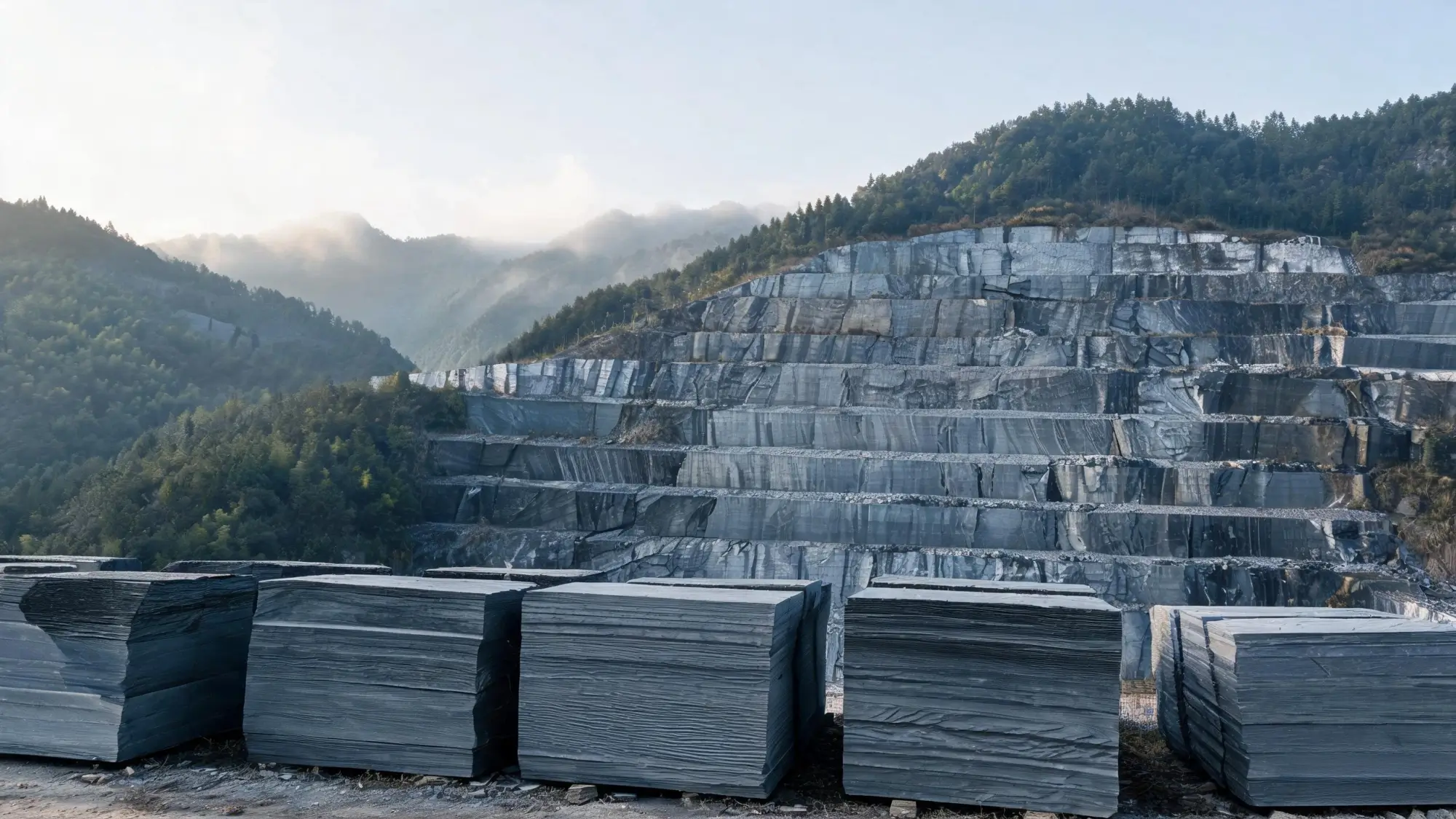
As the pile deepened, the bottom layers began to change. Weight squeezed the water out and crushed the particles together until they stopped being loose mud and became rock — a sedimentary rock called shale. This process is called diagenesis, and it's the quiet, unglamorous first half of slate's life: mud becoming stone, with no help from anything but time.
I like to think of shale as slate's childhood photograph. All the raw material is there — the clay, the quartz, the mica beginning to form — but nothing is organised yet. The minerals lie every which way, like papers scattered across a desk. Shale is promising, but it's not slate. What happens next is the part that turns potential into product.
Chapter Three: The Change — Heat and Pressure Without Melting
Burial alone would have left the rock as shale forever. What made it slate was something more: heat and directed pressure, applied over millions of years, without ever melting the rock. That is metamorphism — literally "change of form" — and slate is its lowest grade, its first rung. Geologists place the change from shale to slate at the very beginning of the metamorphic ladder.
What happened physically is precise. The clays — unstable minerals, born in weathering, not built to survive deep burial — began to change into new minerals that could: tiny flakes of mica (muscovite and chlorite), grains of quartz, and other stable minerals. The heat gave the atoms the energy to rearrange. The pressure came from tectonic forces — the slow squeeze of crustal plates that folded this whole region and, in later episodes, lifted the Lushan massif itself — and it did not squeeze evenly from all directions. It pushed hardest from one direction, and the new flat minerals grew aligned with the direction the pressure allowed: all flat sides facing one way, like a deck of cards squeezed on its edges.
This alignment is called slaty cleavage, and here is the part that matters to everyone who has ever paid for a roof: the cleavage is not the old bedding. It is a new, secondary structure, cut across the original layers. The mud settled in horizontal beds; the pressure came from a plate pushing from the side; the minerals responded by growing perpendicular to the squeeze. That is why a block can be full of visible beds and still split cleanly along a plane that ignores them — the rock was given a second geometry by the mountain-building itself.
A rough number for the temperatures: low-grade metamorphism of this kind happens at a few hundred degrees Celsius — hot enough to reorganise minerals, far below the 700-odd degrees where rock melts. Slate is often described as having been "baked" — meaning cooked just enough, never burned.
One caution, because I'd rather be honest than dramatic: the dates below your feet in this region are not one clean number. The rocks here record a long Palaeozoic history — a range of formations and ages, not a single birthday. When I say "four hundred million years," I'm giving you the family's age, not each member's. Any supplier who tells you their quarry's slate is exactly one age for marketing purposes is selling you a number, not a rock. What is certain is the sequence: mud, burial, compaction, metamorphism, uplift — and then, much later, us.
Chapter Four: The Character — Why It Splits, and Why That Matters
Ask three people in our yard what cleavage is and you'll get the same answer in three accents: it's why the stone opens. Here is the physical version of that answer.
When a splitter sets a chisel edge along the cleavage plane and taps, he is not breaking the rock so much as asking it to separate along a surface it has been prepared to separate along for 400 million years. The aligned mica flakes mean the rock is strong across the cleavage — you have to snap mineral grains themselves — and weak along it, where the flat minerals part like the pages of a book. The split face isn't cut; it's revealed. That's what gives a hand-split tile its natural cleft surface, the one no machine has ever copied, and it's why a skilled splitter can bring a block down to 4, 5, 6 millimetres with thickness variation under a millimetre — by feel, all day. That skill, and why no machine reads the plane the way a hand does, has its own article in this guide.
But cleavage is only half the story. A rock could split and still be worthless — think of poorly metamorphosed shale that crumbles along its planes, or overly foliated schist that is too kinky to lie flat. What makes Jiujiang slate sellable is that its cleavage comes with cohesion. The fine grain means there are no large crystal boundaries to fail. The low-grade metamorphism means the rock was cooked enough to knit tightly but not so much that it grew coarse or brittle. The result is a stone that splits thin and stays whole: a 6 mm tile you can carry with two fingers, lock into a roof, and expect to outlive the person who nailed it there.
Buyers feel the consequence of this long before they understand the cause. A dense, well-knit slate holds a crisp dressed edge and machines without chipping. A poorly metamorphosed one delaminates in the frost. The difference on the test sheet is huge; in the ground, the difference between the two stones can be a few hundred metres and a few million years.
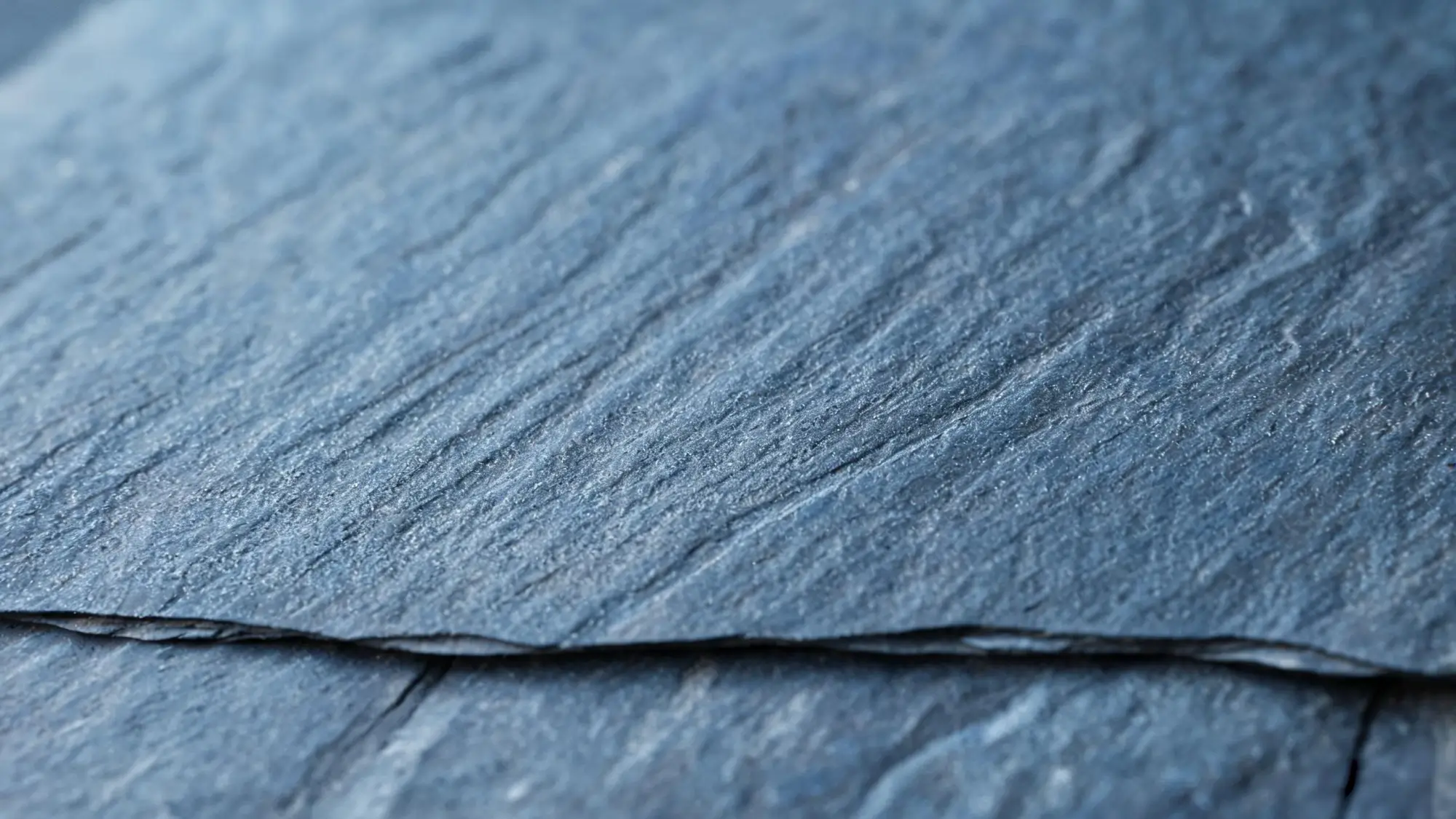
If cleavage is character, density is the pedigree — and in slate, both come from the same kitchen. Low-grade metamorphism drives water out of the rock and packs its minerals tight, which is why well-made slate weighs in at 2.7–2.8 g/cm³. Density might sound like a spec-sheet number, but it's really an integrity check: it tells you the rock was compressed fully, with few voids and little pore space left inside. A pocket of unconsolidated mud or a vug in the stone is a place where water sits — and wherever water sits in a cold climate, ice follows, and where ice goes, cracks follow. Our own figure, with the full test sheet behind it, is written up separately; the short version is that the numbers are why the stone behaves.
Three questions buyers ask about the rock itself:
Is slate always the same age as Jiujiang slate?
No — and it's worth knowing why. Different slate regions formed in different seas at different times: Welsh slate is famously Ordovician (roughly 460–470 million years old), and other regions — Spanish, Chinese, Indian — each have their own ages and formation stories. What matters for your roof is not the birthday but the grade of metamorphism and the mineral result: density, absorption, strength. A well-metamorphosed younger slate will outperform a poorly metamorphosed older one. Age is the story; the test sheet is the evidence.
Does the cleavage plane ever run against the bedding?
Often, yes — and this is one of the more useful things a buyer can learn to picture. In our region the cleavage typically cuts at an angle to the original sedimentary bedding, which is why a block can show banded layers on its ends yet split cleanly along a different plane through the middle. When cleavage and bedding run close together, you can get waviness or ribbons on the split face; when they cross at a healthy angle, the split face comes out clean and flat. Experienced splitters read this relationship before the first chisel tap.
Why do some slates crumble in frost and others don't, if they're all "slate"?
Because "slate" on a quotation is a trade word, not a rock passport. Two stones can both pass a visual inspection yet differ in how completely they were metamorphosed. The frost-proof ones are dense and low-absorption — water can barely get in, so ice has nothing to push apart. The crumbly ones are often shale sold as slate: under-metamorphosed rock that still holds water in its pores. The EN 12326 freeze–thaw test exists precisely to tell them apart; here's how that test works, and why carbonate content is the other half of that story.
Chapter Five: The Gold Stars — Pyrite, the Mineral with a Thousand-Year CV
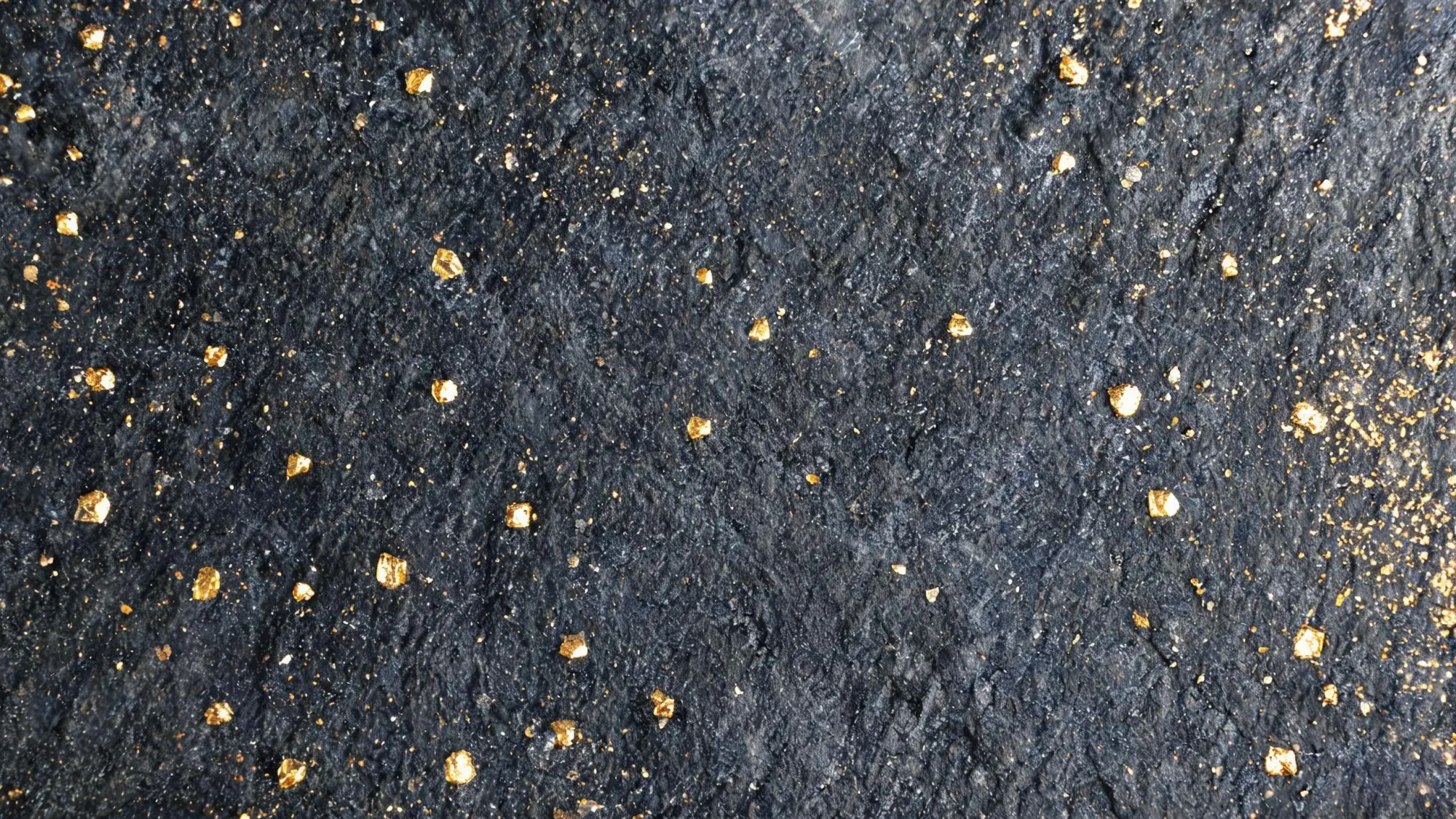
Split enough tiles and you'll meet the gold stars: tiny, brilliant golden flecks scattered through the dark stone like sparks frozen mid-spark. They're pyrite — iron sulphide, FeS₂ — formed when iron combined with sulphur in that ancient seabed. Pyrite can grow as perfect little cubes, which looks like nothing else in nature; mostly, in our stone, it appears as small grains and flecks.
Buyers react to the gold stars in one of two ways. Roofing buyers, especially in the UK and Europe, often love them — a scatter of gold on a blue-grey roof is character, not defect. Billiard buyers have the opposite requirement: a pyrite cluster would raise a bump under the cloth, so table slate comes from blocks selected to be pyrite-free. One stone, two markets, two different verdicts on the same mineral — which is a neat illustration of why "quality" in slate always means "fitness for a purpose," never an absolute. The fuller mineral picture, including the pyrite question, has its own article in this guide.
Now the part I genuinely love telling visitors. A thousand years ago, carvers in this region — the same landscape where our quarry sits — were making gold-star inkstones, prized by scholars through the Song dynasty and beyond: inkstones whose polished slate surfaces show the exact same golden stars. The "gold stars" in those inkstones are the same pyrite, from the same regional rock. Geology and craft in this region are not new acquaintances. When you buy a Jiujiang slate roof today, you're buying a stone whose mineral character has been appreciated in this region for a millennium — the sparks just land on roofs now instead of scholars' desks.
And a quick chemistry note for buyers comparing origins: our stone runs about 66.5% SiO₂ (silica, the quartz frame that gives slate its hardness) and — the figure I watch closest — CaO below 1% (0.56% on our latest sheet). Calcium carbonate — the carbonates I mentioned above — is slate's slow weak spot in acid rain environments, and a low CaO is one of the quiet reasons this rock weathers so well in European climates. If that pair of numbers means nothing to you yet, the carbonate and weathering article translates them.
Chapter Six: The Numbers — What the Rock's History Adds Up To
Everything in the last four chapters — the burial, the change, the minerals, the cleavage — ends up written in five numbers on a test sheet. I think of a test report as the geology, translated into figures a specifier can act on. Here's the translation table, spoken plainly.
Density, 2.7–2.8 g/cm³. The rock was compressed nearly void-free. Dense in the hand — but split to 6–8 mm, a slate roof covering still lands in the low twenties of kilograms per square metre, lighter than plain concrete tiles, and lasts centuries where concrete gives up in decades. Weight, load and what that means for a roof structure is covered here.
Water absorption, 0.2%. This is the number I quote when a Norwegian buyer asks how the stone survives their winters. Barely any water gets in, so ice has almost nothing to expand. It's also the single most important figure on the sheet for cold climates — and the one most often fudged in this trade. Ours is tested, published, and explained in its own article.
Flexural strength, around 60 MPa dry (still above 45 MPa after 48 hours soaked). The mineral frame holds together under bending — the load case a roof tile actually faces under wind uplift and snow. A stone that resists water is one thing; a stone that also resists bending while soaked is the one you want where Atlantic gales meet wet snow. How this maps to the EN 12326 and ASTM C406 grading systems is in the test-report article.
Freeze–thaw, zero weight loss after 120 cycles. The frost test is where the biography gets stress-tested in the lab: 120 freeze–thaw cycles, no measurable loss. If the numbers above are the causes, this is the consequence — and it's the reason I don't blink when a buyer from Canada or the Baltic asks about winter performance.
And the number that isn't on the sheet: 400 million years. Every tile we split, every panel we machine, is a slice of the same rock — same sea, same pressure, same slow biography. A supplier can copy a test report format; nobody can copy a deposit.
All of our published test data, with the standards and methods behind each figure, lives on our public test results page. I'd rather a buyer read it and walk away than not read it and order — that's the whole point of publishing.
Chapter Seven: The Two Careers — Roof and Table
Why does one rock suit two such different jobs? Because the geology serves both, just by different routes.
On the roof, the story runs through water. Density keeps water out; low CaO resists acid rain; flexural strength handles wind and snow loads; the natural cleft face sheds rain and resists slipping underfoot. Slate roofing in Europe is an old trade with its own vocabulary, standards and centuries of case law — if you want that world in one place, the Roofing Slate Guide is the hub, and the natural behaviour of the stone — colour range, weathering, fissility — is written up here. For the buying end — grades, prices, shipping — the roofing slate category lists current stock and specs.
On the table, the story runs through flatness. The same fine grain that has no weak crystal boundaries also machines beautifully: no coarse crystals to tear out under a diamond tool, no veins to wander. CNC grinding brings a panel to ±0.1 mm flatness across the full surface — and ±0.05 mm on precision-ground beds — a tolerance the stone's homogeneity makes possible. The machines and the tolerance story are documented here, and the full world of table slate — sizes, thicknesses, installation — is the Billiard Slate Guide.
Two careers, one rock. The roofing career began a thousand years ago with local builders; the billiard career is newer. What links them is that neither industry chose this stone arbitrarily. Both chose it because the sea that made the mud, and the mountain-building that aligned the minerals, produced a stone that is simultaneously splittable and dense, workable and unchanging. When you specify Jiujiang slate, you are not choosing a colour or a price. You're inheriting an outcome.
Chapter Eight: The Proof — Reading Rock and Document Together
Here's a scene I've watched more than once. A buyer visits, walks the quarry face, and asks to see "the pyrite bed." Then we walk the yard and he sees the same golden stars in tiles cut from blocks two hills away — and understands something about scale and identity. This region's geology is not one pocket of good rock; it's a belt that runs through these hills, which is why the region sustains the volume it does.
So how do you know the rock you're quoted is the rock in the story? Two documents tell you. The first is the test report — EN 12326 or ASTM C406 — which tells you what the stone does. The second is the sample — which tells you what it is. I'll stack three tiles in a box and post them anywhere; put them beside the tiles you're being quoted from elsewhere and the differences between origins become things you can feel with a thumb: edge crispness, density in the hand, the tightness of the cleft. Terms like cleft, gauge, headlap and grade get defined in our terminology guide — the same words you'll meet on any European slate specification.
And the history runs deeper than the trade. Roofing slate has a history centuries long in Europe and, in this region, a story that runs from local builders through Song-dynasty inkstone carvers to today's export trade — the history of slate roofing tells the European side of that story, and ours is still being written into it.
I'll end where I started: with the broken tile on my desk. A geologist would read it as a record of deposition and metamorphism. A roofer reads it as a material that will outlast his career. Both are reading the same 400 million years correctly. If understanding the rock helps you buy with more confidence, this page has done its job — and if you want to hold the rock in your hand before you decide, the next step is simple.
Frequently Asked Questions
How long does slate take to form?
Slate doesn't have a stopwatch. What geologists can say is that the sequence — mud settling, burial and compaction into shale, then low-grade metamorphism as heat and directed pressure aligned the mica — spans geological ages, not human ones. The burial alone took millions of years; the metamorphism millions more. The honest answer is "longer than any waiting room on earth," but the practical point for a buyer is different: what matters on your roof is not how long it took, but how completely the process finished. Density, water absorption and freeze–thaw results measure that completion far better than a calendar.
What is slate made of — what are the actual minerals?
Mostly quartz, mica (muscovite, with some chlorite), and a modest clay-mineral fraction, with minor minerals including pyrite — the gold stars — and traces of carbonaceous material that darken the stone. Our latest sheet runs about 66.5% SiO₂ and CaO below 1% (0.56%). The quartz frame gives hardness; the aligned mica gives cleavage; the low carbonate is a quiet advantage in acid-rain climates. The full breakdown, and what each mineral means for weathering, is in the mineral composition article in this guide.
Is Jiujiang slate the same rock as Welsh or Spanish slate?
No — different seas, different ages, different mineral recipes, though the same family name. Welsh slate is famously Ordovician (roughly 460–470 million years old); Spanish, Chinese and Indian slate regions each have their own ages and formation stories; Jiujiang slate belongs to the Palaeozoic rocks of Jiangxi. What buyers should compare is not the birthday but the metamorphic result: density, water absorption, flexural strength and carbonate content on the test sheet. Those figures, not the passport, decide how a slate behaves on your roof.
Why does Jiujiang slate split so cleanly?
Because its mica grew flat, fine and parallel during low-grade metamorphism. When pressure squeezed the region's rocks, the new mica flakes aligned perpendicular to the push, creating slaty cleavage — a plane where the stone is weak along it and strong across it. A chisel asks the rock to part along a surface it has been ready to part along for hundreds of millions of years. The split isn't a break so much as a revelation.
Are the gold stars a defect or a feature?
Depends entirely on the product. On a roof, golden pyrite flecks are a look many European buyers actively want — character, like knots in good timber. Under a billiard cloth, a pyrite cluster would telegraph as a bump, so table beds are cut from pyrite-free blocks. Neither verdict is wrong; it's the same mineral meeting two different job descriptions. That's why "quality" in slate always means fitness for purpose, not an absolute grade.
What does the geology mean for me as a buyer?
Three things. First, durability is inherited, not manufactured: no factory step adds density or lowers absorption — the rock arrived with those or it didn't. Second, consistency across a deposit means one test sheet honestly represents a whole order, which is why deposit-scale geology matters more than any single quarry's marketing. Third, the test report is your window onto the geology: if a supplier can't produce EN 12326 or ASTM C406 figures for the actual stone being quoted, you're buying a story instead of a rock.
Related Reading
Prefer to judge the rock with your own hands?
We'll post you a sample pack from the yard in Lushan City — tiles and, on request, a small polished piece showing the gold stars. Hold the edge, feel the density, run a thumb over the cleavage. The geology reads better in the hand than on a page.