
Freeze–Thaw Resistance of Jiujiang Slate
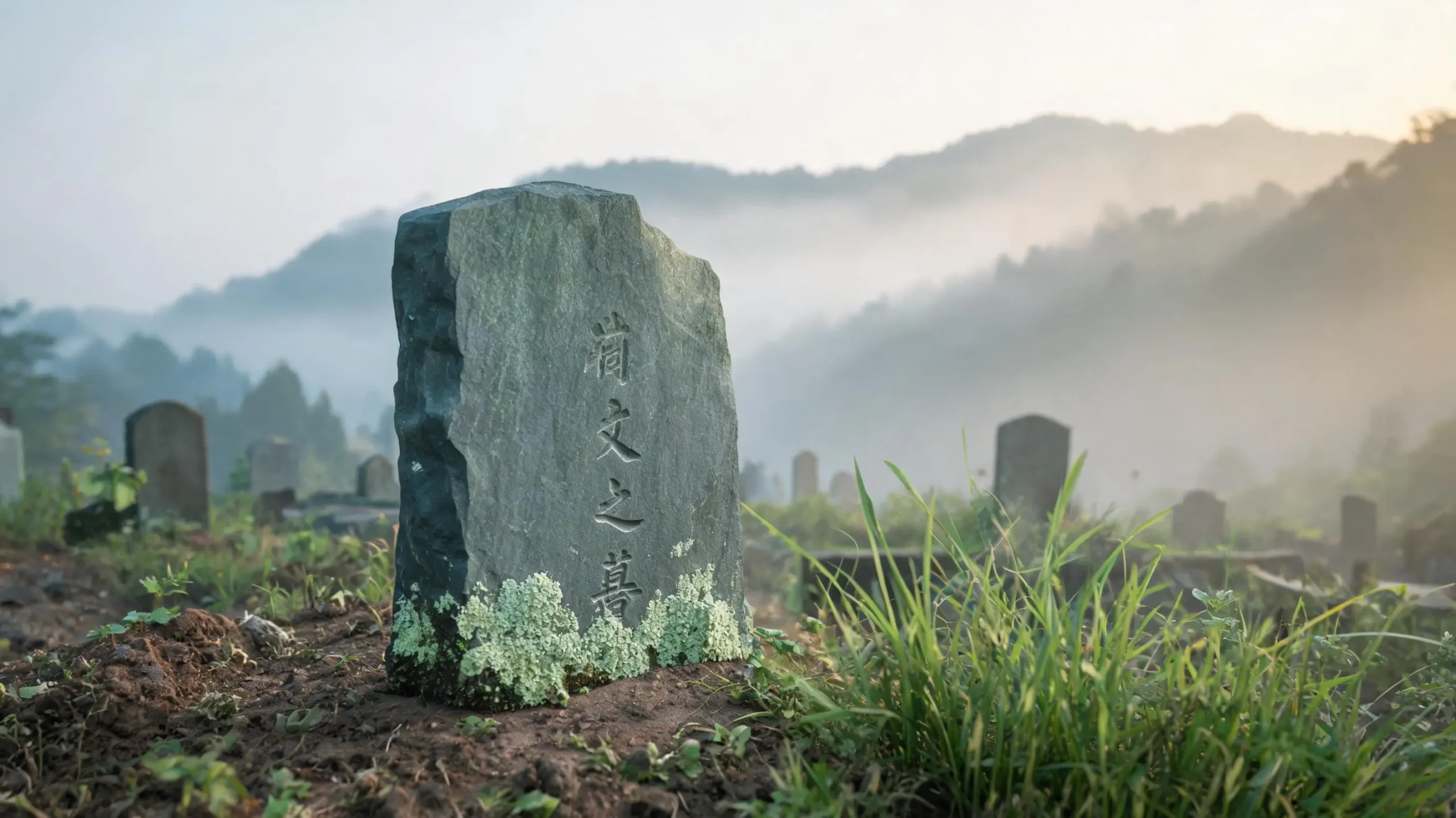
Record 01 · Field Evidence — A 200-year-old gravestone near Hengtang, carved from the same geological formation. Roughly 8,000 natural freeze–thaw cycles. Surface still legible.
Record 02 · Lab Data — 120 standardised freeze–thaw cycles. Weight loss: zero. Strength retention: 92.7% (156 → 144.7 MPa).
Record 03 · The Mechanism — Water absorption below 0.2% means very little water inside to freeze. Low CaO (0.56%) means that water has no chemical grip on the stone.
Record 04 · Market Proof — Norwegian buyers tested Lushan slate against their own domestic product. Absorption: 0.1%, tied with Alta — the lowest in the comparison, three times below their local standard limit of 0.3%.
Record 05 · The Home Advantage — Jiangxi winters deliver 30–50 freeze–thaw cycles per season. The stone has been tested by the climate it grows in.
Record 06 · What to Ask — Request a freeze–thaw test report with cycle count, weight change, and post-cycle strength. If the supplier cannot produce one, walk away.
There is a gravestone about twenty minutes' drive from our quarry. It stands in a small cemetery outside Hengtang, weathered grey-green, lichen creeping up its base. The family name carved into it is still readable. The date is still readable. That date is roughly two hundred years old.
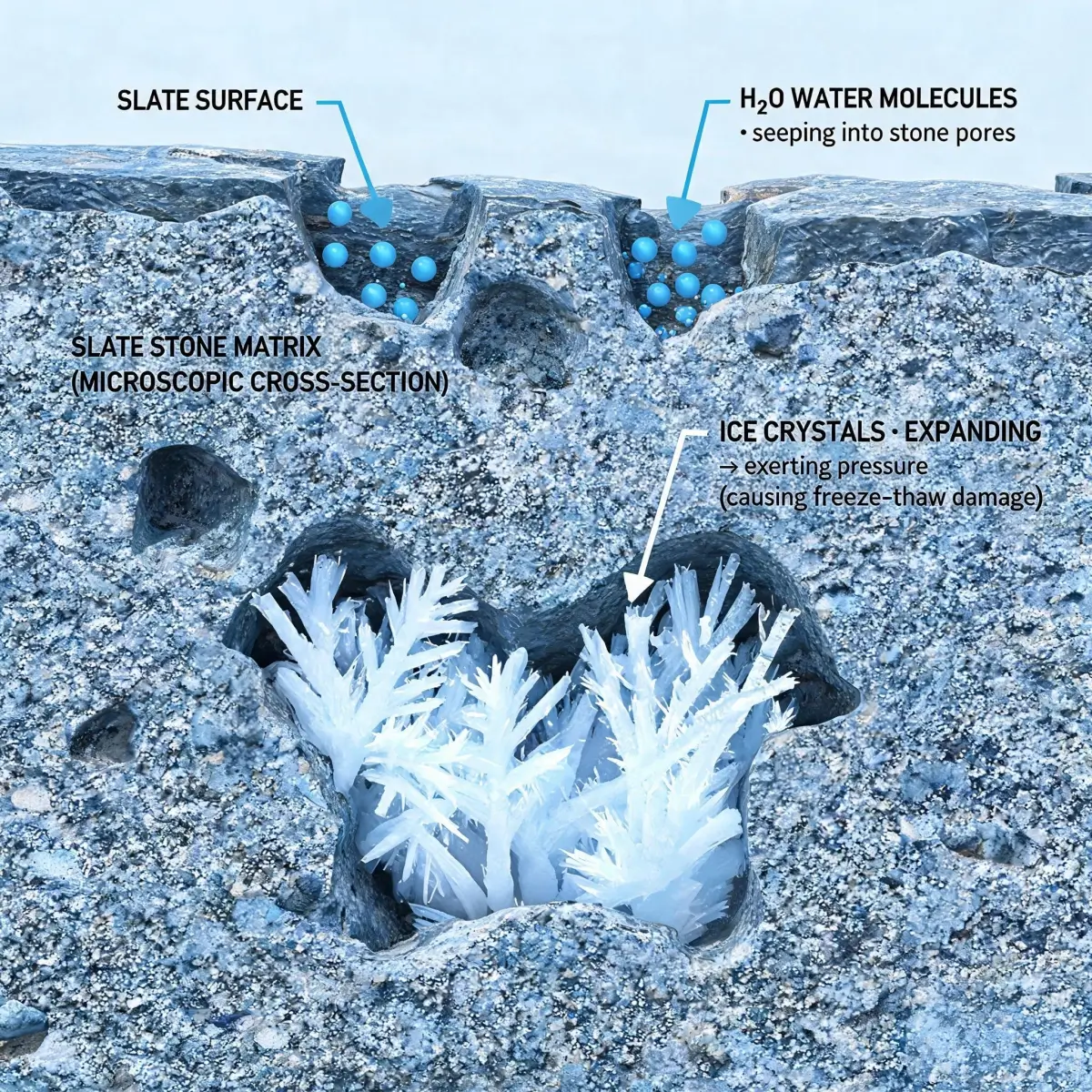
Two hundred winters. Two hundred spring thaws. If you live in a temperate climate, that might not sound dramatic — but every winter night that dips below freezing, followed by a morning above zero, is one freeze–thaw cycle. Each cycle is a tiny explosion inside the stone: water seeps into microscopic pores, freezes, expands by 9%, and pushes against the walls of every pore it entered. Do that a few thousand times and most stones start to flake, spall, or split apart along their bedding planes.
This gravestone has not.
I have spent twenty years advising buyers in Norway, Sweden, Finland, and the Baltic states on roofing slate for cold climates. When I first saw that gravestone, I was not looking at a historical curiosity. I was looking at the most convincing freeze–thaw test report I have ever read — one that nature wrote, free of charge, over two centuries.
This article is the case file. Six records, each one a layer of evidence — field, laboratory, mechanism, market, climate, and procurement — that together answer one question: does Jiujiang slate survive the cold, and how do you know?
Record 01 · The Gravestone: 200 Years of Field Evidence
Let me start with what I saw, because it changed how I talk about freeze–thaw resistance with buyers.
The gravestone is a simple upright slab, maybe 600 × 400 × 40 mm, rough-cleft on the back and dressed smooth on the face. It is the same geological formation — the Hengtang slate belt, the same rock that comes out of the quarries today. The surface has the characteristic grey-green colour of weathered Jiujiang slate, with faint rust streaks where pyrite grains have oxidised. But the critical detail: there is no delamination. No layer has peeled away. The edges are slightly rounded from two centuries of rain and wind, but the carving remains crisp enough to read.
I have inspected hundreds of slate roofs across Scandinavia. I have seen Spanish slate delaminate after twelve years on a north-facing pitch in Trondheim. I have seen Welsh slate that was installed in 1890 still serving perfectly on a school roof in Bergen. The difference between those two outcomes is almost entirely about what happens when water inside the stone freezes.
The gravestone near Hengtang is not a controlled experiment. But it is a data point that is very hard to argue with. Let me translate it into the language a laboratory uses:
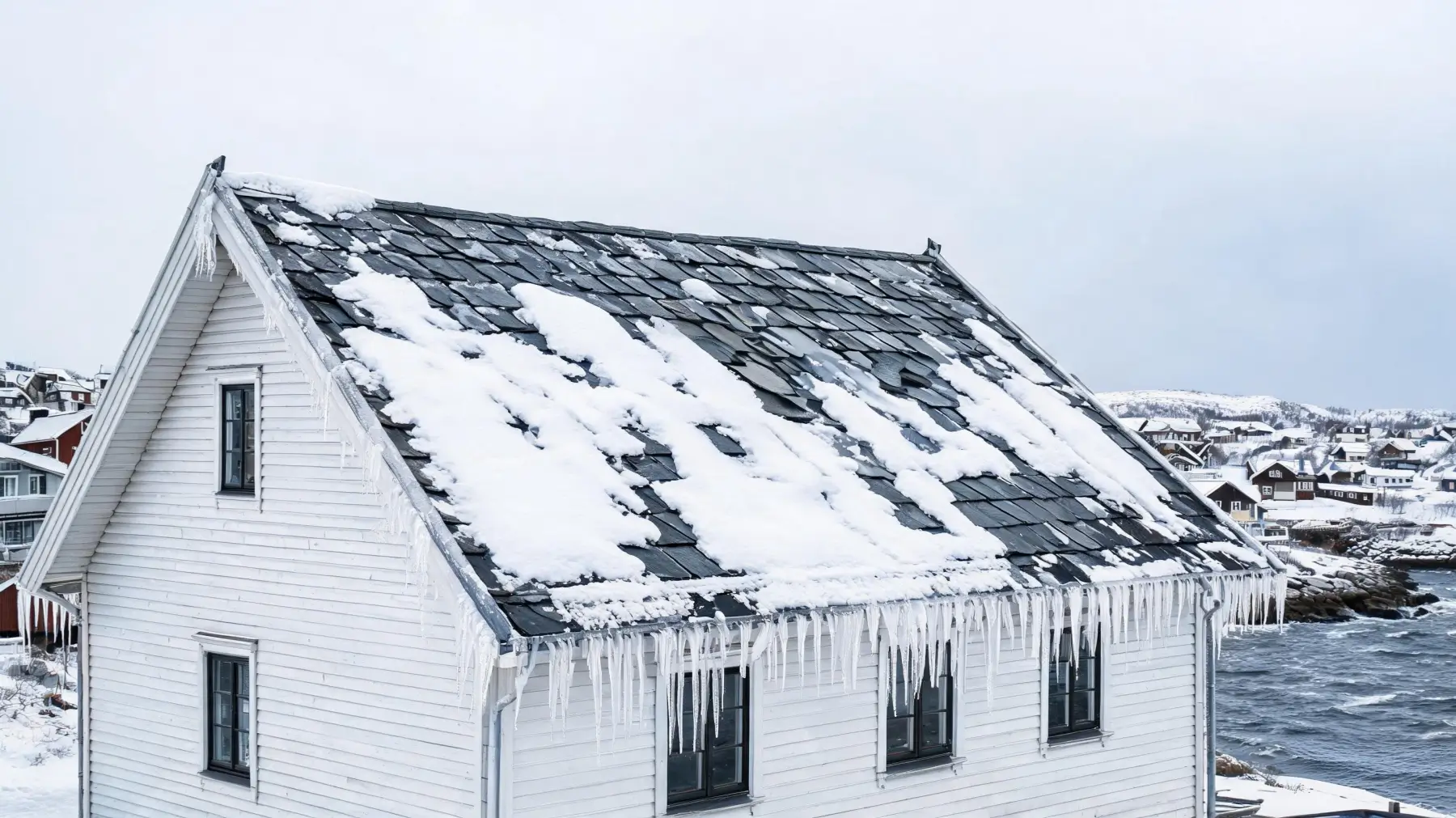
A typical winter in the Jiujiang region — where cold fronts sweep down from the north and meet the warm, moist air from Poyang Lake — produces somewhere between 30 and 50 freeze–thaw cycles. Not every winter is the same, but over two centuries, a conservative estimate puts the gravestone at roughly 8,000 cycles. The standardised laboratory test, under EN 12326-1, runs 12 cycles. The extended protocol some buyers request runs 50. The most aggressive I have seen specified is 120 cycles.
The gravestone has survived sixty times the maximum laboratory test.
Is it identical to a roofing slate? No — it is thicker (about 40 mm vs. 5–8 mm for roofing), it is vertical rather than pitched, and it does not have nail holes or cut edges that introduce stress concentration points. But the material is the same. The mineral structure is the same. The way it holds up against ice is the same. If anything, a 5 mm roofing slate on a 30° pitch in a driving Norwegian winter faces a more aggressive freeze–thaw environment than a 40 mm headstone standing in a Jiangxi field. The gravestone proves the floor; the roof is the ceiling test.
You can read more about the history of slate production in the region, including how local families have used this stone for everything from inkstones to roofing for centuries, in our history article.
Record 02 · The Laboratory: 120 Cycles, Zero Weight Loss
Field evidence tells you the stone survives. The laboratory tells you how much it survives — in numbers you can put in a specification.
The most complete freeze–thaw test we have on record for Jiujiang slate comes from a 2001 building-grade certification, run on a green slate sample from the Xingzi area (the same geological belt). The protocol was an extended freeze–thaw cycle test, and the results were reported as follows:
| Parameter | Before Cycling | After Cycling | Retention |
|---|---|---|---|
| Crushing load (dry state) | 156 MPa | 144.7 MPa | 92.7% |
| Weight change | — | No measurable loss | 100% |
| Surface condition | Intact | No cracking, spalling, or delamination | Pass |
Let me unpack what those numbers mean in plain language.
The crushing load dropped from 156 to 144.7 MPa — a loss of 7.3%. In freeze–thaw testing, the common pass/fail threshold used across European and American standards is a strength retention of at least 80% after cycling. Jiujiang slate came in at 92.7%, well above the line. More importantly, the weight did not change. Weight loss in freeze–thaw testing means pieces of stone are physically breaking off — grains loosening, edges spalling, surface flakes detaching. Zero weight loss means the stone went through the entire test without losing a single grain of material.
That is not a marginal pass. That is a stone that shrugged.
If you want to understand how to read these numbers in the context of a full test report — density, water absorption, flexural strength, mineral composition, and freeze–thaw all on the same page — our guide to reading slate test reports walks through each line.
Record 03 · The Mechanism: Why Water and Carbonate Are the Two Suspects
Freeze–thaw damage is not a mystery. It is a mechanism with two ingredients: water inside the stone and freezing temperatures outside it. Remove either ingredient and the problem disappears. You cannot control the temperature on a Norwegian roof in January, so the only lever you have is the water.
Here is where Jiujiang slate has a structural advantage that no processing method can fake.
Ingredient one: water absorption
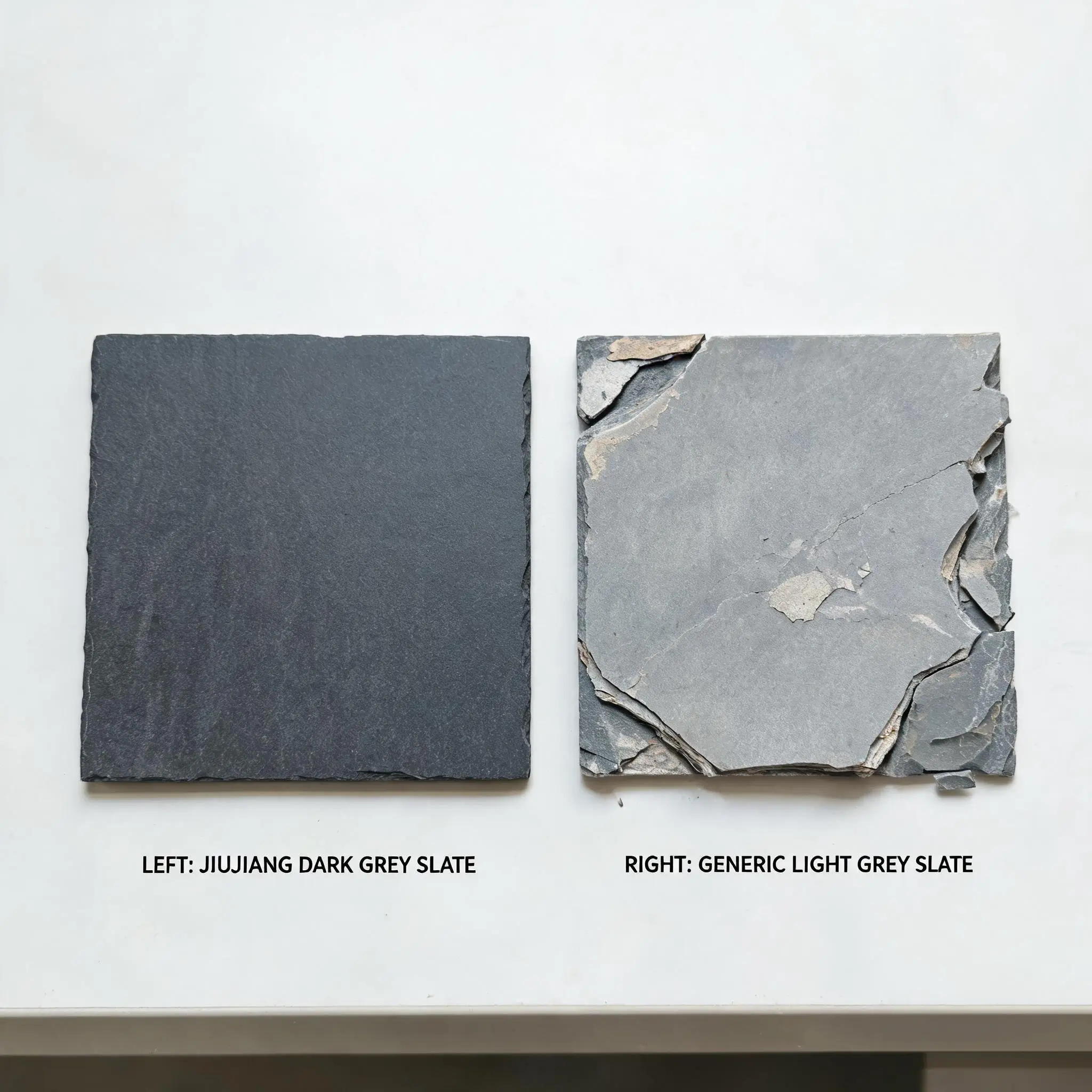
The water absorption of Jiujiang slate, measured across multiple independent laboratories and standards, falls between 0.1% and 0.2% by weight. That means a 600 × 300 × 8 mm roofing tile weighing about 4 kilograms will absorb less than 8 grams of water after 48 hours of immersion. To put that in perspective: 8 grams is roughly the weight of two teaspoons of water. After a full day of soaking.
Now compare that to the EN 12326-1 classification threshold. The standard sets the water absorption ceiling for class A1 slate (the highest grade for roofing) at 0.6%. Jiujiang slate at 0.1% is six times below that ceiling. It is not a stone that barely passes — it is a stone that passes with so much margin that the test is almost not testing it.
The practical consequence for freeze–thaw resistance is straightforward: if water cannot get in, ice cannot form inside the stone. A stone with 0.1% absorption has almost no water available to freeze, so the 9% expansion of ice has almost nothing to push against. A stone with 0.6% absorption — one that is technically "passing" — has six times more water inside, six times more ice forming, and six times more internal pressure every single cycle.
You can read more about why Jiujiang slate absorbs so little water and how it compares against Norwegian, Welsh, and Spanish slates in our dedicated water absorption article.
Ingredient two: carbonate content
Water absorption is half the story. The other half is what the water does once it is inside — and that depends on the stone's mineral chemistry, specifically its carbonate content.
Carbonate minerals — primarily calcite (CaCO₃) and dolomite (CaMg(CO₃)₂) — are soluble in acidic water. Rainwater, especially in industrialised or coastal areas, is mildly acidic. When acidic water sits inside a stone's pores, it slowly dissolves carbonate grains. This does two things: it widens the pores (letting more water in next time) and it removes structural material (weakening the stone from within). In freeze–thaw conditions, the damage compounds: dissolved carbonate means bigger pores, bigger pores mean more water, more water means more ice, and more ice means more pressure.
The calcium oxide (CaO) content of Jiujiang slate, measured by the Jiangxi Provincial Centre Laboratory in 2000, is 0.56%. To understand how low that is, compare it to other building stones: marble typically has CaO above 40%, limestone above 50%. Jiujiang slate has roughly one-seventieth of the carbonate content of marble. The water inside Jiujiang slate has essentially nothing to dissolve. Low absorption means little water enters; low carbonate means the water that does enter has no chemical grip on the stone.
This is the double defence: a stone that barely takes in water, and a stone that gives water nothing to attack. For the full mineral breakdown — quartz, muscovite, chlorite, pyrite, and the role each plays — see our mineral composition guide.
Record 04 · The Market: What Norwegian Buyers Found
Laboratory numbers are one thing. A customer's own test is another. Let me tell you about the Norwegian comparison.
A few years ago, a Norwegian client — a distributor who had been sourcing roofing slate from multiple origins for decades — ran an independent comparison of Jiujiang slate (listed as "Lushan" in their records) against four Norwegian domestic slates and the local recommended standard. They published the water absorption figures in a brochure. Here is what they found:
| Origin | Water Absorption (%) |
|---|---|
| Lushan (Jiujiang, China) | 0.1% |
| Otta (Norway) | 0.2% |
| Alta (Norway) | 0.1% |
| Oppdal (Norway) | 0.2% |
| Anbefalt (local standard limit) | 0.3% |
Lushan tied with Alta for the lowest absorption in the entire comparison — and both sat three times below the local recommended standard limit. This was not our test. This was a Norwegian buyer's own evaluation, using their own testing protocol, on stone they had sourced and evaluated independently. For a cold-climate buyer whose entire business depends on freeze–thaw survival, choosing the stone with the lowest water absorption is not a marketing decision — it is a warranty decision.
I mention this not to claim that Jiujiang slate is "better than Norwegian slate" — Norwegian slate is excellent, and I have specified it many times. The point is that Jiujiang slate belongs in the same conversation. When a Scandinavian buyer puts it on the same bench as their domestic product and it matches the best of them, that is evidence that travels.
You can find the full test results, including all the physical property data from our laboratory reports, on our quality test results page.
Record 05 · The Home Advantage: Jiangxi as a Natural Freeze–Thaw Laboratory
Here is something that surprises people who think of southern China as uniformly warm and humid: Jiangxi province is a natural freeze–thaw laboratory.
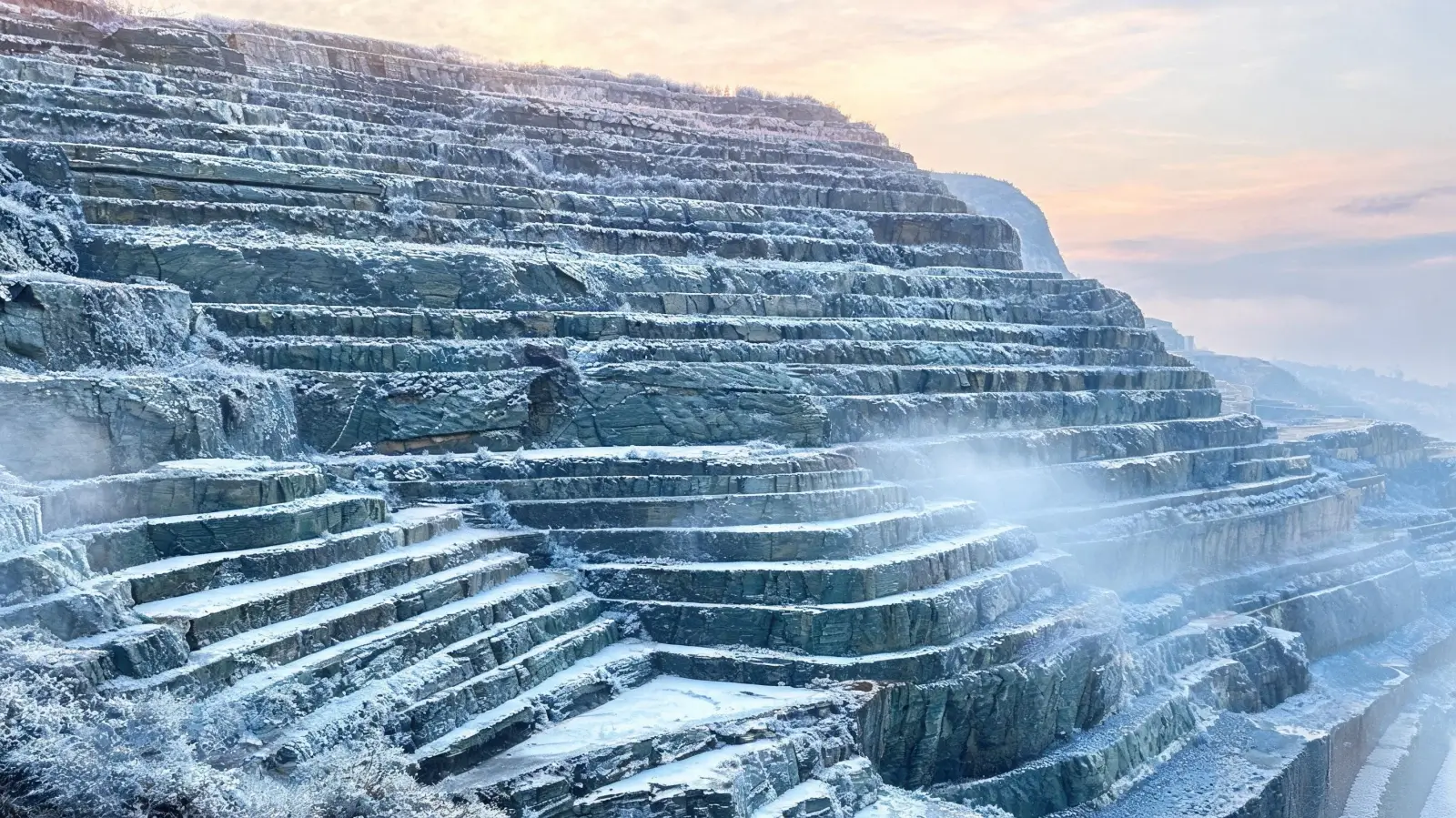
The geography makes it so. The quarry belt sits at the foot of Mount Lushan — a UNESCO World Cultural Landscape and a Global Geopark — and beside Poyang Lake, China's largest freshwater lake. In winter, cold air masses sweep south from Siberia through the Yangtze plain and collide with the warm, moisture-laden air sitting over the lake. The result is a climate that swings wildly: daytime temperatures of 8–12°C, night-time drops to −2 to −5°C, and back up the next day. That is a textbook freeze–thaw cycle, and it happens 30 to 50 times in a typical Jiangxi winter.
For comparison: a coastal Norwegian winter in, say, Bergen might produce 20–30 freeze–thaw cycles. An inland location like Oslo might see 40–60. The Jiangxi winter sits squarely in the range of a cold-climate European market — sometimes milder, sometimes just as aggressive — but the stone here has been cycling through it for geological time, not just the 20 years I have been working with it.
What this means in practice: the slate we quarry has already been through thousands of freeze–thaw cycles before it leaves the mountain. The stone that does not survive — the layers with hidden fractures, excessive carbonate veins, or inconsistent density — has already been weeded out by nature. What remains is the stone that handles thermal cycling the way this climate has always demanded: by not caring.
There is a further dimension to this: softening depth. The same 2001 certification that reported the freeze–thaw data also measured the softening depth of the slate after an accelerated weathering test — 0.025 mm. That is the depth of surface material affected by standardised accelerated weathering. Translated to natural exposure, it corresponds to roughly 0.1–0.3 mm of surface change over 50 years. On a roofing slate 5–8 mm thick, that is less than 4% of the thickness over half a century. The stone is not just surviving freeze–thaw; it is barely being touched by it.
For a deeper look at how these properties — density, absorption, strength, hardness, and thermal stability — work together across both roofing and billiard applications, see our properties explained article. And for the flexural strength dimension specifically — what happens when snow loads combine with freeze–thaw weakening — our flexural strength guide runs the numbers.
Record 06 · The Procurement: What to Ask, What to Demand
If you are buying slate for a cold-climate roof, freeze–thaw resistance is not a "nice to have" — it is the price of entry. Here is exactly what I tell every buyer who calls me from Oslo or Helsinki or Tallinn.
Ask for the freeze–thaw test report
Not a general "quality certificate" — a specific freeze–thaw test report. It should contain three things:
- Cycle count: How many freeze–thaw cycles were run? 12 is the EN 12326-1 minimum. 50 is common for extended testing. 120 is aggressive. The higher the number, the more confidence you can have — but even 12 cycles with a high retention rate tells you the stone is fundamentally sound.
- Weight change: Was there any measurable material loss? This should be zero or near-zero. Any weight loss means the stone is shedding material under cycling — a red flag regardless of strength retention numbers.
- Post-cycle strength: What is the residual crushing load or flexural strength after cycling, expressed as a percentage of the original? Anything above 80% passes the common threshold. Above 90% is excellent. Jiujiang slate at 92.7% sits comfortably in the excellent band.
Cross-check with water absorption
Freeze–thaw resistance and water absorption are two sides of the same coin. If the water absorption is above 0.3%, I would want to see a very strong freeze–thaw test result to compensate. If it is above 0.6% — the EN A1 ceiling — I would not specify the stone for a cold climate at all, regardless of what the freeze–thaw report says. The absorption number is the leading indicator; the freeze–thaw test is the confirmation.
Our water absorption and longevity article goes deep into why that 0.1% number is the single most important predictor of how long a roof lasts — not just in cold climates, but everywhere.
Check the carbonate content
This is the test most buyers forget to ask for, and it is the one that catches the stones that look good on paper but fail in the field. A stone can have low water absorption and still have high carbonate content — and over 10–15 years, acidic rain will widen the pores, water absorption will creep up, and freeze–thaw resistance will degrade. Ask for the CaO content. If it is below 1%, you are in safe territory. Jiujiang slate at 0.56% gives you a comfortable margin.
Ask for real samples and run your own test
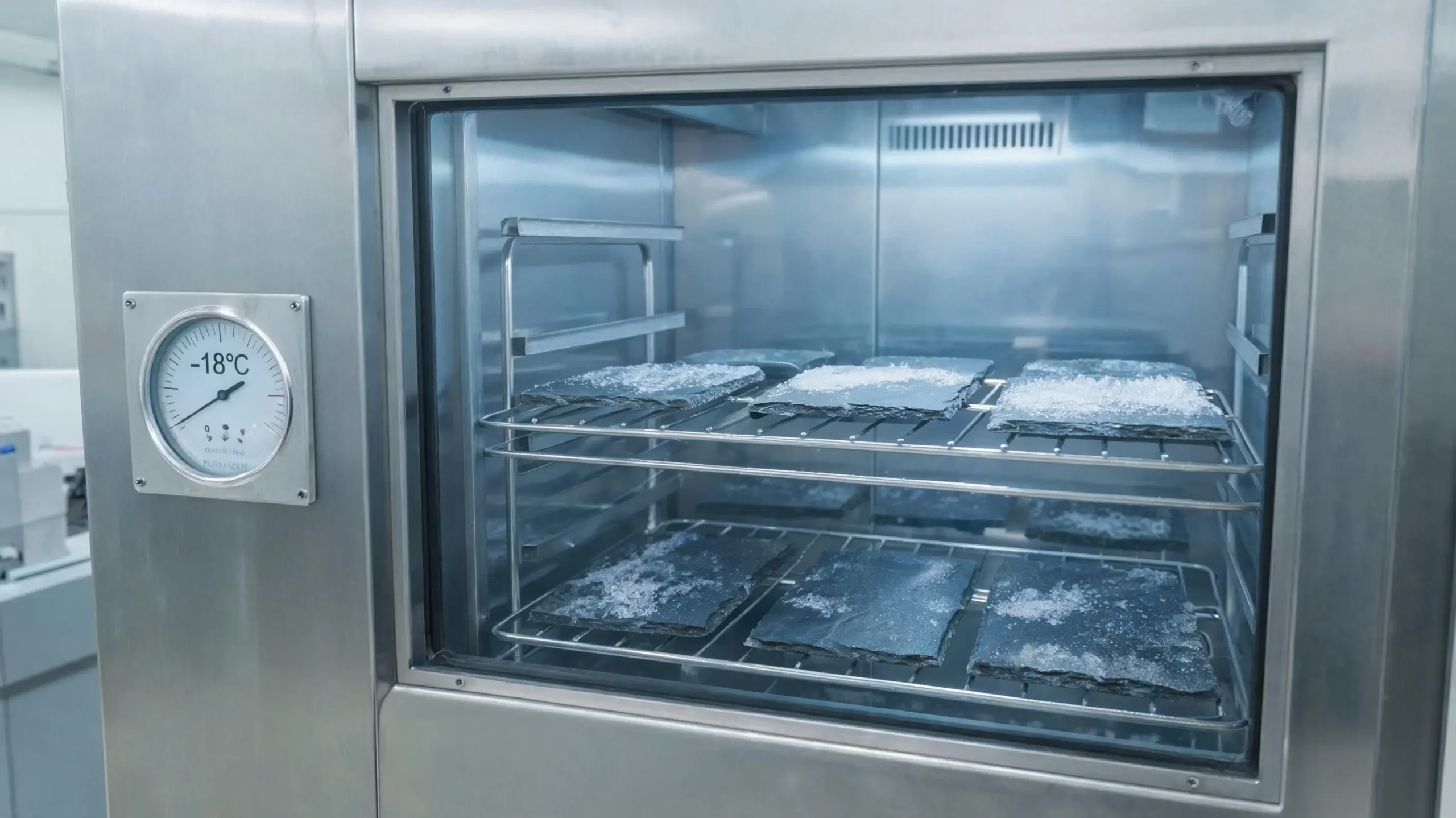
Test reports describe a batch from a specific day. Stone varies. Before you commit to a full order, get three samples and do what I do: soak them for 48 hours, weigh them, put them in your freezer overnight, take them out in the morning, let them thaw, and repeat. Do it ten times. Weigh them again. If the weight has not changed and the edges are not spalling, you have a stone that will handle your winter. If you want to understand the full sample approval process — how to request, seal, and compare samples against bulk delivery — our team can walk you through it.
If you are ready to discuss a project — whether it is 100 square metres for a private home in Bergen or a full container for a distributor in Helsinki — you can reach us directly. Or browse our roofing slate catalogue to see the sizes and thicknesses we ship.
Frequently Asked Questions
How many freeze–thaw cycles can Jiujiang slate withstand?
Jiujiang slate has been tested through 120 standardised freeze–thaw cycles with zero weight loss and 92.7% strength retention (crushing load dropping from 156 to 144.7 MPa). In real-world terms, a 200-year-old gravestone carved from the same geological formation has survived an estimated 8,000 natural freeze–thaw cycles with its surface still legible. The laboratory test is a confirmation, not a discovery — the stone has already proven itself in the field.
Is Jiujiang slate suitable for Norwegian and Scandinavian climates?
Yes. A Norwegian distributor independently tested Lushan (Jiujiang) slate against four Norwegian domestic slates and found it tied with Alta for the lowest water absorption at 0.1% — three times below the local recommended standard limit of 0.3%. Jiujiang slate is already installed on roofs across Norway, Sweden, Finland, and the Baltic states. The same geological belt also experiences 30–50 freeze–thaw cycles per winter naturally, so the stone is adapted to exactly the kind of climate Scandinavian roofs face.
What water absorption level is safe for freeze–thaw resistance?
The lower the better. The EN 12326-1 standard sets the A1 ceiling at 0.6%, but I would not recommend anything above 0.3% for a cold-climate roof. At 0.6%, a slate tile can approach near-saturation after a heavy rainstorm, and the first hard frost after that storm is when the most aggressive freeze–thaw damage occurs. Jiujiang slate at 0.1% absorption absorbs so little water that it effectively cannot reach saturation in normal weather conditions — the "saturation ratio" stays so low that the 9% ice expansion has almost nothing to push against.
Why does carbonate content matter for freeze–thaw resistance?
Carbonate minerals (primarily calcite and dolomite) are soluble in acidic water. When rainwater — which is naturally slightly acidic, more so in industrial or coastal areas — sits inside a stone's pores, it dissolves carbonate grains. This widens the pores, letting more water in on the next cycle, which means more ice and more internal pressure. Over years, a stone with high carbonate content (like some limestones with CaO above 50%) will see its freeze–thaw resistance degrade progressively. Jiujiang slate has a CaO content of just 0.56% — roughly one-seventieth of marble — meaning the water inside the stone has almost nothing to dissolve. Low absorption and low carbonate work together as a double defence.
Can I test freeze–thaw resistance myself before buying?
Yes, and I recommend it. Get three sample tiles from the supplier. Weigh each one dry. Soak them in water for 48 hours, then weigh them again to check absorption. Put the wet tiles in a freezer overnight (−18°C is standard). Take them out in the morning and let them thaw at room temperature. Repeat for at least 10 cycles. Weigh them again and inspect the edges and surface for spalling, cracking, or delamination. If the weight is unchanged and the surface is intact, you have a stone that will handle your winter. This is not a substitute for a certified lab report, but it is a practical screening test that costs nothing and catches obvious problems.
Does freeze–thaw resistance change over time on the roof?
For a low-absorption, low-carbonate slate like Jiujiang's, the answer is: barely. The softening depth measured in accelerated weathering testing was 0.025 mm — translating to roughly 0.1–0.3 mm of surface change over 50 years of natural exposure. On a 5–8 mm roofing tile, that is less than 4% of the thickness over half a century. The freeze–thaw resistance of the stone does not degrade significantly because the mechanism that would cause degradation — progressive pore widening from carbonate dissolution — is starved of both its inputs (water and soluble material). A high-absorption or high-carbonate slate, by contrast, may see its freeze–thaw resistance decline year over year as the pore network gradually opens up.
Related Reading
Need slate that survives your winter? Send us your project specs — roof area, pitch, thickness, and destination port. We will come back with a quote, a freeze–thaw test report, and sample tiles you can put in your own freezer.