
Samples and Sample Approval
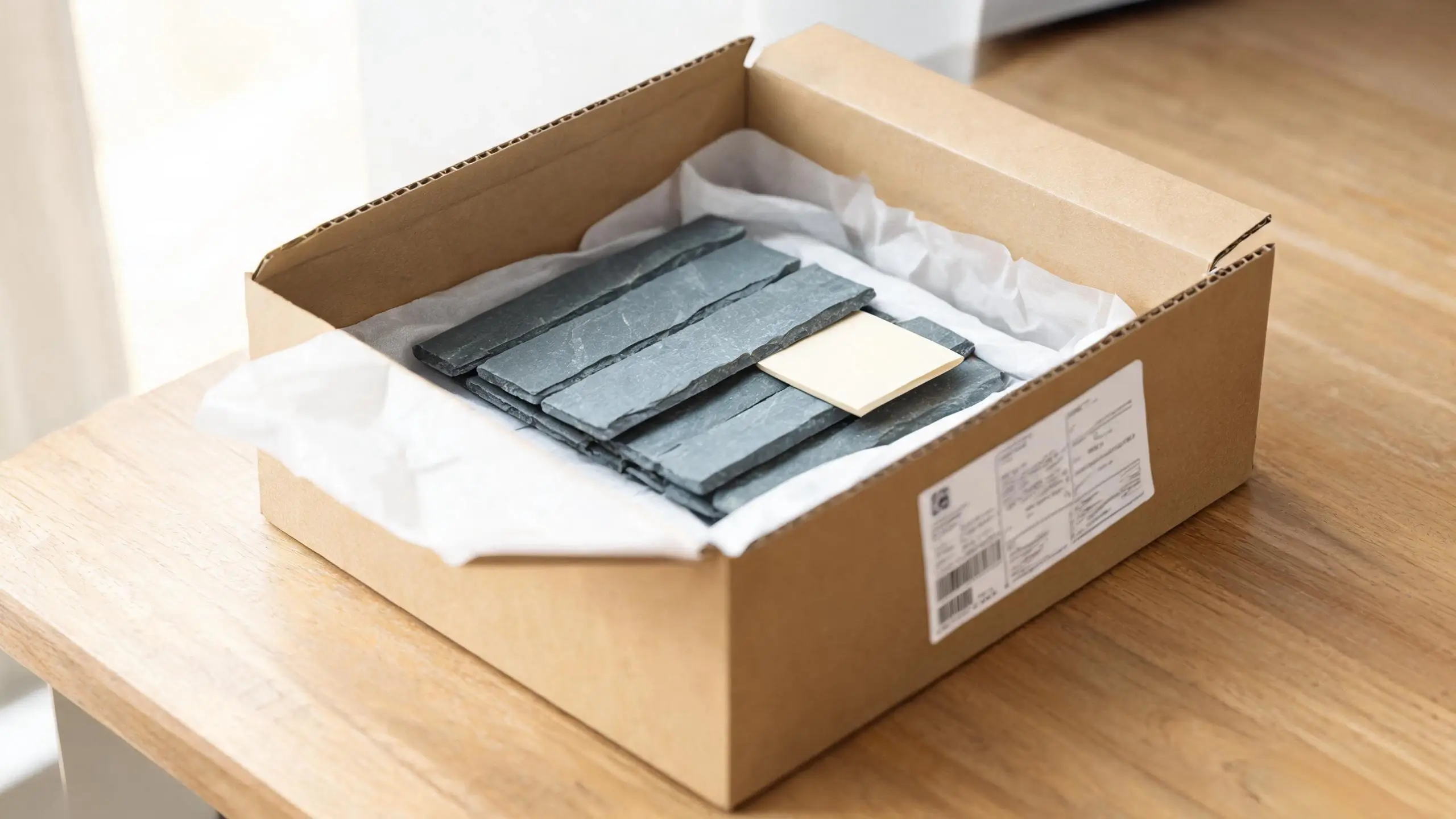
Most weeks, at least one small parcel leaves our sample desk here in Jiujiang. A courier box, a few slate pieces, a card with measurements written by hand. It is the least glamorous thing we ship, and it is the one that decides how everything else goes.
What happens next depends entirely on the buyer. Some open the box, glance at the colour, and reply: Looks good, please proceed. Others treat the sample as a piece of evidence — measure it, wet it, hold it to the light, then write down exactly what they are accepting. The first group is ordering on trust. The second is ordering on a reference.
A sample is not just for checking colour. It is the reference point for the entire production order. A bespoke tailor understands this instinctively: nobody sends a suit into full production after one glance at a fabric swatch. There is a fitting, and the fitting is not about whether the cloth is pretty — it is about agreeing, in three dimensions, what the finished garment will be allowed to be.
A slate sample plays the same role in stone. This guide is written from the factory side of the sample desk: what we put in the box, what you should ask us to put in it, how to run a fair test when it arrives, and how to turn "approved" from a feeling into a document both sides can point at when the container opens.
- Request — a production sample from the current batch, in the size you are buying, several pieces: the range, not the star.
- Inspect — daylight, a caliper, a close look at the edges, and a spoon of clean water. Four simple tools, none of them laboratory equipment, fifteen minutes.
- Approve — in writing: size, thickness range, surface, colour range. Give the sample a number both sides use.
- Keep — one piece sealed on your desk, one on ours, until the shipment has been checked against them.
Part of the Jiujiang Slate Guide's Buying & Exporting section. It follows Questions to Ask Before You Buy — once the inquiry has produced a specification, the sample is what anchors that specification in real stone. The Roofing Slate Guide covers the contract-side approval protocol in Samples and Sample Approval Process; this page covers the testing side and how samples actually leave a Jiujiang factory.
What Are You Actually Approving?
Buyers say "the sample is approved" more often than they define it. Approved for what, exactly? The colour? The thickness? The surface? The size? The material as a whole, or the way this one piece looks on a Tuesday afternoon under an office lamp?
Here is a distinction that saves a surprising number of arguments. A sample answers two separate questions, and you approve them separately:
- How the stone looks — colour, tone, texture, the character of the cleft surface.
- How the stone behaves — thickness consistency, dimensional accuracy, edge quality, and for machined products, what the material does under a cutting head or a drill.
A decorative piece can look beautiful and still be the wrong sample, because it answers only the first question. A machining trial piece can be scruffy at the edges and still be the right sample, because it answers the second. Before approving anything, decide which question your order actually depends on — for roofing slate it is usually both, weighted toward appearance; for billiard slate it is almost entirely the second.
Then write the answer down. A sample approval does not need to be a legal document — six lines is enough, and it takes two minutes:
Sample Approval Reference — example
Product: Natural Jiujiang roofing slate
Size: 300 × 200 mm, sawn edges
Thickness: 6–8 mm, measured range of the sample set written on the card
Surface: natural cleft
Colour: blue-grey to dark grey; the approved range is the spread of the sample set, not any single piece
Reference: physical sample, numbered, one copy held by each side
If you built your inquiry properly — the ten questions we set out in the previous guide — most of those lines already exist in your specification. The sample approval does not replace that work. It fixes it in stone, so that six months from now, when the container is opened, "what we agreed" means an object on the table, not a memory of an email thread.
Four Kinds of Sample — Request the One That Matches Your Order
Not every project needs the same parcel. Suppliers who offer "a sample" are usually reaching for the nearest drawer; buyers who accept whatever arrives are usually getting the wrong kind of evidence. There are four kinds, and each one answers a different question about your order.
1. The standard product sample. A representative piece of a product the supplier already makes — roofing slate, flooring, cladding, paving. It tells you the general character of the material and finish: colour family, texture, density in the hand. For small orders of a catalogue product, this is often enough. It does not tell you what your production run will look like, because it is not from your production run.
2. The size-and-thickness sample. When dimensional accuracy matters — thin calibrated tiles, for instance — ask for a piece large enough to actually check with a caliper. A matchbox-sized offcut cannot tell you whether a supplier holds a thickness range. If your order is 300 × 200 × 6–8 mm, the sample should be a full-size piece from that very product, not a token fragment of something adjacent.
3. The production sample. For a custom order, the gold standard: a piece cut from the current production batch, made to the agreed specification, before the bulk run starts. This is the only sample that can honestly be called a preview of your shipment. It costs the supplier more effort than opening a drawer — which is precisely why asking for it tells you something about the supplier. A factory that is genuinely producing to your spec can cut one in minutes.
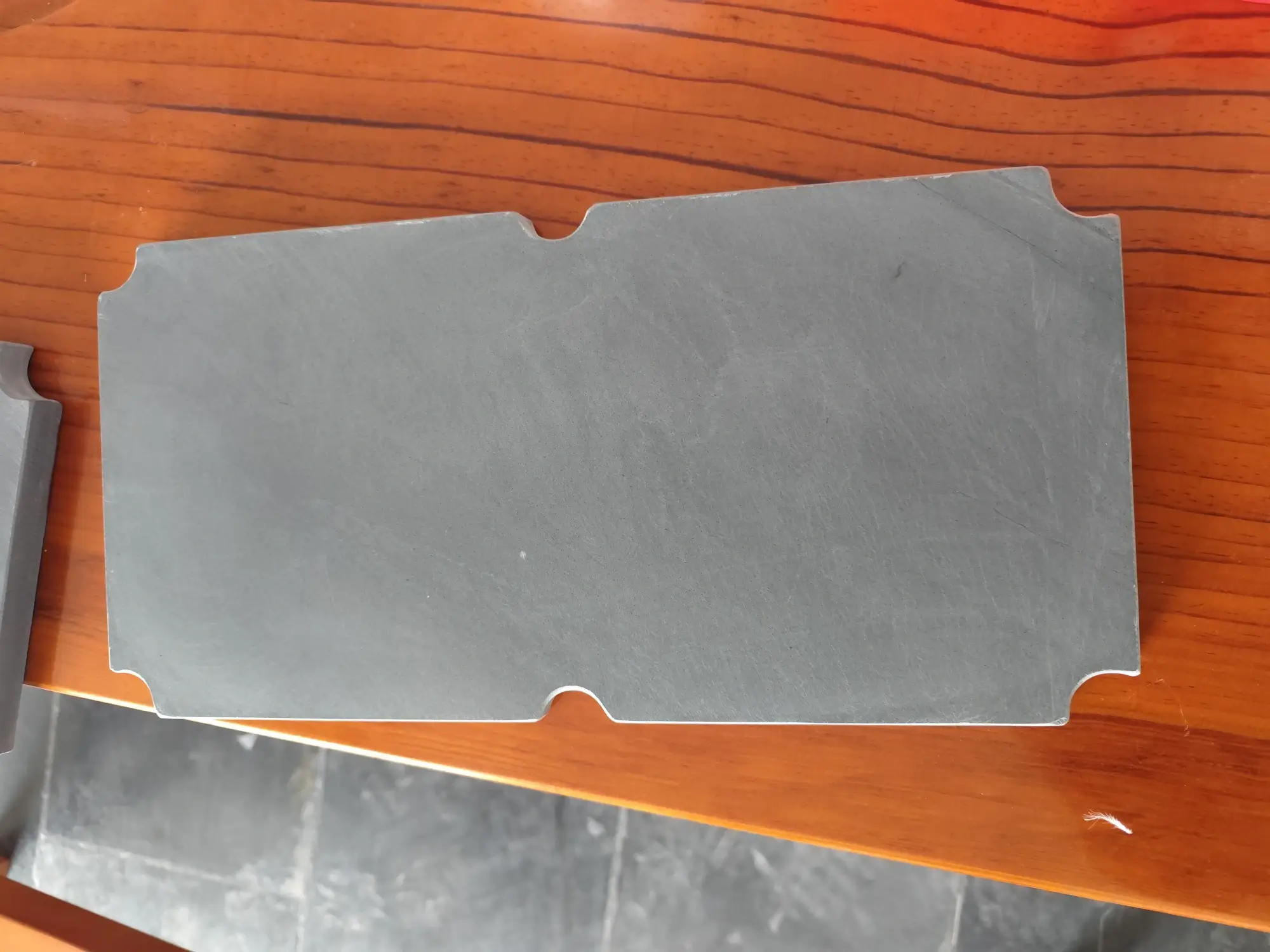
4. The machined billiard sample. For billiard table slate, a polished hand piece is close to worthless. What matters is how the stone behaves under machining: whether drilled holes come out clean, whether joint edges cut true, whether the material stays flat after processing. A proper billiard sample set includes small machined trial pieces — drilled, bevelled, seam-cut — cut from current production material. If a supplier can only send a decorative tile, they are answering the appearance question when your order depends entirely on the behaviour question.
One sentence, worth memorising: if the supplier offers a piece from a drawer, ask instead for a piece cut from current production. The willingness to do it is itself a data point — it sits alongside the evidence checks in How to Verify a Jiujiang Slate Supplier, and a supplier who cannot or will not is telling you something without meaning to.
How a Sample Set Leaves Our Desk
Since this guide is written from our side of the counter, here is what a serious sample set looks like when it is packed — the same standard you should hold any supplier to, including us.
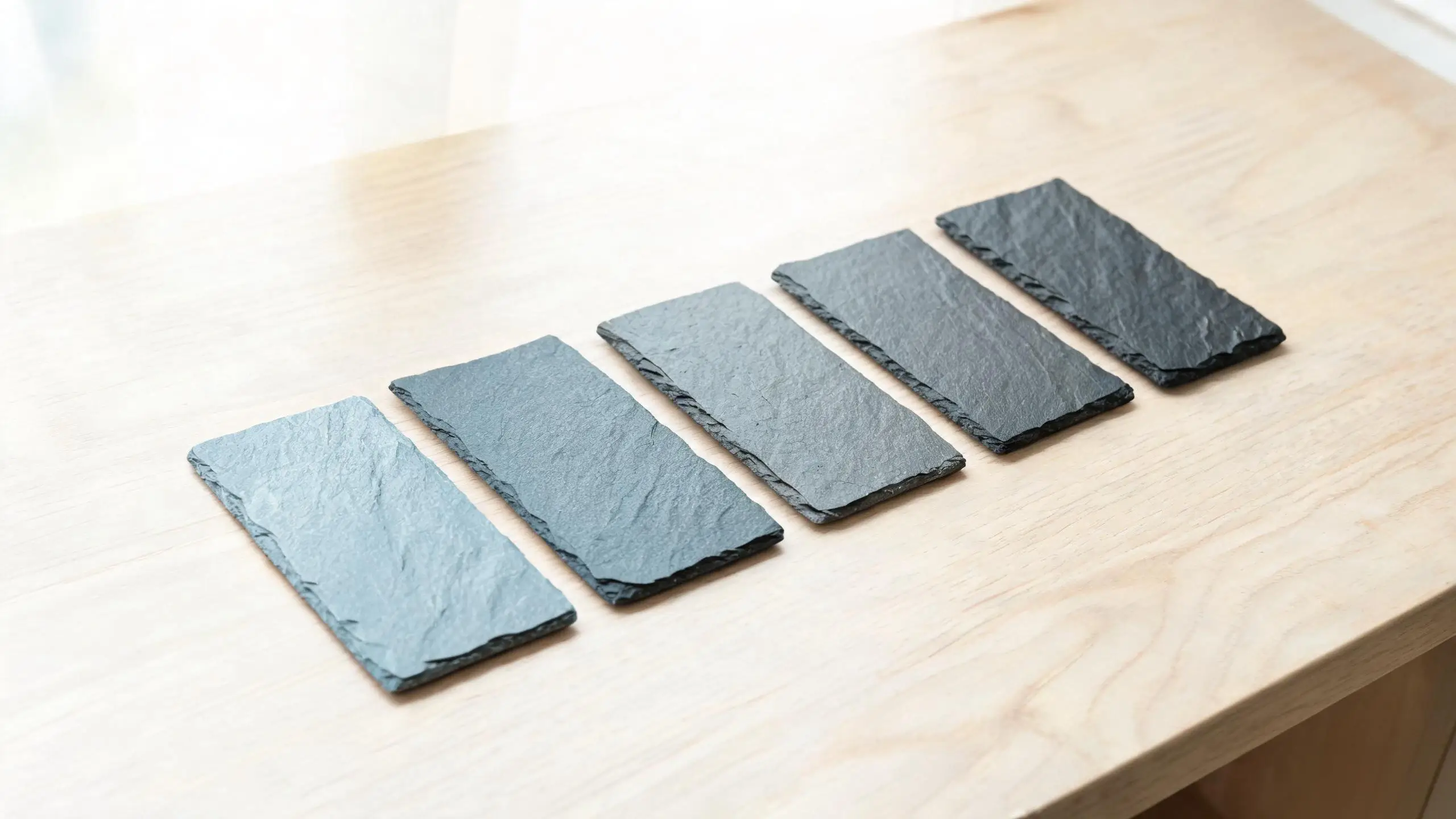
For a roofing project where colour variation matters, a useful sample set is several pieces rather than one — often five or more — selected deliberately across the current production range: lightest, middle tones, darkest. That way what you receive is the honest spread of the batch, not its beauty contest. The piece that matters most is the one in the middle, marked on the card as the centre of the range. That is the piece your roof will most resemble; the extremes show you where the edges of the range sit. A single sample, however pretty, flatters the batch in a way five pieces cannot.
Every piece goes out with a measured-values card. Not the nominal specification — the caliper readings: actual length, actual width, actual thickness at the corners. Nominal numbers belong in quotations; measured numbers belong with samples. You are free to disagree with our caliper, and you should — measure the pieces with your own and write your figures next to ours. Two sets of numbers on one card is not distrust; it is both sides looking at the same stone.
For billiard slate, the set includes machined trial pieces: a drilled hole, a bevelled joint edge, a seam surface — cut from the same material the order would use. Colour is the last question for billiard slate; machining behaviour is the first, so that is what the sample must show.
Courier time to most European addresses runs three to seven working days, typically — the sample is light, and the freight is usually the buyer's only cost. And one honest note: if your production is scheduled months after the approval, ask for a fresh reference piece closer to the production date. The quarry face and production area may change as extraction progresses, so an old approval should not be assumed to represent every future batch. The Roofing Guide's approval process sets a practical validity window for exactly this reason.
If you want to see where these pieces come from — how a block becomes the tile now sitting on your desk — How Jiujiang Slate Is Made walks the full line from quarry face to finished piece.
The Fair Test: A Roofing Slate Sample
"Fair" has a specific meaning here. A fair test measures the things your roof will actually ask of the stone, under conditions your roof will actually impose. It does not test everything, and it does not pretend to. Four simple tools — daylight, a caliper, a thumbnail, a spoon of water — used in the right order, will tell you more than an hour of scrolling through photos.
Daylight first, and wet as well as dry. Open the box near a window, not under a warm desk lamp. Look at the pieces together, spread out, and note the range between lightest and darkest. Then wet one surface with clean water: wet slate is the colour your roof shows after rain, and it is always deeper than the dry face. If colour matters commercially, take your own photo of the set in daylight and keep it with your order file — your photo is your memory; the stone is the evidence.
Caliper second. Measure each piece: length and width once, thickness at the four corners and the middle. Write the numbers down beside ours. What you are looking for is not a single figure but the spread — a set that reads 6.1, 6.3, 6.2 and 6.4 mm shows a relatively tight spread; a set that reads 5.2, 8.1, 5.9 and 7.3 mm shows a much wider spread — not a lottery, but a conversation about tolerance. Whether either is acceptable depends on the agreed thickness range. And if the samples you receive sit systematically at the thin end of that range, note it now, because that is a conversation to have before production, not after unloading.
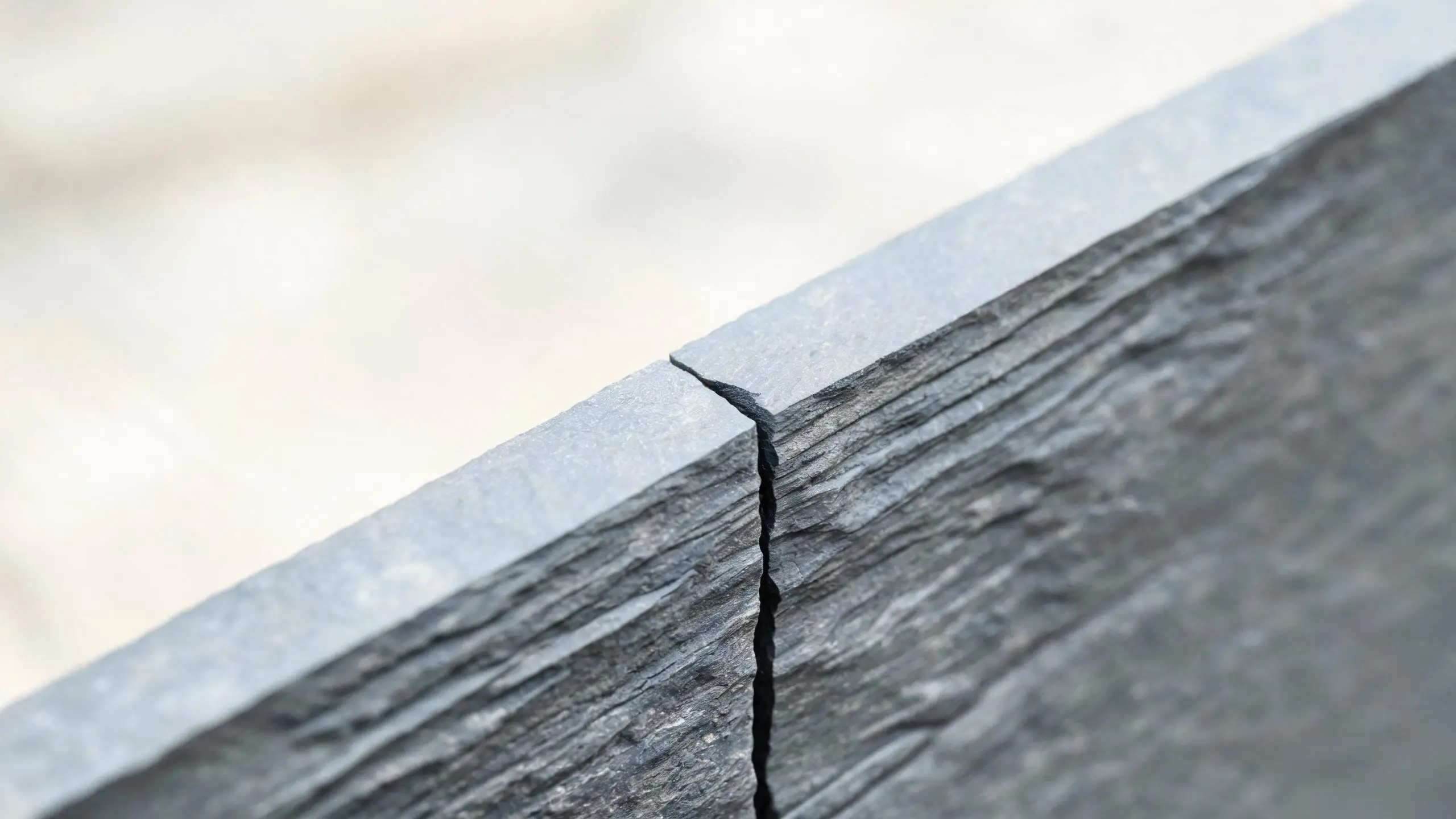
Edges and cleavage third. Turn a piece over and run a thumbnail along the edges: look for chipping, uneven sawing, loose flakes, anything that delaminates under light pressure. Examine the cleft surface for running cracks or soft inclusions. Some edge character is normal on a natural product — a hairline chip on one corner of one piece is a fact of stone, not a scandal. What you are checking is the pattern: one piece with a flaw is a piece, every piece with the same flaw is a production habit.
And the spoon of water. Place a few drops of clean water on the cleft face and watch for a minute. Does the surface darken evenly, or does one zone drink while another stays dry? Even behaviour across the face suggests a consistent stone; wildly uneven behaviour on a single piece is worth a question. Be clear about what this is: a practical observation, a way of comparing samples in front of you — not a laboratory absorption test. What low water absorption actually means for a roof, and what our tested figures are, is covered properly in Roofing Slate Water Absorption and on our published test results page.

The Fair Test: A Billiard Slate Sample
A billiard slate sample is tested for a different set of truths. The stone under your table cloth will be machined, drilled, joined in three pieces and asked to hold a machined plane flat for decades — so the sample you approve should already have survived those operations.
Look at the drilled holes first. A clean hole is a round hole: no chipping at the mouth, no spalling where the bit exited. The behaviour of the stone around a drill is something no polished display piece can demonstrate, and it is one of the most honest indicators of how a batch will behave on the CNC bed.
Then the joint edge. The seams of a three-piece slate meet along machined faces; on the trial piece, the joint edge should be straight and true, the bevel consistent along its length. Hold two trial pieces edge to edge and look along the seam — light leaking unevenly along a straight edge on a sample is a warning about the production.
Then flatness — by number, not by adjective. "Very flat" is a marketing phrase; a flatness figure with a stated measurement method is a specification. Ask the supplier to write down the actual tolerance their production holds, and how it is measured — then compare that written number against your table's requirements. What our own production holds, and how the machines behind it work, is set out in CNC Machining in Our Jiujiang Factory. The billiard-specific questions that expose a weak supplier are listed in What to Ask a Slate Manufacturer.
Notice what is missing from this list: colour. A billiard slate sample is approved on behaviour — machining, dimensional stability, flatness — and colour is a footnote. A buyer who spends the whole sample test admiring the grey is testing the wrong property.
Approve the Range, Not the Star
The single most common mismatch between a buyer's expectation and a natural stone reality is this: the buyer approved one beautiful piece, and then a container arrived containing thousands of pieces, none of which was that piece.
Natural slate is not a manufactured sheet. A quarry face changes character as it is cut down — a shade cooler in one layer, a touch grainier in the next — and the same face can shift with the seasons. None of this is a defect; it is what "natural" means in practice. You are buying stone, not ceramic tiles, and the approval should read like one written for stone. What protects both sides is not pretending variation away, but defining the band the order is allowed to live within.
That is why the five-piece set matters. Spread the pieces out in daylight, from lightest to darkest. That spread — not the prettiest tile in it — is what you are approving. Write it as a range: the production shall fall within the colour spread of the approved sample set, reference number so-and-so. For roofing projects where colour bands need tighter control, the same principle tightens further; the practical drafting of colour and thickness bands into contract language is covered in How to Avoid Color and Thickness Inconsistency, and it applies word for word to any origin, not just ours.
There is an equal and opposite error: treating every difference from the sample as acceptable "because natural stone varies". Variation has edges. If the delivery falls outside the band you defined — darker than the darkest approved piece, thinner than the stated range, a different surface character altogether — then "natural variation" is no longer an explanation, it is an excuse. The band protects you and binds you; that is what makes it fair.
Write It Down, Number It, Keep It
Once the pieces have passed a fair test, the approval needs a body — something that exists when the emails have scrolled away and the people have changed desks. Three habits give it one.
Give the sample a number. Something like JS-RS-2026-01 — origin, product line, year, sequence. It does not matter what the system is; it matters that both sides quote the same characters for the same piece of stone. Half the sample disputes we have ever watched began with two people pointing at two different "approved samples" and both being right.
Write the approval against the number. The six lines from the top of this guide — size, thickness range, surface, colour range, application, reference — signed or confirmed by email, attached to the number. From that point, "checked against reference JS-RS-2026-01" is a sentence with meaning in both languages of the trade.
Keep a sealed copy on each side. The buyer keeps one piece from the numbered set; the factory keeps its twin, visible on the production floor. Both stay untouched until the order has been inspected. And when the same product is re-ordered, the old reference becomes a golden sample — the third point in a comparison that gets more valuable every time you use it: previous approved sample, current production, current shipment. A buyer with two years of retained references can see a drift long before it becomes a dispute.
The full six-step protocol — same-batch sourcing, the three-piece rule, cards, seals, signatures, the arrival check — is written out in the Roofing Slate Guide's Samples and Sample Approval Process. If you are buying roofing slate, that page is the contract-side companion to everything above.
When Production and Sample Disagree
One day a shipment and a reference sample will look at each other across a warehouse floor and not quite match. What happens next is decided by what was written down before production — and by which of the two mismatches you are actually looking at.
Here is the version of that day we have watched more than once. A buyer receives a single beautiful roofing sample, replies "Looks good, please proceed", and three weeks later opens a container of thousands of pieces. The colour sits a shade either side of the one approved tile. Some pieces carry more grain than the sample did. The thickness wanders inside the agreed range. The buyer writes: This is not the same as the sample. The supplier writes back: Natural slate has variation. Both are telling the truth — and neither has a strong position, because a single tile was approved as if it were a paint code. Had the approval defined the colour band, the thickness range and the surface character instead, the same delivery would have been unremarkable: inside the band, no argument. The sample was never the problem. The approval was.
Work down the questions in order. Same material and source as the approved reference? Within the agreed colour band — inside the spread of the numbered set? Within the stated thickness range? Same surface, same edges, same processing? If the answer to each is yes, what you are seeing is the natural range doing exactly what a natural range does, and the order is performing as approved.
If the answer to any of them is no, then size the problem before raising it. A single tile outside the range is a tile. A whole crate outside the range is a conversation. Random pieces on the fringes of a large delivery are one kind of discussion — sorted, documented, usually resolved with a credit or replacement pieces. A systematic shift across the delivery — everything darker, everything thinner — is a different kind, because it points at the production, not the stone.
Then act on evidence, not adjectives. Photograph the delivered pieces beside the sealed reference in the same light, put the caliper figures next to the card, and send the comparison with the sample number attached. A supplier who set up the reference properly expects exactly this conversation and can answer it in one email. The formal place to catch a drift before it sails is a pre-shipment inspection — bring the reference sample, or a photo of it, to the loading; the checklist for that day is in Pre-Shipment Inspection Checklist.
What a Sample Cannot Prove
End with the honest limit, because knowing it is what makes the rest of the process trustworthy. The clearest way to hold it is one sentence: a sample is not a laboratory test. A sample — even a production sample, even a numbered, sealed, golden sample — cannot prove three things buyers sometimes expect it to prove.
It cannot prove the whole batch. A sample is a reference point, not a census. What covers the batch is inspection: the piece-by-piece checks that happen on the factory floor before packing — how that works in our plant is described in 100% Inspection.
It cannot prove the standard. Whether the material meets EN 12326 or ASTM C406 is a question for laboratory testing, answered by test reports — which are worth reading properly, and which should carry batch references that tie them to your material, as explained in How to Read a Slate Test Report.
And it cannot prove the future. A sample says what the stone is today; durability over decades is what the test data and the climate evidence are for — the published Jiujiang test results are the right place to look.
So the mature way to hold all three is a set of three separate questions, asked in order, with three different instruments:
| The question | The instrument | When it is answered |
|---|---|---|
| Is this the product we want? | The physical sample, fairly tested and approved in writing | Before production starts |
| Did they make the order as agreed? | Inspection — in-factory checks, pre-shipment inspection, arrival check against the reference | During production and at loading |
| Does the material meet the standard? | Laboratory test reports, batch-linked, read against the standard | Before the deposit, and again if the batch changes |
Buyers get into trouble when they use one instrument for all three questions — approving a sample and calling the order tested, or reading a certificate and calling the stone seen. Each question deserves its own answer, and the sample is only the first of them. But it is the first one, and nothing downstream works without it: inspection needs a reference to inspect against, and a test report needs a material to describe.
A fitting is not the suit. But no honest tailor skips it — and no buyer who has watched a container being opened, with a numbered piece of stone sitting beside the crates, has ever regretted the fifteen minutes it took.
Frequently Asked Questions
What does "sample approved" actually mean?
In writing, it means six lines: the product, the size, the thickness range as measured (not just as quoted), the surface finish, the colour range expressed as the spread of the sample set, and a reference number attached to a physical piece. Anything less — "the colour is fine, go ahead" — approves the colour and nothing else, which is the smallest and least useful part of the order.
How long do Jiujiang slate samples take to arrive?
Typically three to seven working days to most European addresses by international courier. Sample parcels are light, so courier cost is modest and is usually the buyer's only cost — the pieces themselves are rarely where a supplier earns or loses money. The point of the wait is not the freight; it is that a physical reference exists before production starts, which no amount of email can replace.
What is the difference between a standard sample and a production sample?
A standard sample shows the general character of a catalogue product — useful for judging material and finish. A production sample is cut from the batch your order will actually come from, to your agreed specification, before the bulk run. For custom orders, the production sample is the only honest preview of the shipment. As a rule of thumb: a small order of a standard product can be approved on a standard sample; anything custom should be approved on a production sample.
Is a small hand sample enough for billiard slate?
No. A decorative hand piece answers the appearance question, and billiard slate is decided almost entirely by behaviour: how the stone machines, how drilled holes come out, whether joint edges cut true, and whether the material holds flatness after processing. A useful billiard sample set includes machined trial pieces — drilled, bevelled, seam-cut — from current production material, plus written flatness tolerances and how they are measured. If a supplier can only offer a polished tile, ask for a machining trial instead.
How can I test a slate sample fairly without a laboratory?
Four household tools in fifteen minutes: daylight (check the pieces together, dry and wet, and photograph the set), a caliper (length, width, thickness at four corners and the middle — write your numbers beside the supplier's), a thumbnail along the edges (chipping, loose flakes, delamination under light pressure), and a spoon of clean water on the cleft face (watch whether the surface darkens evenly). These are observations for comparing samples, not substitutes for laboratory testing — but they catch most of what photos hide.
Is an approved sample a guarantee for the whole order?
No, and it was never meant to be. An approved sample answers one question — is this the product we want. Whether the order was made as agreed is answered by inspection, piece by piece, before and at loading. Whether the material meets a technical standard is answered by batch-linked laboratory test reports. Three questions, three instruments. Buyers who expect the sample to answer all three end up trusting it for things it cannot see.
Related Reading
Ask us for a sample, and hold us to it
Tell us the product, the size, the thickness range and the application, and we will cut a sample set from current production — measured, carded, and marked with the middle of the colour range, so what you approve is the range your order will live in, not a hand-picked star. Then keep your copy sealed, and check our container against it. Request a sample · see our roofing slate range