
Two Standards, One Slate: EN 12326 and ASTM C406 Compared Side by Side
Part of the Jiujiang Slate Guide's Quality, Testing & Standards section — the side-by-side companion to our EN 12326 explainer and ASTM C406 guide. If you only need one standard, those pages cover it in depth. If you need to know which one applies to your project — or whether a slate that passes one also passes the other — this is where the two systems meet.
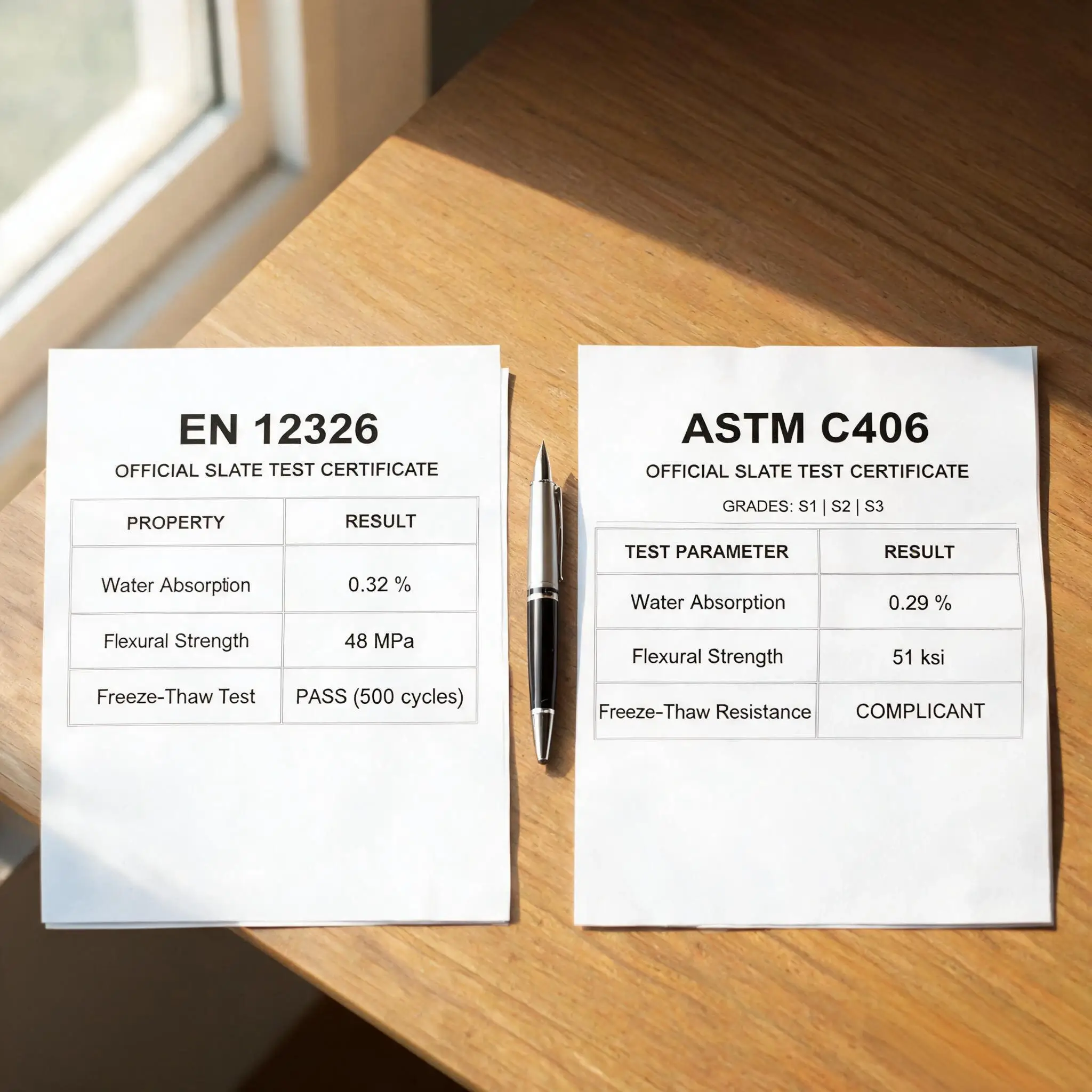
Two test certificates on a desk. One from a European laboratory — EN 12326-1 printed at the top, water absorption 0.1%, flexural strength declared, freeze-thaw cycles completed and recorded. The other from an American lab — ASTM C406 at the top, Grade S1, modulus of rupture tested under C120, water absorption 0.25% max. Same slate. Same quarry in Jiujiang. Two different ways of proving the same thing.
The question every buyer eventually asks is not "which standard is better" — neither is better; they are built for different markets. The question is: which one does your project need, and do these two certificates say the same thing about the stone?
This article answers that. Not by explaining each standard from scratch — the EN 12326 guide and ASTM C406 guide do that — but by putting them side by side across every test area, so you can see where they overlap, where they diverge, and what Jiujiang slate looks like under both.
Quick Answer: EN 12326 and ASTM C406 test the same core properties — water absorption, bending strength, durability — but with different methods, different units, and different classification systems. Here is the comparison at a glance.
| Property | EN 12326 (Europe) | ASTM C406 (North America) |
|---|---|---|
| Water absorption | Soak 48h at atmospheric pressure. Class A ≤ 0.6% | Boil 48h. S1 ≤ 0.25% |
| Flexural strength | Modulus of rupture (MPa), declared value | C120 test, min 575 lbf for S1 |
| Freeze–thaw | Explicitly tested — cycles, weight loss, damage | Not directly tested — inferred from absorption |
| Chemical composition | Carbonate, sulphur, non-carbonate carbon — declared | Not part of C406 |
| Grades | Classes A/B/C + exposure E1/E2/E3 | S1 / S2 / S3 |
Jiujiang slate: water absorption 0.1%, flexural strength 71 MPa, freeze–thaw retention 92.7% — passes both systems at the top tier.
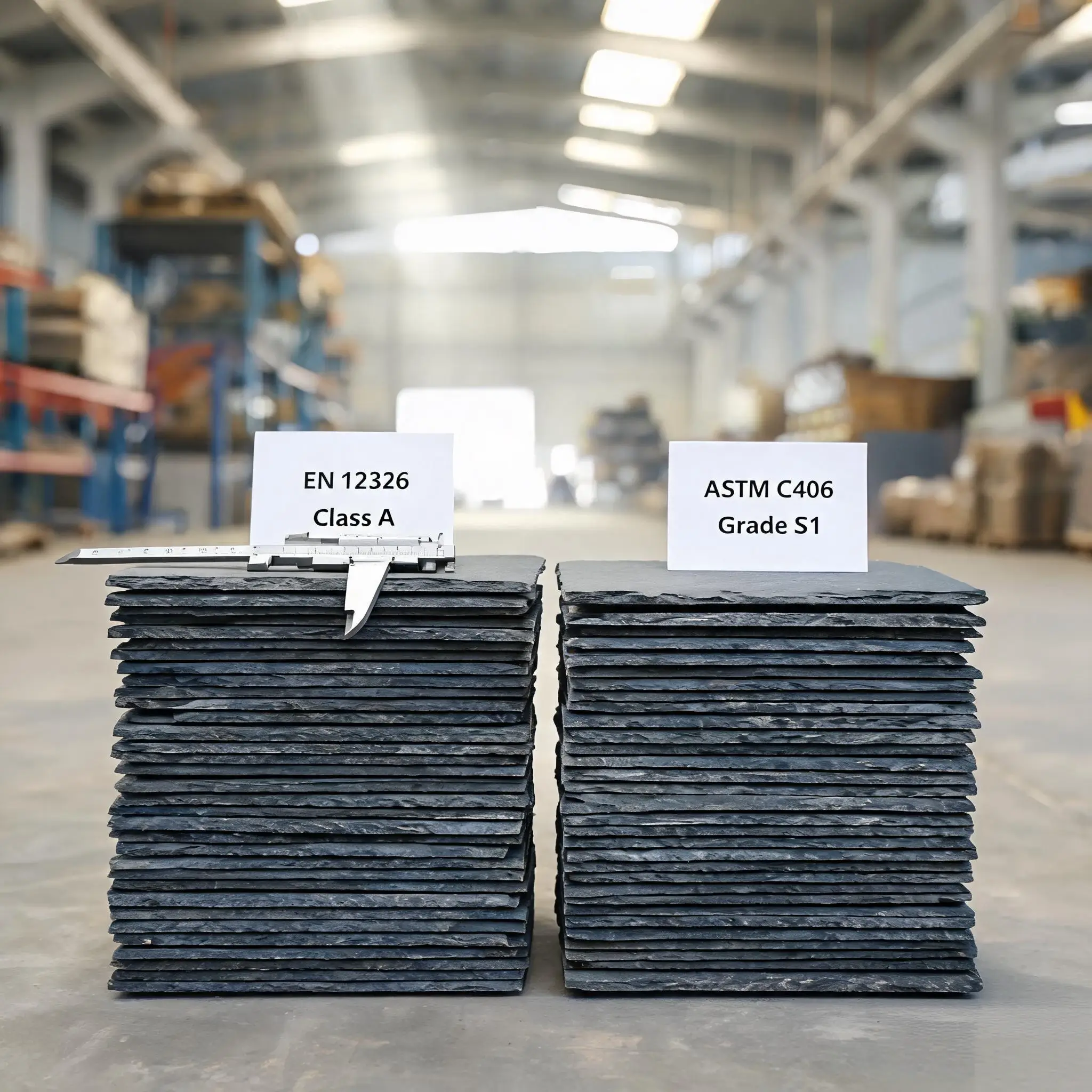
Pair 01: The Framework — Two Standards, Two Architectures
EN 12326 is a European standard published in two parts. EN 12326-1 contains the test methods — the procedures a laboratory follows to measure water absorption, flexural strength, freeze-thaw, chemical composition, thickness, and thermal cycling. EN 12326-2 takes those results and sorts them into a classification: performance classes, exposure categories, and the requirements a slate must meet to carry the standard's name. You get the tests and the sorting rules in one package.
ASTM C406 is an American specification. It does not contain its own test methods. Instead, it calls up a separate standard — ASTM C120 — for the modulus of rupture test, and defines its own water absorption procedure. Then it sets minimum thresholds for three grades: S1, S2, and S3. The tests live in other documents; C406 is the pass/fail line.
The structural difference matters in practice. A European certificate typically shows the test data and the classification together — you can see the actual numbers and the class they produce. An American certificate shows the grade and points you to C120 for the method behind it. Both are legitimate. But if you want the raw data on one sheet of paper, EN makes that easier.
Pair 02: Water Absorption — Two Methods, Same Question
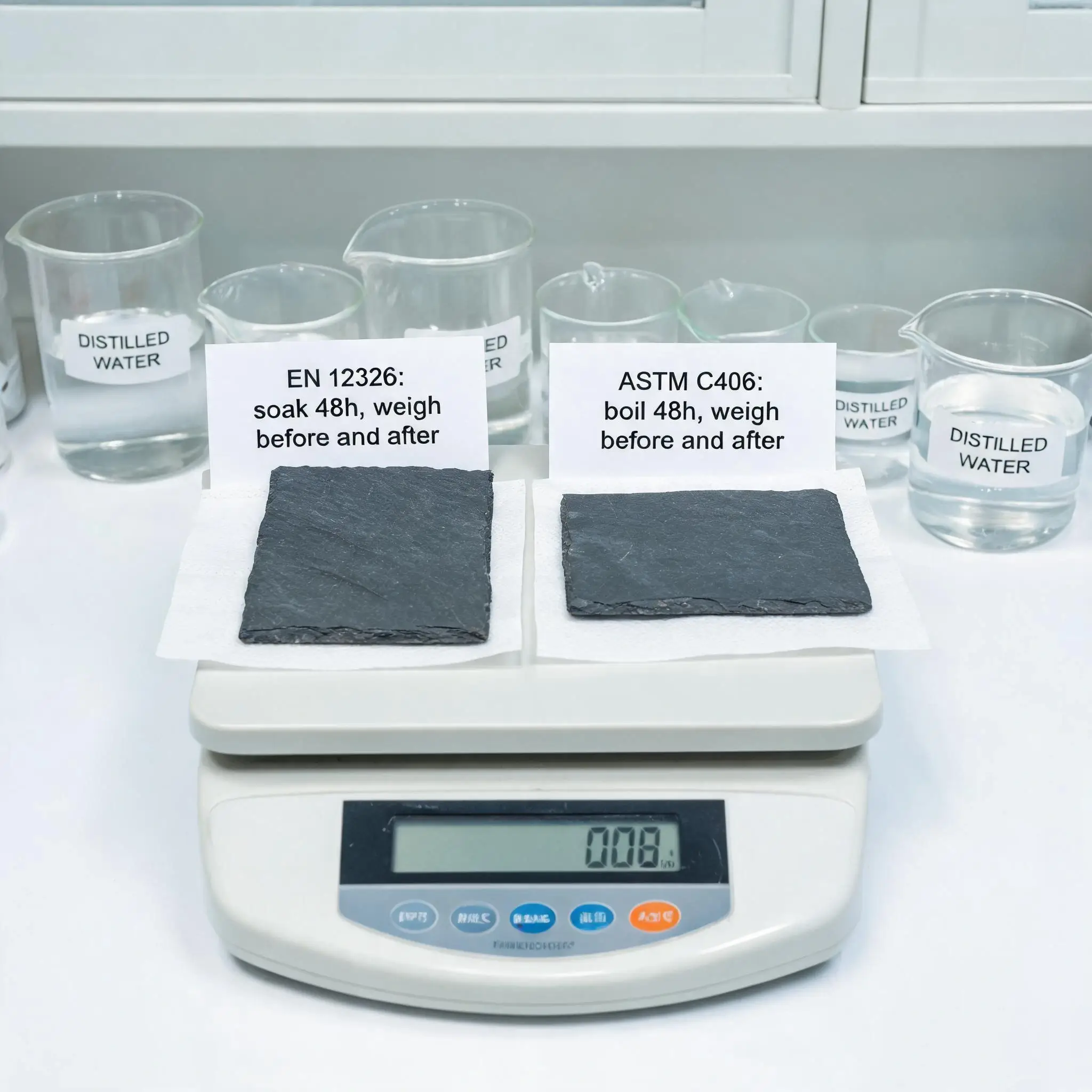
Both standards ask the same question: how much water does this stone soak up? The answer predicts frost damage, staining, and long-term weathering. But they ask it differently.
EN 12326-1: immerse the slate in water at atmospheric pressure for 48 hours. Weigh before and after. Express the gain as a percentage of dry weight. The result sorts the slate into classes: A (≤ 0.6%), B (> 0.6% to ≤ 1.8%), C (> 1.8%).
ASTM C406: immerse the slate in boiling water for 48 hours. Weigh, calculate, classify. The thresholds: S1 (≤ 0.25%), S2 (≤ 0.45%), S3 (≤ 1.00%).
The boiling method is more aggressive. Heat drives water into micro-pores that atmospheric pressure cannot reach, so the same stone tends to show a slightly higher number under ASTM than under EN. This is not a contradiction — it is a different test on the same material, and both are valid within their own system.
Jiujiang slate reports 0.1% water absorption under EN testing. Under the ASTM boiling method, the same stone would still sit well below the 0.25% S1 threshold. The margin is wide enough that the method difference does not change the grade. For a deeper look at why low absorption matters, see our Jiujiang slate water absorption page and the roofing slate water absorption guide.
Pair 03: Flexural Strength — Two Units, Same Physics
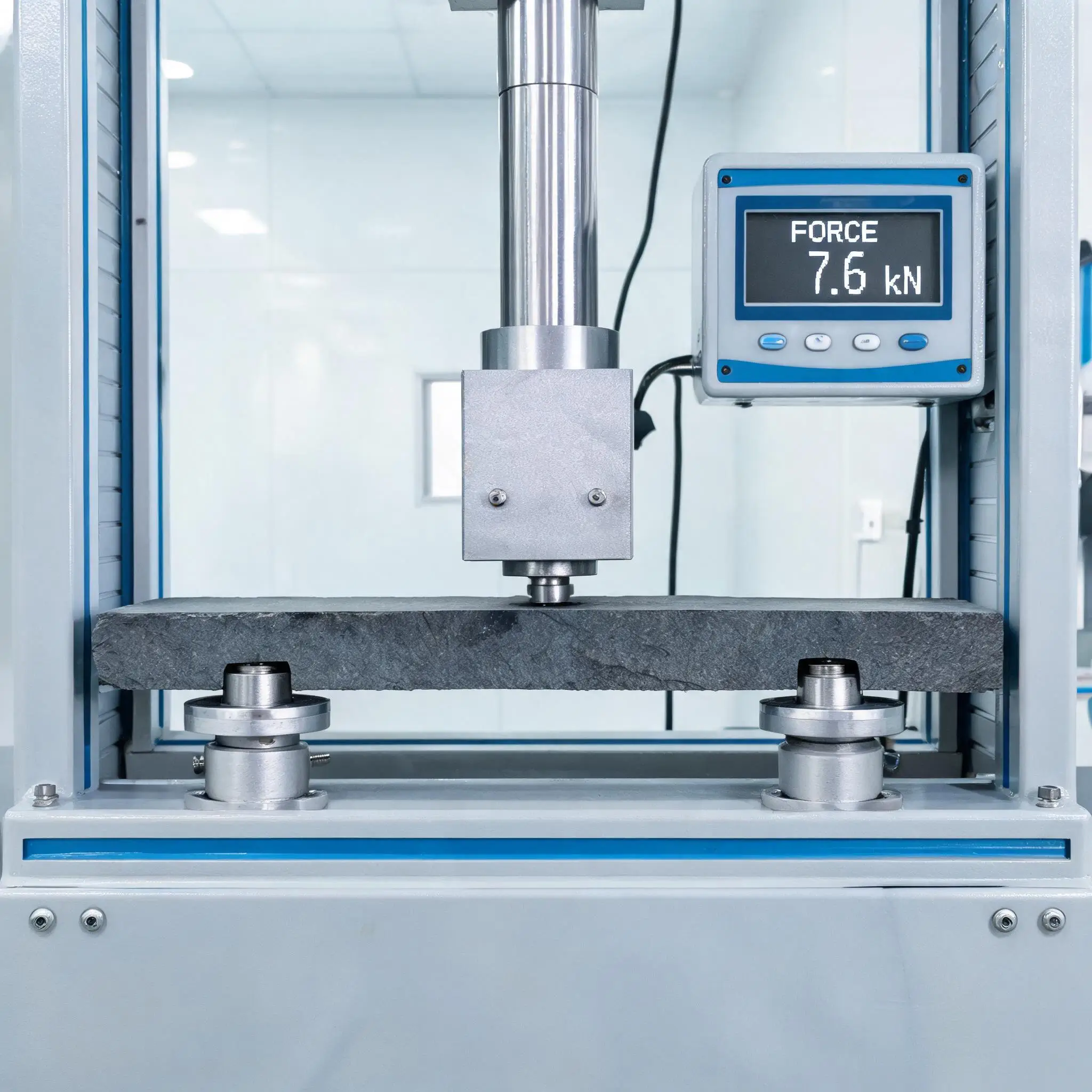
Both standards bend a slate sample until it breaks. The test is a three-point bend: the slate rests on two supports, a loading bar presses down from the centre, and the machine records the force at which the stone fractures.
EN 12326-1 reports the modulus of rupture in megapascals (MPa). The manufacturer declares a minimum value, and the slate must meet it. The declared value appears on the certificate alongside the actual test result.
ASTM C406 calls up ASTM C120 for the same test. The result is reported in pounds-force (lbf). The grade thresholds are absolute: S1 requires a minimum of 575 lbf, S2 requires 500 lbf, S3 requires 400 lbf.
The numbers look different because the specimen sizes and unit systems differ. But the physics is the same: a stone that resists bending under load will resist wind, snow, and the occasional careless foot on a roof. For the full flexural strength picture, see our Jiujiang slate flexural strength page.
Jiujiang slate reports a flexural strength of 71 MPa under EN testing — a strong slate, well above the minimum European specifications typically call for. Under the ASTM system, the same stone passes S1 comfortably.
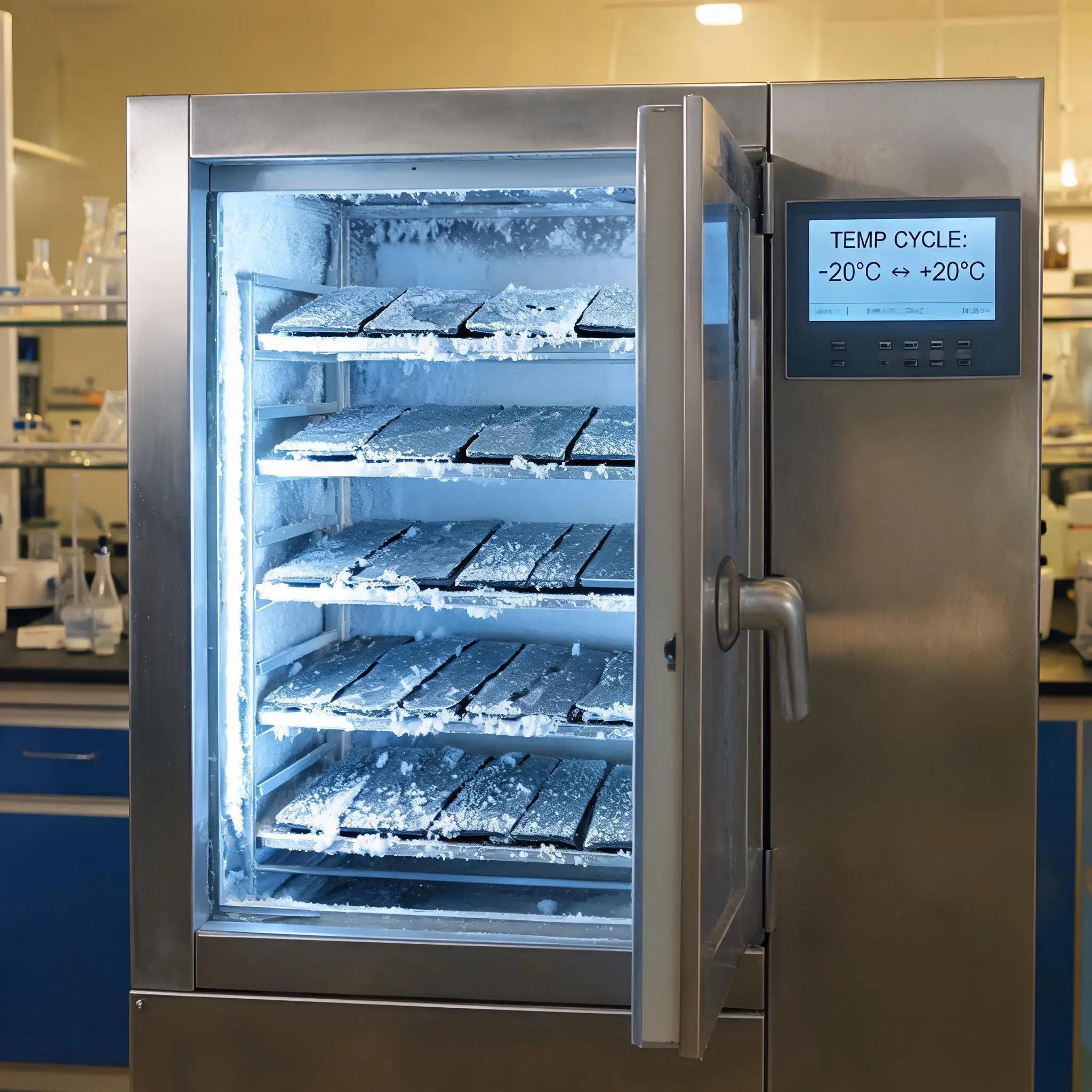
Pair 04: Freeze–Thaw — Where the Two Standards Diverge
This is the single biggest structural difference between EN 12326 and ASTM C406, and it is the one most buyers miss.
EN 12326-1 explicitly tests freeze-thaw resistance. Water-saturated samples go through freeze-thaw cycles in a laboratory. The lab checks for weight loss, visual damage, and changes in flexural strength after cycling. The result appears on the certificate as a declared value — the stone's strength after freezing, expressed as a percentage of its dry strength.
ASTM C406 does not directly test freeze-thaw. The logic is straightforward: if a slate absorbs very little water (S1 = 0.25% max), frost has almost nothing to expand inside the stone. So durability in cold climates is inferred from the absorption number rather than measured in a freezer.
Both approaches are defensible. The European method gives you a direct measurement — you see what happens to the stone after dozens of cycles. The American method gives you an inference — low absorption means frost has little to work with, and a century of field experience supports the correlation.
But here is the practical difference for a buyer: if you are specifying slate for a cold climate and you want freeze-thaw data on paper, you need EN 12326. If your specification accepts ASTM C406, you are trusting the inference — and most North American building codes do trust it, because it has worked. For a full discussion of freeze-thaw testing and what the numbers mean, see our freeze-thaw resistance guide.
For Jiujiang slate, the EN data tells the story the ASTM system assumes: after freeze-thaw cycling, the slate retained 92.7% of its dry strength (156 MPa dropped to 144.7 MPa). That is the kind of number the American standard infers but does not measure.
Pair 05: Chemical Composition — What EN Sees and ASTM Doesn't
EN 12326-1 tests three chemical properties: carbonate content, sulphur content, and non-carbonate carbon. These are assigned to exposure classes — E1 (no change expected), E2 (possible change in appearance, no change in performance), E3 (possible change in both). The logic is simple: carbonate minerals dissolve in acid rain, sulphur can oxidise and stain, and both predict how the stone will weather over decades.
ASTM C406 does not test chemical composition. If a buyer wants that data under the American system, they need to request ASTM C217 — a separate standard for slate weathering that most C406 certificates never reference.
This is another structural gap. A European certificate tells you the stone's chemistry and what it means for long-term weathering. An American certificate tells you the stone is strong and dense, and leaves the chemistry to assumption.
For Jiujiang slate, the chemistry is one of its strongest cards. CaO (calcium oxide, the main proxy for carbonate content) is 0.56%. Compare that to marble (> 40%) or limestone (> 50%). This is one of the lowest carbonate contents in the global slate trade, and it is the reason the stone resists acid rain in a way that high-carbonate slates cannot match. EN 12326 captures this on the certificate. ASTM C406 does not. For the full mineral picture, see our Jiujiang slate mineral composition page.
Pair 06: Dimensional Control — Where Both Standards Agree
Both standards check thickness, flatness, and dimensional consistency. EN 12326-2 sets tolerances per declared size. ASTM C406 sets tolerances per grade. The philosophy is the same: a batch that varies in thickness will produce uneven roof surfaces, inconsistent headlap, and eventual water ingress — regardless of its strength class.
This is the one area where the two standards agree almost completely. Both care about consistency, both set limits, and both reject batches that fall outside them. A slate that passes one standard's dimensional checks will almost certainly pass the other's.
For Jiujiang slate, dimensional control is maintained by CNC machining to ±0.1mm tolerance — tighter than either standard requires. The dimensional checks in both EN and ASTM are satisfied with a margin that most hand-split operations cannot match. See our flatness and dimensional stability page for the full picture.
Which Standard Do You Actually Need?
The answer depends on where the roof is.
If your project is in Europe — the UK, Ireland, the EU, Norway, or any country where CE marking is required — you need EN 12326. Building control officers and architects will ask for it by name. A certificate that says "ASTM C406 Grade S1" will not satisfy a European specification, however good the numbers are.
If your project is in North America — the United States or Canada — you need ASTM C406. Code officials and architects reference it in their specs. An EN 12326 certificate is interesting supplementary data, but it is not the document they asked for.
If you are buying internationally and do not know which standard applies, ask for both. The cost of running both test suites is small compared to the cost of specifying the wrong one and having to re-test. Our published test results cover both systems.
The question to ask a supplier is specific: "Can you provide test reports under both EN 12326 and ASTM C406, with batch numbers and test dates?" If the answer is yes, you are dealing with an operation that has invested in proper testing. If they only have one, find out which market it was tested for — and whether the batch number on the report matches the batch number on your order. For the full list of questions, see our test report reading guide and the Jiujiang slate test report decoder.
Jiujiang slate has been tested under both systems. The EN 12326 data shows Class A water absorption, a declared flexural strength of 71 MPa, and freeze-thaw retention above 92%. The ASTM C406 equivalent is Grade S1 — the top tier, the one meant for a service life of 75 years or more. Both standards, same stone, same conclusion.
Frequently Asked Questions
Do EN 12326 and ASTM C406 test the same things?
They test the same core properties — water absorption and bending strength — but with different methods and units. The biggest gap is freeze-thaw: EN 12326 tests it directly by cycling saturated samples through freezing and thawing; ASTM C406 infers frost resistance from the water absorption number. EN 12326 also tests chemical composition (carbonate, sulphur, non-carbonate carbon), which ASTM C406 does not. So they overlap on the basics but diverge on the details.
Which standard is stricter?
Neither is uniformly stricter — they are different, not stricter or looser. ASTM C406's water absorption thresholds are numerically lower (S1 = 0.25% vs EN Class A = 0.6%), but the ASTM boiling method tends to produce higher readings than the EN soak method, so the tighter threshold is balanced by a tougher test. EN 12326 is more comprehensive in scope (it tests freeze-thaw and chemistry that ASTM skips), which could be called "stricter" in coverage. But a slate that passes one system at the top tier will almost always pass the other at the top tier too.
Can a slate pass EN 12326 but fail ASTM C406?
Yes, in theory. A slate with water absorption of 0.5% would pass EN 12326 Class A (≤ 0.6%) but fail ASTM S1 (≤ 0.25%) and S2 (≤ 0.45%), landing in S3 instead. The boiling method in ASTM can also push the number slightly higher than the EN soak method. In practice, a high-quality slate like Jiujiang (0.1% absorption) passes both at the top tier with a wide margin, so the gap is academic for good stone. But for marginal slate, the method difference can move the grade.
If I'm buying Chinese slate, which standard should I ask for?
Ask for the standard that matches your market. If the roof is in Europe, ask for EN 12326. If it is in North America, ask for ASTM C406. If you are not sure, ask for both — a supplier with both reports has invested in proper testing. Always check that the batch number and test date on the report correspond to the batch you are buying, not a brochure sample from years ago.
Does ASTM C406 test for freeze-thaw resistance?
No. ASTM C406 does not include a freeze-thaw cycling test. It infers cold-climate durability from the water absorption result: if the stone absorbs very little water (S1 = 0.25% max), there is not enough water inside to freeze and crack the stone. This inference is well-supported by field experience across North America. But if you want freeze-thaw data on paper — for a project in Norway, Scotland, or anywhere with severe frost cycling — you need an EN 12326 report that includes the cycling test.
What does it mean when a supplier says "tested to both EN and ASTM"?
It means the supplier has run (or commissioned) two separate test programmes: one under EN 12326-1 methods and classification, and one under ASTM C406 specification with C120 for the bending test. This is a good sign — it shows the supplier has invested in testing for both markets. But always ask for the actual reports, check the batch numbers and dates, and confirm that the sample tested came from the same quarry and production period as the slate you are buying.
Related Reading
Need Both Standards? We Have Both.
Jiujiang slate has been independently tested under EN 12326 and ASTM C406. Class A water absorption. Grade S1 flexural strength. Freeze-thaw retention above 92%. The numbers are on our test results page — with the lab names, dates, and batch references.