
Why Jiujiang Slate Works for Billiard Tables
Strip a billiard table down. Remove the cloth. Remove the cushions, the rails, the pockets and the legs. What remains at the centre of the whole construction is a slab of rock — usually several slabs — weighing, on a professional table, anywhere from 130 to well over 260 kilograms.
Everything else on the table can be replaced in an afternoon. The slate is the reason the game is honest: the surface the ball actually rolls on, the mass that keeps the bed steady when a break is struck, the component that has to stay flat for decades while rooms change temperature around it.
Jiujiang slate, from the Lushan–Xingzi producing area of Jiangxi Province, is used by table manufacturers because its physical characteristics match what a table bed demands. Not its colour — its flatness, density, stability and machinability. This article is about those four characteristics: what each one means on the table, what the stone actually delivers, and how a buyer can verify it before ordering.
Quick Answer: Jiujiang slate works for billiard tables because four physical characteristics line up with the four demands of a table bed — and each one can be verified in numbers before an order is placed:
| Pillar | What it gives the table | Evidence in the material |
|---|---|---|
| Flatness | True ball roll, accurate levelling | Calibrated and ground surfaces, seam gaps a 0.05 mm gauge barely enters |
| Density | A bed that does not move when struck | 2,719–2,819 kg/m³ — roughly 125 kg per square metre at 45 mm |
| Stability | Dimensions that hold through heat, cold and humidity | Low thermal expansion, water absorption of 0.1–0.2% |
| Machinability | Pockets, holes and seams cut to drawing | CNC machining to ±0.1 mm, repeatable across orders |
None of the four is optional. A bed that is flat but light plays “alive”; a dense bed that cannot be machined cannot be built into a table at all.
Strip a Billiard Table Down
A table bed has a demanding job description: it must be hard enough for decades of play, stable enough to sit still under its own considerable weight, accurate enough to accept a cloth without telegraphing every ripple, and machinable enough to carry the pockets, bolt holes and joints a table design requires — all in pieces large enough to cover a 12-foot playing surface.
No stone is born meeting that description. A slab that looks excellent at the quarry can still be inconvenient for table production if it is difficult to machine or hard to control dimensionally. Billiard slate is therefore an engineering material — a natural stone whose usable characteristics are brought under control through selection, calibration, grinding, CNC machining and inspection. The full production journey is covered in From Quarry to Billiard Slate; here, the focus is the physics the finished bed has to deliver.
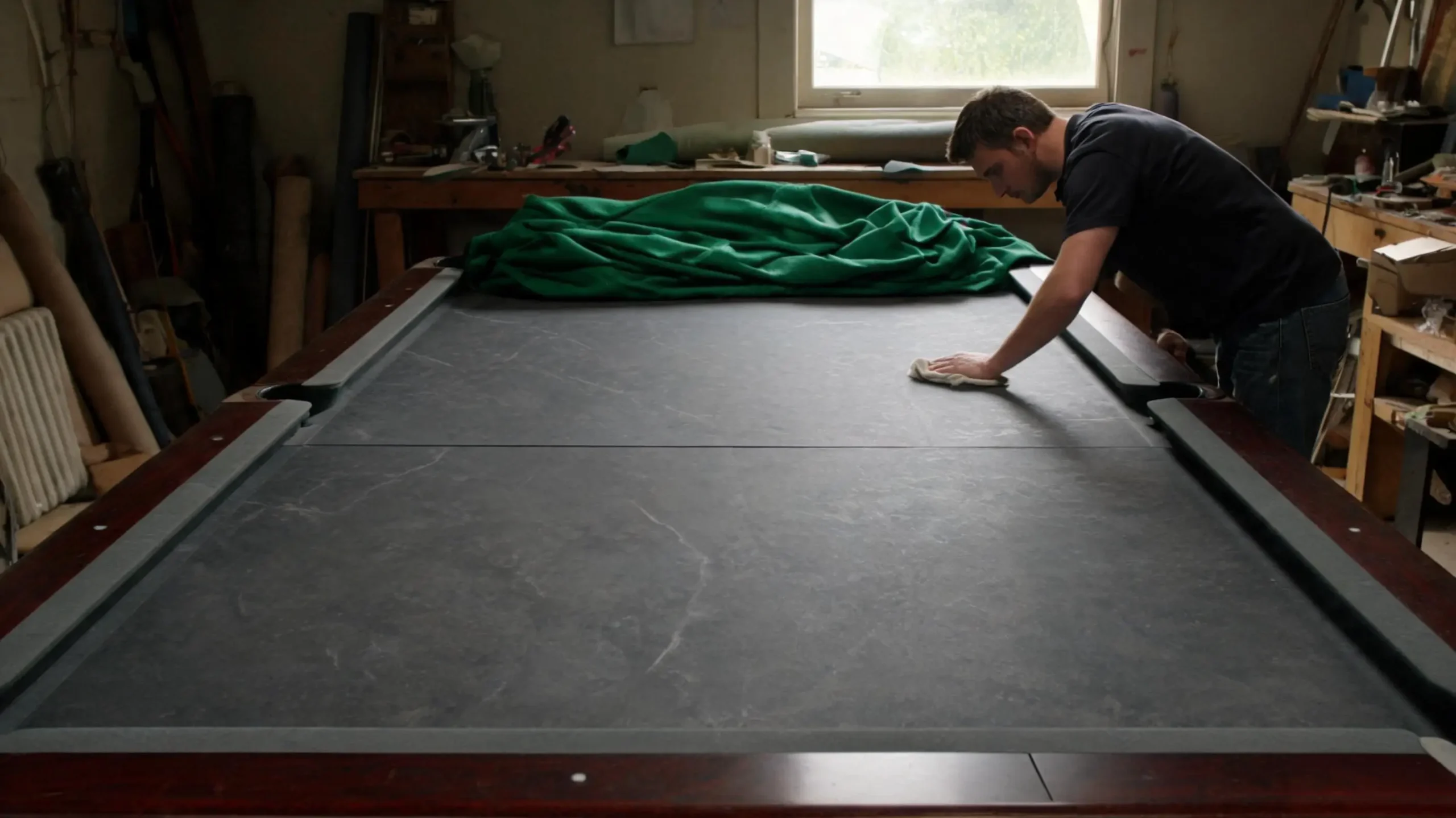
Flatness: The Surface the Game Agrees To
Flatness is the first thing a table manufacturer checks and the last thing a player stops noticing — because a flat bed is invisible in play, while an uneven one announces itself in every slow roll that wanders.
Two things make flatness achievable in a natural stone. The first is the rock itself: slate forms in thin, parallel mineral layers, which means it splits into naturally planar sheets rather than requiring the surface to be carved into shape. The second is processing: the split surface is then calibrated and ground so the finished panel holds a controlled plane, not just a pleasant natural one.
Flatness is also a set property, not only a single-piece property. Professional tables use multiple pieces — three or five, depending on the design — and each piece can be individually flat while the assembled bed is not. The joints have to close as fine, straight seams: on our matched sets, a 0.05 mm feeler gauge barely registers at the joint of a properly finished set. Under the cloth, the pieces must read as one surface, because the ball does not know where the seam is — it only knows whether the bed is true.
How flatness is measured, and how the number on a specification sheet is actually checked with a straightedge and feeler gauges, is covered in detail in Jiujiang Slate Flatness & Dimensional Stability.
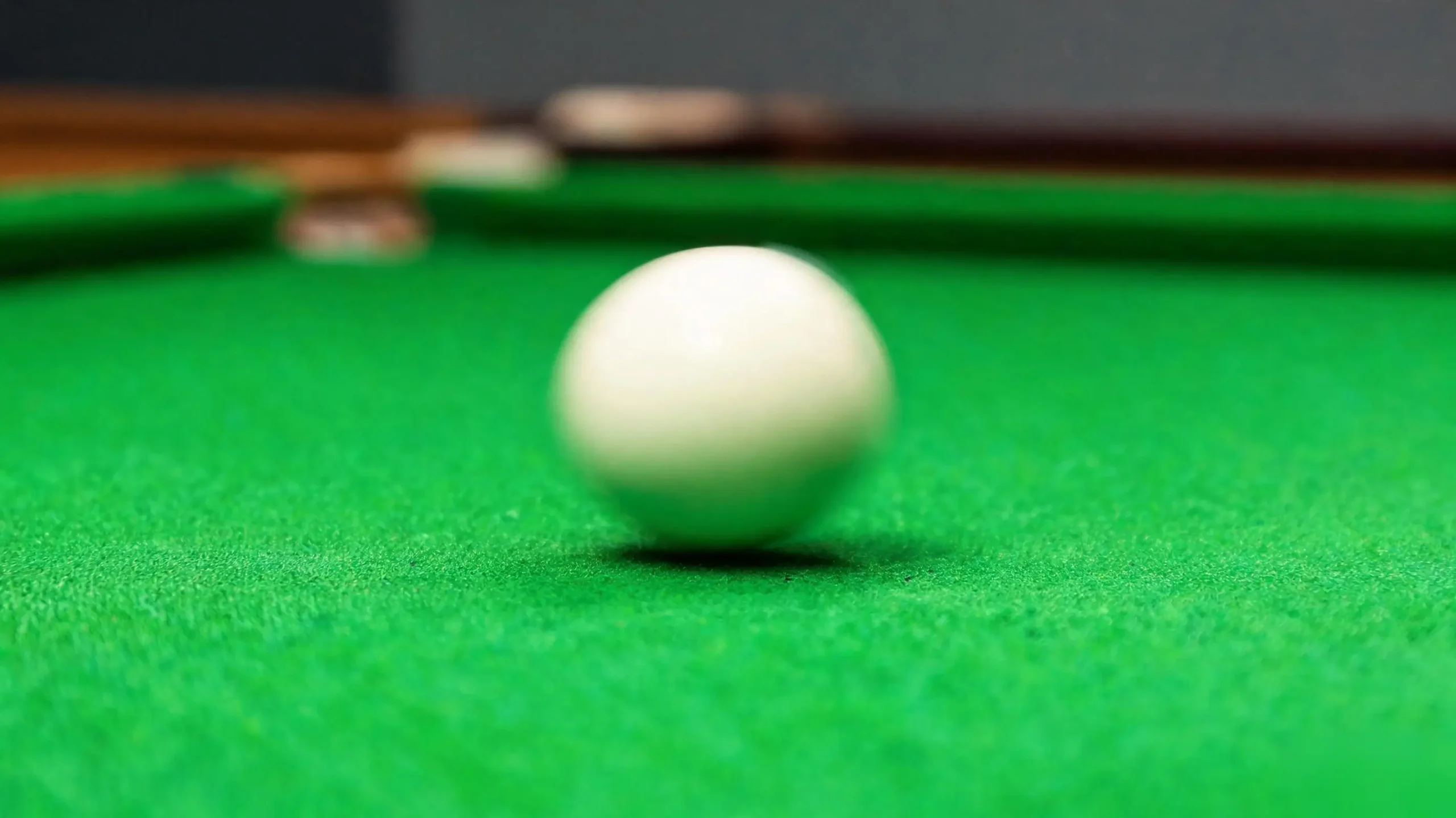
Density: The Mass That Makes the Bed Honest
Density is the characteristic players feel without ever seeing. A billiard bed is not meant to behave like a lightweight panel — it is meant to sit still. When a break is struck, the energy that is not returned to the balls should disappear into the structure of the table, not into a bed that shivers.
Jiujiang slate used for billiard applications tests at 2,719–2,819 kg/m³. In practical terms, that density translates to roughly 125 kilograms of stone per square metre at 45 mm thickness — which is why a full-size snooker bed is a two-or-three-person lift per piece and why the assembled table plays the way it does: solid, quiet, unmoving.
Where that density comes from is a mineral story. The stone is roughly two-thirds silica (SiO₂ around 66.5% in our analysis) — a hard mineral skeleton — compacted by metamorphism into a dense, low-porosity rock. The cleavage surfaces that make slate splittable into planes are, at macro scale, what a honed billiard bed is made of: fine, parallel mineral layers with almost no open pore space between them.
Consistency of density matters as much as the number itself. Uniform density is what allows a CNC machine to take an even cut across the whole panel — the reason a ±0.1 mm tolerance is achievable on this material. A buyer who wants to check density with nothing more than a sample, a scale and a set of calipers can follow the method in Jiujiang Slate Density.
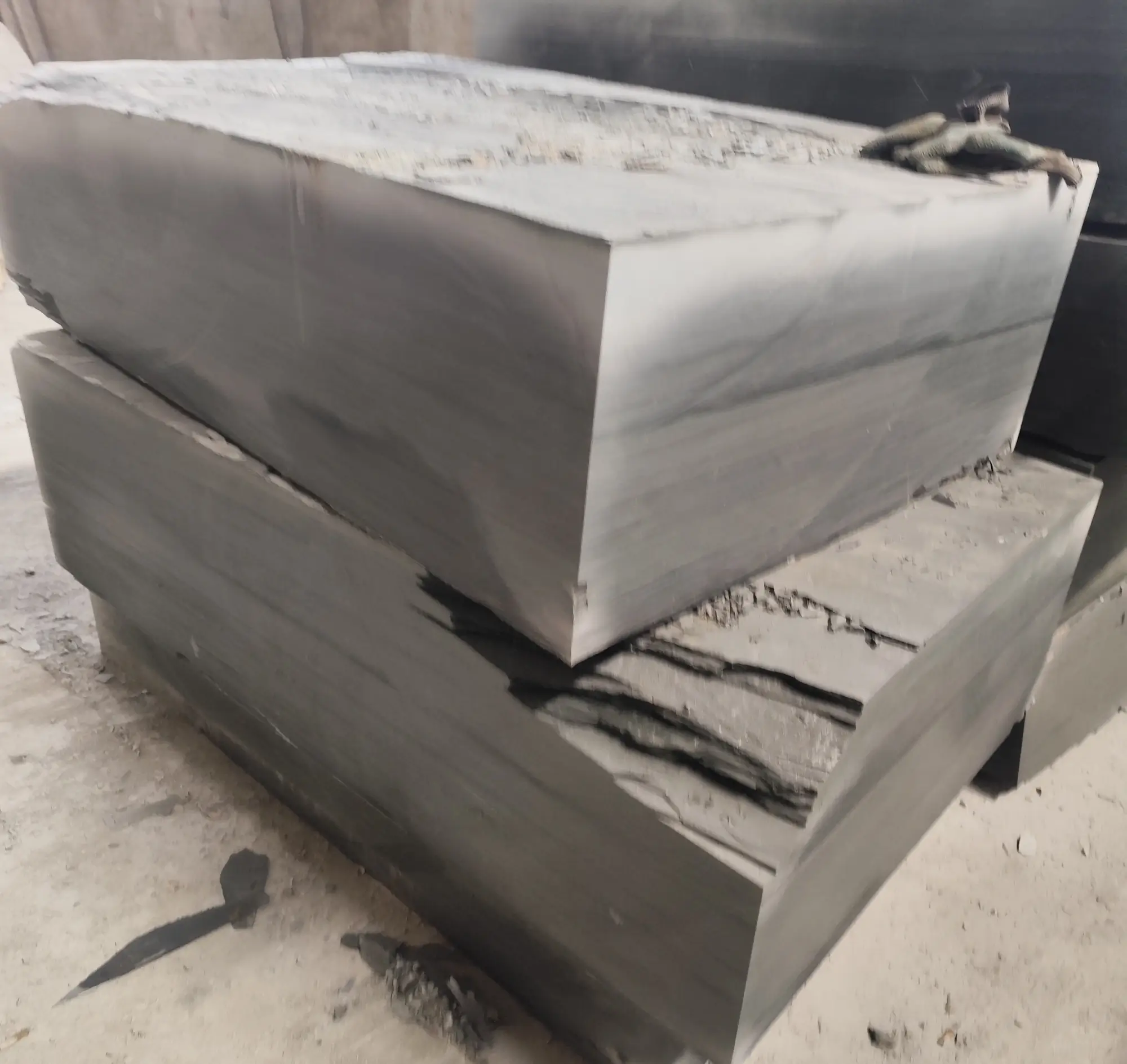
Stability: A Rock That Does Not Change Its Mind
A table bed lives inside a building, and buildings change: radiators cycle, doors open, seasons turn. A bed that shifts with the room cannot hold its level. Stability — the ability to keep dimensions through temperature and humidity swings — is the third pillar, and it is where slate quietly outclasses most alternatives.
Two measured properties do the work. First, thermal expansion: slate moves very little with temperature. The measured coefficient for our material is on the order of 0.0075 mm per metre per degree Celsius — meaning that a single slate panel on a large bed changes by less than a fifth of a millimetre across a 10 °C swing, movement that is absorbed by the design of the joints rather than resisted by the stone. Second, moisture: with water absorption of 0.1–0.2%, the stone takes in so little water that humidity swings have almost no dimensional effect. A bed that neither swells with the rainy season nor shrinks with the heating season stays level for years.
Stability is also why slate ages so well as a material choice: it does not creep under load the way polymer beds can, and it does not delaminate the way cheaper laminated panels eventually do. The stone under a thirty-year-old tournament table is doing the same job it did on the day it was clothed.
Machinability: Hard Stone, Willing to Precision
The fourth pillar is the one that turns a geological material into a manufactured component. A billiard bed needs accurate external dimensions, straight edges, pocket openings, bolt holes in exact positions, cushion-rail machining and prepared joints — features that exist nowhere in nature and must be cut into the stone.
Jiujiang slate sits in a useful middle of the hardness range. On the Mohs scale it tests around 3–4: hard enough to survive decades of play, soft enough that diamond tooling and CNC equipment cut it cleanly and predictably. The region’s stone-processing infrastructure — wire saws, calibration grinders, CNC centres — is built around exactly this working range, which is why finished billiard components, not rough slabs, are what leave the factory.
Machinability is also what makes repeat orders possible. Once a table design’s drawing is approved, the same CNC program produces the same geometry in the next container — pocket positions, hole patterns and joint profiles that match the first approved set. The commercial side of that repeat-ability — what a table manufacturer should ask before the first order — is covered in Why Billiard Table Builders Source from Jiujiang.
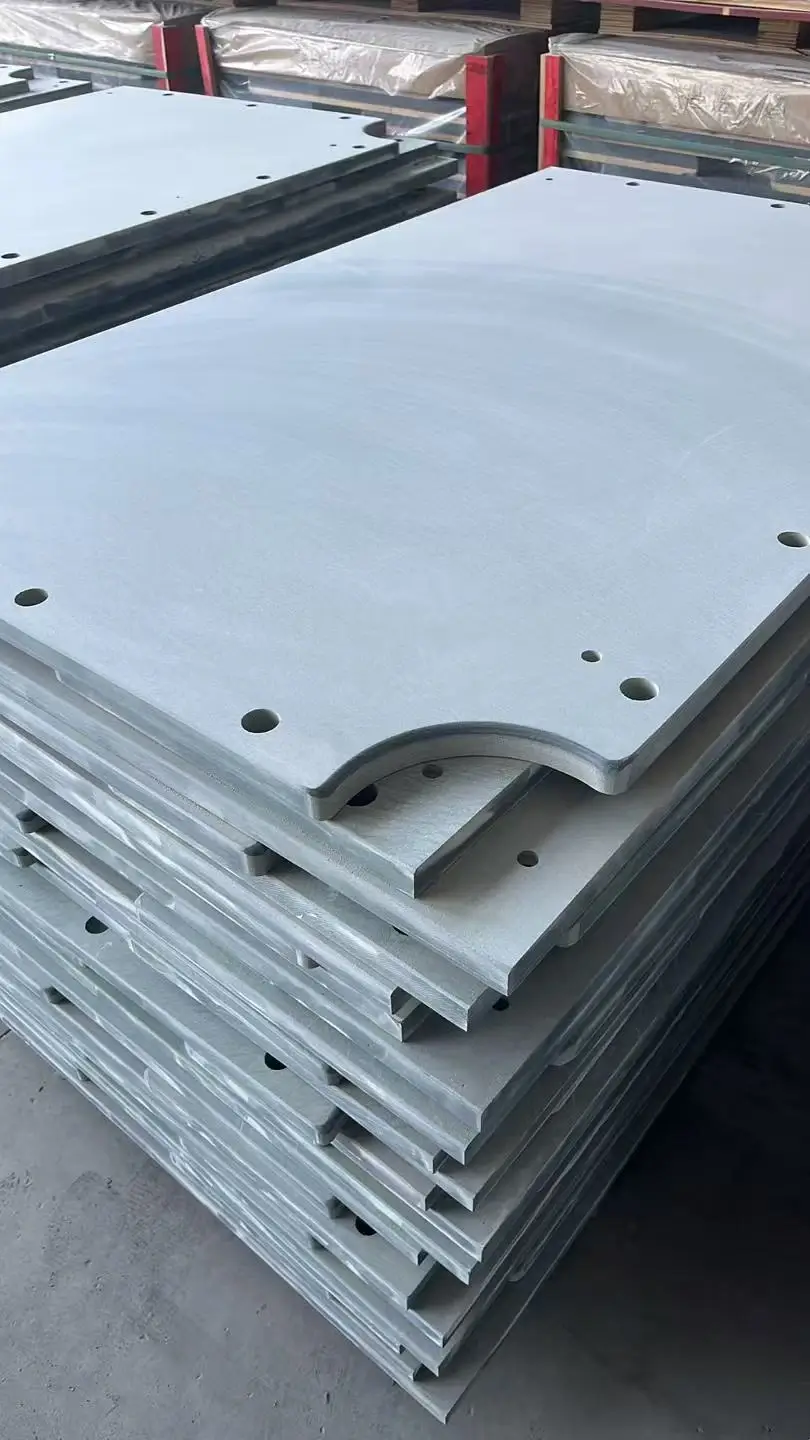
Thickness and Piece Count Are Table Decisions
Buyers often ask which slate thickness is “best”. The honest answer is that thickness is not a slate decision — it is a table decision. The material supplies the physical characteristics; the table design decides how much of them it needs.
Pool tables commonly use slate around 19–25 mm depending on size; carom tables run similar ranges; full-size snooker beds commonly specify 38–50 mm, with 45 mm the most requested for 12-foot tables. A 12-foot bed in the region of 3658 × 1867 mm is usually produced in multiple pieces — three or five, depending on the table design — because a single slab that size would be impossible to quarry, machine, containerise, deliver and carry into most buildings.
More pieces, however, means more engineering, not less. A five-piece bed carries four seams where a three-piece bed carries two, and every seam is a place where two machined edges must meet as one continuous plane. The piece count is a logistics decision; the seam quality is a physics decision — and the game only ever feels the second one.
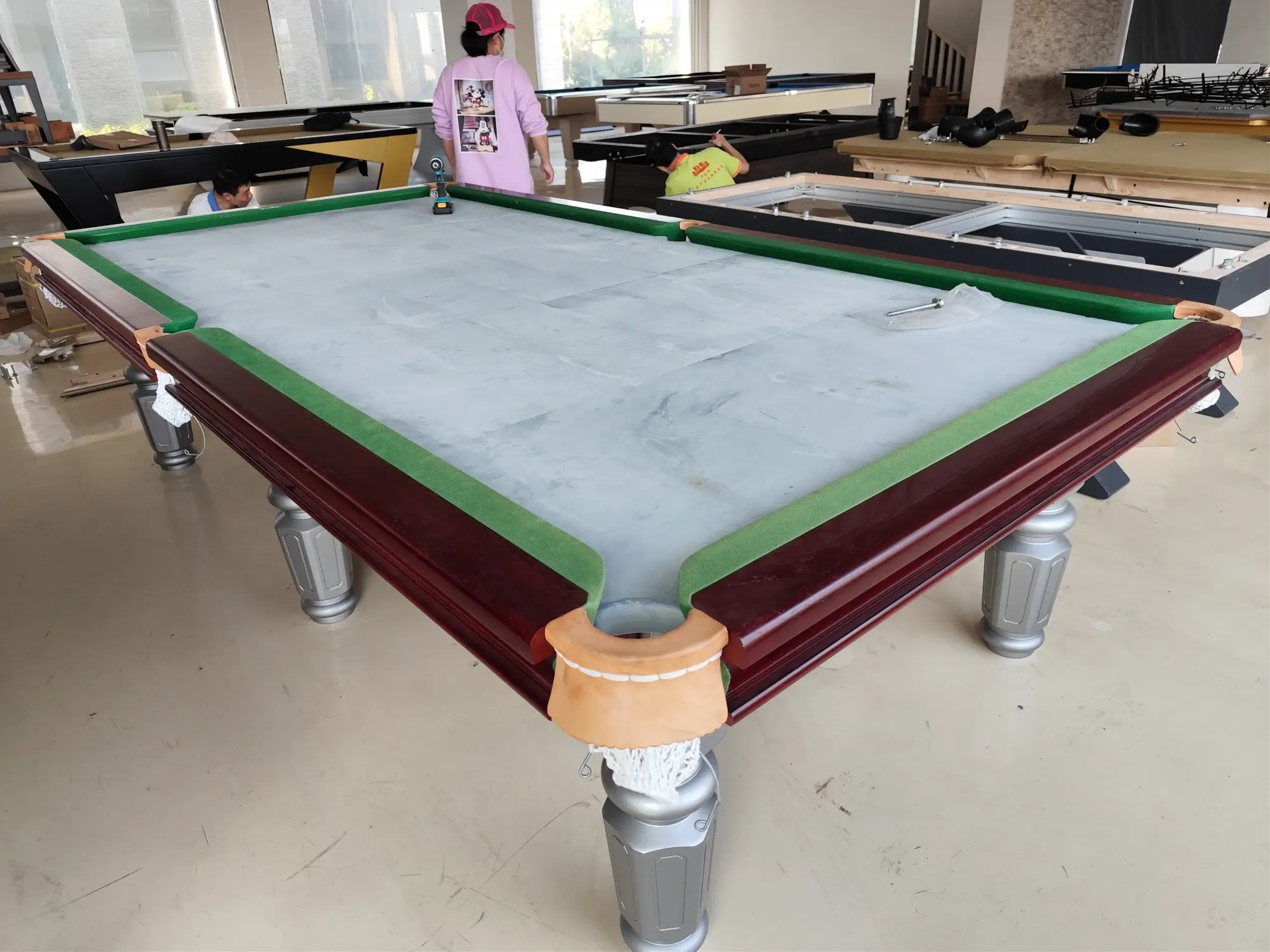
Weight Is Part of the Engineering
Billiard slate is heavy, and that is not an inconvenient side effect of using natural stone — it is part of how the product works. Approximate set weights from production make the point: a 7-foot pool table bed at 19 mm weighs roughly 130–140 kg as a complete set; an 8-foot bed at 25 mm runs around 210–220 kg; a 9-foot bed at the same thickness around 260–270 kg. A 12-foot snooker bed at 45 mm is heavier still, piece by heavy piece.
For the manufacturer and importer, those numbers are a specification to be managed, not an afterthought. Set weight drives container loading plans, crate design, lifting equipment at the warehouse, installation crew sizes and even the delivery instructions sent to the end customer. That is why weight should always be confirmed from the actual production specification — density, finished dimensions, thickness tolerance, machining and piece configuration — rather than estimated from nominal sizes.
The other side of the same coin: weight is the reason the table plays true. A 260-kilogram bed does not flinch when a break is struck. The mass the installer wrestles into place on delivery day is the same mass that keeps the game quiet, level and honest for the decades that follow.
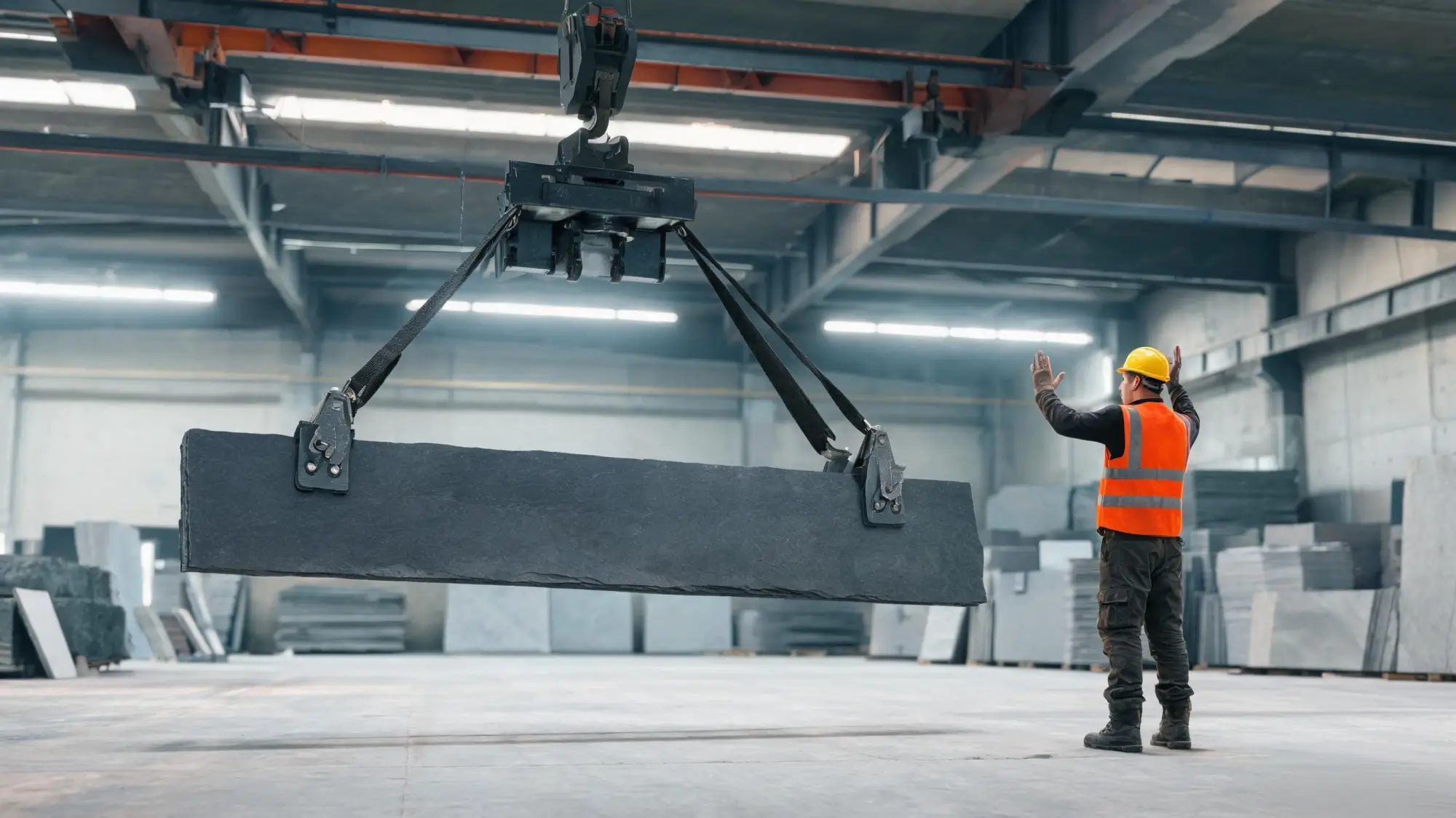
The Fifth Characteristic: Batch Consistency
Four pillars describe what a single set must deliver. But a table manufacturer does not buy one set — a manufacturer buys the next hundred. That makes consistency between batches the fifth characteristic, the one nobody orders by name but everybody depends on.
Consistency is the practical expression of the other four holding steady over time: density that sits in the same range next year, thickness that calibrates to the same tolerance, machining that follows the same drawing, seams that close to the same gauge. It is the property that lets a factory develop a table model once and then simply keep building it.
There is a geological reality behind this that deserves honesty: natural stone varies between quarries, benches and blocks. Consistency is not a gift of geology; it is the result of a production system that selects material against a standard, processes it against a drawing and inspects every panel individually before packing. When buyers ask how consistent a supplier’s material is, what they are really asking is how disciplined that system is.
Four Reasons, One Bed
None of the four characteristics earns its place alone. Flatness without density makes a true surface that plays nervous. Density without machinability makes a solid rock that cannot be shaped into a table. Machinability without stability makes a precise component that quietly drifts out of level. Stability without flatness keeps a surface exactly as imperfect as it started.
What makes Jiujiang slate work for billiard tables is that the four arrive together, and each one is verifiable before an order is committed:
- Flatness — calibrated, ground and seam-matched so the bed plays as one surface
- Density — 2,719–2,819 kg/m³, roughly 125 kg per square metre at 45 mm, the mass that keeps the bed still
- Stability — low thermal expansion and 0.1–0.2% water absorption, dimensions that hold through seasons
- Machinability — a stone that takes CNC precision at ±0.1 mm and repeats it across orders
That combination — not the name of the region, and certainly not the phrase “Chinese slate” — is the reason table beds made from this material play the way they do. For the full properties file behind these four, including flexural strength, hardness and water absorption data, see Jiujiang Slate Properties Explained.
How to Verify the Four Before You Order
Each pillar converts into questions a buyer can actually ask:
- Flatness: What is the specified flatness tolerance? How is it checked — straightedge and feeler gauge, at how many points? What does a matched set close to at the seam?
- Density: What is the measured density of the supplied grade? Is the supplier quoting a single certificate or a working range? Can you verify it yourself from a sample — mass over volume with basic tools?
- Stability: What is the thermal expansion behaviour? What is the water absorption? How were those numbers measured, and do they describe the grade being quoted?
- Machinability: Can the supplier work from your drawings? What thickness tolerance is held in production? Can the same machining program be repeated for the next order?
Answers to those four groups tell a buyer more than any brochure sentence about “premium quality”. And for readers evaluating Jiujiang as a sourcing base from the commercial side — supply chain, OEM terms, first-order qualification — the companion article Why Billiard Table Builders Source from Jiujiang covers the purchasing logic; this one, hopefully, has covered the physics.
Underneath every honest table there is a stone that earned the job. Flat enough to disappear, dense enough to sit still, stable enough to outlast the building’s heating schedule, machinable enough to become a component rather than a boulder. That is the quiet argument for slate — and the specific argument for this particular stone.
Frequently Asked Questions
Is thicker billiard slate always better?
No — thickness is a table design decision, not a quality ranking. Snooker beds commonly use 38–50 mm because large spans need the rigidity and mass; smaller pool tables play perfectly well on 19–25 mm because their spans are shorter and the loads are smaller. Over-specifying thickness adds weight, cost and handling difficulty without adding anything the game can feel. The right question is: what thickness, piece configuration and machining does this table's frame and design require?
Why does a billiard table need such a heavy bed?
Mass is part of the playing performance. When a ball is struck, the bed absorbs energy that is not returned to play; a light, movable bed transmits vibration and can shift its level, while a heavy one sits still. On a full-size bed — 260–270 kg for a 9-foot set, over 125 kg per square metre at 45 mm snooker thickness — the stone barely responds to a break being struck. The weight an installer complains about on delivery day is the same property the player benefits from for decades.
Does natural variation in slate affect how a table plays?
Not when the variation is controlled within specification. Slate is a natural material, so it varies between quarries, benches and blocks — but billiard-grade material is selected before machining, and the characteristics that affect play (flatness, thickness, seam fit) are machined and inspected, not left to geology. The player experiences the finished, calibrated surface, not the raw stone. What natural variation does affect is processing behaviour, which is why material selection and batch consistency matter to the manufacturer.
How flat does billiard slate actually need to be?
Flat enough that the assembled bed, once levelled, lets a ball hold its line at low speed — the practical test most table fitters apply. In manufacturing terms, the surface is calibrated and ground to a controlled plane, and the seams of a matched set close so that a 0.05 mm feeler gauge barely registers at the joint. The full measurement method — straightedge positions, gauge technique and tolerance readings — is covered in Jiujiang Slate Flatness & Dimensional Stability.
Do temperature changes affect a slate bed?
Slate moves very little with temperature. The measured thermal expansion is on the order of 0.0075 mm per metre per degree Celsius, which means a single panel across a 10 °C room swing changes by less than 0.2 mm — movement that the joint design absorbs rather than the stone resisting. Combined with very low water absorption (0.1–0.2%), which keeps humidity swings from having dimensional effects, a slate bed holds its level through seasons in a way few alternative materials can match.
Why is slate still used instead of synthetic table bed materials?
Because the combination of properties is hard to replicate. Synthetic beds can be lighter and cheaper to ship, but they compromise on at least one of the four pillars: polymer materials can creep under load and move with temperature; laminated panels can delaminate over time; medium-density fibreboard beds flex and swell with humidity. Slate delivers mass, dimensional stability, machinable precision and decades of service in one material — which is why professional and tournament tables have stayed with natural stone for generations even as lighter alternatives appeared.
Related Reading
Ask for the numbers behind the bed
Density, flatness method, thermal behaviour, machining tolerance — every physical claim in this article has a number behind it. Send your table specification and we will answer with the measurements, not with adjectives.