
Jiujiang Slate vs Other Chinese Slate Regions
I have walked into factories in four Chinese provinces that all sold "Jiujiang slate." Two of them were nowhere near Jiujiang.
One was in Shaanxi, 800 kilometres west. Another was in Hebei, 1,000 kilometres north. Both had convincing websites, both offered "Jiangxi slate" at competitive prices, and both had no quarry of their own. They bought raw blocks from wherever was cheapest that month, split them, packed them, and labelled the crates with a name buyers recognised.
This is not a scandal. It is how the stone trade works in every producing country — including Spain, Wales and Brazil. But it means that "Jiujiang slate" on a quotation is a label, not a guarantee.
This guide is about how to tell the difference — and the five checks that reveal where your slate actually comes from.
The eight-stage verification chain:
Origin → Quarry → Sample → Specification → Test → Production → Inspection → Shipment
If all eight stages line up, the geographic name means something. If the supplier cannot explain where the stone came from, the label is just a label.
China Has Several Slate Regions — Not One
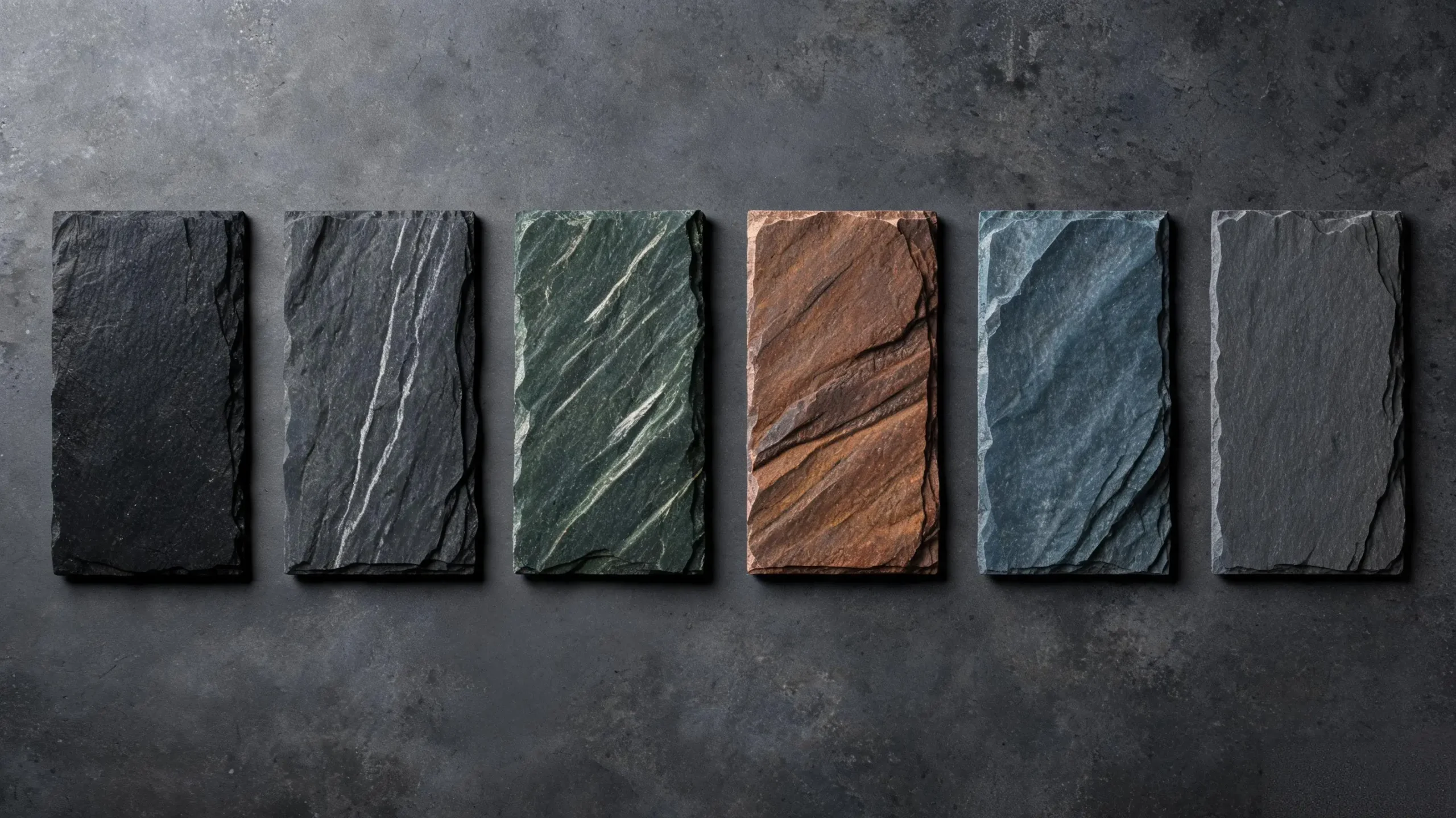
Natural slate is quarried in several parts of China, and the stone from different regions varies significantly in colour, cleavage, density, thickness consistency, weathering behaviour and typical applications. A supplier may describe a product as "Chinese slate," "Jiangxi slate" or "Jiujiang slate" — none of these names tells you where the stone was actually quarried.
| Region | Typical characteristics | Common applications |
|---|---|---|
| Jiangxi | Jiujiang/Lushan area; mature processing industry, established export supply, Silurian-period deposits | Roofing slate, billiard slate, paving, wall cladding |
| Shaanxi | Qinba region; wide colour range; inland logistics chain | Roofing slate, architectural slate, wall and landscape products |
| Hebei | Long-established northern production; numerous varieties and processing centres | Paving, wall cladding, landscaping, decorative stone, roofing |
| Sichuan / Hubei | Part of the broader Qinba slate belt; multiple colours and varieties | Roofing, wall cladding, landscaping, decorative applications |
| Shanxi | Slate resources in several areas; commercial profile differs from major roofing-slate centres | Architectural and construction stone |
| Beijing | Smaller production areas; historically associated with green and rusty slate | Decorative and architectural applications |
A practical overview, not a ranking. The quarry matters more than the provincial label.
Key takeaway: China has at least six slate-producing regions. "Chinese slate" is a category, not a specification.
The Logistics Difference: Jiujiang vs Inland Regions
Jiujiang sits on the Yangtze River. Slate from the Lushan area travels about 40 minutes by truck to Jiujiang Port, then by river barge to Shanghai, where it is loaded onto ocean-going vessels. This is a waterborne supply chain — no long-haul trucking, no multi-stage transfers.
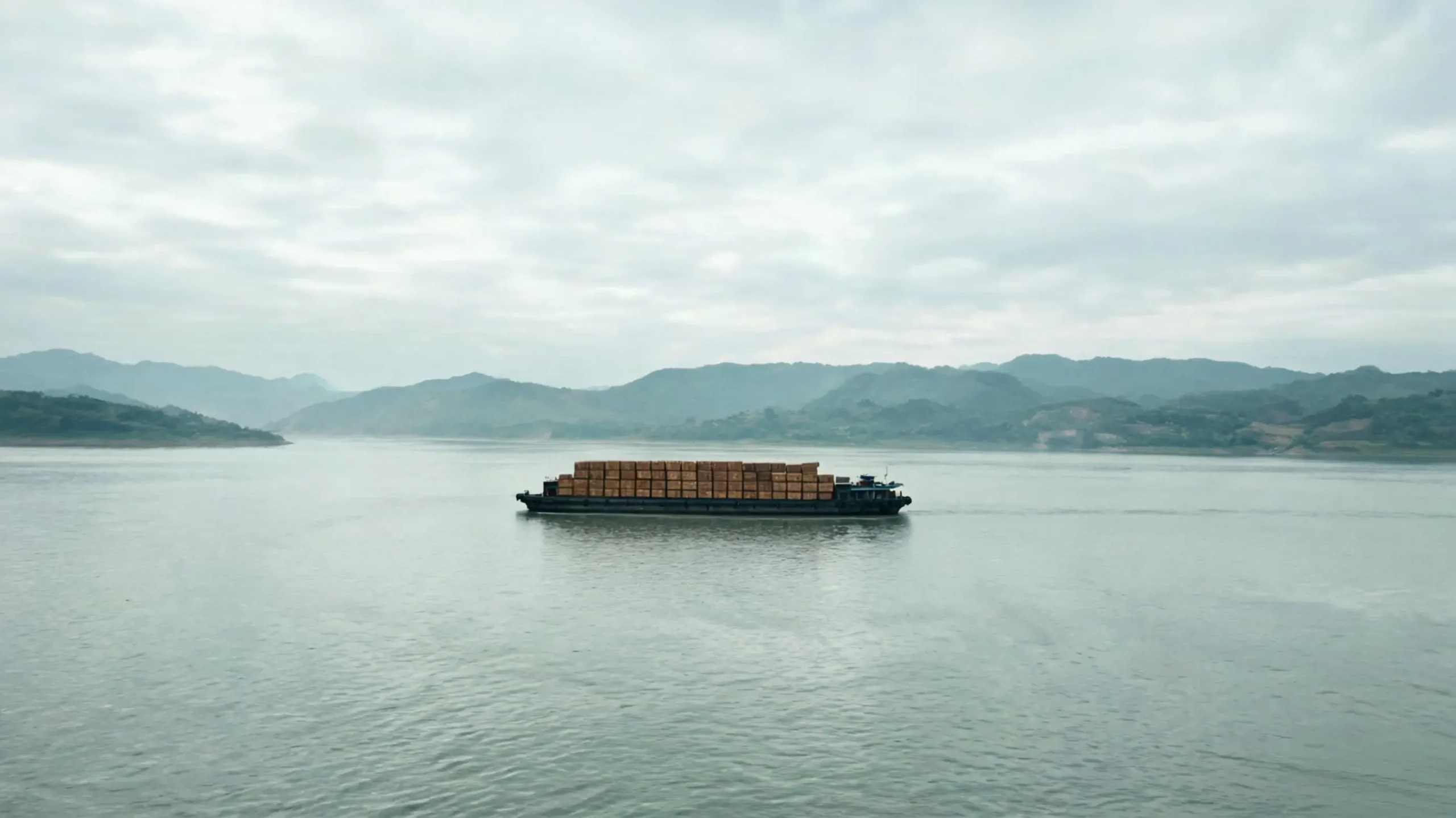
Compare this with Shaanxi. The Qinba slate region, straddling Shaanxi, Sichuan and Hubei, is hundreds of kilometres from the nearest major port. Stone from these inland quarries must travel by road before it can even begin its sea journey. That adds cost, handling and transit time — not because the stone is inferior, but because the logistics chain is longer.
Shaanxi slate has its market. But the logistics channels are different, and that difference shows up in your landed cost.
Green light: A supplier who can explain their logistics chain — factory location, port name, typical transit time — is giving you verifiable facts.
Red flag: A "Jiujiang slate" supplier who cannot tell you which port their slate ships from, or whose factory address does not match the port they claim, may not be shipping Jiujiang stone at all.
Key takeaway: Jiujiang's Yangtze River access means waterborne transport to Shanghai. Inland regions like Shaanxi need hundreds of kilometres of road haulage first. That difference shows up in your landed cost.
Factory Location Is Not Quarry Origin
This is the single most important point in this guide.
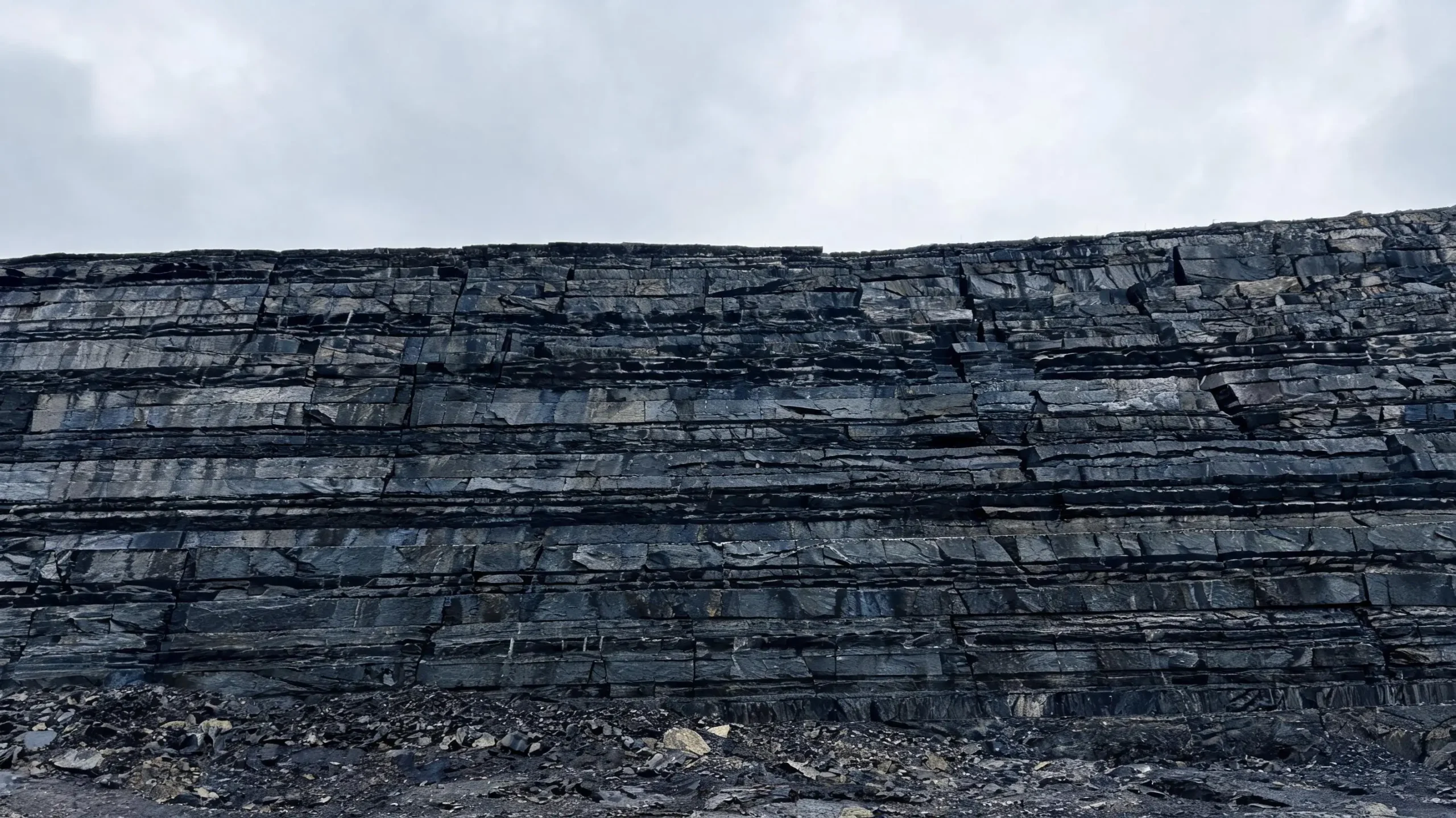
A province is a political boundary. A slate deposit is a geological body. Those are not the same thing. A factory in Jiujiang does not automatically mean every piece of slate it sells was quarried in Jiujiang — a supplier may process stone from another area, and a trading company may buy material from several factories and sell it under one commercial name.
I have seen a factory in the Jiujiang area with excellent CNC equipment and skilled splitters — processing raw blocks trucked in from a neighbouring province because they were cheaper that season. The finished product looked good. The crates said "Jiujiang." The stone was not from Jiujiang.
Even within the same province, different deposits produce different stone. In the Lushan area alone, we work with slate from different deposits that test at 0.1%, 0.13% and 0.2% water absorption. All pass EN 12326 and ASTM standards, but they are not identical. A buyer who needs 0.1% for a severe climate should not receive 0.2% material without knowing the difference.
The Lushan area is unusual within China's slate industry because it produces both roofing slate and billiard slate — two applications with completely different requirements — from different deposits with different processing lines. A roofing buyer in a mild climate may find a Shaanxi green slate perfectly suitable. A buyer specifying billiard-table beds needs precision flatness that only certain deposits can provide.
Red flag: A supplier who claims all their slate has identical test values, regardless of which quarry or layer it came from, is either not testing or not telling the truth.
Green light: A supplier who shows you test data from different deposits, with honest variation, is giving you real information to make real decisions.
Key takeaway: "Where is your factory?" is the wrong question. "Where is the quarry, and can you prove it?" is the right one. Factory location ≠ quarry origin.
Four Business Models Behind "Chinese Slate"
Every "Chinese slate supplier" operates under one of four models. None is inherently wrong, but each has different traceability implications.
Model A — Quarry-owned manufacturer. The manufacturer operates its own quarry and factory. This gives the strongest direct control over raw material and the clearest origin traceability.
Model B — Long-term quarry partner. The factory does not own the quarry but has a stable relationship with a specific quarry. This works well if the material is traceable and quality is controlled.
Model C — Multiple quarry sourcing. The factory purchases material from several quarries depending on price, colour or availability. This may be legitimate, but buyers need tighter specifications and should ask which quarry each order comes from.
Model D — Trading company. The company buys finished or semi-finished slate from other factories. Not automatically a problem — but the buyer should know they are not dealing with the producer, and origin claims need extra verification.
Red flag: A supplier who cannot clearly tell you which model they operate under, or who claims to be Model A but cannot produce quarry photographs or a quarry address.
Green light: A supplier who openly explains their business model and can trace your order back to a specific quarry and deposit.
Key takeaway: Ask "Do you own the quarry, partner with one, buy from multiple, or trade?" The answer tells you how much verification you need.
Five Checks to Verify Real Origin
There is no single visual trick that can prove the origin of natural slate. Instead, use these five independent checks — together, they separate a traceable supply chain from a marketing-based origin claim.
Check 1: Ask for the quarry location — not the factory location.
Ask "Where is the quarry?" Then ask for the quarry's city, county, quarry name, and photographs of the quarry face, extraction process and raw blocks. A serious manufacturer should be able to explain the supply chain.
Check 2: Compare quarry photos with the finished product.
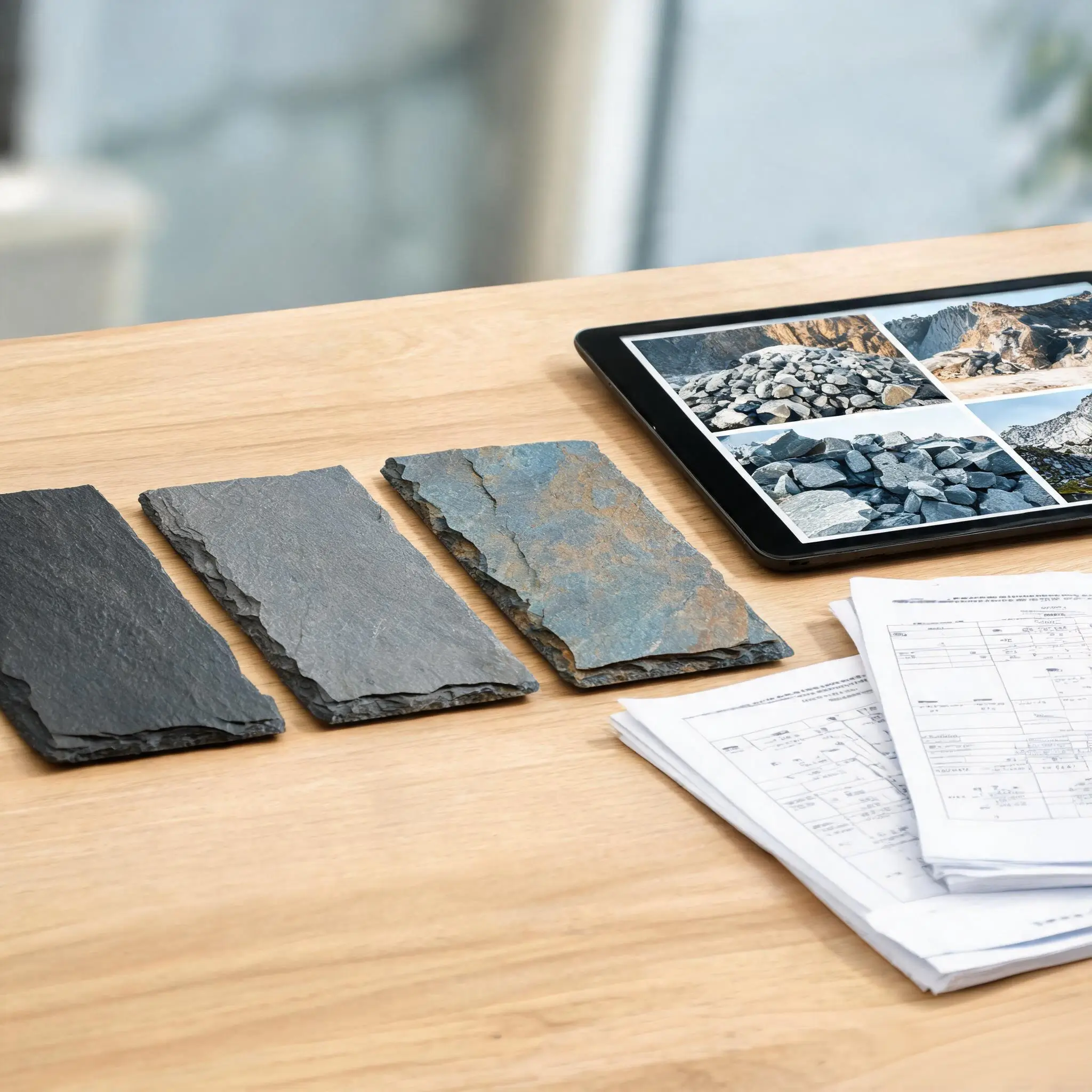
Ask to see photographs of raw material in the quarry, freshly extracted blocks, split material, finished products and packed products. Look for visual continuity — does the quarry material resemble the finished product? This is not laboratory proof, but it is a useful first-level check.
Check 3: Ask whether the factory owns or operates the quarry.
The answer reveals the supply chain structure (see the four models above). Each model has different traceability implications and requires a different level of buyer diligence.
Check 4: Ask for test data with batch numbers.
A test report proves the tested material — not automatically every slate the company sells. Ask which quarry supplied the tested sample, when it was tested, and whether current production comes from the same quarry. Can the supplier provide the original report, not just a screenshot? A report with a batch number that matches your order is worth more than any province name.
Check 5: Request a reference sample from the production batch.
Ask the supplier to retain a reference sample from your production batch, marked with the batch number, so you can compare it against the shipment when it arrives. This is standard practice in serious slate procurement.
For a more detailed procurement workflow, see our guide to sourcing roofing slate from China and our pre-shipment inspection checklist.
Key takeaway: Five checks — quarry location, photo continuity, business model, test data with batch numbers, reference sample. Any one check alone is weak. All five together make it very hard to fake.
Test Data Beats Colour and Province Names

Colour is useful for initial identification, but it is not reliable proof of origin. Black slate occurs in multiple Chinese regions. Green slate occurs in multiple regions. Rusty slate occurs in multiple regions. Even the same quarry may produce different shades depending on the geological layer. Black does not mean Jiujiang. Green does not mean Shaanxi. Rusty does not mean Hebei.
A test report, on the other hand, is evidence you can verify. For roofing slate, relevant standards include EN 12326 and ASTM C406. The key questions: What quarry supplied the tested sample? When was it tested? Is the current production from the same quarry? Can the supplier provide the original report, not a screenshot?
Consider two suppliers offering "Jiujiang Black Slate." Supplier A provides quarry information, sample traceability, density data, water absorption data, strength testing, production photographs and consistent thickness. Supplier B provides a catalogue, a "high quality" claim, a "Jiangxi origin" assertion and a low price. The commercial name is the same. The evidence is not.
For a structured approach to evaluating suppliers, see our questions to ask a roofing slate supplier.
Key takeaway: Colour tells you what the slate looks like. A province name tells you what the crate says. A test report with a batch number tells you what the stone actually is.
What Buyers Should Actually Compare
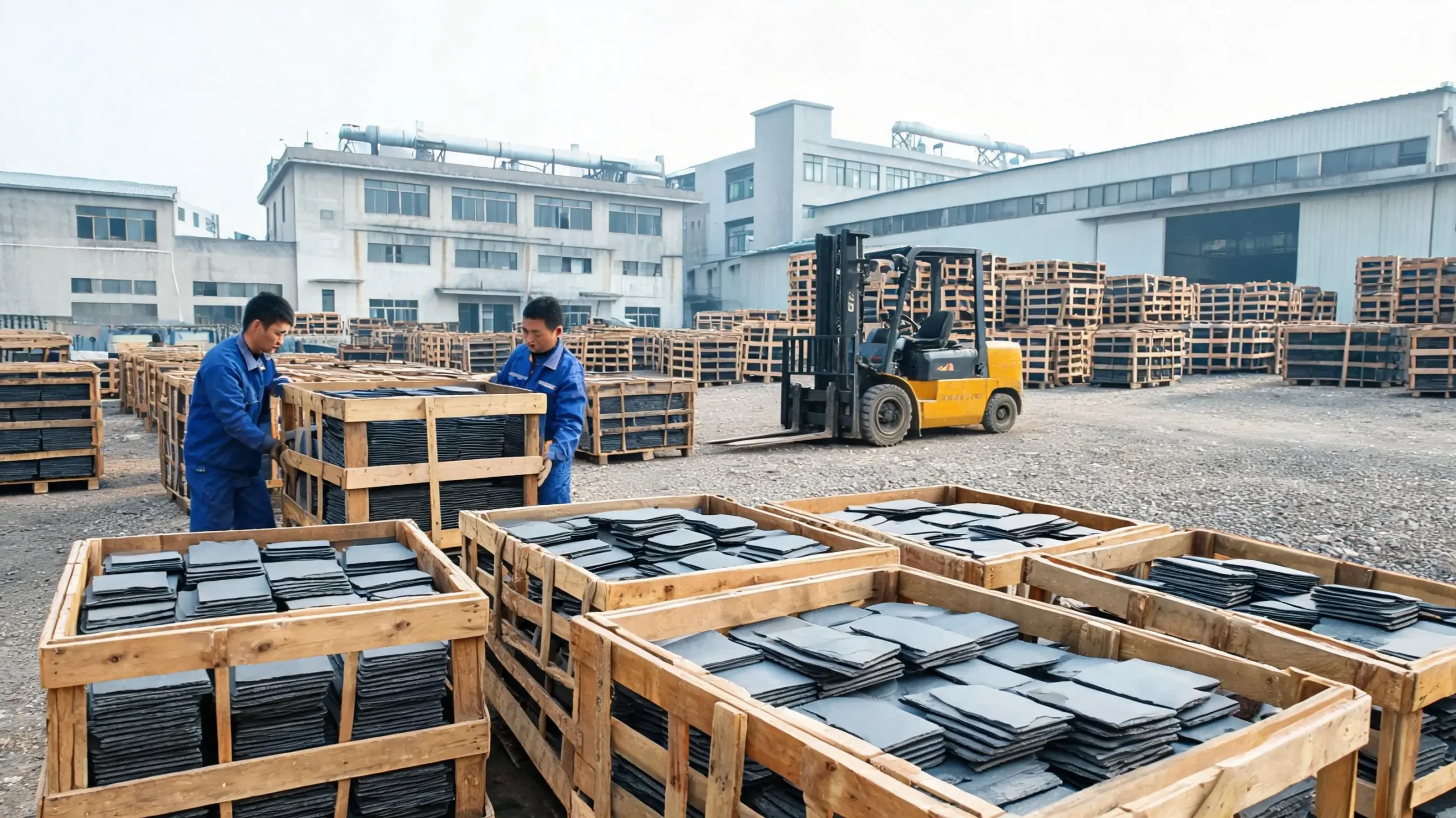
When comparing Jiujiang with another Chinese slate region, use this matrix instead of asking which province has the "best slate":
| Factor | What to compare |
|---|---|
| Quarry origin | Exact quarry, not just province |
| Rock characteristics | Cleavage, grain, structure, mineral composition |
| Colour | Natural range and batch consistency |
| Thickness | Nominal thickness and actual tolerance |
| Flatness | Especially for roofing and billiard applications |
| Density | Measured value, not general claims |
| Water absorption | Test result from representative material |
| Strength | Relevant test method and result |
| Weathering | Freeze-thaw and other applicable tests |
| Production capacity | Actual repeatable output |
| Traceability | Quarry → factory → shipment |
| Logistics | Inland transport distance and port access |
| Price | Based on the same specification |
"Which province has the best slate?" is the wrong question. "Which specific quarry provides the properties I need, at the required scale and consistency, with a verifiable supply chain?" is the right one.
Key takeaway: Compare 13 factors — from quarry origin to logistics to price — not province names. The matrix above is your reference tool.
Don't Buy the Label — Buy the Material
Being from Jiujiang does not automatically make slate high quality. There are good products and poor products in every major stone-producing region. A Jiujiang supplier should be willing to let the material speak for itself through representative samples, clear specifications, quarry information, production evidence, testing and consistent shipment quality.
Our factory processes slate with CNC precision to ±0.1 mm tolerance, and we inspect every single piece — 100% full inspection, not batch sampling. We load containers at our own factory yard, about 40 minutes from Jiujiang Port, without passing through any third-party warehouse. A standard 20-foot container holds 1,130 to 1,450 square metres of 7–9 mm roofing slate. We have exported to more than 30 countries.
But none of that matters if you cannot verify it. If a supplier — Jiujiang or anywhere else — can walk you through the complete chain from quarry to shipment, with photographs, test data and batch numbers, the geographic name becomes meaningful. If they cannot, the label should be treated cautiously.
Do not buy the label. Buy the material — and verify its origin.
Frequently Asked Questions
Which Chinese province produces the best roofing slate?
There is no single "best" province. Slate quality depends on the specific quarry and deposit, not the provincial label. Quarries in Jiangxi, Shaanxi and Hebei can all produce suitable roofing slate if the material meets EN 12326 or ASTM C406 requirements. The better question is: which specific quarry provides the test data, thickness consistency and supply capacity your project needs?
How can I tell if slate labelled "Jiujiang" actually comes from Jiujiang?
Ask for the quarry location (not just the factory address), request current quarry photographs, compare the raw material with the finished product, check whether the test report batch number matches your order, and ask whether the factory owns or operates the quarry. If the supplier cannot answer these questions clearly, the "Jiujiang" label may not reflect the actual origin.
Is Shaanxi slate suitable for roofing?
Yes, Shaanxi slate can be suitable for roofing when it comes from a quarry that produces material meeting EN 12326 or ASTM C406 standards. Shaanxi's Qinba region produces a range of colours and has its own market. The key is to verify the specific quarry's test data and supply consistency, not to assume suitability from the province name alone.
Can a factory in Jiujiang sell slate from other regions?
Yes. A factory's location does not determine where its raw material was quarried. Some factories in Jiujiang process stone from other provinces, and some trading companies source from multiple factories. This is not necessarily a quality problem, but it means the origin label on the crate may not match the actual quarry. Buyers should ask directly: "Was this stone quarried in Jiujiang, or processed here?"
What test data should I ask for when comparing Chinese slate regions?
Ask for water absorption, flexural strength, freeze-thaw resistance, density, and thickness tolerance data tested to EN 12326 or ASTM C406 standards. Most importantly, ask whether the tested sample comes from the same quarry as your order, and request the original report with a batch number — not a screenshot. Test data with batch traceability is the strongest evidence of origin and quality.
Does the province name affect slate quality?
No. A province is a political boundary, not a geological one. Two quarries in the same province can produce slate with different density, absorption, colour and weathering behaviour. Quality is determined by the specific deposit, the processing standard, and the inspection regime — not by which province the crate says on the label.
Related Reading
Want to verify the origin of your Chinese slate?
We can walk you through the complete chain — quarry photographs, test reports with batch numbers, production records and container-loading photos. No re-labelling, no mixed origin, no ambiguity.