
Billiard Slate FAQ: 28 Questions About Sizes, Thickness, Weight & Quality
Most of these questions arrive before the drawing does — what size, how thick, how much it weighs, how flat it is, why two quotes for the same 9 ft slate differ. We ordered this page the way a sourcing project actually unfolds.
Every answer opens with the verdict, then a few sentences of reasoning; where a question deserves a page of its own, we link to it. New to the material? Start with What Is Billiard Slate?
The 28 Answers at a Glance
Scan the verdicts first, then jump to any full answer. The compressed lines leave out the conditions; the answers below carry them.
| # | Question | Short answer |
|---|---|---|
| 1 | What exactly is billiard slate? | A machined natural stone bed — the layer that decides how true a ball rolls. |
| 2 | Why slate instead of MDF or plywood? | Rigidity and stability that sheet wood cannot hold for years. |
| 3 | Is it the same stone as roofing slate? | Same rock family, selected and processed for a different job. |
| 4 | How long does billiard slate last? | Decades — the least consumable part of the table. |
| 5 | Is there a standard slate size for a 7, 8 or 9 ft table? | No. Table size names a table; the drawing names the slate. |
| 6 | How thick should billiard slate be? | Thickness follows the table design, not a universal rule. |
| 7 | Is a thicker slate a better slate? | No — it is a specification, not a grade. |
| 8 | How much does a slate set weigh? | Calculate it from dimensions, thickness and density — a 9 ft 25 mm three-piece set is roughly 250–270 kg. |
| 9 | Why do most tables use three pieces? | Handling and freight — a matched set levels just as true. |
| 10 | Can you cut a size outside the catalogue? | Yes: outline, thickness and piece count from your drawing. |
| 11 | Pockets and bolt holes to our drawing? | Yes, CNC from your CAD — the drawing defines the pattern. |
| 12 | What flatness tolerance should I ask for? | A measurement method and a written agreement, not just a number. |
| 13 | How do you check flatness before shipping? | Every set against the agreed inspection plan, piece by piece. |
| 14 | Can slate be drilled without cracking? | Yes, when stone, tooling and feed rate are controlled. |
| 15 | What should we check on arrival? | Condition first, count second, dimensions third — photos before anything moves. |
| 16 | Does billiard slate crack easily? | Not in play — nearly all cracking is a handling story. |
| 17 | How is slate packed for export? | Flat on heat-treated wood-framed pallets, foam between pieces, strapped. |
| 18 | How many sets fit in a container? | By weight before volume — ask for the loading plan. |
| 19 | What documents does a shipment need? | Invoice, packing list, bill of lading, certificate of origin, ISPM 15. |
| 20 | What if something arrives damaged? | Photograph it in place and claim inside the agreed window. |
| 21 | How do we choose a supplier? | One who can demonstrate control over the key stages — with production photos. |
| 22 | Is Chinese billiard slate good? | Origin is not a grade; the evidence is per batch. |
| 23 | Can we start with a sample or trial order? | Yes — sample, prototype, trial batch, repeat orders. |
| 24 | Why do two quotes for the same 9 ft slate differ? | Because the same size is not the same product. |
| 25 | What should a good enquiry include? | Eight things — and a drawing replaces most of them. |
| 26 | What is the most common ordering mistake? | Ordering by table size alone, without an approved drawing. |
| 27 | Chinese 8-ball, carom and pyramid slate? | Yes — each to its own market specification. |
| 28 | Can billiard slate be used as replacement slate? | Yes — when the replacement matches the original bed's drawing. |
The Stone Under the Cloth
Four questions buyers ask before dimensions enter the conversation. They settle whether the material makes sense for the table; everything after this is engineering.
What exactly is billiard slate?
A dense natural stone bed, cut from large blocks, ground flat and machined to the table drawing — the layer under the cloth that decides how true a ball rolls. It ships as one-piece, three-piece or multi-piece beds depending on the table design, and on professional tables it is drilled and routed to the manufacturer's drawing rather than a generic pattern. The material itself is unpacked in What Is Billiard Slate?
Why do pool and snooker tables use slate instead of MDF or plywood?
Rigidity and dimensional stability — a sheet of wood cannot hold a precision-flat bed for years. MDF and plywood are more sensitive to humidity-related dimensional change, while properly selected and processed slate provides a much more stable playing bed. Composite beds have their place on entry-level and portable tables, where weight and price matter more than long-term accuracy, but on commercial and professional tables natural slate remains the default, because the ball roll follows the surface and the surface stays put. The full case is made in Why Are Pool Tables Made with Slate?
Is billiard slate the same stone as roofing slate?
The same rock family — selected and processed for a completely different job. Roofing slate is graded for weathering, wetting and appearance on a roof; billiard slate is selected for structure and machinability, then ground and drilled to a drawing. A slate that performs beautifully on a roof should not be assumed to suit a table bed, and the reverse holds as well. If you source both products, the roof side of the same stone is covered in our Roofing Slate Guide
How long does billiard slate last?
Decades — the bed is the least consumable part of any table. Cloth, cushions and rails are replaced on schedule; a well-made, correctly installed bed usually outlasts several re-clothings and often the table built around it. What shortens slate life is rarely time — it is impact, wrong lifting and moisture left standing on an unprotected surface. Handle it properly and the stone simply persists.
Sizes, Thickness and Weight
The three numbers that drive the frame, the freight and the price — and the misconception that travels with each of them.
Is there a standard slate size for a 7 ft, 8 ft or 9 ft pool table?
No. A table size names a table, not a slate. The playing area and the slate outline are different measurements, and the outline depends on the frame design, cushion overhang and pocket positions — two 9 ft tables from different manufacturers can take different slates. Ordering by table size alone is the fastest way to end up with a bed that does not fit. The dimensions our production runs most often are collected in Billiard Slate Technical Specifications; anything outside them starts from your drawing.
How thick should billiard slate be?
Thickness follows the table design — an engineering specification, not a universal number. Many pool designs use 19–25 mm; heavier-duty and tournament designs specify 30 mm or more, sometimes up to 38 mm. Full-size snooker beds commonly use 45 mm, with 50 mm also built for heavier designs. The right number for your table is written on its drawing, and the reasoning behind each band is compared in Pool vs Snooker vs Chinese 8-Ball Slate Thickness
Is a thicker slate automatically a better slate?
No. A well-made 25 mm bed that meets the agreed flatness and dimensional tolerances serves its table better than a badly made thicker one. Thickness works together with the frame, the support spacing and the leveling system — it cannot rescue poor machining or a weak frame, and it adds weight that your floor and your freight budget both notice. The honest comparison lives in Pool Slate vs Snooker Slate
How much does a slate set actually weigh?
More than most first-time buyers expect — calculate it, do not guess. The arithmetic is length × width × thickness × density, and natural slate runs around 2.7 t/m³. For reference: a 9 ft three-piece set at 25 mm lands around 250–270 kg — roughly 80–90 kg per piece — while a full-size snooker set at 45 mm can approach 800 kg depending on the drawing; a 7 ft set at 19 mm depends on the actual dimensions. Ask any supplier for per-piece and per-set weights including packing; those numbers decide your forklift, your floor and your freight. Reference weights sit on the technical specifications page.
| Example | Approx. slate weight |
|---|---|
| 9 ft pool, 25 mm, 3-piece | 250–270 kg |
| 12 ft snooker, 45 mm, 5-piece | Can approach 800 kg (depends on drawing) |
| 7 ft pool, 19 mm | Depends on actual dimensions |
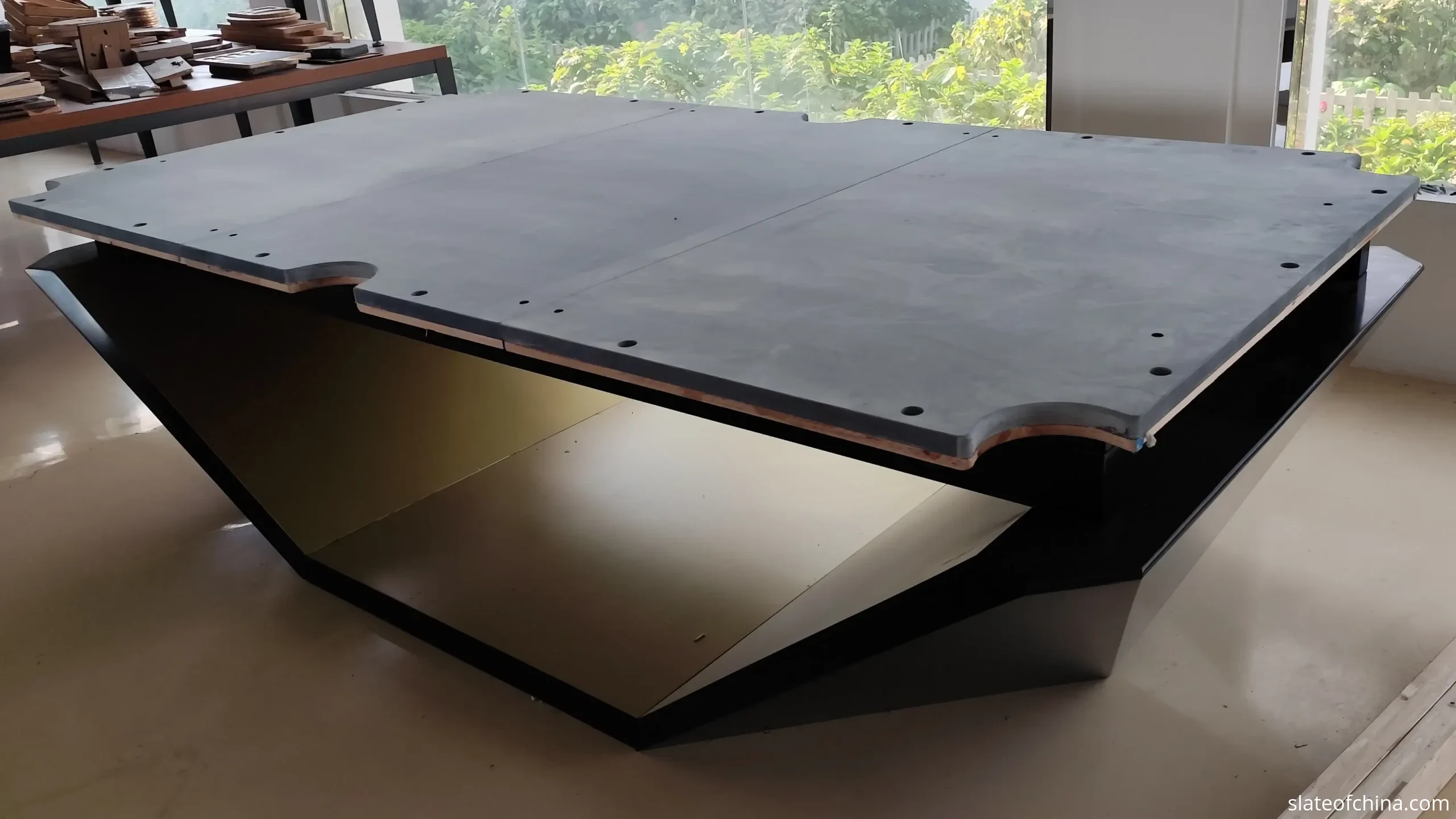
Why do most tables use three pieces of slate?
Because a single slab the size of a table is expensive to move — and a matched three-piece set levels just as true. Splitting the bed makes manufacturing, container loading and installation practical. The pieces are machined as a matched set, their joint faces are ground flat, and the seams are dressed at installation so the bed reads as one surface. One-piece beds still make sense for smaller tables and certain markets; the full trade-off, including the manufacturer's cost view, is in One-Piece vs Three-Piece Pool Table Slate and 1-Piece vs 3-Piece for Manufacturers
Can you cut a size that is not in your catalogue?
Yes — custom outlines, thicknesses and piece counts are normal OEM work, quoted from your drawing. Non-standard sizes are not an exception in this trade; they are the routine. What matters is that the drawing is complete: outline, playing area, pocket positions, hole pattern, joint positions. The workflow is described in Custom Billiard Slate Manufacturing, and the formats we run in production are browsable in the billiard slate category
Machining, Flatness and Quality
Where a slab becomes a component. These six answers decide whether the bed drops straight onto the frame — or onto your complaint list.
Can you machine pocket openings and bolt holes to our own drawing?
Yes — CNC machining from your CAD, and the drawing rather than the game defines the pattern. Pocket openings, bolt holes, screw holes, recesses and edge profiles are all machined to specification. One thing worth knowing: hole patterns are table-specific, not game-specific — two different 9 ft tables can drill completely differently — which is why we ask for the drawing instead of the table size. How our machine floor handles this is shown in CNC Machining in Our Jiujiang Factory
What flatness tolerance should I ask a supplier for?
Ask for a measurement method and a written agreement — not just a number. A tolerance is meaningless until you know how it is measured: straightedge and feeler gauges or laser scanning, on what support, at how many points, recorded per piece or per batch. A quoted flatness tolerance is only meaningful when buyer and supplier agree on the reference surface, measurement points, measuring tool and acceptance limit. Two suppliers quoting the same number with different methods are not quoting the same product. Agree the tolerance and the inspection plan in writing before production starts. The figures we work to, and how they are measured, sit on Billiard Slate Quality & Test Data; the questions that separate evidence from paper are listed in What Buyers Should Ask For
How do you check a set is flat before it ships?
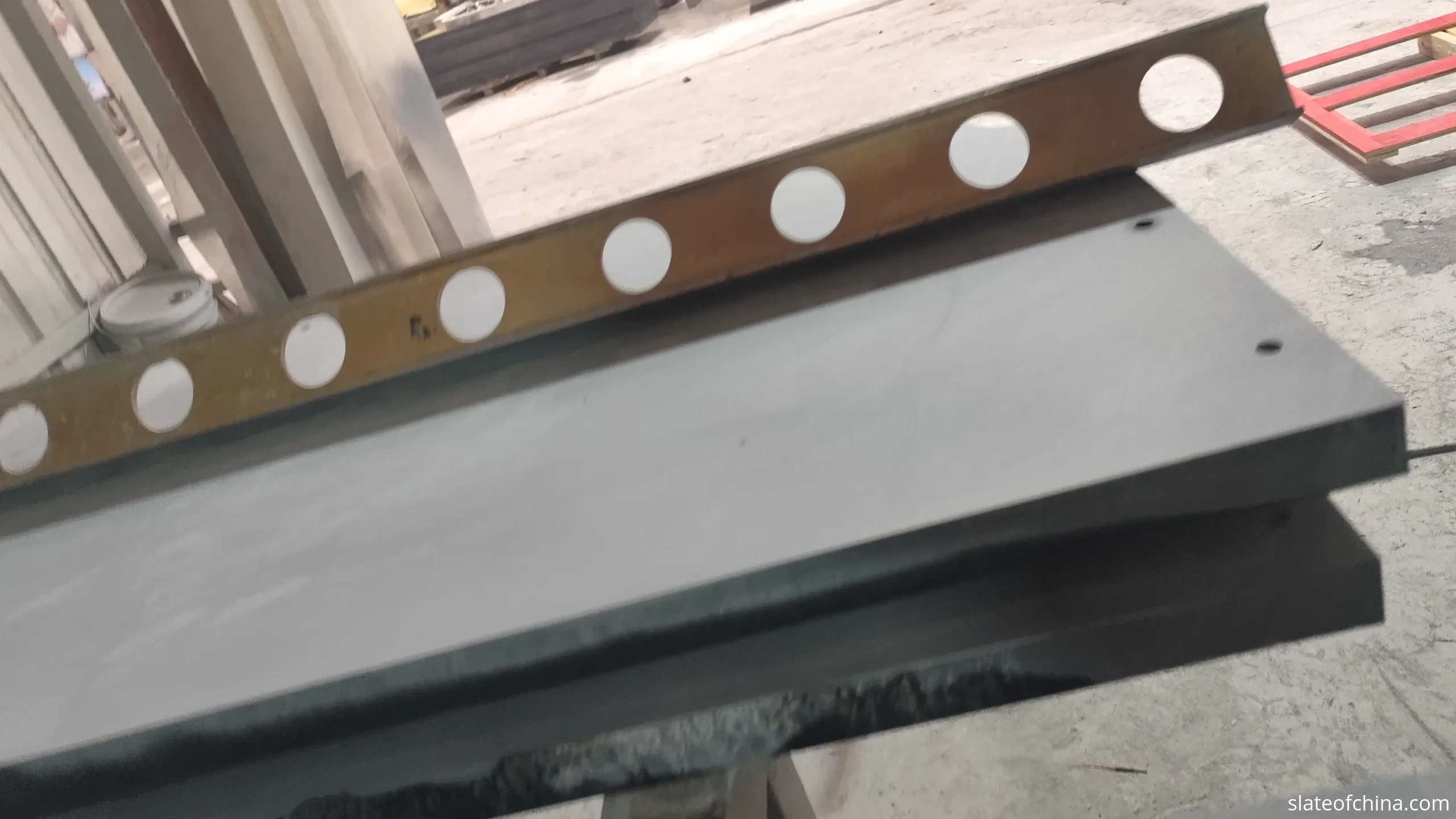
Every set is checked against the agreed inspection plan before packing — surface, joints and edges, recorded piece by piece. A straightedge travels across the honed surface and across both joints of a three-piece set; thickness is taken at several points; edges are checked for chips and machining quality; and matched sets are verified together, so the pieces that leave together belong together. The records travel with the order. What that looks like at the bench, including what gets rejected, is shown in how we check every piece before packing
Can natural slate be drilled without cracking?
Yes — drilling is routine when the stone, the tooling and the feed rate are controlled. The risk is not the hole; it is the conditions around it: hole diameter and position, the distance from the edge, the internal structure of the individual piece, and how the panel is supported while it is machined. This is precisely the work that separates a stone-processing factory from a slate trader with a phone.
What should we check when the container arrives?
Condition first, count second, dimensions third — and photographs before the pallets move. Shoot the pallets as they sit in the container; that is the only record of what the voyage did. Then check the set count against the packing list, walk the edges for chips, spot-check dimensions and flatness against the inspection record, and keep each set strapped until it is ready to move. Report anything inside the claim window written into the contract — not after the pallets have been broken down. The full receiving sequence is part of the import guide
Does billiard slate crack easily?
In normal table use, cracking is generally more likely to result from impact, improper lifting or inadequate support than from ordinary ball play. Slate is a strong stone in the way a table uses it: loaded flat against a frame. Its weak points are edges and corners, which is why packing and lifting get so much attention in the answers above.
Packing, Containers and Shipping
Half the complaints written in this trade are written on the loading dock, not the machine floor. Four answers keep your order off that list.
How is billiard slate packed for export?
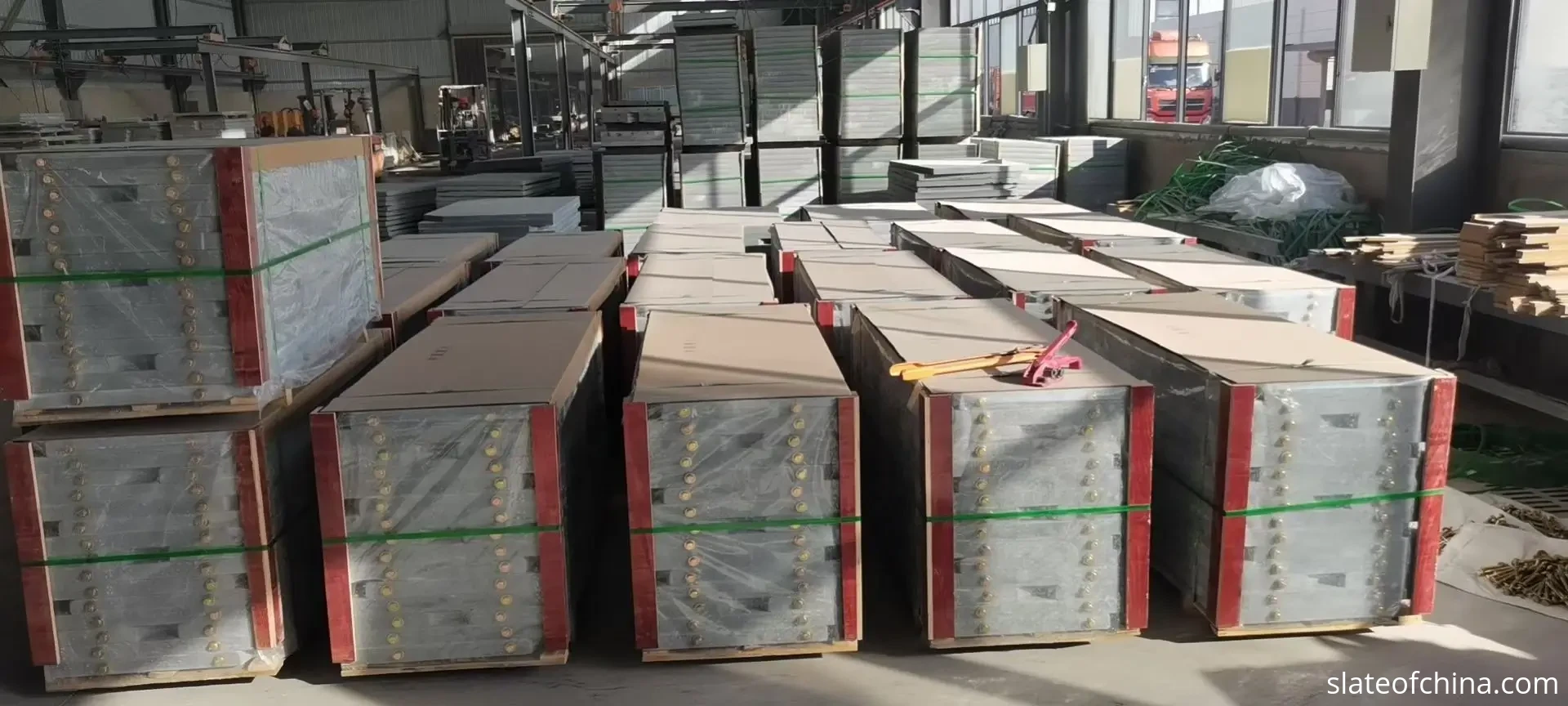
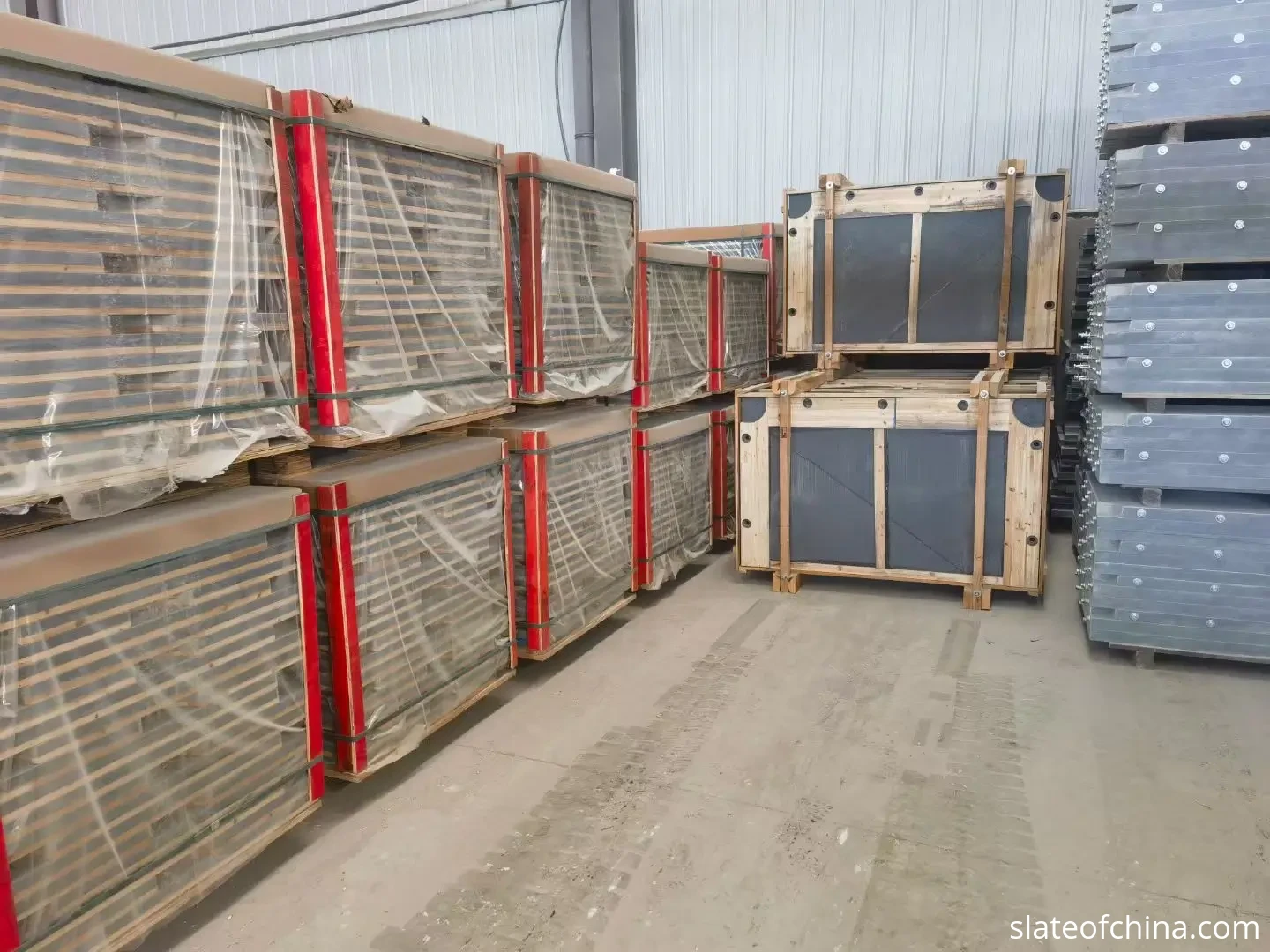
Flat, on heat-treated wood-framed pallets — never loose. The pieces lie flat with foam sheets between them, corners are protected, the stack is strapped and wrapped on a heavy pallet, and matched sets are packed and marked together so the pieces that belong together arrive together. The timber is heat-treated to the ISPM 15 standard. Roofing tiles — small, thick, weather-proofed — travel in closed crates; table beds are large-format panels and travel on pallets, because that is what the shape asks for. How the pallets are braced inside the container is covered in the container loading guide
How many slate sets fit in one container?
A slate container fills by weight long before it fills by volume — so the honest answer is a loading plan, not a number. Set dimensions, thickness and pallet design decide the count, and mixed orders carrying several table sizes are normal for distributors. Before confirming an order, ask the supplier for the packing dimensions, the per-set weights and the loading plan: how many pallets, how they are braced, what the gross weight is.
What documents does a billiard slate shipment need?
The standard export pack: commercial invoice, packing list, bill of lading, certificate of origin — plus ISPM 15 for the pallet timber. The numbers on those documents must agree with each other and with what is physically in the container; it is discrepancy, not missing paperwork, that slows consignments at customs. What your destination adds — duty paperwork, further certificates — varies by port and is covered in the import guide
What happens if something arrives damaged?
With proper pallet packing it is rare — and when it happens, it is a claim, not an argument, if the arrival was documented. The photographs from the answer above, the packing list and the shipping record make the case. Agree the claim procedure before the order is placed: who insures which leg, how damage is counted, how replacement pieces ship, and inside what window it must be reported.
Suppliers, Samples and Price
The commercial questions come last in an enquiry and decide more tables than the stone does. Six answers, no sales talk.
How do we choose a billiard slate supplier?
Look for a supplier who can demonstrate control over the key stages: material selection, cutting, grinding, machining, inspection and packing. Whether these are performed under one roof or through qualified partner facilities, the important point is that responsibility and quality standards are clear. Ask for photos and video of real production — this month's, not the brochure's — plus machined samples and inspection records. What evidence to request, in what order, is laid out in What Buyers Should Ask For; our own base is described on the manufacturer page
Is Chinese billiard slate good?
Origin is not a grade — the evidence is per batch, not per country. China holds large, genuine slate resources and deep stone-processing capacity. Jiujiang has a long history of slate production and processing, and our own billiard slate is exported to customers in more than 30 countries. But the label Chinese slate spans everything from excellent to unusable, exactly as Spanish, Welsh or Indian slate does. Judge the quarry, the factory, the tolerances actually held and the inspection records — including ours — rather than the passport. The material background is on Jiujiang Billiard Slate Manufacturer & Exporter, and the evidence standard on Quality & Test Data
Can we start with a sample or a trial order?
Yes — sample, prototype, trial batch, repeat orders is the normal path for any new design. A small material sample shows the stone and the honed finish; a machined prototype shows the hole pattern and pocket accuracy; a trial batch proves the consistency that mass production has to hold. Minimum quantities follow the drawing's complexity rather than a fixed policy — a shared specification costs less to run than a one-off. The OEM workflow, from drawing approval to batch supply, is in OEM Billiard Slate for Table Manufacturers
Why do two quotations for the same 9 ft slate differ?
Because the same size is not the same product. One quotation may cover roughly calibrated panels; the other, fully CNC-machined, inspected, matched-set, export-packed panels. Machining level, tolerance work, inspection, packing and matched-set handling each sit inside or outside a price — and the cheapest quote is only the cheapest quote. Compare complete specifications and delivery terms, then decide; the checklist for doing that is the Billiard Slate Buying Guide
What should a good enquiry include?
Eight things — and a drawing replaces most of them. Table type; playing area; slate outline in length and width; thickness; pieces per set; hole-pattern reference; quantity; destination port. Attach the drawing and the quotation comes back fast, firm and comparable; if the drawing is incomplete, say so, and an experienced supplier will list exactly what is missing rather than guess. The sourcing steps around it are in the buying guide, and the fastest route is the quotation request page
What is the most common ordering mistake?
Ordering by table size alone — a 9 ft slate without an approved drawing is not a complete production specification. Nominal size hides the outline, the hole pattern, the pocket positions and the piece count; the drawing approval step is what makes an OEM order repeatable, which is why the glossary gives Reference Drawing its own entry. If you do not have a drawing yet, say so plainly — starting from a sketch and a sample is a normal beginning, not a problem. The vocabulary involved is defined in the Glossary of Billiard Slate Terms
Other Formats and Replacement Slate
Pool and snooker move the volume, but they are not the only drawings on the floor — and not the only reason a buyer needs new slate. Two short answers cover the rest.
Do you make slate for Chinese 8-ball, carom and Russian pyramid tables?
Yes — all three, each to its own market specification rather than a resized pool bed. Chinese 8-ball tables call for rounded, snooker-style pocket entrances; in our production experience, 45 mm is the most commonly requested thickness for Chinese 8-ball slate, although 38, 40, 42 and 50 mm are also produced to specific drawings. Korean carom tables run pocketless beds — a common association playing-area specification sits near 2840 × 1420 mm — and Russian pyramid tables demand unusually large, heavy panels. Each format has its own page: Chinese 8-Ball Table Slate, Korean Carom Table Slate and Russian Pyramid Table Slate
Can billiard slate be used as replacement slate?
Yes — when the replacement matches the original bed's outline, thickness, hole pattern and pocket positions. Replacement is routine for tables with an existing drawing or a sample piece to copy; without one, the old slate itself serves as the template. The most common scenario is a cracked bed on an otherwise sound table — the frame, cushions and cloth are fine, only the stone needs replacing. Send the table model or the old slate dimensions and we can quote to match. Browse the billiard slate category or see Custom Billiard Slate Manufacturing
Related Reading
A Question We Did Not Cover?
If your question is not on this page, it is probably specific to your table design — which is exactly the kind we answer best. Send your table type, playing area, slate dimensions, thickness, pieces per set and destination port, or simply attach the drawing.