
Factory vs Trading Company: How to Decode a Jiujiang Slate Supply Chain
Nearly every Chinese slate supplier's website carries the same sentence: "Direct factory manufacturer." Some mean it literally. Some are trading companies describing a partner's facility. Some are factories that also source complementary products from other producers — which is neither deception nor a problem, if you know about it.
The label tells you almost nothing. The supply chain behind it tells you everything.
This article is the third in a series on sourcing Jiujiang slate. The first, How to Source Jiujiang Slate Directly, looked at the routes an order can take from quarry to port. The second, How to Verify a Jiujiang Slate Supplier, showed how to test a supplier's claims with dated evidence. This one answers a question that comes before both: what type of company are you actually dealing with, and does it matter for your order?
It does matter — but not in the way most buyers assume. A factory is not automatically the better choice. A trading company is not automatically the worse one. What matters is whether the company is transparent about where your stone comes from, who processes it, and who is responsible when something goes wrong. The six signals below teach you how to read that transparency, signal by signal, before you place a deposit.
The short version: six signals, six questions.
| Signal | What it tells you | How to test it |
|---|---|---|
| 1. Legal entity | Who you are actually contracting with | Business licence + Unified Social Credit Code |
| 2. Production chain | Whether they make it or source it | Ask them to describe the processing steps |
| 3. Quarry connection | Where the raw stone comes from | Current quarry photos, not stock images |
| 4. Factory video | Whether production is current and real | Request a video shot today showing your product |
| 5. Container loading point | Factory gate or third-party warehouse | Ask where the container will be loaded |
| 6. Bank account | Whether the money goes to the contract company | Compare beneficiary name with contract entity |
You do not need every signal to point the same way. You need the answers to be clear, consistent and verifiable. A supplier who can explain a mixed supply chain honestly is more useful than one who claims "factory direct" and cannot answer a single follow-up question.
Why "Factory or Trading Company" Is the Wrong Question
Buyers often frame the choice as a binary: factory good, trading company bad. It is understandable — nobody wants an unnecessary middleman marking up their stone — but the binary breaks down quickly in practice.
A manufacturer may purchase raw blocks from outside quarries rather than owning its own. A trading company may have worked with the same processing plant for a decade and control the production specification, the inspection criteria and the packing method more tightly than the factory's own management. A company may operate its own processing plant for its core products while sourcing accessories or complementary stone from nearby suppliers — a model common in stone-producing regions such as Jiujiang.
The real question is not factory or trading company. It is: who controls the stone, the processing, the quality inspection, the packing and the container loading behind your order? The company that controls those steps has far more influence on the outcome than the label on its letterhead. A supplier that is transparent about which steps it controls and which it outsources gives you something to work with. One that hides behind the words "factory direct" gives you nothing.
So instead of asking "are you a factory?", the six signals below ask a different question at each step: what can you show me? The signals work on any supply chain — factory direct, trading company or hybrid — and they work whether you are buying roofing slate, billiard slate or paving.
Signal 1 — The Legal Entity Behind the Name
A professional website proves nothing. A simple website does not automatically mean a trading intermediary. The first signal is the legal company behind the quotation.
Ask for the full Chinese company name, the English company name, the business licence, the Unified Social Credit Code, the registered address, the factory address and the bank account beneficiary. For Chinese companies, the Unified Social Credit Code is the key identifier — it is assigned to every registered business entity and appears on the business licence. Registration information can be checked through China's National Enterprise Credit Information Publicity System, which publishes company registration details, annual reports, administrative licences and any abnormal-operation records.
The business licence tells you that a company exists and what its registered business scope covers — typically including language such as "manufacturing" or "wholesale/trading." That scope is a useful first signal, but it is not the final proof of factory ownership. A company registered at an office address in one city may operate a factory some distance away in a stone-producing town. The licence is the starting point, not the conclusion.
What matters is whether the pieces fit together. Compare:
- Company name on the quotation
- Company name on the business licence
- Company name on the sales contract
- Company name receiving the payment
Ideally, all four are the same entity. If they are not, ask why — there may be a legitimate explanation, but you should understand the structure before sending a deposit. A trading company that is open about its role and identifies the manufacturer it works with is giving you useful information. A supplier that cannot or will not name the legal entity behind the quotation is not.

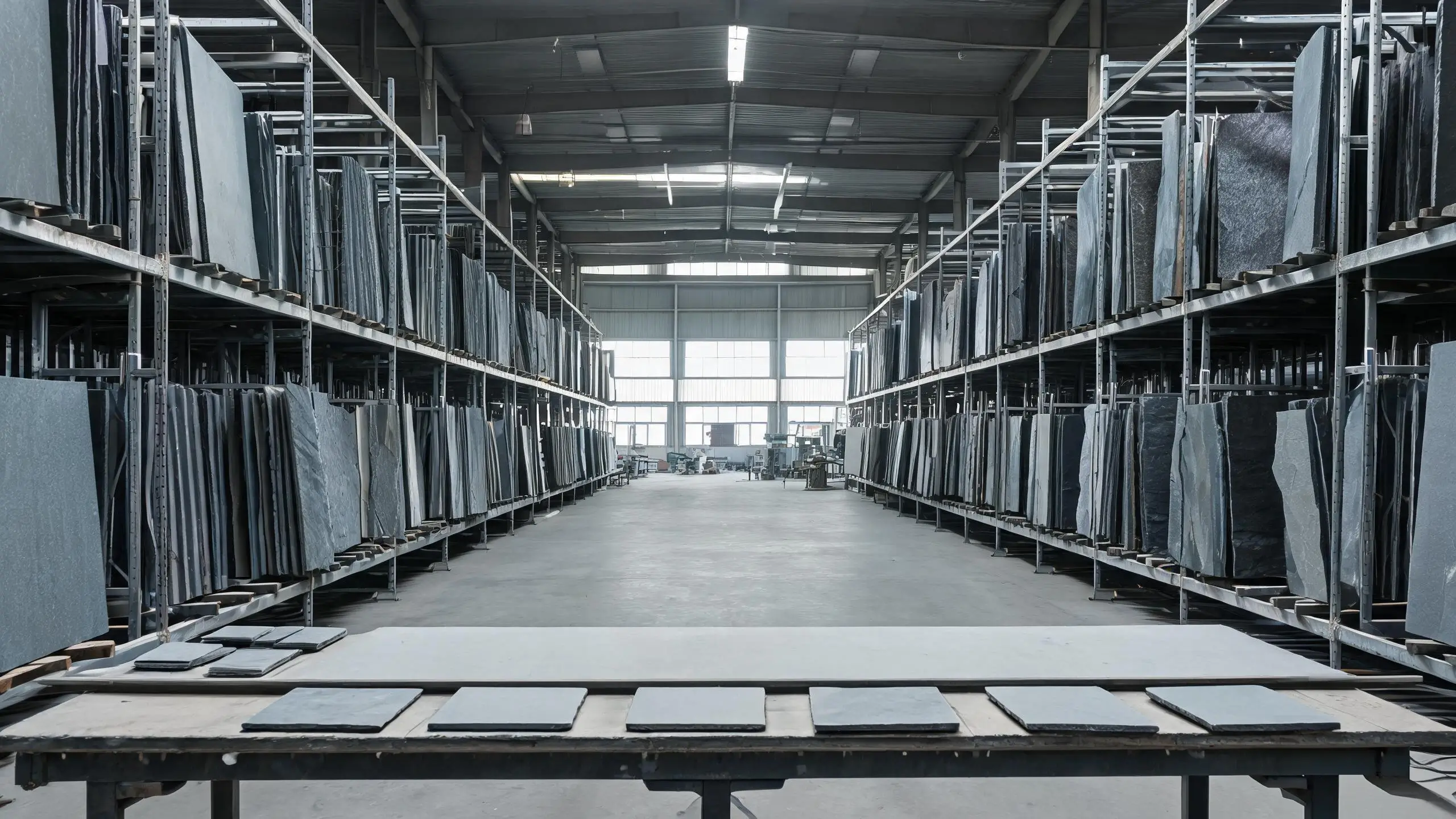
Signal 2 — The Production Chain They Can Describe
One of the most revealing questions you can ask a slate supplier is also one of the simplest: where is the slate for my order processed?
Not "are you a factory?" — that question invites a one-word answer. Ask instead for the production chain, step by step. A genuine manufacturer should be able to walk you through it in practical terms:
- Quarry → raw blocks → cutting or splitting → calibration → CNC or edge processing → inspection → packing → container loading
The exact steps vary by product. For roofing slate, the critical stages include splitting, trimming, thickness sorting, drilling and packing. For billiard slate, the chain includes block selection, sawing, thickness calibration, grinding, CNC machining, edge processing, inspection and reinforced packing. A supplier that understands its own production can tell you which steps happen in-house and which, if any, are outsourced.
What you are listening for is specificity. A supplier who says "we cut, calibrate and inspect everything here" and can describe the equipment, the tolerance targets and the inspection method is giving you a different signal from one who says "yes, we are a factory" and changes the subject. Ask where the final inspection is performed, how flatness is controlled, and what happens to slates that fail inspection. A real production operation answers these questions in minutes; a company that is forwarding emails to someone else's factory may not be able to answer them at all.
This signal also tells you whether the supplier can hold your specification across repeat orders. A company that controls its own CNC machining and has a defined inspection process is in a stronger position to reproduce the same specification from one container to the next. A company that buys finished goods from whoever has stock this month cannot promise the same thing — and may not even know the difference.
Signal 3 — The Quarry Connection
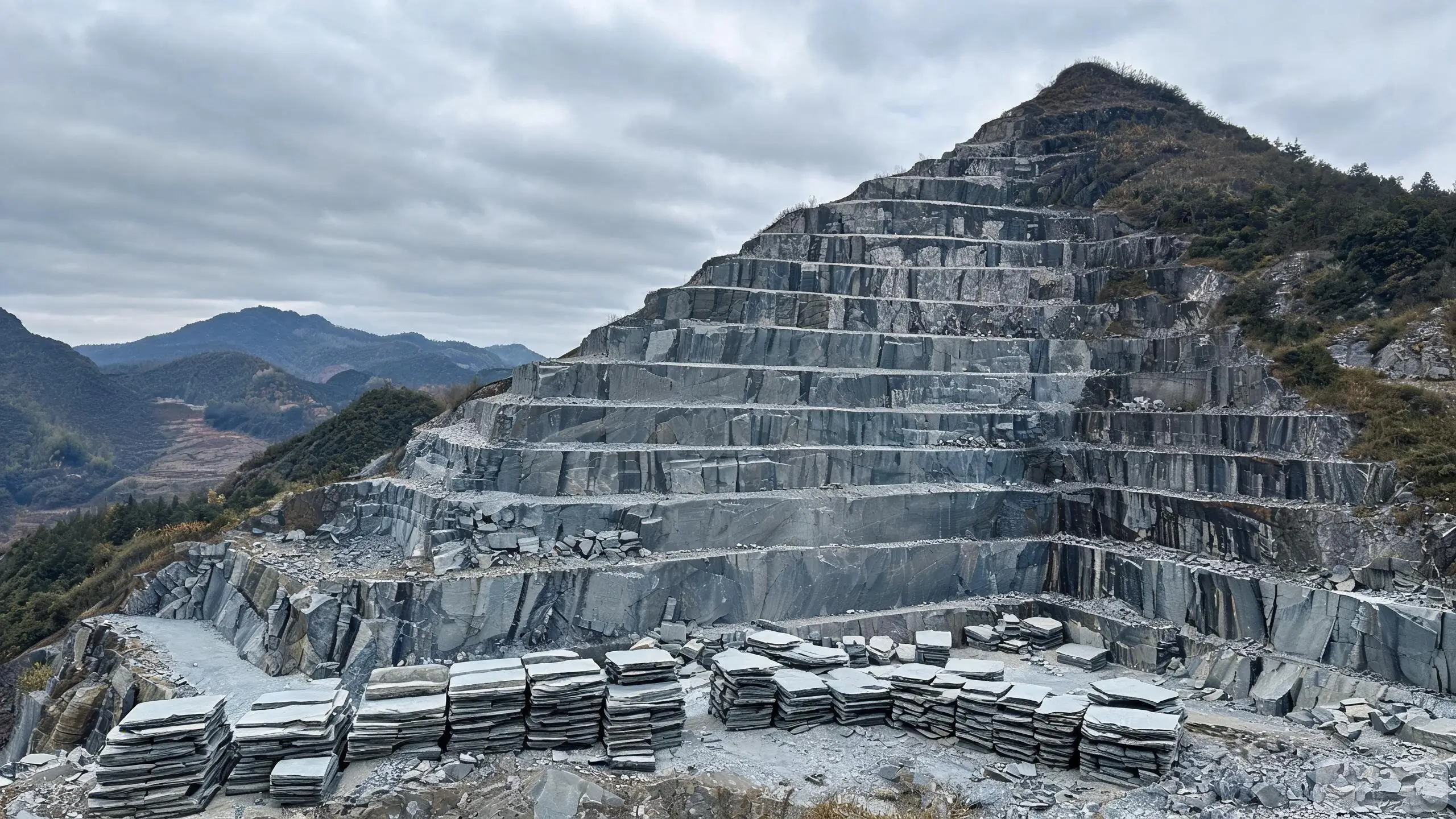
Here the question becomes more nuanced. Not every manufacturer owns a quarry. Not every company with quarry access owns it. In the Jiujiang slate region, a manufacturer may work with its own quarry face, a related quarry, a long-term quarry partner or several local block suppliers. Each arrangement can produce good stone, but open-market sourcing from multiple block suppliers can make consistency from one container to the next much harder to control.
So instead of asking "do you own the quarry?" — which invites a yes/no answer that tells you nothing — ask: where does the raw stone for this product come from, and what is your supply relationship with the quarry?
Then ask for evidence: current quarry photographs, a recent quarry video, raw block photographs and the quarry location. The objective is not to force every supplier to own a quarry. It is to understand where your stone comes from and who controls the supply. A manufacturer that buys blocks from a named partner quarry on a long-term contract may deliver more consistent material than one that owns a small quarry and supplements it with open-market purchases whenever demand spikes.
This signal is especially important when comparing different Chinese slate origins. The mineral composition, colour and cleavage of Jiujiang slate are shaped by the geology of the Lushan–Xingzi belt, and stone from different parts of the belt can look similar but weather differently. A supplier who can name the quarry, show you the face and explain why that source suits your product is giving you a signal you can use. One who answers "Jiujiang, China" and nothing more specific is telling you they do not control the answer.
Signal 4 — The Video That Shows Your Product
A factory video is useful. The quality of the evidence matters more than the existence of a file. An old promotional video proves very little — it is consistent with a supply chain that changed years ago. A better request is specific: please make a short video showing today's production, starting outside the factory gate, then the cutting area, the processing line and the finished products for my order.
You can make the request more targeted. For roofing slate, ask to see raw blocks, splitting, finished tiles, thickness sorting and pallet packing. For billiard slate, ask to see large raw blocks, sawing, calibration, grinding, CNC machining and finished table beds. The point is not to make the supplier perform — it is to ask for something that a working production line can produce in an afternoon and a forwarded email chain cannot.
A simple addition makes the evidence much harder to fake: ask for a sheet of paper with the day's date, or your company name, placed beside the product in the frame. This is not a perfect security measure. But a supplier with their own production can do it in minutes, and one who cannot will show you exactly where their supply chain ends and someone else's begins.
The same principle applies to photographs. Do not accept generic factory photos. If you are buying 25 mm pool table slate, ask for a photograph showing that thickness. If you are buying 200 × 300 mm roofing slate, ask for that exact product being produced. The photograph is evidence only when it corresponds to the product being discussed.
Signal 5 — Where the Container Is Loaded
For an export buyer, this is the single most practical question in this article. It is also the one that separates a factory from a trading company more cleanly than almost anything else.
Ask: where will my container be loaded?
There are four possible answers, and each tells you something different about the supply chain.
At the processing factory. The factory produces the slate, stores the finished goods and loads the container at its own facility. This gives you a clear physical connection: production → finished goods → container, all in one place.
At a partner factory. The supplier coordinates production with another plant and arranges loading there. This can be completely legitimate, but you should know that the supplier is operating through a partner facility rather than its own.
At a warehouse. The goods are produced elsewhere and transferred to a warehouse before export. Again, this can be legitimate — but you should understand who actually performed the processing and whether the goods passed through any intermediate handling that could affect quality.
Multiple suppliers consolidated. More common with trading companies or mixed-product orders: the supplier purchases different products from different factories and consolidates them before shipment. This creates a different quality-control structure, and you should know about it before the container arrives.
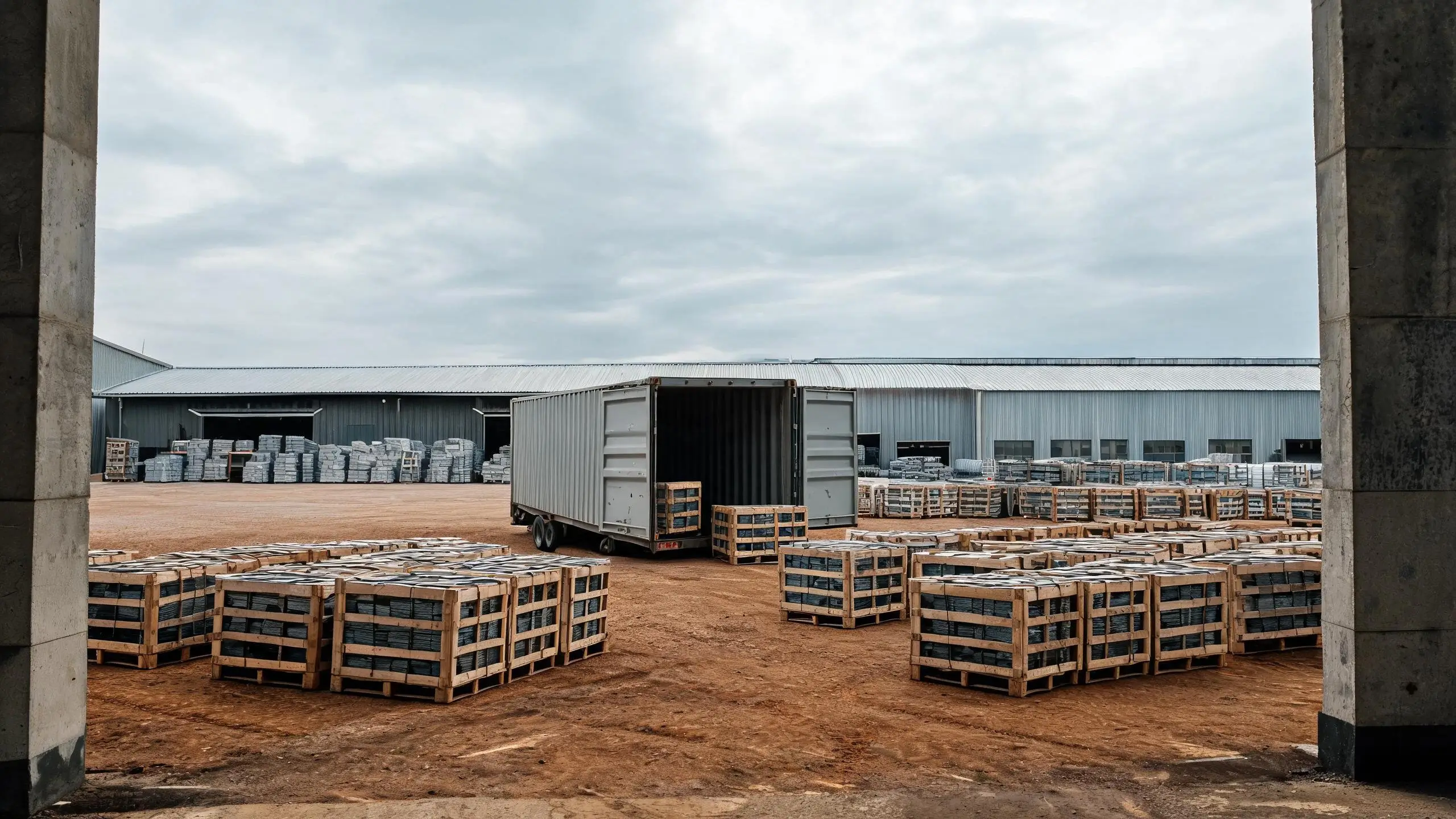
In the Jiujiang slate-producing area, a factory with its own processing plant can have an empty container trucked from the port to the factory gate, load it on-site with its own crew and equipment, and send the loaded container back to the port. A trading company without its own processing facility would normally arrange loading at a supplier's factory or another loading site rather than at its own factory gate.
"The container comes to the factory" is one of the strongest signals in this trade. It connects the production chain to the export chain in a single physical event, and it is visible: you can ask for a photo of the empty container arriving at the factory gate, another of the loading in progress, and a third of the sealed container leaving. A supplier who can provide that sequence — the container loading guide on this site describes the full process — is showing you something that a forwarded email chain cannot replicate.
Signal 6 — The Bank Account and the Paper Trail
The final signal sits at the end of the chain, but it is no less important: who actually receives your money.
Before making a deposit, compare the beneficiary name on the bank account with the legal entity in your contract. Ideally, the quotation, the contract, the proforma invoice and the bank account all carry the same company name. That is a straightforward structure. If payment is requested to a different company, a personal account or an overseas account, ask for a clear explanation and supporting documentation before paying. Do not rely solely on a salesperson's verbal assurance.
This signal also covers the relationship between exporter and manufacturer. A buyer may see one company name as the manufacturer and a different one as the exporter on the shipping documents. This is not necessarily a problem — a trading company can legally export products manufactured by another company, and trading companies can provide useful services such as sourcing, consolidation, logistics and market support. But you should know which role each company plays. Ask three questions: who manufactures the stone, who signs the sales contract and receives the payment, and who issues the commercial invoice. If the answers are different companies, ask them to explain the relationship.
Then cross-check across every source you can find: website, email domain, business licence, factory address, product photographs, company name on trade-platform profiles, export documents, bank information and factory videos. The more independent pieces of information that point to the same company, the clearer the picture. A basic background check is not about catching fraud — it is about confirming that a company exists, verifying its address and understanding its structure before you commit to a transaction.
Follow One Container Backward
If you are seriously evaluating a Jiujiang slate supplier, try this exercise. Take one proposed container — a real order, not a hypothetical one — and trace it backward from the moment it leaves to the moment the stone enters the chain.
Container loading point → packing area → final inspection → processing factory → raw blocks → quarry or raw-material source.
At each step, ask: who performs this step, where does it happen, and can the supplier show it? If the supplier can clearly explain the chain from the quarry face to the sealed container, you have a much better understanding of the supply relationship than any "factory direct" badge could give you. If every answer leads to another unidentified company, another warehouse or another unexplained address, you should investigate further before committing.
This exercise is more useful than asking whether the supplier calls itself a factory, because it tests the chain rather than the label. A trading company with long-term quarry relationships and honest answers about what it outsources can pass this test. A factory that buys blocks from the open market and cannot name its suppliers cannot. The signal is not in the name — it is in the chain.
Eight Red Flags That Deserve a Pause
None of these signs automatically proves that a supplier is unreliable. But when several appear together, it is time to slow down and ask more questions.
1. They refuse to provide the legal company name. A legitimate commercial transaction requires a clearly identifiable contracting party. If a supplier cannot or will not name the entity you are paying, you have no contract partner.
2. The factory address keeps changing. A registered address that moves between quotations, or an address that does not match the one on the business licence, is worth a follow-up question.
3. All factory photographs look like stock images. Ask for a current video. If every photo is perfectly lit, shows no stone dust and could have been taken at any factory in any country, it probably was.
4. They cannot explain where the raw slate comes from. A supplier who cannot name the quarry, show a quarry photo or describe the raw-block supply chain is not controlling the first link.
5. They cannot show the actual product. If you are quoting a 12 ft snooker table bed and the supplier cannot send a photo of a 12 ft table bed — not a smaller pool-table slate, not a generic slab — the photograph is not evidence for your order.
6. They avoid showing the packing area. Packing is where breakage begins or is prevented. A supplier that regularly exports heavy stone should be able to explain its packing method and show the area.
7. The beneficiary name does not match the contract. Ask for documentary clarification before payment. A mismatched bank account is not always a sign of fraud, but it is always a sign that you need to understand the payment structure before sending money.
8. They claim "factory direct" but cannot answer basic technical questions. What is the normal thickness tolerance? How is flatness controlled? What equipment is used for calibration? Where is the final inspection performed? A real production operation should be able to answer these questions about its own process without consulting a third party.
Factory Direct Is Not a Quality Stamp
Here is where the binary breaks down completely. "Factory direct" is not a quality certification — it is a supply-chain description, and not always an accurate one.
A manufacturer can offer direct production, tighter production control, custom specifications, direct technical communication and large-volume capacity. But a manufacturer that has never exported before may struggle with documentation, mixed-product orders, consolidation or alternative sourcing when its own capacity is full. A factory that makes excellent roofing slate may have no experience packing billiard slate — and billiard slate packing is a specialised skill, because the stone is heavy, fragile and expensive to replace.
A trading company, by contrast, may offer access to multiple factories, mixed-product containers, consolidated shipments, export documentation experience, communication support and the ability to switch factories when one cannot meet a specification. For a buyer who needs three different products in one container — roofing slate, paving and wall cladding, say — a trading company with good factory relationships may actually be the more efficient route.
The hybrid model is also common in stone-producing regions such as Jiujiang, and it deserves to be understood rather than dismissed. A company may operate its own processing plant for its core products — roofing slate and billiard slate, for example — while sourcing paving, wall cladding, tiles and other natural stone from nearby suppliers. That does not make it a "pure trading company." It makes it a manufacturer with a trading arm, which is how most mid-sized stone exporters in a production cluster actually operate. The question is not whether the company trades, but which products it actually makes and which it sources — and whether it is honest about the difference.
The key, as always, is transparency. You should know whether you are buying directly from a manufacturer, through a trading company, or through a manufacturer that also uses partner factories. Each model can work. What does not work is not knowing which one you are in.
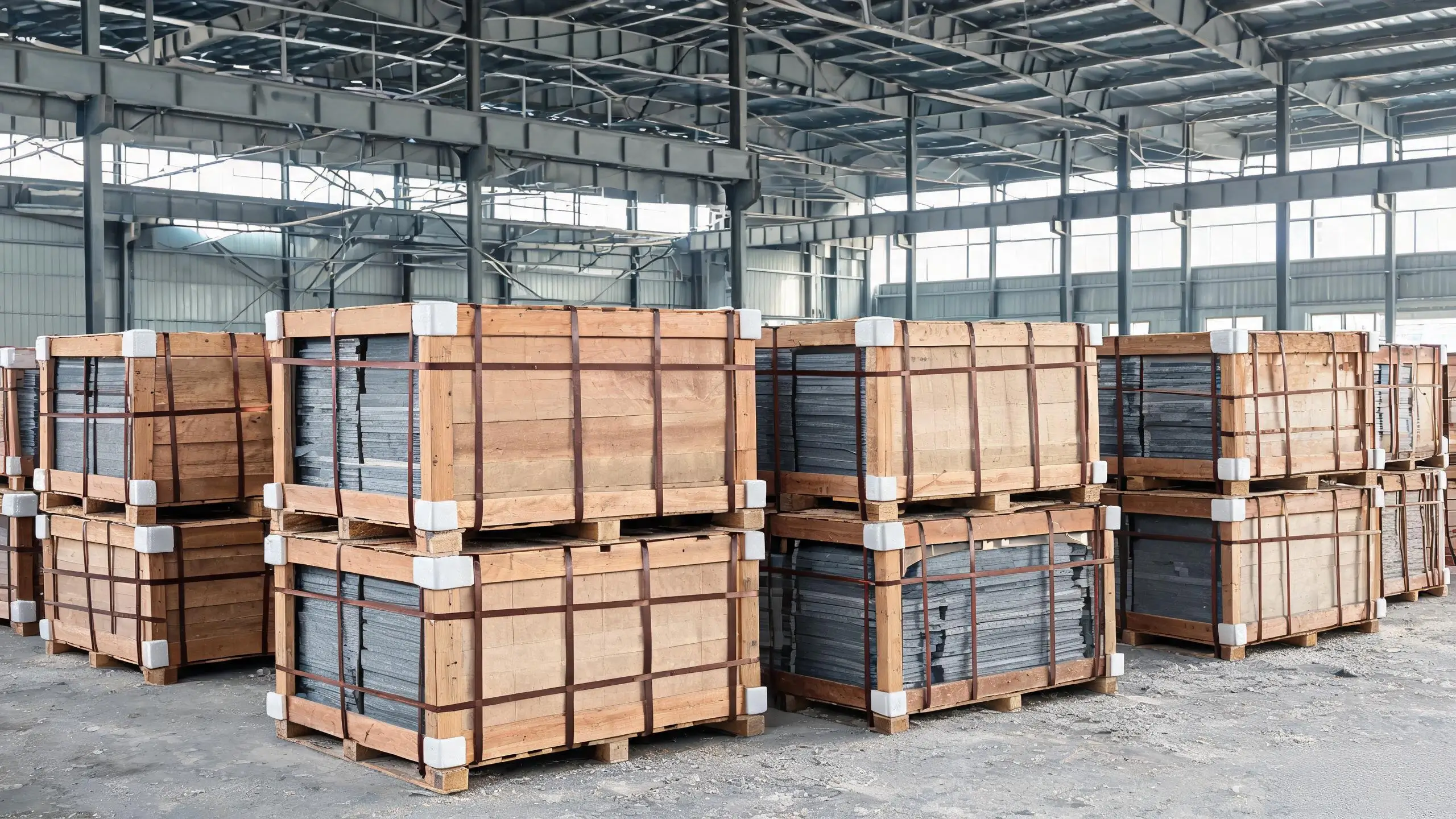
Factory vs Trading Company at a Glance
These are general patterns, not rules. The actual company behind the quotation matters more than the column it sits in.
| Factor | Direct manufacturer | Trading company |
|---|---|---|
| Production control | Usually direct | Depends on factory relationship |
| Product customisation | Often strong | Depends on supplier network |
| Multiple products in one container | May be limited | Often easier |
| Factory access | Usually direct | Usually through partner |
| Quality communication | Direct with production team | Through sales or technical team |
| Quarry access | Depends on company structure | Depends on network |
| Export documentation | Varies — may be basic | Often a core service |
| Supply flexibility | Limited by own capacity | Can use multiple suppliers |
| Price structure | Factory cost + margin | Factory cost + trading margin |
Before You Pay: A 10-Point Decoder Checklist
The six signals above explain how to read the supply chain. The checklist below turns them into a practical pre-deposit process.
Use this for any new supplier — factory, trading company or hybrid. You do not need every answer to be "yes." You need the answers to be clear, consistent and verifiable.
| # | Signal | Question to ask |
|---|---|---|
| 1 | Legal entity | What is your full Chinese legal company name and Unified Social Credit Code? |
| 2 | Business scope | Can you provide your business licence, and does the registered business scope support the manufacturing activities you claim? |
| 3 | Production address | What is the actual production address — not the registered office? |
| 4 | Quarry source | Where does the raw slate come from, and what is your quarry relationship? |
| 5 | Factory video | Can you send a recent video showing my exact product being produced? |
| 6 | Container loading | Where will my container be loaded — at the factory or at a warehouse? |
| 7 | Quality inspection | Who performs the final inspection, and can you show inspection records? |
| 8 | Contract entity | Which company will sign the contract and issue the commercial invoice? |
| 9 | Bank beneficiary | Does the bank account beneficiary match the contracting company? |
| 10 | Transparency | Which products do you manufacture yourself, and which do you source from others? |
A supplier who can answer these ten questions clearly gives you far more useful information than one who simply says "we are a factory." The tenth question — the one about transparency — is the one that tells you whether you are dealing with a partner or a forwarded email.
Frequently Asked Questions
What is the actual difference between a manufacturer and a trading company in the Chinese slate industry?
A manufacturer normally controls a physical processing facility, while a trading company normally coordinates products made by one or more manufacturers. In practice, however, many Chinese stone businesses use a hybrid model. The useful question is not simply who owns the factory, but who controls the production specification, inspection, packing and shipment for your order.
How can I tell if a supplier actually owns their quarry?
Ask for the quarry name, location and a current photograph or video. Then compare the answer with the business licence — a company whose registered scope includes "mining" or "quarrying" is more likely to hold a quarry licence than one whose scope is "wholesale." But quarry ownership is not the only useful arrangement. A manufacturer with a long-term contract at a named quarry may deliver more consistent material than one that owns a small, nearly exhausted face and buys supplemental blocks on the open market. The signal is the supply relationship, not the ownership certificate.
Should I always prefer "factory direct" for slate orders?
No. "Factory direct" means the supplier processes the stone; it does not mean the supplier is good at exporting, packing for international shipping, handling mixed-product containers or communicating in your language. For a single-product order where tight control over specifications and tolerances is critical, a manufacturer with direct production control may be a suitable route. For an order that mixes roofing slate, paving and wall cladding from different stone types, a trading company with good factory relationships may actually be more efficient. Judge transparency and capability, not letterhead.
What does it mean if the exporter and the manufacturer are different companies?
It means a trading company or export agent is handling the shipment while a separate factory produces the stone. This is legal and common in China. The important thing is to understand the relationship: ask who is responsible for quality, who signs the contract, who receives the payment and who issues the invoice. If all four answers are clear and consistent, the arrangement can work. If the supplier cannot explain who does what, the arrangement adds risk without adding clarity.
Can a trading company provide better quality control than a factory?
Yes, in specific situations. A trading company that has worked with the same factory for years, controls the production specification, runs its own pre-shipment inspection and can switch factories when quality drops may outperform a factory that has no export experience, no documented inspection process and no incentive to improve because you are its only foreign buyer. The question is not "factory or trading company" but "who controls the quality, and can they show it?"
What is the "container at the factory gate" test and why does it matter?
Ask where your container will be loaded. If the answer is "at our factory," the supplier can have an empty container trucked from the port to the factory, load it on-site and send it back — something only a company with a physical production facility can do. A trading company without a factory must load at a third-party warehouse or at its supplier's factory. This is one of the hardest signals to fake, because it connects the production chain to the export chain in a single, visible physical event.
Related Reading
Use These Signals on Us
Want to decode our supply chain? You don't have to take our word for it — ask us the same ten questions you would ask any supplier.
We operate our own processing plant in the Jiujiang slate belt. We can show you the quarry we work with, the workshop floor, the CNC machines, the inspection bench, the packing area and the container being loaded at our factory gate. The empty container is trucked from Jiujiang port to our yard, loaded by our crew and sent back — the arrangement this article describes as the hardest signal to fake.
We are also honest about what we source: our core products — roofing slate and billiard slate — are manufactured in-house. Complementary stone products come from partner suppliers in the same region. Ask us which is which, and we will tell you.
Request Our Supply Chain Evidence — tell us what you are sourcing, and our factory team will send current quarry photos, a production video and our container-loading sequence within one working day. Our published test results are open to check before you write.