
How to Verify a Jiujiang Slate Supplier
Here is an email worth copying almost word for word:
"Before we confirm the order, could you send me three things: a short video of this week's production, a photo of the blocks currently being processed, and the batch number on the test report you quoted from?"
That message has one purpose: to replace adjectives with evidence. Anyone can write "we operate our own quarry and factory" on a website. Almost anyone can send a catalogue PDF. But a supplier who is actually turning rock into finished slate this week can answer that email in an afternoon — and one who cannot will show you exactly where their supply chain ends and someone else's begins.
The previous article in this series, How to Source Jiujiang Slate Directly, looked at the routes an order can take from a Jiujiang quarry to your warehouse — factory-direct, through a trading company, or somewhere in between. This article is the second half of that decision: whichever route you choose, how do you verify that the company on the other end of the email is what it claims to be?
It breaks down into five places where claims can be tested with evidence: the quarry, the factory, the inspection bench, the paperwork, and the packing line. A supplier who passes all five has given you a much stronger basis for considering a deposit — one built on evidence rather than adjectives. A supplier who cannot explain the first one has given you a reason to stop and ask more questions before going any further. The method itself travels well: the five stations below are how to verify a Chinese slate supplier of any kind — roofing slate, billiard slate or paving — and this article walks them in the Jiujiang context, one of the most active production areas in the world for both roofing slate and CNC-machined billiard slate.
Verification is not about finding a liar — it is about finding out who controls your stone.
Test five things with evidence, not with words: where the slate is quarried, where it is processed, how it is inspected, whether the documents agree with each other, and how it is packed.
The one habit that matters most: ask for evidence dated this week, and let the supplier's reaction tell you the rest.
And since the title of this article promises twelve checks, here they are, all on one screen. The five stations that follow show you how to collect each piece:
| Check | What to verify |
|---|---|
| 1. Quarry | Where the slate actually comes from |
| 2. Production | Current production evidence, dated this week |
| 3. Factory | Where it is processed — in-house or outsourced |
| 4. Specification | Dimensions and tolerances, confirmed in writing |
| 5. Test data | Reports that match the offered material |
| 6. Inspection | What is actually measured, and with what |
| 7. Inspection records | Actual readings and photos |
| 8. Packing | How the slate is protected |
| 9. Loading | How it enters the container, to the seal number |
| 10. Legal seller | The company named on the contract |
| 11. Payment account | Who actually receives the deposit |
| 12. Repeat supply | Whether the same specification can be reproduced |
The Method: Test Claims, Not Brochures
Almost every supplier in the Jiujiang region — factory or trading company — makes the same five claims: good stone, real factory, careful inspection, proper export packing, reliable repeat supply. The claims are identical because buyers ask for the same things. What separates suppliers is whether each claim comes with something attached.
So each of the five stations below follows the same three beats:
- The claim — the sentence you will read on every supplier's website.
- The proof — the specific, dateable evidence you ask for.
- The read — how to interpret what comes back, including what silence means.
One caution before you start. Verification is not a hunt for fraudsters. A trading company with long-term quarry relationships and honest answers about what it outsources can be a perfectly good supplier — that case is discussed near the end. What the five stations actually measure is transparency: whether the company can show you where your stone comes from and who is responsible for it. That is the difference between a supply chain you can troubleshoot when something goes wrong, and one you can only hope about.
One more thing before the stations: evidence itself has levels, and it helps to know which one you are holding. Almost every proof in this article sits somewhere on this ladder:
Level 1 — Claim. "We have our own quarry." A statement, nothing more. Every supplier starts here, and some never climb.
Level 2 — Current evidence. This week's quarry photos, a dated production video, the block yard as it looks today. Anyone with a working supply chain can produce this in hours.
Level 3 — Verifiable documentation. Company documents, batch-linked test reports, inspection records, packing and loading records — paper that ties the claims to your specific order.
Level 4 — Physical verification. A sealed sample, a factory visit on a normal production day, a third-party inspection at loading.
The stronger the order value, the higher the level of verification you should use. A sample order can live on Level 2; a six-figure annual purchasing programme earns Level 4 — and most first containers sit somewhere in between.
Station One — The Quarry: Where the Stone Actually Comes From
The claim: "Our slate comes from our own quarries in the Jiujiang / Lushan area."
Start with the geography, because it is the claim most easily blurred. A company registered in Jiujiang can honestly say "Jiujiang slate" while buying blocks from three different sources — and in this region, as in most slate regions, that is not automatically a problem. What matters is which of three situations you are actually in:
- the exporter operates its own quarry face;
- the exporter holds a long-term relationship with one or two named quarries;
- the exporter buys blocks on the open market from whoever has stock this month.
All three can produce good slate. Only the third makes consistency across containers a matter of luck, because each purchase may bring a different part of the bed with a slightly different colour or grain.
The proof: ask the supplier to state the relationship plainly — own quarry, named partner, or purchased blocks — and then ask for the pictures that support it: current quarry photos, a video of blocks being extracted or moved this month, and a photo of the raw block yard with the blocks that will roughly become your order. The test is whether the supplier can connect a specific block, or a specific batch of blocks, to the product you are ordering — anything less is geography, not evidence.
The read: the operative word is current. Excellent photographs from five years ago are consistent with a supply chain that changed four years ago. The cheapest way to date a video is to ask that a sheet of paper with the day's date be placed somewhere in the frame — a request a working quarry can satisfy in minutes. A supplier who answers the origin question with the four words "Jiujiang, China" and nothing more specific, over email, is not lying; but they are telling you they do not control the answer.
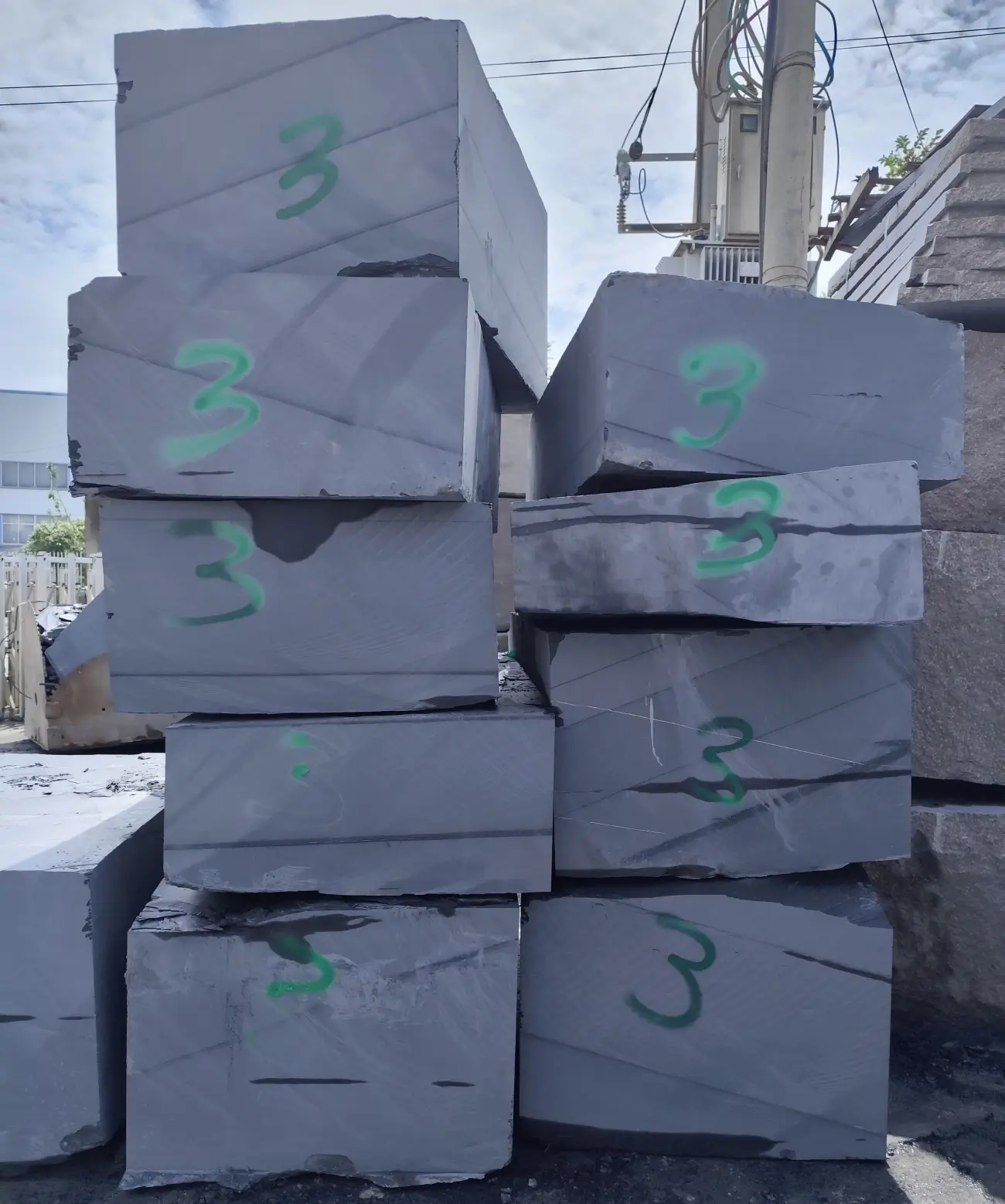
Red flag at this station: the origin of the stone is the one subject the supplier cannot photograph, film, or name a person to discuss.
Station Two — The Factory: What "We Manufacture" Should Look Like
The claim: "Manufacturer. Factory direct."
A registered business address and a warehouse full of finished crates are both consistent with a company that processes nothing. Again, not automatically disqualifying — a good trading company will say so plainly. The question this station answers is who actually machines, calibrates and finishes your slate, and whether that party can hold your specification.
The proof: photos and video of the processing line — splitting, sawing, calibration, machining — with the machines running on material that looks like your order; a plain statement of which steps happen in-house and which happen elsewhere; and, for larger orders, the option to visit. A factory in the Jiujiang region is a practical half-day stop from an international flight into Nanchang, so a supplier who processes its own slate has little reason to discourage a visit.
The proof looks different depending on what you are buying.
If you are ordering billiard slate
Billiard slate is where "manufacturer" is easiest to test, because the processing is unforgiving. A three-piece bed for a 9 ft table has to come out of a thick block, get sawn flat, ground, CNC-machined for pockets and screw holes, and matched so the three pieces behave like one surface. Ask for the machine list and the tolerances: on table slate, thickness is typically held to around ±0.1 mm and joint mating surfaces to roughly 0.05 mm — if a supplier quotes numbers wildly looser than that, or cannot quote at all, you have learned something useful. Our own machining tolerances are described in detail in CNC Machining in Our Jiujiang Factory.
Then replace "yes, we can do it" with something checkable. Send a drawing — or use the table below — and ask the supplier to confirm every line in writing:
| Item | What to verify |
|---|---|
| Table size | 7, 8, 9, 10 or 12 ft — confirm the playing-area dimensions, not just the label |
| Thickness | Nominal (19–45 mm) plus the tolerance the supplier will commit to |
| Pieces | 3-piece or 5-piece, and whether pieces are matched as a set |
| Flatness | The measurement method and the tolerance per piece |
| Joints | Machining of joint surfaces and how a three-piece set is matched |
| Holes | Pocket and mounting-hole diameter and position, checked against your drawing |
| Edges | Required profile and finish |
| Inspection | Factory check before packing — and what record of it you receive |
A supplier who has genuinely produced your specification before will confirm the table with a few corrections and comments — machining people enjoy correcting a drawing. One who has not will confirm everything, instantly, without a single question. In our experience, the corrections are the better sign.
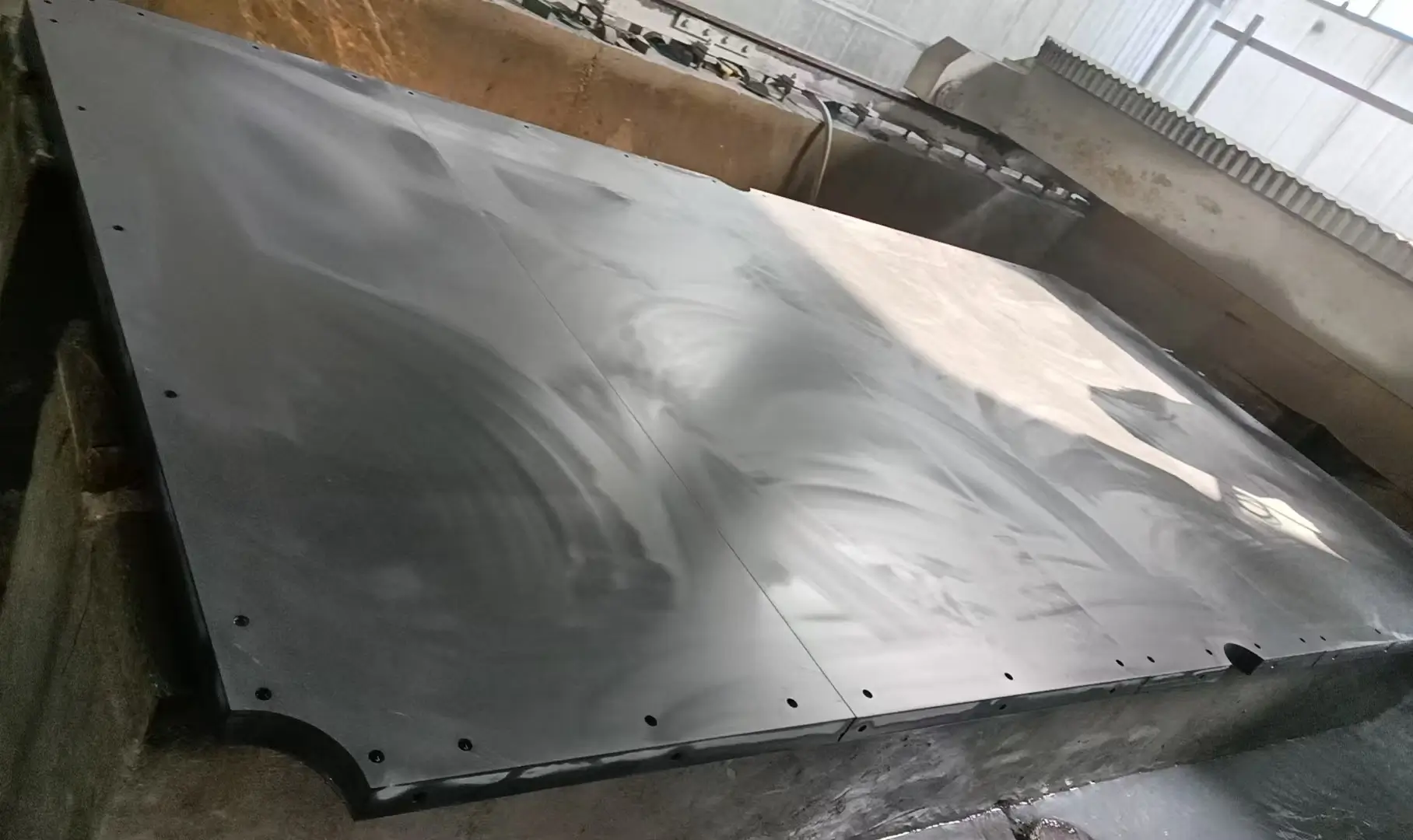
If you are ordering roofing slate
For roofing, the factory claim is really about the stone and the splitting line. Ask what the current production looks like for your exact product — the thickness band you are buying, the colour range the current blocks are yielding, and the size range the line is set up for. A useful photo request here is simple: a picture of today's output for this product, still on the bench, not the best roof photo in the gallery.
Colour deserves a specific question, because it is the most common source of quiet disappointment: two containers ordered six months apart can drift in tone if the blocks come from different parts of the bed. Ask how the supplier manages that — batch mixing, colour sorting, or simply honest warning — and whether tiles are packed so that colour batches are identifiable at your end. The inspection side of that question is covered in the next station. If you want to see what a specification worth checking against actually looks like, our roofing slate range lists the sizes, thickness bands and grades these questions should be run against.
Red flag at this station: every "production photo" turns out to be the same clean, people-free, catalogue-grade shot — a working processing line is dusty, cluttered and impossible to photograph beautifully.
Station Three — Inspection: Making "100% Checked" Mean Something
The claim: "Every piece is inspected before loading."
This is the claim buyers ask for and suppliers learn to say fastest, so make it earn its keep. "Inspected" is not a fact until you know three things: what was checked, with what instrument, and against which number. A full-station walkthrough of how checking actually works on our own line is in 100% Inspection: How We Check Every Piece — but from the buyer's side, the proof request is short.
The proof: ask for photographs of the checking itself, with the numbers visible on the tools. A thickness reading should live in the caliper in the picture, not in the caption of the email — numbers that appear only in typed text are easy; numbers that appear on a measuring instrument are a commitment. For billiard slate, ask for the joint check: the three pieces of a set laid together with a straightedge across the seams. For roofing slate, ask for the day's tally — what was checked, what was rejected, and where the rejected tiles went.
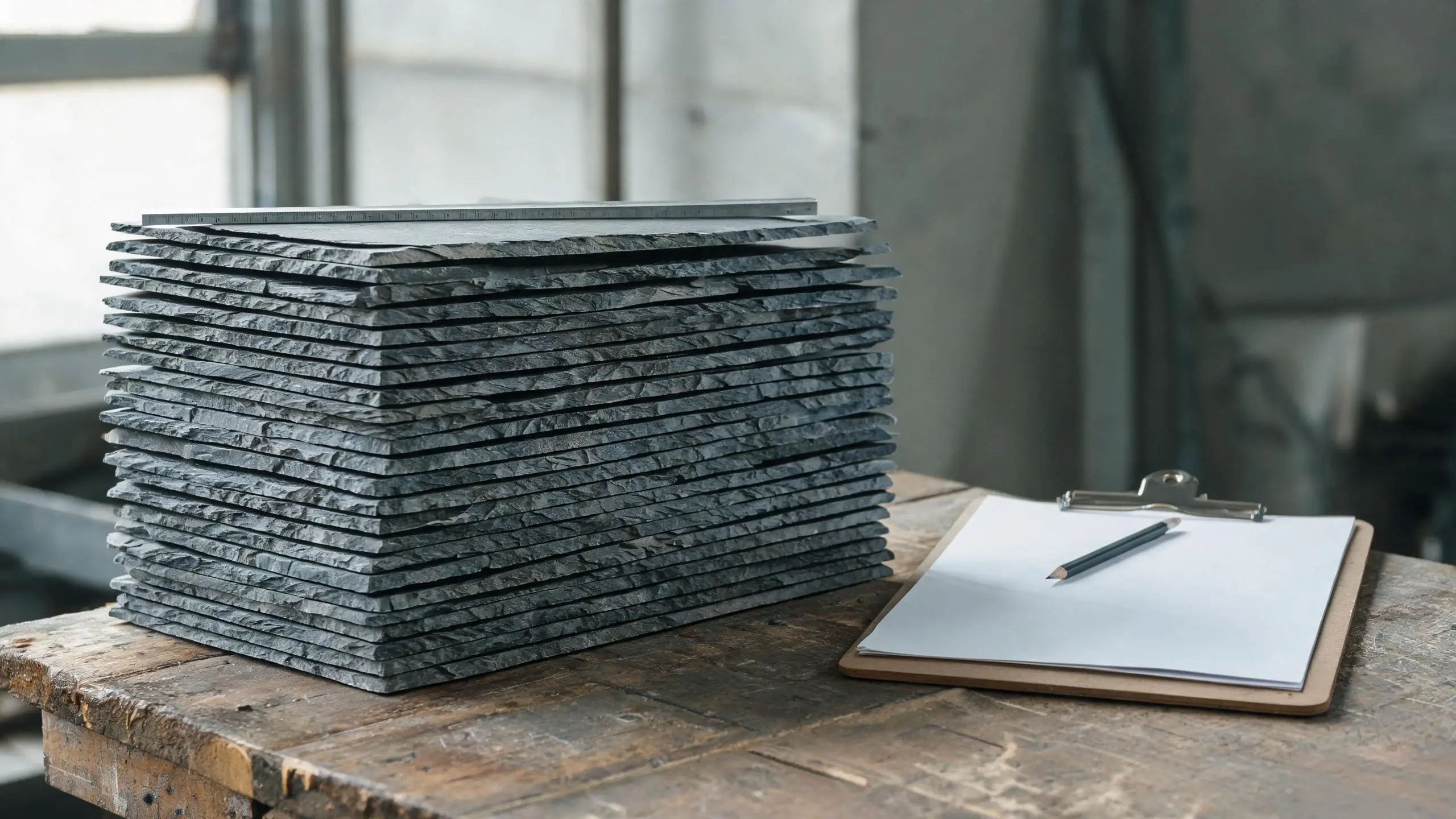
For roofing orders, the same station covers the test data. If the supplier quotes a test report — water absorption, flexural strength, freeze–thaw — make the report answer three questions before you rely on it: does the report carry a batch number, does the material description match the product you are buying, and is the report date reasonably current? A report for a different bed, or a different product line, tells you about the quarry's general geology, not about your roof tiles. The commonest trap in natural stone sourcing is testing one material and supplying another; the batch number is the thread that connects the two. How to read each line of a report is covered separately in How to Read a Roofing Slate Test Report, and our own published figures are on the test results page.
For larger orders — first container with a new supplier, or any order big enough that a problem would hurt — the proof can be a person: a third-party inspector at the factory before loading. A pre-shipment inspection costs a few hundred dollars against a container worth tens of thousands, and the checklist such an inspector works through is worth reading even if you never hire one — see Pre-Shipment Inspection Checklist. The supplier's reaction to the request is also useful evidence: a company with a defined inspection process should be able to explain plainly how a third-party visit would be handled, even if the exact arrangement needs to be agreed in advance.
Red flag at this station: "quality checked" arrives with no method, no instrument, no rejection rate — a factory that checks everything has a reject pile and a number for it.
Station Four — The Paper Trail: Documents That Agree With Each Other
The claim: "We will provide all export documents."
By this point in a deal you will have collected a small stack of paper: company registration, quotation, proforma invoice, specification sheet, test report, packing list, commercial invoice, and later the bill of lading. The buyer-facing skill is not collecting them — any supplier can produce documents — but reading them as a set. What you are checking is that the numbers agree with each other across the stack:
- the product description on the quotation reappears, word for word, on the proforma invoice;
- the quantity and crate count on the packing list match the invoice;
- the batch number on the test report is the batch number that appears on the crates;
- the company name on the contract is the company name you are about to pay.
Before you pay: verify the legal seller. The company named on the quotation, the contract and the proforma invoice should be one and the same, clearly identified — one legal name, end to end: quotation → contract → proforma invoice → bank account. The receiving bank account should normally correspond to that legal entity. If payment is requested to a different company — or to an individual — ask for a written explanation and supporting documentation before the deposit leaves, not after. In most cases there is a legitimate reason; the test is whether the supplier can state it in writing before you pay.
The proof and the read are the same document here. Ask for the full set at quotation stage — before payment, not before shipment — and read them side by side. Well-run export desks produce documents that agree because they are generated from the same record; a stack in which the dimensions on page two quietly differ from page four is telling you that someone edits documents by hand when problems arise. Keep the full pack aligned from the quotation stage and the customs stage largely takes care of itself — the numbers that matter at the border are the numbers you already checked.
Red flag at this station: the numbers across the documents do not agree, and the explanation is "old template" — that phrase is fine once, concerning twice.
Station Five — Packing and Loading: Evidence That Ends at the Container Door
The claim: "Export-standard packing. Very strong crates."
Good slate can still arrive damaged, and packing is where the words are cheapest and the photos most scarce. So ask for the photographs that most suppliers never think to send: not the clean product shot, but the inside of a packed crate, and the container as it is being loaded.
For roofing slate, ask to see how tiles sit inside the crate: flat-packed in layers with padding between them, edge protection, and a stated maximum crate weight so your warehouse knows what it is unloading. Roofing slate from this region normally travels in wooden crates rather than on pallets — a detail worth confirming in writing, because "export packing" means different things to different suppliers. The construction of those crates, and what makes one survive an ocean crossing, is covered in Roofing Slate Packaging and Crate Standards.
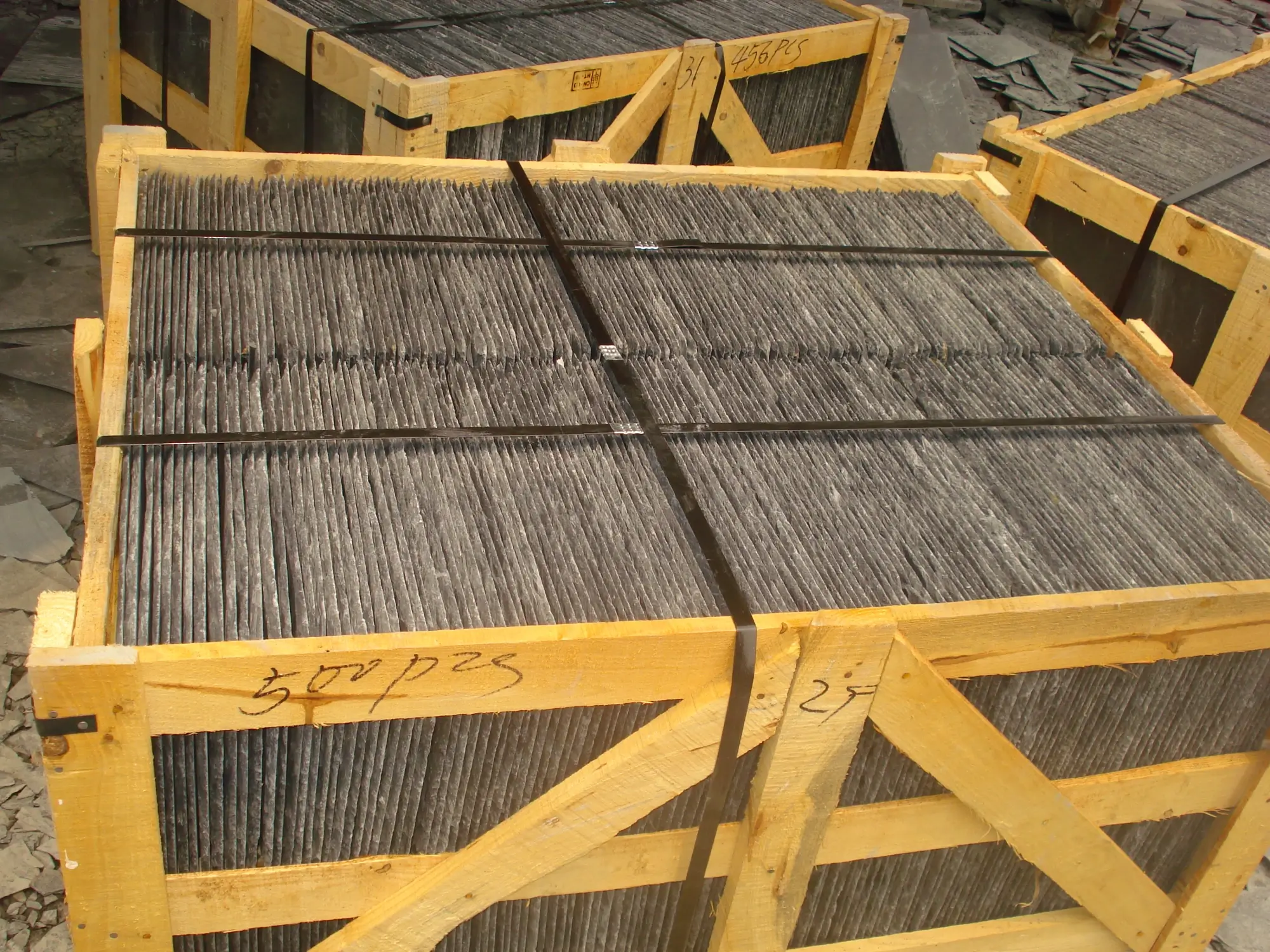
For billiard slate, the stakes are higher and the crate is the product's safety system: individual separation between pieces, corner and edge protection, internal bracing so nothing shifts, and stated lifting points, because a set of table slabs is handled by people who cannot see inside.
The proof for both is the loading sequence — and this is where one specific request separates a documented supply chain from a photographed one. Do not settle for a single photo of a closed container door. Ask for the sequence: the empty container, the crates going in, the voids being braced, the doors closing, and a close-up of the seal number. A closed door could contain anyone's goods; a sequence that ends at a seal number — a number that should then appear on your bill of lading — can only contain yours.
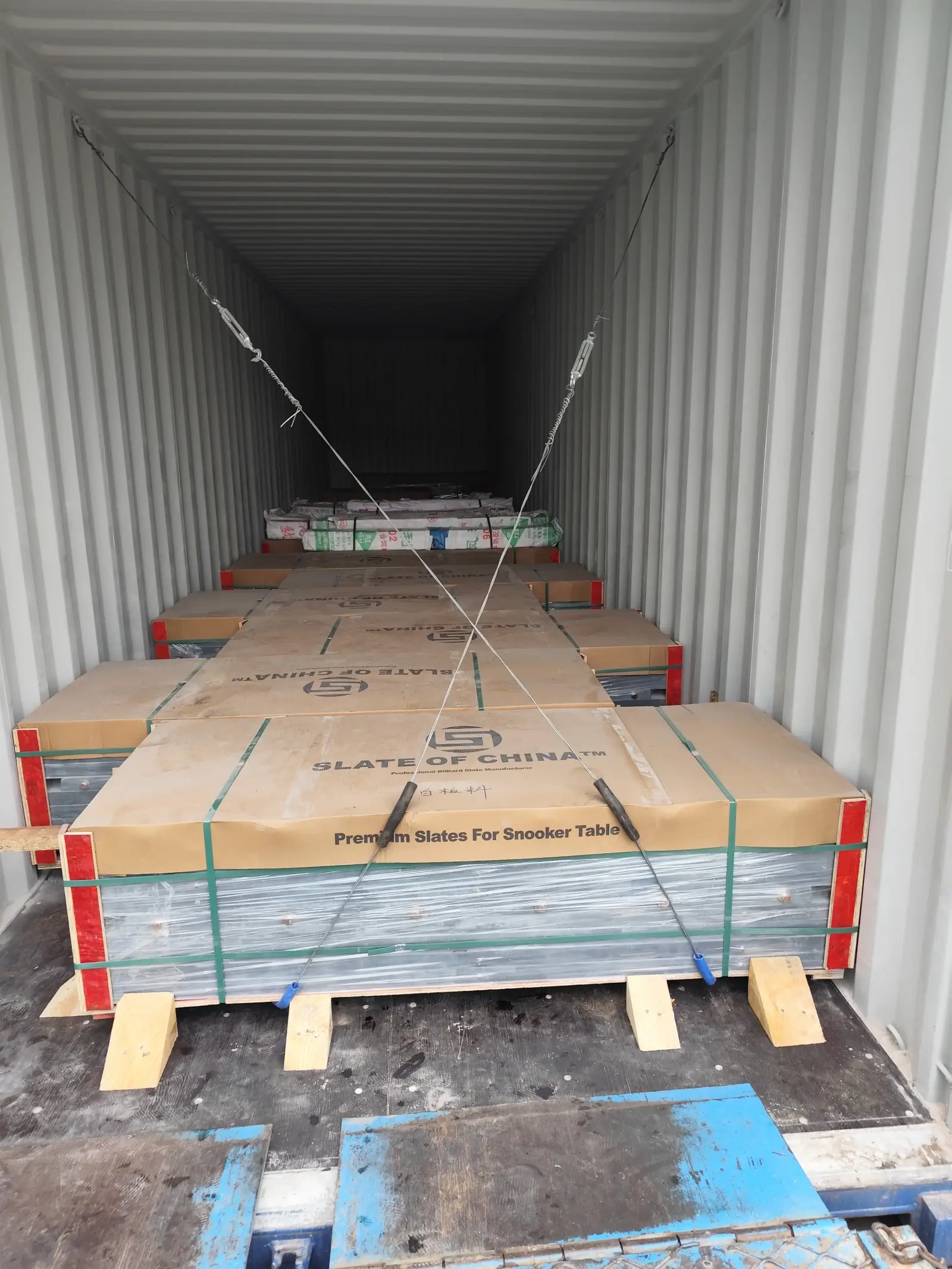
Red flag at this station: the supplier can send beautiful photos of slates and crates, but has never once photographed a container being loaded — the moment that happens to every real shipment.
Compare Evidence, Not Prices
When buyers compare three quotations from three Chinese slate suppliers, the table usually has one row that matters: price. Here is the comparison that predicts what your second container will be like. Fill it in from the five stations above, one tick at a time, and let the quotes sit beside it:
| Evidence requested | Supplier A | Supplier B | Supplier C |
|---|---|---|---|
| Quarry relationship explained plainly | ✓ | ? | — |
| Current production video sent within the week | ✓ | — | ? |
| Processing steps in-house vs outsourced, stated in writing | ✓ | ✓ | — |
| Specification confirmed dimension by dimension, with corrections | ✓ | ? | ✓ |
| Test report with batch number matching the offer | ✓ | — | ✓ |
| Inspection method and instruments described, with photos | ✓ | ? | ? |
| Packed-crate photo and loading sequence offered | ✓ | ✓ | — |
| Third-party inspection accepted without resistance | ✓ | ? | ? |
✓ = provided promptly · ? = promised but not delivered · — = not available
This changes the question from "who is cheapest?" to "who can demonstrate the supply chain my order needs?" — and the two answers are frequently not the same supplier. A quotation is an intention; this table is a preview of how each company will behave after you have paid a deposit.
When a Trading Company Is Honest — and When a "Factory" Isn't
The issue is not whether a supplier is a factory or a trading company. The issue is whether the supply chain is transparent and controlled.
Run the five stations and you may find your best-scoring supplier is a trading company that answered every question honestly: blocks from a named partner quarry, processing at a stated facility, inspection records on request, crates and loading photos without being asked twice. That is a workable supply chain — you know what you are buying and who stands behind each stage. The reverse also happens: a self-declared "factory" that cannot produce a single processing video. The distinction that matters was never the word on the letterhead; it is transparent versus unclear. Trading companies with real quarry relationships and quality control of their own exist, and small factories with no export experience exist. Ask what the company does itself, what it outsources, and who answers when something goes wrong.
There are, however, five answers that should end the conversation — not because every one indicates fraud, but because each one removes your ability to check anything afterwards:
- The origin answer never gets more specific. "Jiujiang, China" is a starting point, not a supply chain. If three polite follow-ups produce nothing but the same four words, move on.
- Every photo is catalogue-grade. If the supplier cannot produce one dusty, cluttered, unglamorous picture of a working line, assume the line is not theirs to photograph.
- Adjectives replace specifications. "Premium quality" and "top grade" are marketing; dimensions, tolerances, batch numbers and test reports are facts. A supplier fluent only in the first kind is hoping you will not ask for the second.
- Reasonable inspection is resisted. For a substantial commercial order, a supplier should be willing to discuss inspection — yours or a third party's — without drama. A supplier who cannot discuss inspection at all is telling you something, though exactly what is worth one more direct question before you decide.
- A low price survives without explanation. Low prices can be legitimate: thinner tiles, looser tolerances, different packing, slower season, larger quantity. But a supplier who cannot say what makes their price low is not showing you a discount — they are showing you what is missing from it.
A Sample Tests the Process, Not Just the Stone
For roofing slate, a physical sample is cheap to arrange and worth arranging — but judge it as a test of the supplier as much as of the stone. How long did the sample take? Did it match the colour and thickness described? What did the packaging look like on arrival? A supplier who handles a small sample order professionally is showing you, at small scale, how your container will be handled. If the sample is approved, keep it sealed and keep the record — a sealed reference set is what your pre-shipment inspection will be measured against.
For billiard slate, samples are usually impractical — a three-piece 9 ft bed is not something anyone couriers. The substitutes are the ones from the stations above: a confirmed drawing, a joint-matching photo, a production video, and a pre-shipment inspection. If you are evaluating table slate for the first time, our billiard slate range shows the specifications these checks should be run against.
Twelve Verification Questions to Send Before a Deposit
The twelve checks are mapped in the table near the top of this article. Here they are again, rewritten as questions you can paste straight into an email — every one asks for a piece of evidence rather than a reassurance, and together they are the audit:
- Where is the slate for my order quarried — your own face, a named partner quarry, or purchased blocks? (origin)
- Can you send a short video of this week's production for this exact product? (current footage)
- Which processing steps happen in your own facility, and which are done elsewhere? (factory role)
- Attached is my specification — please confirm every dimension and tolerance in writing, and tell me where I am wrong. (capability)
- What is the batch number on the test report you quoted from? (data correspondence)
- What exactly do you check on each piece, with which instrument, against which tolerance? (inspection method)
- Can inspection photos show the readings on the measuring tools? (inspection evidence)
- How will my order be packed — crate construction, separators, protection, maximum crate weight? (packing specification)
- Will you send the loading sequence, including a close-up of the seal number? (loading evidence)
- Which legal company will be named on the contract and proforma invoice — and which account will receive our payment? (legal seller & payment account)
- Can we visit the factory, or send a third-party inspector, on a normal production day? (attitude)
- Can you hold this same specification for the next five containers — and how? (consistency)
Question twelve matters most for importers planning to buy more than once. A good first container proves the supplier had your specification once. A supplier who can explain how the fifth container will match the first — batch records, sealed reference samples, the same splitting line — is the one worth building a purchasing plan around.
Trace It Backwards, Verify It Forwards
All five stations compress into one method, and it is worth keeping even after this article is forgotten. Before you order, trace the product backwards — from the finished slate in the photos, back through machining and splitting, back to the raw block, back to the quarry face. Every step should have a picture, a person or a document attached. Then verify your own order forwards, stage by stage, from the specification you approved:
Backwards: finished slate → machining & grinding → splitting & sawing → raw block → quarry face
Forwards: specification → production → inspection → packing → container loading → your warehouse
A transparent supplier does not need to own every link — partner quarries and outsourced steps are normal in this industry. What they need to demonstrate is control: that someone stands behind each stage, that the stages are documented, and that the chain does not change between your first email and your fifth container. That is what the five stations measure, and it is why the work is worth doing before the container is booked — after the seal goes on, the evidence is already at sea.
Frequently Asked Questions
Can I verify a Jiujiang slate supplier without visiting China?
Yes — most of it. A dated production video, current quarry and block photos, a confirmed drawing, inspection records and a full document set can answer most of the practical questions in this article over email. The exceptions worth flying for are a large first order, an annual purchasing plan, or a specification you intend to repeat for years; for those, half a day at the quarry and factory settles what months of emails cannot.
How do I know quarry photos and videos are current?
Ask for something that cannot come from a photo library: a sheet of paper with the day's date in the frame, a specific detail you request ("show me the blocks for a 22 mm order"), or a live video call from the yard. Suppliers with their own production can do any of these within a day or two; the ones who cannot will teach you that instead.
Is a trading company a bad choice for slate buyers?
Not automatically. A trading company with long-term quarry relationships, honest answers about what it outsources, and its own quality control can outperform a factory with no export experience. Judge transparency, not letterhead: ask what the company does itself, what it outsources, and who is responsible for each stage. The five stations work on any supply chain, not just on factories.
What documents should I have before paying a deposit?
A proforma invoice with the full specification, a test report whose batch number and material description match your order, a confirmed drawing or sample reference for machined products, and clarity on which legal company you are paying and why. The rest of the export pack — packing list, bill of lading, certificates — follows the shipment, but the numbers on all of them should trace back to the proforma you approved.
Is a third-party inspection worth the cost?
For a first container with a new supplier, usually yes — an inspection typically costs a few hundred dollars against a container worth tens of thousands, and it converts "trust me" into a dated report. For repeat orders with a supplier who has passed several containers, many buyers reduce it to spot checks or rely on the loading-photo sequence instead.
What is the single most important check for billiard slate?
The joint. Ask for a photo of the three pieces of a set laid together, edge to edge, with a straightedge across the seams — and confirm the flatness and joint tolerances in writing before the deposit. A table bed lives or dies on whether three separate pieces of stone behave as one flat surface; no other specification survives bad joints.
Related Reading
Use These Checks on Us
Want to verify our supply chain? You don't have to take our word for it — ask us for the evidence.
Everything this article tells you to request, we will send: current quarry and raw block photos, this week's production video, processing line photos, the specification for your drawing, inspection photos with the readings on the tools, packed-crate photos, the full container loading sequence to the seal number, and the test documentation behind our EN 12326 / ASTM C406 figures.
If you are evaluating several suppliers, send the same twelve questions to all of them, including us. We would rather lose an order to a better-documented supplier than win one on adjectives.
Request Supplier Verification Evidence — tell us what you are checking for, and our factory team replies within one working day. Our published test results are open to check before you write.