
Jiujiang, Lushan or Xingzi Slate: What's in a Name?
Open one order folder and you can find the same stone written four different ways: Jiangxi on the certificate of origin, Jiujiang on the bill of lading, Lushan on the quotation, Xingzi in the old tender specification that started the whole order.
Those are not four competing origins and not four different slates. They are one administrative area named at four different levels, in two different historical eras, by four different habits of the documents that surround it. The buyer's real question is not "what do these names mean" but "am I actually comparing the same rock when I line two quotations up" — and that is a question you can answer from the paperwork, before a single crates opens.
At a glance — how the names stack, not compete:
| Name you see | What it actually is | Where it shows up |
|---|---|---|
| Jiangxi | The province | Certificate of origin, customs documents |
| Jiujiang | The prefecture-level city | Supplier names, Jiujiang port, container documents |
| Lushan | County-level city since 2016, named after the mountain | New quotations, invoices, bills of lading since 2016 |
| Xingzi | The county name before 2016 | Older specifications, older company registrations |
| Hengtang | A town inside Lushan where the slate processing clusters | Local quarry and workshop references |
The names nest inside each other like addresses: Jiangxi holds Jiujiang, Jiujiang holds Lushan, and Lushan holds the town of Hengtang where much of the region's slate processing sits. When a buyer sees "Lushan slate" and "Jiujiang slate" on two quotations, they are almost always looking at the same broad producing area — and sometimes the very same quarry faces, depending on the season and the batch. But "almost always the same area" is not the same thing as "the same stone." This page is about drawing that line honestly.
The Names Nest, They Do Not Compete
The fastest way to see how the names fit is to draw them as one box inside another. This is the administrative ladder the same slate sits on:
I read documents like this for a living, and I can tell you the practical point in one line: a name on a document tells you the address of the region, not the quality of the stone inside it. "Jiujiang slate" and "Lushan slate" are two ways of writing the same neighbourhood — not a claim about thickness tolerance, absorption, or which quarry face a given batch was cut from. If a supplier's quotation leans heavily on one of these names as if it were a quality label, the name is doing work it was never meant to do.
The deeper history is covered in Lushan, Xingzi and the Slate Belt of Jiangxi — that article walks the belt's geography and the old quarries that built the region's name. What this article adds is the buyer's job: how to read the names on the documents in front of you and be sure you are comparing like for like.
Why "Lushan Slate" Is the Name You Will See Most in Trade
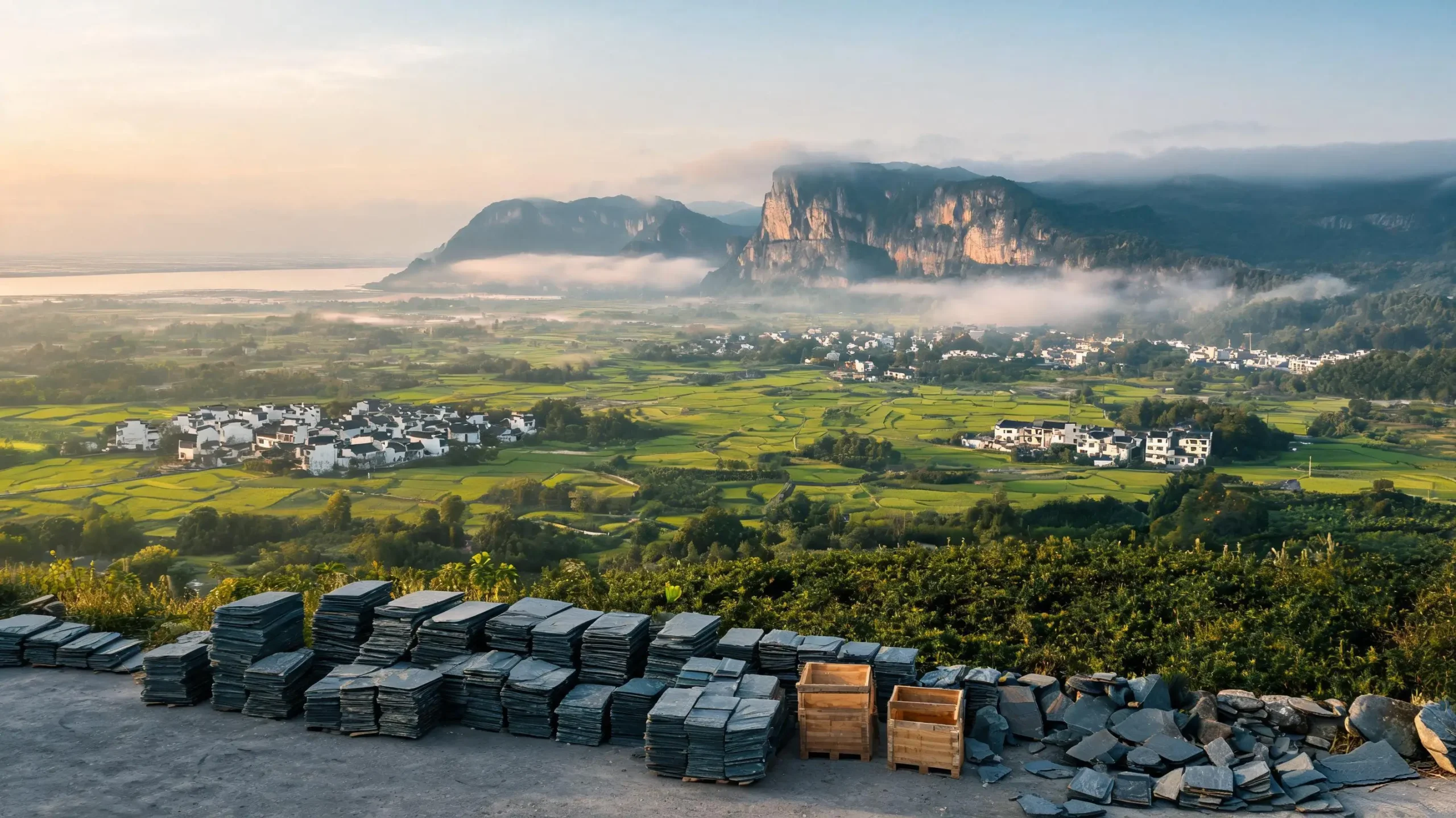
Three things made "Lushan" the name you will meet most often on invoices and bills of lading today.
First, the mountain is the region's identity. Mount Lushan is not an ordinary hill — it is a World Cultural Landscape and a UNESCO-recognised geological park, a name that has carried across the world for more than a century. When a stone comes from its foothills, "Lushan slate" is a far easier name for an international buyer to remember and search than a county boundary line on a map. Names that travel are the ones that survive in trade.
Second, the producing area really sits at the mountain's foot. The slate belt runs along the south-eastern foothills and the low ground between the mountain and the lakeshore, and the processing town of Hengtang belongs administratively to the mountain's county-level city. "Lushan slate" is not a cleverly borrowed label; it is geographically true. This is the difference between a marketing name and an accurate one.
Third, the administration caught up with the geography in 2016. In that year the county of Xingzi was restructured into a county-level city and named Lushan City. Official documents issued since 2016 — invoices, customs declarations, bills of lading — now carry the mountain's name in the address line by default. What was once a case of "everyone calls it Lushan unofficially" became the official wording on paper. That single administrative change is why the term "Lushan slate" jumped from informal usage into the standard text of trade documents.
So when a supplier quotes you "Lushan slate," they are usually quoting the same belt that older documents once called Xingzi. The name got clearer, the mountain did not move.
Why Old Files Still Say "Xingzi"
Now the reverse: why do old specifications and older company registrations keep saying "Xingzi"?
Because before 2016, that was the name on the letterhead. Xingzi County was the administrative unit that covered the slate-producing area for decades — most of the region's established quarries, workshops and merchants built their paperwork, their company names and their customers' expectations around "Xingzi." When the county became Lushan City in 2016, the official name changed, but a large stock of older documents, older company registration names, and decades of trade habit did not vanish overnight. A European importer who has been buying from one workshop since 2010 may still have it filed under "Xingzi" in the buying records — and that is not a sign of age or a lower grade, it is simply the address as it was written that decade.
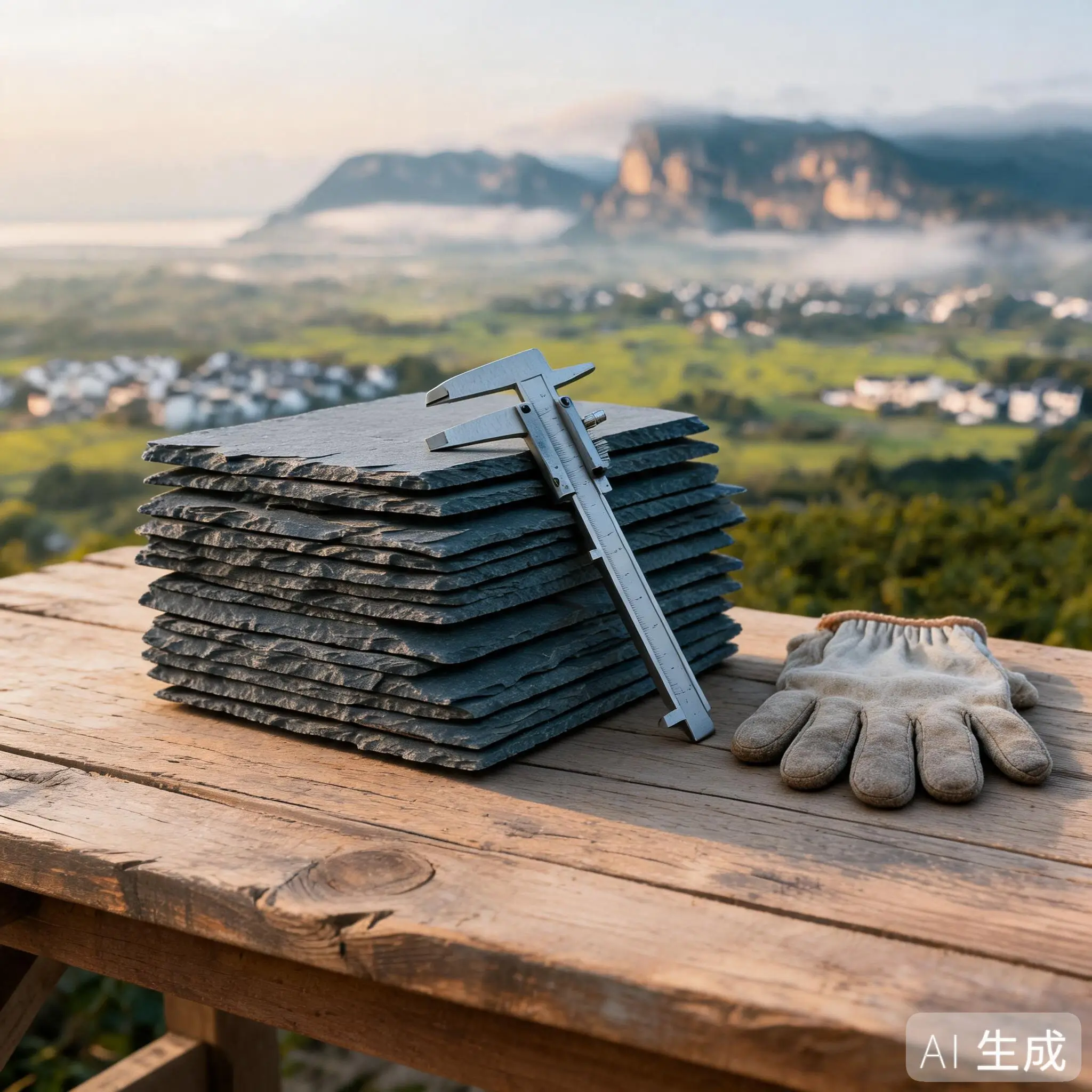
The useful habit is to treat "Xingzi" and "Lushan" as the same origin in your files, and to say so in writing — so the two names do not accidentally sit in your catalogue as if they were two different materials with two different prices. When the name changes on a document, the stone underneath does not change with it.
The Real Question: Are You Comparing the Same Rock?
Here is where the names stop mattering and the verification starts. "Same region" is not "same stone." Inside one well-known slate area, different quarry faces, different seasons and different processing batches can produce genuinely different material — different colour drift, different thickness behaviour, different test readings. The name cannot promise you those are identical; only the documents, the batch and the physical sample can.
So when you are holding two quotations — one that says "Jiujiang slate," one that says "Lushan slate" — the first thing to check is not which name is better. It is whether you are comparing the same thing at all. Run this list, in order:
| # | Check | What to ask for |
|---|---|---|
| 1 | Same broad origin | Both quotes place the stone in the same belt/region (province + city + town), not just the same country. |
| 2 | Same source this season | Which quarry faces or producing area does each quote come from this season — do they match? |
| 3 | Same batch link | Do test reports carry a batch number that will match the crates in your container, and is it the same batch as the sample? |
| 4 | Same physical sample | Does the approved, sealed sample match the production batch — not a best-pick piece set aside for photography? |
| 5 | Same spec, not just same name | Size, thickness band, sorting standard, packing — identical, so the only variable left is the origin itself. |
The short version of that table is one question: "does the paperwork, the test report, and the sample all trace to the same batch?" If the answer is yes, the two names were just two spellings of one stone. If the answer is no — if one quote points at one quarry and the other at another, or the batch number on the report does not match the crates — then the names are doing the cheapest kind of marketing, and no amount of name-negotiating will fix a difference in the actual material.
Our guide to Jiujiang slate versus other Chinese regions makes the same point from the other side: why a "Jiujiang" label on a box proves nothing about the rock, and why you have to look past the label. What we add here is the paperwork habit that lets you look past it cleanly.
Writing the Name So It Cannot Be Misread
Most sourcing confusion is not caused by dishonest suppliers. It is caused by lazy addresses. A specification that says "Chinese slate" is a box you can fill with almost anything; a specification that says "natural slate, Lushan City, Jiujiang, Jiangxi, China" is a address with one home. The second is not more expensive to type, and it removes the space in which "some other quarry's stone" can quietly stand in.
When you write a specification, tender or RFQ, put the origin in one clear line:
Origin: natural slate from Lushan City (former Xingzi County), Jiujiang, Jiangxi, China — split, cut and processed in the Lushan/Hengtang area.
That one sentence does three jobs: it fixes the administrative level (so "Jiujiang" and "Lushan" stop being two competing boxes), it acknowledges the older name so old files align with new ones, and it names the processing town, which is where the workshop that actually splits and checks the slate is. From there, the sample, the test report and the batch number do the quality work — the name just makes sure everyone is talking about the same stone to begin with.
And on the rare occasion you need the whole route from field to container verified at once — quarry, processing, inspection, packing — the seven-checkpoint method in how to source roofing slate from China is a practical checklist that works no matter what name is on the quotation.
For the standard slate dimensions, thicknesses and packing that survive no matter which name they carry, the roofing slate range is a useful short-cut while you build the RFQ above.
Frequently Asked Questions
Is "Lushan slate" the same stone as "Jiujiang slate"?
Almost always they are the same producing area: Jiujiang is the prefecture-level city, Lushan is a county-level city inside it since 2016 (before that, Xingzi County). "Lushan slate" and "Jiujiang slate" are two addresses for the same region, not two different stones. What still needs confirming is the batch — two pieces both called "Lushan slate" are only the same material if they come from the same quarry source and batch.
Is "Xingzi slate" an older or lower-grade product?
No. Xingzi is simply the name of the county before 2016, when it was restructured and renamed Lushan City. A piece sold as "Xingzi slate" is not old stock or a second grade; it is the same geological material that now ships as "Lushan slate." If you see both names in one file, treat them as one region — and one supplier — not two.
Which name should I put on my contract or specification?
Write the address in one clear line: natural slate, Lushan City (former Xingzi County), Jiujiang, Jiangxi, China. Naming the province, the city and the former county together closes the gap between old files and new documents, and gives both sides an unambiguous reference point before the sample and batch number take over.
Does the name affect the price or the quality of the stone?
No. The name is a label of origin, not a quality certificate. Two pieces both called "Jiujiang slate" can differ by quarry seam, season and processing batch — that is what test reports and sealed samples are for. Judging a stone by its name alone is how buyers end up comparing two different products that share one label.
Will a supplier still honour an old spec that says "Xingzi slate"?
Yes, in the normal case — the supplier is the same stone. The practical step is to confirm it in writing: state that the Xingzi County spec refers to the Lushan City/former Xingzi producing area, and attach the test report and sealed sample to that statement so the reference is fixed before production, not argued over after delivery.
Could two different "Jiujiang slate" quotations actually be different stones?
They can. A "Jiujiang" label tells you the region, not the quarry face or the batch. Two suppliers both quoting "Jiujiang slate" may be sourcing different seams, or even different parts of the region. To compare like for like, lock the quarry source and the batch — via test reports with batch numbers and a sealed sample — before you compare the prices.
Related Reading
Name the Stone, Then Verify the Stone
Send us a specification with the address written down — Lushan City, Jiujiang, Jiangxi — and we will answer with more than a name: the quarry faces this season, the batch numbers behind the test reports, and a sealed sample that matches the order. One origin, one batch, one answer.
Browse the roofing slate range or ask the origin question directly.