
Jiujiang Slate Water Absorption: Why 0.1% Beats Every European Benchmark
Three labs, three standards, three test sheets — and the same answer. A European EN 12326 report reads 0.2%. An American ASTM C406 report reads 0.13%. A Norwegian client's own comparison brochure, which placed Jiujiang slate alongside four Norwegian quarries, reads 0.1%. These three numbers come from different methods, different sample preparations, and different batches of the same rock, and the variation between them is exactly what you would expect from a natural stone. What they share is the order of magnitude: well below 0.2%, and in the lowest readings, at the very bottom of what the industry measures.
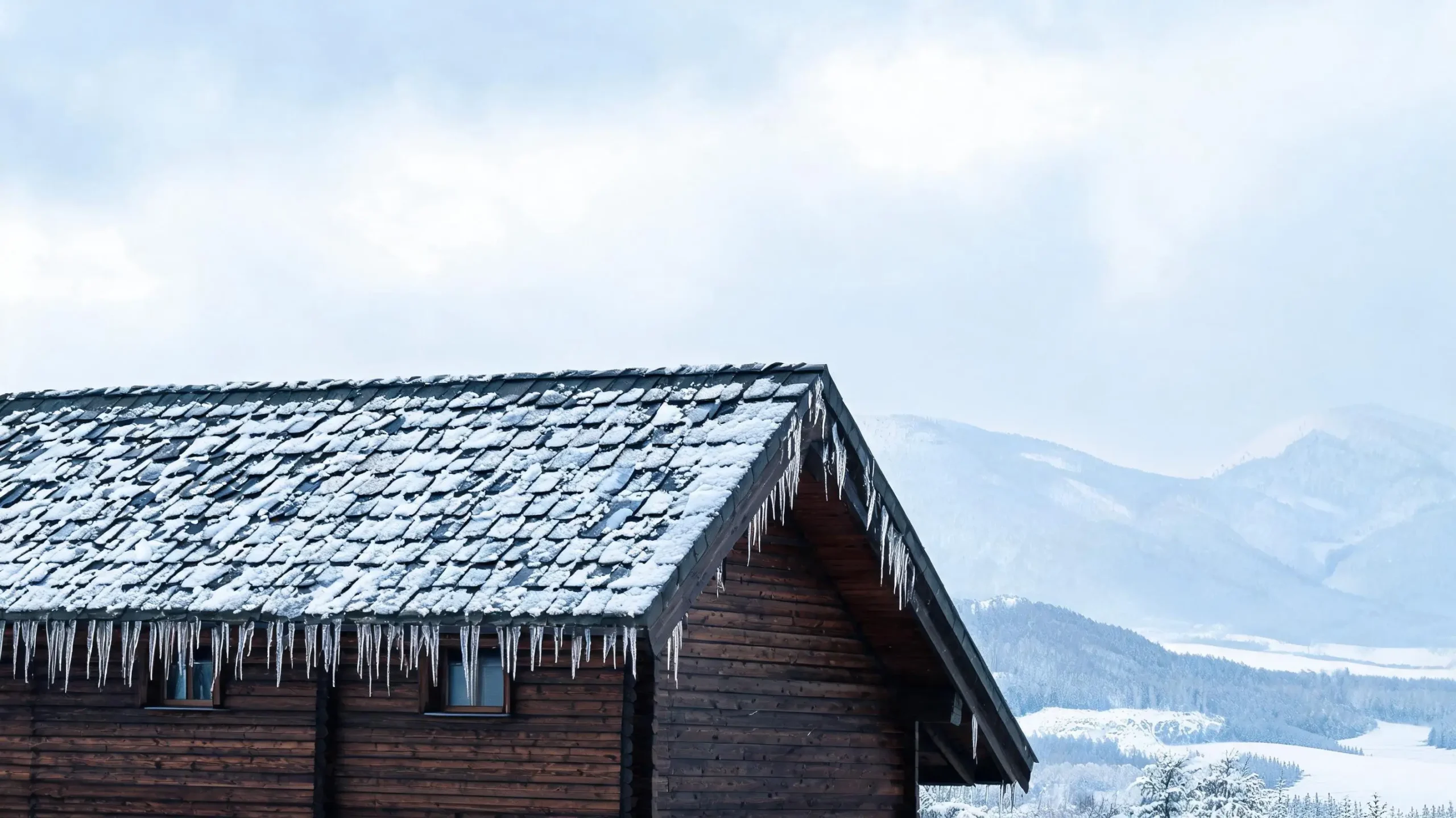
For a roofing buyer in a cold climate, that single figure is the most important number on the test sheet — more important than flexural strength, more important than colour, more important than price per square metre. Because water absorption is the number that decides whether the roof survives its first hard winter or starts shedding flakes in the third. This page is an investigation into why Jiujiang slate's reading is as low as it is, what evidence supports it, and what the number means when the temperature drops.
Quick answer:
Jiujiang slate water absorption: 0.1–0.2% (tested, varies by batch and standard)
EN 12326 Code A1 limit: ≤ 0.6% (Jiujiang is 3–6× below)
ASTM C406 S1 limit: ≤ 0.25% (Jiujiang is below)
Norwegian client comparison: Lushan 0.1% — tied with Alta for lowest of five origins tested
What it means: Water barely enters the stone, so frost has nothing to freeze and nothing to crack
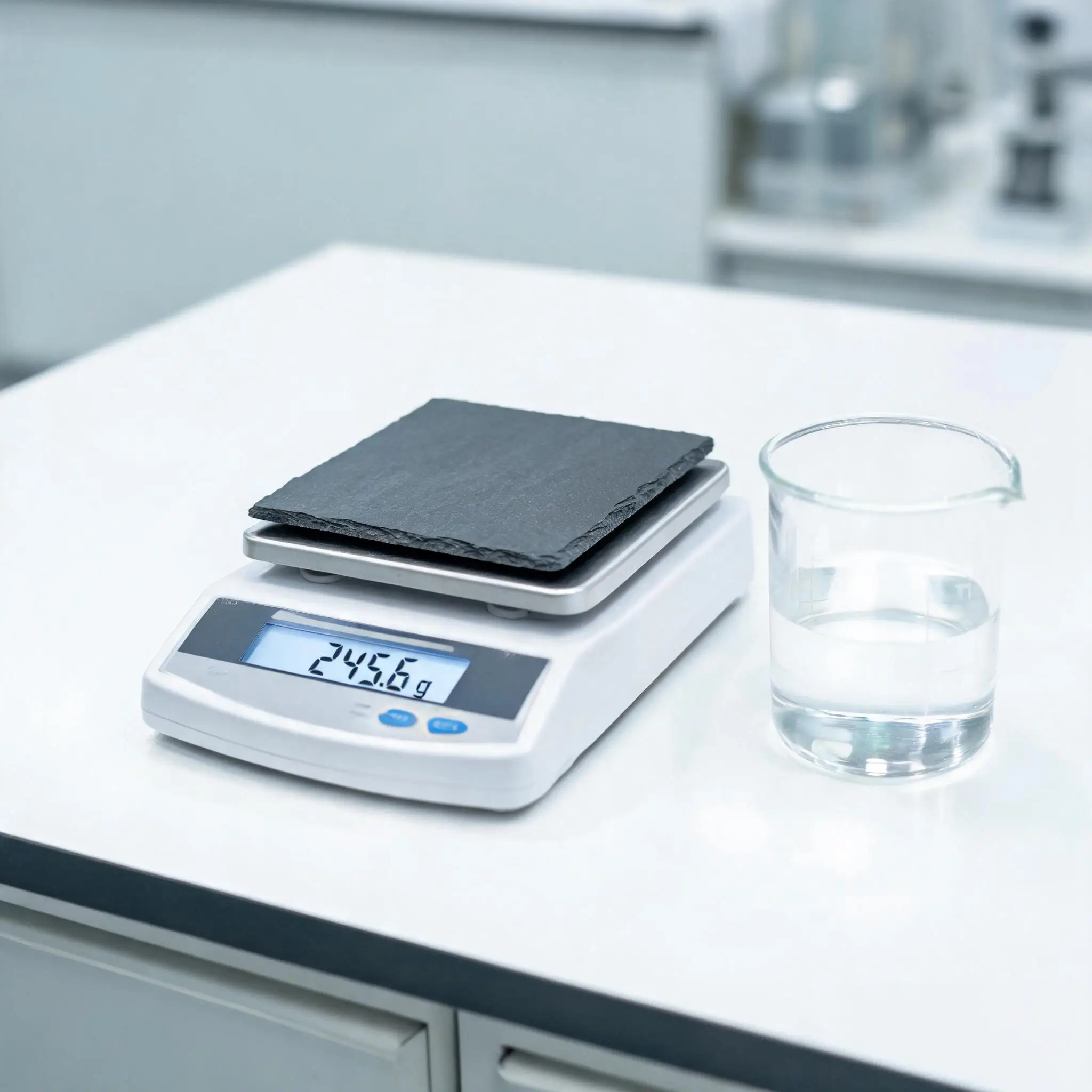
Practical test: A 4 kg tile gains less than 4 grams after 48 hours of soaking — the weight of a single grain of rice
File 1 — The Number: What 0.1% Actually Means
Start with the physical. A standard 600×300×8 mm roofing slate from the Jiujiang belt weighs roughly 4 kilograms. If you oven-dry it, weigh it, soak it in water for 48 hours, take it out, wipe the surface dry, and weigh it again — the EN 12326 routine — the number on the scale will have moved by less than 4 grams. Four grams. That is roughly the weight of a single grain of rice. On a tile that weighs 4,000 grams, the gain is 0.1%.
Most buyers meet this figure as a line on a test report, sandwiched between density and flexural strength, and skip past it. That is a mistake worth pausing on, because among all the numbers on that sheet, water absorption is the one that most directly predicts winter survival. And 0.1% is not "a good number". It is the number that puts Jiujiang slate in the same breath as the best slate Norway has ever produced — and Norway, as any cold-climate roofer will tell you, does not buy slate that drinks water.
The question this page sets out to answer is simple: why is it this low? Not "what is water absorption" — that is covered in the roofing slate water absorption guide — and not "what does 0.6% mean on a standard" — that is in EN 12326 and ASTM C406. Here the question is narrower and harder: what is it about this particular rock, from this particular mountain belt, that makes water struggle to get in?
File 2 — Why It Is This Low: Mineral Skeleton and Pore Network
The answer has two layers, and they work together. The first is mineral. The second is structural, and it is the one that actually does the work.
The mineral side: Jiujiang slate is a low-carbonate metamorphic rock. Its chemistry, published on the test results page, shows SiO₂ at 66.5% and CaO at 0.56%. The quartz content gives the stone its hardness; the near-absence of calcium carbonate means there is very little soluble mineral for acidic water to dissolve. Water that sits on this slate has nothing to react with, and nothing to enlarge the existing pores through chemical weathering. That is a long-term advantage — over decades, a high-carbonate slate will develop larger, more connected pores as acid rain slowly eats the carbonate, while a low-carbonate slate stays structurally the same. The mineral story is told in more detail in mineral composition.
But the mineral is the supporting cast. The lead role belongs to the pore network — the microscopic architecture of empty space inside the stone. And this is where Jiujiang slate's geology earns its number.
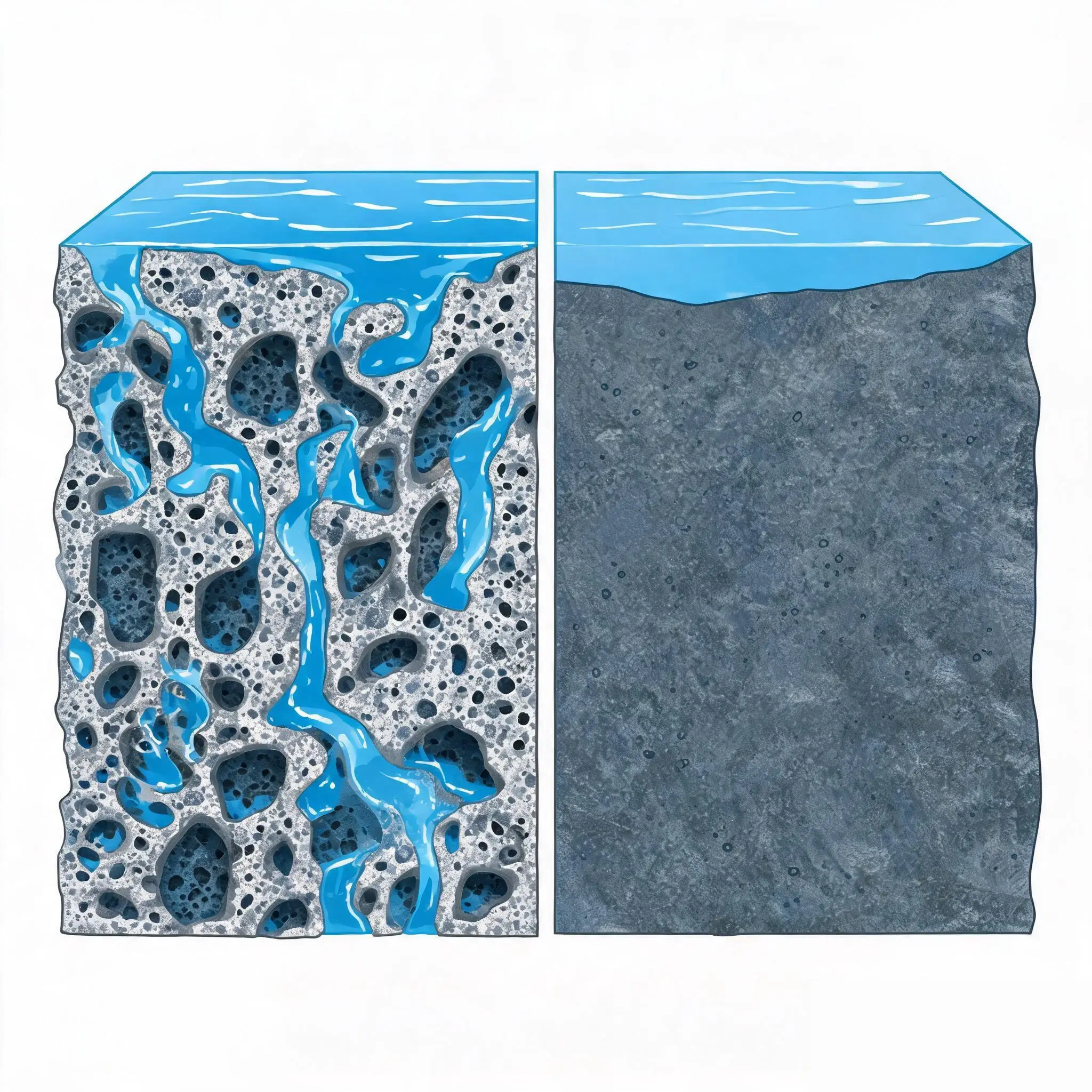
Slate forms when clay-rich sediment is buried, heated, and squeezed over geological time. The pressure recrystallises the clay minerals into flaky micas — primarily muscovite — and aligns those flakes in parallel sheets, interleaved with quartz grains. The result is an interlocked mineral skeleton: sheet after sheet of crystals pressed together so tightly that the spaces between them are small, isolated, and poorly connected. Water can only enter the stone if there is a continuous path of pores from the surface to the interior. In dense slate, that path barely exists. The geology behind this is laid out in the geology of Jiujiang slate, and the density figure that proves it (2.7–2.8 g/cm³) is explained in Jiujiang Slate Density.
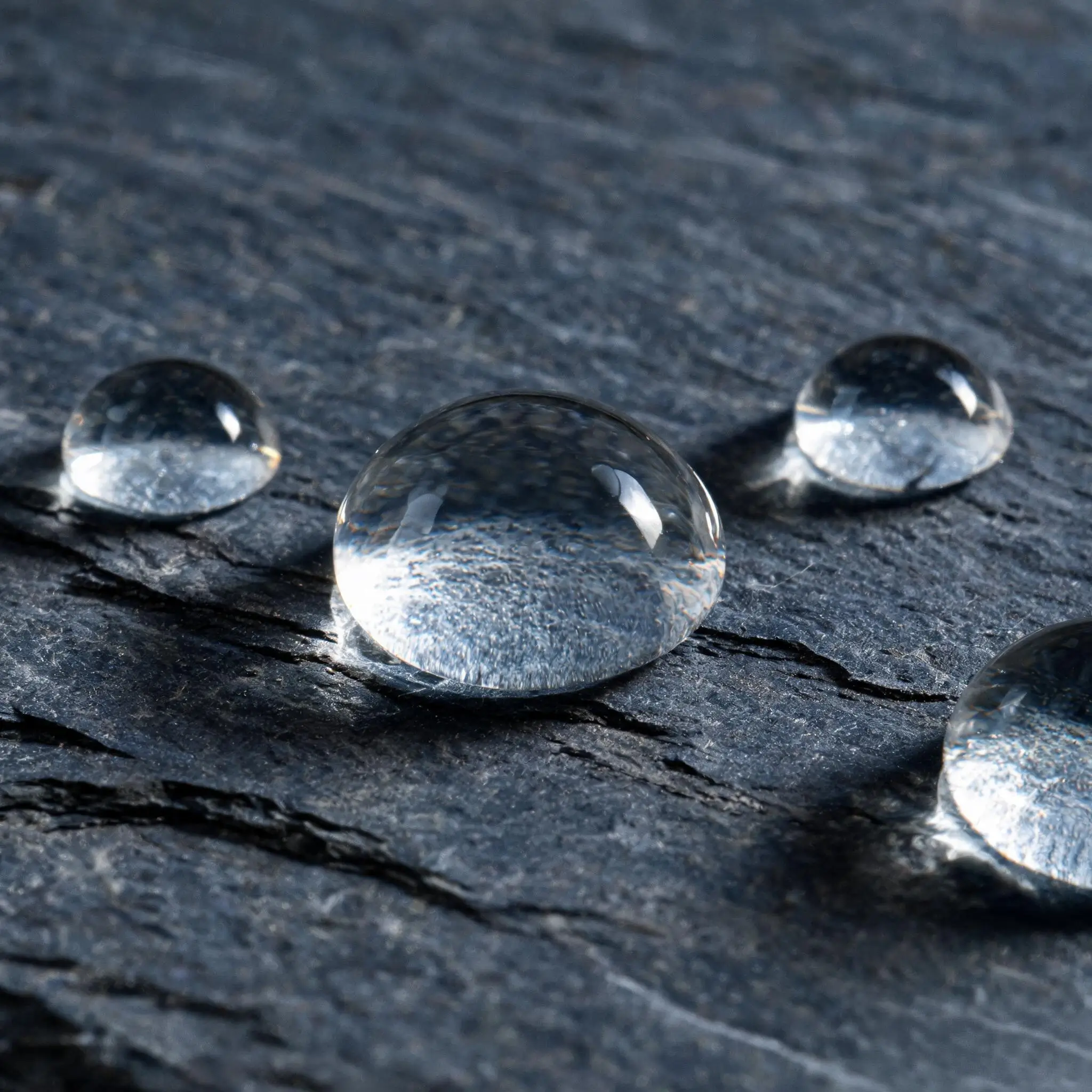
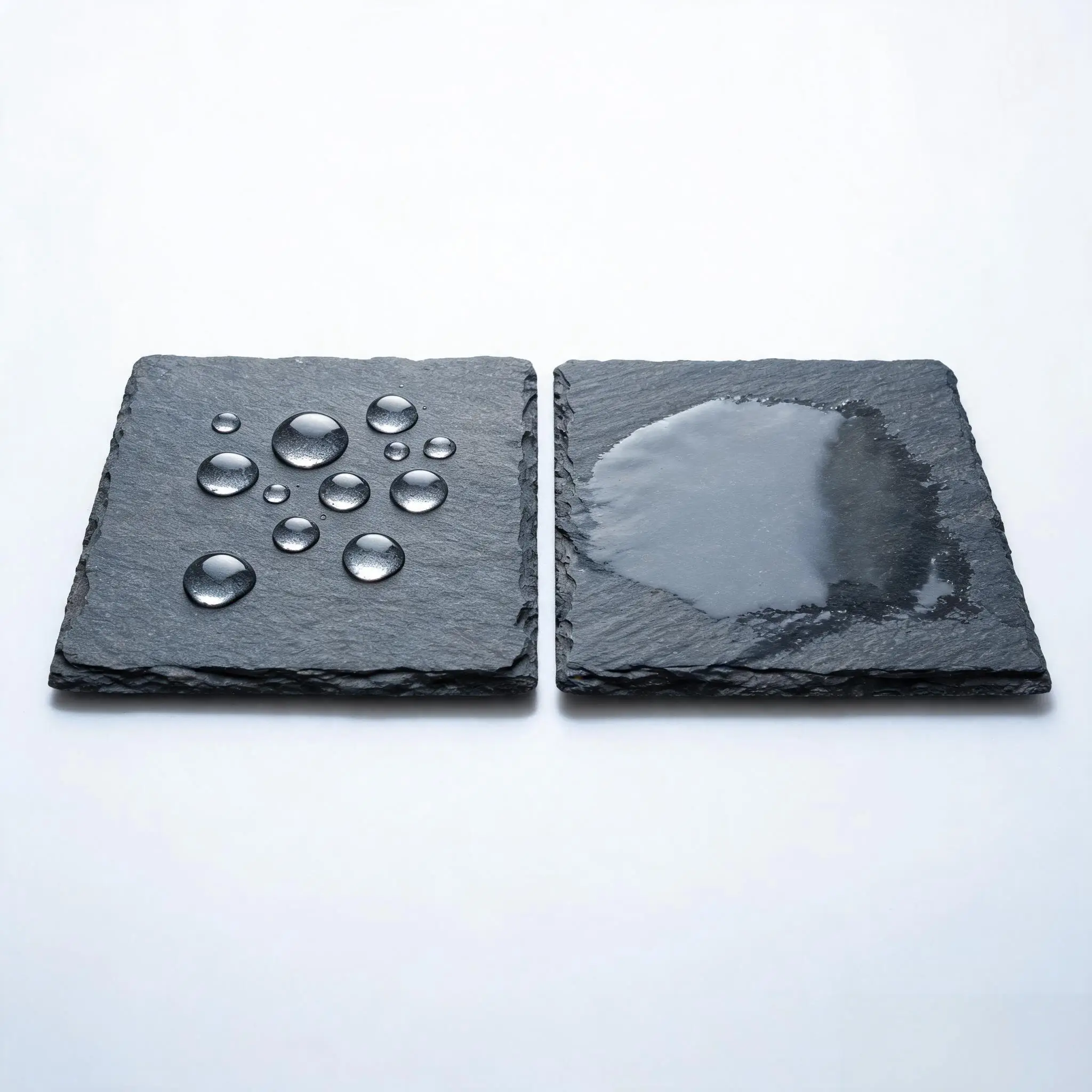
The visual signature of this tight pore network is something any buyer can check in thirty seconds: place a droplet of water on the surface of a freshly split tile. On a dense, low-absorption slate, the water beads up tall and round — it sits on the surface like a glass marble, because there is no pore pathway to pull it in. On a porous slate, the droplet flattens and spreads, darkening the stone as water finds its way through the connected network. The comparison is stark enough that it has become a standard yard check in the trade, and it is one of the two field tests described in the quality evaluation guide.
There is a second, subtler point about pore structure that a single absorption number does not capture: the difference between pore volume and pore connectivity. Two slates can have the same absorption percentage and behave differently on a roof, because absorption measures how much water gets in, not how fast it gets out or where it sits. A slate with many tiny, dead-end pores may absorb a small amount of water but hold it for a long time — which is actually worse for frost resistance, because the water stays inside when the temperature drops. A slate with fewer but better-connected pores may absorb slightly more water but drain it quickly, so the stone is dry before the freeze. This is why the freeze–thaw test, not the absorption number alone, is the final proof of cold-climate performance. That test, and how to read it, is covered in the freeze–thaw resistance guide and will be explored from the Jiujiang perspective in Jiujiang Slate Freeze–Thaw Resistance.
File 3 — The Evidence: A Norwegian Client Did the Comparison
Laboratory reports are one thing. A client who buys your slate, takes it home, tests it against their own domestic supply, and prints the result in their sales brochure — that is something else entirely. And that is what happened.
A Norwegian roofing slate distributor — a client of the Jiujiang factory, selling into the Norwegian market — produced a comparison brochure for their own customers. In it, they placed Lushan slate (the trade name for Jiujiang slate in that market) alongside four well-known Norwegian quarry sources. The water absorption figures, as measured and printed by the client — not by the supplier — were as follows:
| Origin | Water Absorption | Note |
|---|---|---|
| Lushan (Jiujiang, China) | 0.1% | Tied for lowest |
| Alta (Norway) | 0.1% | Tied for lowest |
| Otta (Norway) | 0.2% | — |
| Oppdal (Norway) | 0.2% | — |
| Anbefalt (local spec limit) | 0.3% | Maximum allowed by Norwegian standard |
Read the table carefully. The Norwegian client tested their own domestic slate — the slate they have been selling for generations — and placed a Chinese stone beside it. Lushan tied with Alta for the lowest water absorption of the five origins. Every Norwegian slate in the comparison, except Alta, was higher. And the local specification limit — the maximum a Norwegian roof slate is allowed to absorb — was 0.3%, three times the Lushan reading.
This is not a supplier's self-reported number. It is a client's number, measured for the client's own commercial purposes, printed in the client's own brochure, for the client's own customers. That is a different order of credibility. A supplier can choose which batch to send to the lab; a client tests the stone they are selling.
The three readings that opened this page — 0.1%, 0.13%, 0.2% — now have a context. They are not contradictory. They are the same rock measured by different people, under different protocols, on different batches. The EN 12326 method uses a 48-hour soak at atmospheric pressure. The ASTM method uses a similar regime but with different sample preparation. The Norwegian client's figures may have used their own national test method. Natural stone varies between blocks, between beds, between seasons of extraction. A range of 0.1–0.2% across three labs is not inconsistency — it is the honest bandwidth of a natural material. The honest way to state it, and the way it should be stated, is: below 0.2%, with readings as low as 0.1%.
File 4 — What the Number Decides: Frost, Colour, and Weight
Frost damage is not the roof's enemy. Water is. Frost is just the mechanism — the trigger that fires the bullet that water loaded. The sequence is simple and unforgiving: rain hits the roof, some water finds its way into the surface pores of the tile, night falls, the temperature drops below freezing, the water inside the pores expands by roughly 9% as it turns to ice, and the expansion exerts pressure on the pore walls. Do that once and nothing happens. Do it 50 times in a Norwegian winter, then repeat for 10 winters, and the micro-cracks join up, the surface starts to flake (delamination), and eventually the tile splits through its full thickness.
A slate at 0.1% absorption starves this attack at step one. There is almost no water inside the stone, so there is almost nothing to freeze. The freeze–thaw test in the laboratory — which cycles wet tiles through 100 to 300 freeze–thaw cycles and measures weight loss and strength change — is the formal proof. The full set of Jiujiang slate test results shows zero visible damage after 120 cycles, with weight loss below 0.1%. That number is the direct downstream effect of the absorption number: no water in, no frost damage out.
But water absorption decides two other things that buyers rarely connect to it:
Colour stability. Slate darkens when it absorbs water — anyone who has seen a slate roof after rain knows the wet sheen. A low-absorption slate returns to its dry colour within hours of the rain stopping, because the water never got inside the stone; it sat on the surface and evaporated. A high-absorption slate stays darker for longer, because the water is inside the matrix and takes time to migrate back out. Over years, repeated wetting and drying cycles can cause subtle colour shifts in high-absorption slate, as minerals near the surface undergo minor oxidation. Low-absorption slate holds its colour better — not because of any surface coating, but because water never gets deep enough to start a reaction. More on this in colour and weathering.
Wet weight. A roof is designed for a dead load — the weight of the slates themselves, plus snow, plus wind. If the slate absorbs water, it gets heavier. A 0.1% absorption slate on a 200 m² roof gains roughly 800 grams when wet — negligible. A 2% absorption slate on the same roof gains roughly 16 kilograms — still small, but on a large or old roof with marginal structural capacity, it adds up. The combined load of wet slates plus a heavy snowfall is the worst-case scenario for structural design, and low absorption removes one variable from that calculation. The weight-per-square-metre of Jiujiang slate — 19–24 kg/m² depending on thickness — is explained in Jiujiang Slate Density.
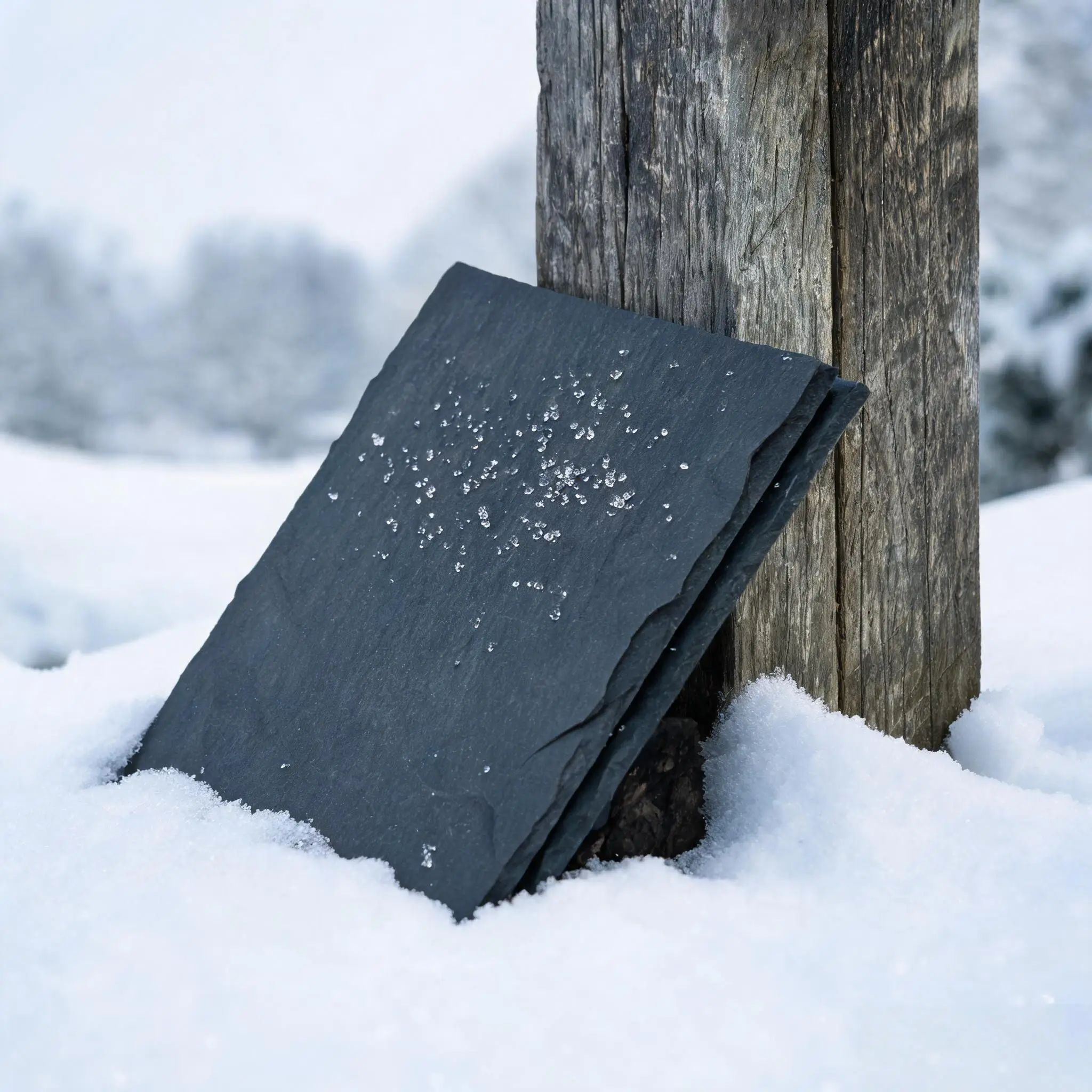
There is also a climate advantage specific to Jiujiang that rarely appears in a test report but matters in practice. The Jiujiang region sits at a latitude where winters bring cold snaps that drop below freezing, and days that rise well above it — a climate that produces 30 to 50 natural freeze–thaw cycles every winter. The slate that comes out of these mountains has already survived a natural freeze–thaw test before it ever reaches a laboratory. The 200-year-old headstones in the local countryside — still legible, still intact — are the field evidence that this rock does not just pass a lab cycling test; it has been passing a real one for centuries. That story is told in the history of slate production in Jiujiang.
File 5 — How to Verify: Three Checks That Take Twenty Minutes
A test report is the formal proof, and every serious buyer should ask for one — with a batch number on it, not a generic company certificate. But a report is paper. Three quick checks on a physical sample will tell you whether the paper is telling the truth, and none of them requires a laboratory.
Check one — the droplet test. Place a single drop of water on the surface of a dry slate sample. Wait 60 seconds. If the droplet is still sitting tall and round, beaded up like mercury, the absorption is very low. If it has flattened, spread, or darkened the stone underneath, the absorption is higher than the report claims. This takes 60 seconds and costs nothing. A specifier who has done this on hundreds of samples can read the absorption to within 0.2% by eye — not lab-precise, but enough to catch a mislabelled stone.
Check two — the weight-gain test. Weigh a dry tile on a kitchen scale. Note the weight. Soak the tile in water for 30 minutes — not 48 hours, just 30 minutes. Take it out, wipe the surface dry with a cloth, weigh it again. A 0.1% absorption slate will gain almost nothing — on a 4 kg tile, the scale will struggle to register the difference. A 1% absorption slate will gain 40 grams, clearly visible. A 2% stone will gain 80 grams, unmistakable. The 30-minute version will not match the lab number exactly, but it will separate the honest stone from the thirsty one with plenty of margin.
Check three — the ring test. Tap the edge of a dry tile with a piece of steel — a screwdriver, a nail, the back of a hammer. A dense, low-absorption slate rings clear and bright, like a bell. A porous or micro-cracked slate thuds dull. This is the oldest test in the trade, and it works because density (which controls absorption) also controls acoustic resonance — a tight mineral skeleton transmits sound, a loose one absorbs it. Every roofer knows it, and it takes three seconds. The full field-verification protocol is in how to evaluate roofing slate quality.
These three checks are not substitutes for a lab report. They are supplements — a way to confirm that the batch you received matches the report you were shown. If the report says 0.2% and your droplet flattens in 30 seconds, something is wrong with the supply chain, and you should pause before that container is loaded.
File 6 — What This Means for Your Buying Decision
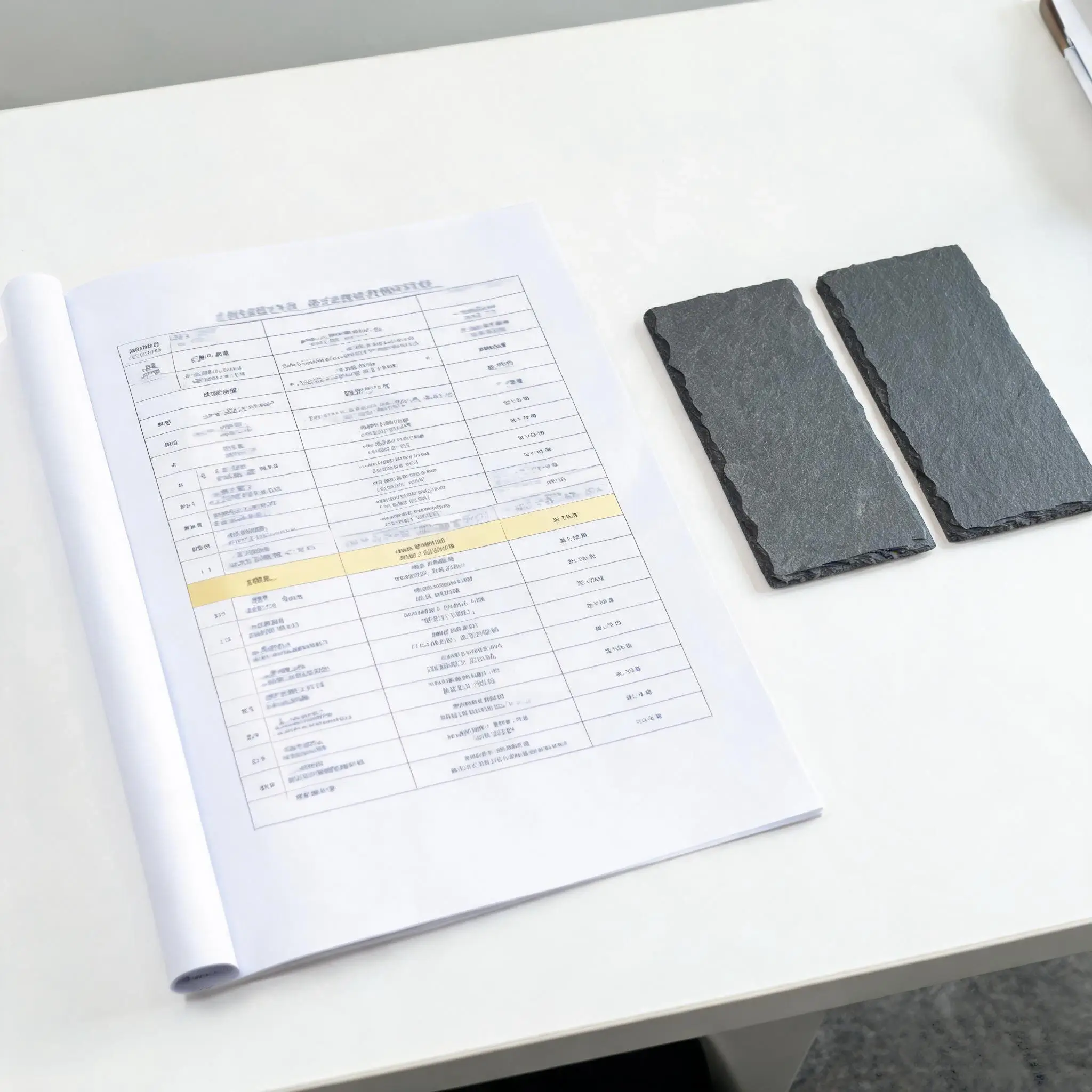
If you are buying roofing slate for a project in a cold climate — Norway, Sweden, Finland, the Alps, Scotland, Canada, the northern United States, or any region where the roof will freeze and thaw repeatedly — the water absorption number is not a "nice to have" on the spec sheet. It is the number that decides whether the roof is a 75-year investment or a 20-year gamble. The EN 12326 standard sets the A1 ceiling at 0.6% — that is a safety net, not a target. The ASTM C406 S1 class sets 0.25% — stricter, but still a floor. Jiujiang slate's tested readings, at 0.1–0.2%, sit well below both, and in the Norwegian client's own comparison, at the very bottom of the table.
For buyers sourcing from Jiujiang, the practical steps are straightforward:
- Ask for the test report with a batch number — not a generic company certificate, but the actual sheet for the batch being shipped.
- Check the water absorption line. If it reads above 0.3%, ask why — the normal range for Jiujiang slate is 0.1–0.2%, and a higher number suggests either a different quarry face or a quality control issue.
- Request a physical sample and run the droplet test. It takes 60 seconds and confirms the report is not fiction.
- Ask for the freeze–thaw cycling data alongside the absorption number — they are two views of the same property, and together they tell you everything about winter performance.
- Keep the number in proportion. Water absorption is the most important single figure for cold climates, but it is one of several that matter. The full property map is in Jiujiang Slate Properties Explained, and the four testable differences that set Jiujiang apart from other origins are in what makes Jiujiang slate different.
If you are comparing origins — Spanish, Welsh, Indian, other Chinese regions — ask each supplier for the same number, tested to the same standard, and put them side by side. The origin comparison page does this for all four major sources. When the numbers are lined up, the absorption column tells the story more clearly than any marketing copy can.
The honest bottom line: 0.1% is not a number that needs embellishment. It is a number that stands on its own, in three labs, on two continents, and in a Norwegian client's brochure. The job of this page was to explain why it is that low, and the answer is in the rock — in a mineral skeleton so tight that water has nowhere to go. Everything else is just the paperwork.
Jiujiang Slate Water Absorption: Questions From Cold-Climate Buyers
What is the water absorption of Jiujiang slate?
Tested values range from 0.1% to 0.2%, depending on the lab, the standard, and the batch. A European EN 12326 report reads 0.2%, an American ASTM report reads 0.13%, and a Norwegian client's own comparison brochure reads 0.1%. All three are well below the EN A1 limit of 0.6% and the ASTM S1 limit of 0.25%.
Why does Jiujiang slate have such low water absorption?
Two reasons work together. The mineral skeleton — interlocked muscovite and quartz grains formed under metamorphic pressure — is so tight that pore spaces are small and poorly connected, leaving water with almost no continuous pathway into the stone. The low carbonate content (CaO 0.56%) means there is very little soluble mineral for acidic water to dissolve and enlarge existing pores over time.
How does Jiujiang slate compare to Norwegian slate for water absorption?
In a Norwegian client's published comparison, Lushan (Jiujiang) slate tested at 0.1% — tied with Alta for the lowest of five origins, and below Otta (0.2%) and Oppdal (0.2%). The Norwegian local specification limit was 0.3%, meaning Jiujiang slate tested three times below the maximum allowed for Norwegian domestic slate.
Is water absorption the same as porosity?
Not exactly. Porosity is the total volume of empty space in the stone, whether or not it is connected to the surface. Water absorption measures only the pores that water can actually reach — the connected porosity. Two stones can have the same total porosity but different absorption, if one has more isolated (unreachable) pores. For frost resistance, what matters is the connected porosity, because that is the water that can freeze.
Can I test water absorption myself without sending a sample to a lab?
You can run a useful field check: weigh a dry tile, soak it in water for 30 minutes, wipe the surface, and weigh again. A 0.1% absorption slate will barely register a change on a kitchen scale; a 1% stone will gain clearly visible weight. Combined with the droplet test (water beads tall on low-absorption slate) and the ring test (dense slate rings clear), these checks confirm the lab report is honest in under 20 minutes.
Why does the water absorption number vary between test reports?
Natural stone is not a manufactured material — it varies between quarry beds, between blocks, and between seasons of extraction. Different test standards (EN 12326, ASTM C406) also use different sample preparation and soaking regimes. A range of 0.1–0.2% across three labs and three methods is the normal bandwidth of a natural material, not inconsistency. What matters is that all readings fall well below the 0.6% EN limit and the 0.25% ASTM limit.