
Slate Testing: What Buyers Should Ask For
☑ Request 01 — The full laboratory test report, not a one-page certificate. Multiple pages, real numbers, a lab name you can call.
☑ Request 02 — Video verification: the actual tiles, the actual gauge, one continuous take, a spoken date.
☑ Request 03 — The numbers behind the adjectives: water absorption, flexural strength, freeze–thaw retention, thickness tolerance.
☑ Request 04 — Batch traceability: one batch number that appears on the quotation, the packing list, and the crate itself.
☑ Request 05 — Physical samples from the current production batch, sealed and labelled — before the container is booked.
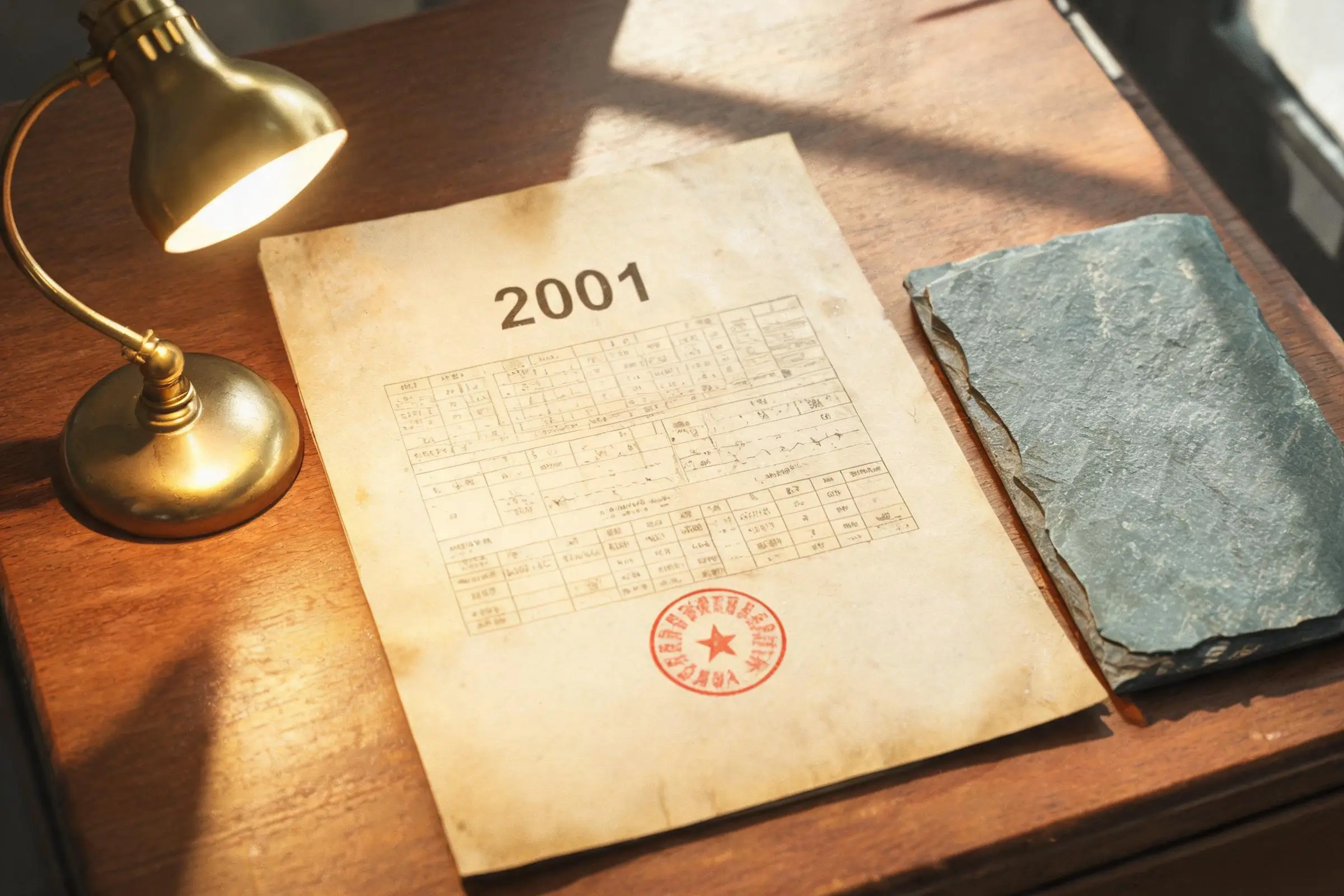
2001.
That is the year printed at the top of the oldest test report in my drawer. It is from the Jiangxi Provincial Centre Laboratory — a building-grade certification for green slate from the Xingzi area, the same geological belt our quarry sits in today. The paper has yellowed. The red stamp has faded at the edges. But the numbers on it — water absorption 0.1%, density 2.8 g/cm³, crushing load 156 MPa — have not moved a decimal in twenty-five years.
I sit on the answering side of the quality question. Buyers email, call, and sometimes fly in, and their requests come across my desk the way orders come across a shipping desk. Over the years I have noticed something that took me too long to put into words: the buyers who ask for the right things get good stone, and the buyers who ask for the wrong things get good marketing. The difference is not budget. It is not even experience. It is knowing what to request — and what a supplier on my side of the desk can, and cannot, fake.
So here is the answering-desk version of the conversation: five requests. Each one is a request I can fulfil in an afternoon, from a real drawer, with a real file. And each one is a request that a supplier who cannot fulfil it will try very hard to change the subject about.
Request 01 · Ask for the Report, Not the Certificate
The single most common mistake I see is a buyer asking, "Can you send me your quality certificate?" — and then accepting whatever comes back.
Here is what tends to come back: a single page, often with a decorative border, sometimes with a gold seal, containing phrases like "conforms to international standards", "first-class quality", or "fully compliant with EN 12326". It has a company name at the top and a signature at the bottom. It looks impressive in a tender document. It tells you exactly nothing about the stone.
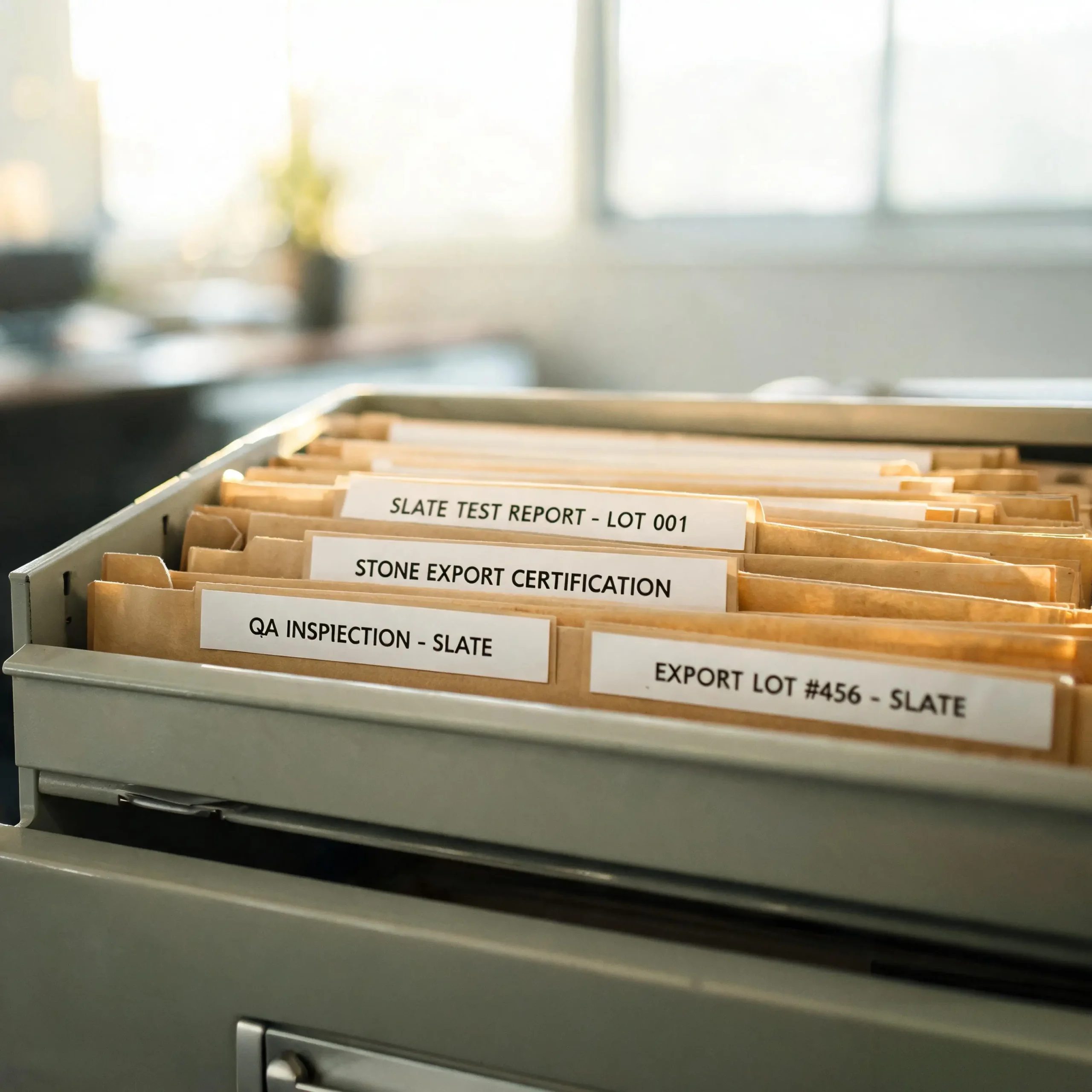
A real test report is a different animal. The 2001 certification in my drawer runs to multiple pages. It contains the testing laboratory's full name and address — the Jiangxi Provincial Centre Laboratory, a government institution, not the quarry's own office. It contains the sample submission details, including the batch it was drawn from. It contains measured values in tables: chemical composition broken down oxide by oxide (SiO₂ 66.46%, Al₂O₃ 15.81%, CaO 0.56%...), physical properties line by line, and the testing protocol each number was produced under. And it contains a date — a real one, tied to a real sample.
The distinction matters because one of these documents can be written by anyone with a printer, and the other cannot. A certificate says "trust us." A report says "here, check us."
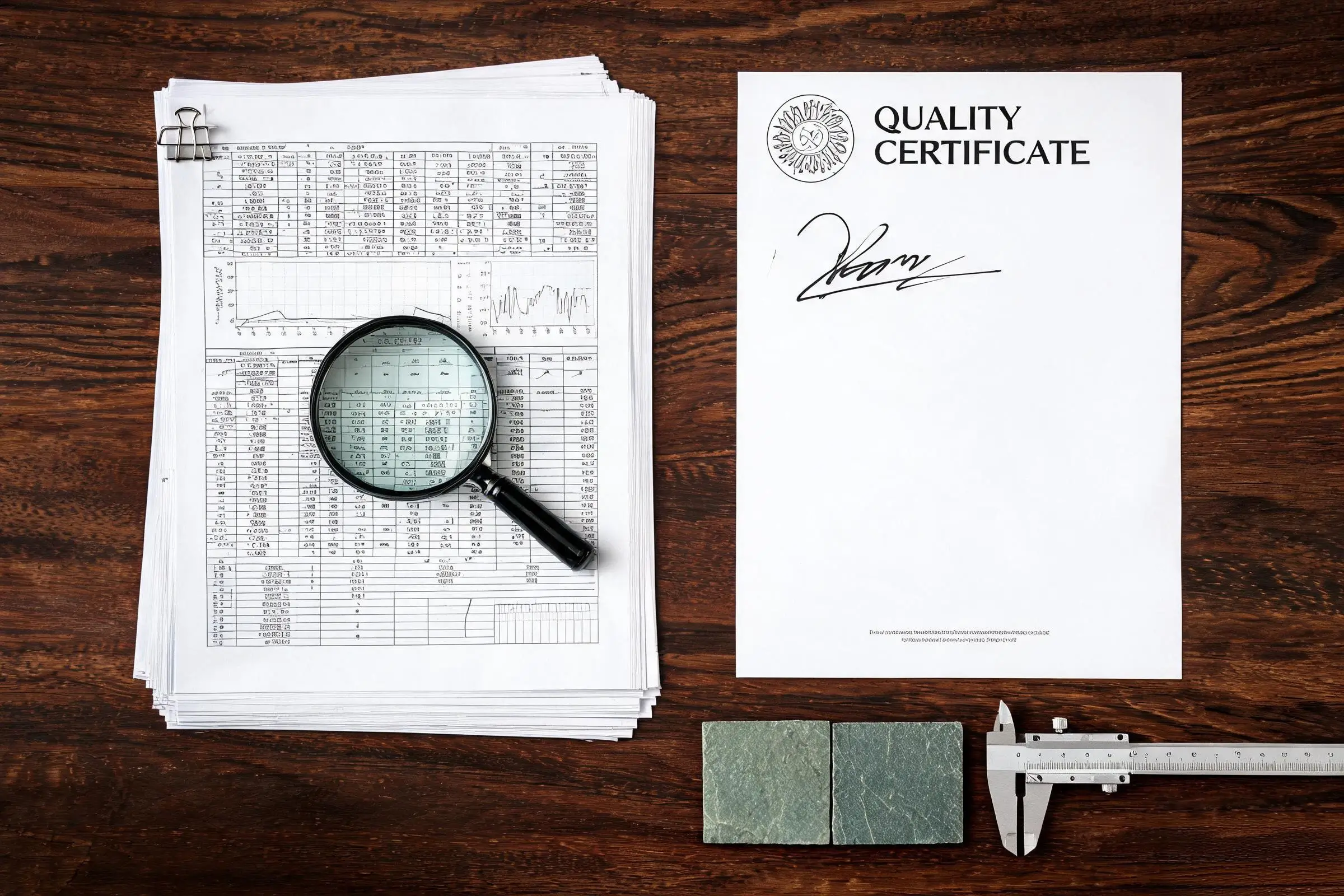
So when you write to a supplier, do not ask for a certificate. Ask exactly this: "Please send the complete laboratory test report — including the laboratory name, the testing date, the sample details, and the full data tables." If the reply is another decorative page, you have learned something important, and you have learned it before paying a deposit.
If you want to know how to read each line of the report once you have it — which numbers matter most, which lines buyers misread, and where the traps are — our guide to reading slate test reports walks through a real one line by line.
Request 02 · Ask for Video — With These Three Things in Frame
A test report describes a stone that was tested on a particular day, in a particular place. It is real evidence, but it is second-hand evidence. The request that closes the distance is video.
Buyers ask us for video more every year, and I think it is one of the healthiest trends in the trade. But the way it is asked makes an enormous difference. "Send me a video of your slate" produces stock footage: a drone pass over the quarry, sunbeams, maybe a logo. Nice to look at. Again: nothing about the stone you will actually receive.
Here is the request that works, and that we happily fulfil:
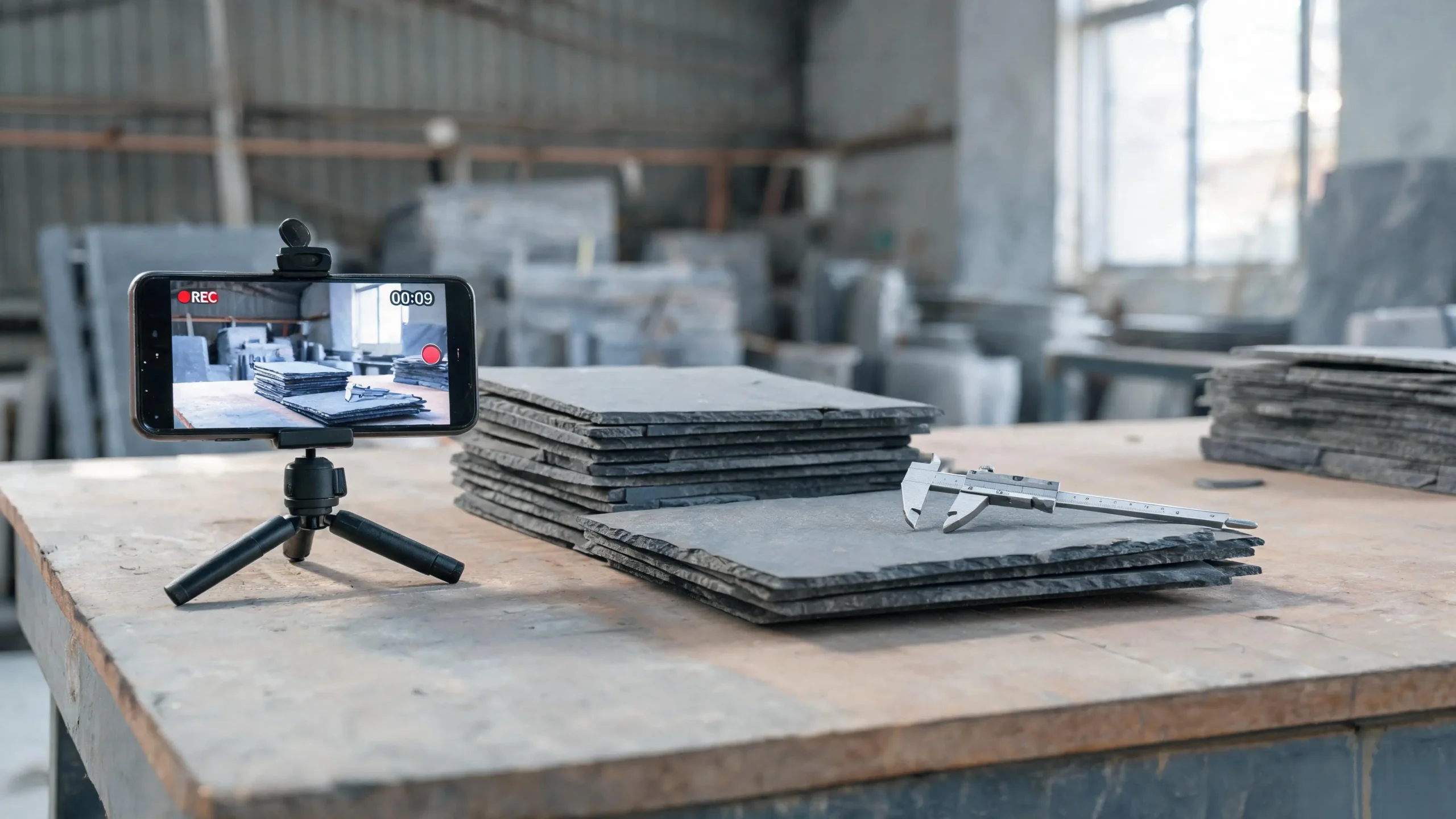
- The tiles themselves — the actual production batch, in the actual workshop, not a showroom display. You want to see the surface, the edges, the colour variation across a stack.
- A measuring instrument in frame — a gauge or rule touching the stone while it is measured, so you can read the thickness yourself instead of reading a claim about it. Our roofing slates are cut to a tolerance of ±0.1 mm on CNC machines, and every single tile is checked, not a sample of tiles — every one. That is what "100% inspection" should mean, and it is a reasonable thing to ask to see.
- One continuous take, with a spoken date — no cuts, no edits. The spoken date matters. An edited video could be from any batch in any year; a continuous take, dated aloud, from a batch you have ordered or are about to order, is tethered to reality.
We keep a small tripod permanently set up by the inspection bench partly for this reason. When a buyer asks properly, the reply is not a marketing video — it is the tile, the gauge, the date, one take. If you are curious how the standards behind these measurements differ between Europe and America, our EN 12326 vs ASTM C406 comparison explains both frameworks in plain language.
Request 03 · Ask for the Numbers Behind the Adjectives
Every supplier in the world will tell you their slate is "high quality", "durable", and "reliable". These words are free. Numbers cost something — someone had to cut the sample, run the test, and sign the result. That is exactly why numbers are worth asking for and adjectives are not.
There are four numbers I would ask about specifically, because they predict how a roof behaves better than anything else on the page. Here is the answering-desk version: what we quote, what it means, and what to be suspicious of.
| What to ask | Our measured value | Why it matters |
|---|---|---|
| Water absorption (EN 12326-1, A1 ceiling 0.6%) | 0.1% | The best single predictor of how long a slate roof lasts. Low absorption starves every decay mechanism — freeze, carbonate attack, thermal cycling. |
| Flexural strength (dry / wet) | 60 MPa dry / 45 MPa wet | The strength a slate carries its own weight and foot traffic with. Wet strength is the honest number — some suppliers quote only dry. |
| Freeze–thaw strength retention after cycling | 92.7% (156 → 144.7 MPa) | Above 80% is the common pass line. Retention after cycling, not strength before it, is what a cold climate actually experiences. |
| Thickness tolerance | ±0.1 mm (CNC, 100% inspected) | Uneven thickness means an uneven roof plane, more breakage in transit, and arguments on the scaffold. |
One habit worth building: when a supplier answers a number question with a sentence, ask the question again. I have been in this trade long enough to know how it works on my side of the desk — the suppliers who have genuinely run the tests can quote their own numbers from memory, because they had to hand them to the laboratory and then to customers for years. The ones who have not will offer the adjectives again. It is not dishonesty, always. Sometimes it is a trader three steps removed from the quarry who has simply never seen a test report. Either way, you have learned the same thing.
For what these numbers mean in context — how absorption translates to decades of roof life, and how our values sit against the standard limits — the details are on our quality test results page, and the mechanism behind the absorption figure specifically is in our water absorption article.
Request 04 · Ask for Traceability: One Number, Three Places
Here is a request that sounds bureaucratic and is actually one of the sharpest questions a buyer can ask: "How will I know that the stone in my container is the stone you tested?"
The honest answer involves a batch number. Ours runs on the production records, the export documents, and the crates themselves. The same number appears in three places: on the quotation, on the packing list, and on the label of the crate that gets loaded. If you order again next year from a different part of the quarry, you get a different batch number — and if you ask, you can get the test records for that batch too, because they are in the drawer, filed by number.
Why does this matter so much? Because slate is a natural material, not a factory product with a fixed formula. Two batches from the same quarry will be very similar — the same mineral belt, the same metamorphic history — but "very similar" and "identical" are different words, and a serious supplier knows the difference. A supplier who cannot produce a batch number is telling you, whether they mean to or not, that their quality story ends at the warehouse door.
There is a second, quieter thing traceability buys you: accountability. If a tile ever breaks in a way that suggests a defect rather than an installation fault, a batch number turns an argument into an investigation. We can pull the batch record, the inspection record, even the container loading photos. Without a number, there is nothing to pull.
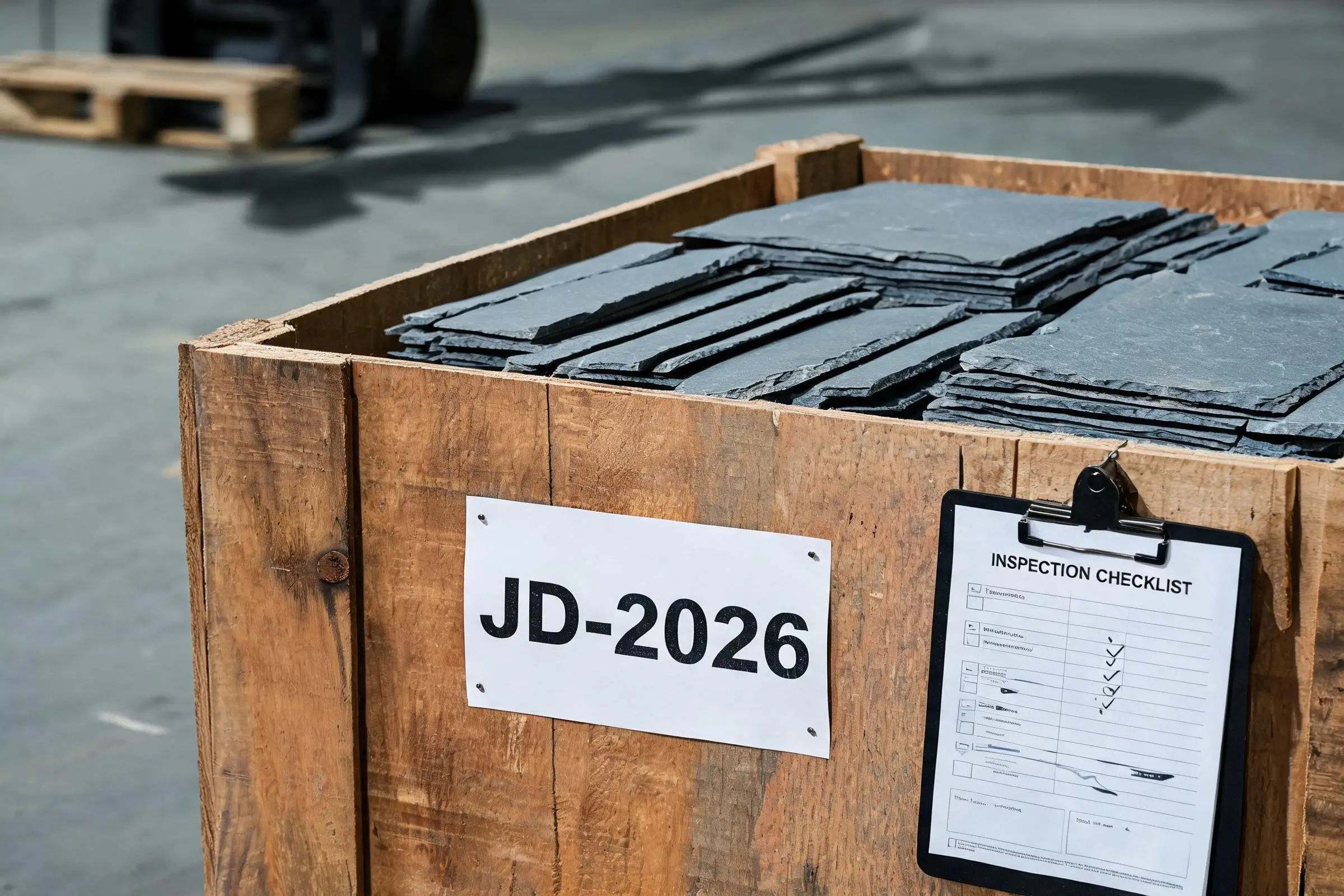
Traceability extends to shipping too, because a roof's quality problems do not always begin at the quarry. We load containers ourselves at the factory — the empty container comes to us, our crew packs it, and it goes back to the port, so the packing standard is ours, not a third-party warehouse's. Before loading, we check the slate's moisture content; anything above 0.5% stays off the boat, because wet stone sealed in a steel box for five weeks at sea is a problem you discover at the other end. A 20-foot container holds 1,130–1,450 m² of our 7–9 mm roofing slate, depending on thickness mix, and every crate in it carries the batch label. If you are weighing up suppliers more broadly — payment terms, lead times, trade references — our roofing slate buying guide covers the commercial side of the same conversation.
Request 05 · Ask for Samples — From the Current Batch, Sealed
Every request so far has been about documents and recordings. The last one is physical, and it is the one that makes all the others unnecessary in the best way: ask for sample tiles — from the current production batch, not from a display shelf — sealed and labelled before you confirm the order.
The details matter here. A showroom sample was chosen for being beautiful; a production sample was pulled from the stack you will actually receive. Ask that the samples be sealed — taped or bagged — and labelled with the batch number before they are handed over or shipped. This is a small thing with a large consequence: it means the samples cannot be swapped for better-looking tiles on the way to your office, and it means that when the container arrives, you can compare the cargo against samples you already hold, from the same batch, with the same number on them.
What do you do with the samples once you have them? Three practical checks that take an afternoon and no laboratory:
- Weigh, soak, re-weigh. A 600 × 300 × 8 mm tile weighs about 4 kg dry. After 48 hours in water, our slate gains less than 8 grams — 0.1% absorption, about two teaspoons of water. If your sample comes out of the soak noticeably heavier, you have your answer without a single lab test.
- Look at the edge in raking light. Hold the tile edge-on near a window and read the layering. Tight, parallel, unbroken layers are what a well-metamorphosed slate looks like. Wavy or interrupted layering is how hidden weakness shows itself to the naked eye.
- Tap it. A dense slate rings; a compromised or high-carbonate slate thuds. It is the oldest test in the trade and still a useful one.
None of this replaces the laboratory report — it confirms it. When the sealed samples, the dated video, the batch number, and the report all tell the same story, you are no longer trusting a supplier. You are trusting a system, which is a much better position to sign a purchase order from.
Frequently Asked Questions
What documents should I request from a slate supplier before ordering?
Ask for the complete laboratory test report — not a one-page quality certificate. The report should carry the testing laboratory's full name and address, the testing date, the sample and batch details, and complete data tables: chemical composition, water absorption, density, flexural strength, and freeze–thaw results. A decorative certificate saying "conforms to international standards" can be produced by anyone with a printer; a multi-page laboratory report with traceable numbers cannot. Also request the batch number that will link your order to those test records.
How can I verify a slate test report is genuine?
Three practical checks. First, look at who issued it: a named government or accredited laboratory with an address you can find is worth far more than an unattributed document. Second, look for internal consistency — the same batch reference should appear on the report, the quotation, and later the packing list; the numbers should be specific (0.1%, 92.7%, ±0.1 mm) rather than round marketing figures. Third, cross-check the report against evidence you generate yourself: sealed samples from the same batch, and a continuous-take video with a spoken date. When the document, the sample, and the video all tell the same story, forgery becomes impractical.
Is a video call to inspect slate worth doing before purchase?
Yes, if you ask for the right footage. A useful video shows the actual production tiles — not showroom pieces — with a measuring instrument touching the stone while thickness is read aloud, in one continuous unedited take, with the date spoken into the camera. That combination is cheap for a real factory to provide and nearly impossible for a broker without a workshop to fake. What the video should not be: a drone pass over a quarry, a logo animation, or anything with cuts between the tile and the measurement.
What is the most important number in a slate test report?
Water absorption. It is the best single predictor of roof longevity because it feeds every decay mechanism: freezing damage inside the pores, acid attack on carbonate grains, and thermal cycling fatigue. Jiujiang slate measures 0.1% — six times below the EN 12326-1 A1 ceiling of 0.6%. After absorption, the next numbers worth your attention are wet flexural strength (some suppliers quote only the dry figure), freeze–thaw strength retention (above 80% passes the common line; Jiujiang slate retains 92.7%), and thickness tolerance. But if a supplier can only give you one number, ask for absorption first.
Should I ask for samples before ordering a full container?
Always — and specify how you want them. Request samples pulled from the current production batch, not display tiles, and ask that they be sealed and labelled with the batch number before they are handed over. With sealed samples you can run three quick home checks: weigh a tile, soak it 48 hours, re-weigh it (ours gains under 0.1%); examine the edge in raking light for tight, parallel layering; and tap it — dense slate rings rather than thuds. The samples then serve a second purpose: when the container arrives, you compare the cargo against the same batch's reference tiles you already hold.
Can a supplier prove the slate in my container matches the slate they tested?
Through batch traceability. A serious supplier operates a batch number system in which the same number appears on the quotation, the packing list, and the labels of the crates actually loaded — ours runs through all three, and the test records are filed by the same number. Slate is a natural material and batches differ slightly, so the batch number is what connects the stone under your roof to the numbers in the laboratory report. It also protects you after delivery: if a tile ever fails in service, the batch record — including inspection and loading records — can be pulled and checked instead of argued about.
Related Reading
Put us to the test. Ask for the report, the video, the batch number, and sealed samples — we will send all four. Your roof deserves evidence, not adjectives.