
From Quarry to Billiard Slate: The Panel Journey
Put a straightedge across a finished billiard panel and hold it up to the light. Look along the edge where steel meets stone. If you can see daylight — even a hairline — the panel goes back. Not to the crate. Back to the machine.
I have been making billiard panels long enough to know that the straightedge test is the moment that matters. Everything before it — the block selection, the cutting, the grinding, the CNC work, the joint matching — exists to make sure that straightedge sits flush. This is the story of how a block becomes that panel.
| Stage | What It Achieves | Tool | Tolerance |
|---|---|---|---|
| Block Selection | Right rock, right grain | Eye, ear, hammer | Pass / fail |
| Primary Cutting | Slab from block | Diamond wire saw | ±2–3 mm |
| Surface Grinding | Both faces flat | Diamond cup wheel | ±0.5 mm |
| CNC Machining | Full-surface precision | CNC milling / grinding | ±0.1 mm |
| Joint Matching | Seamless three-piece set | Diamond hand pad + feeler gauge | <0.05 mm seam |
| Final Inspection | Signed or rejected | Dial indicator + straightedge | 100% checked |
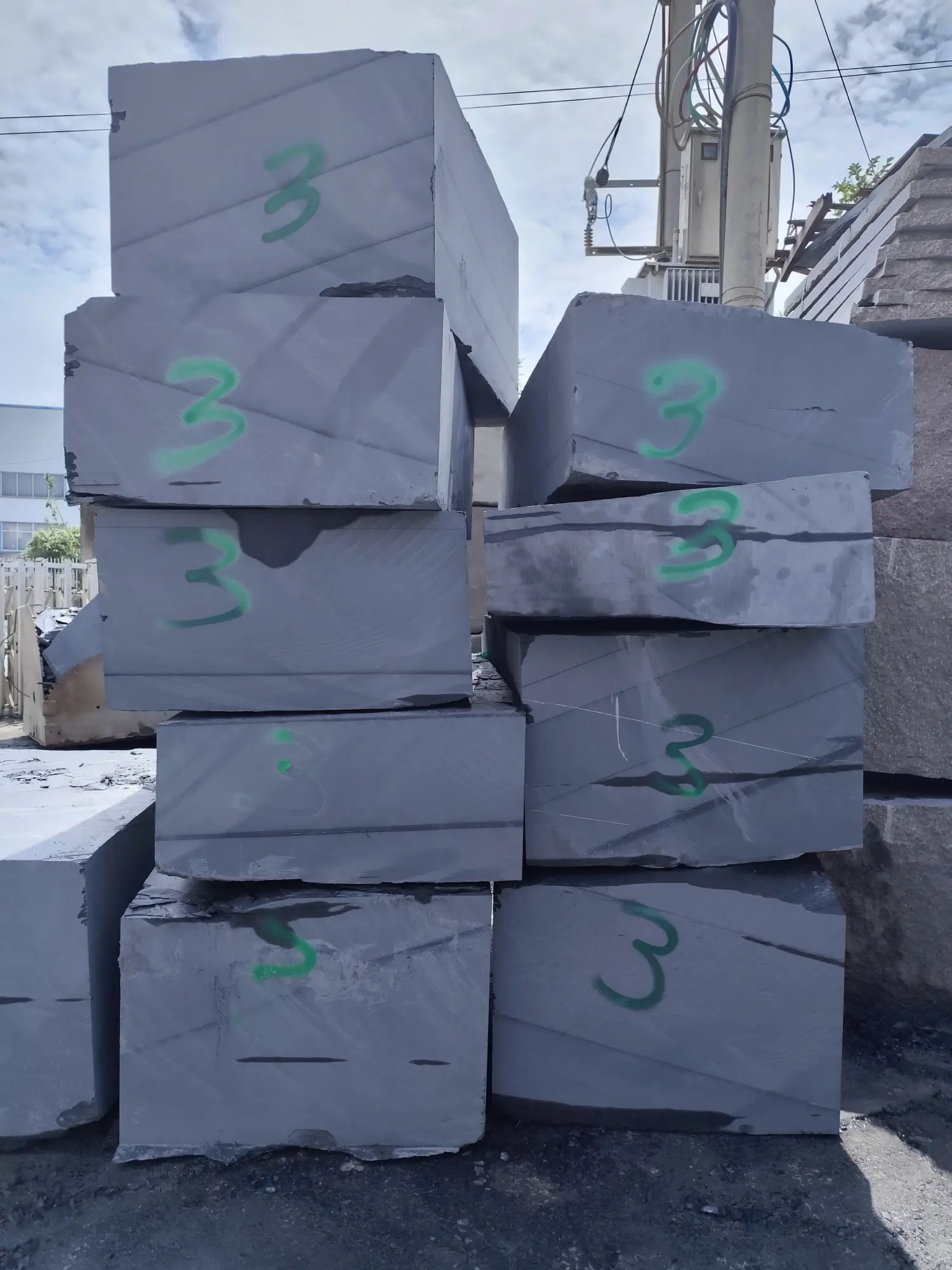
The Block That Qualifies
The block arrives at the factory from the quarry with a chalk mark on it — R for roofing, B for billiard. The foreman at the quarry face made that call, and his decision is worth money: about 80% of the stone becomes roofing tile, and about 20% qualifies for billiard panels. That 20% is what I work with.
What makes a block "B"? Three things. First, size. A 9-foot pool table needs a panel at least 2.4 metres long — that means the block must be at least 2.5 metres in its longest dimension, allowing for the saw kerf and edge trimming. A 12-foot snooker table needs 3.6 metres. Blocks that large are not common, which is part of why billiard slate costs more per square metre than roofing slate.
Second, grain. The cleavage plane must be straight and consistent through the entire block. If the grain wanders — even slightly — the slab will have a curve in it that no amount of grinding can fully remove. I have seen blocks where the grain looks perfect on the outside but drifts 3 or 4 degrees in the middle. The saw cuts through it anyway, but the slab comes out with a slight warp. That warp becomes someone's problem downstream — usually mine.
Third, sound. Before a block enters the cutting area, we tap it with a steel hammer. A clear ring means the stone is solid — no hidden fractures, no delamination. A dull thud means there is a fracture somewhere inside, and the block is not worth the saw time. This is the same test the roofing side uses, but the stakes are higher here: a roofing tile with a hidden fracture might last 50 years on a roof before the fracture matters. A billiard panel with a hidden fracture will show up the first time someone leans on the table.
The density of the block matters too, though it is not something the quarry foreman measures on the spot. Jiujiang slate runs 2.7 to 2.8 g/cm³ — uniform enough that the CNC head cuts at a constant depth across the entire panel. I will come back to why that matters in the CNC section. For now, the point is simple: the foreman selects for size, grain, and sound, and the geology takes care of the rest.
The First Cut
Billiard panels are not split by hand. This is where the panel journey diverges from the tile journey. On the roofing side, a splitter with a mallet and chisels turns a block into tiles along the natural cleavage. Here, the block goes to a diamond wire saw, and the saw cuts it into slabs.
The reason is thickness. A roofing tile is 5 to 8 millimetres thick, and hand splitting naturally produces tiles in that range. A billiard panel is 25 to 50 millimetres thick — far beyond what hand splitting can achieve consistently. More importantly, a hand-split surface has a natural cleft texture. That texture is beautiful on a roof, but it is the enemy of a billiard table. The playing surface must be flat, not textured. So we cut, not split.
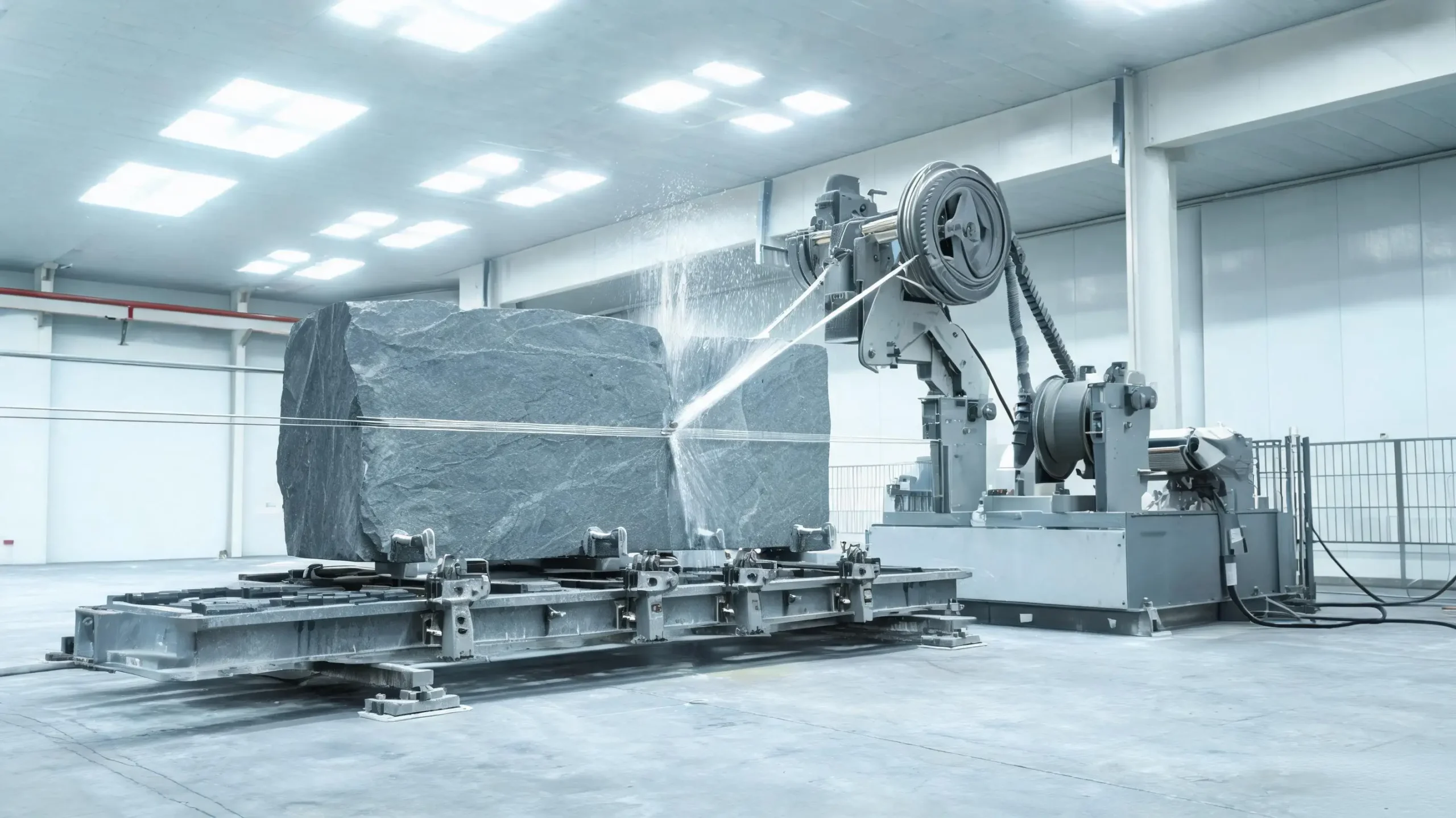
The wire saw runs a diamond-impregnated cable through the block in a continuous loop. Water sprays the cutting zone to keep the stone cool — heat from friction can cause micro-cracking, which is invisible now but might open up months later. The saw removes about 10 millimetres of stone per pass (the kerf), so a block 3 metres long cut into 25-millimetre slabs yields about 10 to 12 slabs, each slightly oversized to allow for grinding and trimming.
For thicker panels — 45 or 50 millimetres for snooker — the yield per block drops. A 3-metre block at 45 mm yields 5 or 6 slabs. That is why 12-foot snooker slate is the most expensive product we make: the block has to be enormous, the yield is low, and every slab is a significant piece of stone.
Each slab comes off the saw rough — the faces have saw marks, the edges are uneven, and the dimensions are 10 to 20 millimetres over the finished size. This is intentional. The precision comes later.
Grinding It Flat
Before a slab goes anywhere near a CNC machine, it has to be flat. Not CNC-flat — just flat enough that the CNC head has a stable surface to work on. The CNC refines precision; it does not create it from a warped slab.
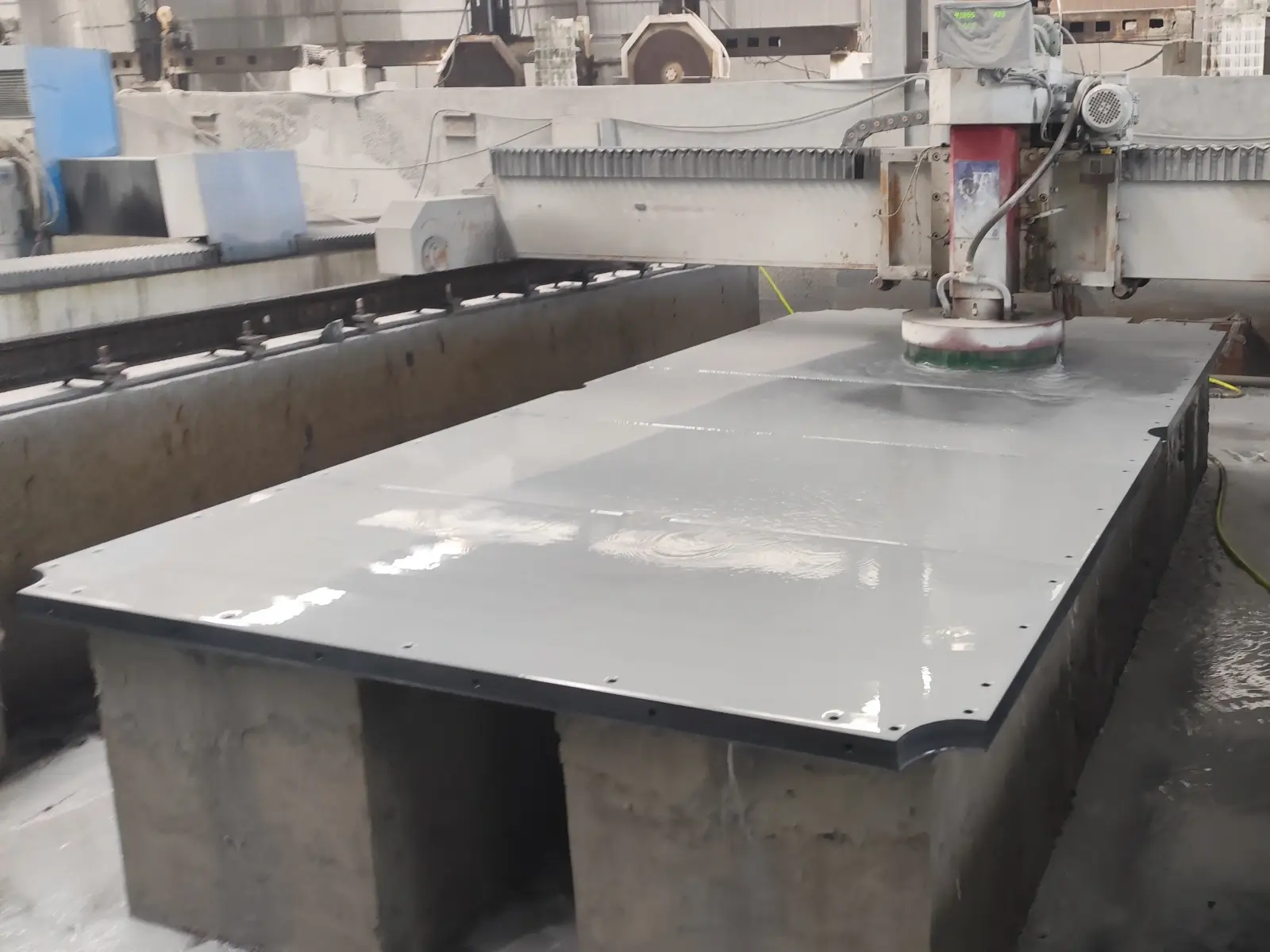
The grinding happens on a surface grinding machine with a diamond cup wheel. The operator mounts the slab on the bed, checks it with a straightedge to find the high spots, and runs the grinding head across the surface in overlapping passes. The first pass is coarse — 60 to 80 grit diamond. This removes the saw marks and gets the surface to within about 0.5 millimetres of flat. It is aggressive: the grinding head takes off 0.2 to 0.3 millimetres per pass, and the water running over the surface turns grey with slate dust. A slab that started at 28 millimetres might come down to 26.5 after the coarse pass.
The second pass is fine — 120 to 200 grit. This brings the surface to within ±0.5 millimetres flat across the full panel. The surface is now smooth to the touch, with a consistent matte finish. Both faces get the same treatment, because a panel that is flat on top but warped on the bottom will rock when it sits on the table frame.
The grinding fluid does double duty: it keeps the stone cool — again, heat causes micro-cracking — and it washes away the swarf, the mix of stone dust and water that would otherwise clog the diamond wheel. The fluid is recycled: we filter out the solids and pump it back. A busy grinding station goes through about 200 litres of water per day, but only about 20 litres of fresh water — the rest is recycled.
Why does the hardness of the stone matter here? Jiujiang slate has a Mohs hardness of 3 to 4, which means the diamond grit cuts it at a predictable rate. If the stone were harder, the grinding would be slower and the diamond wear would be higher. If it were softer, the grinding would be fast but the surface would be prone to scratching. Hardness 3 to 4 is the sweet spot: fast enough to be productive, hard enough to hold a precision surface.
The CNC Pass
This is where a flat slab becomes a billiard panel.
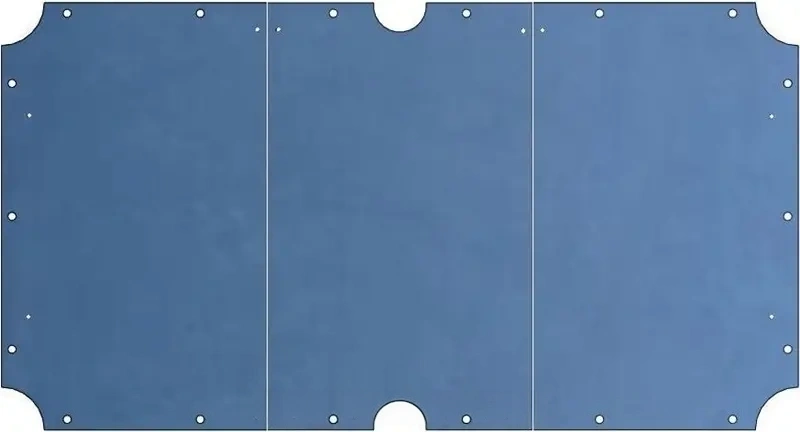
The CNC machine is a three-axis milling and grinding system. The panel is clamped to the bed, and the head moves across the surface in a programmed tool path — a series of parallel passes, each one overlapping the previous by about 30%, so there are no ridges between passes. The standard tolerance is ±0.1 millimetres across the entire surface of the panel. For high-end work — tournament-grade tables — we run a second, finer pass that brings it to ±0.05 millimetres. The difference between standard and high-end is about 15 to 20 minutes of additional machine time per panel. In practical terms, ±0.1 millimetres means a straightedge placed anywhere on the surface will show no visible gap. ±0.05 millimetres means the same, but with an even tighter margin — it is the tolerance that tournament referees check for.
The CNC does not cut blindly. After the machining pass, a probe on the head measures the surface at multiple points — usually 9 or more — and feeds the data back to the controller. If any point is outside tolerance, the machine runs a corrective pass on that area. This self-checking is why CNC-machined panels are consistently flatter than hand-ground ones: the machine measures its own work and corrects it.
Why does density matter so much in this step? The CNC head applies pressure to the stone as it cuts. If the density is uniform — 2.7 to 2.8 g/cm³ throughout, which is what Jiujiang slate delivers — the head cuts at a constant depth, and the surface comes out uniform. If there were a soft spot — a zone of lower density — the head would cut deeper there, creating a dip. A dip of 0.1 millimetres is invisible to the eye, but it is enough to make a billiard ball veer off line. This is why consistent density is not just a marketing point — it is the physical reason the CNC can achieve ±0.1 millimetres. You can read more about the tolerance itself in our flatness and dimensional stability guide.
A 9-foot three-piece set takes 3 to 4 hours of CNC time. A 12-foot snooker set takes 6 to 8 hours — the panels are larger, thicker, and the tolerance is the same. During that time, the operator monitors the machine, checks the cutting fluid, and listens. A change in the sound of the cut can indicate a density variation or a hidden feature in the stone. The machine does not always catch what the ear hears.
Three Pieces, One Surface
A billiard table bed is not one piece of slate. It is three — a centre panel and two end panels — because a single piece large enough for a 9-foot table (2.54 m × 1.27 m) would be impractical to quarry, ship, and install. For 12-foot snooker tables, five pieces are common.
The challenge is making three separate panels behave as one continuous surface. The joints between them must be flat to within 0.05 millimetres — tighter than the panel surface itself — because a ball rolling across a joint should not feel a seam. If the joint is even slightly raised or sunken, the ball will bounce or veer.
Joint matching starts during the CNC pass. The three panels are machined together, as a set, in the same CNC run. The operator loads all three onto the bed — or runs them in sequence if the bed is not large enough — and the machine uses the same tool path and the same zero point for all three. This ensures the surfaces are in the same plane.
After machining, the joint edges — the edges where two panels meet — are cut and ground to create a clean, square edge. The panels are then assembled on a flat reference table, and a feeler gauge checks the seam. The gauge blade is 0.05 millimetres thick. If it slides into the seam, the joint needs work. The operator uses a fine diamond hand pad to adjust the edge — removing a few thousandths of a millimetre at a time — until the gauge no longer fits.
The set is numbered. Panel 1 is the head end, Panel 2 is the centre, Panel 3 is the foot end. That number follows the set through inspection and packing, and it goes on the crate label. A billiard table installer needs to know which panel goes where — the joints are matched to each other, not to a generic edge.
The Straightedge Verdict
Every panel goes through 100% inspection. Not sampling — every piece. This is the same principle as the roofing side, but the standards are tighter and the tools are different.
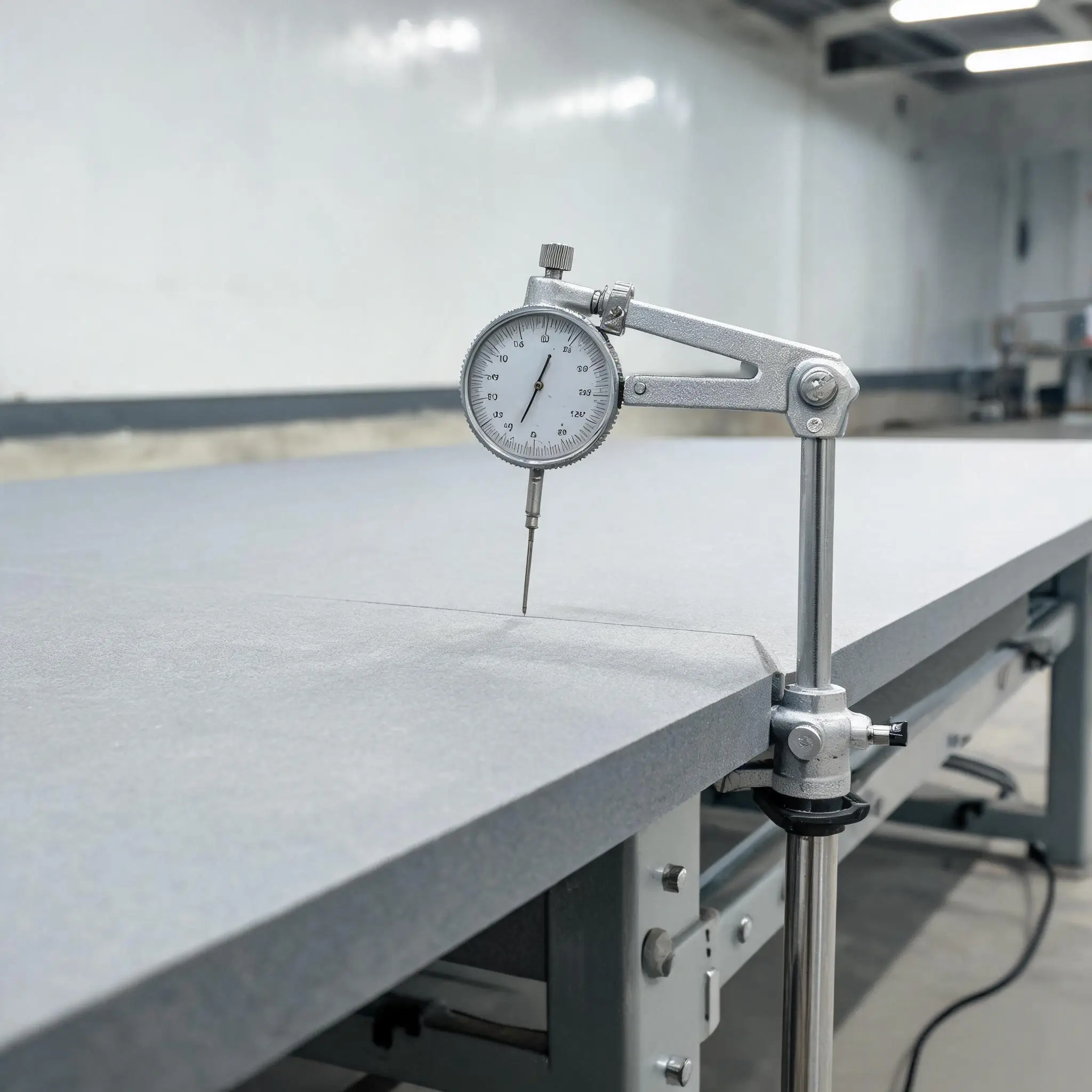
The inspection has four stages. Flatness: a dial indicator mounted on a stand measures the surface at 9 or more points across the panel — corners, edges, centre, and midpoints. The total variation across all points must be within ±0.1 millimetres for standard panels, ±0.05 for high-end. The dial reads in hundredths of a millimetre. If the needle moves more than 10 divisions from its zero point, the panel fails.
Dimensions: length, width, and thickness are checked at each corner and the centre. The thickness tolerance is tighter than for roofing slate — ±0.5 millimetres across the panel, compared to ±1.5 millimetres for roofing tiles. A panel that is too thick will not fit the table frame; too thin, and it will flex under play.
Surface: the inspector examines both faces for tool marks, scratches, colour variation, and any sign of delamination. The playing surface must be uniform — not polished, but consistently matte. The back face must be clean and free of cracks.
Joints: for multi-piece sets, the panels are assembled on a flat surface and the seams are checked with a feeler gauge, same as during joint matching. The set must pass as a unit — a perfect centre panel with a mismatched end panel fails the set.
Finally, the sound test. The inspector taps the panel with a small steel hammer — the same test used at the quarry and on the roofing line, but with a different purpose. A clear ring confirms the panel is solid — no hidden fractures developed during cutting or grinding. A dull note means something is wrong inside, and the panel goes to the reject pile. Each panel that passes gets a serial number, an inspection record, and a grade. You can read more about our inspection philosophy in the 100% inspection guide.
The reject rate for billiard panels runs about 5 to 8% — higher than the 1 to 3% on the roofing line, because the tolerance is ten times tighter. A rejected panel is not wasted. If the failure is flatness and a second CNC pass cannot fix it, the panel goes to a practice table or a bar-size table. If the failure is a hidden fracture, the stone goes to secondary products — paving, crafts, offcuts. Nothing leaves the factory as waste unless it is dust.
Packed for the Ocean
Billiard panels are packed differently from roofing tiles. Roofing tiles go into a crate standing on edge, 800 to a crate, with paper between them. Billiard panels go into a custom wooden crate, standing upright, with foam sheets between each panel. One three-piece set per crate for 9-foot tables; two crates for 12-foot snooker sets.
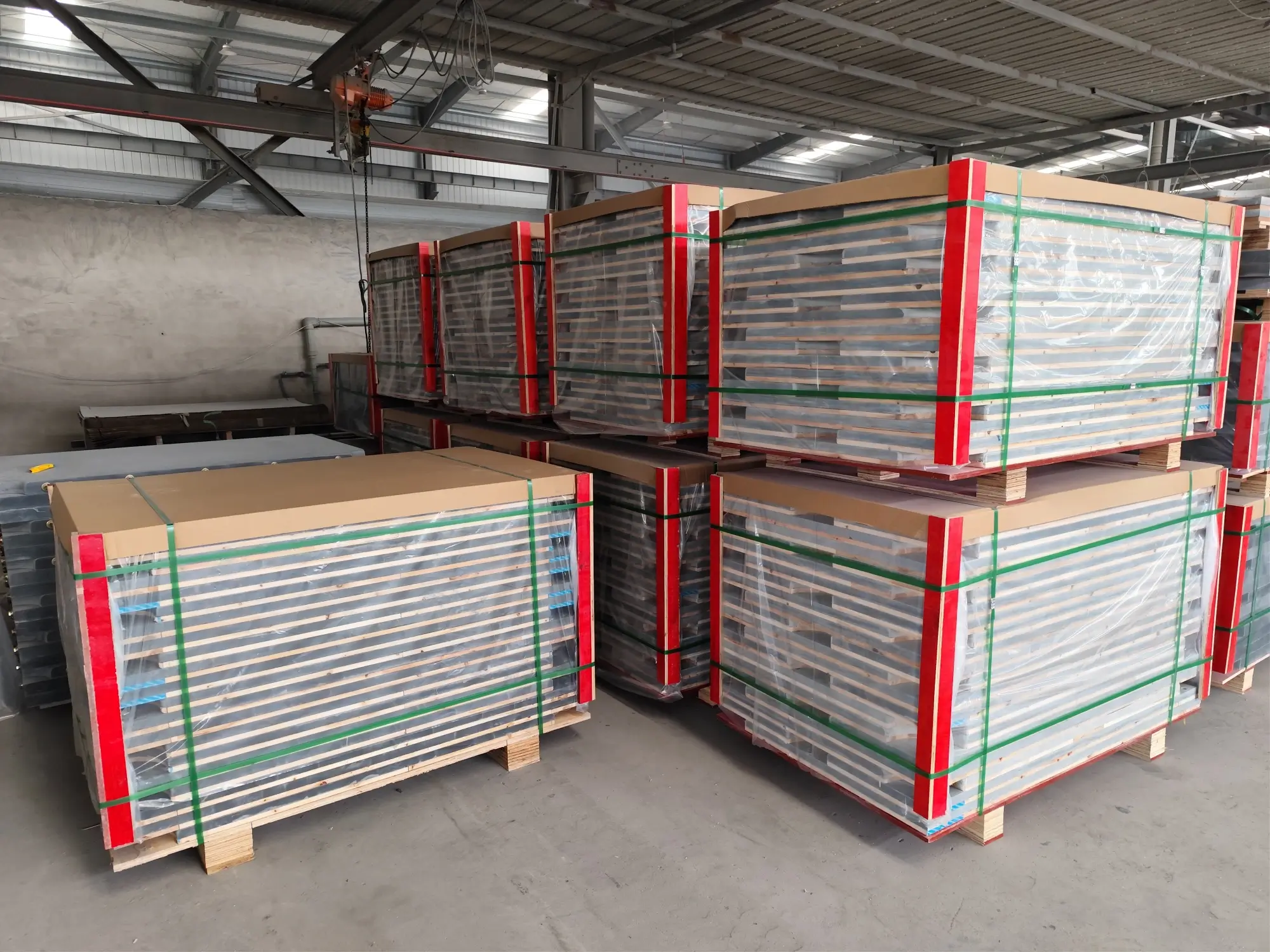
The crate is built to the panel dimensions — not the other way around. The interior is lined with protective material, and the panels are stood on edge, separated by 10-millimetre closed-cell foam sheets. The foam does what paper does for roofing tiles — prevents surface-to-surface contact — but it also cushions, because a billiard panel is a single expensive piece, not one of 800. If a roofing tile chips in transit, the buyer has spares. If a billiard panel cracks, the set is incomplete.
The crate is sealed with steel strapping and labelled with the buyer's name, the destination port, the panel specifications (table size, thickness, number of pieces), the set number, the total weight, and the date. Inside the crate, a packing list and the inspection certificates for each panel are sealed in a waterproof sleeve.
A 9-foot three-piece set in a standard crate weighs about 150 to 180 kilograms — the slate alone is about 120 kilograms, and the crate and packing add the rest. A 12-foot snooker set in two crates can weigh 250 to 300 kilograms. The crates are designed to be moved by forklift or pallet jack, not by hand — a billiard panel is too heavy and too valuable to be carried.
Frequently Asked Questions
Why can't the same block produce both roofing tiles and billiard panels?
It can — and often does. The quarry foreman marks each block R or B based on size, grain, and sound. A block that qualifies for billiard (large enough, straight grain, solid ring) can produce billiard panels from its best portion and roofing tiles from the remainder. What a block cannot do is produce both from the same slab — a slab is either 25 to 50 millimetres thick for billiard or 5 to 8 millimetres for roofing. The thickness is set at the first cut.
How long does the full panel journey take from block to crate?
From the day a block arrives at the factory to the day the crate is sealed, the production time is typically 10 to 15 working days. Cutting takes 1 to 2 days. Surface grinding takes 1 to 2 days per panel. CNC machining takes 3 to 4 hours per 9-foot set, but the machine runs one panel at a time. Joint matching adds another day. Inspection and packing take a day. The total is longer than the roofing journey (5 to 7 days) because every step works to a tighter tolerance.
What is the practical difference between ±0.1 mm and ±0.05 mm tolerance?
For most tables, ±0.1 mm is more than sufficient — a straightedge placed anywhere on the surface shows no visible gap, and a ball rolls true. ±0.05 mm is tournament grade, where the table will be used in professional competition. The difference is 0.05 mm — about half the thickness of a sheet of printer paper. You cannot see it. You can feel it if you are a professional player who knows what a true roll sounds like.
Why are billiard panels cut into three pieces instead of one?
Two reasons. First, a single piece of slate large enough for a 9-foot table (2.54 m × 1.27 m) would require a block of exceptional size — and even if such a block exists, cutting, transporting, and installing a single panel of that size is risky. One crack and the entire bed is ruined. Three pieces mean that if one panel is damaged, only that panel needs replacement. Second, shipping: a three-piece set packs into a manageable crate. A single-piece panel would require a crate so large it would not fit through a standard doorway.
How are the joints between panels made invisible to a rolling ball?
The joint edges are machined square and ground to within 0.05 mm of flush. A feeler gauge — a thin steel blade of known thickness — is run along the seam. If the 0.05 mm gauge blade slides into the gap, the edge is adjusted with a fine diamond hand pad until it no longer fits. When assembled on a flat table frame, the three panels form a continuous surface. A ball rolling across the joint should not bounce, veer, or change speed.
What happens to panels that fail the final inspection?
A panel that fails flatness goes back to the CNC for a corrective pass. If it still fails after a second pass, it is downgraded — it might be sold as a practice table panel, or cut into smaller panels for bar-size tables. A panel that fails the sound test (hidden fracture) cannot be fixed — it goes to secondary products like paving or slate crafts. The reject rate for billiard panels is about 5 to 8%, higher than the 1 to 3% for roofing tiles, because the tolerance is ten times tighter.
Related Reading
Every Panel Has a Story — and an Inspection Record
If you are sourcing slate for table production — or replacing panels on an existing table — we ship three-piece sets to table manufacturers in over 30 countries, with public test data behind every panel. Talk to us about your specifications.