
Jiujiang Slate vs Welsh Slate
Welsh slate carries five centuries of heritage, documented on buildings across Britain and Europe, and commands a premium market position. Jiujiang slate offers modern factory production, flexible specifications, competitive container economics and test results that hold up against any origin. Both can last a century on a roof. The right question is not which country makes better stone — it is which specific quarry, specification and test report fits your project.
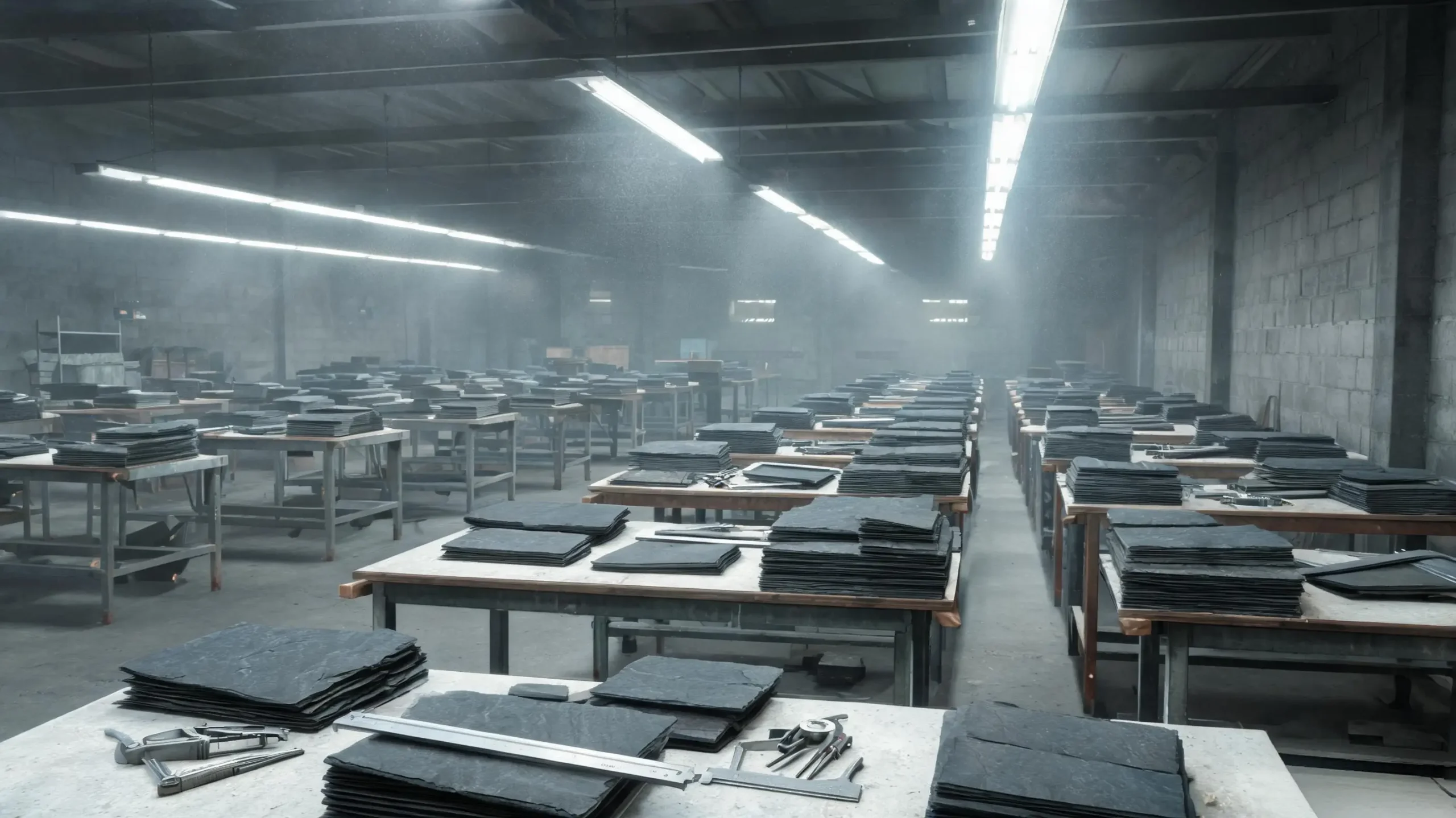
Welsh Slate: Three Quarries and Five Centuries
I have specified Welsh slate for conservation projects where nothing else would satisfy the planning officer, and I respect what those quarries represent.
The Penrhyn Quarry in North Wales has produced roofing slate since the 13th century. Ffestiniog and Cwt-y-Bugail are the other two principal sources. Together they supply three distinctive roofing products:
- Penrhyn Heather Blue — a heather-blue/purple slate
- Cwt-y-Bugail Dark Blue-Grey — dark blue-grey with natural texture and occasional white veins
- Ffestiniog Blue-Grey — blue-grey with a relatively smooth riven texture
That history is not marketing copy. It is visible on buildings across Britain and Europe. I have stood on a school roof in Bergen, Norway, looking at Welsh slate installed in 1890 — still serving, still waterproof, 130 years later. You cannot build that kind of track record in a decade, and no specification writer should pretend otherwise.
For restoration projects, listed buildings and conservation areas, this heritage is a specification requirement, not a preference. The conservation officer does not ask for "grey slate" — they ask for a specific Welsh quarry's product by name.
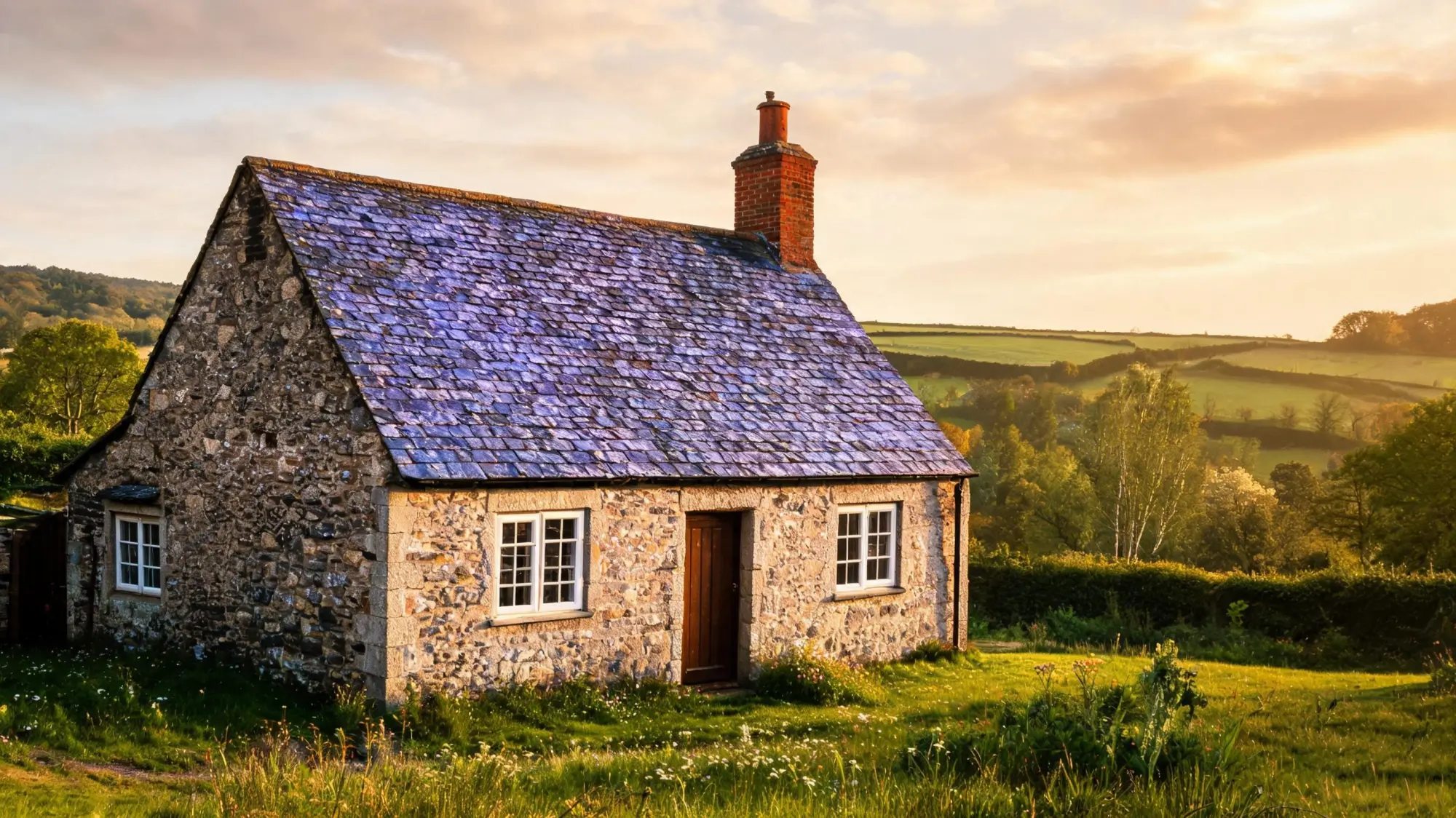
Spec note: For listed buildings in England and Wales, check whether the conservation officer has specified a particular Welsh quarry product by name — if so, substitution requires written approval.
Jiujiang Slate: A Different Kind of Slate Industry
Jiujiang slate comes from the Lushan and Xingzi area in Jiangxi Province, China. The international export market for this slate has been built on contemporary quarrying, processing and container logistics — not on centuries of branding.
What makes the region unusual is that the same slate industry serves two very different applications. Roofing slate needs reliable cleavage, low water absorption and frost resistance. Billiard slate needs large blocks, structural stability and precision machining to ±0.1 mm flatness. The CNC equipment that cuts billiard panels to that tolerance also handles roofing tile dimensions — and that crossover is why Jiujiang roofing slate tends to have tight dimensional tolerances compared with hand-split production from other regions.
The supply chain covers quarrying, splitting, cutting, CNC machining, 100% single-piece inspection, packing and export from the same region — factory to container without intermediaries.
For international buyers, the advantage is not just price. It is the ability to order a specific combination of size, thickness, colour, grade and packing — and have a factory produce it for your project rather than selecting from warehouse stock.
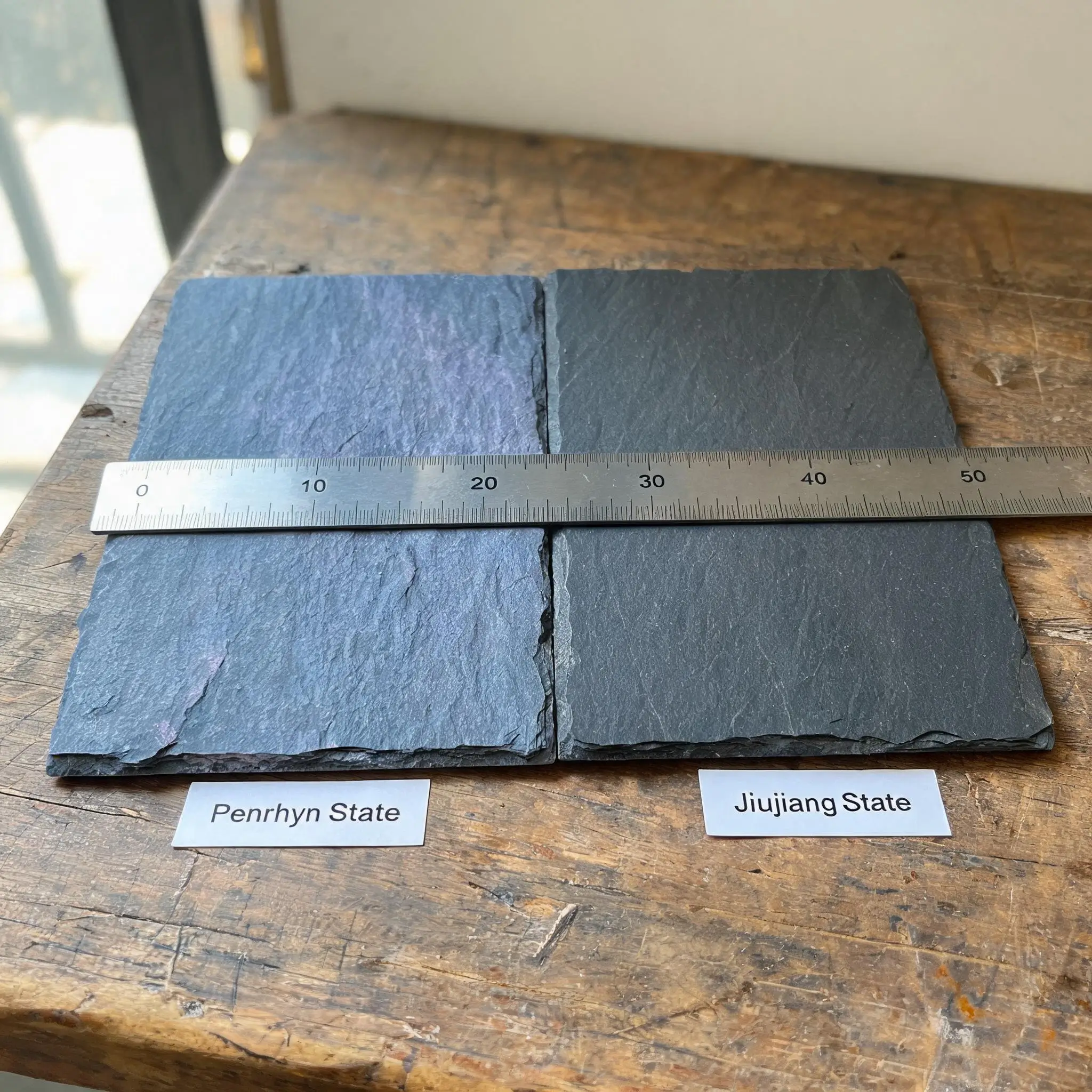
Spec note: Ask whether the supplier controls the quarry or is a trading company — direct quarry access means tighter batch control and better repeat-order consistency.
Appearance: Heather Blue vs Regional Grey
Natural slate is never a single colour. Its appearance depends on mineral composition, cleavage, texture and quarry location.
Welsh slate is known for heather-blue, blue-grey and dark blue-grey tones. Penrhyn is associated with heather-blue and purple. Cwt-y-Bugail has a dark blue-grey appearance with occasional white veins. Ffestiniog is characterised by a blue-grey with a relatively smooth riven texture.
Jiujiang slate produces grey, dark grey, black and regional colour variations depending on the quarry zone.
I once worked on a project in Somerset where the main house — Grade II listed, built in 1840 — needed a roof replacement. The conservation officer specified Welsh slate by colour and texture. No substitutes. But the same estate had a new garage block being built at the back, and the budget was different. We supplied Jiujiang slate for the garage. Same natural stone, same technical performance, roughly a quarter of the material cost. Two buildings on the same property, two different slates, both correct for their context.
The point is not that one colour is better. It is that colour must be evaluated from physical samples — two quarries a few kilometres apart can produce noticeably different tones. A website photograph tells you nothing useful about how a slate will look on your building.
Spec note: Send a piece of the existing roof to both suppliers and compare returned samples in natural daylight — not under showroom lamps.
Geological Age vs Roofing Performance
Welsh slate comes from very old geological formations. Penrhyn slate is from a Cambrian deposit formed more than 500 million years ago. Cwt-y-Bugail and Ffestiniog are associated with Ordovician slate beds, formed more than 470 million years ago.
Jiujiang slate belongs to the Palaeozoic rocks of Jiangxi — also old, also metamorphic, but from a different sea at a different time.
Geological age is scientifically interesting and contributes to the identity of each slate. But a 500-million-year-old deposit is not a roofing performance specification. What matters on a roof is not when the rock formed but how it performs: water absorption, flexural strength, freeze-thaw resistance, thermal cycling, sulphur dioxide exposure and dimensional tolerances.
A well-metamorphosed younger slate will outperform a poorly metamorphosed older one. Compare the test results, not the birthday.
Spec note: EN 12326 water absorption predicts 50-year roof performance better than geological age. Ask for the test report, not the geological history.
Technical Data: Two Reports, One Method
The most important principle in comparing Welsh and Jiujiang slate is this: do not compare "Wales" with "China." Compare the actual tested products.
Welsh Slate publishes technical data for its roofing products. A Penrhyn County Roofing Slate document reports characteristic modulus of rupture values of 52.9 N/mm² transverse and 75.4 N/mm² longitudinal, with water absorption classified as A1 (≤0.6%). A Cwt-y-Bugail County Grade document reports water absorption of 0.30% and modulus of rupture of 38.2 N/mm² transverse and 78.9 N/mm² longitudinal.
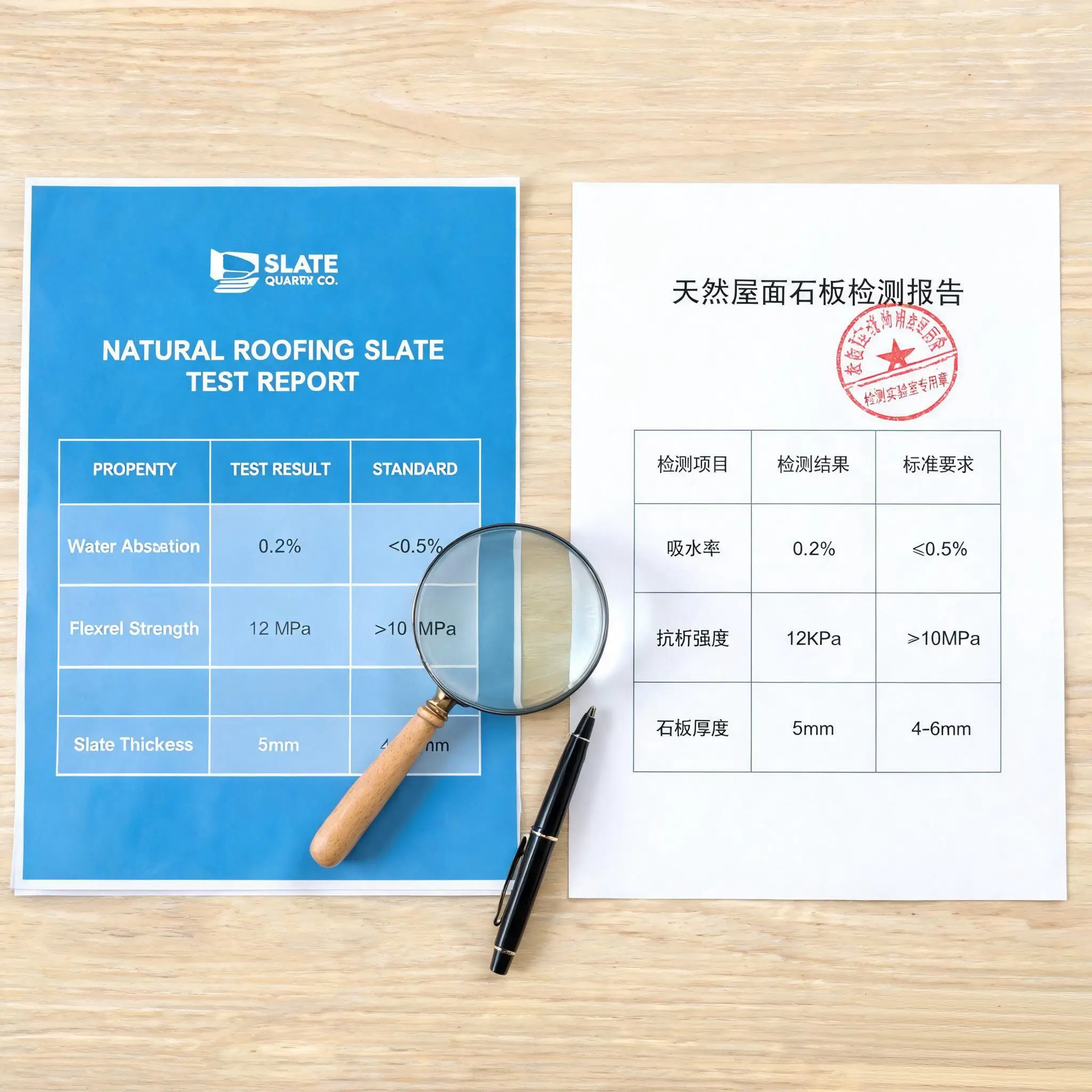
Jiujiang slate has independent laboratory testing that shows: water absorption 0.1% (tested to EN 12326), flexural strength 60 MPa dry / 45 MPa wet, freeze-thaw retention 92.7% after 120 cycles, and density 2.7–2.8 g/cm³. You can read more about what each property means, or see the full published test results.
Both origins have documented technical data that can be examined product by product. The numbers above are not a verdict — they are a starting point. A serious supplier should be able to produce the original test documentation and explain what quarry, batch and sample the report covers.
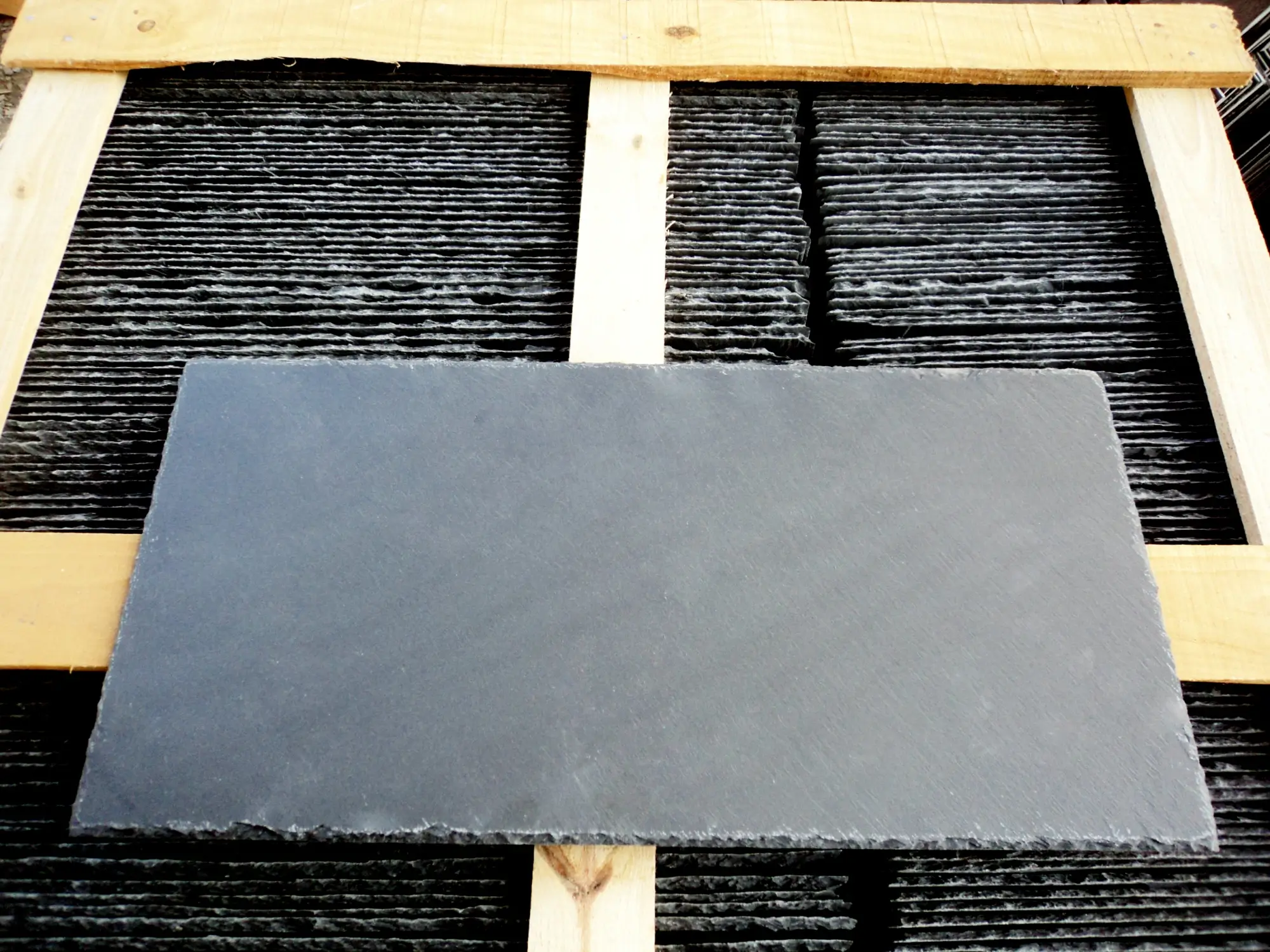
Spec note: Ask both suppliers for EN 12326 test reports using the same method — then compare the numbers, not the flags.
Water Absorption: The Number Behind the Reputation
Water absorption is the single most important indicator for roofing slate. It determines frost resistance, longevity and weathering behaviour.
Welsh Slate publishes very low values: Cwt-y-Bugail reports 0.30%, Penrhyn specifies A1 (≤0.6%). These are excellent numbers, consistent with the slate's reputation.
Jiujiang slate has been tested at 0.1% water absorption by EN 12326, and at 0.13% by an American laboratory using ASTM method. Both are below the EN A1 threshold of 0.6% by a factor of three to six.
I am not giving you those numbers to say our slate is better. I am giving them because they are verifiable — you can ask for the report and check. Three labs, three standards, same answer: below 0.2%.
The honest interpretation is that both origins produce slate with excellent water absorption. The difference between 0.1% and 0.3% is not going to determine which roof lasts longer. What matters is that the number is documented and tied to a specific quarry and batch. A supplier who cannot produce a test report is asking you to take their word for it. Read more about why water absorption decides longevity and how Jiujiang slate performs in freeze-thaw testing.
Spec note: The EN 12326 A1 threshold is 0.6%. Anything below 0.3% is excellent. Below 0.1% is exceptional — regardless of origin.
Thickness Traditions: Capital, County, Celtic and Custom
Welsh Slate offers roofing products in three thickness grades, each designed for a different roofing application:
- Capital — approximately 5.5 mm nominal thickness
- County — approximately 7 mm nominal thickness
- Celtic — approximately 9 mm nominal thickness
The thicker Celtic grade is associated with roofs exposed to severe weather. Penrhyn's core production sizes include 500 × 300 mm, 400 × 250 mm and 300 × 200 mm.
Jiujiang slate is produced to order in any thickness the project requires. The specification is not tied to a grade name — it is tied to a millimetre measurement with a permitted tolerance. A buyer specifies "7 mm ± 1 mm" or "9 mm ± 1 mm" and the factory produces to that specification.
Both approaches work. The Welsh system gives you a named product with an established identity. The Jiujiang system gives you a precise measurement with a documented tolerance. The key is that the specification defines not just nominal thickness but permitted variation, flatness and sorting grade.
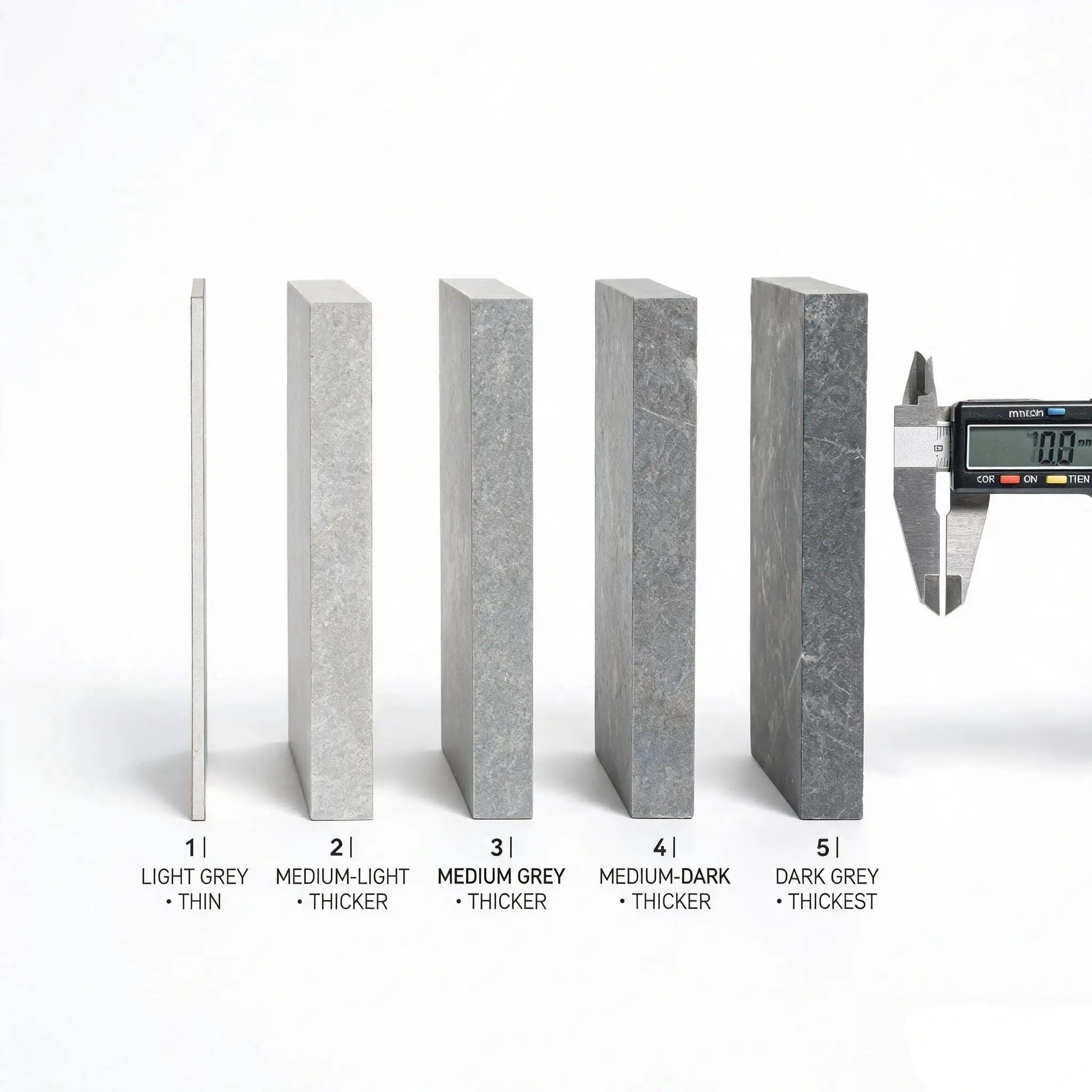
Spec note: Welsh grade names (Capital/County/Celtic) are proprietary product designations. For Jiujiang, specify thickness in millimetres with permitted tolerance — e.g., 7 mm ± 1 mm.
Cost: Heritage Premium vs Project Budget
Welsh slate occupies a premium position in the market, and it has earned that position. UK roofing cost guides show that Welsh natural slate generally commands a higher installed price than imported alternatives.
The difference becomes significant on large projects. For a 500 m² roof, even a modest difference in material cost per square metre translates into real money.
Jiujiang slate's competitive position comes from lower manufacturing costs, factory-scale processing and container-oriented logistics. A 20-foot container holds 1,130–1,450 m² of roofing slate at 7–9 mm thickness. At that volume, the per-square-metre delivered cost can work out favourably even after ocean freight.
But price alone should not determine the decision. A proper cost comparison includes:
Slate material + packing + inland transport + ocean freight + import costs + roofing labour + wastage + accessories + maintenance considerations.
A lower material price is not a bargain if colour shifts between batches, dimensions are inconsistent or the material fails a water absorption test. Price matters; verification matters more.
Spec note: A proper cost comparison includes material + packing + freight + import duty + wastage + installation — not just FOB price per square metre.
Supply: Established Quarries vs Factory Export
Welsh Slate's supply model is quarry-based and brand-driven. Three quarries — Penrhyn, Ffestiniog and Cwt-y-Bugail — supply defined product ranges. This gives buyers strong product identity and traceability.
Jiujiang's supply model is factory-based and export-oriented. Buyers source directly from quarries and processing factories, purchasing by container, by project or by annual contract.
Both models have strengths. For buyers, the practical questions are the same regardless of origin:
- Can the supplier maintain the same colour range?
- Can the supplier reproduce the same thickness?
- Can the supplier provide repeat orders?
- Can the supplier meet container schedules?
- Can the supplier produce project-specific sizes?
- Can the supplier provide replacement material years later?
These are supply-chain questions, not geological questions. The answer depends on the specific supplier's production capacity and quality system, not on which country the slate comes from.
Spec note: Ask both suppliers whether they can reproduce the same specification 12 months later — repeat-order consistency matters more for large developments than for one-off projects.
Which Projects Suit Which Slate?
The best slate choice depends on the project, not the country.
Heritage restoration. A listed building in England or Wales may require slate that visually and technically matches the original roof. In this case, the heritage characteristics of Welsh Slate are not optional — they are a specification requirement. The conservation officer's word is final.
Premium architecture. For a project where provenance and architectural identity are part of the design concept, Welsh Slate is a legitimate choice. The name on the quarry adds value to the building.
Commercial housing. For large residential developments where the priorities are material cost, consistent quality, availability and delivery schedules, Jiujiang slate offers a different value proposition — a natural slate roof at a competitive price without compromising on technical performance.
International distribution. For distributors who need a competitive natural slate product for multiple markets, a Chinese source provides flexibility in product configuration and pricing that an established brand-name quarry may not match.
I have seen both slates perform well on roofs across Europe. The difference is not in the stone — it is in the match between stone and project.
Spec note: Write down your top three project priorities before contacting suppliers — heritage match, budget or volume — and let that drive the origin decision.
At a Glance: A Practical Comparison
| Factor | Jiujiang Slate | Welsh Slate |
|---|---|---|
| Main producing region | Jiangxi, China | North Wales, UK |
| Heritage appeal | Developing international identity | Extremely strong, centuries of use |
| Typical colour character | Grey, dark grey, black, regional variations | Heather blue, blue-grey, dark blue-grey |
| Product customisation | Flexible, factory production | Defined ranges (Capital/County/Celtic) |
| Water absorption (published) | 0.1% (EN 12326 tested) | 0.30% (Cwt-y-Bugail), ≤0.6% (Penrhyn A1) |
| Flexural strength | 60 MPa dry / 45 MPa wet | 52.9/75.4 (Penrhyn), 38.2/78.9 (Cwt-y-Bugail) |
| Cost position | Generally competitive | Generally premium |
| Supply model | Factory production, container export | Quarry-based, established brand |
| Delivery to UK/Europe | 4–6 weeks sea freight + 2–4 weeks production | 3–5 days by truck for stocked items |
| Heritage restoration | Project dependent | Particularly relevant |
| New-build commercial | Strong cost/supply proposition | Premium architectural option |
| Best evaluation method | Sample + test report + factory inspection | Product specification + test data + provenance |
How to Compare Properly
For a serious project, the reliable comparison is sample to sample and document to document.
Step 1 — Approve physical samples. Compare colour, texture, cleavage, thickness, flatness and edge quality. Do this in natural daylight.
Step 2 — Compare technical documents. Check water absorption, flexural strength, dimensional tolerances and durability against EN 12326 or ASTM C406 requirements. Read our guide to reading a slate test report and the EN 12326 vs ASTM C406 walkthrough.
Step 3 — Compare delivered cost. Calculate FOB/CIF price + freight + import cost + wastage + installation implications.
Step 4 — Evaluate supply reliability. Ask whether the supplier can reproduce the same material after six months, one year or several years.
Step 5 — Inspect production. For larger projects, factory or quarry inspection provides confidence that no photograph can match.
This method is more meaningful than comparing two images on a website. It is also more honest than saying "Welsh slate is expensive, Chinese slate is cheap." Welsh slate sells a long-established architectural heritage and provenance. Jiujiang slate sells natural stone with modern manufacturing, export capability and competitive sourcing. These are different commercial propositions — and both can be the right answer for the right project.
For Jiujiang slate, the strongest case is not to claim superiority. It is to provide real samples, transparent specifications, independent test data, consistent production and reliable supply — and let the material speak for itself. Browse our roofing slate products or see the full comparison with Spanish slate.
Spec note: The country on the crate tells you where the slate was quarried. The test report tells you whether it will still be on the roof in 50 years.
Frequently Asked Questions
Is Welsh slate better than Chinese slate?
Neither is universally better. Welsh slate has heritage value, documented test data and a premium market position. Jiujiang slate has competitive test results, flexible production and container-scale supply. The right question is whether a specific quarry's slate meets your project's specifications — not whether one country's slate is superior.
Can Jiujiang slate be used on a listed building?
Only if the conservation officer or planning authority approves it. For listed buildings in England and Wales, the specification often requires a specific Welsh quarry product by name. In that case, substitution requires written approval. For non-listed buildings, Jiujiang slate is a valid option if it meets the technical requirements.
How much more expensive is Welsh slate than Jiujiang slate?
There is no single price for either origin. Welsh slate generally commands a premium due to heritage value and established brand. Jiujiang slate is typically more competitive due to lower manufacturing costs and container logistics. Compare equivalent specifications — the same size, thickness, colour and grade — to get a meaningful price comparison.
Does Jiujiang slate match the colour of Welsh heather blue?
Not exactly. Welsh Penrhyn slate has a distinctive heather-blue/purple tone. Jiujiang slate produces grey, dark grey and black. For a project requiring a specific Welsh colour match, Jiujiang may not be suitable. For projects where grey or dark grey is acceptable, the colour is comparable. Always compare physical samples in natural daylight.
What test data should I compare between Welsh and Jiujiang slate?
Ask both suppliers for EN 12326 test reports covering water absorption, flexural strength, freeze-thaw resistance, thermal cycling and dimensional tolerances. Compare the numbers using the same method. Published Jiujiang data shows 0.1% water absorption and 60/45 MPa flexural strength. Published Welsh data shows 0.30% absorption (Cwt-y-Bugail) and 52.9/75.4 MPa (Penrhyn). Both are excellent — evaluate the specific product, not the country.
Can I mix Welsh and Jiujiang slate on the same roof?
It is not recommended. Different origins can have different colour tones, thicknesses and surface textures that become visible over time as the slate weathers. If budget requires a mixed approach, consider using Welsh slate for the visible main roof and Jiujiang for less visible sections such as porches or outbuildings — but even then, consult your architect first.
Related Reading
If you are currently specifying Welsh slate and want to compare directly, we can send a Jiujiang roofing slate sample, technical specification and test documentation. You compare the actual slate — not just photographs or marketing claims.
Request a Jiujiang Slate Sample →