
Slate Quarries and Processing in Jiujiang: The Places Behind the Product
A slate region is a quieter place than the word industry suggests. Follow the rock out of the hills around Lushan, in the north of Jiangxi Province, and you pass five kinds of places, few of which look like heavy industry from the road: a working face cut into the hillside, a selection yard open to the sky, low sheds where stone is split by hand, machine halls that hum, and a factory gate where export crates wait for a truck. The Jiujiang slate quarries and processing yards — the honest subject of this page — are these places, and the walk below follows them in the order the stone travels.
Buyers usually meet the region as a name on a specification sheet. The hub entry for this article describes it as the quarries and processing yards that make up the region's slate industry today, and that last word — today — is doing real work. The shared journey that both product lines travel has its own page; the provincial picture and what a regional name actually covers do too. What they do not give you is a sense of the ground. By the end of this walk you should be able to look at any supplier's photographs and know which place you are standing in, and what that place can honestly prove.
Two things this page will not do, deliberately. It will not list operating quarries, because working faces and permits change more often than directories do, and yesterday's list becomes tomorrow's innuendo. And it will not argue the region's case — the trade already knows it; a walk is more useful than a brochure. What it can do is show how the places fit together, so that when two suppliers both write Jiujiang slate, you can tell what that sentence is actually standing on.
Quick Answer — five places, one name, and the fork in the middle:
| Place | What happens there | It proves — it does not prove |
|---|---|---|
| 01 · The quarry face | Beds read, blocks freed from the wall | The deposit — not who processes your stone |
| 02 · The selection yard | Blocks sorted by destination, not by beauty | Sourcing discipline — not machining |
| 03 · The splitting sheds | Roofing tiles split, dressed, graded (the roofing lane) | The splitting craft — not flatness work |
| 04 · The machine halls | Billiard panels sawn, ground, CNC-machined (the billiard lane) | Precision capability — not a rescue for weak blocks |
| 05 · The gate | Crates built, containers loaded, the river run | Export readiness — not who made the product |
The stone travels in this order, and splits into two lanes after the yard:
roofing lane: splitting → trimming → sizing → grading · billiard lane: sawing → grinding → CNC machining → bench inspection
One supplier may control all five places, some of them, or none. A desk that controls none can still trade honestly; what matters for sourcing natural slate from Jiangxi is knowing which places stand behind your order — that question runs under the whole walk below.
First, the Ground
The bedrock, briefly. The slate that trades under the Jiujiang name comes from the slate belt of northern Jiangxi: the working area sits on the Lushan side of the region — in and around what older documents still call Xingzi, the county that became Lushan City in 2016 — with Hengtang and its neighbours carrying most of the processing load. The towns behind that outline, and the roads that connect them, are mapped on the where-from page; this walk needs only the outline.
On this page, the quarries means the extraction sites of that belt, and the processing yards means everything that sits between the face and the factory gate. The trade uses the two words in one breath, and almost never means the same company by them. That gap — between the breath and the company — is where most buying mistakes live, so the next section takes it first.
The Address Is Not the Origin
The most useful thing a buyer can internalise about this region: the location of a workshop tells you where work was done, never where the rock was born. A factory registered in Lushan may work blocks from the hills behind it; it may truck material in from another county; it may rent a hall from a neighbour, buy finished panels outright, or simply forward a quotation written by someone else down the road. The reverse holds too, and matters more: an unremarkable yard in a village no atlas names can be the place where the region's soundest beds are actually opened. The slate quarry versus the slate processing factory is asked as though the two were rivals; they are different rooms of the same trade, and most problems come from paying one room for the other room's promises.
The practical habit follows from this: ask any supplier which places in the list above answer for your order — as a question about places, not about brands. The traps in that conversation, and the honest tells, are laid out on the factory-versus-trading page; the fuller audit questions live on the verification page. The walk below gives the ground truth behind both.
The Quarry Face: A Wall You Read, Not a Hole You Dig
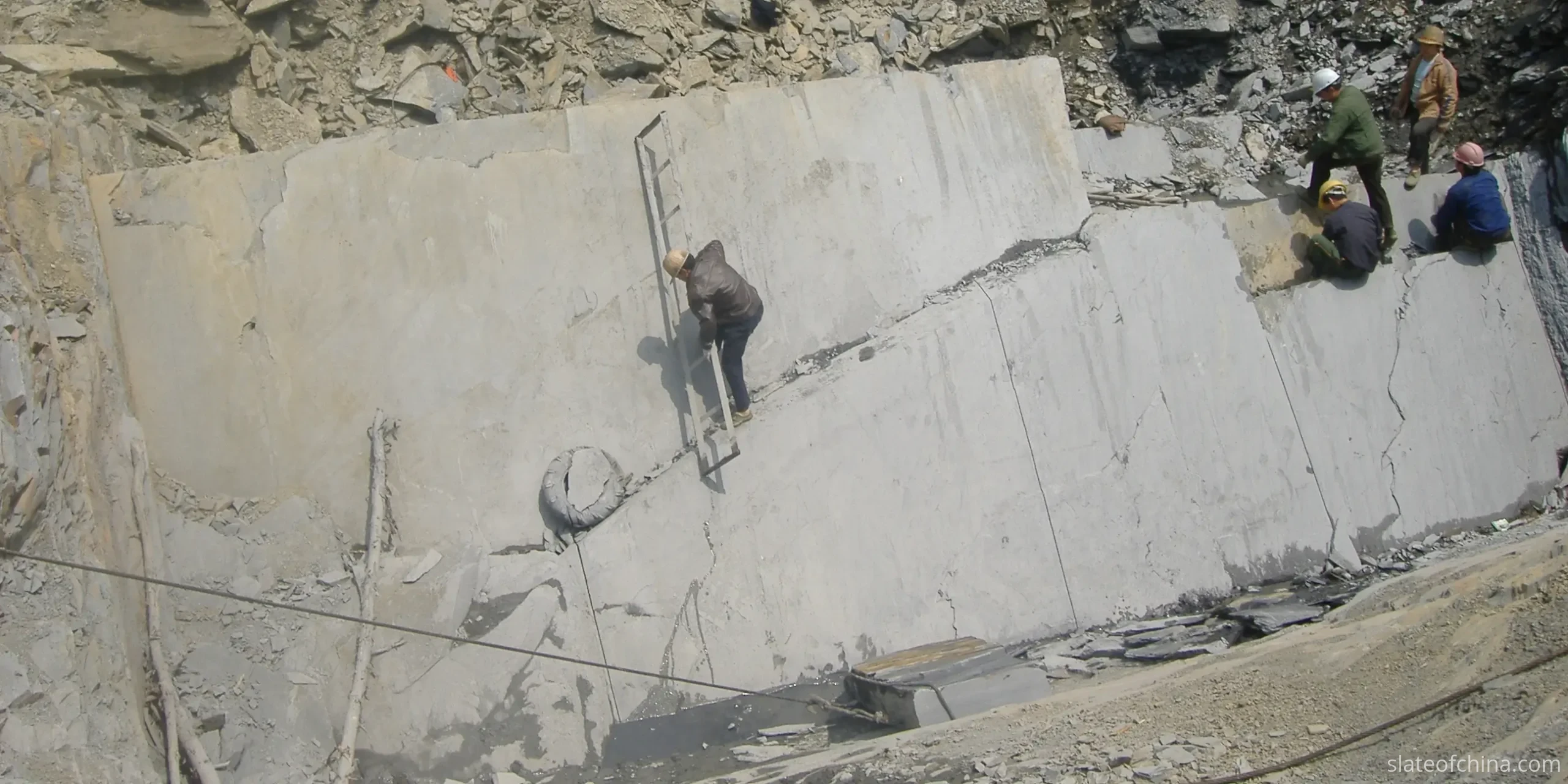
The face is where geology becomes a plan. A working face is not a crater; it is a wall of beds, and the value of a slate belt is decided by how regularly those beds were laid down long before anyone drew boundaries around them. The beds that matter commercially are the ones that split clean, lie flat and hold together — the slate quarries in this part of Jiangxi, China, have made two industries out of that single habit of rock, and the honest way to describe a deposit is with tested figures and a documented scale, not adjectives.
On the scale: the mineral-resources plan for Lushan City records the belt's slate resources in the order of seventeen million cubic metres — a regional resource figure for the belt as a whole, not a permitted mining reserve, and not a number attached to any single face. What that number does and — more importantly — does not promise an individual order is unpacked on the reserves page; a figure that size answers the question of whether the region can supply, and cannot answer the question of who shows up with your container. Extraction itself is quieter than people expect: blocks are freed along the natural beds and joints, and the wire-saw mechanics of that release have their own page. What this walk needs is the reading that happens before the saw: which beds can yield thin roofing, which are massive enough to become table panels, which are better left in the wall. That reading is the whole reason one region can sell the same mountain to two industries.
The Selection Yard: Where a Block's Future Is Decided
When the blocks come down off the bench they land in the selection yard — level ground where stone is sorted by destination before it is sorted by grade. Two families of blocks part ways here, on opposite philosophies. A roofing block is chosen for cleavage: it must want to split, and the yard is testing for willingness. A billiard or architectural block is chosen for soundness and size: it must stay whole, and it must be big enough to yield the panels a drawing asks for. The same truck can deliver both; the yard is where they are told apart, and it is the least photographed, most consequential place in the region.
This is also where specialisation quietly starts, and where the trade's one unforgiving truth lives: a machine hall cannot repair geology. No CNC program grinds a fracture back into a sound panel, and no grinder rescues a block that arrived already tired. A yard that reads cleavage well is worth more to the roofing trade than a hall full of machines; a hall full of machines is worth more to the table trade than the best yard in the province. When you audit a supplier, the yard photographs tell you which philosophy the house was built on — the honest version is unglamorous: blocks on the ground, a foreman who can say which block is waiting, and for which lane.
The Splitting Sheds: Roofing Lane
Step under the first shed roof and the region changes sound. This is the roofing side — the slate splitting and cutting process at its most hand-made — where a block is opened along its cleavage with hammer and chisel, the craft the machines have never fully replaced, and each split tile is then dressed to format, calibrated on thickness, graded and bundled for its crate. The full tile journey, step by step, lives on the roofing journey page; the sister guide carries the same process told for roofing buyers. What belongs on this walk is what the sheds can and cannot answer.
What they can answer is tile-making. What they cannot answer is your drawing — and that gap is where roofing quotations go sideways. Take an order at 500 × 250 mm: the questions that decide whether that price is honest live in the sheds. Are those dimensions nominal or minimum usable? What thickness band does the order carry, and what does the buyer accept as colour variation? What defect rate does the sorter hold to, and what happens to the rejects? A roofing buyer comparing quotations needs those answers on paper, and the comparison guide exists for exactly this moment. Where the roof is bound for a regulated market, the testing conversation follows — EN 12326 where the market leans European, ASTM C406 where it leans American, close cousins that are not interchangeable, and the standards page compares what each actually tests.
Out at the end of the shed row, freshly split Jiujiang roofing slate stands tilted on A-frame racks to air and settle before bundling — the last pause the stone gets as rock, before it becomes parts of a roof. How tiles are graded and sorted into bundles after that pause is the roofing guide's own territory — the sister hub carries it under its buying section; the packing that follows it, with its crates and strapping, waits further down the walk.
The Machine Halls: Billiard Lane
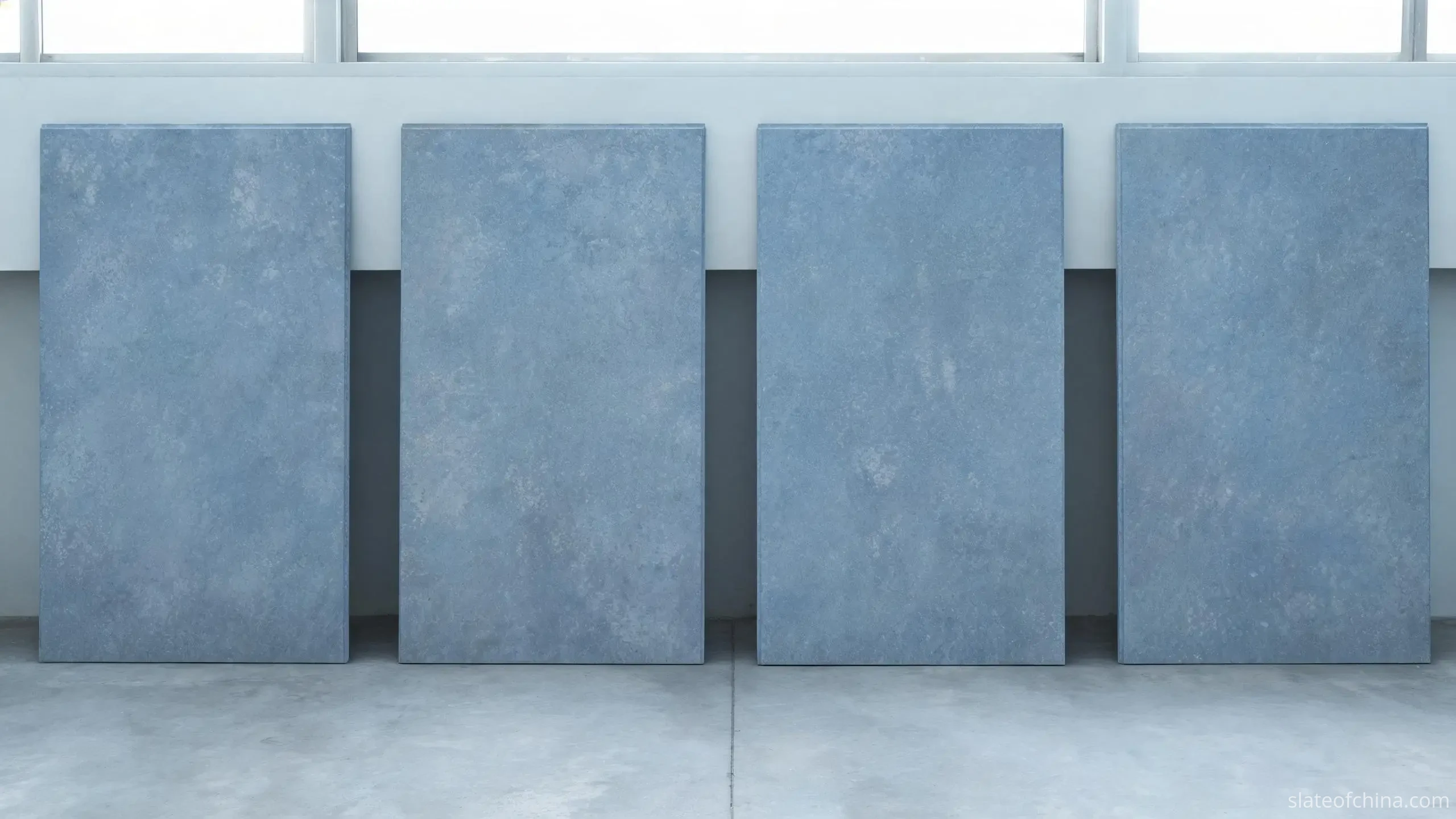
Cross the yard and the sound changes again — the machine halls are the billiard side, and this is how billiard table slate is made: a sound block is sawn into slabs, the slabs are ground, and the grinding is where a stone becomes a bed. Our machined panels are held to a flatness of ±0.1 mm — a working bench figure for the machined face in its finished, delivered state, whose measurement basis and limits are set out on the flatness page of this guide. Thickness travels with the table — the beds this region ships run from roughly 19 mm on the smallest pool frames to 38 mm on the largest snooker builds — and the full panel journey, from saw to set-matching, is the billiard journey page.
The halls cannot invent geometry. The CNC work answers to an approved drawing — the practice here is drawing-first: confirm the drawing, quote on the back of it, approve a physical sample set, and only then does a batch cross the benches. Every panel crosses a bench before it crosses the yard; how that bench works is the inspection page, and the CNC shop itself is described on its own page. In photographs the halls at rest look like the one below: finished panels stood on edge, daylight held between them.
The Quiet Faces: What "Today" Means in a Slate Region
Ground-truth time, because a buying region this old carries faces that no longer work. Some were cut to their economic edge decades ago; others sit inside planning documents, which is a different thing from sitting inside a mountain. An honest description of this industry therefore contains a category the brochures skip: quiet faces, still showing the level beds that made the belt worth opening, and now growing them back — the one in the photograph below, decades retired, reads geologically the same as any working wall.
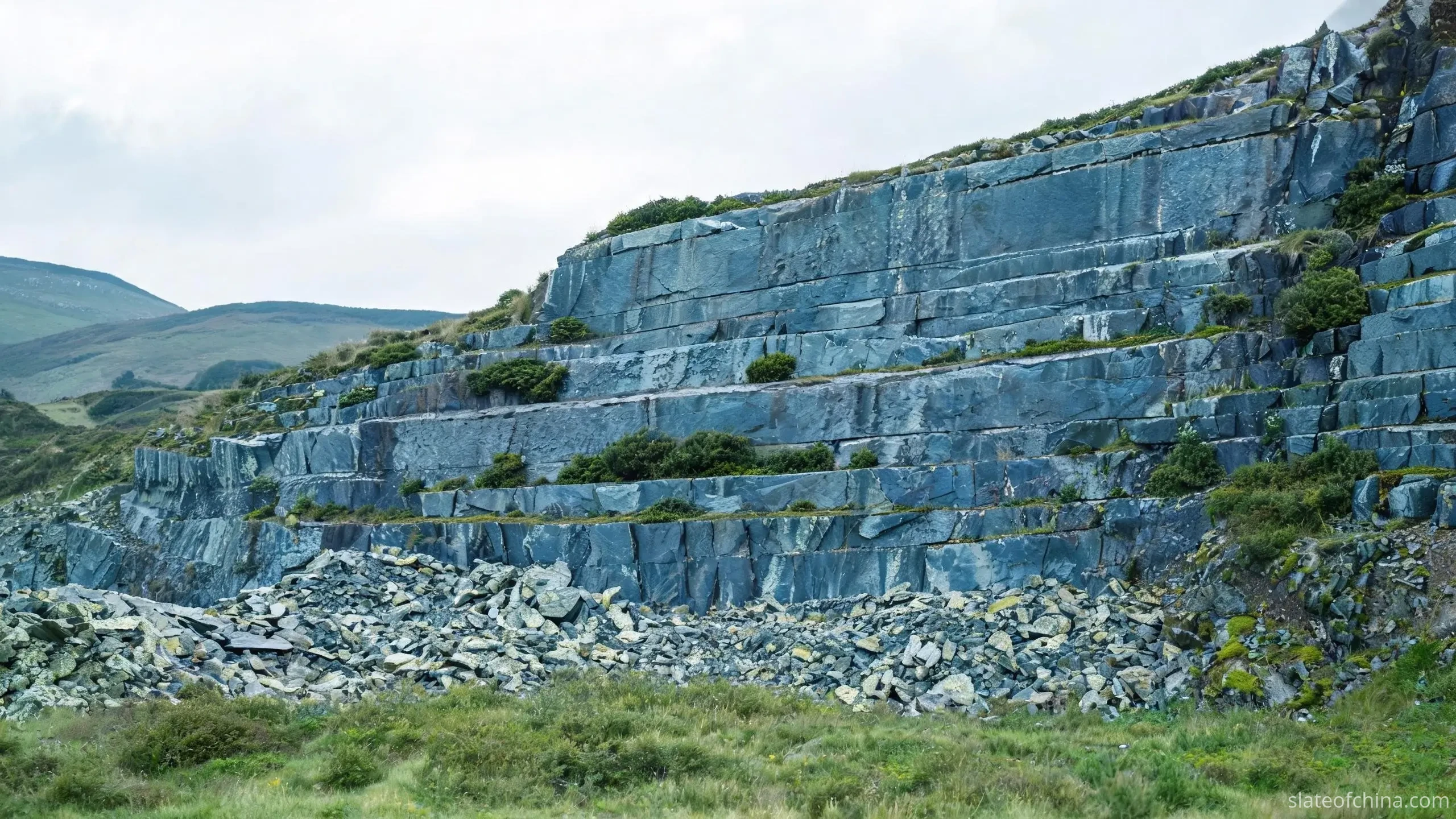
None of this is a warning that the region is winding down. The reserves are documented at the scale quoted above, working faces supply both trades today, and no honest page tells you which faces ran in 1996 as if they run now. The operative test for a buyer is continuity: which face, which yard and which hall answer for your order this quarter — and what happens to the specification if the usual face pauses. The region usually reroutes rather than stops — and a reroute only counts once the substitute material passes your written spec; but that capability has to exist before it is needed. The reserves page takes that question seriously; so should any house that wants your repeat orders.
At the Gate: Crates, Containers and the River
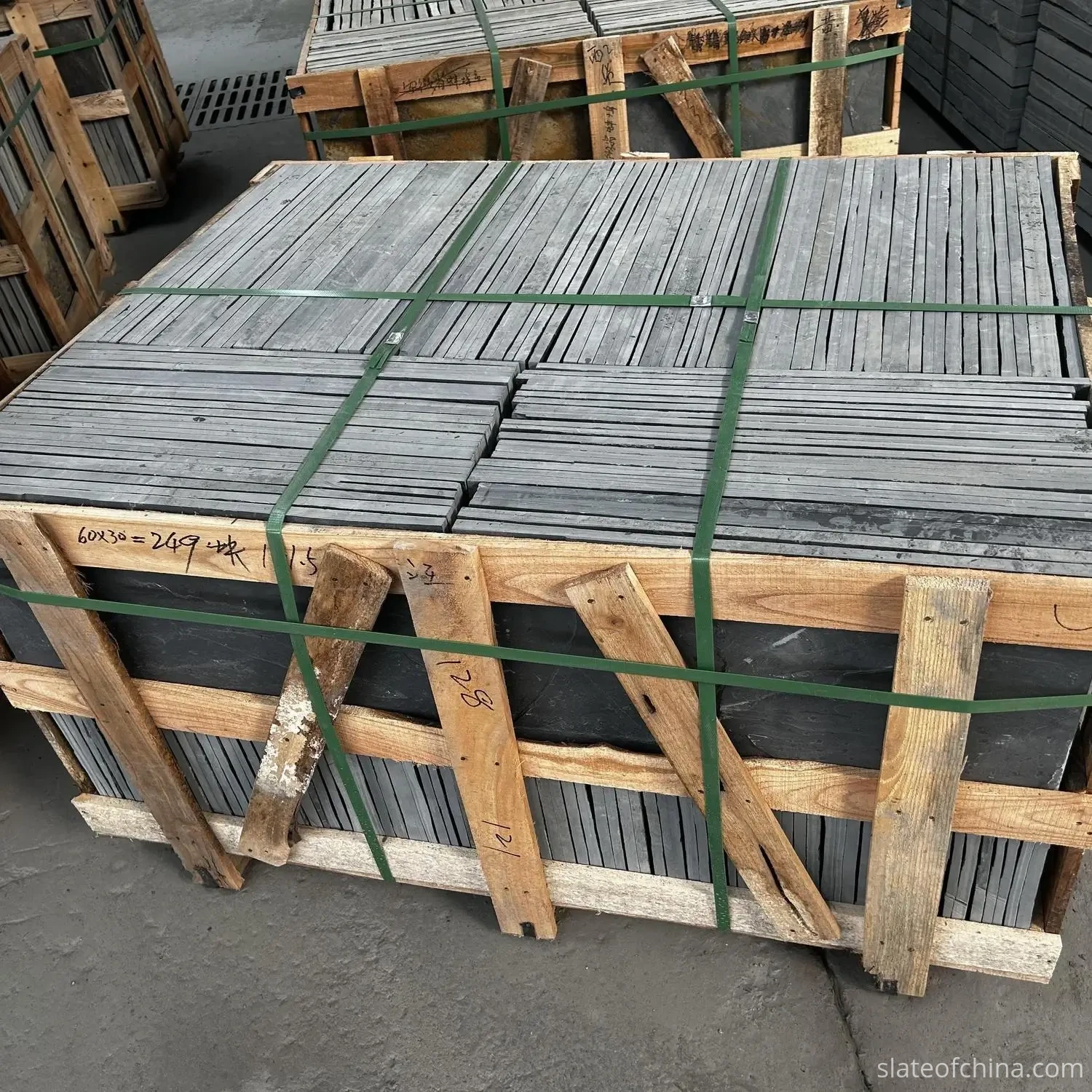
The last place on the walk is a gate — the packing floor and the container bay, where the two production lanes finally look identical. Roofing tiles and billiard panels leave in the same kind of timber export crate, because by this point both are finished goods that must survive the same ocean: the crate standards, the packing routine and the loading day itself each have a page under the shipping guide.
From this side of the region the port is close: a run of roughly forty minutes in normal traffic, from our own works to the river quay at Jiujiang, containers loaded at the factory and hauled to the wharf, and from there the Yangtze carries them down to the sea route. That forty minutes, and the river after it, is the distance between your order leaving the bench and your order leaving the country — the containers, freight and delivery arithmetic belongs on the freight page, not smuggled into this one.
Walk It Yourself
If you can visit — and for a serious order you should ask — walk any supplier's site in the order the stone travels: yard first, then whichever lane is yours, then the benches, then the gate. You are not counting machines; you are checking that each place can point honestly at the next one. Can the yard say where the blocks came from? Can the shed or the hall show you its bench, and yesterday's loading rather than last year's brochure PDF? If you cannot fly out, the same walk runs on video, and the questions run the same way — the full question lists live on the questions page, and when the walk graduates into an order, the buyer checklist takes over from there. That is the map's last use: once you can read the places, you can read the supplier.
Frequently Asked Questions
Are the slate quarries and the processing factories in Jiujiang the same companies?
Sometimes, more often not. Three arrangements cover the whole trade: houses that run their own faces, houses that buy blocks from faces they trust, and houses that own no quarry and no hall at all. Each arrangement can supply honestly; none of them is a certificate. This page shows what each place can prove — so the check is against the ground, not the letterhead.
How many slate quarries are actually operating in Jiujiang today?
No one honestly publishes that number, and this page will not invent one. Face boundaries, permits and plans change more often than directories do. The documented facts are different in kind: the belt's resources are recorded in the mineral-resources plan for Lushan City, and the working face behind your order is the one number that matters. Ask your supplier for it, by name and location — and hear whether the answer names a place or just a region.
Can one Jiujiang factory supply both roofing slate and billiard slate?
It can, when both lanes exist under the same management. It is not automatic: roofing work lives or dies on cleavage reading and hand-splitting, billiard work lives on grinding discipline and bench inspection — different crafts, different machines, different foremen. The number that matters is smaller than the catalogue: ask which lane will make your order, and who works in it, rather than what the company could theoretically produce.
Is the stone processed at the quarry or in town?
Mostly on the town side of the belt: the yards and halls sit between the faces and the gate, some inside the same fence as the workshops, some rented along the road. What matters more than the address is the boundary — which stages are run in-house and which are bought in from other yards. Ask for the boundary, not the postcode: a supplier who can draw that line can usually draw the others too.
Can I visit the quarries and the factories before ordering?
Yes — workshop visits and walk-through videos are normal practice here, and for a significant order you should ask for one. The faces themselves are working sites, so access depends on the operator and the day; the yard, the sheds or halls and the gate are all walkable, and the video version of the same walk asks the same questions. What a visit cannot do is replace a drawing, a sample approval and a written specification — those follow the visit home.
What happens to supply if a quarry stops working?
The honest answer is that the region usually reroutes rather than stops. The belt holds multiple benches with similar material, and a house with more than one face relationship can hold a specification stable across a change — but that capability has to exist before it is needed. Ask for it while things are quiet: which faces can supply your order, and what the house does if the usual one pauses. A supplier with that answer is a supplier with a plan. Whether a reroute actually works for your order, though, is decided by the material, your written spec and re-approval — treat it as a path to verify, not a promise to bank.
Related Reading
Ask for the walk, not the brochure.
The fastest way to test any slate supplier — this one included — is to ask for the places, not the promises. Send a specification and a serious desk answers with a route: which face the stone comes from on this order, which yard sorts it, which lane makes it, how it will be inspected, and when the container loads. Send yours and see:
- Roofing — tile format and thickness band, colour reference, coverage in m², destination market.
- Billiard — table type, drawing or hole layout, slate thickness, number of sets, destination port.
Still researching rather than sourcing? That track is open too, and it needs no specification: read this guide at your own pace, ask us to walk a future order's route in advance, or simply request the standard specifications and test documents first. A quotation can wait until your drawing is ready — the ground will not.
Still researching rather than sourcing? That track is open too, and it needs no specification: read this guide at your own pace, ask us to walk a future order's route in advance, or simply request the standard specifications and test documents first. A quotation can wait until your drawing is ready — the ground will not.
Browse the roofing slate range and the roofing guide, or the billiard slate range and the billiard guide — or skip the browsing and send the enquiry straight to the desk. The ground above is how we quote: from the face down.