
Lushan, Xingzi and the Slate Belt of Jiangxi
Let us start with the answer, because the question behind this page is usually typed into an email at the end of a long day: are Lushan slate, Xingzi slate and Jiujiang slate three different stones, or three names for one thing? They are three names for one thing — one mountain, one lake-shore county, one belt of quarries between them, all inside the prefecture city of Jiujiang, in the province of Jiangxi. The mountain gave the region its beauty and its UNESCO listing; the county gave the slate trade its old name; the belt gave the world the stone.
Why spend two thousand words on names? Because in this trade, names are not scenery — they are paperwork. An old specification sheet says Xingzi slate. A new bill of lading says Lushan City. A supplier's brochure says Jiangxi slate, and a customs paper says China. A buyer who does not know how these four names nest inside each other can easily conclude that he is being offered three or four different materials — and either walk away from the right stone, or pay twice for the same one under two labels.
LUSHAN
The mountain — a UNESCO World Cultural Landscape and Global Geopark. Since 2016, also the county-level city that used to be Xingzi County.
XINGZI
The old county name — on the western shore of Poyang Lake. Still the name the slate trade used for decades, and the one you will find in older specifications.
THE BELT
The quarry country — the band of low hills between the mountain and the lake where the stone actually comes out of the ground.
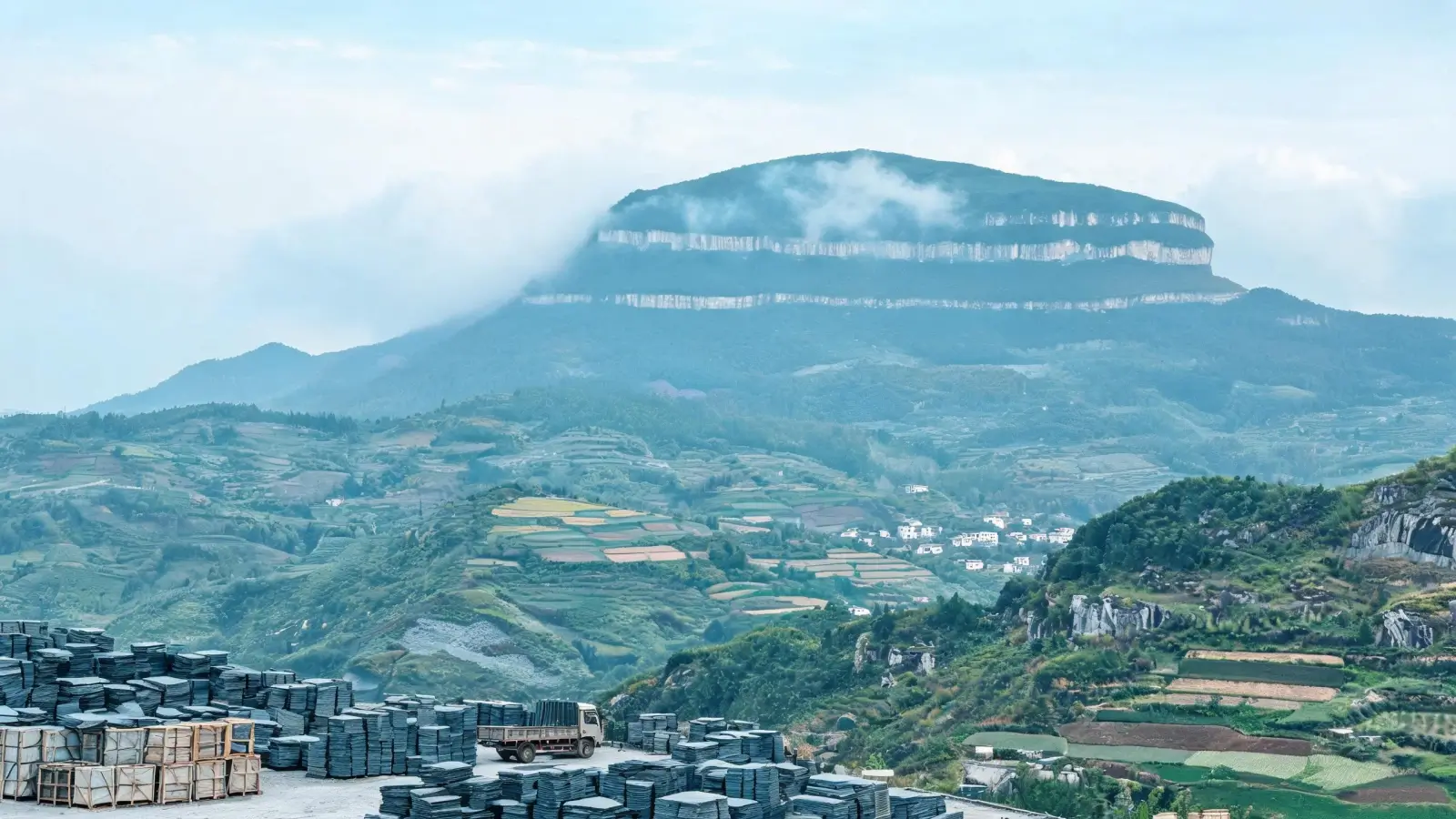
One housekeeping note before we descend into detail. If you want to know where this region sits on the map — the river port, the lake, the drive from the airport — that is the job of the geography page, and it is done there with a map. This page does something the map cannot: it explains what each name means, and in what order they nest — the way "England" sits inside "the United Kingdom", and "Sussex" sits inside England. And it goes one step further, into the hills, to the older quarry workings that made the words Lushan and Xingzi mean something in the slate trade long before export containers were invented.
Lushan: The Mountain That Named the Stone
Start with the mountain, because everything else in this region is arranged around it. Lushan — Mount Lu — is not an ordinary hill with a view. It is a fault-block mountain: a great slab of the earth's crust, lifted and tilted until it stands abruptly above the plain, its summit plateau wrapped in cloud for much of the year. The flat farmland of the Yangtze valley lies around it on three sides, and on the fourth, close enough to see the weather coming across the water, sits the vast grey-blue expanse of Poyang Lake, China's largest freshwater lake. A mountain that has drawn scholars and poets for well over a thousand years carries a World Cultural Landscape listing and a place among the world's geoparks — and the slate belt runs in the foothill country at its feet, where the same ancient earth movements left bands of grey-blue rock running through the low hills.
Here is the detail that confuses the paperwork, and it is worth slowing down for. "Lushan" in a slate context almost never means the mountain itself. The quarries are not up among the cloud-wrapped cliffs; they sit in the low hill country around the mountain's southern and western skirts, where the beds of grey-blue slate run in bands through the foothills. When an old specification or a supplier's letter says "Lushan slate", it means slate from the belt in the mountain's foothill country — not slate quarried on the UNESCO monument. The mountain lends the belt its name the way a great cathedral lends its name to the streets around it.
There is a second, newer meaning, and this is the one that has quietly rewritten invoices since 2016. In that year, Xingzi County — the lake-shore county whose hills hold much of the slate belt — was redesignated as a county-level city, and it took the mountain's name: it became Lushan City. Nothing about the rock changed. The same quarries, the same splitting yards, the same beds. What changed was the letterhead. So today, "Lushan" can mean the mountain, the belt at its feet, or the administrative city whose factories cut the stone — and all three uses are correct. If a document simply says "Lushan City" with a postal code, as ours does, it is the third meaning: the county-level city where the slate belt actually lives.
Xingzi: The Old County Name in Your Specifications
Xingzi is the name the slate trade grew up with. It was for generations the county on the western shore of Poyang Lake — a low, lake-washed land of fishing, farming and stone, with the slate hills running along its back. The name still appears on the documents of the trade for a simple reason: for most of the export era, this was the administrative name the region went by. Buyers who started specifying Chinese slate twenty or thirty years ago learned the stone as Xingzi slate, and some of those specifications are still in service, still being re-quoted, still printed in tender documents today.
So the practical question a buyer actually faces is not "what is Xingzi?" but "how do I handle a file where the old spec says Xingzi and the new offer says Lushan City?" The answer is: treat them as the same origin, and say so in writing. A quotation we receive sometimes comes attached to an old tender spec that says Xingzi slate; our own bill of lading says Lushan City. Between those two papers sits the same rock from the same belt — one document was simply written before the county changed its letterhead, and one after. A supplier who cannot explain that in one clear sentence is a supplier who does not know his own region's history; the full genealogy of these names — Jiujiang, Lushan, Xingzi, and how to be sure you are comparing like with like — has its own page in this guide: Jiujiang, Lushan or Xingzi Slate: What's in a Name?
Keep this name in your file, in other words, but keep it in its place. "Xingzi" is not a different grade, a different quarry or a different stone. It is the same belt, seen through an older administrative window — the geological address was always more permanent than the postal one.
Jiangxi and the Belt: The Province Behind the Name
Zoom out one level and the region resolves into its province. Jiangxi curves around Poyang Lake in the middle of south-eastern China, and along its northern edge — where the province meets the Yangtze — runs the band of hills and old workings that the trade calls the Lushan Xingzi slate belt: the slate belt of Jiangxi, named for the mountain and the old lake-shore county at its heart. The belt is the physical reality behind all three names above: a strip of slate-bearing country in the foothills between Lushan and the lake, where the beds are thick enough, and clean enough, and close enough to the surface, to have supported quarrying for generations — first for local roofs, later for inkstones and lintels, and in the export era for billiard beds and roofing tiles that now ship to more than thirty countries.
A belt is not a single quarry. It is dozens of workings — some old, some active, some worked by hand a lifetime ago and now grassed over — spread along the hills where the slate beds run. Within one belt, the rock is recognisably one family: grey-blue, dense, fine-grained, splitting cleanly along the cleavage that the geology page explains properly. But the family has members. Beds vary in colour tone from face to face; some sections split to thinner, more even tiles than others; a block from the edge of a bed behaves differently from a block taken at its heart. That is why sorting and grading exist as trades, and why a serious supplier will tell you which part of the belt, and which bed, your order is drawn from — the question is not whether the stone is from the belt, but how it was selected once it left the ground.
And the wider picture — where Jiangxi's other stone regions sit, how the province's slate industry is organised beyond this one belt — belongs to the industry pages of this guide rather than here. The point this page is responsible for is smaller and sharper: "Jiangxi" in a slate context means this belt, the way "Champagne" on a label means a particular chalk, not all of France.
Where the Reputation Was Quarried
Every slate region that ships internationally today has an older story underneath the export crates, and this one is no different. Walk the foothills of the belt and you will find the evidence without looking hard: old workings stepped into the hillsides, their benches cut by hand generations ago, thin slate layering showing in the weathered faces where a half-century or more of rain has done nothing but darken the rock. Some of these faces were opened when the only customers were local — the farmsteads and village houses scattered through the same hills, whose grey-blue roofs were the region's first, unwritten quality certificate. Roofs like those have been shedding the lake country's rain and frost for longer than anyone here can remember, and the long history of local use — roofs, inkstones, thresholds — has its own page in this guide.
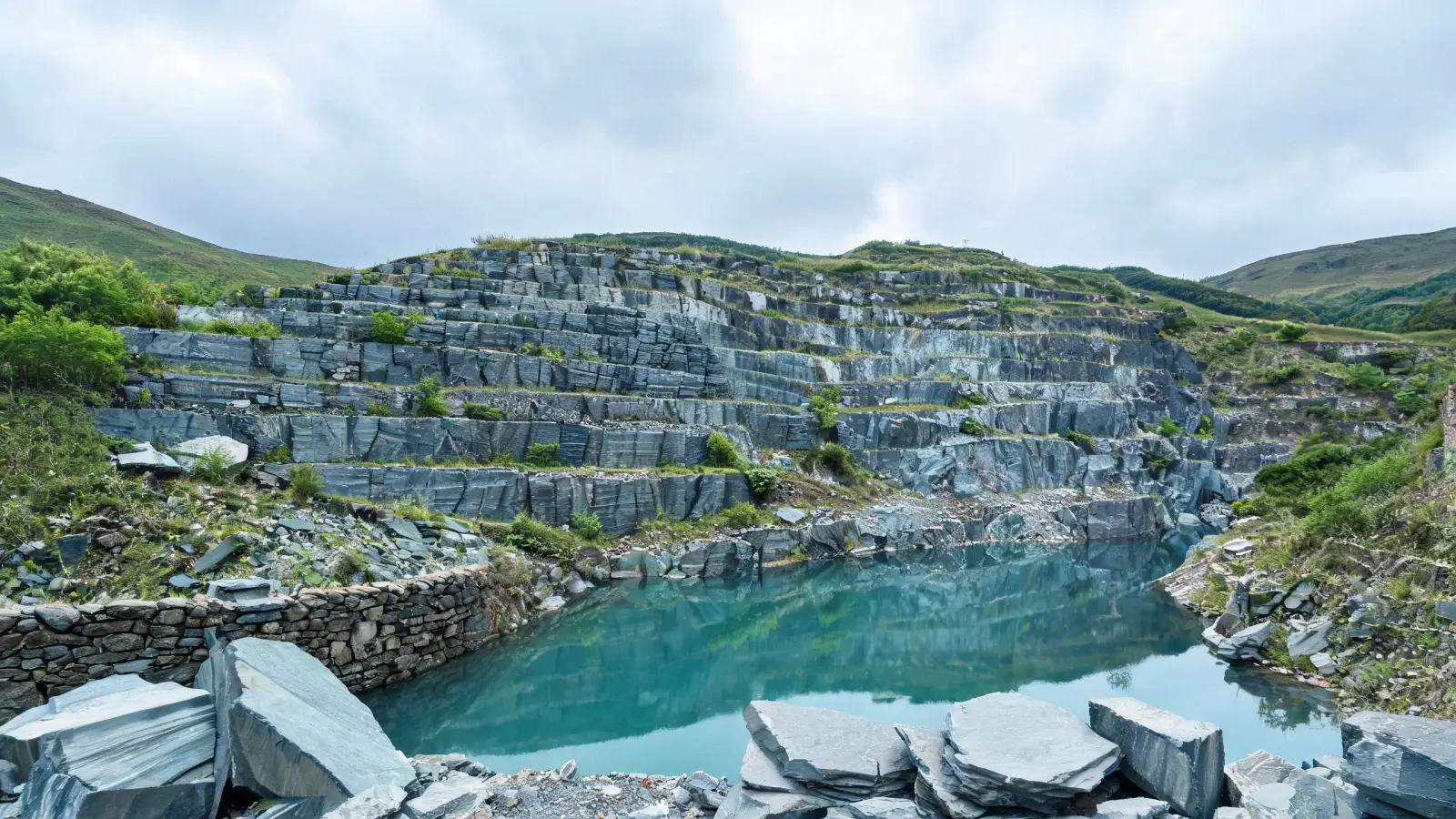
What the old faces established — in the quiet way that only decades of local use can — is the character the belt is still trusted for: hard, dense slate. The stone from these hills runs dense in the hand (around 2.7 to 2.8 grams per cubic centimetre — the figure the test results page carries in full), and density, in this business, is the parent of nearly everything else: low water take-up, frost that finds no foothold, a splitting edge that stays true, and — the reason the billiard trade found its way here a generation later — a bed that can be machined flat and stays flat. The old quarrymen were not thinking about EN 12326 when they opened these faces; they were simply working the best beds they knew. The testing came later, and confirmed what the village roofs already knew.
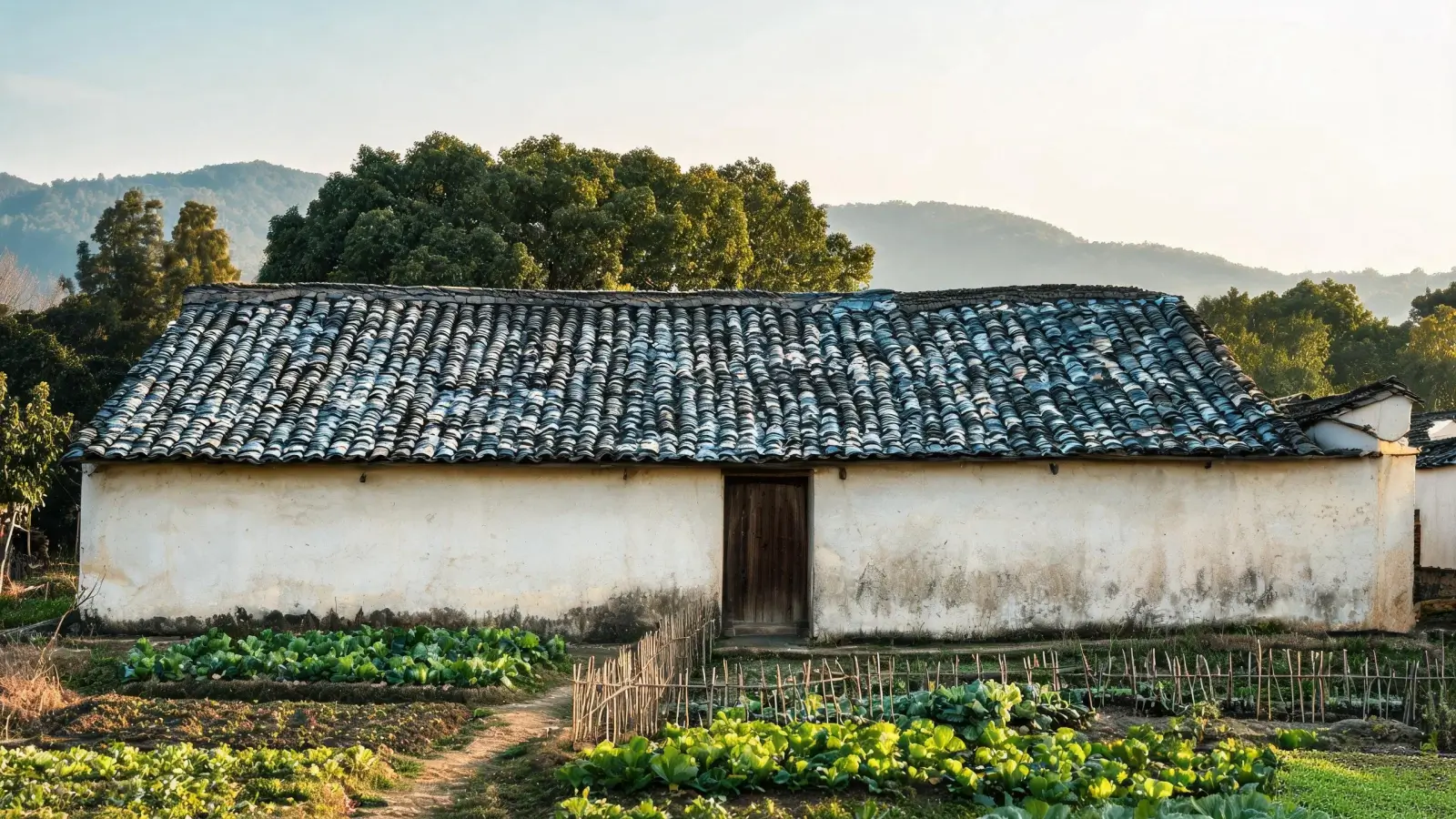
The village roofs deserve their own pause, because they are the most democratic proof in this whole article. A laboratory can test a slate; only time can testify for one. The older houses around Lushan and Xingzi were roofed in tiles split from the same hills that fill today's export crates — no grade stamps, no certificates, no brand — and the ones still standing are still doing their job, weathered silver-grey, edges a little softer than the day they were split. That is what a century of lake-country frost and thaw looks like on this stone when nobody selected for it. When a buyer asks us — and they do ask — how the slate will behave on a roof in Wales or Nova Scotia after thirty winters, the honest answer starts in these foothills: it has already run a longer trial than that, unsupervised, on the houses of the people who quarried it.
The transition from those old faces to today's belt is not a change of stone but a change of scale. Modern workings use wire saws instead of hand-set wedges, the blocks travel to processing yards instead of being dressed at the face, and the finished goods are selected for two very different destinies — roofing tiles on one line, billiard slate on another — but the selection logic is the same one the old quarrymen practised by feel: the cleanest, densest, most even material earns the demanding work, and everything else finds honest use in thicker tiles and other products. How the modern split-and-machine version of that logic works, step by step, is the production page's job. What this page adds is simply the pedigree: the belt's reputation for hard, dense stone was not manufactured by a marketing department. It was quarried, slowly, by people who needed their own roofs to last.
How the Four Names Fit Together
Set the four names side by side and the confusion dissolves. They are not four competing products; they are four administrative circles drawn around one stone, plus the belt itself — the physical thing all the paperwork is trying to point at:
| Name you will see | What it actually is | Where it appears in your paperwork |
|---|---|---|
| Lushan | The mountain — and since 2016, the county-level city that was Xingzi County | Supplier brochures, new specifications, current addresses ("Lushan City") |
| Xingzi | The same county by its pre-2016 name — the western shore of Poyang Lake | Older specifications, tender documents, long-standing buyers' files |
| Jiujiang | The prefecture-level city — the river port that the whole region, including Lushan City, sits inside | Customs papers, bills of lading, the general trade name "Jiujiang slate" |
| Jiangxi | The province — in slate terms, shorthand for this belt along its northern edge | Origin descriptions, comparisons ("Jiangxi slate vs Spanish slate") |
Read the table from the bottom up and you get the nesting order: the belt runs through the hills of a county-level city called Lushan (once Xingzi), inside the prefecture city of Jiujiang, inside the province of Jiangxi. Four circles, one stone. When you next meet a specification that says Xingzi slate while the quotation in your other hand says Lushan City, you already know more than the paperwork does: the geological address did not move — the postal one simply caught up with the mountain.
Frequently Asked Questions
Is "Jiangxi slate" a quarry or a brand name?
Neither — it is a province of origin. Jiangxi is the province in south-eastern China whose northern edge carries the slate belt: the band of quarries and processing yards in the foothills between Lushan and Poyang Lake. When a specification or comparison says "Jiangxi slate", it is pointing at stone from that belt, the same material that also travels under the names Lushan, Xingzi and Jiujiang. Treat it as an origin description, like "Spanish slate" — useful for narrowing the world down, but not a substitute for test data and a sample.
My old specification says "Xingzi slate" — is that still available?
Yes — under its current name. Xingzi County was redesignated in 2016 as Lushan City, a county-level city that took the mountain's name. The quarries, the beds and the stone did not change; only the administrative letterhead did. So a supplier offering Lushan slate today is offering the same belt of stone your Xingzi-era specification described. If you are re-quoting an old tender, ask the supplier to confirm the origin in writing as "Lushan City (formerly Xingzi County), Jiujiang, Jiangxi" — that one line keeps old files and new paperwork telling the same story.
Is "Lushan slate" a grade or a quality level?
No. Lushan is a place name — the mountain, and since 2016 the county-level city around the slate belt. It says where the stone comes from, not how it was selected. Quality within the belt is a matter of bed, selection and grading: the same region produces first-grade roofing tile, commercial grades, and billiard-bed panels, and the difference between them is made after the blocks leave the ground, by sorting and machining. Judge quality by the grade designation and the test report, not by the mountain on the label.
Is all slate from the belt identical?
No — and no honest supplier will tell you it is. Within one belt the stone is recognisably one family: grey-blue, dense, fine-grained, splitting cleanly. But beds vary in colour tone, splitting thickness and weathering character from face to face, and blocks from the edge of a bed behave differently from blocks at its heart. This is exactly why sorting and grading exist, and why two quotations from the same region can legitimately differ. The right question is not "is it from the belt?" but "which bed was it drawn from, and how was it selected?"
If I visit the region, which name will I actually see on the ground?
All of them, in their proper places. Road signs and addresses will say Lushan City; older people and older shopfronts still say Xingzi; the port, the customs office and the train station say Jiujiang; and the province on every map says Jiangxi. The slate belt itself you will recognise by what is in the yards — blocks, crates and trucks — rather than by any sign. The names are four administrative circles around one physical thing, and seeing them nested in real life usually settles the confusion faster than any table can.
Related Reading
The Belt, in Your Hands
Names settle arguments; samples settle orders. We will send you a hand piece of slate from the belt between Lushan and the lake — with the test data that belongs to it — so you can judge the stone the way the village roofs already have.