
CNC Machining in Our Jiujiang Factory
The first thing you hear when you walk into our machine room is not what you expect from a stone factory. No clatter, no dust haze, no shouting over machines. Just the steady hum of a spindle running across a slab, and the hiss of water mist keeping it cool. People come in expecting a quarry in miniature and find, instead, a clean floor with three letters on the machines: CNC.
This is not a tour of our production line — we have covered the panel journey and the tile journey in detail. This is a look at the machines themselves: what they can do, how they hold the tolerances we quote, and why a buyer who asks "what machines do you have" is asking the right question. If you buy slate in volume, this is the part of our factory that decides whether your order arrives the way you specified it.
| Machine | Core Capability | Tolerance / Resolution | What It Serves |
|---|---|---|---|
| Bridge Gantry | Mills, drills and profiles whole panels | ±0.1 mm standard, ±0.05 mm high-end | Billiard panels, large format pieces |
| Cup Wheel Grinder | Automated surface flattening | ±0.5 mm before the fine pass | Every panel before precision work |
| Touch Probe | On-bed self-check and correction | 0.001 mm resolution | Every machined panel, every run |
| Edge Grinder | Square, straight joint edges | 0.05 mm seam flush | Three-piece sets and close-tolerance edges |
| Operator + Programme | Toolpath design, first-off control | Set by CAM, verified by trial | Every batch, every size |
| Granite Bench | Independent flatness verification | 0.01 mm readout | The record that ships with the crate |
Machine 01: The Gantry
The heart of the machine room is the bridge gantry. Two box-section columns stand at either side, a crossbeam runs across the top, and a spindle carriage travels along that beam on linear guides. The whole structure is symmetrical and heavy for a reason: the frame of the machine must not bend while it cuts, or the tolerance lives in the machine, not in the stone.
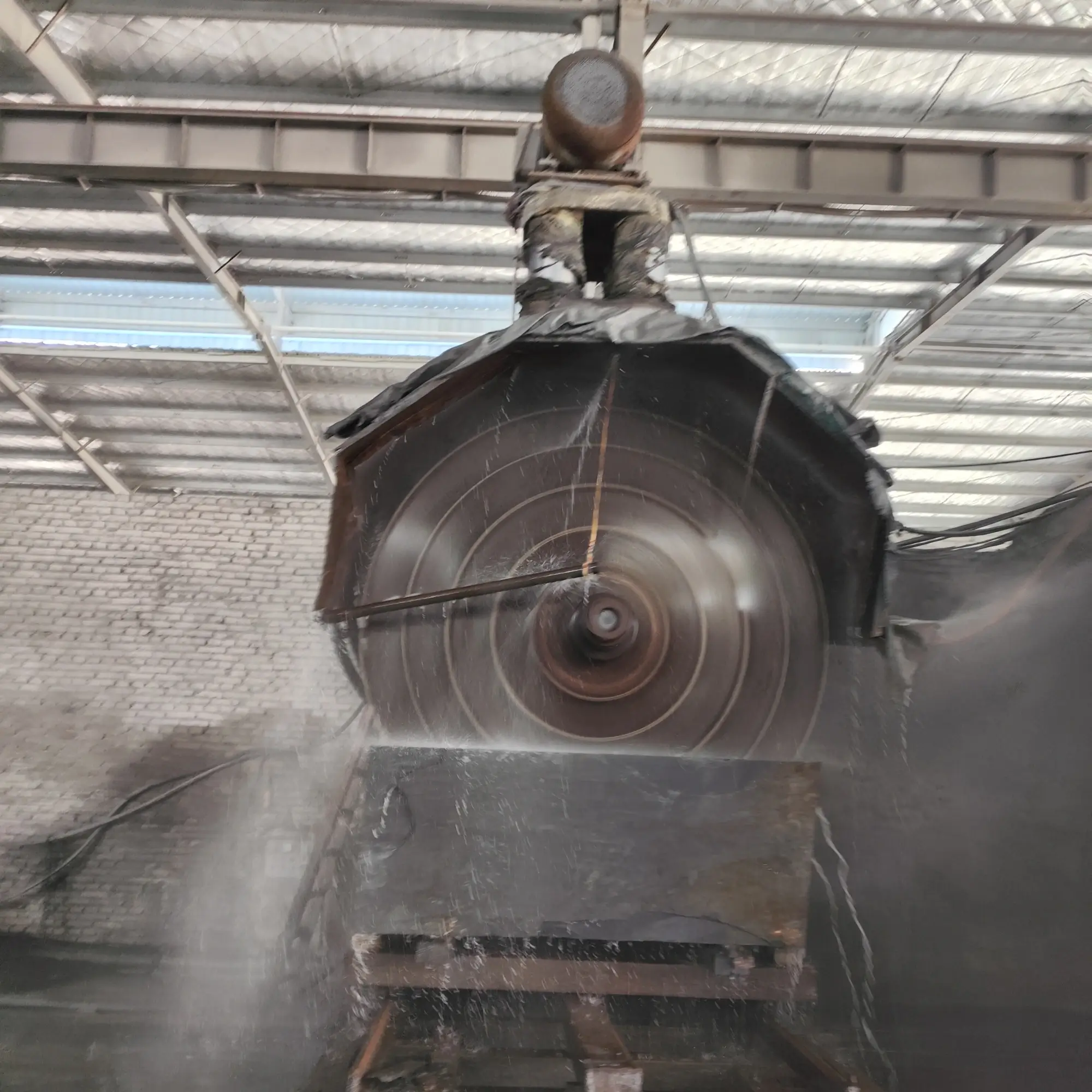
The working area is roughly 2.4 by 4.2 metres, which covers the largest panel we make — the 3.6-metre slab for a 12-foot snooker table — with room to spare. The spindle is a 15-kilowatt unit that turns a diamond tool anywhere between 3,000 and 8,000 rpm depending on the operation. A small automatic tool changer lets the machine switch from a grinding cup to a profiling cutter to a drill without anyone touching the spindle. The machine reads its programme, runs the tool path, and the stone comes out the other side with a surface that has been machined, not guessed.
Why a gantry and not a bridge saw? A saw cuts a straight line. A gantry with a five-axis head can flatten a face, square an edge, cut a pocket, and drill a hole — all in one setup. A 9-foot three-piece set takes roughly three to four hours of machine time on this gantry; a 12-foot snooker set takes six to eight. That is the machine's rhythm: slow, deliberate, and verifiable.
Machine 02: The Cup Wheel
Before any panel goes near the fine tolerance work, it goes through the cup wheel. This is the machine that turns a saw-cut slab into something that will hold a straightedge.
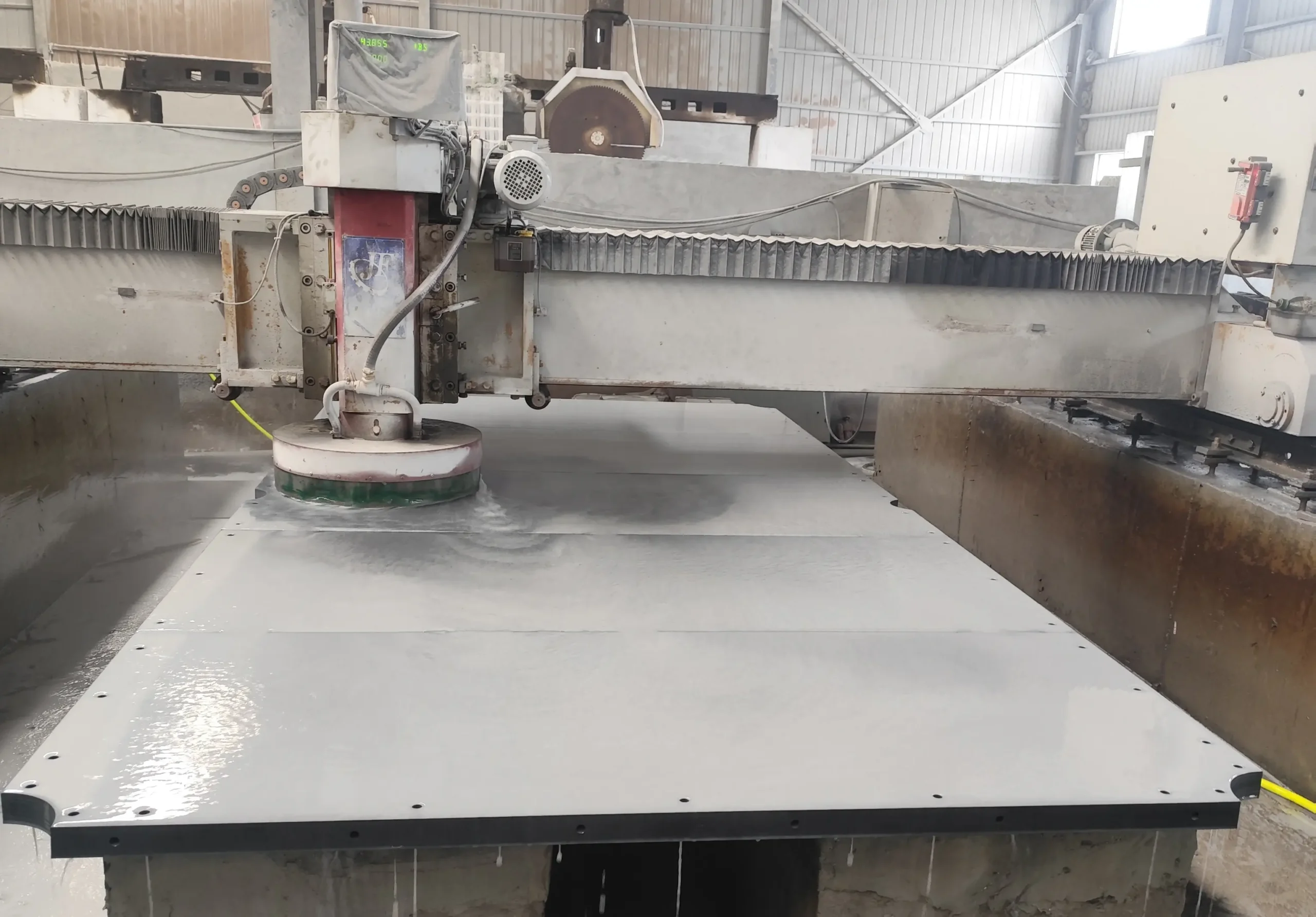
On the outside, a cup wheel looks simple: a disc with diamond segments around the rim. The trick is in how the machine runs it. The tool path is a series of parallel passes, each overlapping the last by about 30%. The overlap is deliberate — it leaves no ridge between passes, which a hand grinder always leaves. The first series of passes uses a coarse diamond segment (60 to 80 grit) and takes the slab to within about half a millimetre of flat. The second series uses a fine segment (120 to 200 grit) and sets the final surface.
Water does two jobs here. It keeps the stone cool — friction heat in a diamond cut can raise micro-cracks that open up months later on a roof or a table. And it carries away the slurry, the fine mix of water and slate dust that would otherwise pack the diamond segments. The water is filtered and recycled through the machine; the shop uses only a small top-up of fresh water each day.
The reason the stone you read about matters here is hardness. Jiujiang slate sits at Mohs 3–4, which means the diamond cuts at a steady, predictable rate. Harder stone would slow the wheel and wear the diamonds; softer stone would cut fast but leave a scratched surface. At 3 to 4, the wheel removes a uniform depth with each pass, which is what lets the machine hold its tolerances at all.
Machine 03: The Probe
The machine that measures its own work is the one that surprises most visitors.

After the machining pass, the machine changes its tool — from the grinding cup to a touch probe, a slim stylus ending in a ruby ball no bigger than a pea. The probe moves across the surface and touches down at twelve points: the four corners, the midpoints of the four edges, the centre, and points in between. Each touch tells the controller how far the surface is from the nominal plane. If any point is out of tolerance, the machine runs a corrective pass over exactly that area — and then probes again.
This closed loop, machine-cut, machine-measure, machine-correct, is why the panels we ship are consistently flatter than anything produced by a fixed tool path. A probe reads to thousandths of a millimetre. When we quote ±0.1 mm as the standard tolerance and ±0.05 mm for tournament-grade work, this is the instrument that has the last word in the machine itself.
Two things make the probe work. First, the density of the stone is uniform enough that the machine cuts a constant depth across the whole panel — a soft spot in the stone would cut deeper and read as a dip. Second, the stone is stable enough that the measurement holds after the cut. A slab that moves as it cools would defeat the probe's work; ours does not.
Machine 04: The Edge Grinder
A flat surface is half the story of a table. The other half is the edges — especially for a three-piece set, where the centre panel and the two end panels have to behave as one surface.
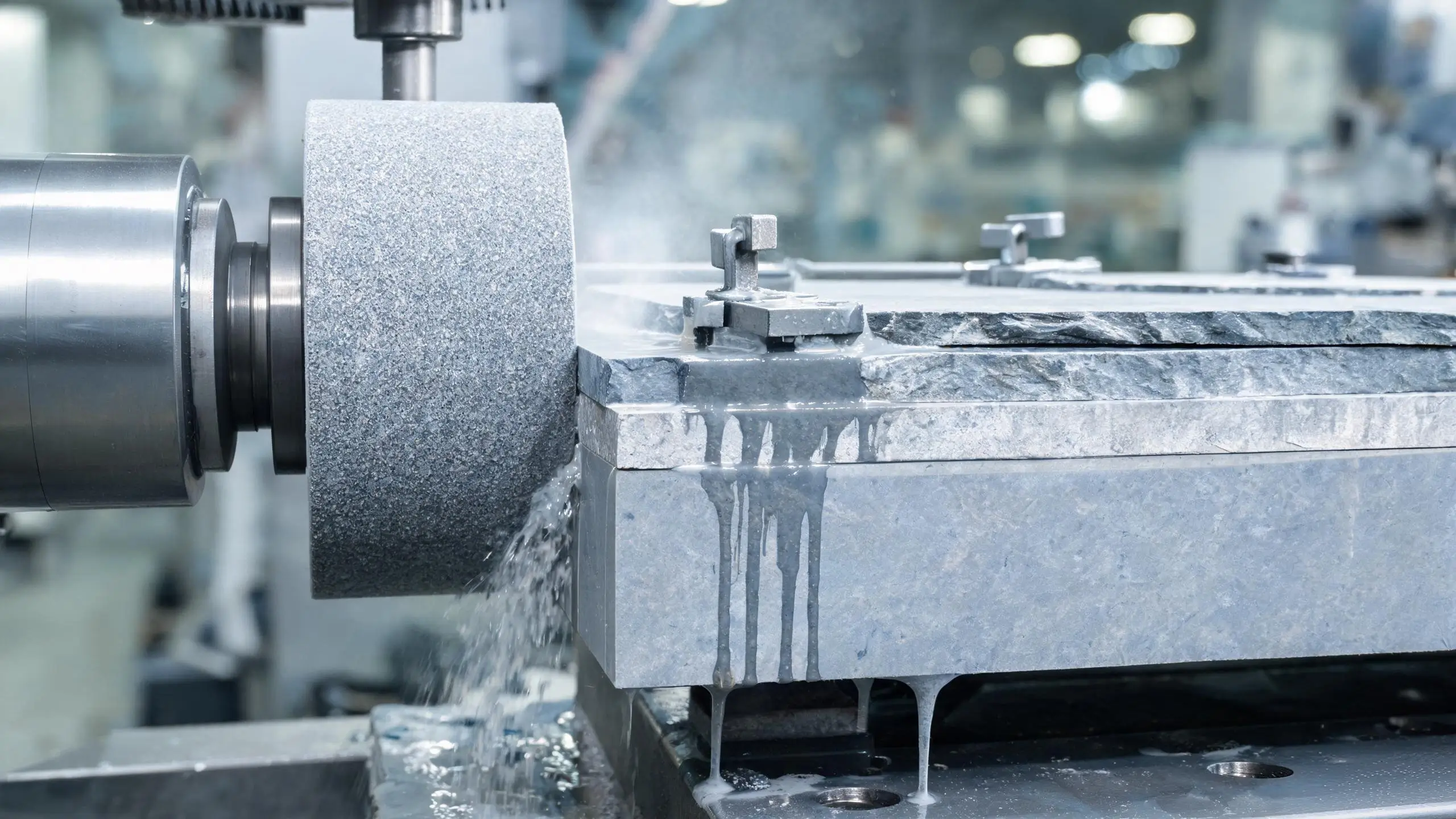
The edge machine holds a cylindrical diamond wheel on a horizontal spindle, and grinds the vertical face of the panel along its full length. The result is an edge that is square to the face — 90 degrees within a fraction of a degree — and straight along its entire run. The joint gap between two machined edges closes to 0.05 millimetres, tight enough that a feeler gauge barely enters, and tighter than the surface tolerance itself. Why? Because a ball crossing a joint should not feel the seam. On a 9-foot table, the three panels are machined as a set against the same reference, then the joint edges are ground together so that they share the same plane.
The same machine handles profile work that is not on a straight edge: the pocket cuts for ball returns, the recesses for corner components, and drilled holes where required. Because the programme controls the tool path, a custom shape is a change to the file, not a change to the tooling. This is what "CNC" means to a buyer ordering something that is not an off-the-shelf size: the machine will work from your drawing, and the drawing becomes the job.
Machine 05: The Programme and the Operator
A CNC machine is not magic. It is a tool that moves a spindle along a path described in a file — and the file is written by a person.
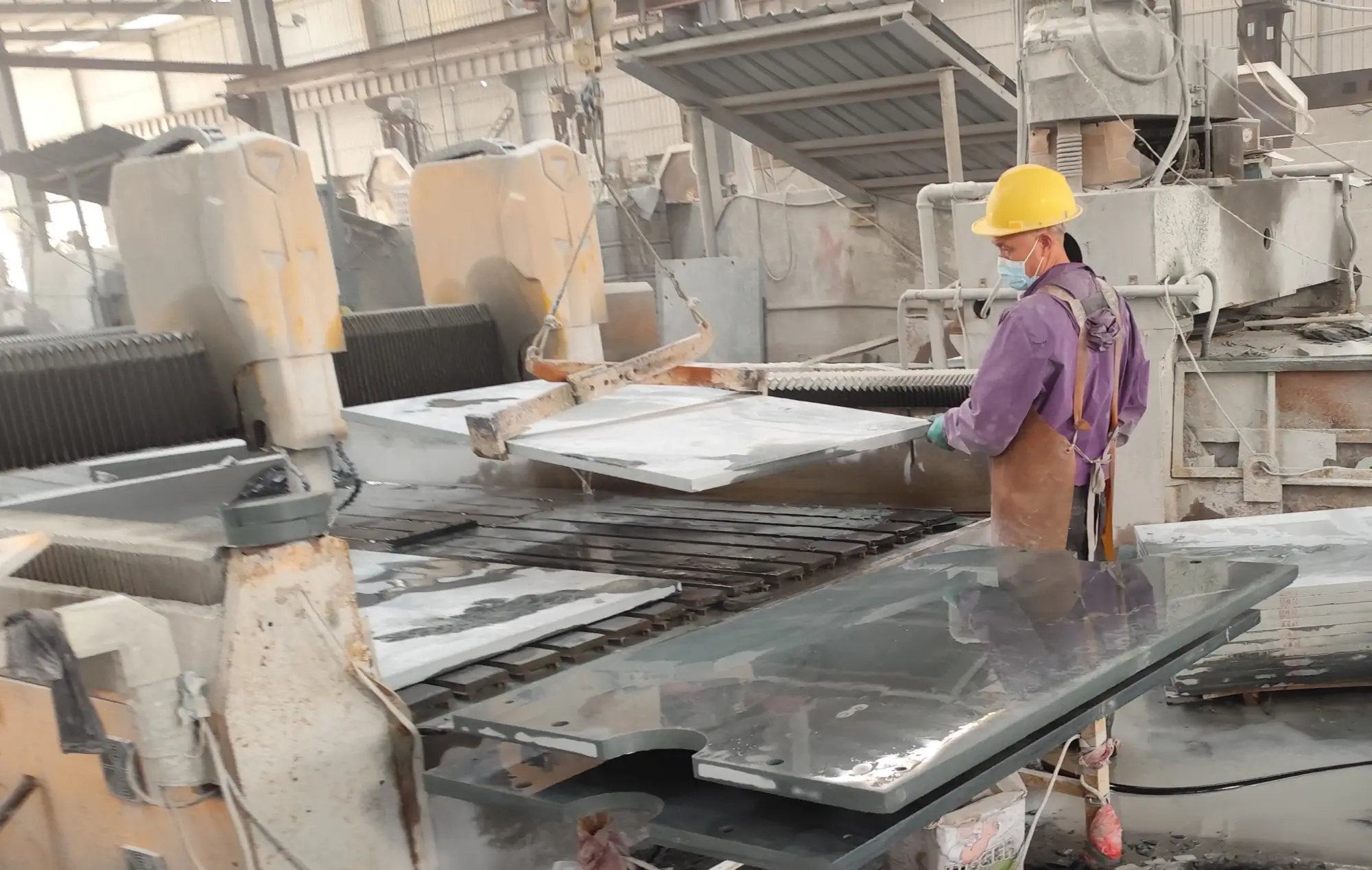
Every new product, every new size, starts in the programming office, not on the machine. The tool path is built in CAM software, run as a simulation, and only then loaded to the machine. The first panel is cut slowly as a trial, measured on the bench, and only when the trial matches the drawing does the batch run at production speed. This "first piece control" is not paperwork — it is the difference between a batch that fits your drawing and a batch that fits your drawing after two rounds of complaints.
The operator's job is not to push a button. It is to listen and watch. A change in the sound of the cut can mean a hard spot or a hidden feature in the stone. A change in the water colour can mean the diamonds are loading. The machine will run happily with a bad edge; the operator stops it, because he knows the edge is what the buyer's installer will see last. Our operators have years of slate experience before they sit at a console. Machine knowledge is taught; stone knowledge is not.
Machine 06: The Bench
The last machine in the room is the one that does not cut anything. It is the one that decides whether the other machines told the truth.
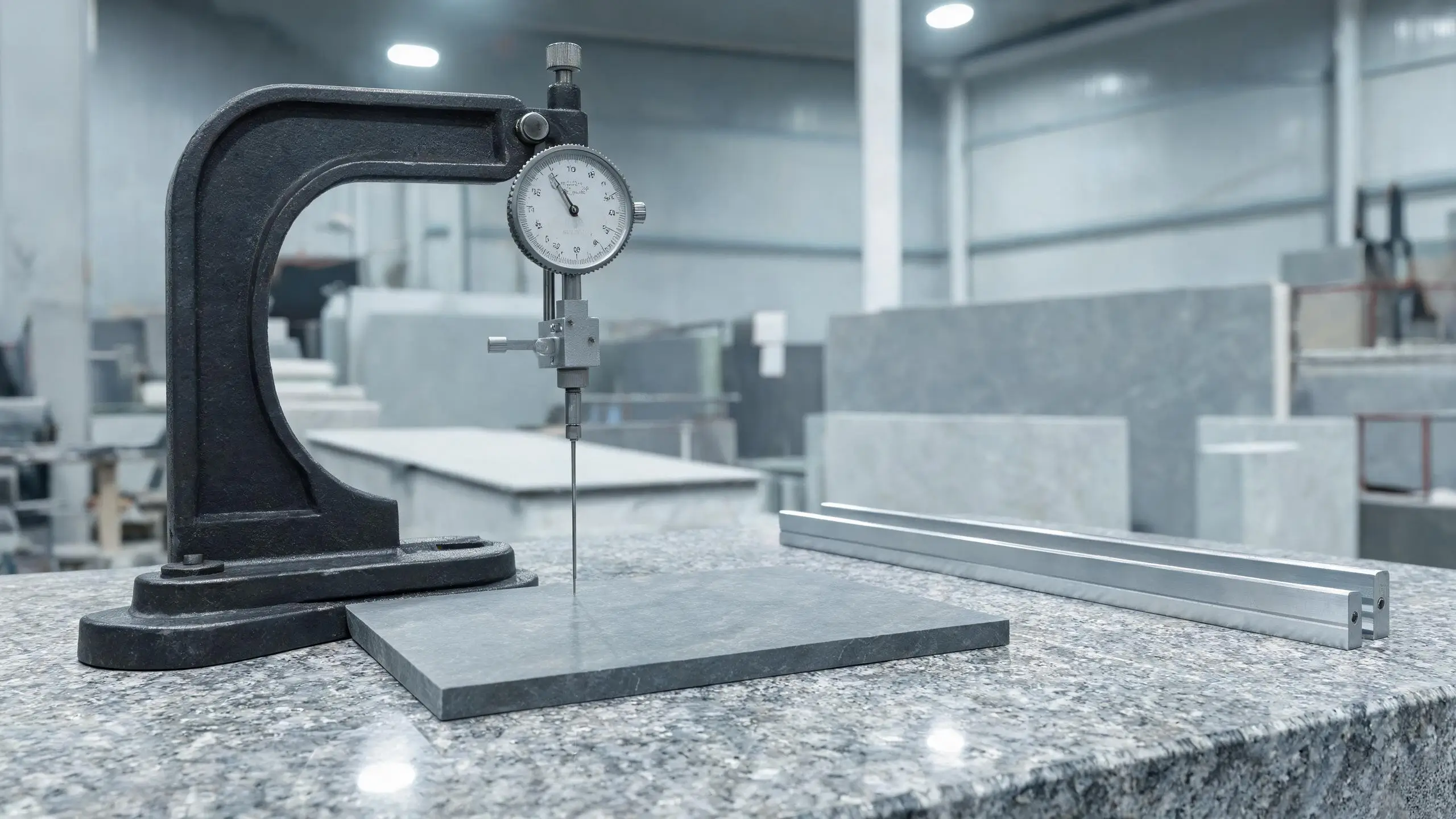
The measurement bench is a granite surface plate — a block of granite ground flat to a few microns, the same grade of flatness used in metrology laboratories. A dial indicator rides on the plate, its needle touching the panel face at the same set of points the probe used in the machine. The plate is not there to be read once; it is there to be the impartial judge between what we claim and what we ship.
Every panel that leaves the machine room carries a measured record: the flatness at each point, the dimensions at the corners and centre, the edge squareness, the joint gap if the panel belongs to a set. That record goes into the crate with the panel, and it is the same record a buyer can request before a payment is released. This is the part of CNC machining that a photograph cannot show you — the numbers that prove the machine kept its promise. It is also the story our 100% inspection will tell in full, panel by panel, piece by piece.
So when a buyer asks what machines we run, I do not list model numbers. I describe the floor: a gantry that will hold ±0.1 mm across a panel, a probe that checks its own work, an edge that closes to 0.05 mm, and a granite bench that will not let any of it slip. The machine list is on the shop floor, and it is auditable on the paper that ships in the crate.
Frequently Asked Questions
What exactly does a CNC machine do to a slate panel?
A CNC machine moves a cutting or grinding tool along a programmed path. In our case it does four jobs: it flattens the surface to the target tolerance, squares and straightens the edges, cuts shapes such as pockets and cutouts, and drills holes where the drawing requires them. The whole sequence runs under one programme, and a touch probe checks the result while the panel is still on the bed.
How do you actually hold ±0.1 mm through a full machine run?
Three layers of control. First, the machine itself is a rigid gantry, so its frame does not flex as the spindle works. Second, the touch probe measures the surface at 12 points and the controller runs corrective passes over any out-of-tolerance area. Third, every panel is re-measured on a granite bench with a dial indicator before it ships — a second, independent measurement that does not trust the machine's own readout.
Do you CNC the roofing slates too, or only the billiard panels?
Most roofing slates never touch the CNC — they are split by hand along the natural cleavage, which is what gives roofing slate its character, and punch and trim on simpler machines. The CNC comes in where precision is the point: larger fixed-size batches, exact square cuts, and unusual dimensions where hand splitting would be too variable. If your roofing spec calls for a non-standard size or a tight tolerance, we programme it; otherwise the hand line is the right and faster answer.
What is the largest size your CNC machines can handle?
The gantry working area is about 2.4 by 4.2 metres. That covers the biggest piece we produce, a 12-foot snooker panel which needs about 3.6 metres in length, with margin for the tool path and the hold-downs. If a project needs something beyond that, we can either split the part into jointed sections or discuss whether the drawing should be broken into machined pieces.
Can you machine custom shapes, pockets or cutouts from my drawing?
Yes. A custom shape is a change to the tool-path file, not a change to the machine. Send a DWG, DXF or PDF with dimensions, we write the programme, cut a first sample, and you approve the sample before the batch runs. This is the same route we take for the pockets and cutouts on table components, and it is how non-standard sizes are handled on the roofing side when they come up.
How does the machine precision translate to what arrives in my container?
In two ways. First, the numbers travel with the crate: every panel is numbered, measured, and the record is sealed into the packaging along with the inspection certificate. Second, precision is packed so it survives the journey — panels travel upright and separated, not stacked, so the flatness that was measured in the factory is the flatness that arrives. You can re-measure on arrival; most buyers do, and the record lets them match what they find to what we shipped.
Related Reading
The Machine Floor Is Open — Ask Us What It Can Do
Sourcing billiard panels or roofing slate to a tight tolerance? Send us your drawing, and we will tell you exactly which machine will run it and what tolerance it will hold. Start the conversation here.