
How Jiujiang Slate Is Made
Have you ever held a piece of slate and wondered how it got from a mountainside to your hands — flat, clean, and exactly the right thickness?
I get asked this more than any other question. Buyers see a finished roofing tile or a polished billiard bed and assume it was stamped out by a machine. It wasn't. The process is part geology, part craft, and part precision engineering — and it hasn't changed in its essentials for centuries, even as the tools have.
This article walks through the full journey, from quarry face to packed crate, for both products we make from Jiujiang slate: roofing tiles and billiard table beds. They share the first three steps and diverge at step four. I'll show you where, and why.
| Step | What Happens | Why It Matters | Roofing vs Billiard |
|---|---|---|---|
| 1 | Quarry the block | Wire saw cuts a clean rectangular block from the rock face | Shared — same quarry, same rock |
| 2 | Read and select | Experienced eye decides which block goes to which product | Best blocks → billiard; standard → roofing |
| 3 | Split by hand | Block becomes thin slabs along the natural cleavage plane | Shared — then paths diverge |
| 4 | Two paths | Roofing: cut, dress, size. Billiard: grind, CNC, finish | Products diverge here |
| 5 | 100% inspection | Every piece checked — not a sample batch | Different criteria, same principle |
| 6 | Pack and load | Crated, sealed, container loaded at our factory gate | Roofing: wooden crates. Billiard: custom frames |
Before We Start: What Makes This Rock Workable
Not every rock can be split into thin, flat sheets. Jiujiang slate can because it's a metamorphic rock — shale that was compressed and recrystallised under pressure deep in the earth hundreds of millions of years ago. That process created a tight, fine-grained stone with a natural cleavage plane: a direction along which it splits cleanly, like the pages of a book.
The density is 2.7–2.8 g/cm³ — heavier than it looks, and the reason it resists water, holds a machined edge, and stays flat under load. You can read the full geological story in The Geology of Jiujiang Slate. For now, just know: the rock's structure is the reason the rest of the process works.
Our factory sits in Lushan City — formerly Xingzi County, which became a city in 2016 and took its name from the famous mountain that looms over the slate belt. The quarries are in the hills around us. The port of Jiujiang is a 40-minute drive away on the Yangtze River. That proximity — quarry to factory to port — is something I'll come back to at the end.
Step 1 — Extracting the Block
Everything starts at the quarry face. The exposed rock shows layers — some thick, some thin, some dark, some with a greenish tint. A geologist would call them strata. We call them the menu.
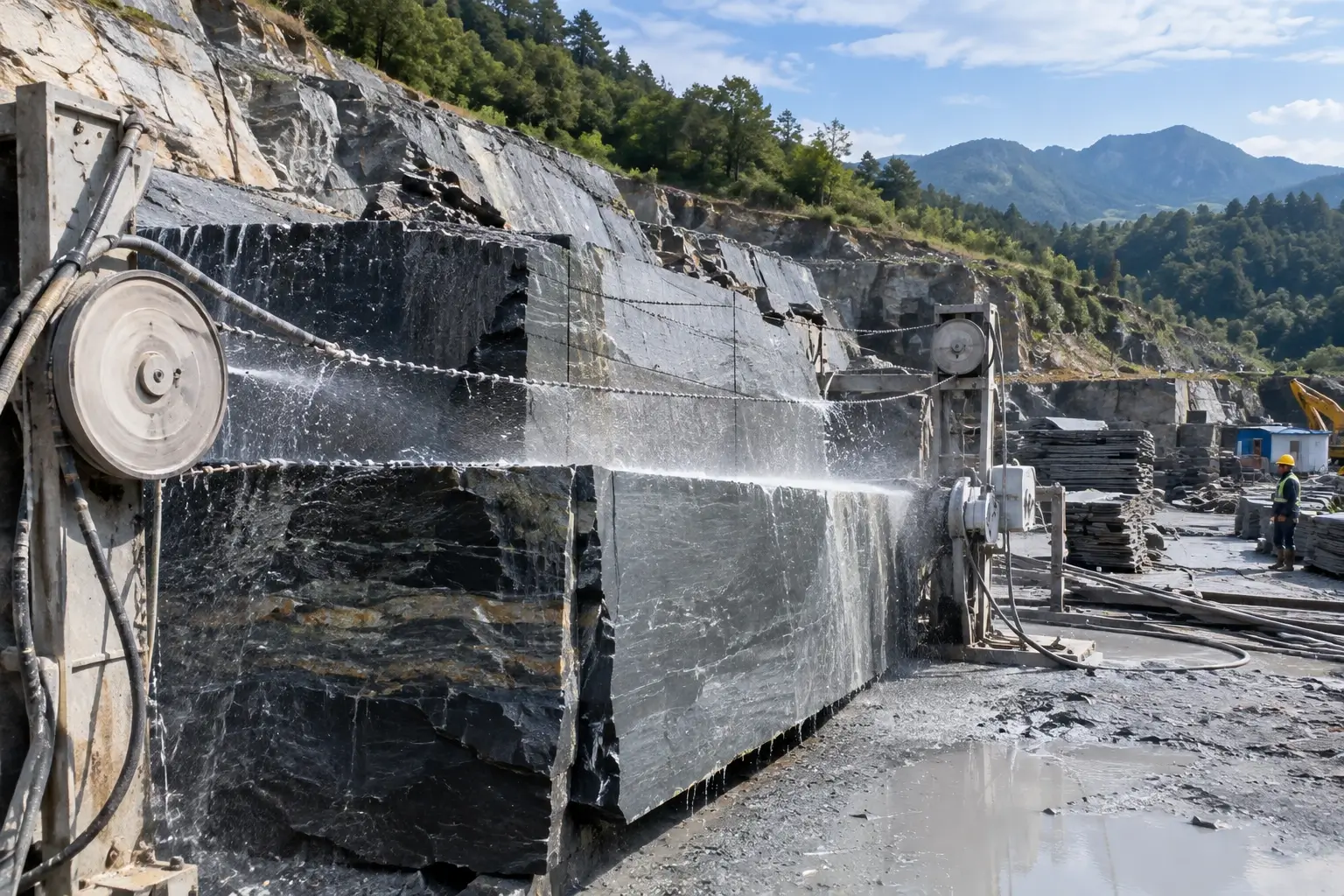
The first cut is made with a wire saw — a steel cable strung with diamond segments that runs in a loop, biting through the stone as water keeps it cool. The saw doesn't cut the slate to its final thickness; it cuts a large rectangular block free from the mountain. A single block might be two metres long, one metre wide, and half a metre deep — weighing several tonnes.
Why a wire saw and not explosives? Explosives shatter. Slate is only valuable if it comes out in coherent pieces. The wire saw produces a clean face, minimal micro-cracking, and a block that still has its internal structure intact. That structure is everything — it's what lets us split the block later.
Step 2 — Reading the Grain and Selecting
This is the step that most factories won't talk about, because it's where experience — not machinery — decides everything.
When a block comes off the quarry face, someone has to look at it and decide: is this a billiard block or a roofing block?
The answer isn't about quality in the sense of "good" versus "bad." It's about characteristics. A block destined for a billiard table needs to be:
- Uniform in colour — no streaks, no mineral veins that could show through the felt
- Exceptionally fine-grained — any coarse mineral inclusions would create weak points
- Free of pyrite clusters — those golden flecks that look beautiful in a roofing tile would raise a bump on a table bed
- Large enough — a one-piece billiard bed for a full-size table needs a single slab, not a glue-up
Roofing tiles are more forgiving. Colour variation is expected — buyers often want the natural range. Pyrite flecks are a feature, not a defect. Smaller blocks are fine, because tiles are small.
So the best blocks — maybe 20% of what comes out of the quarry — go to the billiard line. The rest go to roofing. That ratio, roughly 80% roofing and 20% billiard, is also the split of our total output by volume.
I should be honest: there's no instrument that makes this selection. It's a pair of eyes that has looked at thousands of blocks. You learn it by standing at the quarry face year after year. When I talk about "craft" in slate production, this is what I mean — not just the splitting, but the judgement that happens before a chisel ever touches the stone.
Step 3 — Splitting: Where the Skill Lives
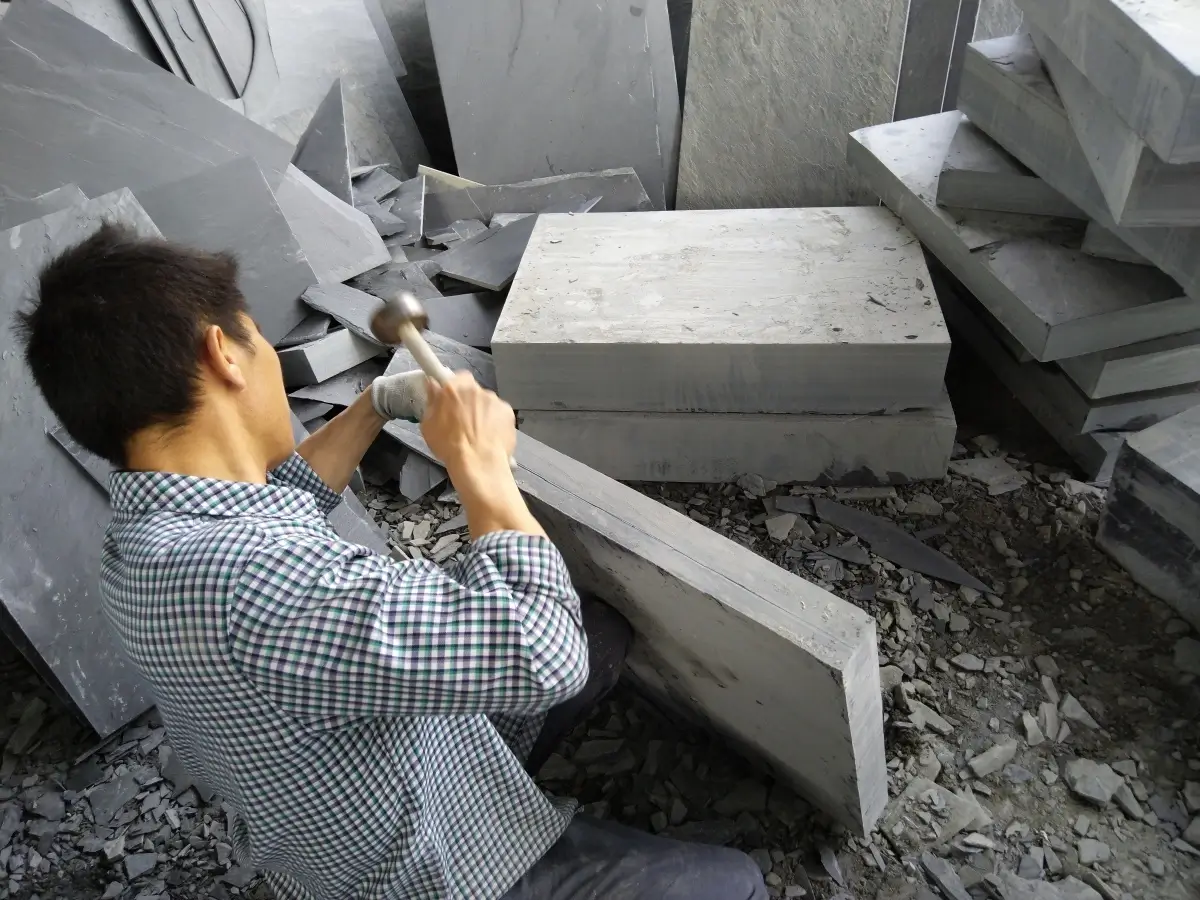
A block sits on the splitting bench. The splitter picks up a wide chisel and a wooden mallet. He taps along a line — not hard, just enough to find the plane. Then he drives the chisel in, and the block opens.
If you've never seen it, it's a remarkable moment. A two-tonne block of stone separates along a plane so clean it looks like it was cut with a blade. The two halves are mirror images — flat, dark, slightly damp from the moisture trapped inside the rock. The surface has a subtle texture that no machine can reproduce: what the trade calls a natural cleft.
For roofing tiles, the splitter repeats this process, halving and halving again until the block becomes tiles of the right thickness — typically 5–8 mm. Each tap is judged by feel. Too hard and the tile cracks. Too soft and the split stalls. A skilled splitter produces tiles with thickness variation under a millimetre, by hand, all day.
For billiard slate, the block isn't split into thin tiles. It's cut into thick slabs — 30 mm or more — using a diamond-blade saw. The slab needs to be a solid, uniform piece with no internal stress. It'll be ground flat later, but the slab itself has to come out of the block clean.
Why not machine-split? Because the cleavage plane isn't perfectly geometric. It follows the mineral structure, which means it can waver, curve, or branch. A machine can't read that. A human splitter can feel it through the chisel. I've seen automated splitters produce tiles that are technically the right thickness but have a "dead" surface — no life, no texture. The hand-split tile has character. And for roofing, that natural cleft surface is what gives the tile its slip resistance and its weathering behaviour.
This is the step that has not changed in its essentials for centuries. The tools are better — the chisels are steel, the benches are stable, the lighting is good — but the skill is the same. When I talk to buyers who want to understand what makes Jiujiang slate different, I bring them here first.
Step 4 — Two Paths Diverge
Up to this point, roofing and billiard slate have shared the same journey: quarry, select, split. Now the paths separate. The same rock, with the same geology, becomes two very different products through two very different processes.
| Stage | Roofing Path | Billiard Path |
|---|---|---|
| Starting material | Hand-split tile, 5–8 mm | Saw-cut slab, 30+ mm |
| Surface | Natural cleft (left as-is) | Ground flat by machine |
| Sizing | Cut to length × width (500×250, 600×300, etc.) | Cut to table spec (e.g. 9ft, 12ft) |
| Precision | ±1–2 mm on dimensions | ±0.1 mm flatness (CNC; ±0.05 mm precision ground) |
| Edge finish | Dressed or sawn edges | Precision-ground, bevelled |
| Jointing | N/A (individual tiles) | 3-piece or 1-piece, dowel-aligned |
The Roofing Path — Cutting, Dressing, Sizing
A split tile comes off the bench at a rough size. It needs to be cut to its final dimensions — say, 500 × 250 mm or 600 × 300 mm — with square corners and a consistent thickness. The cutting is done with a diamond-blade saw, one tile at a time. The edges are dressed — either left with the natural split edge or sawn smooth, depending on what the customer wants.
The tiles are then sorted by thickness, colour, and texture. A typical order might specify 7–9 mm thickness, grey-black colour, and natural cleft surface. The sort ensures that tiles in the same crate look like they came from the same quarry — because they did.
You can read more about the roofing-specific process in How Is Roofing Slate Made? and in our Roofing Slate Guide. The key point here is that the roofing path is about consistency within a natural product — every tile is a little different, but the batch has to look coherent on a roof.
The Billiard Path — Grinding, CNC, Finishing
The billiard path is where stone meets engineering. A saw-cut slab enters the grinding station, where large surface grinders take it from "roughly flat" to "precisely flat." Then it moves to the CNC machine.
CNC — Computer Numerical Control — means the grinding path is programmed, not guided by hand. The machine head moves across the slate surface in a precise pattern, removing material in increments as small as a few hundredths of a millimetre. The target: ±0.1 mm flatness across the entire surface — and for high-end precision-ground billiard beds, we take it down to ±0.05 mm.
Why ±0.1 mm? Because a billiard ball rolls true only if the surface under the cloth is dead flat. A variation of half a millimetre would be invisible to the eye but would deflect a rolling ball enough to miss a pot. For tournament-grade tables, precision grinding brings the flatness down to ±0.05 mm — five hundredths of a millimetre, checked across the full surface, not just at a single point. The tolerance is not marketing — it's physics.
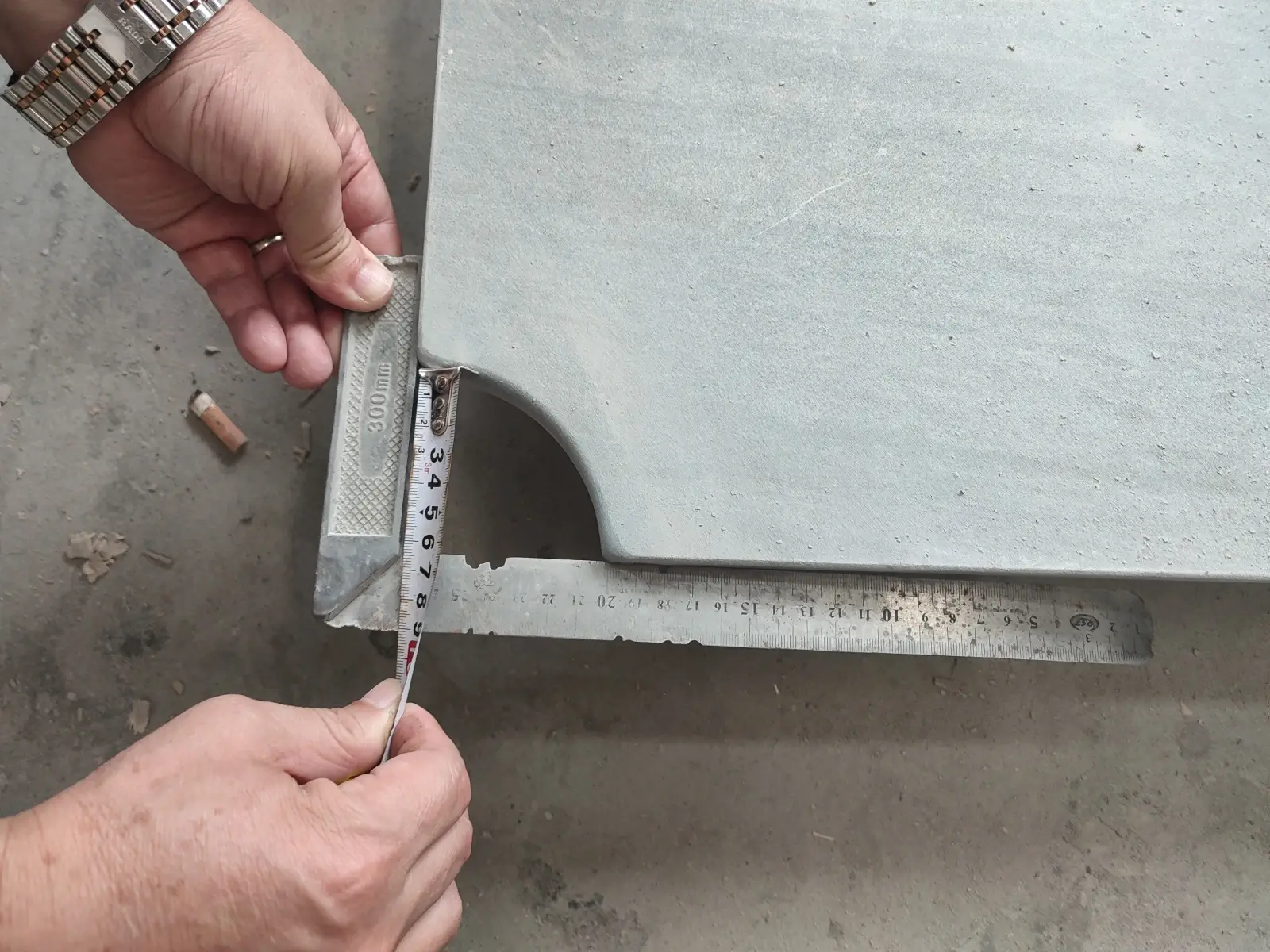
A word on these numbers. ±0.1 mm is our standard — every panel, across the full surface, individually checked. For high-end precision-ground billiard beds, we hold ±0.05 mm. These are not single-point measurements; they are full-surface tolerances, verified with a straight edge and feeler gauge on every piece that leaves the line. Some suppliers quote tighter figures but verify only at a single point. We check the whole surface, because a tight number at one spot doesn't help if the panel varies elsewhere.
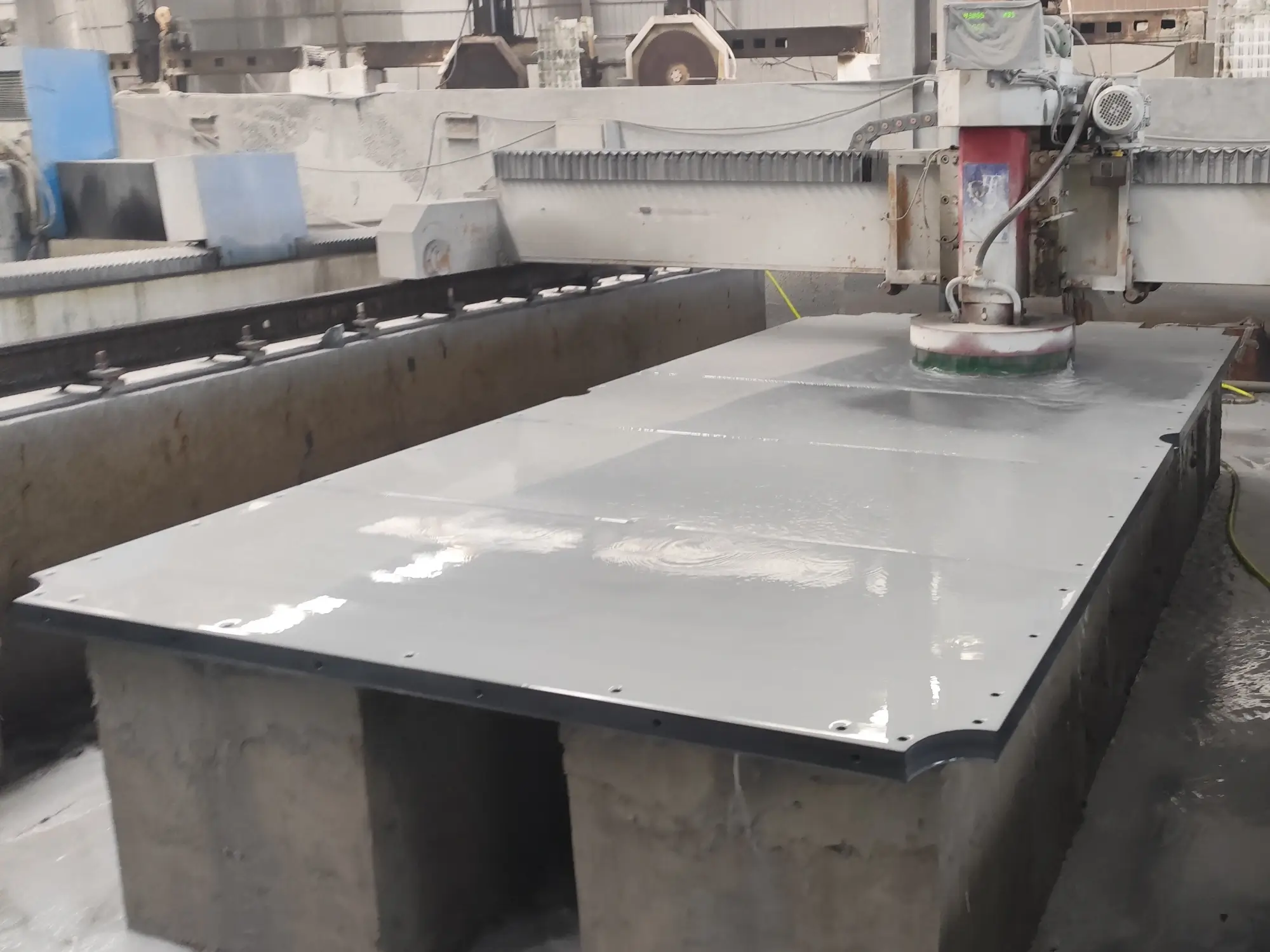
After CNC, the panel is edge-finished — the sides are ground and bevelled, the playing surface is fine-polished, and if it's a 3-piece bed, the mating edges are machined for dowel alignment. The joints need to be invisible under the cloth, which means the mating surfaces have to be flat to the same ±0.1 mm standard (or ±0.05 mm on precision-ground beds).
You can read more about the billiard-specific journey in From Quarry to Billiard Slate: The Panel Journey and in our Billiard Slate Guide.
Step 5 — Inspection: 100%, Every Piece
This is the step that I believe separates a serious slate supplier from the rest. We check every single piece — not a sample, not a batch, not "every tenth tile." Every tile. Every panel.
For roofing tiles, the inspection covers:
- Dimensions — length and width within tolerance
- Thickness — checked with a calliper at multiple points
- Flatness — a straight edge across the face, no light gap
- Surface — no cracks, no loose mineral inclusions, no delamination
- Edges — clean, no chips beyond the allowable limit
For billiard panels, the inspection is stricter:
- Flatness — measured with a straight edge and feeler gauge across the full surface; the ±0.1 mm tolerance (or ±0.05 mm for precision-ground beds) is checked, not assumed
- Thickness — uniform across the panel, measured at the corners and centre
- Surface quality — no pits, no scratches, no mineral veins that could telegraph through the cloth
- Joints — for 3-piece beds, the mating edges are checked for gap and alignment
Anything that fails goes back for rework or is rejected. We don't ship "second quality" to a customer who ordered first quality. The rejected pieces are set aside — some can be recut to a smaller size, some go to the crafts line, some become rubble for the quarry road.
I know other factories that inspect a sample — 5% or 10% — and extrapolate. That saves time and money. It also lets bad pieces through. When a buyer in Norway or the UK opens a crate and finds a cracked tile, they don't care about statistics. They care about that tile. So we check every piece. It costs more. It's the reason our customers come back.
Step 6 — Packing and Loading
The last step is the one most buyers never see, and it's where a lot of damage happens in the supply chain. Not in our factory — in transit. Which is why we control it.
Roofing tiles are packed in wooden crates — not pallets, crates. The tiles are stacked flat, separated by foam sheets, and the crate is sealed and strapped. A standard crate for 6–8 mm tiles holds about 60 square metres. A 20-foot container holds 20 to 38 crates depending on thickness.
Billiard panels are packed in custom wooden frames — each panel is cushioned and immobilised so it cannot shift inside the crate. A billiard bed is a high-value, heavy, fragile product. It has to survive trucking, ocean freight, and handling at the destination port without absorbing any impact.
Here's the part I'm proudest of: we load the container at our factory. An empty container is trucked from the port of Jiujiang to our gate — a 40-minute drive. We load it ourselves. Then it goes back to the port, and from there it ships down the Yangtze to Shanghai or Ningbo for the ocean leg.
Why does this matter? Because the last hands that touch your slate before it crosses the ocean should be the hands that made it. When a third-party warehouse loads the container, you lose control of how the crates are stacked, whether the heavy crates go on the bottom, whether the container floor is clean and dry. We don't use a third-party warehouse. The container comes to us empty, we fill it, and it leaves full. The crates are stacked to our standard, the load is secured to our standard, and we can photograph or video the loading for the buyer if they ask.
That 40-minute drive from the port — and the fact that we load ourselves — is a logistical detail. But it's the logistical detail that means your slate arrives the way it left the inspection bench.
Where to Go Next
This article is the overview — the shared journey from rock to finished product. Each step has its own detailed article if you want to go deeper:
- For the quarry side: How Jiujiang Slate Is Quarried covers wire saws, block extraction, and quarry-face selection in detail
- For the splitting skill: The Art of Splitting Slate by Hand goes deep into the craft that no machine has replaced
- For the roofing path: From Quarry to Roofing Slate: The Tile Journey follows a tile from split to packed crate
- For the billiard path: From Quarry to Billiard Slate: The Panel Journey follows a panel from slab to championship table
- For CNC: CNC Machining in Our Jiujiang Factory covers the machines, the tolerances, and the programming
- For inspection: 100% Inspection: How We Check Every Piece documents the full inspection protocol
If you're new to Jiujiang slate and haven't read the basics, start with What Is Jiujiang Slate? and Why Jiujiang Slate Is Famous Worldwide. If you want to see the test data behind the stone, our EN 12326 / ASTM C406 test results are public.
Frequently Asked Questions
Can the whole process be automated?
Parts of it can — and are. Wire saw cutting, diamond-blade sizing, and CNC grinding are all machine operations. But the two most critical steps — selecting which block goes to which product, and splitting the block along its natural cleavage plane — are done by hand. No instrument can replace the experienced eye that reads a block's grain, and no machine can feel the cleavage plane through a chisel. We've looked. The technology isn't there yet, and I'm not sure it ever will be — because every block is different.
How long does it take from quarry to packed crate?
For roofing tiles, a block can go from quarry face to packed crate in a matter of days — the splitting and cutting are fast once the block is selected. For billiard panels, the process is longer because CNC grinding is done in multiple passes with cooling time between them. A billiard panel might take a week from slab to finished, inspected, and packed. Neither timeline includes the time the block spends at the quarry face before it's cut — that depends on the quarry schedule and weather.
Why do you use wooden crates instead of pallets for roofing slate?
Crates offer full enclosure — the tiles are protected on all six sides, not just stacked on a platform. A pallet leaves the top and sides exposed, which means rain, dust, and handling impacts can reach the tiles during transit. For ocean freight, a crate is the minimum standard. We've shipped to over 30 countries, and the one constant in every shipment that arrives intact is a solid wooden crate.
What happens to the slate that fails inspection?
Tiles with minor dimensional issues can be recut to a smaller size and re-inspected. Tiles with surface defects that don't affect structural integrity might go to our crafts line — coasters, placemats, signs. Panels that fail the flatness check are re-ground if the defect is correctable, or rejected if it's not. Rejected stone isn't wasted — it goes to quarry road surfacing and other bulk uses. Nothing leaves the factory as "first quality" unless it passed every check.
What flatness tolerance do you achieve on billiard beds?
Our standard CNC grinding holds ±0.1 mm flatness across the entire surface of every panel, individually checked. For high-end precision-ground billiard beds — tournament-grade tables — we take it down to ±0.05 mm. These are full-surface tolerances, not single-point measurements. We verify with a straight edge and feeler gauge on every piece, not a sample. A tighter figure measured at one spot doesn't help if the panel varies elsewhere — so we check the whole surface, every time.
Can I visit the factory and see the process?
Yes. We host overseas buyers regularly — over the years, many of our customers have visited to see the quarry, the splitting, the CNC machining, and the inspection process for themselves. The nearest major airport is Nanchang, about a 40-minute drive from our factory in Lushan City. If you're considering an order and want to see the process before you commit, get in touch and we'll arrange it.
Related Reading
Want to see the process for yourself?
We host buyers at our factory in Lushan City — 40 minutes from Nanchang airport. See the quarry, the splitting, the CNC, the inspection. Then decide.