
Jiujiang Slate Supply Chain: Where the Money Goes in Five Layers
On most of the quotations that cross my desk, the cheapest single line is the rock. Not on every order — the balance shifts with the product, the specification and the term quoted — but often enough to be worth saying plainly. I build these quotation pages for a living, between the workshops and the loading yard, and by the time a price reaches a buyer's inbox, the quarry bench is usually a minority share of the number.
That surprises people, because slate looks like a game of geology — you either have the mountain or you don't. The mountain matters. But between that bench and a sealed container sit four more sets of hands: the sorting that decides what survives, the machines that turn rock into a product, the translation that turns a drawing into a shipment, and the voyage that gets a container's worth of dense stone across the water. Every one of them spends real money. Every one of them can spend it well or badly — which is why two honest suppliers can quote the same stone differently.
This guide describes the Jiujiang slate industry as a chain of trades; the hub page sums up this one as quarries → factories → export traders — how the chain works and where the margin goes. That sentence is the assignment. Some context first: the same rock leaves this region for two very different industries — thin, split roofing slate on one side, massive machined billiard beds on the other — one rock, one shared chain, and every layer below invoices both of them in the same currency.
The chain behind how you source slate from China is five layers deep. Here is the cross-section, and then each layer in turn.
Quick Answer — the five layers inside a slate export price:
| Layer | What it holds | The question it answers |
|---|---|---|
| 01 · The bench | Block extraction, deposit quality, block selection at the quarry | Was the raw material chosen — or just inherited? |
| 02 · The yield | Splitting, sorting, and the pieces that never survive processing | What does one usable square metre actually cost? |
| 03 · The machines | Cutting, grinding, CNC machining, inspection benches | What processing standard are you buying? |
| 04 · The translation | Specifications, quality checks, documents, export coordination | Who turns your drawing into a shipment? |
| 05 · The voyage | Packing, loading, inland haulage and ocean freight | What does moving the stone to your port truly cost? |
Quarry, factory, exporter — the chain you may have read about is these five layers wearing three hats. The sections below take them in order, show where the money settles in each, and end with what all of it means for the quotation sitting in your inbox.
Layer 1 — The Bench: Where the First Dollar Goes
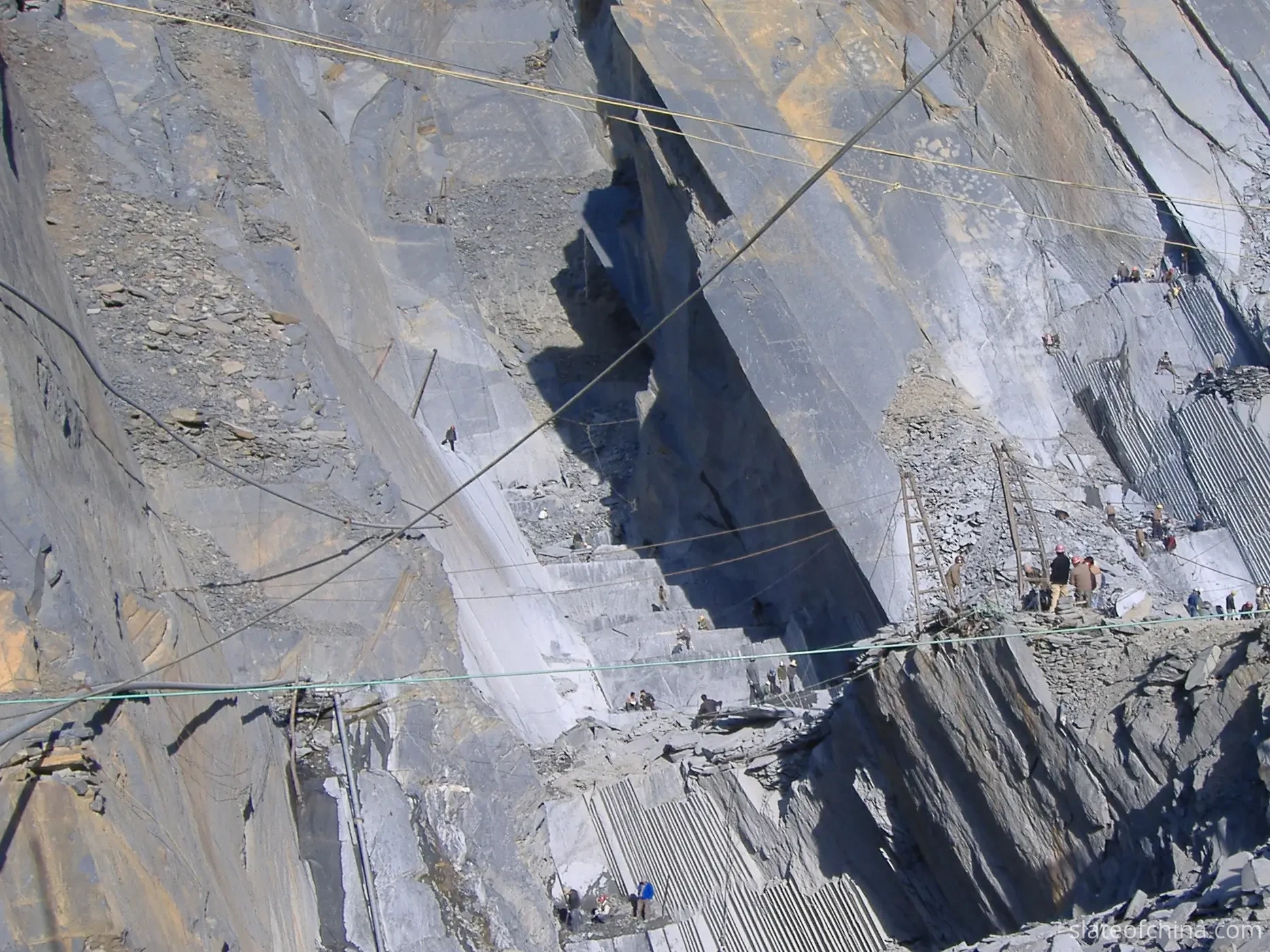
A slate quotation starts on a working face like the one in the photograph: level beds of blue-grey rock, some thicker than some, and a quarry master who reads them long before a wire saw moves. What the face promises decides everything downstream. Six properties set which fate a block can serve — how it splits, how evenly it beds, how flat it lies, what it looks like, how sound it stays, and how much of it survives the saw. Roofing wants a stone that cleaves into thin, weather-proof tiles; a billiard bed wants rock massive and flat enough to grind true. Very few deposits do both well, and the selection happens at the bench, not in the sales office.
So the first dollar of your price buys an answer to those six questions — and this is where the first illusion of the trade lives. A cheap quarry price is a lottery ticket unless you know the recovery rate: rough slate that sorts badly simply moves its cost onto every layer below it. A quarry charging less for blocks that yield poorly can be the most expensive quarry in the region per usable square metre of finished product. The only bench price that matters is the one expressed in finished tile, never in rock.
Geology explains why the chain exists at all — a dense blue-grey slate, 2.7–2.8 g/cm³ in our published test data, splitting clean and holding a roof for generations. But the geology is a minority shareholder. Everything that follows is labour.
Layer 2 — The Yield: The Cost of What Doesn't Survive
The second layer is the quietest one, and often the biggest variable. Between a raw block and a finished tile stand splitting, cutting, trimming and sorting — and at every one of those steps, stone quietly leaves the order. Slates that split crooked. Edges that crumble. Thickness outside the band. Pieces that fail the bench. Someone paid for that stone: it rode a truck, occupied a saw, earned a wage. When it lands on the discard pile, the cost does not vanish — it re-attaches to the pieces that survived. The hand craft behind the split is not sentiment; it is yield, and yield is money.
An honest example with round numbers. A batch enters processing as 100 square metres of rough material; sorting releases 75 that meet the specification. The quarry's price did not get cheaper — it is now spread over 75 metres, not 100. Simplified figures, not an industry-wide benchmark: real recovery moves with the raw material, the format, the processing method and the acceptance criteria. But the direction of the arithmetic never changes. That is the whole difference between the price of stone and the cost of slate.
Which is why two manufacturers working the same stone can quote differently and both be telling the truth. The one selecting better blocks, splitting to a steadier band and throwing away less pays more at the quarry — and still quotes less, because its maths runs on a different divisor. When you compare a Jiujiang slate manufacturer against another, you are comparing yield before you are comparing price, even if neither quotation sheet uses the word.
Layer 3 — The Machines: What Processing Adds — and What It Protects
The third layer is where product identity gets machined in. Roofing orders travel the tile journey: split to a thickness band, cut to format, edge-dressed, tone-sorted, stacked. Billiard orders travel the panel journey: cut oversized, ground, CNC-machined — our machined beds are inspected to a flatness of ±0.1 mm, a working bench figure whose measurement basis and limits the flatness page of this guide sets out in full — matched into sets, drilled to drawing, inspected piece by piece. Same rock; two different machine parks, two different kinds of expertise.
Capability is priced, honestly. Machine hours, tooling, calibration and the people who know how close to the limit each cut can run are as real as the timber in a crate. A shop tooled for thin roofing stone runs many pieces fast; a shop tooled for billiard beds runs few pieces slow and exact. Each is badly priced for the other's work — which is why the right manufacturer is the one whose production line matches your specification, not the one with the most impressive gate or the widest catalogue.
Inspection belongs to this layer too. Every piece we ship crosses a bench before it crosses the yard — thickness, dimensions, flatness, surface, then batch-matching for orders that need it. A quotation with no inspection inside it has not skipped a cost; it has merely postponed invoicing it, at a worse rate, somewhere after arrival.
Layer 4 — The Translation: What the Desk Does with Your Drawing
The fourth layer is the least photogenic and the least understood. Overseas orders arrive as drawings, standard references and deadlines; quarries and workshops speak in blocks, beds and shifts. Between the two languages sits a desk — sometimes inside a factory, sometimes a trading company, sometimes both at once — which is the service layer natural slate export suppliers actually sell. Its working day is invisible in the product and decisive in the experience: translating your specification into a production order, choosing which workshop suits the product, holding the schedule, checking quality before shipment, arranging packing and loading, assembling the export document pack, coordinating freight, and standing in front of whatever goes wrong. That is what an export desk sells.
Whether the label says manufacturer or trader matters far less than whether this layer earns its price — the comparison and the route decision each have a page of their own, and the questions to ask a third. From the money side, the test I run is short: a desk that prevents one specification error, one wrong batch or one missed vessel has paid for itself several times over; a desk that forwards PDFs has added a layer of cost without adding a layer of value. That is also the honest answer to the oldest suspicion in this trade: a margin in the middle of a chain is not a toll by definition — it is the price of work done and risk carried, and the only question worth asking of any desk is whether the work and the risk are the ones your order actually needs. Ask a supplier what happens when something goes wrong. The answer is either the layer's price justification or its indictment.
The paperwork half of the translation — invoice, packing list, bill of lading, the rest — is unpacked file by file on the export-desk page; the trade vocabulary sits in the glossary's fourth drawer. From here on, the money moves.
Layer 5 — The Voyage: Packing, Loading and the Water
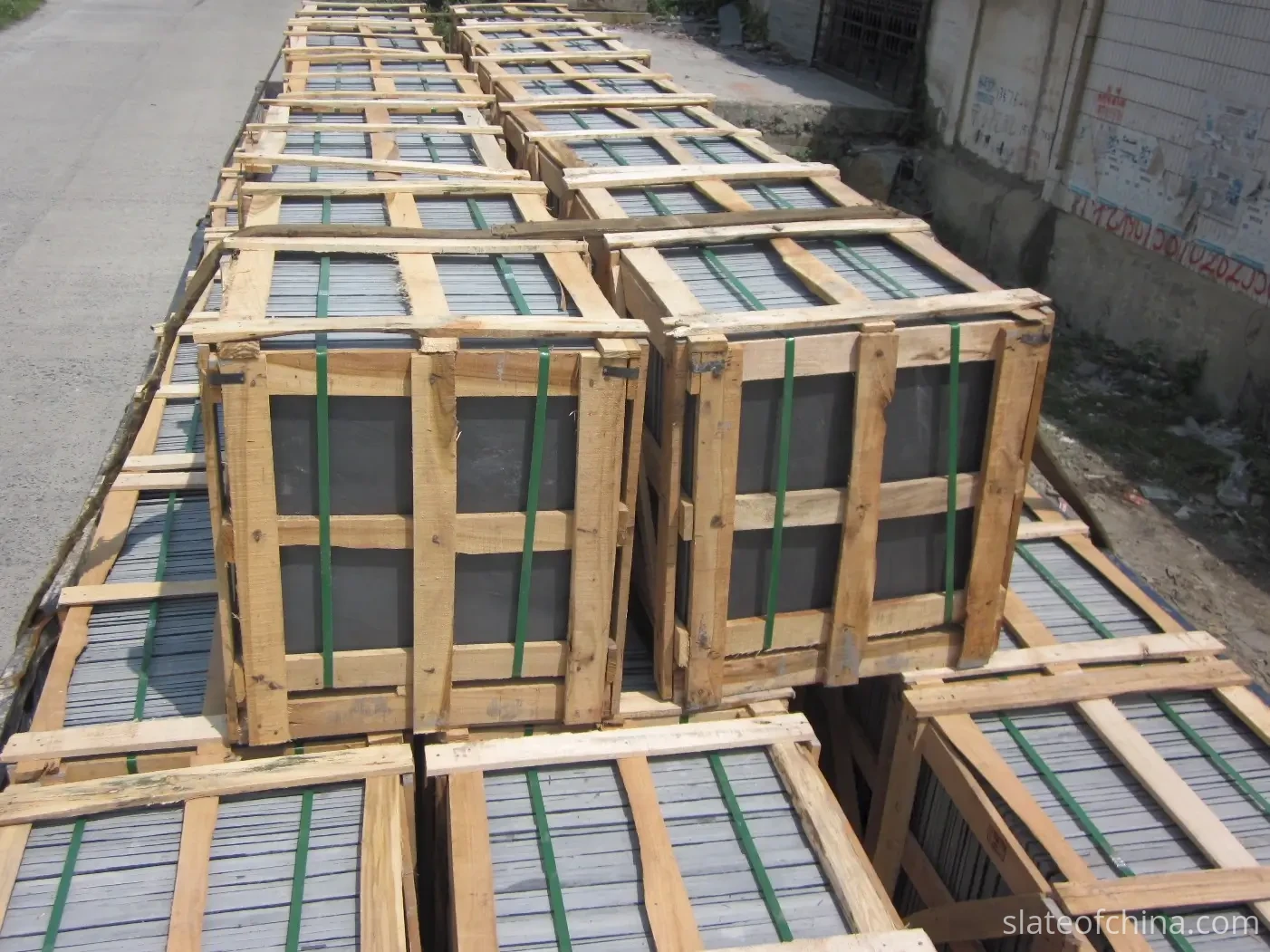
The fifth layer begins where the product is finished, because stone is only finished once it has survived transport. Packing is engineered cost: timber, separators, strapping, corner protection, crates built for the product and the mode — roofing slate leaving this region normally travels in wooden crates, and a billiard bed's matched pieces travel together, as the packing page shows in detail. Cheap packing is the most expensive savings in the industry; the sea collects.
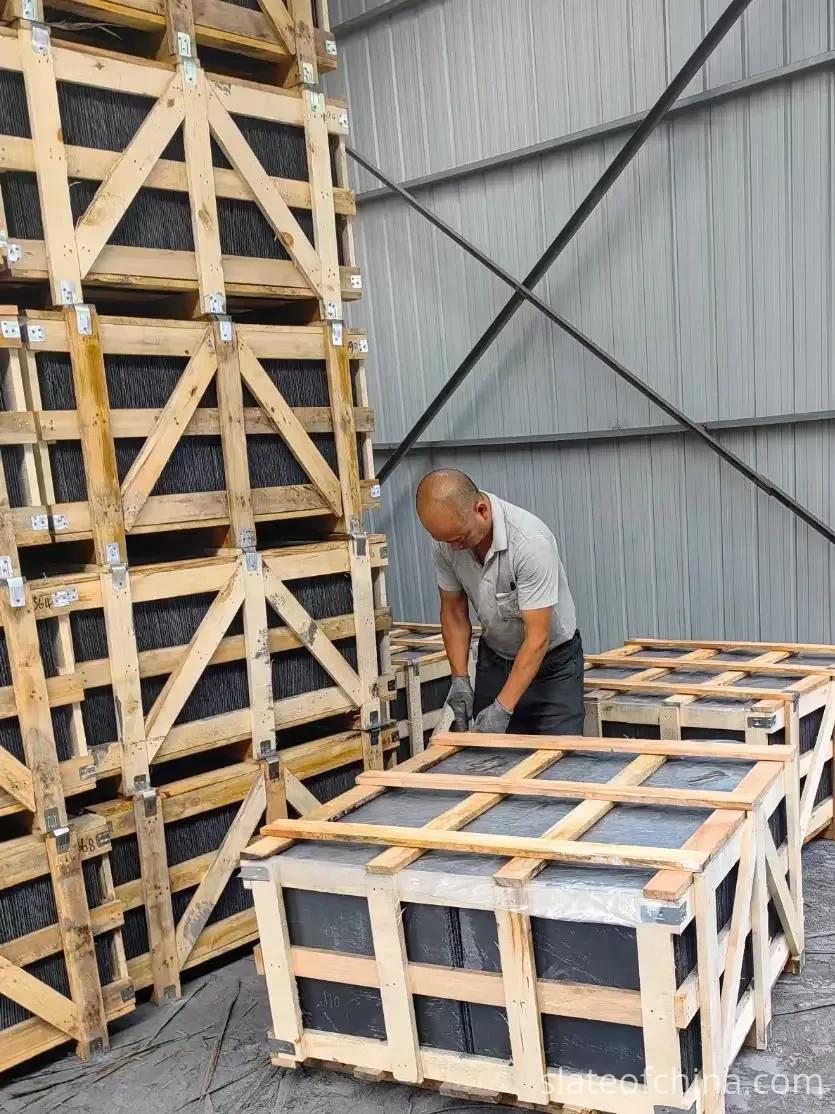
Then loading, and a detail of our own accounting: the container comes to us empty. It is backed into our yard, loaded at our bay, and returns to the Yangtze river port the same day — some forty minutes down the road — with no third-party warehouse and no double handling between the inspection bench and the seal. From the port the economics change register: river, ocean, an Incoterm deciding exactly where your supplier's price and your risk draw their line. The full arithmetic of freight and landed cost has its own page in this guide; for this page, one rule is enough: before comparing any two quotations, make both quote the same thing — one term, one named port, one currency.
The Price After the Port: One More Layer, and It Is Yours
The chain does not end at your port; it changes owner. Importer, distributor, roofing contractor, table manufacturer, retailer — each adds a function to the stone: clearance and duties, stockholding, regional delivery, sales effort, warranty, risk. A tile that leaves Jiujiang at one price sits on a roof at a multiple of it — and that distance is mostly real cost, though where cost ends and margin begins varies with every market and every operator. It is a second economy built around the stone.
Two readings of that, both practical. Judged mid-chain, your supplier's margin is not the distance between the export price and your local retail price — that distance is the destination market's business, not your supplier's. And flattery runs the other way too: whatever your market adds on top, the export price still has to honestly contain the five layers above. The mistake to avoid is pricing at one end of the chain and scrutinising the other.
Reading the Quote in Your Inbox
Which brings the page back to the desk where it started. A quotation lands in your inbox as a number, a format and a term — a slate factory price seen through whichever Incoterm it was dressed in. The layers are invisible unless you ask for them. This is the build order I type, row by row:
| Row in the price | What it pays for |
|---|---|
| Raw material | Block extraction and selection at the quarry |
| Processing | Splitting, cutting, grinding, machining |
| Recovered material | The share of stone that never ships — breakage and rejects |
| Sorting and inspection | Thickness gauging, tone sorting, flatness benches, batch matching |
| Packing | Timber, separators, strapping, crate build, marks |
| Logistics | Yard to port, river feeder, ocean — per the Incoterm quoted |
| Export operations | Documents, coordination, pre-shipment checks |
| Overheads and margin | The floor under all of the above, and the reward for carrying it |
There is no fixed recipe of percentages, and anyone who offers you one — the quarry takes a third, the factory a third, the exporter the rest — is describing an industry that does not exist. Products differ, seasons differ, orders differ. What the table is for is spotting which row a supplier's price quietly skipped.
What Each Link Carries — and Why It Earns a Return
Cost rows are half the ledger. The other half is exposure: each link in the chain prices the risk it absorbs on your behalf, and this is what a fair margin in the middle of a slate deal is actually buying.
| The link | What it carries | What the return buys you |
|---|---|---|
| The quarry (Layer 1) | Extraction, block selection, and the supply risk of a natural deposit — faces that play out, beds that run better or worse than promised | Raw material that was chosen, not inherited |
| The processing yard (Layer 2) | Labour, equipment and the full weight of the yield — every broken metre lands on its account, not yours | An honest cost per usable square metre, and a thickness band that means something |
| The specialist factory (Layer 3) | Precision machinery, tooling, calibration, and the reject rate that tight tolerances charge | Dimensions, flatness and batch matching that hold from first order to repeat |
| The export desk (Layer 4) | Specification translation, packing decisions, documents, schedules — and commercial exposure when any of it fails | One enforceable shipment instead of several hopeful ones |
| The importer and distributor (your side) | Freight, duties, warehousing, stock risk and local sales cost | Slate available in small lots near your site — and one more piece when a roof or a table needs it |
The links worth challenging are the ones that carry nothing and add nothing — a test to run on individual suppliers, not a verdict on an industry.
Two tools make quotations comparable. The first is the honest total: product price, plus the logistics and handling not already inside the quoted term, plus your import-side costs, plus the expected cost of quality and delivery risk. It is a comparison framework rather than an accounting rule — some components already sit inside the Incoterm, so do not count them twice. The second is the yield correction, best shown with an illustrative pair: Supplier A quotes $8.00 per square metre with about 92% of delivered material usable; Supplier B quotes $8.40 with 98% usable. Per usable square metre, A costs 8.70 and B costs 8.57 — the dearer quotation is the cheaper slate. (Illustrative figures only — they assume the same quantity basis and no recoverable value in rejects.) The buyer-side discipline for comparing roofing slate quotations runs the same logic in more detail.
The same comparison again with no dollar attached — five questions to put to both desks, whichever way the answers come out:
| What you compare | Supplier A | Supplier B |
|---|---|---|
| Raw material and source cost | Lower | Slightly higher |
| Processing loss and usable yield | Higher loss — around 92% usable | Lower loss — around 98% usable |
| Inspection | Basic checks at completion | Tighter specification checks with batch records |
| Export services | Some matters left for you to coordinate | Coordination, documents and loading included |
| What the choice must rest on | Not the quoted number alone | Total cost of conforming, delivered product |
An example pair, not real suppliers — but every row has a real answer in every quotation you will ever collect.

Same Stone, Different Invoices: Why Jiujiang Slate Prices Differ
Buyers who collect two or three Jiujiang slate quotations describing apparently the same product routinely find a spread that freight cannot explain. Usually all the quotations are honest. Six places the difference hides:
- The deposit. Even inside one region, beds differ — in colour, cleavage, thickness consistency and flatness. Material described the same way need not be the same material; the regional picture explains why.
- The standard behind the nominal size. Two suppliers can quote "500×250" while working to different tolerance sets, sorting rules and acceptance limits. Specify measurable criteria, not adjectives like premium.
- The yield each maker accepts. A maker working less selective material must price in more breakage and rejects — the discard pile from Layer 2, arriving by another route.
- The order itself. Volume genuinely helps until unusual formats, special sorting or mixed packaging start cancelling the scale. A price break on a standard format is real; on a custom drawing it is negotiated, not granted.
- The basis of the quotation. Incoterm, loading port, packing method, quantity — shift any one and the number moves with it. Confirm all four before subtracting one quote from another.
- How much assurance is inside. Sample approval, inspection before shipment, reports tied to the material, willingness to answer for problems — these cost the supplier money and are worth yours. A price without them is not lower; it is later.
A price difference is not noise. It is information about one of those six decisions — and asking which one will teach you more about a supplier than the number ever will. The questions that surface it are collected on the questions page, and the sample end of the subject on the sample page.
Follow the Money, Then Ask for the Proof
Money questions deserve document answers, and every layer leaves a trail a serious supplier can produce without much coaxing:
- The bench: which deposit, which quarry arrangement — origin stated in writing, not implied by a brand name.
- The yield: the sorting standard applied, and what happens to pieces that fail it.
- The machines: demonstrated experience with your product, and test reports tied to the material being quoted — we publish ours, and a full audit of a Jiujiang slate supplier is a documented walk of its own.
- The translation: who actually processes the order, and who answers when something goes wrong — in writing.
- The voyage: packing described and priced, photographs at loading, document drafts agreed before the vessel sails — the file-by-file version is here.
Mapped like this, verification stops being an interrogation and becomes an audit of the five layers — money first, paperwork following it. What each check means for the page you sign is the business of the buyer checklist, which inherits everything above.
Is the Jiujiang Chain the Right Chain?
An honest close to the money story: the chain earns its place per specification, not per geography. For some projects, slate from other Chinese production regions genuinely competes — on price, on flatness, on appearance, on available formats — and the honest comparisons already exist in this guide. What origin tells you is which supply base is realistic; what the specification tells you is whether to use it.
In practice that means roofing buyers compare dimensions, thickness band, tonal sorting, weathering evidence and delivered cost — most of it detailed in the roofing slate guide — while billiard buyers compare flatness, machining, joint matching and repeat-order consistency, the ground covered in the billiard guide. Both comparisons reward the same habit: put every origin against the same written specification, and let the deposits, not the postal codes, compete.
Where We Sit in the Chain
For completeness, our own position: we process and export Jiujiang slate — billiard beds for the larger share of what we ship, roofing slate for the rest — working with the region's quarries and workshops, and shipping to buyers in more than thirty countries. Across the five layers, the desk adds selection at the bench through long-standing quarry relationships, honest yield standards, machining matched to the product, the translation itself, and loading at our own bay under our own cameras.
Our preference, stated plainly rather than promised: if one of our numbers costs more than a competitor's, we would rather show you which layer explains the difference than offer a smaller number with no contents. That habit — explain the price, don't just lower it — is the entire sourcing lesson of this page, and the published test data is a fair place to see it practised.
Questions About the Chain and the Money
Is it cheapest to buy Jiujiang slate directly from the quarry?
Not necessarily. For most importers who need finished, export-ready slate, buying at the quarry gate does not reduce total cost once splitting, calibration, sorting, inspection, packing and export arrangements are all paid for — a quarry sells rough material to processors, and a gate price compared with a finished FOB quotation is rock compared with product. The basis that matters is finished material, one Incoterm, one named port — the trade words are defined in the glossary of this guide, and the exception, buyers with processing capacity of their own, is the question below.
Who takes the biggest margin — the quarry, the factory or the exporter?
There is no fixed split, and this page will not invent one. Each link's reward moves with the product, the season, the order size and the destination market, and competition keeps the whole chain reasonably thin. The stable fact is different: every layer must be paid once — either inside the quoted price, or later, as a problem. Anyone quoting exact percentage splits for "the margin" is describing an industry that does not exist.
Why do two Jiujiang factories with the same stone quote different prices?
Because "the same stone" is where the similarity ends. Deposits differ, tolerance standards behind the same nominal size differ, accepted yield differs, packing and terms differ, and the depth of inspection differs. A price spread is a message about one of those six decisions — ask which one, and the answer, or the absence of one, tells you what you are buying.
Do larger orders always get lower unit prices?
Often, not always. Volume spreads setup and changeover costs across more material and steadies production planning — until unusual formats, special sorting, mixed packaging or a compressed schedule start subtracting the savings back. A quantity break on a standard format is a real efficiency; on a custom drawing it is a negotiation, layer by layer, not a courtesy.
Why did my quotation change between two enquiries weeks apart?
Usually because part of the chain repriced. Ocean freight and fuel largely move in US dollars; quarry material, labour and packing largely move in renminbi — so a quotation tracks whichever side moved, and terms that include more of the freight side, such as CIF or CFR, move more visibly than FOB. A supplier who explains which layer moved is showing you the contents of the number; one who shrugs at "market prices" is showing you nothing.
Could I buy rough blocks and process them at home to cut a layer out?
You can remove the processing from the seller's invoice, but you install it in your own building. Splitting skill, saws, grinders, dust extraction, reject rates and batch-matching know-how are the layer — someone always pays them, at home or in Jiujiang. It can make sense for a table manufacturer with an in-house stone shop; for most importers it converts a supply relationship into a manufacturing project. Ask first who absorbs the discard pile.
Related Reading
Lay your specification on this desk.
Buying slate from China is easier when you can see the layers. Send us what you need and the reply comes back itemised — stone, splitting, machining, inspection, packing, freight — so you can compare it against any other number on the same basis:
- Roofing — tile format, thickness band, colour reference, quantity in m², destination port, target date.
- Billiard — table type, drawing or hole layout, slate thickness, number of sets, destination port.
Start from the published test results, browse the roofing slate range and the billiard slate range, or send the enquiry directly. If another desk's number is lower, ask both desks what it contains — that question is welcome here, and answered in layers.