
Glossary of Jiujiang Slate Terms: The 36 Words Between You and Your Supplier
A Jiujiang slate glossary explains the technical, quality-control, geographical and trade terms used when sourcing natural slate from Jiangxi, China. It helps roofing contractors, architects, importers and distributors understand slate specifications, test reports, dimensions, installation terminology and export quotations.
Three buyers, one word. Last spring I answered three enquiries that all used the word density, and none of the three was asking the same question. A Dutch importer wanted to know whether 2,700 kg/m³ from Jiujiang was "better" than the 2,750 a Spanish competitor had quoted. A British architect asked which density figure he should enter into a structural load calculation. An American distributor just wanted the number converted to pounds per cubic foot for his catalogue. Same word, three jobs — and only the architect was using it the way a laboratory would. The Dutch buyer was using density as a quality ranking, which it is not. The distributor was using it as marketing copy, which it also is not.
That morning I started keeping a list. Not of technical definitions — those are in the standards — but of the words that actually cross the desk between a slate buyer in Europe and a slate factory in Jiujiang, and of the small ways each one gets misread. This glossary is that list, written up.
It is not arranged alphabetically, because the alphabet is the wrong order for a buyer. You do not meet these words in alphabetical order. You meet them first in your hands, when a sample tile arrives. Then on paper, when the test reports and datasheets follow. Then on a map, because half the confusion in this trade is about place names — Jiujiang, Lushan, Xingzi. And finally across a table, in the trade and shipping terms that close an order. Slate, cleft, headlap, gauge, density — every term you will meet when dealing with suppliers, sorted into those four drawers.
Quick Answer — the four drawers on this page:
Drawer one, in your hands (terms 1–12): the words you can verify with a tile in your hands — cleft, cleavage, edge finish, nominal size, thickness, weight, colour sorting.
Drawer two, on paper (terms 13–21): the words that only mean something with a document behind them — water absorption, flexural strength, EN 12326, ASTM C406, batch number, sealed sample.
Drawer three, on the map (terms 22–29): the place names that appear on your invoices — Jiujiang, Lushan, Xingzi, Hengtang, Poyang Lake, Yangtze — and why they matter commercially.
Drawer four, across the table (terms 30–36): the trade words — FOB, CIF, MOQ, lead time, crate packing, breakage allowance.
Each entry tells you where you will meet the word, what it means, and — the part most glossaries skip — what it is not. Skip to the word-to-RFQ table if you are mid-enquiry, and note that headlap and gauge, the two installation words most buyers arrive here with, are given short definitions at the end of the page — the installation arithmetic itself stays in the roofing guides.
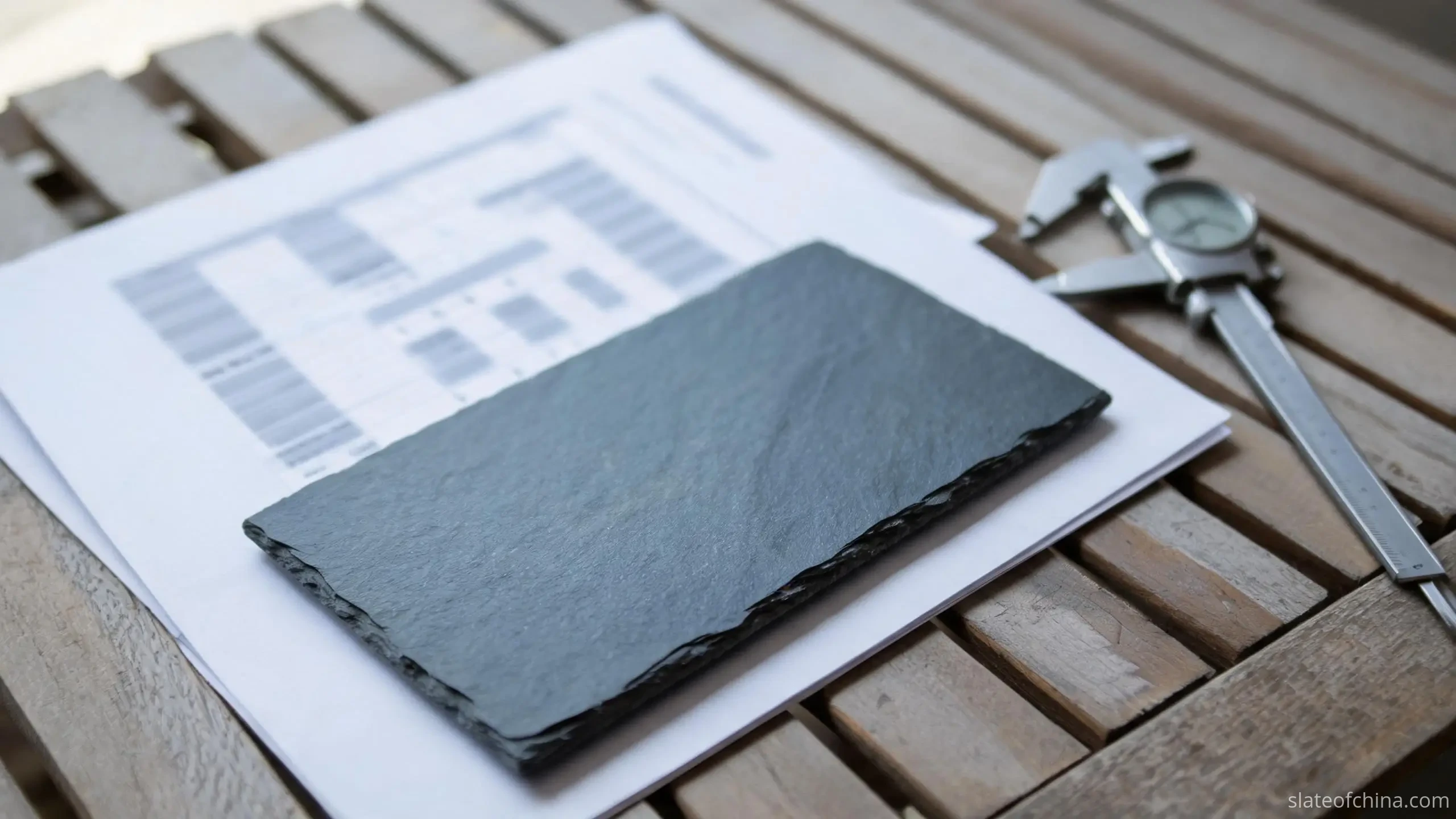
The First Drawer: Words You Can Verify in Your Own Hands
Everything in this drawer can be checked with a sample tile, a ruler, a set of bathroom scales and daylight. That is the point: before any paperwork argues with you, the stone itself can tell you most of what you need to know. These are the first twelve terms, and they cover the physical product from surface to weight.
1. Slate
Where you'll meet it: everywhere — it is the first word on every document, which is exactly why it gets skipped.
Slate is a fine-grained metamorphic rock that splits along natural planes into thin sheets. Unlike concrete or clay tiles, its colour, texture and splitting behaviour are geological, not factory-set — which is why two "slates" can be more different from each other than a slate is from a clay tile.
On my desk: "Slate" on its own specifies nothing. It is the word the rest of this glossary has to modify. The same word covers a stone that lasts a century on a northern roof and a soft, unsuitable one — the difference is in the drawers below, not in the noun.
2. Natural Cleft
Where you'll meet it: the "finish" line of a quotation, and under your thumb on the sample.
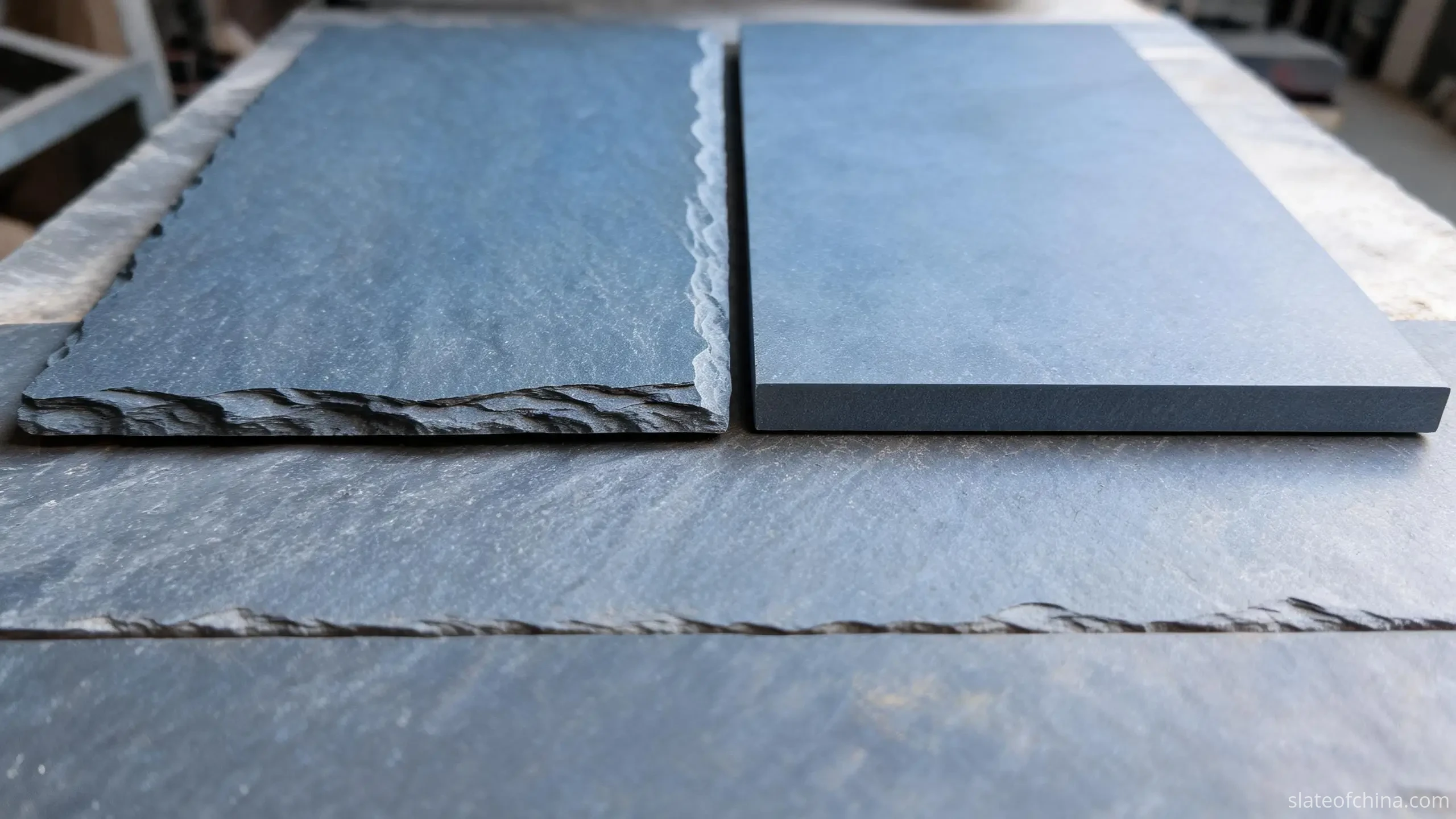
The natural cleft is the surface you get when slate is split along its cleavage: slightly rippled, softly ridged, never glass-flat. It is the standard finish for roofing, and it is the reason no two slate roofs look quite the same in raking light.
On my desk: photograph a cleft surface dead-on and it tells you almost nothing; the texture only reads at an angle. When a buyer asks me for "flatter cleft", I ask them to tilt the sample towards a window first — half the time the flatness they want is already there.
3. Cleavage
Where you'll meet it: technical data sheets, geology talk, quality discussions.
Cleavage is the property behind the cleft: the rock's ability to split along thin, parallel planes. It is why one block in Jiujiang becomes a pallet of 5-millimetre tiles and not a pile of gravel, and why the region has been working this stone for centuries — the full story of how the slate is made starts here.
On my desk: a buyer never needs to discuss cleavage itself. But when a supplier talks about it too little, that absence tells you something — a workshop that cannot explain its own stone's splitting behaviour rarely sorts it very carefully.
4. Grain
Where you'll meet it: drawings, specifications, and occasionally a roofer's email.
Grain is the directional structure within the stone — the long axis of how the minerals line up. It interacts with cleavage and decides how a tile behaves when it is split, cut and worked.
On my desk: for roofing, grain direction is almost never a problem — but every year someone inherits an architectural spec written for another stone and asks us to guarantee grain orientation. If direction matters to your project, say so in writing before production; it changes how blocks are selected at the quarry, not just how tiles are cut.
5. Sawn Edge and Rived Edge
Where you'll meet it: the "edge" line of a quotation — and it is a price line, not a decoration line.
A sawn edge is machine-cut: straight, crisp, uniform. A rived edge is split by hand: livelier, slightly irregular, the traditional look. Both are legitimate; they are different products at different prices, because one is a machine pass and the other is a craftsman's time.
On my desk: the most expensive mistake I have seen with edges was a heritage renovation that ordered sawn-edge slate because the price was better — then spent more than the savings having a contractor chip the edges on site to fake the rived look. Choose the edge in the specification, not at the port.
6. Nominal Size
Where you'll meet it: the first line of almost every quotation.
Roofing slate is quoted in standard formats — 500×250, 500×300, 600×300 millimetres are the common ones for export. "Nominal" means the format is the target, not a promise that every tile measures exactly that. Permitted variation is a separate agreement (term 7 below sorts thickness; length-and-width tolerance is its own conversation).
On my desk: two suppliers quoting the same nominal size are not necessarily quoting the same product. When comparing quotes, the question after the size is not "is it 500×300?" but "what dimensional tolerance do you allow — the permitted length and width variation — and how do you check it?" The full size chart shows which formats cover which markets.
7. Nominal Thickness and Actual Thickness
Where you'll meet it: the thickness line of a quotation — read this one twice.
Export roofing slate is usually supplied in a thickness range such as 6–8 mm. The number is honest, but it is a range, not a single value: slate is split, not poured into a mould, so tiles in one batch naturally vary within the agreed band. The specification that matters is the range and the acceptable spread around it — agreed in writing, not assumed.
On my desk: the phrase to watch for is "target range". A quotation that says only "6 mm slate" has quietly turned a range into a single number, and that number cannot be kept by any splitter in the world. Ask for the working range on paper — our thickness guide explains how the band affects weight, fixing and price.
8. Density
Where you'll meet it: technical datasheets, structural calculations, and — as the opening story showed — misread more often than any other number.
Density is mass per unit volume, usually quoted in kg/m³. The density of the slate you are actually buying should be established from reliable measurements or test data — in our published results, Jiujiang slate measures around 2,700–2,800 kg/m³, a range that serves as a useful reference for freight planning and structural calculations, since stones sold under the same regional name can vary. As the opening story showed, density is one physical property among several: on its own, it does not establish roofing quality or durability.
On my desk: density is not a quality ranking, and it does not correlate cleanly with durability. The number answers "how heavy", never "how good". What answers "how good" lives mostly in drawer two. We unpack the whole subject — including the buyer-side test you can run with a kitchen scale — in Jiujiang Slate Density.
9. Weight per Square Metre
Where you'll meet it: the email thread with your structural engineer, usually before the colour discussion.
Installed slate weight, typically around 19–24 kg/m² for standard export thickness, is what the building actually has to carry. It depends on thickness (which is why the range matters), density, and the layout the roofer chooses.
On my desk: on renovation projects this is the first number the engineer asks for and the last one many buyers think to request. Get it in writing early — it can change the thickness you order, and thickness is a price driver.
10. Cupping and Curvature
Where you'll meet it: quality-control notes, occasionally a dispute about "bent tiles".
Cupping is a slight curvature across a tile's face — a natural result of splitting along a plane that is never perfectly uniform. A small amount is normal in natural slate and is measured by standard methods, not by eyeballing; how flatness and stability are actually specified and measured is a subject of its own, which we cover in dimensional stability.
On my desk: the fast field check is to lay a tile face-down on a flat table and see whether it rocks on its corners. Slight rocking is within nature's margin; a tile that spins like a top is a conversation with the supplier. The useful question to send is not "your tiles are bent" but "how do you measure curvature, and what do you accept?"
11. Colour Sorting (A / B / C)
Where you'll meet it: the "sorting" line of a quotation and the remarks column of a packing list.
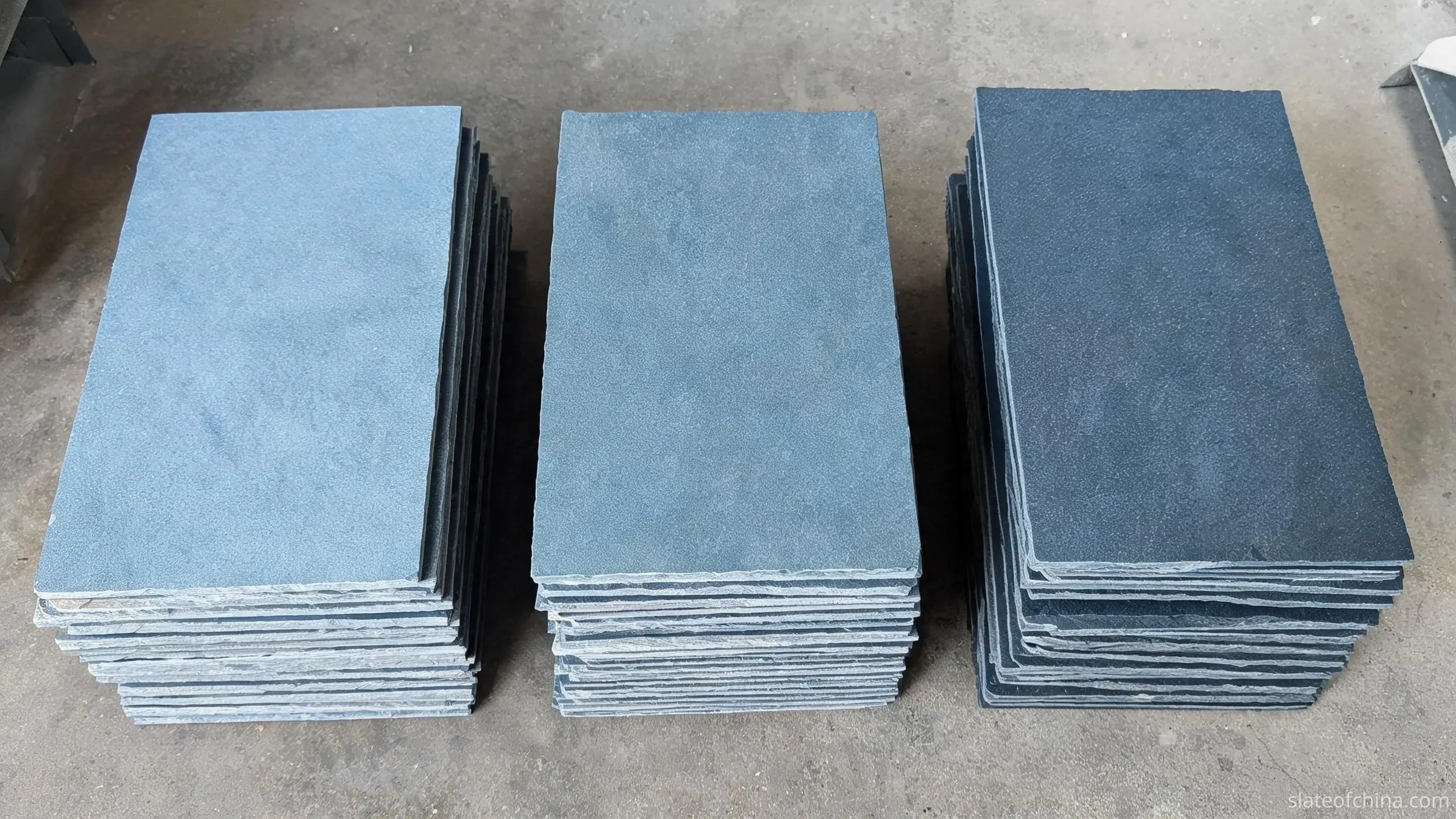
Within one batch, natural slate shows a tonal spread — lighter, mid, darker. Many factories sort tiles into grades (often labelled A, B and C) so the spread can be managed. The sorting happens at the factory; the mixing happens on the roof, where the roofer blends the tones so the finished roof reads even rather than patchy.
On my desk: a buyer who receives well-sorted crates and then lets the roofer lay straight from one crate will get a striped roof and blame the stone. The sorting-and-mixing guide is the fix — it belongs in your reading list before installation day, not after.
12. Tonal Range and Colour Names
Where you'll meet it: the colour line of a quotation — the least standardised line on the page.
"Smoke grey", "graphite", "blue-black", "rustic grey": these names describe tonal families, and no international standard governs them. Two suppliers using the same colour name can be describing visibly different stone; lighting changes them again.
On my desk: colour names are conversation starters, not specifications. The specification that travels is a mutually approved physical sample, supported by photographs and a written acceptance range, referenced in the contract — the sample approval process is exactly how that is done. Until then, treat every colour name on a quotation as a rough description, not a binding specification.
The Second Drawer: Words That Only Mean Something on Paper
Nothing in this drawer can be verified in your hands. Water absorption, flexural strength, freeze–thaw behaviour — these words acquire meaning only when a named test method, a specimen and a report stand behind them. That is why the words here are shorter to define and slower to master: each one is really a question about paperwork discipline.
13. Water Absorption
Where you'll meet it: the first line most buyers look for on a test report.
Water absorption is the percentage of water a saturated specimen takes up under a defined test procedure. Low values are one of the more useful single indicators of how a slate will behave in wet, freezing climates. Our published test results for Jiujiang slate sit around 0.2% or below — but always read the number together with the method, because European and American test procedures differ, and figures from different methods are not directly comparable.
On my desk: the report line to look for is not just the number but the standard next to it. A buyer who asks "what is your water absorption?" will get a number; a buyer who asks "under which method, and may I see the report?" will get the truth we stand behind — full story in Jiujiang Slate Water Absorption, real figures in our published test results.
14. Flexural Strength — and the Wet Number
Where you'll meet it: the strength section of a test report, sometimes split into dry and wet values.
Flexural strength is resistance to bending, in megapascals. For roofing slate the figure matters twice over: tiles are handled, hoisted and nailed, and on the roof they carry wind, snow and a person's foot. Test reports may include dry and wet flexural strength values. Wet-state results can matter when the slate will serve in wet or freezing conditions, but both values should be interpreted according to the applicable test method, the product requirements and the intended service conditions — neither number is a verdict on its own.
On my desk: when a report shows only the dry figure, I ask for the wet one — and for the results around it. How much strength the stone keeps after saturation, and why it matters, is in Jiujiang Slate Flexural Strength.
15. Freeze–Thaw Resistance
Where you'll meet it: the climate section of a test report, and in every conversation about northern Europe.
Freeze–thaw resistance describes how the stone withstands repeated freezing and thawing while wet, usually reported as cycles completed plus what happened to the specimen. The cycles alone are theatre; cycles plus measured damage is evidence.
On my desk: I read a freeze–thaw line the way an auditor reads a bank statement: what was the balance after the cycles, not just how many statements there were. The test logic and what it predicts for cold-climate roofs are unpacked in our freeze–thaw resistance guide.
16. Carbonate Content
Where you'll meet it: the chemistry section of a test report — the least-read, most consequential paragraph.
Carbonate minerals in slate can react with acid rain and weaken the stone over decades. It is a slow mechanism, invisible in a sample, and precisely for that reason it lives on paper: the chemical analysis of the stone is one meaningful basis for assessing weathering risk — not the only basis, but one of the few available before decades on a roof tell the story.
On my desk: this is the term I insist first-time buyers learn, even though almost none of them ask about it, because it separates a roof that ages gracefully from one that starts pitting. The mechanism, the limits and how to read them are in Carbonate Content and Weathering Risk.
17. EN 12326
Where you'll meet it: European quotations, declarations of performance, CE-style paperwork.
EN 12326 is the European product standard family for slate and stone for discontinuous roofing and cladding. It names the test methods, the classification codes and the marking rules a European buyer's paperwork is built on. The family has parts and editions — commonly cited as EN 12326-1 for the product specification and EN 12326-2 for the test methods — so a precise reading always asks which part, and which edition, a document refers to.
On my desk: two sentences sound identical and are not: "tested to EN 12326 methods" and "classified under EN 12326". The first says the stone sat in the right machines; the second says the results landed in the right classes. Ask which one you are being sold — and remember that either sentence describes a test or a class, not proof that the slate meets every requirement of your particular project. Matching the report to your project's specification is the buyer's step. The codes themselves are in Understanding EN 12326.
18. ASTM C406
Where you'll meet it: North American quotations and specifications.
ASTM C406 is the North American product specification for roofing slate, with its own test methods and its own performance grades — S1, S2 and S3. It is a parallel system to EN 12326: similar intentions, different tests, different codes, different numbers. The S-grades are classifications within the ASTM system, identified through testing under its methods; they are not shared with EN 12326 and should not be treated as translatable to it.
On my desk: the letters do not translate between the systems. S1 is ASTM vocabulary; a European report uses the EN marking scheme. So when a document says "S1 to EN 12326", treat the sentence as a translation error and ask for the original report — the full comparison, including what S1 actually guarantees, is in Understanding ASTM C406.
19. Batch Number
Where you'll meet it: test reports, packing lists, and our own loading photographs.
A batch number ties a stack of documents to a stack of stone. The report's numbers, the crates on the quay and the slates on your roof all become parts of one conversation once a batch number connects them.
On my desk: an unnumbered report is a compliment to a quarry; a numbered report is a description of your goods. When a supplier sends test paperwork, my first glance is not at the values but at whether any number on it matches the shipping mark — how to walk a report line by line is in How to Read a Roofing Slate Test Report.
20. Sealed Sample
Where you'll meet it: the annexes of a contract, and courier envelopes you hope never to open.
A sealed sample is a specimen tile — or a set of them — that both parties have signed, dated and kept, precisely so that "is this what we agreed?" can be answered with an object instead of an argument. It covers colour, texture, thickness character and edge finish in one artefact.
On my desk: the sealed sample is the cheapest insurance in this trade; it costs two tiles and a signature, and it has ended more disputes than any clause I have written. The full procedure, including how many tiles to seal and what to mark on them, is in the sample approval process.
21. Certificate of Origin
Where you'll meet it: letters of credit, customs files, preferential-duty applications.
A certificate of origin (CO) is an export document stating where the goods were produced. It is issued before shipment, and which exact certificate a buyer needs depends on the destination's customs arrangements — the generic CO is only one member of the family.
On my desk: this term causes delays, not disputes, because it belongs to the logistics timeline: the certificate has to be applied for and issued while the container is still in China. Say it early. If your customs broker or letter of credit needs origin paperwork, name it in the first order confirmation, not in the week of departure.
The Third Drawer: The Names on the Map
Half the confusion in this trade is not technical at all — it is geographic. Slate from this producing belt arrives in your inbox under three or four different place names depending on the age of the document, the habit of the writer and the level of the administrative hierarchy they happen to reach for. These eight terms will not be found in any roofing manual, but they are on your invoices, your bills of lading and your old test reports, and each one carries a small commercial meaning of its own. The full story of which name belongs where runs deeper than a glossary — what follows is the working version.
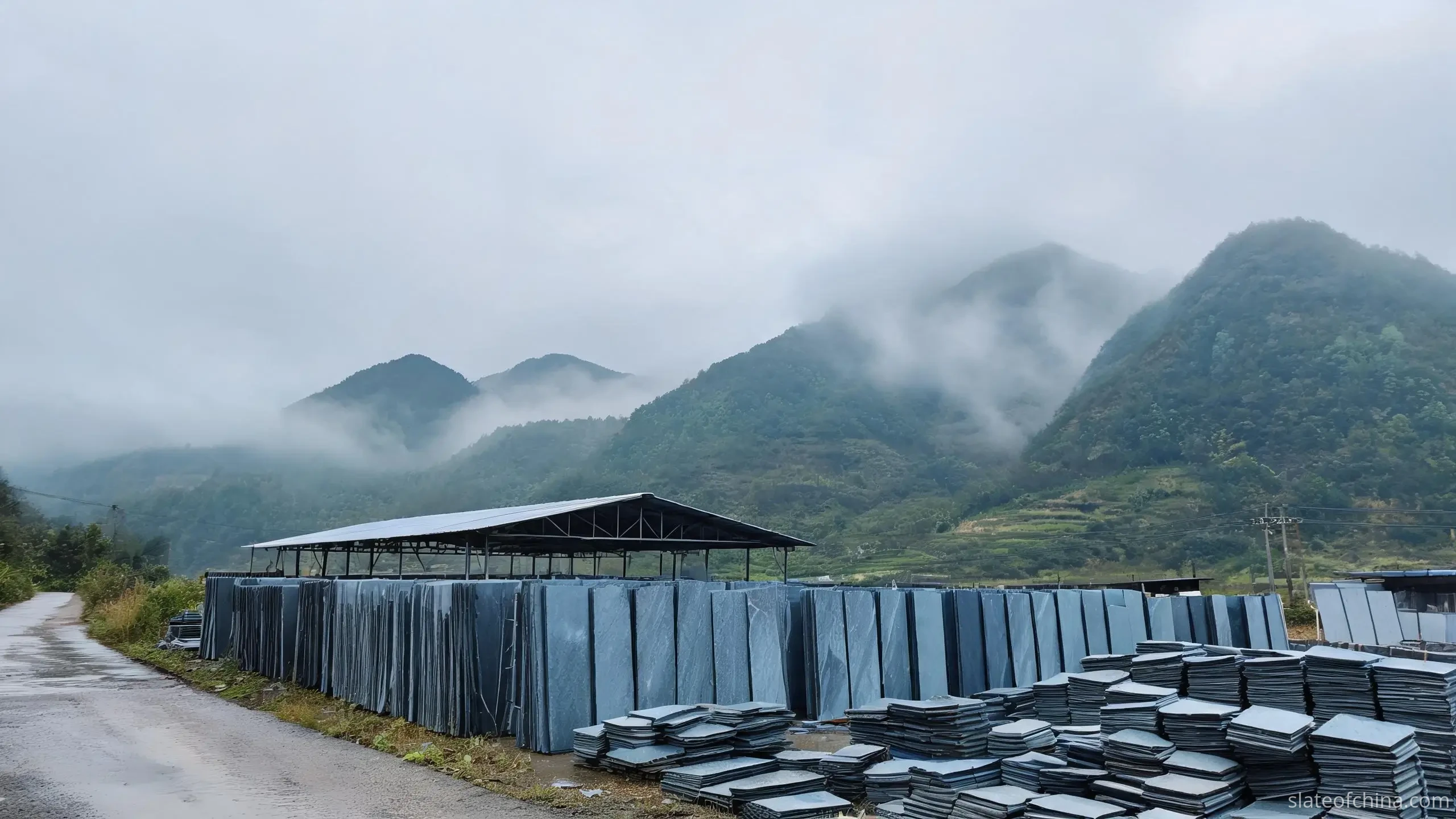
22. Jiujiang
Where you'll meet it: the "port of loading" and "place of receipt" fields on shipping documents.
Jiujiang is the prefecture-level city on the Yangtze associated with this slate belt, and it circulates as the belt's commercial location name. The river port in the city is where containers of slate from this region are commonly loaded for export — commonly, not always: the actual routing depends on the shipment plan, the order terms and the carrier's arrangements, so read the port-of-loading field on each document rather than assuming one route.
On my desk: when a document says "Jiujiang", it is talking about logistics, not geology. The stone was quarried and worked some distance away in the belt below Lushan; Jiujiang is where the stone becomes freight. The geography chain, city to quarry face, is drawn out in Where Is Jiujiang Slate From?
23. Lushan
Where you'll meet it: supplier websites, brochures, and some European wholesalers' price lists.
Lushan is the famous mountain — a UNESCO World Heritage site and Global Geopark — whose foothills hold much of the slate belt. "Lushan slate" is the traditional trade name, and because the mountain's name carries recognition, it is the name most often reached for in marketing copy.
On my desk: Lushan on a brochure and Jiujiang on a bill of lading will often — though not always — describe slate from the same producing belt; the mountain names the tradition, the port names the paperwork. Which seam, block or grade you are actually buying is a drawer-two question, not a map question. The geology that makes the name honest is worth one minute of any buyer's time.
24. Xingzi
Where you'll meet it: documents older than 2016 — and, still today, half the trade's vocabulary.
Xingzi was the county on the lake that historically anchored the slate industry. In 2016 it was reorganised, and the county became a county-level city named after the mountain — so on new paperwork "Xingzi" quietly turns into "Lushan" while referring to the same ground. Old test reports, old business cards and long-standing clients' habit all keep Xingzi alive.
On my desk: if your 2014 report says Xingzi County and your 2024 invoice says Lushan City, nothing moved except a line on an administrative map. The relationship between the three names is mapped out in Lushan, Xingzi and the Slate Belt.
25. Hengtang
Where you'll meet it: the "manufacturer address" line — and occasionally as a quality byword.
Hengtang is the town where much of the slate processing is concentrated: saws, splitters, sorting yards, finishing shops. Over the years "Hengtang slate" has picked up a reputation the way industrial towns do — as shorthand for the whole cluster's workmanship.
On my desk: the town name tells you where the machines are, not what came out of them. The cluster is real and its standards have risen measurably — the industrial story is told in The Jiujiang Slate Industry — but a specification still outscores a byword, every order, every time.
26. Poyang Lake
Where you'll meet it: "about us" pages, directions, geography small talk at dinner.
Poyang Lake is China's largest freshwater lake, lying just east of the slate belt. It never appears on a shipping document, but it appears in nearly every description of where this stone comes from, because it is the fixed landmark that orients everything else.
On my desk: its commercial value to a buyer is simple: it is the word that makes "somewhere in China" become a place you can picture — and see, on the Jiujiang Slate Map. Provenance you can picture is the beginning of provenance you can trust.
27. Yangtze
Where you'll meet it: freight quotations, routing discussions with your forwarder.
The Yangtze is the working river. When slate leaves this region, it typically descends the river from Jiujiang's port towards the coast and the ocean fleet — a routing that shapes the freight economics of many a quotation from this belt. "Typically", because the final route is always a shipping-plan decision: per order, per carrier, and sometimes per port.
On my desk: when a European buyer compares a CIF Rotterdam quote from Jiujiang with one from an inland quarry a thousand kilometres from deep water, they are comparing slate, yes — but they are also comparing rivers. How the loading plan and freight math actually work is laid out in the container loading guide.
28. Jiangxi
Where you'll meet it: encyclopedia entries, customs descriptions, and occasionally, imprecise marketing.
Jiangxi is the province. "Jiangxi slate" is a true statement and a loose one — the province is wide, and its slate is not one uniform deposit. Jiujiang's belt is the best-known producing area, but the provincial name spreads further than the belt does.
On my desk: the more precise the name in your specification, the fewer surprises. If a supplier says only "Jiangxi slate", ask which belt, which county — the provincial picture, including where else stone comes from, is surveyed in The Slate Industry of Jiangxi.
29. "Jiujiang Slate" as a Category Word
Where you'll meet it: everywhere — and that is exactly the trap.
"Jiujiang slate" is how the trade refers to slate from this belt, the way "Champagne" refers to a region's wine. But unlike wine law, no regulation polices the phrase. Two factories inside one belt can sort, test and pack to very different standards, and both can print "Jiujiang slate" on their quotations.
One field-level habit keeps this drawer honest: port of loading, place of receipt, manufacturer's address and quarry location are different fields, on different documents. They often all point into the same belt, but each deserves to be checked on its own — not assumed to be one and the same.
On my desk: the name is a starting point, never a certificate of quality. What separates the top of a belt from its middle is everything in drawers one, two and four — the sorting discipline, the documented numbers, the packing honesty. What a name can and cannot tell you is argued properly in What Is Jiujiang Slate? and, with some necessary honesty, in whether it is the best slate in China.
The Fourth Drawer: Words Spoken Across the Trade Table
The last drawer holds the commercial vocabulary — the words that decide price, timing and risk. They are not about stone at all; they are about who is responsible for what, and when. Each one is short to define and expensive to get wrong.
30. FOB, CFR and CIF
Where you'll meet it: the price line of every quotation — usually as a three-letter suffix.
FOB (Free On Board), CFR (Cost and Freight), and CIF (Cost, Insurance and Freight) are Incoterms® rules for sea and inland waterway transport. Under FOB, the seller delivers the goods on board the vessel at the named port of shipment. Under CFR, the seller also pays the freight to the named destination port; under CIF, the seller arranges freight and the insurance required by the rule. Under all three rules, risk generally transfers when the goods are on board the vessel at the port of shipment.
These rules allocate specific delivery, cost and risk responsibilities — they do not mean the seller bears all risks until the goods reach the destination port. Always state the named port and the applicable Incoterms® version in the contract, and do not compare quotations until the trade term, the quantity and the included charges are on a consistent basis.
On my desk: the detail buyers miss in CIF is that risk still passes at loading, not at arrival — what you are buying is the seller's freight arrangement and the insurance the rule requires, so ask what that insurance actually covers and on what terms before relying on it. The full discipline of comparing prices on one basis is in How to Compare Roofing Slate Quotations.
31. MOQ (Minimum Order Quantity)
Where you'll meet it: the first substantive line of a supplier's first reply.
MOQ is the smallest order a supplier will accept under stated conditions. In slate it is rarely arbitrary: behind it stand block yields, batch economics and container physics — the reasons one container is such a common answer.
On my desk: MOQ is a negotiation about economics, not a test of your seriousness. Explain your project size and ask what drives their number — standard sizes, shared batches and scheduled production can all move it. The arithmetic behind it is laid out in Roofing Slate MOQ Explained.
32. Lead Time
Where you'll meet it: the delivery line of a quotation, and every project schedule you will ever write.
Lead time is the span between an agreed starting point and delivery. The traps are the two unstated halves: production time and shipping time are different clocks, and the starting point itself is negotiable — deposit received, sample approved, or order confirmed.
On my desk: the question I teach buyers to ask is not "what is your lead time?" but "from what milestone to what milestone?" A supplier answering honestly will give you both clocks and both endpoints — see roofing slate lead times for how the real numbers stack up.
33. Net Weight and Gross Weight
Where you'll meet it: packing lists, bills of lading, customs entries.
Net weight is the slate; gross weight is the slate plus crates, corner protection, strapping, pallets. The gap between the two is not noise — on a crate-packed container it is a real percentage that freight quotes, road regulations and customs documents all care about.
On my desk: when your forwarder asks for weights, send the packing list row, not a remembered figure. And when comparing freight quotations, confirm which weight the price was built on — the difference between net and gross baselines is a quiet source of "surprise" charges at destination. How the container is planned and loaded explains the rest.
34. Crate Packing
Where you'll meet it: the "packing" line of a quotation and the structure of every packing list.
Export roofing slate normally travels in wooden crates: tiles stacked flat in layers, protected at edges and corners, secured for the sea passage. The crate is also the unit of counting — tiles per crate, crates per container — which makes it the natural key for inspection and verification. A complete packaging specification normally states tiles per crate, crates per container, the protection between layers, and the moisture precautions taken.
On my desk: the packing line of a quote deserves the same scrutiny as the price line: how many tiles per crate, what protection between layers, what moisture precautions. The whole journey from crate to overseas roof is documented in Shipping Roofing Slate Internationally.
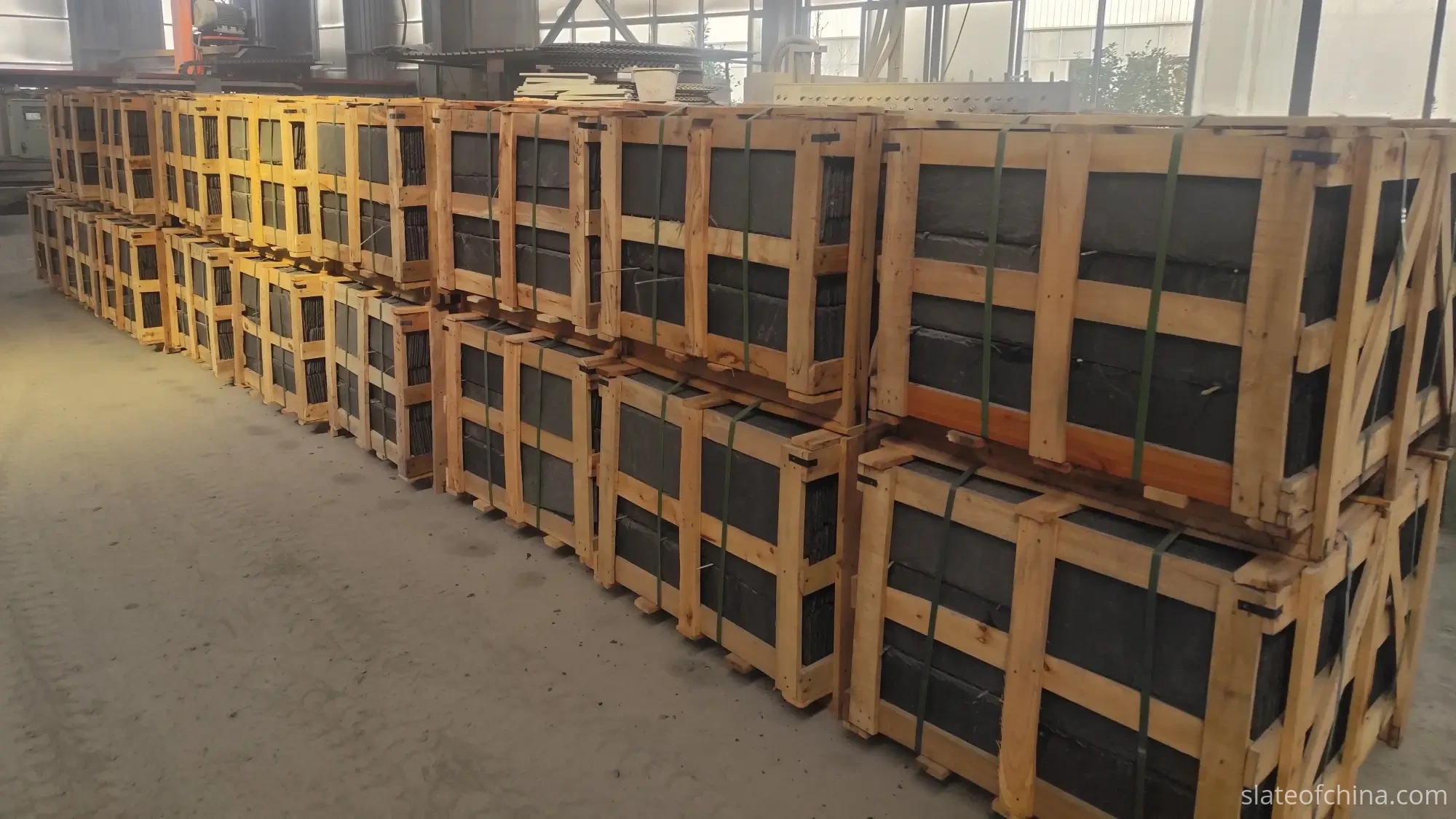
35. Breakage Allowance
Where you'll meet it: the terms and conditions sheet — the page everyone skims.
Breakage allowance is the agreed tolerance for tiles damaged in transit, and the agreed response: replacement, credit, or nothing to pay. The percentage gets all the attention, but the mechanics — counted how, claimed within what window, settled how — decide whether the clause is real.
On my desk: a breakage clause with a percentage but without a claim window is a promise with no calendar. Check the window before you sign, and photograph the crates before opening them at destination — the full playbook is in Understanding Breakage Allowance.
36. Pre-Shipment Inspection (PSI)
Where you'll meet it: the order confirmation, and the week before loading.
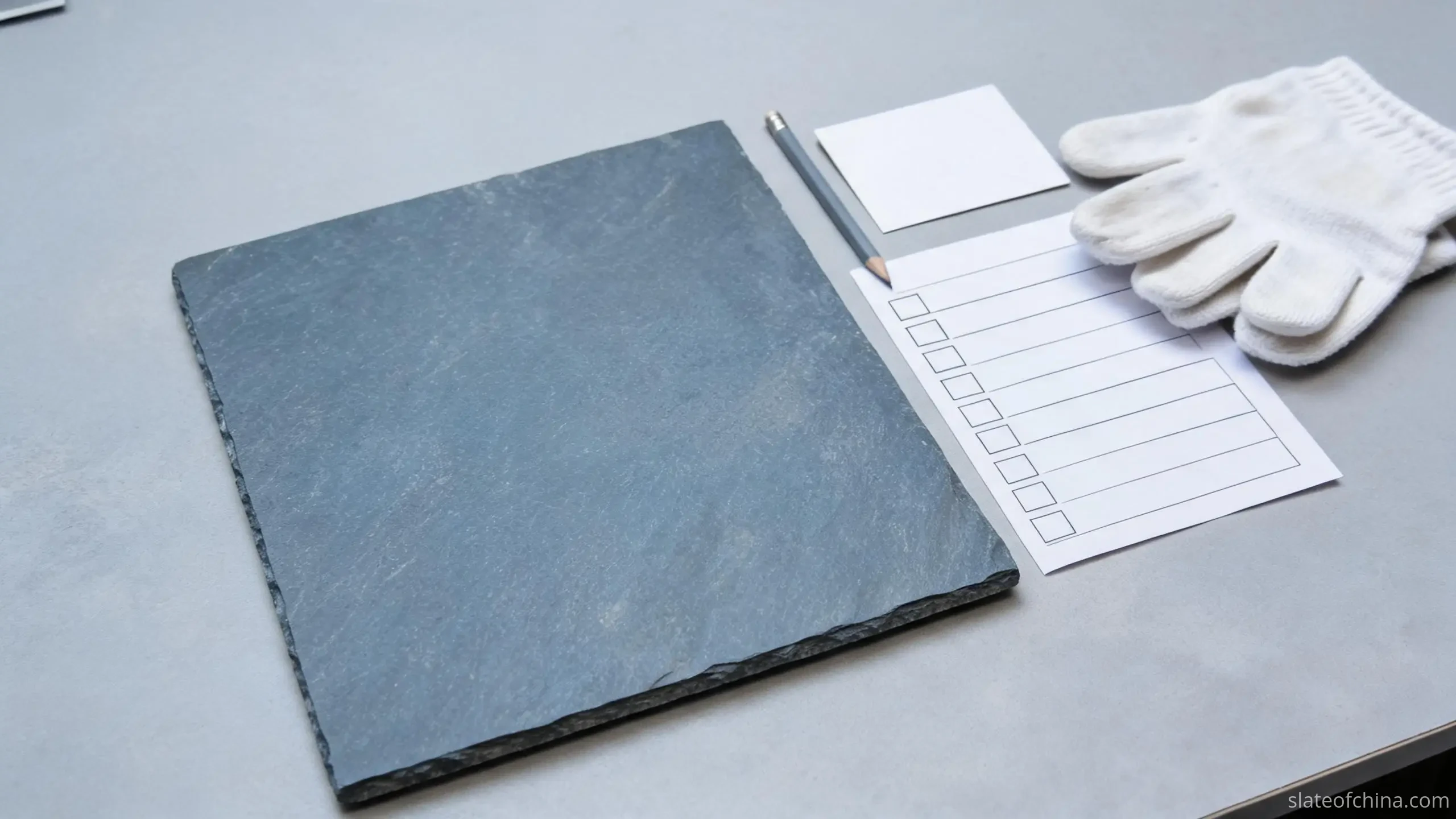
Pre-shipment inspection is the agreed check of finished goods before they leave the factory — by your own inspector, a third-party agency, or a documented video/photo procedure. What is inspected, against what criteria, on what sampling basis: all of that is negotiable, and belongs in the order confirmation, not in an improvised video call.
On my desk: the best PSI clauses are boring: a checklist annexed to the contract, a sampling method agreed in advance, evidence filed per crate. The checklist we would hand a client's inspector is written out in the pre-shipment inspection checklist.
How to Use This Glossary: From Word to Written Specification
A glossary earns its keep only when its words turn into lines in your enquiry. Below is the conversion table I keep tacked above my desk — the left column is what a quotation says, the middle is what your RFQ should receive, the right is why. Copy the middle column into your next enquiry and most of this page travels with it.
| The word on the quote | What to write in your RFQ | Why |
|---|---|---|
| "500×300" | 500×300 mm nominal; permitted length/width variation stated in writing | Nominal is a target, not a promise |
| "6–8 mm" | target range 6–8 mm, with acceptance criteria and measurement method attached | A range without acceptance rules is a mood |
| "Graphite grey" | colour per approved sealed sample, referenced with date and batch | Colour names are not standardised |
| "EN tested" | test report number, issuing body, date and batch number, to the standard named | "Tested" must land on a numbered document |
| "FOB price" | named port, Incoterms version, and any comparison quotes converted to the same basis | Different trade terms are different prices |
| "Crate packing" | export crates; tiles per crate and crates per container per packing list | Packing must be countable to be checkable |
| "3% breakage OK" | allowance percentage, claim window in days from discharge, and settlement method | A percentage without a window is theatre |
| "We'll inspect before loading" | inspection scope, sampling method and evidence format annexed to the order | An inspection nobody defined is a photograph |
The words travel in both directions, by the way — the questions worth asking a supplier and the buyer's guide use this same vocabulary in full sentences.
The Two Words You Probably Came For: Headlap and Gauge
The hub description of this guide promises "headlap" among its words, so here they are — short definitions, with the installation arithmetic left where it is done properly. They sit outside the four drawers because they belong to the roof, not to the stone, the paper, the map or the table; but a buyer searching for either word should not have to leave this page empty-handed.
Headlap
Where you'll meet it: the specification section of a roofer's quote — and in the introduction to this very guide.
Headlap is the vertical distance by which a slate is overlapped by the slate two courses above it in a traditional double-lap roof. It is the waterproofing overlap — the joint that stops wind-driven rain crossing between courses. The required headlap depends on slate size, roof pitch, exposure and the applicable roofing specification; low pitches and severe exposure generally demand more.
Gauge
Where you'll meet it: roofing specifications and slaters' setting-out notes — and, with a different meaning, in older billiard drawings.
In traditional double-lap slate roofing, gauge is the vertical spacing between successive courses, commonly used to determine batten spacing. For equal-length slates, a typical calculation is: Gauge = (Slate Length − Headlap) ÷ 2. Confirm the roofing system and the measurement convention before applying the formula. The visible height of each course between the laps is the exposure; for a given slate length, exposure and headlap trade off against each other, and together they decide how many slates a roof consumes per square metre — the worked tile counts, including the effect of headlap choices, are in How Many Slates per Square Metre.
One warning before you move on: gauge means something different again in billiard slate, where older drawings use it for panel thickness — that third meaning lives in the billiard slate glossary. Three trades, three dictionaries, one word: when a document uses it, check which table it was written for. The full installation arithmetic for both words — worked examples, pitch adjustments and tile counts — is in the roofing slate glossary and in Headlap, Gauge and Exposure.
Frequently Asked Questions
Is there an official, standardised glossary of slate terms?
No. Standards such as EN 12326 and ASTM C406 define test methods and classification codes, but the commercial language — colour names, sorting grade labels, trade shorthand — is convention, not regulation. That is why the same word can mean slightly different things from two suppliers, and why the working rule is simple: if a word decides money or risk, define it in the document, not in the conversation.
Why do my documents say Lushan, Xingzi and Jiujiang for the same slate?
Because the three names describe the same producing belt at three administrative levels. Jiujiang is the prefecture city with the Yangtze river port; Lushan is the mountain whose foothills hold the belt, and since 2016 also the county-level city that replaced the old Xingzi County; Xingzi is the old county name that pre-2016 documents still carry. Same ground, three zoom levels. When paperwork mixes the names, follow the chain instead of suspecting three suppliers.
What do headlap and gauge mean on this page?
They get short definitions near the end of the page rather than drawer entries. Headlap is the vertical overlap by which a slate is covered by the slate two courses above it in a traditional double-lap roof; gauge is the vertical spacing between successive courses, typically calculated as (Slate Length − Headlap) ÷ 2. The full installation arithmetic, with worked examples, lives in the roofing guides. In billiard slate, gauge has a different meaning again — panel thickness in older drawings — so when a document uses the word, first check which trade's table it was written for.
Are colour names such as "graphite grey" standardised between suppliers?
No. Colour names describe tonal families loosely, are used differently from one supplier — and one market — to the next, and move again under different lighting and screens. The only colour specification that travels is a physical approved sample, sealed and referenced in the contract. Colour names are for the conversation; samples are for the order.
Can EN 12326 and ASTM C406 terms be used interchangeably?
No. The two systems specify different test methods, classifications and marking codes, and their results do not map one-to-one. S1 is ASTM vocabulary, while a European report uses the EN marking scheme — a document that mixes the two should be queried, not translated. When writing a specification, name one system and hold every document to it.
Which of these 36 terms should a first-time buyer master first?
Five, in this order: the thickness range, because "6–8 mm" read as a single number causes the most surprises; water absorption, always together with its test method; the sealed sample, the cheapest insurance in the trade; FOB versus CIF, because comparing prices across different trade terms is false arithmetic; and the batch number, which is what ties every other document to the stone you actually receive. Master those five and the remaining thirty-one will fall into place as you meet them.
Related Reading
Put the glossary to work on your next order.
Thirty-six words, four drawers — and every one of them appears in the specifications we quote against. Send your sizes, thickness range, colour reference and destination port, and you will receive documents that use these words the way this page defined them. Start with the published test results, browse the roofing slate range, or go straight to requesting a quotation.