
Glossary of Billiard Slate Terms: 26 Terms from Real Quotes and Drawings, Explained Plainly
When a billiard table manufacturer receives a slate quotation, the numbers are usually not the difficult part. The difficult part is the technical language behind the drawing — terms like 25 mm gauge, 3-piece slate bed, CNC pocket cut, dowel holes, chamfered edge, flatness tolerance ±0.20 mm. These are not just technical details. They define how the slate will be manufactured, installed and perform on the table.
This glossary is written for importers, table manufacturers and OEM buyers — not casual players. It explains the terminology commonly used in billiard slate drawings, OEM specifications and factory quotations, so the words on the quote and the words on the drawing mean the same thing on the workshop floor.
An email lands in the sales inbox:
Please quote: 9 ft pool slate, 25 mm gauge, 3-piece, calibrated, chamfered edges, CNC pocket cuts, dowel holes per drawing, packed on pallets.
That single line uses nine of the twenty-six terms in this glossary. On my desk, most problem quotes come down to one word read two ways — a term that meant one thing to the buyer and a slightly different thing to the workshop. A gauge to a roofing-slate buyer is a coursing distance down the roof; to a billiard-slate workshop it is a panel thickness. A pocket to a player is the leather bag; to the CNC operator it is the cut-out in the stone. Same word, different trade.
Each entry below tells you what the word means here, where you will meet it, and the one thing most likely to go wrong if it is read the wrong way.
Quick Answer: The Five Terms Most Often Misread
Thickness (gauge) is the slate panel thickness in a billiard quote — not the roofing-slate coursing distance. Pocket is the cut machined into the stone — not the leather bag the balls drop into. Bed is the whole playing surface (one piece or three), not a single panel. Calibrated means uniform thickness, not flatness. Matched set means the three pieces were machined together as one bed, not just cut to the same size.
Every term below carries a Seen in tag — Drawing, Quote, Spec sheet, Packing list or Installation — showing which document it usually appears on. Skip to the quick-reference table for all twenty-six on one page, or to how to read a billiard-slate specification sheet for a worked example.
The Words That Name the Stone
These six terms describe what the slate is before any machining is specified. They appear on quotes and spec sheets, and they are the words a buyer uses first when describing what they need.
1. Billiard Slate Bed
Seen in: Quote · Spec sheet
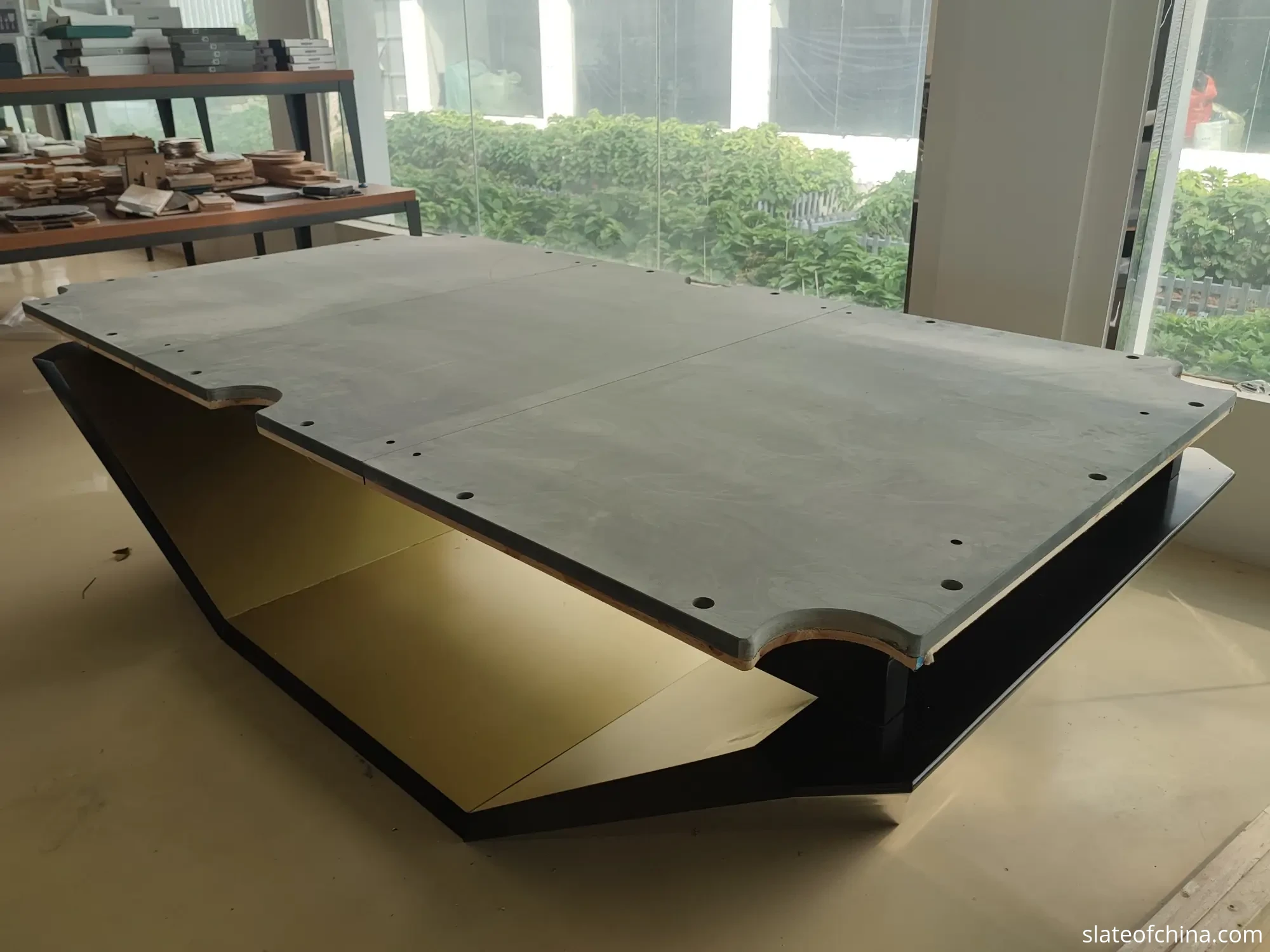
The bed is the complete playing surface under the cloth — one solid piece or, for most professional tables, three pieces precision-machined to sit as one. Buyers often say "the slate" when they mean the bed; the workshop says "the bed" when it means the assembled surface. A three-piece bed is not three loose slates thrown together — it is one playing surface that happens to arrive in three pieces, which matters for shipping, installation and seam preparation. What Is Billiard Slate? covers the material itself.
2. Three-Piece Slate
Seen in: Quote · Spec sheet
A three-piece slate is a billiard bed delivered as three precision-machined panels that assemble as one playing surface. The three pieces are cut as a matched set, aligned across two seams with dowels, and leveled on site before cloth installation. Three-piece is the standard configuration for professional tables and for export — a one-piece bed of the same playing size is too heavy to ship and handle. See 1-Piece vs 3-Piece for Manufacturers for the configuration trade-off.
3. Slate Thickness (Gauge)
Seen in: Quote · Spec sheet · Drawing
In billiard slate specifications, buyers usually refer to this as thickness. Some older documents and quotes may use the word gauge to describe the same measurement — the finished panel thickness. Commonly specified thicknesses by table type:
| Table type | Commonly specified thickness |
|---|---|
| 7 ft / 8 ft pool | 19 mm (some 8 ft: 22 mm) |
| 9 ft / 10 ft pool | 25 mm |
| 12 ft snooker | 35 / 45 mm (45 most common; 50 on some tournament designs) |
| Chinese 8-ball | 38–50 mm (45 mm most common) |
| Carom / Russian pyramid | 45 mm and above |
A thicker panel is stiffer, but thickness alone does not make a better bed — the frame, the flatness and the machining have to match it. A buyer who also purchases roofing slate should know the word "gauge" there means the exposed coursing distance down the roof, not thickness; in a billiard quote it always means panel thickness. See the thickness comparison guide for the full breakdown.
Buyer question: "Is thicker slate always better?"
Not necessarily. Thickness should match the table design, frame structure and playing requirements. A 25 mm panel on a properly engineered 9 ft table plays truer than a 45 mm panel on a frame not designed for it. How to Choose Billiard Slate walks through the decision path.
4. Calibrated Slate
Seen in: Spec sheet · Quote
Calibrated means the back surface of the slate has been ground to a controlled, uniform thickness. Natural slate leaves the quarry with variation; calibration removes it. The most common mistake is reading "calibrated" as a flatness guarantee — it is a thickness guarantee. A calibrated panel has uniform thickness and good frame contact; whether its playing surface is flat is a separate question, answered by the flatness tolerance. The calibration step is part of the panel journey from quarry to finished slate.
5. Back Surface (Backing)
Seen in: Spec sheet
The back surface is the underside of the panel — the face that sits on the table frame. On a calibrated panel it is ground flat; on an uncalibrated one it is left as-split. A flat back makes the bed sit without rocking: if the spec sheet says "calibrated back" and the frame is flat, leveling is a small adjustment; if either is not true, leveling becomes a fight against the stone. The technical specifications page lists what a spec sheet should state about the back surface.
6. Matched Set
Seen in: Quote · Packing list
A matched set is the group of panels (usually three) machined together as one bed. The pieces are not interchangeable with pieces from another set — the dowel positions, seam edges and thickness were cut as a unit. "Price per matched set" on a quote means the three pieces that form one table, machined and matched to each other; ordering a single replacement piece for a matched set is a measurement job, not a catalogue lookup. We machine and keep sets together from the first cut — mixing a piece from a different set is the fastest way to a seam you can feel through the cloth. See OEM Billiard Slate for Table Manufacturers for how matched sets behave across repeat orders.
The Words the Drawing Uses
These ten terms live on the CAD drawing. They are the words that tell the factory exactly what to cut, drill and machine — and they are the words a size label alone can never replace.
7. Slate Drawing (CAD Drawing)
Seen in: Drawing
The slate drawing is the technical drawing showing every machining detail — overall dimensions, thickness, pocket locations, bolt holes, dowel positions, edge details and tolerances. "9 ft pool slate" is not a specification; a manufacturer needs the exact playing area, hole pattern, pocket design and frame structure, all of which live on the drawing. For custom work the drawing is more important than any size description. The American Pool Table Slate Buying Guide walks through drawing review and approval.
8. Reference Drawing (Approved Drawing)
Seen in: Drawing · Quote
A reference drawing — also called an approved drawing or production drawing — is the drawing that has been confirmed by the buyer and the factory as the basis for production. OEM projects often go through several drawing revisions (Rev. A, Rev. B…) before approval; a repeat order should be produced from the latest approved revision, not an earlier one. When a quote says "per approved drawing" or "per reference drawing", it means the machining follows that specific revision — not a generic pattern, and not the buyer's verbal description. See OEM Billiard Slate for Table Manufacturers for how drawing revision control works in repeat orders.
Buyer question: "Can a manufacturer produce from just a table-size label?"
Not for OEM or custom work. "9 ft pool slate" tells the factory the nominal table size but not the finished outline, the playing area, the pocket geometry, the hole pattern or the edge machining. A manufacturer needs a drawing — or at minimum a sample or detailed measurements from an existing table. See Custom Billiard Slate Manufacturing for what to prepare.
9. Playing Area vs Finished Outline
Seen in: Drawing · Spec sheet
The playing area is the surface inside the cushions where the balls travel. The finished outline is the outer edge of the slate itself. They are two different numbers: a 9 ft pool table has a playing area of about 2540 × 1270 mm but a finished slate outline of about 2718 × 1448 mm. Quoting "2540 × 1270" as the slate size is a common error — the slate is always larger than the playing area, because it extends under the cushions and frame.
10. Centerline
Seen in: Drawing
A centerline is a reference line on the CAD drawing used for dimensional measurement and hole positioning. Pocket centers, dowel patterns and mounting-hole coordinates are often dimensioned from the centerline rather than from the edge. Two drawings of the "same" table can differ in where the centerline sits relative to the slate edge, which is why hole positions must be read from the drawing, not assumed from the table-size label.
11. Pocket Cut
Seen in: Drawing
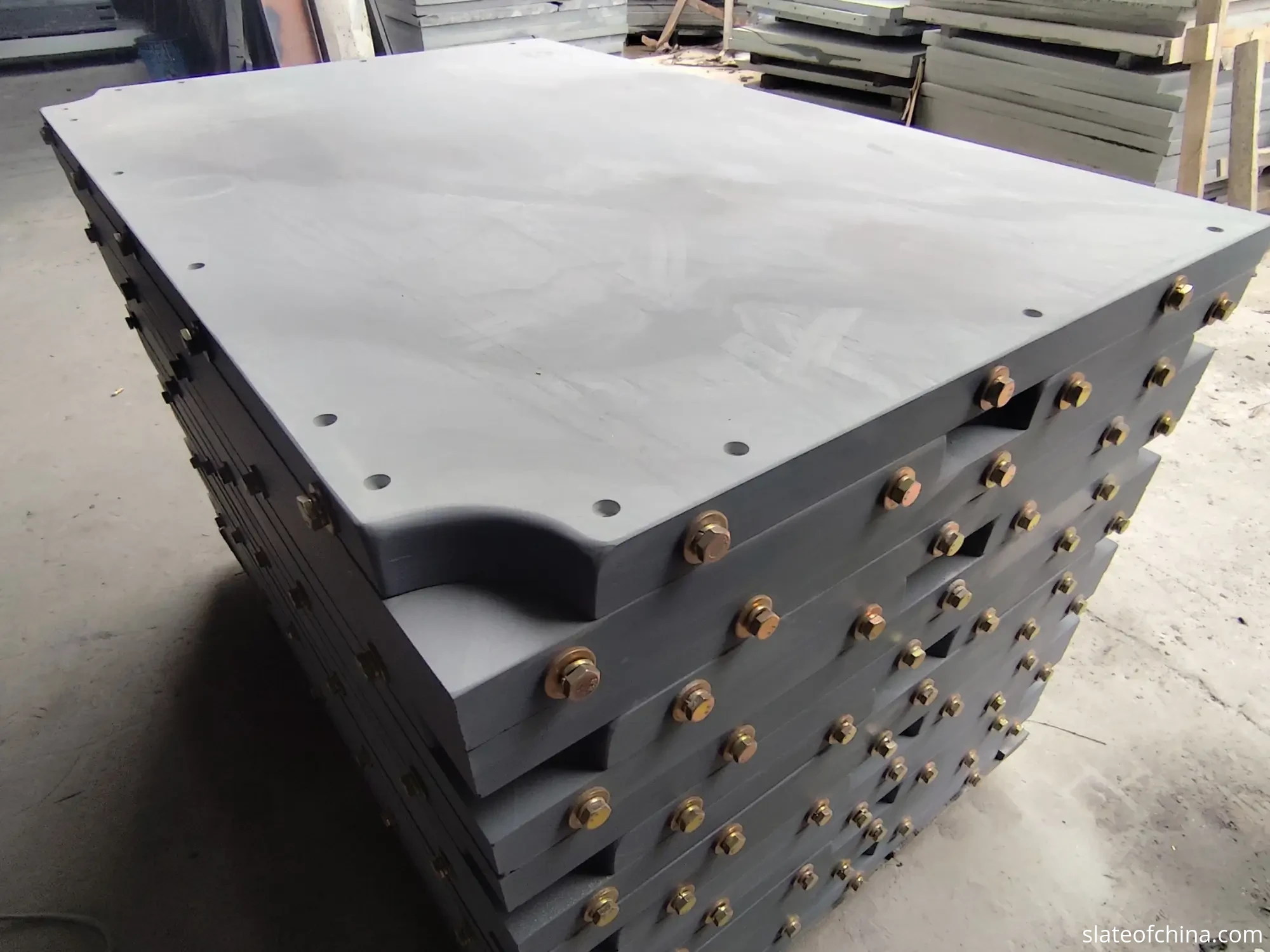
The pocket cut is the machined opening in the slate where the table pockets sit. Its shape — angle, corner radius, depth — follows the table design, and different markets cut pockets differently (American pool, snooker, Chinese 8-ball, Russian pyramid). There is no universal "standard pocket"; a manufacturer needs the pocket geometry from the drawing before cutting. See Custom Billiard Slate Manufacturing for how pocket layouts are specified.
12. Pocket Opening
Seen in: Spec sheet · Drawing
The pocket opening is the visible opening size on the playing surface — the gap the ball passes through. It affects game difficulty: professional snooker tables play with tighter openings than American pool tables. Pocket opening and pocket cut are related but not the same — the cut is the machined recess in the stone, the opening is the gap the player sees; both must match the final table design. Types of Billiard Slate compares pocket styles by table type.
13. Chamfer
Seen in: Spec sheet · Drawing
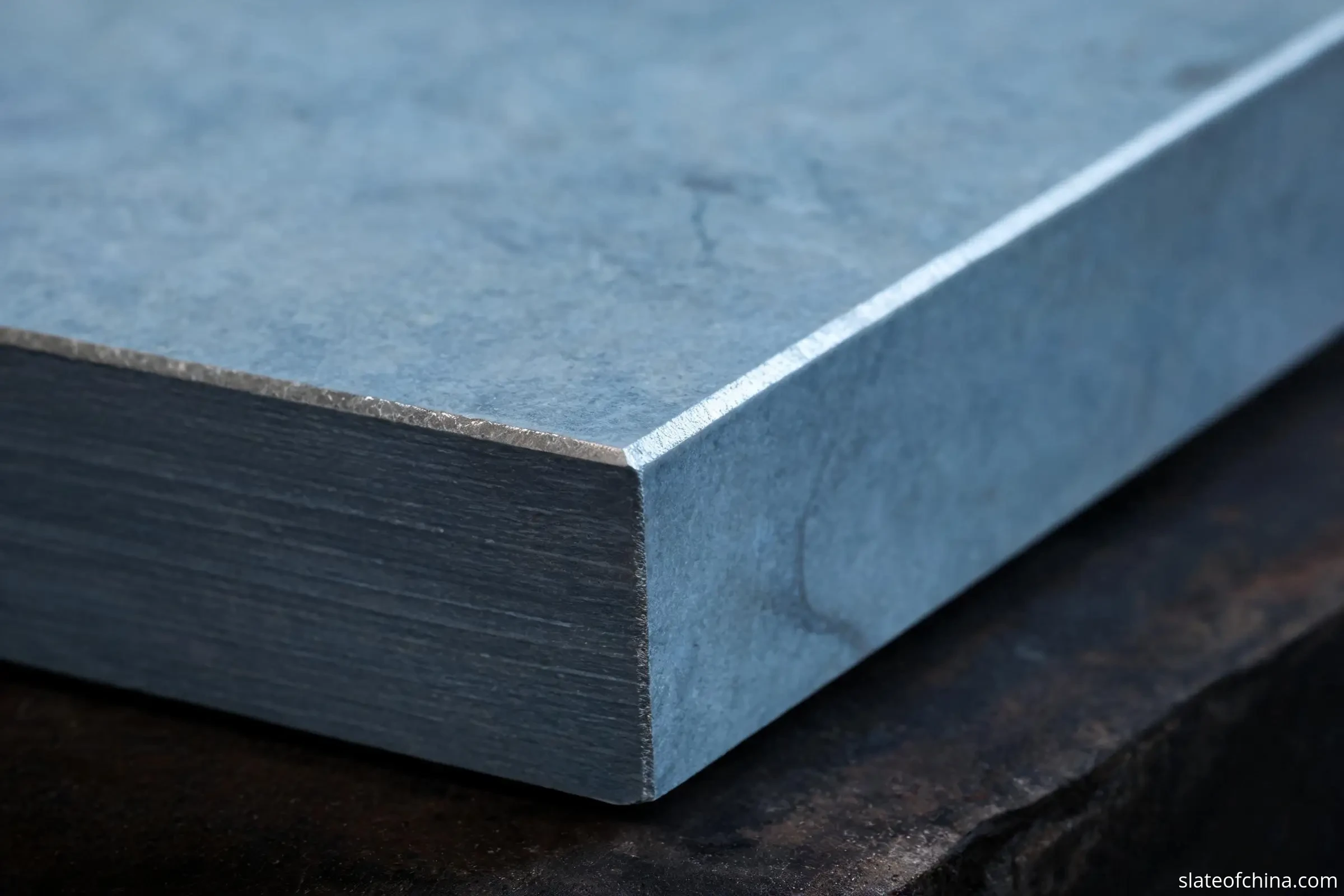
A chamfer is a small angled cut made along the top edge of the slate instead of leaving a sharp 90° corner — commonly 2 mm or 3 mm at 45°. It makes the edge safer to handle, reduces chipping, and helps the slate seat cleanly into the frame. It is a small detail that costs little but matters for installation and edge durability.
14. Rail Cut
Seen in: Drawing
The rail cut is the machined area where the cushion rail assembly meets the slate. Its accuracy sets the cushion height and the ball rebound. Rail dimensions are table-specific — a rail cut machined to the wrong cabinet design will not align the cushions correctly, and no amount of shimming fixes a wrong rail cut. See Custom Billiard Slate Manufacturing.
15. Dowel Holes (Slate Dowels)
Seen in: Drawing
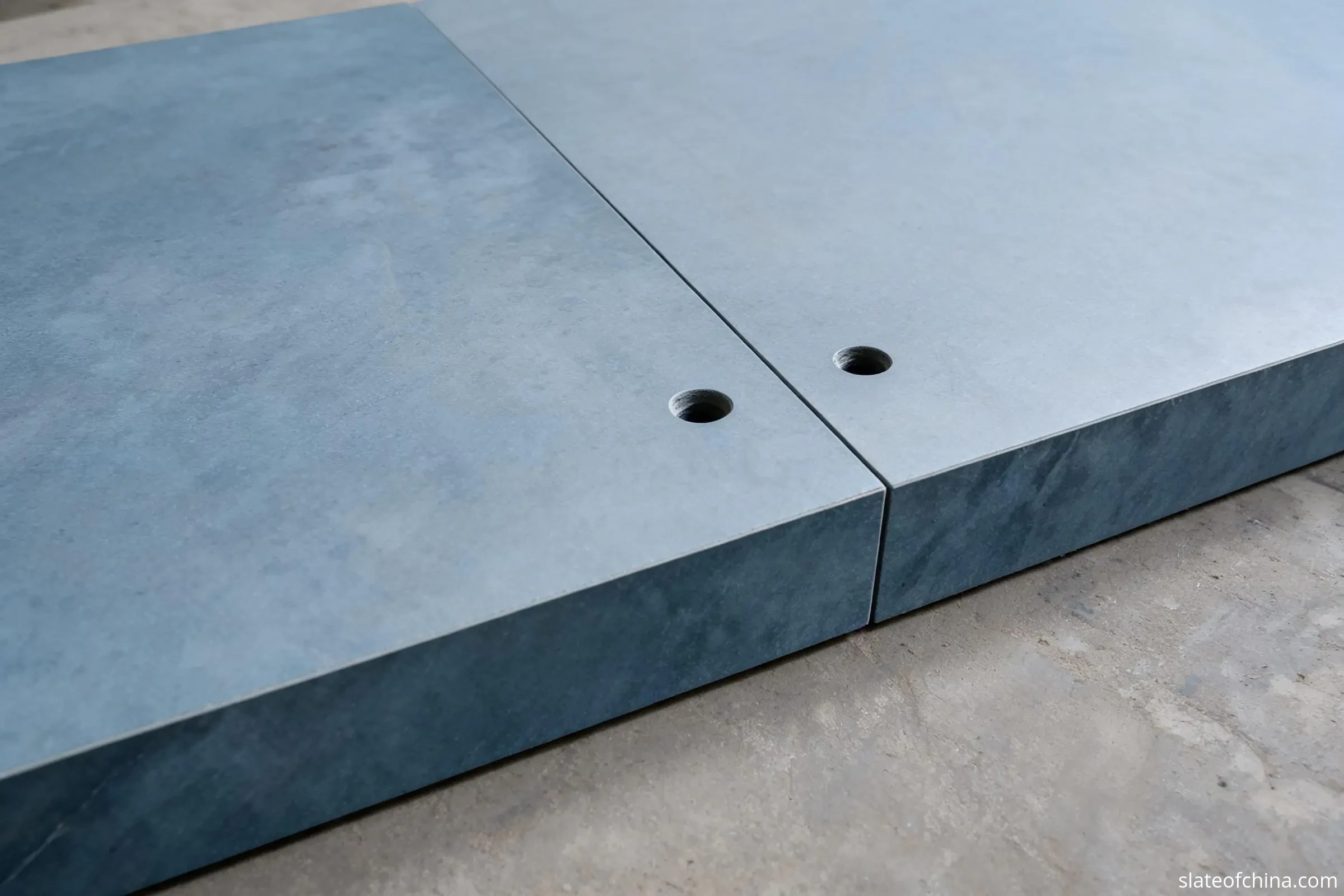
Dowel holes are precisely machined holes that take alignment dowels between two slate pieces. The dowels keep the three pieces aligned across the seam; without them, the seam can shift during installation. For replacement slate or export projects, dowel positions must match the original table design — wrong positions mean misaligned seams, installation delays and a ridge the cloth cannot hide.
16. Mounting Holes (Bolt Holes)
Seen in: Drawing
Mounting holes — also called bolt holes — are the holes that bolt the slate to the table frame. Their diameter, coordinates, depth and countersink all come from the drawing. A bolt-hole pattern is manufacturer-specific — it follows the cabinet and rail design, not the game type: two "9 ft pool" tables from different brands usually need different hole patterns. The American Pool Table Slate Buying Guide lists what to specify for a hole layout.
The Words Behind the Machining
These six terms describe how the slate is made accurate. They appear on spec sheets and in technical discussions, and they are the words that separate a panel that plays true from one that only looks flat.
17. Flatness Tolerance
Seen in: Spec sheet
Flatness tolerance is how much the slate surface may deviate from a perfectly flat plane. Typical spec sheets quote values in the ±0.1 to ±0.3 mm range, depending on table type and level. A bed can look flat to the eye and still deflect a slow-rolling ball, so serious buyers ask three questions: how the tolerance is measured, where on the panel it is measured, and whether the number is for each piece or the assembled surface. A tolerance number on its own means little without the method behind it. Choosing Slate for Professional & Tournament Tables covers what tournament-grade flatness actually requires.
Buyer question: "What tolerance should I specify?"
It depends on the table level. A commercial club table and a tournament table do not need the same number. More important than the number itself is the method: ask how the tolerance is measured, where on the panel it is measured, and whether it applies to each piece or the assembled bed. A tolerance without a measurement method is just an adjective. See Choosing Slate for Professional & Tournament Tables.
18. Dimensional Tolerance
Seen in: Spec sheet · Drawing
Dimensional tolerance is the allowed variation in the overall outline dimensions — length and width — as distinct from flatness tolerance (how much the surface deviates from flat). A spec sheet may state "2718 × 1448 mm ±2 mm", meaning the finished outline can vary by 2 mm in either direction. Dimensional tolerance matters for frame fit: if the slate outline is outside tolerance, it may not seat correctly on the cabinet. Both tolerances appear on a spec sheet, and they measure different things.
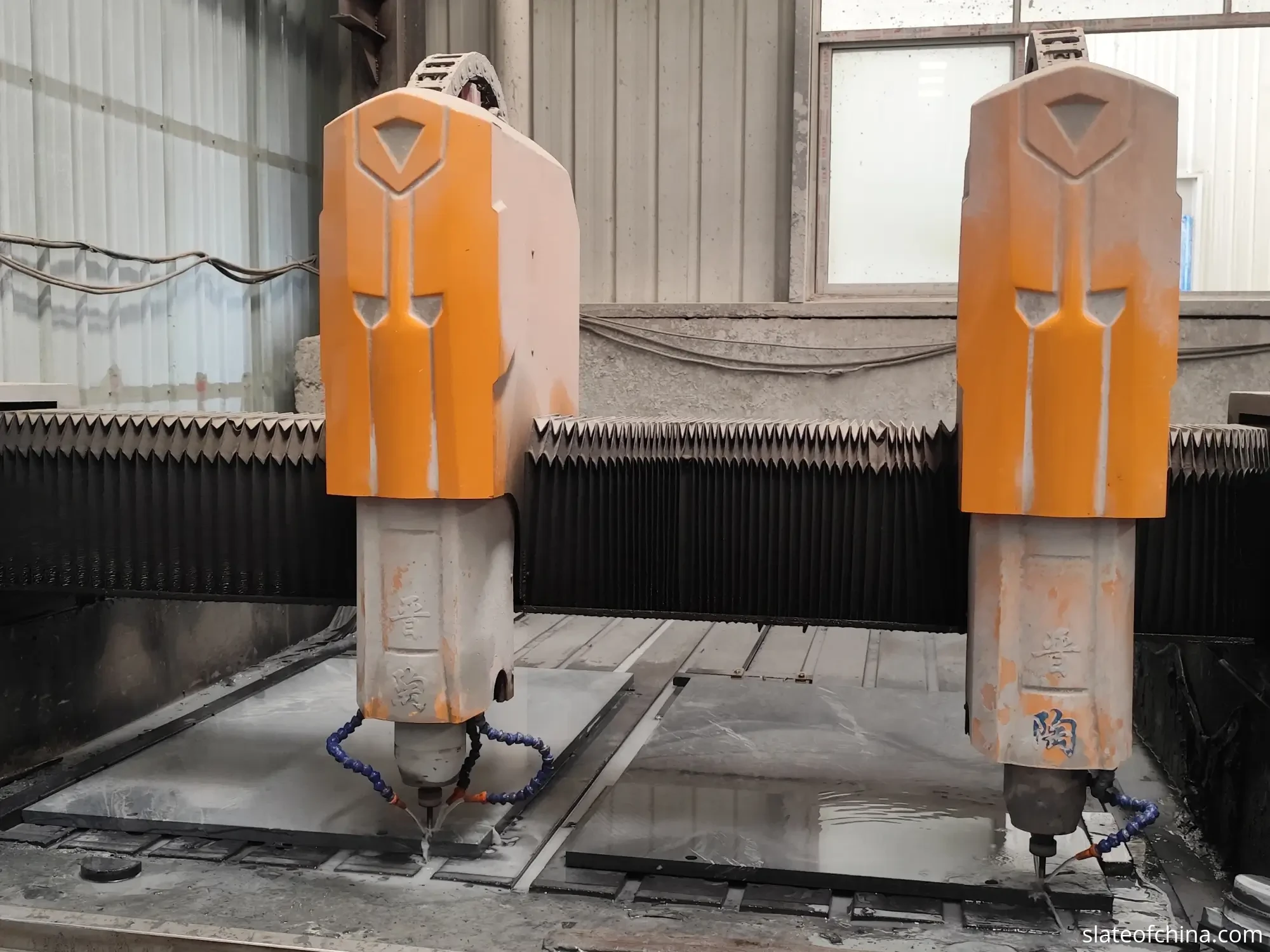
19. CNC Machining
Seen in: Quote · Spec sheet
CNC machining is slate processing controlled by computer program — pocket cutting, hole drilling, edge work and custom shapes. Compared with manual work it gives repeatability and the ability to hold a tight tolerance across a batch. For large-volume orders, CNC is what keeps the 51st set the same as the 1st. It is a method, not a quality grade.
20. Machining Allowance
Seen in: Drawing · Spec sheet
Machining allowance is the extra material left on the slab before final machining. Natural slate is a geological material — a panel is cut a little thick, then calibrated and machined down to the final thickness and outline. This is why a rough block measures thicker than the finished 25 mm on the quote; the allowance is removed, and the final number is what you get. The panel journey shows where the allowance sits in the process.
21. Seam
Seen in: Spec sheet · Installation
The seam is the visible joint where two slate pieces meet; on a three-piece bed there are two. A well-prepared seam has accurate edge matching, minimal height difference between pieces, and proper leveling before the cloth goes on. A common buyer question is whether a three-piece bed is as good as a one-piece bed — for professional tables, a properly machined three-piece bed plays as one surface, and ships and installs in a way a one-piece bed of the same size cannot. 1-Piece vs 3-Piece for Manufacturers breaks down the trade-off.
22. Joint Face
Seen in: Drawing · Spec sheet
The joint face is the machined mating surface between two slate pieces — the edge that touches the neighbouring panel across the seam. It is distinct from the seam itself: the seam is the visible line on the playing surface, the joint face is the machined edge below it that determines how tightly two pieces fit. A joint face that is not machined flat and square creates a height step at the seam that no amount of cloth will hide. For OEM production, the joint face tolerance is one of the details that separates a matched set from three panels cut to the same size.
The Words at Shipping and Installation
The last four terms appear on packing lists and in installation notes. They decide how the bed arrives and how it becomes a true playing surface on site.
23. One-Piece vs Three-Piece Configuration
Seen in: Quote · Spec sheet
One-piece slate has no seam and installs simply, but is extremely heavy and costly to ship internationally. Three-piece slate is the standard for professional and export tables — easier to ship, easier to install, and plays as one surface when machined and assembled correctly. For export projects, three-piece is the default solution; the trade-off is seam preparation, which is a machining and installation discipline rather than a disadvantage. See 1-Piece vs 3-Piece for Manufacturers.
24. Backer / Backing
Seen in: Drawing · Spec sheet
A backer is a backing material — typically wood or composite — bonded to the back of the slate panel on some table designs. It is not the same as the back surface (the slate's own underside). Not all tables use a backer; when a drawing specifies one, the material, thickness and bonding method must be confirmed, because the backer adds weight and changes how the slate seats on the frame.
25. Pallet Packing (and ISPM-15)
Seen in: Quote · Packing list
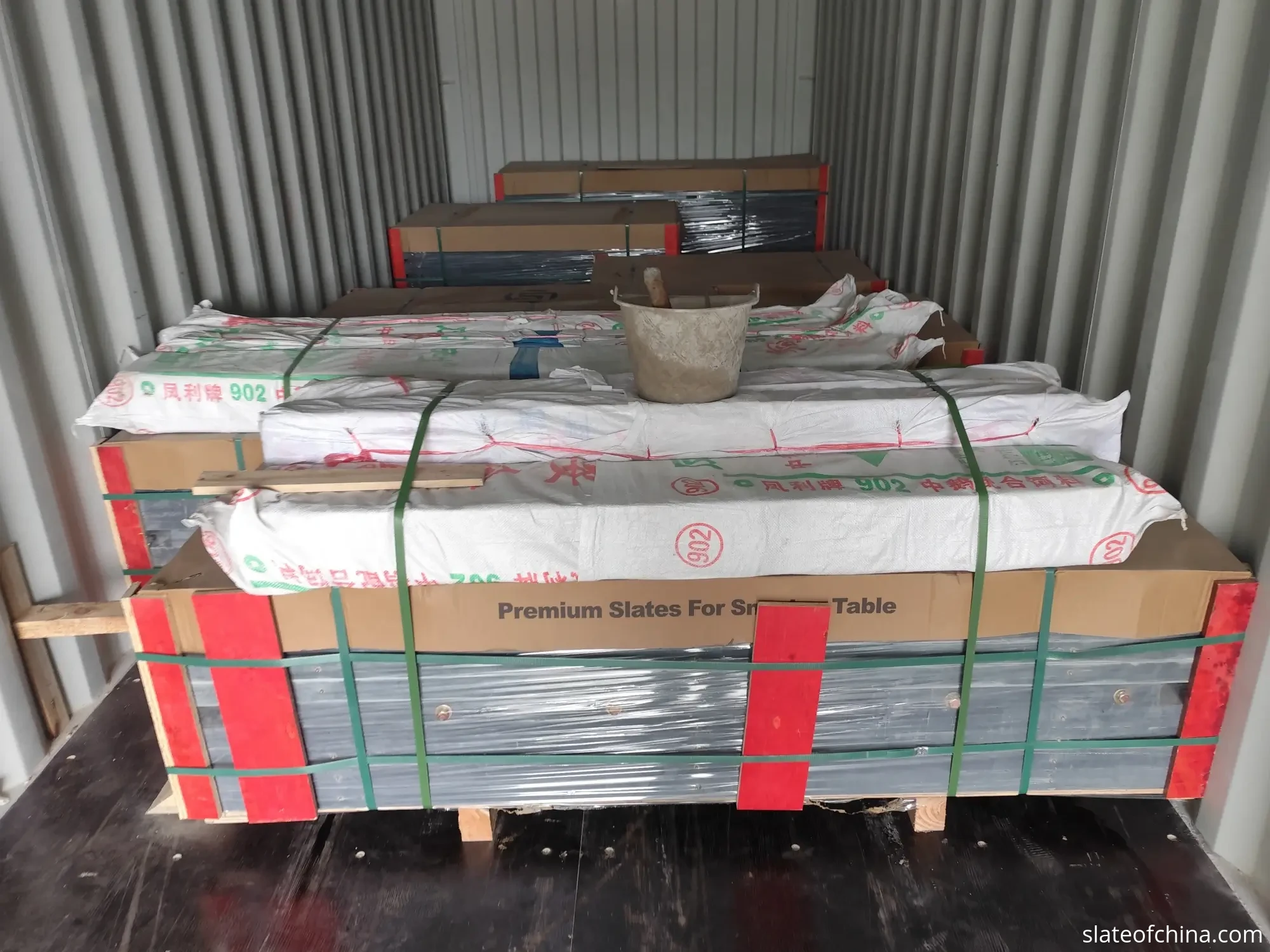
Billiard slate ships on wooden pallets — the panels banded and wrapped, not sealed inside fully enclosed wooden crates. The pallet timber carries an ISPM-15 heat-treatment stamp, which is the line customs in most importing countries check. "Packed on pallets" on a quote tells you the loading method and the handling risk: billiard slate moves on pallets rather than in crates because the panels need to be lifted individually at installation.
26. Leveling System
Seen in: Installation
The leveling system is how the bed is brought to flat after the pieces are placed — frame leveling, slate shims, adjustable support points. Even a high-quality bed needs correct leveling at final assembly; a bed that leaves the factory within tolerance can still play uneven if the leveling on site is wrong. Leveling is the last step that turns three machined pieces into one true playing surface.
Why These Terms Matter in OEM Slate Production
Most problem quotes come down to one word read two ways. A buyer who writes "25 mm gauge" means the finished thickness; a workshop that reads "25 mm" on a rough block sees the machining allowance before calibration. The same number, different stages of the process — and the glossary is what keeps them apart.
A request like this is common:
Need 9 ft billiard slate, 25 mm thickness, 3-piece.
That sentence is a starting point, not a production specification. A factory still needs:
- exact finished outline and playing area
- pocket geometry (angle, radius, depth)
- hole positions (dowel, mounting, countersink)
- thickness tolerance and flatness tolerance
- edge machining details (chamfer, rail cut, joint face)
A "9 ft slate" without an approved drawing is not a complete production specification. For OEM projects, technical drawings are what reduce communication errors between buyers and factories — the terms in this glossary are the vocabulary on those drawings. When a buyer and a workshop use the same word the same way, the drawing that goes into production is the drawing the buyer approved. OEM Billiard Slate for Table Manufacturers covers the full OEM workflow; From Jiujiang Quarry to Billiard Table traces one order end to end.
Quick Reference: All 26 Terms at a Glance
One line per term. Use this as a checklist when you read a quote, a drawing or a spec sheet.
| Term | Plain-English meaning | Seen in |
|---|---|---|
| Bed | The whole playing surface, one piece or three | Quote · Spec |
| Three-piece slate | Three panels machined as one bed | Quote · Spec |
| Slate thickness (gauge) | Finished panel thickness; "gauge" is an older term for the same thing | Quote · Spec · Drawing |
| Calibrated | Back surface ground to uniform thickness (not flatness) | Spec · Quote |
| Back surface | The underside that contacts the frame | Spec |
| Matched set | The 3 panels machined together as one bed | Quote · Packing list |
| Slate drawing | The CAD drawing with all machining details | Drawing |
| Reference drawing | The approved drawing revision that production follows | Drawing · Quote |
| Playing area vs outline | Surface inside cushions vs outer edge of the slate | Drawing · Spec |
| Centerline | Reference line on the drawing for measurement | Drawing |
| Pocket cut | The machined opening in the stone for the pocket | Drawing |
| Pocket opening | The visible gap the ball passes through | Spec · Drawing |
| Chamfer | Small angled cut along the top edge | Spec · Drawing |
| Rail cut | Machined area where the cushion rail meets the slate | Drawing |
| Dowel holes | Holes for alignment dowels between pieces | Drawing |
| Mounting holes (bolt holes) | Bolt holes that fix the slate to the frame | Drawing |
| Flatness tolerance | How much the surface may deviate from flat | Spec |
| Dimensional tolerance | Allowed variation in overall outline dimensions | Spec · Drawing |
| CNC machining | Program-controlled cutting, drilling and edge work | Quote · Spec |
| Machining allowance | Extra material left on before final machining | Drawing · Spec |
| Seam | The visible joint where two slate pieces meet | Spec · Installation |
| Joint face | The machined mating edge between two pieces | Drawing · Spec |
| One-piece vs three-piece | Configuration choice; three-piece is the export standard | Quote · Spec |
| Backer / backing | Backing material bonded to the slate back on some designs | Drawing · Spec |
| Pallet packing | Ships on pallets with ISPM-15 timber, not in crates | Quote · Packing list |
| Leveling system | Frame leveling, shims and supports used on site | Installation |
How to Read a Billiard Slate Specification Sheet
A typical spec sheet line for a 9 ft pool table reads:
9 ft Pool Table Slate
Size: 2718 × 1448 mm
Thickness: 25 mm
Pieces: 3 pcs
Material: Natural slate
Machining: CNC pocket cut
Flatness: ±0.20 mm
Edge: Chamfered
Dowel holes: According to drawing
Read it term by term:
- Size 2718 × 1448 mm — this is the finished outline, not the playing area. The playing area (about 2540 × 1270 mm) is what the player sees; the outline is what the slate is.
- Thickness 25 mm — the panel thickness (also called gauge on some quotes). For a 9 ft pool table, 25 mm is the common specification.
- Pieces 3 pcs — a three-piece bed. Two seams, three matched panels.
- Material Natural slate — not composite, not MDF. Natural Slate vs Alternative Playing Surfaces explains why the distinction matters.
- Machining CNC pocket cut — the pocket geometry was cut by CNC program, to drawing.
- Flatness ±0.20 mm — the tolerance. Ask how it is measured.
- Edge Chamfered — a small angled cut along the top edge.
- Dowel holes According to drawing — the dowel positions match the attached drawing, not a generic pattern.
A buyer who reads all eight lines and confirms each one before production has done the cheapest quality control there is.
Frequently Asked Questions
What does "gauge" mean on a pool table slate quote?
On a billiard-slate quote, gauge means the finished thickness of the slate panel — for example 25 mm for a 9 ft pool table or 45 mm for a Chinese 8-ball table. Most buyers and spec sheets today use the word "thickness"; gauge is an older term still seen on some quotes and drawings. It does not mean the roofing-slate coursing distance, which is a different use of the same word.
Is a three-piece slate bed as good as a one-piece bed?
For professional and tournament tables, a properly machined three-piece bed plays as one surface. The three pieces are cut as a matched set, aligned across the seams with dowels, and leveled on site before the cloth goes on. A one-piece bed of the same size has no seam but is extremely heavy and costly to ship internationally, which is why three-piece is the standard for export.
What is the difference between pocket cut and pocket opening?
The pocket cut is the machined recess in the stone — the physical opening cut into the slate by CNC, with a specific angle, corner radius and depth. The pocket opening is the visible gap on the playing surface that the ball passes through. The two are related but defined separately on the drawing: the cut is what the factory machines, the opening is what the player sees.
What does "calibrated" actually guarantee?
Calibrated means the back surface of the slate has been ground to a uniform, controlled thickness. It guarantees thickness consistency and good frame contact — it does not guarantee flatness of the playing surface. A calibrated panel can still have a flatness issue; that is a separate measurement covered by the flatness tolerance on the spec sheet.
What does "matched set" mean on a slate quote?
A matched set is the group of panels — usually three — that were machined together as one bed. Their dowel positions, seam edges and thickness were cut as a unit, so the pieces are not interchangeable with pieces from another set. "Price per matched set" means you are buying the three panels that form one table, matched to each other, not three panels of the same size picked at random.
Which slate terms matter most on a first OEM order?
On a first OEM order the terms that matter most are the ones on the drawing: the slate drawing itself, the reference drawing (approved revision), the playing area vs finished outline, the pocket cut geometry, the dowel hole positions, the mounting hole pattern, the joint face, and the matched set concept. Getting these right on the drawing and the sample is what makes the 51st set the same as the 1st; thickness and tolerance matter, but they follow the drawing, not the other way round.
Related Reading
Need Help Reading a Billiard Slate Drawing?
Send us your table size, thickness requirement, machining drawing or sample. Our team can review the dimensions, machining details, hole positions and production feasibility before quotation — so the words on the quote and the words on the drawing mean the same thing on the workshop floor.