
Shipping Roofing Slate Internationally: A Practical Import Guide
The short version: shipping roofing slate internationally runs through six handovers — factory to truck, truck to terminal, terminal to vessel, vessel to your port, port to customs, customs to your site. Three things decide whether it goes to plan: how the crates are packed and secured, which Incoterm governs the sale, and whether the documents repeat the same numbers.
Under Incoterms® 2020, both FOB and CIF transfer risk at the same point — when the goods are on board the vessel at the named port of shipment. CIF adds freight and minimum insurance to the price; it does not add delivery to your site.
Part of the Roofing Slate Guide's Buying & Importing section — the pricing half of the same story is in How to Compare Roofing Slate Quotations, and the calendar half is in Roofing Slate Lead Times.
International roofing slate shipments involve more than ocean freight. A container that reaches site on the agreed date is the product of three decisions taken long before the vessel sails: how the slate is packed and braced, which trade term divides cost and risk, and whether the paperwork agrees with itself. When one of those three is loose, the symptom usually appears at a port — a container held because the declared weight does not match the manifest, a bill of lading that cannot be released until the balance clears, a buyer who reads CIF as delivery to site and discovers at the terminal that it is not.
None of these are stone problems. They are handover problems, and handovers can be planned — which is why importing roofing slate from China rewards a written process more than a good relationship. What follows is the sequence every slate container goes through, the two documents that decide most of the arguments, and the packing and insurance details that are usually left until something goes wrong.
The Six Handovers: The Whole Journey in One Map
Ports differ; the sequence does not. Each handover changes three things that are easy to confuse: who is physically holding the cargo, which document records the transfer, and — separately — where risk sits under the sale contract.
| Handover | Party handling the cargo | Key transport document |
|---|---|---|
| 1. Factory to truck | Supplier and inland haulier | Packing list, pre-shipment inspection record |
| 2. Truck to terminal | Haulier, then the container terminal | Trucking note, terminal receipt (dock receipt) |
| 3. Terminal to vessel | Terminal and shipping line | Mate's receipt, then the bill of lading |
| 4. Vessel to your port | Carrier, in physical control only | Bill of lading, or sea waybill |
| 5. Port to your warehouse | Importer or forwarder, after customs release | Customs release, delivery order |
| 6. Warehouse to roof | Your site team | Receiving check, arrival inspection |
Physical custody, transfer of risk and legal ownership are separate concepts, and the table keeps them apart on purpose. A terminal or a shipping line may hold the cargo without owning it. A bill of lading acts as a document of title only when it is issued in negotiable form; a sea waybill, used where payment is already settled, is not a title document at all. Risk follows the Incoterm and the contract, not the custody chain.
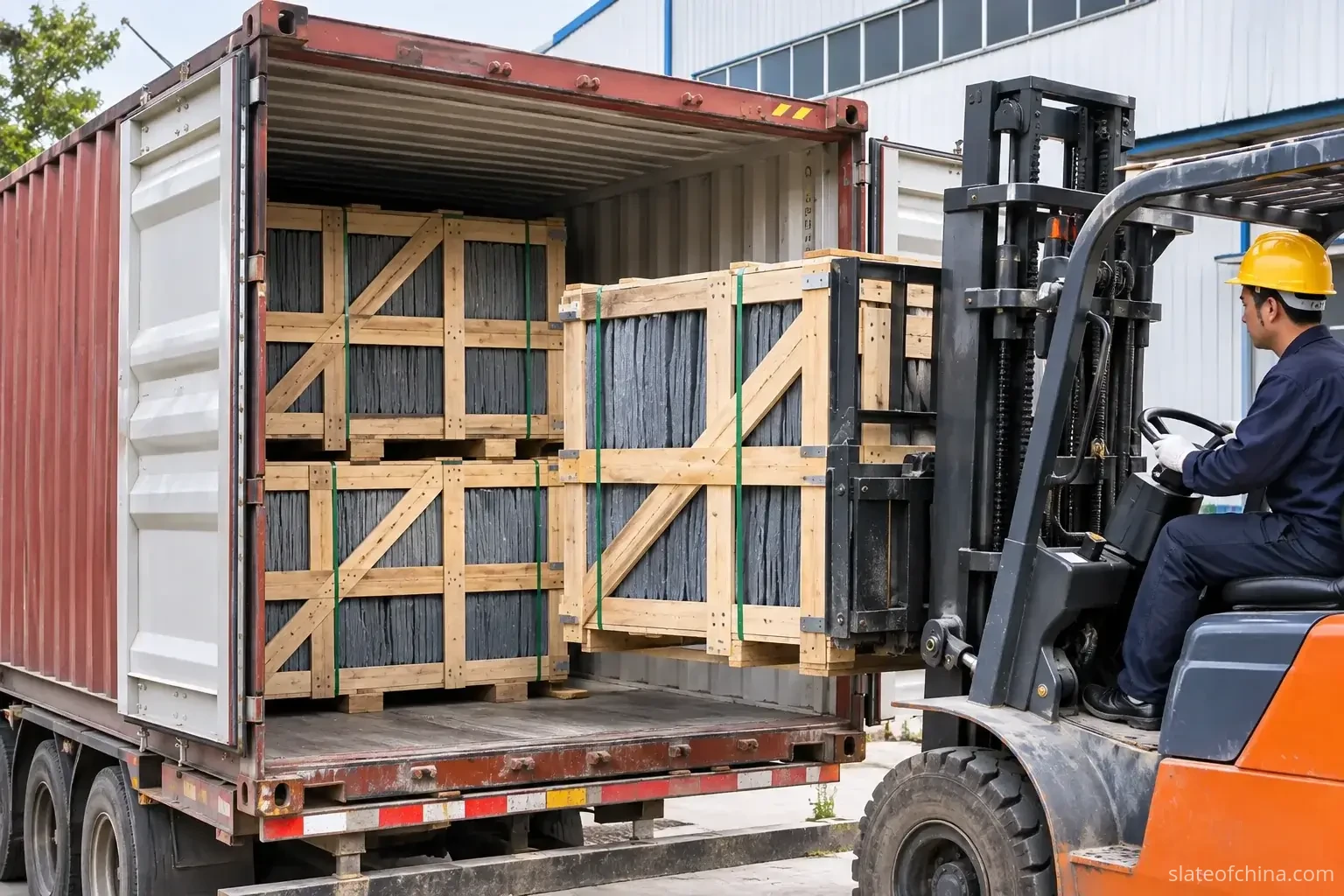
The practical value of the map is that it shows where a buyer's influence begins. Up to handover three, the supplier controls packing, trucking and export clearance, and the buyer's leverage is in the specification and the pre-shipment record. From the moment the container is on board, the buyer's risk begins, and the buyer's instruments are the bill of lading, the insurance certificate and the arrival inspection. After customs release, everything is local: the truck, the crane, the site access and the receiving check.
Incoterms for Roofing Slate: FOB, CIF and What Each Term Covers
Incoterms are the standard definitions of who arranges and pays for what in an international sale. Slate quotations almost always use one of two: FOB and CIF. Both name a port, and the port matters as much as the term.
FOB (Free On Board) — named port of shipment. The supplier delivers the crates on board the vessel at the named port, for Chinese slate usually Shanghai or Ningbo, and clears them for export. The buyer contracts the carriage, pays the ocean freight, arranges insurance, and takes over from the moment the goods are on board.
CIF (Cost, Insurance and Freight) — named port of destination. The supplier arranges and pays the carriage to the named destination port and buys insurance at the level the rules require, both included in the quoted price. Destination terminal charges, customs, duty, VAT and the inland truck remain the buyer's.
The FOB vs CIF roofing slate comparison is usually presented as a question about price. It is at least as much a question about which party books the vessel, and where risk sits between the terminal gate and the deck.
Here is the point that causes most of the disputes. CIF does not move the risk to the destination port. The older shorthand — risk passing as the cargo crosses the ship's rail — is no longer the reference point. Under Incoterms 2020 the transfer happens when the goods are loaded on board the vessel at the named port of shipment, and that is true for FOB and CIF alike. What CIF adds is cost, not risk.
That distinction has practical consequences. If a container is damaged in the terminal before it is loaded, the loss generally rests with the seller under both terms, because the risk has not yet passed. Once the container is on board, the risk is the buyer's, and the insurance arranged under a CIF sale is the buyer's remedy. Which is why the scope of that cover — not merely its existence — deserves a line in the quotation.
The minimum cover CIF requires is modest: Institute Cargo Clauses (C), at 110% of the contract value, in the currency of the contract. Clause C is a named-perils cover, and rough handling in transit is not one of the named perils. The quotation guide treats this as one of the lines that must be normalised before two prices can be compared.
| Question | FOB | CIF |
|---|---|---|
| Who books the vessel | Buyer, or the buyer's forwarder | Seller |
| Who pays ocean freight | Buyer, on the carrier's invoice | Seller, inside the price |
| Insurance | Buyer's choice and cost | Seller, minimum ICC (C), 110% of value |
| Where risk passes | On board at the named port of shipment | On board at the named port of shipment |
| Seller's cost ends at | On board, port of shipment | Named port of destination |
| Who controls the sailing date | Buyer | Seller's booking |
A common sequencing for a first container: buy CIF, so that freight and insurance sit with the party that books sailings every week, then move to FOB with an appointed forwarder once the process is familiar. The second order is usually cheaper on freight and gives the buyer control of the sailing date — which is the one input that makes an arrival date something more than an estimate.

How Roofing Slate Is Packed and Secured Inside a Container
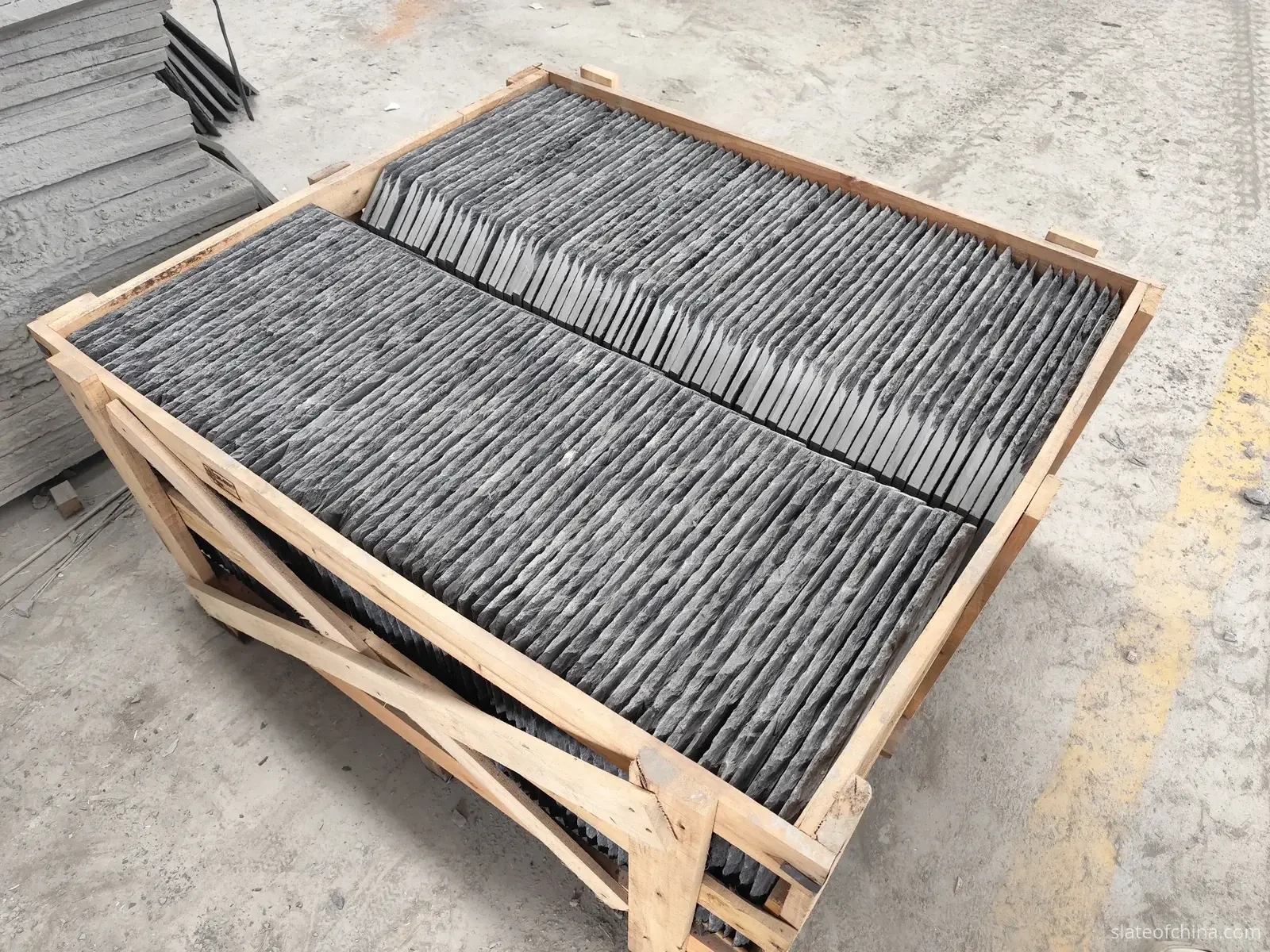
Packing is usually filed under factory detail, but it is the part of the shipment the buyer can still influence, and the part that decides how much slate arrives sound. A 20ft slate load carries roughly one to one and a half tonnes of packaging before any stone is counted, and that packaging has to do three jobs at once: hold each tile still, spread the weight across the container floor, and survive being handled by people who will never see the crate opened.
The crate itself
Roofing slate is crated on edge rather than stacked flat. A flat stack loads the stone across its cleavage planes and leaves the edges exposed to every impact when the crate is set down; standing the tiles on edge keeps the load in compression along the length of the tile. Bundles are separated with interleaving, the corners are protected, and the whole stack is held by a timber frame with base skids so a forklift can lift it without touching the stone. Crate design, timber sizes and the twelve lines that make a crate fit for export are set out in the crate standards guide; for shipping purposes, the two things to confirm are that the base can take the load and that the frame will not rack when the box is lifted at one end.
ISPM 15 and the mark on the wood
Solid wood packaging crossing a border — crates, pallets, dunnage — generally has to be heat-treated or fumigated and carry the IPPC mark under ISPM 15. The mark is stamped on the timber itself; it is not the same thing as a phytosanitary certificate for the consignment, and processed panels such as plywood are generally outside the requirement. A container with unmarked solid-wood packaging can be held, re-shipped or de-crated at the importer's cost, so the check is worth doing on the loading photos rather than at destination.
Weight distribution and the 20ft ceiling
Roofing slate container shipping is weight-limited long before it is volume-limited. A 20ft box of crated 7–9 mm material comes to roughly 1,080–1,390 m², typically 18–23 crates; thinner slate carries further, thicker slate less, and the exact figure moves with tile size, crate weight and the payload permitted for the unit and the route. The square-metres-per-container page works the arithmetic from the data plate, the density of the stone and the crate tare. Two consequences follow for loading: the heavy crates go low and spread across the floor rather than stacked in one corner, and the total is calculated to stay inside the road axle limits on the haul to the port as well as the vessel's stowage plan.
Securing inside the box
Floor-loaded crates need to be prevented from moving in three directions. Timber dunnage or purpose-made chocks are fixed to the container floor to stop fore-and-aft creep, straps or lashings tie the stack to the container's securing points, and the door end is braced so that nothing leans against the doors during the voyage. Gaps between crates are filled rather than left open: a void is somewhere cargo can gather speed.
- Confirm the crate count, weights and batch numbers against the packing list before loading starts.
- Load heavy crates first, distributed across the floor, with the centre of gravity low and central.
- Fix timber chocks or dunnage at the front, along the sides and at the door end.
- Tension straps over the stack, protecting the top course from strap contact.
- Photograph the loaded box from the doorway before closing, with the crates and bracing visible.
- Record the verified gross mass (VGM) — the carrier will not load a container without it — and check it against the packing list.
- Close the doors, fit the seal, photograph the seal number, and put that number on the bill of lading and the packing list.

This is also where the pre-shipment record earns its keep. A photograph of the sealed container, a seal number written into the documents and a weighed crate are the only evidence that separates damage that happened before loading from damage that happened afterwards. The pre-shipment inspection checklist lists what to capture; the point here is that the record must travel with the shipment, not stay in the factory's folder.
The Bill of Lading: The Document That Stands In for the Cargo
No one can inspect a crate at sea, so the carrier issues a document that represents it. A bill of lading does three jobs: it is a receipt for the cargo as loaded, it is evidence of the contract of carriage, and — when issued in negotiable form — it is a document of title. That third function is why banks and buyers treat the original with such care.
Two forms are common, and the difference matters:
- Negotiable bill of lading. Commonly issued as a set of three originals; the carrier releases the cargo against one surrendered original. This is the form used where payment runs through a letter of credit or where the seller wants to retain control until the balance clears.
- Sea waybill. Not negotiable and not a document of title. The cargo is released to the named consignee on identification, which is faster and cheaper, and appropriate when the commercial relationship and the payment are already settled.
A telex release is not a third document but an instruction: the originals are surrendered at origin and the carrier's system releases the cargo at destination without paper travelling. For most slate shipments it is the sensible default once the balance is cleared, and it removes the risk of an original set going missing in the post.
The bill of lading, the packing list and the manifest must tell one story — same crate count, same gross weight, same seal number, same batch references. When they drift apart, the mismatch surfaces at the port, and the container waits while it is resolved. A forwarder who releases the bill of lading only after the balance clears is following normal commercial practice: the document is the lever that holds the cargo.
Marine Insurance: What CIF Cover Pays For, and What It Does Not
Insurance is the line most often assumed rather than read. Under a CIF sale the seller must arrange cover, but only at the minimum the rules require, and that minimum is narrower than most buyers expect for a heavy, brittle cargo.
| Cover | What it generally responds to | Practical reading for slate |
|---|---|---|
| ICC (C) — CIF minimum | Major casualties: stranding, sinking, burning, collision, discharge at a port of refuge | Rough handling at a terminal is not a named peril; chipping from handling may fall outside cover |
| ICC (B) | A wider list of named perils, including earthquake, water damage from sea, lake or river | Better for wet damage; still list-based rather than all-risk |
| ICC (A) | All risks, subject to the exclusions in the clauses | The usual choice for high-value consignments; the premium difference is typically small against the cargo value |
Every policy also carries exclusions that matter for stone: loss caused by insufficient or unsuitable packing, by inherent vice, by delay, and by ordinary leakage or loss of weight. A deductible or franchise applies to most policies, so small breakage is often below the policy's threshold. Cover protects the value of the cargo; it does not correct a crate that was never fit to travel.
If broader cover is wanted, ask for it explicitly and expect the premium to be quoted: an ICC (A) certificate at 110% of the invoice value, with the deductible stated, is a different product from the minimum a CIF price includes. The documents needed when a claim is made are consistent across insurers — policy or certificate, bill of lading, commercial invoice, packing list, survey report where one was commissioned, photographs of the damage and of the seal, a repair or replacement quotation, and a written notice of claim. Notice should be given as soon as damage is known; the carrier's contractual time limits and the policy's own notice conditions run in parallel, and the one-year limitation period common in carriage conventions is a backstop, not a schedule to plan around.
Port Charges, Customs and the Last Truck: the Legs Buyers Underestimate
The ocean leg is the visible cost. The money that surprises importers usually sits in the smaller legs, and none of them are guessable from a port name alone.
- Inland haul to the port. From a Jiujiang factory to Shanghai or Ningbo is roughly 600 km by road, about half a day's drive. The truck is quoted per container and varies with distance, fuel surcharge, season and the axle limits on the route — ask for it as a separate line rather than assuming it is inside an FOB price, and compare quotes on the same port.
- Terminal handling (THC). Charged per container at both ends, and it varies by terminal and by whether the box is a full container load. Confirm whether the origin THC is included in the FOB or CIF figure; it is often the line that appears twice.
- Demurrage and detention. Demurrage is time inside the terminal beyond the free days; detention is time the container spends outside it. Both are charged per day and both escalate. A few days of customs delay can cost more than the freight difference that took a week to negotiate.
- Customs, duty and VAT. Worked slate under HS heading 6803 usually attracts low or zero duty in the UK and the EU, but the rate depends on the classification and the origin and should be confirmed for the actual product; VAT is charged at the destination country's rate, 20% in the UK. Brokerage and clearance fees are separate again.
- The truck from the destination port. Priced by distance, access and equipment — a site that needs a crane or a smaller rigid vehicle costs more than a warehouse on an industrial estate. Quote it with the postcode and the access constraints, not with an average.
On documentation, the pack is small but it has to be consistent: commercial invoice, packing list, bill of lading, and — where the buyer or the bank asks for it — a certificate of origin. The ISPM 15 mark belongs on the wood. A phytosanitary certificate is a plant-health document and is only relevant where the importing country requires one for the packaging; it is not a standard requirement for the stone itself. The documents guide covers the full set and the numbers that must agree across it.
On timing, roofing slate shipping time from a Chinese port to a UK or European port commonly runs 25–40 days, about four to six weeks, and that figure is a reference rather than a promise: routing, transhipment and port congestion move it. Customs and the final truck add another one to two weeks. From confirmed order to destination port, a standard one-container order typically plans on 10–12 weeks, with delivery to site a further one to two weeks; the lead time guide sets out the week-by-week version.
If the Crate Is Scratched or Wet: the Claims Road
Damage claims run on two separate tracks, and mixing them is the most common reason a valid claim fails. One track is against the carrier, under the contract of carriage. The other is against the supplier, under the sale contract. They have different deadlines, different evidence and different defendants.
Against the carrier. Visible damage should be noted on the delivery receipt at the time of delivery, before a clean receipt is signed. Damage that is not apparent on delivery — a chipped tile inside an intact crate, for instance — generally requires written notice within a short period; the three-day notice for non-apparent loss or damage in Hague-Visby-type regimes is the common reference, but the bill of lading's terms and the applicable law govern, and some contracts set different periods. There is no universal "three to seven days" that applies to every shipment.
Against the supplier. The claim period is whatever the contract says, which is why it belongs in the contract rather than in an exchange of emails. The commercial reference point for breakage is 1–3% of the tiles by piece count on a properly packed full container load; well-run shipments often land under 2%. That is a negotiated reference, not a statutory threshold, and it counts pieces rather than square metres. Less-than-container loads carry more risk because the crates are handled more often, but the percentage varies with the consolidation and should not be quoted as a fixed figure.
- Photograph the seal and the doors before opening, with the seal number legible.
- Photograph the crate in place, then after opening, before any straps are cut.
- Count against the packing list with the crate number and batch visible in the same frame.
- Keep damaged pieces separate and labelled; do not let them leave the site before they are assessed.
- Note visible damage on the delivery receipt, and give written notice to the carrier within its stated period.
- Commission a survey where the value justifies it, and notify the insurer in parallel.
- Compare the count, weight and batch with the pre-shipment record before attributing cause.
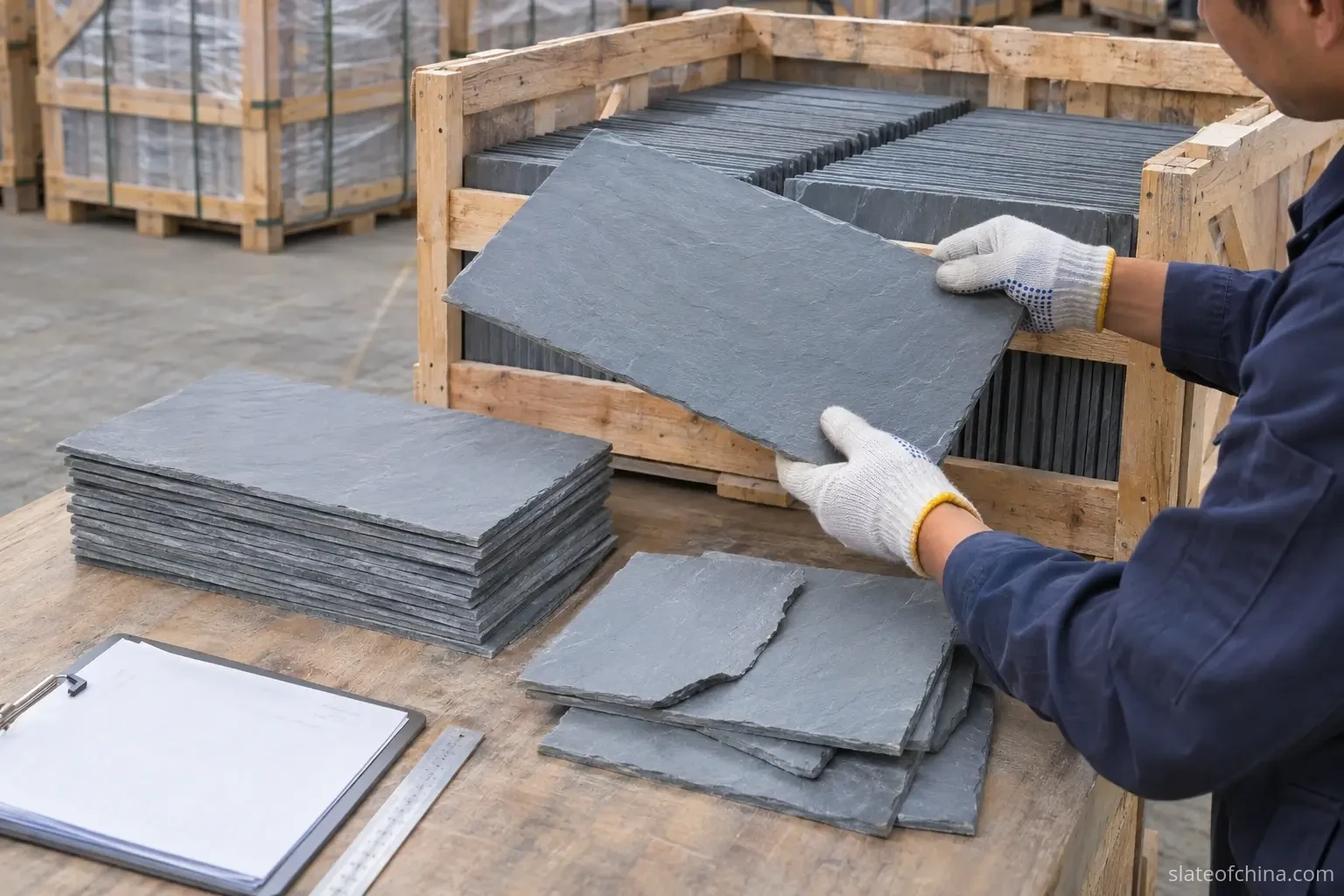
The breakage allowance guide sets out how the percentage is calculated and how the clause is worded; the short version is that the pre-shipment photographs and the seal record decide which side of the line a claim falls.
The Shipping Checklist: Eight Lines to Put on Every Order
Most of the friction described above can be removed at the quotation stage, at no cost, by putting eight lines on the order:
- Name the Incoterm, the port and the edition. "FOB Shanghai, Incoterms 2020" or "CIF Felixstowe, Incoterms 2020" — not "shipping included".
- Ask for freight and insurance as separate lines. On a CIF price, the two components should be visible, with the insured value and the clauses named.
- State the risk point in words. "Risk passes when the goods are on board the vessel at the named port of shipment."
- Specify the insurance scope. Which Institute Cargo Clauses, what insured percentage, what deductible.
- Confirm the document pack and who issues what. Invoice, packing list, bill of lading or sea waybill, certificate of origin if required, ISPM 15 marks on the timber, test report with the batch number.
- Agree the weight evidence. Packing list weights, VGM, and the tolerance at which a discrepancy becomes a query.
- Fix the release mechanism. Original set or telex release, and who instructs the carrier once the balance clears.
- Write the claim windows into the contract. The carrier's notice period for visible and non-apparent damage, and the supplier's claim period, stated as dates from delivery.
The sea is the predictable part. Packing, the trade term and the paper are where a shipment is actually decided — and all three are settled before the container reaches the quay.
Frequently Asked Questions
What is the best way to ship roofing slate from China?
A full 20ft container of crated roofing slate, loaded and braced at the factory, is the standard arrangement. It is a weight-limited load — crated 7–9 mm material comes to roughly 1,080–1,390 m², with thinner slate carrying further — and the ocean leg to a UK or European port commonly runs 25–40 days as a reference. A first order is often bought CIF so that freight and insurance sit with the seller; later orders usually move to FOB with an appointed forwarder.
Is FOB or CIF better for importing roofing slate?
CIF is simpler for a first container because the seller arranges the carriage and the minimum insurance and folds both into the price. It is not a delivered price: destination charges, customs, duty, VAT and the inland truck stay with the buyer, and the risk still passes when the goods are on board at the port of shipment. After the first order, FOB with the buyer's own forwarder usually gives cheaper freight and control of the sailing date.
When does risk transfer under FOB and CIF?
Under both terms, and under Incoterms 2020, risk passes when the goods are loaded on board the vessel at the named port of shipment. The old "ship's rail" description is no longer the reference point. CIF changes who pays the freight and buys the insurance, not where the risk moves, so damage before loading generally remains the seller's risk and damage after loading is the buyer's, with the insurance as the remedy.
What documents do I need to clear a roofing slate shipment?
The commercial invoice, the packing list and the bill of lading are the core set; a certificate of origin is added where the buyer or the bank requires one. Solid wood packaging must carry the ISPM 15 mark, and the test report with the batch number is what ties the stone to the specification. A phytosanitary certificate is a plant-health document and is only needed where the importing country requires one for the packaging. Every document must agree on crate count, gross weight, seal number and batch, or the container can be held.
How long does a slate container take to arrive?
The ocean leg from a Chinese port to a UK or European port commonly runs 25–40 days, about four to six weeks, and is a reference rather than a commitment because routing, transhipment and port congestion move it. Customs and the final truck add one to two weeks. A standard one-container order typically plans on 10–12 weeks from confirmed order to destination port, plus one to two weeks to site.
Does CIF insurance cover broken slate?
Often less than buyers assume. The minimum cover CIF requires is Institute Cargo Clauses (C) at 110% of the contract value, which responds to major casualties such as stranding, sinking, fire or collision rather than to rough handling at a terminal. Insufficient packing and inherent vice are excluded, and a deductible applies. For a high-value consignment, ask for ICC (A) cover and confirm the insured value and the deductible in writing.
What if my slate arrives damaged?
Note visible damage on the delivery receipt before signing, and give written notice to the carrier within the period its bill of lading sets — for damage that is not apparent on delivery, three days is the common reference under Hague-Visby-type regimes, but the contract and the applicable law govern. Against the supplier, the claim period is whatever the sale contract says; photograph the seal before opening, keep damaged pieces separate, and count against the packing list. The pre-shipment record and the seal number decide where the damage happened.
Related Reading
Ship the First Container Without the Guesswork
Slate of China's quotations name the port, the Incoterm and the freight and insurance lines separately, and every 20ft box leaves with the test report, the ISPM 15 crate, the seal number and the batch label that tie the paper to the stone. ask for a quotation with the handovers spelled out · browse the roofing slate range · view our test results