
Jiujiang Slate Flexural Strength: What 60 MPa Dry and 45 MPa Wet Actually Prove
How much bending can a slate take before it gives up? If your supplier can't answer that in MPa — and can't show you the wet number alongside the dry one — you're already in trouble.
Flexural strength is the line on a test report that separates a roof that lasts fifty years from one that starts shedding tiles in the third winter. It's also the number that decides whether a billiard bed panel stays dead flat across a 2.4-metre span or slowly bows until the balls roll crooked. For Jiujiang slate, that number tests at roughly 60 MPa dry and 45 MPa after 48 hours of full water saturation — but the two figures together tell a far more useful story than either one alone.
I'm a structural engineer. I sign calculations for buildings, and I've spent enough time around slate specifications to know that most strength pages tell you what the number is without ever explaining what it does. So this page is different. I'm going to put Jiujiang slate's flexural strength into three real load scenarios — wind, snow, and a billiard table — and show you what 60 and 45 actually buy you. No lab jargon you can't use. No numbers without context.
Quick Answer:
| Condition | Value |
|---|---|
| Dry flexural strength | ~60 MPa |
| Wet (48h soak) | ~45 MPa |
| ASTM C406 S1 minimum | ≥ 575 lbs (C120 test) |
| Wet retention | 75% of dry value |
Part of the Jiujiang Slate Guide — the origin story behind the numbers. If you want the testing methodology, our Roofing Slate Flexural Strength page covers the test setup; this page covers what the results mean.
Act I — Wind: The Force That Peels, Not Pushes
Most people picture wind pushing a roof down. That's not how slate roofs fail. Wind uplift is the real enemy — negative pressure that grabs the bottom edge of a tile and tries to peel it upward, prying against the nail or hook that holds it down. The tile doesn't just resist being pulled off; it resists being bent off. That's a flexural strength problem.
Here's what happens on a steeply pitched slate roof in a proper coastal blow. Wind hits the roof, splits at the ridge, and accelerates as it races down the leeward slope. Bernoulli's principle does the rest: faster air means lower pressure, and the pressure difference between the top and bottom of a tile can hit 1.5 kN/m² in a UK Zone 5 exposure (the highest wind zone in the British Standard for roofing). A standard 600×300 mm tile catches about 0.18 m² of that pressure differential, which means the uplift force on a single tile can reach roughly 270 newtons — the weight of a 27 kg child hanging off one nail.
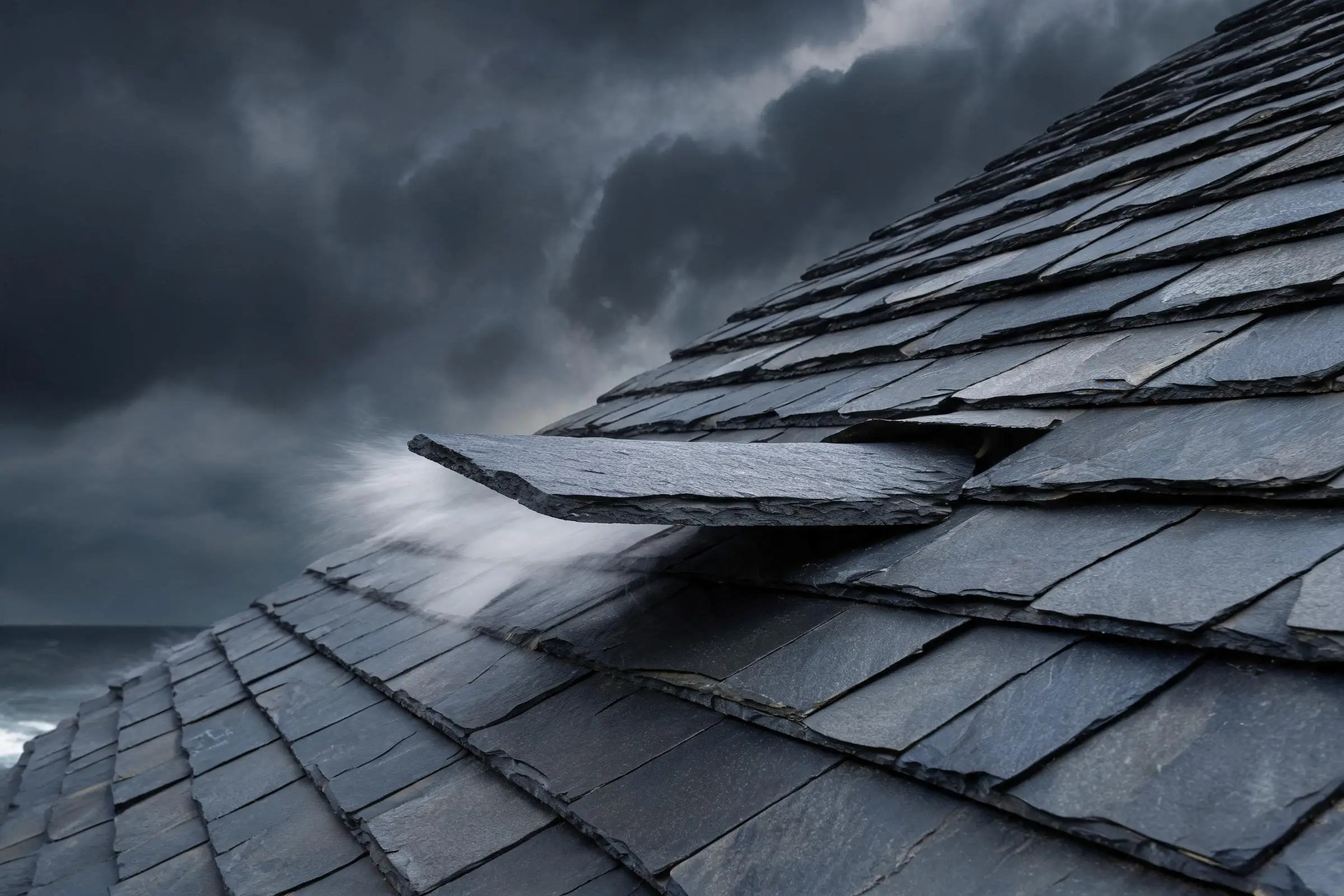
Now, what does 270 N of uplift mean to a tile that tests at 60 MPa? A 600×300×8 mm slate in a three-point bending setup breaks at roughly 3.5–4 kN of applied central load. The uplift force is pulling at the edge, not the centre, so the bending moment is lower than the test configuration — but even if you convert conservatively, the tile's bending capacity sits about 15 times above the worst-case uplift. That's not a close call. That's a tile that stays on the roof.
The reason I walk through this arithmetic is that a lot of slates are a close call. A stone testing at 30 MPa — and yes, some do — carries barely half the margin. Add a few years of water ingress opening up micro-pores, a wet-strength drop to 20 MPa, and a winter storm that finds the one tile the installer nailed slightly off-centre, and the safety factor evaporates. This is why the dry number alone is a sales number. The number that protects the building is the one after the rain.
Act II — Snow: The Force That Pushes Down and Stays
Snow load is the opposite of wind. Wind is a brief, violent tug. Snow is a slow, patient press that sits there for weeks. On a slate roof, every tile under the snowpack acts as a small beam — supported at the batten by its nail or hook, carrying the weight of snow above it, transferring load to the tile below through the headlap. The mechanics are gentle but relentless, and a tile with poor bending strength doesn't shatter — it creeps, cracks at the nail hole, and quietly drops a course.
The numbers are straightforward. UK snow load on a pitched roof typically runs 0.6 kN/m² for a standard site, though exposed and upland sites go higher. In Norway, Sweden, or the Alps, you can see 2.4 kN/m² or more. A 600×300 mm tile under 0.6 kN/m² carries about 108 N of distributed load. Under 2.4 kN/m² — a heavy Scandinavian snowpack — that becomes 432 N. Both are well below the bending capacity of a 60 MPa slate. Even accounting for the fact that a real roof tile isn't simply supported at two points like the test specimen, the margin remains comfortable.
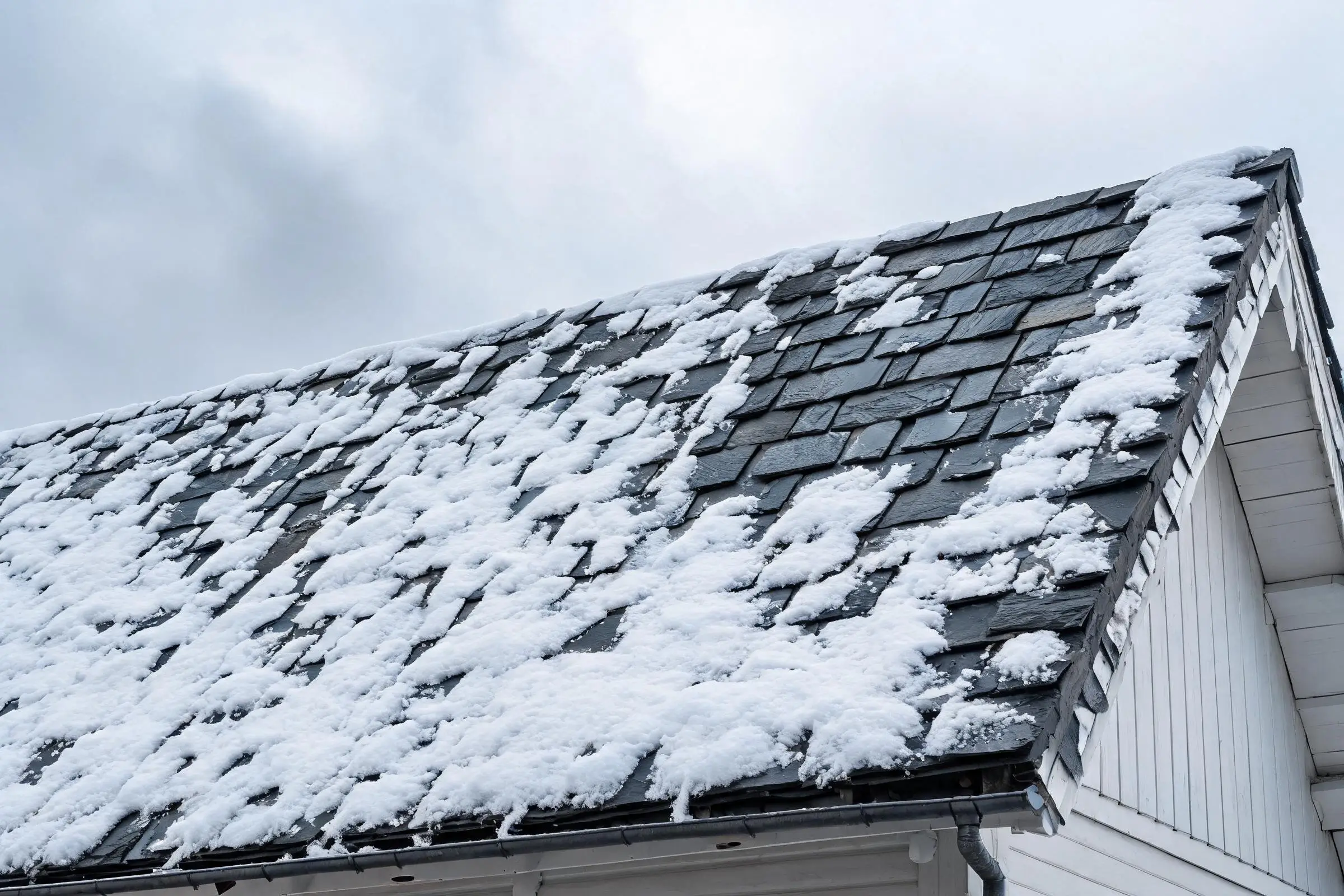
But snow has a secondary weapon, and it's the one engineers worry about more than the weight: wet snow followed by a freeze. A snowpack that thaws, refreezes, and thaws again cycles the slate through wet and frozen states. The water that entered the stone during the thaw now expands as it freezes — 9% volume increase — and that expansion happens inside the very pores that weaken the stone's bending resistance. A slate with 0.2% water absorption (Jiujiang's tested figure — see our water absorption analysis) barely takes on water, so the freeze–thaw penalty on its flexural strength is small. A slate with 0.6% absorption — which still passes the EN standard — may lose 30–40% of its bending strength over a hard winter. The 60 MPa you bought becomes 36 MPa on the coldest night of the year, and the snow load hasn't changed.
This is the connection most specifiers miss: water absorption and flexural strength aren't independent. They're a chain. Low absorption preserves strength in wet and freezing conditions. High absorption erodes it. Jiujiang slate's 0.2% absorption feeding into a 45 MPa wet strength is the chain working in your favour.
Act III — Water: The Number That Eats the Other Number
Every slate tests weaker soaked than dry. The question is never whether the number drops — it's how much and whether what's left is still enough. This is the part of the flexural strength conversation where I see the most misleading marketing.
Here's the mechanism in one sentence: water sitting in micro-pores between mineral grains acts like a wedge, reducing the interlocking friction that gives the stone its bending resistance. The more water gets in, the more the grains can slide, and the lower the force needed to snap the bar. A slate at 0.2% absorption has almost no water inside it, so the wedge effect is negligible. A slate at 0.8% absorption carries four times the water weight in its pores, and the wedge effect is real.
Jiujiang slate's test profile tells the story cleanly:
- Dry: ~60 MPa — the stone at its strongest, which it never is on a roof
- After 48-hour full soak: ~45 MPa — the stone after two days underwater, which no roof experiences but which the test runs to find the floor
- Retention: 75% — the wet strength holds three-quarters of the dry value
The industry's informal benchmark for "good slate" is wet retention above 70%. Jiujiang clears that at 75%. A slate that drops to 50% of dry after soaking is a stone whose mineral frame is merely compacted, not genuinely interlocked — and the difference between "compacted" and "interlocked" is exactly the difference between a slate that survives fifty winters and one that doesn't.
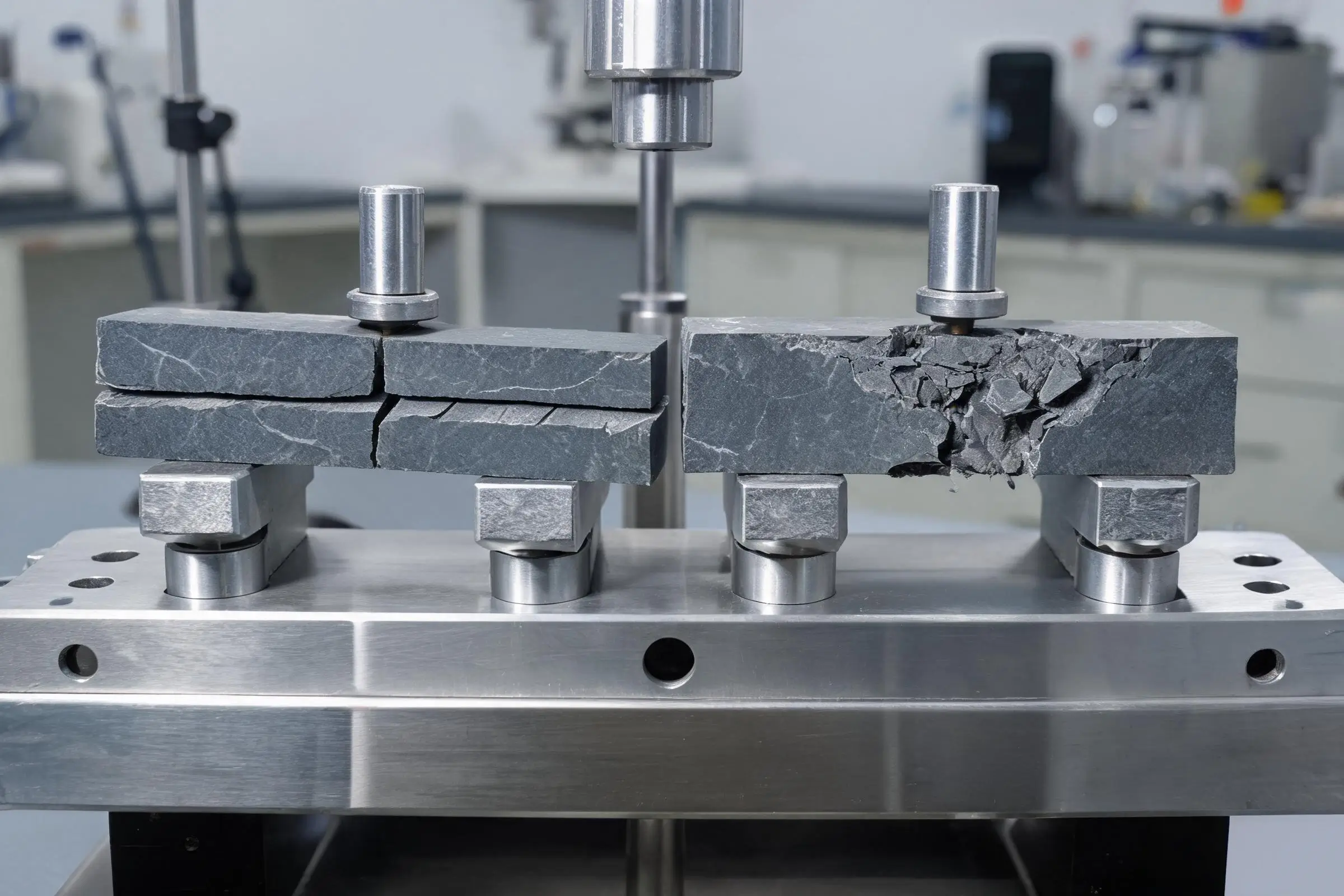
There's a reason the EN 12326 test soaks the sample for 48 hours. It's not trying to simulate a rainstorm — a roof tile dries between storms. The test is finding the floor: what's the lowest this stone's bending resistance ever goes? If 45 MPa is the floor and the minimum passing grade is 40 MPa, you're 5 MPa above the line at the stone's worst moment. That's a pass. But I'd rather see 45 MPa as a floor with the standard minimum sitting well below it — which is exactly where Jiujiang's numbers place it.
The three-point bending test itself is worth a moment, because the number on the report only makes sense if you know how it was produced.
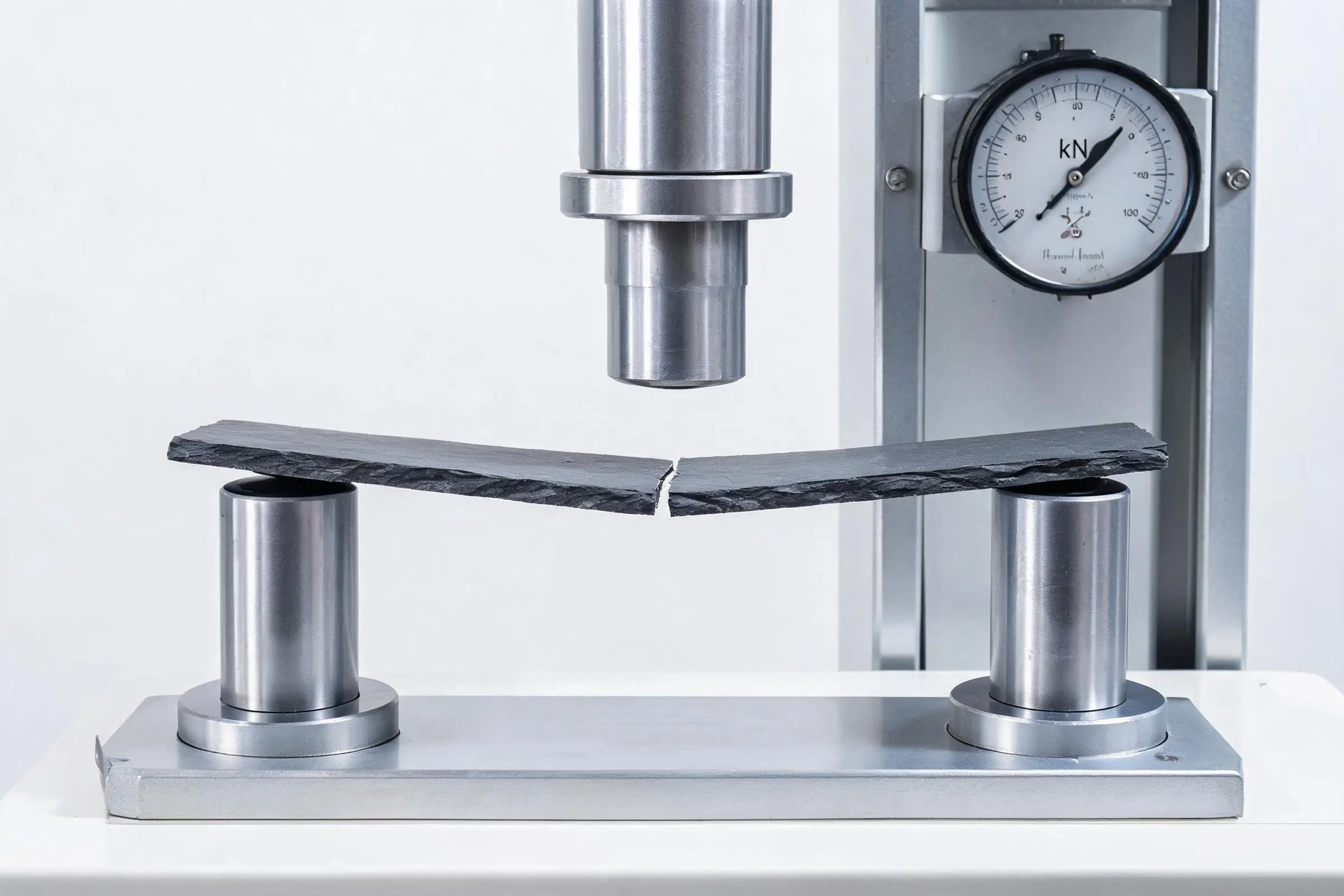
A rectangular bar of slate — typically 100 mm wide, cut from a production tile — rests on two cylindrical steel supports spaced 200 mm apart. A third steel cylinder presses down at the exact centre, increasing force at a controlled rate until the bar fractures. The machine records the peak force in newtons. That force, combined with the bar's width and the square of its thickness, gives the modulus of rupture in megapascals. The thickness-squared relationship is critical: an 8 mm bar tests roughly four times stronger in breaking load than a 4 mm bar of the same stone. This is why a test report that doesn't state the specimen thickness is not a test report — it's a flyer.
The methods are standardised as EN 12372 (European) and ASTM C120 (US). The classification that grades your product sits under EN 12326-1 and ASTM C406 respectively. For the full method walkthrough — jig geometry, loading rate, specimen preparation — the Roofing Slate Flexural Strength page on our sister guide is the technical companion to this one. Here, I'm more interested in what the number does than how the machine produces it.
Act IV — The Billiard Table: A 2.4-Metre Beam Nobody Sees
Most flexural strength pages end at the roof. Jiujiang slate has a second life, and the strength story there is entirely different.
A full-size tournament billiard table uses a three-piece slate bed: a centre panel and two end panels, each roughly 1.5 × 0.9 metres, totalling about 2.4 metres in playing length. Each panel is typically 25–40 mm thick — far thicker than a roof tile, because the job is different. The panel doesn't carry a person's boot or a snowpack. It carries its own weight, across a span, for decades, and it must not sag. Not by a visible amount. Not by the amount that makes a ball roll wrong.
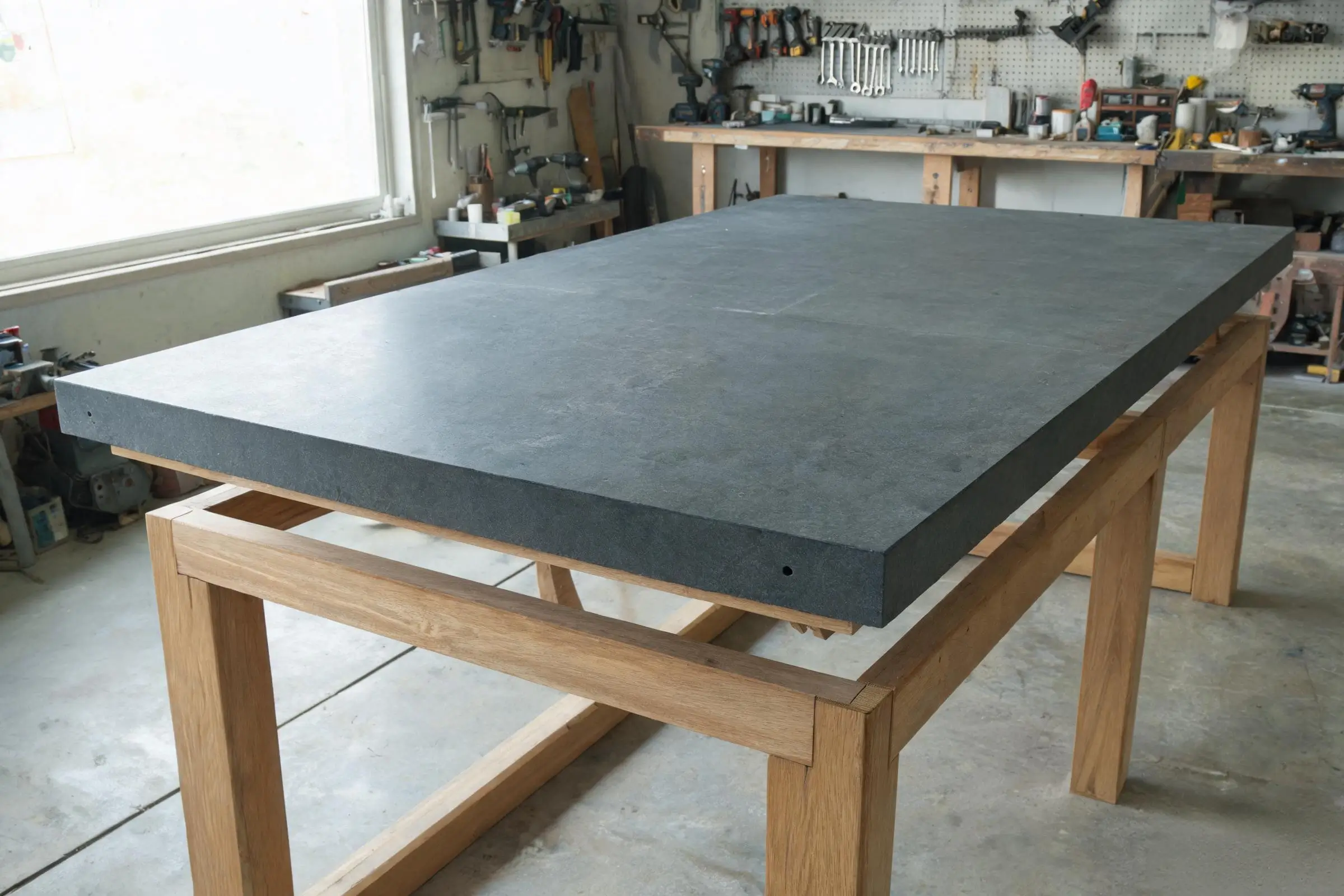
Here's the engineering: a 1.5 × 0.9 × 0.04 m slate panel weighs roughly 162 kg. It sits on a wooden frame that supports it at the long edges, leaving the centre free to span. Under its own weight, the panel deflects — all beams do. The question is by how much. For a simply supported plate of these dimensions, with a modulus of elasticity typical of dense slate (~20 GPa) and the self-weight distributed across the span, the theoretical mid-span deflection is well under 0.3 mm. That's below what the human eye can detect and well below the tolerance a table frame's levelling system is designed to absorb. The 60 MPa flexural strength isn't the number that stops the panel from sagging — that's the stiffness (modulus of elasticity) — but a stone with low flexural strength tends to have low stiffness too, because both trace back to the same mineral interlock.
So why does flexural strength matter on a billiard table? Because the panel isn't simply sitting there. It gets moved, lifted, transported, and — in three-piece tables — assembled and disassembled. Each handling event applies bending forces. A panel with 60 MPa flexural strength survives being lifted by two people at the edges, driven across a continent in a truck, and set onto a frame without developing micro-cracks that would later propagate under thermal cycling. A panel at 30 MPa flexural strength may look identical in the showroom and develop a hairline crack within a year of being moved. The flatness and dimensional stability of a billiard bed is the sum of several properties — flexural strength is the one that keeps it intact during handling, and density is the one that keeps it flat during service.
The link between the two uses is the same physical fact: Jiujiang slate's mineral skeleton is genuinely interlocked, not merely pressed together. That's what 60 MPa dry and 45 MPa wet — with 0.2% water absorption holding the wet number up — actually tells you. The stone doesn't pass because it's thick. It passes because the mica and quartz grains are locked into each other at a microscopic level that water can't easily pry apart. The density page and the water absorption page each trace this from their own angle; here, the evidence is the bending bar.
Act V — Reading the Report: Three Lines, One Verdict
When a supplier sends you a test certificate, the flexural strength section usually has two or three rows. Here's how I read them as an engineer, in order of importance:
- The wet value. This is the number that exists on the roof. If the report only shows a dry figure, the report is incomplete. A dry-only number tells you what the stone is in a showroom; a wet number tells you what it is after the first storm. Ask for it. If the lab didn't test it, find out why.
- The specimen thickness. Because the modulus formula squares the thickness, comparing two slates tested at different thicknesses is meaningless. A 4 mm slate reporting 40 MPa and an 8 mm slate reporting 50 MPa aren't in the same conversation — the 8 mm one is dramatically stronger in breaking load despite only modestly higher stress. Always confirm the test specimen matches the tile you're buying.
- The standard reference. ASTM C406 S1 requires a minimum modulus of rupture of 575 lbs in the C120 test. EN 12326-1 expresses breaking load in newtons by size class. Know which standard your market uses and check against the correct floor. Our published test results show both.
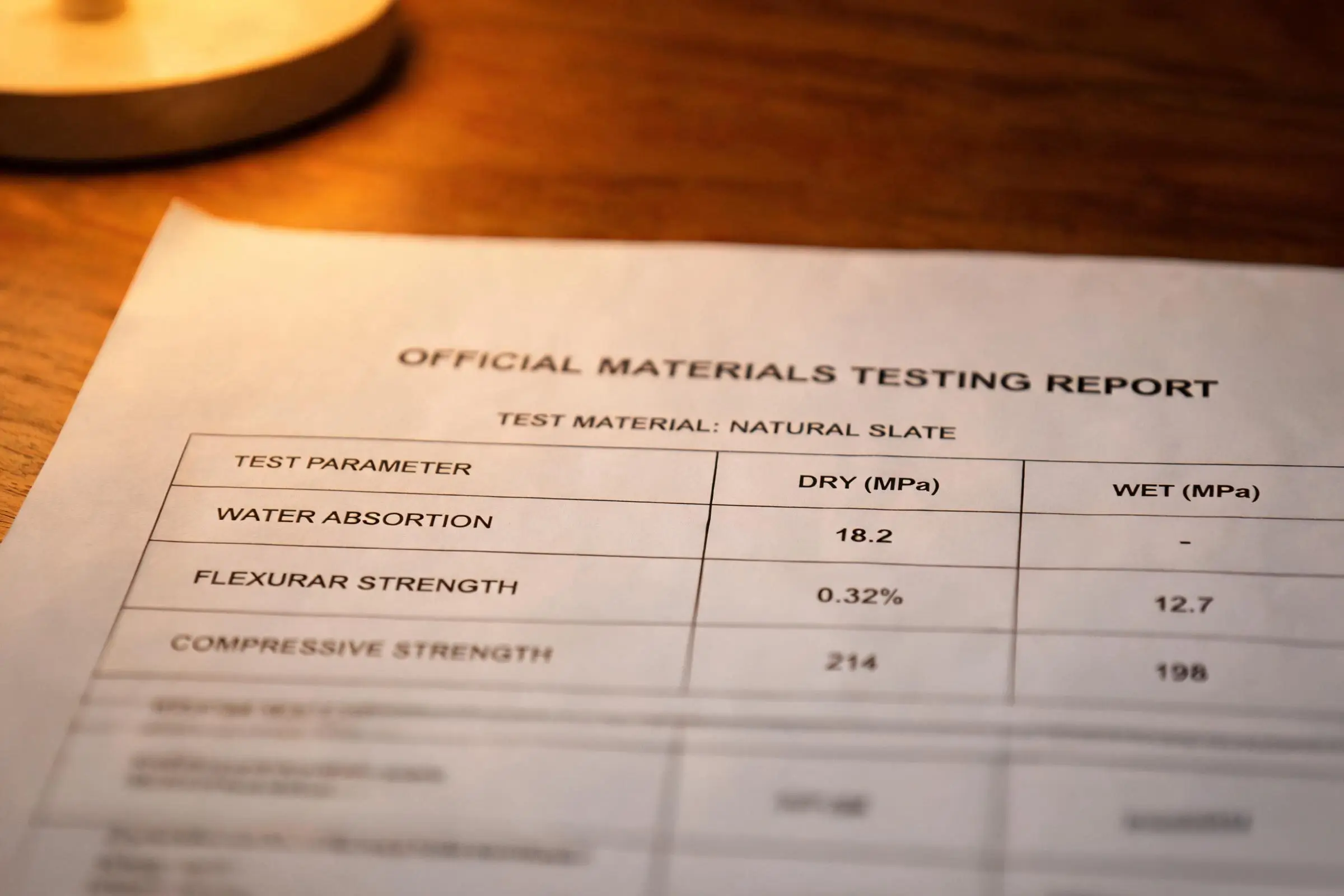
One trap I see repeatedly: a supplier quoting a single MPa figure without context — "our slate is 55 MPa" — as if that number stands alone. It doesn't. Fifty-five at what thickness? Dry or wet? Under which standard? A bare number without these three qualifiers is a marketing line, not an engineering specification. The test report reading guide covers the full certificate; here, the takeaway is that flexural strength is never one number. It's a pair — dry and wet — qualified by size and standard, and the gap between the pair tells you as much as either figure alone.
The gap, specifically, tells you about the stone's structure. A small gap (60 → 45, 25% loss) means water barely gets in and barely weakens the frame. A large gap (50 → 25, 50% loss) means water is finding connected pore space and levering the grains apart. The gap is, in effect, a second absorption test — run through the lens of strength rather than weight. Read both numbers, and the gap between them, and you've read more about the stone than any single figure on the certificate can tell you.
For Jiujiang slate, that gap is 15 MPa — a 25% drop that places the wet value at 75% of dry, comfortably above the 70% retention benchmark the trade uses to separate genuinely interlocked slate from merely compacted stone. That's the number I'd put in a calculation file. Not 60. Not 45. The relationship between them.
What is a good flexural strength for roofing slate?
In the trade, good roofing slate tests in the 40–60 MPa dry range and stays above 40 MPa after 48 hours of water soaking. Jiujiang slate reports around 60 MPa dry and 45 MPa wet, placing it in the upper band. The minimum passing grades are set by ASTM C406 (S1 requires ≥ 575 lbs in the C120 test) and EN 12326-1 (breaking load minimums by tile size). What separates a good slate from a marginal one is not the dry number but how much of it survives a soak — anything above 70% retention is solid; Jiujiang holds 75%.
Why does wet flexural strength matter more than dry?
Because a roof tile is never dry during the moment that tests it most. The worst load case — a wet snowpack on a freezing night, or wind-driven rain followed by a frost cycle — happens when the stone has taken on water and its bending resistance is at its lowest. The dry number tells you what the stone can do in a showroom; the wet number tells you what it can still do after two days underwater, which is the most aggressive scenario the test can simulate. If the wet number clears the standard, the dry number is almost irrelevant — the stone will always be stronger dry than wet, so the wet figure is the one that limits the design.
How does thickness affect slate bending strength?
Flexural strength (in MPa) is a material property — the same stone tests at roughly the same MPa regardless of thickness. But breaking load (in newtons) scales with the square of thickness: doubling the thickness roughly quadruples the force needed to break the bar. This means a 4 mm tile and an 8 mm tile of the same Jiujiang slate have the same flexural strength but very different breaking loads — the 8 mm tile can carry about four times the force before snapping. That's why test reports always state the specimen thickness, and why comparing MPa across different thicknesses, while valid, doesn't tell you how the tile behaves on a roof.
Is 60 MPa strong enough for high-wind and snow areas?
Yes, with comfortable margin. A UK Zone 5 wind exposure generates roughly 1.5 kN/m² of uplift on a roof — about 270 N on a 600×300 mm tile. The same tile in a three-point bending test breaks at roughly 3.5–4 kN, giving a safety factor of about 15. Snow loads up to 2.4 kN/m² (heavy Scandinavian snowpack) apply about 432 N per tile — still far below the breaking threshold. The wet strength of 45 MPa maintains this margin even after the stone has taken on water, which is the condition that matters in a real storm.
What is the difference between flexural strength and breaking load?
Breaking load is the raw force (in newtons or kilonewtons) that snaps a specific slate bar in the test machine. Flexural strength, or modulus of rupture, is that force recalculated for the specimen's width and the square of its thickness, expressed in megapascals. Breaking load belongs to that specific piece of slate; flexural strength belongs to the stone itself. Two tiles of different thickness from the same quarry have the same flexural strength but different breaking loads — the thicker one carries more force before snapping.
Does flexural strength matter for billiard slate?
Yes, but for a different reason than roofing. A billiard bed panel is 25–40 mm thick and sits on a frame that supports it at the edges — it doesn't face wind or snow loads. Flexural strength matters during handling: lifting, transporting, assembling and disassembling three-piece tables all apply bending forces. A panel with 60 MPa flexural strength resists micro-cracking during handling, and micro-cracks are what eventually propagate under thermal cycling and cause a bed to lose flatness. Low-strength slate can look identical in the showroom and develop hairline cracks within a year of being moved.
Strength is a pair of numbers, not one.
Ask for the wet value. If a supplier only quotes dry MPa, the number they're hiding is the one that matters.
Request Our Test Data