
Roofing Slate Buying Guide
Choosing the right roofing slate is one of the most important decisions for any roofing project. The ideal slate depends on factors such as roof design, climate, budget, desired lifespan, and architectural style. With so many options available, understanding the differences in slate quality, sizes, thicknesses, colors, and grades can help you avoid costly mistakes and ensure long-lasting performance.
This comprehensive Roofing Slate Buying Guide walks you through every step of the selection process—from choosing the right natural slate and comparing specifications to estimating quantities and selecting a reliable supplier. Whether you’re a homeowner, architect, roofing contractor, builder, or distributor, this guide will help you make an informed purchasing decision with confidence.
Table of Contents
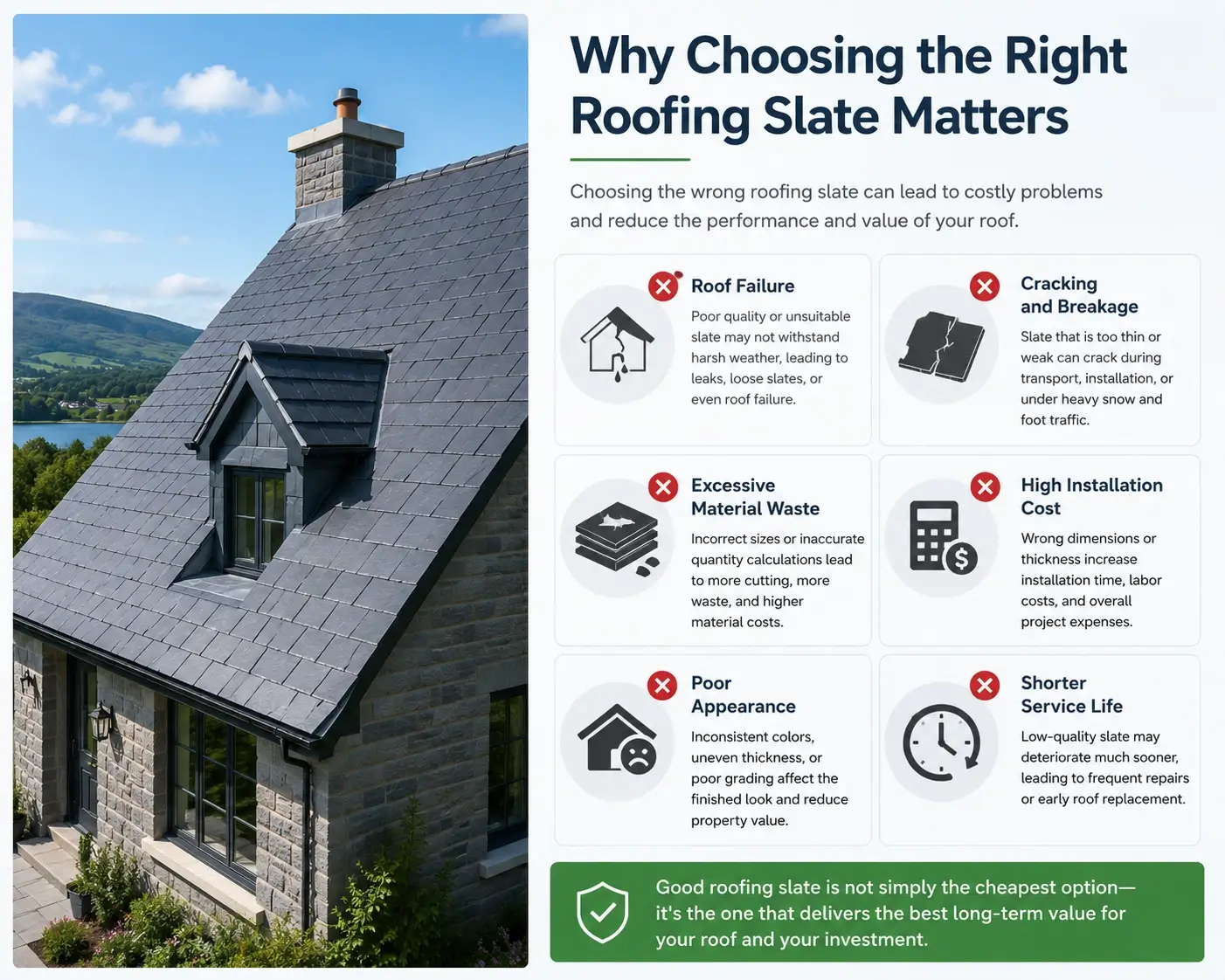
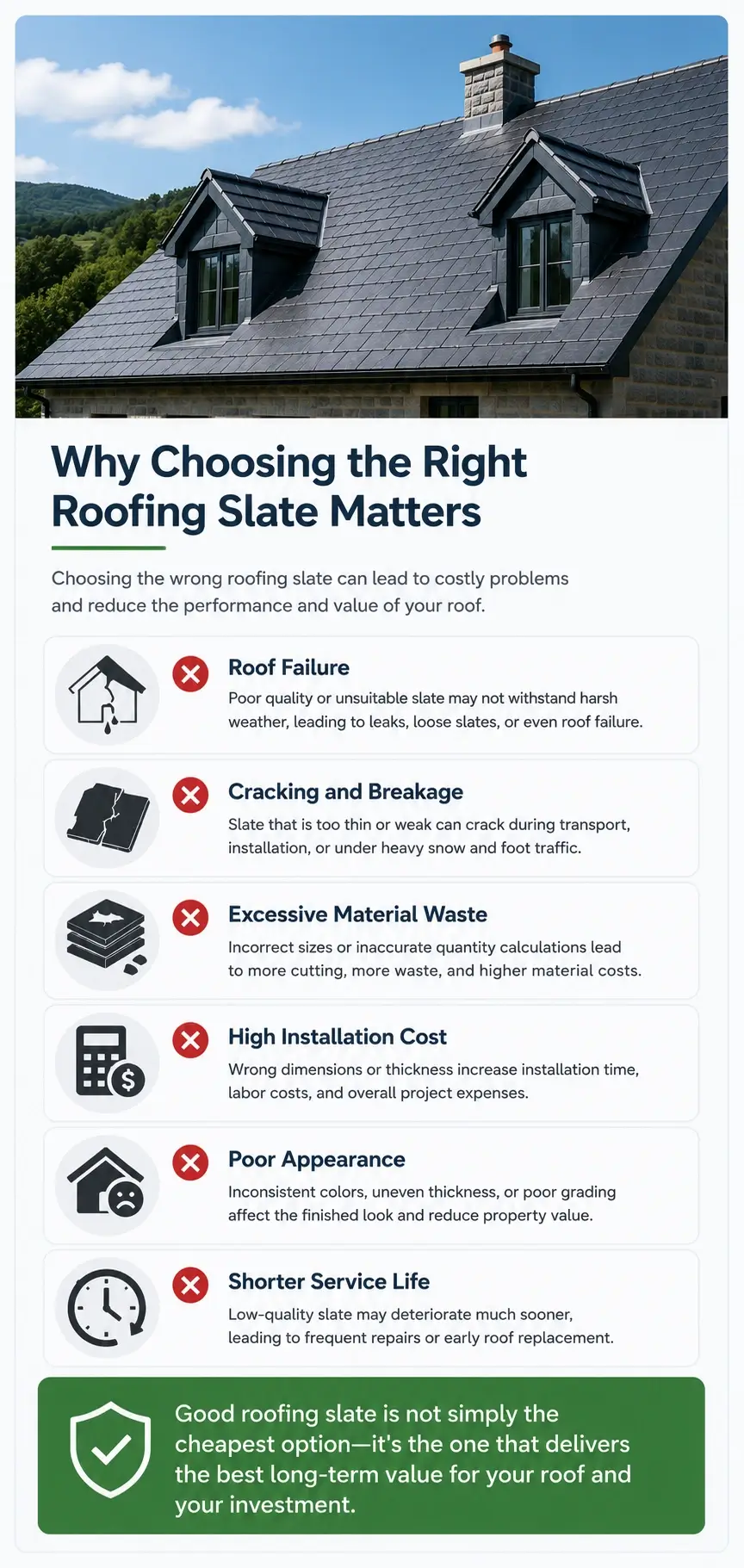
Why Choosing the Right Roofing Slate Matters
A slate roof is a long-term investment, but its performance depends on choosing the right roofing slate from the very beginning. While many buyers focus mainly on price, factors such as slate quality, thickness, size, grade, and suitability for the local climate have an even greater impact on the roof’s durability, appearance, and overall cost.
Selecting the wrong slate can lead to expensive repairs, premature replacement, and disappointing results. Understanding the key buying factors before placing an order helps ensure your roof performs as expected for decades.
Common Problems Caused by Choosing the Wrong Roofing Slate
❌ Roof Failure
Low-quality slate or unsuitable specifications may fail to withstand harsh weather conditions, resulting in water infiltration, loose slates, or even roof failure over time.
❌ Cracking and Breakage
Slate that is too thin or lacks sufficient strength can crack during transportation, installation, or under heavy snow and foot traffic, increasing replacement costs.
❌ Excessive Material Waste
Incorrect slate sizes or inaccurate quantity calculations often lead to unnecessary cutting, excessive waste, and additional material purchases.
❌ Higher Installation Costs
Choosing the wrong slate dimensions or thickness can significantly increase installation time and labor costs, especially on complex roof designs.
❌ Poor Roof Appearance
Inconsistent colors, uneven thickness, or poor grading can affect the finished roof, reducing the visual appeal and value of your property.
❌ Shorter Service Life
Not all roofing slate offers the same durability. Slate with poor geological properties or inadequate quality control may deteriorate much sooner than expected, leading to higher lifetime ownership costs.
How This Buying Guide Helps You Make the Right Choice
Buying roofing slate doesn’t have to be complicated. This guide simplifies the decision-making process by explaining what really matters when comparing natural roofing slate products.
You’ll learn how to:
- Choose the right slate type for your project.
- Compare slate sizes, thicknesses, and grades.
- Select the most suitable color and finish.
- Understand quality standards and technical specifications.
- Estimate the correct quantity and budget.
- Avoid common buying mistakes.
- Find a reliable roofing slate supplier.
Whether you’re planning a residential roof, a commercial building, a heritage restoration, or an export project, this guide provides practical advice to help you buy roofing slate with confidence.
Step 1 – Choose Natural Slate or Synthetic Slate
One of the first decisions you’ll make when buying roofing slate is whether to choose natural slate or synthetic slate. Both materials can create an attractive roof, but they differ significantly in durability, appearance, maintenance, and long-term value.
The right choice depends on your project goals, budget, and how long you expect the roof to last. Before comparing sizes, thicknesses, or colors, it’s important to decide which roofing material best meets your needs.
Natural Slate: The Premium Long-Term Investment
Natural roofing slate has been used for centuries on homes, churches, castles, and public buildings around the world. Formed by nature over millions of years, each slate tile offers unique texture, rich color variations, and exceptional durability.
If you’re looking for a roof that combines timeless beauty with outstanding performance, natural slate remains the industry benchmark.
Natural roofing slate is the ideal choice if you value:
✔ A service life of 100 years or more
High-quality natural slate can last for over a century with proper installation and minimal maintenance.
✔ Authentic natural beauty
Every slate tile has unique textures and subtle color variations that cannot be perfectly replicated by manufactured products.
✔ Higher property value
A genuine slate roof is widely recognized as a premium roofing system that enhances curb appeal and can increase the value of residential and commercial properties.
✔ Excellent weather resistance
Natural slate performs exceptionally well in rain, snow, frost, wind, and UV exposure, making it suitable for a wide range of climates.
Synthetic Slate: A Budget-Friendly Alternative
Synthetic slate, also known as composite or artificial slate, is manufactured from engineered materials such as recycled polymers, rubber, or composite resins. It is designed to imitate the appearance of natural slate while reducing the initial purchase and installation costs.
Synthetic slate may be a suitable option for projects where budget is the primary concern or where the roof structure cannot support the additional weight of natural stone.
It is commonly chosen for:
- Budget-conscious residential projects
- Roof renovations with weight limitations
- Projects requiring a slate-like appearance at a lower upfront cost
However, its appearance, lifespan, weathering characteristics, and long-term value may differ from those of genuine natural slate.
Which Roofing Slate Is Right for You?
| If you want… | Recommended Choice |
|---|---|
| 100+ year lifespan | ✅ Natural Slate |
| Authentic natural appearance | ✅ Natural Slate |
| Maximum property value | ✅ Natural Slate |
| Premium architectural projects | ✅ Natural Slate |
| Heritage restoration | ✅ Natural Slate |
| Lower initial budget | ✅ Synthetic Slate |
| Lightweight roofing material | ✅ Synthetic Slate |
Our Recommendation
For homeowners, architects, builders, and distributors seeking long-term performance and lasting value, natural roofing slate remains the preferred choice. Although the initial investment is higher than synthetic alternatives, its exceptional durability, timeless appearance, and minimal maintenance requirements often result in a lower lifetime cost.
If your priority is reducing upfront expenses or meeting specific structural requirements, synthetic slate can be a practical alternative. The best option ultimately depends on your project’s objectives, budget, and performance expectations.
Want a detailed comparison? Read our complete guide: Natural Slate vs Synthetic Slate to explore the differences in durability, appearance, cost, maintenance, environmental impact, and long-term value before making your final decision.
Natural Slate
✅ 100+ Years
✅ Natural Stone
✅ Premium Appearance
✅ Adds Property Value
✅ Low Maintenance
Synthetic Slate
✓ 30–50 Years
✓ Composite Material
✓ Slate-like Appearance
✓ Lower Initial Cost
✓ Lightweight
Step 2 – Select the Right Slate Type
Not all natural roofing slate is the same. The characteristics of slate are largely determined by its geological origin, quarry location, and mineral composition. These factors influence the slate’s color, texture, strength, weather resistance, consistency, and long-term performance.
When choosing roofing slate, it’s important to look beyond the country of origin. Instead, consider the quality and reliability of the specific quarry, as well as the supplier’s ability to deliver consistent products over time.
Why Quarry Quality Matters More Than Country of Origin
Many buyers assume that all slate from the same country performs identically. In reality, roofing slate from different quarries—even within the same region—can vary in:
- Geological formation
- Mineral composition
- Density
- Water absorption
- Frost resistance
- Surface texture
- Color consistency
- Dimensional accuracy
For long-term roofing performance, choosing a reliable quarry with proven quality control is often more important than focusing solely on the country where the slate is produced.
Why Many Buyers Choose Jiujiang Roofing Slate
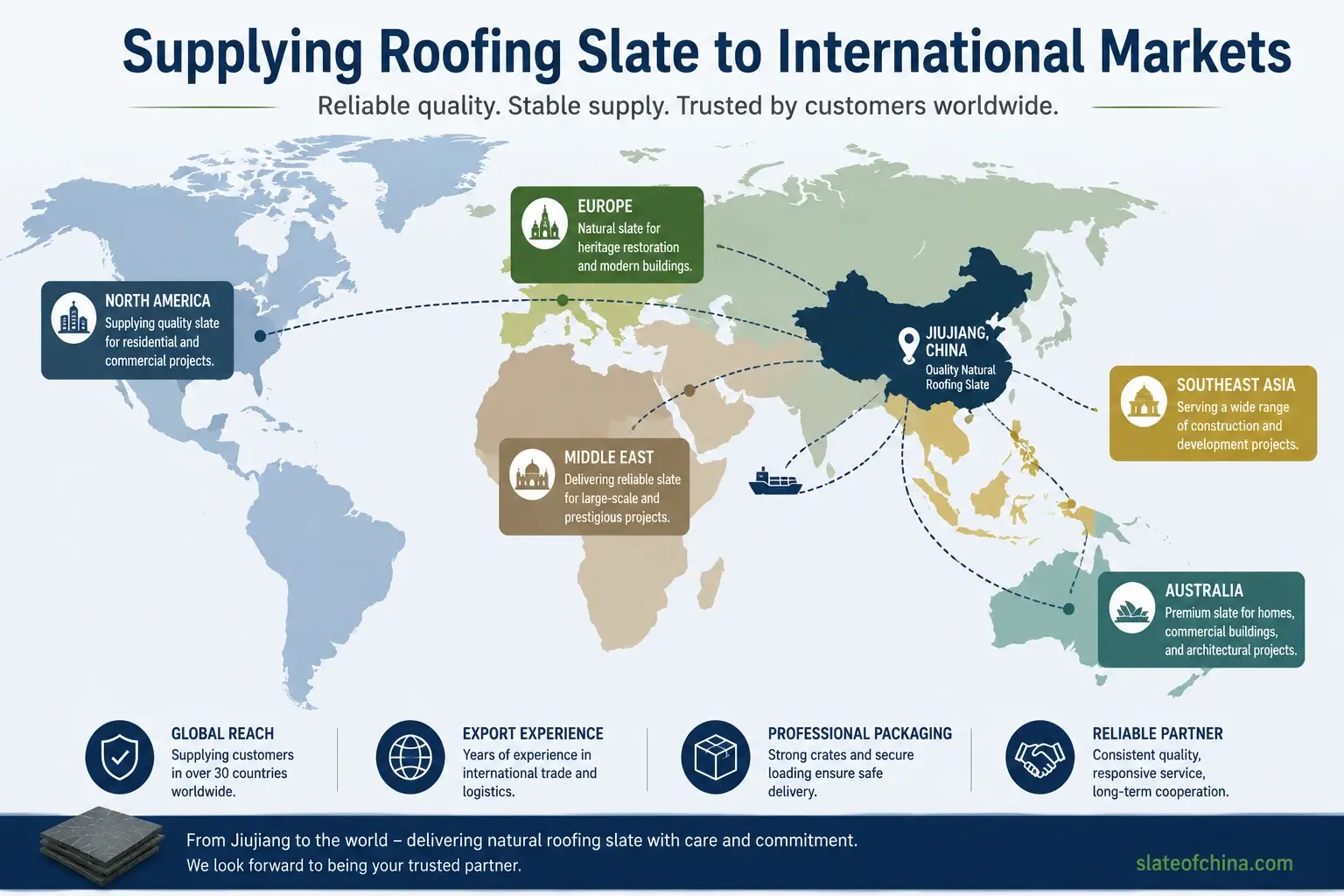
Jiujiang, located in Jiangxi Province, China, is one of the world’s most established natural slate production regions. Thanks to its abundant slate resources and decades of manufacturing experience, Jiujiang roofing slate has become a popular choice for residential, commercial, and export projects across Europe, North America, and other international markets.
Rather than competing on price alone, many buyers choose Jiujiang slate because it offers a balanced combination of quality, supply stability, and overall value.
Consistent Quality
Jiujiang roofing slate is known for its stable geological characteristics, helping manufacturers produce slate with consistent color, thickness, dimensional accuracy, and surface texture. This consistency contributes to easier installation and a more uniform finished roof.
Reliable Availability
Large production capacity and well-established manufacturing facilities allow Jiujiang suppliers to support both small custom orders and large commercial projects while maintaining dependable lead times.
Excellent Cost-Effectiveness
Compared with many premium European roofing slates, Jiujiang slate offers excellent performance at a competitive price, making it a practical solution for projects seeking long-term durability without exceeding budget.
Extensive Export Experience
With decades of international export experience, many Jiujiang manufacturers understand the requirements of overseas markets, including CE certification, ASTM-related testing, customized packaging, container loading, and international logistics.
This experience helps reduce purchasing risks and ensures smoother project delivery.
Which Slate Type Is Right for Your Project?
Your choice should depend on the goals of your project rather than simply selecting the most expensive or the least expensive option.
Consider these questions before making a decision:
- Is long-term durability your highest priority?
- Do you need consistent color across a large project?
- Is your project residential, commercial, or historic restoration?
- What is your available budget?
- Do you require reliable long-term supply for multiple phases?
- Does your supplier provide technical documentation and quality testing?
Answering these questions will help you narrow down the most suitable roofing slate for your project.
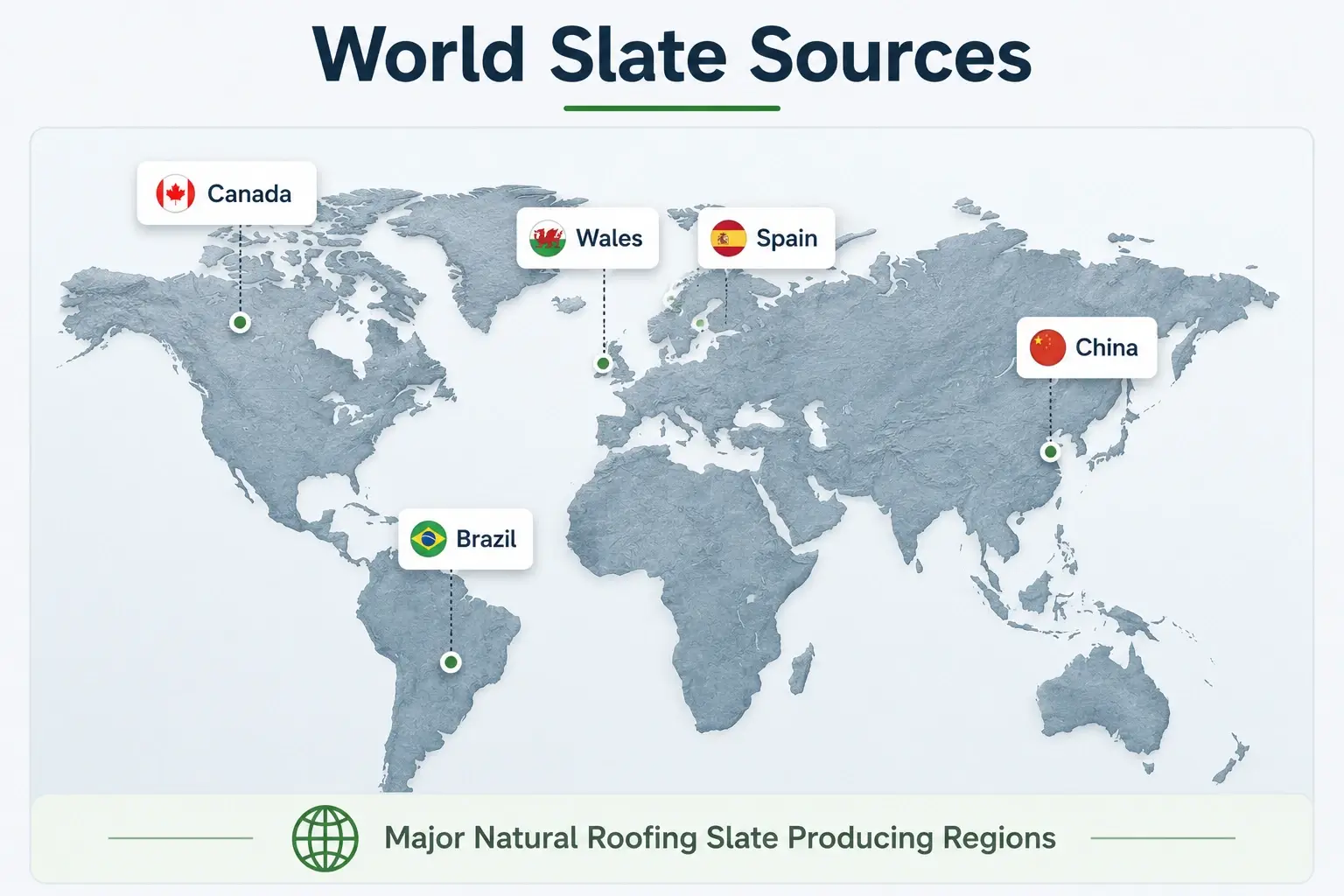
🇨🇳 China
Excellent Value
Stable Supply
Many Colors
🇪🇸 Spain
Premium Market
Dark Grey
European Standard
🏴 Wales
Historic
Premium Heritage
Limited Supply
🇧🇷 Brazil
Dense Slate
Competitive Price
🇨🇦 Canada
Premium Residential
Natural Colors
Why Choose Jiujiang Slate
Step 3 – Decide the Right Slate Size
Choosing the right roofing slate size is about more than appearance. The dimensions of a slate tile affect installation time, material usage, roof aesthetics, and overall project cost.
There is no single “best” roofing slate size. The ideal choice depends on your roof design, architectural style, roof pitch, climate, and budget. Selecting the appropriate size helps achieve the right balance between performance, visual appeal, and installation efficiency.
Need detailed dimensions? See our complete guide: Roofing Slate Sizes.
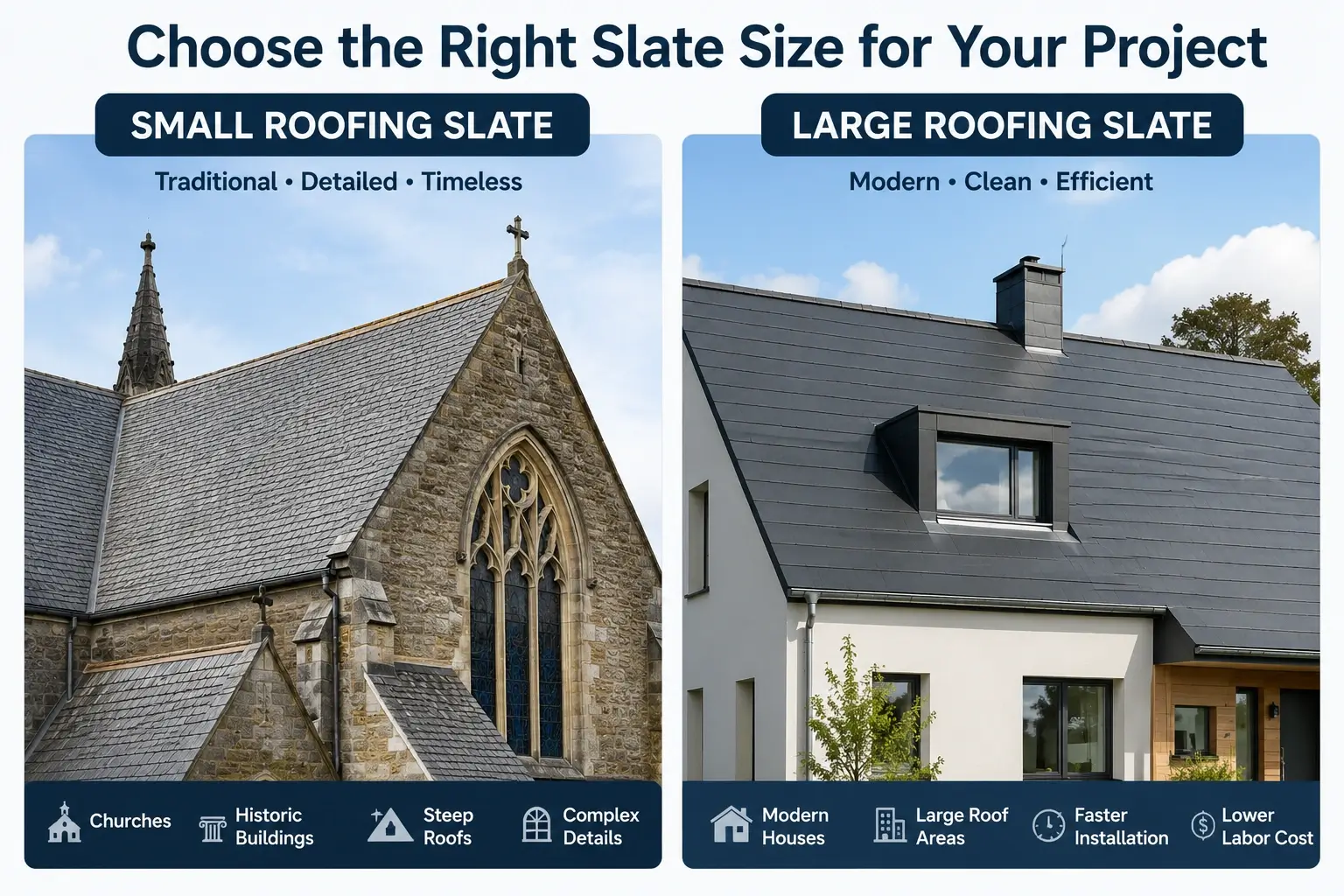
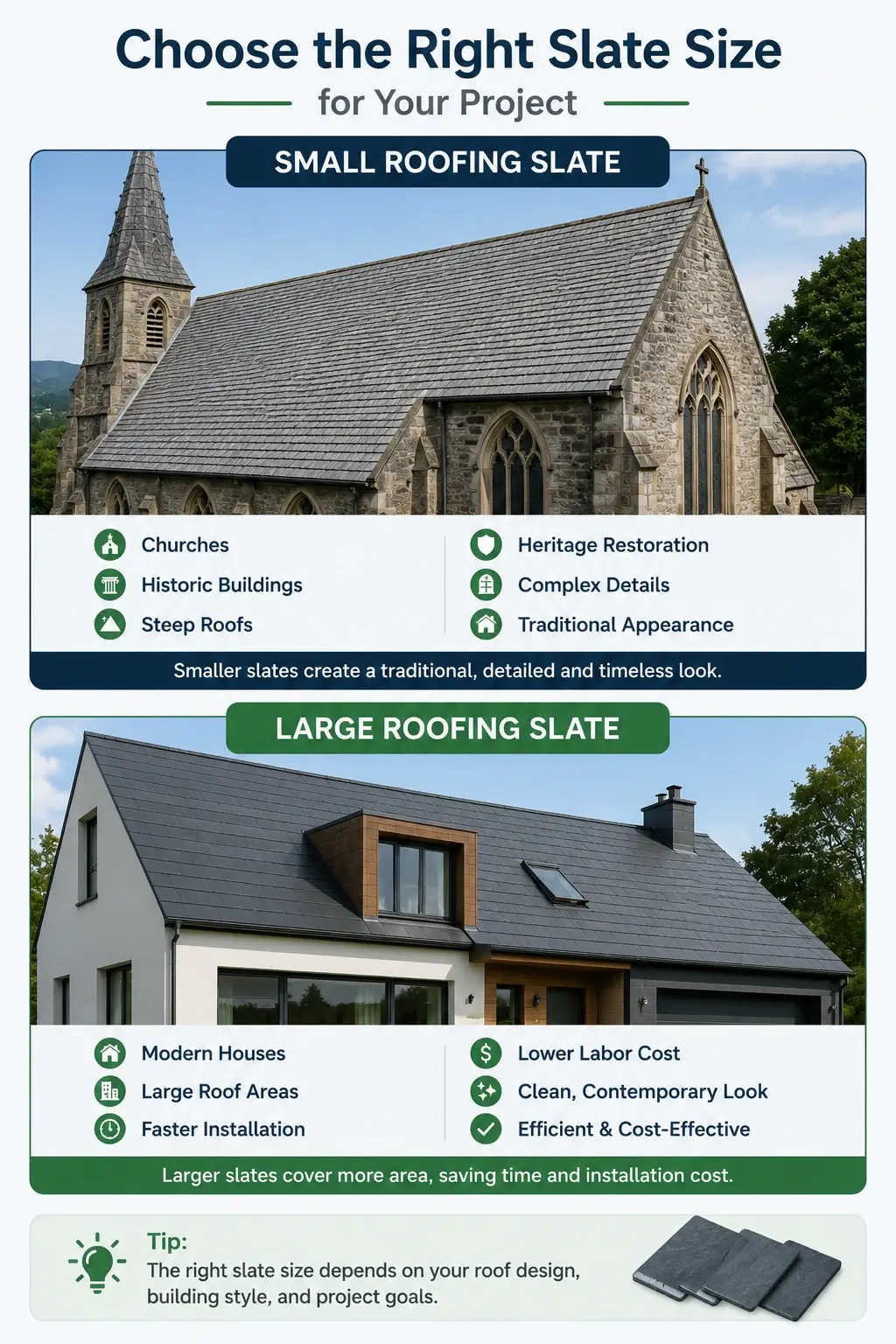
When to Choose Small Roofing Slate
Small-format roofing slates create a traditional, highly detailed roof surface. Because more individual slates are installed per square meter, they provide excellent flexibility for complex roof designs and architectural details.
Small roofing slate is often recommended for:
Churches and historic buildings requiring an authentic traditional appearance.
Steep roofs, where smaller slates fit roof angles and details more easily.
Heritage restoration projects, where matching the original roof design is essential.
Roofs with dormers, valleys, turrets, or curved sections, where frequent cutting and fitting are required.
Although installation typically takes longer and requires more labor, small slate tiles deliver timeless elegance and architectural character.
When to Choose Large Roofing Slate
Large-format roofing slates are increasingly popular for modern residential and commercial buildings. Their larger coverage area means fewer tiles need to be installed, improving installation efficiency while creating a clean, contemporary roof appearance.
Large roofing slate is generally the better choice for:
- Modern homes with simple roof layouts.
- Large residential or commercial roofs where installation efficiency is important.
- Projects seeking lower labor costs due to fewer slates being installed.
- Contemporary architectural designs that emphasize clean lines and larger roof surfaces.
Large slates can reduce installation time and help lower overall project costs, especially on uncomplicated roof structures.
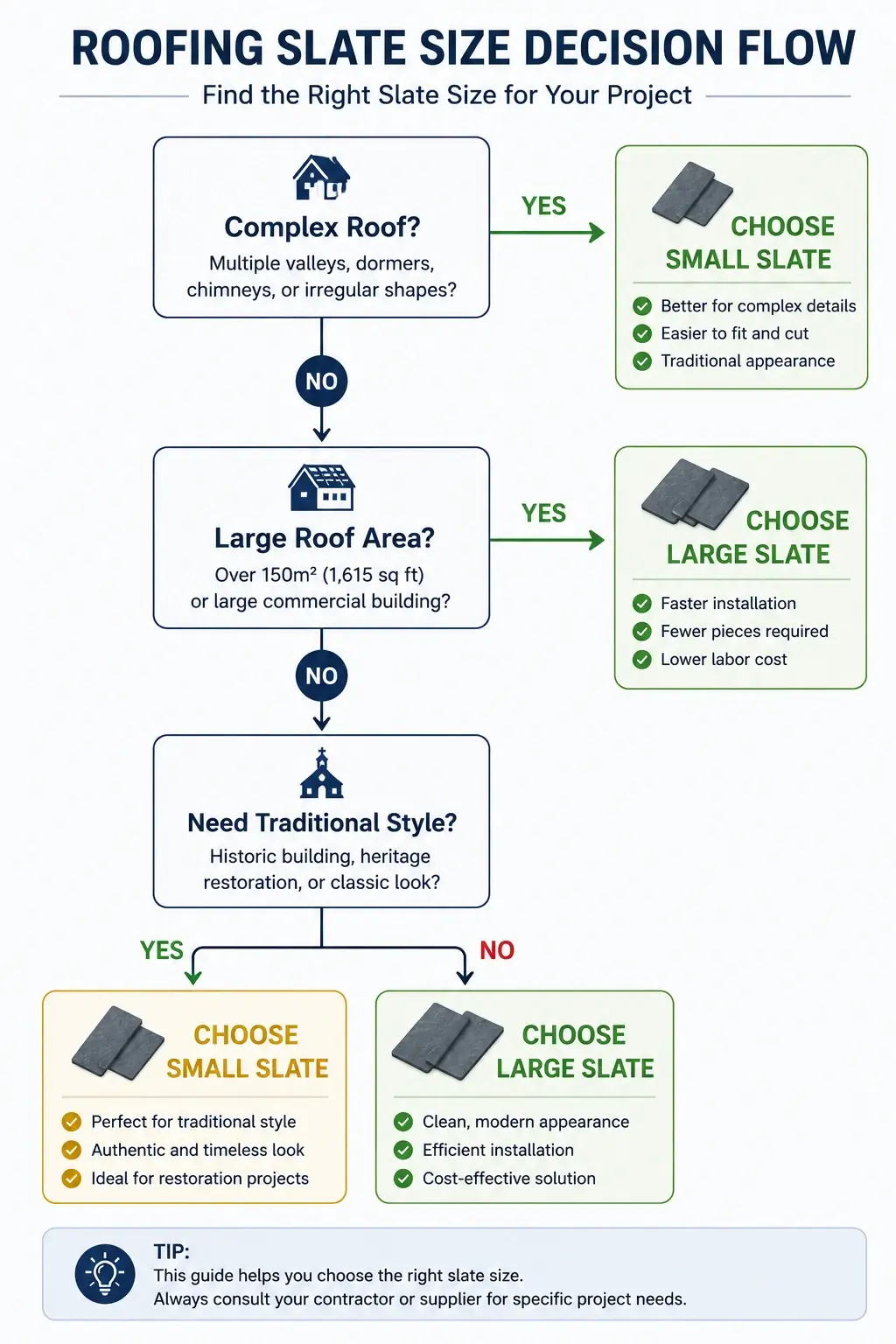
Factors to Consider Before Choosing Slate Size
Before deciding on a roofing slate size, consider these important factors:
Roof Design
Complex roofs with multiple hips, valleys, dormers, or chimneys usually benefit from smaller slates, while simple roof designs often work well with larger formats.
Roof Pitch
Steeper roofs traditionally use smaller slate tiles because they follow the roof geometry more effectively and create a classic appearance.
Building Style
Historic architecture often looks best with smaller slates, whereas contemporary buildings usually suit larger slate formats.
Installation Budget
Larger roofing slates require fewer pieces per square meter, which can reduce installation time and labor costs.
Visual Preference
Smaller slates create a more detailed, textured roof. Larger slates provide a cleaner, more minimalist appearance.
Roofing Slate Size Decision Guide
| Project Type | Recommended Slate Size |
|---|---|
| Historic churches | ✅ Small Slate |
| Heritage restoration | ✅ Small Slate |
| Steep roofs | ✅ Small Slate |
| Complex roof designs | ✅ Small Slate |
| Modern houses | ✅ Large Slate |
| Commercial buildings | ✅ Large Slate |
| Large roof areas | ✅ Large Slate |
| Faster installation | ✅ Large Slate |
| Lower labor cost | ✅ Large Slate |
Expert Recommendation
Rather than selecting a slate size based solely on personal preference, consider the roof as a complete system. The best roofing slate size is one that complements the building’s architecture, suits the roof structure, and supports efficient installation while staying within your project budget.
If you’re unsure which size is most suitable, consult your roofing contractor or slate supplier before placing an order. They can recommend the most appropriate slate dimensions based on your roof drawings, local building practices, and installation method.
Small Roofing Slate
🏰 Traditional
⛪ Church
🏛 Heritage
⛰ Steep Roof
✂ Easy for Details
Large Roofing Slate
🏡 Modern
🏢 Commercial
🏠 Residential
⏱ Faster Installation
💰 Lower Labor Cost
Step 4 – Choose the Correct Slate Thickness
Roofing slate thickness plays an important role in the roof’s durability, appearance, structural weight, and overall project cost. While many buyers assume that thicker slate is always better, the ideal thickness depends on the building type, local climate, roof structure, and design objectives.
Choosing the right thickness helps achieve the best balance between long-term performance, installation efficiency, and budget.
Looking for standard thicknesses and technical specifications?
Read our detailed guide: Roofing Slate Thickness.
Thin Roofing Slate
Thin roofing slate is lightweight and economical, making it a practical choice for many residential roofing projects where structural loads are limited.
It is commonly used for:
- Residential homes in mild climates
- Roof renovations where weight is a concern
- Budget-conscious projects
- Buildings with adequate roof pitch and standard weather exposure
Because thin slate places less load on the roof structure, it can also reduce transportation and installation costs. However, it should always meet the required quality standards and local building regulations.
Medium-Thickness Roofing Slate
Medium-thickness slate offers an excellent balance between durability, appearance, and cost. It is the most widely specified option for modern residential and commercial roofing projects.
It is suitable for:
- Most residential homes
- Commercial buildings
- Schools and public buildings
- Projects requiring long service life with moderate installation costs
For many projects, medium-thickness slate provides the best combination of performance, aesthetics, and value.
Heavy Roofing Slate
Heavy roofing slate is often selected for demanding environments and prestigious architectural projects. Its greater thickness creates a more substantial roof appearance while offering enhanced resistance to harsh weather conditions.
Heavy slate is commonly recommended for:
- Snow-prone regions
- High-wind coastal areas
- Luxury homes
- Historic buildings
- Heritage restoration projects
- Landmark commercial buildings
Because heavier slate increases the dead load on the roof, the roof structure should always be designed or verified to support the additional weight.
How Climate Influences Slate Thickness
Local weather conditions are one of the most important factors when selecting roofing slate thickness.
Snow Areas
Regions with heavy snowfall often benefit from thicker roofing slate because it provides greater strength and durability under increased roof loads.
High-Wind Areas
In coastal and exposed locations, selecting the appropriate slate thickness—combined with the correct fixing system—can improve roof performance under strong wind conditions.
Moderate Climates
In areas without extreme snow or wind, medium-thickness slate is often the most economical and practical solution.
Thickness Recommendations by Project Type
| Project Type | Recommended Thickness |
|---|---|
| Standard residential home | ✅ Thin or Medium |
| Modern house | ✅ Medium |
| Commercial building | ✅ Medium |
| Snow area | ✅ Heavy |
| High-wind coastal area | ✅ Heavy |
| Luxury residence | ✅ Heavy |
| Historic building | ✅ Heavy |
| Heritage restoration | ✅ Heavy |
Expert Buying Advice
Choosing roofing slate thickness should never be based on appearance alone. A thicker slate may improve durability and create a premium visual effect, but it also increases roof weight, transportation costs, and installation requirements.
Instead, consider the complete roofing system—including roof structure, local climate, architectural style, and project budget—to select the most appropriate thickness.
If you’re unsure which thickness is right for your project, consult your roofing contractor or slate supplier. A professional recommendation based on your roof design and local conditions can help ensure long-term performance and avoid unnecessary costs.
Thickness Comparison
Thin Slate
🏠 Residential
💰 Budget Friendly
⚖ Lightweight
Medium Slate
⭐ Most Popular
🏡 Residential
🏢 Commercial
Heavy Slate
❄ Snow Areas
🌬 Wind Areas
🏛 Historic Buildings
🏰 Luxury Projects
Buying Tip
The best roofing slate thickness is not necessarily the thickest—it is the one that matches your roof structure, local climate, and project requirements. A well-balanced choice delivers better long-term value than simply choosing the heaviest slate available.
Climate Selection
❄ Heavy Snow
↓
Choose Heavy Slate
🌬 High Wind
↓
Choose Heavy Slate
☀ Mild Climate
↓
Thin / Medium Slate
Step 5 – Pick the Best Roofing Slate Color
The color of your roofing slate has a significant impact on the overall appearance of your property. Beyond aesthetics, slate color can influence architectural harmony, regional preferences, perceived property value, and even heat absorption in certain climates.
Natural roofing slate is available in a range of beautiful colors, each created by unique geological formations rather than artificial pigments. Choosing the right color helps ensure your roof complements the building while meeting your long-term design goals.
Want to explore every available color? Read our complete guide: Roofing Slate Colors.
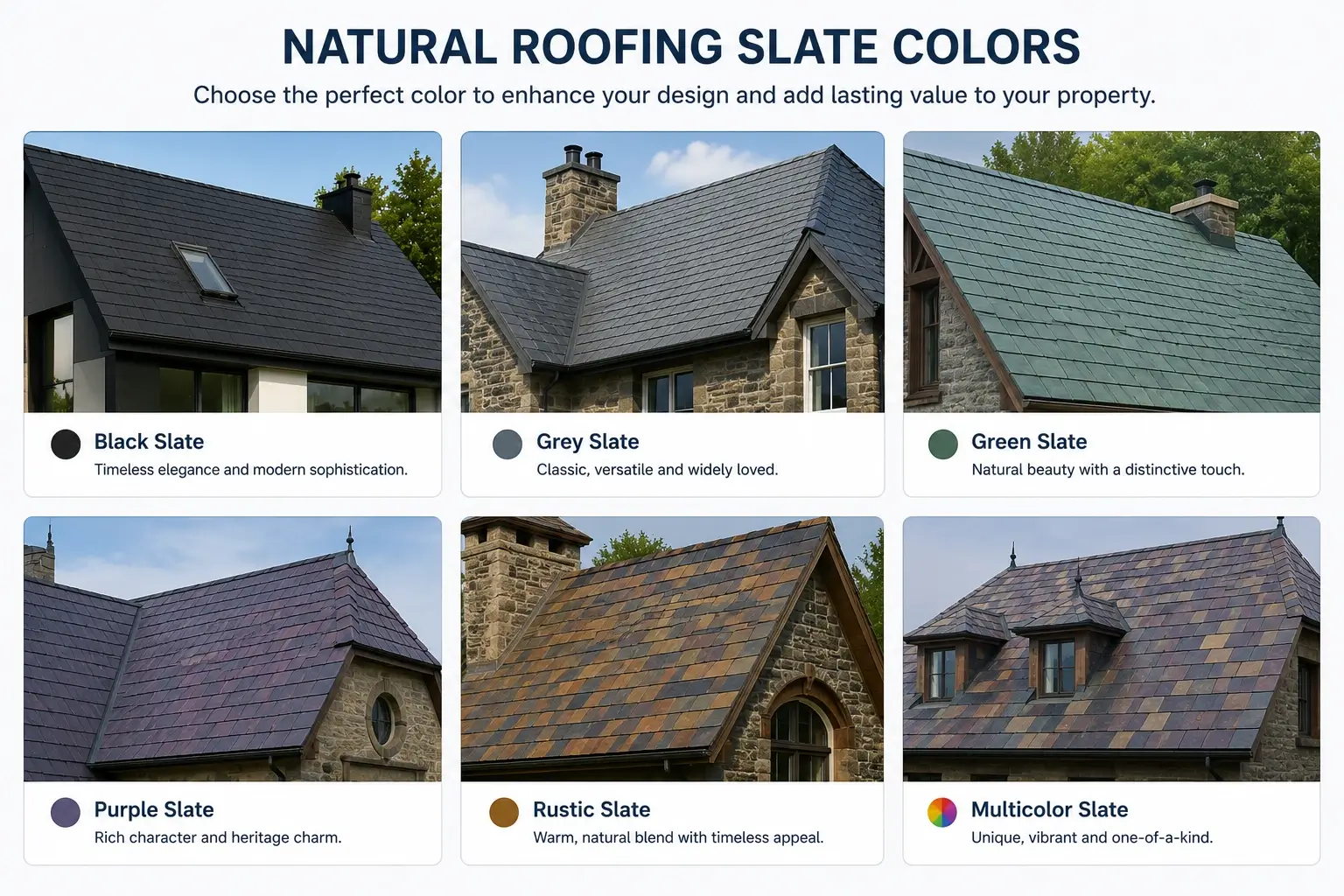
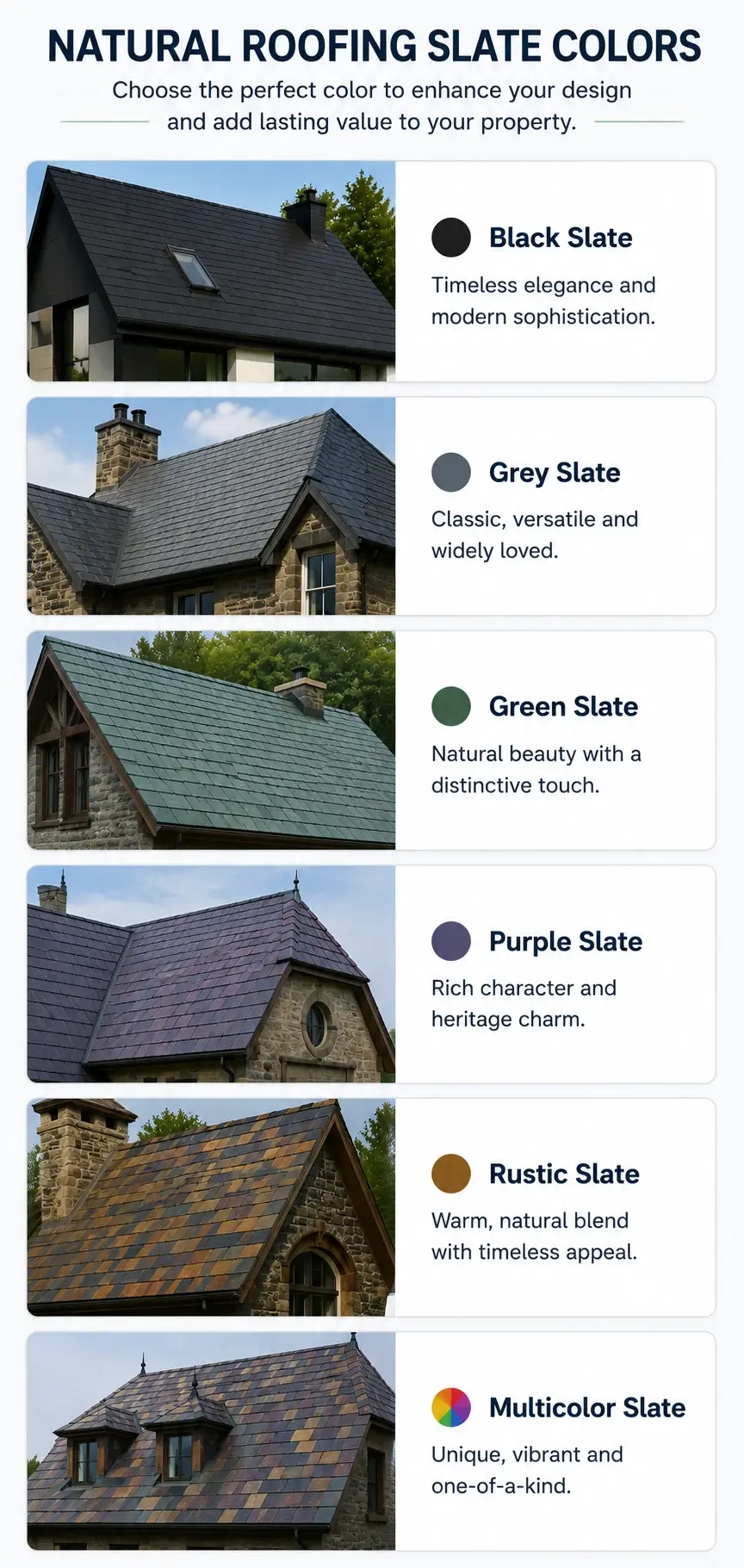
Black Roofing Slate – Timeless and Elegant
Black roofing slate remains the most popular choice worldwide. Its clean, sophisticated appearance complements both traditional and contemporary architecture.
Black slate is ideal for:
- Modern homes
- Luxury residences
- Commercial buildings
- Contemporary architectural designs
Advantages
- Classic appearance
- High resale appeal
- Easy to match with most exterior materials
- Popular in Europe and North America
Grey Roofing Slate – Natural and Versatile
Grey slate offers a softer, more natural appearance while maintaining a timeless style. It works well with stone, brick, and timber exteriors.
Grey roofing slate is commonly selected for:
- Residential homes
- Country houses
- Public buildings
- Renovation projects
Advantages
- Neutral appearance
- Excellent architectural flexibility
- Widely accepted in most markets
Green Roofing Slate – Distinctive and Premium
Green slate creates a unique roof that blends beautifully with natural surroundings.
It is often chosen for:
- High-end custom homes
- Mountain lodges
- Luxury villas
- Landscape-oriented architecture
Advantages
- Elegant natural appearance
- Premium visual impact
- Excellent for environmentally inspired designs
Purple Roofing Slate – Character and Heritage
Purple roofing slate provides subtle color variation and is frequently specified for heritage buildings and distinctive architectural projects.
Best suited for:
- Historic restoration
- Churches
- Museums
- Premium residential projects
Advantages
- Rich natural character
- Traditional architectural appeal
- Unique visual identity
Rustic and Multicolor Roofing Slate – Natural Variation
Rustic and multicolor slate combines several natural shades within one roof, creating a highly individual appearance.
These colors are popular for:
- Luxury homes
- Country estates
- Resorts
- Boutique hotels
Advantages
- Natural color variation
- Distinctive roof design
- Premium handcrafted appearance
How Slate Color Affects Your Project
Property Value
A well-chosen roofing slate color enhances curb appeal and complements the overall architecture, helping maintain or even increase property value.
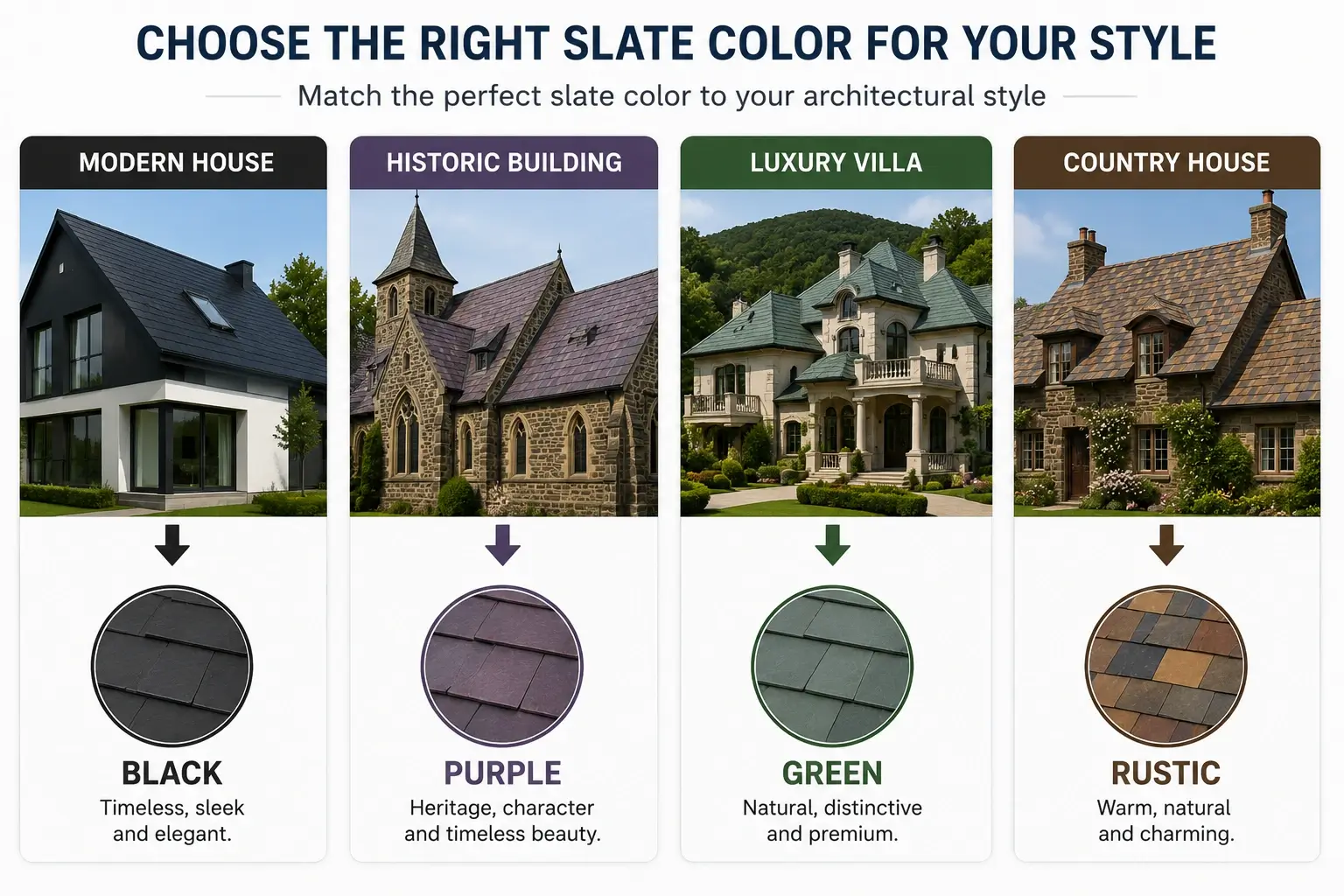
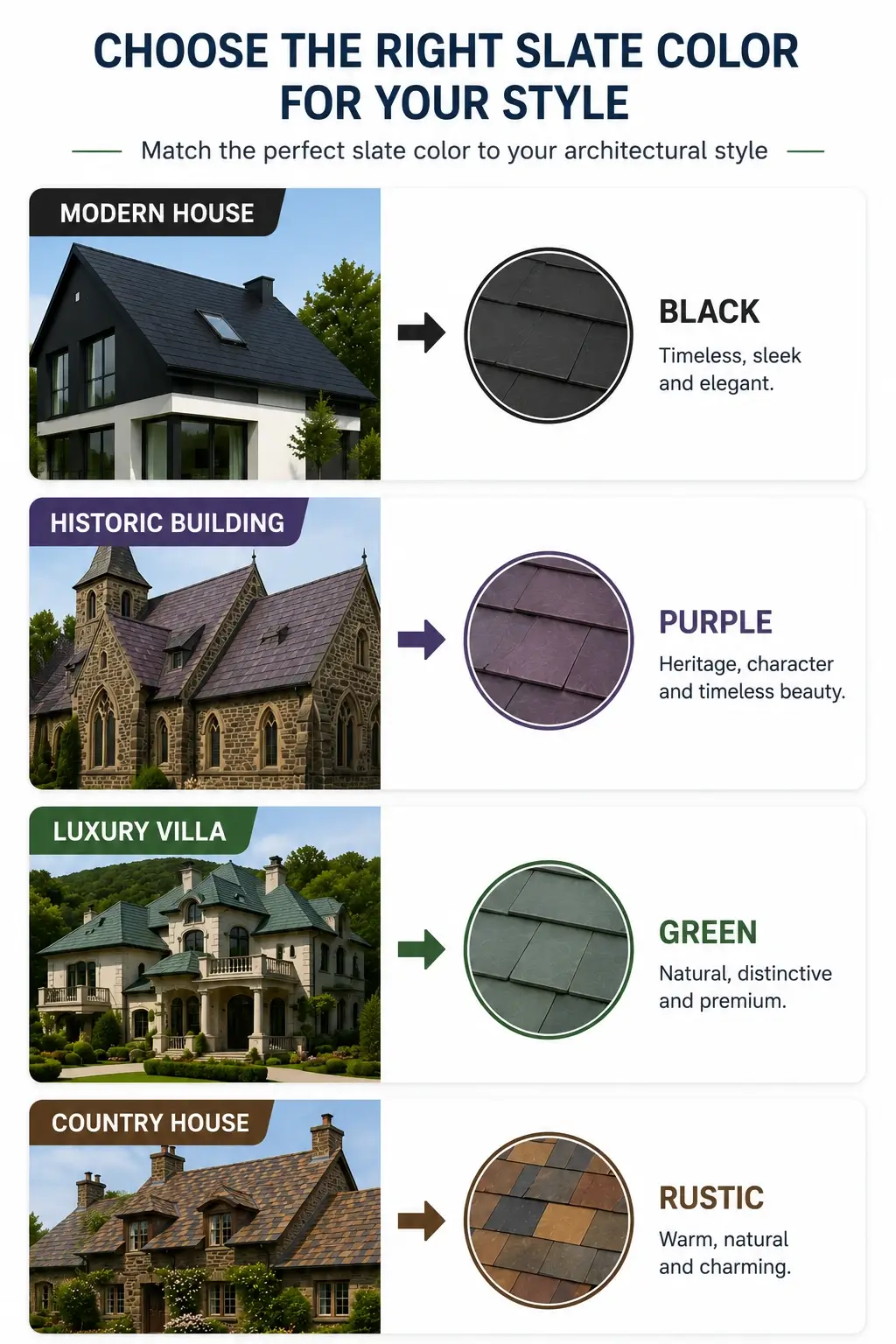
Architectural Style
Different colors suit different building styles.
- Black → Contemporary
- Grey → Traditional and modern
- Green → Luxury and natural settings
- Purple → Historic architecture
- Rustic → Premium custom homes
Heat Absorption
Darker roofing slate generally absorbs more solar heat than lighter colors. In warmer climates, lighter shades such as grey may help reduce heat gain slightly. However, roof insulation, ventilation, and building design usually have a much greater influence on indoor temperature than slate color alone.
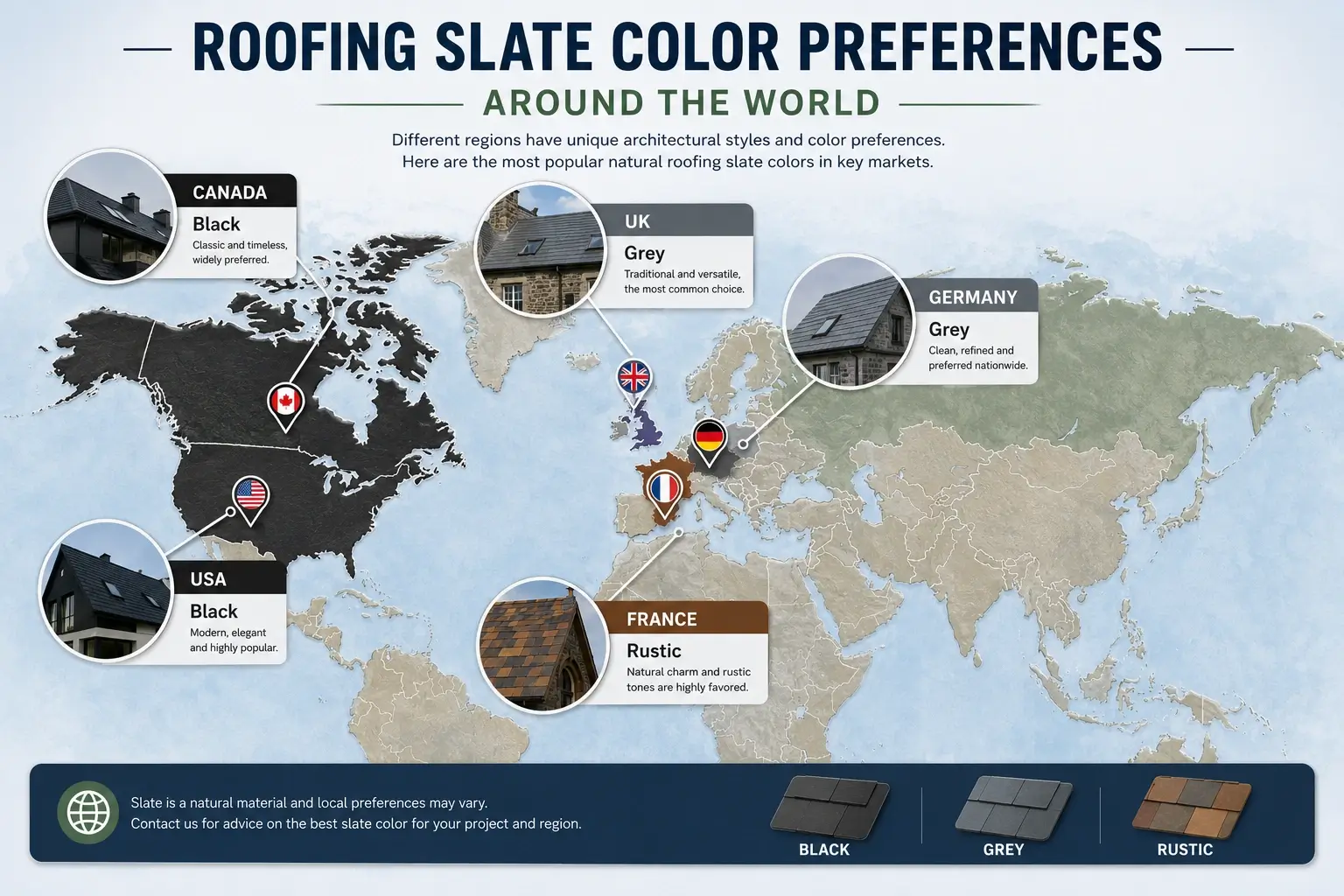
Regional Preferences
Color preferences vary between markets.
- United Kingdom: Grey and Blue Grey
- France: Grey and Rustic
- Germany: Grey and Black
- United States: Black, Grey, Green
- Canada: Black and Grey
Understanding local architectural trends can help ensure your roof blends naturally with surrounding buildings.
Roofing Slate Color Selection Guide
| Your Priority | Recommended Color |
|---|---|
| Modern architecture | ✅ Black |
| Traditional homes | ✅ Grey |
| Luxury residences | ✅ Green |
| Historic restoration | ✅ Purple |
| Natural countryside setting | ✅ Rustic |
| Unique premium appearance | ✅ Multicolor |
| Highest market acceptance | ✅ Black or Grey |
Expert Recommendation
The best roofing slate color is one that complements both your building and its surroundings. While personal preference is important, consider your local architectural style, climate, neighborhood trends, and long-term property value before making a decision.
If you’re uncertain, black and grey roofing slate remain the safest and most versatile choices, while green, purple, rustic, and multicolor slate offer distinctive options for premium or architect-designed projects.
Color Recommendation
| Goal | Best Color |
|---|---|
| Modern | Black |
| Traditional | Grey |
| Luxury | Green |
| Historic | Purple |
| Natural | Rustic |
| Premium | Multicolor |
Step 6 – Understand Roofing Slate Grades
Roofing slate grades are one of the most important factors to consider before making a purchase. However, grade names alone do not always tell the full story.
Terms such as Grade A, Grade B, or Commercial Grade may vary between suppliers and countries. The true quality of roofing slate should be evaluated through its physical properties, durability, and independent test results—not simply by its price or marketing description.
Understanding what really determines slate quality can help you avoid costly mistakes and choose a roof that performs reliably for decades.
Learn more about grading systems in our complete guide: Roofing Slate Grades.
Common Roofing Slate Grade Categories
Although grading systems differ among manufacturers, roofing slate is commonly classified into the following categories.
Grade A Slate
Grade A roofing slate is generally considered the highest-quality natural slate. It is selected for its excellent durability, low water absorption, and outstanding weather resistance.
Typical applications include:
- Premium residential homes
- Luxury villas
- Commercial buildings
- Historic restoration
- Long-life roofing projects
When properly installed, high-quality Grade A slate may provide a service life of 75–100 years or more, depending on the geological characteristics of the stone.
Grade B Slate
Grade B slate is suitable for projects with moderate durability requirements and tighter budgets.
It may be selected for:
- Standard residential buildings
- Renovation projects
- Budget-sensitive developments
Performance varies between quarries, so buyers should always request technical specifications rather than relying solely on the grade name.
Commercial Grade Slate
Commercial Grade roofing slate is typically supplied for projects where cost is the primary consideration.
It may be appropriate for:
- Temporary buildings
- Budget-driven commercial projects
- Shorter design-life applications
Because quality standards vary significantly, buyers should carefully review test reports before purchasing.
Roofing Standard vs. Marketing Terms
Different suppliers may use different grading terminology. A “Grade A” designation from one supplier does not automatically mean it has the same physical properties as Grade A slate from another quarry.
Instead of focusing only on labels, compare measurable technical data.
Don’t Judge Roofing Slate by Price Alone
The lowest-priced roofing slate is not always the most economical choice.
A cheaper slate with poor durability may require repairs or replacement much earlier, resulting in higher lifetime costs.
Likewise, the most expensive slate is not automatically the best option. The right choice is one that offers proven performance, consistent quality, and good long-term value for your project.
What Really Determines Roofing Slate Quality?
When evaluating natural roofing slate, buyers should pay close attention to objective performance indicators rather than marketing claims.
Density
High-density slate generally has a more compact structure, contributing to excellent strength, durability, and long-term weather resistance.
Water Absorption
Lower water absorption helps reduce the risk of moisture penetration and freeze-thaw damage, particularly in cold climates.
Freeze-Thaw Resistance
Roofing slate used in regions with freezing temperatures should demonstrate excellent resistance to repeated freeze-thaw cycles.
ASTM Testing
For projects in North America, many buyers specify roofing slate that has been tested according to relevant ASTM standards. Independent testing provides greater confidence in long-term performance.
EN 12326 Certification
For European markets, EN 12326 is the recognized standard for natural roofing slate. It evaluates important characteristics such as durability, water absorption, flexural strength, and frost resistance.
Independent Test Reports
Always ask your supplier for recent laboratory test reports or certification documents.
Reliable testing provides objective evidence of product quality and helps reduce purchasing risk.
Roofing Slate Grade Selection Guide
| Project Type | Recommended Grade |
|---|---|
| Luxury residence | ✅ Grade A |
| Historic restoration | ✅ Grade A |
| Long-life residential roof | ✅ Grade A |
| Commercial building | ✅ Grade A or High-Quality Commercial Grade |
| Budget residential project | ✅ Grade B |
| Cost-sensitive project | ✅ Commercial Grade (after reviewing test data) |
Expert Buying Advice
When buying roofing slate, think beyond the grade label.
A supplier who can provide consistent geological quality, verified laboratory testing, ASTM or EN 12326 compliance, and transparent technical documentation is usually a safer choice than one offering only the lowest price.
In the long run, investing in proven quality often delivers lower maintenance costs, a longer roof lifespan, and better overall value.
Grade Comparison
Grade A
★★★★★
100+ Years
Premium Projects
Grade B
★★★★☆
Residential
Balanced Value
Commercial Grade
★★★☆☆
Budget Projects
Cost Focus
What Really Matters
Buyer Checklist
Before Buying Roofing Slate
☑ Check density
☑ Review water absorption
☑ Verify freeze-thaw resistance
☑ Ask for ASTM or EN12326 reports
☑ Request recent testing reports
☑ Compare lifetime value—not just price
Step 7 – Check the Technical Specifications
A beautiful roofing slate may look impressive at first glance, but appearance alone cannot guarantee long-term performance.
Professional buyers, architects, contractors, and distributors rely on technical specifications to evaluate the quality and durability of natural roofing slate. These measurable properties provide objective evidence of how the slate is likely to perform under real-world conditions.
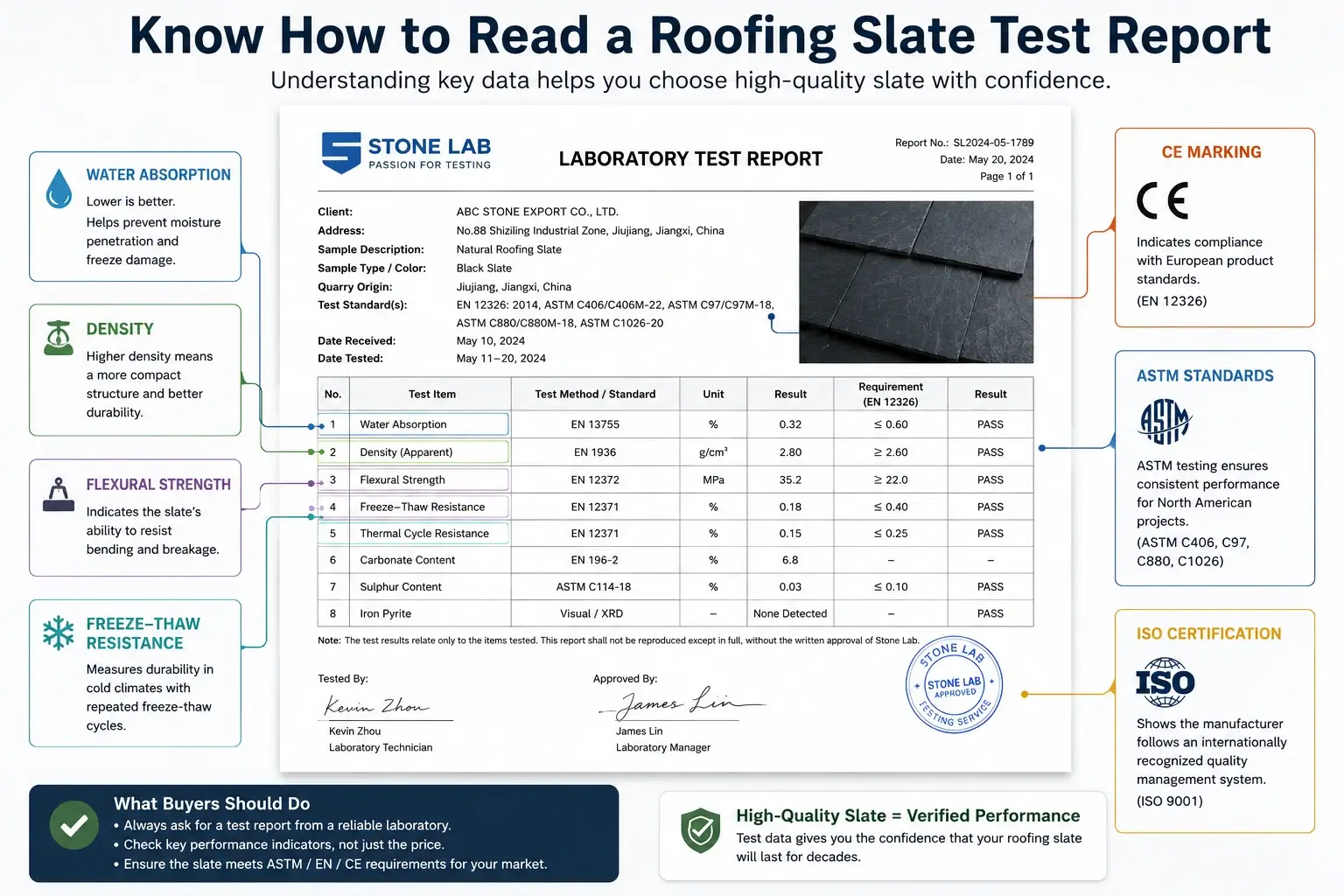
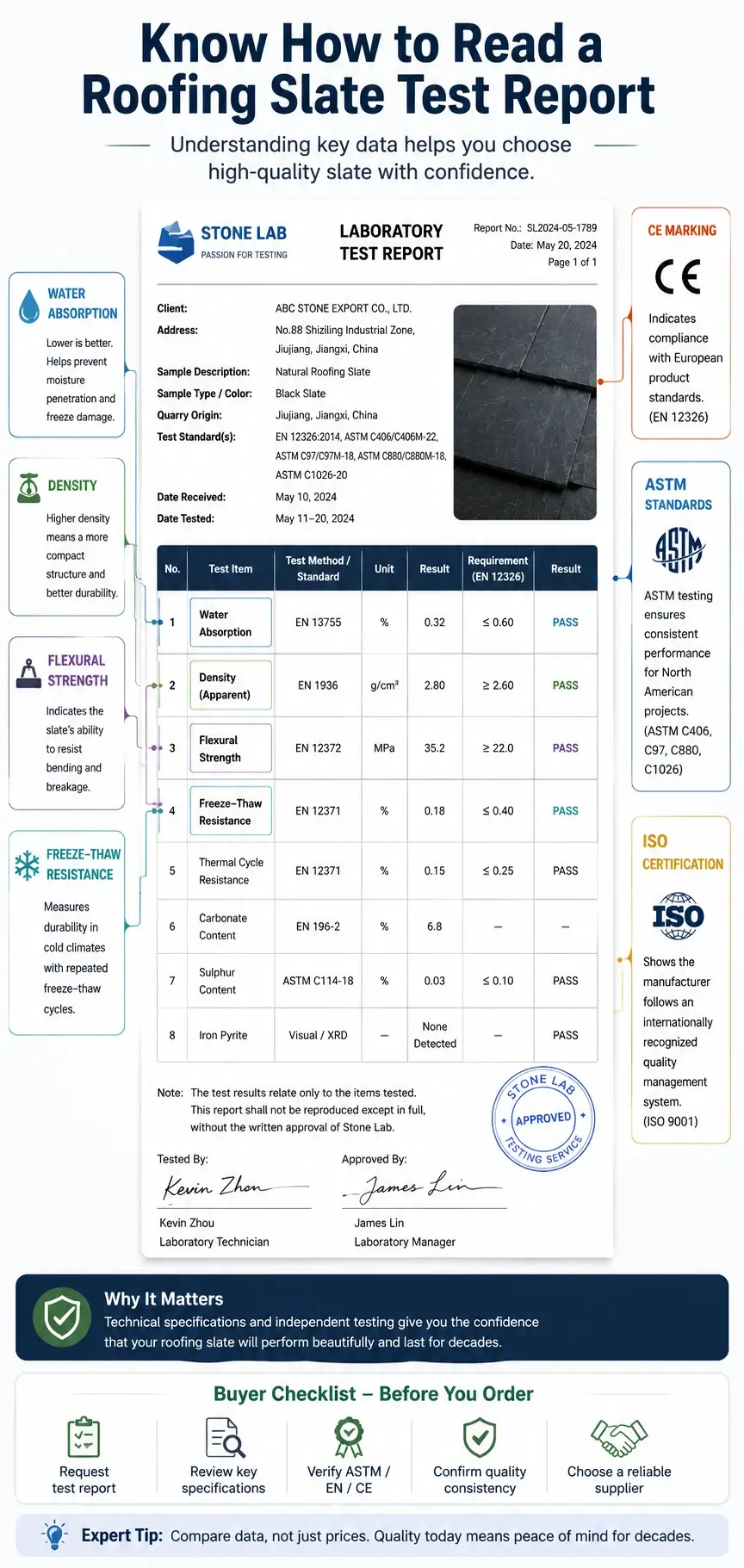
Before placing an order, always request a technical data sheet or independent laboratory test report. Verifying key performance indicators helps reduce purchasing risks and ensures the roofing slate is suitable for your project.
Why Technical Specifications Matter
Two slate tiles may appear almost identical, yet perform very differently over time.
Technical testing helps answer critical questions such as:
- Will the slate absorb excessive moisture?
- Can it withstand repeated freeze-thaw cycles?
- Is it strong enough for long-term roofing use?
- Does it meet recognized international standards?
Choosing roofing slate based on verified test data is one of the most effective ways to ensure long service life and minimize future maintenance costs.
Key Technical Specifications to Review
The following properties are among the most important indicators of roofing slate quality.
| Technical Specification | Why It Matters |
|---|---|
| Water Absorption | Lower water absorption generally improves moisture resistance and helps reduce freeze-thaw damage. |
| Flexural Strength | Indicates the slate’s ability to resist bending and breakage during installation and service. |
| Density | Higher density often reflects a compact stone structure with excellent durability. |
| Carbonate Content | Excessive carbonate minerals may reduce long-term weather resistance in some geological formations. |
| Thermal Cycle Resistance | Measures the slate’s ability to withstand repeated temperature changes without deterioration. |
| Freeze-Thaw Resistance | Essential for projects in cold climates where freezing and thawing occur regularly. |
| Sulphur Content | Low sulphur content helps reduce the risk of weather-related discoloration or mineral instability. |
| Iron Pyrite | Excessive pyrite may cause staining or oxidation over time. High-quality roofing slate is carefully evaluated for pyrite characteristics. |
| CE Marking | Indicates compliance with applicable European product requirements. |
| ASTM Testing | Demonstrates performance according to widely recognized North American testing standards. |
| ISO Certification | Shows that the manufacturer follows internationally recognized quality management systems. |
What Should You Ask Your Supplier?
Before confirming your order, request the following documents whenever possible:
- Technical Data Sheet (TDS)
- Laboratory Test Report
- CE Declaration of Performance (if applicable)
- ASTM test results (for North American projects)
- Product specifications
- Quality inspection records
A reliable supplier should be willing to provide clear, up-to-date documentation to support product quality.
Don’t Focus on One Number
Many buyers pay attention to only one specification, such as water absorption or density. In reality, roofing slate performance depends on the combination of multiple characteristics.
For example:
- Low water absorption alone does not guarantee excellent freeze-thaw resistance.
- High density does not automatically indicate superior flexural strength.
- CE marking does not replace the need to review actual laboratory test results.
Evaluating the complete technical profile provides a much more reliable basis for selecting roofing slate.
Roofing Slate Technical Specification Checklist
| Item | Check Before Buying |
|---|---|
| Water Absorption | ✅ Review laboratory result |
| Flexural Strength | ✅ Verify specification |
| Density | ✅ Confirm measured value |
| Carbonate Content | ✅ Check mineral composition |
| Thermal Cycle Resistance | ✅ Review test report |
| Freeze-Thaw Resistance | ✅ Essential for cold climates |
| Sulphur Content | ✅ Confirm acceptable level |
| Iron Pyrite | ✅ Evaluate mineral stability |
| CE Marking | ✅ Required for many European projects |
| ASTM Testing | ✅ Recommended for North America |
| ISO Certification | ✅ Verify manufacturer quality system |
Expert Buying Advice
Technical specifications provide far more reliable information than product descriptions or marketing claims.
When comparing roofing slate suppliers, prioritize companies that can provide transparent technical documentation, recognized laboratory testing, and compliance with international standards. This not only reduces purchasing risks but also gives you greater confidence that the roofing slate will deliver the durability, safety, and long-term performance your project requires.
Technical Specification Checklist
✔ Water Absorption
✔ Flexural Strength
✔ Density
✔ Carbonate Content
✔ Thermal Cycle
✔ Freeze-Thaw Resistance
✔ Sulphur Content
✔ Iron Pyrite
✔ CE
✔ ASTM
✔ ISO
Buyer Decision Flow
Request Test Report
↓
Review Technical Specifications
↓
Verify ASTM / EN / CE
↓
Compare Suppliers
↓
Place Your Order
Step 8 – Calculate the Right Roofing Slate Quantity
Ordering the correct quantity of roofing slate is just as important as choosing the right product. Ordering too little can delay installation and create color variation if additional slate comes from a different production batch. Ordering too much increases project costs and leaves unnecessary surplus material.
To estimate the amount of roofing slate required, you need more than the roof area alone. Roof pitch, slate size, overlap, and roof details all influence the final quantity.
If you’re unsure, ask your roofing contractor or supplier to prepare a material takeoff based on your roof drawings.
What Information Do You Need?
Before requesting a quotation, prepare the following project information.
Roof Area
The total roof surface area is the starting point for every roofing slate calculation.
Roof Pitch
Steeper roofs usually require greater headlap (overlap), which affects the number of slates needed per square meter.
Slate Size
Different roofing slate sizes provide different coverage areas. Larger slates cover more roof area per piece, while smaller slates require more individual tiles.
Headlap (Overlap)
The overlap between roofing slates is essential for weather protection. Greater overlap improves waterproof performance but also increases material consumption.
Roof Details
Complex roof designs require additional slate cutting and waste.
Typical details include:
- Starter course
- Hip
- Ridge
- Valley
- Dormers
- Chimneys
- Roof windows
These features increase both material usage and installation time.
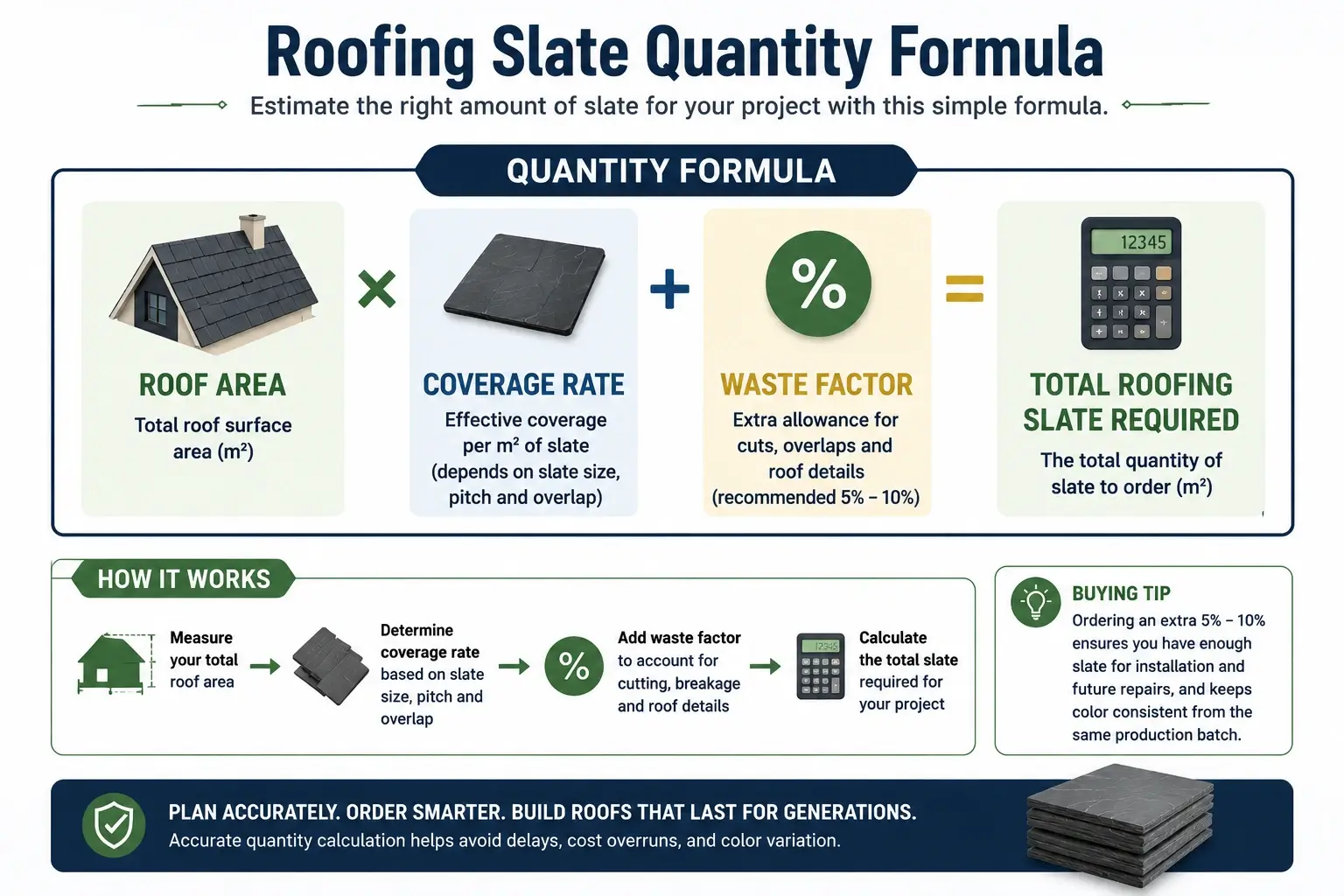
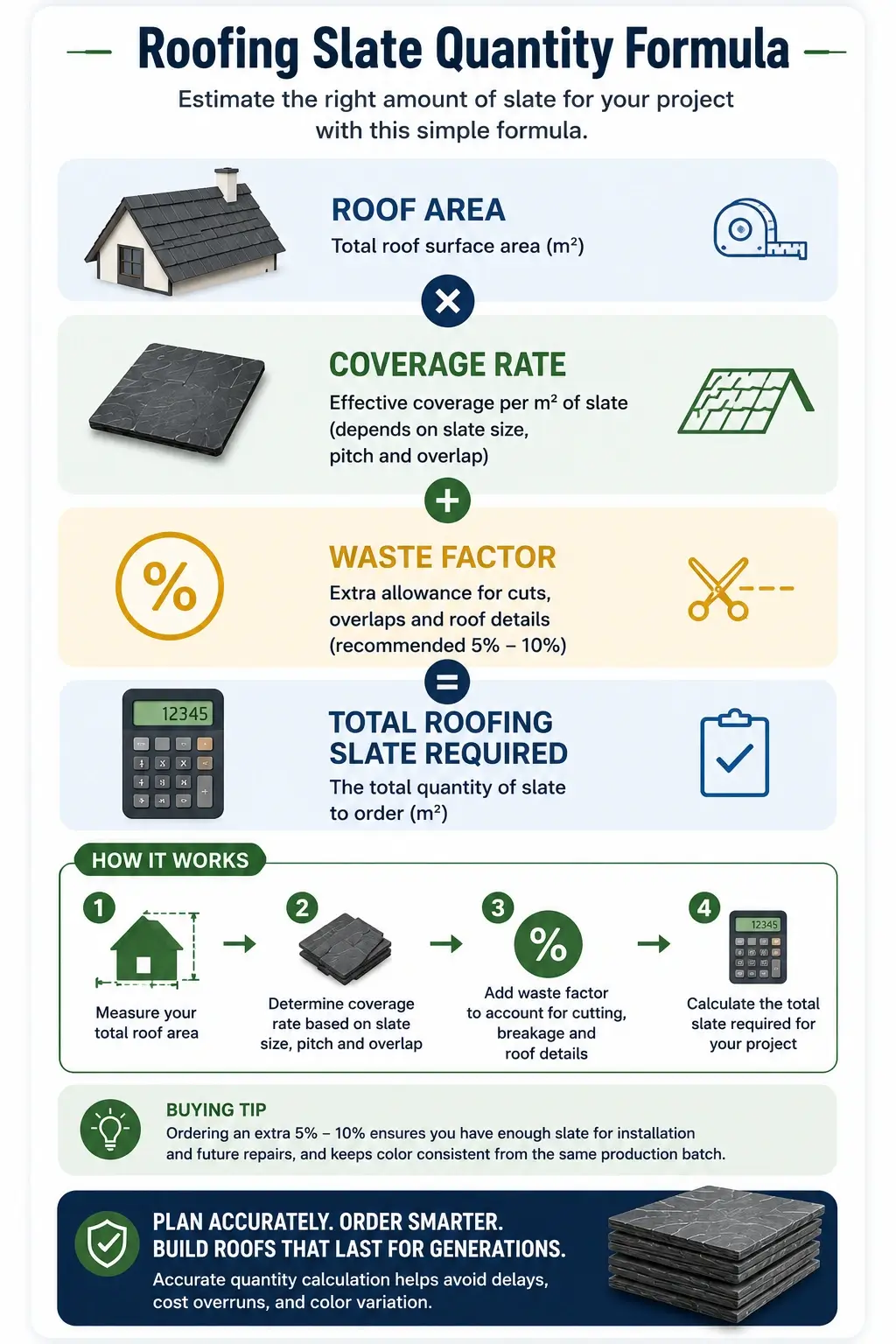
Roofing Slate Quantity Formula
A simple estimation formula is:
Estimated Roofing Slate Quantity
Roof Area × Coverage Rate × Waste Factor
Or, if ordering by square metres:
Required Slate Area = Roof Area + Waste Allowance
Remember that the actual coverage rate depends on the slate size, roof pitch, and headlap selected.
Don’t Forget the Waste Factor
Every roofing project generates some waste due to cutting, trimming, and fitting around roof details.
Typical recommendations are:
| Roof Design | Suggested Waste Allowance |
|---|---|
| Simple roof | 5% |
| Standard residential roof | 7–8% |
| Complex roof with valleys and dormers | 10% |
| Historic restoration | 10–15% |
For projects involving natural slate, ordering slightly more material at the beginning is usually more economical than trying to source matching slate later.
Accessories Also Require Planning
Roofing slate is only part of the complete roofing system.
Be sure to calculate the quantities for:
- Starter slates
- Ridge slates
- Hip slates
- Valley details
- Ridge and hip accessories
- Slate hooks or nails
- Flashings and underlayment
Including these items in your estimate helps avoid delays during installation.
Roofing Slate Quantity Checklist
| Item | Include in Your Estimate |
|---|---|
| Roof area | ✅ |
| Roof pitch | ✅ |
| Slate size | ✅ |
| Headlap (Overlap) | ✅ |
| Waste factor | ✅ |
| Starter course | ✅ |
| Hip | ✅ |
| Ridge | ✅ |
| Valley | ✅ |
| Roof openings (chimneys, skylights, dormers) | ✅ |
Expert Buying Advice
A roofing slate order should never be based on roof area alone.
Accurate quantity estimation requires consideration of the roof design, slate dimensions, installation method, and expected waste. Ordering an additional 5–10% is generally recommended to cover cutting losses, accidental breakage, and future repairs.
Whenever possible, purchase all roofing slate from the same production batch to ensure consistent color, texture, and thickness across the entire roof.
Roofing Quantity Checklist
☑ Roof Area
☑ Roof Pitch
☑ Slate Size
☑ Headlap
☑ Starter Course
☑ Hip
☑ Ridge
☑ Valley
☑ Waste Factor
Waste Factor Comparison
| Roof Type | Extra Slate to Order |
|---|---|
| Simple Roof | 5% |
| Standard House | 7–8% |
| Complex Roof | 10% |
| Historic Restoration | 10–15% |
Buying Tip: Ordering an extra 5–10% of natural roofing slate helps cover cutting waste, accidental breakage, and future repairs while ensuring consistent color from the same production batch.
Step 9 – Compare Roofing Slate Prices Wisely
When comparing roofing slate prices, many buyers focus only on the cost per square meter. While the material price is important, it represents only part of the total investment.
A roofing slate that costs less initially may require higher installation costs, generate more material waste, or have a shorter service life. In contrast, a higher-quality natural roofing slate often delivers better long-term value through lower maintenance requirements and a significantly longer lifespan.
Want to learn more about pricing? Read our complete guide: Roofing Slate Cost.
Don’t Compare Price per Square Meter Alone
The quoted price per square meter is only the purchase price of the roofing slate itself.
Before making a decision, consider the complete cost of ownership.
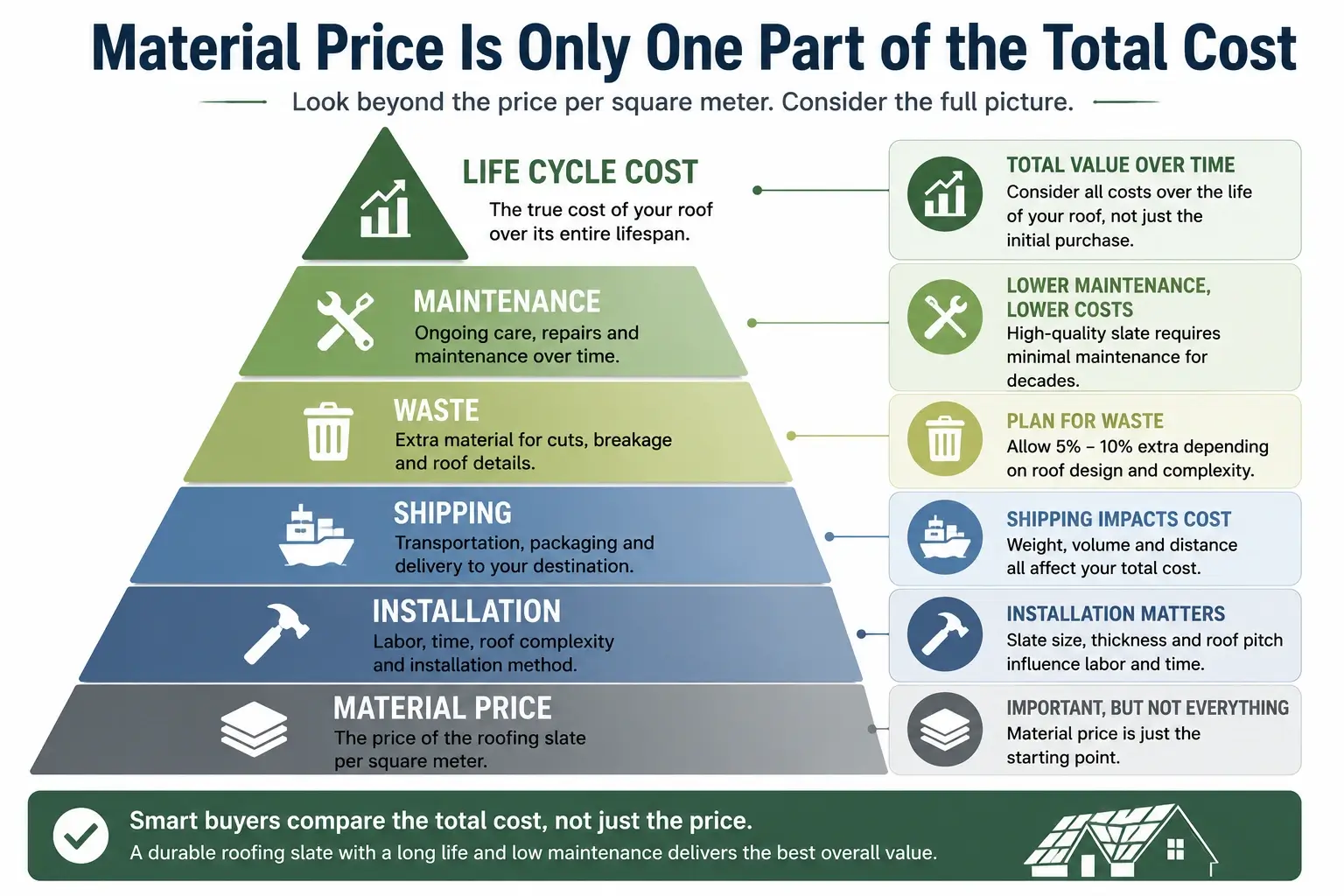
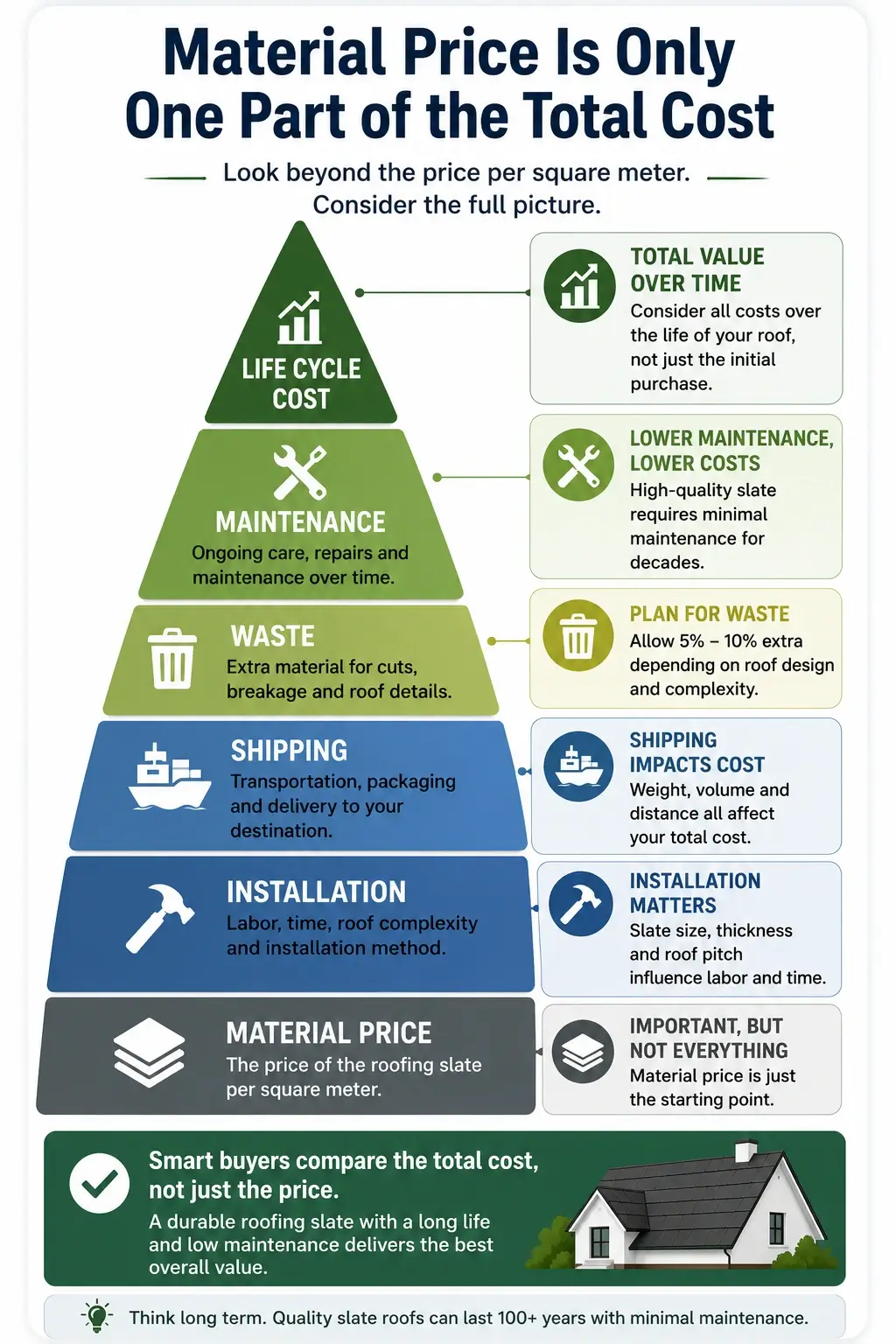
A meaningful comparison should include:
- Material cost
- Installation cost
- Shipping cost
- Waste allowance
- Maintenance expenses
- Expected service life
Looking at the total picture helps you choose the most cost-effective roofing solution rather than simply the cheapest product.
The Five Costs Every Buyer Should Compare
Material Price
The initial cost of the roofing slate is often the first figure buyers see. However, selecting the lowest-priced slate without considering quality may increase long-term expenses.
Installation Cost
Installation can account for a substantial portion of the total roofing budget.
Factors affecting installation include:
- Slate size
- Slate thickness
- Roof complexity
- Roof pitch
- Local labor rates
Larger roofing slates generally require fewer individual tiles and may reduce installation time on suitable roof designs.
Shipping Cost
Natural roofing slate is a heavy building material, making transportation costs an important part of the overall budget.
Shipping costs depend on:
- Weight
- Packaging
- Container utilization
- Shipping distance
- Delivery destination
Selecting the most appropriate slate size and thickness may also improve shipping efficiency.
Waste Allowance
Every roofing project requires additional material to accommodate cutting, trimming, breakage, and complex roof details.
Ordering the correct waste allowance helps avoid costly delays while minimizing unnecessary surplus material.
Maintenance Cost
High-quality natural roofing slate typically requires very little maintenance throughout its service life.
Lower-quality products may require more frequent repairs or premature replacement, increasing long-term ownership costs.
Why Life Expectancy Changes the Real Cost
A roofing slate that lasts over 100 years may initially cost more than a lower-priced alternative.
However, when the total investment is spread over its entire service life, the annual ownership cost is often significantly lower.
This is why architects and commercial developers frequently evaluate roofing materials based on life cycle cost rather than purchase price alone.
Compare the Total Cost, Not Just the Purchase Price
| Cost Factor | Low Initial Price | Higher Quality Slate |
|---|---|---|
| Material Price | ⭐ Lower | Higher |
| Installation Cost | May be higher | Often more efficient |
| Shipping Cost | Similar | Depends on weight and size |
| Waste | May be higher | Often lower with consistent quality |
| Maintenance | Higher | Lower |
| Service Life | Shorter | Much longer |
| Overall Value | Moderate | Excellent |
Think in Terms of Life Cycle Cost
Instead of asking:
“Which roofing slate is the cheapest?”
Ask:
“Which roofing slate provides the lowest cost over its entire service life?”
A simplified way to think about it is:
Life Cycle Cost = Initial Purchase + Installation + Shipping + Maintenance + Future Repairs
Although this is a simplified concept rather than a strict engineering calculation, it helps buyers compare roofing options more realistically and make informed purchasing decisions.
Expert Buying Advice
The best roofing slate is rarely the one with the lowest price tag.
When comparing suppliers, evaluate the complete value offered—including product quality, installation efficiency, transportation costs, expected lifespan, and maintenance requirements.
For most residential and commercial projects, investing in high-quality natural roofing slate can provide better long-term value, fewer repairs, and greater peace of mind over the life of the roof.
Cost Comparison Table
| Compare | Supplier A | Supplier B |
|---|---|---|
| Price/m² | ✔ | ✔ |
| Installation Cost | ✔ | ✔ |
| Shipping Cost | ✔ | ✔ |
| Waste Factor | ✔ | ✔ |
| Life Expectancy | ✔ | ✔ |
| Maintenance | ✔ | ✔ |
| Best Overall Value | ⭐ | ⭐ |
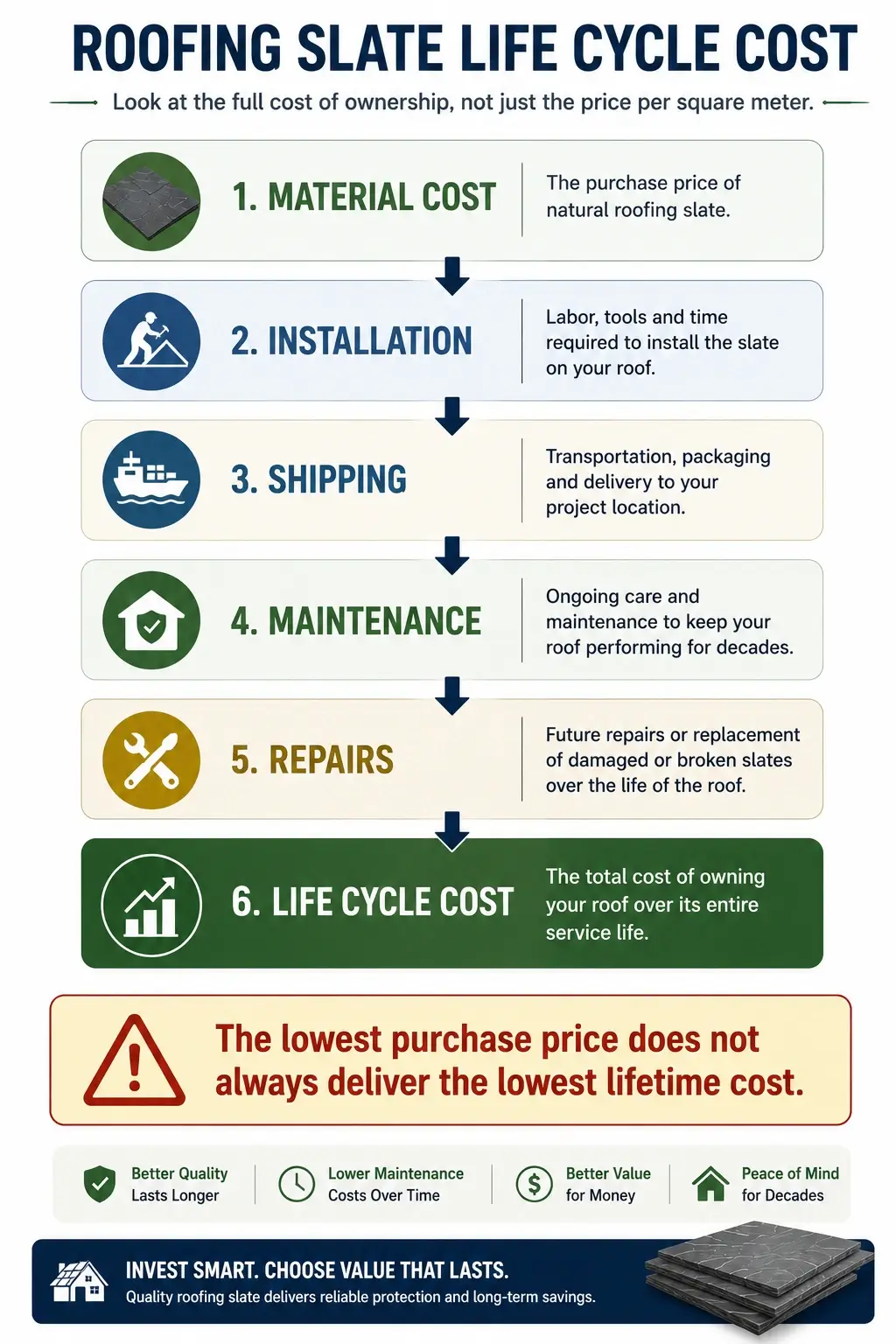
The lowest purchase price does not always deliver the lowest lifetime cost.
Buying Tip: When comparing roofing slate suppliers, calculate the total cost of ownership—not just the price per square meter. A durable slate with a longer lifespan and lower maintenance requirements often provides the best return on investment.
Step 10 – Choose a Reliable Roofing Slate Supplier
Selecting the right roofing slate is only half of the buying process. Choosing a reliable supplier is equally important.
An experienced supplier does more than provide competitive prices—they offer consistent product quality, transparent documentation, dependable delivery, and professional support throughout your project.
Whether you are an importer, roofing contractor, builder, architect, or homeowner, working with a trustworthy roofing slate supplier can help reduce risks, avoid costly mistakes, and ensure a smoother purchasing experience.
What Makes a Reliable Roofing Slate Supplier?
A professional supplier should be able to provide much more than a quotation.
Look for suppliers that are willing to share clear product information, quality documentation, and evidence of previous export experience.
The following checklist can help you evaluate potential suppliers.
Roofing Slate Supplier Checklist
| What to Check | Why It Matters |
|---|---|
| Quarry Information | Confirms the geological source and helps ensure consistent color and quality. |
| Laboratory Test Reports | Verify important properties such as water absorption, flexural strength, density, and freeze-thaw resistance. |
| CE Documentation | Demonstrates compliance with applicable European product requirements when required. |
| Packing Photos | Show packaging quality and help reduce the risk of transport damage. |
| Container Loading Photos | Demonstrate loading practices and container utilization. |
| Size Tolerances | Ensure dimensional consistency for easier installation and a better roof appearance. |
| Export Experience | Experienced exporters are usually more familiar with international standards, documentation, and logistics. |
| After-Sales Support | Responsive communication is valuable if questions arise before, during, or after delivery. |
Questions Worth Asking Before You Buy
Before placing an order, consider asking your supplier:
- Which quarry does the slate come from?
- Can you provide recent laboratory test reports?
- Does the slate comply with ASTM or EN 12326 requirements?
- Can you share packing and container loading photos?
- What are your size and thickness tolerances?
- Which countries have you exported to?
- How do you handle quality claims or after-sales support?
A supplier that answers these questions clearly and confidently is generally more likely to provide a reliable purchasing experience.
Why Experience Matters
Natural roofing slate is a premium building material that requires careful quarry selection, quality control, packaging, and international logistics.
Suppliers with long-term export experience are often better equipped to:
- Maintain consistent product quality
- Prepare export documentation accurately
- Coordinate container loading efficiently
- Meet delivery schedules
- Support customers throughout the purchasing process
Experience cannot guarantee perfection, but it often helps reduce avoidable problems.
Our Approach at Slate of China
At Slate of China, we believe that transparency is just as important as product quality.
For customers evaluating roofing slate, we aim to provide practical information that supports informed purchasing decisions, including:
- Clear quarry and product information
- Technical specifications and laboratory test reports
- Packing and container loading photos
- Consistent size and thickness control
- Export support for international customers
- Responsive communication before and after shipment
Our goal is to help customers choose the roofing slate that best fits their project—not simply to offer the lowest price.
Ready to Start Your Roofing Slate Project?
If you’re comparing roofing slate suppliers or planning a new project, we’d be happy to help.
Whether you need technical information, sample recommendations, or a quotation, our team can provide practical guidance based on your project requirements.
Contact us to discuss:
- Roofing slate recommendations
- Available sizes and colors
- Technical documentation
- Samples
- Packaging and shipping options
- Project quotations
What Every Reliable Roofing Slate Supplier Should Provide
✔ Quarry Information
✔ Laboratory Test Reports
✔ CE Documentation
✔ Packing Photos
✔ Loading Photos
✔ Size Tolerance
✔ Export Experience
✔ After-Sales Support
Purchasing Process
Choose Slate
↓
Request Test Reports
↓
Review Samples
↓
Confirm Order
↓
Production
↓
Packing
↓
Container Loading
↓
Delivery
↓
After-Sales Support
How We Support International Roofing Slate Buyers
| What We Provide | |
|---|---|
| Quarry-based sourcing | ✔ |
| Technical documentation | ✔ |
| Export packaging | ✔ |
| Global shipping experience | ✔ |
| Sample support | ✔ |
| Responsive service | ✔ |
Need Help Choosing the Right Roofing Slate?
Our team can help you compare slate types, sizes, colors, technical specifications, and shipping options to find the best solution for your project.
Questions to Ask Before Buying Roofing Slate
Before placing an order, it’s worth asking a few important questions. The answers can help you compare suppliers more effectively, understand the quality of the roofing slate, and avoid costly surprises later.
The following questions are commonly asked by architects, contractors, importers, and homeowners when purchasing natural roofing slate.
Final Buying Checklist
Before confirming your order, make sure you can answer “Yes” to the following questions:
| Question | ✔ |
|---|---|
| Is it natural roofing slate? | ✅ |
| Do I know the quarry source? | ✅ |
| Have I reviewed the test reports? | ✅ |
| Does it meet ASTM or EN 12326 requirements? | ✅ |
| Have I selected the correct size and thickness? | ✅ |
| Have I included a waste allowance? | ✅ |
| Can the supplier provide matching accessories? | ✅ |
| Have I reviewed packaging and loading photos? | ✅ |
| Does the supplier have export experience? | ✅ |
| Is after-sales support available? | ✅ |
Buying Tip: The best roofing slate purchase is based on clear answers—not assumptions. Asking the right questions before ordering helps you compare suppliers objectively, reduce project risks, and choose a roofing slate that delivers reliable performance for decades.
Roofing Slate Buying Checklist
Choosing the right roofing slate involves much more than selecting a color or comparing prices.
Before placing your order, take a few minutes to review the checklist below. It summarizes the key points covered throughout this buying guide and can help you avoid common purchasing mistakes.
Whether you’re a homeowner, roofing contractor, architect, or importer, this checklist provides a practical reference for selecting high-quality natural roofing slate with confidence.
Roofing Slate Buying Checklist
Before confirming your order, make sure you have completed each of the following steps.
| Checklist Item | Status |
|---|---|
| ✔ Confirm the slate is natural roofing slate | ☐ |
| ✔ Choose the appropriate slate type and quarry | ☐ |
| ✔ Confirm the roofing slate grade | ☐ |
| ✔ Select the correct slate size | ☐ |
| ✔ Select the appropriate thickness | ☐ |
| ✔ Choose the right slate color | ☐ |
| ✔ Review technical specifications | ☐ |
| ✔ Request laboratory test reports | ☐ |
| ✔ Calculate the required quantity | ☐ |
| ✔ Include a 5–10% waste allowance | ☐ |
| ✔ Confirm matching ridge and accessories | ☐ |
| ✔ Verify pallet packing and protection | ☐ |
| ✔ Confirm shipping terms (FOB, CIF, etc.) | ☐ |
| ✔ Confirm production lead time | ☐ |
| ✔ Review after-sales support | ☐ |
Why Use a Roofing Slate Buying Checklist?
Even experienced buyers occasionally overlook important details during the purchasing process.
A simple checklist helps you:
- Compare suppliers using the same criteria
- Reduce purchasing risks
- Avoid unexpected costs
- Improve communication with suppliers
- Ensure the roofing slate meets your project requirements
A few minutes spent reviewing these items before ordering can help prevent delays, quality issues, and unnecessary expenses later.
Need Help Reviewing Your Project?
If you’re still comparing roofing slate options or preparing a quotation request, we’re happy to help.
Our team can assist with:
- Slate selection
- Sizes and thickness recommendations
- Color suggestions
- Technical documentation
- Quantity estimation
- Packaging and shipping advice
Simply send us your roof drawings, project specifications, or questions, and we’ll help you identify the most suitable roofing slate for your project.
Why Contractors Choose Jiujiang Roofing Slate
Jiujiang, Jiangxi Province, is one of China’s best-known natural roofing slate production regions. For decades, roofing contractors, distributors, importers, and builders have selected Jiujiang roofing slate for residential, commercial, and restoration projects around the world.
Rather than relying on marketing claims, experienced buyers typically evaluate roofing slate based on consistency, technical performance, supply reliability, and long-term value. These are the factors that continue to make Jiujiang roofing slate a practical choice for many international projects.
Stable Quarry Resources
Reliable roofing projects begin with reliable raw materials.
Jiujiang roofing slate is sourced from established slate-producing areas with long mining histories. Consistent geological conditions help maintain stable color, texture, and physical properties across production batches.
For importers and contractors managing large or phased projects, this consistency is important because it reduces the risk of noticeable variations between deliveries.
Consistent Size and Quality
Dimensional accuracy is essential for efficient installation and a professional roof appearance.
Well-manufactured Jiujiang roofing slate is produced with controlled size and thickness tolerances, helping roofers achieve:
- More uniform roof lines
- Faster installation
- Better alignment
- Reduced cutting on site
- Lower material waste
Consistent sizing also makes future maintenance and replacement easier.
Low Water Absorption and Good Weather Resistance
Natural roofing slate is expected to perform in demanding outdoor environments for decades.
High-quality Jiujiang roofing slate typically offers:
- Low water absorption
- Dense stone structure
- Good freeze-thaw resistance
- Excellent weather durability
These characteristics make it suitable for many climates, including regions that experience seasonal freezing and thawing.
As with any roofing material, buyers should confirm performance through independent laboratory test reports.
Competitive Cost Without Compromising Quality
Many buyers look for the best balance between quality and budget rather than simply choosing the lowest-priced product.
Jiujiang roofing slate is widely recognized for offering a competitive combination of:
- Reliable quality
- Stable supply
- Efficient production
- Attractive overall project value
When evaluated over the full service life of the roof, this balance can provide an excellent return on investment for residential and commercial projects.
Extensive Export Experience
International roofing projects require more than quality stone.
Experienced exporters understand:
- International packaging requirements
- Container loading efficiency
- Export documentation
- Quality inspection procedures
- International shipping logistics
These capabilities help reduce delays, minimize transport damage, and improve the overall purchasing experience.
Professional Packaging for Global Shipping
Roofing slate is heavy and requires careful handling during transportation.
Professional export packaging typically includes:
- Strong wooden pallets or crates
- Protective wrapping
- Secure pallet strapping
- Optimized container loading
Well-designed packaging helps reduce breakage during international transport and ensures products arrive in good condition.
Trusted by Customers Worldwide
Jiujiang roofing slate has been supplied to projects in many international markets, including Europe, North America, Australia, and Asia.
Instead of focusing on individual projects, many buyers value long-term supply capability, consistent product quality, and dependable delivery.
Where appropriate, consider presenting verified company statistics such as:
- Exported to 30+ countries (replace with your actual figure)
- Millions of square metres supplied worldwide (replace with your verified figure)
- Years of export experience (replace with your actual experience)
- Long-term partnerships with roofing distributors and contractors (if accurate)
Using real, verifiable data builds far more credibility than broad claims.
Our Commitment at Slate of China
At Slate of China, we believe that selecting roofing slate should be based on reliable information and transparent communication.
We support customers by providing:
- Detailed product specifications
- Laboratory test reports
- Consistent production quality
- Packing and loading photos
- Export documentation
- Responsive technical support
Our objective is to help customers choose roofing slate that matches their project requirements, budget, and long-term performance expectations.
Why Contractors Choose Jiujiang
| Metric | Value* |
|---|---|
| Export Markets | 30+ Countries |
| Roofing Slate Supplied | Millions of m² |
| Export Experience | 20+ Years |
| Container Shipments | Thousands |
| Product Sizes Available | Multiple Standard Sizes |
Get Expert Advice Before Buying
Still Unsure Which Roofing Slate Is Right for Your Project?
Choosing the right roofing slate involves many important decisions—from selecting the appropriate slate type and size to determining the correct thickness, quantity, and shipping method.
If you’re still comparing options or have questions about your project, our team is here to help.
Simply send us your roof drawings, architectural plans, project specifications, or purchasing requirements. Based on your project, our roofing slate specialists will provide practical recommendations to help you make an informed decision.
What We Can Help You With
Whether you’re planning a residential home, commercial building, heritage restoration, or wholesale import project, we can assist with:
- Choosing the most suitable natural roofing slate
- Recommending the best slate size for your roof
- Selecting the appropriate slate thickness
- Estimating the required roofing slate quantity
- Reviewing technical specifications and test reports
- Suggesting matching ridge slates and accessories
- Recommending pallet packing and container loading solutions
- Planning the most suitable shipping option
- Preparing a detailed quotation based on your project requirements
Our recommendations are based on your project—not a one-size-fits-all solution.
What to Send Us
To provide accurate recommendations, it’s helpful if you can share:
- Roof drawings or architectural plans
- Roof dimensions and pitch
- Preferred slate size or color (if known)
- Project location and climate
- Estimated order quantity
- Delivery destination
- Any technical specifications or standards required (such as ASTM or EN 12326)
The more information you provide, the more precise our recommendations can be.
Why Work with Slate of China?
At Slate of China, we support international buyers with practical information and transparent communication throughout the purchasing process.
When you contact us, you can expect:
- Professional product recommendations
- Clear technical documentation
- Fast and responsive communication
- Reliable export support
- Secure packaging solutions
- Experience serving customers in international markets
Our goal is to help you choose the right roofing slate with confidence and make your purchasing process as straightforward as possible.
Request Your Free Roofing Slate Quotation
Ready to move forward with your project?
Send us your requirements today, and we’ll prepare a tailored quotation along with product recommendations based on your specific needs.
We aim to provide:
- A free quotation within 24 hours
- Professional roofing slate recommendations
- Technical data and test reports (upon request)
- Packaging and shipping advice
- Prompt responses from our export team
Let’s discuss your roofing project and help you find the right natural roofing slate solution.