
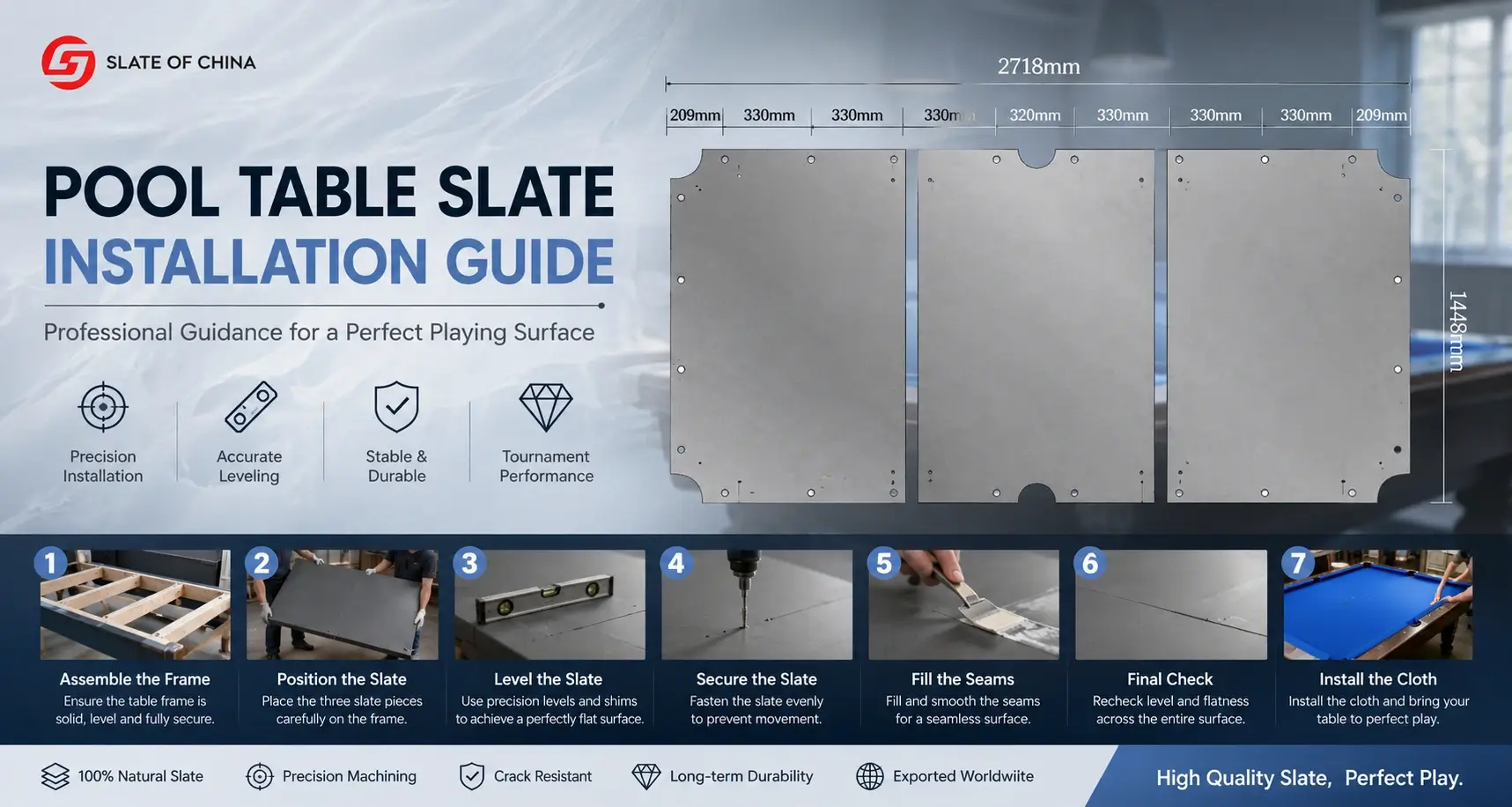
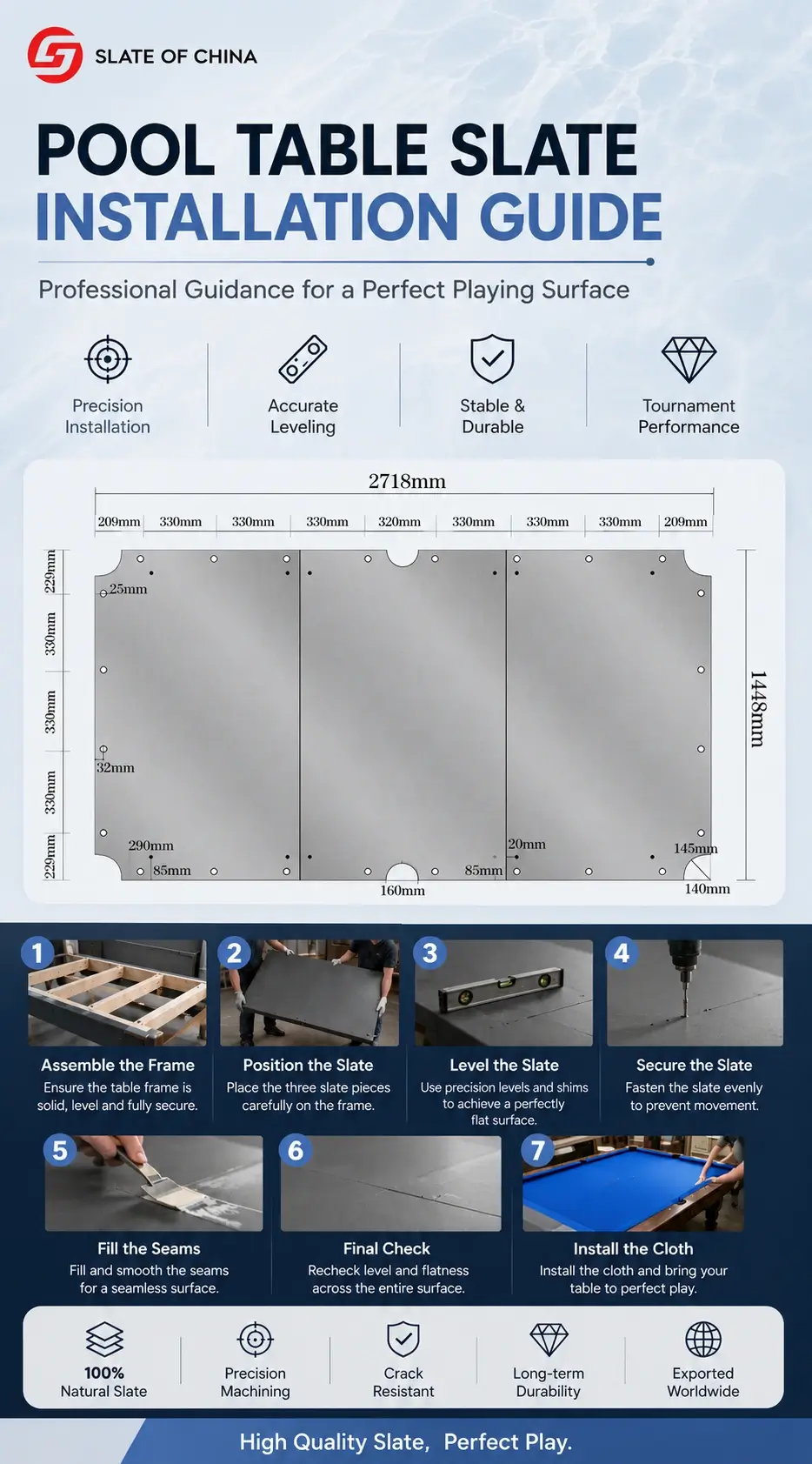
Billiard Slate Installation Guide
Industry Best Practices from a Slate Manufacturer
A properly installed billiard slate is the foundation of a level, accurate, and professional playing surface. Whether used for snooker tables, pool tables, carom tables, or custom billiard tables, the slate must be positioned, aligned, and leveled correctly to support smooth ball roll, consistent playing speed, and long-term table performance.
Billiard slate installation involves more than simply placing slate panels onto a table frame. Frame stability, slate positioning, panel matching, seam alignment, leveling accuracy, and slate quality all play an important role in the final playing result. For one-piece, three-piece, or multi-piece slate systems, proper installation helps reduce ball roll inconsistencies, uneven play, and premature cloth wear.
As a professional billiard slate manufacturer, we do not provide on-site installation services. However, understanding standard slate installation practices helps table manufacturers, distributors, installers, and end users achieve better table performance. Through years of supplying precision-machined natural slate for snooker, pool, and carom table manufacturers worldwide, we understand the key slate characteristics that make installation easier and improve playing results.
This guide summarizes common industry practices for billiard slate installation, including slate preparation, frame checking, slate positioning, leveling, seam treatment, final flatness inspection, and preparation before cloth installation. It also explains how slate quality, thickness consistency, joint accuracy, and surface finish can influence the installation process and overall table performance.
Whether you are purchasing a new billiard table, replacing existing slate, working with a snooker slate or pool slate set, or simply learning about billiard table construction, this guide provides a practical overview of billiard slate installation best practices.
💡 Manufacturer’s Note
As a slate manufacturer, our role is to produce precision-machined slate for billiard table manufacturers and distributors worldwide. Installation procedures may vary between table brands and professional installers. The information in this guide is intended as a general reference based on common industry practices.
Table of Contents
Why Proper Pool Table Slate Installation Matters
Pool table slate installation plays a critical role in determining how a table performs throughout its service life. While high-quality natural slate provides the foundation for a stable and accurate playing surface, proper installation is equally important to ensure that the slate performs as intended.
A pool table is only as good as its playing surface. Even precision-machined slate can deliver poor results if the table frame is not properly leveled, the slate sections are misaligned, or the seams are not finished correctly. Small installation errors that may appear insignificant during assembly can have a noticeable impact on gameplay over time.
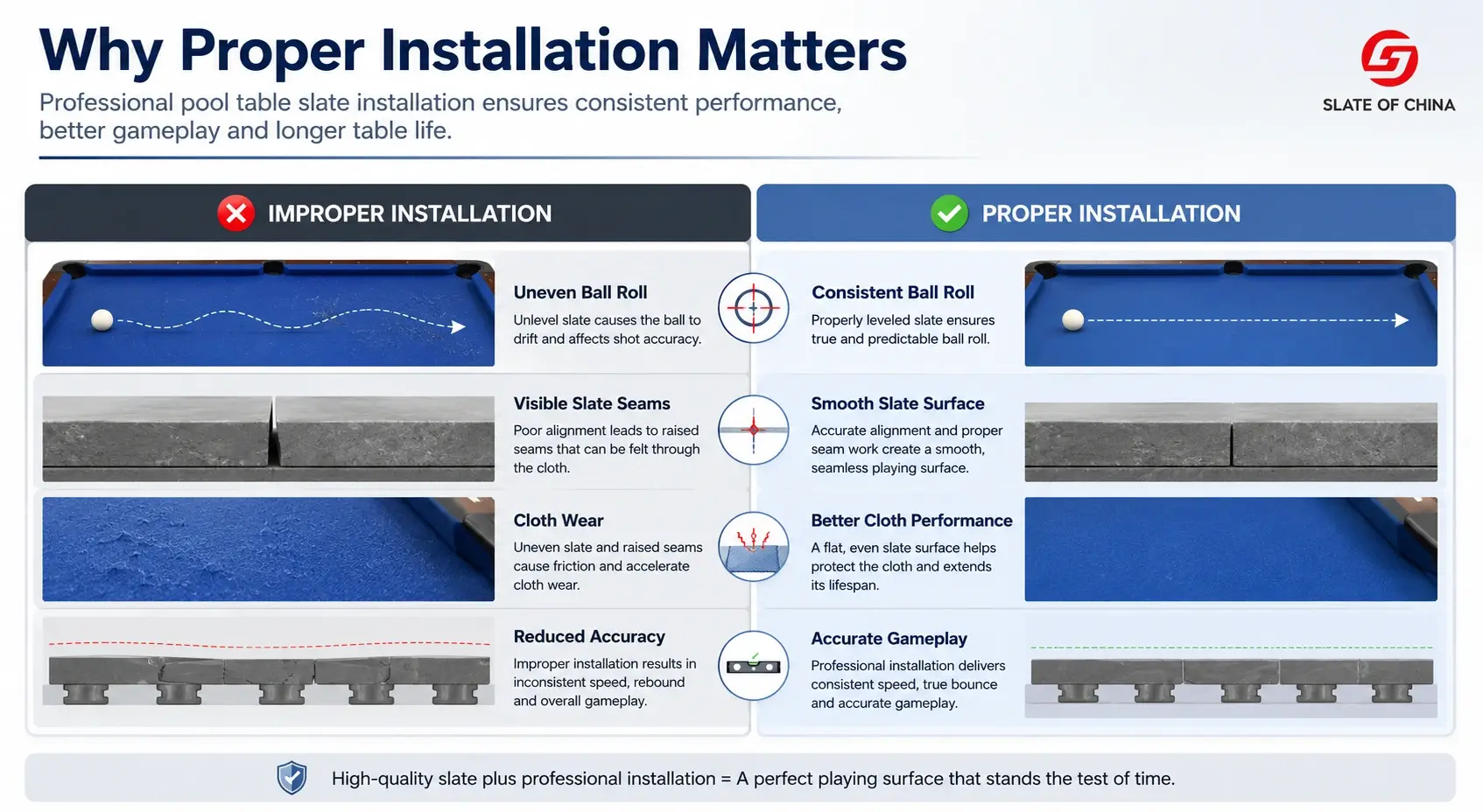
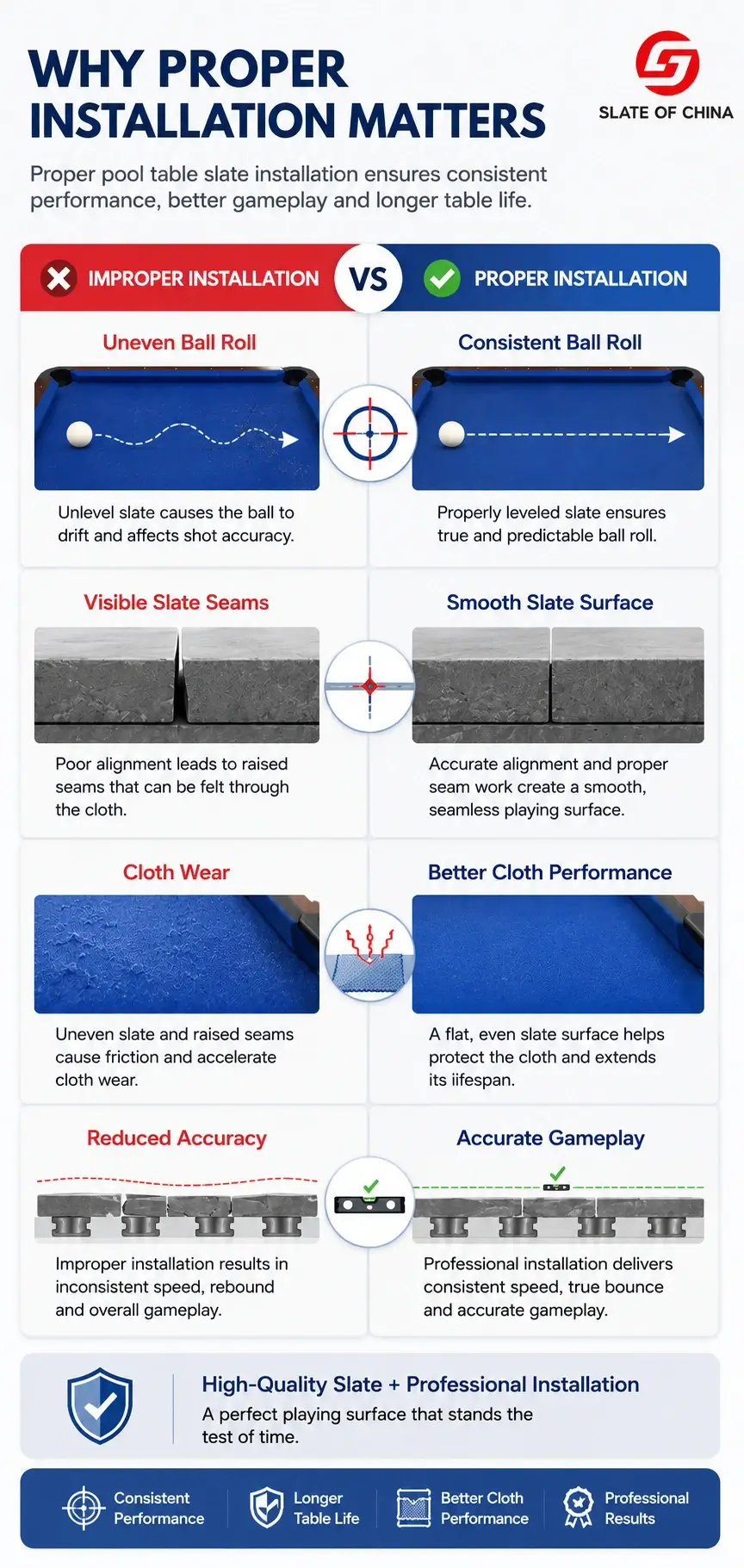
Problems Caused by Improper Slate Installation
Poor pool table slate installation can lead to several performance and maintenance issues:
- Uneven Ball Roll – Balls may drift or change direction unexpectedly on an unlevel playing surface.
- Poor Table Leveling – Inaccurate leveling affects shot consistency and overall playing experience.
- Visible Slate Seams – Improper seam alignment or filling can create noticeable joints beneath the cloth.
- Premature Cloth Wear – Raised seams and uneven surfaces may accelerate cloth deterioration.
- Reduced Playing Accuracy – Players may experience inconsistent ball speed, rebound, and shot precision.
These issues often become more noticeable as the table ages and experiences regular use.
Benefits of Proper Pool Table Slate Installation
Following industry-standard pool slate installation practices helps create a smoother, more reliable playing surface and reduces long-term maintenance requirements.
Key benefits include:
- Consistent Ball Roll for predictable shot performance
- Accurate Gameplay that meets professional playing standards
- Improved Slate Stability with reduced movement over time
- Better Cloth Performance and extended cloth lifespan
- Longer Table Service Life through proper support and load distribution
Whether installing a new table or replacing an existing slate bed, careful slate positioning, accurate leveling, and proper seam preparation are essential steps toward achieving optimal table performance.
For this reason, professional table manufacturers and installers place significant emphasis on every stage of the pool table slate installation process, from frame preparation to final leveling and inspection.
Improper Installation vs Proper Installation
| Improper Installation | Proper Installation |
|---|---|
| Uneven Ball Roll | Consistent Ball Roll |
| Visible Slate Seams | Smooth Playing Surface |
| Faster Cloth Wear | Extended Cloth Life |
| Frequent Re-Leveling | Long-Term Stability |
| Reduced Accuracy | Professional Performance |
Understanding Billiard Table Slate Construction
The slate bed is the most important structural component of a billiard table. It forms the playing surface that determines ball roll accuracy, table stability, and overall playing performance. Whether used in home recreation tables, commercial venues, or tournament-grade equipment, a high-quality pool table slate provides the flatness and consistency required for accurate gameplay.
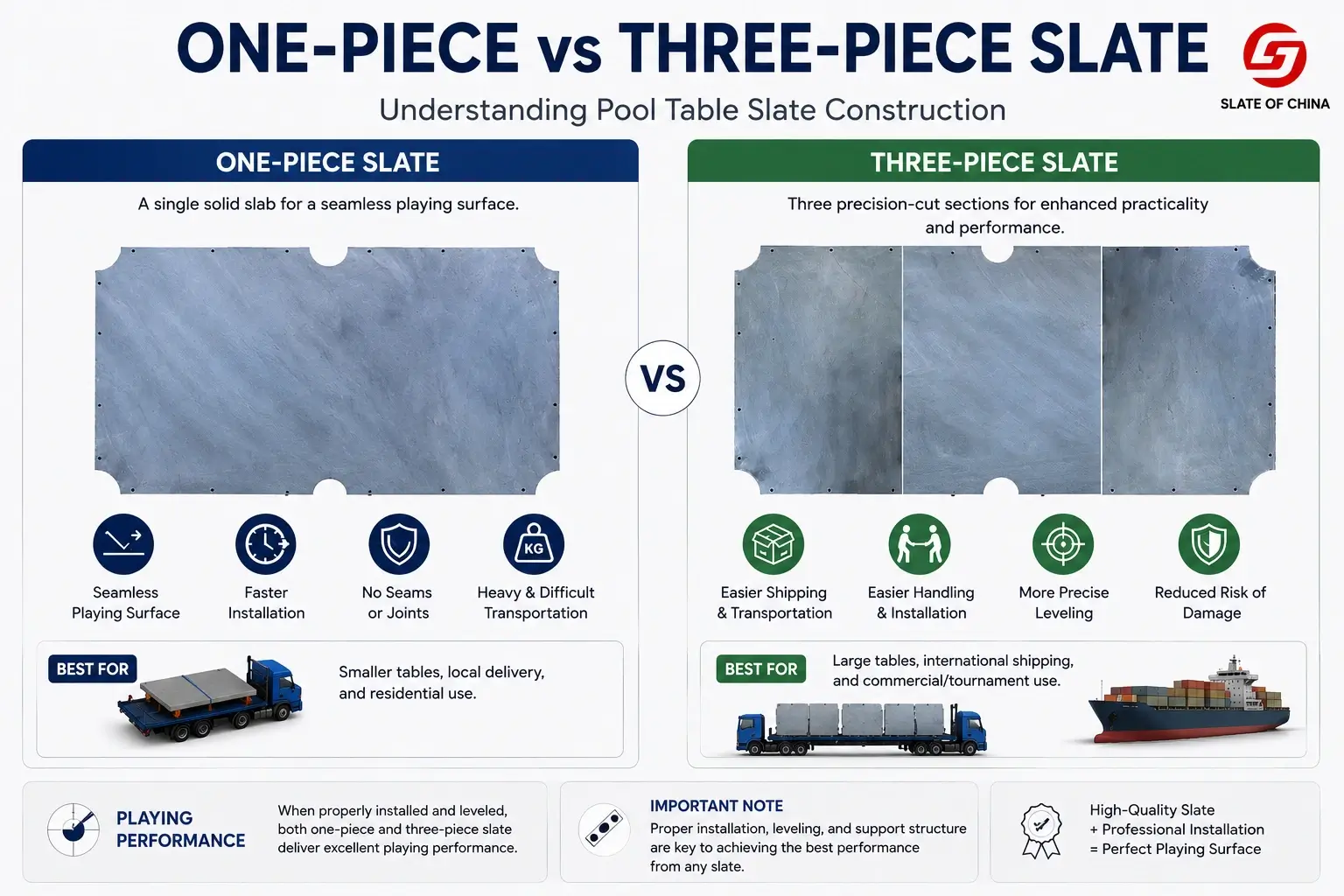
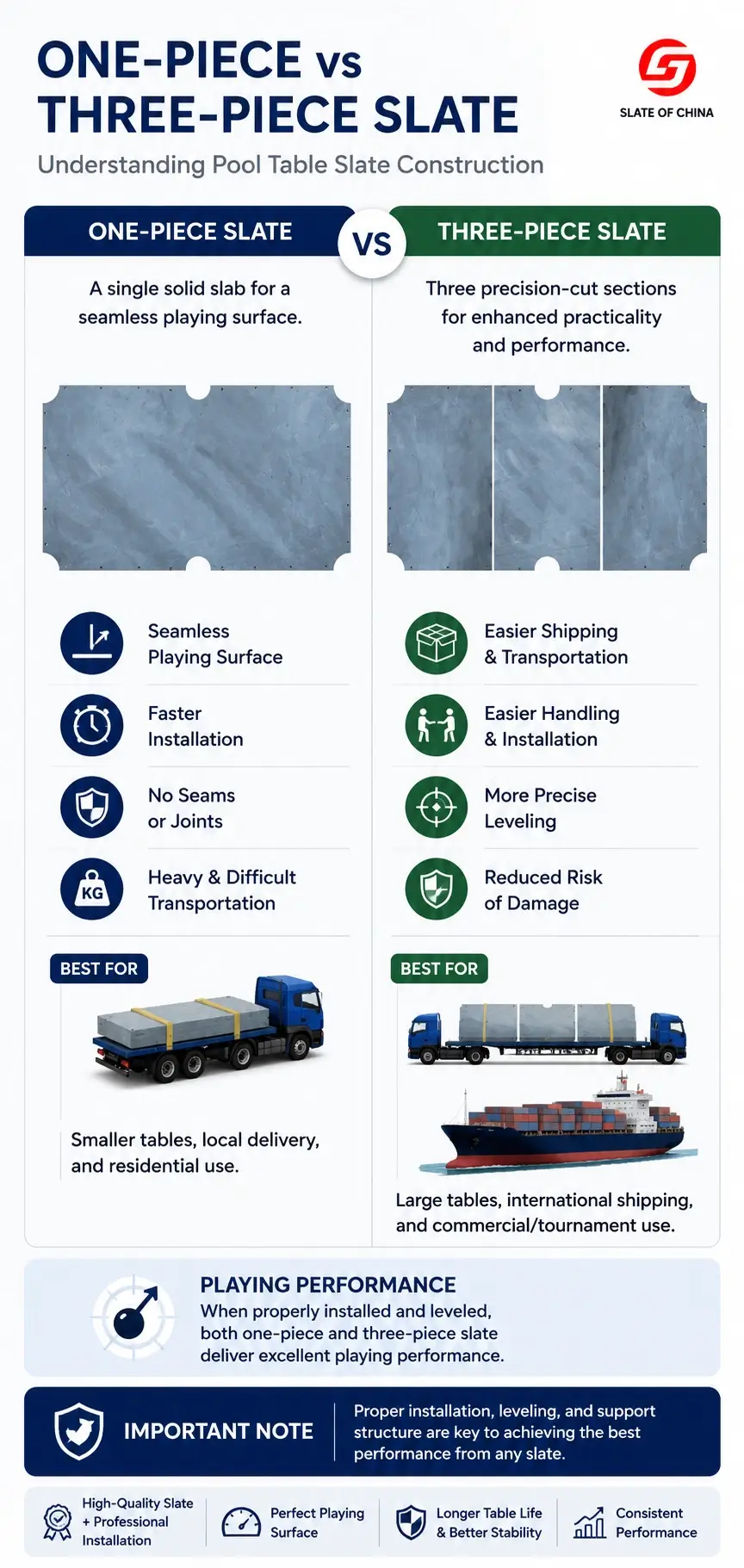
Modern pool tables typically use either a one-piece slate or a three-piece slate construction. While both designs can deliver excellent playing performance when properly manufactured and installed, each offers distinct advantages depending on transportation requirements, table size, installation conditions, and market preferences.
Understanding the differences between these slate bed configurations helps table manufacturers, distributors, and buyers select the most suitable solution for their needs.
One-Piece Pool Table Slate
A one-piece slate consists of a single solid slab that covers the entire playing surface.
Because there are no joints between slate sections, a one-piece slate naturally provides a seamless playing surface without the need for seam alignment or filling during installation.
Advantages of One-Piece Slate
- Seamless playing surface
- No slate joints or seam treatment required
- Faster installation process
- Reduced risk of seam visibility under cloth
- Excellent playing consistency
Considerations
While one-piece slate offers simplicity and excellent performance, transportation and handling can be challenging due to its size and weight.
Large one-piece slates often require specialized packaging, lifting equipment, and additional labor during delivery and installation. For this reason, one-piece slate is more commonly used for smaller residential pool tables and local installations.
Three-Piece Pool Table Slate
A three-piece slate bed divides the playing surface into three precision-machined sections that are joined together during installation.
This design has become the industry standard for most professional and commercial pool tables worldwide.
When properly leveled and seam-finished, a three-piece slate provides playing performance that is virtually indistinguishable from a one-piece slate.
Advantages of Three-Piece Slate
- Easier shipping and international transportation
- Easier handling during installation
- Reduced risk of transportation damage
- More practical for large table sizes
- Allows highly precise leveling adjustments
Why Most Professional Tables Use Three-Piece Slate
Because each slate section can be adjusted independently during installation, professional installers can achieve extremely accurate leveling across the entire playing surface.
This flexibility makes three-piece slate particularly suitable for commercial pool tables, tournament tables, and export markets where transportation efficiency and installation accuracy are critical.
Which Slate Construction Is Better?
There is no universal answer. The best choice depends on the specific application.
| Feature | One-Piece Slate | Three-Piece Slate |
|---|---|---|
| Playing Performance | Excellent | Excellent |
| Shipping Convenience | Moderate | Excellent |
| Handling Ease | Moderate | Excellent |
| Installation Speed | Faster | Moderate |
| Leveling Flexibility | Limited | Excellent |
| Commercial Use | Less Common | Industry Standard |
For most modern pool table manufacturers and international distributors, three-piece slate remains the preferred choice because it offers the best balance of performance, transportation efficiency, and installation flexibility.
To learn more about slate dimensions and thickness options, see our Pool Slate Size Guide and Pool Slate Thickness Guide.
Preparing Pool Slate Before Installation
Proper preparation is an essential first step in any pool table slate installation project. Before the slate bed is positioned, leveled, or secured to the table frame, it should be carefully inspected, stored correctly, and handled using appropriate lifting techniques.
Many installation problems that appear later in the setup process can often be traced back to issues that occurred during transportation, storage, or handling. Even precision-machined natural slate can be damaged if it is moved improperly or stored under unsuitable conditions.
For this reason, professional pool table manufacturers and installers typically perform a thorough pool slate inspection before installation begins.
The following recommendations represent common industry practices for pool slate preparation and handling.
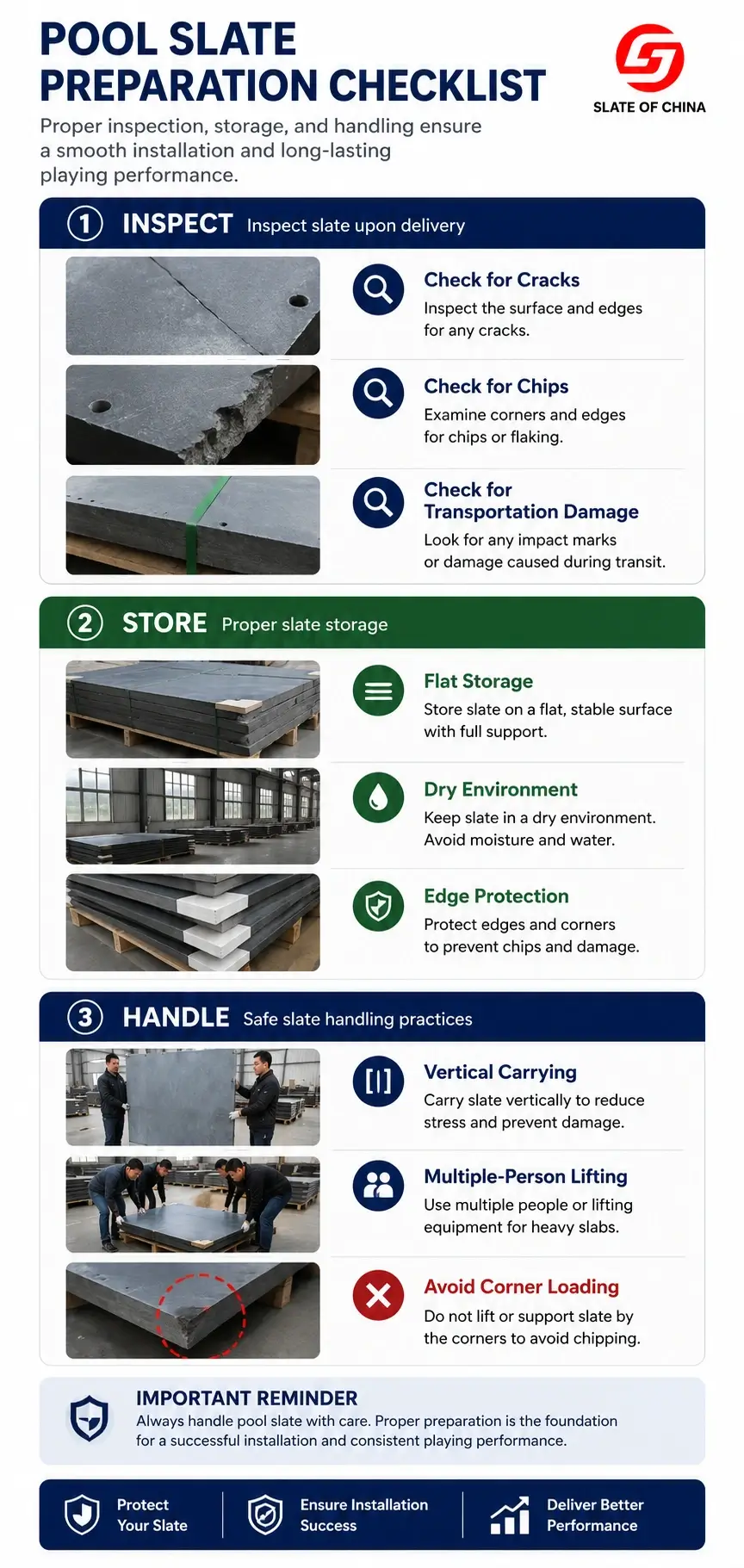
Inspecting Slate Upon Delivery
Before installation, each slate section should be inspected immediately after delivery to verify that it has arrived in good condition.
Although natural slate is highly durable, it can still be damaged by improper handling during transportation or unloading.
What to Check
Inspect the slate carefully for:
- Visible cracks
- Edge chips
- Corner damage
- Surface scratches
- Transportation-related impact marks
- Damage to machined edges and seam surfaces
Particular attention should be given to the slate edges and precision-machined seam areas, as these sections play an important role in achieving accurate alignment during installation.
If any damage is discovered, it is advisable to document the condition with photographs before proceeding with installation.
Why Inspection Matters
A damaged slate section may affect:
- Playing surface flatness
- Seam alignment
- Table leveling accuracy
- Long-term structural stability
Early inspection helps prevent unnecessary installation delays and allows issues to be addressed before assembly begins.
Proper Slate Storage
In some situations, pool table slate may need to be stored for days or weeks before installation.
Proper storage helps preserve the dimensional stability and surface quality of the slate.
Recommended Storage Practices
- Store slate on a flat and stable surface
- Keep all slate sections fully supported
- Protect edges and corners from accidental impacts
- Avoid uneven support points
- Store indoors whenever possible
Maintain a Dry Environment
Natural slate itself is not significantly affected by normal humidity levels. However, prolonged exposure to excessive moisture may affect packaging materials, support structures, and surrounding components.
For best results:
- Keep slate in a dry environment
- Avoid standing water or excessive moisture
- Protect stored slate from outdoor weather exposure
Edge Protection
Slate corners and edges are generally the most vulnerable areas during storage and movement.
Using protective padding or edge guards can help reduce the risk of accidental chipping before installation.
Safe Slate Handling Practices
Pool table slate is extremely heavy and should always be handled with care.
Improper lifting techniques can result in personal injury, damaged slate, or both.
Carry Slate Vertically When Possible
Professional handlers commonly transport slate sections in a near-vertical position rather than laying them flat during movement.
Vertical carrying helps:
- Reduce stress on the slate
- Improve handling control
- Minimize the risk of bending-related damage
Avoid Corner Loading
Never support the entire weight of a slate section from a single corner.
Concentrated loads may increase the risk of:
- Edge chipping
- Corner fractures
- Structural damage
The weight should always be distributed evenly across the slate during lifting and transportation.
Use Multiple-Person Lifting
Because pool table slate sections can weigh hundreds of pounds, multiple-person lifting is strongly recommended.
For larger slate beds, lifting equipment may also be used to improve safety and reduce handling risks.
General Handling Recommendations
- Lift slowly and evenly
- Avoid sudden impacts
- Do not drag slate across hard surfaces
- Protect machined edges from direct contact
- Keep pathways clear during movement
Proper slate handling not only reduces the risk of damage but also helps ensure that the slate arrives at the installation area in optimal condition for leveling and assembly.
Careful inspection, storage, and handling provide the foundation for a successful pool table slate installation and contribute to long-term playing performance.

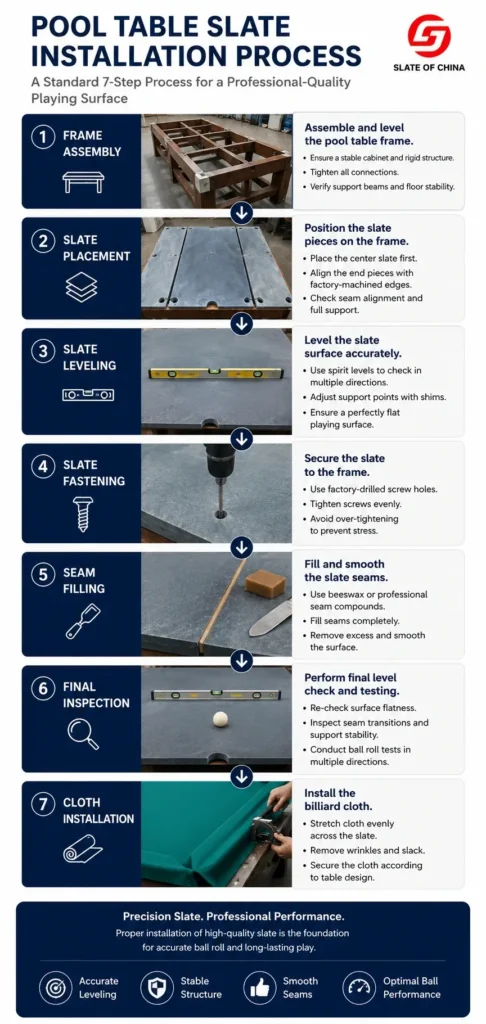
Standard Pool Table Slate Installation Process
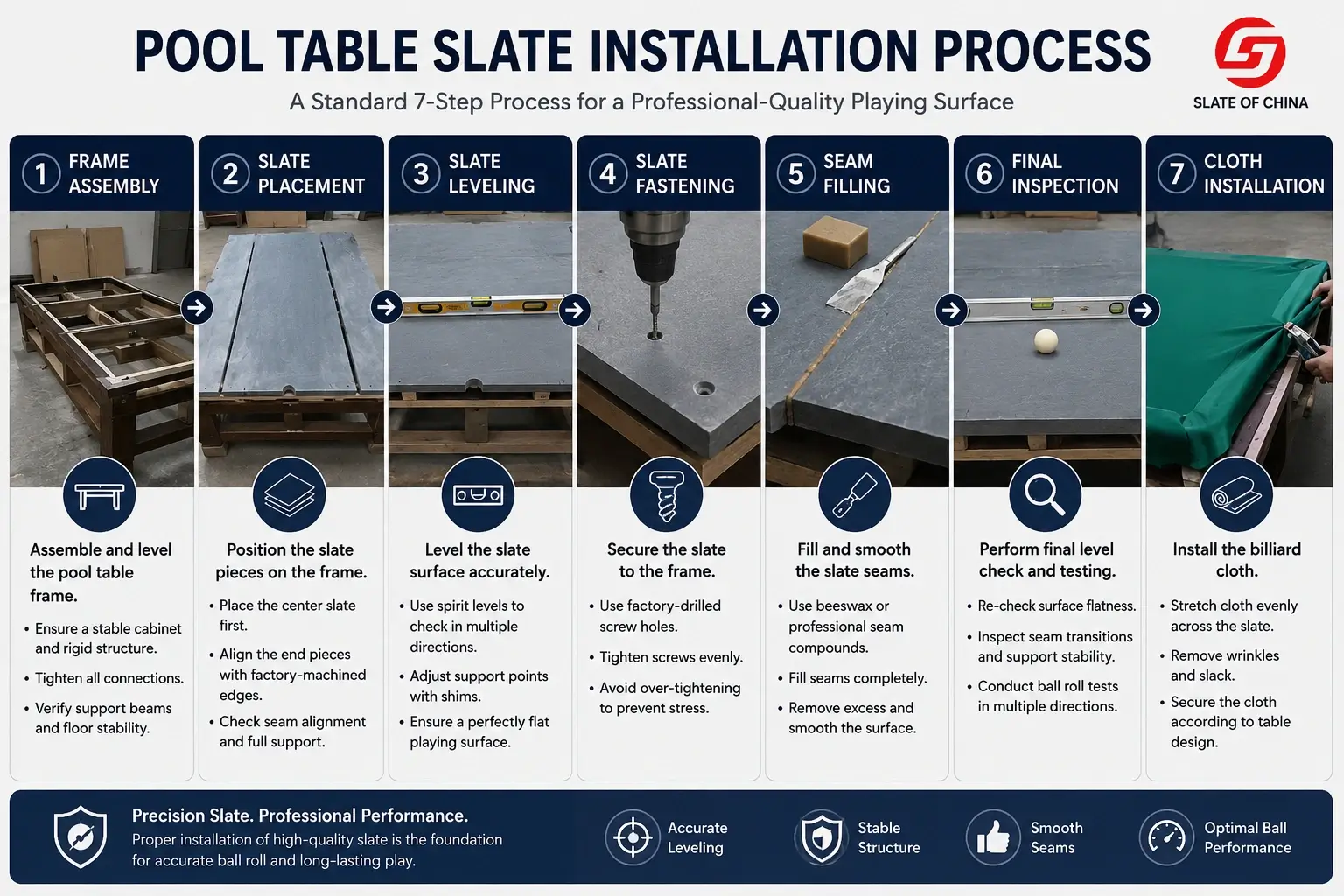
Professional installers may use different techniques depending on table design, slate configuration, and local installation practices. However, the following process reflects common industry practices used when installing a pool table slate bed.
While specific procedures may vary, the overall objective remains the same: to create a stable, level, and seamless playing surface capable of delivering accurate ball roll and long-term performance.
Step 1 – Assemble and Level the Pool Table Frame
Before any slate pieces are installed, the pool table frame must be fully assembled and positioned in its final location.
A properly constructed frame provides the foundation for the entire slate bed. Even the highest-quality pool table slate cannot perform correctly if the underlying support structure is unstable or uneven.
Key Considerations
- Ensure the cabinet structure is rigid and secure
- Tighten all frame connections according to manufacturer specifications
- Verify that support beams are correctly positioned
- Confirm that the table is located on a stable floor surface
Why Frame Stability Matters
The slate bed relies on the frame for support. Any movement, twisting, or settling within the frame can affect slate alignment and leveling accuracy over time.
For this reason, professional installers typically verify frame stability before proceeding with slate placement.
Step 2 – Position the Slate Pieces
Once the frame is prepared, the slate sections can be positioned onto the support structure.
Most modern pool tables use a three-piece slate system, although one-piece slate beds are also used in certain applications.
Typical Slate Placement Process
- Position the center slate section first
- Align the two end sections with the center piece
- Check seam alignment along the full slate length
- Verify that all slate sections are properly supported
Importance of Factory-Machined Edges
Precision-machined slate edges help achieve tighter seam alignment and smoother transitions between slate sections.
Accurate machining simplifies installation and contributes to improved playing surface consistency.
Step 3 – Level the Slate Surface
Slate leveling is one of the most critical stages of the pool table slate installation process.
The objective is to create a perfectly flat playing surface that allows balls to roll consistently in all directions.
Common Leveling Tools
Professional installers often use:
- Spirit levels
- Precision machinist levels
- Straight edges
- Slate shims
Leveling Principles
Leveling is typically checked:
- Lengthwise
- Widthwise
- Diagonally
Adjustments are usually made at support points beneath the slate bed.
Why Proper Leveling Is Important
Even minor deviations can affect:
- Ball roll accuracy
- Shot consistency
- Professional playing performance
Accurate slate leveling helps ensure a reliable playing surface throughout the life of the table.
Step 4 – Secure the Slate
After leveling is completed, the slate sections are secured to the table frame.
Typical Slate Fastening Practices
- Align factory-drilled screw holes
- Tighten fasteners gradually and evenly
- Verify that leveling remains unchanged during fastening
Avoid Excessive Force
Over-tightening fasteners may place unnecessary stress on the slate.
Professional installers generally aim for secure attachment while avoiding excessive force that could affect slate integrity.
Proper slate fastening helps maintain stability and minimizes movement during long-term use.
Step 5 – Fill and Smooth Slate Seams
For three-piece slate beds, the seams between slate sections must be filled and finished before cloth installation.
Common Slate Seam Materials
- Beeswax
- Professional seam compounds
- Specialty slate fillers
Among these options, beeswax remains one of the most widely used materials in the billiards industry.
Objectives of Seam Filling
- Eliminate gaps between slate sections
- Create a smooth playing surface
- Prevent seam visibility beneath the cloth
Surface Finishing
After filling, excess material is removed and the seam area is smoothed to ensure a uniform surface.
Proper seam treatment contributes significantly to overall table performance and appearance.
Step 6 – Final Level Check
Before cloth installation begins, installers typically perform a final inspection of the slate bed.
Inspection Areas
- Surface flatness
- Seam transitions
- Support stability
- Overall level accuracy
Ball Roll Testing
Many installers also perform basic ball roll tests to verify that the playing surface responds consistently in multiple directions.
This final verification step helps identify any remaining adjustments before the table is completed.
Step 7 – Pool Table Cloth Installation
Once the slate bed has been leveled and inspected, billiard cloth can be installed.
Typical Cloth Installation Process
- Position cloth evenly across the slate surface
- Stretch cloth uniformly
- Remove wrinkles and slack areas
- Secure cloth according to table design
Why Cloth Installation Matters
Even a perfectly installed slate bed can be affected by improper cloth fitting.
Correct cloth tension contributes to:
- Consistent ball speed
- Accurate shot response
- Improved cloth durability
After cloth installation is complete, the pool table is ready for final rail assembly and play testing.
Manufacturer’s Note
As a professional pool table slate manufacturer, our primary focus is producing precision-machined natural slate that supports easier installation and superior playing performance.
While installation methods may vary between table brands and installers, the principles of proper support, accurate leveling, secure fastening, and precise seam finishing remain essential to achieving a professional-quality playing surface.
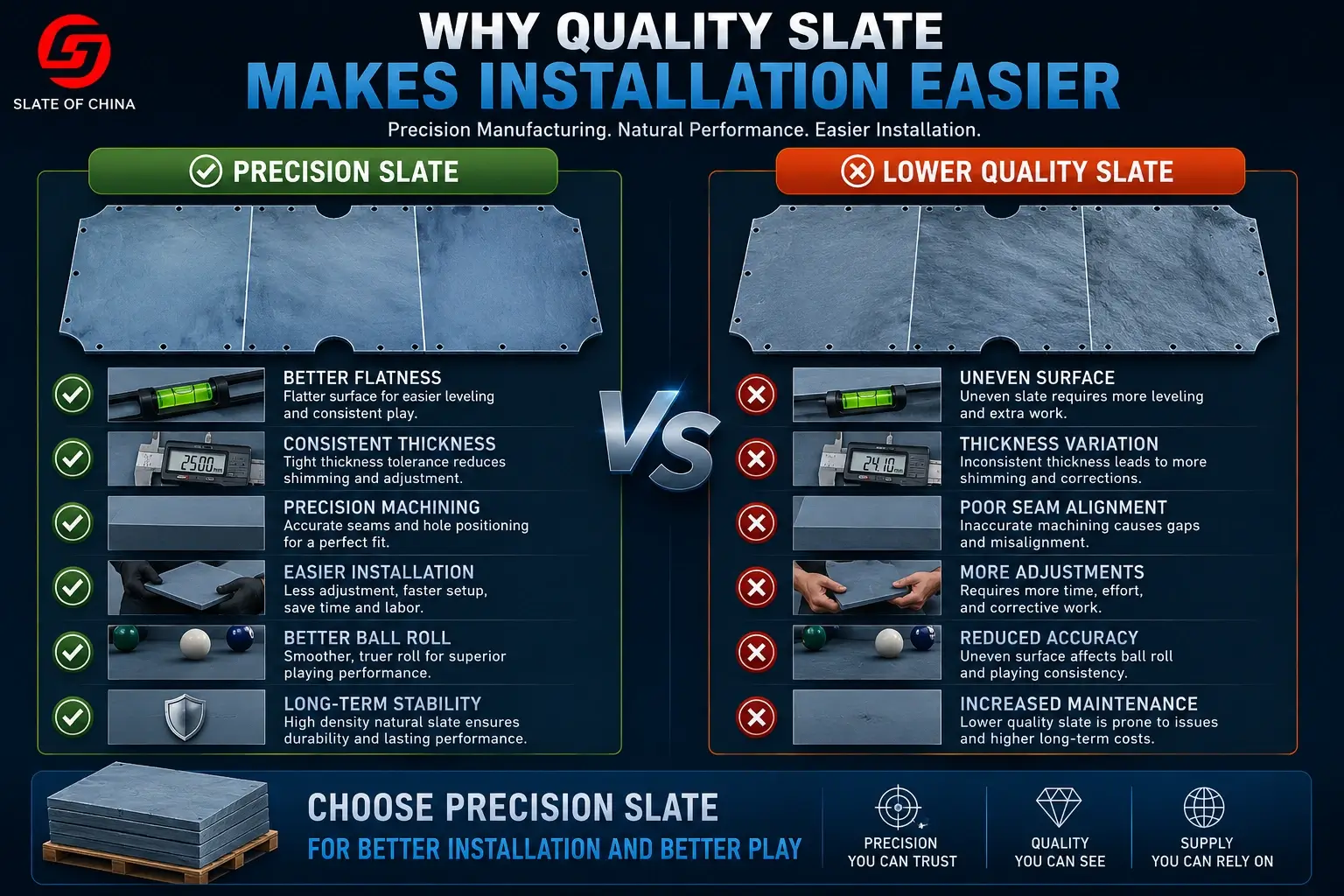
How Slate Quality Affects Installation Results
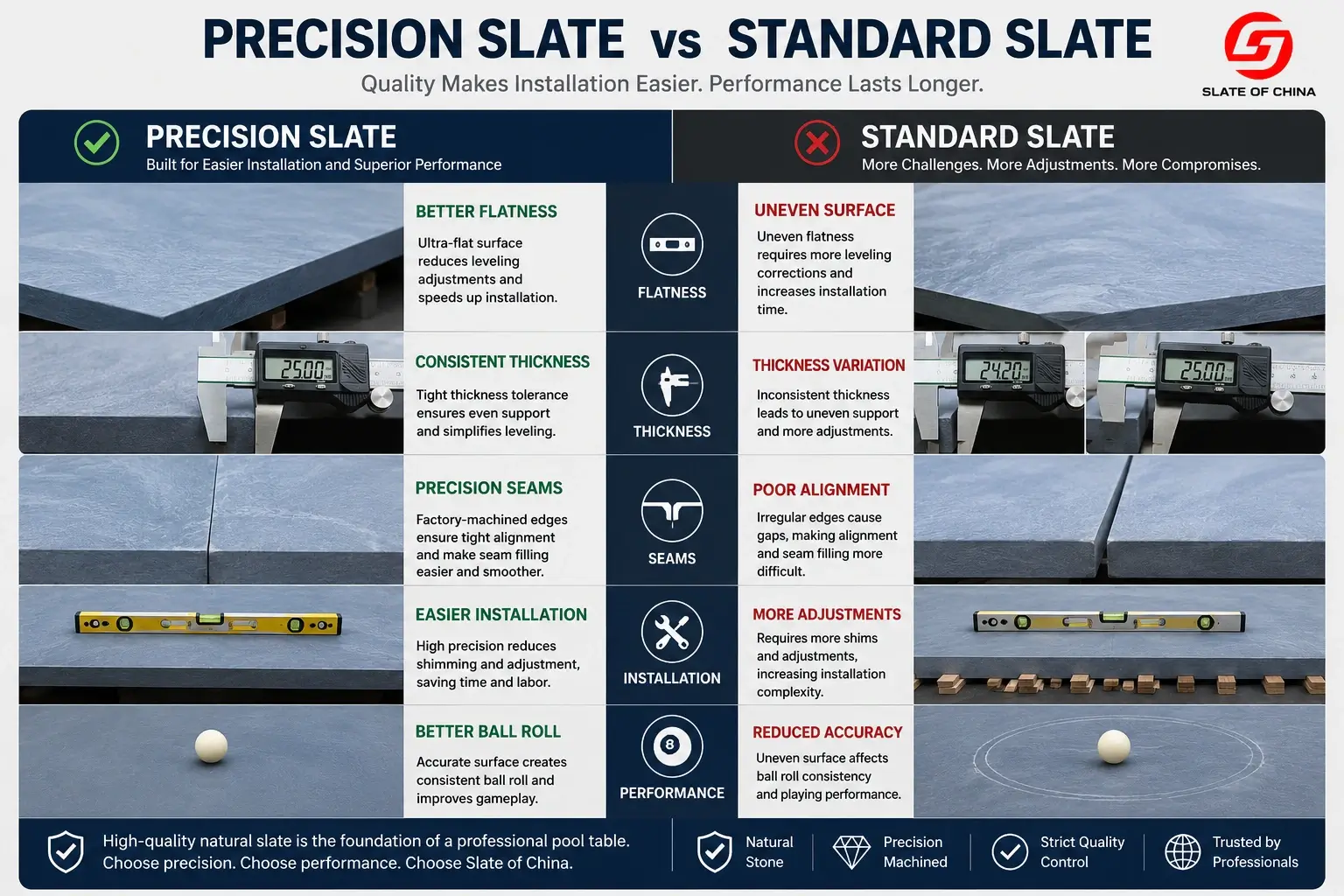
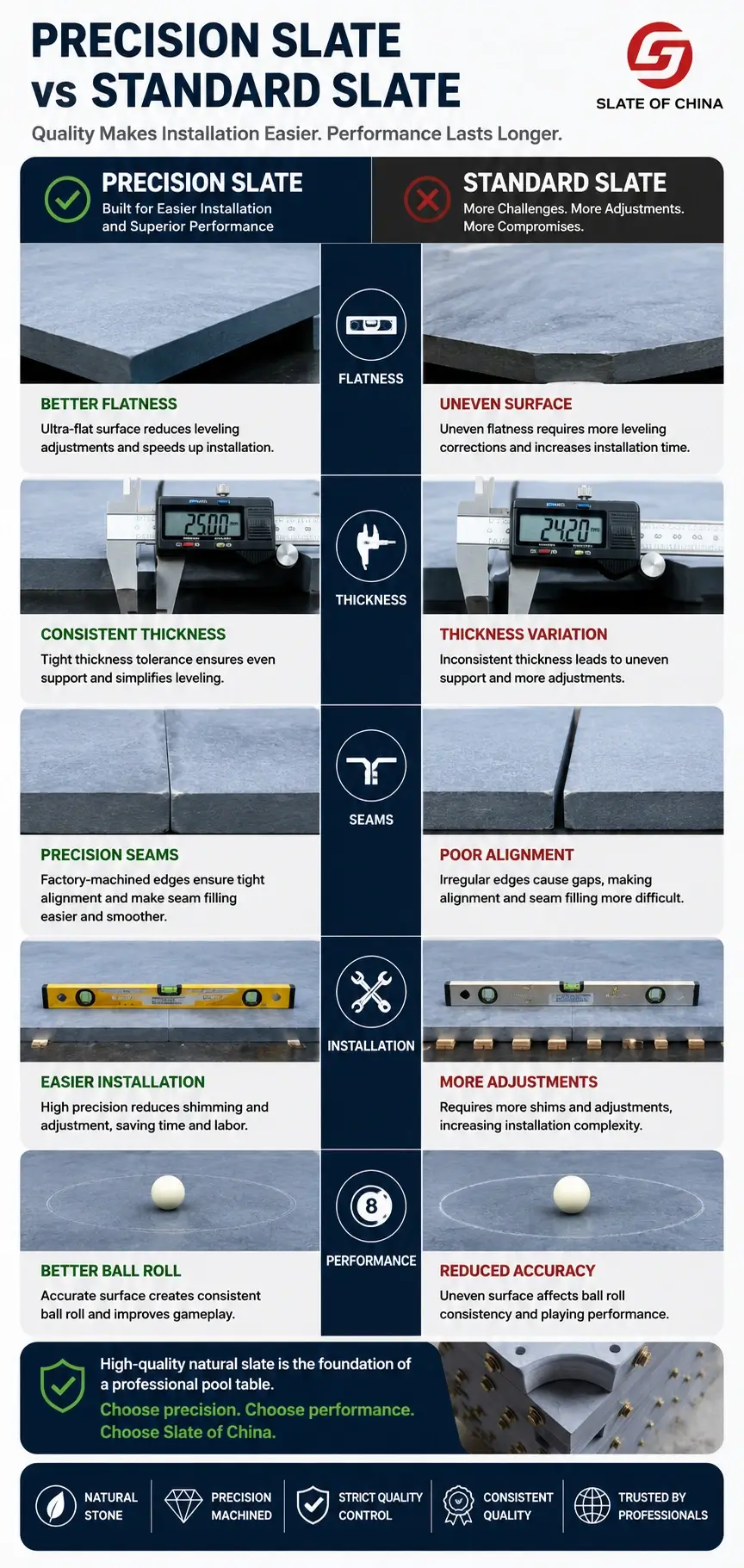
Successful pool table slate installation depends not only on the skills of the installer but also on the quality of the slate itself.
Even experienced installers may encounter challenges when working with slate that lacks dimensional accuracy, consistent thickness, or properly machined seams. Conversely, high-quality precision slate can simplify installation, improve alignment, reduce adjustment time, and contribute to superior playing performance.
For this reason, professional pool table manufacturers place significant emphasis on slate quality before installation even begins.
The characteristics of a precision-machined natural slate bed can directly influence both installation efficiency and long-term table performance.
Slate Flatness
Flatness is one of the most important indicators of pool table slate quality.
The purpose of slate leveling is to create a perfectly uniform playing surface. However, if the slate itself is not sufficiently flat, achieving accurate leveling becomes much more difficult.
Why Flatness Matters
High-quality precision slate offers:
- Better surface uniformity
- Reduced leveling corrections
- Improved ball roll consistency
- Easier installation and adjustment
Poor slate flatness may result in:
- Additional shimming requirements
- Longer installation times
- Inconsistent playing characteristics
- Increased difficulty achieving professional-level accuracy
For professional billiard tables, precise slate flatness forms the foundation of reliable gameplay.
Slate Thickness Consistency
Consistent slate thickness is another critical factor that influences installation quality.
When multiple slate sections are used in a three-piece slate bed, variations in thickness can create alignment challenges between adjoining pieces.
Benefits of Thickness Consistency
Uniform slate thickness helps:
- Simplify slate placement
- Reduce leveling adjustments
- Improve support distribution
- Maintain consistent seam alignment
Installation Advantages
When each slate section maintains consistent thickness throughout production, installers can focus on fine leveling adjustments rather than compensating for manufacturing variations.
This improves installation efficiency and helps create a more stable playing surface.
Precision-Machined Seams
For three-piece pool table slate systems, seam quality plays a major role in both installation and performance.
Precision-machined seam surfaces allow adjoining slate sections to fit together more accurately.
Benefits of Precision-Machined Seams
High-quality seam machining helps:
- Improve slate alignment
- Reduce visible seam lines
- Simplify seam filling
- Enhance overall surface smoothness
Better Seam Performance
Accurate seam geometry allows beeswax or professional seam compounds to perform more effectively.
As a result, installers can achieve cleaner transitions between slate sections and a more uniform playing surface beneath the cloth.
For this reason, precision-machined seams are considered a key feature of professional-grade pool table slate.
Structural Stability
Natural slate is valued throughout the billiards industry for its long-term dimensional stability.
However, not all slate materials offer the same structural characteristics.
Why Stability Matters
A structurally stable slate bed helps maintain:
- Level playing conditions
- Consistent seam alignment
- Long-term frame support
- Reliable ball roll performance
Long-Term Benefits
Quality natural slate is less likely to experience dimensional changes that could affect table performance over time.
This contributes to:
- Reduced maintenance requirements
- Improved durability
- Better long-term playing accuracy
For commercial pool rooms, tournament venues, and serious players, structural stability remains one of the most important advantages of professional-grade slate.
The Connection Between Slate Quality and Installation Success
While proper installation techniques remain essential, high-quality pool table slate makes the entire installation process more efficient and predictable.
Compared with lower-quality materials, precision slate can:
✔ Simplify installation
✔ Reduce leveling adjustments
✔ Improve seam alignment
✔ Minimize installation time
✔ Enhance playing performance
✔ Improve long-term table stability
Ultimately, the best installation results are achieved when skilled installation practices are combined with high-quality natural slate manufactured to strict dimensional standards.
For this reason, many leading pool table manufacturers choose precision-machined slate as the foundation of their premium billiard tables.
Manufacturer’s Insight
At Slate of China, every slate section is manufactured with attention to flatness, thickness consistency, seam accuracy, and structural integrity. These quality factors not only improve installation efficiency but also contribute to the long-term playing performance expected from professional pool tables worldwide.
Common Pool Slate Installation Problems
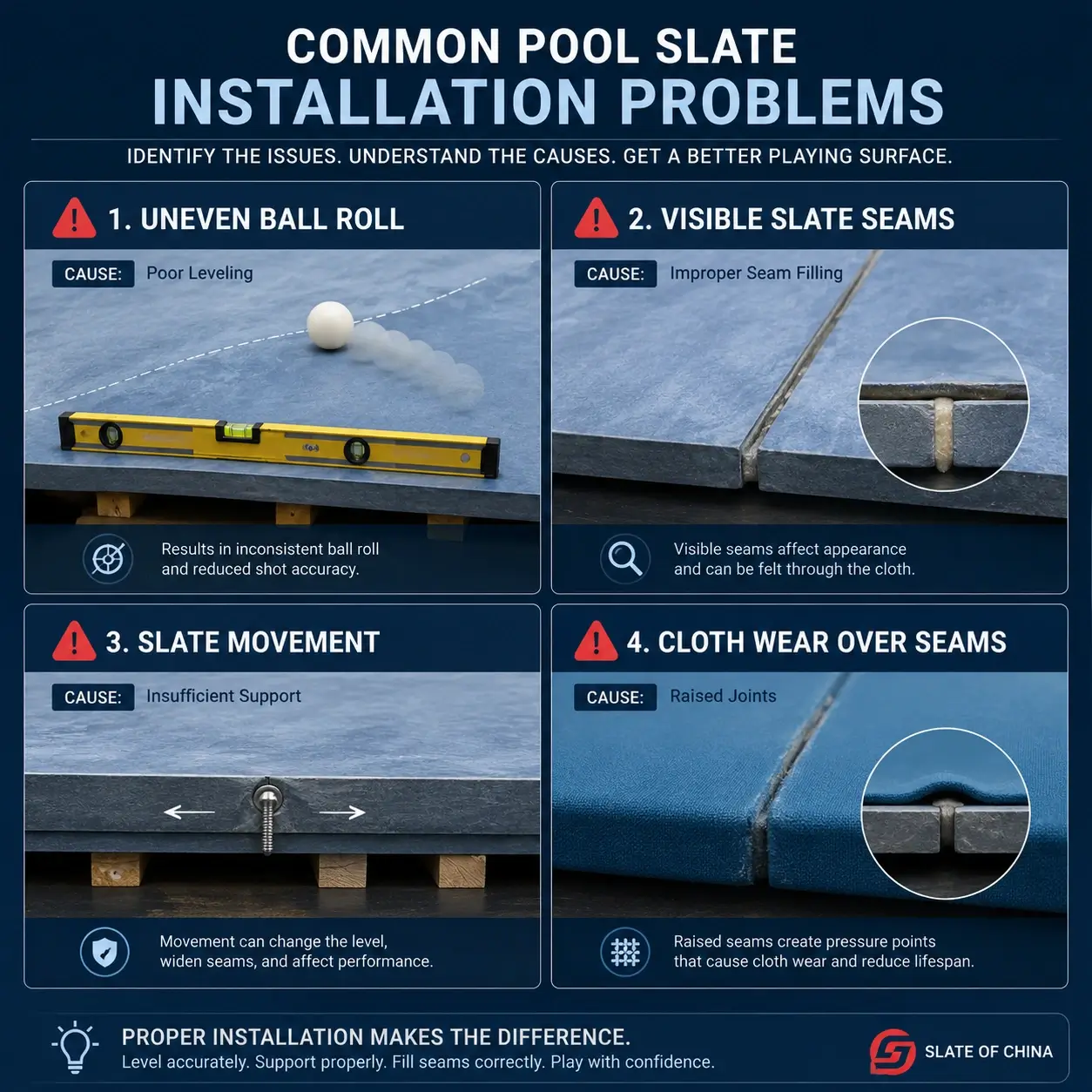
Even when high-quality pool table slate is used, installation-related issues can occur if proper procedures are not followed. Understanding the most common pool table slate problems can help installers identify potential issues early and achieve a more accurate, durable, and professional-quality playing surface.
The following examples represent some of the most frequently encountered challenges during pool table slate installation.
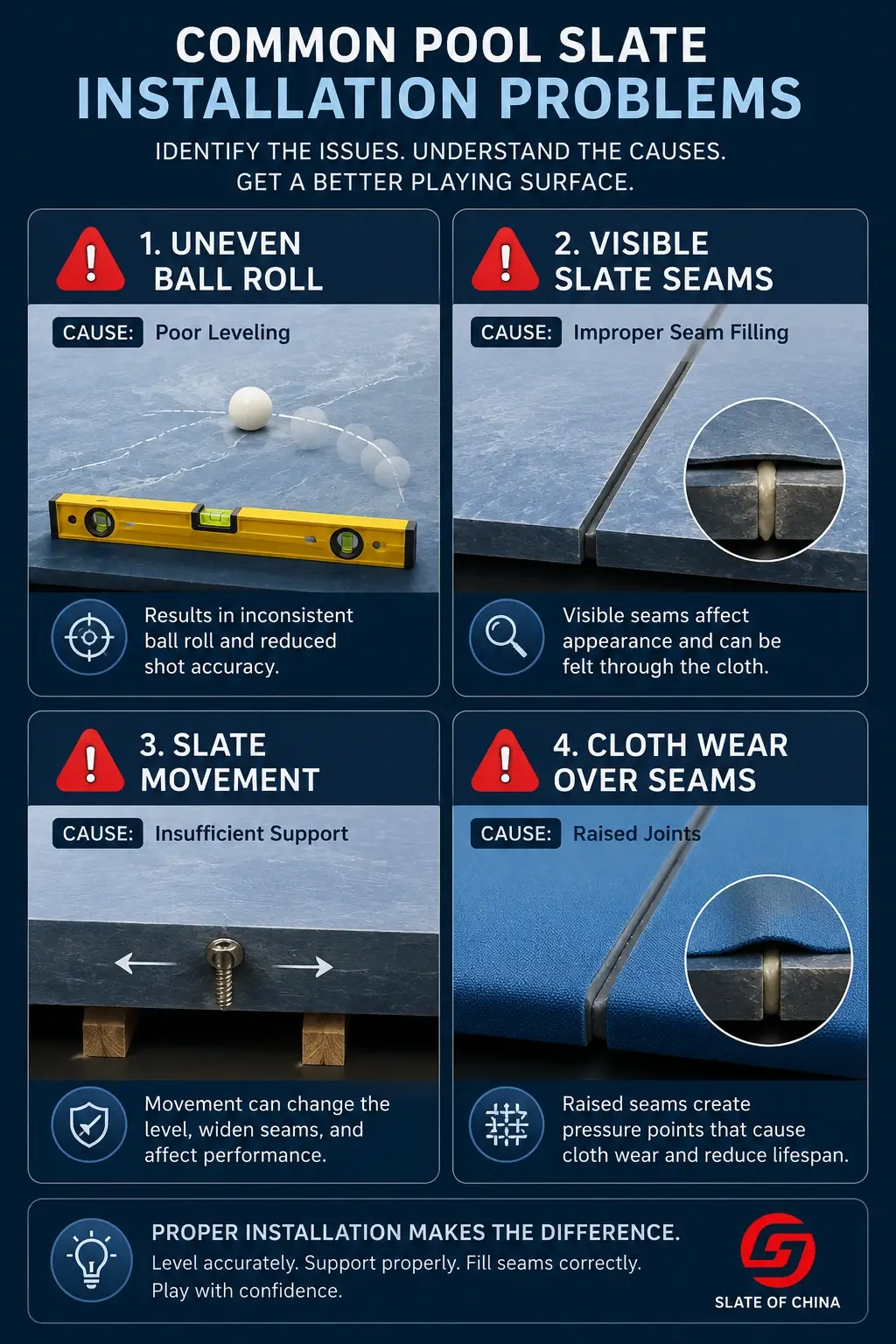
Uneven Ball Roll
One of the most noticeable signs of an installation problem is uneven ball roll.
When a pool table is not properly leveled, balls may drift away from their intended path, affecting shot accuracy and overall gameplay.
Common Causes
- Poor slate leveling
- Uneven support points
- Improper frame setup
- Settlement of the table structure over time
Potential Effects
- Inconsistent ball movement
- Reduced playing accuracy
- Difficulty performing precision shots
Industry Practice
Professional installers typically check slate level in multiple directions and perform ball roll testing before completing the installation process.
Visible Slate Seams
Visible slate seams can affect both table appearance and playing performance.
Although three-piece slate systems are designed to create a smooth, continuous playing surface, improper seam treatment may leave noticeable joint lines beneath the cloth.
Common Causes
- Improper seam filling
- Incomplete seam finishing
- Poor alignment between slate sections
- Low-quality seam materials
Potential Effects
- Visible cloth irregularities
- Reduced playing surface smoothness
- Customer dissatisfaction
Industry Practice
Beeswax and professional seam compounds are commonly used to create smooth transitions between slate sections before cloth installation.
Slate Movement
Slate movement can occur when the slate bed is not adequately supported or secured.
Even small amounts of movement may affect table leveling and long-term playing performance.
Common Causes
- Insufficient support structure
- Improper slate fastening
- Loose frame components
- Inadequate installation practices
Potential Effects
- Changes in table level
- Increased seam visibility
- Reduced structural stability
Industry Practice
Proper support distribution and secure slate fastening help minimize movement during long-term use.
Cloth Wear Over Seams
Premature cloth wear may develop above slate seams when the playing surface is not perfectly smooth.
Raised seam areas can create localized stress points beneath the cloth.
Common Causes
- Raised slate joints
- Incomplete seam finishing
- Uneven seam filler application
- Improper surface preparation
Potential Effects
- Accelerated cloth wear
- Visible cloth imperfections
- Reduced cloth lifespan
Industry Practice
Professional seam finishing and final surface inspection help reduce the likelihood of cloth wear developing above seam locations.
Preventing Pool Table Slate Installation Problems
Most slate installation issues can be avoided through:
✔ Proper frame preparation
✔ Accurate slate leveling
✔ Precision seam alignment
✔ Secure fastening
✔ High-quality natural slate
When quality slate and proper installation practices are combined, the result is a stable, level, and durable playing surface capable of delivering consistent ball roll and long-term performance.
Pool Table Slate Installation Time
One of the most common questions from table manufacturers, distributors, and end users is:
How long does pool table slate installation take?
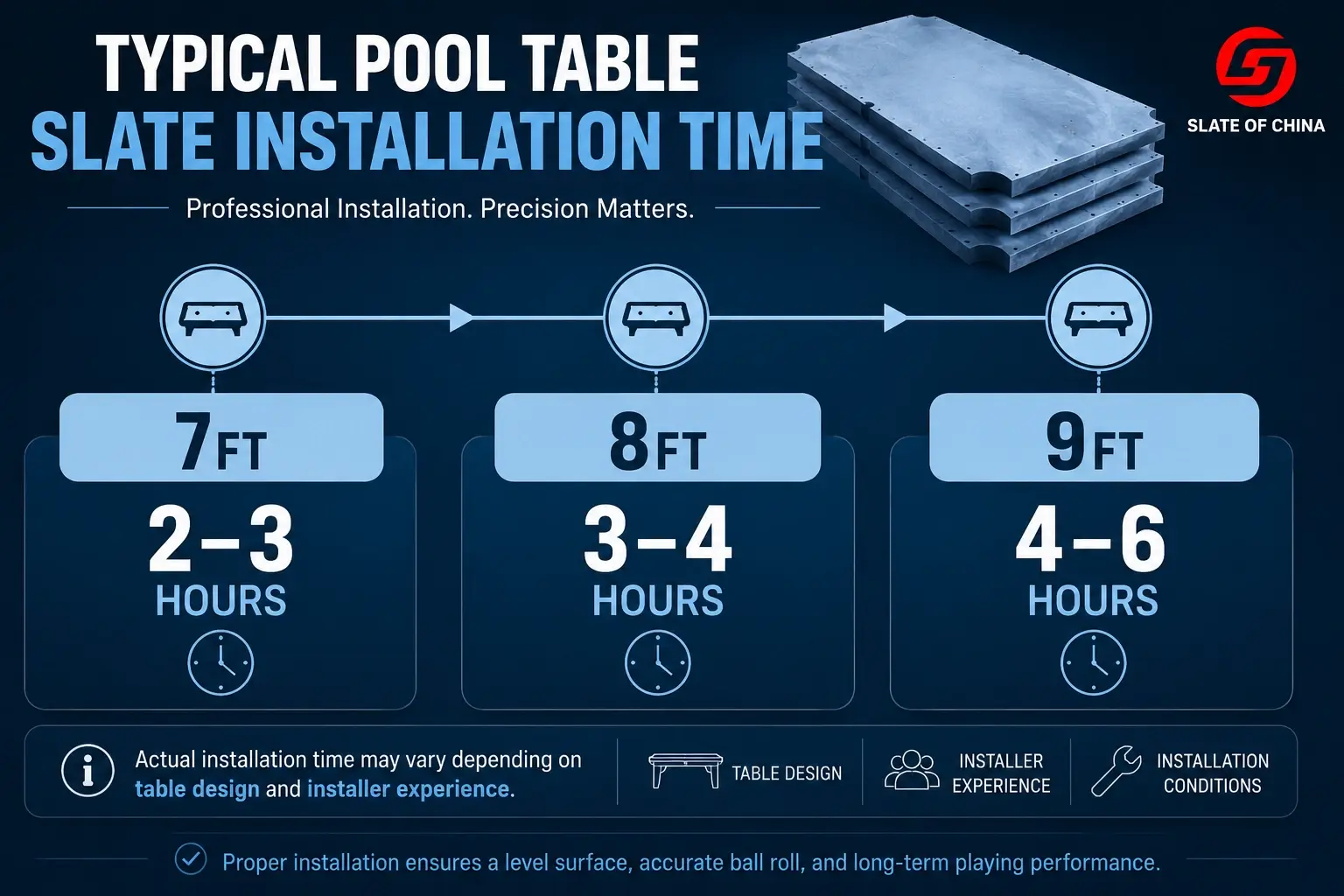
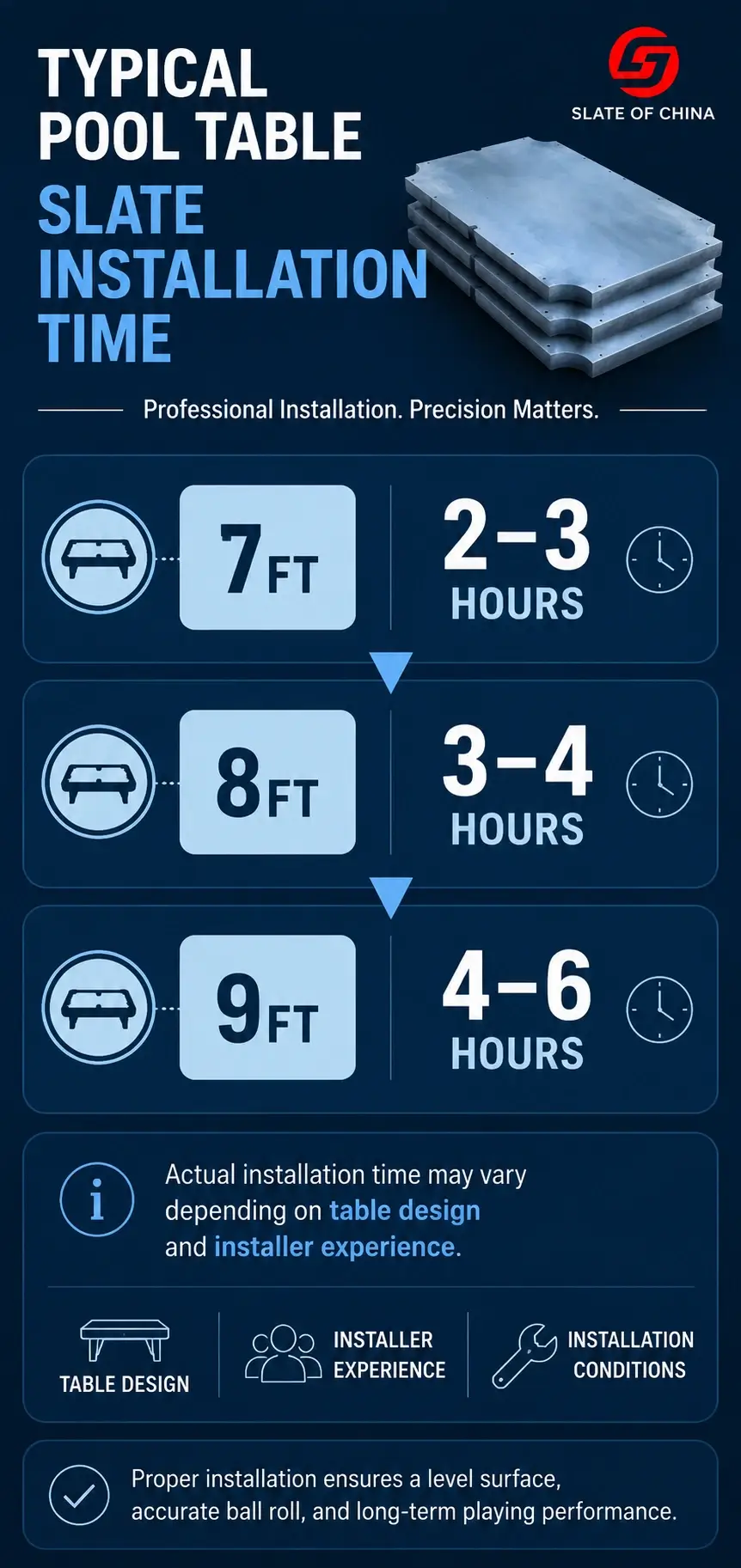
The answer depends on several factors, including table size, slate configuration, installation environment, and the experience level of the installation team.
In general, larger tables require additional time for positioning, leveling, seam finishing, and final inspection.
Typical Pool Table Slate Installation Time
| Table Size | Typical Installation Time |
|---|---|
| 7ft Pool Table | 2–3 Hours |
| 8ft Pool Table | 3–4 Hours |
| 9ft Pool Table | 4–6 Hours |
Factors That Influence Installation Time
Installation time may vary depending on:
- One-piece or three-piece slate construction
- Table frame complexity
- Slate leveling requirements
- Seam finishing methods
- Installer experience
- Site accessibility
Important Note
The installation times shown above represent typical industry estimates. Actual installation duration may vary depending on table design, site conditions, and the experience of the installation team.
Professional installers generally spend additional time on leveling and seam finishing to achieve the highest possible playing accuracy.
Manufacturer’s Perspective
From a slate manufacturer’s perspective, high-quality precision slate can help reduce installation time by improving:
- Slate alignment
- Leveling efficiency
- Seam consistency
- Overall installation accuracy
Precision-machined slate does not replace proper installation techniques, but it can make the installation process more efficient while helping installers achieve better final results.
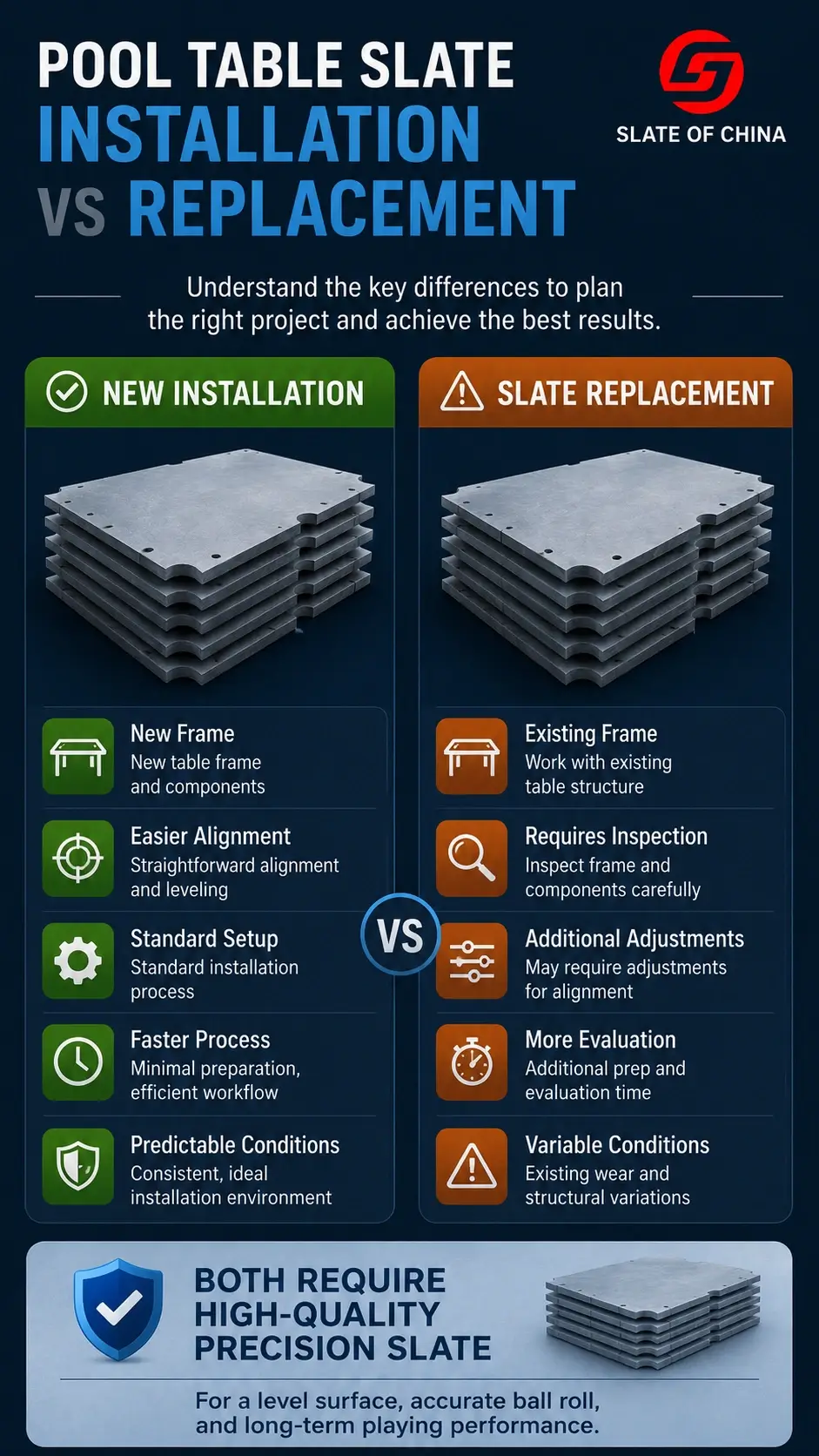
Pool Table Slate Installation vs Slate Replacement
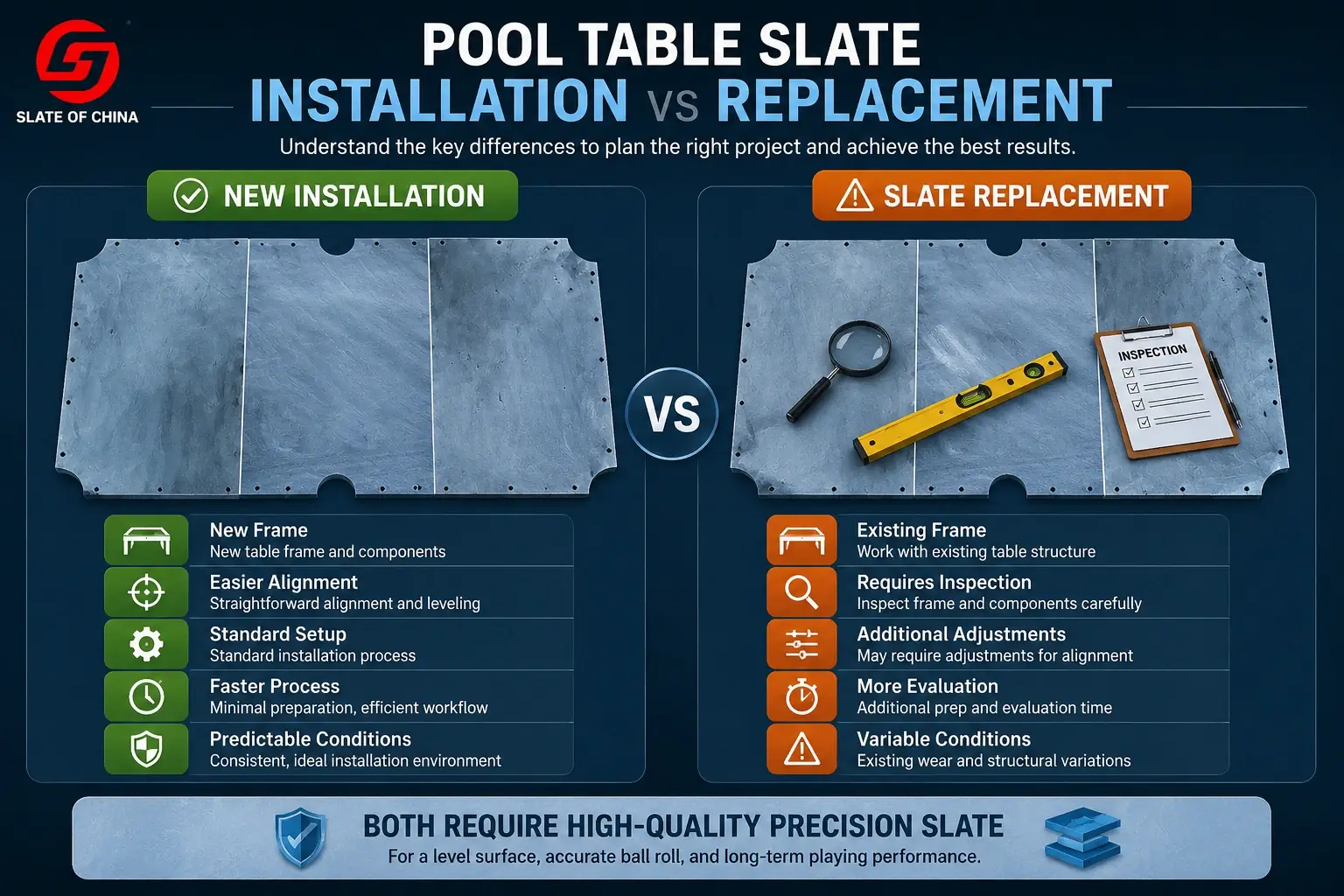
While new pool table slate installation and slate replacement share many of the same installation principles, the two projects often present different challenges.
A new installation begins with a newly assembled table frame and freshly manufactured components, while slate replacement typically involves working with an existing table structure that may have experienced years of use.
Understanding these differences helps table owners, installers, and distributors better plan their projects and achieve the best possible results.
New Pool Table Slate Installation vs Slate Replacement
| New Installation | Slate Replacement |
|---|---|
| New table frame | Existing table frame |
| Factory-new components | Existing components may require inspection |
| Easier slate alignment | Alignment may require additional adjustments |
| Standard setup process | Existing wear conditions must be evaluated |
| Predictable installation environment | Structural condition may vary |
| Minimal preparation work | Additional preparation may be required |
When Is Pool Table Slate Replacement Necessary?
In many cases, natural slate can last for decades. However, replacement may be recommended when the existing slate no longer provides an acceptable playing surface.
Common Reasons for Slate Replacement
- Cracked slate sections
- Severe transportation damage
- Excessive drilling or modification
- Structural damage from improper handling
- Restoration of older pool tables
- Upgrading to higher-quality precision slate
Replacing damaged slate can often restore the performance and value of an existing pool table.
Challenges of Replacing Pool Table Slate
Unlike a new installation, slate replacement requires careful evaluation of the existing table structure before installation begins.
Existing Frame Condition
The frame must be inspected for:
- Structural integrity
- Support beam condition
- Leveling capability
- Signs of warping or damage
Even high-quality replacement slate may not perform correctly if the supporting structure has deteriorated over time.
Existing Hardware and Components
Installers often inspect:
- Fasteners
- Mounting points
- Rail systems
- Pocket assemblies
Additional adjustments may be required to ensure compatibility with the replacement slate.
Advantages of Using Precision Slate for Replacement Projects
For pool table refurbishment and restoration projects, precision-machined slate can simplify the replacement process.
Benefits of Precision Slate
✔ Better flatness
✔ Consistent thickness
✔ Improved seam alignment
✔ Easier leveling
✔ Enhanced playing performance
✔ Long-term structural stability
Because replacement projects frequently involve older table structures, dimensional accuracy becomes even more important.
High-quality precision slate helps installers compensate for minor variations within existing table frames and achieve more consistent results.
Can a Three-Piece Slate Be Replaced?
Yes.
Most modern pool tables use a three-piece slate bed, and individual slate sections can often be replaced when necessary.
However, professional installers generally evaluate:
- Slate dimensions
- Thickness consistency
- Pocket cut geometry
- Mounting hole locations
- Seam alignment requirements
For best results, replacement slate should match the original table specifications as closely as possible.
Manufacturer’s Perspective
From a slate manufacturer’s standpoint, slate replacement projects require the same core qualities as new installations:
- Accurate flatness
- Consistent thickness
- Precision-machined seams
- Reliable structural stability
Whether installing slate on a new table or replacing an existing slate bed, the objective remains the same: creating a level, seamless, and durable playing surface that delivers consistent ball roll and professional playing performance.
Choosing the Right Slate for Easy Installation
Selecting the right slate is one of the most important decisions in any pool table project.
Even experienced installers can face challenges when working with poorly manufactured slate. Variations in flatness, thickness, machining accuracy, or structural consistency often lead to additional leveling work, seam adjustments, and reduced playing performance.
By contrast, a high-quality natural slate pool table bed can simplify installation, improve accuracy, and help deliver a professional playing experience.
For table manufacturers, distributors, installers, and restoration specialists, choosing the best pool table slate means looking beyond appearance and focusing on precision and consistency.
What Makes the Best Pool Table Slate?
When evaluating a pool table slate, several factors directly influence installation efficiency and long-term table performance.
Flatness
Flatness is one of the most critical characteristics of precision slate.
A flatter slate surface helps installers:
- Reduce leveling adjustments
- Improve seam matching
- Achieve more consistent ball roll
- Shorten installation time
Even small deviations in flatness can become noticeable during play, particularly on larger tables.
Density
High-quality natural slate should have a dense and stable structure.
Benefits of proper slate density include:
- Better structural strength
- Improved vibration resistance
- Consistent playing characteristics
- Long-term dimensional stability
Dense slate is less likely to develop performance issues caused by internal weaknesses or material inconsistencies.
Thickness Accuracy
Thickness consistency plays a major role during slate leveling and assembly.
A precision-manufactured slate bed helps installers avoid excessive shimming and correction work.
Advantages include:
- Faster setup
- Easier alignment
- Improved frame support
- Better overall installation accuracy
Consistent thickness becomes especially important in three-piece slate systems where multiple sections must align perfectly.
Precision Machining
Machining accuracy directly affects how slate sections fit together.
Precision-machined slate offers:
- Better seam alignment
- Cleaner pocket geometry
- More accurate screw-hole positioning
- Easier installation
When seams fit correctly, installers can achieve a smoother playing surface with less adjustment.
This is particularly important for professional-grade pool tables where playing precision is a priority.
Packaging Quality
Slate quality does not end at manufacturing.
Proper packaging protects the slate during transportation and storage.
Professional packaging should provide:
- Corner protection
- Edge protection
- Moisture resistance
- Secure palletization
Good packaging reduces the risk of transportation damage and helps ensure the slate arrives ready for installation.
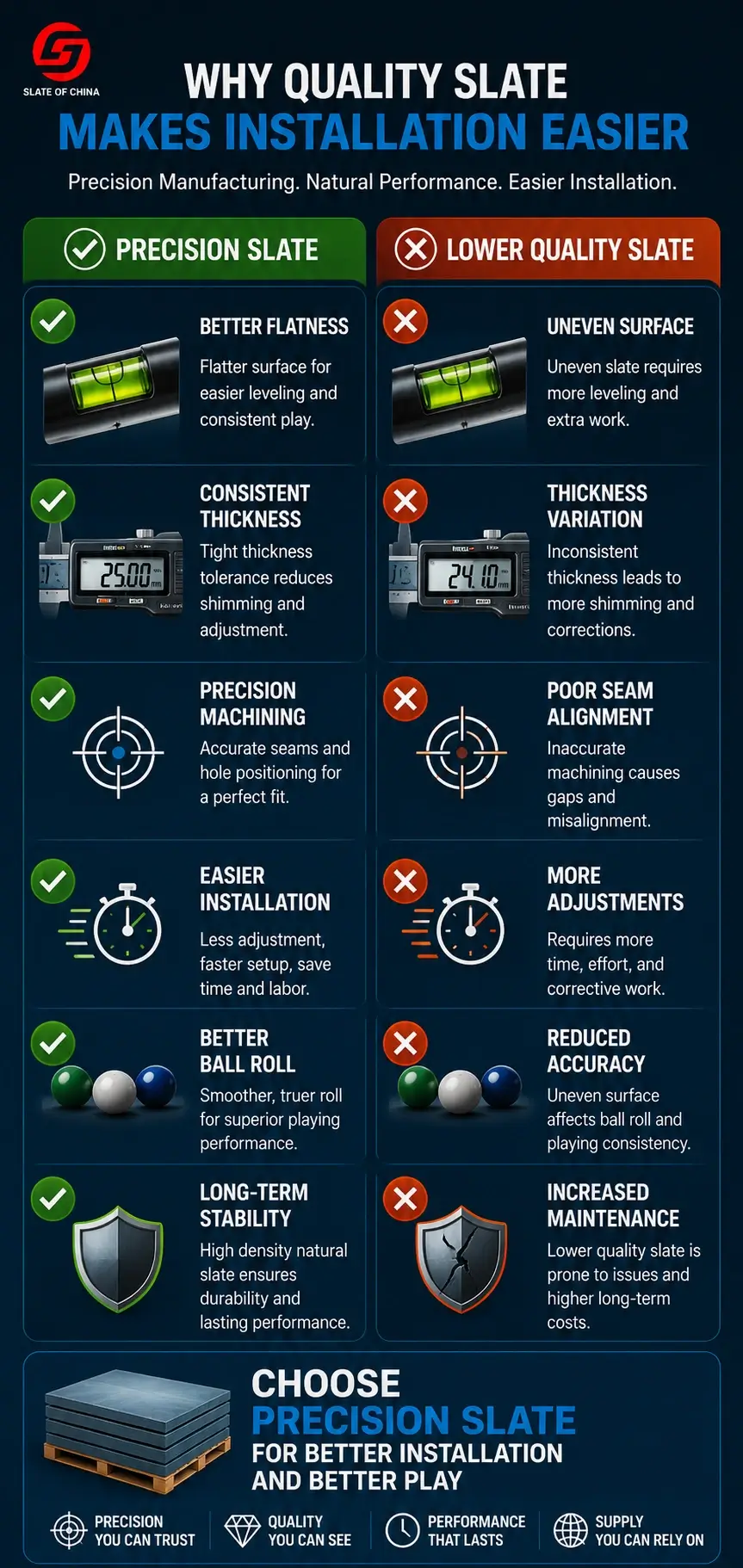
Why Precision Slate Simplifies Installation
Many installation challenges can be traced back to inconsistent slate quality.
High-quality precision slate helps installers by:
✔ Reducing leveling adjustments
✔ Improving seam alignment
✔ Simplifying assembly
✔ Minimizing corrective work
✔ Enhancing ball roll consistency
✔ Supporting long-term table stability
For manufacturers and installers, this means a more efficient installation process and fewer post-installation issues.
Why Natural Slate Remains the Industry Standard
For decades, natural slate pool table beds have been the preferred choice for premium billiard and pool tables.
Natural slate offers:
- Excellent flatness characteristics
- High dimensional stability
- Superior durability
- Consistent playing performance
- Long service life
These qualities explain why natural slate continues to be used on professional tournament tables and high-end residential pool tables worldwide.
Choosing a Reliable Pool Table Slate Supplier
When selecting a slate supplier, buyers should evaluate more than just price.
Important considerations include:
- Slate source and material quality
- Manufacturing precision
- Thickness tolerances
- Machining capabilities
- Packaging standards
- Export experience
- Quality control procedures
A reliable supplier helps ensure that every slate bed arrives ready for efficient installation and long-term performance.
Learn More About Our Precision Pool Table Slate
At Slate of China, we manufacture high-quality natural slate for pool tables, snooker tables, and billiard tables worldwide.
Our production focuses on:
- Precision-machined slate surfaces
- Consistent thickness tolerances
- Accurate seam matching
- Professional export packaging
- Stable long-term performance
Whether you are building new tables or replacing existing slate beds, high-quality precision slate can make installation easier and improve overall table performance.
Recommended Resources
Related Pool Slate Guides
Whether you’re selecting a new pool table slate, planning an installation project, or comparing different slate specifications, these expert guides provide additional information to help you make informed decisions.
Explore our complete pool slate resource center below.
📏 Pool Slate Thickness Guide
Understanding slate thickness is essential for selecting the right playing surface. Learn the differences between 18mm, 20mm, 25mm, 30mm, and thicker slate options, and discover how thickness affects durability, leveling, and gameplay performance.
Topics Covered:
✔ Standard pool slate thicknesses
✔ Tournament-grade slate specifications
✔ Thickness vs table size
✔ Thickness impact on installation
➡ Read the Pool Slate Thickness Guide
⚖️ Pool Slate Weight Guide
Pool table slate is one of the heaviest components of a billiard table. This guide explains typical slate weights by table size, slate thickness, and slate configuration.
Topics Covered:
✔ 7ft, 8ft, and 9ft slate weights
✔ One-piece vs three-piece slate weight
✔ Shipping considerations
✔ Handling and installation planning
➡ Read the Pool Slate Weight Guide
📐 Pool Slate Size Guide
Pool slate dimensions vary according to table size and game type. Understanding accurate slate measurements helps manufacturers, distributors, and installers ensure proper table construction and fitment.
Topics Covered:
✔ Standard pool table slate sizes
✔ 7ft, 8ft, and 9ft slate dimensions
✔ Pocket cut specifications
✔ Custom slate sizing options
➡ Read the Pool Slate Size Guide
🧹 Pool Slate Maintenance Guide
Proper maintenance helps preserve slate performance and extends the lifespan of both the slate bed and the table cloth.
Topics Covered:
✔ Slate care best practices
✔ Humidity and storage considerations
✔ Surface inspection recommendations
✔ Long-term performance protection
➡ Read the Pool Slate Maintenance Guide
🔄 3-Piece vs 1-Piece Pool Slate
Not sure whether to choose a one-piece slate or a three-piece slate system? This guide compares installation, transportation, leveling, and long-term performance.
Topics Covered:
✔ One-piece slate advantages
✔ Three-piece slate advantages
✔ Installation differences
✔ Commercial and residential applications
➡ Read the 3-Piece vs 1-Piece Pool Slate Guide
📦 Pool Slate Packaging Guide
Proper packaging is critical for protecting precision-machined slate during international transportation. Learn how professional slate manufacturers package and secure slate for export.
Topics Covered:
✔ Export packaging standards
✔ Crate construction
✔ Corner protection systems
✔ Shipping damage prevention
➡ Read the Pool Slate Packaging Guide
Why Explore These Guides?
Selecting the right pool table slate, understanding slate thickness, evaluating slate weight, and following proper pool table slate installation practices all contribute to better table performance and easier installation.
As a professional manufacturer of natural slate pool table beds, we provide these technical resources to help table manufacturers, distributors, installers, and billiard enthusiasts make informed decisions.
Frequently Asked Questions About Pool Table Slate Installation
Need Help Choosing the Right Pool Table Slate?
Whether you need precision-machined slate for new table production, slate replacement projects, or international distribution, our team can help you select the right specifications for your market.
Whether you need:
✔ One-piece pool slate
✔ Three-piece pool slate
✔ Custom slate dimensions
✔ OEM pool table slate
✔ Export packaging solutions
Our team can help you find the right slate for your project.
Contact Slate Of China for technical support and product recommendations.
About the Author
This guide was prepared by Slate Of China, a professional natural slate manufacturer with over 30 years of experience in slate quarrying, processing, and export. We supply precision-machined pool table slate to table manufacturers, distributors, and billiard equipment companies worldwide.