
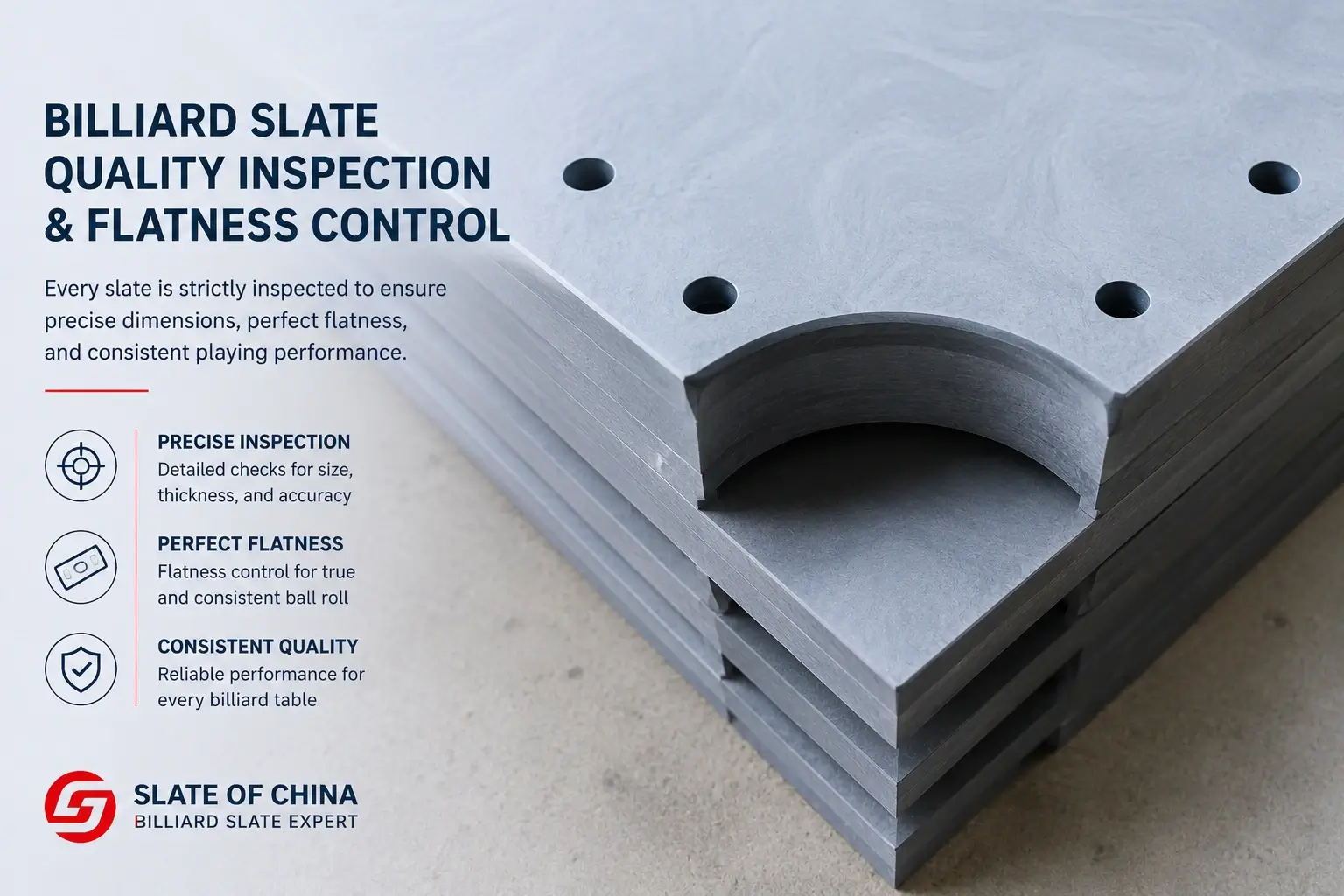
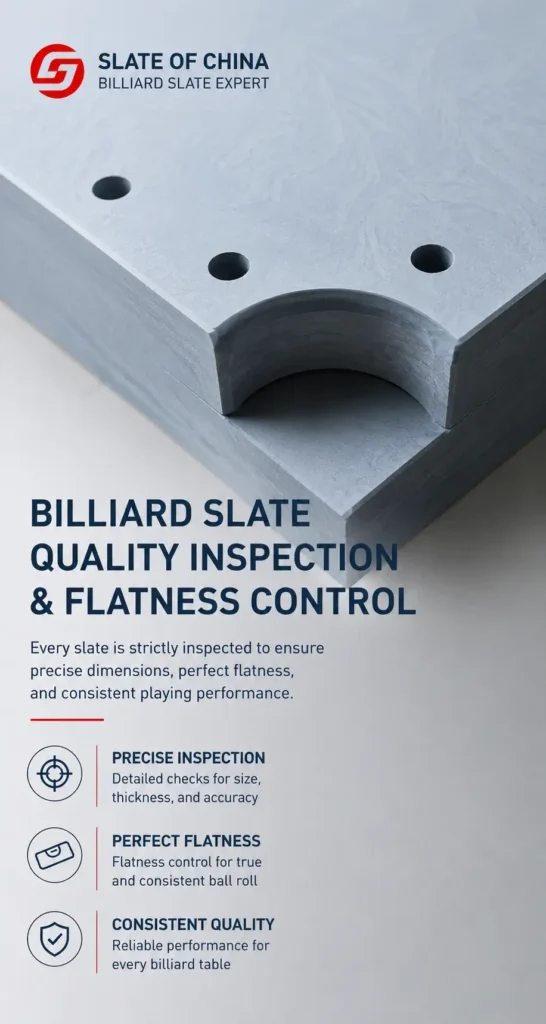
Billiard Slate Quality Inspection & Flatness Control
Every slate panel is inspected for flatness, thickness consistency, joint accuracy, surface finish, and dimensional precision to ensure reliable installation and professional playing performance.
The performance of any billiard table begins with the quality of its slate. Even minor variations in flatness, thickness, or joint alignment can affect ball roll, table leveling, cloth installation, and long-term playing consistency.
At Slate of China, every billiard slate is inspected throughout the manufacturing process and again before packing and shipment. Our quality control procedures focus on flatness, thickness consistency, dimensional accuracy, joint matching, surface finish, drilling precision, and overall structural integrity.
Whether for snooker tables, pool tables, or carom tables, proper slate inspection helps ensure easier installation, improved table stability, and reliable playing performance. This page explains the key quality inspection procedures and flatness control measures used to support professional billiard table manufacturing worldwide.
Table of Contents
Why Slate Inspection Matters for Billiard Table Performance
The playing performance of any billiard table begins with the slate. Whether for snooker tables, pool tables, or carom tables, the slate serves as the foundation of the playing surface and directly influences ball roll accuracy, table leveling, cloth installation, and long-term stability.
Even small variations in slate flatness, thickness consistency, or joint alignment can create noticeable problems after installation. Uneven surfaces may affect ball movement, inconsistent thickness can make leveling more difficult, and poorly matched joints may create visible seams or installation challenges for multi-piece slate systems.
For table manufacturers, distributors, and installers, reliable slate quality means faster installation, fewer adjustments, and reduced risk of customer complaints. For end users, it helps ensure a smooth playing surface, predictable ball response, and consistent table performance over time.
This is why professional billiard slate should be carefully inspected throughout production and before shipment. Flatness control, dimensional accuracy, thickness consistency, joint matching, surface finish, and structural integrity are all important factors in delivering a slate that meets the requirements of modern pool tables, snooker tables, and competition-level billiard tables.
A comprehensive quality inspection process helps reduce installation issues, minimize rework on site, and ensure that every slate set arrives ready for reliable performance.
Professional slate inspection is not only about meeting specifications—it is about ensuring reliable installation, accurate ball roll, and long-term playing performance.
Key Inspection Items Before Shipment
Every billiard slate set undergoes multiple quality inspections before packing and shipment. These inspections help verify flatness, dimensional accuracy, thickness consistency, joint matching, surface quality, and structural integrity.
By identifying potential issues before delivery, manufacturers, distributors, installers, and end users can reduce installation problems, improve table performance, and ensure a more reliable playing experience.
The following inspection items are commonly checked during the quality control process.
| Inspection Item | Why It Matters |
|---|---|
| Flatness Inspection | Ensures accurate ball roll, proper table leveling, and a stable playing surface. |
| Thickness Tolerance Check | Maintains consistent support across all slate panels and improves leveling accuracy. |
| Surface Finish Inspection | Provides a smooth and clean surface for cloth installation and long-term performance. |
| Joint Matching Inspection | Helps multi-piece slate sets fit together correctly with minimal joint variation. |
| Hole Position Inspection | Verifies drilling accuracy and proper alignment during table assembly. |
| Edge Straightness Check | Supports precise installation and improves panel alignment. |
| Corner & Edge Damage Inspection | Prevents shipment of chipped or damaged slate panels. |
| Crack & Structural Inspection | Detects visible cracks or structural defects that may affect durability. |
| Packing Inspection | Confirms protection measures before export transportation and handling. |
Not all inspection items have the same impact on table performance. Among them, flatness control, thickness consistency, joint accuracy, and dimensional precision are generally considered the most critical factors for professional billiard table installation.
For three-piece slate systems commonly used in pool tables and snooker tables, joint matching and panel consistency are especially important. Even if individual slate panels meet dimensional requirements, poor matching between panels can increase installation time and affect the final playing surface.
A comprehensive inspection process helps ensure that the slate delivered to customers is ready for efficient installation, reliable leveling, and consistent playing performance.
What Do Professional Buyers Look for in Slate Inspection?
Professional table manufacturers and distributors typically pay close attention to:
• Slate flatness and surface accuracy
• Thickness consistency between panels
• Joint matching quality for multi-piece slate sets
• Dimensional tolerances and drilling accuracy
• Surface finish for cloth installation
• Protection against transport damage
These factors directly influence installation efficiency, table stability, ball roll performance, and long-term customer satisfaction.
Thickness Consistency for Stable Table Leveling
Thickness consistency is an important part of billiard slate quality control. While overall slate thickness is important, maintaining consistent thickness across individual panels and within a complete slate set is equally critical for proper table installation and long-term playing performance.
Even small variations in thickness can increase leveling difficulty, create joint height differences between panels, and require additional adjustments during installation. For professional billiard tables, thickness consistency helps provide a stable foundation for accurate table leveling and reliable ball roll.
For snooker tables, pool tables, and carom tables, slate thickness must remain consistent throughout the manufacturing process. This is especially important for thicker slate products such as 45mm snooker slate and 50mm snooker slate, where dimensional consistency directly affects installation efficiency and playing surface accuracy.
During quality inspection, thickness is checked at multiple locations across each slate panel to verify uniformity. For multi-piece slate systems, the thickness relationship between all panels is also inspected to help ensure proper matching during assembly.
Consistent thickness offers several important advantages:
• Easier and faster table leveling during installation
• Improved joint alignment between slate panels
• Reduced risk of high or low spots across the playing surface
• Better support from the table frame structure
• More consistent long-term playing performance
For three-piece slate systems commonly used in professional snooker tables and commercial pool tables, panel-to-panel thickness matching is particularly important. Even when individual panels meet nominal thickness requirements, differences between panels can increase installation time and affect final table flatness.
Why Thickness Consistency Matters
| Benefit | Impact |
|---|---|
| Easier Leveling | Reduces installation time and adjustments |
| Better Joint Matching | Helps create smoother panel transitions |
| Improved Stability | Provides more uniform support across the table |
| Consistent Ball Roll | Supports reliable playing performance |
Different billiard tables may require different slate thickness specifications depending on table size, playing requirements, and market standards. Professional snooker tables commonly use 45mm or 50mm slate, while pool tables may use different thickness options according to table size and design requirements.
To learn more about slate thickness specifications, weights, and selection considerations, please refer to our detailed guides:
Joint Matching Inspection for 3-Piece Slate Sets
Many professional snooker tables and pool tables use 3-piece slate systems to simplify transportation, handling, and installation. However, the performance of a multi-piece slate set depends not only on the quality of each individual panel, but also on how accurately the panels fit together.
Even if each slate panel meets dimensional requirements, poor joint matching can create installation difficulties, visible seams, uneven transitions, and additional leveling work on site. For this reason, joint accuracy is considered one of the most important quality inspection items for professional billiard slate.
Before packing and shipment, every 3-piece slate set is inspected as a complete matched set rather than as individual panels. The goal is to help installers achieve accurate alignment, smooth transitions, and reliable table flatness during assembly.
During the inspection process, special attention is given to:
• Joint edge straightness
• Panel-to-panel matching accuracy
• Contact surface consistency
• Joint flatness and height alignment
• Matching sequence verification
• Dimensional consistency between panels
These inspections help reduce the risk of visible joint gaps, height differences, or alignment issues after installation.
For professional snooker tables, especially 12ft tournament tables, accurate joint matching is critical because even small variations can affect table leveling, cloth installation, and long-term playing performance.
Why Joint Accuracy Matters
| Joint Quality Factor | Benefit |
|---|---|
| Straight Joint Edges | Improves panel alignment during installation |
| Accurate Panel Matching | Reduces adjustment time on site |
| Consistent Joint Height | Helps create a smoother playing surface |
| Better Flatness Across Joints | Supports accurate ball roll performance |
| Verified Matching Sequence | Prevents installation confusion |
Each slate set is marked, inspected, and packed as a matched set to help ensure correct panel alignment during installation.
Matched Sets for Easier Installation
Proper panel matching can significantly improve installation efficiency. By inspecting and packing slate panels as matched sets, installers can more easily identify the correct panel sequence and achieve better joint alignment during assembly.
For export orders, matched-set inspection helps reduce installation adjustments, minimize on-site rework, and improve the consistency of the finished playing surface.
Each slate set is marked and packed according to its matching sequence to support efficient installation and reliable performance.
Joint matching inspection works together with flatness control and thickness consistency inspection to create a stable, level, and professional playing surface. When these factors are properly controlled, installers can achieve better table accuracy, smoother ball roll, and more consistent long-term performance.
Surface Finish Inspection Before Cloth Installation
A billiard table cloth can only perform as well as the slate surface beneath it. Even when flatness and dimensional accuracy meet specifications, surface imperfections may affect cloth installation, table appearance, and playing performance.
For this reason, surface finish inspection is an important part of billiard slate quality control. Before shipment, the slate surface is inspected to help ensure it is clean, even, and suitable for professional cloth installation.
A properly finished slate surface provides a stable foundation for table cloth installation and helps support consistent ball movement across the playing area.
During inspection, the slate surface is checked for visible defects that may affect installation or performance, including:
• Rough or uneven surface areas
• Excessive grinding marks
• Surface chips and edge damage
• Visible cracks or structural defects
• Raised areas that may affect cloth contact
• Surface contamination or debris
• Finishing defects around drilled holes and pocket openings
Special attention is also given to pocket cut-outs, edge areas, and drilled sections, where installation-related issues are more likely to occur if the surface is not properly finished.
A clean and uniform slate surface helps the cloth sit correctly, improves installation efficiency, and contributes to a smoother and more professional playing surface.
Why Surface Finish Matters
Surface finish inspection is not limited to the main playing area. Pocket openings, drilled holes, slate edges, and corner sections are also examined during quality control.
These areas may not directly contact the table cloth, but they can affect installation quality, structural stability, and the overall appearance of the finished table. Careful inspection helps identify defects before packing and shipment.
A clean, even, and properly finished slate surface helps simplify cloth installation and supports consistent playing performance.
Surface finish inspection works together with flatness control, thickness consistency checks, and joint matching inspection to help ensure that each billiard slate set is ready for professional installation and reliable long-term use.
Before shipment, all visible surfaces and critical installation areas are inspected to help reduce installation issues and improve overall table quality.
Drilling Accuracy and Hole Position Check
For many billiard table projects, accurate drilling is just as important as slate flatness and dimensional consistency. Hole positions must align correctly with the table frame, support structure, pocket assemblies, and installation hardware.
Even small drilling deviations may create assembly difficulties, increase installation time, or require additional adjustments on site. For this reason, drilling accuracy and hole position verification are included in the quality inspection process whenever machining services are required.
When drilling or machining services are specified, hole locations are checked according to customer drawings, production specifications, or table structure requirements before shipment.
Inspection typically focuses on:
• Mounting hole positions
• Pocket opening machining areas
• Alignment holes and locating holes
• Countersunk hole accuracy
• Hole spacing and dimensional verification
• Edge-to-hole distance consistency
• Machined areas around pocket openings
Accurate drilling helps ensure that slate panels can be assembled efficiently and correctly during table installation. Properly positioned holes also reduce the risk of assembly issues, misalignment, and unnecessary modifications on site.
Why Hole Position Accuracy Matters
| Inspection Area | Installation Benefit |
|---|---|
| Mounting Hole Accuracy | Helps ensure proper frame attachment |
| Pocket Area Machining | Supports accurate pocket assembly |
| Hole Spacing Verification | Reduces installation adjustments |
| Alignment Hole Inspection | Improves panel positioning accuracy |
| Countersunk Hole Check | Helps achieve proper hardware fit |
| Drawing Compliance Verification | Ensures manufacturing matches project requirements |
Manufactured According to Customer Drawings
Different billiard table designs often require different drilling layouts and mounting configurations. When customer drawings or technical specifications are provided, machining operations are performed according to the approved design requirements.
Before packing and shipment, drilled and machined areas can be inspected to verify that critical dimensions and hole locations correspond with the project specifications. This helps improve installation efficiency and reduces the possibility of assembly-related issues after delivery.
Accurate drilling and hole position verification help reduce installation problems, improve assembly efficiency, and support reliable table construction.
Inspection Beyond Standard Dimensions
Quality inspection does not stop at overall slate dimensions. Machined features such as mounting holes, locating holes, pocket cut-outs, and countersunk areas are also important inspection points because they directly affect installation quality and table assembly.
By verifying these details before shipment, manufacturers and installers can minimize on-site corrections and achieve more consistent installation results.
Drilling accuracy inspection complements flatness control, thickness consistency checks, joint matching inspection, and surface finish verification. Together, these quality control procedures help ensure that each billiard slate set is prepared for efficient installation and dependable long-term performance.
Visual and Structural Quality Check
In addition to flatness, thickness consistency, and dimensional accuracy, visual condition and structural integrity are also important aspects of billiard slate quality control.
Before packing and shipment, slate panels are visually inspected to identify defects that may affect installation, durability, appearance, or overall table performance. This inspection helps ensure that the slate delivered to customers meets the requirements for professional billiard table manufacturing and export use.
Visual and structural inspection focuses on identifying defects that may not be detected through dimensional measurements alone.
Typical inspection items include:
• Visible cracks
• Chipped corners
• Edge damage
• Surface stains or contamination
• Abnormal marks affecting appearance
• Hidden structural defects visible during inspection
• Damage caused during handling or processing
• Condition verification before packing
Particular attention is given to corners, edges, pocket openings, drilled areas, and other locations that may be more vulnerable to damage during manufacturing or transportation.
By identifying these issues before shipment, manufacturers and distributors can reduce the risk of installation problems, product claims, and unnecessary replacement costs.
Natural Slate Characteristics vs. Quality Defects
As a natural stone material, slate may display natural color variations, texture patterns, mineral markings, and other visual characteristics that are inherent to the stone itself.
These natural features do not affect structural performance and are commonly accepted within the billiard slate industry.
However, structural cracks, serious edge damage, significant chips, uneven joints, and defects that may affect installation or playing performance are not accepted for export-quality billiard slate.
Why Visual and Structural Inspection Matters
| Inspection Area | Customer Benefit |
|---|---|
| Crack Inspection | Helps ensure long-term structural stability |
| Corner Inspection | Reduces risk of installation damage |
| Edge Inspection | Improves handling and assembly quality |
| Surface Condition Check | Supports a clean and professional appearance |
| Structural Integrity Verification | Reduces the possibility of product failure |
| Pre-Packing Inspection | Helps prevent shipping damaged products |
Export-quality billiard slate should be free from structural cracks, serious chips, and defects that may affect installation, stability, or playing performance.
Inspection Before Packing and Shipment
Visual inspection is performed before final packing to help identify any damage that may have occurred during processing, handling, or storage.
This final verification step helps ensure that slate panels are in suitable condition before export packing and international transportation. Early identification of defects can help reduce customer claims, installation delays, and replacement costs after delivery.
Visual and structural inspection complements flatness control, thickness consistency checks, joint matching inspection, and drilling verification. Together, these quality control procedures help ensure that every billiard slate set is prepared for reliable installation, long-term durability, and professional table performance.
Final Inspection Before Export Packing
Quality control does not end after manufacturing is completed. Before export packing and shipment, each billiard slate set undergoes a final inspection to verify that the product matches the order requirements and is ready for transportation.
This final verification step helps reduce the risk of shipping errors, installation delays, transit damage, and customer claims after delivery.
Before packing, each slate set is inspected again to confirm that critical quality requirements have been met.
Typical final inspection items include:
• Slate size verification
• Thickness consistency confirmation
• Surface condition inspection
• Joint matching verification
• Edge and corner protection check
• Quantity confirmation according to order requirements
• Set identification and numbering verification
• Packaging condition inspection
For multi-piece slate systems, panels are checked and packed according to their matching sequence. This helps installers identify the correct panel arrangement during installation and reduces the risk of assembly errors.
Each slate set is prepared for export transportation only after completing the final inspection process.
Matched Set Identification and Numbering
For 3-piece and multi-piece slate systems, each panel is identified and packed as part of a matched set.
Panel numbering and matching sequence verification help ensure that corresponding panels remain together throughout packing, transportation, and installation. This process helps reduce installation confusion and improves assembly efficiency on site.
Protection Before Transportation
Special attention is given to edge protection, corner protection, and overall package stability before shipment.
Depending on customer requirements and transportation methods, slate products may be packed using export wooden crates, pallets, or other protective packaging systems designed to reduce the risk of handling damage during international transportation.
Proper packing inspection helps ensure that the slate arrives in suitable condition for installation.
Before shipment, every billiard slate set is inspected, identified, protected, and packed to help ensure safe transportation and efficient installation after arrival.
Documentation and Pre-Shipment Verification
When required, inspection photos and packing records may be prepared before shipment to support order verification and quality documentation.
Pre-shipment verification helps confirm that the quantity, dimensions, thickness specifications, and packaging arrangements correspond to the customer’s order requirements before delivery.
| Final Inspection Item | Customer Benefit |
|---|---|
| Size Verification | Confirms compliance with order specifications |
| Thickness Confirmation | Supports easier installation and leveling |
| Surface Condition Check | Helps ensure professional table appearance |
| Matched Set Verification | Reduces installation errors |
| Edge Protection Inspection | Helps prevent transport damage |
| Quantity Confirmation | Avoids shipment discrepancies |
| Packaging Inspection | Improves transportation safety |
Frequently Asked Questions
Need Professional Billiard Slate for Your Project?
From 12ft tournament snooker slate to commercial pool table slate and custom OEM projects, we supply precision-machined billiard slate with strict quality inspection and flatness control.
Our team can assist with specifications, drawings, thickness options, drilling requirements, packing solutions, and export arrangements.
Looking for reliable billiard slate with consistent flatness, accurate machining, and professional quality inspection?
We supply snooker slate, pool slate, carom slate, and custom billiard slate for table manufacturers, distributors, and project buyers worldwide.
Contact us today to discuss your specifications, request product details, or receive a competitive quotation.