
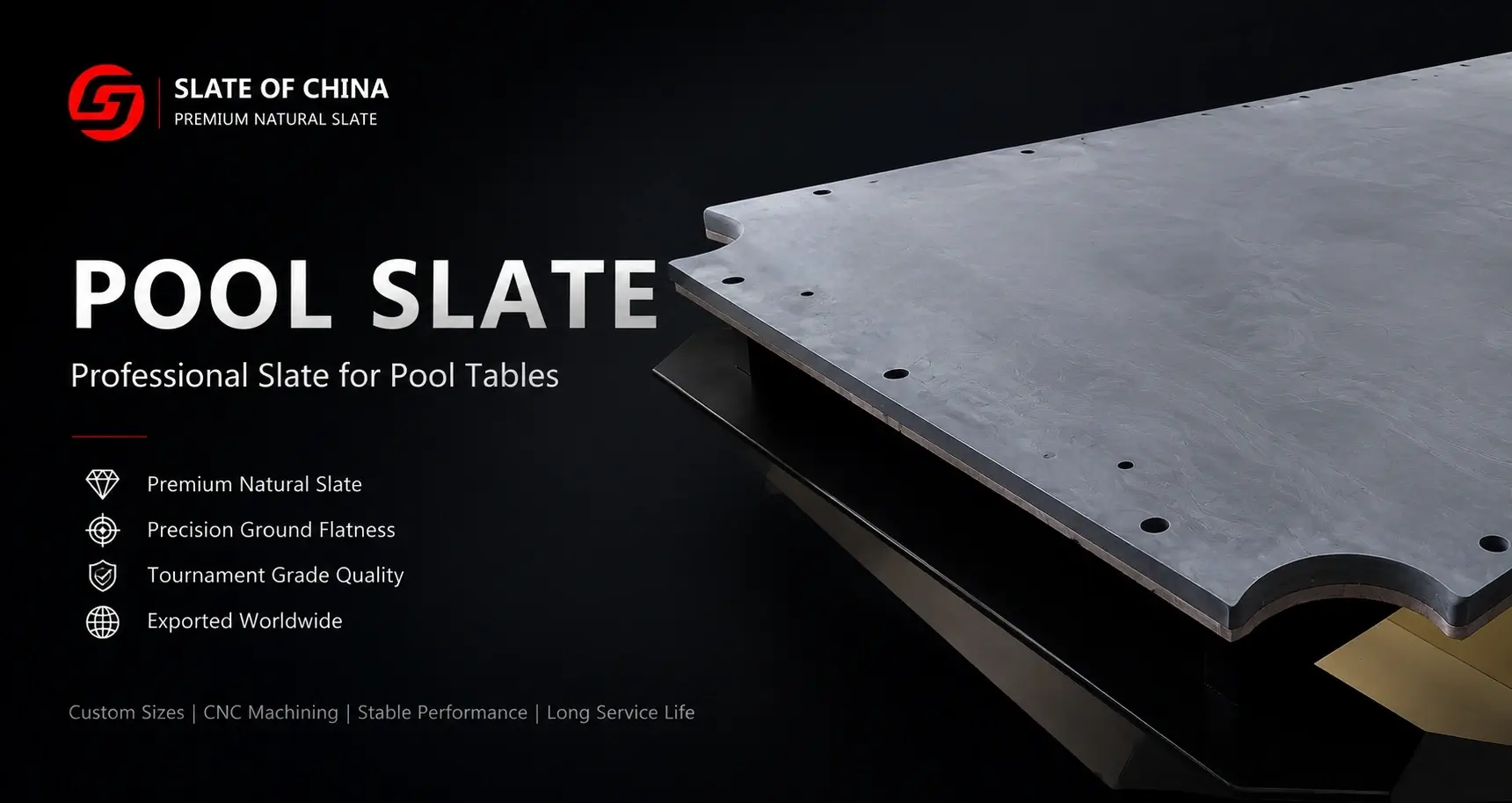
Pool Slate: Professional Pool Table Slate Manufacturer & Supplier
Pool slate is the industry-standard playing surface used in professional pool tables worldwide. Manufactured from premium natural slate, it provides the flatness, stability, and durability required for accurate ball roll and long-term performance. At Slate of China, we supply precision-ground Jiujiang pool slate to pool table manufacturers, distributors, and billiard equipment suppliers across global markets.
Our pool slates are CNC machined, accurately calibrated, and available in custom sizes for residential, commercial, and tournament-grade pool tables. Explore everything you need to know about pool slate, including slate types, thickness, manufacturing, installation, and technical specifications.
Table of Contents
What Is Pool Slate?
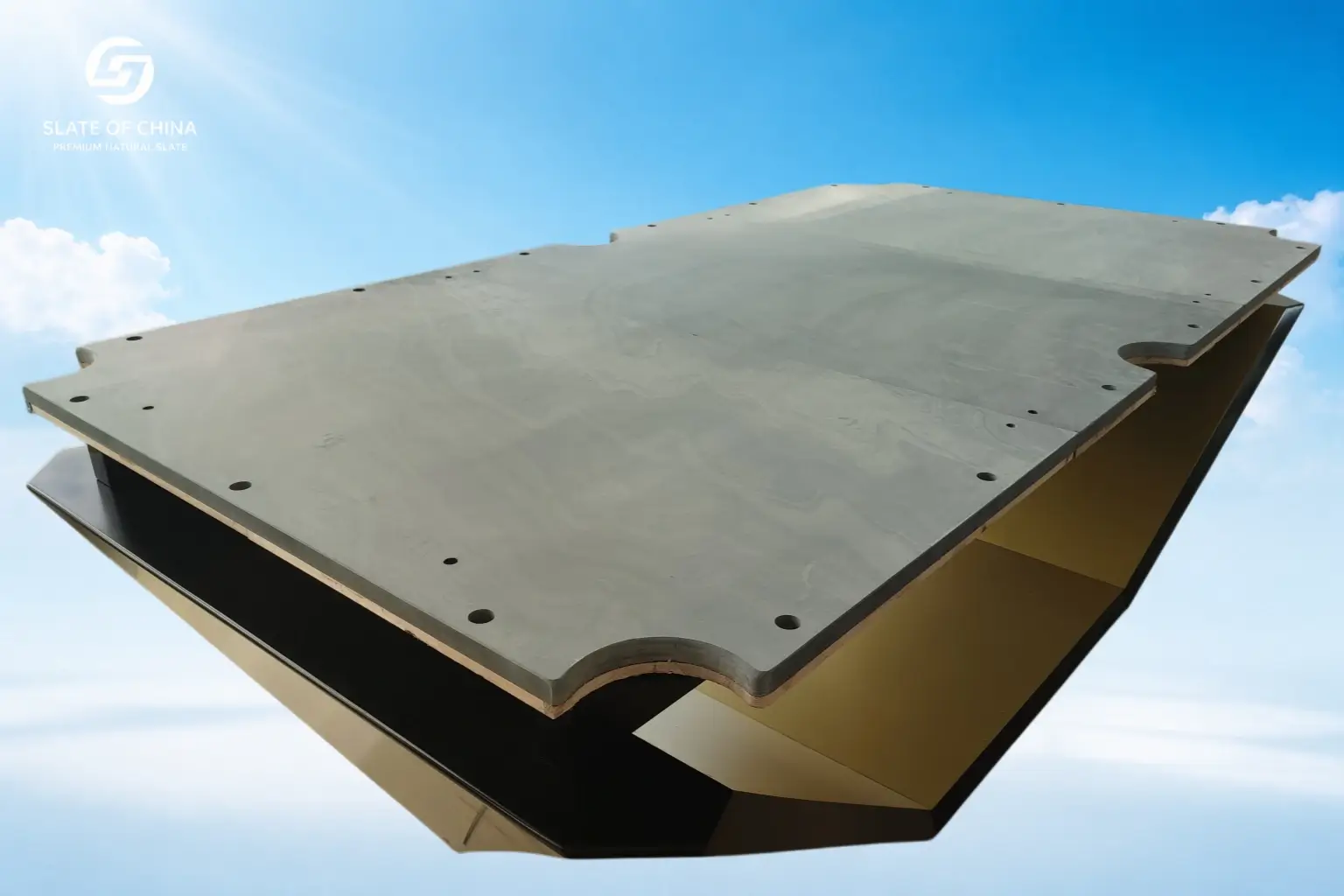
Pool slate is the precision-machined natural stone used as the playing surface of a pool table. Often referred to as pool table slate or billiard slate, it forms the foundation of the table and provides the perfectly flat, stable, and durable surface required for accurate ball roll and consistent game performance.
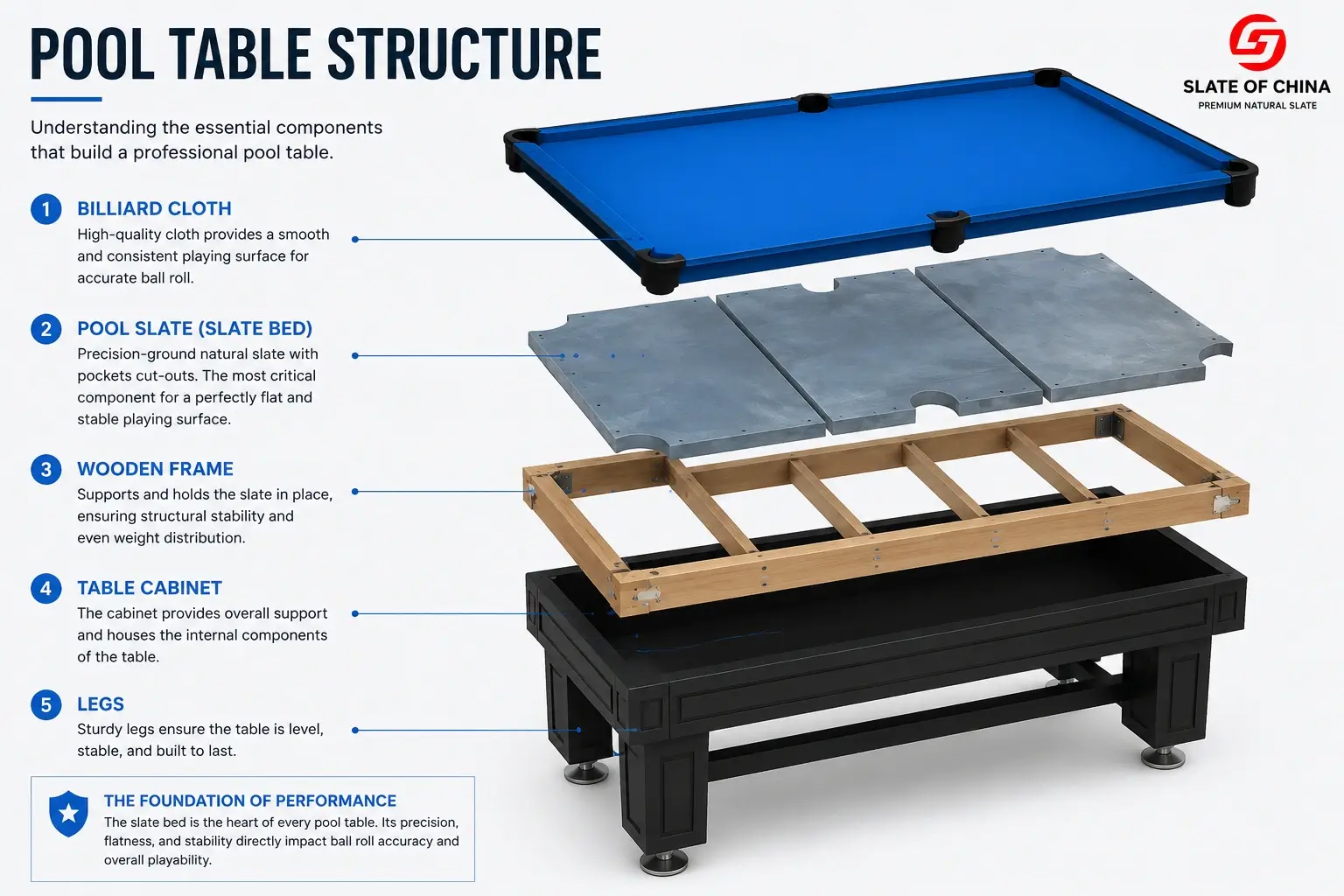
A typical pool table consists of a cabinet, frame, rails, cushions, cloth, and a slate bed. Among these components, the slate is widely considered the most important part because it directly affects the speed, accuracy, and overall quality of play. Whether for home use, commercial venues, or tournament competition, high-quality pool slate is essential for professional performance.
Why Is Natural Slate Used for Pool Tables?
Natural slate has been the preferred material for pool tables for more than a century due to its unique physical properties.
Unlike wood, MDF, plywood, or synthetic materials, natural slate offers exceptional dimensional stability and resistance to warping. Once properly machined and leveled, a slate playing surface can maintain its flatness for decades.
The main advantages of natural slate include:
- Excellent flatness and precision
- High density and structural stability
- Resistance to moisture and temperature changes
- Long service life with minimal deformation
- Consistent ball roll across the entire table surface
Because of these characteristics, virtually all professional pool tables, commercial billiard tables, and tournament-grade tables use natural slate as the playing bed.
What Does Pool Slate Do?
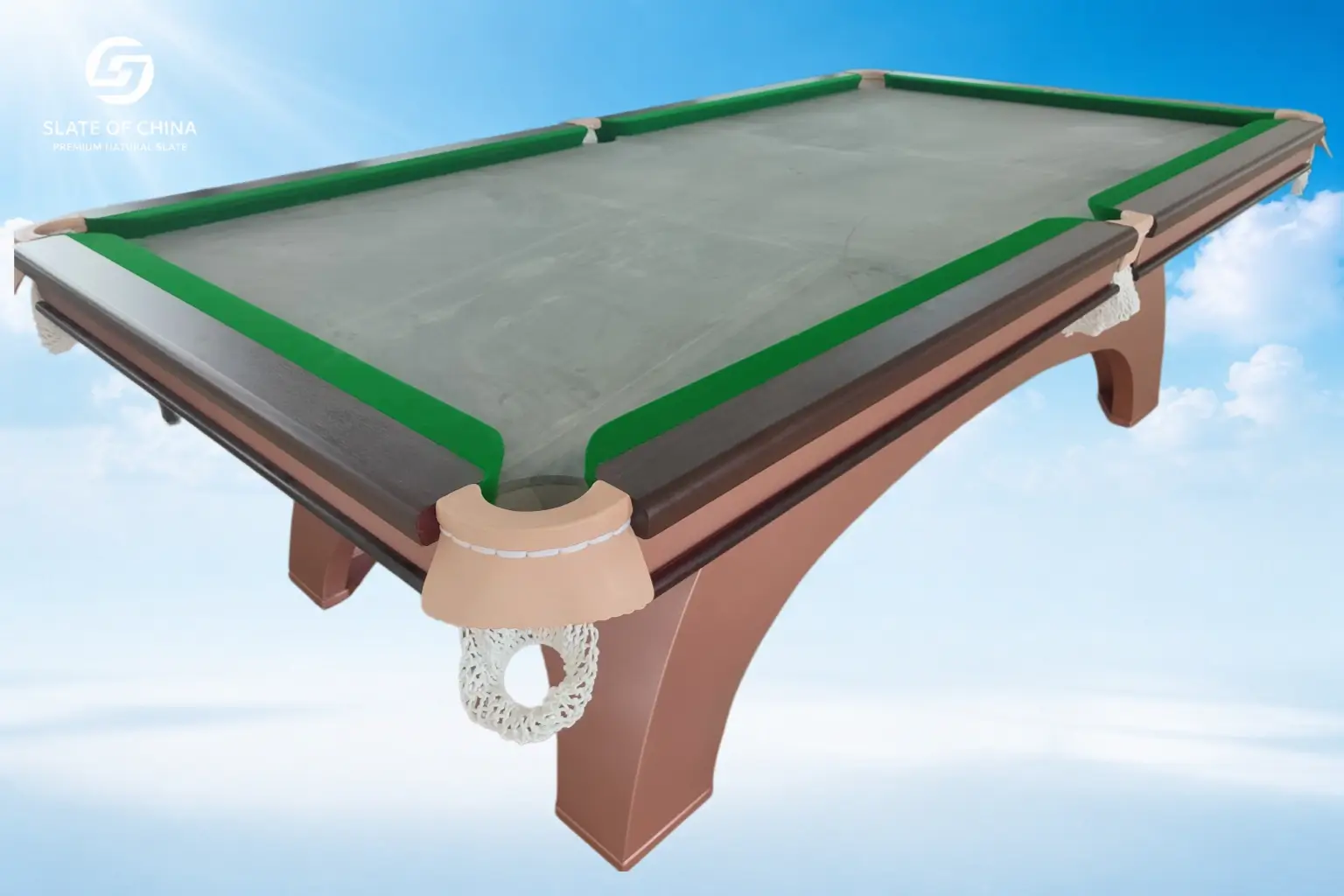
The primary function of pool slate is to create a perfectly level and stable playing surface underneath the billiard cloth.
A precision-ground slate bed ensures that balls roll smoothly and accurately without drifting or bouncing. Even small imperfections in the playing surface can affect shot accuracy, making slate quality one of the most critical factors in table performance.
Modern pool table slate is typically manufactured with CNC machining and precision grinding processes to achieve extremely tight flatness tolerances. It is available in one-piece or three-piece configurations and can be customized for different pool table sizes and specifications.
At Slate of China, we manufacture premium natural pool slate for residential, commercial, and tournament pool tables. Each slate is carefully selected, precision machined, and inspected to ensure superior flatness, durability, and long-term playing performance.
Common Pool Slate Specifications
| Item | Specification |
|---|---|
| Material | Natural Slate |
| Surface | Precision Ground |
| Configuration | 1 Piece / 3 Piece |
| Thickness | 19mm / 22mm / 25mm |
| Application | Pool Tables |
| Flatness | Precision Calibrated |
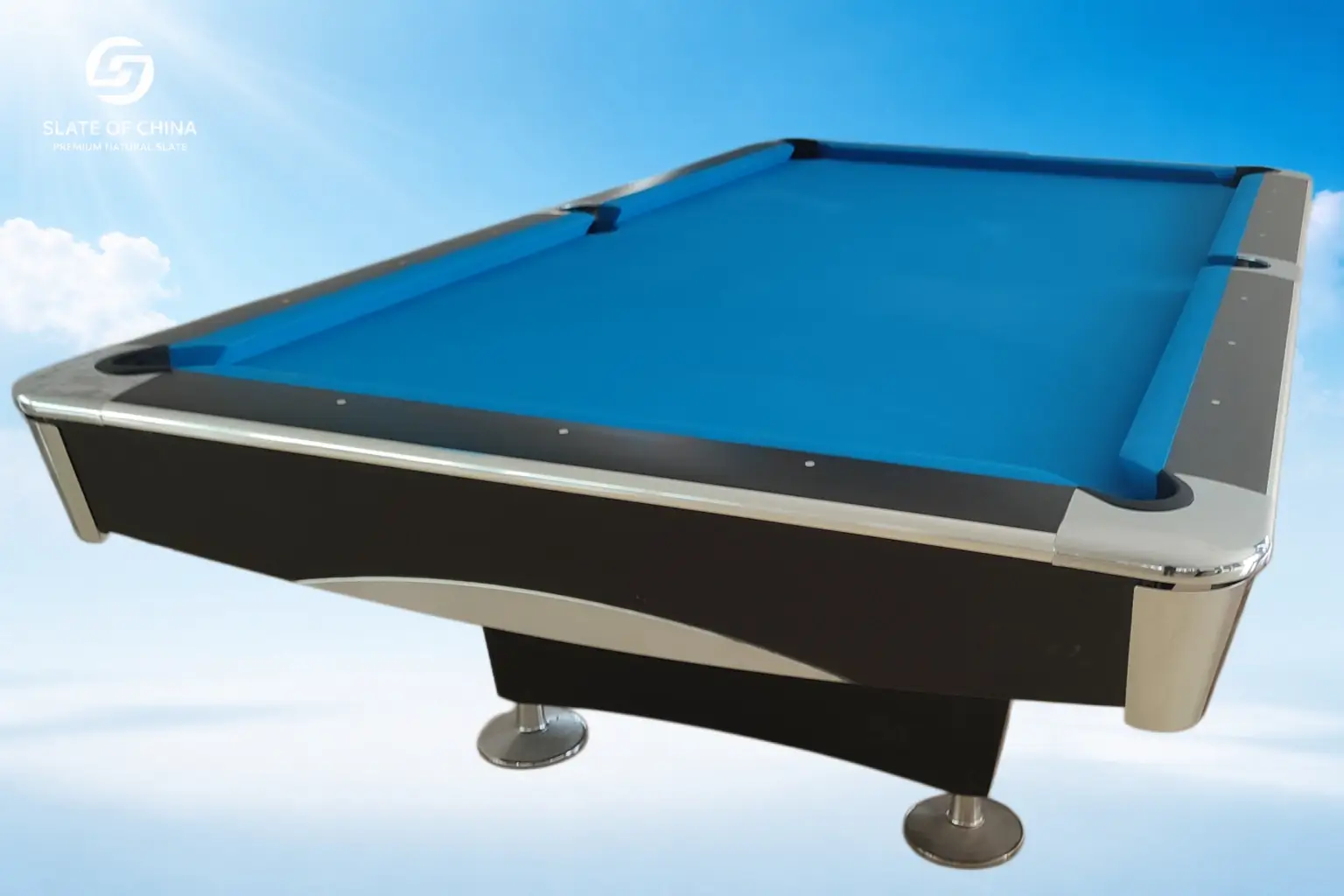
Why Is Slate Used for Pool Tables?
Natural slate has been the preferred playing surface for pool tables for more than 100 years. From home recreation tables to professional tournament tables, slate remains the industry standard because no other material can match its combination of flatness, stability, durability, and long-term performance.
A pool table is only as good as its playing surface. Even the highest-quality cloth and cushions cannot compensate for an uneven or unstable table bed. This is why virtually all professional pool tables use precision-ground natural slate as their foundation.
Perfect Flatness
One of the biggest advantages of pool slate is its exceptional flatness.
Natural slate can be precision machined and ground to extremely tight tolerances, creating a smooth and level playing surface across the entire table. This flatness is critical because even minor imperfections can affect ball direction and shot accuracy.
Professional pool table slate is typically calibrated to maintain consistent surface levels, ensuring that every shot behaves exactly as intended.
Outstanding Stability
Unlike wood-based materials, natural slate is highly stable and resistant to environmental changes.
Materials such as MDF or plywood can expand, contract, warp, or bend when exposed to temperature fluctuations and humidity. Slate, however, maintains its shape and dimensions over time, making it ideal for pool tables that require long-term precision.
This stability helps preserve table levelness and prevents performance issues caused by surface movement.
Exceptional Durability
Pool slate is one of the most durable materials used in billiard table construction.
A properly installed slate bed can last for decades without losing its structural integrity. It resists wear, compression, and deformation even under constant use in commercial pool halls and tournament venues.
Many pool tables manufactured decades ago are still using their original slate, demonstrating the remarkable longevity of natural stone.
Precision Ball Roll
Accurate ball roll is one of the most important requirements for a quality pool table.
Because slate provides a perfectly flat and rigid foundation beneath the billiard cloth, balls roll smoothly and consistently across the entire playing surface. Players can rely on predictable speed, direction, and rebound characteristics.
Whether for casual games or professional competition, slate helps ensure fair and consistent playing conditions.
Long Service Life
While slate pool tables typically cost more than MDF or plywood tables, they offer significantly greater value over time.
A slate bed can remain in service for many decades with minimal maintenance. The combination of durability, stability, and performance makes slate the preferred choice for homeowners, clubs, pool halls, and tournament organizers worldwide.
For anyone seeking long-term playing quality, natural pool slate remains the best investment available.
Slate vs MDF vs Plywood
The differences between playing surface materials are significant.
| Material | Flatness | Stability | Durability | Cost |
|---|---|---|---|---|
| Natural Slate | Excellent | Excellent | Excellent | High |
| MDF | Poor | Poor | Low | Low |
| Plywood | Fair | Fair | Low | Low |
Why Professional Pool Tables Use Slate
Although MDF and plywood may reduce manufacturing costs, they cannot provide the precision and consistency required for serious play.
Professional pool table manufacturers overwhelmingly choose natural slate because it delivers:
✓ Superior flatness
✓ Consistent ball roll
✓ Long-term dimensional stability
✓ Exceptional durability
✓ Tournament-grade performance
For these reasons, natural pool slate continues to be the preferred playing surface for commercial, residential, and tournament pool tables around the world.
Frequently Asked Questions About Pool Table Slate
Types of Pool Table Slate
Pool table slate is generally available in two configurations: one-piece slate and three-piece slate. Both options provide a solid playing surface, but they differ significantly in transportation, installation, maintenance, and market preference.
Understanding the differences between these slate types can help pool table manufacturers, distributors, and buyers select the most suitable solution for their specific requirements.
One-Piece Pool Slate
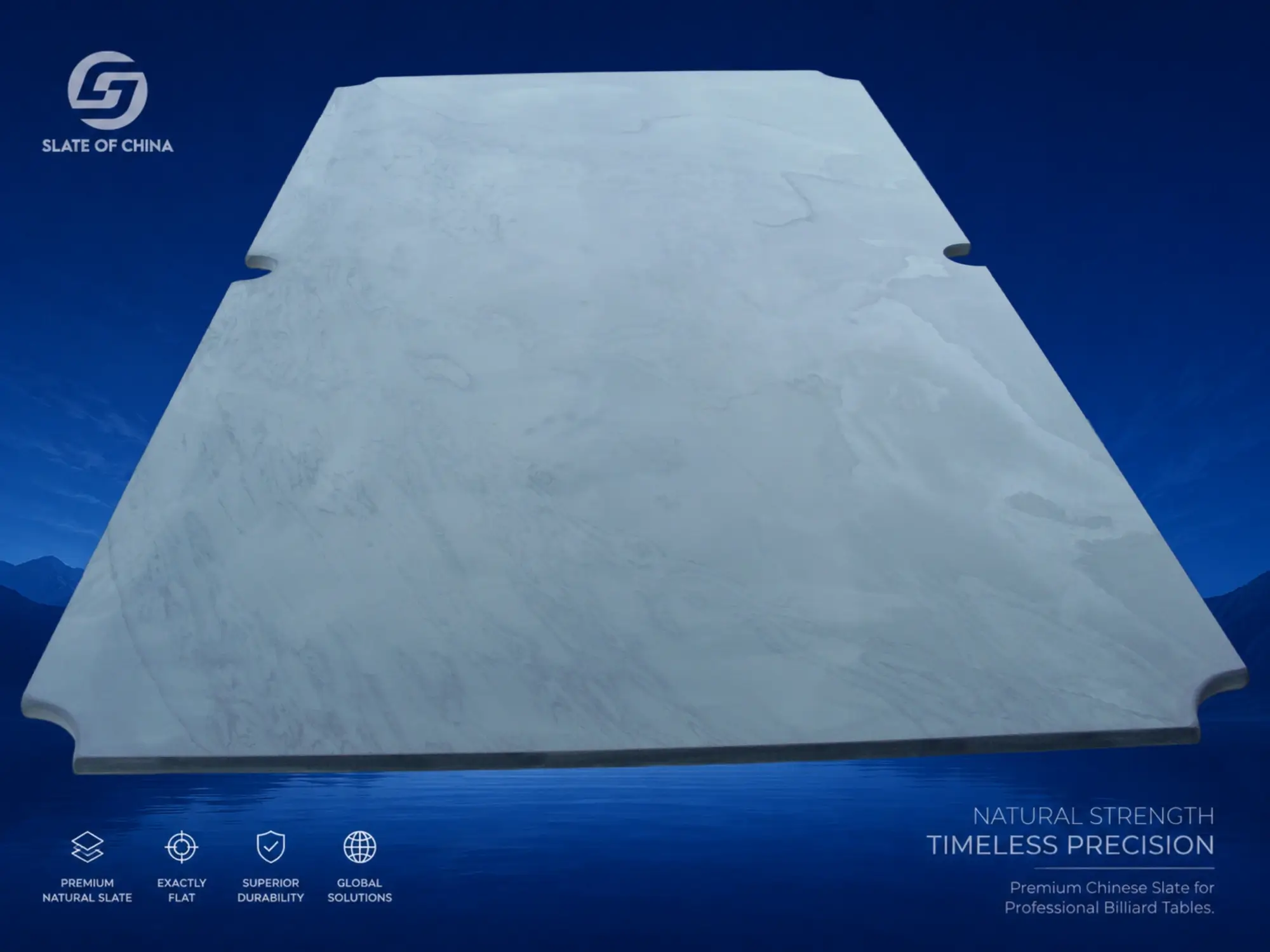
A one-piece slate consists of a single solid slab covering the entire playing surface of the pool table.
This design eliminates slate joints, creating a continuous surface without seams. One-piece slate is commonly used in smaller residential pool tables and coin-operated tables where simplified installation is preferred.
Features
- Single solid slate slab
- No seams or joints
- Simpler installation process
- Commonly used for smaller table sizes
- Available in various thicknesses
Advantages
Seamless Playing Surface
Because there are no slate joints, the playing surface is completely continuous.
Faster Installation
One-piece slate requires less assembly and fewer leveling adjustments during installation.
Reduced Risk of Joint Movement
There are no seams that may require future maintenance or re-leveling.
Disadvantages
Heavy and Difficult to Transport
A full-size one-piece slate can be extremely heavy, making handling and transportation more challenging.
Limited Access During Installation
Moving a large single slab through stairways, elevators, and narrow doorways can be difficult.
Higher Risk of Breakage During Handling
Because the entire slate is one large piece, damage during transportation can result in replacing the entire slab.
Typical Applications
- Home pool tables
- Coin-operated pool tables
- Recreational tables
- Small-size pool tables
- Markets with simpler installation requirements
Three-Piece Pool Slate
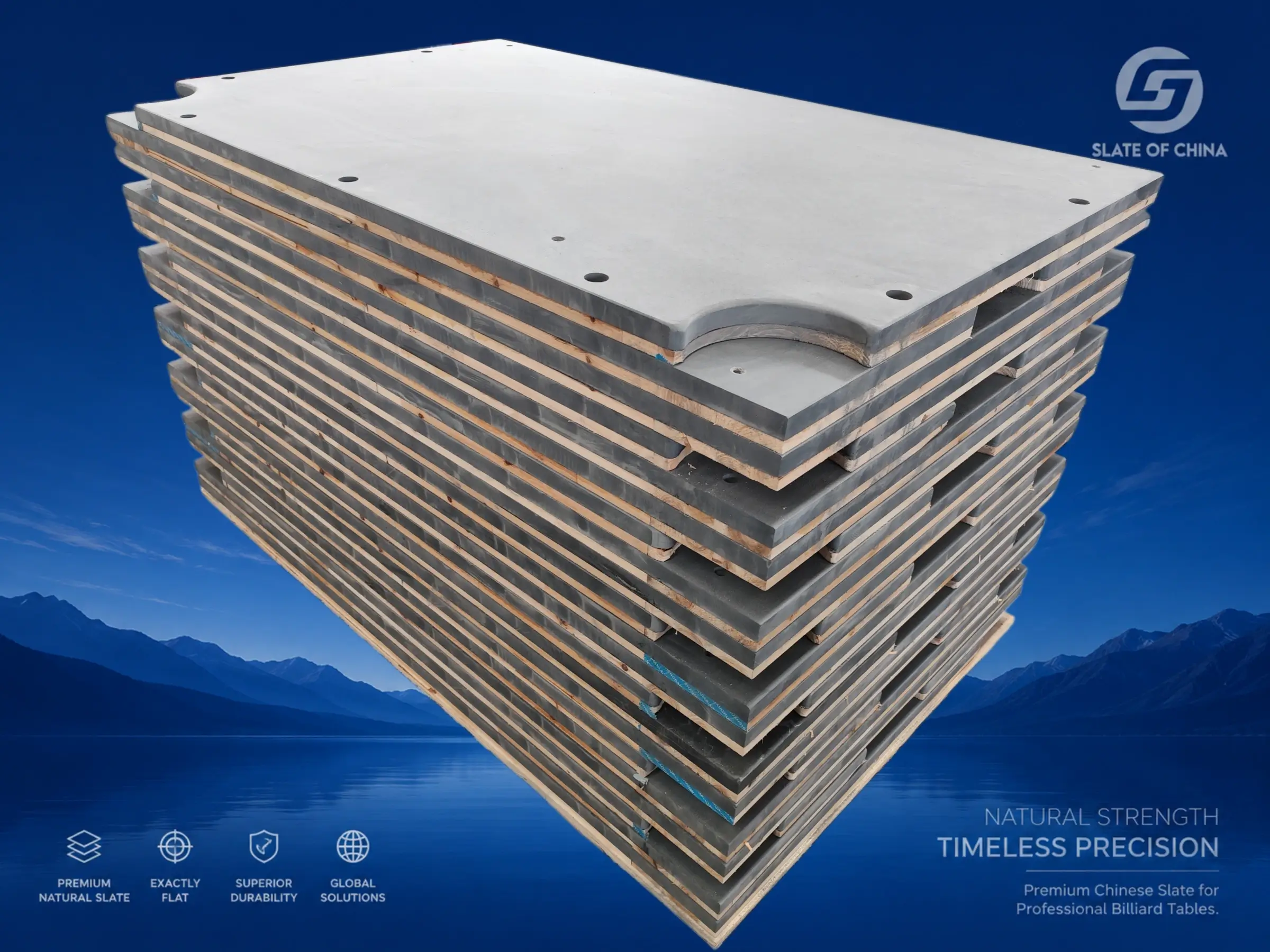
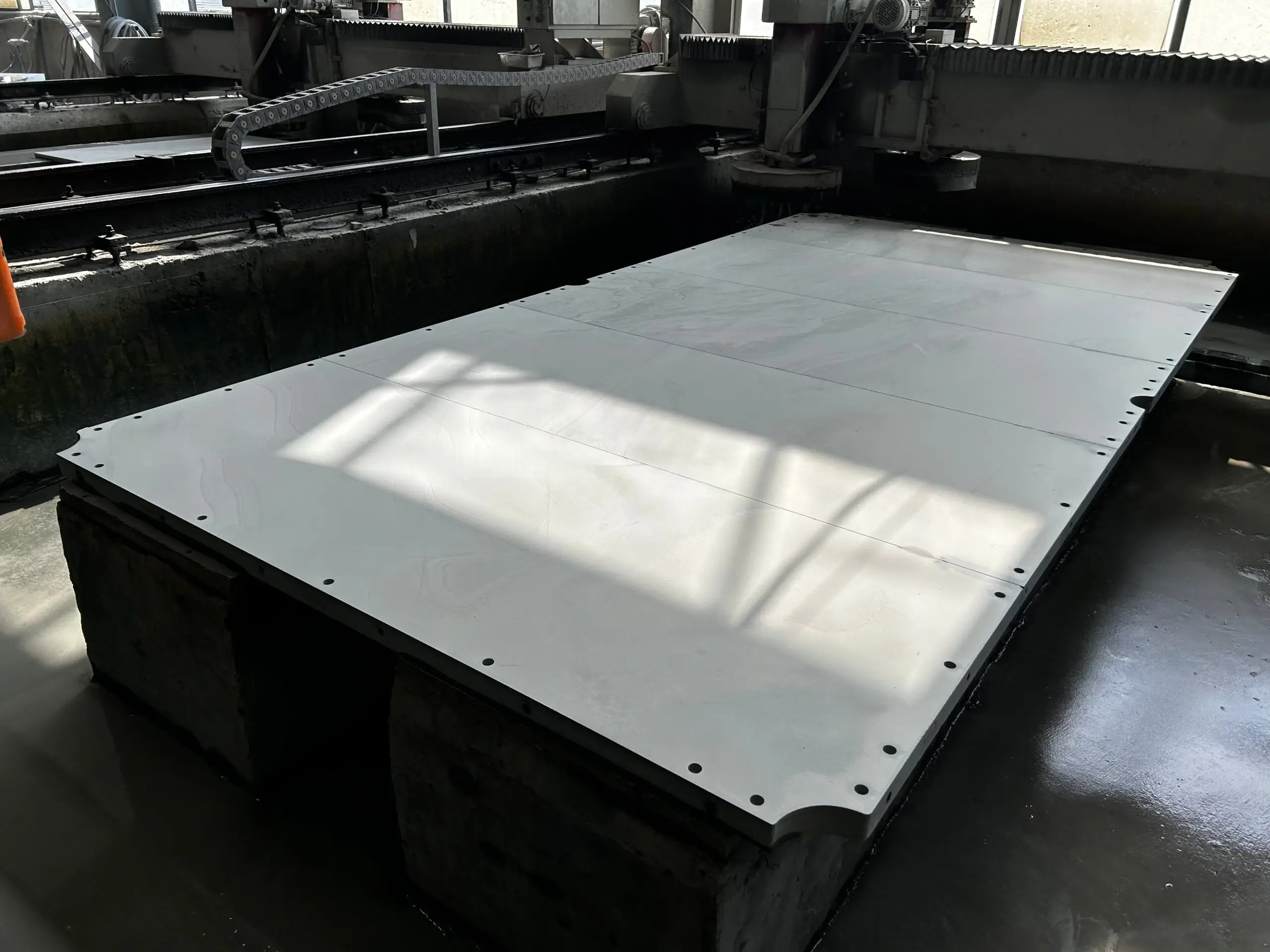
A three-piece slate consists of three precision-machined slate sections that are assembled and leveled during installation.
This is the most widely used configuration for professional pool tables and is considered the industry standard for commercial and tournament applications.
The three sections are accurately matched and precision-ground to create a perfectly flat playing surface after installation.
Features
- Three precision-cut slate sections
- Machined edges for accurate alignment
- Easier transportation and handling
- Suitable for larger pool tables
- Industry standard for professional tables
Advantages
Easier Transportation
Each slate section is smaller and lighter, making transportation and handling significantly easier.
Simplified Installation in Difficult Locations
Three-piece slate can be moved through doorways, staircases, and elevators that would be impossible for a one-piece slate.
Superior Leveling Flexibility
Installers can independently adjust and level each section to achieve exceptional flatness.
Preferred for Tournament Tables
Most commercial and tournament-grade pool tables use three-piece slate because it provides outstanding performance and installation flexibility.
Disadvantages
Longer Installation Process
The slate sections must be carefully aligned, leveled, and sealed during installation.
Requires Professional Installation
Achieving perfect seams and levelness requires proper installation techniques and experience.
Typical Applications
- Commercial pool tables
- Professional pool tables
- Tournament tables
- Pool halls and clubs
- High-end residential tables
- Export markets
One-Piece Slate vs Three-Piece Slate
| Feature | One-Piece Slate | Three-Piece Slate |
|---|---|---|
| Number of Pieces | 1 | 3 |
| Transportation | Difficult | Easy |
| Installation | Simple | Moderate |
| Leveling Flexibility | Limited | Excellent |
| Doorway Access | Difficult | Easy |
| Tournament Use | Rare | Standard |
| Commercial Use | Limited | Widely Used |
| Export Suitability | Moderate | Excellent |
Which Pool Slate Is Most Popular in the United States?
Three-piece slate is by far the most popular choice in the United States and other major pool table markets.
Most American pool table manufacturers, distributors, and installers prefer three-piece slate because it offers easier transportation, greater installation flexibility, and superior serviceability over the long term.
Professional tournament tables, commercial pool hall tables, and premium residential tables almost always use precision-ground three-piece slate.
For this reason, three-piece pool slate has become the global industry standard for high-quality pool table manufacturing.
At Slate of China, we manufacture both one-piece and three-piece pool slate in custom sizes and thicknesses to meet the requirements of pool table manufacturers and distributors worldwide.
Frequently Asked Questions About Pool Table Slate
Pool Slate Thickness Guide: Choosing the Right Thickness for Pool Tables
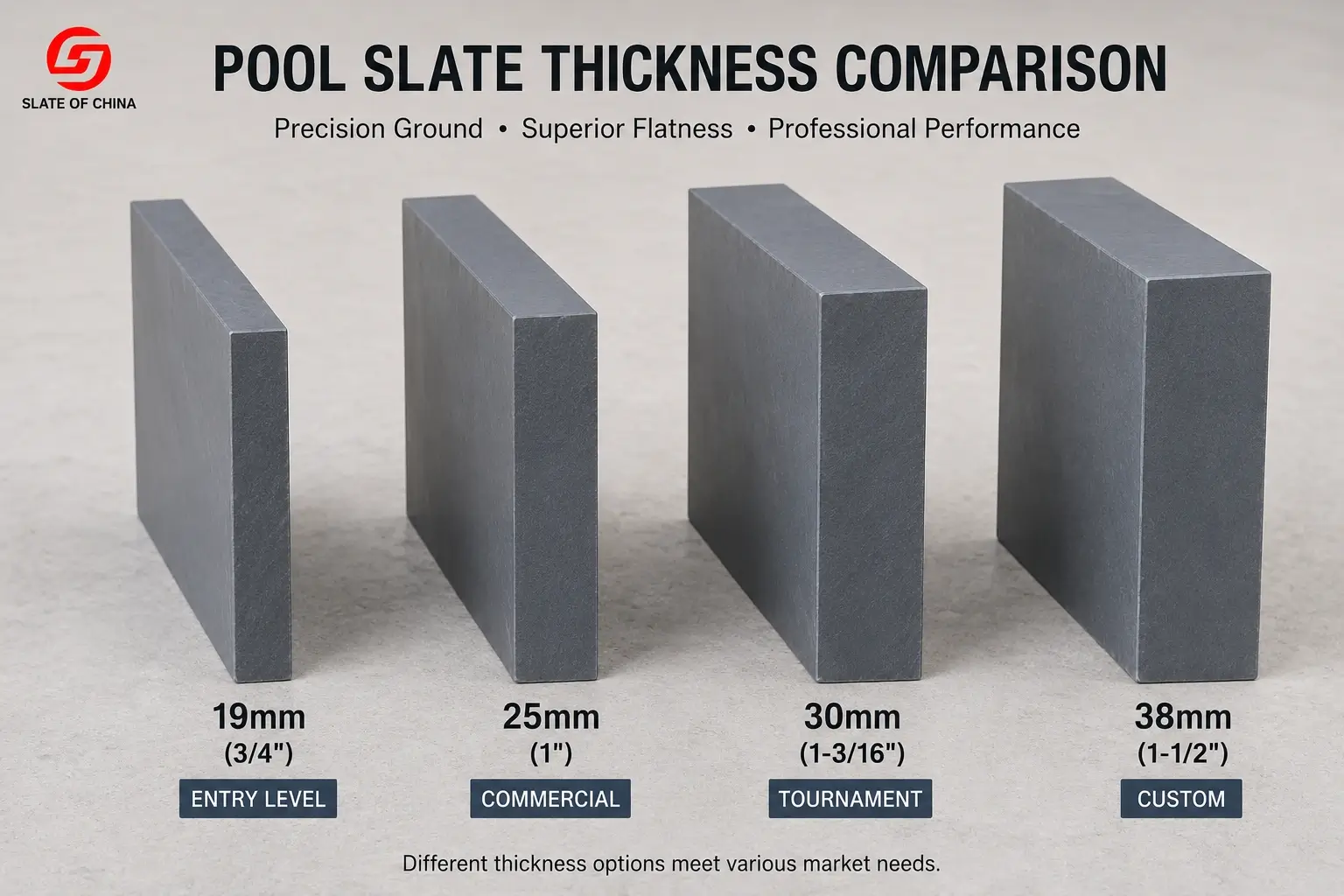
Pool slate thickness is one of the most important factors affecting the performance, durability, and overall quality of a pool table. Different slate thicknesses are designed for different applications, ranging from entry-level recreational tables to professional tournament tables.
In general, thicker slate provides greater rigidity and stability, helping maintain a perfectly flat playing surface over many years of use. However, thicker slate also increases table weight and transportation costs.
Understanding the most common pool slate thickness options can help manufacturers, distributors, and buyers choose the right slate for their market and application.
Common Pool Slate Thicknesses
| Slate Thickness | Imperial Size | Typical Application |
|---|---|---|
| 19 mm | 3/4″ | Entry-Level Pool Tables |
| 22 mm | 7/8″ | Residential Pool Tables |
| 25 mm | 1″ | Commercial & Professional Pool Tables |
| 30 mm | 1-3/16″ | Tournament Pool Tables |
| 38 mm | 1-1/2″ | Custom Heavy-Duty Tables |
19 mm (3/4″) Pool Slate
19 mm slate is commonly used in entry-level and budget-friendly pool tables.
It provides a stable playing surface while keeping manufacturing and transportation costs lower. This thickness is often found in recreational tables designed for occasional home use.
Advantages
- Lower overall table weight
- More economical transportation
- Suitable for entry-level markets
Typical Applications
- Home recreation tables
- Budget pool tables
- Light-duty residential use
25 mm (1″) Pool Slate
25 mm (1 inch) slate is the most widely used thickness in the global pool table industry.
It offers an excellent balance between rigidity, durability, weight, and cost. Most commercial pool tables, premium residential tables, and many professional tables use 1-inch pool slate.
Because of its superior structural stability, 1-inch slate provides a consistently flat playing surface while remaining practical for manufacturing, shipping, and installation.
Advantages
- Excellent flatness and stability
- Industry-standard thickness
- Suitable for commercial use
- Preferred by many pool table manufacturers
- Strong balance between performance and cost
Typical Applications
- Commercial pool tables
- Premium home tables
- Pool halls and clubs
- Professional competition tables
30 mm Tournament Slate
30 mm slate is often used in high-end tournament and professional competition tables.
The increased thickness provides additional rigidity and support, helping maintain precise flatness under intensive use conditions.
Advantages
- Maximum structural stability
- Exceptional durability
- Preferred for tournament environments
Typical Applications
- Tournament pool tables
- Professional billiard clubs
- Competition venues
38 mm Custom Slate
38 mm slate is primarily produced for specialized projects and custom-built tables.
Due to its substantial weight and cost, this thickness is typically reserved for unique applications where maximum mass and rigidity are required.
Typical Applications
- Custom luxury pool tables
- Heavy-duty commercial installations
- Special engineering projects
Why Is 1-Inch Pool Slate the Most Popular?
Among all available options, 25 mm (1 inch) pool slate has become the industry standard worldwide.
The reason is simple: it offers the best combination of performance, durability, weight, and cost.
Compared with thinner slate, 1-inch slate provides greater rigidity and long-term stability. Compared with thicker slate, it is easier to transport, install, and manufacture while still delivering professional playing performance.
For these reasons, most pool table manufacturers, distributors, and installers consider 1-inch slate the ideal choice for commercial and professional pool tables.
Today, the majority of pool tables sold in North America, Europe, and other major markets are equipped with precision-ground 1-inch pool slate.
How Thick Should Pool Table Slate Be?
For most applications, 25 mm (1 inch) slate is the recommended thickness.
However, the ideal choice depends on the intended use:
| Application | Recommended Thickness |
| Home Recreation | 19 mm – 22 mm |
| Residential Premium | 25 mm |
| Commercial Pool Hall | 25 mm |
| Professional Competition | 25 mm – 30 mm |
| Tournament Tables | 30 mm |
| Custom Projects | 38 mm |
At Slate of China, we manufacture pool slate in multiple thickness options to meet the requirements of residential, commercial, and tournament-grade pool tables worldwide.
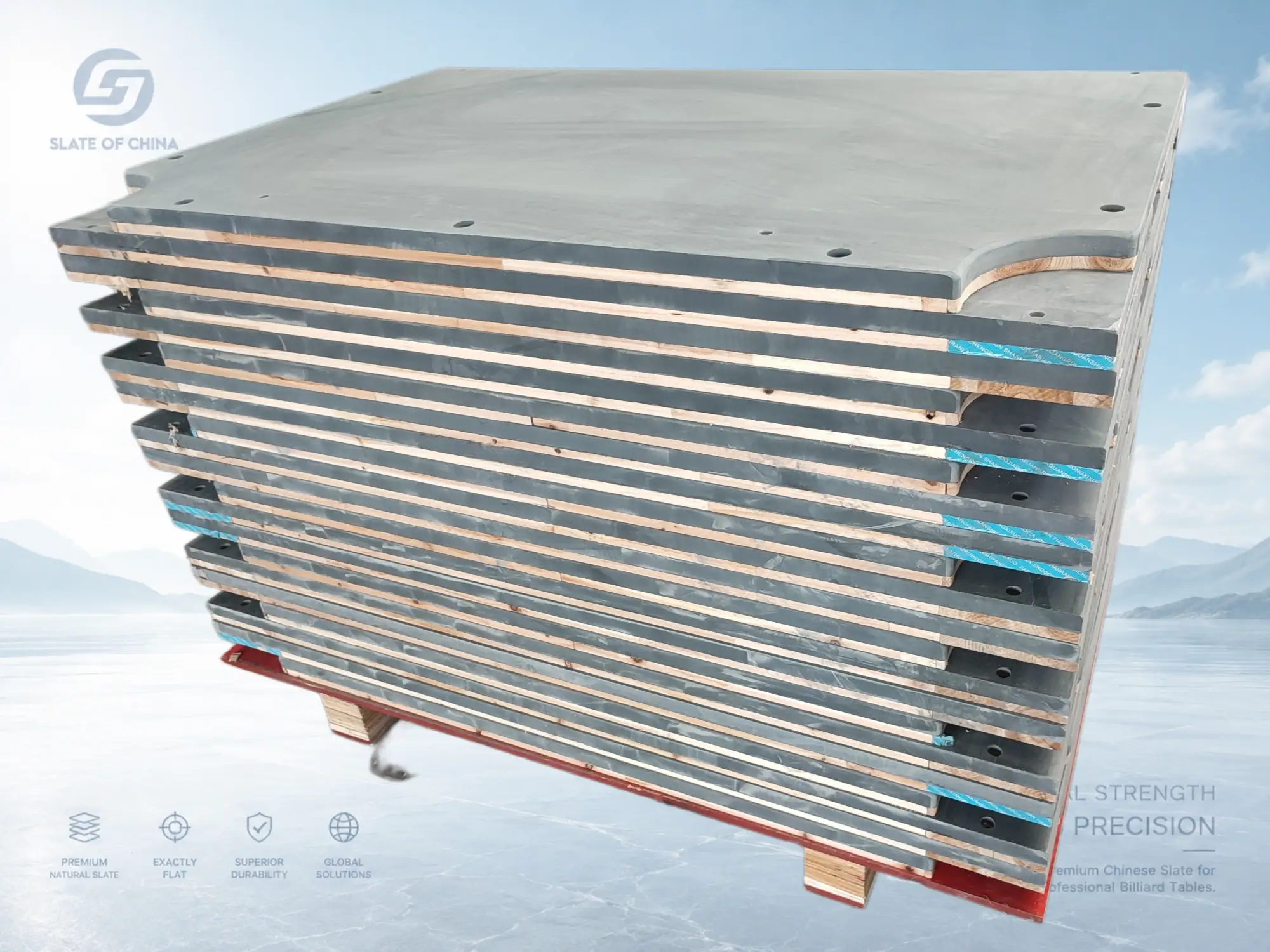
Frequently Asked Questions About Pool Table Slate
Pool Table Slate Size Chart & Standard Slate Dimensions
Pool table slate is manufactured in various sizes to match different table dimensions. Choosing the correct slate size is essential for ensuring proper fit, structural stability, and professional playing performance.
Most pool table slates are produced as precision-machined one-piece or three-piece sets designed specifically for standard pool table sizes. The dimensions vary depending on the table model, playing field requirements, and market standards.
Understanding standard pool table slate sizes helps manufacturers, distributors, and installers select the right slate configuration for residential, commercial, and tournament-grade pool tables.
Standard Pool Table Slate Sizes
The following chart shows the most common pool table slate dimensions used in North America and international markets.
| Pool Table Size | Playing Surface | Typical Slate Size (3-Piece Set) |
|---|---|---|
| 6ft Pool Table | 1600 × 800 mm | Custom Size |
| 7ft Pool Table | 1981 × 990 mm | Approx. 1981 × 990 mm |
| 8ft Pool Table | 2240 × 1120 mm | Approx. 2240 × 1120 mm |
| 8 Pro Pool Table | 2340 × 1170 mm | Approx. 2340 × 1170 mm |
| 9ft Pool Table | 2540 × 1270 mm | Approx. 2540 × 1270 mm |
Actual slate dimensions may vary slightly depending on table design and manufacturer specifications.
Most Popular Pool Table Slate Sizes
7ft Pool Table Slate
7ft pool tables are commonly used in bars, clubs, and recreational environments.
Benefits include:
- Compact footprint
- Easier transportation
- Suitable for limited spaces
- Popular coin-operated table size
Common markets:
- United States
- Canada
- United Kingdom
- Australia
8ft Pool Table Slate
The 8ft pool table is one of the most popular residential table sizes worldwide.
Advantages include:
- Balanced playing experience
- Suitable for home game rooms
- Excellent compromise between space and performance
Common applications:
- Residential pool tables
- Home recreation rooms
- Private clubs
8 Pro Pool Table Slate
The 8 Pro table has become increasingly popular in North America and professional leagues.
Advantages include:
- Larger playing area than standard 8ft tables
- Tournament-style gameplay
- Professional appearance
Many premium table manufacturers use 8 Pro slate configurations for higher-end products.
9ft Pool Table Slate
The 9ft pool table is the industry standard for professional tournament play.
Most international competitions and professional events use 9ft tables because they provide the highest level of shot accuracy and skill development.
Advantages include:
- Maximum playing area
- Professional competition standard
- Preferred by experienced players
Common applications:
- Tournament pool tables
- Commercial pool halls
- Professional billiard clubs
Which Pool Table Slate Size Is Most Popular in the United States?
The American market is dominated by:
Commercial Market
- 7ft Pool Slate
- 9ft Pool Slate
Residential Market
- 8ft Pool Slate
- 8 Pro Pool Slate
Among professional pool table manufacturers, three-piece 9ft slate remains the most widely used configuration for tournament-grade tables.
One-Piece vs Three-Piece Slate Sizes
While smaller pool tables may use one-piece slate, larger commercial and professional tables almost always use three-piece slate.
Advantages of three-piece slate include:
- Easier transportation
- Simplified installation
- Better access through doors and stairways
- Improved leveling flexibility
For this reason, most 8ft, 8 Pro, and 9ft pool tables are manufactured using precision-ground three-piece slate sets.
Custom Pool Slate Sizes Available
In addition to standard pool table slate sizes, custom slate dimensions can be produced for:
- Private-label pool table manufacturers
- Commercial table builders
- Tournament table projects
- OEM pool table production
At Slate of China, we manufacture precision-machined pool slate in standard and custom sizes to meet the requirements of pool table manufacturers worldwide.
Frequently Asked Questions About Pool Table Slate Sizes
How Pool Slate Is Manufactured
Pool slate is manufactured through a series of specialized processes that transform natural slate blocks into precision-engineered playing surfaces. From quarry selection to final inspection, every step directly affects the flatness, durability, and performance of the finished slate.
At Slate of China, we combine premium natural slate resources with modern CNC machining and precision grinding technology to produce high-quality pool table slate for manufacturers, distributors, and tournament table builders worldwide.
From Natural Slate to Professional Pool Table Slate
Unlike many other materials, pool slate begins as natural stone extracted from carefully selected quarries.
The manufacturing process must ensure:
- Consistent density
- Structural stability
- Excellent flatness
- Long-term durability
- Precision dimensions
Only high-quality natural slate can provide the smooth and stable playing surface required for professional pool tables.
1. Quarry Selection
The manufacturing process begins with selecting suitable natural slate deposits.
Not all slate is suitable for billiard applications. Pool table slate requires:
- Fine grain structure
- High density
- Excellent stability
- Minimal internal defects
- Consistent material properties
Careful quarry selection ensures that only premium raw materials enter the production process.
Why It Matters
The quality of the finished pool slate can never exceed the quality of the original stone.
Recommended Image
- Slate quarry
- Raw slate blocks
- Quarry production
2. Block Cutting
Large slate blocks are transported from the quarry and cut into manageable sections.
Modern cutting equipment is used to maximize material utilization while maintaining dimensional accuracy.
This stage prepares the material for further processing into slate slabs.
Key Objectives
- Accurate sizing
- Reduced internal stress
- Efficient material usage
Recommended Image
- Block cutting machine
- Large slate blocks
- Saw cutting process
3. Slab Processing
After block cutting, the material is processed into slate slabs of specific thicknesses.
Common pool slate thicknesses include:
- 19 mm (3/4″)
- 25 mm (1″)
- 30 mm
- 38 mm
The slabs are carefully calibrated to ensure consistent thickness throughout the entire production batch.
Benefits
- Consistent dimensions
- Improved structural stability
- Better machining accuracy
Recommended Image
- Slate slab production
- Thickness calibration
- Slab stacking
4. CNC Machining
CNC machining is one of the most critical stages in pool slate manufacturing.
Computer-controlled equipment is used to produce:
- Pocket openings
- Bolt holes
- Frame mounting holes
- Precision edge profiles
- Custom table designs
This process ensures repeatable accuracy and compatibility with pool table frames.
Advantages of CNC Machining
- High precision
- Consistent dimensions
- Custom design capability
- Improved installation efficiency
Recommended Image
- CNC machining center
- Pocket cutting
- Hole drilling operation
5. Precision Grinding
Precision grinding creates the perfectly flat playing surface required for professional pool tables.
The slate surface is ground using specialized equipment to achieve exceptional flatness and smoothness.
This stage directly influences:
- Ball roll accuracy
- Playing consistency
- Tournament performance
Why Grinding Matters
Even small surface deviations can affect gameplay.
Professional-grade slate must maintain strict flatness tolerances across the entire playing area.
Recommended Image
- Surface grinding machine
- Grinding operation
- Flatness inspection
6. Quality Inspection
Every pool slate undergoes rigorous inspection before packing and shipment.
Inspection items typically include:
- Surface flatness
- Thickness accuracy
- Hole positioning
- Pocket dimensions
- Edge quality
- Visual appearance
Only slates meeting quality requirements proceed to packing.
Inspection Benefits
- Consistent product quality
- Reduced installation issues
- Improved customer satisfaction
Recommended Image
- Flatness inspection
- Dimensional measurement
- Quality control process
7. Export Packing
Proper packing is essential for protecting pool slate during international transportation.
Slate of China uses export-grade packing systems designed to minimize handling damage and ensure safe delivery.
Typical packing methods include:
- Wooden crates
- Reinforced pallets
- Corner protection
- Moisture protection
- Shock-resistant packaging
Shipping Advantages
- Reduced breakage risk
- Easier handling
- Improved loading efficiency
Recommended Image
- Packed slate crates
- Container loading
- Export packaging
Why Manufacturing Quality Matters
The performance of a pool table depends heavily on the quality of its slate.
High-quality pool slate offers:
✓ Superior flatness
✓ Accurate ball roll
✓ Long-term stability
✓ Easy installation
✓ Extended service life
By combining premium natural slate, CNC machining, precision grinding, and strict quality control, Slate of China delivers pool slate products trusted by pool table manufacturers worldwide.
Frequently Asked Questions About Pool Slate Manufacturing
Precision Requirements for Pool Slate
The quality of a pool table slate is determined not only by the material itself but also by the precision achieved during manufacturing.
Professional pool slate must meet strict requirements for flatness, thickness consistency, surface finish, and joint accuracy. Even minor dimensional deviations can affect installation quality, ball roll performance, and long-term table stability.
At Slate of China, every pool slate is manufactured using precision grinding and CNC machining processes to ensure consistent dimensions and reliable playing performance.
Why Precision Matters
A pool table may look perfectly level to the naked eye, but even small surface variations can influence how a billiard ball travels across the table.
Professional players and pool table manufacturers require slate that delivers:
- Accurate ball roll
- Consistent playing speed
- Reliable installation
- Long-term dimensional stability
- Tournament-grade performance
This is why precision manufacturing is essential for high-quality pool table slate.
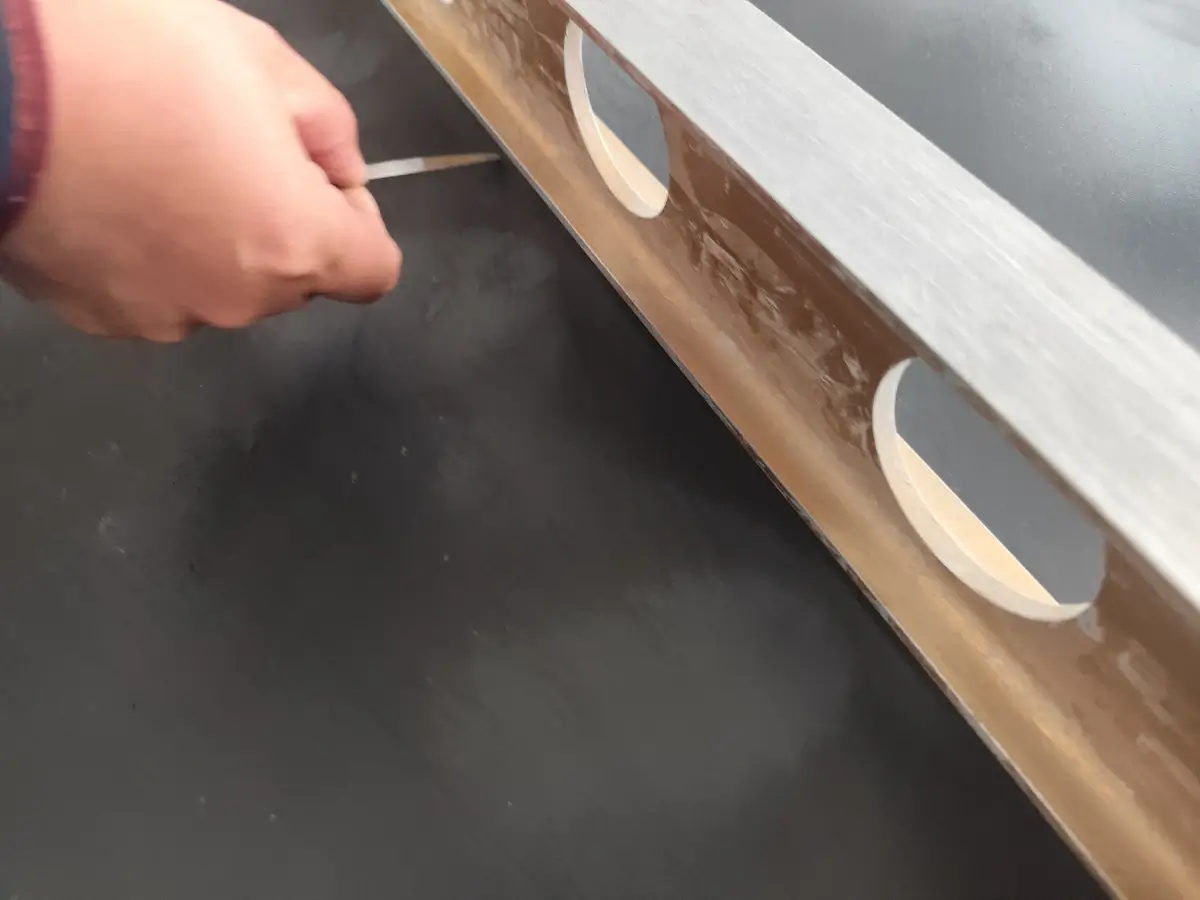
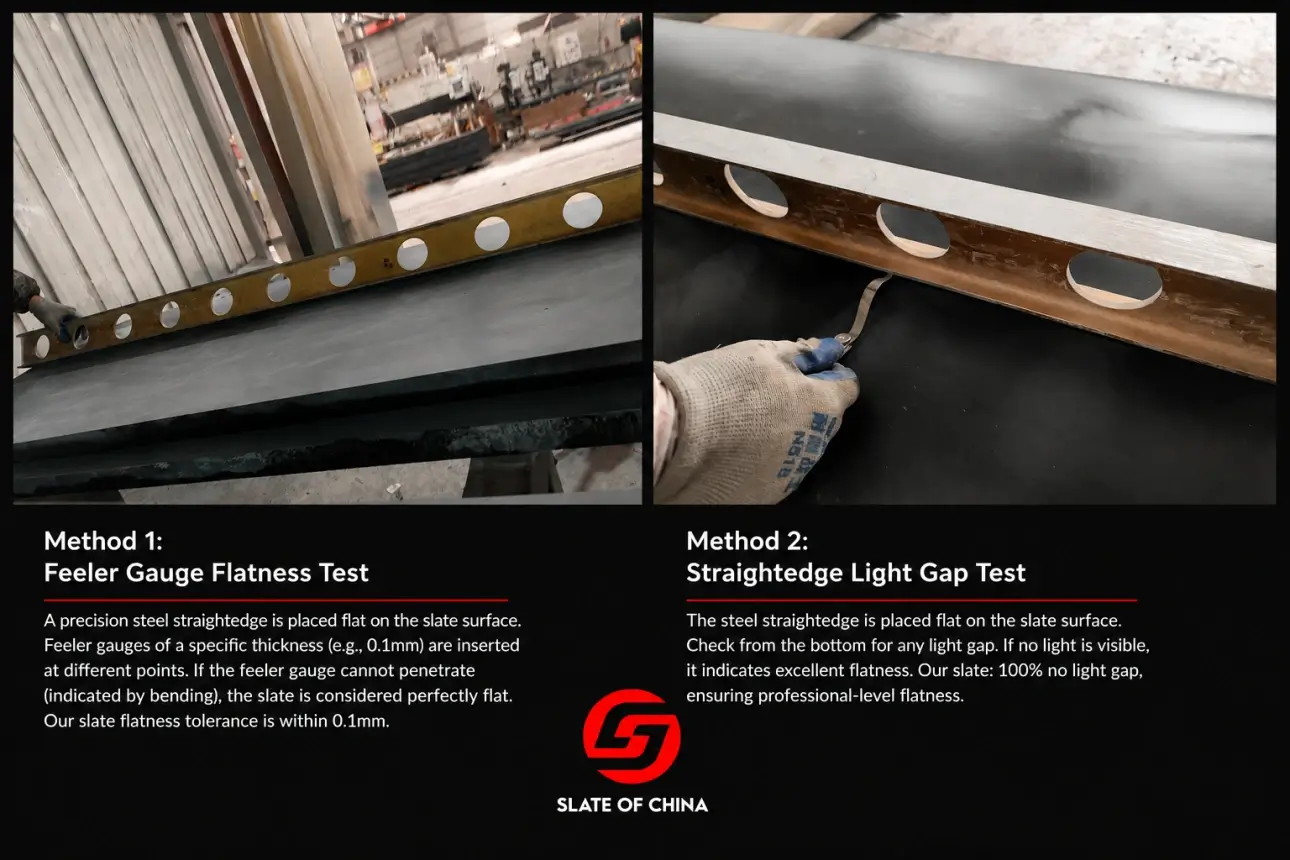
Flatness Tolerance
Flatness is the most important quality characteristic of pool slate.
A perfectly flat slate surface allows billiard balls to roll naturally without unwanted drift or directional changes.
Professional pool slate is precision ground to achieve extremely tight flatness tolerances across the entire playing surface.
Typical Flatness Tolerance
| Quality Level | Flatness Tolerance |
|---|---|
| Standard Slate | ±0.3 mm |
| Commercial Grade | ±0.2 mm |
| Professional Pool Slate | ±0.1 mm |
Why Flatness Is Critical
Even small surface deviations may result in:
- Ball roll inconsistency
- Installation difficulties
- Uneven cloth tension
- Reduced playing accuracy
For tournament and commercial pool tables, maintaining flatness tolerance is essential for consistent gameplay.
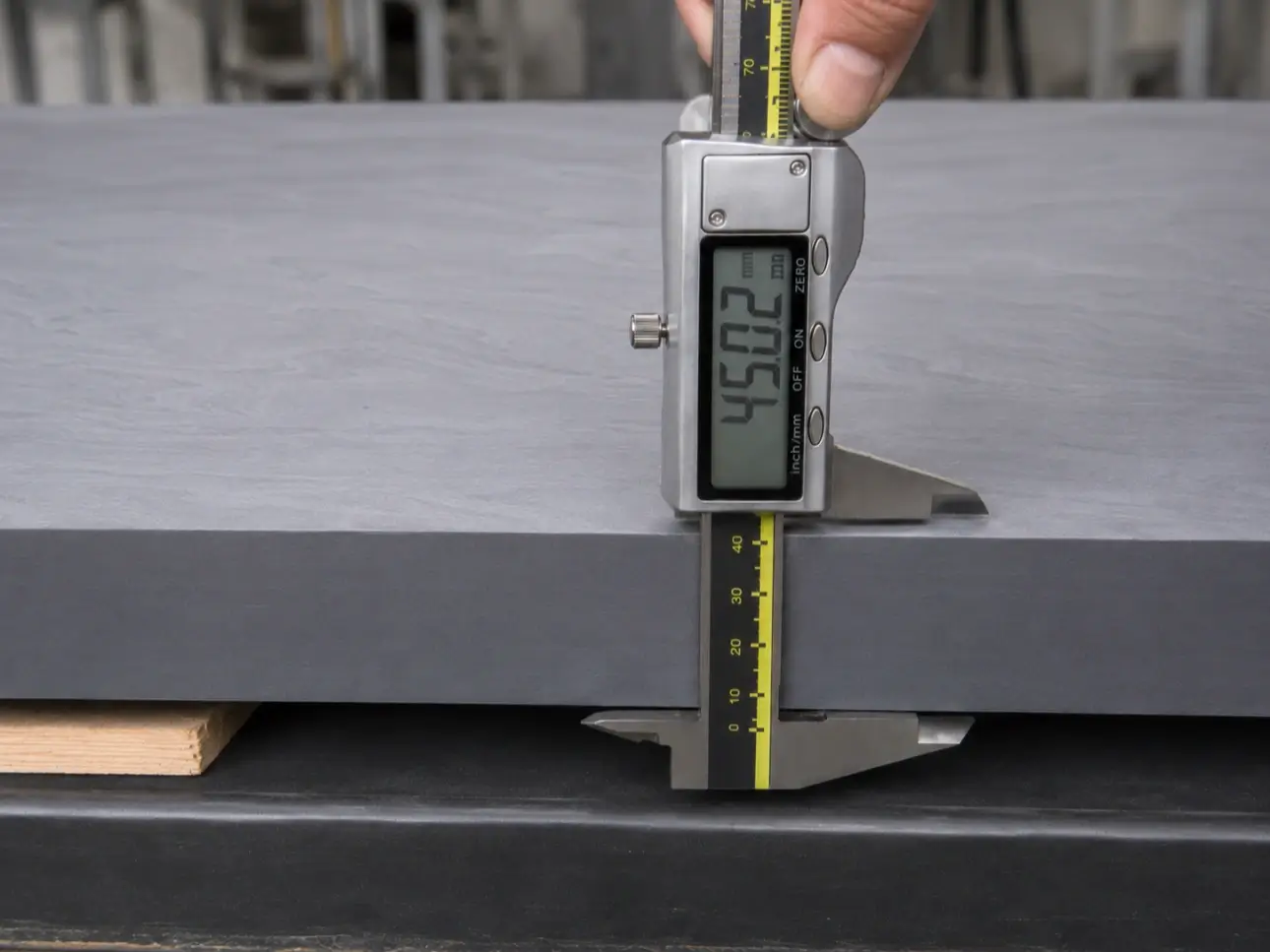
Thickness Tolerance
Thickness consistency ensures that every slate section fits properly during installation and provides uniform structural support.
Precision thickness control is particularly important for three-piece slate sets where all sections must align perfectly.
Typical Thickness Tolerance
| Slate Thickness | Typical Tolerance |
| 19 mm Slate | ±0.2 mm |
| 25 mm Slate | ±0.2 mm |
| 30 mm Slate | ±0.2 mm |
| 38 mm Slate | ±0.3 mm |
Benefits of Consistent Thickness
- Easier installation
- Improved leveling
- Better frame support
- Increased long-term stability
Surface Finish
A professional pool table slate requires a smooth and uniform surface finish before cloth installation.
Precision grinding removes irregularities and creates the ideal foundation for billiard cloth.
Surface Finish Requirements
- Smooth grinding marks
- Uniform texture
- No visible high spots
- No surface waviness
- Consistent finish across all slate sections
Advantages
A properly finished slate surface helps ensure:
- Consistent ball speed
- Better cloth installation
- Longer cloth life
- Improved playing performance
Joint Accuracy
Most commercial and tournament pool tables use three-piece slate.
For these tables, the accuracy of the joints between slate sections is extremely important.
Poorly machined joints can create:
- Visible gaps
- Installation difficulties
- Uneven playing surfaces
- Premature seam movement
Precision Joint Requirements
Professional three-piece slate should provide:
- Tight seam alignment
- Accurate edge machining
- Consistent dimensions
- Smooth transitions between sections
When properly installed, the joints become virtually invisible beneath the billiard cloth.
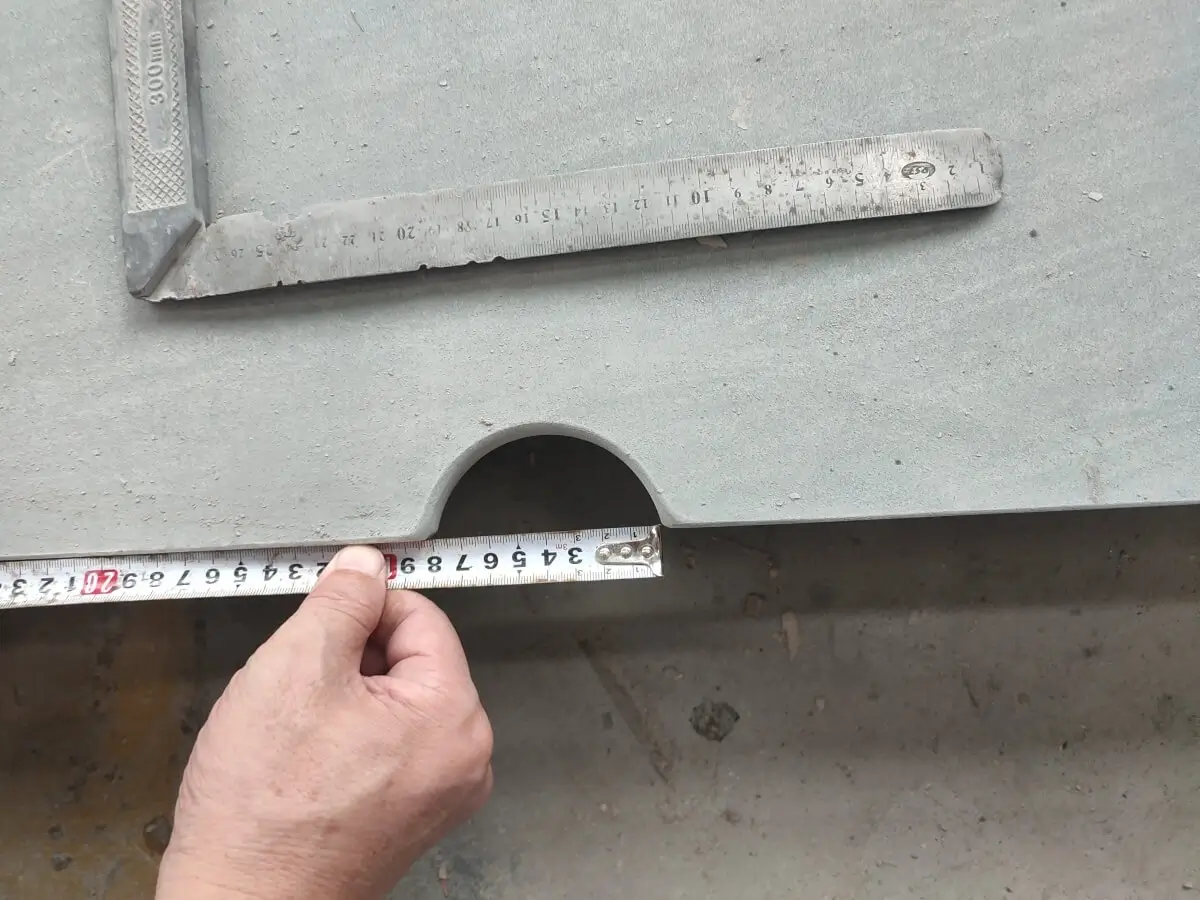
Quality Inspection Standards
Before packing and shipment, every pool slate should be inspected for:
✓ Surface flatness
✓ Thickness consistency
✓ Pocket dimensions
✓ Hole positioning
✓ Joint alignment
✓ Surface finish quality
These inspections help ensure that the finished slate meets the requirements of pool table manufacturers, installers, and professional players.
Precision Manufacturing for Professional Pool Tables
The best pool slate combines premium natural material with advanced manufacturing technology.
By controlling flatness tolerance, thickness accuracy, surface finish, and joint precision, professional slate manufacturers can deliver a playing surface that provides exceptional ball roll accuracy, durability, and long-term performance.
At Slate of China, every pool slate is produced with strict quality control procedures to meet the requirements of residential, commercial, and tournament-grade pool tables worldwide.
Frequently Asked Questions About Pool Slate Precision
Backed Slate vs Unbacked Slate
Pool table slate is available in several construction options, including wood backed slate, frame backed slate, and unbacked slate.
While the playing surface is always natural slate, the backing structure attached to the underside of the slate can affect installation, durability, cloth attachment, transportation, and manufacturing costs.
Understanding the differences between backed and unbacked slate helps pool table manufacturers and distributors select the most suitable option for their products and target markets.
What Is Backed Slate?
Backed slate refers to pool slate that has an additional support material permanently attached to the underside of the slate.
The backing provides structural reinforcement and creates a convenient surface for attaching billiard cloth during installation.
The two most common types are:
- Wood Backed Slate
- Frame Backed Slate
Wood Backed Slate
Wood backed slate consists of a natural slate slab with a wooden backing board bonded to the underside.
The wood backing typically extends around the perimeter of the slate and provides a convenient anchoring surface for cloth installation.
Features
- Natural slate playing surface
- Wooden backing attached underneath
- Simplified cloth stapling
- Widely used in North America
Advantages
✓ Easier cloth installation
✓ Faster assembly process
✓ Improved fastening options
✓ Popular with many pool table manufacturers
Disadvantages
✗ Higher overall weight
✗ Increased material cost
✗ Wood may react to humidity over time
Typical Applications
- Residential pool tables
- Commercial pool tables
- OEM table production
- North American market
Frame Backed Slate
Frame backed slate uses a wooden frame structure attached around the perimeter of the slate rather than a full backing board.
This design provides support while reducing overall weight.
Features
- Natural slate playing surface
- Wooden perimeter frame
- Reduced material usage
- Easier handling compared with full wood backing
Advantages
✓ Lower weight
✓ Good structural support
✓ Reduced material cost
✓ Easier transportation
Disadvantages
✗ Less support area than full wood backing
✗ Cloth installation may vary depending on table design
Typical Applications
- Commercial pool tables
- OEM production
- Export markets
Unbacked Slate
Unbacked slate consists entirely of natural slate without any wooden backing or supporting frame attached.
This is the traditional form of pool slate and remains popular among many professional table manufacturers.
Features
- 100% natural slate
- No attached backing materials
- Lowest material complexity
- Maximum flexibility for table builders
Advantages
✓ Lower weight
✓ Lower manufacturing cost
✓ No wood-related expansion issues
✓ Preferred by many professional manufacturers
Disadvantages
✗ Cloth installation may require additional support structures
✗ Installation methods vary by table design
Typical Applications
- Professional pool tables
- Tournament tables
- Custom table manufacturing
- International export markets
Backed Slate vs Unbacked Slate Comparison
| Feature | Wood Backed Slate | Frame Backed Slate | Unbacked Slate |
|---|---|---|---|
| Natural Slate Surface | ✓ | ✓ | ✓ |
| Wood Components | Full Backing | Perimeter Frame | None |
| Weight | Highest | Medium | Lowest |
| Cloth Installation | Easy | Easy | Depends on Table Design |
| Manufacturing Cost | Highest | Medium | Lowest |
| Shipping Cost | Higher | Medium | Lower |
| Moisture Resistance | Moderate | Good | Excellent |
| Commercial Use | Common | Common | Common |
| Tournament Use | Limited | Limited | Widely Used |
Which Type of Pool Slate Is Best?
There is no single solution that fits every application.
The best choice depends on:
- Table design
- Manufacturing method
- Installation preference
- Target market
- Shipping requirements
Many American pool table manufacturers prefer wood backed slate because it simplifies cloth installation.
Many professional and export-oriented manufacturers prefer unbacked slate because it reduces weight, lowers shipping costs, and eliminates potential wood movement caused by environmental conditions.
For custom projects, frame backed slate often provides an excellent balance between support, weight, and cost.
Choosing the Right Pool Slate Construction
When selecting pool slate, buyers should consider more than just slate thickness and table size.
Backing configuration can significantly influence:
- Installation efficiency
- Shipping costs
- Manufacturing flexibility
- Long-term performance
At Slate of China, we manufacture wood backed slate, frame backed slate, and unbacked slate according to customer specifications and OEM requirements for residential, commercial, and tournament-grade pool tables worldwide.
Frequently Asked Questions About Backed and Unbacked Pool Slate
Pool Slate Installation Guide
Even the highest-quality pool slate cannot deliver optimal playing performance without proper installation.
Professional pool table slate installation is essential for achieving a perfectly level playing surface, accurate ball roll, and long-term table stability. Incorrect installation may result in uneven gameplay, visible seams, cloth wrinkles, or future leveling issues.
Most commercial and tournament pool tables use three-piece slate, making precise installation especially important.
The pool slate installation process generally consists of five key stages.
1. Slate Positioning
The first step is positioning the slate sections onto the pool table frame.
Each slate piece must be placed in the correct order and orientation to ensure proper alignment.
During this stage, installers verify:
- Frame stability
- Correct slate positioning
- Proper pocket alignment
- Accurate section placement
Correct positioning creates the foundation for all subsequent installation steps.
2. Slate Leveling
Leveling is one of the most critical steps in pool table installation.
Professional installers use precision levels and shims to ensure the entire playing surface remains perfectly flat.
Proper leveling helps achieve:
- Accurate ball roll
- Consistent playing speed
- Improved table performance
- Long-term stability
Even small deviations can affect gameplay, making precise leveling essential for professional pool tables.
3. Slate Seaming
For three-piece slate tables, the joints between slate sections must be carefully aligned.
The objective is to create a smooth and continuous playing surface without visible transitions.
Professional seaming ensures:
- Tight joint alignment
- Smooth slate transitions
- Better cloth installation
- Improved playing consistency
When properly installed, slate seams become virtually undetectable beneath the cloth.
4. Wax Filling
After the slate joints are aligned, seam gaps are typically filled using beeswax or specialized slate seam filler.
Wax filling helps create a smooth surface across the entire playing area.
Benefits include:
- Eliminating joint imperfections
- Improving surface smoothness
- Supporting accurate ball roll
- Preparing the slate for cloth installation
This step is particularly important for tournament-grade pool tables.
5. Cloth Installation
Once the slate surface is leveled and seams are finished, billiard cloth is installed over the slate bed.
Proper cloth installation requires:
- Correct stretching tension
- Smooth surface preparation
- Accurate pocket cutting
- Secure attachment
A well-installed cloth works together with the slate surface to provide consistent playing speed and professional performance.
Why Professional Slate Installation Matters
Pool slate installation directly influences the performance of the finished pool table.
Proper installation helps ensure:
✓ Accurate ball roll
✓ Perfect surface flatness
✓ Invisible slate seams
✓ Long-term stability
✓ Professional tournament-level performance
For this reason, many manufacturers and installers recommend professional installation for commercial and tournament pool tables.
Learn More About Pool Slate Installation
This section provides a general overview of the installation process.
For detailed step-by-step instructions, tools, leveling techniques, seam filling methods, and professional installation tips, please visit our complete guide:
👉 Pool Slate Installation Guide
(/billiard-slate/slate-installation/)
Frequently Asked Questions About Pool Slate Installation
Pool Slate Leveling Guide
Proper slate leveling is one of the most important factors affecting pool table performance.
Even a premium pool slate cannot deliver accurate ball roll if the playing surface is not correctly leveled. Small variations in level can cause balls to drift, affect shot accuracy, and reduce the overall playing experience.
For this reason, professional pool table installers consider slate leveling one of the most critical steps during installation.
Whether using one-piece or three-piece pool slate, achieving a perfectly level playing surface is essential for residential, commercial, and tournament pool tables.
Why Is Pool Slate Leveling Important?
Pool slate serves as the foundation of the playing surface.
If the slate is not level, players may experience:
- Ball drift
- Inconsistent shot accuracy
- Uneven playing speed
- Visible seam movement
- Long-term table instability
Proper leveling ensures that the slate bed remains flat and stable across the entire table surface.
This is particularly important for professional pool tables where precision and consistency are essential.
How to Level Pool Table Slate
The leveling process begins after the slate sections have been positioned on the table frame.
Professional installers typically follow these steps:
1. Check Frame Stability
Before leveling the slate, the table frame must be inspected to ensure it is structurally stable and properly assembled.
A weak or uneven frame can prevent accurate slate leveling.
2. Position the Slate Sections
The slate pieces are carefully placed onto the frame and aligned according to the table design.
For three-piece slate tables, proper section positioning is essential before leveling begins.
3. Measure Surface Level
Installers use precision spirit levels or machinist levels to check the surface across multiple directions.
Measurements are taken:
- Lengthwise
- Widthwise
- Diagonally
This helps identify any uneven areas.
4. Adjust Using Shims
Small leveling shims are placed between the slate and frame to correct surface variations.
The objective is to achieve a perfectly level playing surface across all slate sections.
5. Verify Final Level
After adjustments are complete, the surface is rechecked to confirm consistent levelness throughout the table.
Only after leveling is verified should seam filling and cloth installation begin.
Leveling Three-Piece Pool Slate
Three-piece slate is the most common configuration for commercial and tournament pool tables.
Because the playing surface is assembled from three separate sections, leveling accuracy becomes even more important.
Professional installers must ensure:
- Consistent height between sections
- Smooth seam transitions
- Uniform support across the frame
- Proper alignment before seam filling
When correctly leveled, a three-piece slate table provides a virtually seamless playing surface.
Common Pool Slate Leveling Mistakes
Improper leveling can lead to long-term performance issues.
Common mistakes include:
✗ Leveling the slate before checking the frame
✗ Using inaccurate leveling tools
✗ Insufficient support beneath slate sections
✗ Ignoring diagonal measurements
✗ Filling seams before final leveling
Avoiding these mistakes helps ensure professional installation quality.
Professional Slate Leveling for Tournament Performance
Tournament pool tables require exceptional leveling accuracy.
Professional installers often perform multiple inspections throughout the installation process to ensure:
✓ Accurate ball roll
✓ Consistent playing speed
✓ Seamless slate transitions
✓ Long-term table stability
Proper slate leveling is one of the key reasons why professional pool tables deliver superior playing performance.
Learn More About Pool Slate Leveling
This section provides a general overview of the leveling process.
For detailed step-by-step instructions, leveling tools, shim techniques, seam adjustment methods, and professional installation tips, please visit our complete guide:
👉 Pool Slate Leveling Guide
/billiard-slate/slate-leveling/
Frequently Asked Questions About Pool Slate Leveling
Pool Slate Weight Chart
Pool slate is a dense natural stone specifically selected for its stability, rigidity, and durability. As a result, pool table slate is significantly heavier than alternative materials such as MDF or plywood.
Understanding pool slate weight is important for transportation planning, installation, packaging, and container loading. The weight of a slate set varies depending on table size, slate thickness, and whether the slate is manufactured as a one-piece or three-piece set.
The following chart provides typical weight references for standard 25 mm (1-inch) three-piece pool slate sets.
Pool Slate Weight Chart
| Pool Table Size | Slate Thickness | Approximate Weight |
|---|---|---|
| 7ft Pool Table | 25 mm (1″) | 170 – 190 kg |
| 8ft Pool Table | 25 mm (1″) | 210 – 230 kg |
| 8 Pro Pool Table | 25 mm (1″) | 240 – 260 kg |
| 9ft Pool Table | 25 mm (1″) | 260 – 280 kg |
Actual weight may vary depending on slate dimensions, pocket design, machining requirements, and manufacturing tolerances.
Typical Pool Slate Weight by Table Size
7ft Pool Slate Weight
A standard 7ft pool table slate set typically weighs between 170 kg and 190 kg.
This size is widely used for:
- Bar tables
- Coin-operated pool tables
- Recreational tables
- Compact commercial installations
Because of its relatively lower weight, 7ft slate is easier to transport and install compared with larger tournament-sized slate.
8ft Pool Slate Weight
An 8ft slate set generally weighs between 210 kg and 230 kg.
This is one of the most popular sizes for residential pool tables and premium home game rooms.
The additional mass provides excellent stability while remaining manageable for transportation and installation.
8 Pro Pool Slate Weight
8 Pro pool slate is increasingly popular in North America and professional league environments.
Typical weight ranges from 240 kg to 260 kg depending on thickness and machining specifications.
Many manufacturers consider 8 Pro tables the ideal balance between residential and professional gameplay.
9ft Pool Slate Weight
A professional 9ft pool table slate set typically weighs between 260 kg and 280 kg.
This is the industry standard for tournament and competition tables.
The increased mass helps maximize structural stability and contributes to superior playing performance.
What Factors Affect Pool Slate Weight?
Several factors influence the final weight of a pool slate set.
Slate Thickness
Thicker slate naturally weighs more.
Common options include:
- 19 mm (3/4″)
- 25 mm (1″)
- 30 mm
- 38 mm
Increasing slate thickness improves rigidity but also increases transportation and installation requirements.
Table Size
Larger pool tables require larger slate sections, resulting in greater overall weight.
Pocket Design
Corner and side pocket machining removes material and may slightly affect total weight.
Backed vs Unbacked Slate
Wood backed slate generally weighs more than unbacked slate due to the additional backing material.
Why Pool Slate Weight Matters
Knowing the weight of pool table slate helps manufacturers, distributors, and installers plan for:
✓ Shipping costs
✓ Export packing
✓ Container loading
✓ Warehouse handling
✓ Installation requirements
✓ Structural support design
Accurate weight information is particularly important when exporting pool slate internationally.
Pool Slate Weight and Shipping
Because pool slate is a heavy natural stone product, shipping efficiency is an important consideration.
Many pool table manufacturers prefer precision-machined three-piece slate because it provides:
- Easier handling
- Safer transportation
- Improved installation flexibility
- Better container utilization
Proper packing and loading procedures help reduce breakage risk while maximizing shipping efficiency.
At Slate of China, we provide detailed slate weight data, packing dimensions, and container loading recommendations to help customers plan transportation and logistics more effectively.

Frequently Asked Questions About Pool Slate Weight
Chinese Pool Slate vs Brazilian Slate
Chinese pool slate and Brazilian slate are among the most widely used materials in the global billiard industry. Both are natural slate products that have been successfully used in residential, commercial, and tournament pool tables for many years.
While both materials can provide excellent playing performance when properly manufactured, there are differences in raw material characteristics, production capabilities, supply chain efficiency, and export logistics.
Understanding these differences helps pool table manufacturers and distributors select the most suitable slate source for their business requirements.
Raw Material Characteristics
Both Chinese slate and Brazilian slate are natural metamorphic stones formed over millions of years.
High-quality slate used for pool tables typically offers:
- High density
- Good structural stability
- Fine grain structure
- Excellent machinability
- Long service life
The performance of finished pool slate depends not only on the quarry source but also on the manufacturing process, grinding accuracy, and quality control procedures.
Comparison
| Factor | Chinese Pool Slate | Brazilian Slate |
|---|---|---|
| Natural Material | Excellent | Excellent |
| Density | Excellent | Excellent |
| Durability | Excellent | Excellent |
| Industry Reputation | Well Established | Well Established |
Surface Flatness
Flatness is one of the most important requirements for professional pool slate.
Both Chinese and Brazilian slate can achieve professional-level flatness when processed using modern grinding equipment.
The actual playing performance is generally determined more by manufacturing precision than by geographic origin.
Comparison
| Factor | Chinese Pool Slate | Brazilian Slate |
|---|---|---|
| Precision Grinding | Excellent | Excellent |
| Flatness Potential | Excellent | Excellent |
| Tournament Use | Yes | Yes |
Production Capacity
China is currently one of the largest pool slate manufacturing regions in the world.
Large-scale production facilities and extensive processing capacity allow manufacturers to handle both standard and custom orders efficiently.
Brazilian slate producers typically operate with smaller overall production volumes but maintain strong positions in specific international markets.
Comparison
| Factor | Chinese Pool Slate | Brazilian Slate |
|---|---|---|
| Production Capacity | Very High | Moderate |
| Custom Orders | Strong Capability | Available |
| Large Volume Supply | Strong Advantage | Limited Availability |
Lead Time
Lead time is an important consideration for pool table manufacturers and distributors.
Chinese manufacturers often benefit from:
- Large production capacity
- Established export infrastructure
- Extensive container shipping networks
Lead times vary by supplier and order size, but China generally offers greater flexibility for large-volume production schedules.
Comparison
| Factor | Chinese Pool Slate | Brazilian Slate |
|---|---|---|
| Production Flexibility | High | Moderate |
| Large Order Handling | Strong | Moderate |
| Export Frequency | High | Moderate |
Cost Considerations
Pricing depends on multiple factors including:
- Slate grade
- Thickness
- Machining requirements
- Order quantity
- Shipping destination
In many international markets, Chinese pool slate is often selected because of its competitive manufacturing and logistics advantages.
Brazilian slate may be preferred in certain regions depending on transportation routes and supplier relationships.
Comparison
| Factor | Chinese Pool Slate | Brazilian Slate |
|---|---|---|
| Manufacturing Cost | Competitive | Competitive |
| Export Logistics | Strong | Moderate |
| Value for Money | Excellent | Excellent |
Export Experience
China has decades of experience exporting pool slate to:
- North America
- Europe
- Australia
- Southeast Asia
- Middle East
Many Chinese manufacturers provide:
- OEM production
- Custom machining
- Export packaging
- Container loading support
Brazilian suppliers also maintain established export operations and continue to serve international pool table manufacturers worldwide.
Comparison
| Factor | Chinese Pool Slate | Brazilian Slate |
|---|---|---|
| Export Experience | Extensive | Extensive |
| OEM Capability | Strong | Available |
| Global Distribution | Wide | Wide |
Which Pool Slate Should You Choose?
Both Chinese pool slate and Brazilian slate can provide excellent performance when sourced from reputable manufacturers.
The best choice depends on:
- Product specifications
- Delivery requirements
- Production schedules
- Budget considerations
- Logistics preferences
For many pool table manufacturers, the decision is based on the overall balance of quality, lead time, customization capability, and supply reliability rather than the country of origin alone.
Why Many Manufacturers Choose Chinese Pool Slate
Many international pool table manufacturers choose Chinese pool slate because of:
✓ Large production capacity
✓ Consistent supply availability
✓ Advanced CNC machining capability
✓ Competitive manufacturing costs
✓ Extensive export experience
✓ Flexible OEM production
When combined with strict quality control and precision grinding, Chinese pool slate can meet the requirements of residential, commercial, and tournament-grade pool tables worldwide.
Why Choose Slate Of China Pool Slate?
| Item | Value |
|---|---|
| Quarry Experience | 40+ Years |
| Export Markets | 30+ Countries |
| Slate Types | Pool & Snooker Slate |
| Production Method | CNC Machining |
| Flatness Standard | Tournament Grade |
| OEM Service | Available |
Choosing the right pool slate supplier is just as important as selecting the right slate material. Consistent quality, precision manufacturing, reliable delivery, and export experience all play a critical role in the success of pool table manufacturers and distributors.
At Slate Of China, we combine premium natural slate resources, advanced processing technology, and decades of industry experience to supply high-quality pool slate to customers worldwide.
Whether you require standard pool table slate, custom sizes, OEM production, or large-volume export orders, we are committed to delivering reliable products and professional service.
40+ Years of Slate Quarry Experience
Our slate resources originate from one of China’s most established slate-producing regions.
With more than four decades of experience in slate extraction and processing, we understand the material characteristics required for professional billiard applications.
Benefits
✓ Stable raw material supply
✓ Consistent slate quality
✓ Extensive industry knowledge
✓ Long-term production reliability
Professional CNC Processing
Modern CNC machining equipment ensures precise manufacturing of:
- Pocket openings
- Bolt holes
- Mounting holes
- Edge profiles
- Custom specifications
Precision machining improves installation efficiency and ensures consistent dimensions across every production batch.
Benefits
✓ Accurate dimensions
✓ Repeatable quality
✓ Custom production capability
✓ OEM support
Tournament-Grade Flatness
Flatness is one of the most important requirements for professional pool slate.
Our production process combines precision grinding and strict quality control procedures to help ensure:
- Smooth ball roll
- Consistent playing performance
- Reliable installation
- Long-term stability
Typical Applications
- Commercial pool tables
- Professional clubs
- Tournament tables
- OEM manufacturing
Exported to 30+ Countries
Our pool slate products have been supplied to customers across:
- North America
- Europe
- Australia
- Southeast Asia
- Middle East
- South America
Years of export experience allow us to understand international quality requirements, packing standards, and logistics challenges.
Benefits
✓ Export-ready products
✓ International shipping experience
✓ Global customer support
✓ Reliable delivery schedules
OEM & Private Label Manufacturing
We work closely with pool table manufacturers, distributors, and billiard brands worldwide.
OEM services include:
- Custom slate sizes
- Private labeling
- Custom machining
- Special pocket designs
- Packaging customization
Benefits
✓ Brand flexibility
✓ Product differentiation
✓ Manufacturing support
✓ Scalable production
Custom Pool Slate Sizes Available
Not every project requires standard dimensions.
We manufacture pool slate according to customer drawings and specifications, including:
- Custom table sizes
- Special thicknesses
- Unique pocket configurations
- OEM table designs
Benefits
✓ Flexible production
✓ Design compatibility
✓ Faster project development
Strong Export Packing System
Pool slate is a heavy and fragile natural stone product that requires professional packing for international transportation.
Our export packing system is designed to minimize handling risks and protect slate during ocean freight and inland transportation.
Typical Features
- Reinforced wooden crates
- Steel strap protection
- Corner protection systems
- Moisture-resistant packaging
- Container loading optimization
Benefits
✓ Reduced breakage risk
✓ Safer transportation
✓ Improved loading efficiency
✓ Better delivery performance
Reliable Supply for Pool Table Manufacturers
We understand the needs of professional pool table manufacturers and distributors.
Our focus is not only on supplying slate, but also on helping customers achieve:
✓ Consistent quality
✓ Stable lead times
✓ Competitive pricing
✓ Efficient logistics
✓ Long-term business growth
By combining premium natural slate, precision manufacturing, and global export experience, Slate Of China has become a trusted supplier for residential, commercial, and tournament-grade pool table projects worldwide.
Frequently Asked Questions About Slate Of China Pool Slate
Frequently Asked Questions About Pool Slate
Request a Pool Slate Quote
Looking for a reliable pool slate manufacturer?
Whether you need standard pool table slate, custom sizes, OEM production, or large-volume export orders, our team is ready to help.
Simply provide your project requirements, and we will recommend the most suitable pool slate specifications based on your table design, target market, and budget.
Our experienced export team can assist with product selection, technical specifications, packing recommendations, and international shipping arrangements.
Information We Need
To provide an accurate quotation, please include the following information:
Pool Table Size
Select the table size you require:
- 7ft Pool Table Slate
- 8ft Pool Table Slate
- 8 Pro Pool Table Slate
- 9ft Pool Table Slate
- Custom Size
Slate Thickness
Please specify your preferred slate thickness:
- 19 mm (3/4″)
- 25 mm (1″)
- 30 mm
- 38 mm
- Custom Thickness
Quantity Required
Please indicate:
- Trial Order
- Small Batch Production
- Full Container Order
- Annual Demand
Destination Country
Shipping costs and packing requirements vary by destination.
Examples:
- United States
- Canada
- United Kingdom
- Germany
- Australia
- Middle East
- Southeast Asia
- South America
Additional Requirements
You may also include:
- One-piece or three-piece slate
- Backed or unbacked slate
- OEM requirements
- Custom machining
- Private label packaging
- Target delivery date
What You Will Receive
After receiving your inquiry, our team will provide:
✓ Recommended slate specifications
✓ Product quotation
✓ Weight information
✓ Packing details
✓ Container loading data
✓ Estimated lead time
✓ Shipping recommendations
Why Contact Slate Of China?
✓ 40+ Years of Slate Industry Experience
✓ Professional CNC Processing
✓ Tournament-Grade Pool Slate
✓ Custom Sizes Available
✓ OEM Manufacturing Support
✓ Strong Export Packing
✓ Exported to 30+ Countries
Get a Free Pool Slate Quote Within 24 Hours
Tell us your table size, slate thickness, quantity, and destination country.
Our team will respond with a professional quotation and technical recommendations within 24 hours.
Contact us today to discuss your pool slate project.
Looking for pool slate prices, custom pool table slate, or OEM billiard slate manufacturing? Contact Slate Of China today for a free quotation and technical consultation.