
Roofing Slate Cost Guide
Discover roofing slate material prices, installation costs, key pricing factors, and practical tips to maximize the long-term value of your natural slate roof.
Table of Contents
How Much Does Roofing Slate Cost?
Natural roofing slate is one of the most durable and prestigious roofing materials available, but its cost can vary significantly depending on where you are and how your roof is built.
For example, the average installed cost of a natural slate roof is typically:
| Region | Typical Installed Cost |
|---|---|
| United States | US$15–40 per sq.ft |
| United Kingdom | £80–180 per m² |
| Europe | €70–180 per m² |
If you’re purchasing roofing slate only (excluding installation), material prices generally range from:
US$4–18 per sq.ft, depending on the slate type, quality, and origin.
However, the cost of a slate roof depends on much more than the stone itself.
Factors such as slate quality, country of origin, tile size, thickness, roof design, installation complexity, labor costs, accessories, and transportation all influence the final project cost. Even two roofs with the same area can have very different budgets because of these variables.
Whether you’re a homeowner planning a renovation, a roofing contractor estimating a project, or an importer sourcing natural roofing slate, understanding these cost factors is essential for making the right decision.
In this guide, we’ll explain every factor that affects roofing slate cost, compare prices across different markets, and help you choose the best-value natural slate for your project.
Key Takeaway:
The price of a slate roof is determined by far more than the cost of the slate tiles. Material quality, roof complexity, installation, and logistics all contribute to the total investment. Understanding these factors helps you compare quotations more accurately and avoid unexpected costs.
Average Roofing Slate Cost
The cost of a natural roofing slate project varies depending on whether you’re purchasing slate tiles only or budgeting for a fully installed roof. Material costs represent only part of the total investment, while installation, roof design, and local labor rates can significantly affect the final price.
The table below provides a general price range for natural roofing slate projects in major international markets.
| Item | Average Cost |
|---|---|
| Roofing Slate Material | US$4–18 per sq.ft |
| Installation | US$8–25 per sq.ft |
| Complete Slate Roof (Installed) | US$12–40 per sq.ft |
Note: These prices are intended as a general guide. Actual costs vary by country, slate type, project size, roof complexity, and local labor rates.
Why Do Roofing Slate Prices Vary?
Not all natural roofing slate is the same. Prices vary considerably depending on the geological source, production process, quality standards, and market demand.
For example:
| Slate Origin | Typical Price Level | Characteristics |
|---|---|---|
| Spanish Slate | $$$ | Widely used across Europe, consistent quality, premium pricing. |
| Chinese Slate | $$ | Excellent value, reliable quality, and highly competitive pricing for international projects. |
| Welsh Slate | $$$$$ | Historic, prestigious, and among the most expensive roofing slates available. |
| Canadian Slate | $$$$ | Premium natural slate commonly used in North American residential and heritage buildings. |
While slate from different countries may appear similar, differences in durability, water absorption, strength, thickness tolerance, color consistency, certification, and production capacity all contribute to the final price.
Rather than focusing on the lowest initial cost, it is important to evaluate the overall value of the roofing slate, including its expected service life, installation efficiency, maintenance requirements, and long-term performance.
Quick Tip:
A higher-quality roofing slate may cost more initially, but its longer lifespan and lower maintenance requirements often result in a lower lifetime cost than cheaper roofing materials.
Roofing Slate Material Cost by Origin
The price of natural roofing slate varies considerably depending on where it is quarried. Geological conditions, production methods, quality standards, availability, and transportation costs all influence the final material price.
Although roofing slate from different countries serves the same purpose, each source has its own characteristics, market positioning, and price range.
Chinese Roofing Slate
Chinese roofing slate has become an increasingly popular choice in international markets thanks to its excellent balance between quality and affordability. It is widely used for residential housing, commercial buildings, and roofing distribution projects across Europe, North America, and Oceania.
Its key advantages include:
- Competitive material cost
- Stable long-term supply
- Large production capacity
- Extensive export experience
- Wide range of sizes, thicknesses, and finishes
- Ideal for residential and commercial roofing projects
Among China’s major slate-producing regions, Jiujiang Slate is well known for its consistent blue-grey color, low water absorption, good splitting properties, and reliable production quality. For many international buyers, it offers an excellent balance between performance, durability, and price.
Spanish Roofing Slate
Spain is one of the world’s largest producers and exporters of natural roofing slate, particularly for the European market. Spanish slate is widely specified for residential developments, public buildings, and restoration projects.
Typical characteristics include:
- Consistent quality
- Strong reputation in Europe
- Wide availability
- Higher average market price than many Asian alternatives
Spanish slate is often selected for premium residential construction where established European sourcing is preferred.
Welsh Roofing Slate
Welsh slate is regarded as one of the most prestigious natural roofing materials in the world. It has been used for centuries on castles, churches, historic landmarks, and luxury properties throughout the United Kingdom.
Typical characteristics include:
- Exceptional durability
- Rich historical heritage
- Premium appearance
- Limited supply
- Highest material cost among major roofing slates
Because of its rarity and heritage value, Welsh slate is primarily chosen for restoration work and high-end architectural projects rather than cost-sensitive developments.
Canadian Roofing Slate
Canadian roofing slate is widely used throughout North America, particularly for custom homes, institutional buildings, and heritage restoration.
Its main advantages include:
- Premium natural stone quality
- Excellent freeze-thaw resistance
- Long service life
- Strong reputation in North American construction
Canadian slate generally commands a premium price due to quarrying costs, labor expenses, and regional market demand.
Roofing Slate Material Cost Comparison
The following table provides a general comparison of roofing slate from major producing regions.
| Origin | Relative Price | Typical Lifespan | Typical Applications |
|---|---|---|---|
| China | $$ | 70–100 Years | Residential, commercial, export projects |
| Spain | $$$ | 80–100 Years | Residential housing, European construction |
| Canada | $$$$ | 80–120 Years | Premium homes, institutional buildings |
| Wales | $$$$$ | 100+ Years | Historic restoration, luxury architecture |
Note: Lifespan depends not only on the origin of the slate, but also on the geological quality of the quarry, proper installation, local climate, and ongoing roof maintenance.
Which Roofing Slate Offers the Best Value?
The most expensive roofing slate is not always the most cost-effective.
For many modern roofing projects, buyers are looking for the best combination of quality, durability, appearance, and price rather than simply choosing the highest-priced material.
This is where Jiujiang Roofing Slate stands out. With its attractive blue-grey color, consistent quality, reliable supply, and competitive factory pricing, it provides excellent long-term value for distributors, roofing contractors, builders, and homeowners worldwide.
Whether you’re importing roofing slate in container quantities or specifying materials for a construction project, selecting a slate that delivers reliable performance at a reasonable cost is often a smarter investment than simply paying for the highest-priced option.
Factors That Affect Roofing Slate Cost
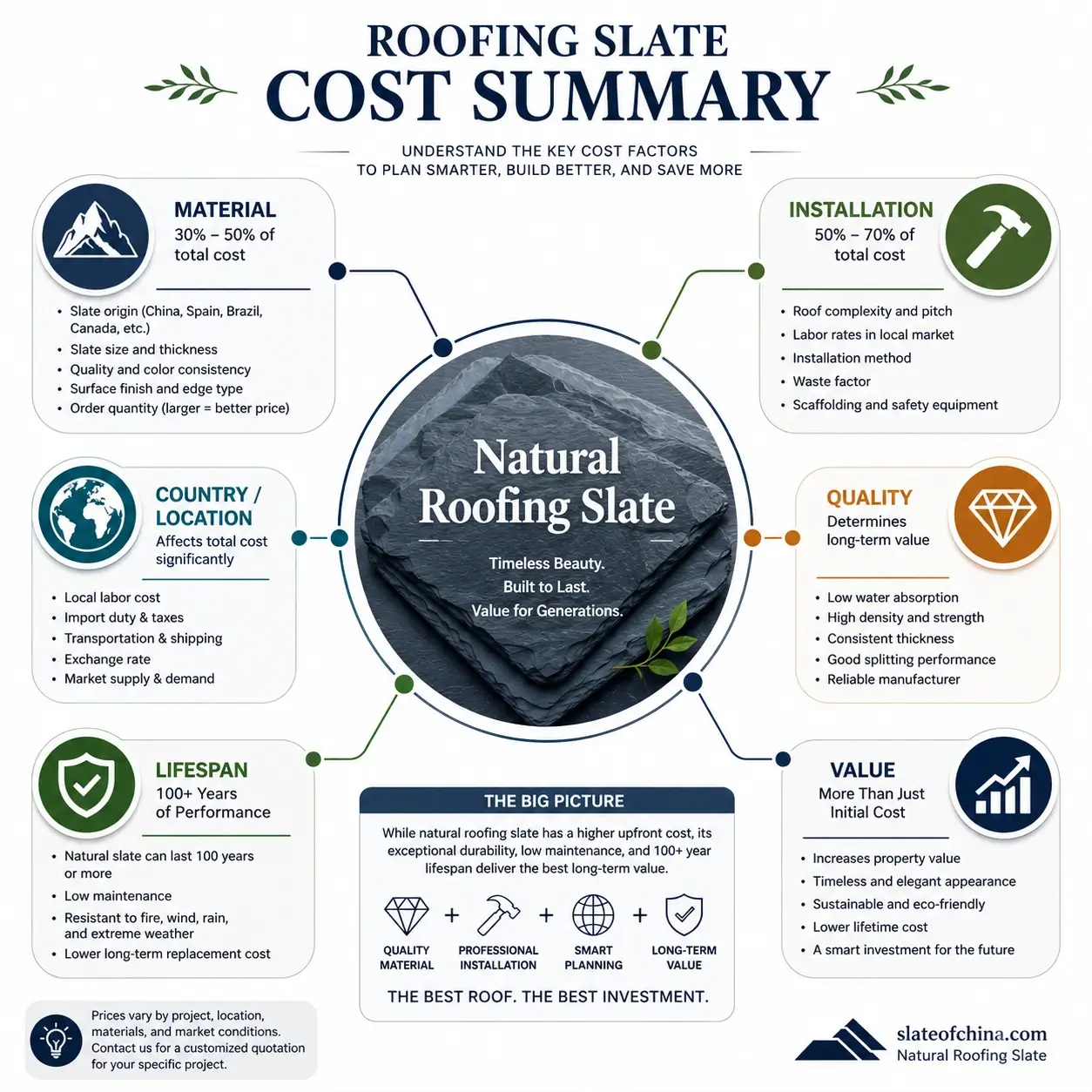
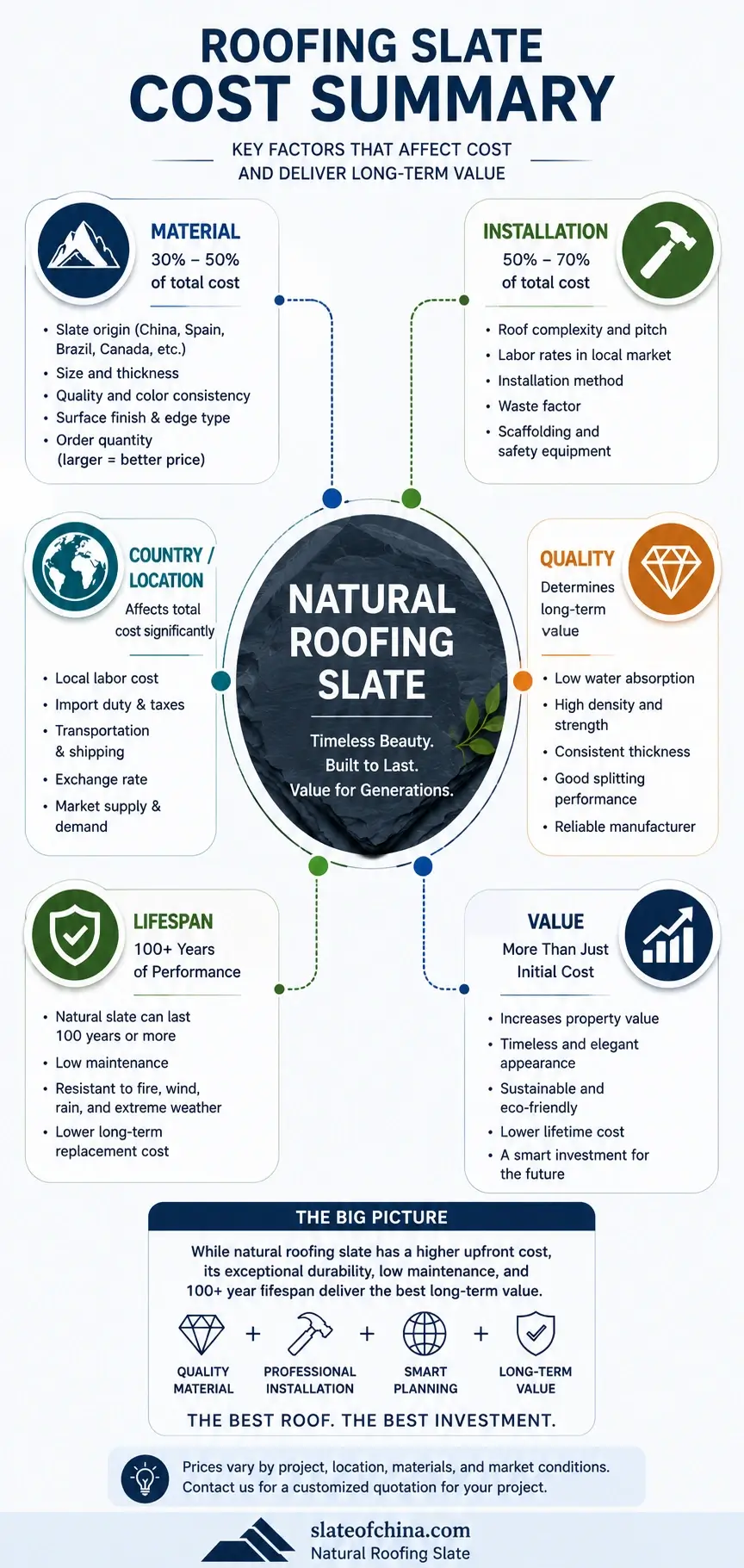
The price of natural roofing slate is influenced by many factors beyond the cost of the stone itself. Material quality, slate dimensions, roof design, installation complexity, and even transportation can all affect the total project budget.
Understanding these factors will help you compare quotations more accurately and choose the most cost-effective roofing solution for your project.
4.1 Slate Quality
The quality of natural roofing slate is the single most important factor affecting its price. High-quality slate offers greater durability, better weather resistance, and a longer service life, making it a better long-term investment.
Professional roofing slate is commonly evaluated according to standards such as EN 12326 in Europe and ASTM specifications in North America. Key performance indicators include:
- Water absorption
- Flexural strength
- Carbonate content
- Pyrite content
- Freeze-thaw resistance
- Dimensional accuracy
High-grade slate that meets international standards typically commands a higher price, but it also provides superior durability and lower maintenance costs over its lifetime.
4.2 Slate Size
Slate size affects both material costs and installation costs.
Smaller roofing slates usually cost less per piece but require more tiles, more fixing points, and significantly more installation time. Larger slates are generally more expensive individually, but they cover a greater roof area, reducing labor and installation time.
For this reason, larger slate sizes are often more economical for large roofing projects, while smaller formats remain popular for traditional architecture and decorative roof designs.
4.3 Slate Thickness
Roofing slate is available in various thicknesses, commonly ranging from 3–5 mm, 5–7 mm, and 7–9 mm.
In general:
- Thicker slate costs more to produce.
- It weighs more, increasing transportation costs.
- It is often stronger and more durable.
- It is commonly specified for prestigious or long-life projects.
Choosing the appropriate thickness depends on the building design, local climate, roof structure, and project budget rather than simply selecting the thickest option.
4.4 Slate Color
Natural roofing slate is available in a variety of colors, including:
- Black
- Blue-grey
- Grey
- Green
- Purple
- Multi-color blends
Standard colors produced in large quantities are generally the most affordable. Less common colors, limited-production quarries, or highly decorative color variations often command premium prices due to their rarity and stronger architectural appeal.
For most residential projects, blue-grey and dark grey roofing slate provide the best balance between appearance, availability, and cost.
4.5 Roofing Pattern
The installation pattern also influences the overall roofing cost.
Standard rectangular installations are usually the most economical because they minimize cutting and material waste. More decorative layouts require additional labor, more precise installation, and higher material consumption.
Common roofing patterns include:
- Regular Pattern
- Random Width Pattern
- Graduated Roofing
- Decorative Roofing
- Fish Scale
- Diamond Pattern
- Hexagonal Pattern
Complex patterns can significantly increase both labor costs and material waste, making them more expensive than standard installations.
4.6 Roof Complexity
The complexity of the roof structure has a major impact on installation costs.
Simple gable roofs are relatively quick to install, while complex roof designs require more cutting, flashing, and skilled labor.
Features that typically increase roofing costs include:
- Steeper roof pitch
- Valleys
- Dormers
- Chimneys
- Skylights
- Hips and ridges
- Multiple roof intersections
Even when using the same roofing slate, a complex roof may cost substantially more than a simple roof because installation is far more labor-intensive.
| Cost Factor | Impact on Price | Typical Effect |
|---|---|---|
| Slate Quality | ★★★★★ | Higher quality = higher price, longer lifespan |
| Slate Size | ★★★☆☆ | Larger slates cost more but reduce labor |
| Slate Thickness | ★★★★☆ | Thicker slate is heavier, stronger, and more expensive |
| Slate Color | ★★☆☆☆ | Rare colors usually cost more |
| Roofing Pattern | ★★★★☆ | Decorative patterns increase labor and waste |
| Roof Complexity | ★★★★★ | Steep or complex roofs require more installation time |
Key Takeaway
The total cost of a slate roof is determined by far more than the price of the slate tiles. Material quality, slate size, thickness, color, roofing pattern, and roof complexity all contribute to the final investment. Understanding these factors allows you to compare quotations fairly and choose the roofing slate that delivers the best long-term value.
Roofing Slate Installation Cost
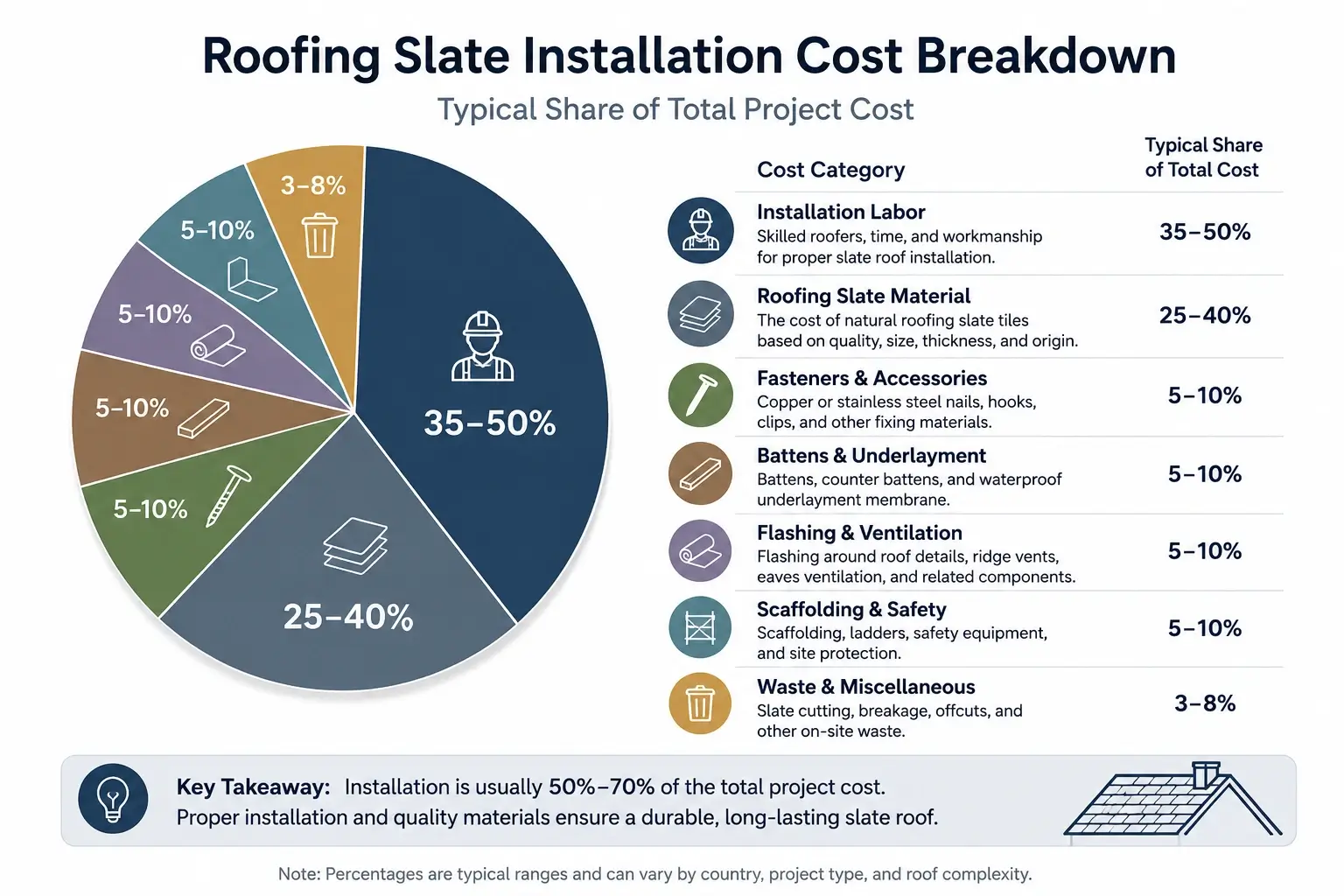
Installing a natural slate roof requires skilled craftsmanship, specialized tools, and high-quality roofing accessories. As a result, installation is often the largest single expense in a slate roofing project.
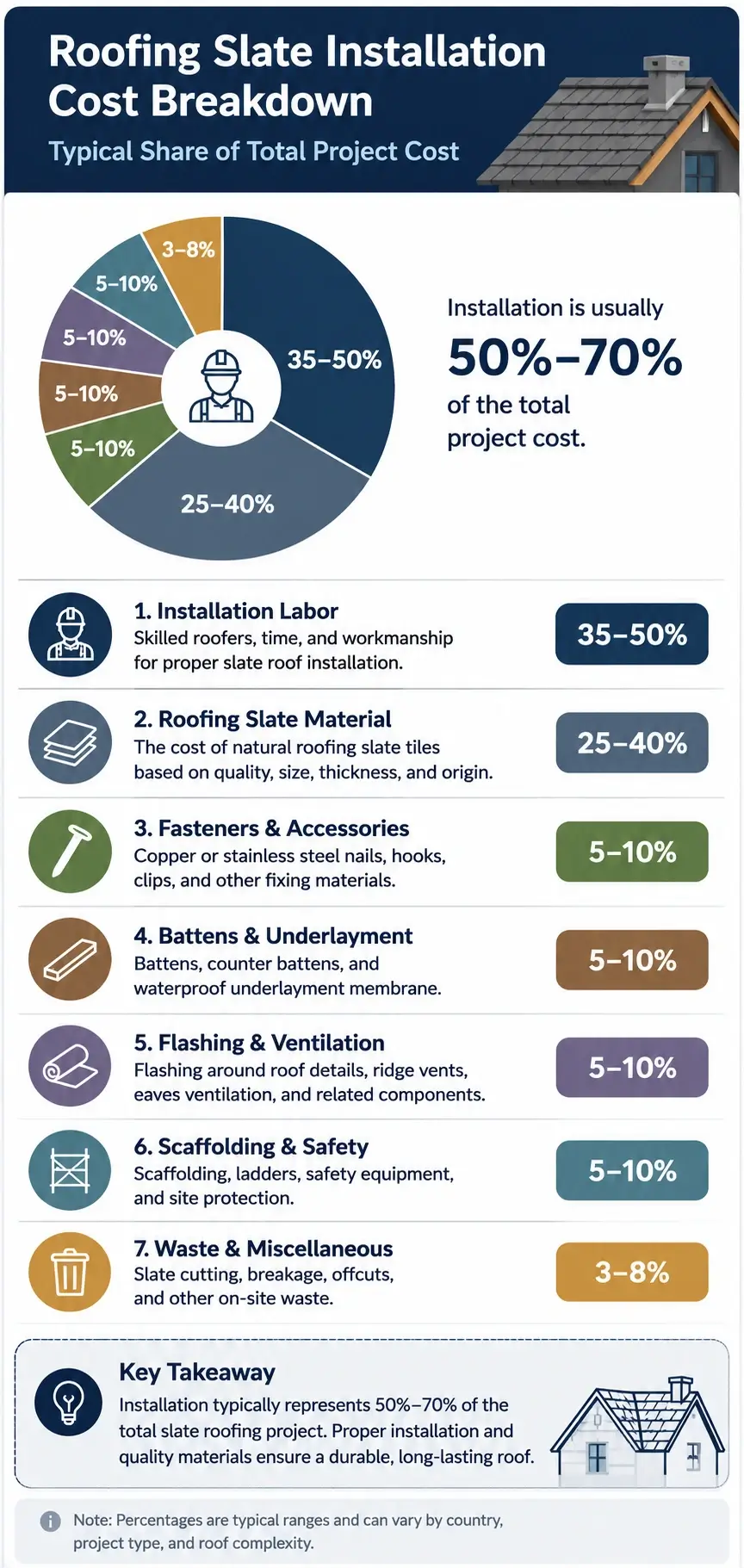
In most markets, installation typically accounts for 50%–70% of the total cost of a completed slate roof. Even if two projects use the same roofing slate, installation costs can vary significantly depending on roof design, labor rates, and local building requirements.
The table below shows the main components that contribute to roofing slate installation costs.
| Installation Component | Description |
|---|---|
| Labor | Professional slate roof installation by experienced roofers. |
| Fasteners | Copper or stainless steel nails and hooks used to secure each slate. |
| Battens | Timber or metal battens that support the roofing slates. |
| Underlayment | Waterproof roofing membrane that provides secondary weather protection. |
| Flashing | Lead, zinc, copper, or aluminum flashing around chimneys, valleys, and roof joints. |
| Ventilation | Ridge vents, eaves ventilation, and airflow systems that improve roof performance. |
| Scaffolding | Temporary access systems required for safe installation, especially on multi-story buildings. |
| Material Waste | Slate cutting, breakage, offcuts, and installation waste generated during construction. |
Why Installation Costs Vary
Several factors influence the final installation cost of a slate roof, including:
- Local labor rates
- Roof pitch and accessibility
- Roof complexity
- Slate size and fixing method
- Building height
- Weather conditions during installation
- Regional building codes and safety requirements
A simple rectangular roof with standard-sized slates is generally much less expensive to install than a complex roof featuring multiple valleys, dormers, chimneys, and decorative slate patterns.
Is Professional Installation Worth the Cost?
Unlike asphalt shingles or metal roofing, natural roofing slate is a premium material that requires specialist installation. Incorrect fixing, poor flashing, or inadequate ventilation can shorten the roof’s lifespan and lead to expensive repairs.
Hiring experienced slate roofing contractors helps ensure:
- Proper slate alignment and fixing
- Improved weather resistance
- Better roof ventilation
- Reduced maintenance costs
- Maximum service life
Although professional installation may involve a higher initial investment, it protects the long-term value of your roofing slate and helps the roof perform reliably for decades.
Key Takeaway:
For most slate roofing projects, installation represents approximately 50%–70% of the total project cost. Choosing experienced installers and quality roofing accessories is just as important as selecting high-quality natural roofing slate.
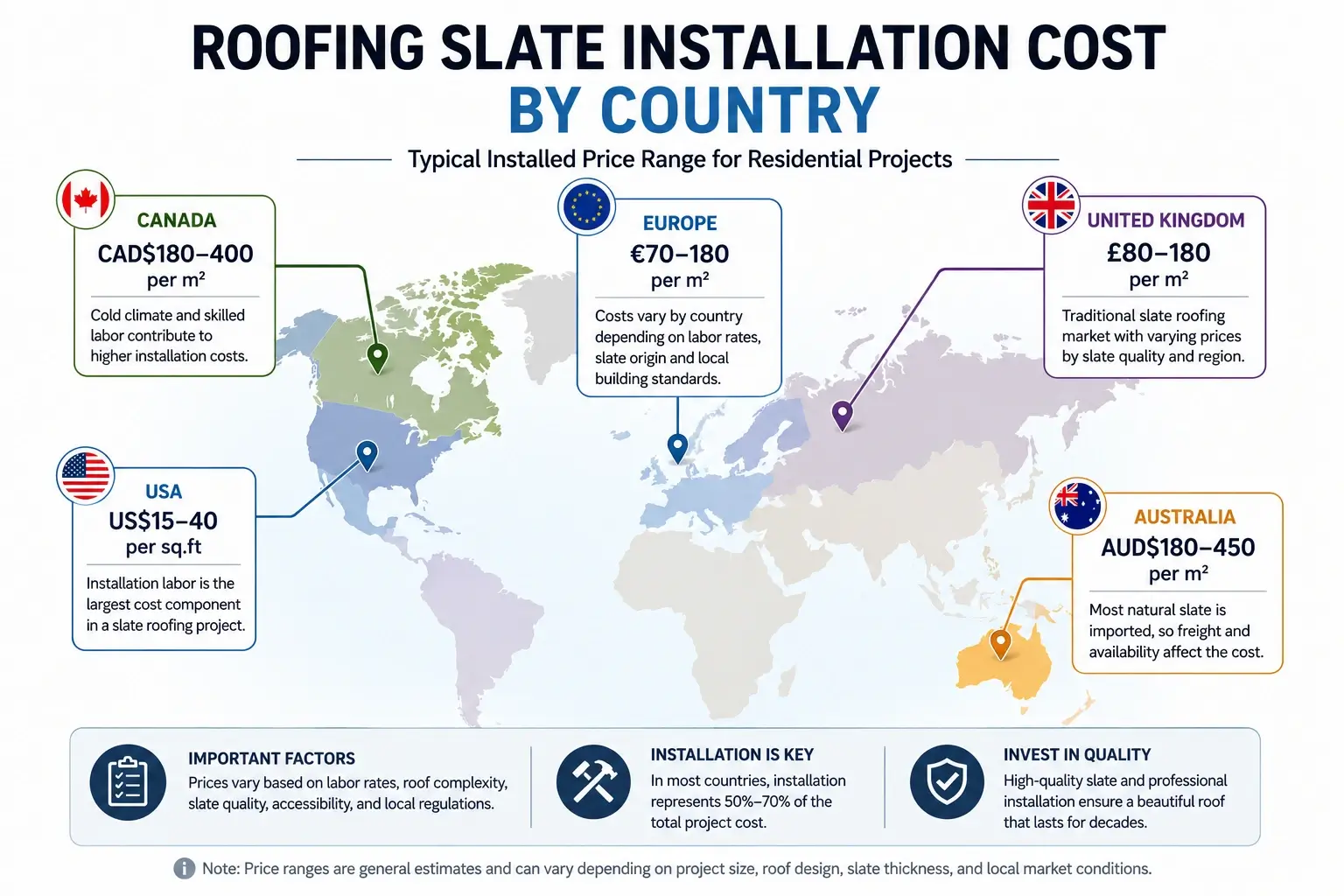
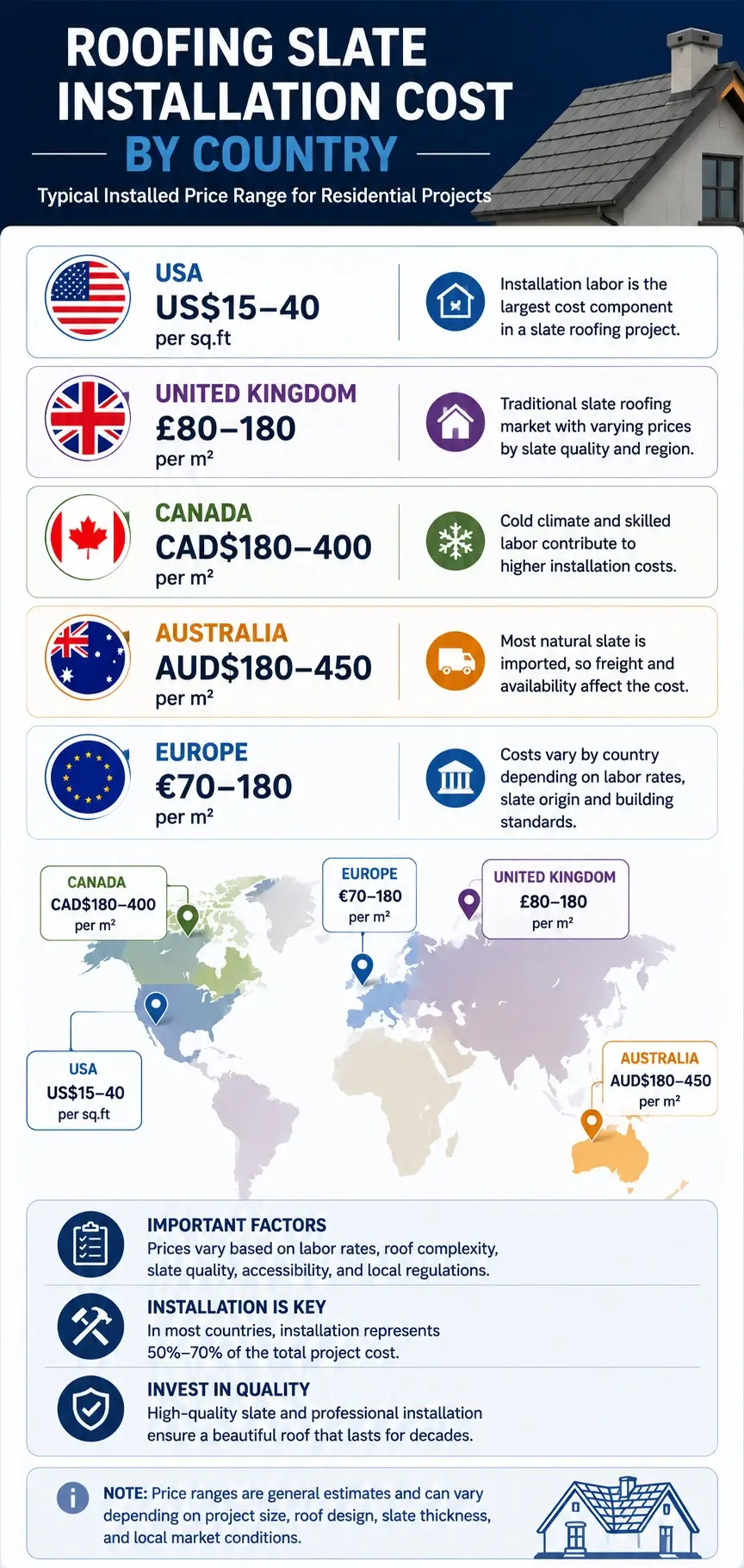
Roofing Slate Cost by Country
The cost of a natural slate roof varies considerably from country to country. While the price of roofing slate itself is an important factor, local labor rates, building regulations, transportation costs, and market demand often have an even greater impact on the total project cost.
The following figures represent typical installed price ranges for residential roofing projects and are intended as general guidance only.
| Country / Region | Typical Installed Cost |
|---|---|
| 🇺🇸 United States | US$15–40 per sq.ft |
| 🇬🇧 United Kingdom | £80–180 per m² |
| 🇨🇦 Canada | CAD$180–400 per m² |
| 🇦🇺 Australia | AUD$180–450 per m² |
| 🇪🇺 Europe | €70–180 per m² |
Note: Prices vary depending on roof size, slate quality, installation complexity, and local labor costs.
United States
Natural slate roofing is considered a premium roofing system in the United States. Although the material itself represents a significant investment, skilled installation labor usually accounts for the largest share of the total project cost.
Typical installed cost:
US$15–40 per sq.ft
Historic homes, luxury residences, and institutional buildings generally fall toward the upper end of this price range due to more complex installation requirements.
United Kingdom
The UK has one of the world’s longest traditions of slate roofing. Both imported and domestic slate are widely used for new construction and roof replacement.
Typical installed cost:
£80–180 per m²
Costs are strongly influenced by the choice between imported natural slate and premium Welsh slate, as well as regional labor rates.
Canada
Natural slate is widely specified for high-end homes, heritage buildings, and institutional projects throughout Canada. The country’s cold climate places additional emphasis on freeze-thaw durability and professional installation.
Typical installed cost:
CAD$180–400 per m²
Installation costs are generally higher than in many countries because of skilled labor requirements and seasonal construction conditions.
Australia
Slate roofing remains a popular choice for luxury homes, wineries, and architectural projects in Australia. Since most natural roofing slate is imported, freight and logistics contribute to the overall project cost.
Typical installed cost:
AUD$180–450 per m²
Material availability, transportation distance, and local installation expertise all influence final pricing.
Europe
Natural slate roofing is widely used across Europe, particularly in countries such as France, Germany, Belgium, Spain, and Ireland. Regional pricing varies according to local labor costs and the source of the roofing slate.
Typical installed cost:
€70–180 per m²
European projects commonly use Spanish slate, although slate from other producing countries is also widely available depending on the market.
Why Do Prices Differ Between Countries?
Even when using the same roofing slate, total project costs can vary significantly because of differences in:
- Local labor rates
- Building regulations
- Roofing traditions
- Transportation and import costs
- Climate requirements
- Availability of experienced slate roof installers
For example, two identical roofs using the same natural slate may have very different installed costs simply because labor and construction standards differ between countries.
Key Takeaway
The price of natural roofing slate is only one part of the total investment. In most countries, labor, installation methods, transportation, and local market conditions have a greater impact on the final cost than the slate material itself.
Natural Slate vs Other Roofing Materials
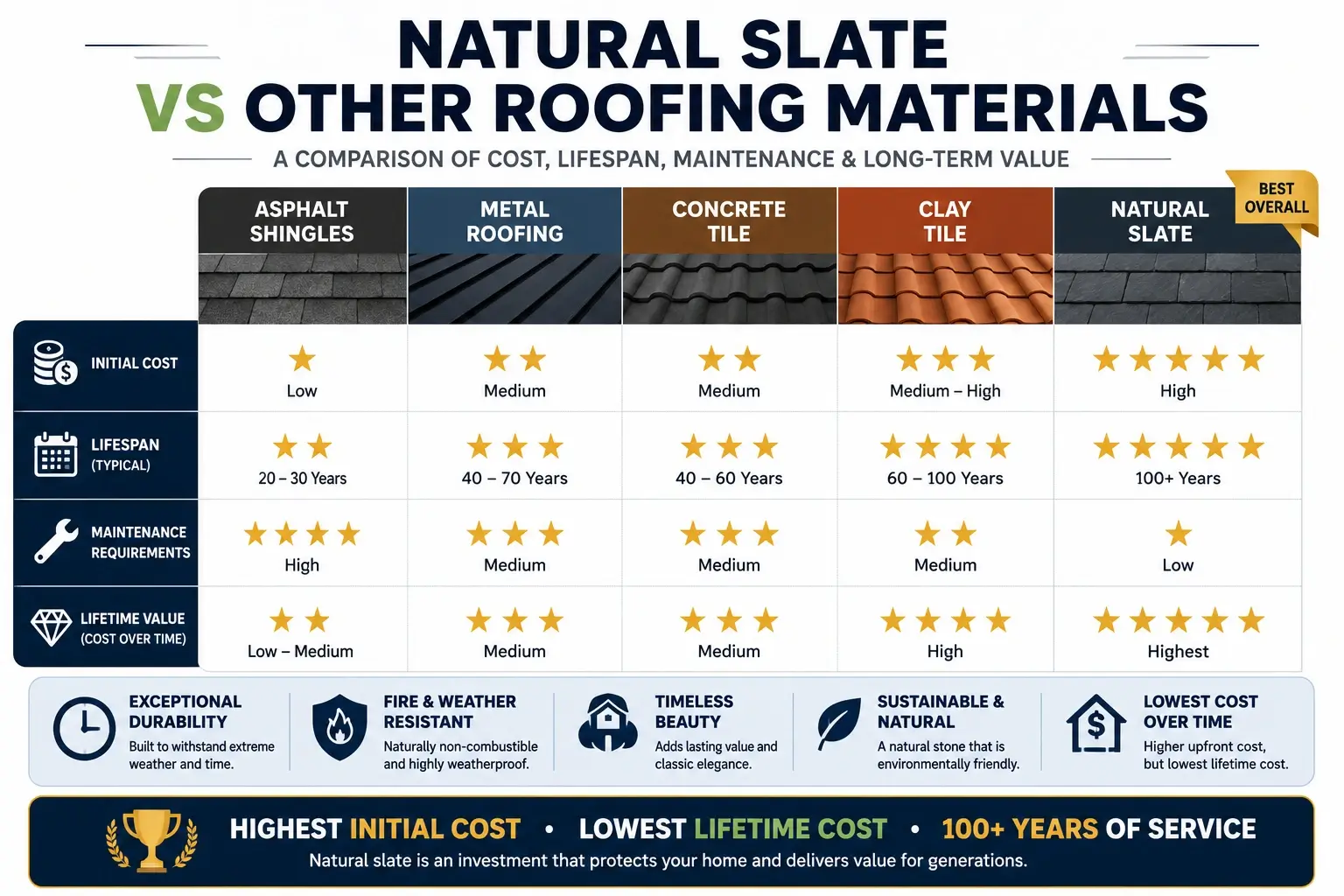
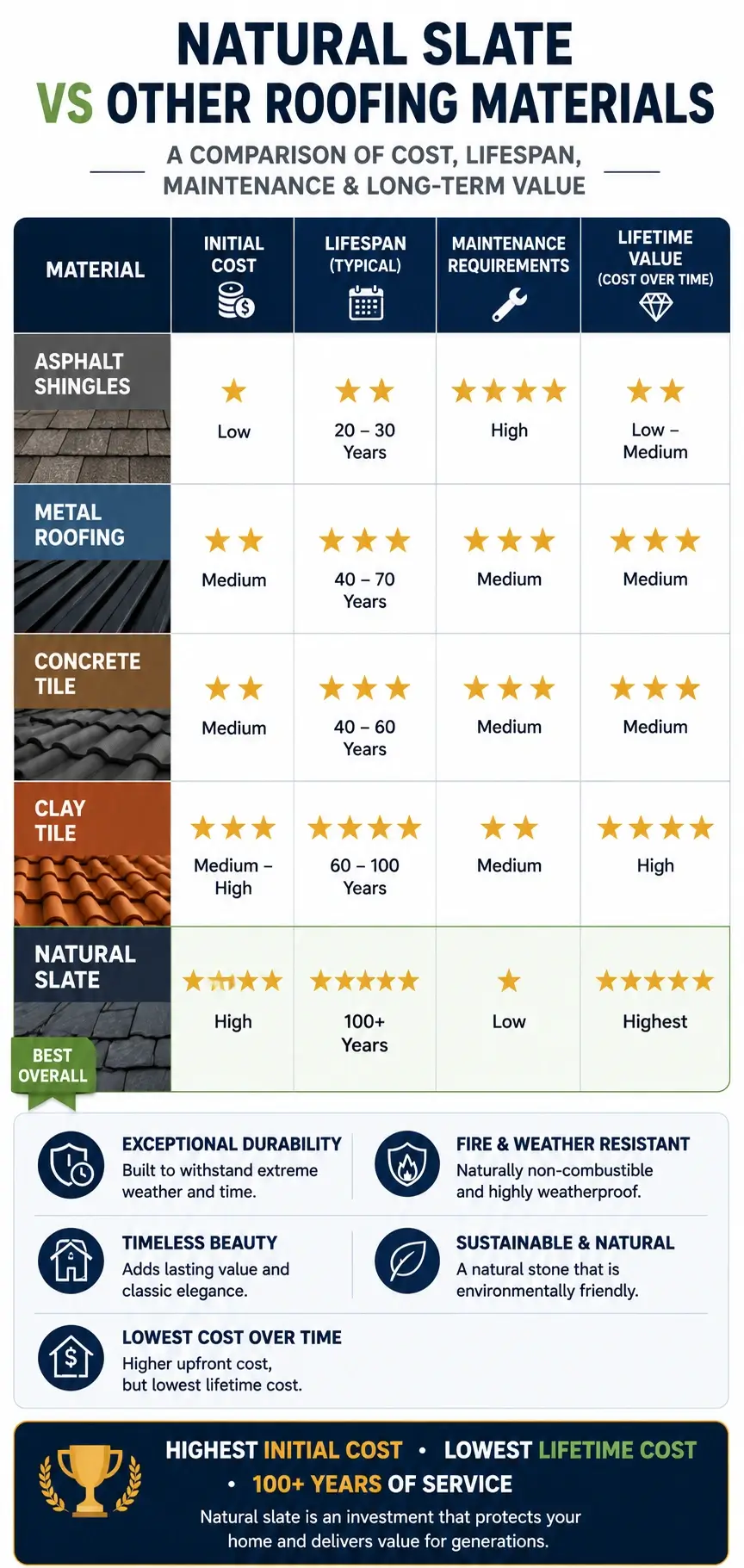
When choosing a roofing material, it’s important to look beyond the initial purchase price. A roof is a long-term investment, and factors such as durability, maintenance, replacement frequency, and overall life-cycle cost should all be considered.
Although natural roofing slate generally has a higher upfront cost than many other roofing materials, its exceptional lifespan and minimal maintenance requirements often make it the most economical choice over the long term.
Comparison of Common Roofing Materials
| Roofing Material | Initial Cost | Typical Lifespan | Maintenance |
|---|---|---|---|
| Asphalt Shingles | Low | 20–30 Years | High |
| Metal Roofing | Medium | 40–70 Years | Medium |
| Concrete Roof Tiles | Medium | 40–60 Years | Medium |
| Clay Roof Tiles | Medium–High | 60–100 Years | Medium |
| Natural Roofing Slate | High | 100+ Years | Low |
Note: Lifespan varies depending on material quality, climate, installation quality, and regular maintenance.
Asphalt Shingles
Asphalt shingles are one of the most affordable roofing materials and are widely used in North America. Their low purchase price makes them attractive for budget-conscious projects.
However, they generally require replacement after 20–30 years and may be more susceptible to wind damage, UV exposure, and temperature fluctuations. Over the lifespan of a building, multiple roof replacements are often required.
Metal Roofing
Metal roofs offer good durability, relatively low maintenance, and excellent weather resistance. They are commonly installed on residential, commercial, and agricultural buildings.
Although metal roofing generally lasts longer than asphalt shingles, it may still require repainting, fastener replacement, or repairs over several decades.
Concrete Roof Tiles
Concrete roof tiles provide a durable and cost-effective roofing solution with good fire resistance and strength.
However, they are considerably heavier than many other roofing materials and may become susceptible to surface weathering, moss growth, or cracking over time.
Clay Roof Tiles
Clay roof tiles are valued for their traditional appearance and excellent durability. They are widely used in Mediterranean, Spanish, and luxury residential architecture.
Although clay tiles can last for many decades, individual tiles may occasionally crack or require replacement, especially in regions with severe freeze-thaw cycles.
Natural Roofing Slate
Natural roofing slate is widely regarded as one of the most durable roofing materials available. Unlike manufactured roofing products, slate is a natural metamorphic stone formed over millions of years, offering exceptional resistance to weather, fire, moisture, and UV exposure.
When properly installed, a natural slate roof can last 100 years or more, with very little maintenance beyond routine inspections and occasional replacement of damaged flashings or individual slates.
Its combination of longevity, timeless appearance, and outstanding durability makes natural roofing slate a preferred choice for luxury homes, heritage buildings, churches, public buildings, and premium residential projects worldwide.
Why Natural Slate Offers the Lowest Lifetime Cost
Although natural roofing slate has the highest initial investment, it often provides the lowest life-cycle cost because it lasts significantly longer than most alternative roofing materials.
Instead of replacing the roof every few decades, homeowners and building owners can enjoy generations of reliable performance with minimal maintenance.
Over a building’s lifetime, natural slate can reduce:
- Roof replacement costs
- Maintenance expenses
- Material waste
- Long-term ownership costs
For this reason, many architects and property owners consider natural roofing slate to be an investment rather than an expense.
Key Takeaway:
Natural roofing slate may cost more initially, but its exceptional durability, low maintenance requirements, and 100+ year lifespan often make it the most cost-effective roofing material over the lifetime of a building.
Is Roofing Slate Worth the Cost?
At first glance, natural roofing slate appears to be one of the most expensive roofing materials available. However, when evaluated over the lifetime of a building, it often delivers exceptional value.
Instead of focusing solely on the initial purchase price, homeowners, architects, and builders should also consider long-term performance, maintenance costs, durability, and property value.
For many projects, natural roofing slate is not simply a roofing material—it is a long-term investment.
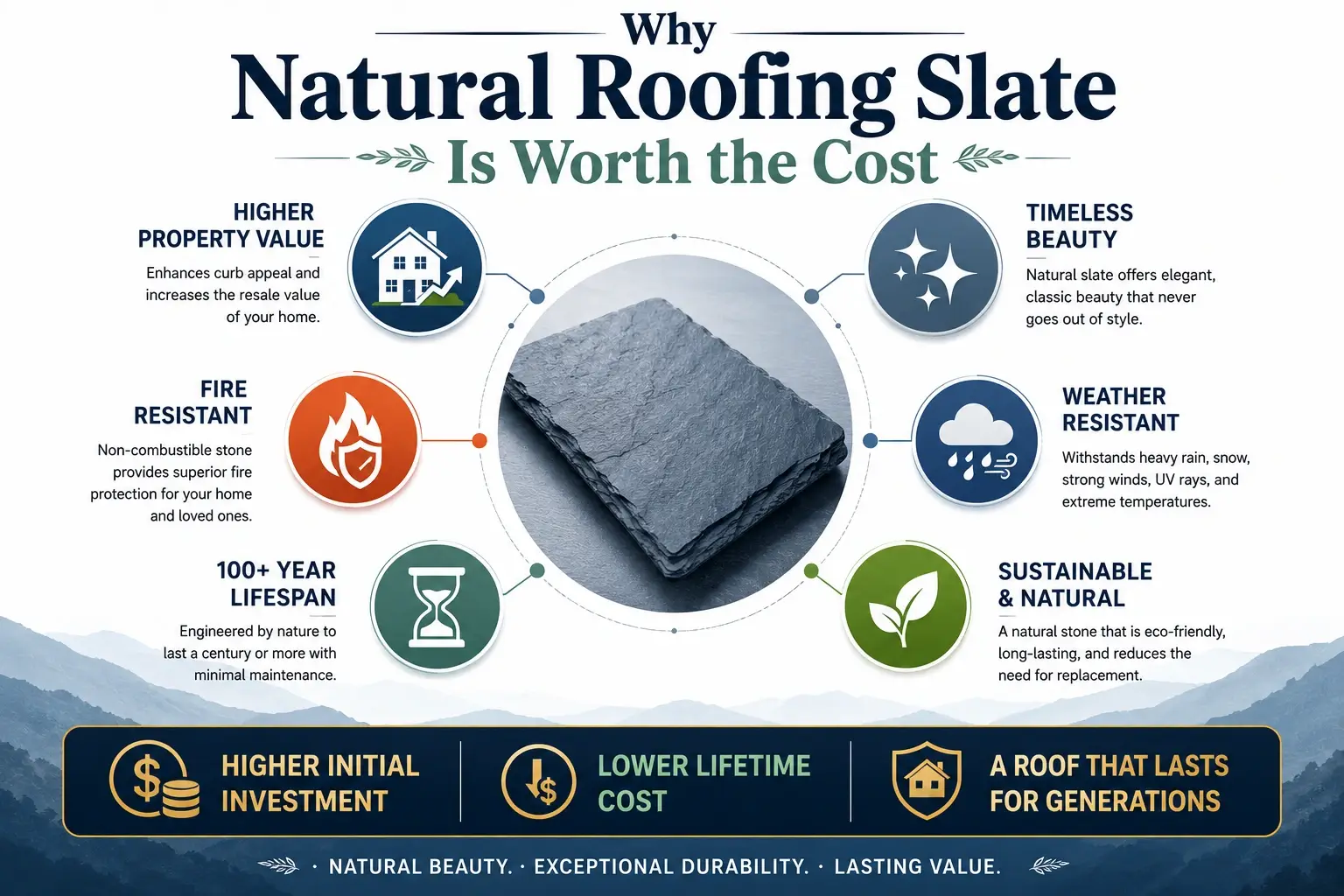
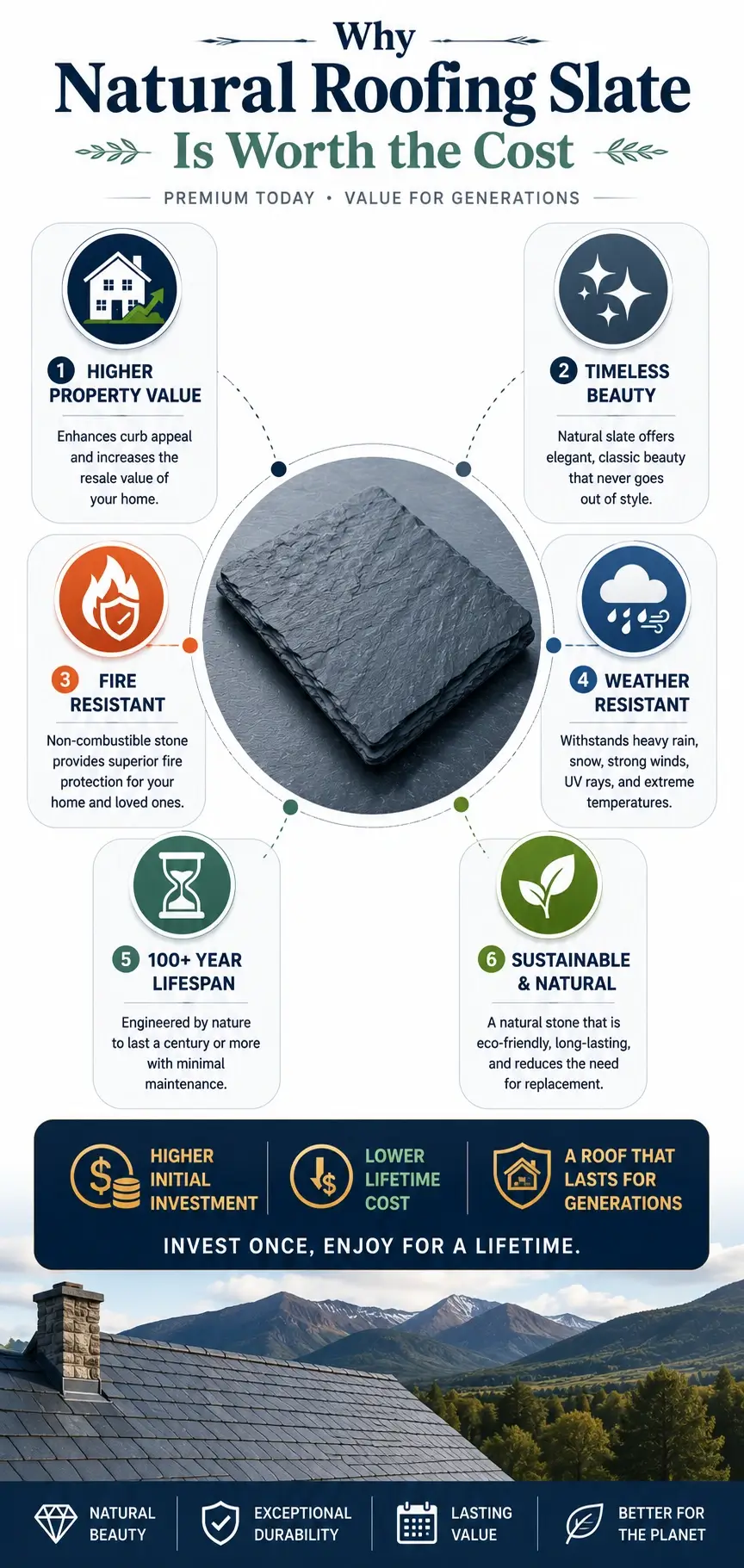
Increases Property Value
A natural slate roof enhances the appearance and prestige of a property. Its premium look, exceptional durability, and long service life are highly valued by homebuyers and can contribute to higher resale value.
For luxury homes, heritage properties, and architect-designed buildings, a slate roof is often considered a desirable feature rather than an optional upgrade.
Timeless Beauty
Unlike manufactured roofing products that may fade or deteriorate over time, natural slate retains its authentic color and texture for decades.
Its elegant appearance complements both traditional and contemporary architecture, making it one of the few roofing materials that never goes out of style.
Excellent Fire Resistance
Natural slate is a non-combustible stone with outstanding fire resistance.
Unlike wood shingles or many synthetic roofing materials, it does not burn or contribute to the spread of fire, providing an additional level of safety for residential and commercial buildings.
Outstanding Weather Resistance
Natural roofing slate performs exceptionally well in harsh weather conditions.
It resists:
- Heavy rain
- Snow and ice
- Strong winds
- UV exposure
- Freeze-thaw cycles
With proper installation, a slate roof can maintain its structural integrity and appearance in a wide range of climates for many decades.
Exceptional Longevity
One of the greatest advantages of natural roofing slate is its lifespan.
While many roofing materials require replacement after a few decades, a high-quality slate roof can last 100 years or more with minimal maintenance.
For many homeowners, this means the roof may only need to be installed once during the lifetime of the building.
A Sustainable Roofing Choice
Natural slate is one of the most environmentally responsible roofing materials available.
As a naturally occurring stone, it requires minimal processing and contains no synthetic chemicals. Its exceptionally long service life also reduces the need for replacement, helping to conserve resources and minimize construction waste over time.
For environmentally conscious projects, natural slate supports both durability and sustainability.
Why Many Buyers Choose Natural Slate
Although the initial investment is higher, natural roofing slate offers benefits that many alternative roofing materials cannot match:
- Premium architectural appearance
- Increased property value
- Outstanding fire resistance
- Excellent weather performance
- 100+ year service life
- Minimal maintenance
- Sustainable and environmentally friendly
These advantages often outweigh the higher upfront cost, particularly for homeowners and developers planning for the long term.
Key Takeaway
Natural roofing slate is an investment rather than an expense.
While it requires a higher initial investment, its exceptional durability, timeless beauty, low maintenance requirements, and century-long lifespan make it one of the most cost-effective roofing materials over the lifetime of a building.
How to Save Money on a Slate Roof
A natural slate roof is a long-term investment, but that doesn’t mean you have to overspend. By making informed decisions during material selection, project planning, and installation, you can significantly reduce overall costs without compromising quality or durability.
Here are some practical ways to maximize the value of your roofing investment.
Choose the Right Slate Size
Selecting an appropriate slate size can have a noticeable impact on both material and installation costs.
Larger slates cover more roof area with fewer pieces, reducing installation time and labor. Smaller slates may be ideal for traditional or decorative roofs, but they generally require more fixing points and more installation work.
Choosing the right size for your project helps balance appearance, performance, and budget.
Select a Standard Slate Thickness
Thicker slate is generally more expensive and heavier to transport.
For most residential projects, standard thicknesses provide excellent durability while keeping material and shipping costs under control. Unless required by local regulations or architectural specifications, selecting an appropriate standard thickness is often the most economical option.
Minimize Material Waste
Careful roof planning can reduce unnecessary cutting and waste.
Simple roof layouts, efficient slate planning, and accurate quantity calculations help lower material consumption and reduce overall project costs.
Working with experienced roofing professionals can also improve material utilization.
Buy Directly from the Manufacturer
Purchasing roofing slate directly from the manufacturer eliminates unnecessary distribution costs and gives buyers greater control over product quality, specifications, and delivery schedules.
For contractors, importers, wholesalers, and large construction projects, factory-direct sourcing can provide substantial savings while ensuring consistent product quality.
Order Full Container Quantities
If your project requires a large volume of roofing slate, ordering a full container is usually more economical than purchasing smaller shipments.
Full-container orders typically offer:
- Lower unit prices
- Better shipping efficiency
- Reduced logistics costs
- More consistent production batches
This approach is particularly beneficial for distributors, developers, and commercial roofing projects.
Choose Experienced Slate Roof Installers
Even the highest-quality roofing slate can perform poorly if installed incorrectly.
Experienced installers work more efficiently, minimize breakage, reduce material waste, and ensure the roof performs as intended for decades. Investing in skilled installation often saves money by avoiding costly repairs in the future.
Use High-Quality Roofing Accessories
Roofing accessories such as stainless steel or copper fasteners, quality underlayment, battens, flashing, and ventilation systems represent a relatively small portion of the total budget, yet they play a critical role in the roof’s long-term performance.
Choosing durable accessories helps prevent premature failures and reduces future maintenance costs.
Maintain Your Roof Regularly
Natural roofing slate requires very little maintenance, but periodic inspections are still recommended.
Checking flashings, gutters, roof valleys, and individual slates can help identify minor issues before they become expensive repairs. Regular maintenance extends the service life of the entire roofing system and protects your investment.
Factory-Direct Purchasing Can Reduce Material Costs
For large residential developments, commercial buildings, roofing distributors, and importers, sourcing directly from a professional roofing slate manufacturer can significantly reduce overall material costs.
At Slate of China, we supply premium Jiujiang Roofing Slate directly from our manufacturing facilities, offering:
- Competitive factory pricing
- Stable production capacity
- Consistent quality
- Flexible sizes and thicknesses
- Reliable worldwide export experience
Buying directly from the manufacturer not only reduces procurement costs but also provides better control over product specifications, delivery schedules, and long-term supply.
Key Takeaway
Saving money on a slate roof isn’t about choosing the cheapest material—it’s about making smarter decisions. Selecting the right slate, optimizing the roof design, working with experienced installers, and sourcing directly from a trusted manufacturer can significantly reduce costs while preserving the beauty, durability, and long-term value of a natural slate roof.
Roofing Slate Cost-Saving Checklist
| ✓ | Recommendation |
|---|---|
| ✓ | Choose the right slate size |
| ✓ | Select a standard slate thickness |
| ✓ | Minimize material waste |
| ✓ | Buy directly from the manufacturer |
| ✓ | Order full-container quantities when possible |
| ✓ | Hire experienced slate roof installers |
| ✓ | Use high-quality roofing accessories |
| ✓ | Perform regular roof inspections and maintenance |
Why Jiujiang Roofing Slate Offers Excellent Value
Among the world’s major roofing slate sources, Jiujiang Roofing Slate has earned a strong reputation for delivering an excellent balance of quality, durability, and affordability.
Located in Jiangxi Province, China, the Jiujiang region has abundant natural slate resources and decades of experience in quarrying, processing, and exporting roofing slate to international markets.
Rather than competing as the lowest-priced product, Jiujiang roofing slate is widely recognized for offering consistent quality at a competitive price, making it a practical choice for residential, commercial, and distribution projects.
Rich Natural Slate Resources
Jiujiang is one of China’s most important natural slate-producing regions, with extensive quarry resources that support stable long-term production.
The availability of high-quality raw material helps ensure consistent supply for projects of all sizes, from individual homes to large commercial developments.
Stable Natural Color
Jiujiang roofing slate is well known for its attractive blue-grey color, one of the most popular choices for natural slate roofing worldwide.
Its natural appearance complements both traditional and contemporary architecture while maintaining excellent color consistency across production batches.
Excellent Splitting Properties
High-quality roofing slate should split cleanly into uniform thicknesses without compromising strength.
Jiujiang slate possesses excellent natural cleavage, allowing precise processing into a wide range of roofing sizes and thicknesses while maintaining smooth surfaces and attractive natural edges.
This also contributes to improved installation efficiency and a refined finished appearance.
Low Water Absorption
Water absorption is one of the most important indicators of roofing slate performance.
Jiujiang roofing slate features low water absorption, helping it resist moisture penetration, freeze-thaw damage, and long-term weathering in a variety of climates.
These characteristics contribute to reliable long-term roof performance.
Competitive Factory Pricing
As one of China’s established roofing slate manufacturing regions, Jiujiang benefits from efficient production, large manufacturing capacity, and mature export logistics.
These advantages enable buyers to obtain high-quality natural roofing slate at competitive factory prices without compromising performance.
Consistent Quality
Reliable quality is essential for professional roofing projects.
Through controlled quarry selection, standardized production processes, and quality inspection, Jiujiang roofing slate is manufactured with consistent dimensions, thickness tolerance, and surface finish, helping contractors achieve efficient installation and dependable project results.
OEM and Custom Manufacturing
To meet different market requirements, Jiujiang roofing slate is available in a wide range of:
- Sizes
- Thicknesses
- Edge finishes
- Hole configurations
- Surface treatments
- Packaging options
OEM production and private-label packaging are also available for distributors, importers, and building material brands.
Trusted by International Customers
Today, Jiujiang roofing slate is supplied to customers across Europe, North America, Australia, and many other international markets for residential, commercial, and heritage roofing projects.
Its combination of reliable quality, competitive pricing, and dependable export service has made it a preferred choice for many roofing professionals and building material distributors worldwide.
(If you can verify the exact figure, you may replace this paragraph with: “Jiujiang roofing slate has been exported to customers in more than XX countries worldwide.”)
Key Takeaway
For many roofing projects, Jiujiang roofing slate offers one of the best balances between quality, durability, and cost. Its stable color, low water absorption, excellent splitting characteristics, consistent manufacturing quality, and competitive factory pricing make it an outstanding choice for homeowners, contractors, distributors, and importers seeking long-term value.
Why Buy from Slate of China?
- ✔ Direct factory supply from Jiujiang, China
- ✔ Consistent blue-grey natural roofing slate
- ✔ OEM & private label service
- ✔ Flexible sizes and thicknesses
- ✔ Competitive factory pricing
- ✔ Professional export packaging
- ✔ Worldwide shipping support
- ✔ Fast quotation and technical assistance
Looking for a reliable roofing slate supplier? Contact the Slate of China team to discuss your project requirements, request samples, or receive a competitive factory quotation.
Frequently Asked Questions
Request a Free Roofing Slate Quote
Planning a roofing project or sourcing natural roofing slate for your business?
At Slate of China, we supply premium Jiujiang Roofing Slate directly from the manufacturing region in Jiangxi, China. With consistent quality, competitive factory pricing, and professional export experience, we help customers worldwide find the most cost-effective roofing slate solution for their projects.
Whether you’re a:
- Roofing material distributor
- Building materials importer
- Roofing contractor
- Architect or designer
- Builder or property developer
- Homeowner planning a new roof
our experienced team is ready to assist you with product recommendations, technical support, and a competitive quotation tailored to your requirements.
What to Include in Your Inquiry
To help us prepare an accurate quotation, please include as much of the following information as possible:
- Project location (country or destination port)
- Estimated roof area or quantity required
- Preferred slate size
- Slate thickness
- Slate color
- Edge finish (natural, dressed, etc.)
- Hole configuration (if applicable)
- Estimated order quantity
- Expected delivery schedule
If you’re unsure about the specifications, simply tell us about your project. We’ll recommend the most suitable roofing slate based on your budget, local climate, and installation requirements.
Why Request a Quote from Slate of China?
- ✔ Direct factory supply from Jiujiang, China
- ✔ Premium natural blue-grey roofing slate
- ✔ Competitive factory pricing
- ✔ Consistent product quality
- ✔ OEM & private label service available
- ✔ Flexible sizes and thicknesses
- ✔ Professional export packaging
- ✔ Worldwide shipping support
- ✔ Fast quotation and technical assistance
Get Started Today
Whether you need roofing slate for a private residence, a commercial building, or a large distribution project, we’re here to help.
Request your free, no-obligation quotation today and discover how premium Jiujiang Roofing Slate can deliver outstanding quality, long-term durability, and excellent value for your next roofing project.
The prices shown in this guide are intended as general estimates only.
Actual roofing slate costs may vary depending on project size, slate specification, installation method, transportation, and local labor rates.
For an accurate quotation, please contact our technical team with your project details.
Last Updated
July 2026
Written by
Slate of China Technical Team
30+ Years of Natural Slate Manufacturing & Export Experience