
Roofing Slate Lifespan Guide: How Long Does a Natural Slate Roof Last?
A practical guide to slate roof durability, service life, maintenance, and long-term value for residential, commercial, and heritage roofing projects.
Natural roofing slate is widely valued as one of the longest-lasting roofing materials available. A well-selected and properly installed slate roof can commonly last 60–125 years or even longer, depending on the quality of the slate, roof design, installation method, climate conditions, and regular maintenance.
For many high-quality natural slate roofs, especially those used on historic buildings and premium architectural projects, the service life can extend well beyond a century. This guide explains what affects roofing slate lifespan, how to extend the life of a slate roof, and why Jiujiang natural roofing slate is a durable and cost-effective choice for long-term roofing projects.
Table of Contents
1. Introduction: Why Lifespan Matters in Roofing Slate Selection
When choosing roofing slate, lifespan is one of the most important factors for homeowners, architects, contractors, and importers. A roof is not a product that can be replaced easily. Once installed, it becomes a long-term part of the building structure, affecting protection, appearance, maintenance cost, and property value for decades.
Roof replacement can be expensive. Labor costs are often high, installation requires skilled work, and poor roofing performance may lead to leaks, structural damage, interior repairs, and unnecessary maintenance. This is why many buyers do not look only at the initial material price. They also consider how long the roof will last and how stable its performance will be over time.
Natural roofing slate is not a short-term roofing material. It is selected for long service life, natural beauty, weather resistance, and low life-cycle cost. A natural slate roof is often chosen not because it is the cheapest roofing option at the beginning, but because it can serve the building for generations when the right slate is selected and properly installed.
However, slate roof lifespan does not depend on the stone alone. The durability of a slate roof is also affected by slate quality, thickness, roof pitch, fixing method, underlayment, flashing details, local climate, and regular maintenance. Understanding these factors helps buyers choose suitable roofing slate and avoid costly roof problems in the future.
For residential homes, commercial buildings, and heritage restoration projects, natural slate roof durability is a key reason why slate remains one of the most respected premium roofing materials in the world.
In the following sections, we will explain how long slate roofing lasts, what affects roofing slate lifespan, and how to choose durable natural slate for long-term roofing projects.
2. How Long Does a Natural Slate Roof Last?
Quick Answer
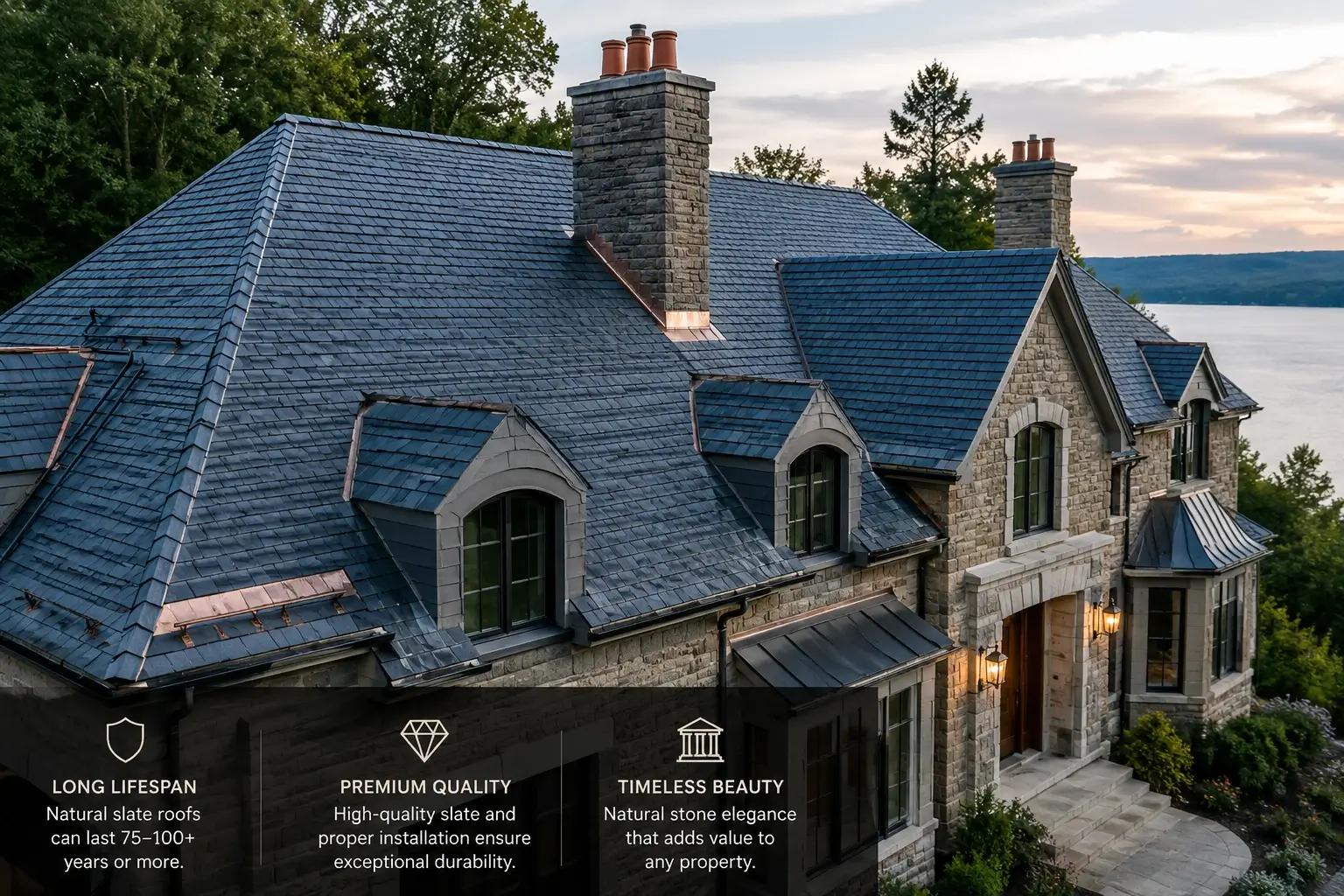
A high-quality natural slate roof can usually last 75–100 years or more, and in suitable conditions it may last well over a century. In many projects, a well-selected and properly installed natural slate roof can last 75–100+ years, making it one of the longest-lasting roofing materials available.
However, the actual slate roof lifespan depends on several important factors, including the quality of the slate, thickness, roof pitch, installation method, fixing materials, local climate, and regular maintenance. Not every slate roof will last the same length of time. A premium slate roof installed by skilled roofers may perform for generations, while poor-quality slate or incorrect installation can significantly reduce the service life.
In general, natural roofing slate has the following typical lifespan ranges:
| Slate Roof Type | Typical Lifespan |
|---|---|
| Lower-quality or poorly installed slate roof | 40–60 years |
| Standard natural slate roof | 60–100 years |
| High-quality natural slate roof | 100+ years |
| Premium slate with excellent installation and maintenance | 120–150+ years possible |
This is why buyers should not judge roofing slate only by price. The initial cost is important, but the long-term performance is often more important. A durable natural slate roof can reduce future replacement costs, lower long-term maintenance pressure, and protect the building for decades.
For homeowners, contractors, architects, and importers, the key question is not only “how long does slate roofing last?” but also “what type of slate should be selected for a long-lasting roof?” Choosing the right slate quality, size, thickness, and fixing system is essential for achieving a long roof service life.
Jiujiang natural roofing slate can be supplied in different sizes and thicknesses for residential, commercial, and heritage roofing projects. When properly selected and installed, it offers international buyers a durable, natural, and cost-effective roofing solution for long-term use.3. What Makes Slate Roofing Last So Long?
Natural roofing slate lasts so long because it is a real stone roofing material formed by nature over a very long geological process. Unlike many manufactured roofing products, slate has a dense structure, natural strength, and excellent resistance to weather exposure. These material characteristics help a slate roof maintain stable performance for decades.
One of the key reasons for the long roofing slate lifespan is the compact structure of natural slate. Good-quality slate has low water absorption, which helps reduce damage caused by rain, moisture, frost, and repeated freeze-thaw cycles. This is especially important in climates with heavy rainfall, snow, or seasonal temperature changes.
Natural slate is also resistant to fire, ultraviolet light, and normal weathering. It does not easily fade under sunlight, and its natural color and texture can remain attractive for many years. This combination of durability and beauty is why slate roofing is widely used for high-end homes, traditional buildings, commercial projects, and heritage roof restoration.
Jiujiang roofing slate is valued for its natural stone texture, workable splitting quality, stable supply, and cost-effective export advantage. Formed from natural stone with a compact structure, Jiujiang slate can be split into thin but strong roofing tiles suitable for different roof designs. Depending on quarry selection, it can offer natural grey, black, and greenish tones, giving architects and roofing contractors more design flexibility.
For international buyers, Jiujiang natural roofing slate offers a practical balance between natural appearance, durability, and competitive export pricing. It is suitable for traditional roofing, heritage-style buildings, modern residential projects, villas, hotels, and commercial roofing applications where long service life and natural stone aesthetics are required.
However, even durable natural slate must be selected and installed correctly. The final slate roof durability depends not only on the slate material itself, but also on proper thickness, roof pitch, headlap, fixing method, flashing details, and maintenance. When the right slate is used with professional installation, a natural slate roof can provide reliable protection and long-term value for generations.
4. Main Factors That Affect Roofing Slate Lifespan
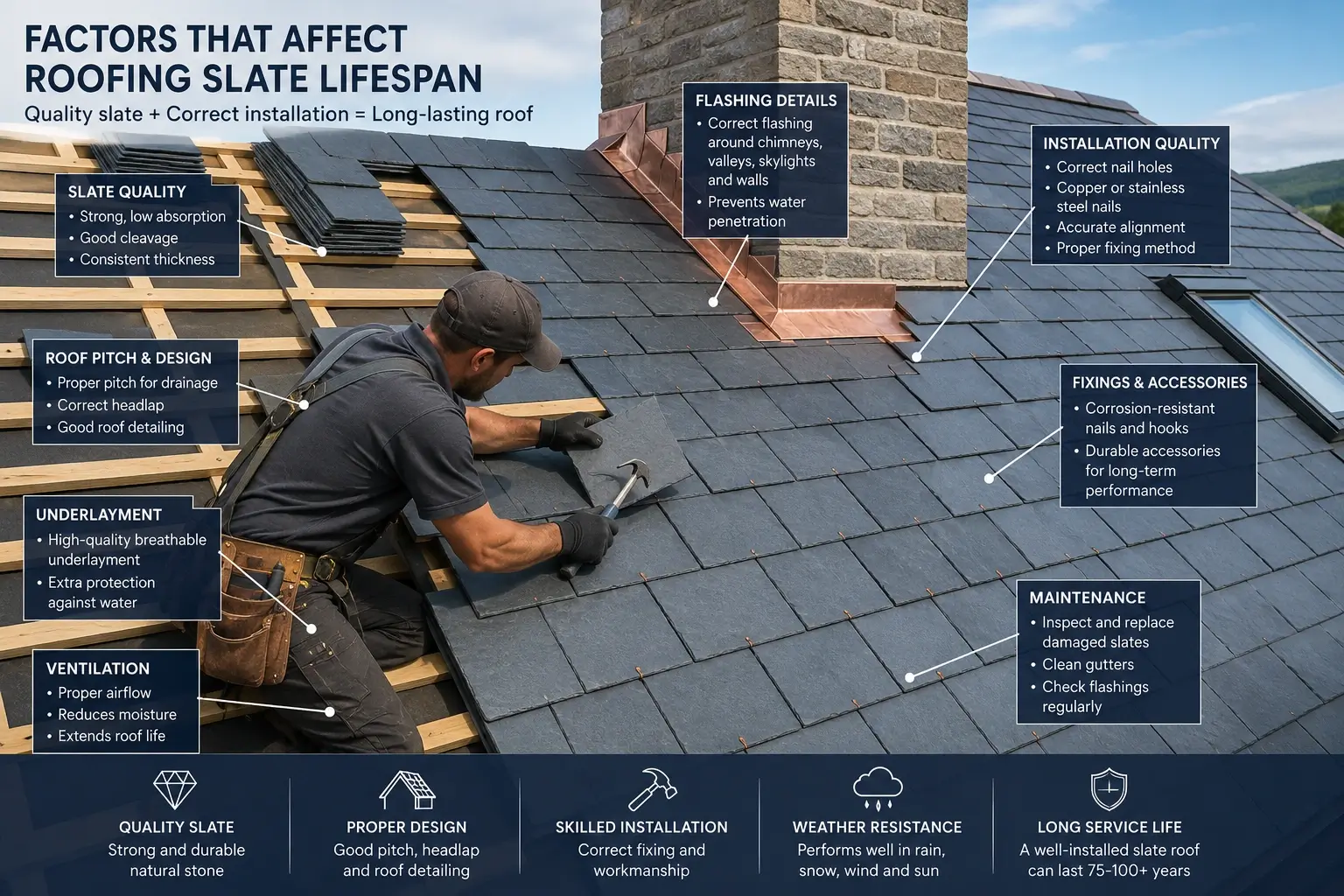
The lifespan of a natural slate roof is not determined by one single factor. A high-quality roofing slate may have excellent durability, but the final roof performance also depends on roof design, installation quality, local climate, fixing materials, and long-term maintenance.
This is why two slate roofs made from natural stone can have very different service lives. One roof may last for more than 100 years, while another may need major repairs much earlier because of poor slate selection, incorrect installation, unsuitable roof pitch, or failed flashing details.
Understanding the main factors that affect roofing slate lifespan helps homeowners, contractors, architects, and importers choose the right slate for long-term roofing projects.
4.1 Slate Quality and Geological Origin
Slate quality is the foundation of slate roof lifespan. Before considering size, thickness, or installation method, buyers should first understand where the slate comes from and whether the stone itself is suitable for long-term roofing use.
Natural roofing slate is formed through geological pressure over a long period of time. Its mineral composition, density, cleavage quality, strength, water absorption, and weathering resistance all influence how long the slate can perform on a roof. A dense, strong, low-absorption slate with clean splitting characteristics is generally more suitable for durable roofing applications.
Important quality factors include:
- Mineral composition
- Density and compact structure
- Cleavage quality
- Water absorption rate
- Flexural strength
- Resistance to weathering
- Freeze-thaw performance
- Consistency between production batches
This is why quarry selection matters. Different quarries can produce slate with different colors, textures, strengths, and weathering behavior. Even within the same region, careful material selection and quality control are important for stable roofing performance.
For international buyers, choosing a reliable roofing slate supplier is not only about price. It is also about consistent quarry source, stable production, quality inspection, accurate sizing, and export experience. These factors help ensure that the slate supplied for one project performs consistently across the entire roof.
4.2 Thickness and Size
Slate thickness and size also affect natural slate roof durability. However, thicker slate is not always automatically better. The correct thickness should be selected according to roof pitch, slate size, fixing method, wind exposure, local climate, and building structure.
For many roofing projects, the goal is not simply to choose the thickest slate, but to choose the most suitable slate. If the slate is too thin for the project conditions, it may be more vulnerable to breakage. If it is unnecessarily thick, it may increase roof weight and installation cost.
Slate size is also important. Larger slates may provide a different visual effect and can sometimes reduce the number of pieces installed per square meter, but they must be suitable for the roof pitch, headlap, wind load, and fixing system. Smaller slates may be more flexible for complex roof shapes, dormers, valleys, and heritage restoration work.
A good roofing slate specification should consider:
- Slate thickness
- Slate length and width
- Roof pitch
- Headlap requirement
- Wind exposure
- Roof structure load capacity
- Local building practice
- Visual appearance required by the project
For better long-term performance, buyers should select slate thickness and size together, not separately. A properly matched slate size and thickness can improve installation quality, roof stability, water shedding, and overall slate roof life expectancy.
For more details, see our related guides: Roofing Slate Thickness Guide and Roofing Slate Sizes Guide.
4.3 Roof Pitch and Roof Design
Roof pitch has a direct influence on roofing slate lifespan because it affects how quickly rainwater, snow, and debris move off the roof. In general, a steeper roof pitch improves drainage and helps reduce the time that water stays on the slate surface.
When the roof pitch is too low, water drains more slowly. This may increase the risk of water penetration, moss growth, frost damage, and long-term moisture problems, especially in cold or wet climates. Low-pitch slate roofs require more careful design, including suitable slate size, correct headlap, reliable underlayment, and proper installation details.
Roof design details are also very important. Valleys, hips, ridges, chimneys, skylights, dormers, roof windows, and other penetrations must be designed and installed correctly. Many roof leaks happen not because the slate itself has failed, but because water enters through weak details around flashings, joints, or roof intersections.
Key roof design factors include:
- Roof pitch
- Headlap design
- Valley and hip details
- Ridge details
- Chimney and skylight flashings
- Roof ventilation
- Drainage path
- Gutter system
- Complexity of the roof shape
A simple, well-designed slate roof with good drainage can often last longer and require less maintenance than a complicated roof with poor detailing. For long service life, roofing slate should always be matched with suitable roof design.
4.4 Installation Quality
Installation quality is one of the most important factors affecting slate roof lifespan. Many slate roof problems are not caused by the slate itself, but by incorrect installation.
Natural slate roofing requires skilled workmanship. Each slate must be fixed correctly, aligned properly, and installed with the right headlap. Nail holes should be positioned correctly, and the fixing system should allow the slate to perform under wind, rain, temperature change, and building movement.
Important installation details include:
- Correct headlap
- Proper nail hole position
- Accurate slate alignment
- Suitable fixing method
- Copper or stainless steel nails
- Quality underlayment
- Proper roof ventilation
- Correct flashing details
- Careful installation around valleys, ridges, hips, and chimneys
Using the wrong nails or poor fixing materials can shorten the life of the roof. For example, if nails corrode before the slate reaches the end of its life, slates may slip even though the stone is still in good condition. This is why corrosion-resistant nails, hooks, and flashing materials are important for long-lasting slate roofs.
Proper installation also helps reduce breakage, water penetration, wind uplift, and future repair costs. A natural slate roof is a premium roofing system, and it should be installed by roofers who understand slate roofing techniques.
For buyers and contractors, the message is clear: good slate needs good installation. A high-quality slate installed poorly will not deliver its full lifespan, while a suitable slate installed correctly can provide decades of reliable performance.
4.5 Climate and Weather Exposure
Local climate plays a major role in natural slate roof lifespan. Slate is a durable natural stone, but the complete roofing system must be suitable for the weather conditions in the project location.
Different markets have different concerns:
UK and Northern Europe:
Rain, freeze-thaw cycles, moss growth, and long wet seasons are common considerations. Good slate quality, proper headlap, reliable drainage, and regular gutter maintenance are important.
North America:
Snow load, freeze-thaw conditions, strong wind, hail, and temperature changes can affect roof performance. Slate thickness, fixing method, roof pitch, and structural support should be carefully considered.
Southeast Asia:
Heavy rain, high humidity, strong sunlight, and heat exposure are important factors. Good ventilation, drainage, and corrosion-resistant fixing materials are necessary for long-term performance.
Coastal Areas:
Salt air can accelerate corrosion of metal fixings, flashings, and accessories. In coastal environments, stainless steel, copper, or other suitable corrosion-resistant materials should be considered.
It is important to understand that slate itself may be very durable, but the overall roof lifespan also depends on the supporting system. Fixings, battens, underlayment, timber structure, flashings, and drainage components must also perform well. If these parts fail early, the roof may need repair even when the slate tiles are still sound.
For long-term roofing projects, buyers should choose roofing slate and accessories according to the local climate, not only according to appearance or price.
4.6 Maintenance
A natural slate roof is low-maintenance, but it is not maintenance-free. Regular inspection and simple maintenance can help extend slate roof lifespan and prevent small problems from becoming expensive repairs.
Unlike some short-life roofing materials, slate does not usually require frequent replacement when it is properly installed. However, individual slates may break because of impact, foot traffic, storm damage, or movement in the roof structure. These damaged slates should be replaced early to prevent water entering the roof.
Recommended maintenance includes:
- Inspect broken, cracked, or slipped slates
- Clean gutters and drainage channels
- Check flashings around chimneys, valleys, ridges, and roof windows
- Remove leaves, branches, and debris
- Remove heavy moss carefully when necessary
- Avoid walking directly on the slate roof
- Replace damaged slates individually
- Inspect the roof after severe storms
- Check attic or roof space for signs of moisture
One of the advantages of natural slate roofing is that damaged pieces can often be replaced individually. This helps preserve the roof and reduce unnecessary replacement costs.
Maintenance should be done carefully. Walking on slate incorrectly can crack tiles. Harsh cleaning methods, pressure washing, or aggressive moss removal can damage the roof surface or disturb the installation. For older slate roofs, inspection and repair should be carried out by experienced roofing professionals.
With proper maintenance, a good natural slate roof can continue to protect a building for many decades. This long service life is one reason why slate remains a preferred roofing material for premium homes, commercial buildings, churches, schools, and heritage restoration projects.
| Factor | Why It Matters for Slate Roof Lifespan |
|---|---|
| Slate quality | Determines the basic durability of the roofing material. |
| Thickness and size | Affects strength, weight, fixing, and suitability for roof design. |
| Roof pitch | Influences drainage and water exposure. |
| Installation quality | Prevents leaks, slipping slates, and premature roof failure. |
| Climate | Affects freeze-thaw, wind, rain, humidity, and corrosion risk. |
| Maintenance | Helps detect small problems before they become costly repairs. |
Related Roofing Slate Guides
To choose the right natural slate for a long-lasting roof, buyers should also consider slate thickness, size, weight, installation method, and total project cost. You may find these related guides helpful:
- Learn how to choose the correct roofing slate thickness for different roof pitches, climates, and project requirements.
- Compare common roofing slate sizes and understand how slate dimensions affect appearance, headlap, coverage, and installation.
- Read our slate roof installation guide to understand fixing methods, headlap, nail selection, underlayment, flashing, and roof detailing.
- Check the roofing slate weight guide to calculate roof load, structural requirements, and shipping considerations.
- Review the roofing slate cost guide to compare initial price, installation cost, maintenance, and long-term life-cycle value.
5. Roofing Slate Lifespan Compared with Other Roofing Materials
When buyers compare roofing materials, the first question is often about price. However, the real value of a roof should be measured not only by the initial material cost, but also by its service life, maintenance needs, replacement frequency, and long-term performance.
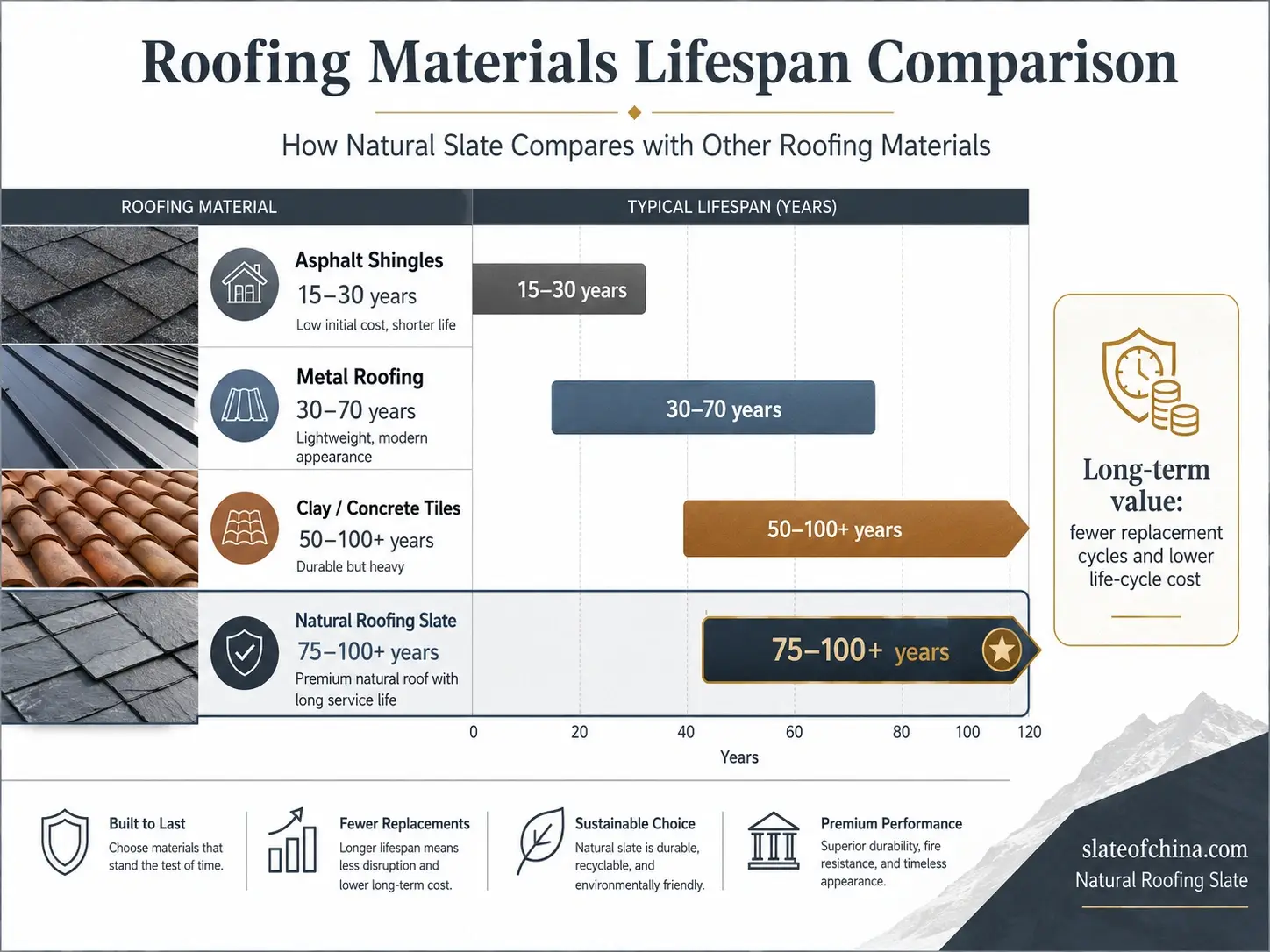
Natural roofing slate is usually more expensive at the beginning than many short-life roofing materials. But because a high-quality slate roof can last 75–100 years or more, it may reduce the need for future roof replacement and provide better long-term value over the life of the building.
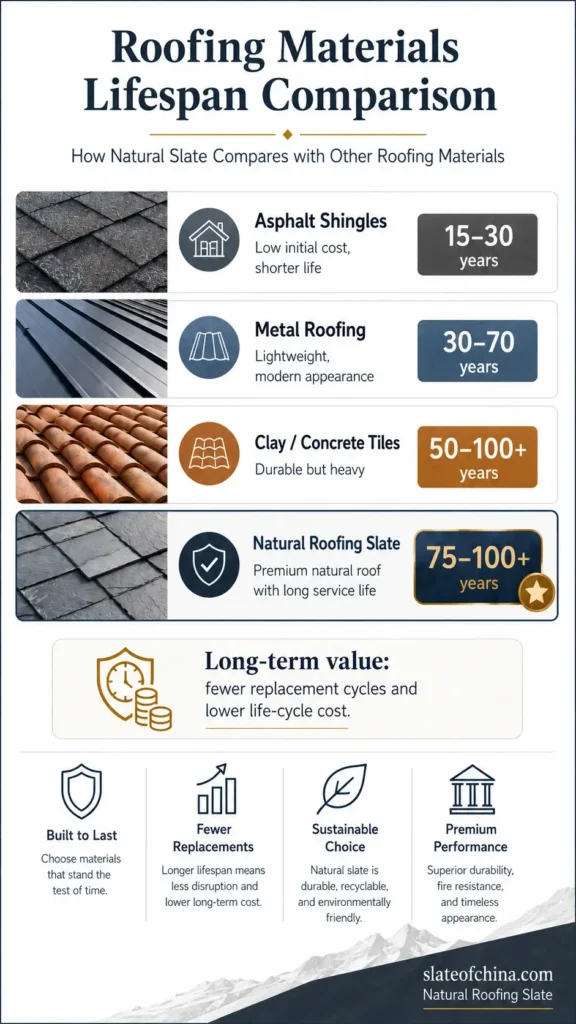
The table below gives a general comparison of roofing material lifespan:
| Roofing Material | Approximate Lifespan | Key Point |
|---|---|---|
| Asphalt shingles | 15–30 years | Low initial cost, but shorter service life |
| Metal roofing | 30–70 years | Lightweight, modern appearance, moderate to long lifespan |
| Clay / concrete tiles | 50–100+ years | Durable, but relatively heavy |
| Natural roofing slate | 75–100+ years | Premium natural roof with long service life |
Long-Term Value Tip
A natural slate roof may cost more at the beginning, but its long service life can reduce replacement frequency and improve the overall life-cycle value of the building.
This comparison does not mean that one roofing material is suitable for every project. Asphalt shingles may be chosen for low-cost housing, metal roofing may be suitable for lightweight modern buildings, and clay or concrete tiles may work well in certain architectural styles. Each material has its own market and application.
However, for premium homes, villas, churches, schools, commercial buildings, and heritage restoration projects, natural slate roofing is often selected because of its long lifespan, classic appearance, weather resistance, and low life-cycle cost.
Although natural slate has a higher initial cost than many short-life roofing materials, its long service life can reduce replacement cycles and improve long-term value. A building may need to replace asphalt shingles several times during the service life of one well-installed natural slate roof.
For importers, contractors, and project owners, this long-term performance is an important selling point. Natural slate roofing is not only a roof covering; it is a durable building material that can protect and enhance the property for generations.
To better understand the relationship between initial price and long-term value, read our detailed roofing slate cost guide.
6. Signs That a Slate Roof Is Reaching the End of Its Life
A natural slate roof is known for its long service life, but even a durable slate roof should be inspected carefully as it ages. Over time, weather exposure, movement in the roof structure, corroded fixings, failed flashings, or poor previous repairs may reduce roof performance.
It is important to understand that one broken slate does not mean the whole roof has failed. In many cases, individual slates can be replaced, which is one reason slate roofing is valued for long-term maintenance. However, when damage becomes widespread, it may be a sign that the roof is reaching the end of its useful life or needs major repair.
Common signs of an aging slate roof include:
- Many broken, cracked, or missing slates
- Delaminated slates with visible splitting layers
- Powdering, flaking, or soft surface texture
- Rusted nails causing slipped slates
- Frequent roof leaks after rain or snow
- Failed flashings around chimneys, valleys, ridges, or skylights
- Uneven or wavy roof surface
- A large number of previous patch repairs
- Water staining inside the attic or roof space
- Damp timber, mold, or moisture marks under the roof
One or two damaged slates can usually be repaired without replacing the whole roof. But if many slates are cracking, slipping, or delaminating across different areas, the problem may be more serious. In older slate roofs, the slate itself may still be sound, while the nails, battens, flashings, or underlayment have reached the end of their service life.
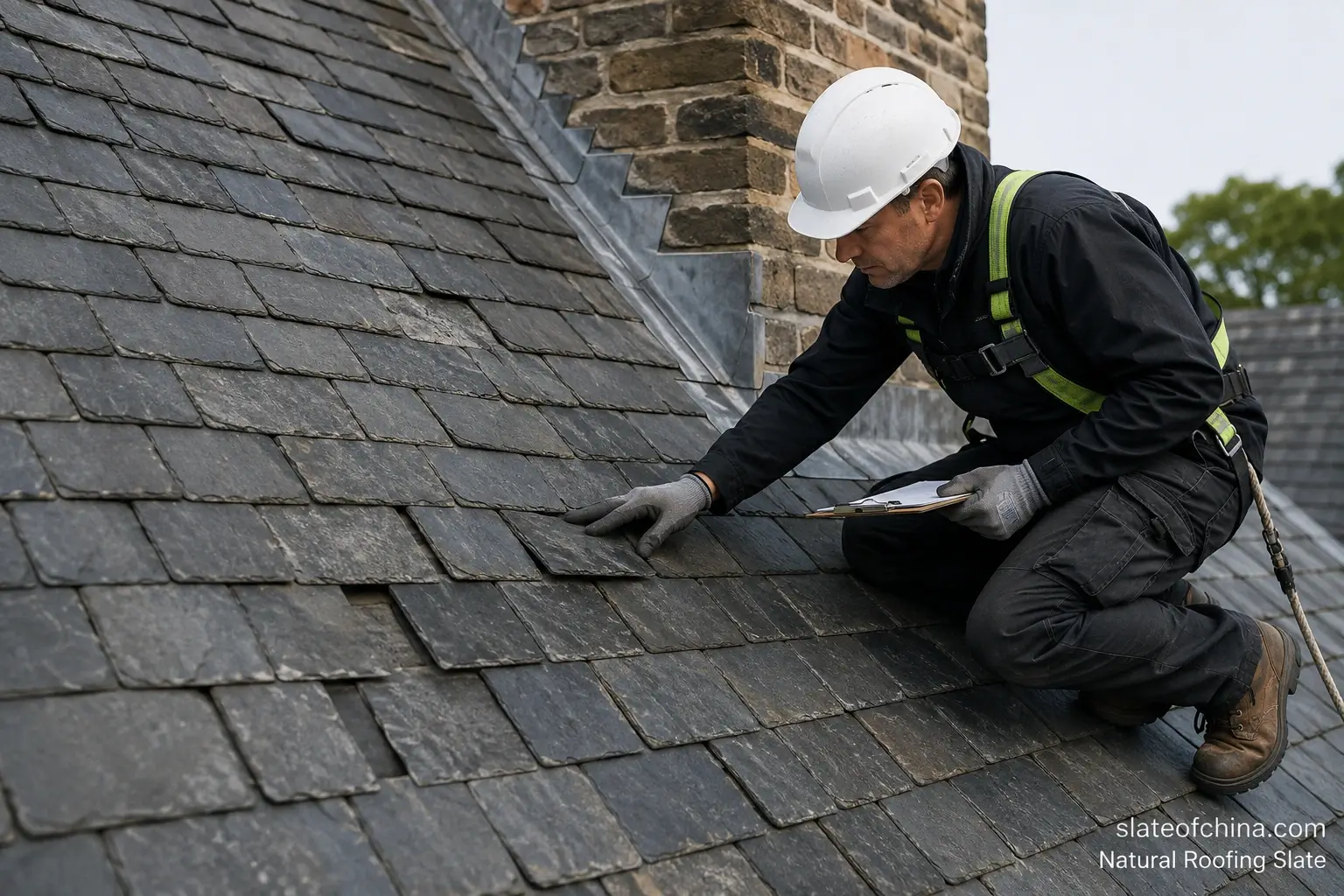
This is why a professional roof inspection is important before making a replacement decision. A qualified slate roofing contractor can check whether the roof needs simple slate replacement, partial re-roofing, fixing repair, flashing repair, or full roof replacement.
For homeowners, contractors, and building owners, early inspection can help reduce repair costs. Replacing damaged slates, repairing flashings, and solving small leaks early can often extend the slate roof lifespan and protect the building from larger water damage.
When old slate roof problems are identified early, many natural slate roofs can continue to perform well for many more years.
Does One Broken Slate Mean the Whole Roof Must Be Replaced?
No. One broken or missing slate does not usually mean the whole roof has failed. Natural slate roofs are repairable, and damaged slates can often be replaced individually. Full replacement is normally considered only when damage is widespread, leaks are frequent, fixings have failed across large areas, or the roof structure has been affected by long-term moisture.
Inspection Tip
If your slate roof has frequent leaks, many slipped slates, rusted nails, or large areas of delamination, arrange a professional inspection before deciding whether repair or full replacement is needed.
7. Can a Slate Roof Be Repaired Instead of Replaced?
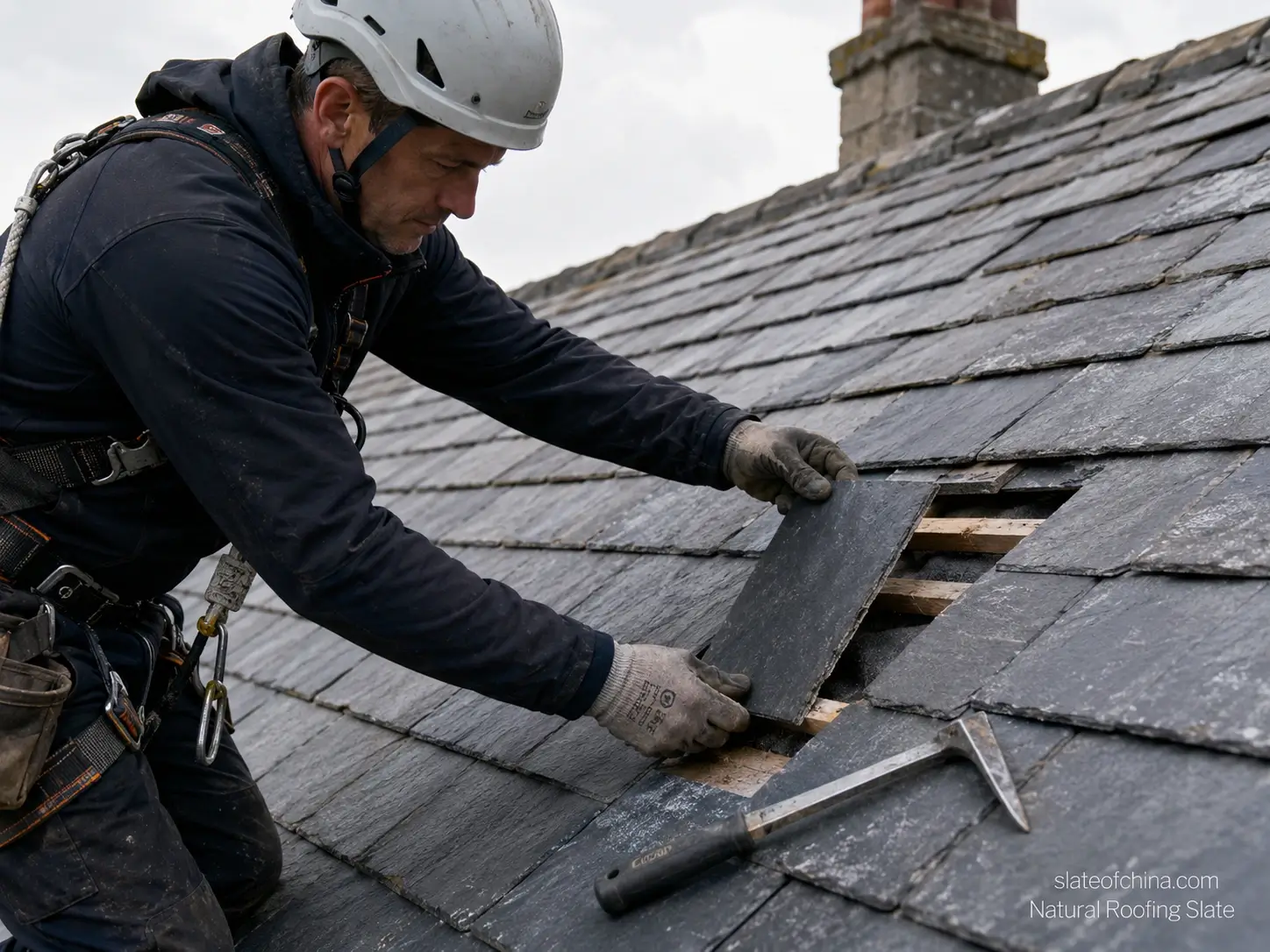
In many cases a slate roof can be repaired instead of fully replaced. One of the advantages of natural slate roofing is that damaged slates can often be replaced individually. This makes slate roofs easier to maintain over the long term and helps reduce unnecessary replacement costs.
However, whether a slate roof should be repaired or replaced depends on the condition of the slate, the fixings, flashings, underlayment, timber structure, and the extent of the damage. A professional inspection is usually needed before deciding the best solution.
Minor Slate Roof Repair
Minor repair is usually suitable when only a few slates are broken, cracked, missing, or slipped. In this situation, the damaged pieces can often be removed and replaced with matching slate tiles.
Common minor slate roof repairs include:
- Replacing broken or cracked slates
- Refixing slipped slates
- Repairing small leak areas
- Replacing individual damaged tiles after storm impact
- Fixing small flashing problems around chimneys or roof edges
Minor repair is often the most cost-effective solution when the main roof is still in good condition. It can help extend the slate roof lifespan without the cost of a full roof replacement.
Partial Re-Roofing
Partial re-roofing may be needed when one roof slope, one section, or one damaged area has more serious problems. For example, one side of the roof may be more exposed to wind, rain, snow, sunlight, or moisture, causing faster aging than other areas.
Partial re-roofing may be suitable when:
- One roof slope has many broken or slipped slates
- A valley or chimney area has repeated leaks
- Previous repairs were poorly done
- A section of underlayment or battens has failed
- The slate is still usable on some parts of the roof, but not all areas
Partial re-roofing can be a practical solution because it avoids replacing sound slate areas unnecessarily. It is especially useful for large buildings, heritage roofs, churches, schools, villas, and commercial roofing projects.
Full Slate Roof Replacement
Full replacement is normally considered when the roof has widespread failure. This may happen when most of the slates are deteriorated, the fixings have failed across large areas, flashings are no longer reliable, or the roof structure has been damaged by long-term water penetration.
A full slate roof replacement may be needed when:
- Many slates are cracked, delaminated, soft, or flaking
- Slates are slipping across different areas of the roof
- Leaks are frequent and difficult to repair
- Nails or hooks have failed widely
- Underlayment, battens, or timber structure are damaged
- The roof has reached the end of its practical service life
- Previous patch repairs can no longer solve the problem
Full replacement costs more at the beginning, but it can restore the roof as a complete long-term roofing system. For high-value buildings, this may be the best option when repair is no longer reliable.
Matching Slate for Repair and Restoration Projects
For slate roof repair and restoration projects, matching the original slate is very important. The replacement slate should be compatible with the existing roof in size, thickness, color, texture, and appearance. A poor match can affect both roof performance and visual appearance.
This is especially important for heritage buildings, historic homes, churches, public buildings, and premium residential projects. In these projects, the goal is not only to stop leaks, but also to preserve the original architectural character.
Jiujiang roofing slate can be supplied in different sizes and thicknesses to meet repair, replacement, and restoration needs. For international buyers, contractors, and roofing suppliers, this flexibility helps match project requirements more accurately and supports long-term slate roof maintenance.
| Roof Condition | Recommended Solution |
|---|---|
| A few broken, cracked, or missing slates | Minor slate roof repair |
| One roof slope or one area has repeated problems | Partial re-roofing |
| Many slates are deteriorated across the roof | Full slate roof replacement |
| Original roof appearance must be preserved | Matching slate for restoration |
Repair or Replace Tip
Do not decide on full slate roof replacement only because of a few broken slates. Many natural slate roofs can be repaired successfully when the slate tiles are still sound and the roof structure is in good condition.
Need matching natural slate for a repair or restoration project? Slate of China supplies Jiujiang roofing slate in different sizes, thicknesses, and surface textures to support slate roof repair, partial replacement, and heritage roofing projects.
8. How to Extend the Lifespan of a Slate Roof
A natural slate roof is one of the longest-lasting roofing systems, but its service life can be extended even further with the right material selection, correct installation, suitable roof design, and regular maintenance. Many slate roof problems can be avoided when the roof is planned carefully from the beginning and inspected properly over time.
The goal is simple: choose the right slate, install it correctly, and prevent small problems from becoming expensive repairs.
Slate Roof Lifespan Extension Checklist
Use this checklist to help improve natural slate roof durability and long-term performance:
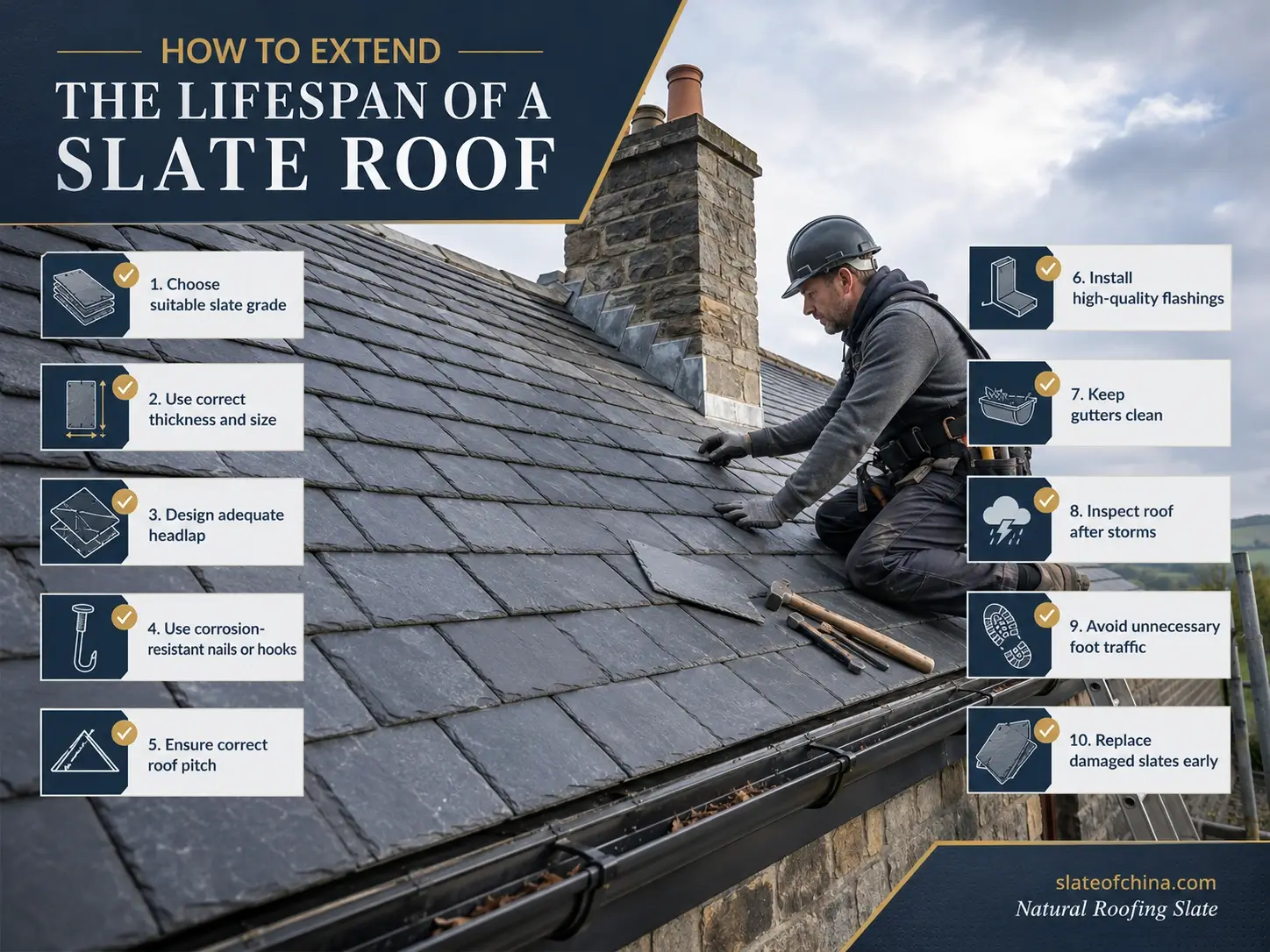
- Choose suitable slate grade
Select roofing slate with good density, low water absorption, clean cleavage, strong weather resistance, and consistent quality. - Use correct thickness and size
The slate thickness and size should match the roof pitch, local climate, wind exposure, fixing method, and building structure. - Design adequate headlap
Proper headlap helps prevent water penetration and improves the long-term waterproof performance of the slate roof. - Use corrosion-resistant nails or hooks
Copper, stainless steel, or other suitable corrosion-resistant fixings help prevent slipped slates caused by nail failure. - Ensure correct roof pitch
A suitable roof pitch allows rainwater and snow to drain properly, reducing moisture exposure and long-term roof problems. - Install high-quality flashings
Chimneys, valleys, ridges, skylights, dormers, and wall junctions need reliable flashing details to prevent leaks. - Keep gutters clean
Blocked gutters can cause water backup, overflow, and moisture problems around the roof edge. - Inspect the roof after storms
Strong wind, heavy rain, hail, snow, or falling branches may damage individual slates or flashing details. - Avoid unnecessary foot traffic
Walking directly on slate tiles can crack or loosen them. Roof access should be handled carefully by trained professionals. - Replace damaged slates early
Broken, cracked, missing, or slipped slates should be repaired early to protect the roof structure and extend slate roof lifespan.
Maintenance Tip
A natural slate roof is low-maintenance, not maintenance-free. Regular inspection, clean gutters, good flashings, and early replacement of damaged slates can help extend the lifespan of a slate roof.
Good Maintenance Protects Long-Term Value
A slate roof does not usually need heavy maintenance, but regular inspection is important. In many cases, small repairs such as replacing a broken slate, fixing a slipped tile, or repairing flashing can prevent larger roof problems later.
For homeowners and building owners, proper slate roof maintenance helps protect the property from leaks, moisture damage, and unnecessary replacement cost. For contractors and importers, understanding maintenance requirements also helps explain the long-term value of natural roofing slate to customers.
A well-maintained natural slate roof can continue to provide reliable protection, classic appearance, and excellent long service life for many decades.
Related Guides for a Longer-Lasting Slate Roof
To extend the lifespan of a slate roof, material selection and installation details must work together. Learn more from our related roofing slate guides:
Read our Roofing Slate Installation Guide to understand correct headlap, fixing methods, underlayment, ventilation, and flashing details.
Visit the Roofing Slate Thickness Guide to choose suitable slate thickness for different roof pitches, climates, and project requirements.
Check the Roofing Slate Weight Guide to understand roof load, structural support, and shipping considerations.
Review the Roofing Slate Cost Guide to compare initial price, maintenance, replacement cycles, and long-term life-cycle value.
9. Does Slate Thickness Affect Lifespan?
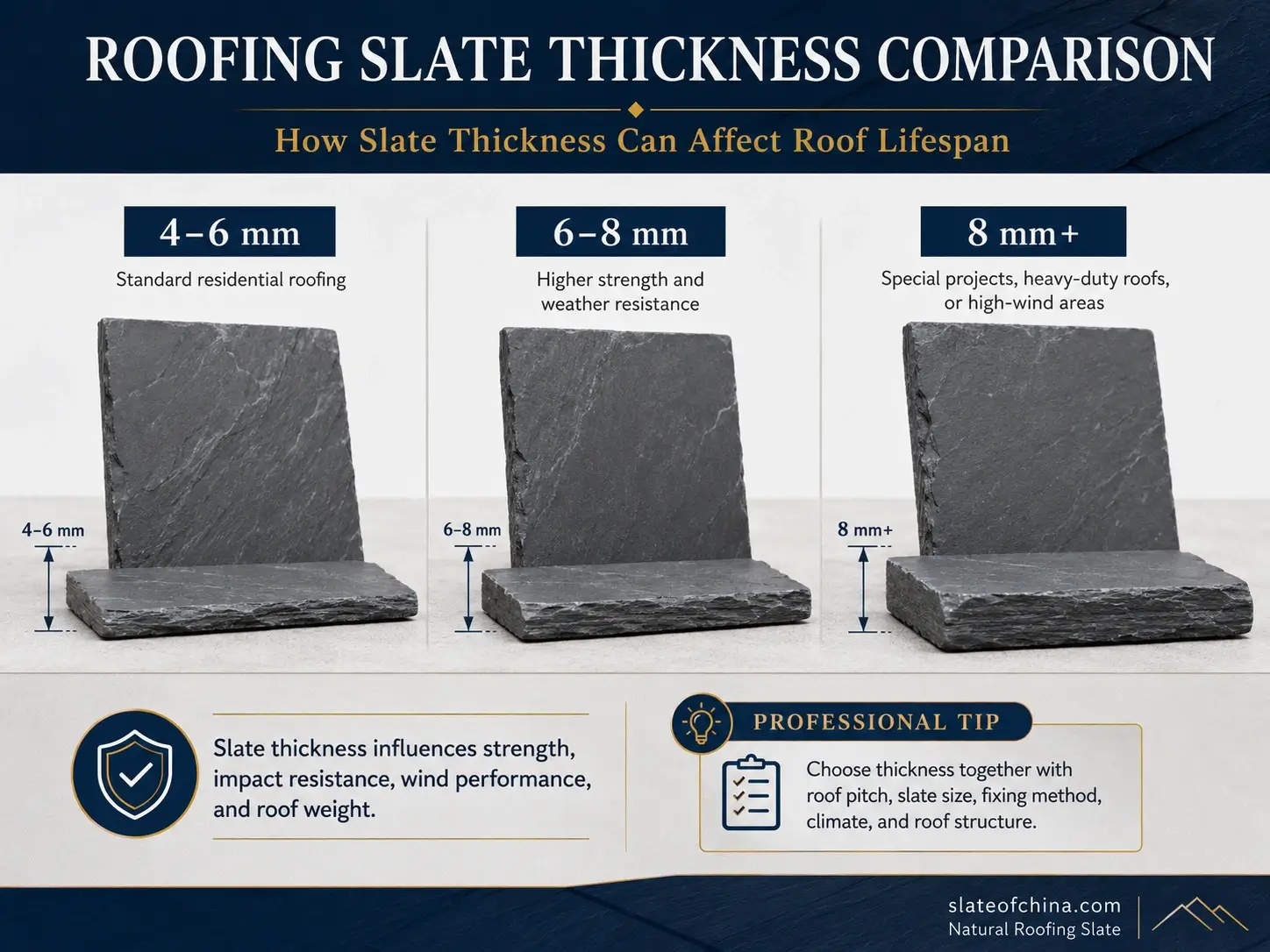
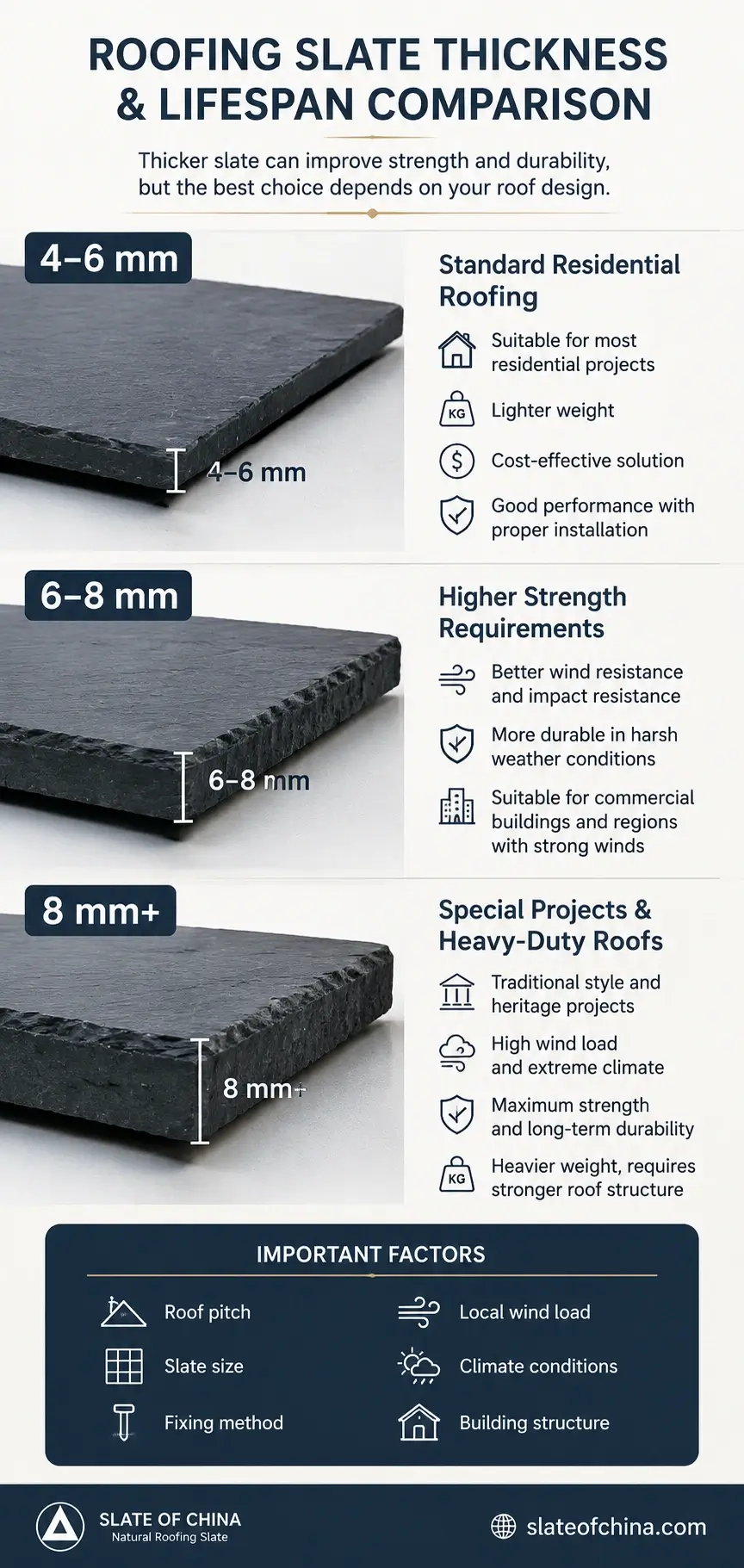
Yes, slate thickness can affect the lifespan and performance of a slate roof, but it should not be considered alone. A thicker slate may offer better strength, impact resistance, wind resistance, and durability in demanding conditions. However, the long-term performance of a natural slate roof also depends on slate quality, roof pitch, slate size, fixing method, local wind load, climate, and building structure.
In other words, thicker slate is not always automatically better. The correct slate thickness should be selected according to the project requirements. A well-chosen 5–6 mm slate may perform very well on a standard residential roof, while a thicker slate may be preferred for high-wind areas, heavy-duty roofing, traditional architectural styles, or special restoration projects.
Slate thickness can influence several important factors:
- Strength and breakage resistance
Thicker slate is generally stronger and less likely to break during handling, installation, or severe weather conditions. - Wind resistance
In exposed areas, suitable thickness, correct fixing, and proper headlap can help improve roof stability under wind pressure. - Impact resistance
Thicker slate may provide better resistance against hail, falling branches, or accidental impact. - Roof weight
Thicker slate is heavier, so the roof structure must be able to support the additional load. - Installation method
Slate thickness should match the fixing method, nail hole position, hook system, and local installation practice. - Appearance
Thicker slate can create a stronger, more traditional roof appearance, especially for heritage buildings or premium architectural projects.
Common roofing slate thickness ranges include:
| Slate Thickness | Common Application |
|---|---|
| 4–6 mm | Standard residential roofing projects |
| 6–8 mm | Projects requiring higher strength or better weather resistance |
| 8 mm+ | Special projects, heavy-duty roofs, traditional styles, or high-wind areas |
Thickness Selection Tip
Thicker slate can improve strength and impact resistance, but the best slate thickness should always be selected together with roof pitch, slate size, fixing method, wind exposure, climate, and roof structure.
For most buyers, the best choice is not simply the thickest slate, but the most suitable slate. Slate thickness should be selected together with slate size, roof pitch, headlap, fixing method, wind exposure, climate conditions, and structural load capacity.
For example, a low-pitch roof may require careful headlap design and suitable slate size. A coastal or high-wind project may require stronger fixings and possibly thicker slate. A restoration project may need slate that matches the original roof thickness, color, texture, and size.
For international roofing projects, Jiujiang roofing slate can be supplied in different thicknesses and sizes to meet various residential, commercial, and restoration requirements. If a project requires long service life, the slate specification should be confirmed according to the actual roof design and local climate conditions.
For a more detailed explanation of slate thickness, weight, roof pitch, and project selection, read our Roofing Slate Thickness Guide.
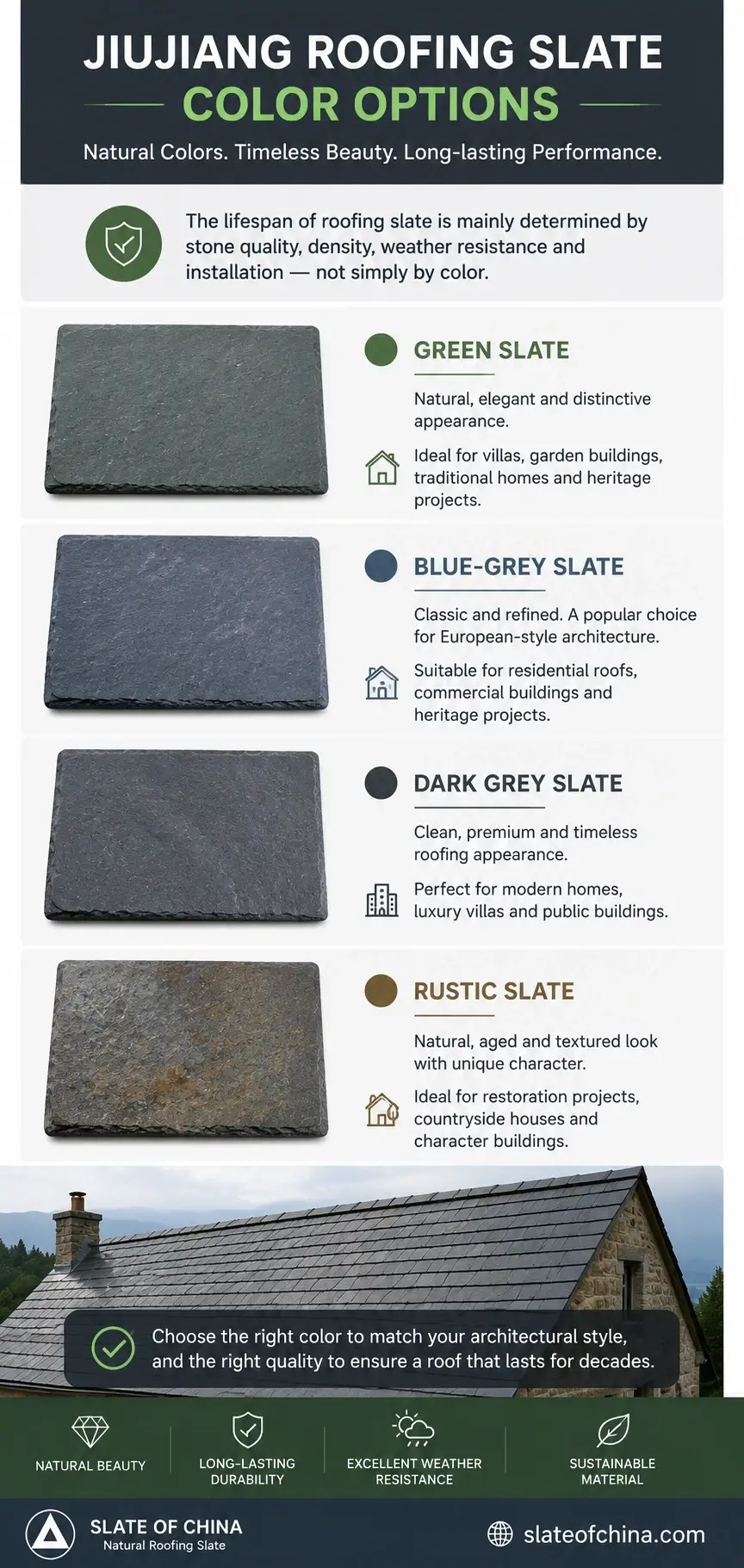
10. Does Color Affect Roofing Slate Lifespan?
Slate color affects the visual style of the roof, but slate quality determines long-term roofing performance.
Slate color is one of the first things buyers notice when choosing natural roofing slate. However, the color itself is not the main factor that determines slate roof lifespan. The lifespan of roofing slate is mainly determined by the stone quality, density, mineral stability, weather resistance, water absorption, installation quality, roof design, and maintenance — not simply by color.
In natural slate, color comes from the mineral composition of the stone. Different minerals can create different shades, such as grey, blue-grey, green, black, purple, or rustic tones. These natural colors give slate roofing its unique architectural character, but buyers should not judge slate durability by color alone.
A beautiful slate color is important for the appearance of the building, but long-term roof performance depends more on technical quality. A good roofing slate should have stable structure, good cleavage, low water absorption, strong weather resistance, and consistent quality. These properties help the slate roof perform well for many decades.
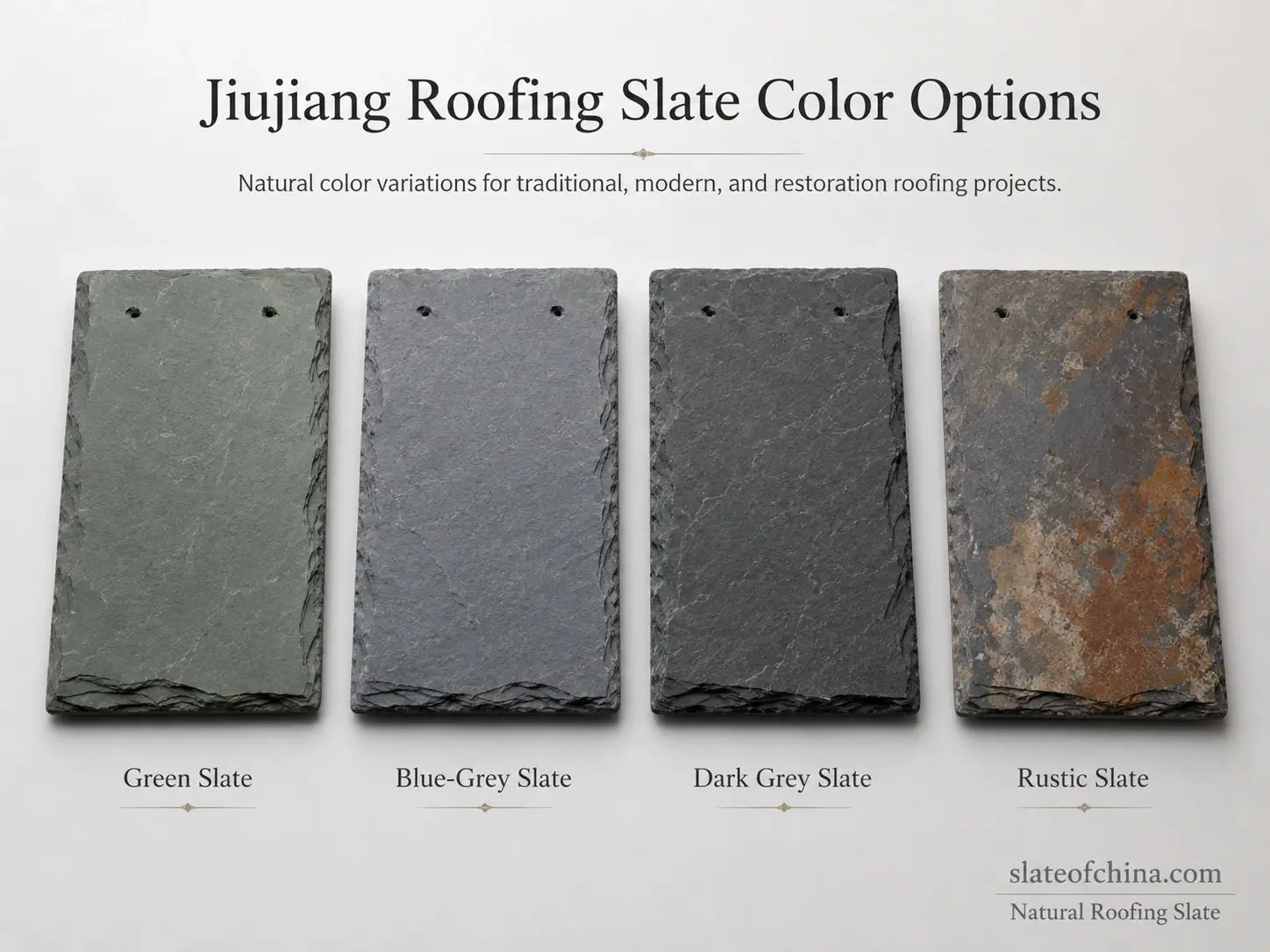
Jiujiang roofing slate is available in several natural color tones, including green, blue-grey, dark grey, and rustic color variations. These colors can be used for different architectural styles and market needs:
- Green slate offers a natural and elegant appearance, suitable for traditional homes, garden buildings, villas, and heritage-style projects.
- Blue-grey slate provides a classic roofing appearance and is widely used for European-style residential and commercial buildings.
- Dark grey slate creates a clean, premium, and timeless roof surface for both modern and traditional architecture.
- Rustic slate gives a more natural, aged, and textured appearance, often suitable for restoration projects, countryside houses, and character buildings.
For heritage restoration projects, matching the original slate color, surface texture, size, and thickness is especially important. The goal is not only to protect the roof, but also to preserve the architectural character of the building.
For new residential and commercial projects, slate color can help define the style of the building. Blue-grey and dark grey slate often create a refined and professional appearance, while green and rustic slate can provide a more natural and distinctive roof design.
When selecting roofing slate, buyers should consider both appearance and performance. The best choice is a slate that matches the project design while also meeting the required standards for durability, weather resistance, thickness, and installation conditions.
| Jiujiang Slate Color | Appearance | Suitable Projects |
|---|---|---|
| Green slate | Natural, elegant, distinctive | Villas, garden buildings, traditional homes |
| Blue-grey slate | Classic, refined, European style | Residential roofs, commercial buildings, heritage projects |
| Dark grey slate | Clean, premium, timeless | Modern homes, luxury villas, public buildings |
| Rustic slate | Natural, aged, textured | Restoration projects, countryside houses, character buildings |
Color Selection Tip
Do not choose roofing slate by color alone. For long service life, buyers should also check slate quality, thickness, water absorption, weather resistance, fixing method, and installation requirements.
11. Jiujiang Roofing Slate Lifespan: What Buyers Should Know
After understanding the main factors that affect roofing slate lifespan, buyers often ask an important question: which slate source should be selected for long-term roofing projects?
Jiujiang roofing slate is a practical choice for international buyers who need natural slate appearance, reliable supply, workable quality, and competitive export pricing. For roofing projects that require long service life, weather resistance, and classic natural stone aesthetics, Jiujiang natural roofing slate is a strong option to consider.
Why Jiujiang Roofing Slate Is Used for Long-Term Roofing Projects
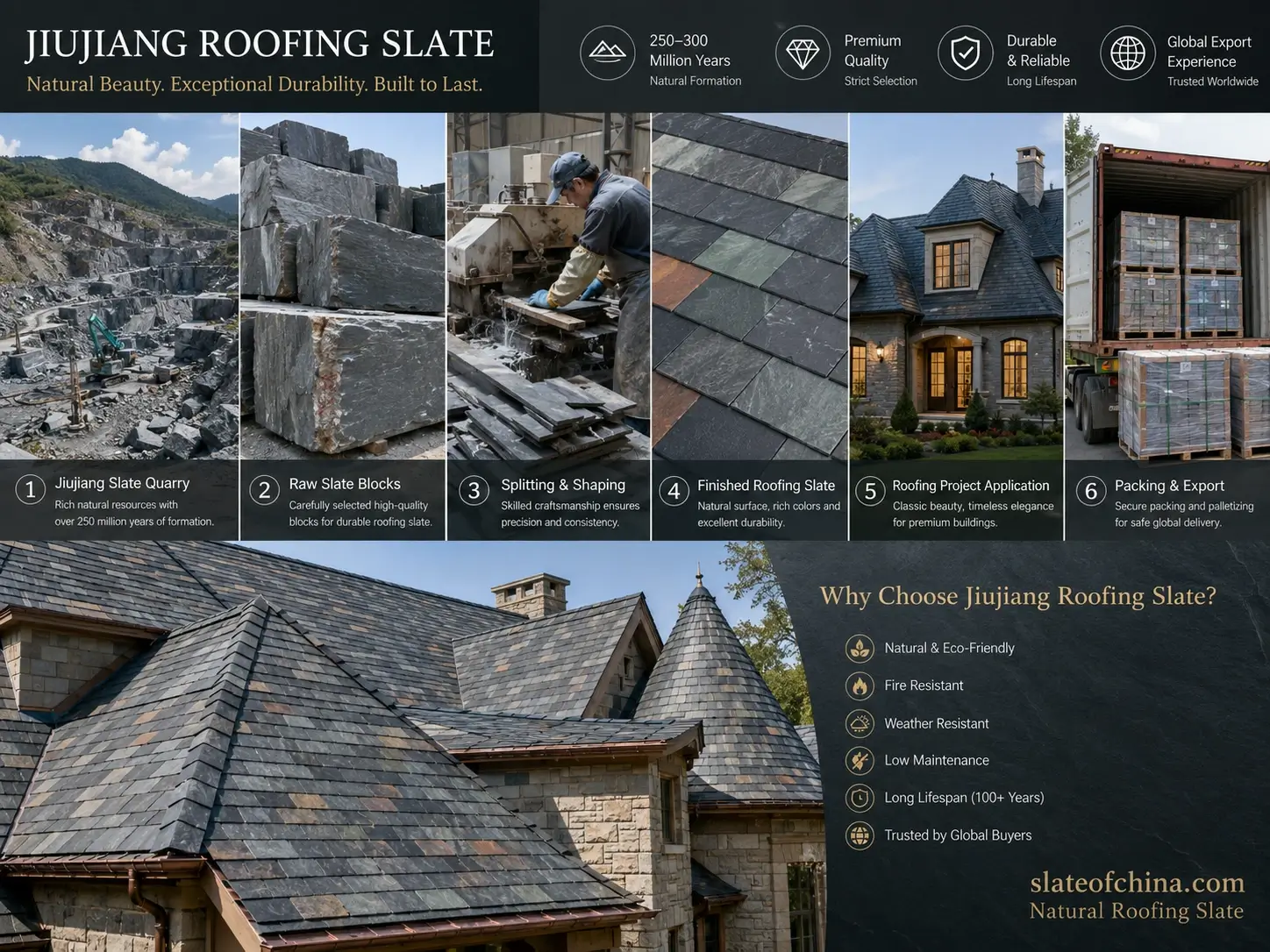
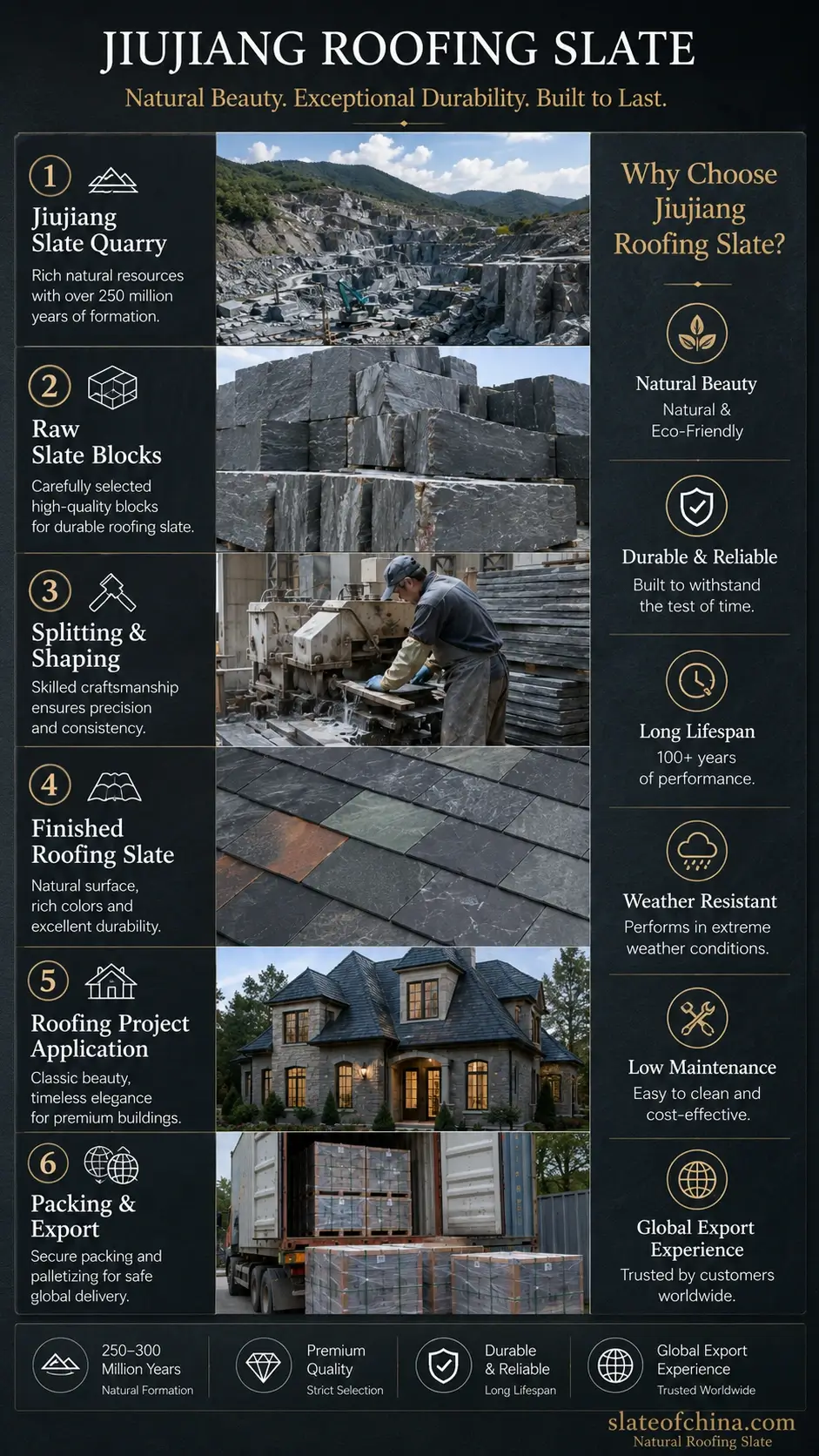
Jiujiang has a long history of natural slate production and stone processing. The region is known for its natural slate resources, skilled splitting techniques, and export experience. For roofing slate buyers, this means more than just material supply. It also means access to stable production, different slate specifications, and practical support for international roofing projects.
Jiujiang roofing slate can be split and processed into different sizes and thicknesses according to project requirements. This flexibility makes it suitable for residential roofing, commercial buildings, wall cladding, restoration projects, and traditional-style architecture.
Key advantages of Jiujiang roofing slate include:
- Natural stone appearance with classic slate texture
- Long service life when properly selected and installed
- Available sizes and thicknesses for different project needs
- Skilled splitting and processing experience
- Suitable for roofing, wall cladding, and restoration work
- Cost-effective compared with some European slate sources
- Export experience for international buyers
- Flexible packing for pallets and container loading
- Suitable for importers, wholesalers, roofing contractors, and project suppliers
A Practical Balance of Quality, Supply, and Cost
For many international buyers, the ideal roofing slate is not only beautiful and durable, but also commercially practical. Supply stability, specification consistency, packing quality, container loading, and export pricing all matter.
Jiujiang roofing slate offers a practical balance between natural slate performance and competitive sourcing cost. Compared with some high-cost European slate sources, Jiujiang slate can provide a cost-effective option for projects that still require the natural beauty and long-term durability of real stone slate.
This makes it especially suitable for importers, wholesalers, and roofing contractors who need reliable roofing slate supply for repeated orders, project tenders, and local distribution.
Suitable for New Roofing and Restoration Projects
Jiujiang roofing slate can be used in different types of roofing projects, including new residential roofs, villas, commercial buildings, heritage-style projects, countryside houses, and repair or replacement work.
For restoration projects, matching the original roof appearance is often very important. Buyers may need slate with suitable size, thickness, color, surface texture, and edge finish. Jiujiang slate can be supplied in different natural color tones, including green, blue-grey, dark grey, and rustic variations, helping buyers match both technical and aesthetic requirements.
For new buildings, Jiujiang slate provides a natural, elegant, and long-lasting roofing material that can enhance the value and appearance of the property.
What Buyers Should Confirm Before Ordering
To achieve a long-lasting slate roof, buyers should confirm the correct specification before placing an order. The most important details include slate size, thickness, color, quantity, packing method, roof pitch, fixing method, and local climate conditions.
Before ordering roofing slate, buyers should consider:
- Required slate size and thickness
- Natural color and surface texture
- Roof pitch and headlap requirements
- Fixing method, such as nails or hooks
- Local weather conditions and wind exposure
- Quantity per square meter
- Packing method and pallet protection
- Container loading quantity
- Sample approval before bulk order
- Project schedule and delivery time
Choosing the right slate specification from the beginning helps reduce installation problems, improve roof performance, and extend the natural slate roof lifespan.
Jiujiang Slate for International Roofing Buyers
Slate of China supplies Jiujiang natural roofing slate for international roofing projects. We support importers, wholesalers, contractors, and project buyers with slate selection, size options, thickness recommendations, packing solutions, and export quotations.
If your project requires durable natural roofing slate with long service life, classic appearance, and cost-effective supply, Jiujiang roofing slate is a reliable material to consider.
| Buyer Concern | How Jiujiang Roofing Slate Helps |
|---|---|
| Long service life | Natural slate material suitable for durable roofing projects |
| Project matching | Available in different sizes, thicknesses, and natural colors |
| Cost control | Cost-effective compared with some European slate sources |
| Export supply | Suitable for importers, wholesalers, and roofing contractors |
| Restoration needs | Can support matching of color, texture, size, and thickness |
| Logistics | Flexible packing and container loading options |
Need durable Jiujiang roofing slate for your market or project? Contact Slate of China for samples, specifications, packing details, and export quotation.
12. Roofing Slate Lifespan and Cost: Is Slate Worth It?
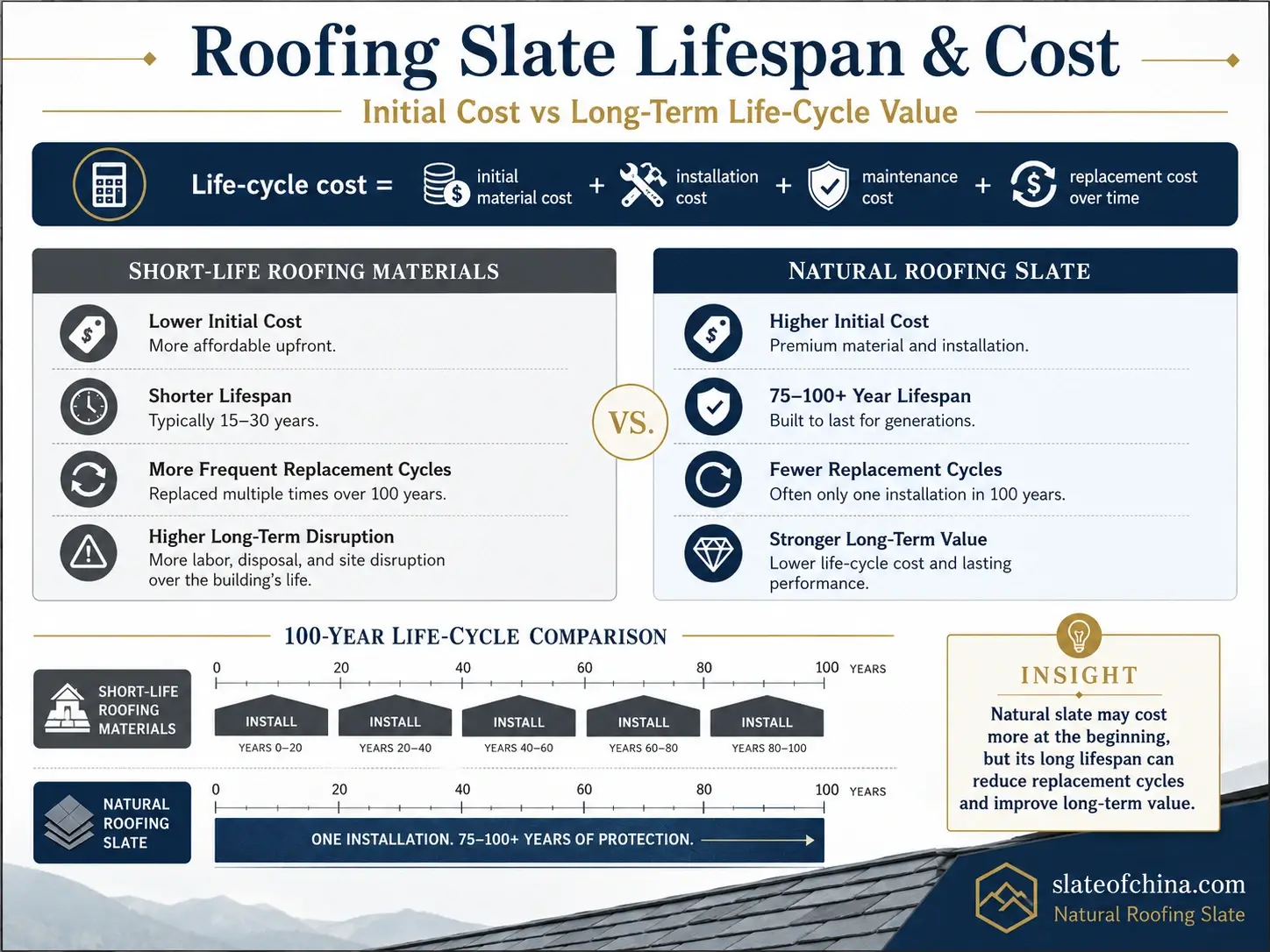
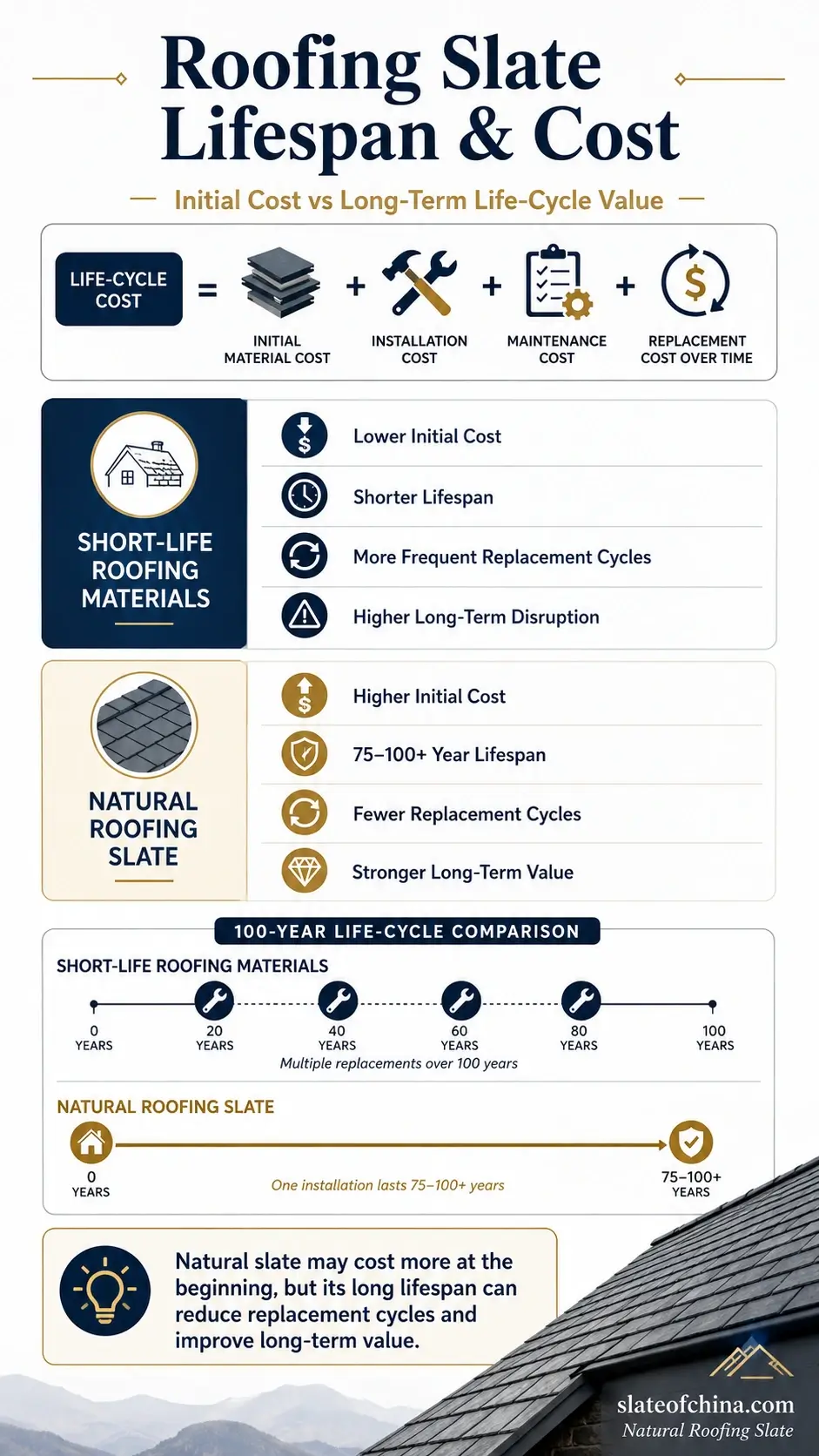
When buyers compare roofing materials, natural slate is often seen as a premium option. Its initial material cost and installation cost may be higher than asphalt shingles, synthetic roofing products, or some lightweight alternatives. However, the real value of roofing slate should be measured over the full life of the roof, not only at the time of purchase.
A roof is a long-term investment. If a cheaper roofing material needs to be replaced two or three times during the service life of one natural slate roof, the total cost over time may be much higher than it appears at the beginning.
Initial Cost vs. Life-Cycle Cost
The initial cost of a roof usually includes the roofing material, accessories, installation labor, and transportation. Life-cycle cost looks further. It considers how long the roof will last, how often it needs repair, how many times it may need to be replaced, and how much value it adds to the building.
A simple way to understand life-cycle cost is:
Life-cycle cost = initial material cost + installation cost + maintenance cost + replacement cost over time
Natural roofing slate may cost more at the beginning, but its long lifespan can reduce replacement cycles and improve long-term value. A well-selected and properly installed slate roof can often last 75–100 years or more, while many short-life roofing materials may need replacement much earlier.
Why Long Lifespan Can Reduce Long-Term Cost
The longer a roof lasts, the fewer replacement cycles the building owner may face. This is especially important because roof replacement does not only involve material cost. It also includes labor, scaffolding, disposal, project disruption, and possible repairs to the building if leaks or moisture damage occur.
Natural slate can help reduce long-term cost in several ways:
- Fewer full roof replacements over the life of the building
- Lower long-term disruption for homeowners or building users
- Reduced waste from repeated roof replacement
- Strong natural appearance that can add property value
- Long-term performance for premium and heritage buildings
- Individual damaged slates can often be repaired or replaced
For long-term projects, premium homes, heritage buildings, and high-value developments, natural slate is often considered an investment rather than only a roofing expense.
Life-Cycle Cost Formula
Life-cycle cost = initial material cost + installation cost + maintenance cost + replacement cost over time
A roofing material with a low initial price may not always have the lowest long-term cost if it needs frequent replacement.
Is Natural Slate Roofing Worth the Cost?
Natural slate roofing is usually worth considering when the project requires long service life, premium appearance, weather resistance, and long-term value. It may not be the cheapest option for a low-budget short-term building, but it is a strong choice for buildings designed to last for decades.
Slate roofing is especially suitable for:
- Luxury homes and villas
- Heritage buildings and restoration projects
- Churches, schools, and public buildings
- Commercial buildings with long-term ownership
- High-value residential developments
- Projects where natural stone appearance is important
- Markets where long-lasting roofing materials are preferred
For importers, wholesalers, roofing contractors, and project buyers, the long lifespan of natural roofing slate is also an important selling point. Customers are not only buying roof tiles. They are buying durability, natural beauty, reduced replacement frequency, and long-term building protection.
Cost-Effective Jiujiang Roofing Slate for International Buyers
Jiujiang roofing slate offers international buyers a practical balance of natural slate quality, long service life, classic appearance, and competitive export pricing. Compared with some high-cost slate sources, Jiujiang slate can be a cost-effective option for buyers who need durable natural roofing slate for residential, commercial, and restoration projects.
When evaluating roofing slate cost, buyers should consider not only the price per piece or price per square meter, but also the expected roof lifespan, installation requirements, packing quality, shipping efficiency, and long-term performance.
A lower initial price is not always the best value if the roof fails early. A durable, properly selected natural slate roof can provide stronger long-term value and better customer satisfaction.
| Cost Factor | Short-Life Roofing Materials | Natural Roofing Slate |
|---|---|---|
| Initial cost | Usually lower | Usually higher |
| Service life | Shorter | Longer |
| Replacement frequency | More frequent | Less frequent |
| Long-term disruption | Higher | Lower |
| Appearance value | Varies | Premium natural stone appearance |
| Life-cycle value | Depends on replacement cycles | Strong for long-term buildings |
To understand pricing factors in more detail, including material cost, thickness, size, packing, shipping, and installation considerations, read our Roofing Slate Cost Guide. You may also find our Roofing Slate Thickness Guide, Roofing Slate Installation Guide and Roofing Slate Weight Guide helpful when planning a long-lasting slate roof.
13. Common Myths About Slate Roof Lifespan
Natural slate roofing is known for its long service life, but there are still many misunderstandings about slate roof lifespan, maintenance, thickness, repair, and suitable applications. Understanding these common myths can help buyers make better decisions when choosing roofing slate for residential, commercial, or restoration projects.
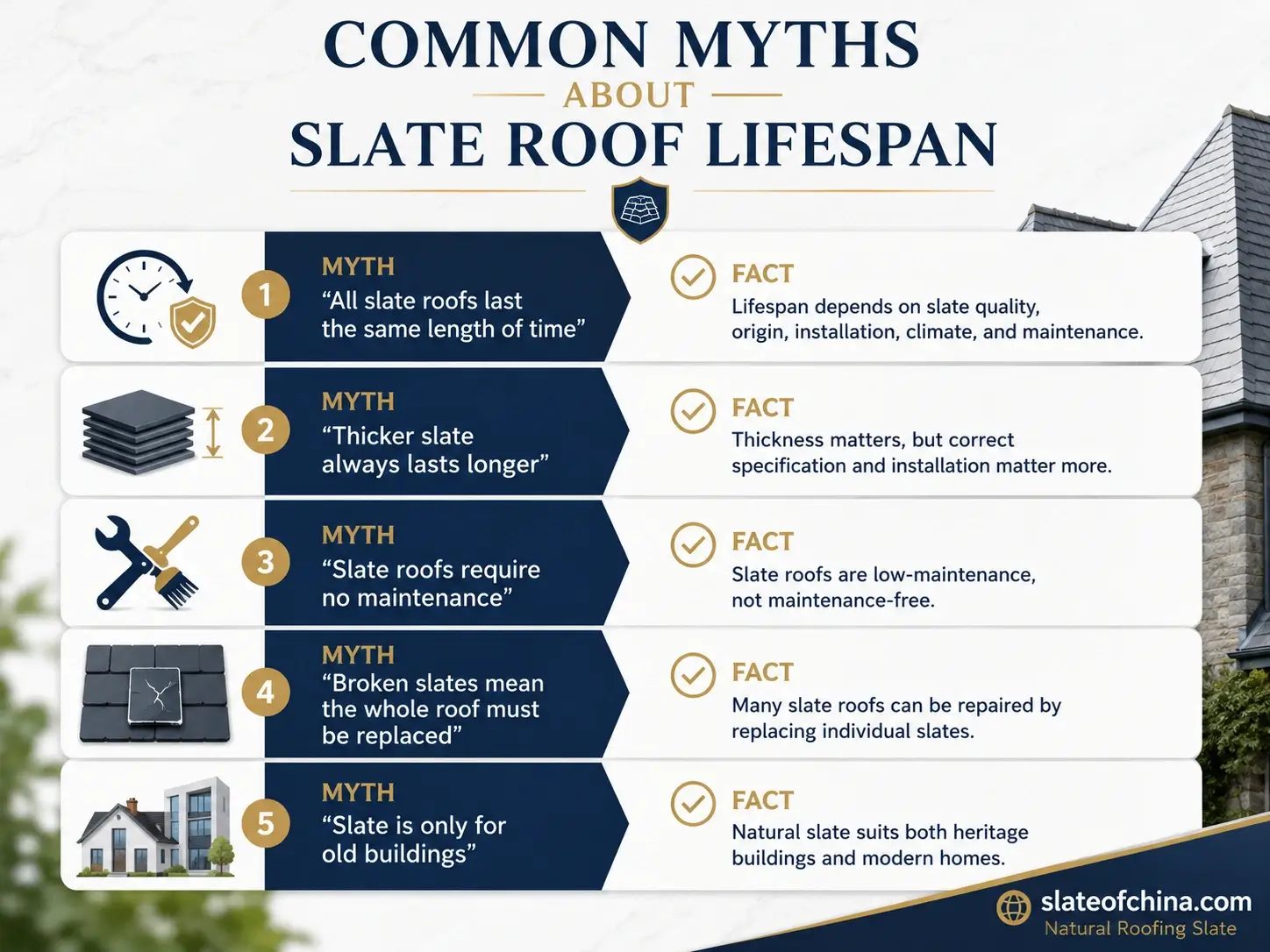
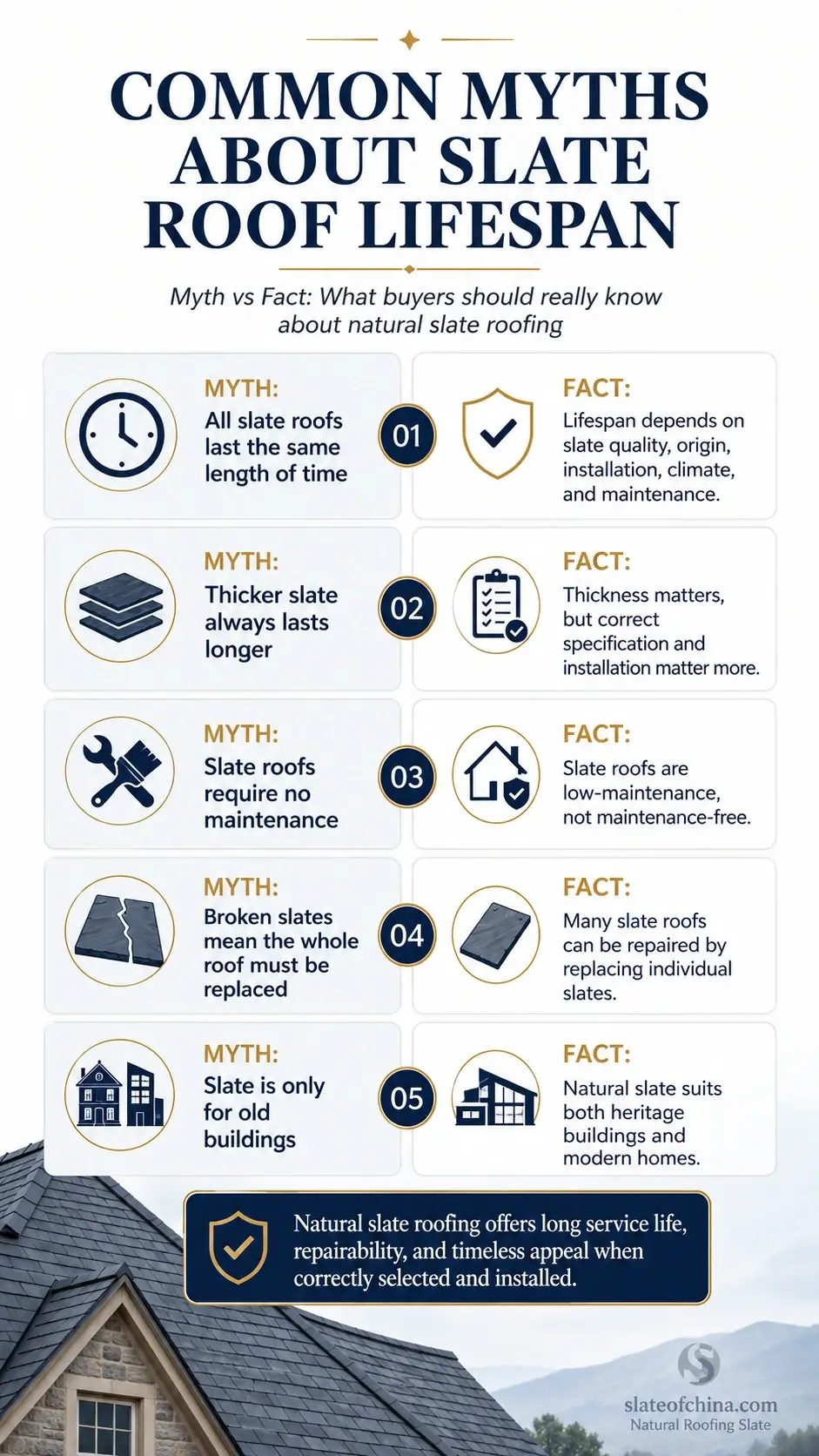
Myth 1: All Slate Roofs Last the Same Length of Time
This is not true. Not all slate roofs have the same lifespan.
The service life of a slate roof depends on many factors, including slate origin, stone quality, density, water absorption, thickness, roof pitch, installation quality, fixing materials, climate, and maintenance. A high-quality slate roof installed correctly may last for more than 100 years, while a poor-quality or poorly installed slate roof may need major repair much earlier.
For buyers, this means that slate selection should not be based only on color or price. The quality of the slate and the suitability of the roofing system are essential for long-term performance.
Myth 2: Thicker Slate Always Lasts Longer
Thicker slate can improve strength, impact resistance, wind performance, and durability in certain conditions. However, thicker slate does not automatically mean a longer slate roof lifespan.
The best slate thickness depends on roof pitch, slate size, fixing method, wind exposure, local climate, and roof structure. A properly selected 5–6 mm slate may perform very well on a standard residential roof, while thicker slate may be more suitable for high-wind areas, heavy-duty roofing, traditional buildings, or special restoration projects.
Slate thickness is important, but it should always be considered together with the full roof design and installation system.
Myth 3: Slate Roofs Require No Maintenance
A natural slate roof is low-maintenance, but it is not maintenance-free.
Even a long-lasting slate roof should be inspected from time to time. Gutters should be kept clean, flashings should be checked, damaged or slipped slates should be repaired, and moss or debris should be removed carefully when necessary.
Regular maintenance helps prevent small problems from becoming expensive repairs. This is one reason why slate roofing can provide excellent long-term value when properly cared for.
Myth 4: Broken Slates Mean the Whole Roof Must Be Replaced
One broken slate does not mean the entire roof has failed.
In many cases, individual broken, cracked, missing, or slipped slates can be replaced without removing the whole roof. This repairability is one of the advantages of natural slate roofing. A well-maintained slate roof can often continue to perform for many years after minor repairs.
Full slate roof replacement is normally considered only when damage is widespread, many slates are deteriorated, fixings have failed across large areas, flashings are no longer reliable, or the roof structure has been affected by moisture.
Myth 5: Slate Roofing Is Only for Old Buildings
Slate roofing is often associated with historic homes, churches, and heritage buildings, but it is not only for old architecture.
Natural roofing slate is also widely used on modern villas, luxury homes, hotels, commercial buildings, public buildings, and high-end residential developments. Its natural stone texture, long service life, weather resistance, and timeless appearance make it suitable for both traditional and contemporary design.
Blue-grey, dark grey, green, and rustic slate can create different architectural effects, from classic European roofing styles to clean modern roof designs. For projects that require durability, natural beauty, and long-term value, slate remains a strong roofing material choice.
| Myth | Fact |
|---|---|
| All slate roofs last the same | Slate lifespan depends on quality, installation, climate, and maintenance |
| Thicker slate always lasts longer | Thickness matters, but correct specification matters more |
| Slate roofs need no maintenance | Slate roofs are low-maintenance, not maintenance-free |
| Broken slates mean full replacement | Many slate roofs can be repaired tile by tile |
| Slate is only for old buildings | Slate is suitable for both traditional and modern architecture |
14. FAQ About Roofing Slate Lifespan
Many buyers have similar questions before choosing natural roofing slate for a long-term roof project. The answers below explain common concerns about slate roof lifespan, maintenance, repair, replacement, and Jiujiang roofing slate selection.
How long does a natural slate roof last?
A high-quality natural slate roof can often last 75–100 years or more with correct installation and regular maintenance. In suitable conditions, premium natural slate roofing may last well over a century.
Can a slate roof last 150 years?
In some cases, yes. A slate roof may last 120–150 years or even longer when premium slate is used, the roof is properly designed, installation is done correctly, and maintenance is carried out over time. However, actual slate roof lifespan depends on slate quality, climate, fixing materials, roof pitch, and maintenance.
What reduces the lifespan of a slate roof?
Poor slate quality, incorrect installation, low roof pitch, insufficient headlap, poor ventilation, failed flashings, rusted nails, weak underlayment, severe weather exposure, and lack of maintenance can all reduce slate roof lifespan. Many old slate roof problems are caused by poor roof design or installation details rather than the slate itself.
Is Jiujiang slate suitable for long-life roofing?
Yes. Selected Jiujiang roofing slate can be used for durable natural slate roofing projects when the correct grade, size, thickness, and installation method are chosen. It is available in different natural colors, sizes, and thicknesses for residential roofing, commercial buildings, wall cladding, and restoration projects.
Does a slate roof need maintenance?
Yes. A natural slate roof is low-maintenance, but it is not maintenance-free. Regular maintenance usually includes roof inspections, replacing broken or slipped slates, cleaning gutters, checking flashings, removing debris, and inspecting the roof after storms.
Is natural slate better than artificial slate for lifespan?
Natural slate generally has a longer proven service life than many artificial or synthetic slate alternatives. High-quality natural roofing slate is often preferred for heritage buildings, premium homes, churches, public buildings, and long-term roofing projects because of its durability, natural appearance, and long service life.
Can old slate be reused?
Sometimes, yes. Old slate can sometimes be reused if the tiles are still sound, strong, and free from serious cracks, delamination, or excessive nail hole damage. Reuse depends on slate condition, thickness, size, fixing holes, project requirements, and whether the old slate matches the new roof design.
Need durable natural roofing slate for a long-life roof project? Contact Slate of China for Jiujiang roofing slate samples, size options, thickness recommendations, packing details, and export quotation.
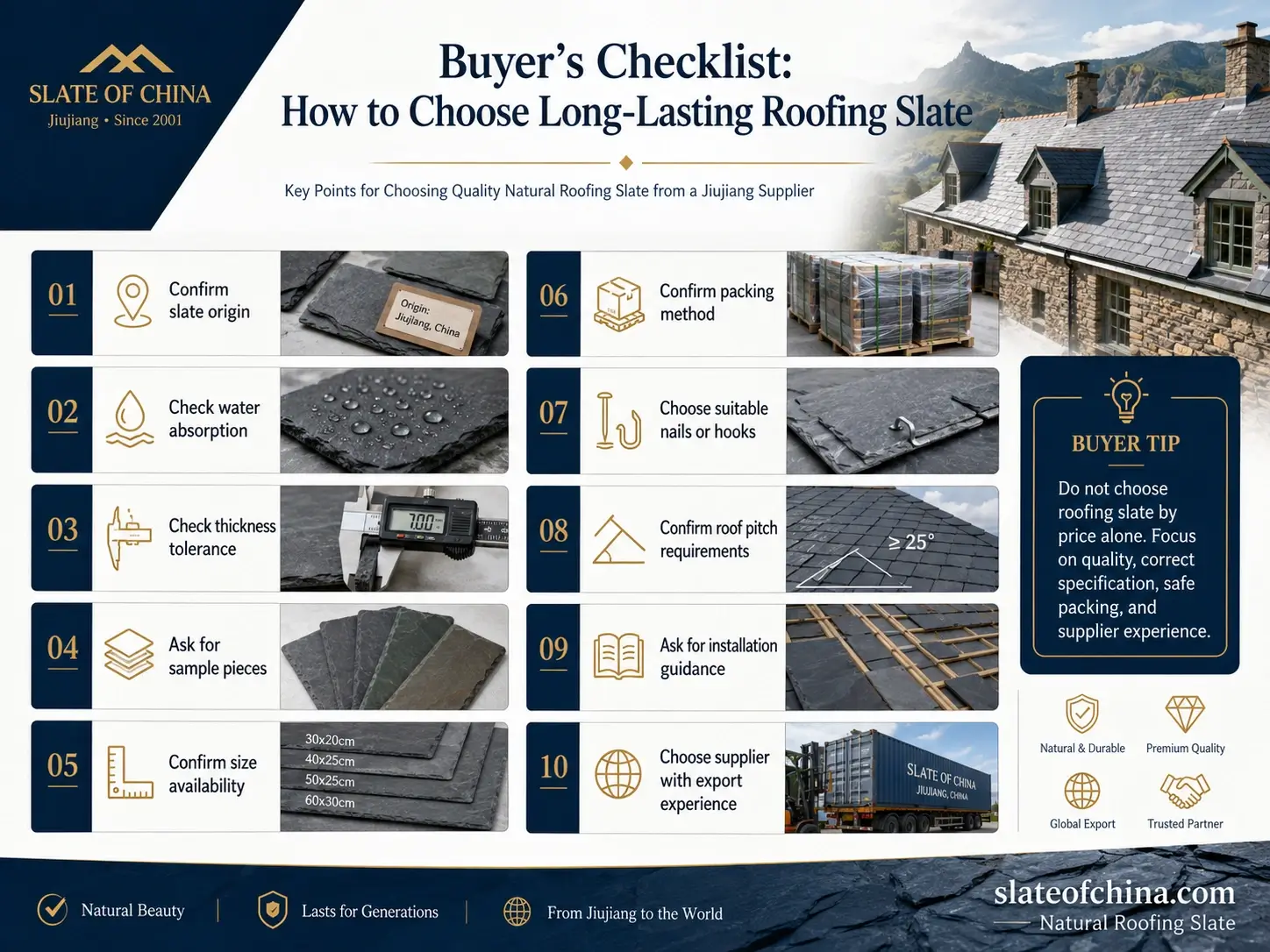
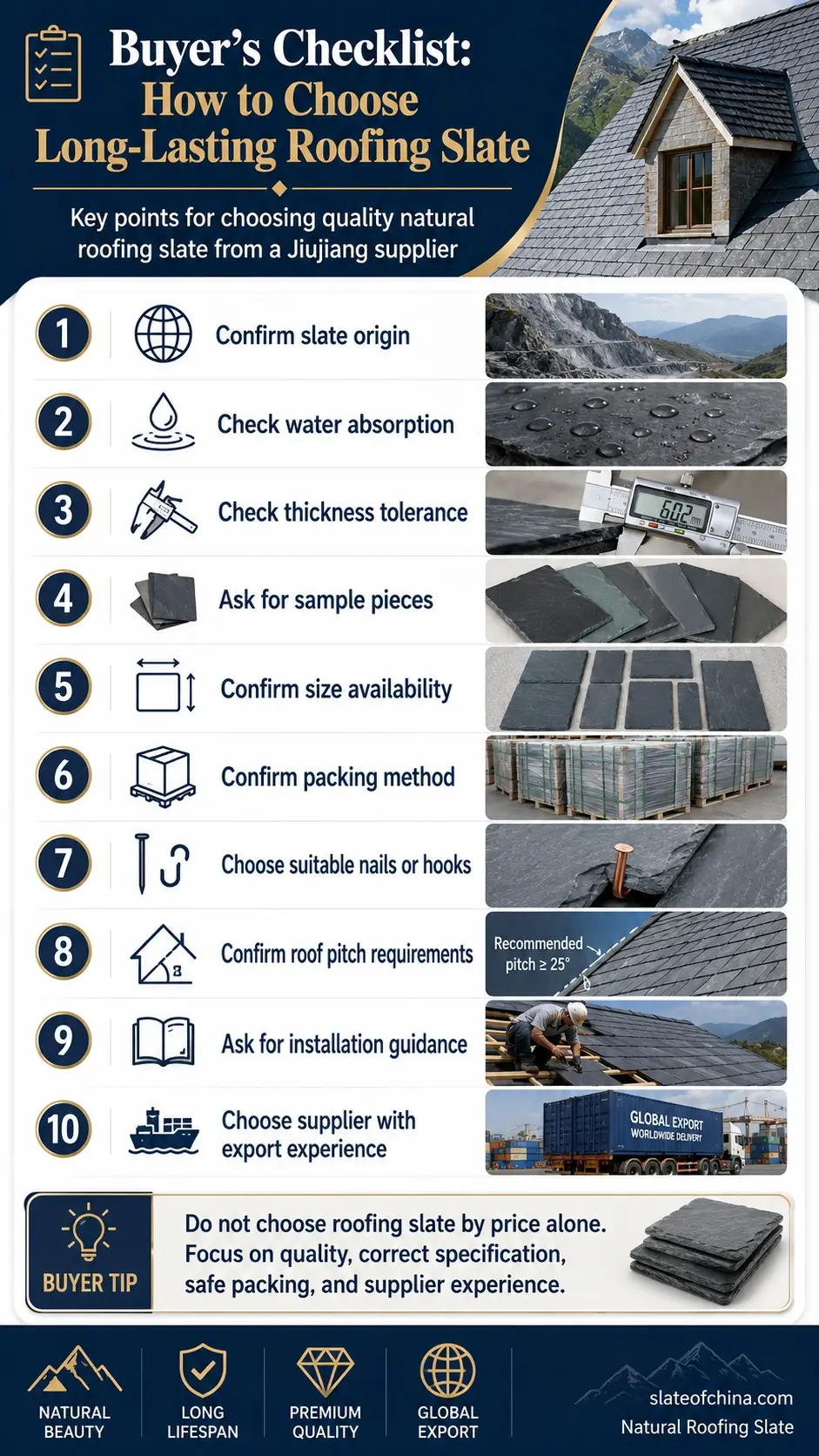
15. Buyer’s Checklist: How to Choose Long-Lasting Roofing Slate
Choosing long-lasting roofing slate is not only about selecting a beautiful natural stone. Buyers should also confirm the technical details, project requirements, packing method, and supplier experience before placing an order. A good roofing slate specification can help improve roof performance, reduce installation problems, and extend slate roof lifespan.
Use the checklist below before purchasing natural roofing slate for your project or market.
Buyer Tip
Do not choose roofing slate by price alone. A reliable long-life slate roof depends on slate quality, correct specification, safe packing, proper installation, and an experienced supplier.
Roofing Slate Buyer’s Checklist
- Confirm slate origin
Ask where the slate comes from and whether the quarry source is suitable for roofing applications. Slate origin can affect color, texture, density, cleavage, and long-term weathering performance. - Check water absorption
Low water absorption is important for natural slate roof durability, especially in rainy, cold, or freeze-thaw climates. - Check thickness tolerance
Roofing slate thickness should be consistent and suitable for the roof design. Poor thickness control may affect installation, appearance, weight, and roof performance. - Ask for sample pieces
Samples help buyers check color, texture, surface finish, edge quality, thickness, nail holes, and overall workmanship before bulk order. - Confirm size availability
Make sure the supplier can provide the required roofing slate sizes for your roof pitch, headlap, coverage, design style, and local installation practice. - Confirm packing method
Export packing is important for natural slate because improper packing may cause breakage during transportation. Ask about pallet packing, wooden crates, protection method, and container loading. - Choose suitable nails or hooks
Fixing materials affect slate roof lifespan. Copper, stainless steel, or other corrosion-resistant nails and hooks are often recommended for long-lasting slate roofs. - Confirm roof pitch requirements
Roof pitch affects drainage, headlap, slate size selection, and installation method. Low-pitch roofs need more careful design to reduce water penetration risk. - Ask for installation guidance
Correct headlap, fixing method, flashing details, ventilation, and alignment are essential for long-term slate roof performance. - Choose a supplier with export experience
For international buyers, a reliable roofing slate supplier should understand quality control, packing, documentation, container loading, delivery schedules, and project communication.
Choose Slate for Long-Term Performance
A long-lasting slate roof starts with the right material and the right supplier. Price is important, but buyers should also consider slate quality, size consistency, thickness tolerance, packing safety, installation support, and long-term roof performance.
For importers, wholesalers, contractors, and project buyers, choosing the right roofing slate supplier can reduce risk and improve customer satisfaction. A well-selected natural slate roof can provide durability, weather resistance, natural beauty, and long service life for decades.
Need long-lasting natural roofing slate for your project? Contact Slate of China for Jiujiang roofing slate samples, sizes, thickness options, packing details, and export quotation.
For bulk orders or project supply, buyers can request samples to check slate color, thickness, splitting quality, nail holes, packing method, and size tolerance before shipment.
16. Conclusion: A Slate Roof Is Built for Generations
A natural slate roof is more than a roof covering. It is a long-term building asset that can protect, enhance, and add value to a property for decades. When the right slate is selected, properly installed, and regularly inspected, roofing slate can deliver outstanding durability, natural beauty, weather resistance, and long-term value.
The lifespan of a slate roof depends on many factors, including slate quality, thickness, size, roof pitch, fixing method, installation workmanship, climate conditions, and maintenance. This is why buyers should not choose roofing slate by price alone. A long-lasting slate roof begins with suitable material, correct specification, professional installation, and a reliable supplier.
For residential homes, commercial buildings, villas, churches, public buildings, and heritage restoration projects, natural roofing slate remains one of the most respected long-life roofing materials. Its classic appearance, proven durability, repairability, and low life-cycle cost make it a strong choice for projects designed to last for generations.
Jiujiang roofing slate offers international buyers a practical balance of natural stone beauty, durable performance, available sizes and thicknesses, competitive export pricing, and reliable supply. For projects that require long service life and timeless natural slate appearance, it is a roofing material worth considering.
Slate of China supplies Jiujiang natural roofing slate for international roofing projects. Contact us for product specifications, samples, packing details, thickness options, and export pricing.
Need Long-Lasting Natural Roofing Slate?
Slate of China supplies Jiujiang roofing slate for residential, commercial, and heritage roofing projects worldwide. Contact us for samples, specifications, thickness options, packing details, and export quotation.