
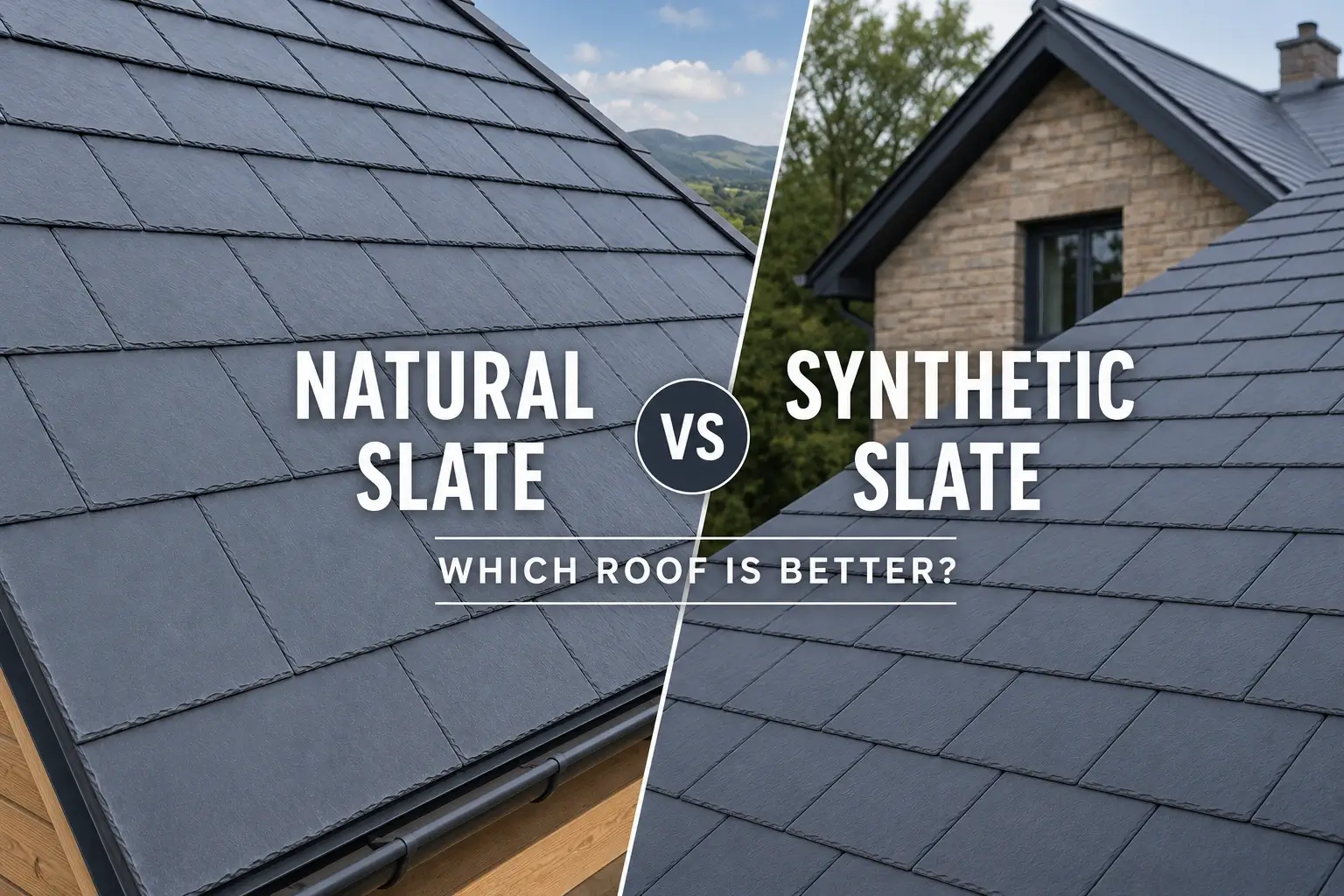
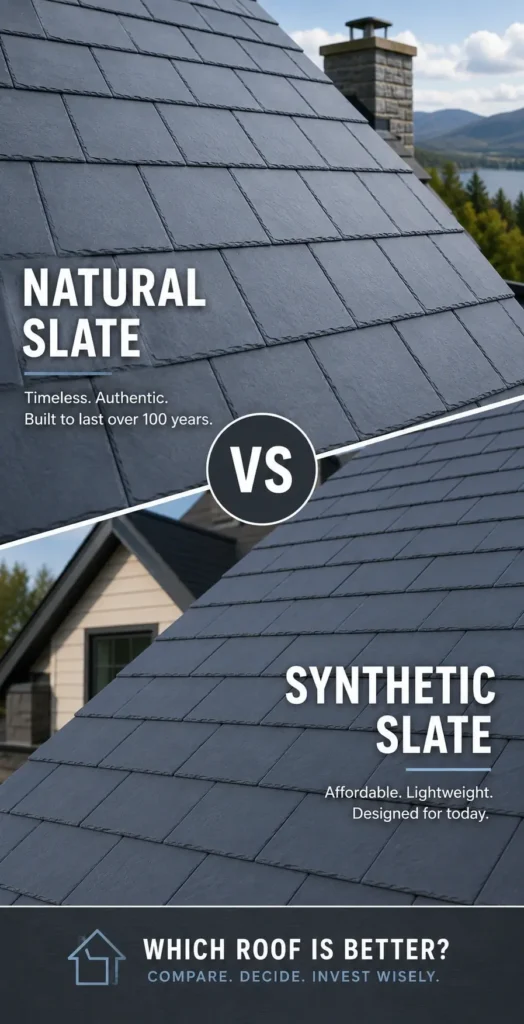
Natural Slate vs Synthetic Slate
Compare natural slate and synthetic slate roofing in terms of appearance, durability, lifespan, cost, maintenance, and long-term value. This guide helps homeowners, architects, and builders choose the right roofing material for their project.
Choosing the right roofing material is one of the most important decisions when building a new home or replacing an existing roof. Many homeowners, architects, and contractors compare natural slate vs synthetic slate roofing because both offer a similar appearance, yet they differ significantly in material, durability, lifespan, cost, maintenance, sustainability, and long-term value.
While synthetic slate roofing is often selected for its lower upfront cost and lighter weight, natural slate roofing has been trusted for centuries thanks to its authentic beauty, exceptional durability, and service life that can exceed 100 years.
In this comprehensive guide, you’ll discover the key differences between natural slate and synthetic slate, compare their pros and cons, and learn which roofing material is the better investment for your project.
Table of Contents
Natural Slate vs Synthetic Slate: Quick Comparison
If you’re looking for a quick overview, the table below highlights the most important differences between natural slate roofing and synthetic slate roofing. Compare their materials, appearance, lifespan, durability, maintenance, cost, sustainability, and long-term value to see which roofing option best fits your home or commercial project.
Comparison Table
| Feature | Natural Slate Roofing | Synthetic Slate Roofing |
|---|---|---|
| Material | 100% Natural Stone | Polymer, Rubber or Composite Materials |
| Appearance | Authentic stone texture with natural color variation | Manufactured to imitate natural slate |
| Lifespan | 75–150+ Years | 20–50 Years |
| Durability | Exceptional | Good |
| Weather Resistance | Excellent in rain, snow, frost and UV exposure | Good, but varies by manufacturer |
| Fire Resistance | Non-combustible (Class A) | Generally Class A rated, depending on product |
| UV Resistance | Permanent natural color | May fade after prolonged UV exposure |
| Weight | Heavy (requires adequate roof structure) | Lightweight |
| Maintenance | Very Low | Low to Moderate |
| Repairability | Individual slates can be replaced | Repairs depend on product design |
| Initial Cost | Higher | Lower |
| Lifetime Value | Excellent | Moderate |
| Sustainability | Natural, recyclable, long-lasting | Petroleum-based or recycled composite materials |
| Best For | Premium homes, heritage buildings, luxury projects | Budget-conscious renovations and lightweight roof structures |
Key Takeaway
Although synthetic slate roofing offers a lower upfront cost and easier installation, natural slate roofing delivers unmatched beauty, exceptional durability, and a service life that can exceed 100 years. For homeowners seeking the best long-term investment, natural slate remains the benchmark roofing material.
What Is Natural Slate Roofing?
Natural slate roofing is made from genuine metamorphic stone that was formed deep within the earth over millions of years through intense heat and pressure. Large blocks of slate are quarried and carefully split into roofing tiles along their natural cleavage, creating durable roof slates with a distinctive texture that cannot be replicated by manufactured products.
Unlike synthetic slate roofing, natural slate contains no plastics, polymers, resins, or chemical additives. Its color, texture, and strength are created entirely by nature, making it one of the most durable and sustainable roofing materials available. Natural slate is highly resistant to fire, moisture, frost, and UV exposure, allowing many slate roofs to last for more than a century with minimal maintenance.
Because every piece of stone is formed naturally, slight variations in color, grain, and surface texture are normal and contribute to the timeless beauty and character of a natural slate roof.
Every slate tile is naturally unique.
Why Choose Natural Slate?
- 100% natural stone with no artificial materials
- Formed naturally over millions of years
- Exceptional durability with a lifespan of 75–150+ years
- Naturally fire-resistant and weather-resistant
- Low maintenance and environmentally sustainable
- Authentic appearance that enhances property value
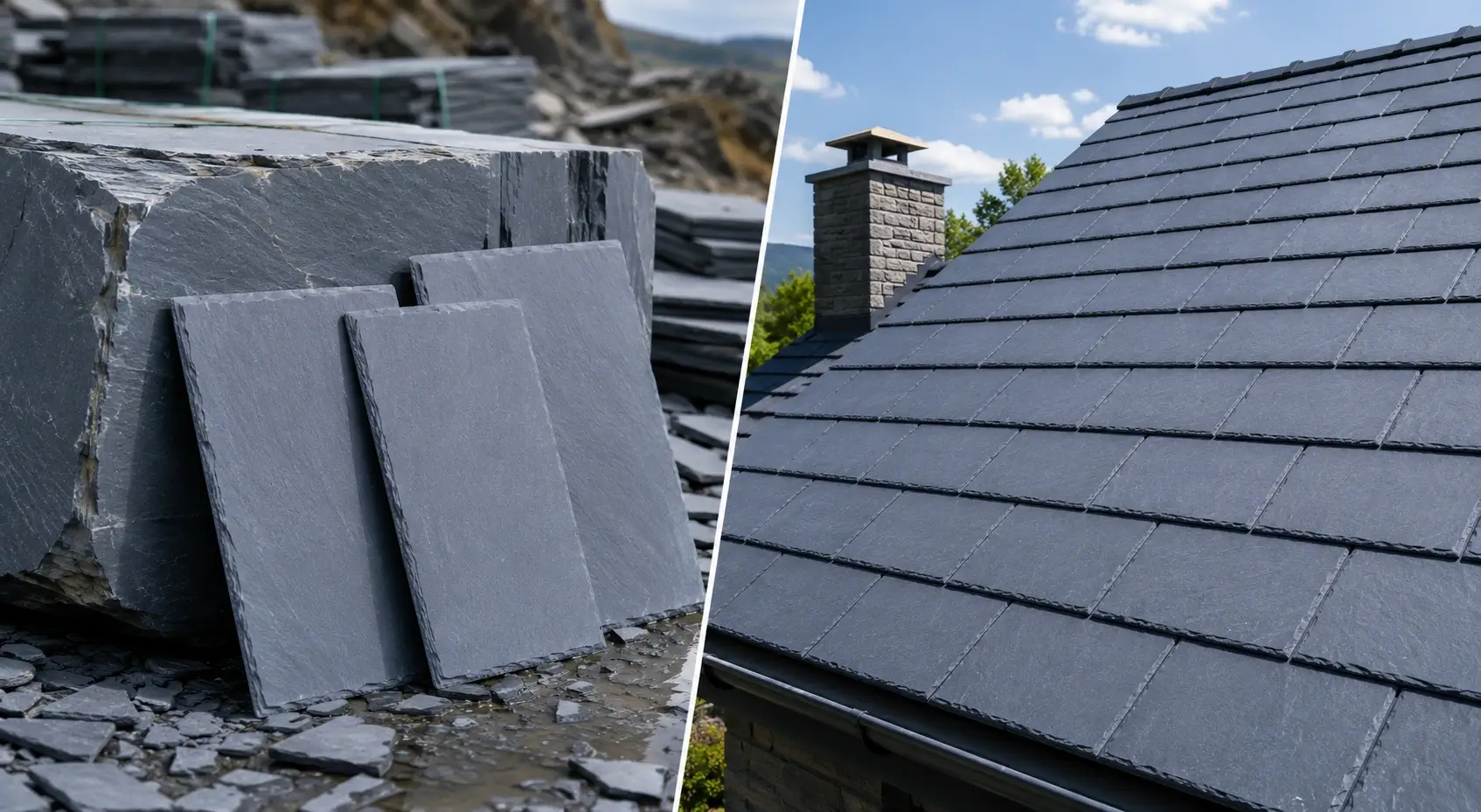
High-quality natural roofing slate, such as Jiujiang slate, combines the timeless beauty of genuine stone with excellent durability, consistent quality, and reliable performance for residential, commercial, and heritage roofing projects worldwide.
What Is Synthetic Slate Roofing?
Synthetic slate roofing is a manufactured roofing material designed to replicate the appearance of natural slate roofing while reducing weight and installation costs. Instead of being quarried from stone, synthetic slate tiles are typically made from recycled rubber, plastics, polymers, or composite materials, which are molded into shapes and textures that resemble genuine slate.
Modern synthetic slate roof tiles are engineered to provide a lightweight alternative for residential and commercial roofing projects. Their lower weight often makes installation easier and may reduce structural requirements, making them a practical option for certain roof renovations and new construction.
However, because synthetic slate is a manufactured product, its appearance, durability, weather resistance, and service life can vary depending on the material formulation and manufacturer. While many products successfully imitate the look of natural slate, they cannot fully reproduce the unique texture, natural color variation, and geological characteristics found in genuine stone.
Key Features of Synthetic Slate
- Manufactured from recycled rubber, plastics, polymers, or composite materials
- Molded to imitate the appearance of natural slate roofing
- Lightweight and easier to install than natural slate
- Lower initial cost for many roofing projects
- Available in a variety of colors and profiles
- Performance and lifespan vary by product and manufacturer
Why Homeowners Choose Synthetic Slate
Many homeowners choose synthetic slate roofing because it offers the visual appeal of a slate roof at a lower upfront cost. Its lighter weight can simplify installation and reduce the need for additional roof reinforcement, making it suitable for projects where structural limitations or budget are primary considerations.
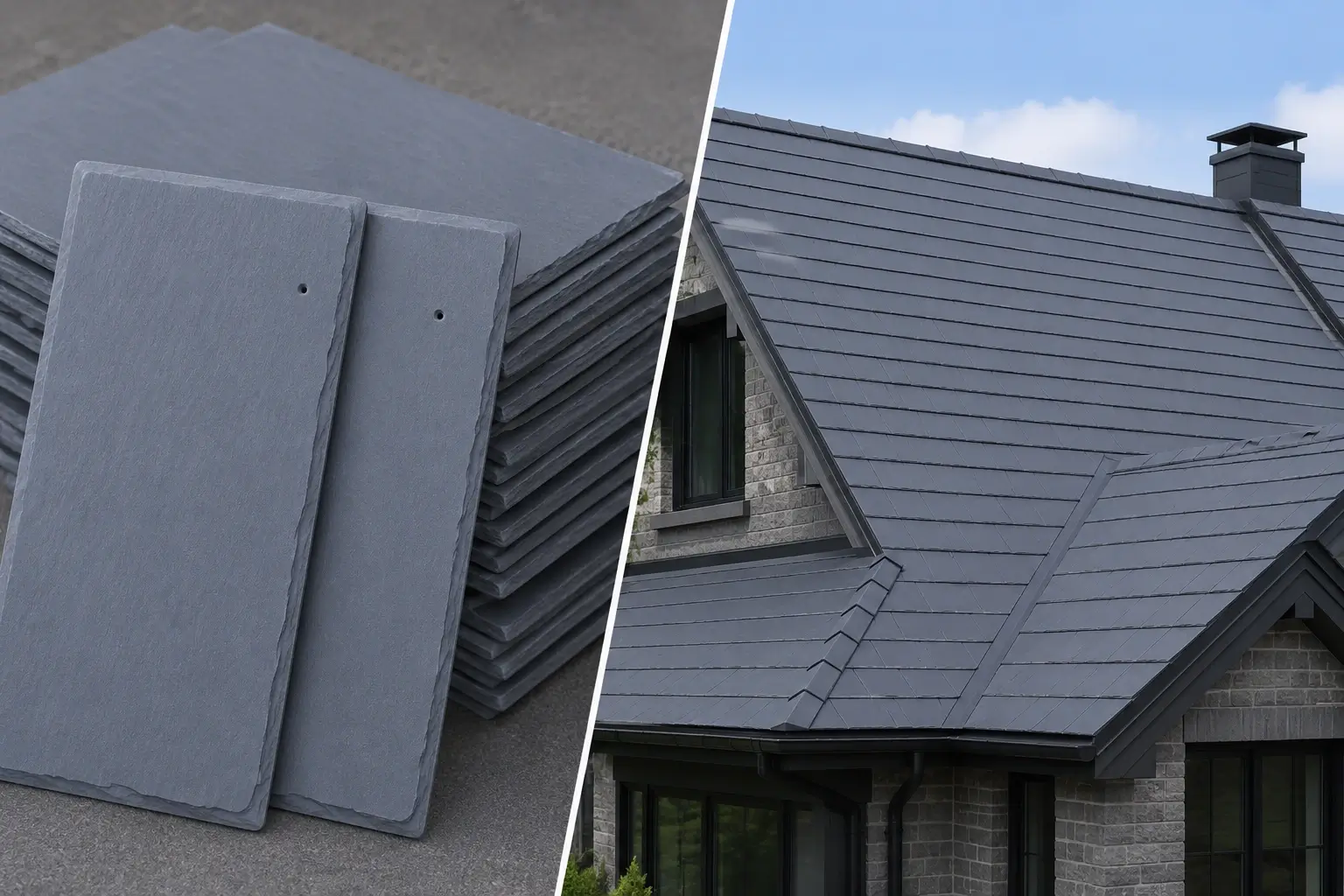
Although synthetic slate is designed to resemble natural slate, the differences in material, durability, lifespan, maintenance, and long-term value become much clearer when the two roofing materials are compared side by side.
Natural Slate vs Synthetic Slate Appearance
At first glance, natural slate roofing and synthetic slate roofing may look similar, especially from a distance. However, the differences become much more noticeable when viewed up close or after years of exposure to the elements. Texture, color variation, edge detail, and weathering all contribute to the distinctive character of a genuine slate roof.
Natural Slate: Authentic Beauty Created by Nature
Natural slate is genuine stone, formed naturally over millions of years. Each roofing slate is split along its natural layers, creating a natural cleft texture with subtle ridges and surface variations that cannot be manufactured.
Because slate is a natural material, every tile displays its own natural color variation, grain, and mineral patterns. These slight differences create a roof with depth, character, and a timeless appearance rather than a repetitive pattern.
Unlike manufactured materials, natural slate also ages beautifully. Its color remains stable for decades, while the stone develops a refined, weathered appearance that enhances both traditional and contemporary architecture.
Highlights
- Genuine natural stone
- Unique natural cleft texture
- Natural color variation in every tile
- Elegant, premium appearance
- Ages beautifully without losing authenticity
Synthetic Slate: Designed to Resemble Natural Slate
Synthetic slate roofing is manufactured using molds that replicate the surface of natural slate. Modern products can achieve a convincing appearance from street level, making them an attractive option for projects with budget or structural limitations.
However, because the tiles are produced from molds, the texture and surface patterns are repeated across many pieces. The overall appearance is typically more uniform and consistent, lacking the subtle variations found in genuine stone.
Depending on the material formulation and UV resistance, some synthetic slate products may gradually fade or weather differently over time. At close viewing distances, the molded texture and manufactured edges are generally easier to distinguish from authentic slate.
Highlights
- Molded stone-like texture
- Uniform appearance with repeated patterns
- Lightweight and consistent dimensions
- Available in various colors and profiles
- Some products may fade after prolonged UV exposure
Key Difference
Natural slate offers a level of authenticity that comes from real stone. Its unique texture, natural color variation, and graceful aging create a roof with lasting character. While modern synthetic slate can closely imitate its appearance, especially from a distance, it cannot fully reproduce the individuality and geological beauty of genuine natural slate.
| Appearance Feature | Natural Slate Roofing | Synthetic Slate Roofing |
|---|---|---|
| Texture | Natural cleft stone texture | Molded texture |
| Surface Pattern | Every tile is unique | Repeated mold patterns |
| Color | Natural color variation | More uniform color |
| Edge Detail | Hand-split natural edges | Manufactured edges |
| Aging | Ages beautifully | Appearance depends on material |
| Close-Up Look | Genuine natural stone | Artificial appearance is easier to notice |
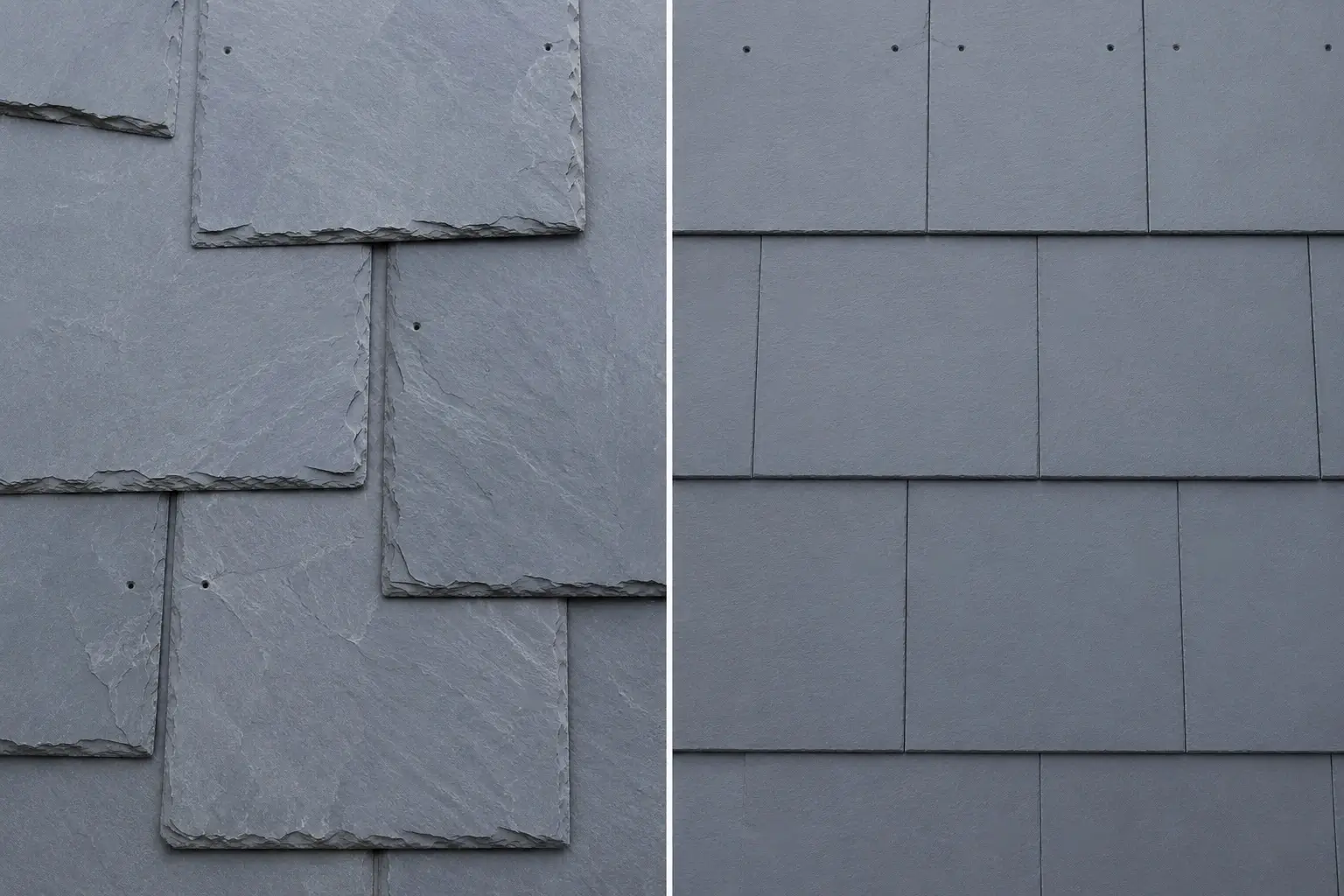
For premium roofing projects where authenticity, architectural character, and long-term visual appeal are priorities, natural slate remains the gold standard. No manufactured material can exactly replicate the unique texture and individuality created by millions of years of geological formation.
Durability & Lifespan
When investing in a new roof, durability and lifespan are among the most important factors to consider. Although both natural slate roofing and synthetic slate roofing are designed to provide long-lasting protection, they perform very differently over decades of exposure to sunlight, rain, snow, frost, and temperature changes. Understanding these differences can help you choose the roofing material that offers the best long-term value.
Comparison Table
| Factor | Natural Slate Roofing | Synthetic Slate Roofing |
|---|---|---|
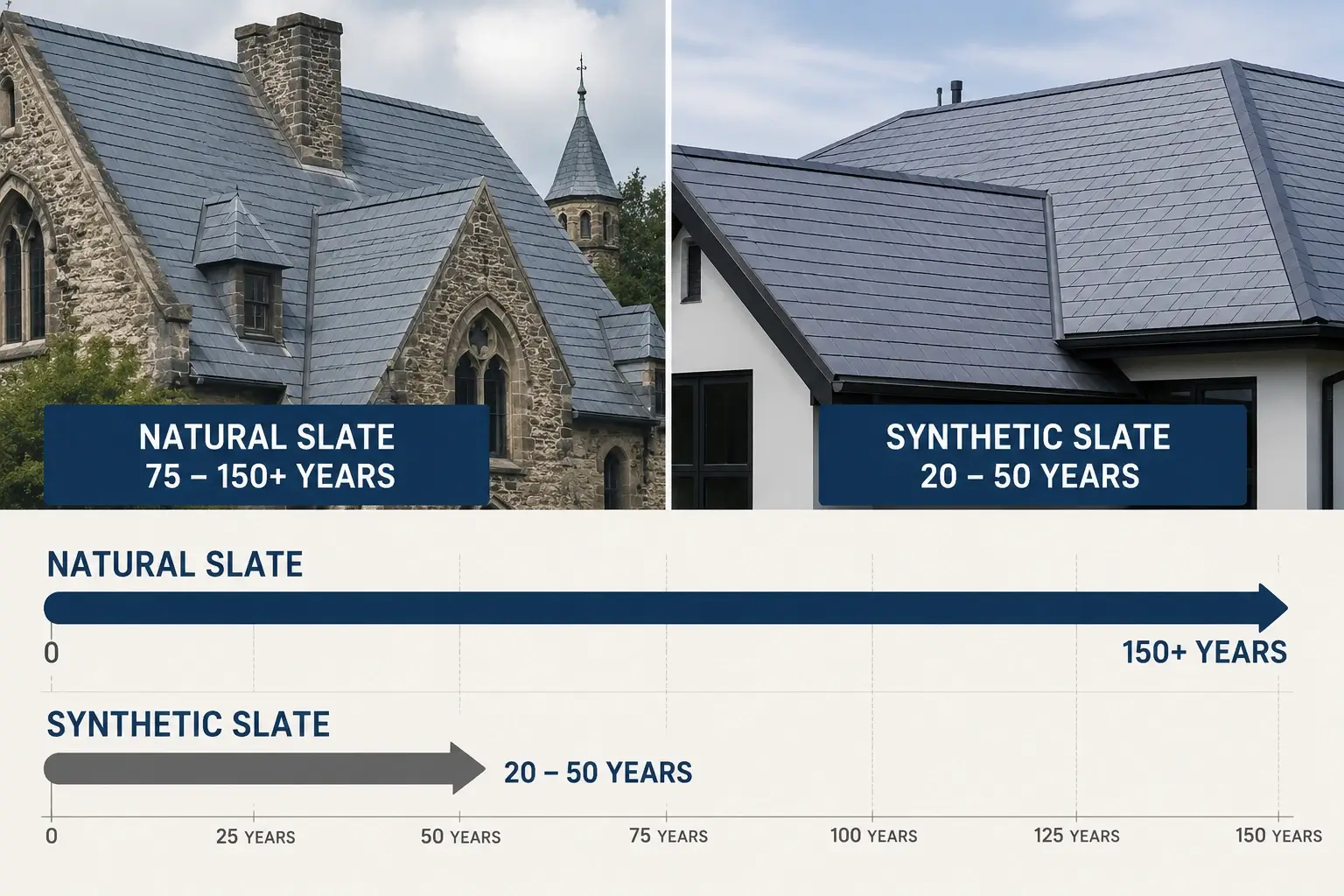
| Expected Lifespan | 75–150+ years | 20–50 years |
| Weather Resistance | Excellent | Good |
| Freeze-Thaw Resistance | Excellent | Good |
| UV Resistance | Excellent | Moderate |
| Color Stability | Permanent natural color | May gradually fade |
| Moisture Resistance | Excellent | Good |
| Impact Resistance | High (depending on slate grade) | Varies by material |
| Maintenance Requirements | Very low | Low to moderate |
Natural Slate: Built to Last for Generations
One of the greatest advantages of natural slate roofing is its exceptional longevity. Because it is solid natural stone rather than a manufactured product, slate is highly resistant to UV radiation, moisture, frost, fire, and extreme weather. High-quality natural slate roofs have protected homes, churches, and historic buildings for well over a century, with many remaining in service for 100 to 150 years or more when properly installed and maintained.
Unlike many roofing materials, natural slate does not warp, rot, or lose its structural integrity through normal weather exposure. Its color is created by naturally occurring minerals, so it remains stable without requiring paints or surface coatings.
Synthetic Slate: Durable, but with a Shorter Service Life
Modern synthetic slate roofing is engineered to withstand typical residential weather conditions and generally offers a longer lifespan than asphalt shingles. Depending on the product quality and installation, many synthetic slate roofs can perform well for 20 to 50 years.
However, because synthetic slate is manufactured from polymers, plastics, rubber, or composite materials, its long-term performance depends on material quality, UV stabilizers, and environmental conditions. Over time, some products may experience color fading, surface aging, or gradual material degradation, particularly in regions with intense sunlight or large temperature fluctuations.
Key Difference
Natural slate is a geological material that has already proven its durability over millions of years of natural formation. Synthetic slate is an engineered product designed for long-term performance, but its lifespan is ultimately limited by the aging characteristics of manufactured materials.
Why Lifespan Matters
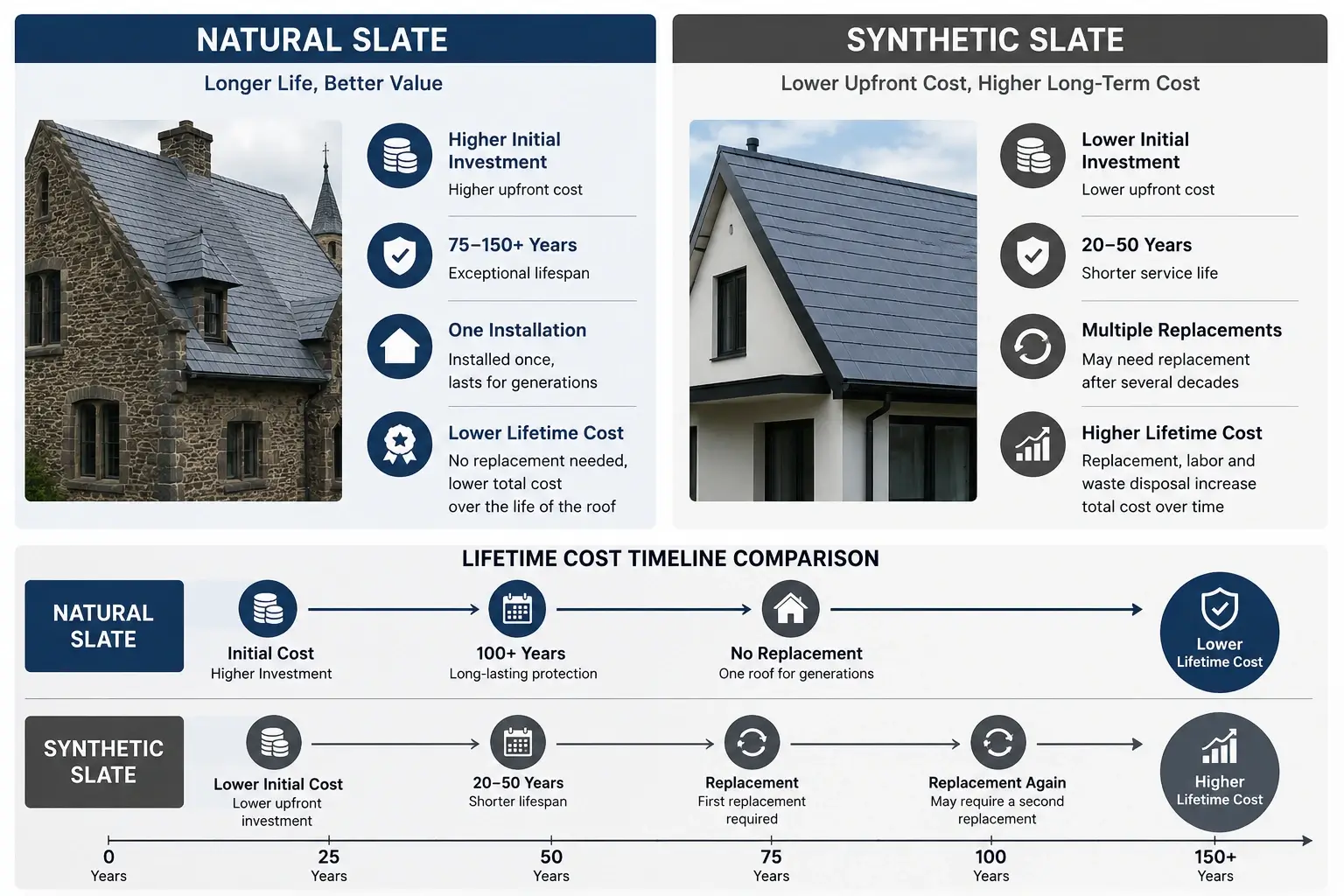
Although natural slate roofing typically has a higher initial purchase price, its exceptionally long service life often results in a lower lifetime cost. A roof that lasts more than a century may never need replacement during the lifetime of the building owner, reducing future material, labor, and disposal costs.
By comparison, synthetic slate roofing usually requires replacement much sooner, increasing the total cost of ownership over the life of the property.
A synthetic slate roof may need replacement two or even three times during the lifespan of a single natural slate roof. For homeowners seeking the greatest long-term value, durability, and peace of mind, natural slate remains one of the most reliable roofing materials available.
Cost Comparison: Initial Cost vs Lifetime Value
When comparing natural slate vs synthetic slate roofing, many buyers focus on the initial purchase price. However, the true cost of a roof should be measured over its entire service life. A roofing material with a higher upfront investment may deliver better long-term value if it lasts significantly longer and requires fewer repairs or replacements.
Instead of asking “Which roof costs less today?”, a better question is “Which roof costs less over the next 100 years?”
Comparison Table
| Cost Factor | Natural Slate Roofing | Synthetic Slate Roofing |
|---|---|---|
| Initial Material Cost | Higher | Lower |
| Installation Cost | Higher (specialist installation) | Lower |
| Expected Lifespan | 75–150+ years | 20–50 years |
| Maintenance Cost | Very low | Low to moderate |
| Replacement Frequency | Rare | May require one or more replacements |
| Lifetime Cost | Lower over the long term | Higher over multiple replacement cycles |
| Return on Investment (ROI) | Excellent | Moderate |
Initial Cost: Synthetic Slate Has the Advantage
For projects with limited budgets, synthetic slate roofing generally has a lower upfront cost. The lightweight material is often easier to transport and install, reducing both material and labor expenses.
By comparison, natural slate roofing requires a higher initial investment due to the cost of quarrying, processing, and professional installation. For some projects, this higher purchase price can be an important consideration during the planning stage.
Lifetime Cost: Natural Slate Delivers Greater Long-Term Value
While natural slate costs more initially, its exceptional lifespan and minimal maintenance requirements often make it the more economical choice over the long term.
A high-quality natural slate roof can protect a building for more than a century, meaning many homeowners will never need to replace it. In contrast, a synthetic slate roof may require replacement after several decades, resulting in additional expenses for materials, labor, and disposal.
When evaluating the Total Cost of Ownership (TCO) rather than the purchase price alone, natural slate frequently provides the better long-term investment.
Initial Cost vs Lifetime Cost
| Natural Slate | Synthetic Slate | |
|---|---|---|
| Initial Cost | 💰💰💰 Higher | 💰💰 Lower |
| Over 100 Years | One roof | Two or three roofs |
| Overall Value | Excellent | Moderate |
Key Takeaway
Choosing a roof based only on the initial purchase price can be misleading. When lifespan, maintenance, replacement costs, and property value are considered together, natural slate roofing often delivers the lowest Total Cost of Ownership and the highest long-term return on investment.
Although natural slate requires a higher upfront investment, its exceptional durability means that one natural slate roof can often outlast two or even three synthetic slate roofs, making it one of the most cost-effective roofing materials over the lifetime of a building.
Installation Comparison
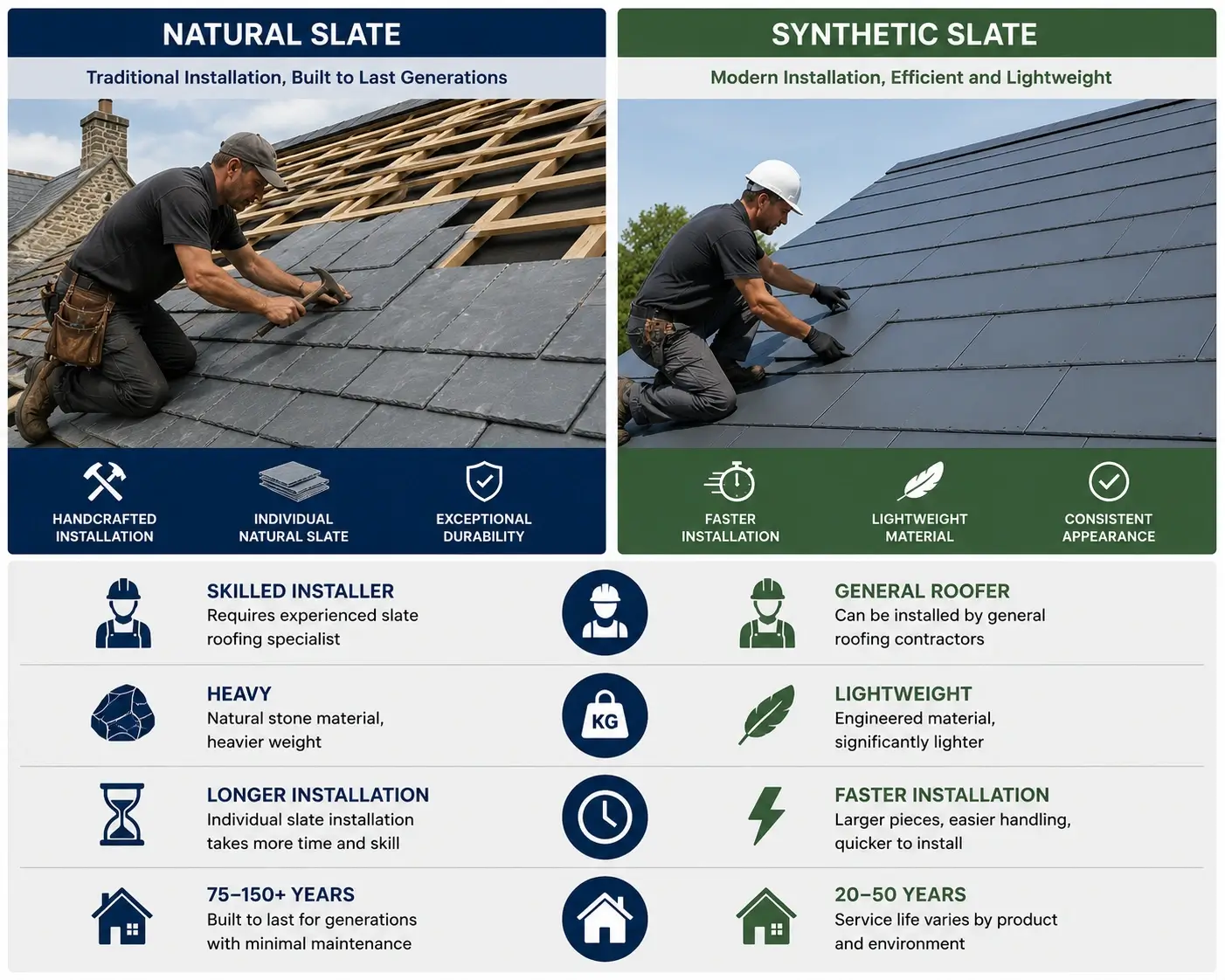
Both natural slate roofing and synthetic slate roofing can provide an attractive finished roof, but their installation requirements are quite different. Natural slate demands skilled craftsmanship and a properly designed roof structure, while synthetic slate is generally lighter and easier to install. Understanding these differences helps homeowners and builders balance installation cost, structural requirements, and long-term performance.
Comparison Table
| Installation Factor | Natural Slate Roofing | Synthetic Slate Roofing |
|---|---|---|
| Weight | Heavy | Lightweight |
| Roof Structure | Stronger roof framing required | Suitable for many standard roof structures |
| Installation Method | Traditional slate roofing techniques | Similar to conventional roofing systems |
| Installer Experience | Requires experienced slate roofing installers | Easier for general roofing contractors |
| Installation Speed | Slower | Faster |
| Installation Cost | Higher | Lower |
| Long-Term Performance | Excellent | Depends on product quality |
Natural Slate: Professional Installation for Maximum Performance
Installing natural slate roofing requires experienced craftsmen who understand traditional slate roofing techniques. Each slate tile is individually positioned and fixed to create a roof capable of lasting for generations.
Because natural slate is heavier than most manufactured roofing materials, the building must have adequate roof framing to safely support the additional weight. When installed correctly, a natural slate roof offers outstanding weather resistance, exceptional durability, and minimal maintenance for decades.
Although installation requires more time and skilled labor, it is an investment in long-term performance rather than simply a construction cost.
Synthetic Slate: Faster and Easier Installation
One of the main advantages of synthetic slate roofing is its lightweight design. Because the tiles weigh significantly less than natural slate, they are easier to handle, transport, and install.
Many synthetic slate systems can be installed by general roofing contractors using installation methods similar to other roofing products. This often reduces labor time and installation costs, making synthetic slate an attractive option for projects with tight budgets or structural limitations.
Key Difference
Natural slate requires greater installation expertise and a stronger supporting structure, but this contributes to its exceptional longevity and performance. Synthetic slate is easier and faster to install, making it more economical in the short term.
Easy installation does not necessarily mean longer service life.
Which Installation Option Is Right for You?
Choose Natural Slate Roofing if you:
- Want a roof that can last for generations
- Are building a premium or heritage property
- Have a roof structure designed for natural slate
- Value long-term durability over initial installation cost
Choose Synthetic Slate Roofing if you:
- Need a lightweight roofing solution
- Have structural weight limitations
- Want faster installation
- Are working within a tighter construction budget
Want to learn how a natural slate roof is installed? Read our complete Roofing Slate Installation Guide for step-by-step methods, fastening options, and professional installation tips.
Environmental Impact
Sustainability has become an increasingly important factor when selecting roofing materials. While both natural slate roofing and synthetic slate roofing can provide long-lasting protection, their environmental impact differs significantly. The materials they are made from, their expected lifespan, and how often they need to be replaced all influence their overall environmental footprint.
Comparison Table
| Environmental Factor | Natural Slate Roofing | Synthetic Slate Roofing |
|---|---|---|
| Raw Material | Natural stone | Polymers, plastics, rubber or composite materials |
| Chemical Additives | None | Typically contains synthetic additives |
| Renewable Resource | Natural geological material | Petroleum-based or manufactured materials |
| Expected Lifespan | 75–150+ years | 20–50 years |
| Replacement Frequency | Very low | Higher over a building’s lifetime |
| Recyclability | Can often be reused or recycled as stone | Depends on product and local recycling facilities |
| Lifetime Carbon Impact | Lower over its service life | Generally higher due to shorter lifespan |
Natural Slate: A Naturally Sustainable Roofing Material
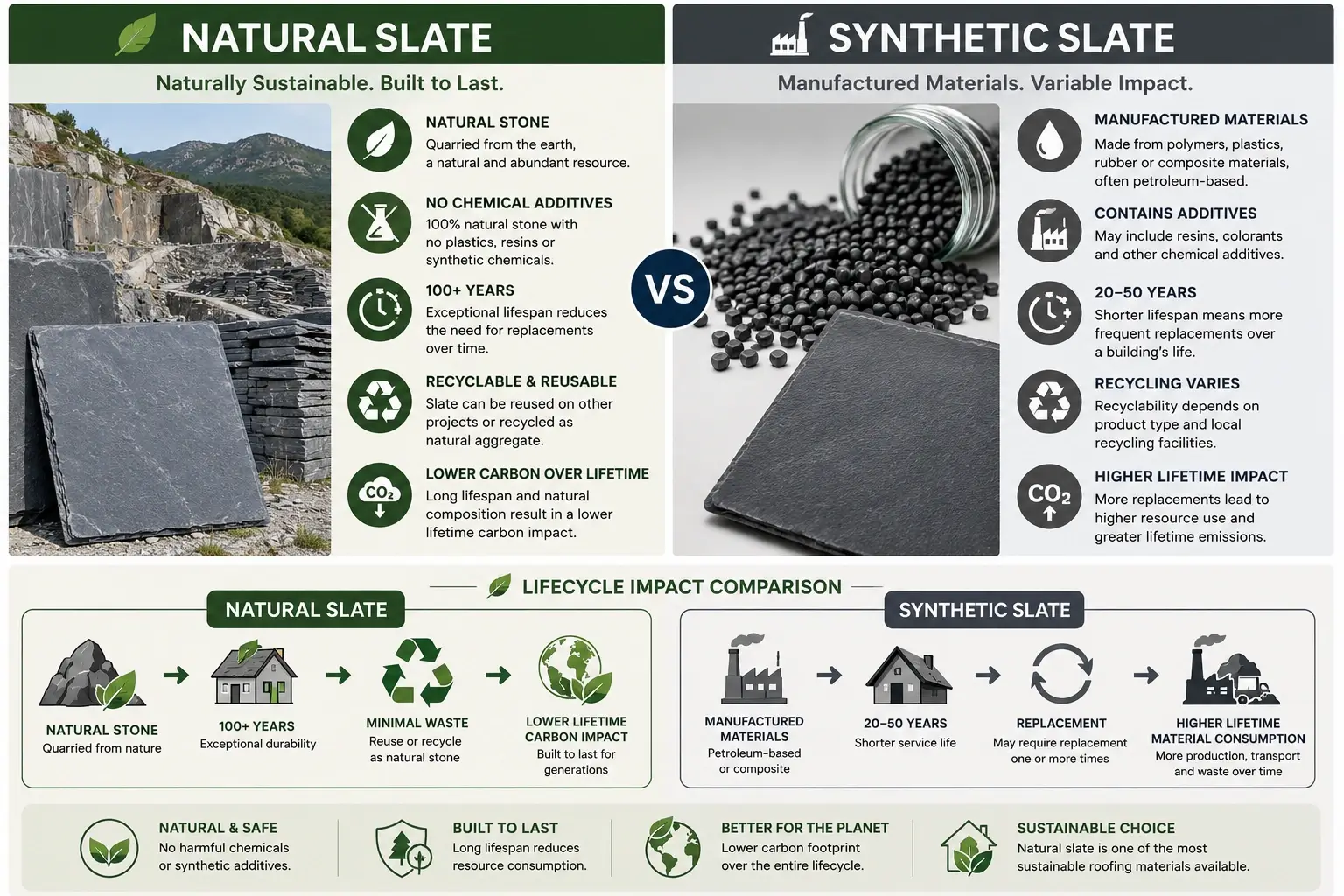
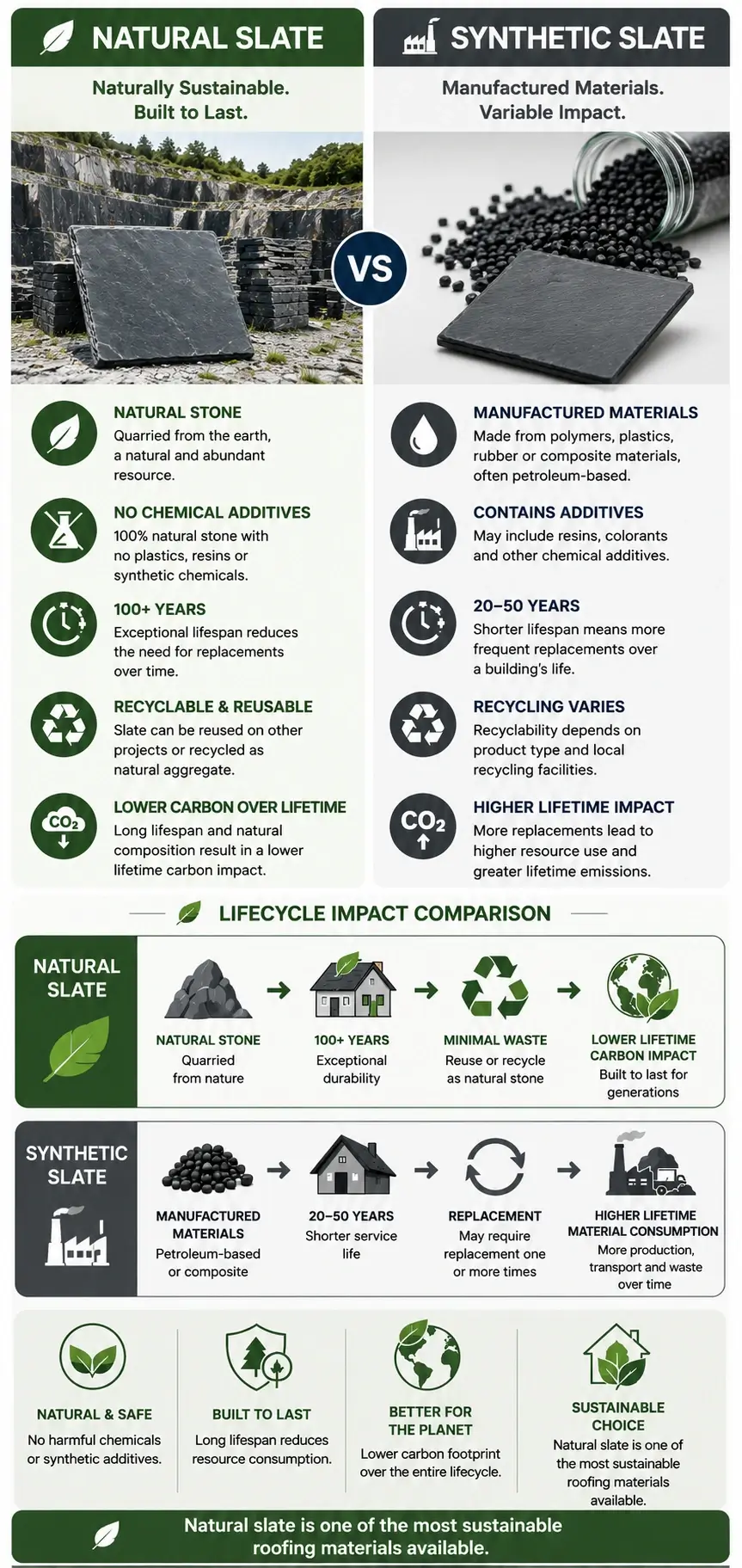
Natural slate roofing is produced from genuine stone that has been formed naturally over millions of years. It contains no plastics, resins, synthetic polymers, or chemical additives, making it one of the most environmentally friendly roofing materials available.
Because natural slate can last for more than 100 years, it rarely needs replacement during the lifetime of a building. This significantly reduces the demand for new materials, transportation, manufacturing, and construction waste. At the end of its service life, many slate tiles can also be reused on restoration projects or recycled as natural stone aggregate.
Synthetic Slate: Manufactured for Performance
Synthetic slate roofing is typically manufactured from recycled rubber, plastics, polymers, or composite materials. Some products incorporate recycled content, which helps reduce waste and makes use of existing resources.
However, synthetic slate remains a manufactured material. Its environmental impact depends on the raw materials used, manufacturing processes, product lifespan, and the recycling options available in each region. Because most synthetic slate roofs have a shorter service life than natural slate, they may require replacement more frequently over the lifetime of a building.
Why Lifetime Matters for Sustainability
When evaluating environmental performance, it is important to look beyond the materials used on the day of installation.
A roof that lasts for more than a century generally requires fewer replacement materials, less transportation, fewer installation cycles, and produces less construction waste than a roof that must be replaced every few decades. For this reason, lifecycle performance is an important part of sustainable building design.
Key Takeaway
Natural slate combines natural materials, no chemical additives, exceptional durability, and an extremely long service life, making it one of the most sustainable roofing materials available. While some synthetic slate products include recycled content, their overall environmental impact depends on product composition, lifespan, and end-of-life recycling options.
The most sustainable roof is not simply the one made from recycled materials—it is the one that delivers outstanding performance for the longest possible time with the fewest replacements. In this respect, natural slate continues to set the benchmark for sustainable roofing.
Maintenance Requirements
A roof that requires less maintenance not only saves time and money but also reduces the risk of unexpected repairs. Both natural slate roofing and synthetic slate roofing are considered relatively low-maintenance roofing materials, but their long-term maintenance requirements are quite different due to the materials from which they are made.
Comparison Table
| Maintenance Factor | Natural Slate Roofing | Synthetic Slate Roofing |
|---|---|---|
| Routine Maintenance | Very little | Periodic inspection recommended |
| Color Stability | Permanent natural color | May gradually fade over time |
| Surface Aging | Natural weathering | May show material aging |
| Cracking Risk | Low (high-quality slate) | Possible, depending on material and age |
| Replacement Frequency | Very low | Higher over time |
| Overall Maintenance | Minimal | Low to moderate |
Natural Slate: Minimal Maintenance for Decades
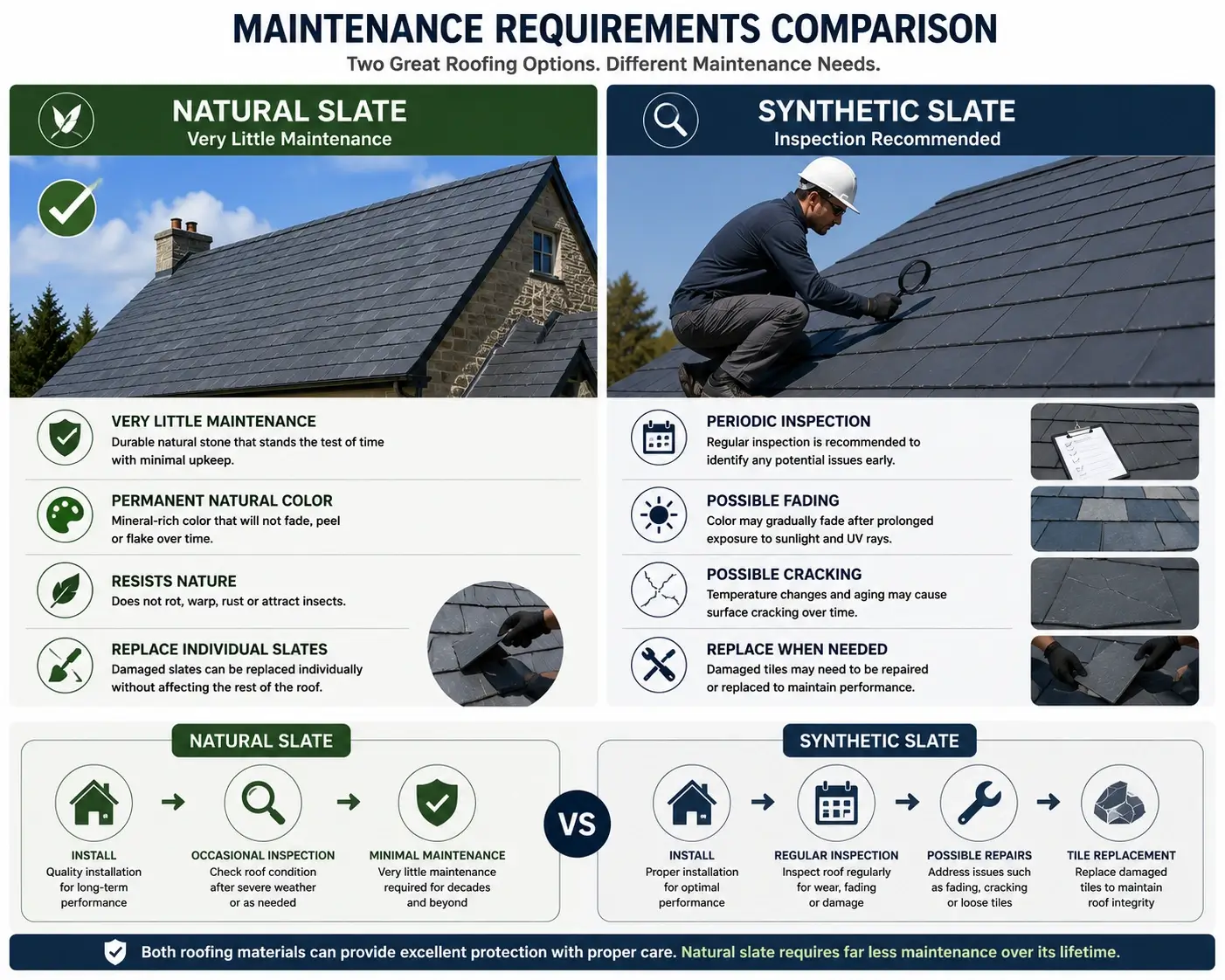
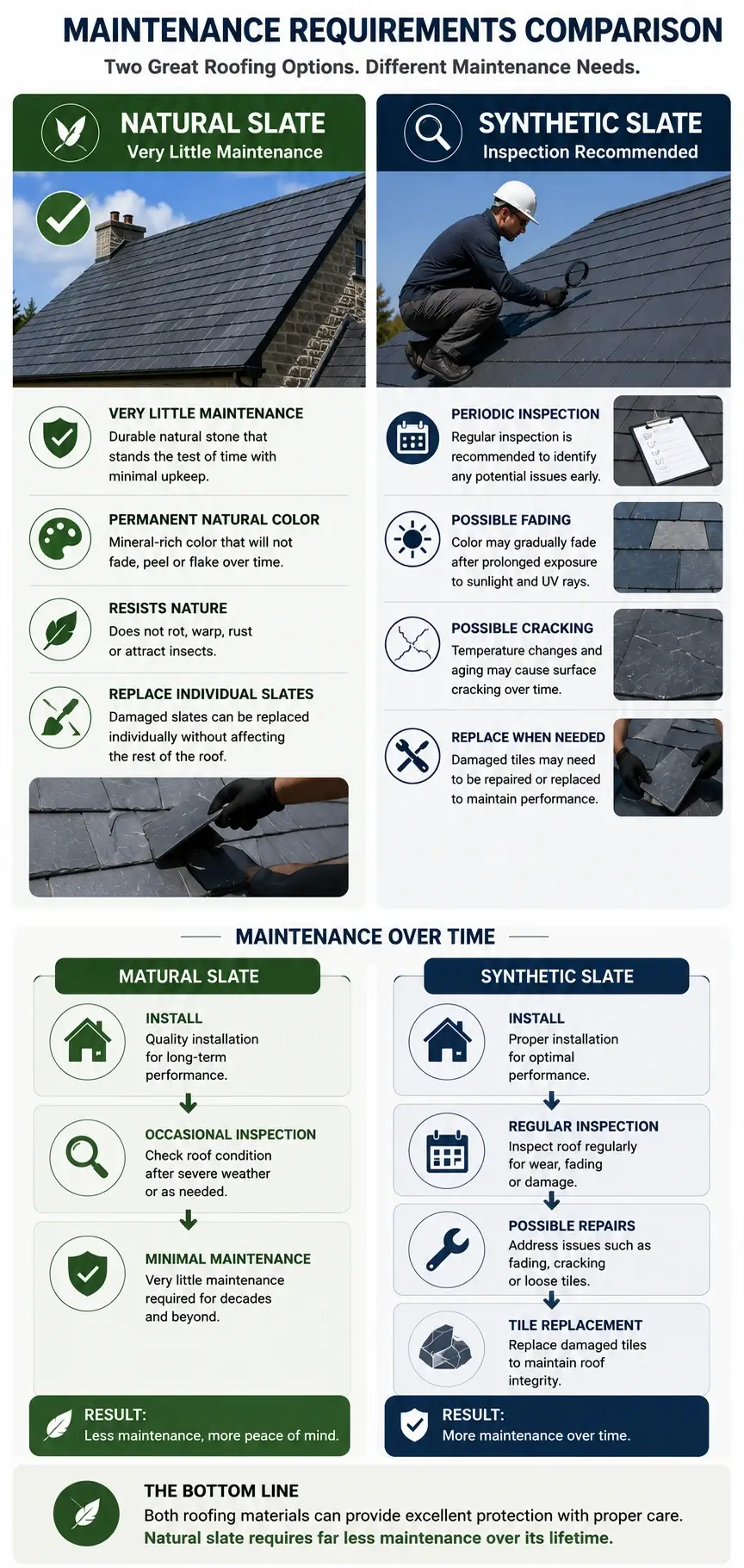
One of the greatest advantages of natural slate roofing is its exceptionally low maintenance requirements. Because slate is a dense, durable natural stone, it does not rot, warp, rust, or require painting. Its natural color is created by minerals within the stone, so it will not peel or lose its appearance like coated roofing materials.
Routine maintenance usually involves keeping gutters clean, removing debris, and carrying out occasional inspections after severe storms. If a slate tile is damaged by external impact, it can often be replaced individually without affecting the rest of the roof.
Synthetic Slate: Regular Inspection Is Recommended
Synthetic slate roofing also requires relatively little maintenance compared with many conventional roofing materials. However, because it is manufactured from polymers, plastics, rubber, or composite materials, periodic inspections are recommended to check for signs of wear or damage.
Depending on the product quality and climate, some synthetic slate roofs may experience color fading, surface weathering, or minor cracking after years of exposure to sunlight and temperature changes. Early inspection and timely replacement of damaged tiles can help maintain the roof’s appearance and performance.
Key Difference
Natural slate requires very little maintenance throughout its exceptionally long service life. Synthetic slate is also relatively easy to maintain, but regular inspections are advisable to identify potential fading, weathering, or cracking before they become more significant issues.
Maintenance at a Glance
Natural Slate Roofing
- ✔ Very little routine maintenance
- ✔ Permanent natural color
- ✔ Resistant to rot, rust, and insects
- ✔ Individual slate tiles can be replaced if damaged
- ✔ Excellent long-term performance
Synthetic Slate Roofing
- ✔ Lightweight and easy to inspect
- ✔ Periodic roof inspections recommended
- ✔ Monitor for fading and material aging
- ✔ Check for cracking after severe weather
- ✔ Replace damaged tiles when necessary
Both roofing materials are relatively low maintenance compared with many traditional roofing systems. However, natural slate offers the advantage of exceptional durability and long-term stability, allowing many roofs to perform for decades with only minimal maintenance.
Want practical maintenance advice? Read our complete Roofing Slate Maintenance Guide to learn how to inspect, clean, and care for a natural slate roof to maximize its service life.
Weather Performance
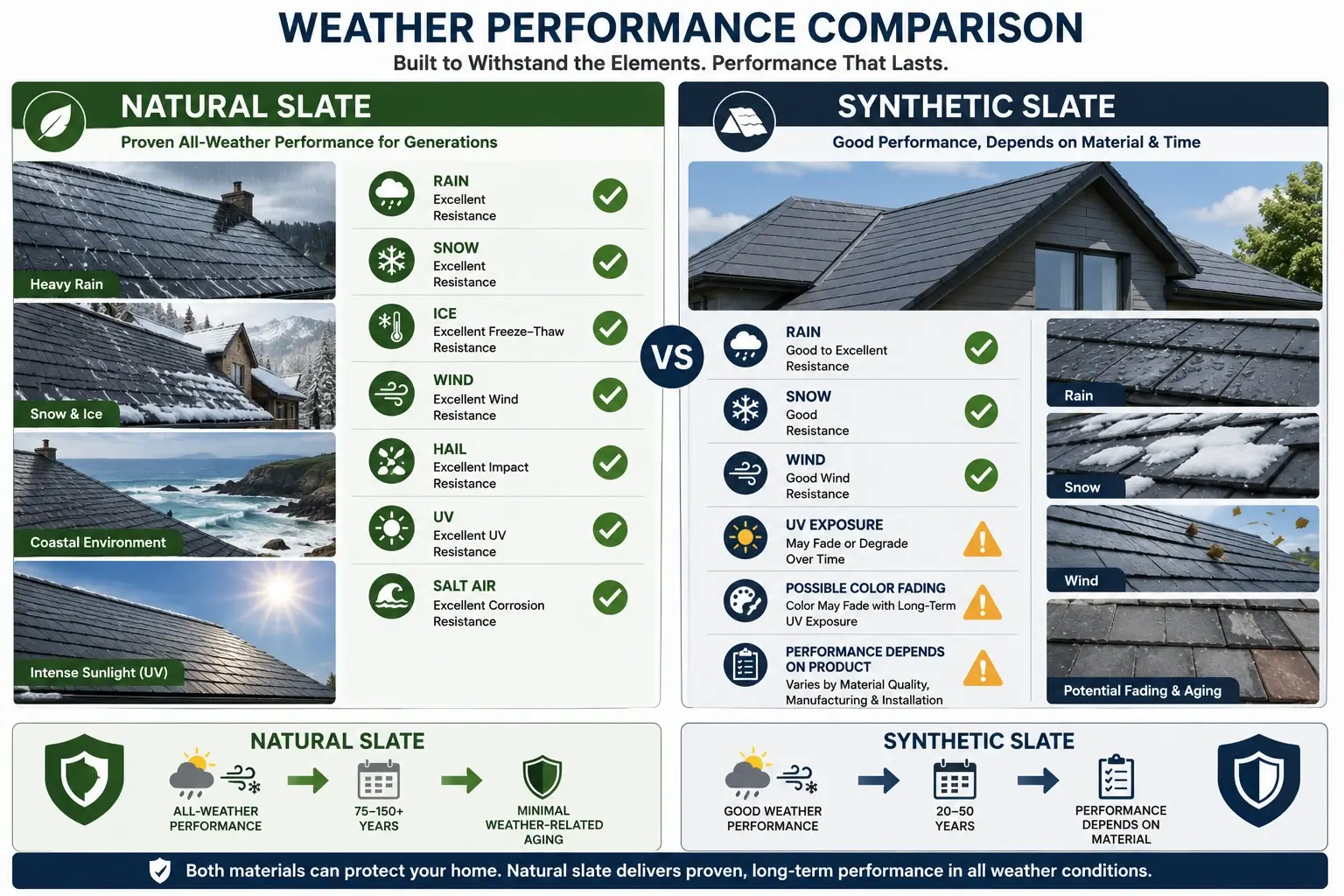
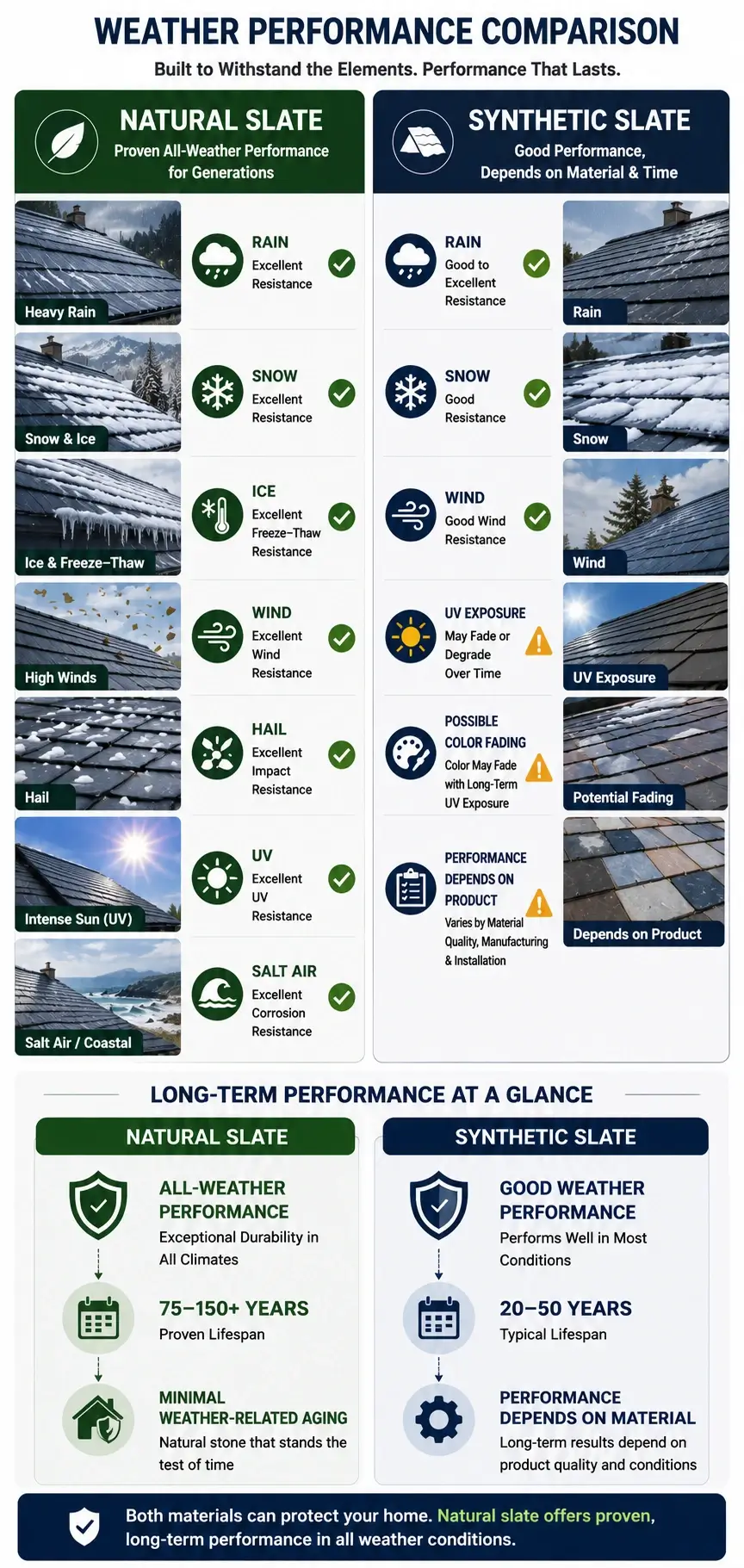
A roof must perform reliably in all weather conditions, from heavy rain and snow to strong winds, intense sunlight, and coastal environments. While both natural slate roofing and synthetic slate roofing are designed for outdoor durability, their long-term performance can differ depending on the climate and the materials from which they are made.
Weather Performance Comparison
| Weather Condition | Natural Slate Roofing | Synthetic Slate Roofing |
|---|---|---|
| 🌧 Rain | Excellent | Good to Excellent |
| ❄ Snow | Excellent | Good |
| 🧊 Freeze-Thaw Cycles | Excellent | Good |
| 💨 High Winds | Excellent (when properly installed) | Good (varies by product) |
| 🧱 Hail Resistance | Excellent (depends on slate grade) | Good (depends on material) |
| ☀ UV Exposure | Excellent – Natural color remains stable | Moderate to Good – May fade over time |
| 🌊 Salt Air / Coastal Areas | Excellent | Good (varies by material formulation) |
Natural Slate: Proven Performance in Every Climate
Natural slate roofing has protected homes and historic buildings for centuries in some of the world’s harshest climates. It is naturally resistant to rain, snow, frost, UV radiation, fire, and salt air, making it suitable for both cold northern regions and sunny coastal environments.
Because slate is solid natural stone, it is not affected by prolonged sunlight in the same way as many manufactured materials. Its mineral-based color remains stable for decades, while its dense structure provides outstanding resistance to moisture penetration and freeze-thaw damage.
Synthetic Slate: Reliable Performance with Material Limitations
Modern synthetic slate roofing is engineered to perform well in a wide range of weather conditions. Many products are tested for wind uplift, impact resistance, and moisture protection, making them suitable for most residential roofing applications.
However, long-term performance depends on the product formulation and installation quality. Extended exposure to intense UV radiation, temperature fluctuations, or severe weather may contribute to surface aging, color fading, or material deterioration over time. Performance can also vary between manufacturers.
Which Roofing Material Performs Better?
Both roofing materials provide dependable weather protection when properly installed. However, for projects where maximum durability, long-term weather resistance, and proven performance are priorities, natural slate has a long history of success across diverse climates, from snowy mountain regions to windy coastlines.
Best Roofing Material by Climate
| Climate | Recommended Roofing Material |
|---|---|
| Heavy Rain | Natural Slate ⭐ |
| Snow & Ice | Natural Slate ⭐ |
| Coastal Areas | Natural Slate ⭐ |
| High UV Regions | Natural Slate ⭐ |
| Strong Wind Zones | Natural Slate ⭐ (with proper installation) |
| Budget Renovations | Synthetic Slate ✓ |
| Lightweight Roof Structures | Synthetic Slate ✓ |
Key Takeaway
Natural slate has been proven in real-world conditions for centuries, offering exceptional resistance to rain, snow, frost, UV exposure, wind, and coastal environments. While synthetic slate performs well in many climates, its long-term weather resistance depends on the quality of the manufactured material and may vary between products.
Natural slate has protected homes, churches, castles, and public buildings around the world for hundreds of years, demonstrating exceptional performance in a wide variety of climates and weather conditions.
Industry Standards and Quality Testing
When comparing natural slate roofing and synthetic slate roofing, it is important to look beyond appearance and consider how roofing materials are evaluated for long-term performance. High-quality natural roofing slate is commonly tested in accordance with internationally recognized standards to verify its durability, strength, and suitability for roofing applications.
Key performance indicators include:
- ASTM C406 – Standard specification for roofing slate used in North America.
- EN 12326 – European standard for natural slate and stone roofing products.
- Water Absorption – Measures the slate’s ability to resist moisture penetration.
- Flexural Strength – Evaluates the slate’s resistance to bending and breaking under load.
- Freeze-Thaw Resistance – Assesses long-term durability in cold climates with repeated freezing and thawing cycles.
Choosing roofing slate that complies with recognized industry standards helps ensure consistent quality, reliable performance, and a long service life.
Learn more: Read our ASTM C406 Roofing Slate Guide and EN 12326 Roofing Slate Guide to understand how natural roofing slate is tested and classified.
| Quality Standard | What It Evaluates |
|---|---|
| ASTM C406 | Roofing slate classification and quality requirements |
| EN 12326 | European performance and durability standards |
| Water Absorption | Moisture resistance |
| Flexural Strength | Structural strength and load resistance |
| Freeze-Thaw Resistance | Performance in cold climates |
Expert Tip
Not all natural slate offers the same level of performance. When selecting roofing slate, always ask whether the material has been tested to recognized standards such as ASTM C406 or EN 12326. Certified test results provide greater confidence in the slate’s durability, weather resistance, and long-term service life.
High-quality natural roofing slate is commonly evaluated according to internationally recognized standards such as ASTM C406 in North America and EN 12326 in Europe. These standards assess important characteristics including water absorption, flexural strength, and freeze–thaw resistance, helping architects, builders, and homeowners select roofing slate that delivers proven long-term performance.
To learn more about how natural roofing slate is graded and tested, see our Roofing Slate Grades Guide.
Which Roof Adds More Property Value?
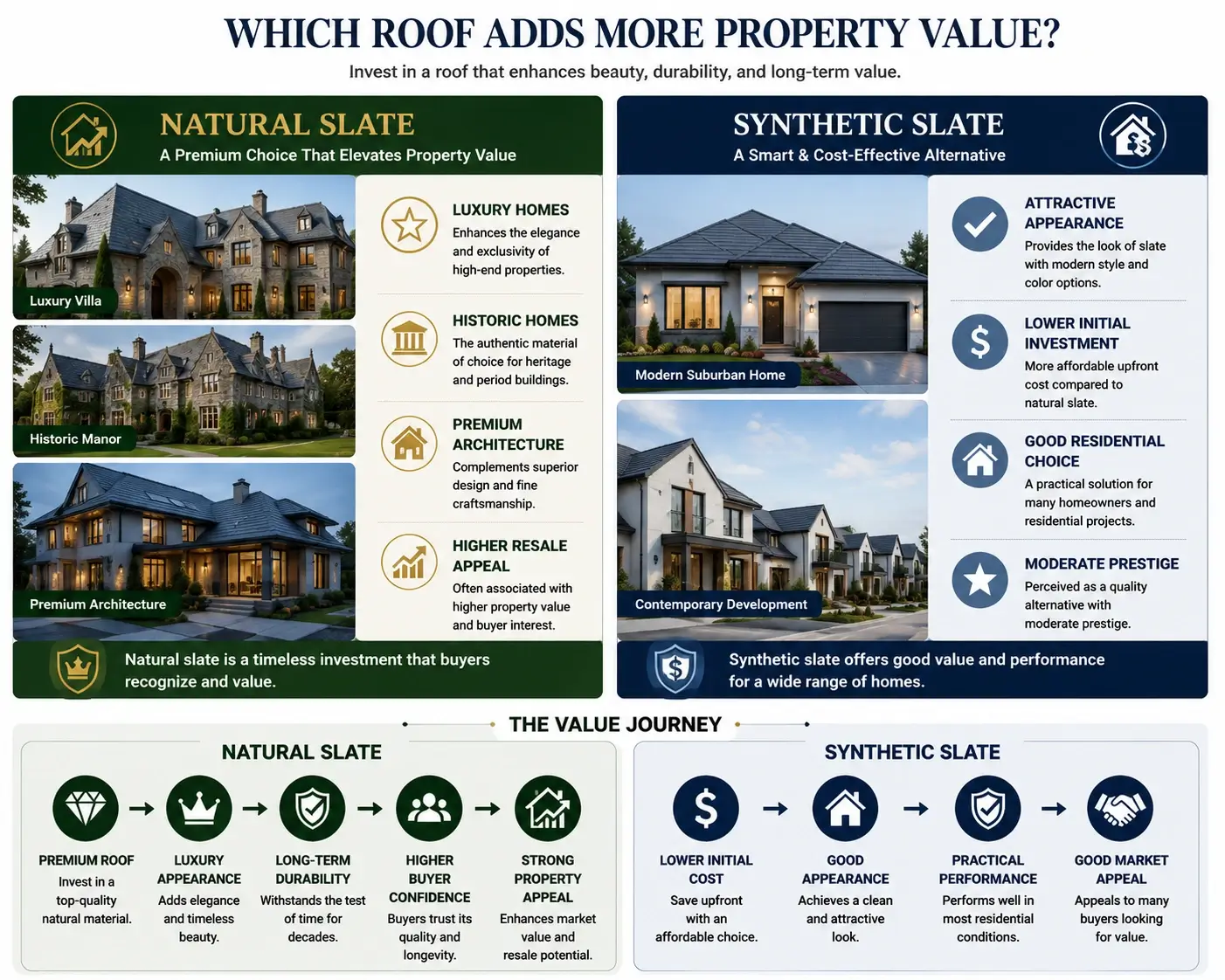
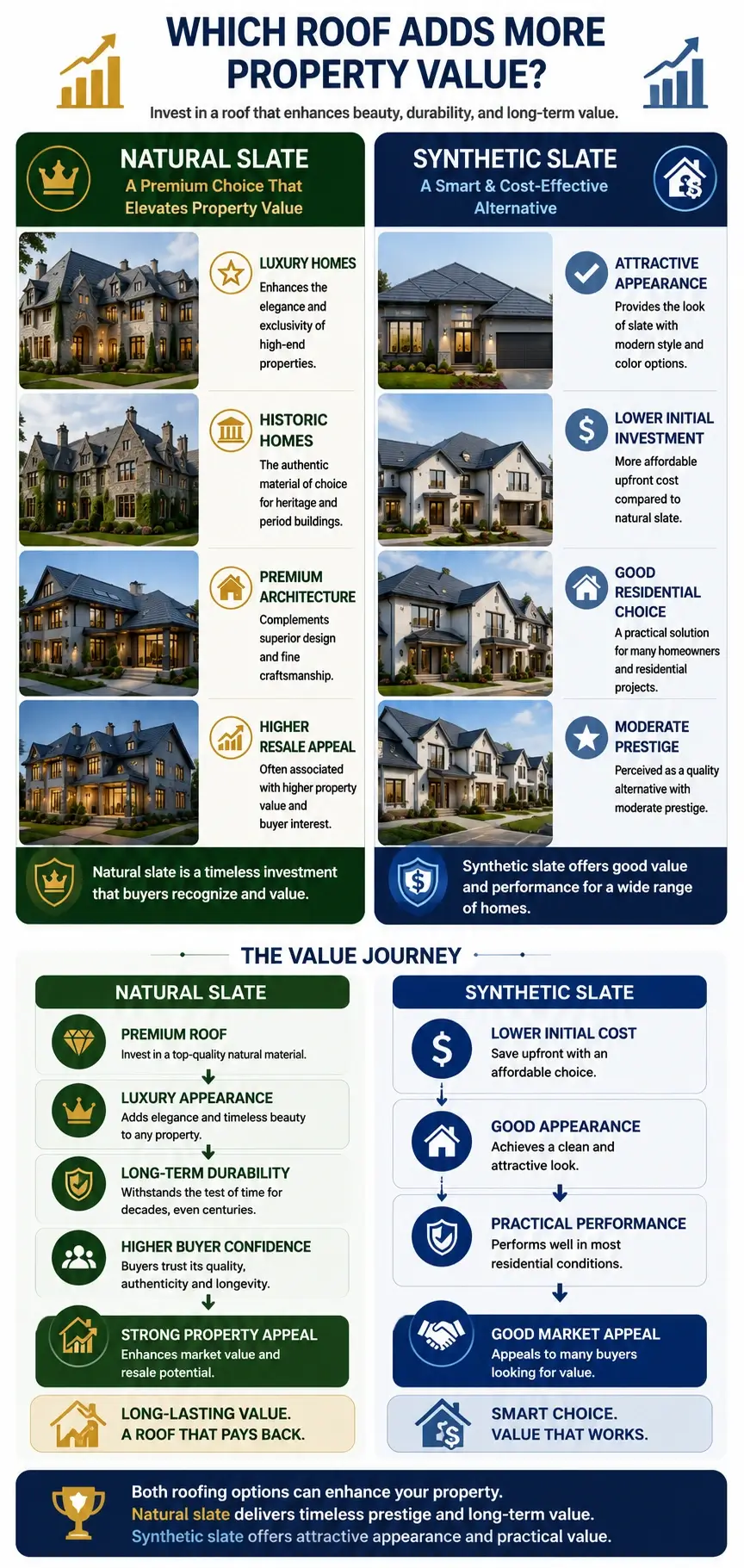
A new roof is more than a construction investment—it can also influence a property’s appearance, market appeal, and perceived value. Buyers often consider the quality, durability, and expected lifespan of a roof when evaluating a home. While both natural slate roofing and synthetic slate roofing can improve curb appeal, they are often perceived differently in the real estate market.
Comparison Table
| Property Value Factor | Natural Slate Roofing | Synthetic Slate Roofing |
|---|---|---|
| Luxury Appearance | Excellent | Good |
| Prestige | High | Moderate |
| Historic & Heritage Homes | Ideal | Generally not preferred |
| Premium Architecture | Excellent | Good |
| Buyer Perception | Premium natural material | Attractive manufactured alternative |
| Long-Term Value | Excellent | Good |
| Potential Resale Appeal | Often higher | Moderate |
Natural Slate: A Premium Roofing Material That Enhances Property Appeal
For centuries, natural slate roofing has been associated with luxury homes, historic buildings, prestigious public architecture, and high-end residential developments. Its authentic stone texture, natural color variation, and exceptional longevity create a distinctive appearance that is difficult to replicate with manufactured materials.
Because of its reputation for durability and craftsmanship, a natural slate roof is often viewed as a premium architectural feature. In many markets, buyers recognize natural slate as a long-lasting investment that may reduce future roof replacement costs, which can positively influence a property’s resale appeal.
Synthetic Slate: Attractive Appearance with Lower Initial Investment
Synthetic slate roofing offers an attractive slate-like appearance at a more affordable price. It is a practical choice for homeowners who want the look of slate while reducing installation costs or avoiding structural modifications.
Although modern synthetic slate products can enhance a home’s curb appeal, they are generally regarded as a manufactured alternative rather than genuine natural stone. As a result, they may not carry the same level of prestige or architectural significance as natural slate in premium or heritage properties.
When Does Natural Slate Add the Greatest Value?
Natural slate is particularly well suited for:
- Luxury homes
- Historic and heritage buildings
- High-end custom residences
- Traditional architecture
- Premium commercial buildings
- Long-term property investments
For these types of projects, natural slate is often chosen not only for its performance but also for its contribution to architectural character and long-term property appeal.
Key Takeaway
Both natural slate and synthetic slate can improve a property’s appearance. However, natural slate is widely regarded as a premium roofing material, valued for its authenticity, durability, and timeless architectural character. For homeowners seeking maximum long-term value and prestige, natural slate is often the preferred choice.
What Do Homebuyers Value Most?
When evaluating a roof, many buyers look for:
- ✔ Long expected lifespan
- ✔ Premium appearance
- ✔ Low maintenance requirements
- ✔ Proven durability
- ✔ High-quality building materials
- ✔ Long-term investment value
Natural slate performs exceptionally well in all of these areas, making it a preferred choice for many premium residential projects.
While many factors influence property value, a natural slate roof is often seen as a premium feature that enhances architectural quality, buyer confidence, and long-term appeal. Synthetic slate provides an attractive and cost-effective alternative, but it does not always carry the same level of prestige as genuine natural stone.
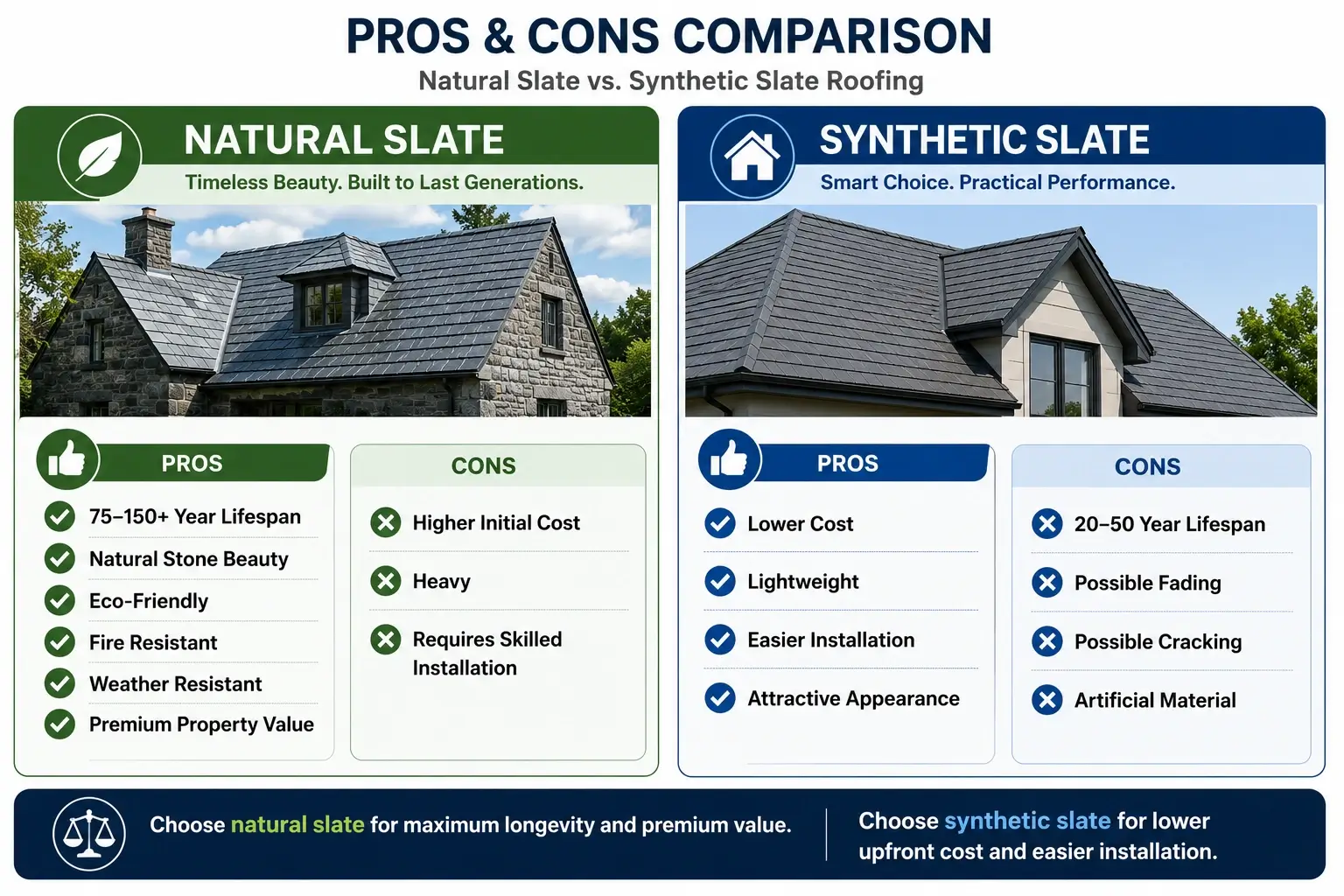
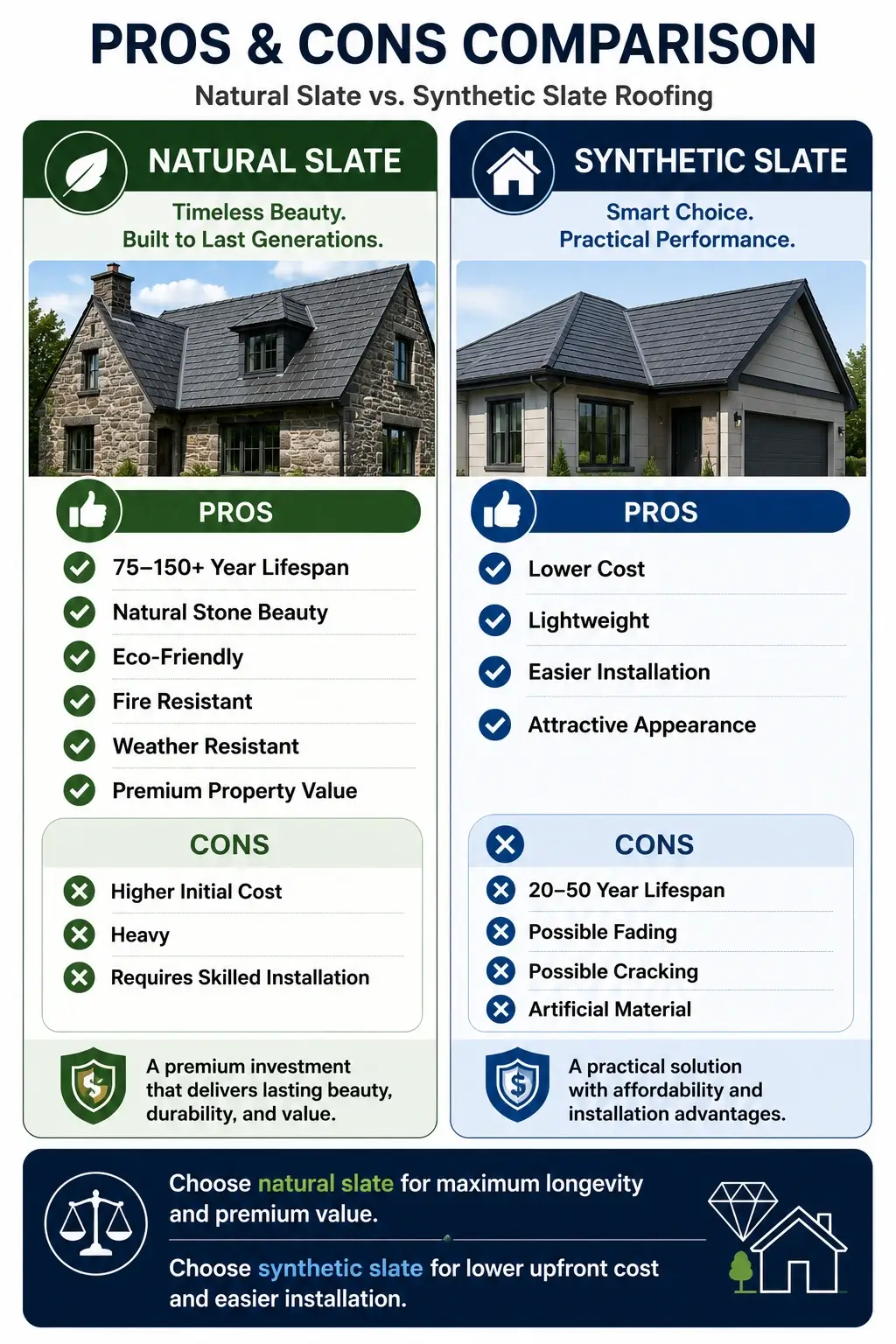
Pros and Cons
Every roofing material has its own strengths and limitations. The best choice depends on your priorities, including budget, aesthetics, durability, maintenance expectations, and long-term investment goals. The comparison below summarizes the key advantages and disadvantages of natural slate roofing and synthetic slate roofing to help you make an informed decision.
Comparison Table
| Natural Slate Roofing | Synthetic Slate Roofing |
|---|---|
| Pros | Pros |
| ✔ Exceptional lifespan (75–150+ years) | ✔ Lower initial cost |
| ✔ Authentic natural stone beauty | ✔ Lightweight construction |
| ✔ Unique natural texture and color variation | ✔ Easier and faster installation |
| ✔ Excellent weather resistance | ✔ Attractive slate-like appearance |
| ✔ Fire-resistant and UV-stable | ✔ Suitable for many existing roof structures |
| ✔ Very low maintenance | ✔ Good short- to medium-term value |
| ✔ Environmentally friendly and recyclable | |
| ✔ Premium architectural appeal | |
| ✔ Strong long-term property value | |
| Cons | Cons |
| ✖ Higher upfront investment | ✖ Shorter lifespan (20–50 years) |
| ✖ Heavier roof structure required | ✖ May fade with prolonged UV exposure |
| ✖ Requires experienced slate installers | ✖ Possible cracking or material aging |
| ✖ Manufactured rather than natural stone | |
| ✖ Lower long-term prestige and resale appeal |
Natural Slate Is Best For
Natural slate is an excellent choice if you:
- Want a roof that can last for generations
- Appreciate the beauty of genuine natural stone
- Are building a luxury, heritage, or high-end property
- Value sustainability and low lifetime maintenance
- Prefer long-term value over the lowest initial cost
Synthetic Slate Is Best For
Synthetic slate may be the better option if you:
- Have a limited construction budget
- Need a lightweight roofing material
- Want faster installation
- Are renovating a roof with structural weight limitations
- Prefer a slate-like appearance at a lower upfront cost
Key Takeaway
Both roofing materials have their advantages. Natural slate offers unmatched longevity, authenticity, sustainability, and architectural prestige, making it an outstanding long-term investment. Synthetic slate provides an attractive appearance with lower upfront costs and easier installation, making it a practical choice for projects where budget or structural constraints are the primary considerations.
Decision Summary:At a Glance
| If You Value… | Recommended Choice |
|---|---|
| Maximum lifespan | ⭐ Natural Slate |
| Authentic appearance | ⭐ Natural Slate |
| Lowest initial cost | ⭐ Synthetic Slate |
| Easy installation | ⭐ Synthetic Slate |
| Long-term value | ⭐ Natural Slate |
| Sustainability | ⭐ Natural Slate |
| Luxury homes | ⭐ Natural Slate |
| Lightweight roofing | ⭐ Synthetic Slate |
There is no single roofing material that is perfect for every project. However, if your goal is exceptional longevity, timeless beauty, sustainability, and lasting property value, natural slate remains one of the finest roofing materials available. If affordability, lightweight construction, and faster installation are your priorities, synthetic slate offers a practical alternative.
Which One Should You Choose?
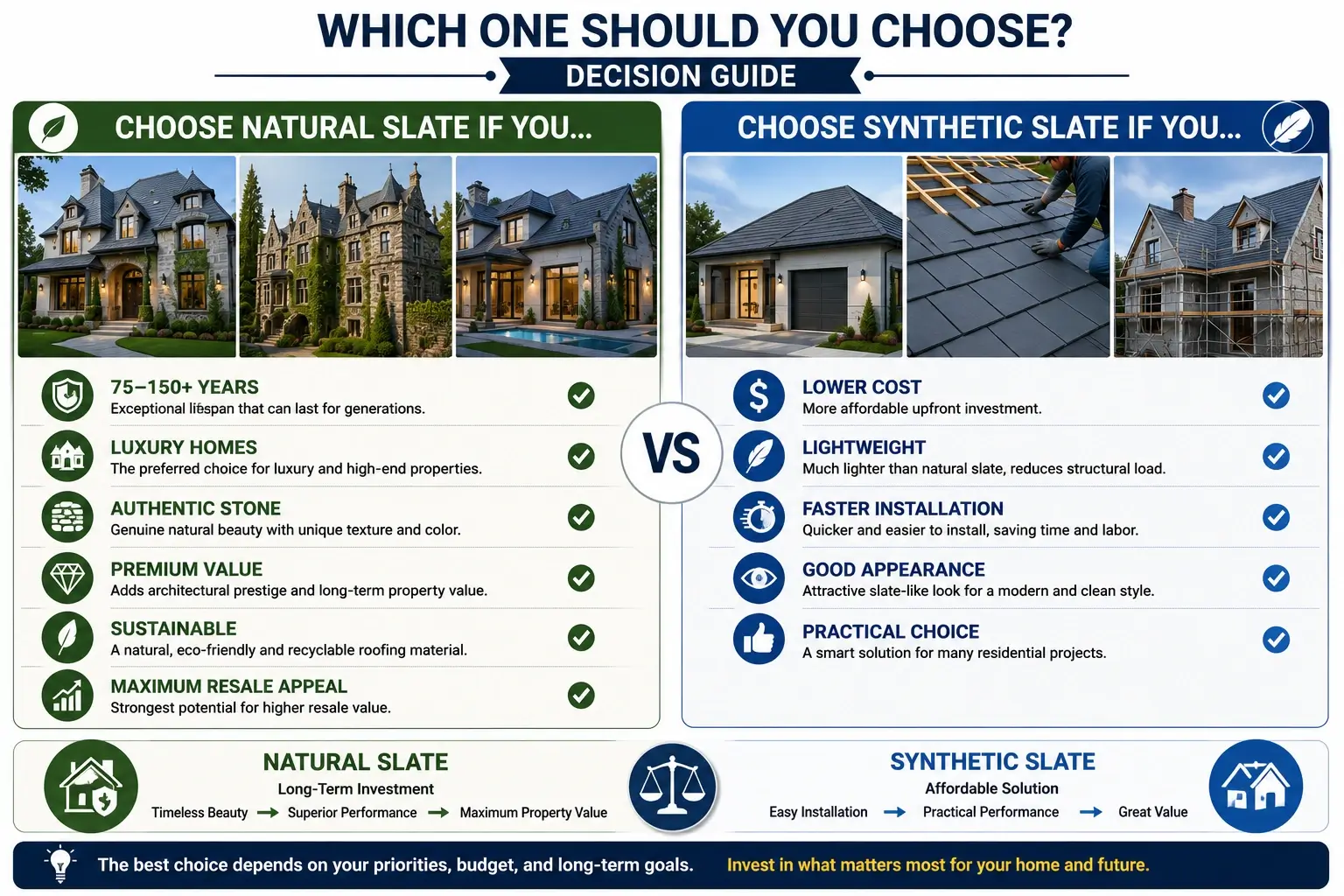
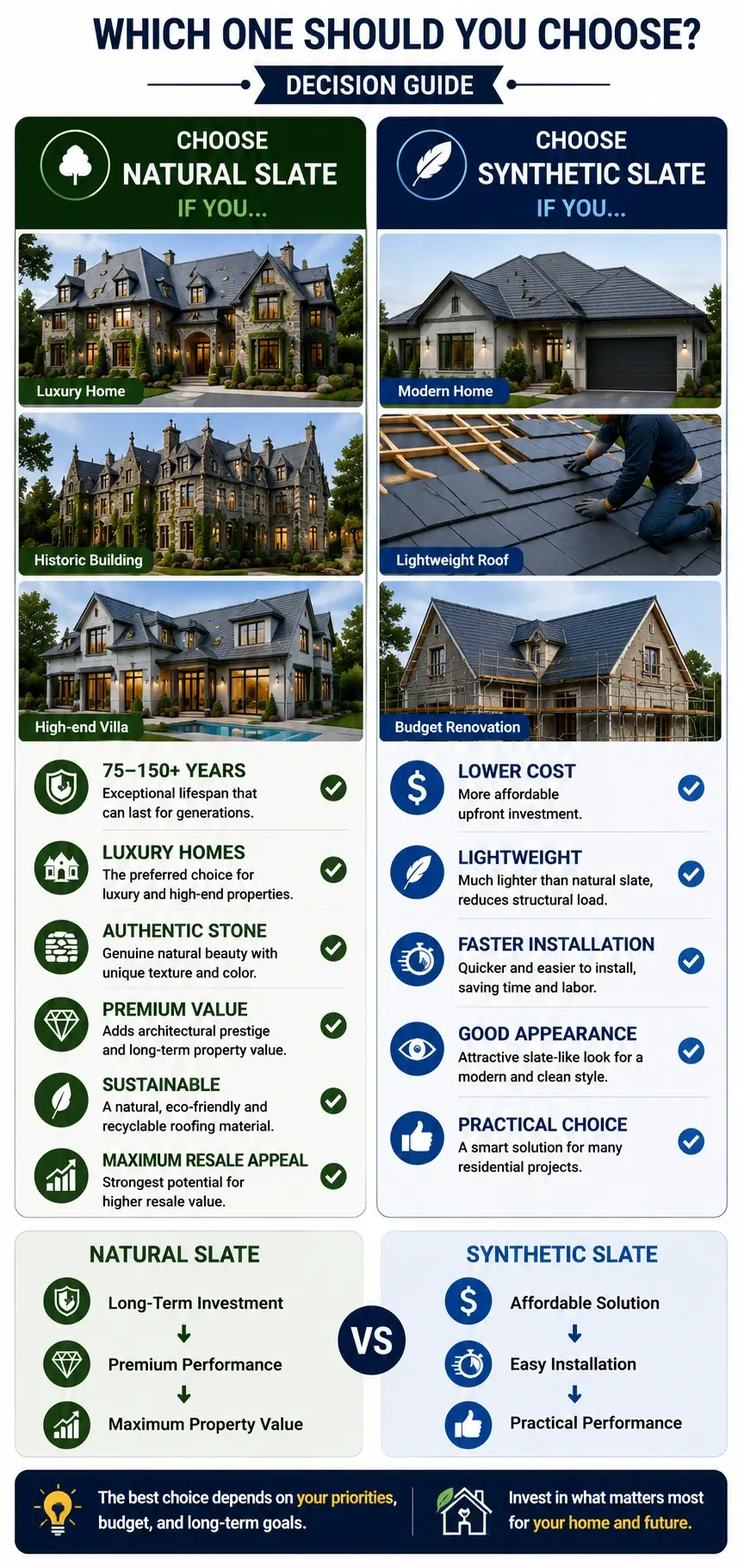
Choosing between natural slate roofing and synthetic slate roofing depends on your budget, project requirements, and long-term goals. Both materials can create an attractive roof, but they are designed for different priorities. If you value longevity, authenticity, and premium architectural appeal, natural slate is difficult to match. If your main priorities are affordability, lightweight construction, and faster installation, synthetic slate may be the more practical solution.
Quick Decision Guide
| If Your Priority Is… | Recommended Choice |
|---|---|
| Roof lifespan of 75–150+ years | ⭐ Natural Slate |
| Authentic natural stone appearance | ⭐ Natural Slate |
| Luxury or heritage property | ⭐ Natural Slate |
| Maximum resale appeal | ⭐ Natural Slate |
| Sustainability | ⭐ Natural Slate |
| Lowest upfront cost | ⭐ Synthetic Slate |
| Lightweight roof structure | ⭐ Synthetic Slate |
| Faster installation | ⭐ Synthetic Slate |
| Budget-conscious renovation | ⭐ Synthetic Slate |
Choose Natural Slate Roofing If You…
Natural slate is the ideal choice if you:
- ✔ Want a roof that can last 75–150+ years
- ✔ Appreciate the beauty of genuine natural stone
- ✔ Are building a luxury, custom, or heritage property
- ✔ Care about authenticity and timeless architecture
- ✔ Want the highest potential resale appeal
- ✔ Prefer a sustainable, environmentally friendly roofing material
- ✔ Are looking for the best long-term return on investment
Natural slate is designed for homeowners and architects who value quality, longevity, and lasting performance over the lowest initial purchase price.
Choose Synthetic Slate Roofing If You…
Synthetic slate may be the better option if you:
- ✔ Have a limited construction budget
- ✔ Need a lightweight roofing material
- ✔ Want faster and easier installation
- ✔ Are renovating an existing roof with structural weight limitations
- ✔ Like the appearance of slate but prefer a lower upfront investment
- ✔ Need a practical roofing solution for short- to medium-term ownership
Synthetic slate offers a balance between appearance, affordability, and ease of installation, making it a suitable choice for many residential projects.
Final Comparison
| Feature | Best Choice |
|---|---|
| Appearance | ⭐ Natural Slate |
| Lifespan | ⭐ Natural Slate |
| Durability | ⭐ Natural Slate |
| Sustainability | ⭐ Natural Slate |
| Property Value | ⭐ Natural Slate |
| Weather Performance | ⭐ Natural Slate |
| Maintenance | ⭐ Natural Slate |
| Initial Cost | ⭐ Synthetic Slate |
| Installation | ⭐ Synthetic Slate |
| Weight | ⭐ Synthetic Slate |
At a Glance
| If you want… | Choose |
|---|---|
| Longest Life | Natural |
| Lowest Cost | Synthetic |
| Luxury | Natural |
| Easy Installation | Synthetic |
Key Takeaway:
The price of a slate roof is determined by far more than the cost of the slate tiles. Material quality, roof complexity, installation, and logistics all contribute to the total investment. Understanding these factors helps you compare quotations more accurately and avoid unexpected costs.
Key Takeaway
If your goal is maximum longevity, timeless beauty, sustainability, and premium property value, natural slate roofing is the superior long-term investment.
If your priorities are lower upfront cost, lightweight construction, and faster installation, synthetic slate roofing provides an attractive and practical alternative.
There is no one-size-fits-all roofing solution. The best choice depends on your project’s priorities. However, for homeowners, architects, and builders seeking exceptional durability, authentic natural beauty, and long-term value, natural slate continues to be regarded as one of the world’s finest roofing materials.
Need Help Choosing the Right Roofing Slate?
Whether you’re designing a luxury home, restoring a historic building, or sourcing roofing materials for a commercial project, our team can help you select the most suitable natural slate for your requirements.
Contact us today for expert advice, free product recommendations, and a competitive quotation.
Frequently Asked Questions
Still Have Questions?
Choosing between natural slate roofing and synthetic slate roofing depends on your budget, architectural style, climate, and long-term goals. If you’re unsure which material is best for your project, our roofing specialists can provide expert recommendations based on your specific requirements.
Contact us today for professional advice, product information, and a free quotation.
Making the Right Choice
After comparing natural slate roofing and synthetic slate roofing across appearance, lifespan, durability, installation, maintenance, weather performance, sustainability, and long-term value, one conclusion becomes clear: both materials have their place, but they are designed for different priorities.
Synthetic slate roofing offers an attractive slate-like appearance, lower upfront costs, lighter weight, and easier installation, making it a practical option for budget-conscious projects or buildings with structural weight limitations.
However, natural slate roofing remains the benchmark for authentic beauty, exceptional longevity, proven weather resistance, environmental sustainability, and long-term property value. For homeowners, architects, and builders seeking a premium roofing solution that can last for generations, natural slate continues to be one of the world’s most trusted and respected roofing materials.
Ultimately, the right choice depends on your project’s budget, architectural style, structural requirements, and long-term investment goals. By understanding the strengths of each option, you can confidently select the roofing material that best meets your needs.
Need Expert Advice on Natural Roofing Slate?
If you’re planning a new build, renovating a historic property, or sourcing roofing materials for an upcoming project, choosing the right slate is just as important as choosing the right roof design.
At SlateofChina, we specialize in supplying high-quality Jiujiang natural roofing slate to customers around the world. Our roofing slates are carefully selected for their durability, natural beauty, consistent quality, and reliable performance, making them suitable for residential, commercial, heritage, and architectural projects.
Whether you need help selecting the right slate size, thickness, color, or installation method, our experienced team is ready to provide professional recommendations and competitive quotations.
Contact us today to discuss your project or explore our complete range of Jiujiang natural roofing slate products.
Natural slate and synthetic slate each have their advantages. If your priority is the lowest initial investment and easier installation, synthetic slate is a practical choice. If you value authentic natural beauty, exceptional durability, sustainability, and long-term property value, natural slate remains one of the finest roofing materials available.
With decades of manufacturing and export experience, we supply premium Jiujiang natural roofing slate to builders, distributors, architects, and importers worldwide. From product selection to project support, we’re committed to helping you choose the right roofing slate for long-lasting performance and timeless architectural beauty.
Reviewed by
Slate Roofing Specialist
30 Years Experience