Pool Slate Thickness Guide: Choosing the Right Slate for Your Pool Table
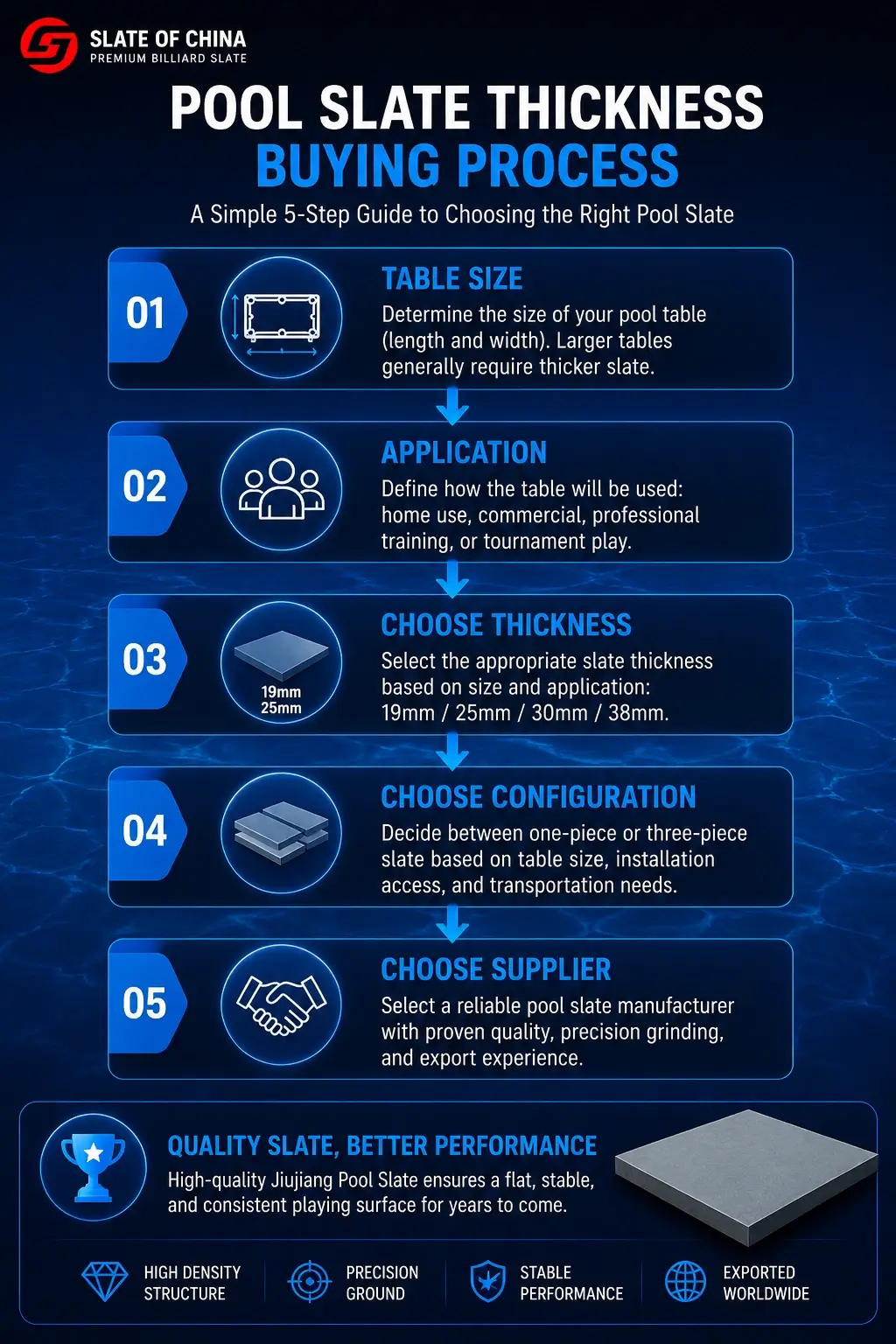
Slate is the foundation of every quality pool table and has a direct impact on ball roll accuracy, table stability, and long-term durability. Choosing the correct pool slate thickness is critical for manufacturers, distributors, and billiard room operators. While thinner slate may reduce costs and weight, thicker slate generally provides greater rigidity and more consistent playing performance. This Pool Slate Thickness Guide explains the differences between 19mm, 25mm, 30mm, and thicker slate options, helping you select the right billiard slate for home, commercial, or tournament applications.
Table of Contents
Standard Pool Slate Thicknesses
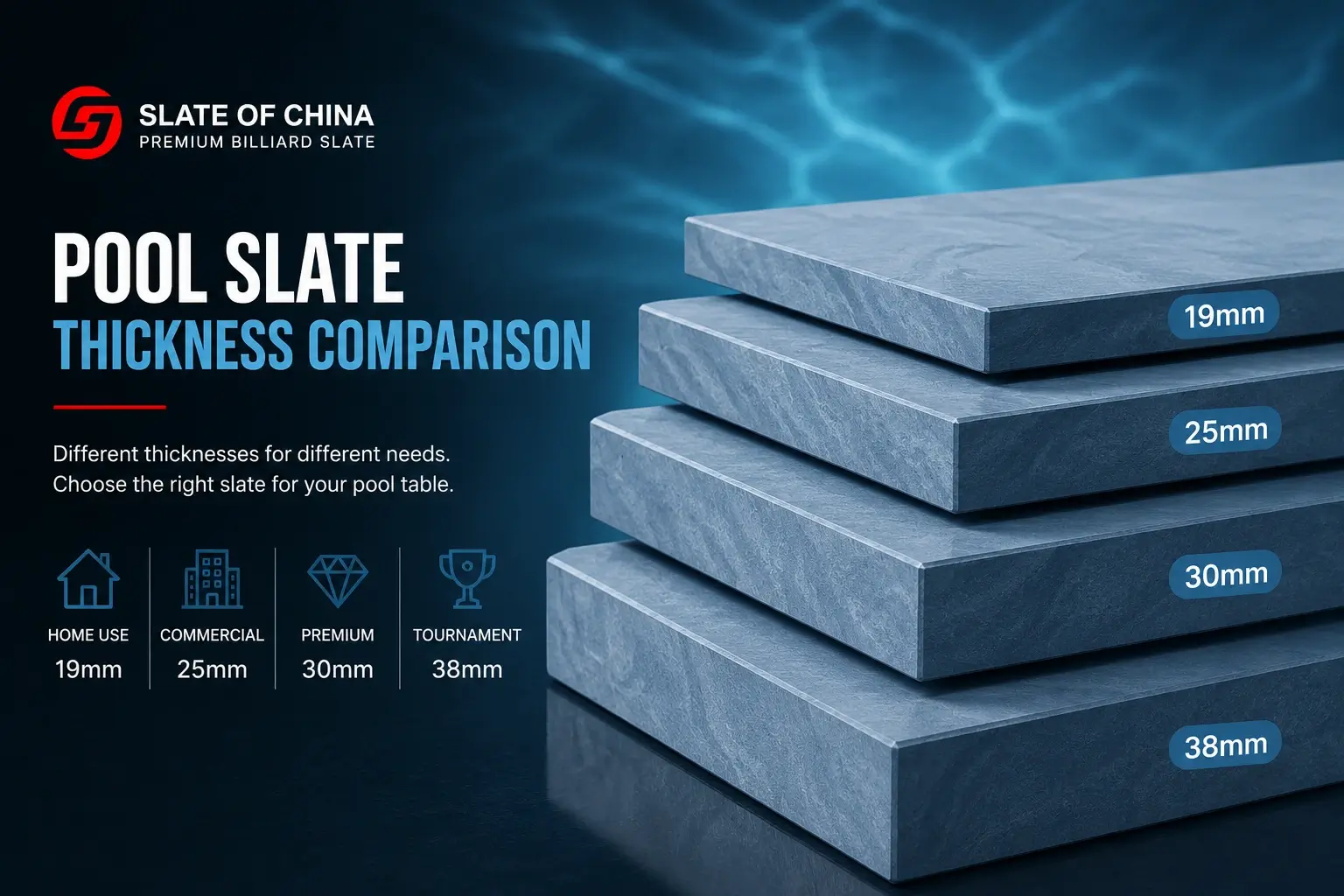
Pool table slate is available in several thickness options, each designed for different applications and performance requirements. The most common pool slate thicknesses range from 19mm (3/4″) to 38mm (1.5″), with 19mm and 25mm slate being the most widely used in today’s market.
The ideal slate thickness depends on factors such as table size, intended use, installation environment, and budget. While thinner slate can reduce transportation costs and overall table weight, thicker slate generally offers greater rigidity, improved stability, and more consistent ball roll performance.
| Slate Thickness | Inch Equivalent | Typical Application |
|---|---|---|
| 19mm | 3/4″ | Home Pool Tables |
| 25mm | 1″ | Commercial & Professional Tables |
| 30mm | 1.18″ | Premium Pool Tables |
| 38mm | 1.5″ | Tournament & Luxury Tables |
Most modern pool tables use slate between 19mm and 25mm thick. For residential pool tables, 19mm slate provides an excellent balance between performance and affordability. For commercial billiard clubs, professional training facilities, and high-end pool tables, 25mm slate is widely regarded as the industry standard.
Understanding Each Pool Slate Thickness
19mm (3/4″) Pool Slate
19mm slate is commonly used on residential pool tables and entry-level recreational tables. It offers reliable performance while keeping transportation and installation costs lower.
Best for:
- Home pool tables
- Family game rooms
- Recreational use
- Budget-conscious projects
Advantages:
- Lower weight
- Easier handling and installation
- More economical
25mm (1″) Pool Slate
25mm slate is considered the most popular choice for commercial and professional pool tables. The additional thickness improves rigidity and helps maintain a flatter playing surface over time.
Best for:
- Commercial pool halls
- Professional training centers
- Competition-grade tables
- High-quality custom pool tables
Advantages:
- Excellent stability
- Consistent ball roll
- Long-term durability
- Industry-standard performance
30mm (1.18″) Pool Slate
30mm slate is often selected for premium pool tables where superior stability and a substantial feel are desired.
Best for:
- Luxury pool tables
- High-end clubs
- Premium custom projects
Advantages:
- Increased rigidity
- Enhanced playing consistency
- Greater resistance to flexing
38mm (1.5″) Pool Slate
38mm slate represents one of the heaviest and most robust slate options available. It is typically reserved for luxury installations, specialized tournament tables, and projects requiring maximum structural stability.
Best for:
- Luxury billiard rooms
- Tournament-level installations
- Prestige commercial projects
Advantages:
- Maximum stability
- Exceptional durability
- Premium appearance and feel
Expert Recommendation
For most buyers, 25mm (1 inch) pool slate offers the best balance of performance, durability, and value. It is widely used on commercial pool tables and professional-grade equipment around the world. Home users seeking a more affordable solution often choose 19mm slate, while premium projects may benefit from the added stability of 30mm or 38mm slate.
Why Slate Thickness Matters
Pool table slate thickness affects much more than the overall weight of a table. It directly influences playing accuracy, structural stability, long-term durability, and cushion response. While all quality slate provides a solid playing surface, thicker slate generally offers greater rigidity and consistency, especially on larger tables or in high-use commercial environments.
Understanding how slate thickness affects performance can help you choose the right pool slate for your specific application.
Playing Accuracy
One of the primary reasons professional pool tables use thicker slate is improved playing accuracy.
A thicker slate bed is more resistant to flexing and vibration, helping maintain a flatter and more consistent playing surface. This allows balls to roll more smoothly and predictably across the table.
Even small surface deviations can affect ball movement, especially during long shots and precision position play. Thicker pool table slate helps minimize these variations and supports tournament-level playing conditions.
Benefits
- More accurate ball roll
- Better surface flatness
- Improved shot consistency
- Enhanced professional playing experience
Stability
Slate thickness also contributes significantly to overall table stability.
Because thicker slate weighs more, it creates a stronger and more stable foundation for the pool table. This additional mass helps reduce movement and vibration during play, particularly in commercial pool halls where tables are used continuously throughout the day.
For larger tables such as 8ft and 9ft pool tables, thicker slate provides greater structural support and long-term reliability.
Benefits
- Increased table rigidity
- Reduced vibration during play
- Better support for larger tables
- Improved leveling stability
Durability
A quality slate bed can last for decades, but thickness plays an important role in long-term durability.
Thicker slate is generally less susceptible to stress, flexing, and structural deformation over time. This makes it particularly suitable for commercial environments where tables experience heavy daily use.
For pool room operators and table manufacturers, investing in thicker billiard slate often results in lower maintenance requirements and a longer service life.
Benefits
- Greater resistance to wear
- Improved structural strength
- Longer lifespan
- Reduced maintenance costs
Cushion Performance
Many players focus on the cloth and cushions, but slate thickness also influences cushion performance.
A more rigid slate foundation helps maintain consistent energy transfer between the cushion system and the playing surface. This contributes to more predictable rebounds and improved shot control.
Professional and tournament-grade pool tables typically use thicker slate to support consistent cushion response throughout the entire table.
Benefits
- More consistent rebound angles
- Better cue ball control
- Improved overall table performance
- Tournament-quality playing characteristics
Does Thicker Slate Always Mean Better Performance?
Not necessarily.
For most residential pool tables, 19mm slate provides excellent performance and value. However, 25mm slate is widely considered the industry standard for commercial and professional pool tables because it offers an ideal balance between stability, durability, weight, and cost.
For luxury installations and specialized tournament applications, 30mm or 38mm slate may provide additional rigidity and premium performance characteristics.
In general:
| Application | Recommended Slate Thickness |
|---|---|
| Home Pool Tables | 19mm |
| Commercial Pool Tables | 25mm |
| Professional Training Tables | 25mm–30mm |
| Tournament Pool Tables | 30mm–38mm |
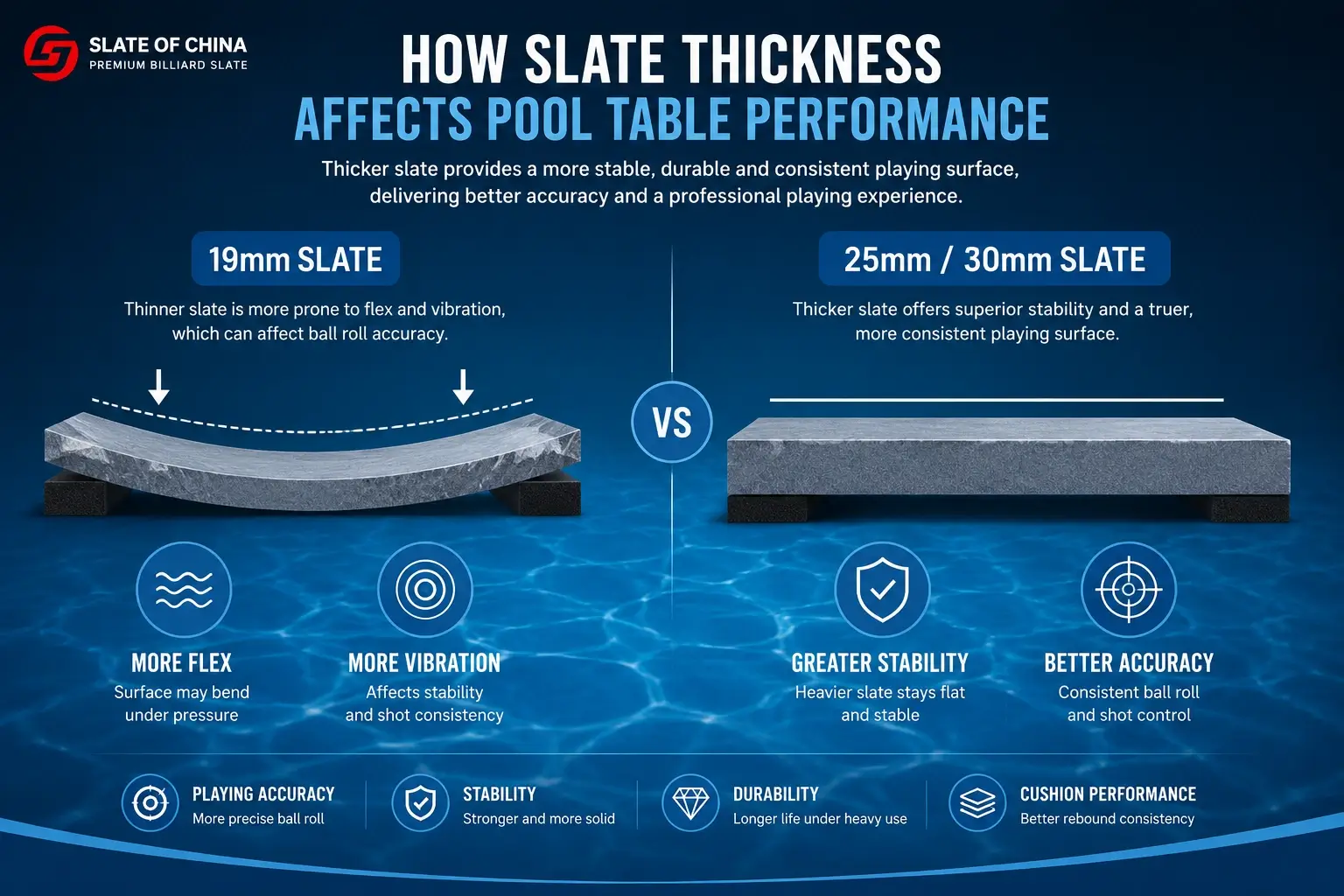
Recommended Slate Thickness by Pool Table Size
Choosing the right slate thickness depends not only on budget and intended use, but also on the size of the pool table. As table dimensions increase, the slate must support a larger playing surface and withstand greater structural loads. Using the correct slate thickness helps maintain flatness, stability, and consistent playing performance over time.
The following recommendations are commonly used by pool table manufacturers, billiard clubs, and professional table builders worldwide.
| Pool Table Size | Recommended Slate Thickness |
|---|---|
| 7ft Pool Table | 19mm–25mm |
| 8ft Pool Table | 25mm |
| 9ft Pool Table | 25mm–30mm |
| Tournament Pool Tables | 25mm–38mm |
7ft Pool Table: 19mm–25mm Slate
A 7ft pool table is the most common size for home game rooms, apartments, and recreational venues. Because the playing surface is relatively compact, both 19mm slate and 25mm slate can provide excellent performance.
For residential use, 19mm slate is often the most economical choice, offering a good balance between playing quality, weight, and cost. Buyers seeking a more premium playing experience may choose 25mm slate for additional rigidity and long-term stability.
Recommended for:
- Home pool tables
- Family game rooms
- Recreational use
- Residential installations
Best choice: 19mm for value, 25mm for premium performance.
8ft Pool Table: 25mm Slate
The 8ft pool table is widely regarded as the ideal balance between recreational and professional play. Because of its larger playing area, 25mm slate is generally considered the industry standard.
A 25mm slate bed provides sufficient rigidity to maintain excellent flatness while delivering consistent ball roll and cushion response. This thickness is commonly used by commercial pool halls and serious home players.
Recommended for:
- Commercial pool rooms
- Premium home tables
- Club-level installations
- Professional practice tables
Best choice: 25mm slate.
9ft Pool Table: 25mm–30mm Slate
The 9ft pool table is the standard size used in many professional competitions and training facilities. The larger slate surface requires greater structural stability to ensure consistent playing conditions.
Most professional-grade 9ft tables use 25mm slate, while premium or tournament-oriented tables may utilize 30mm slate for increased rigidity and durability.
For players seeking tournament-level performance, thicker slate can provide a more stable playing surface and enhanced shot consistency.
Recommended for:
- Professional training centers
- Competition venues
- High-end billiard clubs
- Serious players
Best choice: 25mm–30mm slate.
Tournament Pool Tables: 25mm–38mm Slate
Tournament pool tables demand the highest standards of accuracy, stability, and durability. These tables are designed to perform consistently under intensive use while maintaining strict playing specifications.
Most modern tournament pool tables utilize 25mm precision-ground slate, which has become the accepted industry standard. Some luxury or specialized competition tables may use 30mm or even 38mm slate to maximize structural rigidity and long-term performance.
While thicker slate increases weight and cost, it can provide additional stability in high-performance environments.
Recommended for:
- Professional tournaments
- Championship events
- International competitions
- Elite training facilities
Best choice: 25mm slate for most tournament tables, with 30mm–38mm used in specialized applications.
Quick Selection Guide
If you’re unsure which slate thickness to choose, the following recommendations provide a simple starting point:
| Application | Recommended Thickness |
|---|---|
| Home Pool Table | 19mm |
| Premium Home Table | 25mm |
| Commercial Pool Hall | 25mm |
| Professional Training Table | 25mm–30mm |
| Tournament Pool Table | 25mm–38mm |
For most buyers, 25mm pool slate remains the most versatile option, offering an excellent combination of playing accuracy, stability, durability, and value.
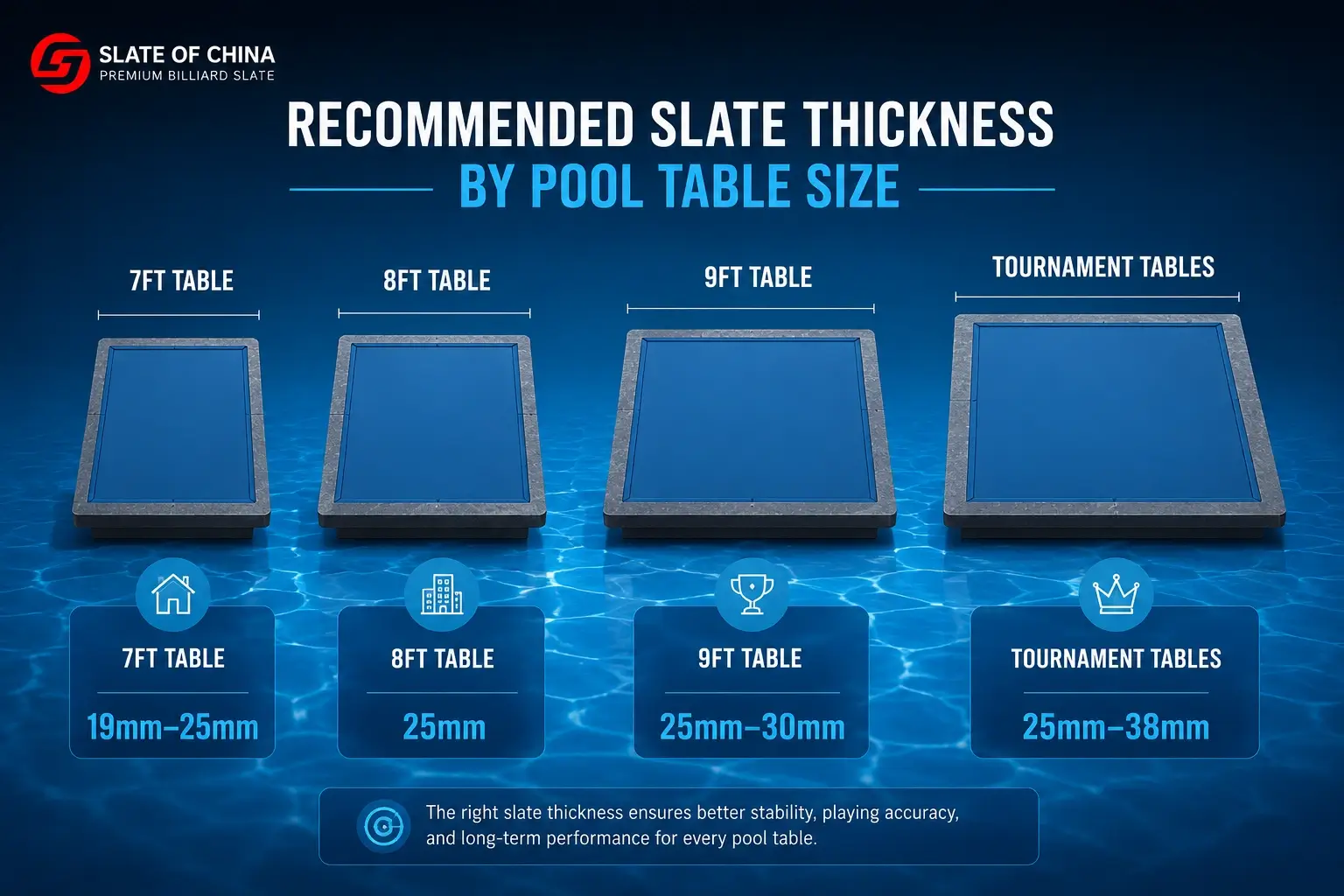
19mm vs 25mm Pool Slate
When choosing pool table slate, the most common question is whether to select 19mm (3/4 inch) or 25mm (1 inch) slate. Both thicknesses are widely used throughout the billiards industry, but they are designed for different applications and performance requirements.
While 19mm slate offers a cost-effective solution for residential tables, 25mm slate provides greater stability, durability, and long-term playing consistency. Understanding the differences can help you choose the right slate for your pool table project.
Comparison Table
| Feature | 19mm Slate | 25mm Slate |
|---|---|---|
| Weight | Lighter | Heavier |
| Cost | Lower | Higher |
| Stability | Good | Excellent |
| Durability | Good | Better |
| Commercial Use | Limited | Ideal |
| Tournament Use | No | Yes |
Weight
One of the most noticeable differences between 19mm and 25mm pool slate is weight.
Because 25mm slate contains more material, it is significantly heavier than 19mm slate. The additional mass helps create a more stable playing surface, but it also increases transportation and installation costs.
19mm Slate
- Easier to transport
- Easier to install
- Lower shipping costs
25mm Slate
- Greater structural rigidity
- Reduced vibration
- Enhanced table stability
Cost
For many buyers, budget is an important factor.
19mm slate is generally more affordable because it uses less raw material and reduces shipping weight. As a result, it is commonly found on residential and entry-level pool tables.
25mm slate requires more material and machining, resulting in a higher purchase price. However, many manufacturers and commercial operators consider the additional investment worthwhile because of the performance benefits.
Best Choice
- Budget-focused projects → 19mm
- Long-term value → 25mm
Stability
Stability is one of the primary reasons professional tables use thicker slate.
A thicker slate bed is less likely to flex under load and helps maintain a consistently flat playing surface. This becomes increasingly important on larger pool tables and in commercial environments where tables are used continuously.
19mm Slate
- Good stability for home use
- Suitable for recreational play
25mm Slate
- Excellent rigidity
- Better long-term flatness
- More consistent ball roll
Durability
Both thicknesses can provide many years of service when manufactured from high-quality billiard slate. However, 25mm slate generally offers greater resistance to long-term stress and heavy daily use.
For pool halls, clubs, and training facilities, thicker slate can reduce maintenance requirements and help preserve playing quality over time.
Recommended Applications
19mm Pool Slate
- Home pool tables
- Residential game rooms
- Casual recreational use
25mm Pool Slate
- Commercial pool halls
- Professional training centers
- High-end pool tables
- Competition venues
Commercial and Tournament Use
Most commercial operators prefer 25mm slate because it provides the durability and stability required for frequent use.
Similarly, professional and tournament-grade pool tables typically use 25mm precision-ground slate as the industry standard. The additional thickness helps maintain consistent playing conditions and supports accurate ball movement during competitive play.
Industry Preference
| Application | Preferred Thickness |
|---|---|
| Home Use | 19mm |
| Premium Home Use | 25mm |
| Commercial Pool Hall | 25mm |
| Professional Training | 25mm |
| Tournament Tables | 25mm |
Which Pool Slate Thickness Should You Choose?
The right choice depends on how the table will be used.
Choose 19mm pool slate if you are building a residential pool table and want a cost-effective solution with reliable playing performance.
Choose 25mm pool slate if you need greater stability, longer service life, and professional-level playing characteristics.
Expert Recommendation
For most commercial and professional pool tables, 25mm slate is the preferred choice. It delivers the best balance of playing accuracy, stability, durability, and long-term value, making it the most widely used pool table slate thickness in the industry today.
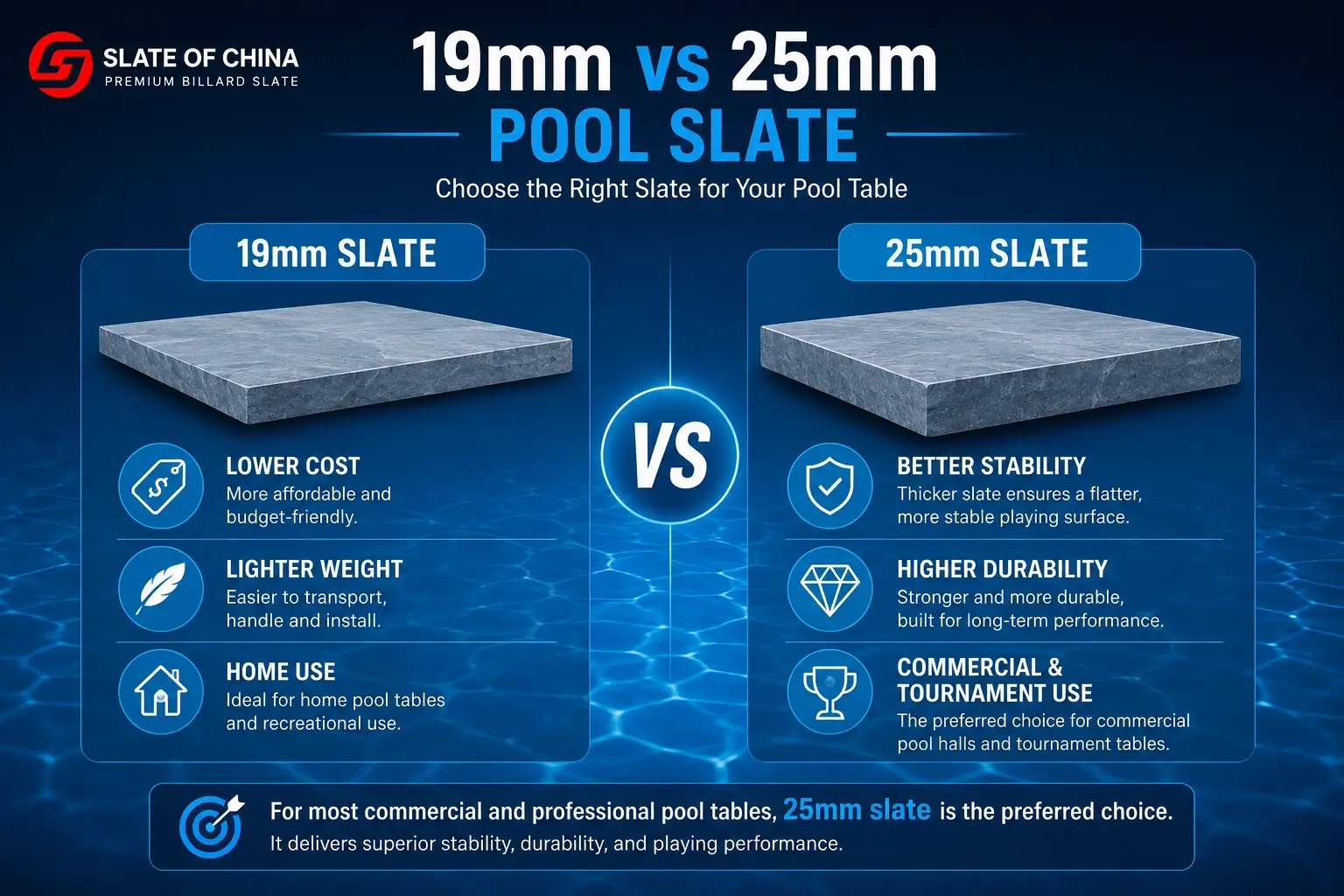
One-Piece vs Three-Piece Pool Slate
In addition to slate thickness, the configuration of the slate also plays an important role in pool table performance, transportation, and installation. Pool table slate is typically manufactured in either one-piece or three-piece construction.
Both options can provide excellent playing quality when properly installed. The choice depends on table size, transportation requirements, installation conditions, and intended use.
Quick Comparison
| Feature | One-Piece Slate | Three-Piece Slate |
|---|---|---|
| Transportation | More Difficult | Easier |
| Installation | Simpler | More Precise Setup Required |
| Seam Leveling | Not Required | Required |
| Weight Distribution | Single Piece | Distributed Across Sections |
| Home Use | Excellent | Excellent |
| Commercial Use | Limited | Ideal |
| Tournament Use | Rare | Industry Standard |
| Large Table Compatibility | Limited | Excellent |
One-Piece Slate
One-piece slate consists of a single solid slab covering the entire playing surface.
Because there are no joints between sections, installation is relatively straightforward and no seam filling or leveling is required. Many homeowners appreciate the simplicity of one-piece slate tables.
However, transportation and handling can become challenging as table size increases because the entire slate must be moved as a single heavy piece.
Advantages
✔ Easier installation
✔ No seam leveling required
✔ Fewer installation adjustments
✔ Excellent for smaller tables
Best For
- 7ft pool tables
- Home game rooms
- Residential installations
- Recreational use
Three-Piece Slate
Three-piece slate divides the playing surface into three precision-machined sections that are assembled during installation.
Although professional leveling and seam treatment are required, three-piece slate offers significant advantages for transportation, handling, and long-term serviceability.
For this reason, three-piece slate has become the standard configuration for most commercial, professional, and tournament pool tables worldwide.
Advantages
✔ Easier transportation
✔ Easier handling during installation
✔ Better leveling adjustment
✔ Industry standard for professional tables
✔ Suitable for larger table sizes
Best For
- 8ft pool tables
- 9ft pool tables
- Commercial pool halls
- Professional training facilities
- Tournament tables
Which Slate Configuration Is Better?
Neither configuration is universally better. The best choice depends on the intended application.
For smaller residential tables, a one-piece slate can provide excellent performance while simplifying installation.
For larger tables, commercial environments, and professional play, three-piece slate offers superior flexibility during transportation and leveling, making it the preferred option throughout the billiards industry.
Expert Recommendation
For most modern 8ft and 9ft pool tables, especially in commercial and professional settings, three-piece slate is the preferred choice. It provides easier transportation, more precise leveling, and greater practicality for long-term maintenance.
For 7ft home pool tables, a high-quality one-piece slate can be an excellent solution when transportation and access conditions allow.
Tournament Pool Table Slate Thickness
Professional tournaments demand the highest standards of accuracy, consistency, and durability. For this reason, tournament pool tables are built using carefully selected slate that meets strict performance requirements.
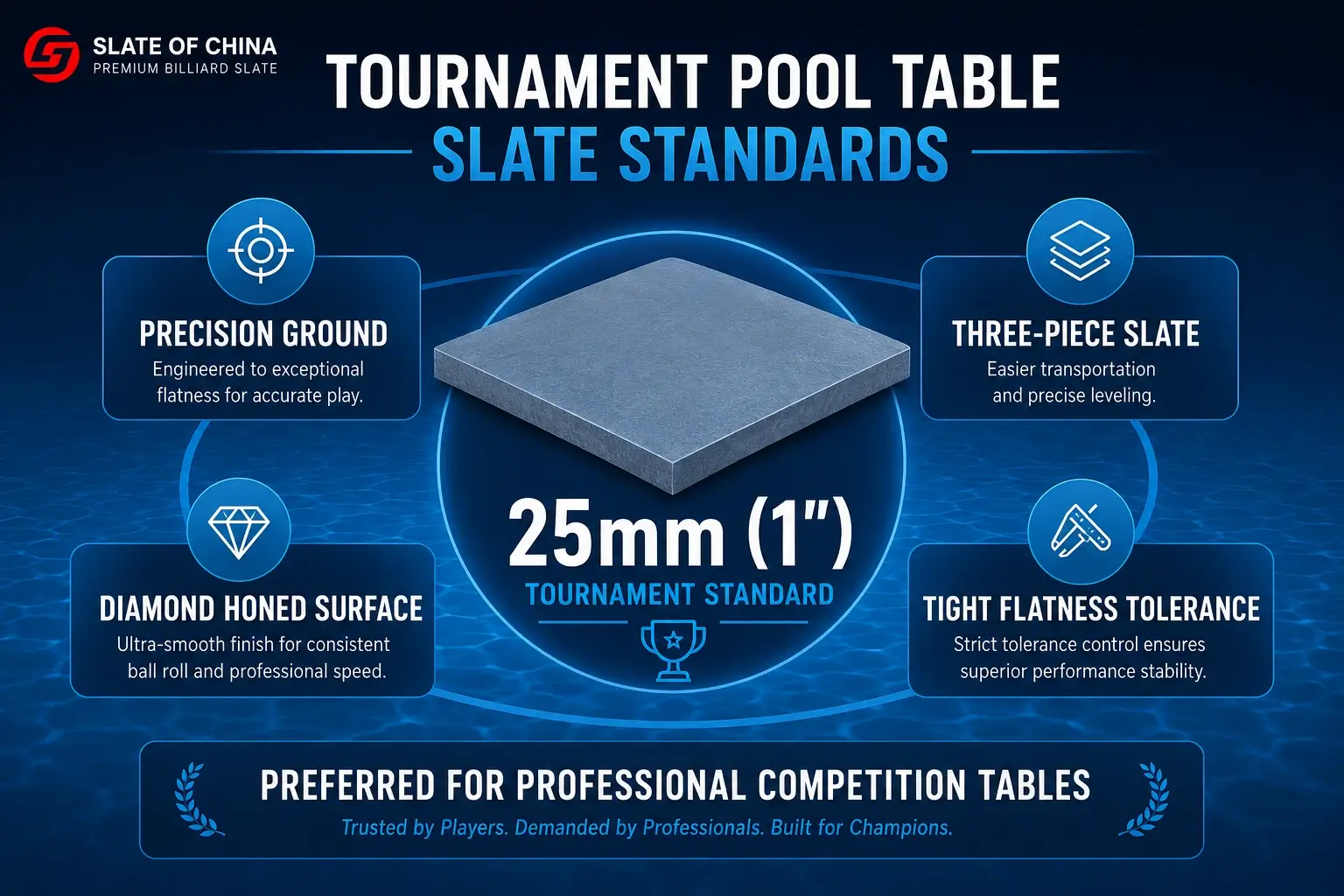
Most modern tournament pool tables use:
✔ 25mm (1 inch) precision-ground slate
✔ Three-piece slate construction
✔ Diamond-honed playing surface
✔ Tight flatness tolerances
These specifications help ensure consistent ball roll, accurate shot execution, and reliable playing conditions throughout an entire tournament.
Why 25mm Slate Is the Tournament Standard
Although thicker slate options are available, 25mm (1 inch) slate has become the most widely accepted standard for professional pool tables.
A 25mm slate bed provides an excellent balance between rigidity, stability, weight, and installation practicality. It is thick enough to resist flexing and vibration while remaining manageable for transportation and table assembly.
For professional players, even minor surface variations can affect shot accuracy. A properly manufactured 25mm slate helps maintain the flat, stable playing surface required for high-level competition.
Benefits of 25mm Tournament Slate
- Superior playing accuracy
- Consistent ball roll
- Excellent structural stability
- Long-term durability
- Professional competition performance
Why Tournament Tables Use Three-Piece Slate
Virtually all professional tournament pool tables utilize three-piece slate construction.
Rather than using a single large slab, the playing surface is divided into three precision-machined sections. This design simplifies transportation and installation while allowing installers to achieve extremely accurate leveling.
When properly assembled and seam-filled, a three-piece slate table provides a seamless playing surface that meets professional competition standards.
Advantages of Three-Piece Slate
- Easier transportation
- Precise leveling adjustment
- Better installation flexibility
- Industry standard for tournament tables
- Suitable for large 8ft and 9ft tables
Precision-Ground and Diamond-Honed Surfaces
Tournament-grade slate undergoes precision machining to achieve exceptional flatness.
After cutting and calibration, the playing surface is carefully ground and finished to tight tolerances. Many premium manufacturers utilize diamond-honing technology to create an ultra-flat surface capable of supporting professional-level play.
This process helps ensure:
- Accurate ball movement
- Uniform table speed
- Consistent cushion response
- Long-term surface stability
Flatness Tolerance Matters
Slate thickness alone does not determine playing quality.
Even a thick slate can perform poorly if the surface is not accurately machined. Professional tournament tables require strict flatness tolerances to eliminate unwanted ball drift and maintain fair playing conditions.
High-quality billiard slate is manufactured to precise specifications and inspected before installation to ensure tournament-level performance.
Key Tournament Requirements
| Requirement | Tournament Standard |
|---|---|
| Slate Thickness | 25mm (1 inch) |
| Slate Configuration | Three-Piece |
| Surface Finish | Precision Ground / Diamond Honed |
| Flatness | Tight Tolerance |
| Application | Professional Competition |
Professional Competition Standards
Many professional events follow equipment specifications recognized by organizations such as the World Pool-Billiard Association (WPA).
While tournament organizers may use different table brands, the majority of competition tables share several common characteristics:
- 25mm precision-ground slate
- Three-piece slate construction
- Professional-grade leveling
- Consistent cushion response
- Tournament-quality playing surfaces
These requirements help create uniform playing conditions for professional competitors around the world.
What Slate Thickness Is Best for Tournament Pool Tables?
For most professional tournaments and competition venues, 25mm slate remains the preferred choice.
Some premium installations may utilize 30mm or thicker slate for additional rigidity, but 25mm precision-ground slate continues to be the industry benchmark because it delivers the ideal balance of performance, stability, and practicality.
Expert Recommendation
If you are manufacturing, specifying, or purchasing a tournament-grade pool table, choose:
✔ 25mm precision-ground slate
✔ Three-piece construction
✔ Diamond-honed surface finish
✔ Professional leveling system
This combination represents the standard used by most professional competition tables worldwide.
How Pool Slate Thickness Affects Weight
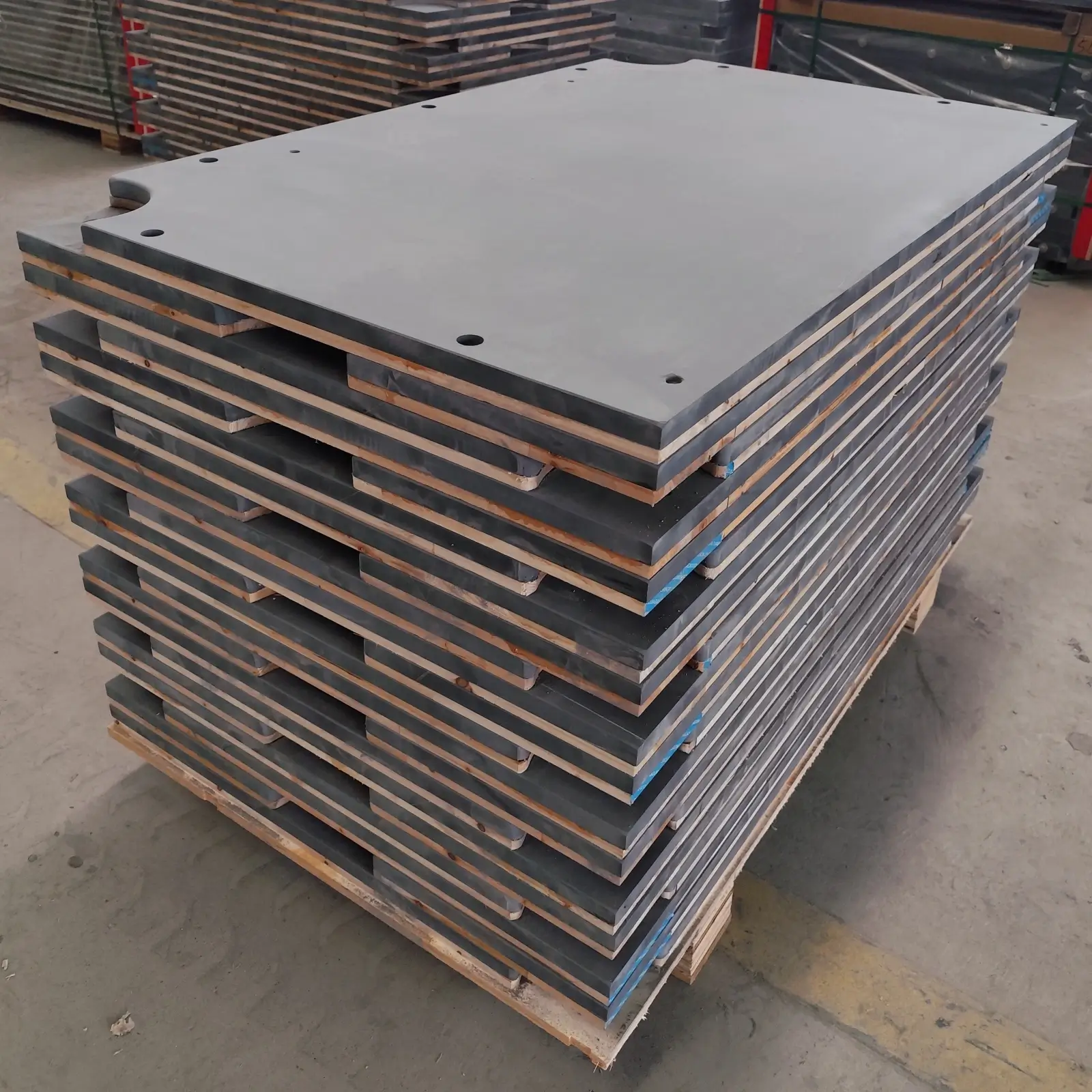
Slate thickness has a direct impact on the overall weight of a pool table. As slate becomes thicker, both the weight of the slate bed and the total table weight increase significantly.
While thicker slate generally provides better stability and durability, it also requires stronger table frames, more careful transportation, and additional installation considerations.
For manufacturers, distributors, and pool room operators, understanding the relationship between slate thickness and weight is essential when selecting the right pool table slate.
Typical Weight Comparison
| Slate Thickness | Approximate Weight |
|---|---|
| 19mm | Lower |
| 25mm | Medium |
| 30mm | High |
| 38mm | Very High |
Why Weight Matters
The weight of a pool slate affects more than just shipping costs.
Transportation and Handling
Thicker slate is heavier and may require additional equipment or manpower during transportation and installation.
Table Stability
Heavier slate creates a more stable playing surface, helping reduce vibration and maintain consistent playing conditions.
Frame Requirements
As slate thickness increases, the table frame must be strong enough to support the additional weight without affecting long-term performance.
Installation Considerations
Commercial and tournament tables often use heavier slate, making professional installation highly recommended.
General Rule
In most cases:
- 19mm slate offers a lighter and more economical solution for home pool tables.
- 25mm slate provides the best balance between weight, stability, and performance.
- 30mm and 38mm slate deliver maximum rigidity but require stronger support structures and more careful handling.
Learn More About Pool Slate Weight
This page focuses on slate thickness. If you would like detailed weight estimates for different slate sizes, thicknesses, and pool table configurations, see our:
Which Pool Slate Thickness Should You Choose?
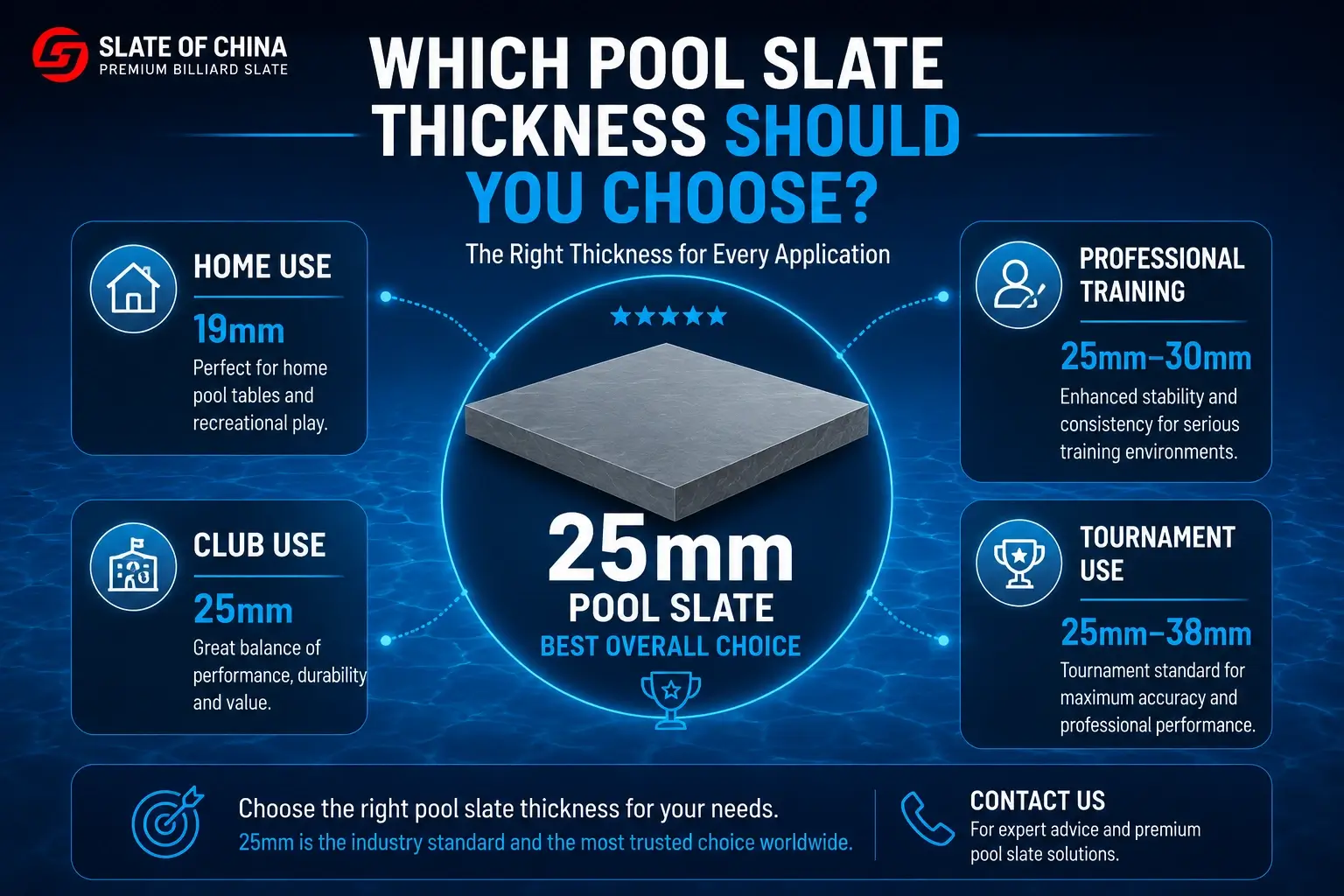
The best pool slate thickness depends on how the table will be used. Factors such as table size, playing frequency, performance expectations, transportation requirements, and budget all influence the ideal choice.
While thicker slate generally provides greater stability and durability, it is not always necessary for every application. Selecting the right thickness ensures the best balance between performance, weight, and cost.
The following recommendations can help you choose the most suitable pool table slate for your project.
Recommended Thickness by Application
| Application | Recommended Thickness |
|---|---|
| Home Use | 19mm |
| Club Use | 25mm |
| Commercial Pool Hall | 25mm |
| Professional Training | 25mm–30mm |
| Tournament Use | 25mm–38mm |
Home Use
For residential pool tables and family game rooms, 19mm slate is often the most practical choice.
It offers reliable playing performance, lower transportation costs, and easier installation while providing excellent value for recreational players.
Recommended For
- Home pool tables
- Family game rooms
- Recreational play
- Budget-conscious projects
Recommended Thickness: 19mm
Club Use
Pool clubs and social venues typically require equipment that can withstand regular use while maintaining consistent playing quality.
For these environments, 25mm slate provides a stronger and more stable playing surface than thinner alternatives.
Recommended For
- Billiard clubs
- Community recreation centers
- Premium leisure venues
Recommended Thickness: 25mm
Commercial Pool Halls
Commercial pool halls demand durability, stability, and long-term reliability.
Because tables may be used continuously throughout the day, 25mm pool slate has become the industry standard for most commercial installations.
Recommended For
- Pool halls
- Billiard centers
- Entertainment venues
- Coin-operated pool tables
Recommended Thickness: 25mm
Professional Training Facilities
Professional players require highly consistent playing conditions for practice and skill development.
For this reason, many training centers use 25mm to 30mm slate, providing additional rigidity and improved long-term stability.
Recommended For
- Professional coaching centers
- Elite player training facilities
- Competition preparation venues
Recommended Thickness: 25mm–30mm
Tournament Use
Tournament pool tables require the highest standards of accuracy and consistency.
Most professional competition tables utilize 25mm precision-ground three-piece slate, while some premium installations may use 30mm or thicker slate to maximize rigidity and durability.
Recommended For
- Professional tournaments
- Championship events
- International competitions
- Exhibition tables
Recommended Thickness: 25mm–38mm
Quick Buying Guide
If you’re still unsure which thickness to choose, use this simple rule:
✔ 19mm Slate — Best for home pool tables and recreational use.
✔ 25mm Slate — Best all-around choice for clubs, commercial pool halls, and professional-quality tables.
✔ 30mm Slate — Best for premium installations and professional training facilities.
✔ 38mm Slate — Best for luxury projects and specialized tournament applications.
Expert Recommendation
For most manufacturers, distributors, and billiard room operators, 25mm (1 inch) pool slate is the preferred choice. It offers the ideal balance of playing accuracy, structural stability, durability, transportation practicality, and overall value.
If you are looking for a single recommendation suitable for most commercial and professional applications, 25mm pool slate remains the industry benchmark worldwide.
Why Jiujiang Slate Is Preferred for Pool Tables
Jiujiang, China has been one of the world’s most important production centers for billiard slate for decades. Today, Jiujiang Pool Slate is widely used by pool table manufacturers, distributors, and billiard equipment suppliers across North America, Europe, Australia, and Asia.
The popularity of Chinese Pool Slate is not simply due to production capacity. It is driven by the unique geological characteristics of Jiujiang slate, combined with advanced machining technology and strict quality control.
As a result, many manufacturers choose Precision Ground Pool Slate from Jiujiang for residential, commercial, and professional pool tables.
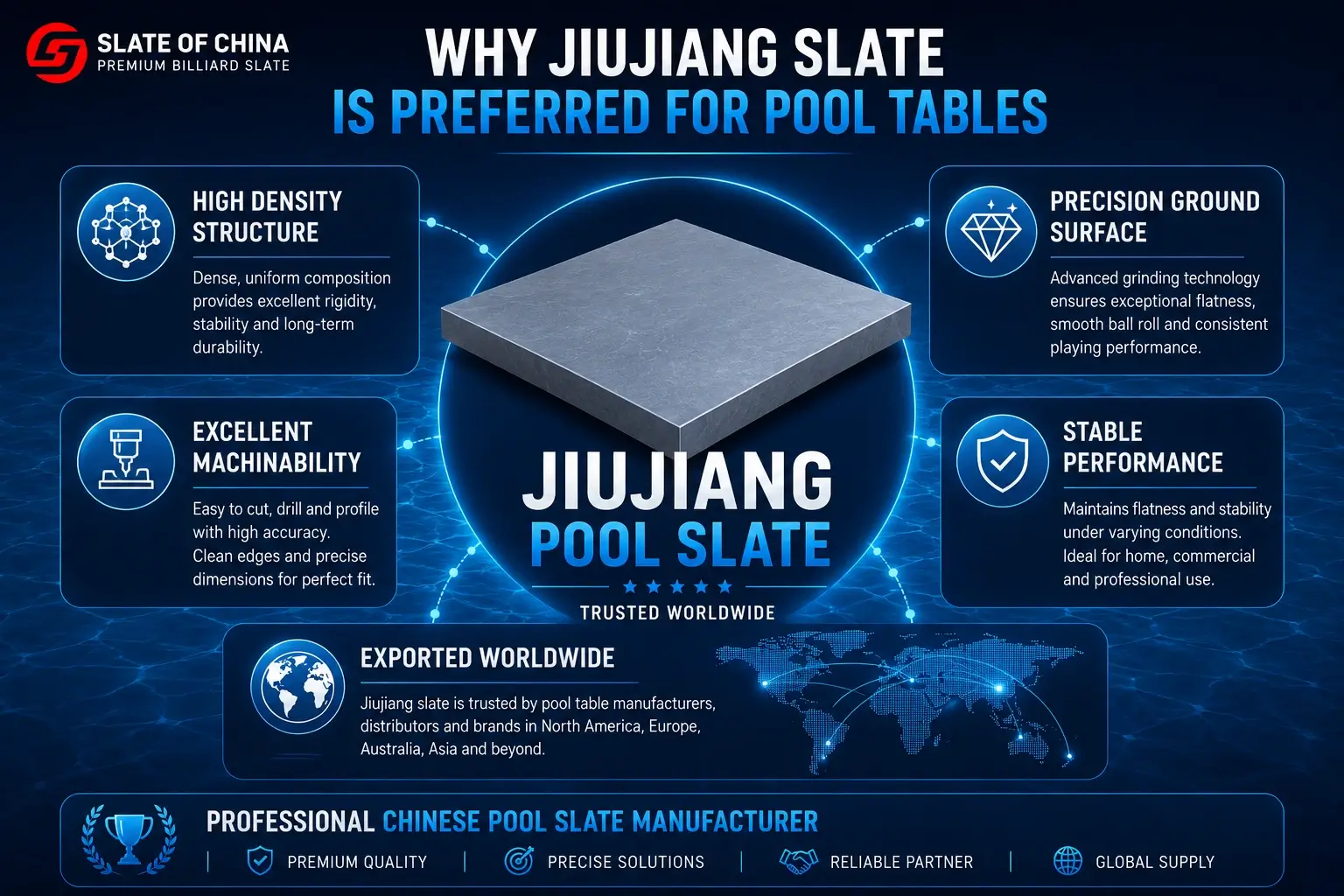
High-Density Slate Structure
The performance of a pool table begins with the quality of the slate itself.
Jiujiang slate is known for its dense and uniform mineral structure, which provides excellent rigidity and long-term stability. The high density helps reduce vibration and contributes to a smooth, consistent ball roll.
Benefits of High-Density Slate
✔ Improved playing accuracy
✔ Reduced surface vibration
✔ Better dimensional stability
✔ Enhanced durability
For pool table manufacturers, a dense slate structure helps ensure consistent performance throughout the life of the table.
Excellent Machinability
One reason Jiujiang slate is highly valued within the billiards industry is its excellent machinability.
The material can be accurately cut, calibrated, drilled, and profiled while maintaining structural integrity. This allows manufacturers to produce slate with precise dimensions and clean edge finishes.
Manufacturing Advantages
✔ Precise cutting and profiling
✔ Consistent thickness control
✔ Accurate pocket machining
✔ Reliable assembly and installation
These characteristics are particularly important for modern pool table slate manufacturing, where precision directly affects table performance.
Precision Ground Playing Surface
A pool table is only as good as the accuracy of its playing surface.
High-quality Precision Ground Pool Slate from Jiujiang is machined using advanced grinding processes to achieve exceptional flatness and surface consistency.
The result is:
✔ Smooth ball movement
✔ Consistent table speed
✔ Accurate shot performance
✔ Reliable cushion response
For commercial pool halls and professional training facilities, precision grinding is essential to maintaining high playing standards.
Stable Performance Over Time
A premium pool table must perform consistently year after year.
Jiujiang slate is valued for its ability to maintain flatness and structural stability under varying environmental conditions. When properly installed, it provides a dependable playing surface that resists deformation and supports long-term use.
Suitable For
- Home pool tables
- Commercial pool halls
- Professional training centers
- Tournament tables
This versatility makes Jiujiang Pool Slate a preferred choice for manufacturers serving different market segments.
Exported Worldwide
Jiujiang has become a major global source of billiard slate products.
Today, Chinese Pool Slate from Jiujiang is exported to customers throughout:
- United States
- Canada
- United Kingdom
- Germany
- France
- Australia
- Southeast Asia
- Middle East
Many pool table brands and OEM manufacturers rely on Jiujiang slate because of its combination of quality, consistency, and cost efficiency.
The extensive international use of Jiujiang slate demonstrates its proven performance in a wide variety of applications and markets.
Why Manufacturers Choose Jiujiang Pool Slate
When selecting a slate supplier, manufacturers look for more than just raw material quality. They need consistency, precision, and reliable production capabilities.
Jiujiang slate offers:
| Advantage | Benefit |
|---|---|
| High Density Structure | Better Stability |
| Excellent Machinability | Precise Manufacturing |
| Precision Grinding | Accurate Playing Surface |
| Stable Performance | Long Service Life |
| Global Export Experience | Reliable Supply Chain |
The Preferred Choice for Modern Pool Tables
Whether you are building a residential pool table, operating a commercial billiard hall, or manufacturing tournament-grade equipment, Jiujiang Pool Slate provides the performance and consistency required by today’s market.
With its high-density structure, precision-ground surface, excellent machinability, and worldwide reputation, Jiujiang Slate remains one of the most trusted materials for pool table slate production worldwide.
Looking for a reliable Pool Slate Supplier in China?
Why Trust Slate Of China?
Located in Jiujiang, China, Slate Of China specializes in precision-ground pool slate and snooker slate for global billiard table manufacturers.Slate Of China manufactures precision-ground Jiujiang pool slate for home, commercial, and professional pool tables worldwide.
With over 30 years of slate manufacturing and export experience, we provide calibrated slate solutions for home tables, commercial installations, and tournament-grade billiard equipment worldwide.
Contact us today for specifications, pricing, and OEM support.
Pool Slate Thickness: Key Takeaways
For most pool table applications, 25mm (1 inch) slate remains the industry standard due to its balance of stability, durability, and playing performance.
19mm slate is suitable for residential tables, while 25mm slate is preferred for commercial and professional use. Tournament tables typically use 25mm precision-ground three-piece slate with tight flatness tolerances.
When selecting pool slate, buyers should consider table size, intended use, transportation requirements, and long-term performance rather than thickness alone.