
Roofing Slate Grades Guide
Not all roofing slates are created equal. Two natural slate tiles may look almost identical in color, size, and thickness, yet their quality and long-term performance can be very different. Roofing slate grade determines how well the slate resists water absorption, freeze-thaw cycles, weathering, and mechanical stress.
Choosing the right roofing slate grade is essential for achieving a durable, low-maintenance roof that can last for decades. Whether you are a homeowner, architect, roofing contractor, or importer, understanding the differences between ASTM slate grades, EN 12326 classifications, and commercial quality grades will help you make a more informed decision.
In this guide, you’ll learn how roofing slates are graded, what the major standards mean, and how to choose the best natural roofing slate for your project.
Table of Contents
What Does Roofing Slate Grade Mean?
A roofing slate grade is a classification that indicates the overall quality and expected performance of a natural roofing slate. It is based on laboratory testing and recognized industry standards rather than the appearance of the slate.
Many buyers mistakenly believe that a darker color, thicker tile, or larger size automatically means better quality. In reality, these characteristics have little to do with the actual grade of roofing slate. Two slate tiles may look almost identical but perform very differently over decades of service.
A roofing slate grade reflects how well the slate meets specific performance requirements, including:
- Durability – the ability to maintain its performance over many decades.
- Weather Resistance – resistance to rain, UV exposure, and long-term environmental conditions.
- Water Absorption – lower absorption reduces the risk of moisture-related damage.
- Freeze-Thaw Resistance – the ability to withstand repeated freezing and thawing without cracking.
- Flexural Strength – resistance to bending and mechanical stress during installation and service.
- Physical Properties – characteristics such as density, mineral composition, and structural stability.
- Testing Performance – compliance with recognized standards such as ASTM C406 and EN 12326.
Rather than describing how a slate looks, a roofing slate grade tells you how reliably it is expected to perform throughout its service life. This makes grading one of the most important factors when selecting natural roofing slate for residential, commercial, or heritage roofing projects.
A Roofing Slate Grade Is NOT…
❌ The color of the slate
❌ The size of the tile
❌ The thickness of the slate
❌ The country of origin
❌ The surface finish
A Roofing Slate Grade IS…
✅ A quality classification
✅ A measure of durability
✅ A reflection of laboratory testing
✅ An indicator of long-term performance
✅ A guide to expected service life
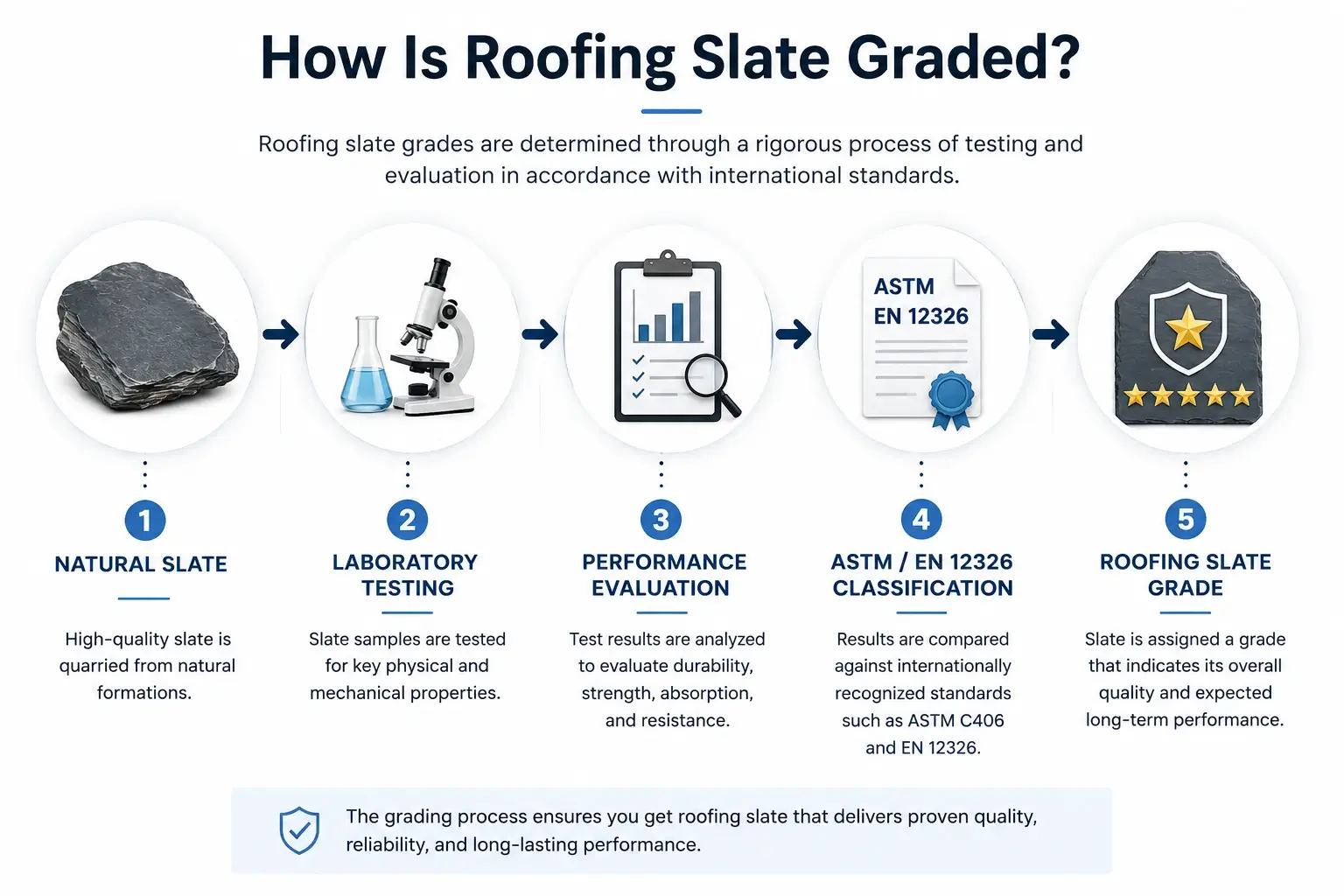
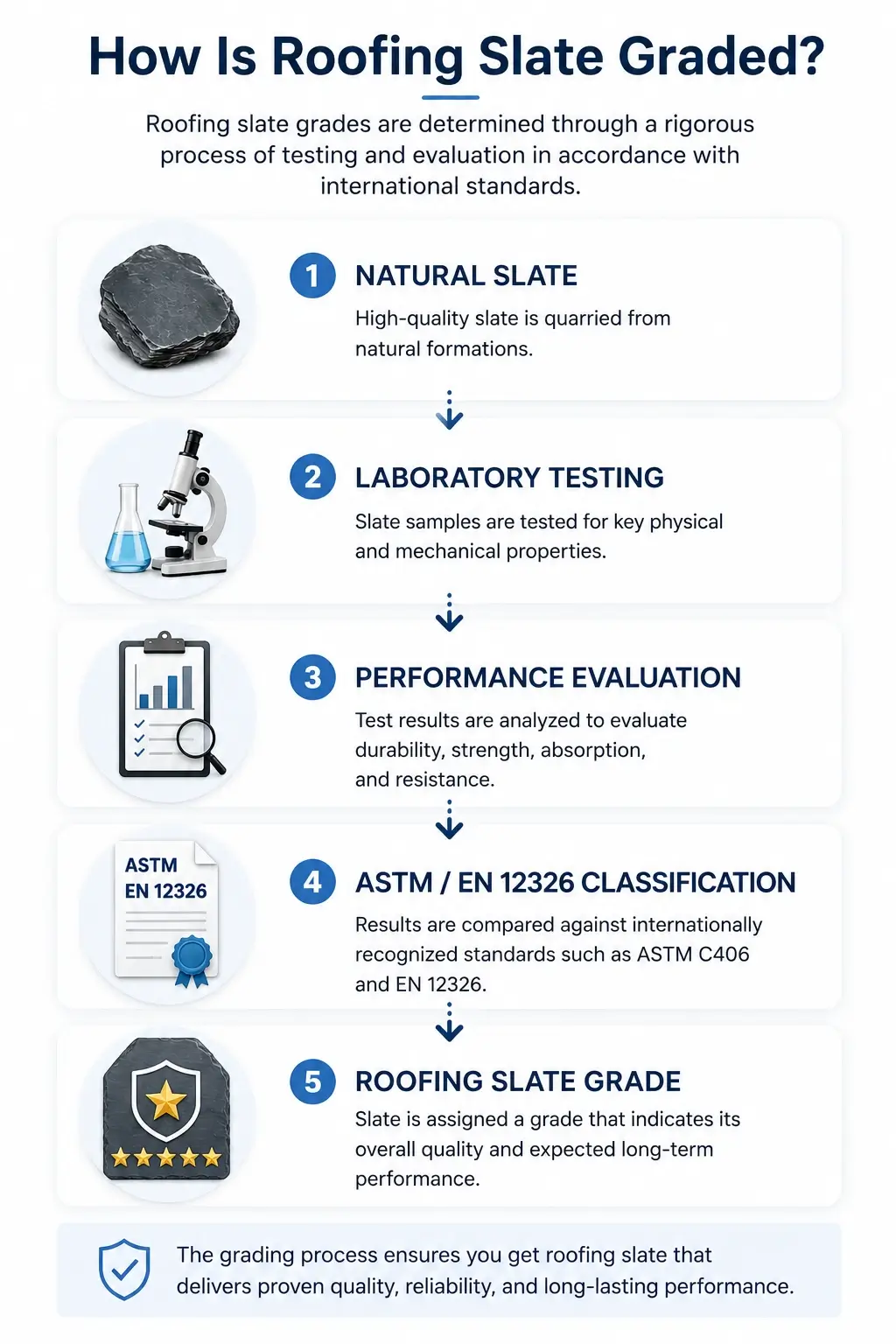
Roofing slate grades are determined through standardized laboratory testing rather than appearance alone.
Understanding what a roofing slate grade means is only the first step. The next question is why these grades matter and how they affect the lifespan, maintenance, and overall value of your roof.
Why Roofing Slate Grades Matter
Choosing the right roofing slate grade is about far more than appearance. It directly affects the long-term performance, maintenance requirements, and overall cost of your roof.
A high-quality natural roofing slate is designed to withstand decades of exposure to rain, frost, sunlight, and temperature changes while maintaining its structural integrity. Lower-grade slate may look similar when first installed, but it is often more susceptible to cracking, delamination, moisture damage, and premature replacement.
For homeowners, architects, contractors, and importers, understanding roofing slate grades means making a smarter investment. A premium slate roof may cost more initially, but its longer lifespan and lower maintenance requirements often result in a significantly lower lifetime cost.
How Roofing Slate Grade Affects Your Investment
| What the Grade Affects | Why It Matters |
|---|---|
| Roof Lifespan | Higher-grade slate can last over 100 years, while lower-quality slate may require replacement within 20–30 years. |
| Maintenance Costs | Durable slate needs fewer repairs, reducing long-term maintenance expenses. |
| Replacement Frequency | Better-quality slate minimizes premature failures and costly roof replacement. |
| Property Value | A long-lasting natural slate roof enhances curb appeal and increases property value. |
Premium Slate vs. Low-Quality Slate
| Premium Roofing Slate | Low-Quality Slate | |
|---|---|---|
| Expected Lifespan | 100+ Years | 20–30 Years |
| Water Absorption | Very Low | Higher |
| Freeze-Thaw Resistance | Excellent | Limited |
| Maintenance | Minimal | More Frequent |
| Lifetime Cost | Lower | Higher |
| Best For | Long-Term Investment | Budget or Temporary Projects |
Did You Know?
Although premium roofing slate usually has a higher initial cost, its exceptional durability and minimal maintenance often make it the most economical choice over the life of the roof.
🏠
Longer Roof Life
100+ Years
🔧
Lower Maintenance
Fewer Repairs
🔄
Less Replacement
Long-Term Reliability
📈
Higher Property Value
Better Return on Investment
Understanding why roofing slate grades matter makes it easier to compare the different grading systems used around the world. In the next section, we’ll explain the two most widely recognized standards: ASTM C406 and EN 12326.
Two Main Roofing Slate Grading Systems
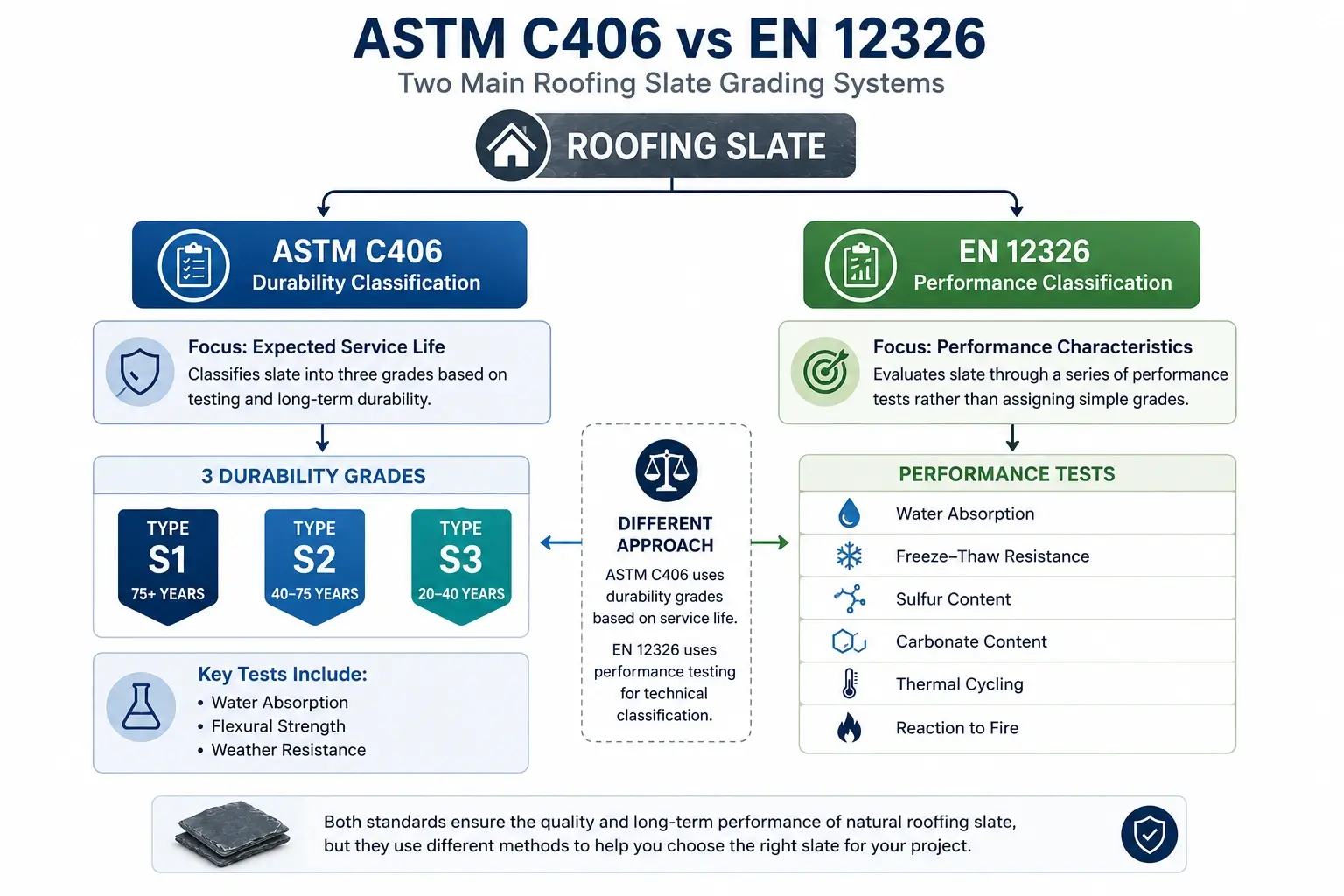
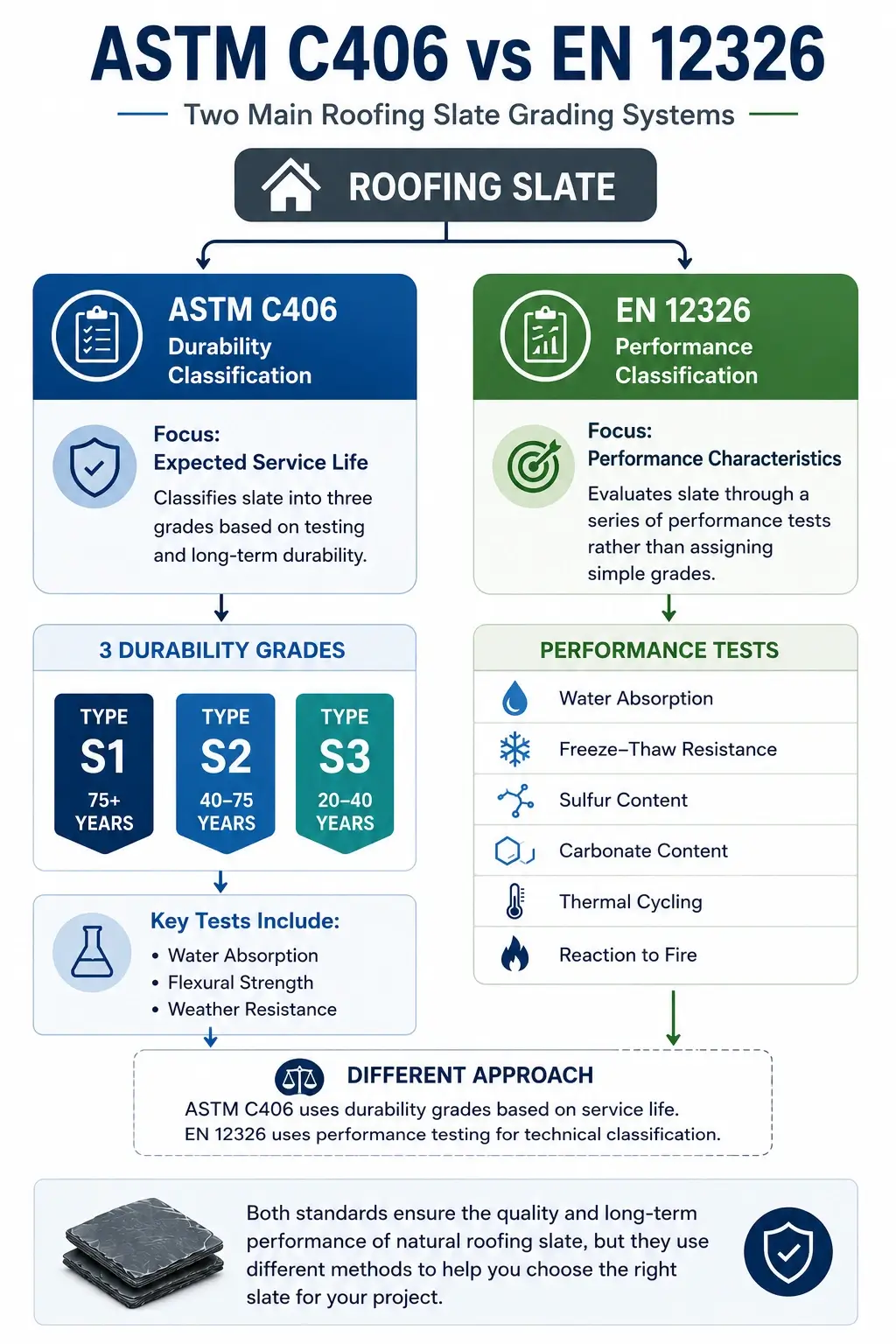
Around the world, roofing slate quality is evaluated using recognized industry standards rather than appearance alone. The two most widely accepted systems are ASTM C406, commonly used in North America, and EN 12326, the European standard for natural roofing slate.
Although both standards assess the long-term performance of natural slate, they use different approaches. ASTM C406 classifies slate into three durability grades based on expected service life, while EN 12326 focuses on laboratory test results and performance classifications for specific physical and chemical properties.
Understanding the differences between these two systems helps homeowners, architects, distributors, and importers choose roofing slate that meets the requirements of their market and project.
ASTM C406 Classification (North America)
ASTM C406 is the primary standard used in the United States and Canada for classifying natural roofing slate. Published by ASTM International, it evaluates slate based on laboratory testing and expected long-term durability.
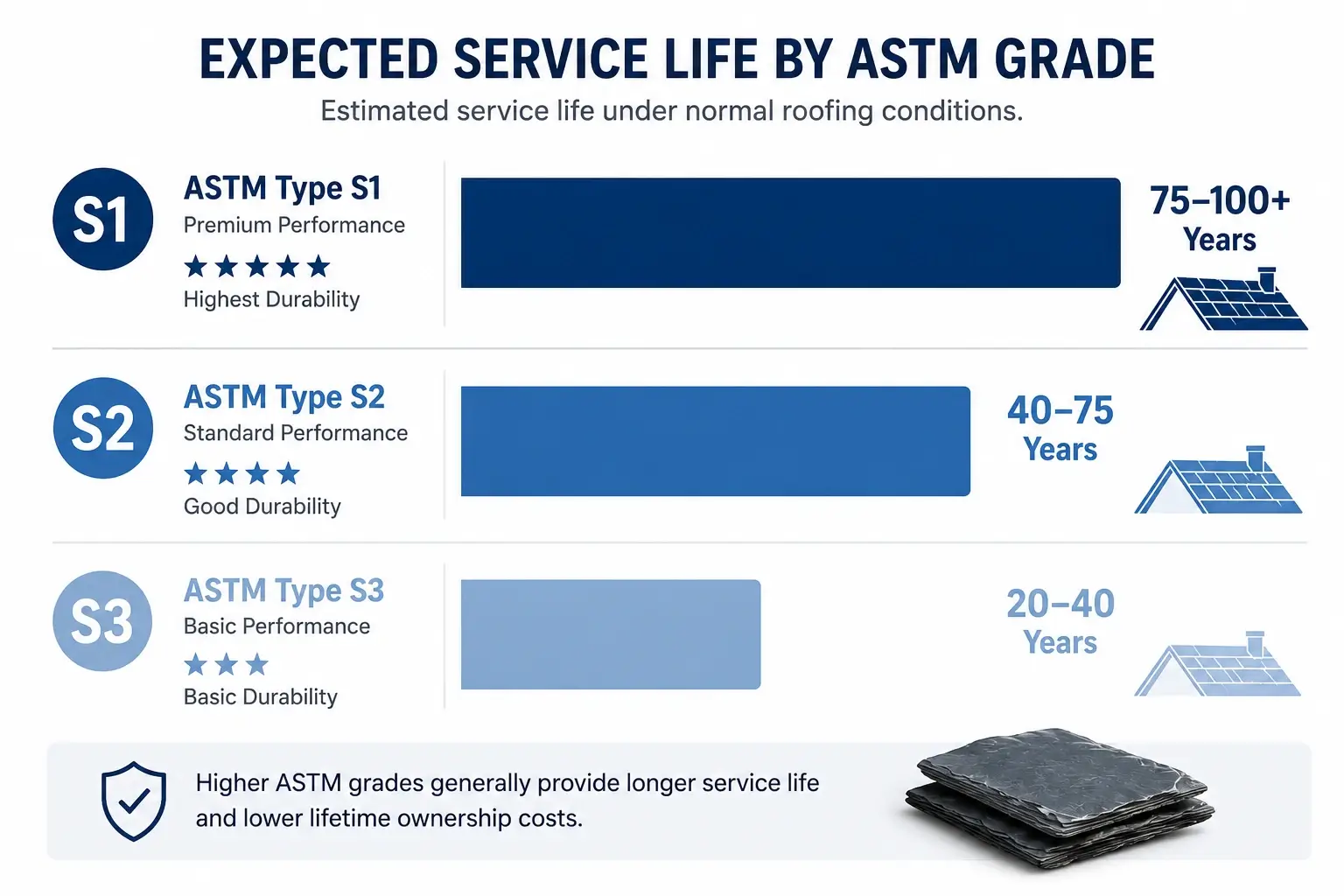
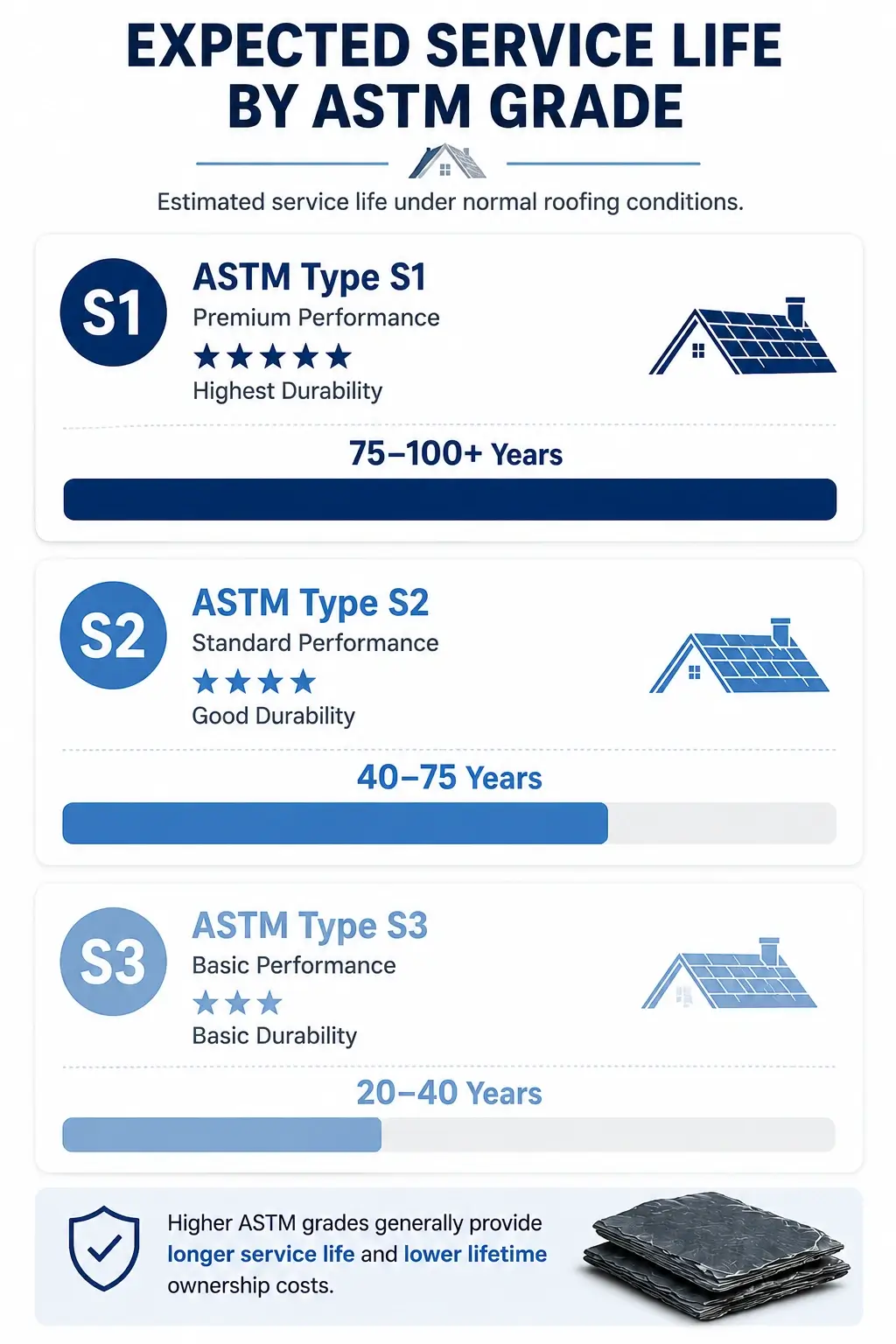
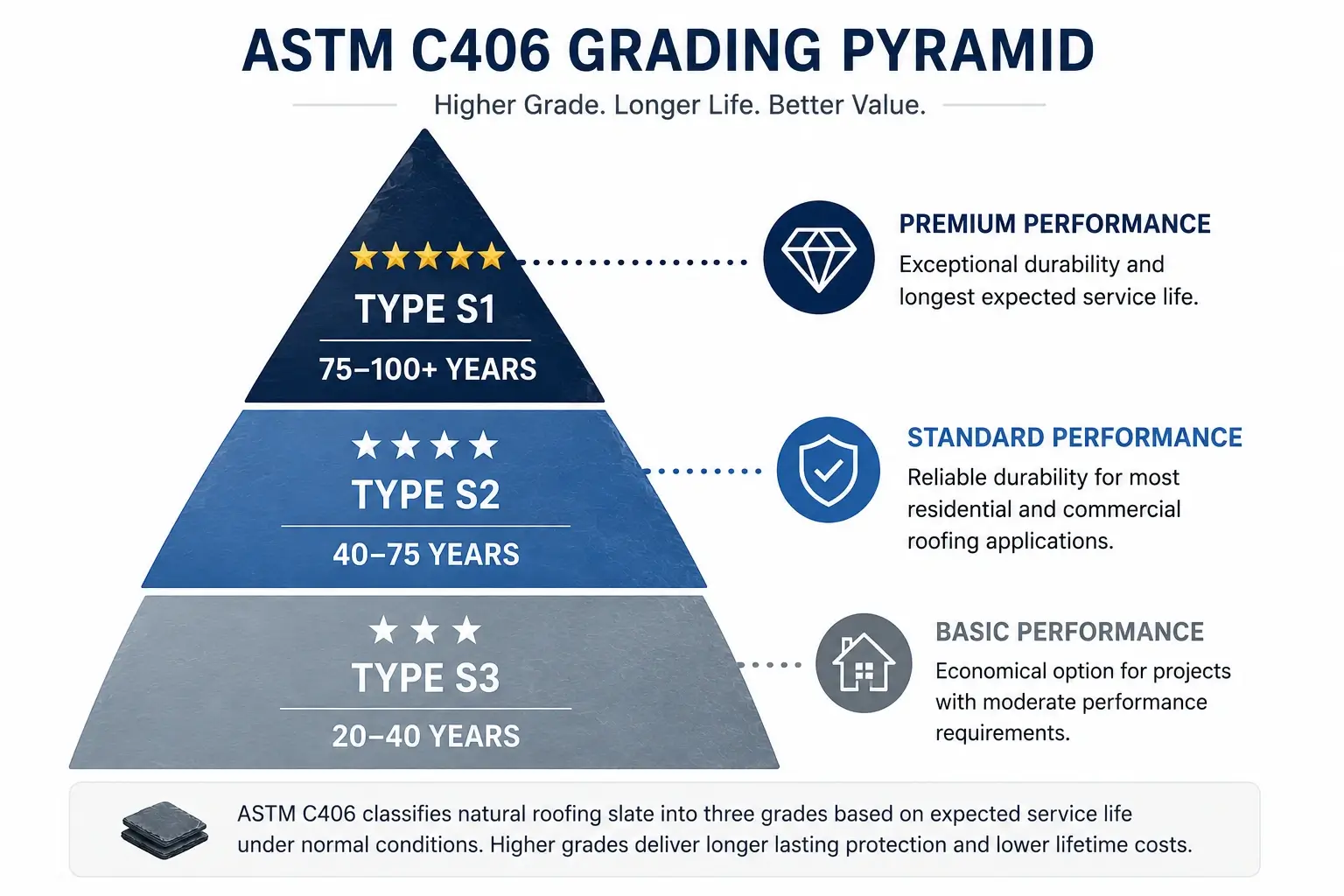
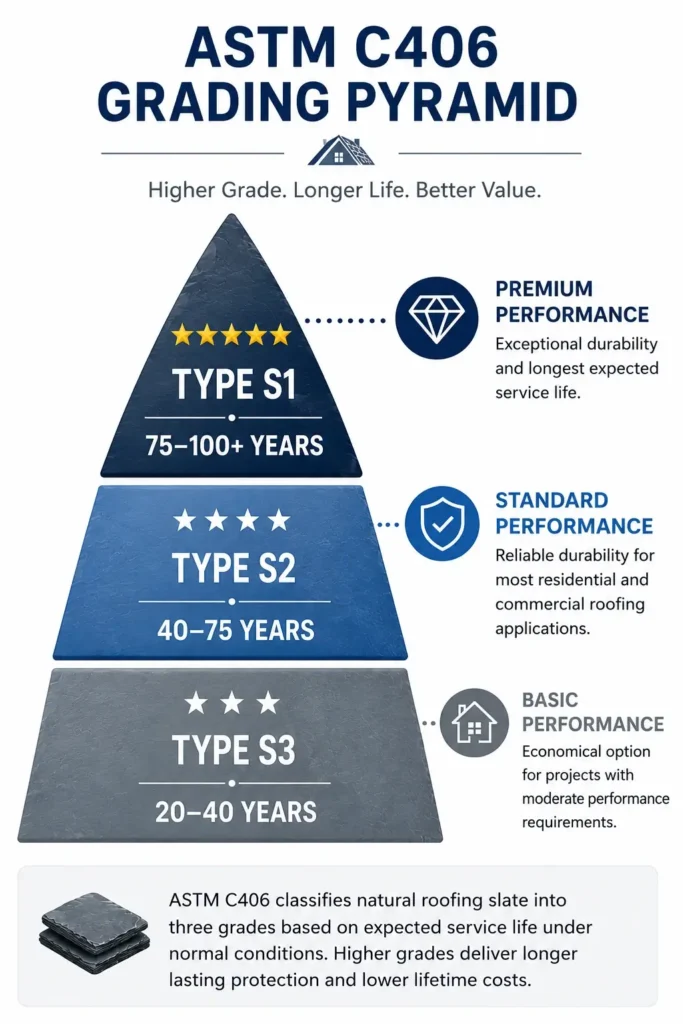
The standard divides roofing slate into three grades according to its estimated service life under normal conditions.
| ASTM Grade | Expected Service Life | Typical Application |
|---|---|---|
| Type S1 | 75+ Years | Premium residential, commercial buildings, historic restoration |
| Type S2 | 40–75 Years | Standard residential and commercial roofing |
| Type S3 | 20–40 Years | Economy projects or temporary buildings |
To determine the appropriate grade, ASTM C406 evaluates several important performance characteristics, including:
- Water Absorption – lower absorption improves moisture resistance.
- Flexural Strength – the ability to resist bending and mechanical stress.
- Weather Resistance – long-term durability under natural weather exposure.
In general, Type S1 roofing slate provides the highest durability and the longest expected service life, making it the preferred choice for premium roofing projects where longevity is a priority.
EN 12326 Classification (Europe)
Unlike ASTM C406, EN 12326 does not simply divide roofing slate into fixed quality grades. Instead, it provides a comprehensive performance classification system based on laboratory testing.
The European standard evaluates whether a natural roofing slate meets specific technical requirements for long-term durability, structural stability, and environmental resistance.
Rather than asking “Which grade is this slate?”, EN 12326 focuses on “How does this slate perform?”
| Test Category | Why It Matters |
|---|
| Water Absorption | Indicates moisture resistance and durability |
| Freeze-Thaw Resistance | Measures performance in cold climates |
| Carbonate Content | High carbonate levels may reduce durability |
| Sulfur Content | Evaluates the risk of oxidation and staining |
| Thermal Cycling | Tests resistance to repeated temperature changes |
| Reaction to Fire | Determines fire performance classification |
Because EN 12326 emphasizes laboratory performance rather than simple grading, it provides architects and specifiers with more detailed information when selecting roofing slate for different climates and building requirements.
Many European projects specify compliance with EN 12326 instead of requesting a particular commercial grade.
ASTM C406 vs EN 12326
| Feature | ASTM C406 | EN 12326 |
|---|---|---|
| Primary Market | North America | Europe |
| Classification Method | Durability Grades | Performance Classification |
| Main Focus | Expected Service Life | Laboratory Test Results |
| Typical Output | Type S1 / S2 / S3 | Test Classifications |
| Suitable For | Roofing durability comparison | Technical project specifications |
Which Standard Is Better?
Neither standard is universally “better.” ASTM C406 provides a simple durability grading system that is easy to understand, while EN 12326 offers a more detailed technical evaluation based on laboratory performance. The appropriate standard depends on your market, local building requirements, and project specifications.
Whether your project follows ASTM C406 or EN 12326, understanding these standards makes it easier to compare roofing slate quality. In the next section, we’ll look at commercial roofing slate grades and explain how terms such as Premium Grade, Architectural Grade, and Commercial Grade are commonly used in the global slate industry.
Commercial Roofing Slate Grades
In addition to official standards such as ASTM C406 and EN 12326, many roofing slate suppliers use commercial grade names to describe the quality of their products. Terms such as Premium Grade, Architectural Grade, Commercial Grade, Export Grade, A Grade, B Grade, and First Quality are widely used in the international slate trade.
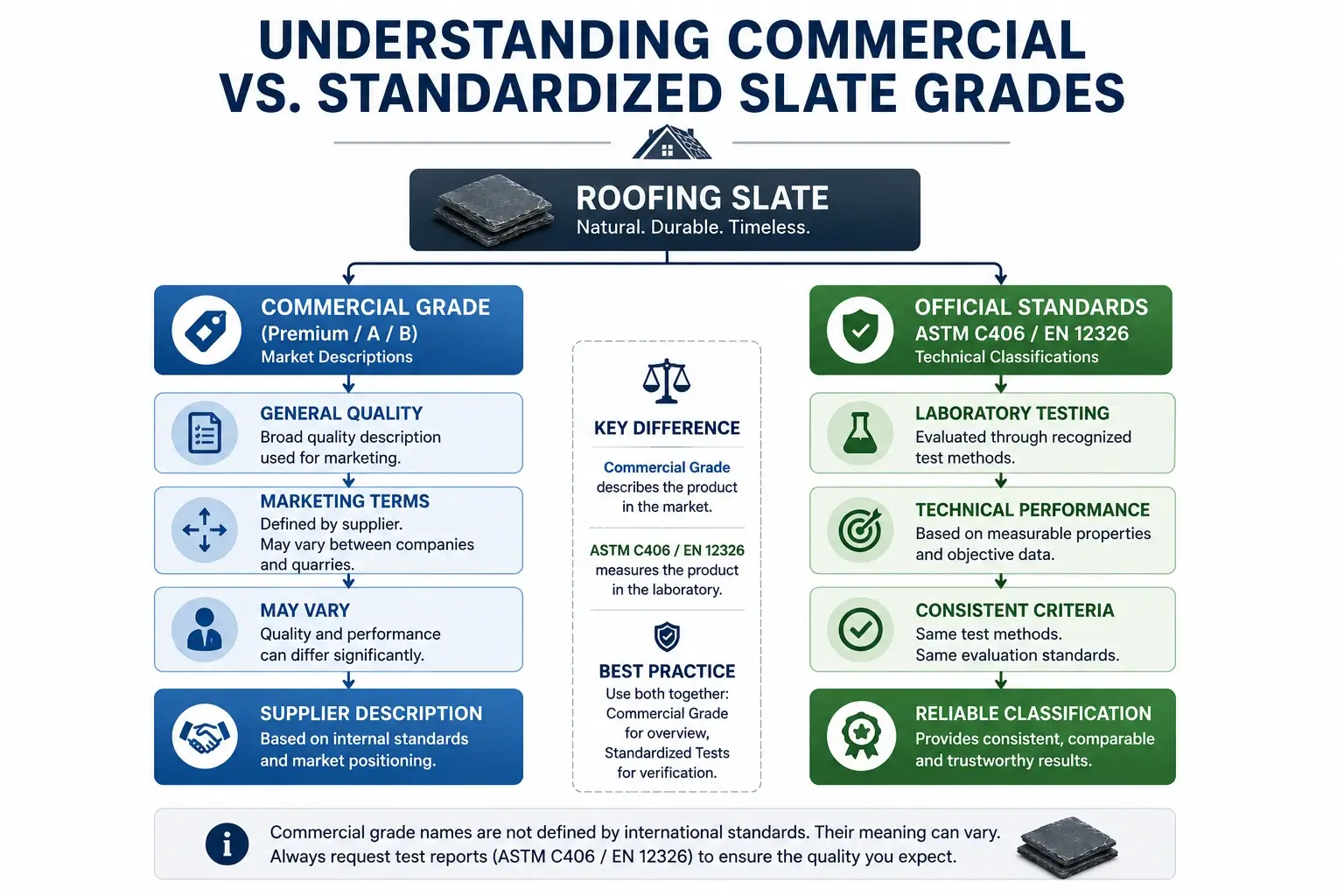
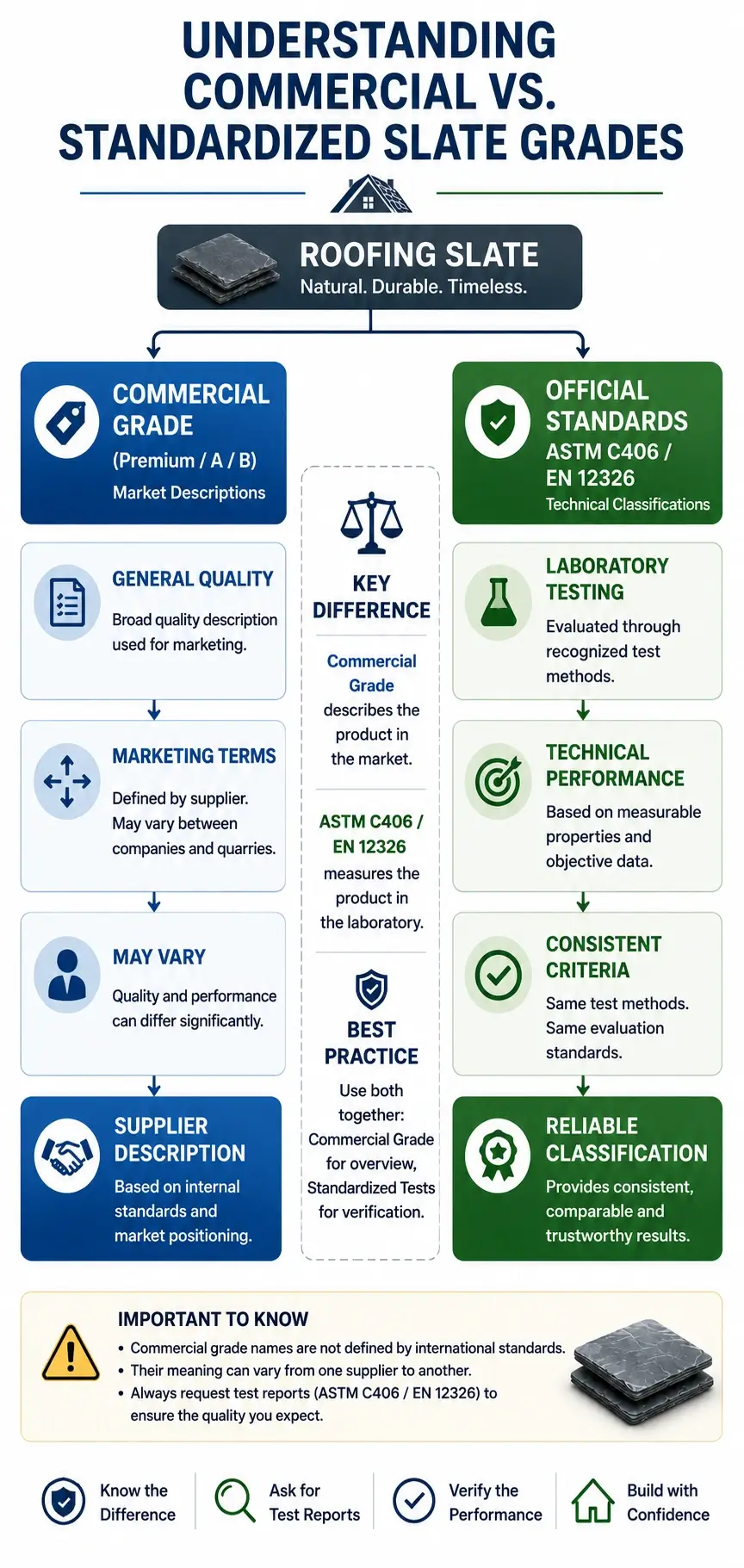
However, it is important to understand that these commercial grades are not defined by any international standard. Their meaning can vary from one quarry, manufacturer, or supplier to another. A product labeled as Premium Grade by one company may not meet the same quality level as a similarly named product from another supplier.
For this reason, commercial grade names should be considered as general quality descriptions rather than official technical classifications. Whenever possible, buyers should also request laboratory test reports or certification to verify the actual performance of the roofing slate.
Common Commercial Roofing Slate Grades
| Commercial Grade | Typical Quality | Common Applications |
|---|---|---|
| Premium Grade | Highest quality with excellent durability and appearance | Luxury homes, heritage buildings, high-end roofing |
| Architectural Grade | High quality with consistent performance | Residential and commercial roofing |
| Commercial Grade | Good overall quality for general applications | Standard residential and commercial projects |
| Export Grade | Produced to meet export market specifications | International construction projects |
| A Grade | Often indicates higher-quality selection | Residential and architectural roofing |
| B Grade | Usually a lower commercial selection | Budget-conscious projects |
| First Quality | Carefully selected for appearance and consistency | Premium roofing and visible applications |
| Standard Quality | General-purpose roofing slate | Cost-sensitive roofing projects |
Note: Commercial grade names are not standardized worldwide. The actual quality and performance may vary between manufacturers and quarries.
⚠️ Important
Do not assume that two products with the same commercial grade name have the same quality.
Before purchasing roofing slate, always ask for:
- ASTM C406 or EN 12326 test reports
- Water absorption results
- Flexural strength data
- Freeze-thaw resistance testing
- Quarry source and production consistency
This information provides a much more reliable indication of roofing slate quality than a commercial grade name alone.
Commercial Grade vs. Official Standards
| Commercial Grades | ASTM C406 / EN 12326 | |
|---|---|---|
| Defined by | Manufacturer or supplier | International standards |
| Globally Consistent | ❌ No | ✅ Yes |
| Laboratory Tested | Sometimes | Yes |
| Easy to Compare | Limited | High |
| Recommended for Specification | No | Yes |
Commercial grade names are useful for general product descriptions, but they should never replace recognized testing standards. Whether you are purchasing natural roofing slate for a residential home, commercial building, or restoration project, always evaluate both the commercial grade and the supporting technical documentation before making a decision.
How Roofing Slate Is Tested for Quality
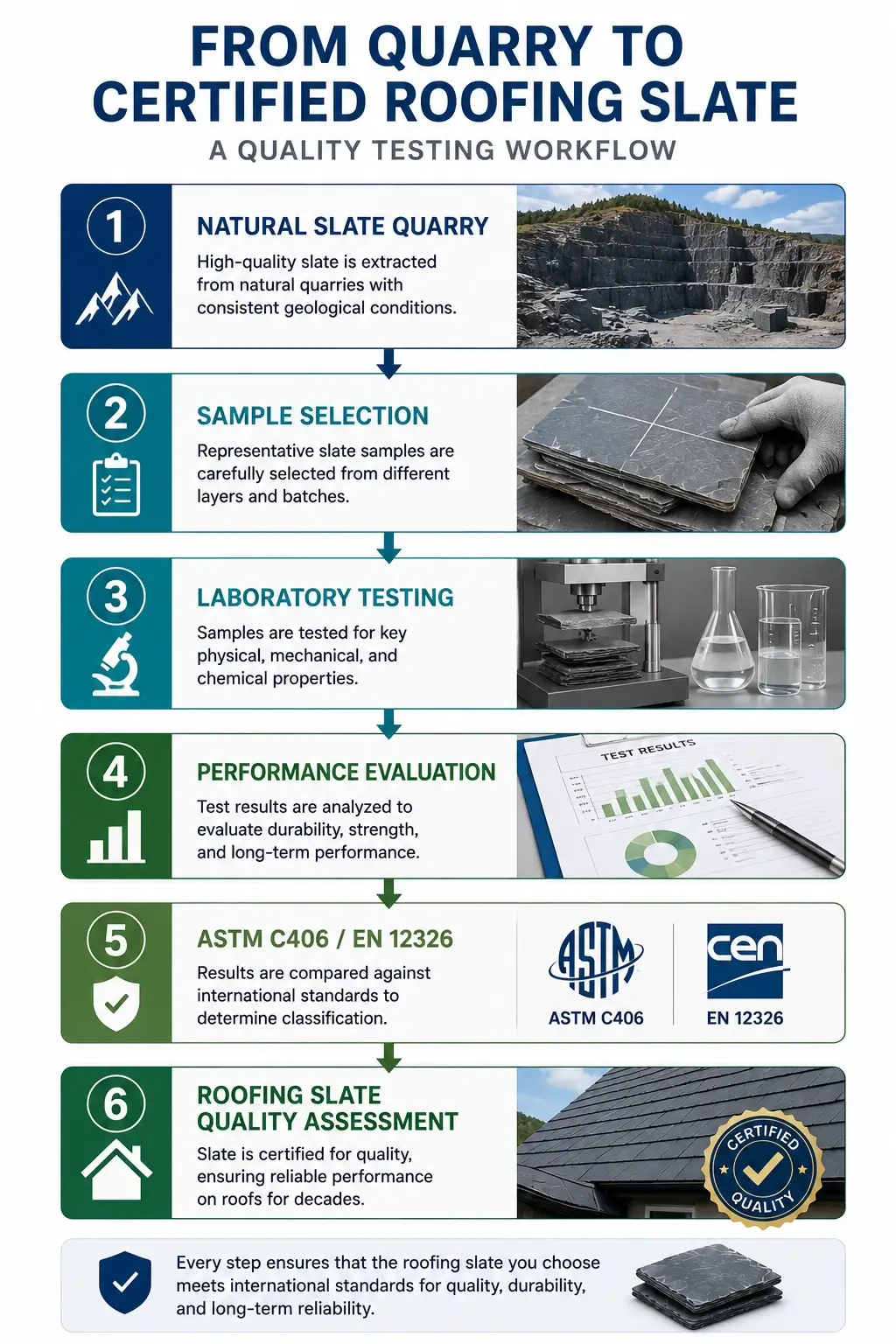
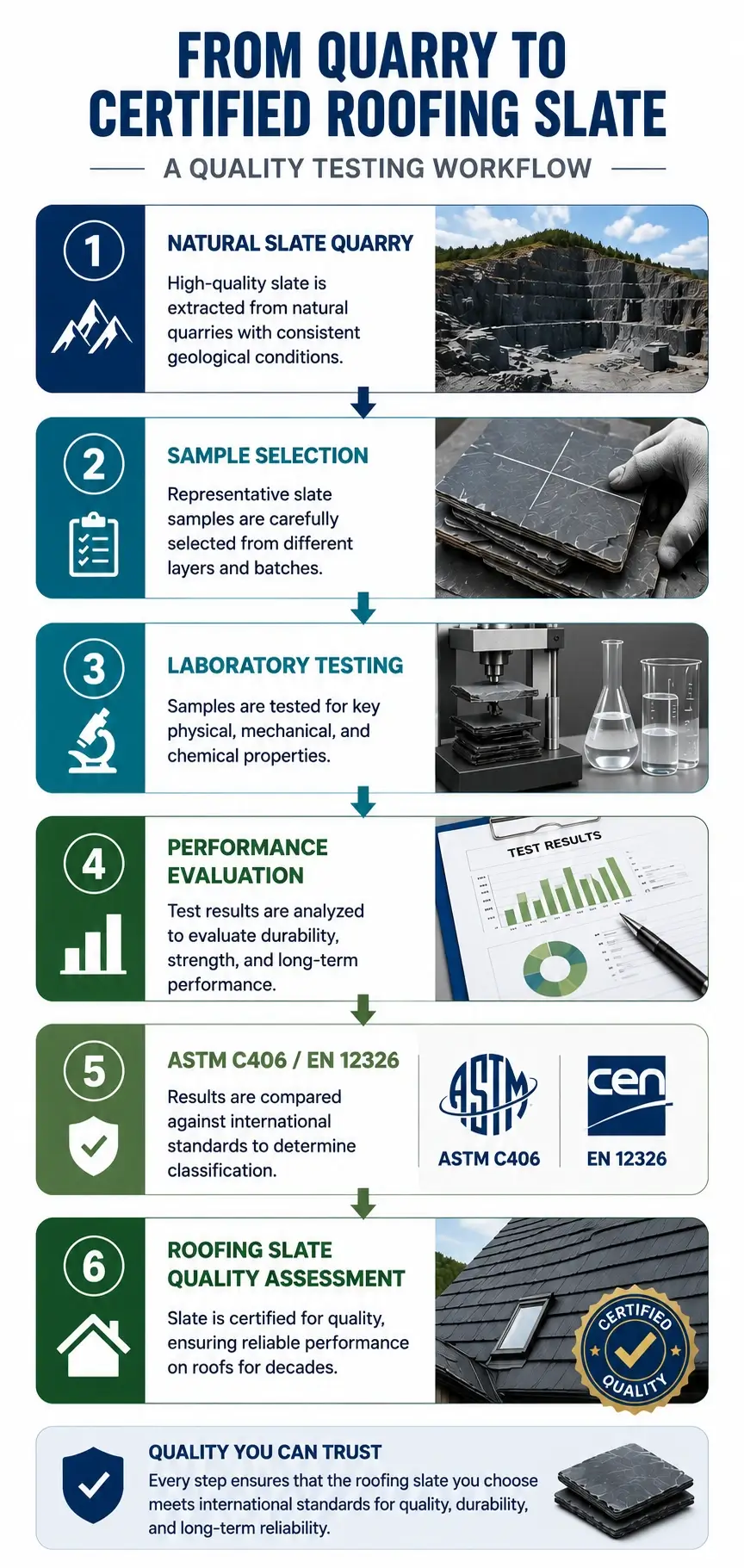
The quality of natural roofing slate cannot be judged by appearance alone. Two slate tiles may have the same color, texture, and thickness, yet perform very differently over time. That is why recognized standards such as ASTM C406 and EN 12326 rely on laboratory testing to evaluate the physical, mechanical, and chemical properties of roofing slate.
These tests help determine whether a slate is suitable for long-term roofing applications and provide buyers with objective data rather than relying on visual inspection or commercial grade names.
Key Roofing Slate Quality Tests
| Test | Why It Matters |
|---|---|
| Water Absorption | Measures how much water the slate absorbs. Lower absorption generally improves durability and freeze-thaw resistance. |
| Flexural Strength | Evaluates the slate’s resistance to bending and breaking during installation and long-term service. |
| Density | Higher density often indicates a more compact structure with better durability and weather resistance. |
| Thermal Cycling | Tests the slate’s ability to withstand repeated temperature changes without deterioration. |
| Freeze-Thaw Resistance | Simulates freezing and thawing conditions to verify performance in cold climates. |
| Acid Resistance | Assesses resistance to acidic environments that may accelerate surface deterioration. |
| Oxidation Potential | Evaluates the likelihood of mineral oxidation that could cause staining or long-term changes in appearance. |
| Impact Resistance | Measures the slate’s ability to resist accidental impact from hail, debris, or handling during installation. |
Why Laboratory Testing Matters
Laboratory testing provides measurable, objective data that helps architects, contractors, distributors, and importers compare roofing slate products with confidence. Rather than relying solely on appearance or commercial grade names, testing verifies whether a slate meets recognized performance standards for durability and long-term reliability.
Before Buying Roofing Slate, Ask for These Test Results
✔ Water Absorption
✔ Flexural Strength
✔ Freeze-Thaw Resistance
✔ Oxidation Test
✔ EN 12326 or ASTM C406 Report
Although no single laboratory test can determine the overall quality of roofing slate, these tests together provide a comprehensive assessment of durability, strength, and long-term performance. Understanding these testing methods makes it easier to compare different roofing slate products and choose the most suitable material for your project.
| Test | Importance |
|---|---|
| Water Absorption | ⭐⭐⭐⭐⭐ |
| Freeze-Thaw Resistance | ⭐⭐⭐⭐⭐ |
| Flexural Strength | ⭐⭐⭐⭐☆ |
| Oxidation Potential | ⭐⭐⭐⭐☆ |
| Density | ⭐⭐⭐⭐☆ |
| Thermal Cycling | ⭐⭐⭐☆☆ |
| Impact Resistance | ⭐⭐⭐☆☆ |
| Acid Resistance | ⭐⭐☆☆☆ |
The relative importance of each test may vary depending on climate, building type, and project requirements.
What Makes a High-Quality Roofing Slate?
A high-quality roofing slate is defined by its long-term performance rather than its appearance. While color, texture, and finish may influence aesthetics, they do not necessarily indicate durability or service life.
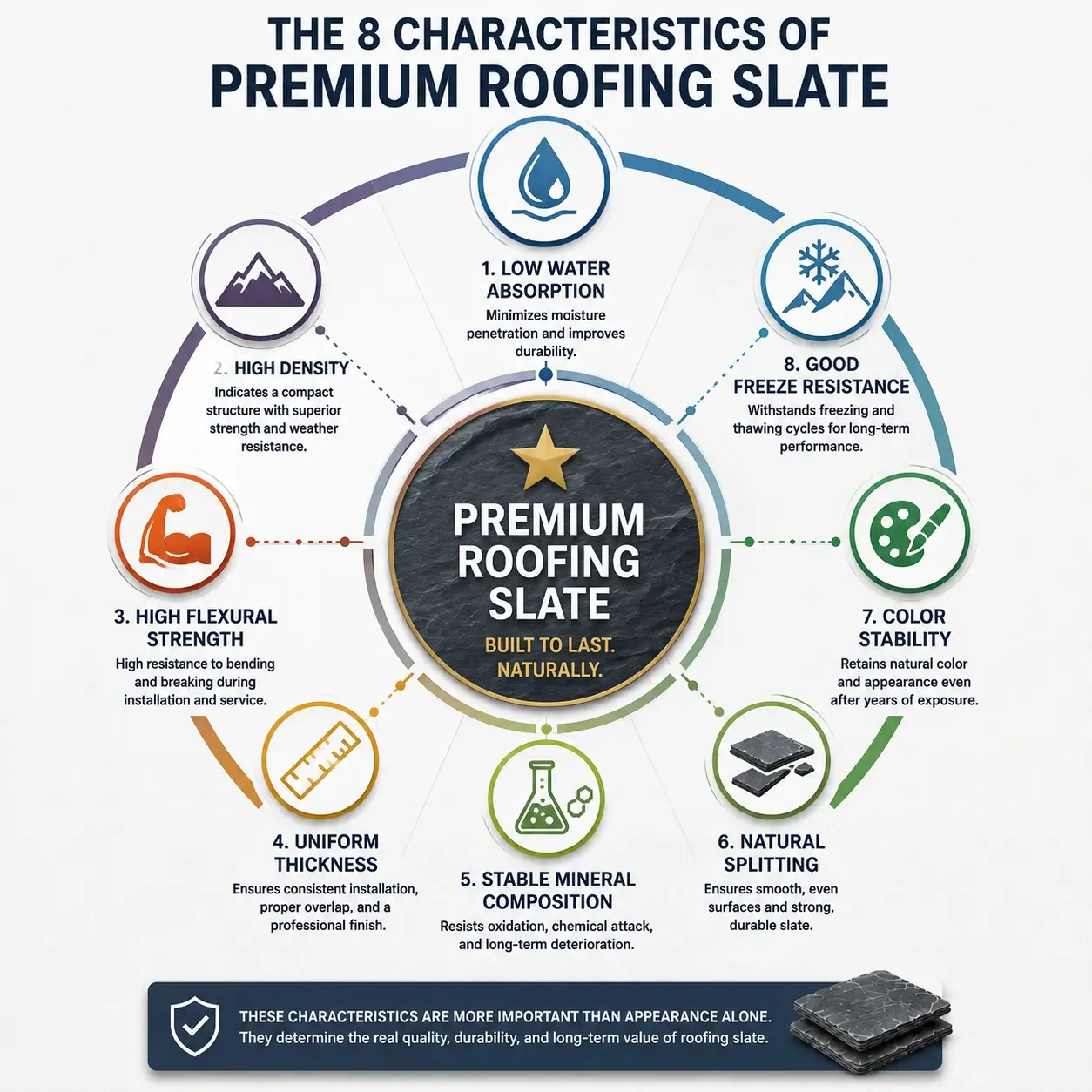
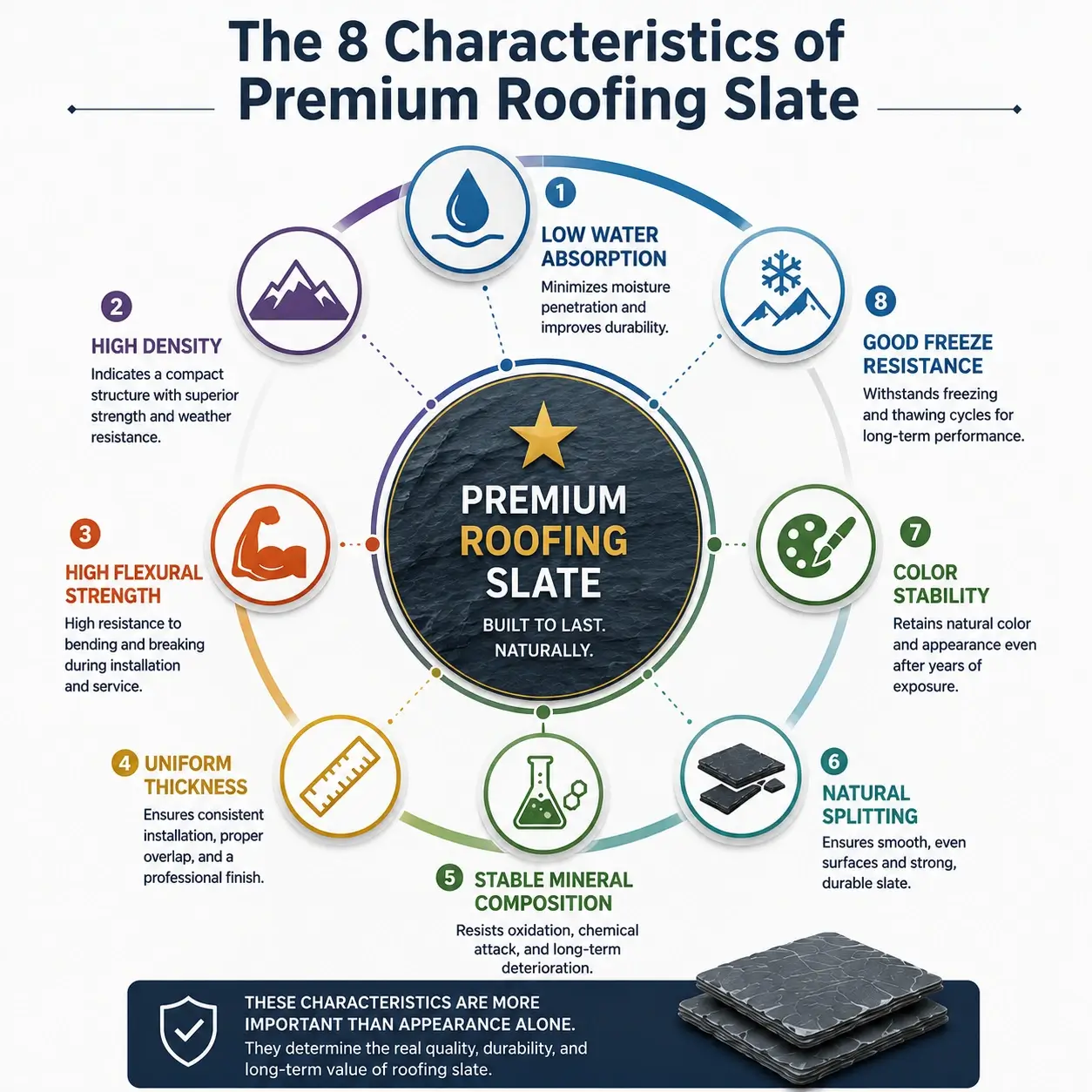
Professional architects, roofing contractors, and importers evaluate natural roofing slate based on a combination of physical properties, laboratory test results, and manufacturing consistency. The following characteristics are widely recognized as indicators of premium roofing slate quality.
Characteristics of High-Quality Roofing Slate
| ✔ | Characteristic | Why It Matters |
|---|---|---|
| ✅ | Low Water Absorption | Minimizes moisture penetration and improves freeze-thaw durability. |
| ✅ | High Density | Indicates a compact stone structure with excellent strength and weather resistance. |
| ✅ | High Flexural Strength | Reduces the risk of cracking during installation and long-term service. |
| ✅ | Uniform Thickness | Ensures consistent installation, proper overlap, and a professional roof appearance. |
| ✅ | Natural Splitting | Produces smooth, stable cleavage surfaces without excessive defects or weak layers. |
| ✅ | Stable Mineral Composition | Helps prevent oxidation, discoloration, and premature deterioration. |
| ✅ | Good Freeze-Thaw Resistance | Essential for maintaining durability in cold and variable climates. |
| ✅ | Excellent Color Stability | Preserves the natural appearance of the roof despite long-term exposure to sunlight and weather. |
Appearance Isn’t Everything
Two roofing slates may look almost identical in color, size, and thickness, yet their long-term performance can differ significantly. Laboratory-tested properties such as water absorption, flexural strength, and freeze-thaw resistance provide a far more reliable indication of roofing slate quality than appearance alone.
Before Purchasing Roofing Slate, Check That It Has:
✔ Low water absorption
✔ High flexural strength
✔ Good freeze-thaw resistance
✔ Uniform thickness
✔ Stable mineral composition
✔ ASTM C406 or EN 12326 test reports
✔ Consistent color and texture
✔ Reliable quarry source
Choosing high-quality natural roofing slate is about much more than selecting an attractive color or finish. By focusing on proven performance characteristics and recognized testing standards, buyers can confidently choose roofing slate that delivers exceptional durability, low maintenance, and lasting value for decades.
Premium Roofing Slate Quality Checklist
✔ Low Water Absorption
★★★★★
✔ High Density
★★★★★
✔ Flexural Strength
★★★★★
✔ Uniform Thickness
★★★★★
✔ Natural Splitting
★★★★★
✔ Stable Minerals
★★★★★
✔ Freeze Resistance
★★★★★
✔ Color Stability
★★★★★
Premium Roofing Slate
✔ Ready for Long-Term Roofing
The best roofing slate is not simply the one that looks the most attractive—it is the one that combines proven durability, consistent physical properties, and verified laboratory performance. These characteristics are far more important than appearance alone when selecting natural roofing slate for a long-lasting roof.
Roofing Slate Grades Comparison Table
There is no single grading system used worldwide for natural roofing slate. Depending on the market, you may encounter ASTM C406 classifications, EN 12326 performance standards, or various commercial grade names such as Premium Grade or Architectural Grade.
The table below provides a general comparison of the most commonly used roofing slate grade systems. It is intended as a practical reference rather than a direct equivalence between standards.
Comparison of Common Roofing Slate Grades
| Grade / Classification | Typical Service Life* | Freeze-Thaw Resistance | Typical Applications |
|---|---|---|---|
| Premium Grade (Commercial) | 100+ Years | Excellent | Luxury homes, landmark buildings, heritage restoration |
| ASTM Type S1 | 75+ Years | Excellent | Premium residential and commercial roofing |
| Architectural Grade (Commercial) | 75–100+ Years | Excellent to Good | High-end residential roofing |
| ASTM Type S2 | 40–75 Years | Good | Standard residential and commercial projects |
| Commercial Grade (Commercial) | Varies | Varies | General roofing applications |
| ASTM Type S3 | 20–40 Years | Basic | Budget or temporary roofing projects |
| Economy Grade (Commercial) | Varies | Basic | Cost-sensitive or temporary buildings |
*Service life is an estimate under normal installation and maintenance conditions. Actual performance depends on the quarry source, mineral composition, installation quality, local climate, and compliance with recognized testing standards.
Key Takeaways from the Comparison
When comparing roofing slate grades, keep these points in mind:
- ASTM Type S1 is the highest official durability classification under ASTM C406.
- EN 12326 evaluates roofing slate through laboratory performance rather than assigning S1, S2, or S3 grades.
- Commercial grades such as Premium Grade or Architectural Grade are marketing terms and are not internationally standardized.
- Always review laboratory test reports and product specifications in addition to commercial grade names.
Pro Tip
The best roofing slate is not necessarily the one with the most impressive commercial name—it is the one that combines verified laboratory performance, proven durability, and consistent manufacturing quality.
Overall Performance Comparison
| Grade | Overall Performance |
|---|---|
| Premium Grade | ⭐⭐⭐⭐⭐ |
| ASTM Type S1 | ⭐⭐⭐⭐⭐ |
| Architectural Grade | ⭐⭐⭐⭐☆ |
| ASTM Type S2 | ⭐⭐⭐⭐☆ |
| Commercial Grade | ⭐⭐⭐☆☆ |
| ASTM Type S3 | ⭐⭐☆☆☆ |
| Economy Grade | ⭐☆☆☆☆ |
Important: Commercial grade names are not equivalent to ASTM classifications. A product marketed as “Premium Grade” should always be supported by independent test reports or compliance with recognized standards such as ASTM C406 or EN 12326.
Where Does Jiujiang Roofing Slate Fit?
Jiujiang roofing slate is one of the best-known natural roofing slate materials produced in China and has been widely exported to Europe, North America, Australia, and other international markets for decades.
Formed through natural geological processes, Jiujiang slate is valued for its consistent quality, attractive appearance, and reliable long-term performance. Depending on the quarry source and verified laboratory test results, it can be suitable for a wide range of residential, commercial, and architectural roofing projects.
Rather than relying solely on commercial grade names, professional buyers typically evaluate Jiujiang roofing slate according to its physical properties and compliance with recognized testing standards.
Key Characteristics of Jiujiang Roofing Slate
| ✔ | Property | Why It Matters |
|---|---|---|
| ✅ | Low Water Absorption | Helps reduce moisture penetration and supports long-term durability in wet climates. |
| ✅ | High Density | Provides excellent structural stability and resistance to weathering. |
| ✅ | Excellent Natural Splitability | Produces smooth, consistent roofing slates with clean edges and reliable installation performance. |
| ✅ | Stable Mineral Composition | Contributes to long-term durability and minimizes the risk of oxidation or premature deterioration. |
| ✅ | Good Freeze-Thaw Resistance | Suitable for regions with seasonal freezing and thawing when verified by laboratory testing. |
| ✅ | Consistent Color and Texture | Creates an attractive, uniform roof appearance while maintaining the natural beauty of slate. |
Performance and Quality
Jiujiang roofing slate is widely recognized for its balance of durability, workability, and aesthetic appeal. When sourced from well-managed quarries and supported by independent laboratory testing, it is capable of meeting the performance requirements of many high-quality roofing applications.
Depending on the quarry source, mineral composition, and test results, Jiujiang slate may be suitable for projects requiring:
- Premium residential roofing
- Commercial roofing
- Heritage restoration
- Architectural roofing
- High-performance natural slate applications
Because natural slate is a geological material, properties can vary between quarries and production batches. For this reason, product selection should always be based on verified laboratory test reports rather than appearance or commercial grade names alone.
Why Buyers Choose Jiujiang Roofing Slate
✔ Naturally durable
✔ Excellent splitting quality
✔ Consistent production
✔ Attractive natural appearance
✔ Competitive value
✔ Exported worldwide
✔ Suitable for demanding roofing projects
Professional Recommendation
When specifying Jiujiang roofing slate for residential or commercial projects, request the latest laboratory test reports and product specifications to confirm compliance with your project’s technical requirements. This ensures that the selected slate meets the required performance criteria under ASTM C406, EN 12326, or other applicable standards.
With proper quarry selection, quality control, and independent testing, Jiujiang natural roofing slate offers an excellent combination of durability, appearance, and value. For buyers seeking reliable natural slate for long-term roofing performance, it remains one of China’s most established and internationally recognized roofing slate materials.
Note: The performance of natural roofing slate may vary depending on the quarry source and production batch. Any statements regarding compliance with ASTM C406, EN 12326, or other standards should be supported by current laboratory test reports for the specific product supplied.
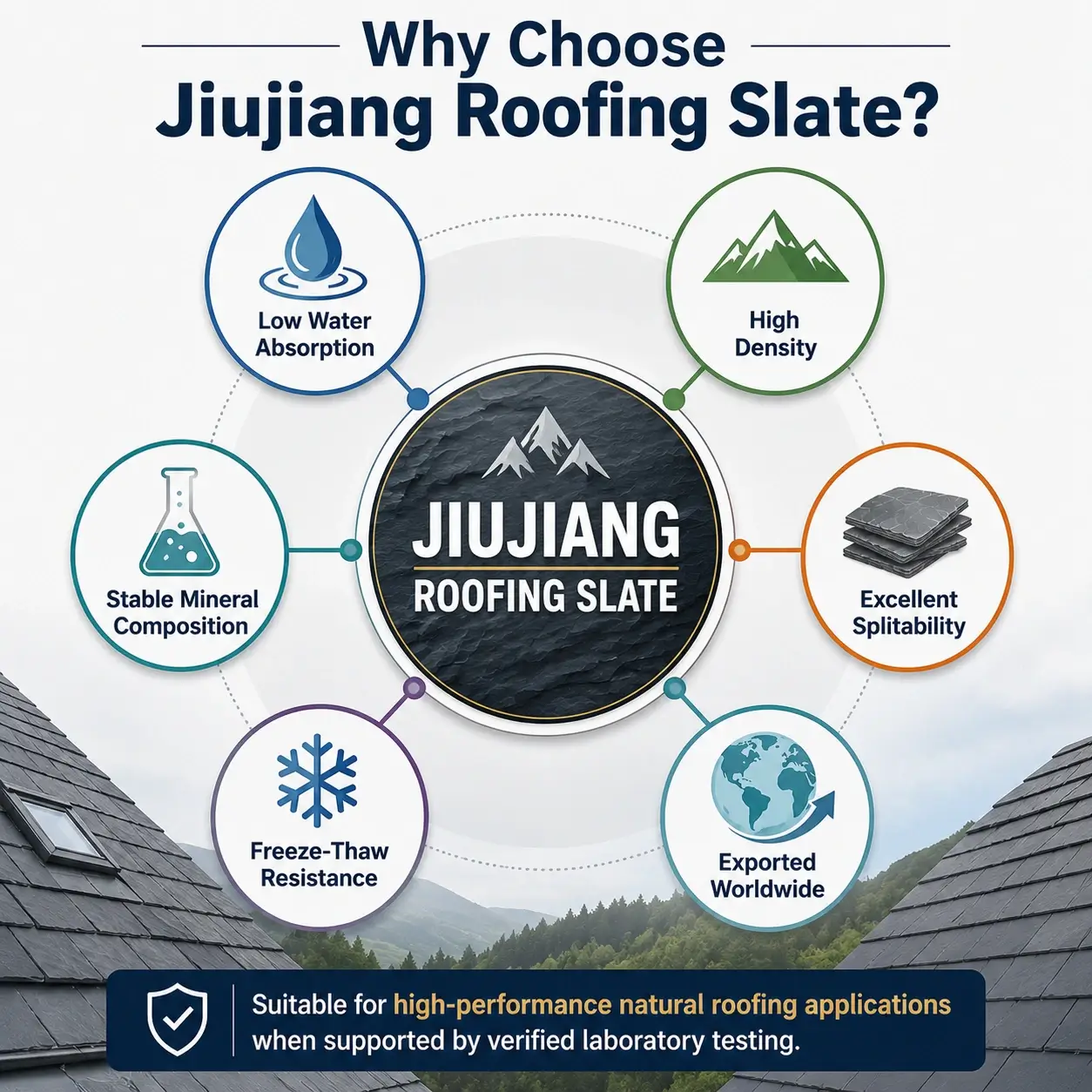
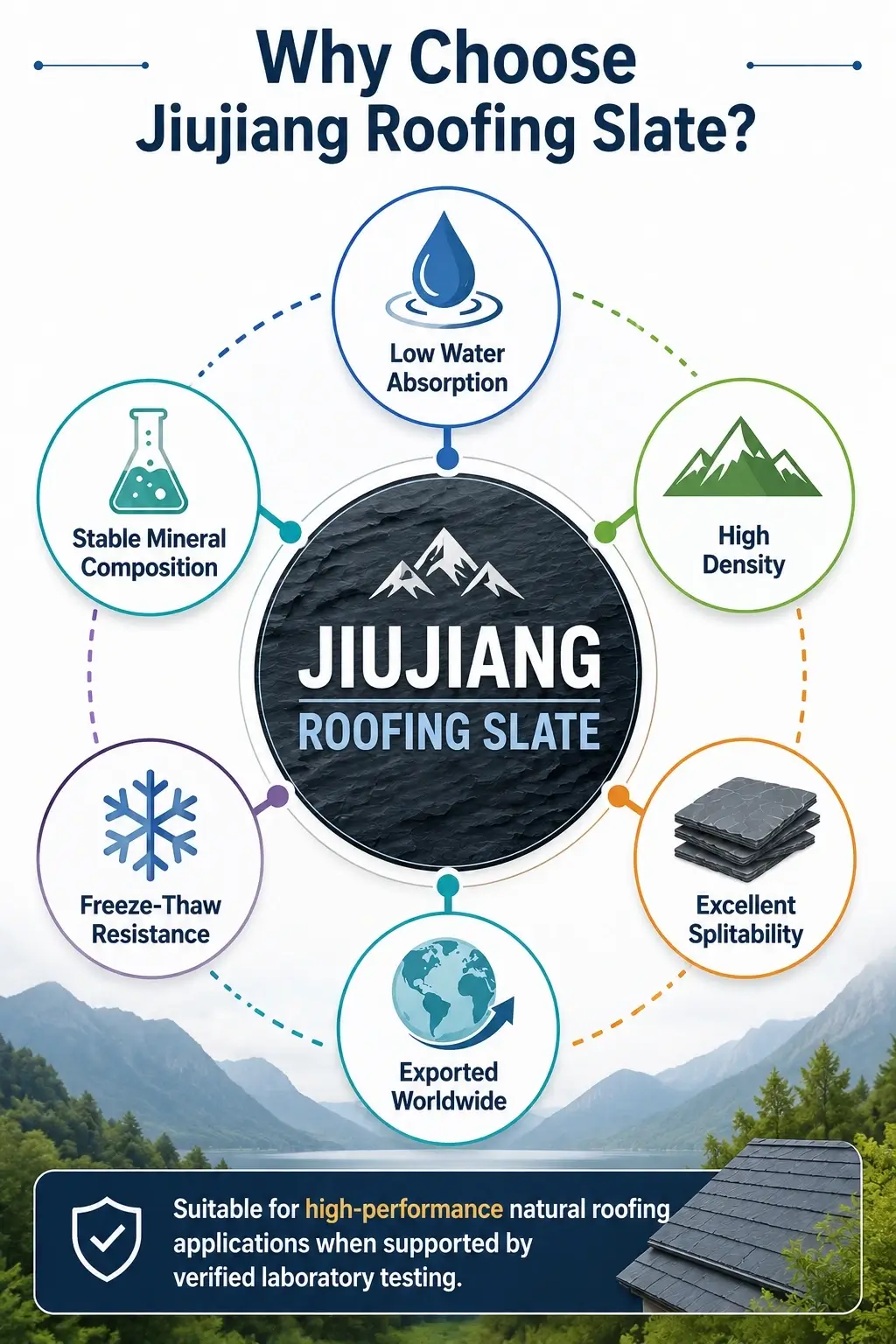
Suitable for high-performance natural roofing applications when supported by verified laboratory testing.
How to Choose the Right Roofing Slate Grade
The best roofing slate grade depends on your project requirements, budget, climate, and performance expectations. A premium slate may be the right choice for a luxury home or historic restoration, while a standard commercial grade may be sufficient for cost-sensitive projects.
Rather than choosing solely by price or appearance, consider the building type, expected service life, local weather conditions, and whether the slate has been tested to recognized standards such as ASTM C406 or EN 12326.
The recommendations below can help different types of buyers select the most suitable natural roofing slate for their needs.
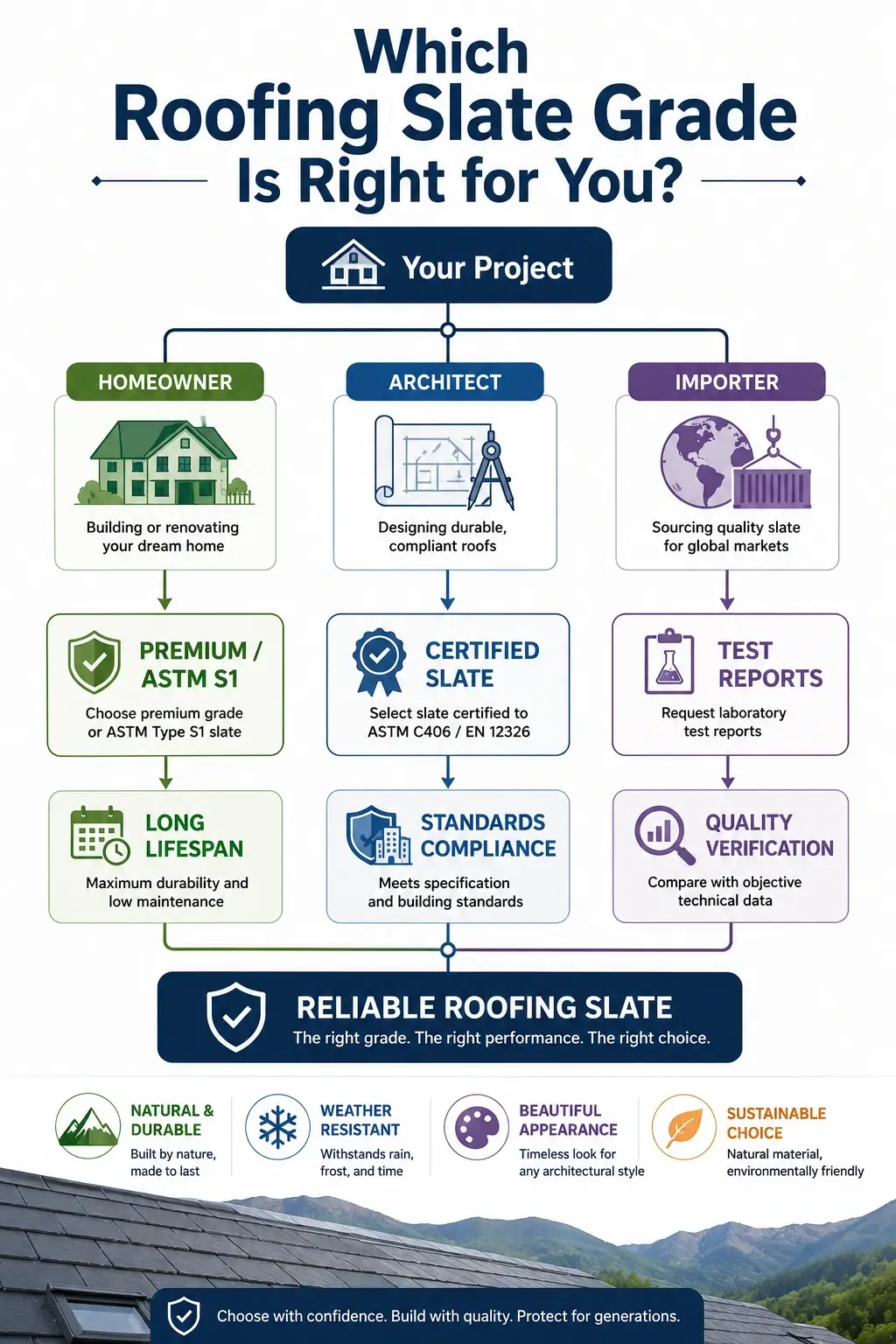
Choosing the Right Slate Grade for Your Project
| Buyer | Recommended Choice | Why It Matters |
|---|---|---|
| 🏡 Homeowners | Premium Grade or ASTM Type S1 | Ideal for long-lasting roofs with low maintenance and maximum property value. |
| 📐 Architects & Specifiers | Certified Slate (ASTM C406 / EN 12326) | Verified laboratory performance helps ensure compliance with project specifications. |
| 🌍 Importers & Wholesalers | Request Laboratory Test Reports | Compare products using objective technical data rather than commercial grade names. |
| 📦 Distributors | Consistent Quarry Source & Quality Control | Reliable production ensures customer satisfaction and fewer quality issues. |
| 🔨 Roofing Contractors | Balance Quality and Budget | Select roofing slate that meets the project’s performance requirements without unnecessary cost. |
Key Questions to Ask Before Buying Roofing Slate
Before selecting a roofing slate supplier, consider the following questions:
- Is the slate supported by ASTM C406 or EN 12326 laboratory testing?
- Does it have low water absorption and good freeze-thaw resistance?
- Is the thickness and size consistent throughout the shipment?
- Is the quarry source reliable and experienced in producing roofing slate?
- Does the supplier provide technical documentation and quality control records?
These questions help buyers compare natural roofing slate more accurately and reduce the risk of unexpected performance issues after installation.
Expert Recommendation
Choose roofing slate based on verified performance—not just appearance or marketing labels. A combination of recognized laboratory testing, consistent manufacturing quality, and a reliable quarry source will provide the best long-term value for your roofing project.
Conclusion
Selecting the right roofing slate grade is about matching the product to the needs of your project. Whether you are a homeowner, architect, importer, distributor, or roofing contractor, understanding grading systems, laboratory testing, and quality characteristics will help you make a confident and informed decision.
When evaluating natural roofing slate, always look beyond commercial grade names and review independent test results whenever possible. This approach ensures better durability, lower maintenance, and long-term performance for every roofing project.
Common Mistakes When Buying Roofing Slate
Choosing the right natural roofing slate involves more than comparing colors or prices. Many roofing problems and unexpected replacement costs can be traced back to mistakes made during the purchasing process.
Whether you are a homeowner, architect, importer, or roofing contractor, avoiding the common mistakes below will help you select high-quality roofing slate with confidence and achieve better long-term performance.
1. Buying Slate Based on Color Alone
Many buyers assume that slates with similar colors have the same quality. In reality, color is an aesthetic feature, not a measure of durability or performance.
Better choice: Review laboratory test results, mineral composition, and grading information in addition to appearance.
2. Ignoring Laboratory Test Reports
One of the biggest purchasing mistakes is relying only on commercial grade names or supplier descriptions.
Without independent testing, it is difficult to verify important properties such as:
- Water absorption
- Flexural strength
- Freeze-thaw resistance
- Oxidation potential
Better choice: Request ASTM C406, EN 12326, or other recognized laboratory reports whenever possible.
3. Comparing Price Instead of Value
The lowest-priced roofing slate is not always the most economical choice.
A higher-quality slate may last decades longer, require less maintenance, and significantly reduce lifetime ownership costs.
Better choice: Compare service life, durability, and long-term value, not just the purchase price.
4. Assuming Thicker Slate Is Always Better
A thicker slate does not automatically mean better quality.
The long-term performance of roofing slate depends on factors such as mineral composition, density, water absorption, and manufacturing consistency, not thickness alone.
Better choice: Evaluate overall performance rather than relying on thickness as the only indicator.
5. Assuming All Natural Slate Performs the Same
Natural slate varies depending on its geological origin, quarry source, mineral composition, and quality control processes.
Even slates that look almost identical may have very different durability and weather resistance.
Better choice: Compare laboratory data, quarry reputation, and compliance with recognized standards before making a purchasing decision.
Common Mistakes vs. Better Decisions
| Common Mistake | Better Decision |
|---|---|
| Buying by color only | Evaluate performance and laboratory test results |
| Ignoring testing reports | Request ASTM C406 or EN 12326 documentation |
| Comparing only price | Consider lifetime value and durability |
| Confusing thickness with quality | Compare physical and mechanical properties |
| Assuming all slate performs equally | Verify quarry source and quality consistency |
Expert Tip
The best roofing slate is selected based on verified performance, recognized testing standards, and consistent manufacturing quality—not simply on appearance, thickness, or the lowest price.
By avoiding these common mistakes, buyers can make more informed decisions and select roofing slate that delivers reliable performance, lower maintenance, and long-term value. Taking the time to compare verified quality data today can help prevent costly repairs and premature roof replacement in the future.
5 Mistakes to Avoid When Buying Roofing Slate
❌ Common Mistakes
🎨 Buy by Color
💰 Lowest Price
📏 Thickness Only
🏷 Trust Commercial Grade
🪨 All Slate Is the Same
✅ Better Choices
🧪 Check Test Reports
⏳ Compare Lifetime Value
💪 Evaluate Performance
📑 Review ASTM / EN12326
🪨 All Slate Is the Same → 🏔 Verify Quarry Source
Buy roofing slate based on performance, not assumptions.
Example: Two roofing slates may have the same size, thickness, and color, but one has a water absorption rate of 0.3% while the other exceeds 1.0%. Over time, this difference can significantly affect freeze-thaw resistance, durability, and expected service life.
Frequently Asked Questions About Roofing Slate Grades
Understanding roofing slate grades helps buyers compare products more confidently and select natural roofing slate that meets the performance requirements of their project. By considering recognized standards, laboratory testing, and verified quality characteristics, homeowners, architects, contractors, distributors, and importers can make informed decisions and achieve long-lasting roofing performance.
Choosing the Right Roofing Slate Grade
Choosing the right roofing slate grade is one of the most important decisions when planning a durable, attractive, and long-lasting roof. While slate tiles may appear similar in color, size, or thickness, their long-term performance can vary significantly depending on their physical properties, mineral composition, and laboratory-tested quality.
Understanding ASTM C406 classifications, EN 12326 performance testing, and the differences between official standards and commercial grade names enables homeowners, architects, contractors, distributors, and importers to make more informed purchasing decisions. Rather than relying on appearance or price alone, buyers should evaluate recognized testing results, expected service life, and the consistency of the quarry source.
High-quality natural roofing slate offers exceptional durability, low maintenance requirements, excellent weather resistance, and lasting architectural beauty. By selecting slate that matches the technical requirements of your project, you can maximize roof performance while protecting your long-term investment.
If you are considering Jiujiang roofing slate for your next project, choose products supported by verified laboratory testing and supplied by experienced manufacturers with consistent quality control. This approach helps ensure reliable performance and confidence in every roofing application.
Key Takeaways
Before choosing a roofing slate, remember these essential points:
- Choose performance, not just appearance.
- Look for recognized standards such as ASTM C406 or EN 12326 whenever possible.
- Request laboratory test reports to verify quality.
- Compare long-term durability rather than purchase price alone.
- Work with reliable suppliers that provide consistent products and technical support.
Final Recommendation
Whether you are building a new home, restoring a historic property, or sourcing slate for international distribution, understanding roofing slate grades is the key to selecting a material that delivers decades of reliable performance. With the right information and verified quality data, you can confidently choose natural roofing slate that combines durability, beauty, and long-term value.
Need Help Choosing the Right Roofing Slate?
If you need assistance selecting the most suitable roofing slate grade for your project, our team can provide:
- Product recommendations based on your project requirements
- Laboratory test reports and technical specifications
- Size, thickness, and color options
- Export and packaging solutions for international markets
- Professional support for architects, distributors, importers, and roofing contractors
Contact us to discuss your roofing slate requirements or request a quotation.
Last Updated: July 2026
Reading Time: 15 min
Written by
Slate Of China Technical Team
30+ Years Roofing Slate Manufacturing Experience