
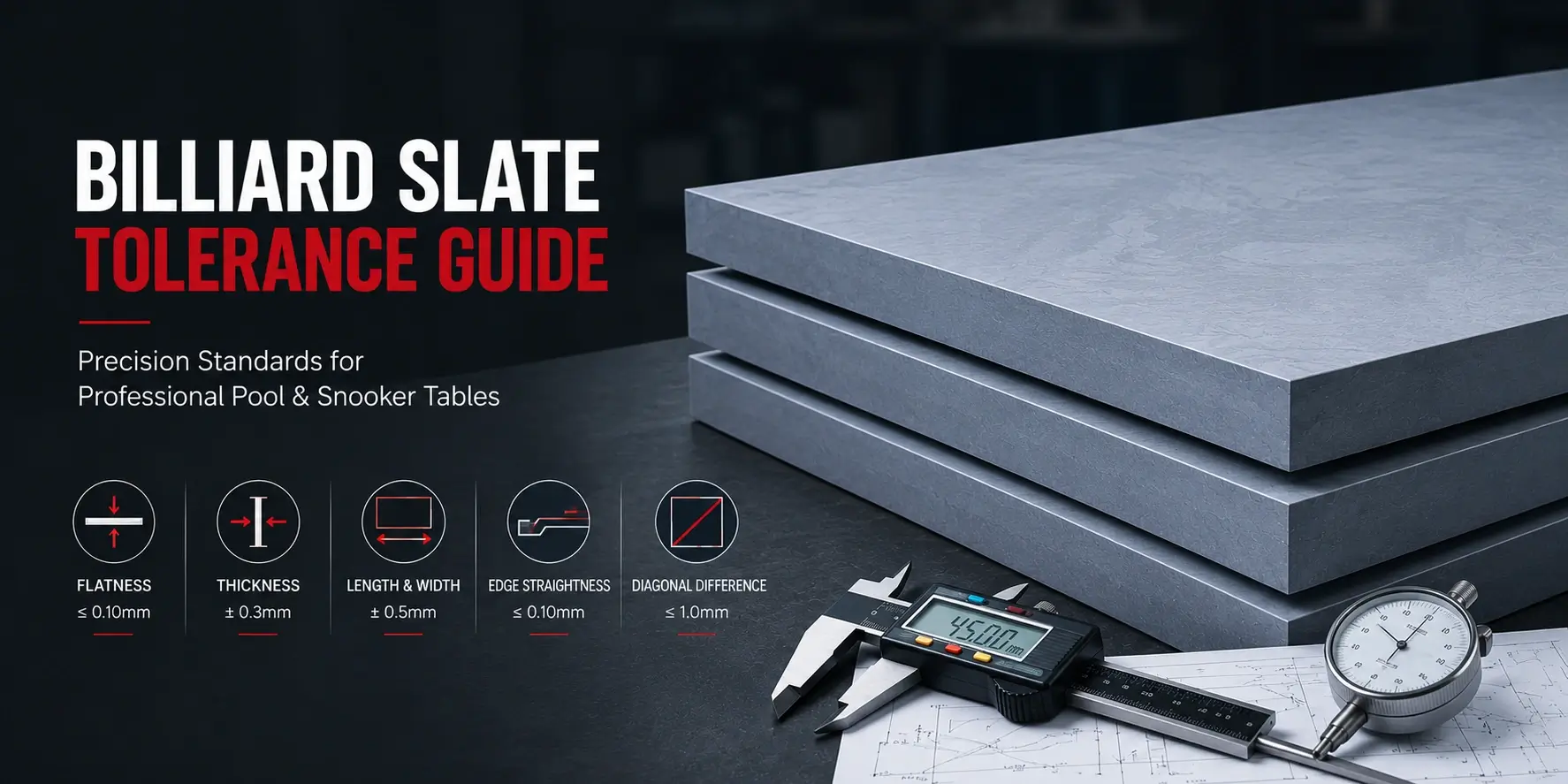
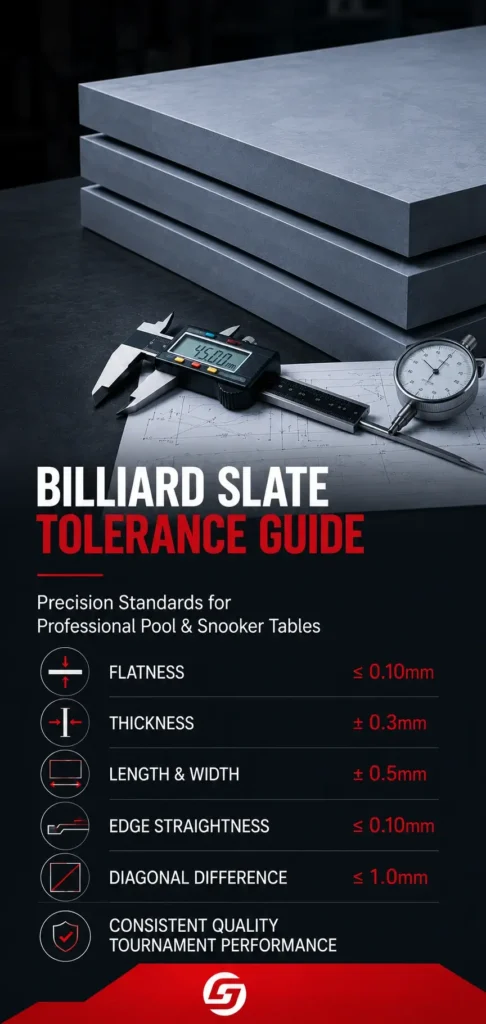
Billiard Slate Tolerance Guide
Understanding Flatness, Thickness & Dimensional Accuracy for Tournament Pool and Snooker Slate
Manufacturing tolerance is one of the most important indicators of billiard slate quality. Accurate flatness, thickness, and dimensional tolerances directly affect ball roll, table installation, rail alignment, and long-term playing performance. Whether you’re sourcing pool table slate or snooker slate, understanding professional tolerance standards helps you compare suppliers, evaluate manufacturing quality, and choose slate that delivers reliable tournament-level performance. This guide explains the key tolerance specifications, inspection methods, and quality standards used in precision billiard slate manufacturing.
Table of Contents
What Is Billiard Slate Tolerance?
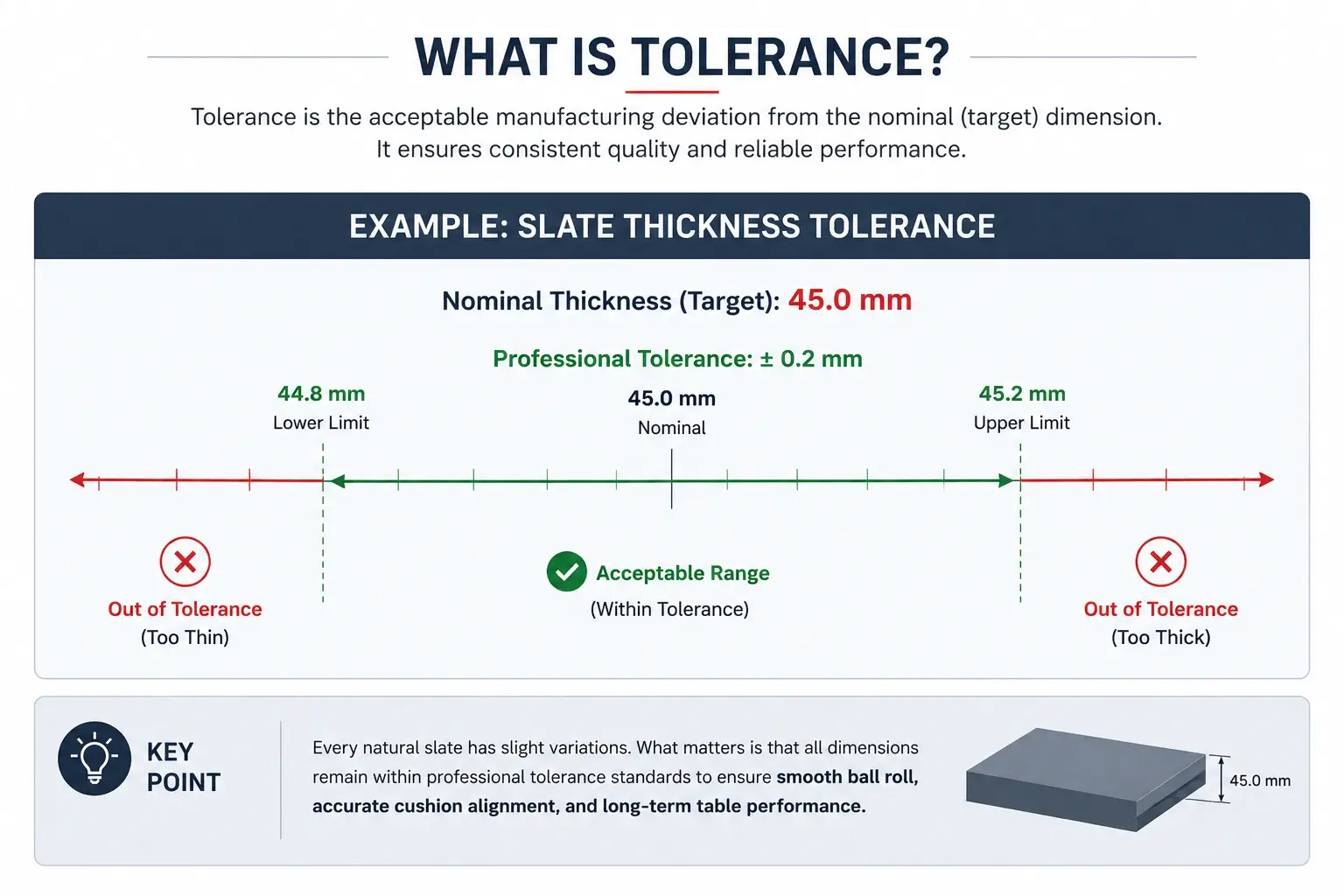
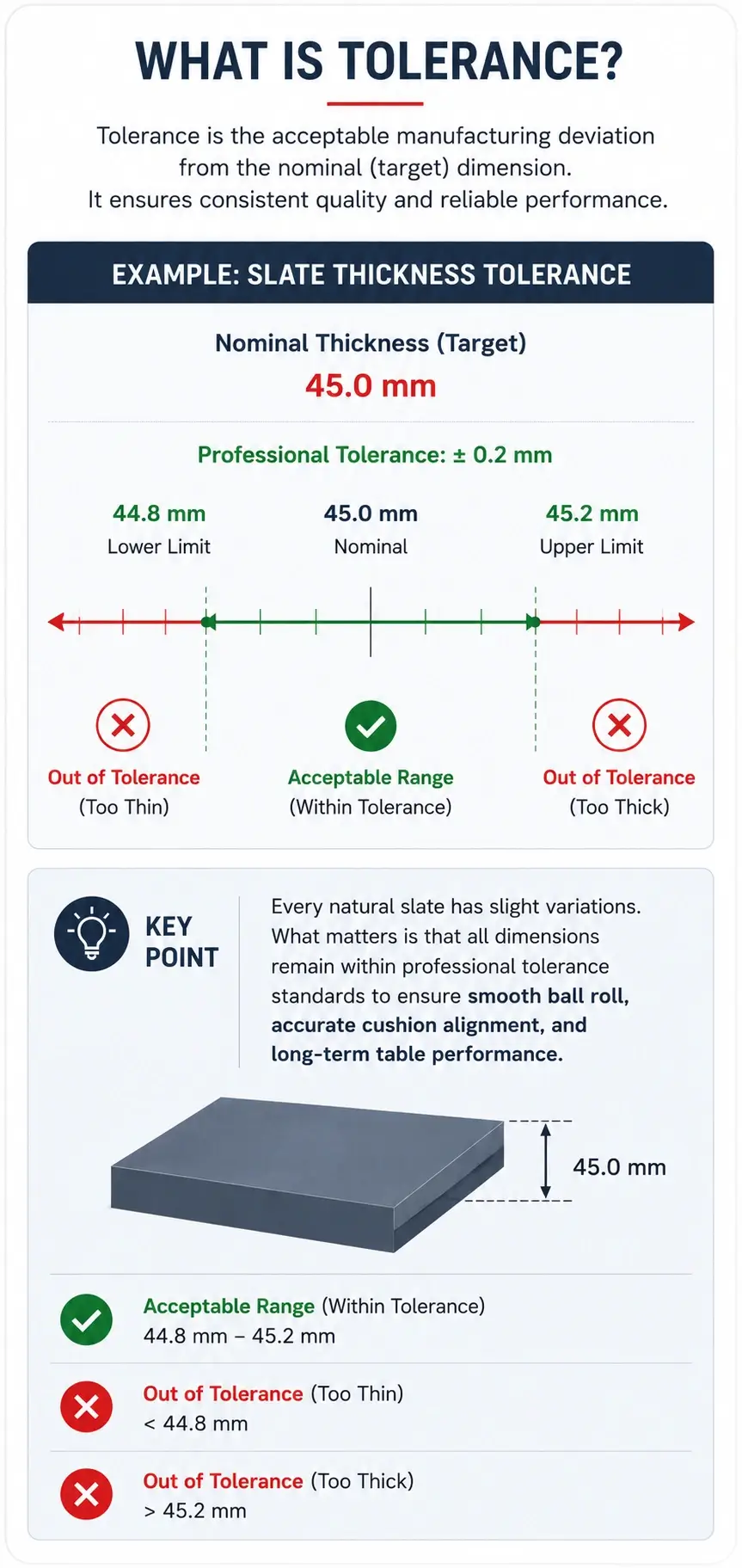
Every billiard slate is manufactured to specified dimensional tolerances. In simple terms, a tolerance is the acceptable variation between the intended design dimension and the actual finished product. It is not a manufacturing defect or mistake—it is a controlled range that ensures the slate meets professional quality standards.
Because billiard slate is made from natural stone, no two pieces are completely identical. Minor variations in flatness, thickness, and overall dimensions are normal, even after precision machining and grinding. The key is ensuring these variations remain within carefully controlled tolerance limits.
For pool table slate and snooker slate, tight manufacturing tolerances are essential. Accurate dimensions help ensure smooth ball roll, consistent cushion alignment, precise slate joints, easier installation, and reliable long-term playing performance. Professional manufacturers use advanced CNC machining, precision grinding, and strict quality inspection to achieve these standards.
In short, the quality of a slate is not determined by whether it has zero deviation—because no natural stone can. It is determined by whether every measurement remains within professional tolerance specifications required for tournament-quality billiard tables.
Tolerance Is Not a Defect
✔ Every natural slate has small dimensional variations.
✔ Manufacturing tolerance defines the acceptable range of those variations.
✔ High-quality billiard slate keeps every measurement within strict professional standards to ensure consistent playing performance.
What Are the Key Slate Tolerances?
Professional billiard slate tolerance is not defined by a single measurement. Instead, it includes several critical dimensional specifications that work together to ensure accurate installation, smooth ball roll, and long-term table stability.
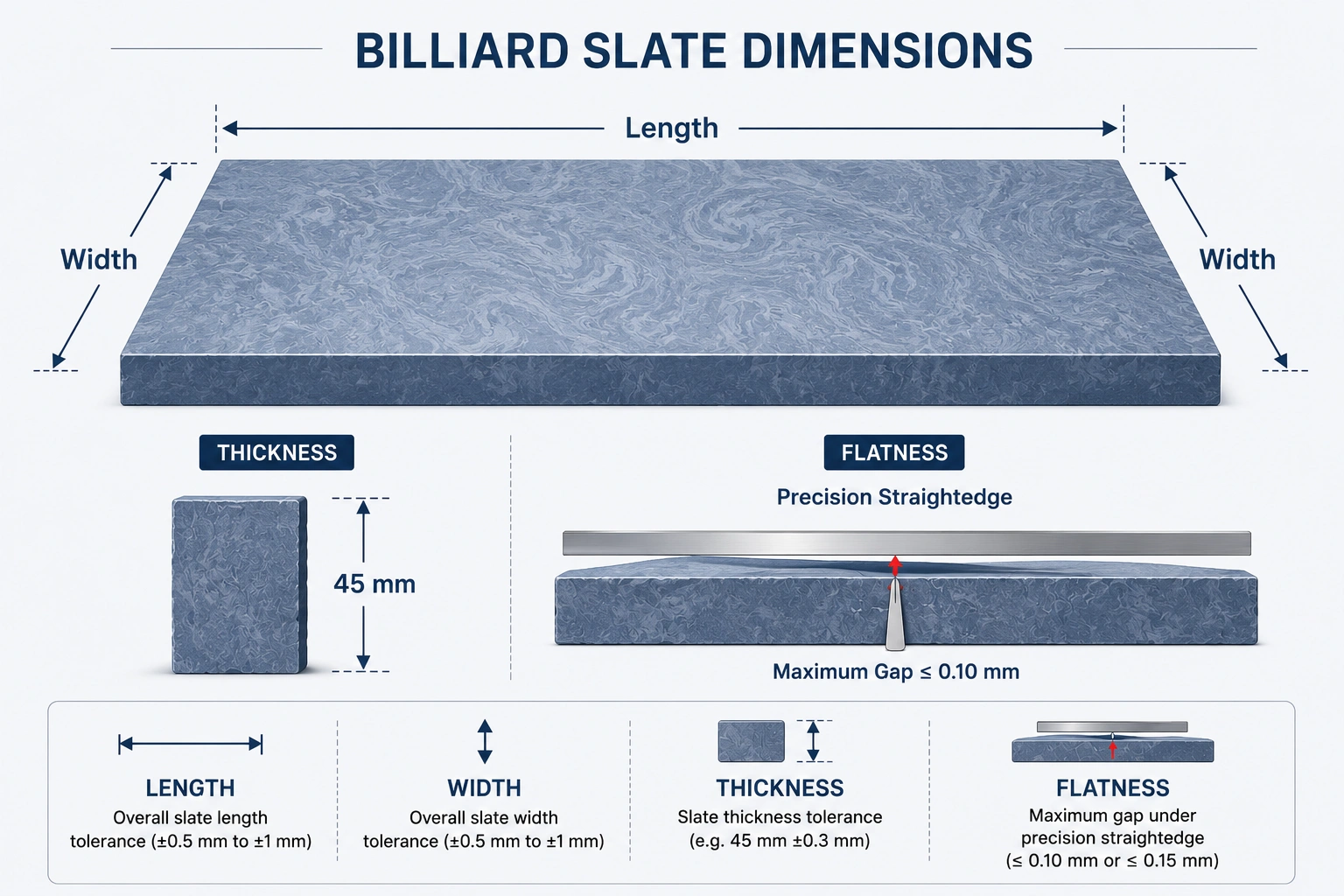
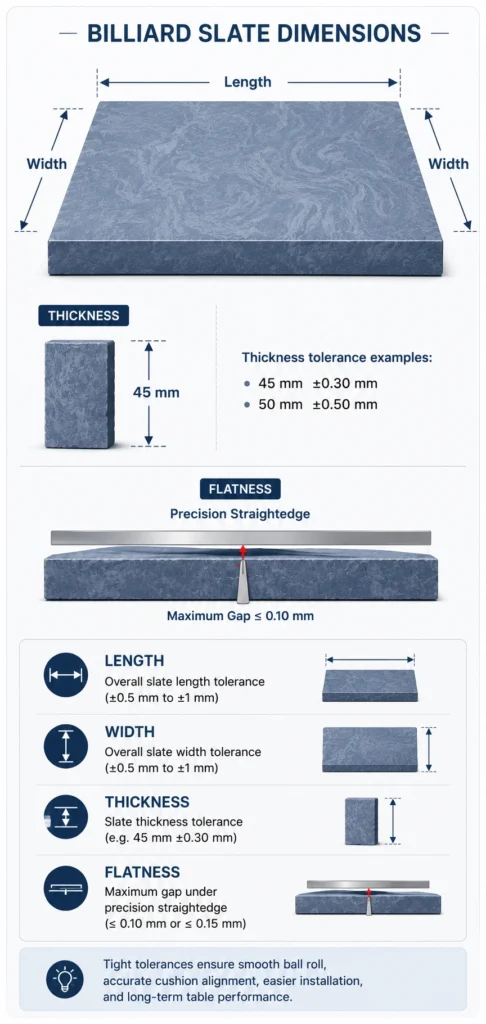
For pool table slate and snooker slate, manufacturers typically control three key tolerances: Thickness Tolerance, Flatness Tolerance, and Size (Length & Width) Tolerance. Each plays a different role in the overall performance and quality of the finished table.
1. Thickness Tolerance
Thickness tolerance refers to the allowable variation between the specified slate thickness and the actual finished thickness after machining.
Typical examples include:
- 45 mm Slate: ±0.30 mm
- 50 mm Slate: ±0.50 mm
Consistent thickness helps maintain correct cushion height, uniform table support, and easier installation.
2. Flatness Tolerance
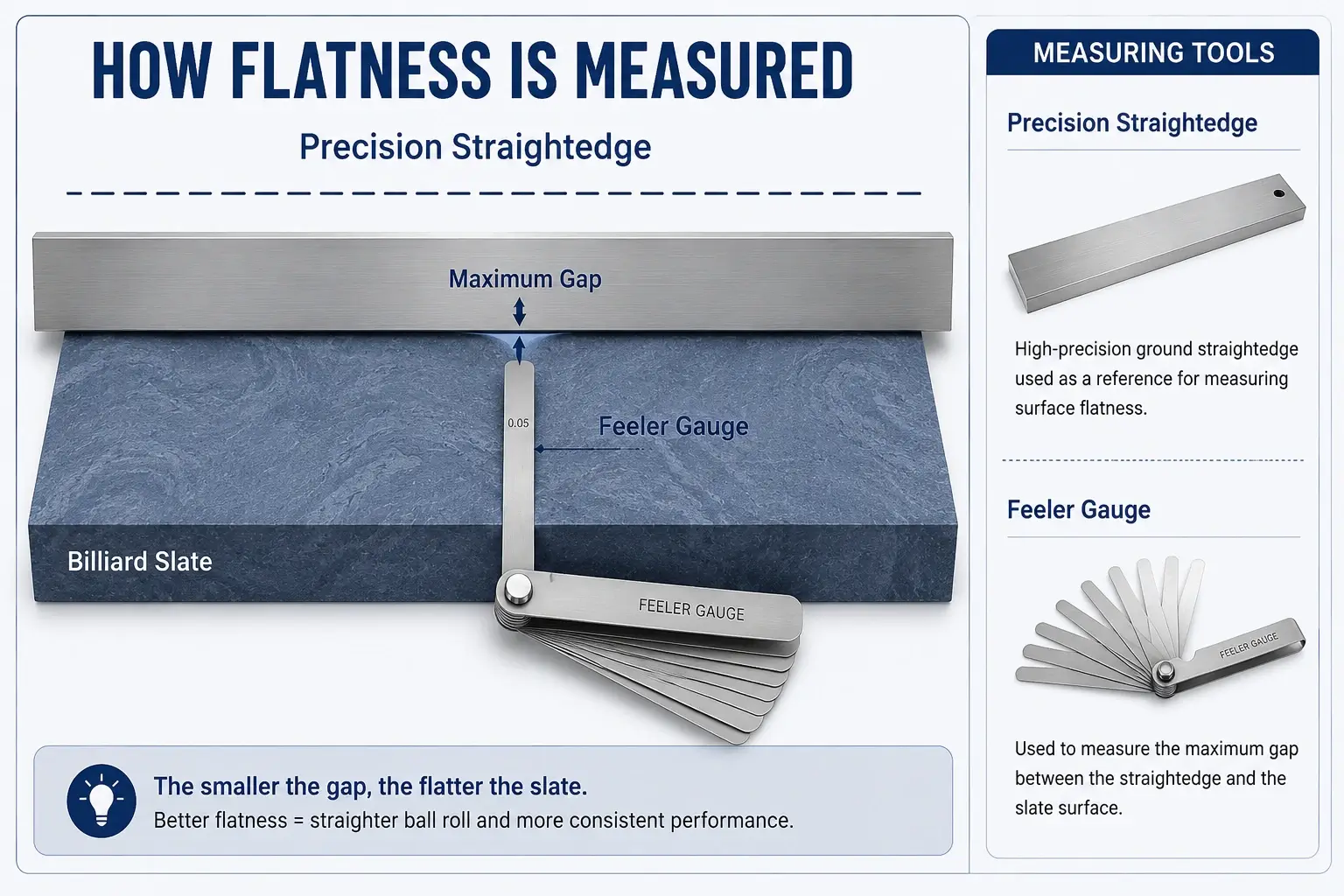
Flatness tolerance measures how level the slate surface remains across its entire playing area. It is typically inspected using a precision straightedge and feeler gauge.
Typical professional standards:
- ≤ 0.10 mm
- ≤ 0.15 mm
Better flatness ensures straight ball roll, accurate rebound angles, and invisible slate joints after installation.
3. Size (Length & Width) Tolerance
Dimensional tolerance controls the accuracy of the slate’s overall length and width after machining.
Typical manufacturing standards:
- ±0.5 mm
- ±1.0 mm
Accurate dimensions improve frame fit, rail alignment, pocket positioning, and overall assembly precision.
Summary
Although these tolerances measure different characteristics, they all contribute to one goal—delivering a precision billiard slate that installs correctly, performs consistently, and meets professional tournament standards.
| Tolerance Type | Typical Standard | Primary Purpose |
|---|---|---|
| Thickness Tolerance | 45 mm ±0.30 mm 50 mm ±0.50 mm | Maintains uniform cushion height and structural support |
| Flatness Tolerance | ≤0.10 mm or ≤0.15 mm | Ensures smooth and accurate ball roll |
| Size (Length & Width) Tolerance | ±0.5 mm to ±1.0 mm | Guarantees precise installation and rail alignment |
Why Slate Tolerance Matters
The quality of a billiard slate is measured not only by the stone itself, but also by the precision of its manufacturing tolerances. Even small dimensional deviations can affect ball roll, cushion response, slate joint quality, and installation efficiency.
Whether you’re manufacturing tournament tables, supplying commercial billiard equipment, or installing a home table, tight billiard slate tolerances help ensure consistent playing performance, easier assembly, and long-term reliability.
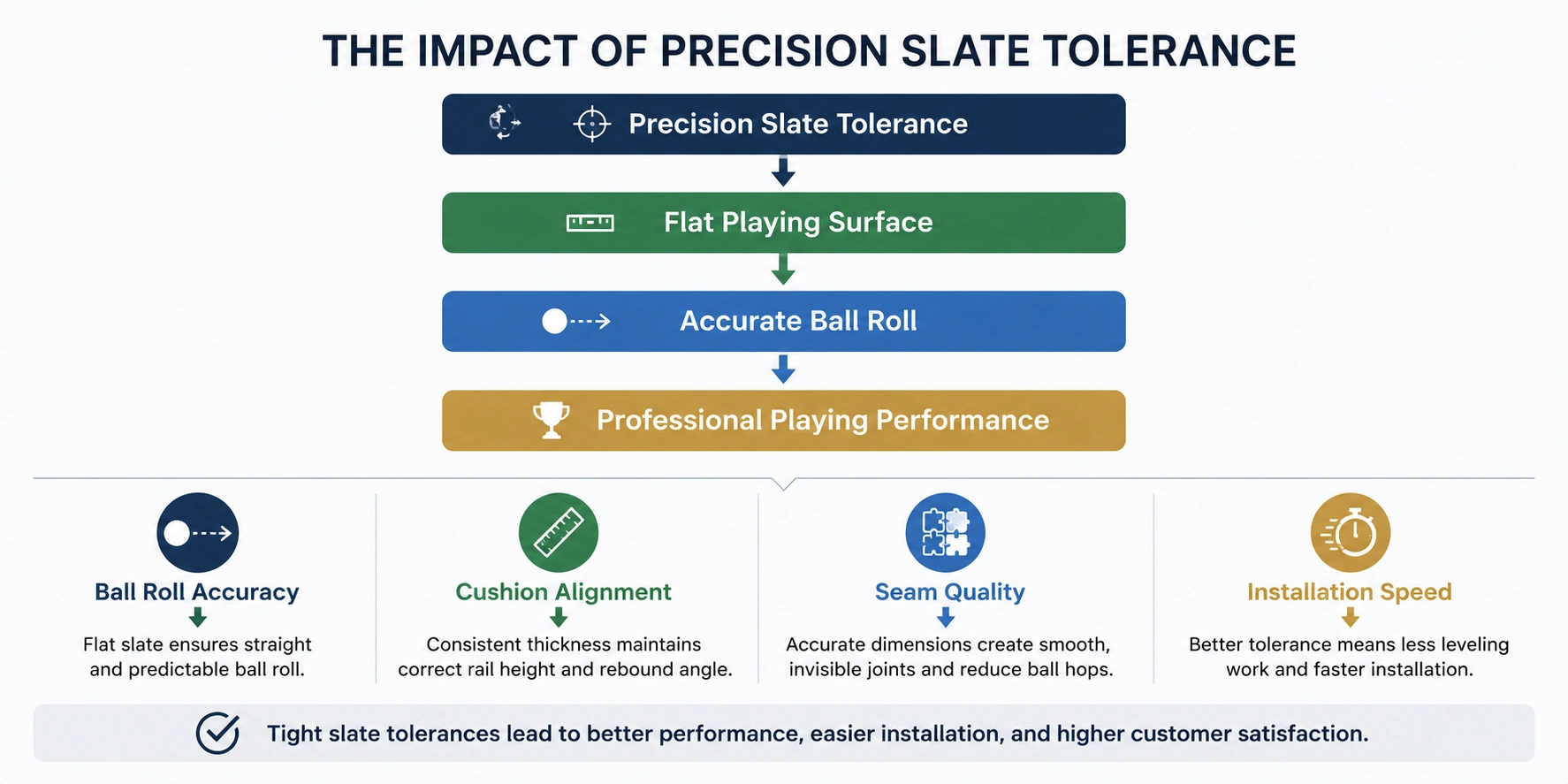
① Ball Roll Accuracy
Smooth Ball Roll Starts with a Flat Slate
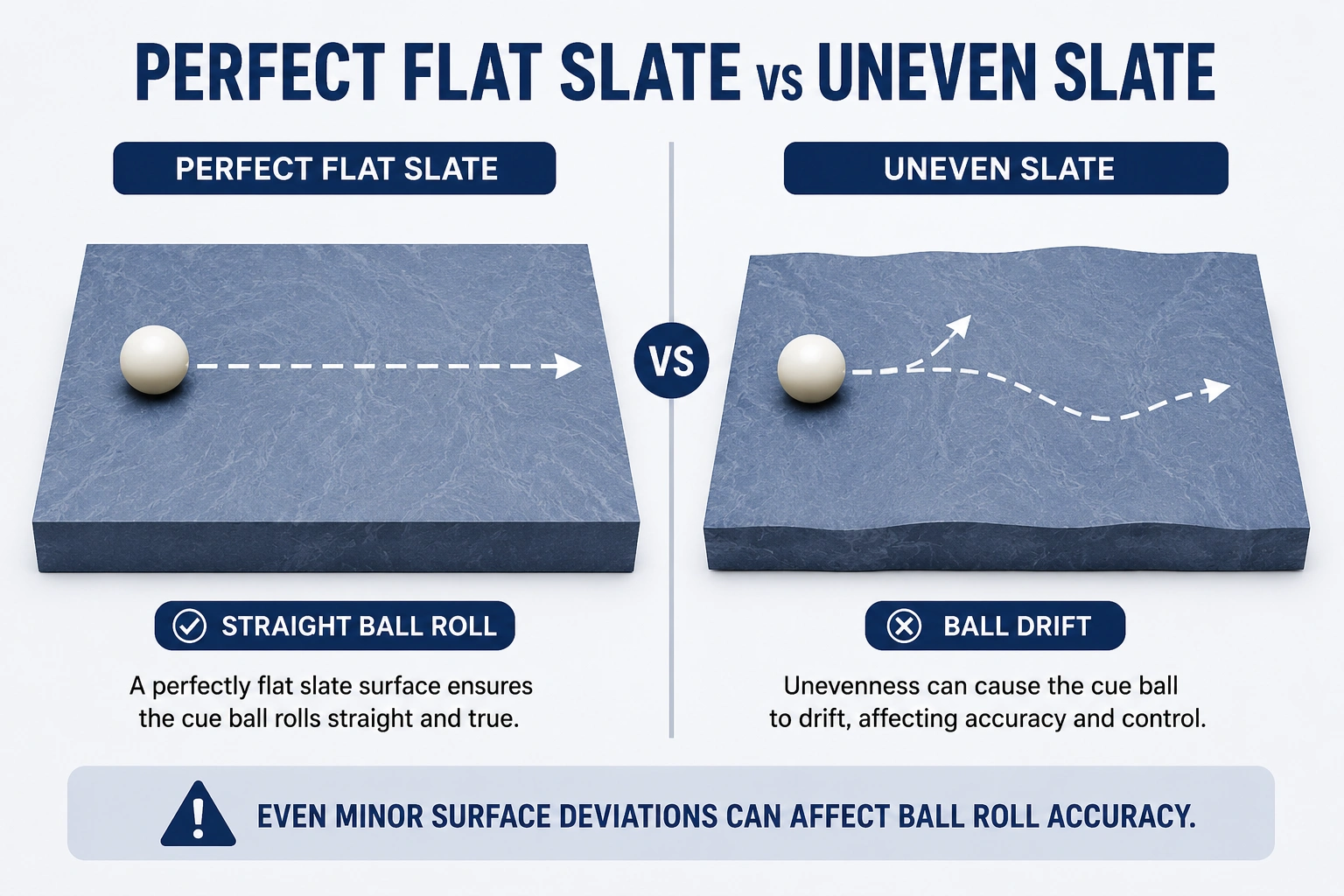
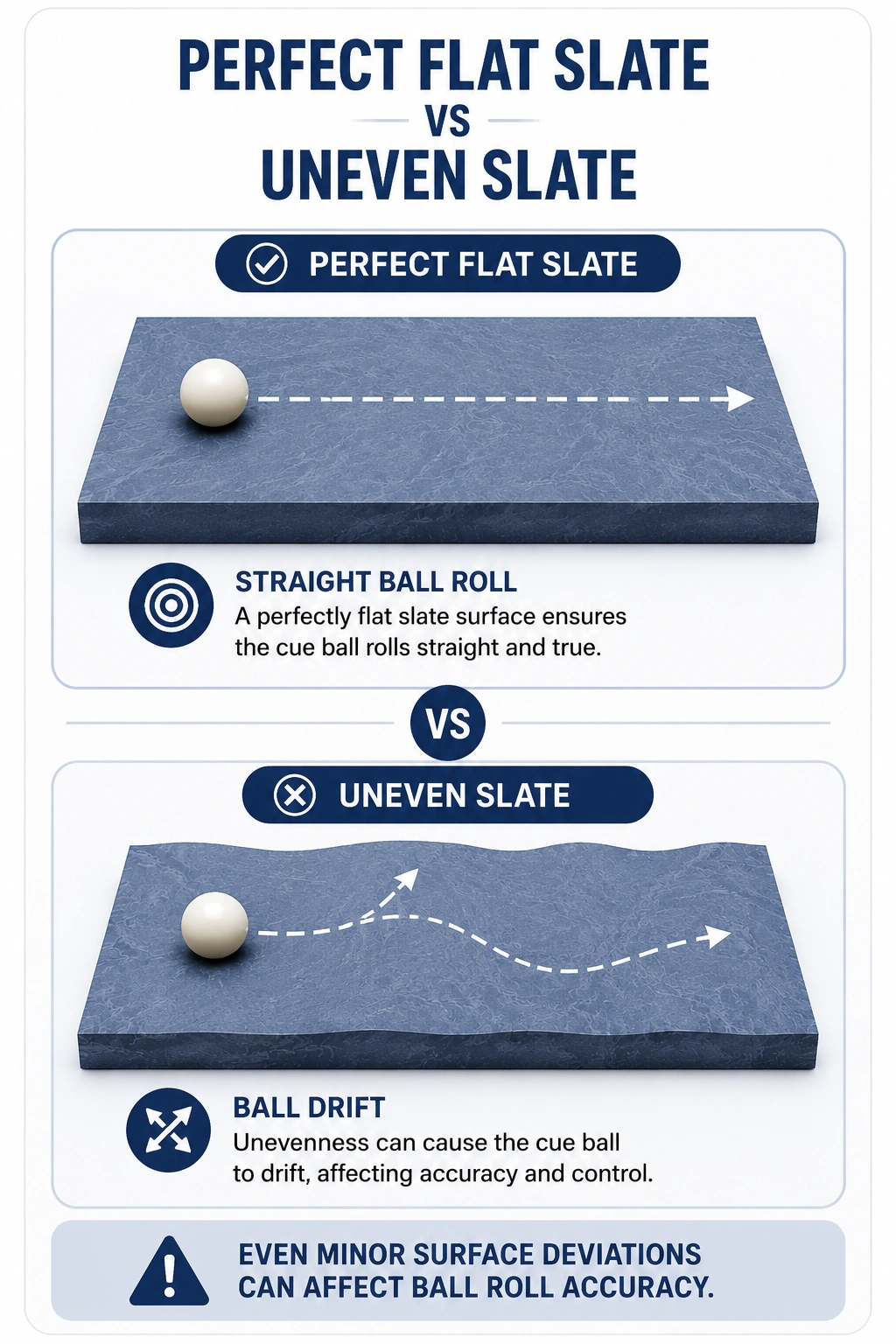
A perfectly flat playing surface allows the cue ball to travel in a straight and predictable path. Excessive flatness deviation may cause the ball to drift, slow unexpectedly, or change direction, reducing playing accuracy and consistency.
Professional pool table slate and snooker slate are precision-ground to minimize surface variation and ensure reliable ball roll accuracy across the entire table.
② Cushion Alignment
Consistent Thickness Ensures Accurate Rail Performance
Uneven slate thickness changes the installed height of the cushion rails. Even small variations can affect cushion nose height and rebound angles, resulting in inconsistent bank shots and inaccurate ball response.
Maintaining tight thickness tolerance helps preserve uniform rail alignment and professional playing characteristics.
③ Seam Quality
Precision Dimensions Create Nearly Invisible Slate Joints
For three-piece billiard slate, dimensional accuracy is critical.
If the individual slate sections vary in thickness, flatness, or overall dimensions, visible seams may remain after installation. These uneven joints can interrupt ball travel and cause the cue ball to hop or deflect.
High manufacturing precision allows installers to create smooth, nearly invisible slate joints for tournament-quality performance.
④ Installation Speed
Better Tolerance Means Faster Installation
Accurately machined slate requires less adjustment during installation.
With consistent dimensions and flatness, installers spend less time shimming, leveling, and correcting joints. This reduces installation time while improving overall table accuracy.
For table manufacturers and installers, tighter slate tolerances translate directly into greater efficiency and more consistent assembly results.
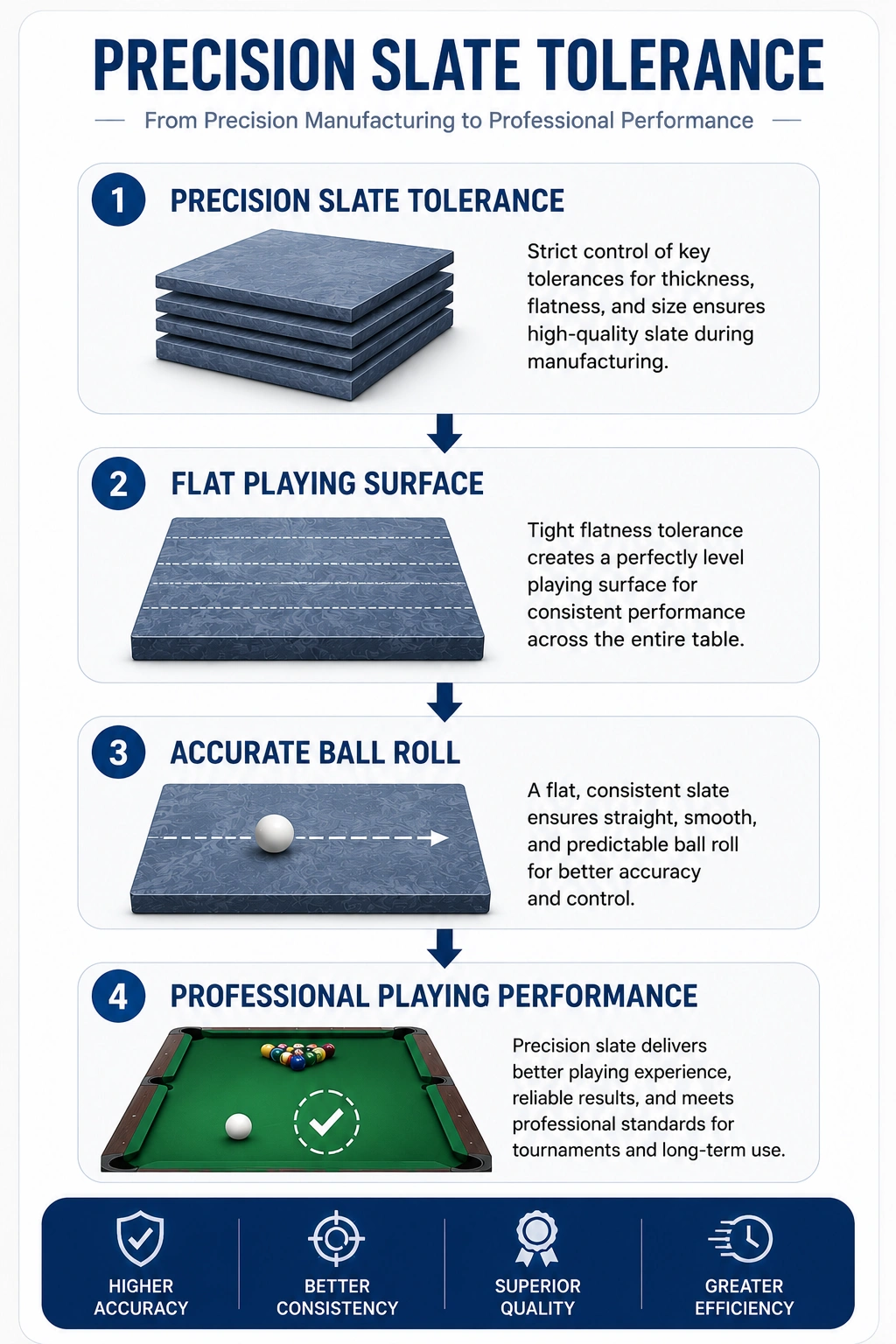
Why Tight Slate Tolerances Matter
✔ Straighter and more consistent ball roll
✔ Accurate cushion alignment and rebound
✔ Smoother three-piece slate joints
✔ Faster installation with less leveling
✔ Long-term stability and tournament-quality performance
Now that you understand why slate tolerance is essential, let’s take a closer look at the three key tolerance categories: thickness, flatness, and dimensional accuracy.
Typical Tolerance Standards for Professional Billiard Slate
Although there is no single worldwide standard for billiard slate tolerances, professional manufacturers generally follow strict dimensional specifications to ensure accurate installation and consistent playing performance.
The following values represent typical tolerance ranges achieved by high-quality pool table slate and snooker slate manufactured using precision CNC machining, surface grinding, and quality inspection. Actual tolerances may vary depending on manufacturing capability, customer requirements, and product specifications.
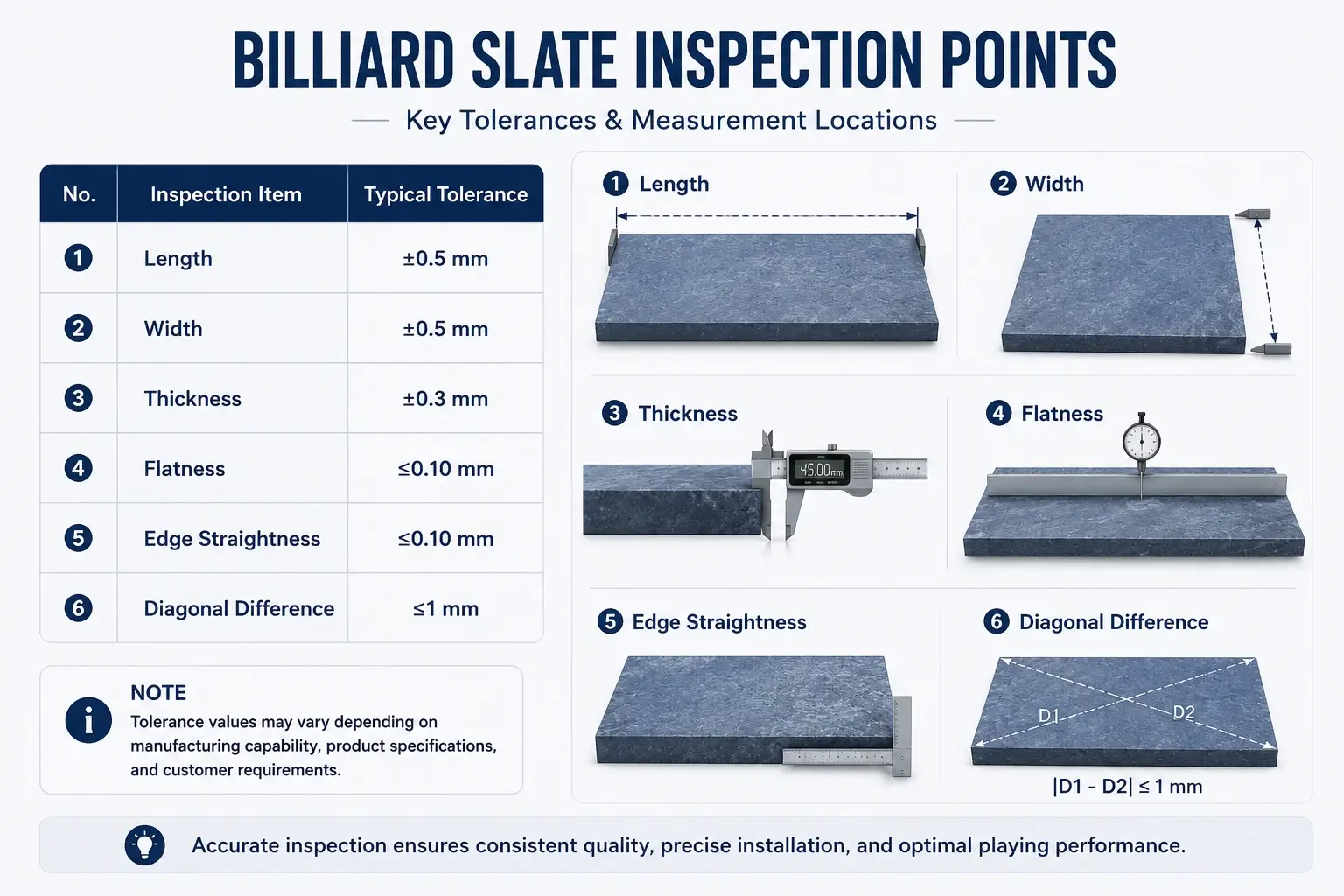
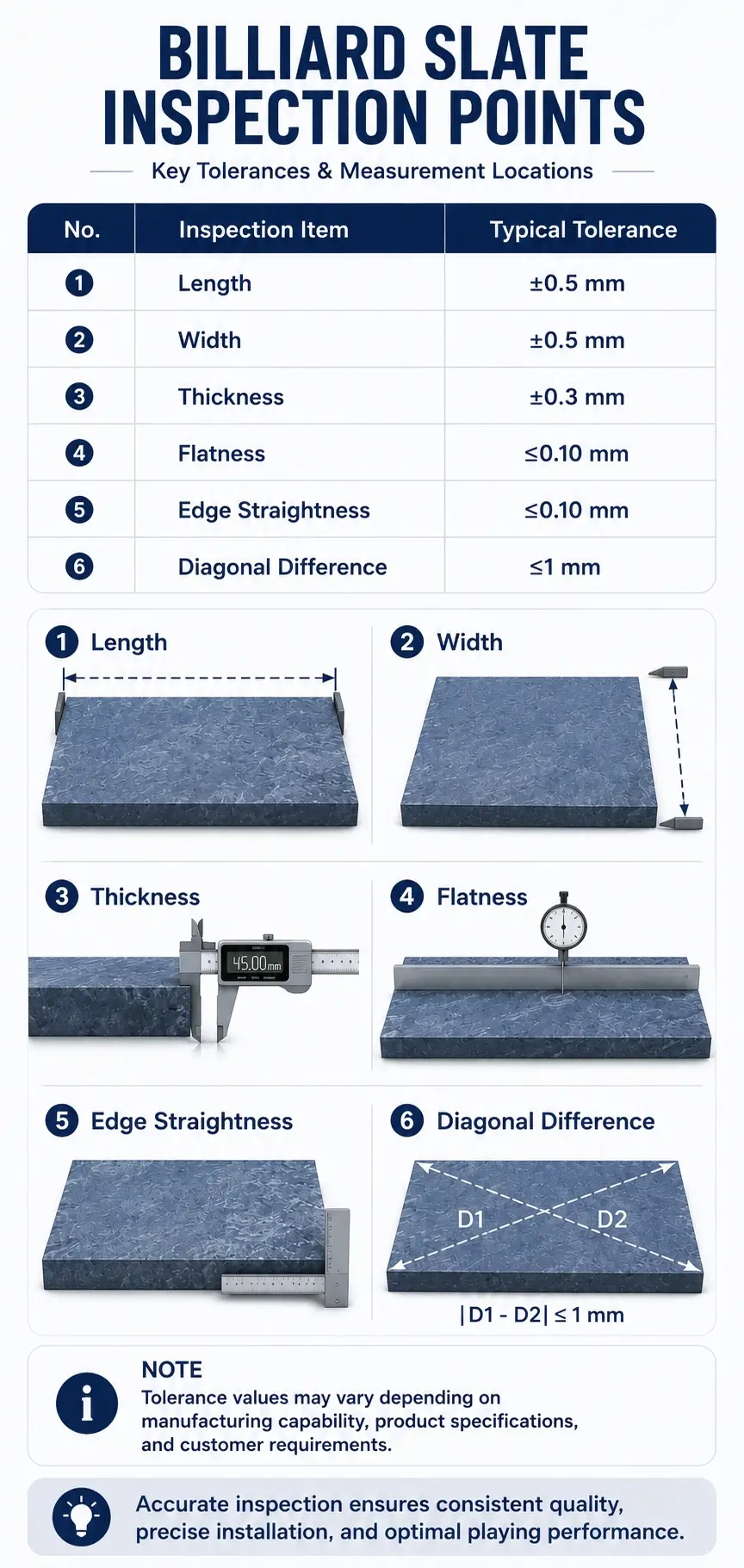
Typical Billiard Slate Tolerance Table
| Inspection Item | Typical Professional Tolerance | Why It Matters |
|---|---|---|
| Length | ±0.5 mm | Ensures accurate frame fit and table assembly |
| Width | ±0.5 mm | Maintains correct rail positioning and pocket alignment |
| Thickness | ±0.3 mm* | Provides consistent cushion height and structural support |
| Flatness | ≤0.10 mm* | Delivers smooth, accurate, and predictable ball roll |
| Edge Straightness | ≤0.10 mm | Creates tight slate joints and easier installation |
| Diagonal Difference | ≤1.0 mm | Confirms overall dimensional squareness and machining accuracy |
* Typical values for precision-ground tournament-grade slate. Actual tolerances should be confirmed with the manufacturer based on product type and machining capability.
Why These Tolerances Matter
Each tolerance controls a different aspect of slate quality, but together they determine how well a billiard table performs after installation.
- Length and width tolerances ensure the slate fits the table frame accurately.
- Thickness tolerance keeps cushion rail height consistent across the entire table.
- Flatness tolerance directly affects ball roll accuracy and leveling performance.
- Edge straightness allows multiple slate sections to join smoothly with minimal visible seams.
- Diagonal accuracy confirms the slate is perfectly square, reducing installation adjustments and ensuring precise rail alignment.
Professional billiard slate manufacturers inspect these dimensions before shipment to help table builders and installers achieve reliable, tournament-quality results.
Important
The tolerance values shown above represent typical professional manufacturing targets, not universal international standards.
Actual specifications should always be agreed upon between the manufacturer and customer based on:
- Slate thickness
- Table type (Pool or Snooker)
- Product grade
- Machining capability
- Customer requirements
Flatness Tolerance Explained
What Is Flatness Tolerance?
Flatness tolerance refers to the maximum allowable deviation between the surface of a billiard slate and a perfectly flat reference plane. It indicates how level the playing surface remains after precision grinding and machining.
Unlike thickness or dimensional tolerances, flatness directly affects how accurately a billiard ball rolls across the table. Even a very small surface deviation can influence ball direction, speed, and consistency.
For professional pool table slate and snooker slate, maintaining excellent flatness is one of the most important requirements for tournament-quality playing performance.
Why Flatness Matters
A flatter slate creates a more consistent playing surface.
When the slate surface remains within a tight flatness tolerance, the cue ball travels in a straight, predictable path without unwanted drift or deflection.
If the surface contains excessive high or low spots, even minor deviations can cause:
- Ball drift during long shots
- Inconsistent cue ball speed
- Reduced positional accuracy
- Poor overall playing experience
This is why professional slate manufacturers place such a strong emphasis on precision surface grinding and flatness inspection before shipment.
How Is Flatness Measured?
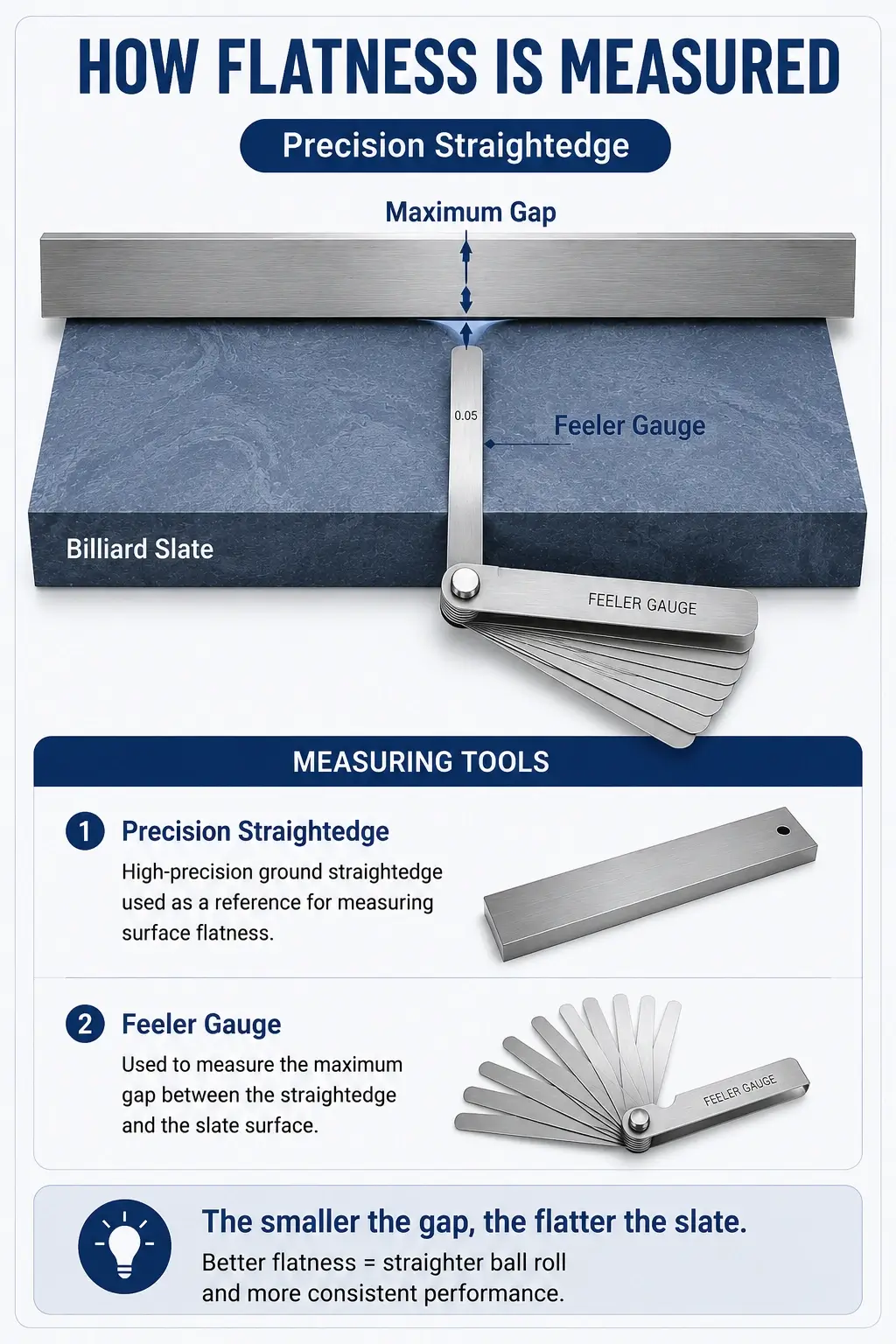
Professional manufacturers typically inspect billiard slate flatness using two precision measuring tools:
Precision Straightedge
A certified precision straightedge is placed across the slate surface in multiple directions to establish a perfectly straight reference line.
Feeler Gauge
A feeler gauge is then inserted between the straightedge and the slate surface to measure the maximum gap. The largest measured gap represents the slate’s flatness deviation.
The smaller the gap, the flatter the slate and the more accurate the playing surface.
Typical Professional Flatness Standard
For precision-ground billiard slate, a typical professional target is:
| Inspection Item | Typical Professional Value |
|---|---|
| Flatness Tolerance | ≤ 0.10 mm |
| Premium Tournament Grade* | ≤ 0.05–0.10 mm |
*Actual tolerance values may vary depending on slate thickness, table size, machining capability, and customer specifications.
Flatness Determines Ball Roll Accuracy
✔ Smaller surface gaps create straighter ball roll.
✔ Better flatness reduces installation adjustments.
✔ Precision grinding improves long-term playing consistency.
✔ Professional flatness inspection ensures tournament-quality performance.
Thickness Tolerance Explained
What Is Thickness Tolerance?
Thickness tolerance refers to the allowable variation between the specified thickness of a billiard slate and its actual finished thickness after precision machining.
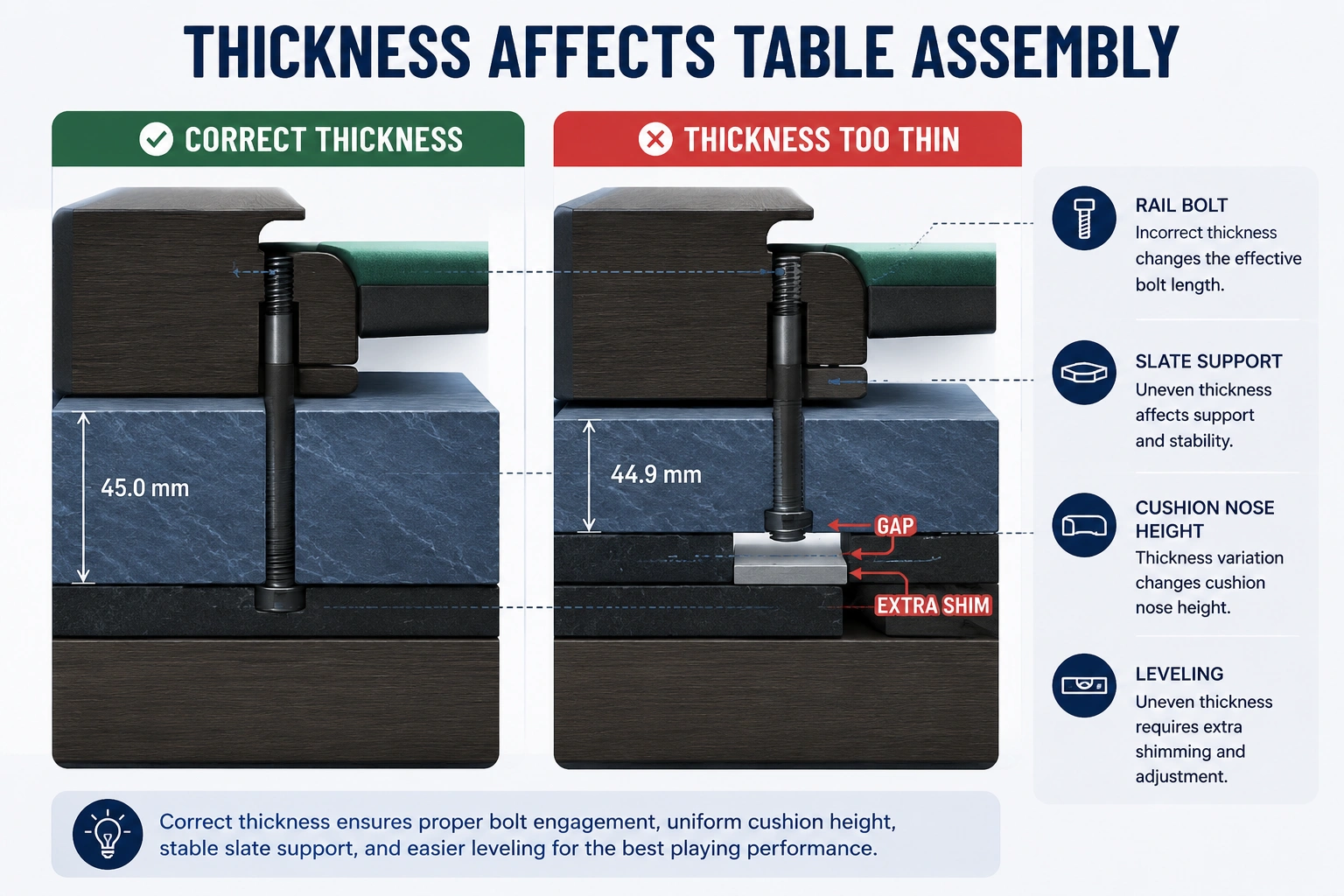
For example, a slate specified as 45 mm with a tolerance of ±0.30 mm means the acceptable finished thickness ranges from 44.70 mm to 45.30 mm.
The goal is not simply achieving the correct average thickness, but maintaining consistent thickness across every slate section to ensure reliable installation and professional playing performance.
Why Thickness Consistency Matters
Uniform thickness is essential for every professional pool table slate and snooker slate. Even small differences between slate pieces can affect table assembly, rail alignment, and long-term stability.
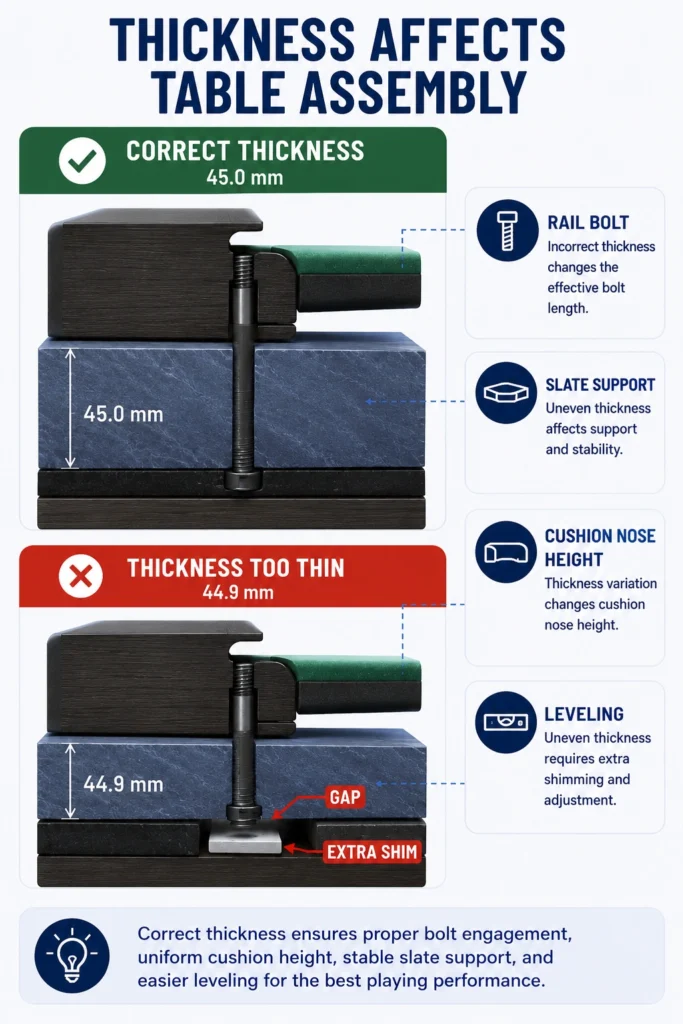
Rail Bolt Length
If slate thickness varies, the effective length of the rail bolts changes. Some bolts may tighten correctly while others may bottom out or fail to clamp the rails securely, affecting the table’s structural integrity.
Slate Support
Consistent thickness allows the slate to sit evenly on the table frame. Uneven thickness may create localized stress points or unsupported areas, reducing long-term stability.
Leveling
Slate sections with different thicknesses require additional shimming and adjustment during installation. Better thickness tolerance means faster leveling and more precise table setup.
Cushion Nose Height
The cushion nose height is directly related to the installed slate thickness. Variations can change rebound angles and ball response, reducing playing consistency across the table.
Typical Thickness Tolerance
Professional manufacturers typically control billiard slate thickness tolerance within a narrow range, depending on slate specification and customer requirements.
| Nominal Thickness | Typical Professional Tolerance |
|---|---|
| 45 mm | ±0.30 mm |
| 50 mm | ±0.50 mm |
Actual tolerance values may vary according to machining capability, slate size, and customer specifications.
Good vs Poor Thickness Consistency
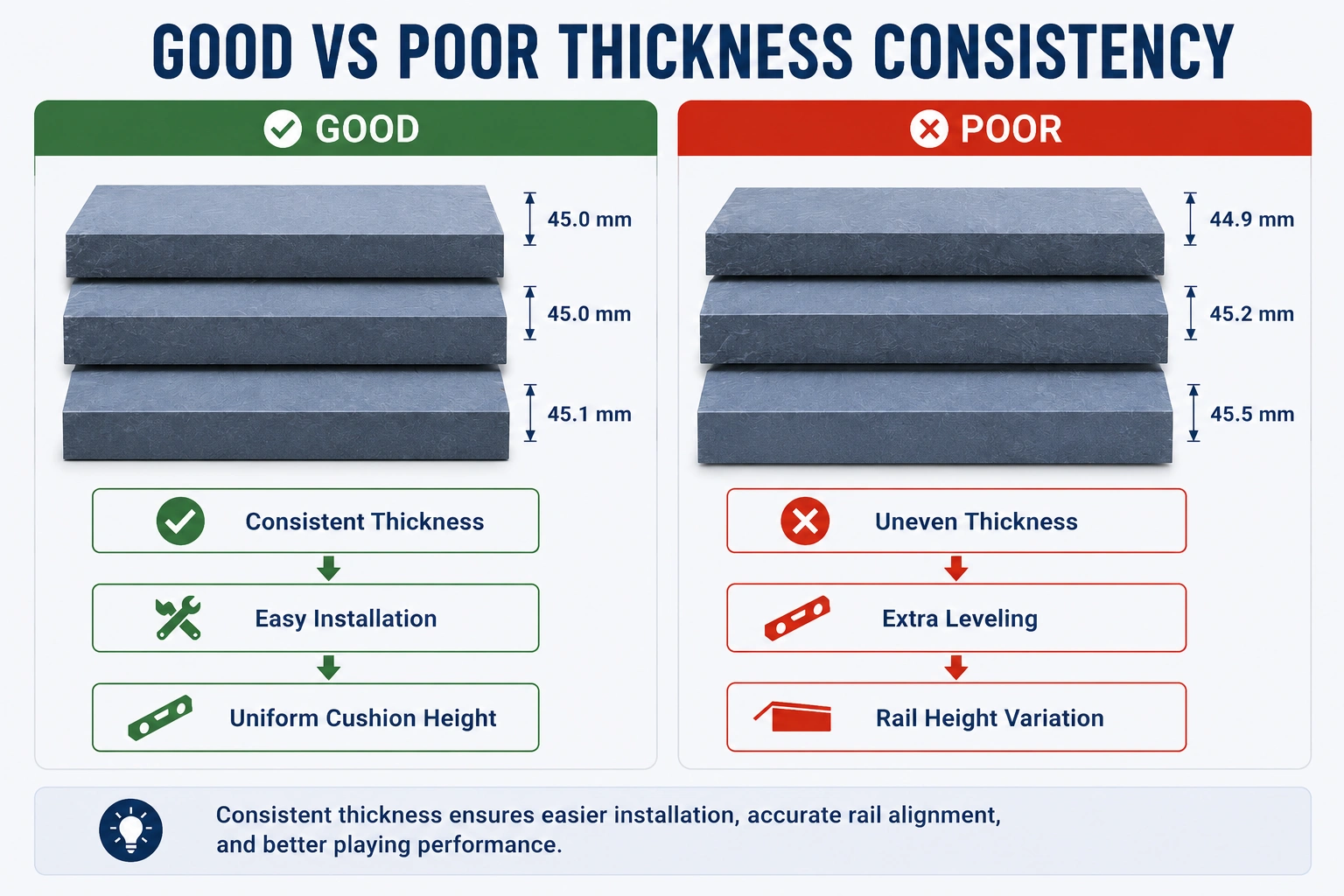
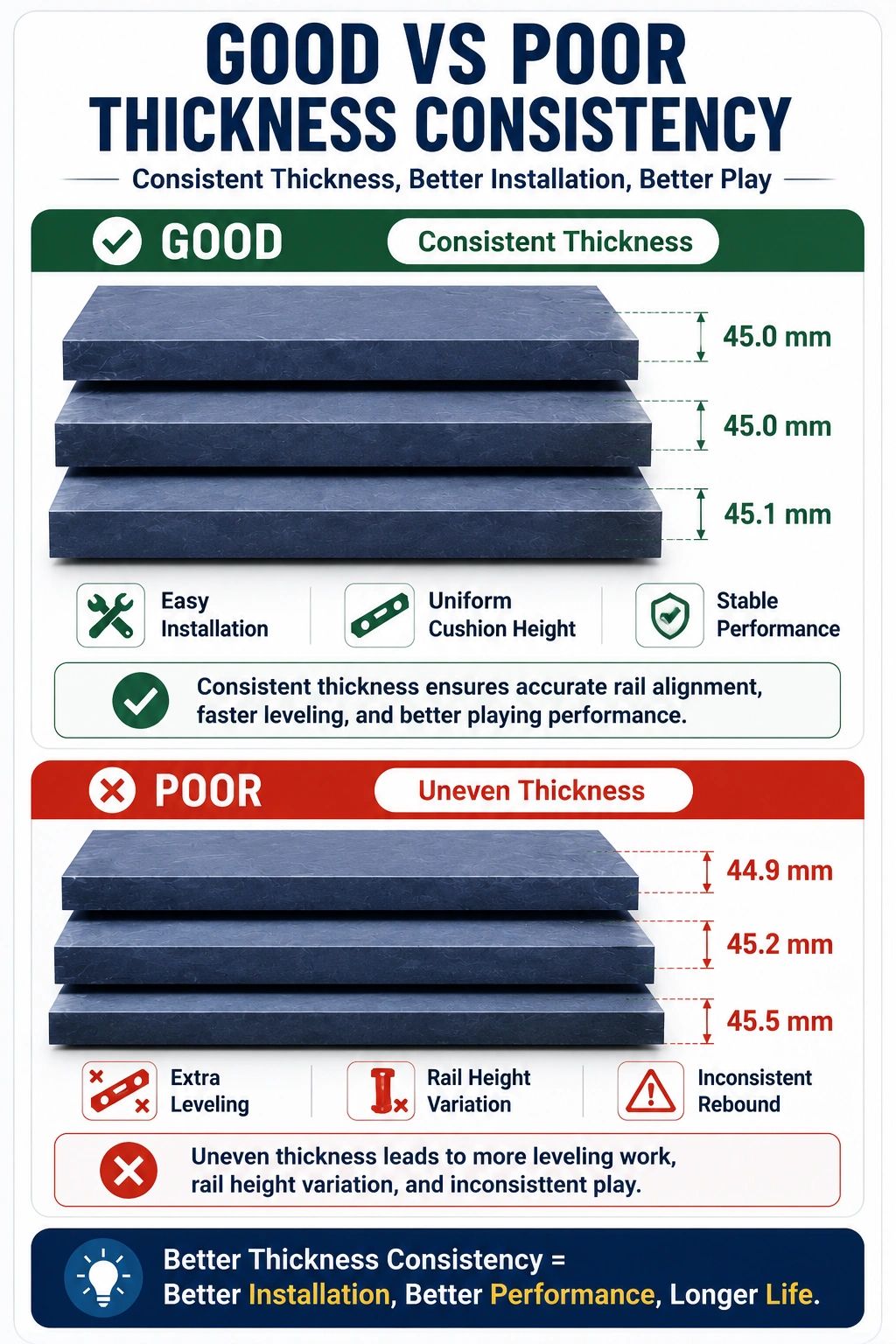
A high-quality slate is not defined by a single thickness measurement—it is defined by consistent thickness across all slate pieces.
Good Thickness Consistency
- 45.0 mm
- 45.1 mm
- 45.0 mm
✓ Easy installation
✓ Uniform rail height
✓ Stable slate support
✓ Consistent playing performance
Poor Thickness Consistency
- 44.9 mm
- 45.2 mm
- 45.5 mm
✗ More leveling work
✗ Uneven cushion height
✗ Difficult rail installation
✗ Inconsistent rebound performance
Consistent Thickness Means Better Installation and Better Play
✔ Uniform slate support
✔ Accurate cushion nose height
✔ Faster leveling and assembly
✔ Reliable rail installation
✔ Long-term structural stability
✔ Consistent tournament-level performance
Size Tolerance Explained
Professional pool table slate and snooker slate are manufactured to strict dimensional tolerances because even small size deviations can affect the entire table assembly.
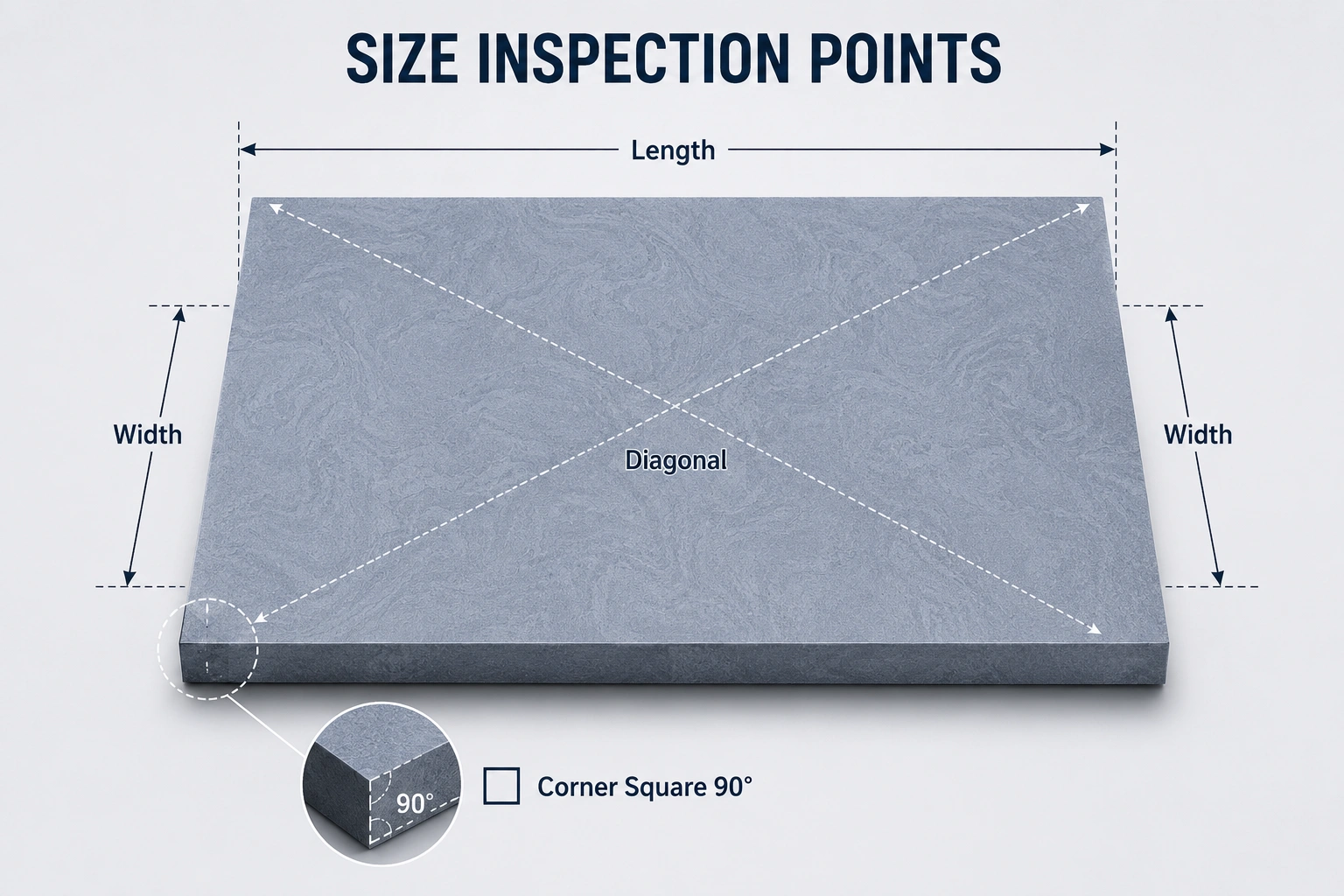
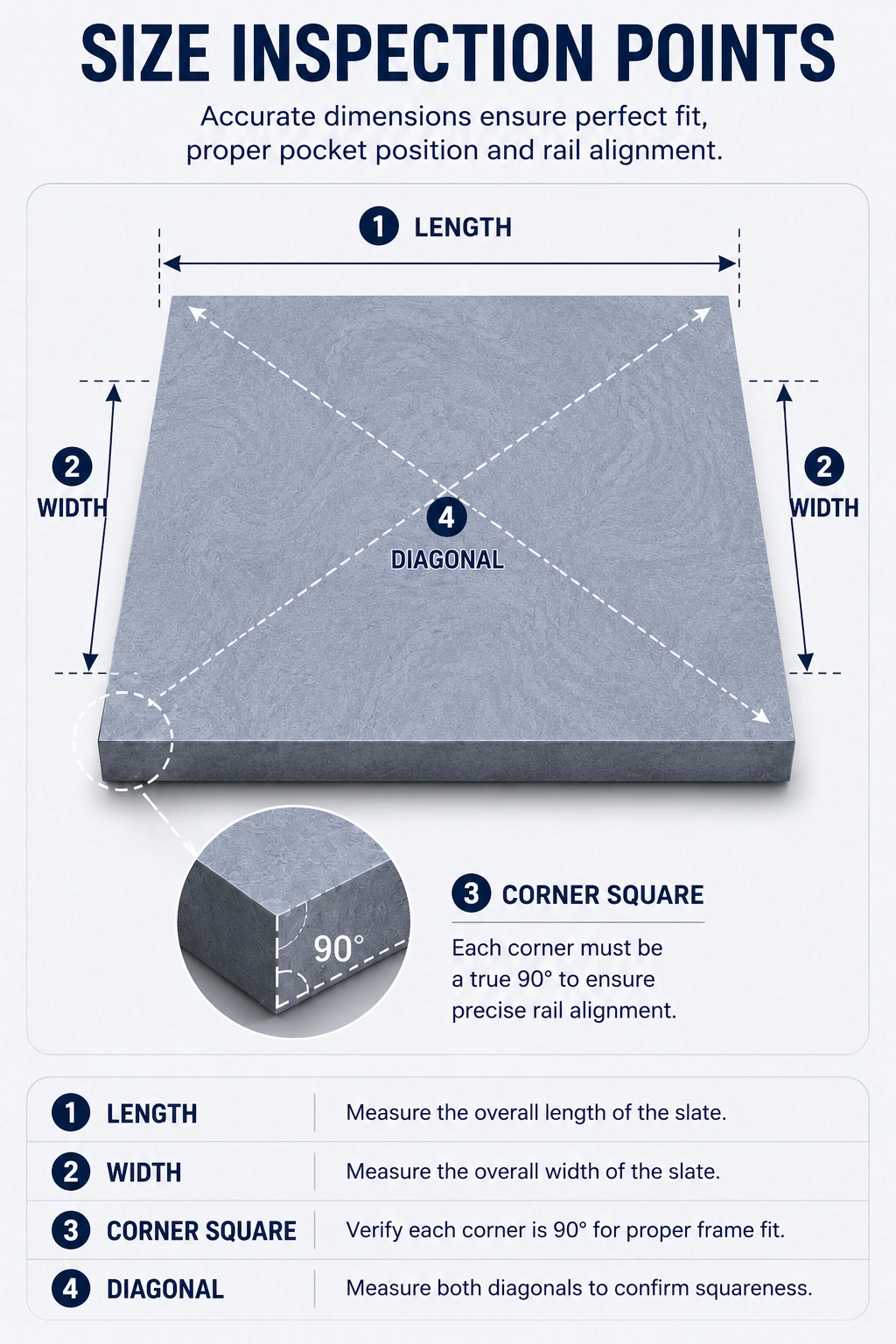
The four most important dimensional measurements are:
- Length
- Width
- Corner Squareness
- Diagonal Accuracy
Together, they ensure that every slate piece fits correctly within the table frame and aligns perfectly with the rails and pockets.
Key Dimensional Checks
Length
Length tolerance ensures the slate matches the table frame precisely. Excessive deviation may cause installation difficulties or uneven rail positioning.
Width
Accurate width maintains the correct table geometry and ensures proper spacing between the rails and pockets.
Corner Squareness
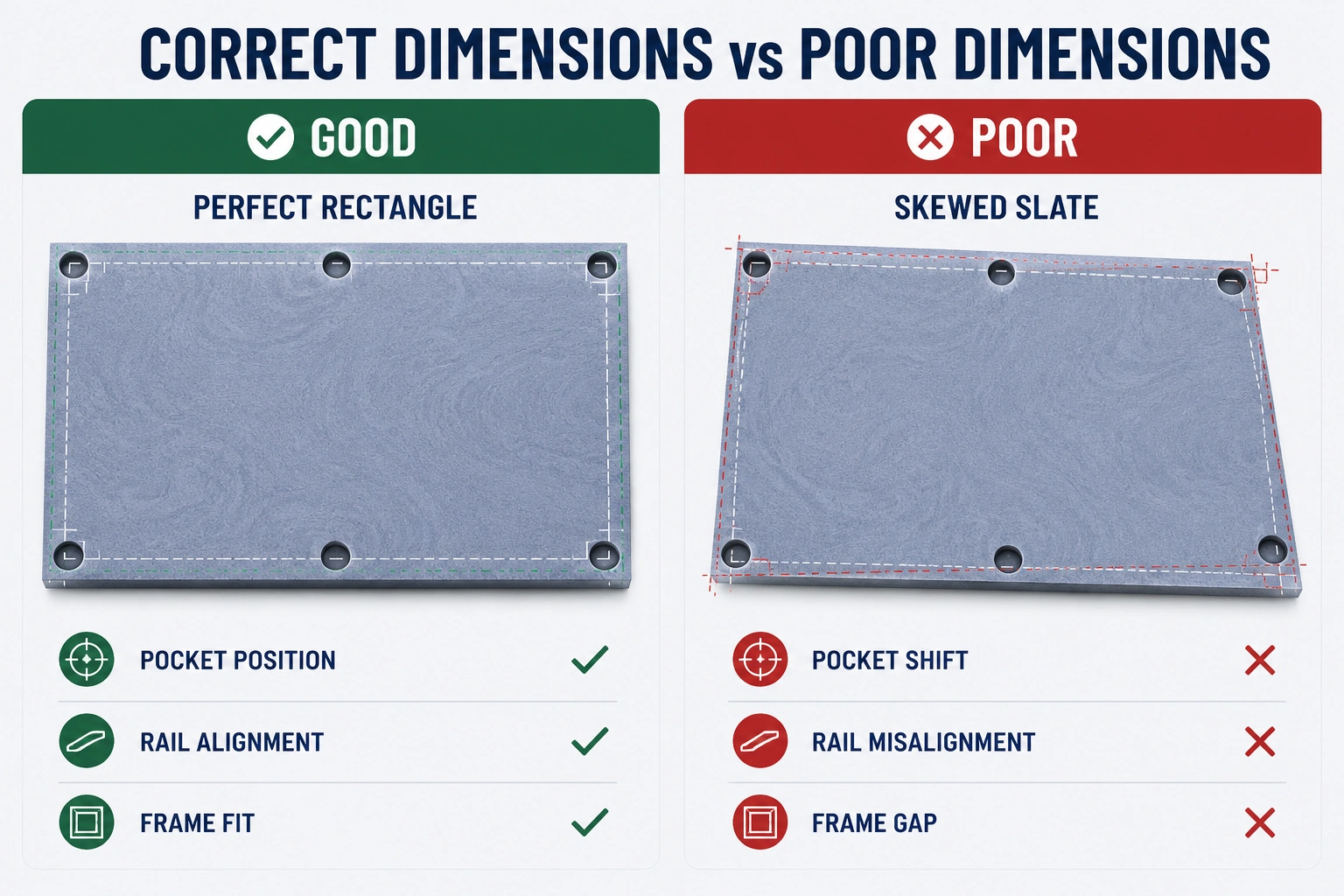
Every corner should form a true 90° angle. Poor corner squareness may prevent accurate rail alignment and create visible gaps during assembly.
Diagonal Accuracy
Measuring both diagonals confirms the slate is perfectly square. Significant differences between diagonal measurements indicate dimensional distortion that can affect installation accuracy.
Why Accurate Dimensions Matter
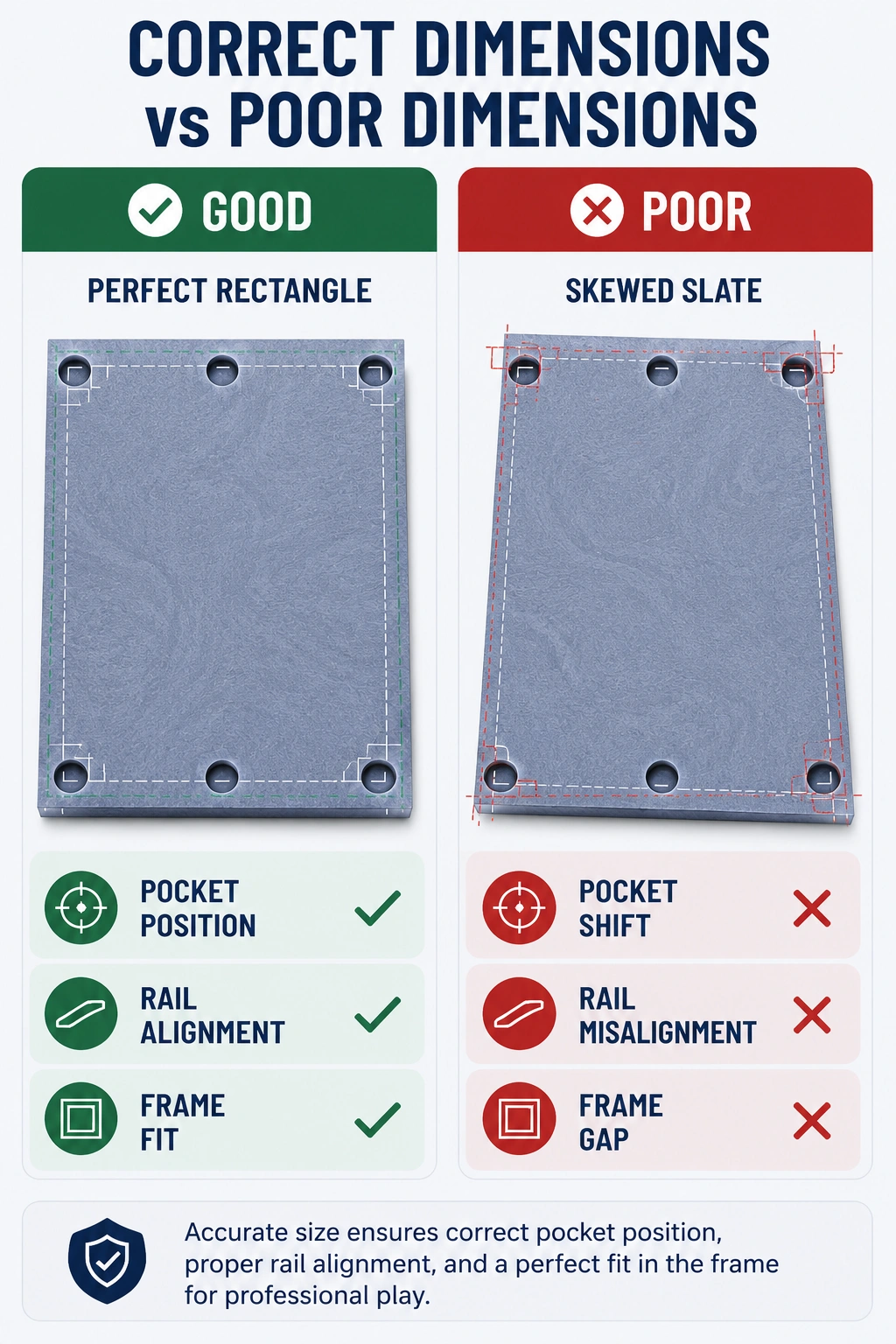
Pocket Position
Incorrect slate dimensions may shift the position of pocket openings, affecting pocket geometry and ball acceptance.
Frame Fit
A slate manufactured within tight dimensional tolerances fits securely inside the table frame with minimal adjustment, improving installation efficiency and structural stability.
Rail Alignment
Accurate length, width, and corner squareness help ensure the cushion rails align evenly around the playing surface, providing consistent rebound angles and professional playing performance.
Typical Size Tolerance
| Inspection Item | Typical Professional Tolerance |
|---|---|
| Length | ±0.5 mm |
| Width | ±0.5 mm |
| Corner Squareness | 90° ± Small Manufacturing Tolerance* |
| Diagonal Difference | ≤1.0 mm |
*Actual dimensional tolerances may vary depending on product specifications, machining capability, and customer requirements.
Accurate Dimensions Ensure Accurate Assembly
✔ Precise frame fit
✔ Correct pocket positioning
✔ Uniform rail alignment
✔ Easier installation
✔ Better joint accuracy
✔ Consistent tournament-quality performance
Professional billiard slate quality depends on three equally important factors: flatness for accurate ball roll, thickness for stable installation, and dimensional accuracy for precise frame fit and rail alignment. Together, these tolerances ensure reliable tournament-level performance.
How We Measure Billiard Slate Tolerance
Precision Inspection at Every Production Stage
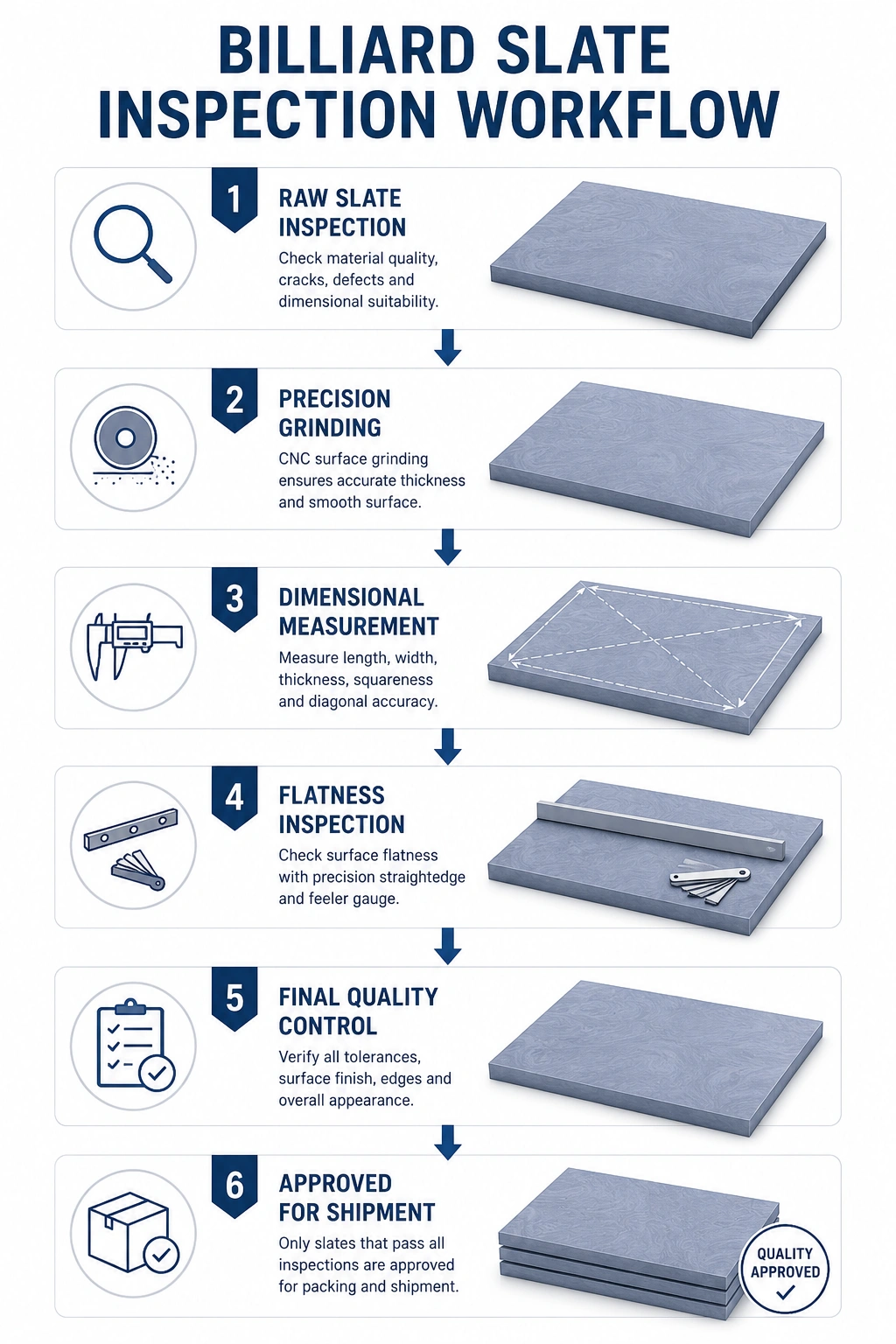
At Slate of China, every billiard slate undergoes a comprehensive inspection process before shipment. From raw material selection to final quality control, each manufacturing stage is carefully monitored to ensure the slate meets the required flatness, thickness, and dimensional tolerances.
Our quality inspection process combines precision machining, professional measuring instruments, and experienced technicians to deliver reliable tournament-grade performance.
Our Quality Inspection Process
Step 1 – Raw Slate Inspection
Every slate block is visually inspected before machining to verify material quality, structural integrity, and dimensional suitability.
During this stage, inspectors check for:
- Surface defects
- Natural cracks
- Structural weaknesses
- Material consistency
Only qualified slate enters the machining process.
Step 2 – Precision Surface Grinding
The slate surface is precision-ground using CNC-controlled grinding equipment to achieve a smooth and uniform playing surface.
This process helps establish:
- Accurate thickness
- Excellent surface flatness
- Consistent machining quality
Step 3 – Precision Dimensional Measurement
After machining, each slate is measured using calibrated inspection tools to verify:
- Length
- Width
- Thickness
- Corner squareness
- Diagonal accuracy
All dimensions are compared against the required manufacturing tolerances.
Step 4 – Flatness Inspection
Surface flatness is inspected using a precision straightedge and feeler gauge.
Technicians measure the maximum gap at multiple positions across the slate surface to confirm compliance with the specified flatness tolerance.
This inspection helps ensure smooth, accurate, and consistent ball roll.
Step 5 – Final Quality Control
Before packing, every finished slate undergoes a final inspection.
The QC team verifies:
- Surface finish
- Dimensional accuracy
- Flatness
- Machining quality
- Edge condition
- Overall appearance
Only slates that pass the complete inspection process are approved for packing and shipment.
Why This Process Matters
A systematic inspection process ensures every pool table slate and snooker slate is manufactured with consistent quality and reliable dimensional accuracy.
By inspecting each production stage instead of only the finished product, potential issues can be identified and corrected early, improving both manufacturing efficiency and final product performance.
For table manufacturers, distributors, and installers, this means:
- More consistent product quality
- Easier installation
- Reduced adjustment time
- Improved table performance
- Greater long-term reliability
Every Slate Is Verified Before Shipment
✔ Raw material inspection
✔ Precision CNC grinding
✔ Thickness and dimensional measurement
✔ Flatness verification
✔ Final quality control approval
Measuring Equipment for Billiard Slate Quality Inspection
Accurate billiard slate tolerance inspection depends not only on skilled technicians but also on professional measuring equipment.
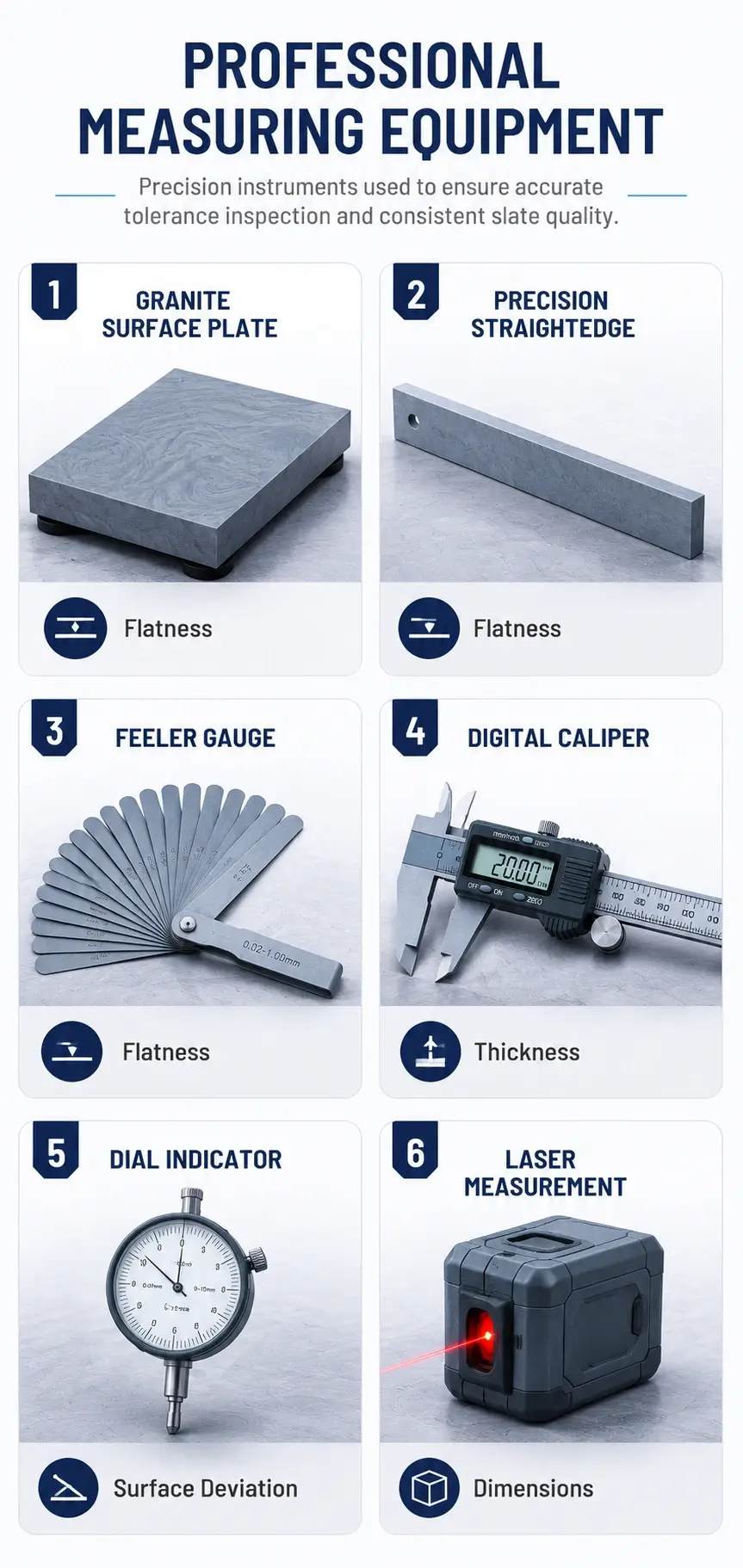
At Slate of China, every critical dimension—including flatness, thickness, length, width, edge straightness, and diagonal accuracy—is verified using calibrated inspection tools throughout the manufacturing process.
Using precision measuring instruments helps ensure consistent product quality, reliable dimensional accuracy, and tournament-grade playing performance.
Granite Surface Plate
Purpose
Provides a perfectly stable and level reference surface for dimensional inspection.
Used For
- Flatness inspection
- Height measurement
- Precision dimensional verification
Why It Matters
A certified granite surface plate eliminates reference errors and improves inspection accuracy.
Precision Straightedge
Purpose
Checks surface flatness by comparing the slate surface against a certified straight reference.
Used For
- Flatness inspection
- Surface straightness verification
Why It Matters
Works together with a feeler gauge to measure the maximum surface deviation.
Feeler Gauge
Purpose
Measures the maximum gap between the straightedge and the slate surface.
Used For
- Flatness tolerance inspection
Why It Matters
Smaller gaps indicate a flatter playing surface and more accurate ball roll.
Digital Caliper
Purpose
Measures thickness and other critical dimensions with high precision.
Used For
- Slate thickness
- Machined dimensions
- Groove and edge measurements
Why It Matters
Ensures every slate section remains within the specified manufacturing tolerance.
Dial Indicator
Purpose
Detects extremely small dimensional variations and surface deviations.
Used For
- Flatness verification
- Height difference inspection
- Precision leveling
Why It Matters
Ideal for measuring minute deviations that cannot be detected visually.
Laser Measurement System
Purpose
Provides non-contact dimensional inspection for large slate components.
Used For
- Overall dimensional accuracy
- Surface profiling
- Automated quality inspection
Why It Matters
Laser measurement improves inspection efficiency and repeatability, particularly in high-volume production environments.
Availability depends on individual manufacturing facilities and production requirements.
Equipment Summary
Why Professional Equipment Matters
Professional measuring equipment allows every pool table slate and snooker slate to be inspected with repeatable accuracy.
Instead of relying on visual inspection alone, precision instruments help verify that every slate meets the required dimensional tolerances, resulting in:
- More consistent product quality
- Reliable installation
- Accurate ball roll
- Reduced assembly adjustments
- Greater customer confidence
Precision Equipment Supports Precision Manufacturing
✔ Calibrated measuring instruments
✔ Repeatable inspection results
✔ Accurate flatness verification
✔ Reliable dimensional measurements
✔ Consistent tournament-grade quality
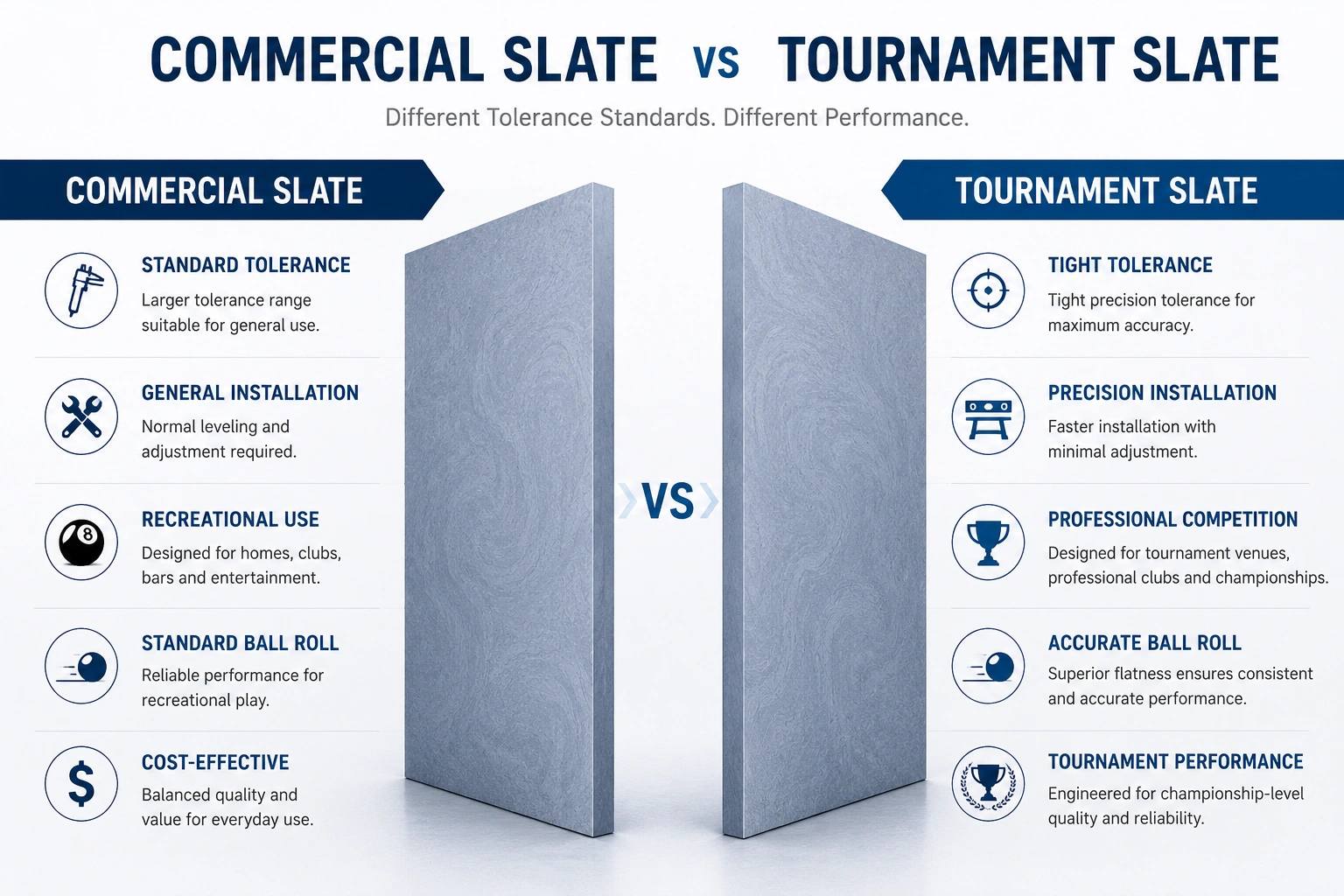
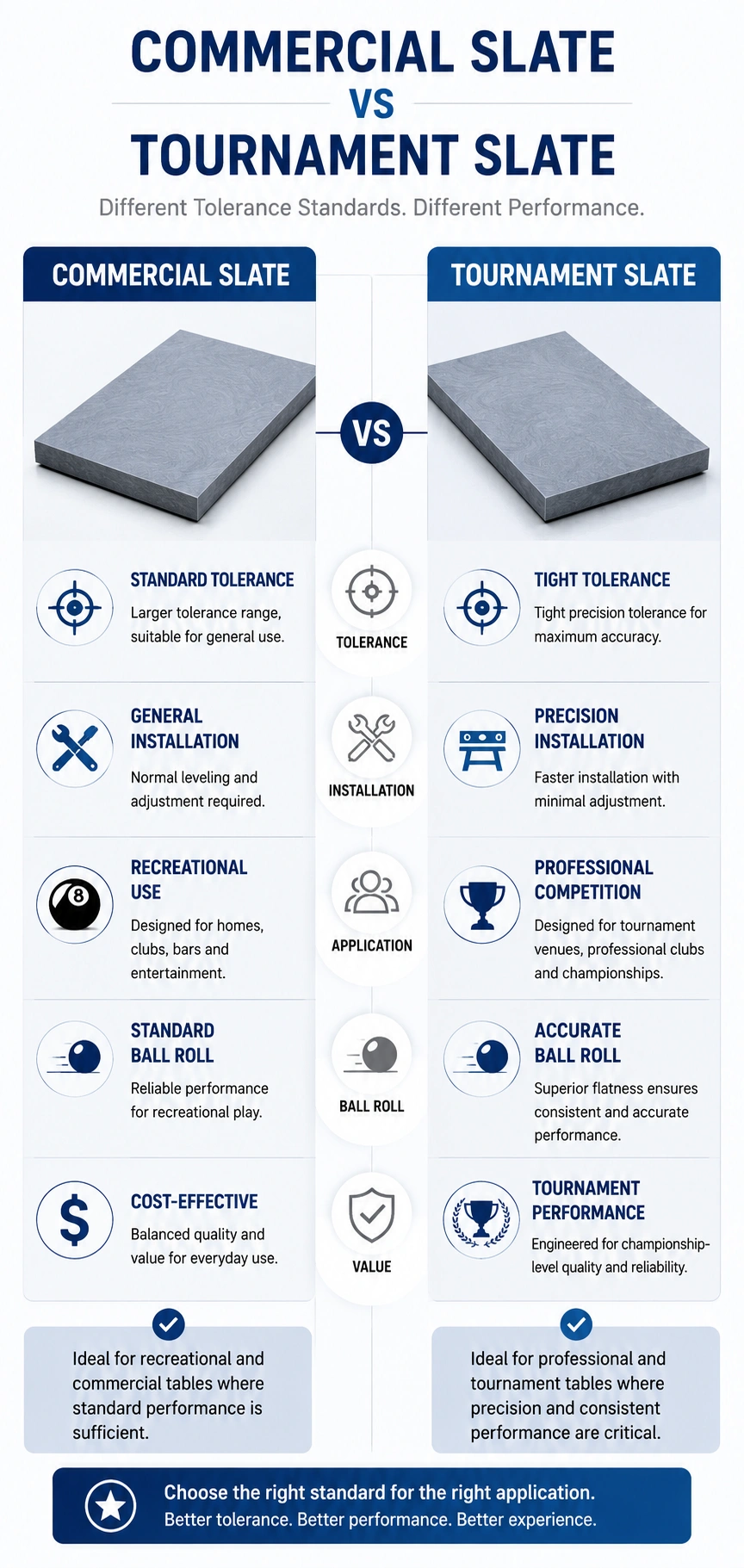
Tournament Standards vs Commercial Standards
Different Applications Require Different Tolerance Standards
Not every billiard table requires the same manufacturing precision. The required billiard slate tolerance depends on the intended application, installation requirements, and expected playing performance.
For recreational and commercial tables, standard manufacturing tolerances are generally sufficient to provide reliable performance. However, tournament billiard slate used in professional competitions demands significantly tighter tolerances to ensure exceptional ball roll accuracy, consistent cushion response, and seamless multi-piece installation.
Choosing the appropriate tolerance level helps manufacturers balance performance, production efficiency, and project cost.
Commercial vs Tournament Slate Comparison
| Feature | Commercial Slate | Tournament Slate |
|---|---|---|
| Typical Tolerance | Standard commercial tolerance | Tight precision tolerance |
| Flatness Accuracy | Suitable for recreational play | Tournament-grade flatness |
| Thickness Consistency | Standard machining | High-precision machining |
| Dimensional Accuracy | General production tolerance | Strict dimensional control |
| Installation | Normal leveling and adjustment | Faster, more precise installation |
| Rail Alignment | Standard accuracy | Precision rail alignment |
| Playing Performance | Recreational & commercial use | Professional competition |
| Typical Applications | Clubs, pubs, homes, entertainment venues | Tournament venues, professional clubs, championship tables |
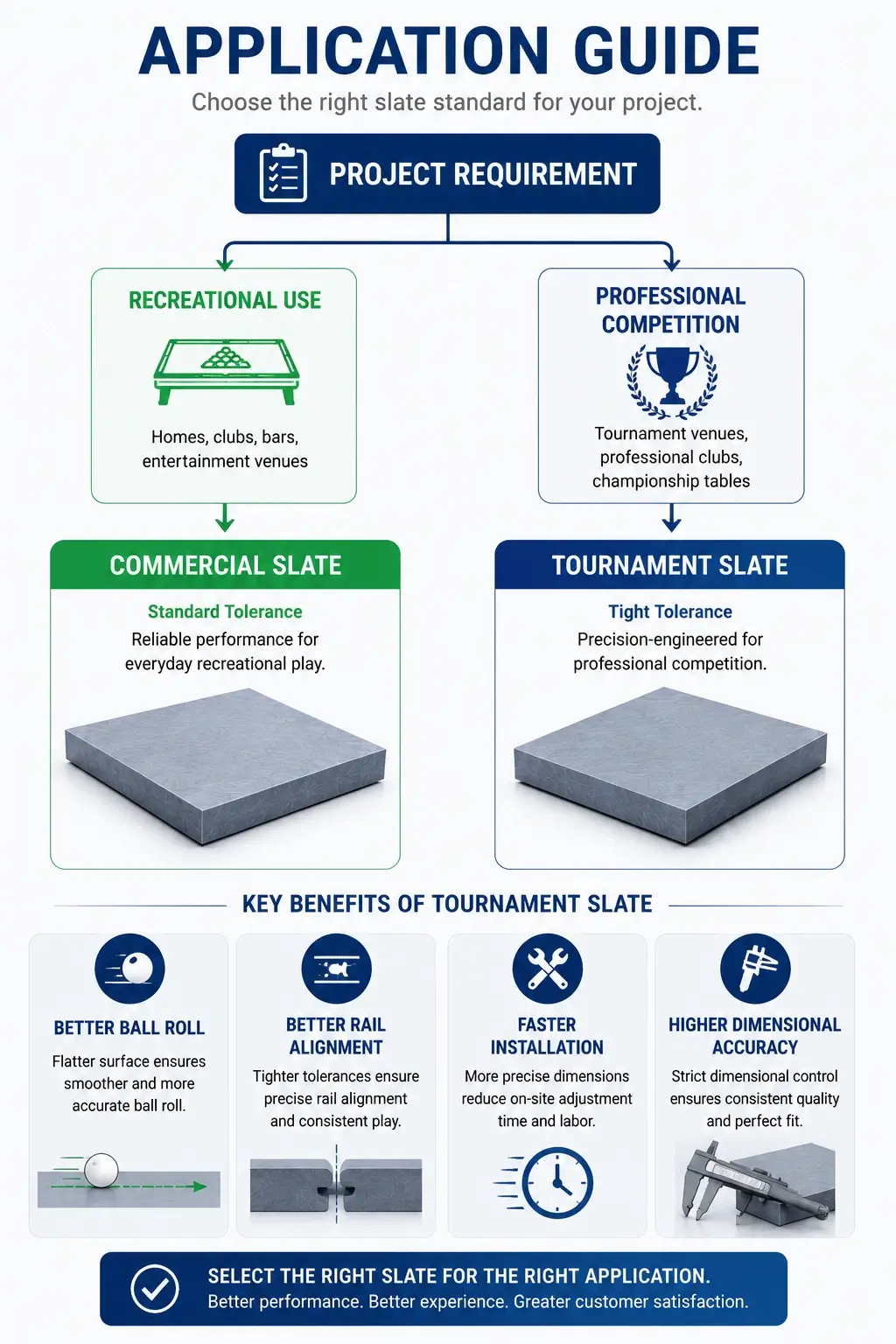
Which Standard Is Right for Your Project?
The ideal tolerance specification depends on your target market and table quality requirements.
Commercial Billiard Slate
Commercial-grade slate is designed for general-purpose tables used in homes, clubs, hotels, bars, and entertainment venues. It offers dependable performance while maintaining cost-effective production.
It is suitable for:
- Recreational pool tables
- Club and bar tables
- Home billiard tables
- Leisure and commercial entertainment facilities
Tournament Billiard Slate
Tournament-grade slate is manufactured to much tighter dimensional tolerances and is intended for high-performance tables where precision is critical.
This level of quality is recommended for:
- Professional pool tables
- Professional snooker tables
- Championship competition tables
- International tournament equipment
- Premium table manufacturers
Professional Snooker Slate vs Tournament Snooker Slate
Although the terms are sometimes used interchangeably, there can be practical differences depending on customer specifications.
Professional Snooker Slate
Designed for high-quality commercial and professional-use tables, offering excellent flatness, dimensional accuracy, and reliable playing performance.
Tournament Snooker Slate
Manufactured under stricter quality control with tighter tolerance requirements to satisfy the demands of professional tournaments and championship-level competition.
Typical improvements include:
- Higher flatness accuracy
- Better thickness consistency
- More precise dimensional control
- Improved multi-piece seam alignment
- Superior ball roll consistency
Why Tighter Tolerances Matter
For tournament tables, even very small dimensional deviations can influence:
- Ball roll accuracy
- Cushion rebound consistency
- Seam visibility between slate sections
- Rail alignment
- Pocket positioning
- Installation efficiency
Tighter tolerances reduce installation adjustments and help deliver the consistent playing characteristics expected on professional competition tables.
Choose the Right Tolerance for the Right Application
✔ Commercial Slate – Reliable quality for everyday recreational and commercial use.
✔ Tournament Slate – Precision-engineered for professional installation and championship-level performance.
At Slate of China, we manufacture both commercial-grade and tournament-grade billiard slate. Tolerance specifications can be customized to meet the requirements of pool table manufacturers, snooker table brands, distributors, and OEM projects worldwide.
Common Billiard Slate Tolerance Problems
Understanding Common Slate Quality Issues
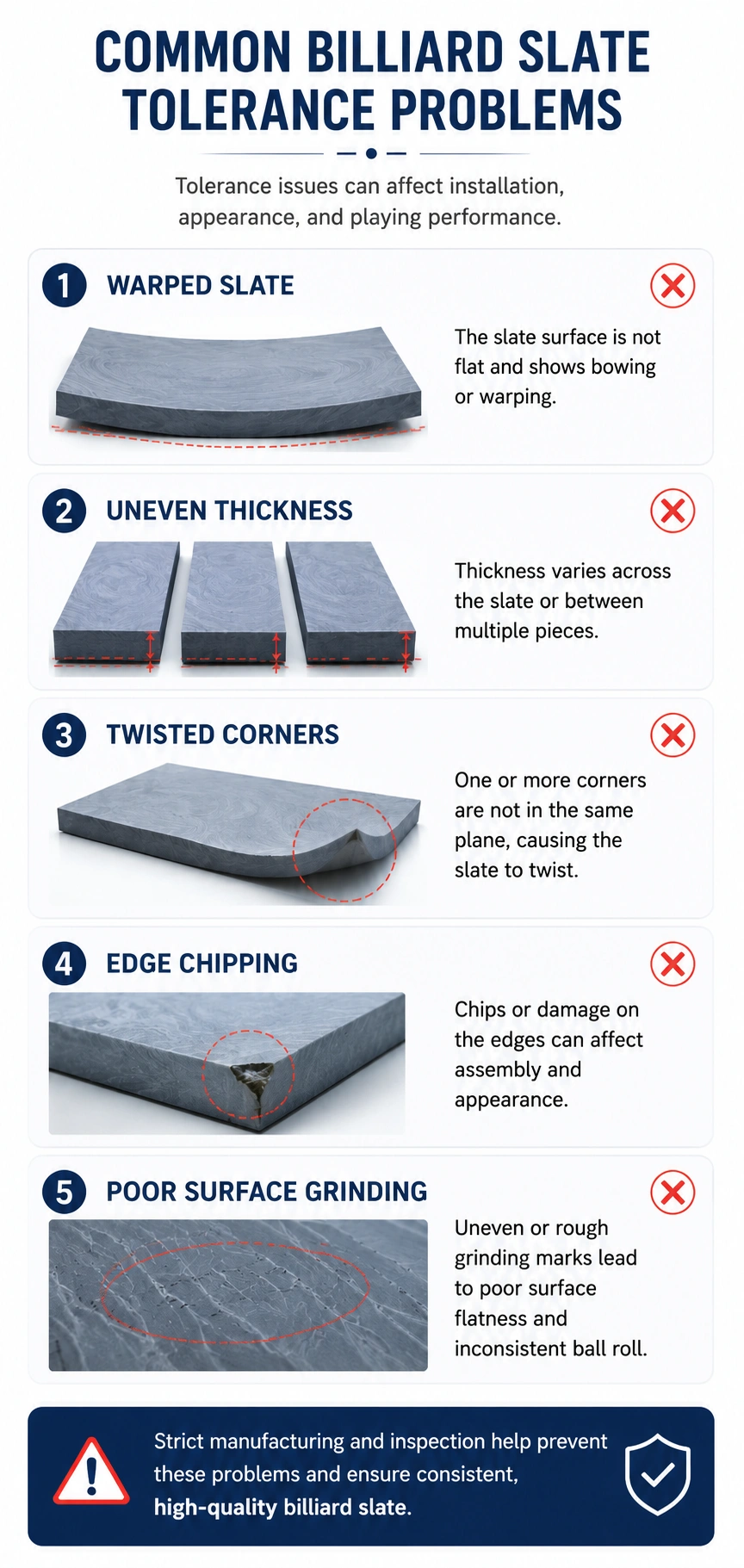
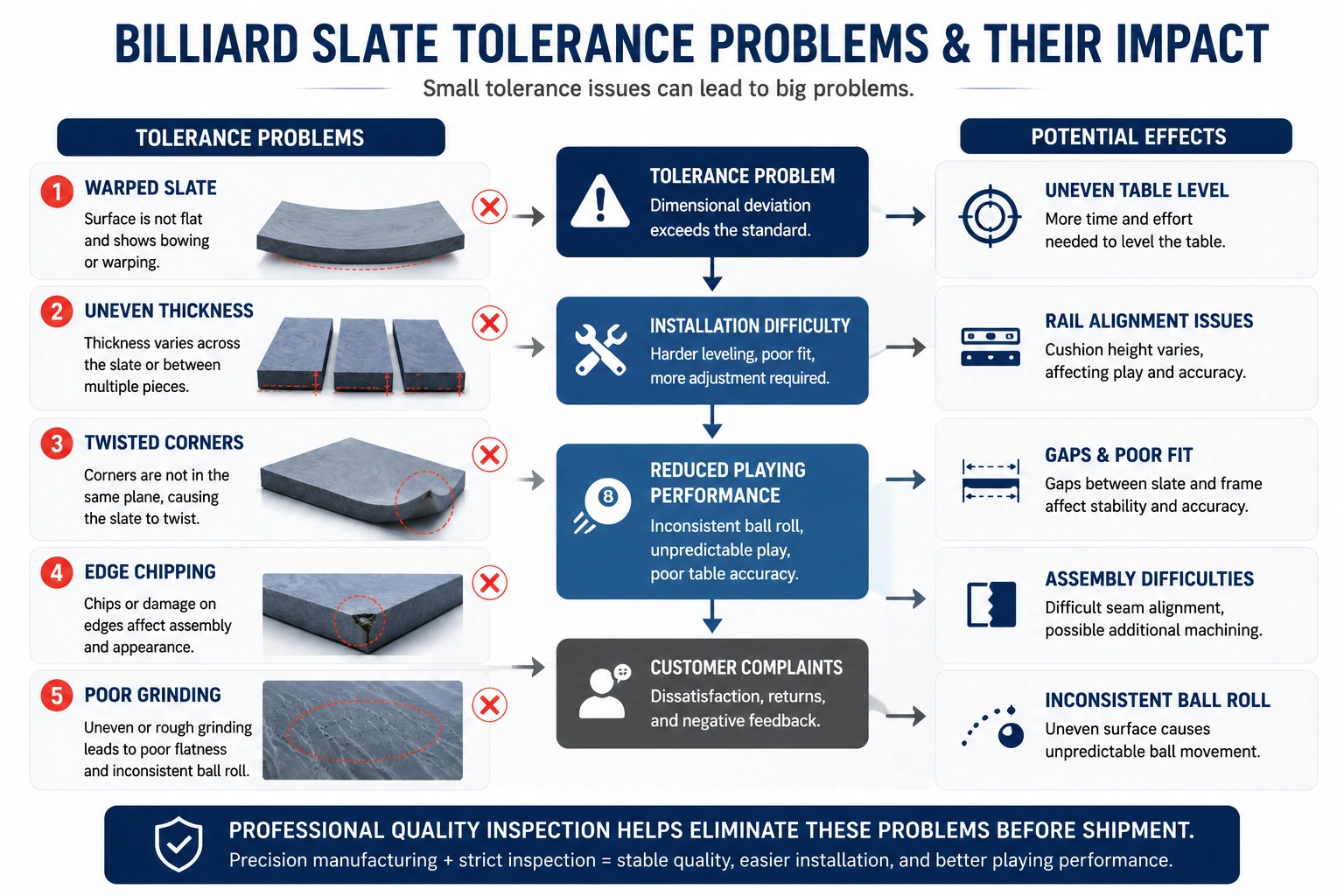
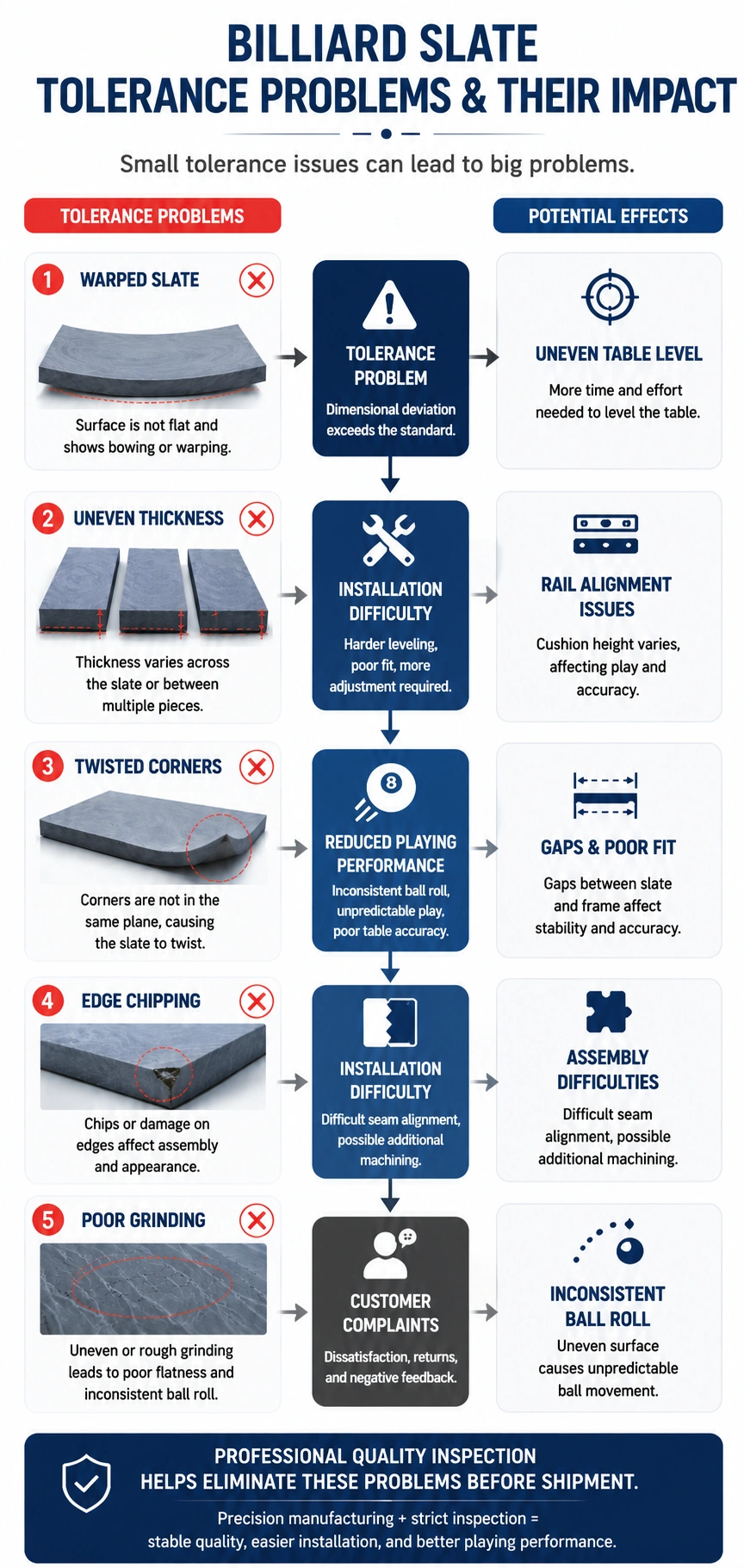
Even small dimensional deviations can significantly affect the installation, appearance, and playing performance of a billiard table. Poor manufacturing control may result in tolerance problems that increase installation time, reduce table accuracy, and negatively impact the playing experience.
The following are the most common tolerance issues found in billiard slate, along with their causes, potential effects, and recommended solutions.
1. Warped Slate
What Is It?
A warped slate has an uneven playing surface caused by excessive flatness deviation. Instead of remaining perfectly level, the surface may curve or bow slightly.
Effects
- Inconsistent ball roll
- Unpredictable cue ball movement
- More difficult table leveling
- Poor tournament performance
Solution
Precision grinding combined with flatness inspection using a precision straightedge and feeler gauge helps ensure the slate remains within the specified flatness tolerance.
2. Uneven Thickness
What Is It?
The slate thickness varies across one piece or between multiple slate sections.
Effects
- Rail bolt alignment problems
- Cushion nose height variation
- Additional leveling work
- Uneven table support
Solution
Accurate thickness machining and digital caliper inspection ensure consistent thickness throughout the slate.
3. Twisted Corners
What Is It?
One or more corners are not in the same plane, causing the slate to twist slightly.
Effects
- Corner lifting during installation
- Gaps between slate and frame
- Poor seam alignment
- Reduced playing accuracy
Solution
Proper machining, precision grinding, and final flatness inspection minimize corner distortion.
4. Edge Chipping
What Is It?
Small chips or damage occur along the machined edges during cutting, handling, or transportation.
Effects
- Difficult seam assembly
- Visible edge damage
- Reduced appearance quality
- Possible installation adjustments
Solution
Careful machining, edge protection, and secure export packaging help prevent edge damage.
5. Poor Surface Grinding
What Is It?
The playing surface has visible machining marks or inconsistent grinding quality.
Effects
- Reduced flatness
- Uneven cloth installation
- Less consistent ball roll
- Poor overall finish
Solution
Multiple precision grinding passes followed by thorough surface inspection produce a smoother, more uniform playing surface.
Summary Table
| Tolerance Problem | Possible Effect | Recommended Solution |
|---|---|---|
| Warped Slate | Ball roll deviation | Precision grinding & flatness inspection |
| Uneven Thickness | Rail height variation | Accurate thickness machining |
| Twisted Corners | Poor installation & seam alignment | Flatness control and dimensional inspection |
| Edge Chipping | Assembly difficulties | Edge protection and careful handling |
| Poor Surface Grinding | Uneven playing surface | Multi-stage precision grinding |
Why Choosing a Professional Manufacturer Matters
Reliable billiard slate manufacturing is not only about precision machining but also about maintaining strict quality control throughout the entire production process. Professional inspection minimizes tolerance-related problems before the slate leaves the factory, ensuring easier installation, better playing performance, and greater long-term reliability.
Preventing Tolerance Problems Starts with Quality Manufacturing
✔ Precision CNC grinding
✔ Strict flatness inspection
✔ Accurate thickness control
✔ Professional dimensional measurement
✔ Careful handling and protective packaging
At Slate of China, every billiard slate is inspected before shipment to minimize tolerance-related defects. By combining precision machining, calibrated measuring equipment, and strict quality control, we help customers receive slate that is easier to install and delivers reliable tournament-grade performance.
Frequently Asked Questions About Billiard Slate Tolerance
If you’re sourcing billiard slate, understanding manufacturing tolerances is essential for achieving reliable installation and consistent playing performance. Flatness, thickness, and dimensional accuracy all contribute to ball roll, rail alignment, seam quality, and overall table performance. Choosing a manufacturer with strict quality control and professional inspection procedures helps ensure dependable results for both commercial and tournament applications.
Still Have Questions About Slate Tolerances?
Our engineering team can help you understand flatness, thickness, dimensional tolerances, inspection methods, and customized manufacturing specifications for your project. Whether you need commercial billiard slate, tournament-grade slate, or OEM production, we’re happy to provide technical guidance and quality documentation before your order is placed.
👉 Contact us today to discuss your project requirements and request a quotation.
Need Professional Tournament Slate?
✔ 45mm Snooker Slate
✔ 50mm Snooker Slate
✔ Pool Table Slate
✔ OEM Manufacturing
✔ Export Worldwide
Get Free Quote →
Explore More Billiard Slate Guides
Continue Learning About Billiard Slate
Choosing the right billiard slate involves more than understanding dimensional tolerances. Manufacturing processes, flatness inspection, installation methods, slate thickness, weight, and construction all contribute to table quality and long-term playing performance.
The following technical guides provide additional information to help table manufacturers, distributors, installers, and buyers make informed decisions when selecting pool table slate and snooker slate.
Related Technical Guides
Billiard Slate Manufacturing Process
Learn how premium billiard slate is quarried, precision-machined, ground, inspected, and prepared for shipment. This guide explains each production stage and how modern manufacturing techniques contribute to consistent quality and dimensional accuracy.
You’ll learn about:
- Slate production process
- CNC machining
- Surface grinding
- Quality control
- Manufacturing workflow
Quality Inspection & Flatness Control
Discover how professional manufacturers inspect flatness, thickness, dimensions, and surface quality using precision measuring equipment to ensure tournament-grade performance.
Topics include:
- Flatness inspection
- Precision straightedge
- Feeler gauge
- Dimensional measurement
- Quality assurance
Billiard Slate Installation Guide
Proper installation is essential for achieving accurate ball roll and long-term stability. Learn the correct procedures for leveling, joining slate sections, and assembling a professional billiard table.
Topics include:
- Slate installation
- Leveling
- Seam filling
- Rail alignment
- Table assembly
Pool Slate Thickness Guide
Understand how slate thickness influences table stability, weight, installation, and playing characteristics. Compare common thickness options for different applications.
Topics include:
- Slate thickness
- 25 mm
- 30 mm
- 45 mm
- 50 mm
Pool Slate Weight Guide
Estimate shipping weight, handling requirements, and structural support by comparing the weights of different slate sizes and thicknesses.
Topics include:
- Slate weight
- Shipping calculations
- Container loading
- Installation handling
Pool Slate Size Guide
Explore standard slate sizes for pool and snooker tables, including dimensions for tournament and commercial applications.
Topics include:
- Slate dimensions
- Table sizes
- Standard specifications
- Manufacturing sizes
One-piece vs Three-piece Pool Slate
Compare the advantages and limitations of one-piece and three-piece slate designs, including transportation, installation, seam quality, and maintenance.
Topics include:
- One-piece slate
- Three-piece slate
- Transportation
- Installation
- Ball roll
45 mm vs 50 mm Snooker Slate
Learn the differences between 45 mm and 50 mm snooker slate in terms of rigidity, weight, tournament suitability, and manufacturing requirements.
Topics include:
- Thickness comparison
- Professional snooker slate
- Tournament requirements
- Playing performance
Tournament Snooker Slate
Explore the manufacturing standards, flatness requirements, dimensional tolerances, and quality control processes used to produce championship-quality tournament slate.
Topics include:
- Tournament standards
- Precision tolerance
- Professional competition
- Championship quality
Professional Snooker Slate
Learn why professional table manufacturers choose precision-machined slate with superior flatness, thickness consistency, and dimensional accuracy for high-performance snooker tables.
Topics include:
- Professional snooker slate
- Premium quality
- Precision grinding
- Flatness control
- OEM manufacturing
Build a Complete Understanding of Billiard Slate
Whether you’re selecting slate for a commercial pool table, tournament snooker table, or an OEM manufacturing project, these technical guides provide practical information to help you evaluate quality, compare specifications, and choose the right slate for your application.
About the Author
This guide was prepared by Slate Of China,
a professional natural slate manufacturer
with over 30 years of quarrying,
precision machining,
quality inspection,
and international export experience.