
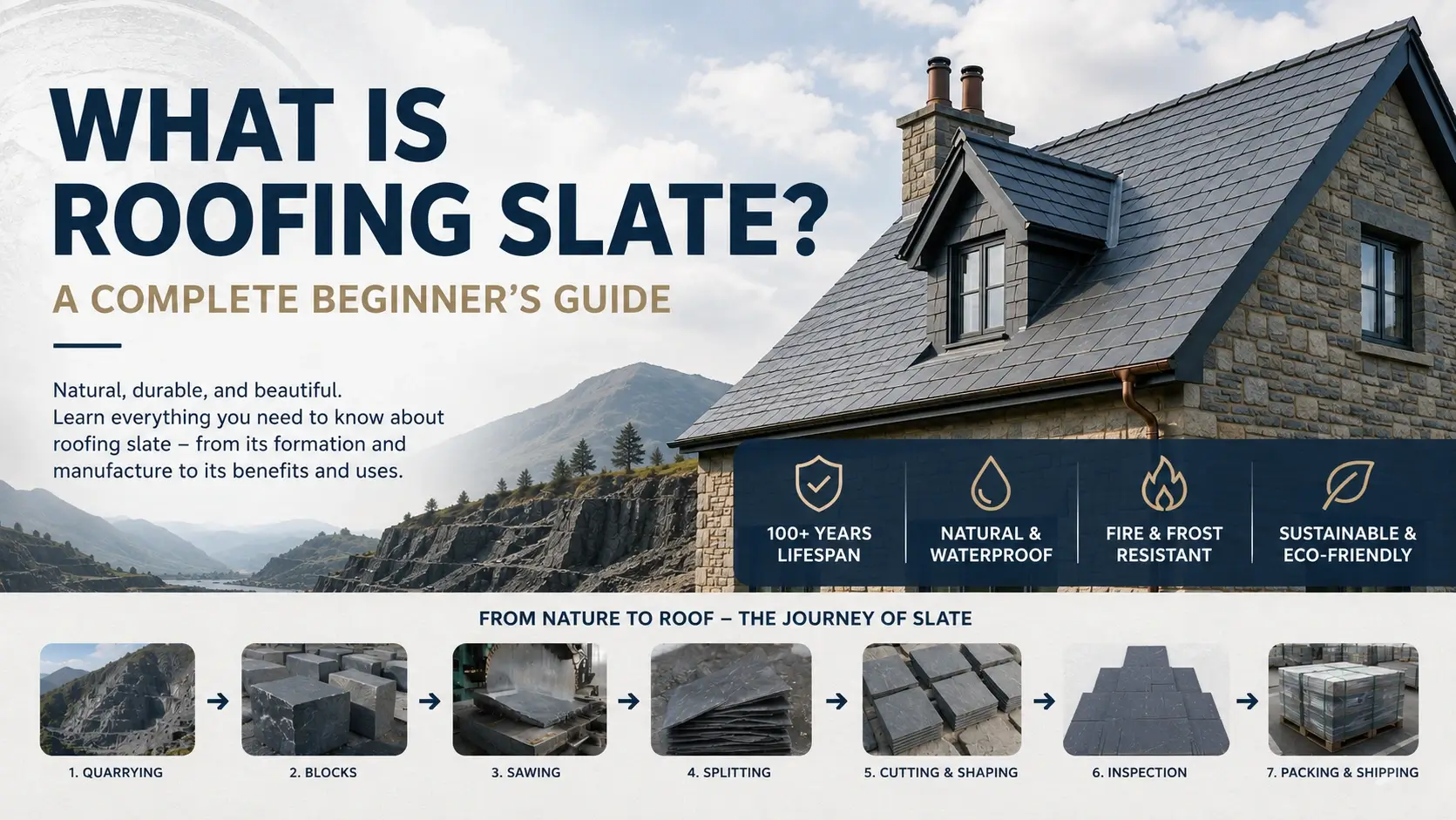
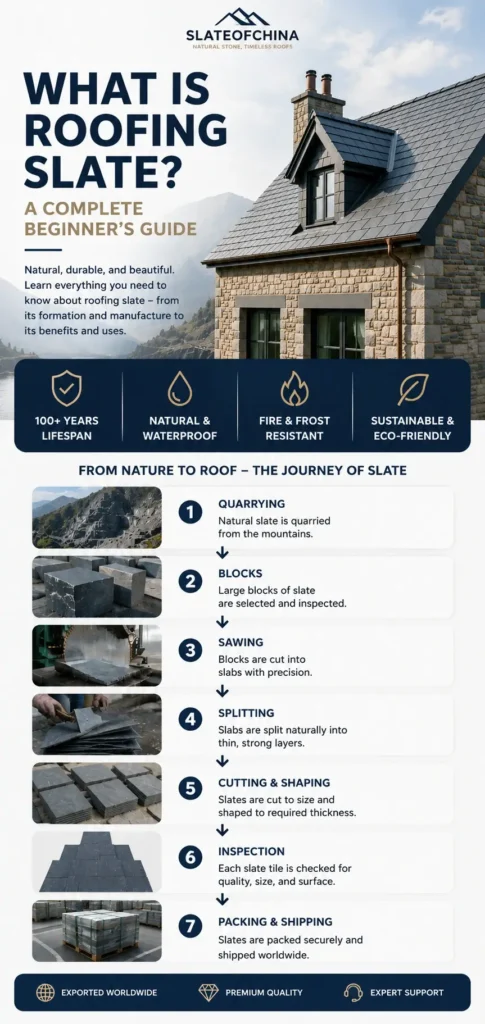
What Is Roofing Slate?
Learn what natural roofing slate is, how it is formed, its key benefits, lifespan, applications, and why it remains one of the world’s most durable and trusted roofing materials.
Natural roofing slate is one of the world’s oldest and most respected roofing materials. Formed deep within the earth over millions of years, this fine-grained metamorphic stone is naturally split into durable roofing tiles that have protected homes, churches, castles, and public buildings for centuries. Unlike manufactured roofing products, every piece of natural roofing slate is unique in texture, color, and character, giving each roof a timeless and elegant appearance.
Today, slate roofing material remains a preferred choice for architects, builders, homeowners, and roofing contractors who value exceptional durability, low maintenance, and long-term performance. A properly installed slate roof can last well over 100 years while offering excellent resistance to fire, frost, moisture, and harsh weather conditions.
Whether you’re planning a new roofing project, restoring a historic building, or sourcing roofing slate for commercial supply, understanding the basics is the first step. In this guide, you’ll learn everything beginners should know about roofing slate—from its geological origin and manufacturing process to its advantages, types, installation, lifespan, and how to choose the right slate for your project.
Table of Contents
What Exactly Is Roofing Slate?
Roofing slate is a premium natural roofing material made from fine-grained metamorphic rock that has formed deep within the earth over millions of years. Under intense heat and pressure, layers of shale are transformed into dense, durable slate with a unique natural cleavage, allowing it to be split into thin, strong sheets without losing its strength.
Unlike concrete tiles, asphalt shingles, or synthetic roofing products, natural roofing slate is not manufactured from artificial materials. Each slate tile is quarried from natural stone, carefully split by skilled craftsmen or modern machinery, cut to precise dimensions, and finished as individual roofing slates ready for installation.
During installation, each slate is fixed individually in overlapping rows using nails or hooks. This traditional installation method creates a highly durable, weatherproof roofing system that effectively sheds rain, snow, and wind while allowing damaged slates to be replaced individually when necessary.
Because of its exceptional strength, low water absorption, fire resistance, and natural beauty, slate roofing material has been used for centuries on castles, churches, historic buildings, luxury homes, and modern architectural projects worldwide. A properly selected and professionally installed slate roof can provide reliable protection for more than 100 years, making it one of the most durable roofing systems available today.
Definition
Roofing slate is a natural metamorphic stone made from fine-grained metamorphic rock that is split into thin sheets, cut into individual roofing tiles, and installed one by one to create a durable, waterproof, and long-lasting roof covering.
From Mountain to Roof: The Journey of Roofing Slate
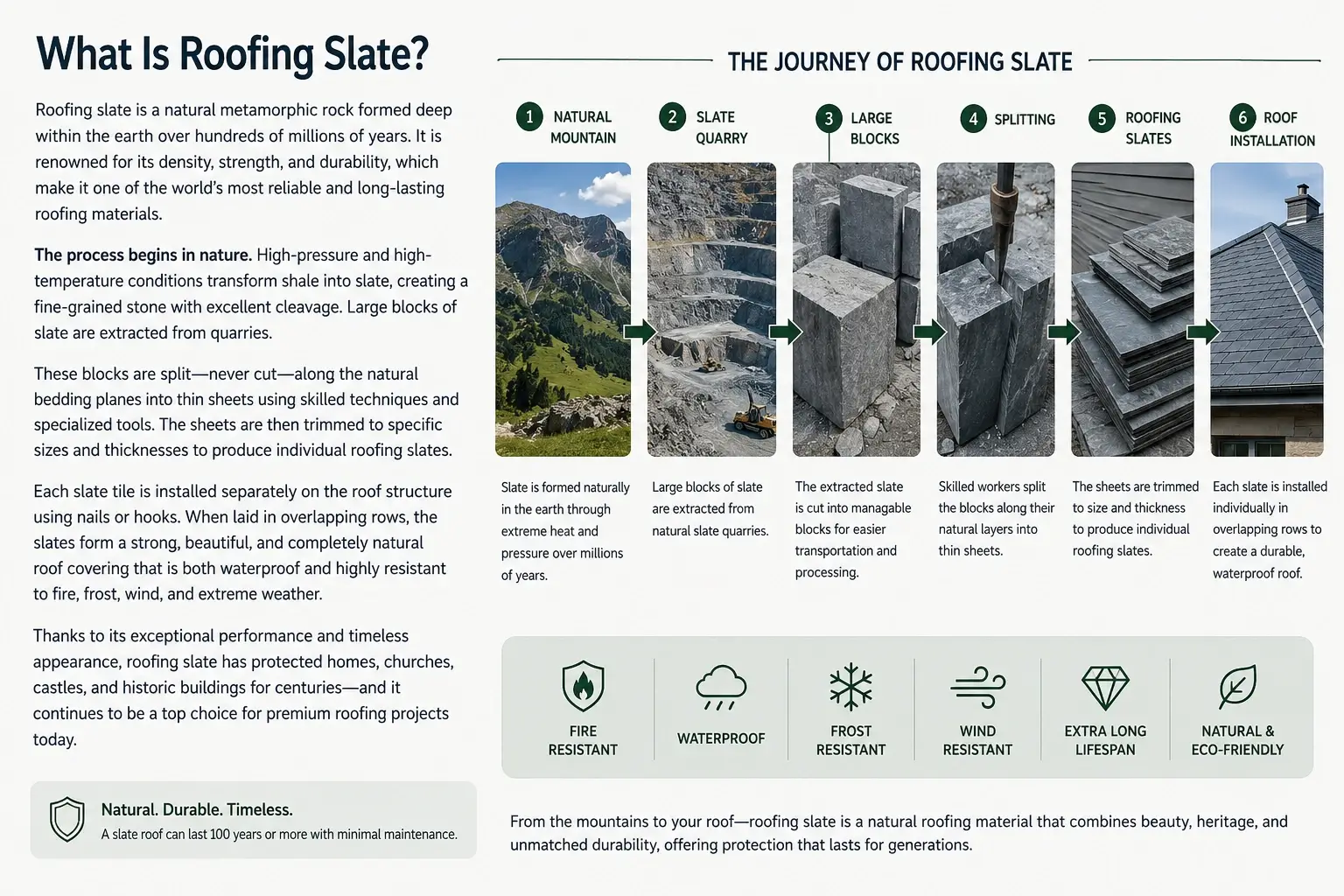
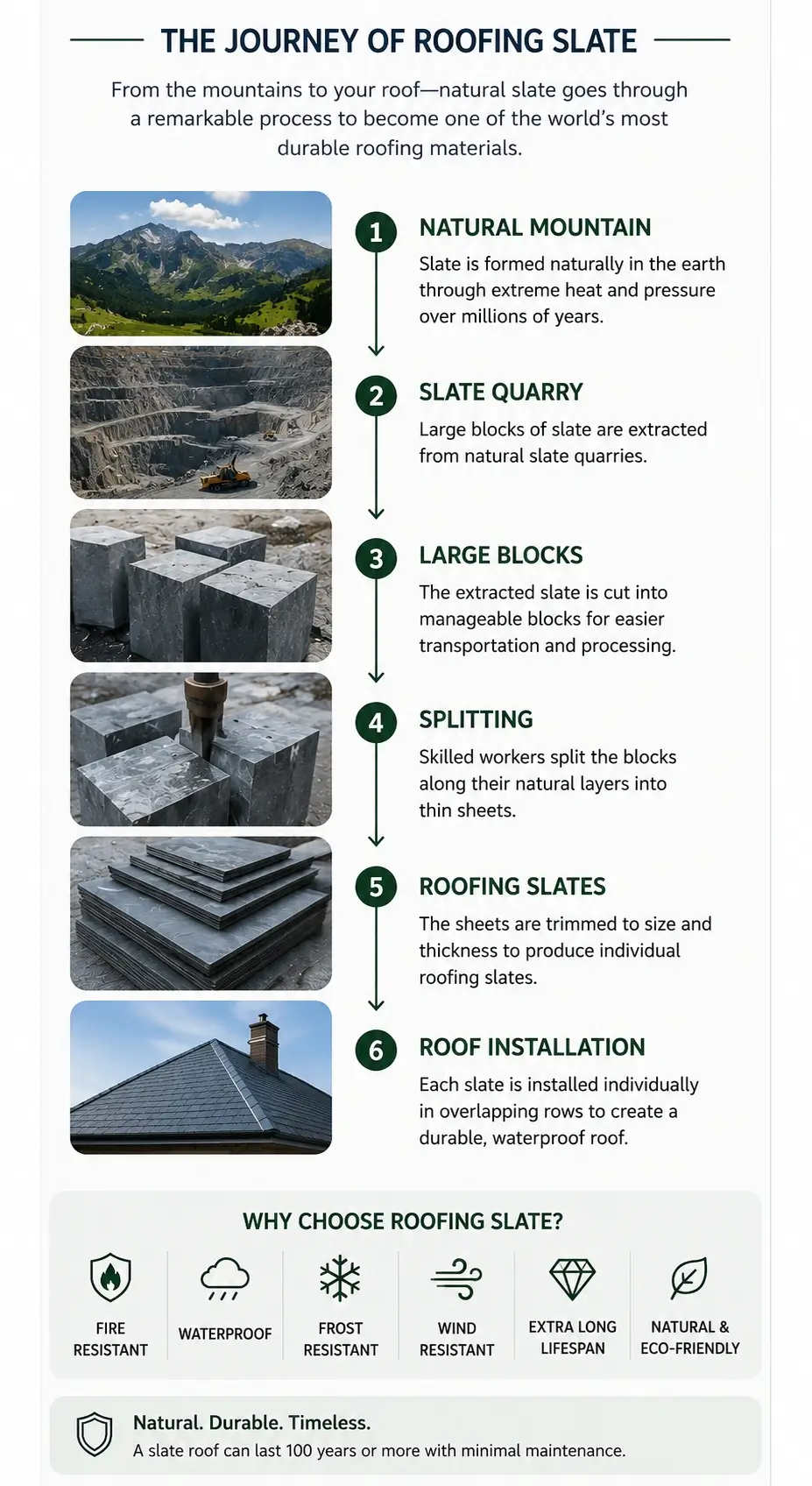
Natural roofing slate follows a carefully controlled journey—from mountain quarry and large stone blocks to splitting, shaping, and finally becoming durable roofing slates installed on roofs around the world.
Why Is Roofing Slate Different?
Unlike factory-made roofing materials, every slate tile is a unique piece of natural stone. Its durability, low water absorption, and resistance to fire, frost, and weather make roofing slate one of the longest-lasting roofing materials available for residential and commercial buildings.
How Is Roofing Slate Formed?
Every piece of natural roofing slate began its journey millions of years ago beneath the earth’s surface. Unlike manufactured roofing materials, slate is created entirely by nature through a slow geological process involving mud, clay, heat, and enormous pressure. This natural formation is the reason why roofing slate is exceptionally strong, durable, and capable of lasting for more than a century.
The Geological Formation Process
Millions of years ago, fine particles of mud and clay settled on the bottoms of ancient lakes and seas. Over time, these sediments accumulated in thick layers and gradually hardened into shale.
As tectonic movements buried the shale deeper underground, it was exposed to extreme pressure and elevated temperatures. Unlike melting, this process slowly transformed the rock’s internal structure, creating a dense, fine-grained metamorphic rock known as slate.
Because the minerals inside the stone became aligned in parallel layers during metamorphism, slate developed a unique property called natural cleavage. This allows the stone to be split cleanly into thin, strong sheets while maintaining excellent structural strength.
Why Can Slate Be Split into Thin Roofing Tiles?
One of the most valuable characteristics of natural roofing slate is its natural cleavage.
Natural cleavage refers to the stone’s ability to split smoothly along its mineral layers without cracking randomly. Unlike concrete or ceramic roofing products, slate does not need to be molded or manufactured into shape. Skilled workers simply split the stone along these natural planes to produce durable roofing slates of different thicknesses and sizes.
This natural structure gives slate several important advantages:
- Consistent strength throughout the tile
- Low water absorption
- Excellent frost resistance
- High weather resistance
- Long service life
These qualities make slate roofing material one of the most reliable choices for long-lasting roofs.
Why Geological Formation Matters
The geological history of slate is more than just an interesting fact—it directly determines the performance of the finished roof.
Because slate formed naturally under immense heat and pressure over millions of years, it has a dense structure, exceptional durability, and outstanding resistance to moisture, fire, frost, and harsh weather. These characteristics explain why slate roofs have protected homes, churches, castles, and public buildings around the world for centuries.
Simply put, the quality of a slate roof begins long before it reaches the quarry—it begins deep within the earth.
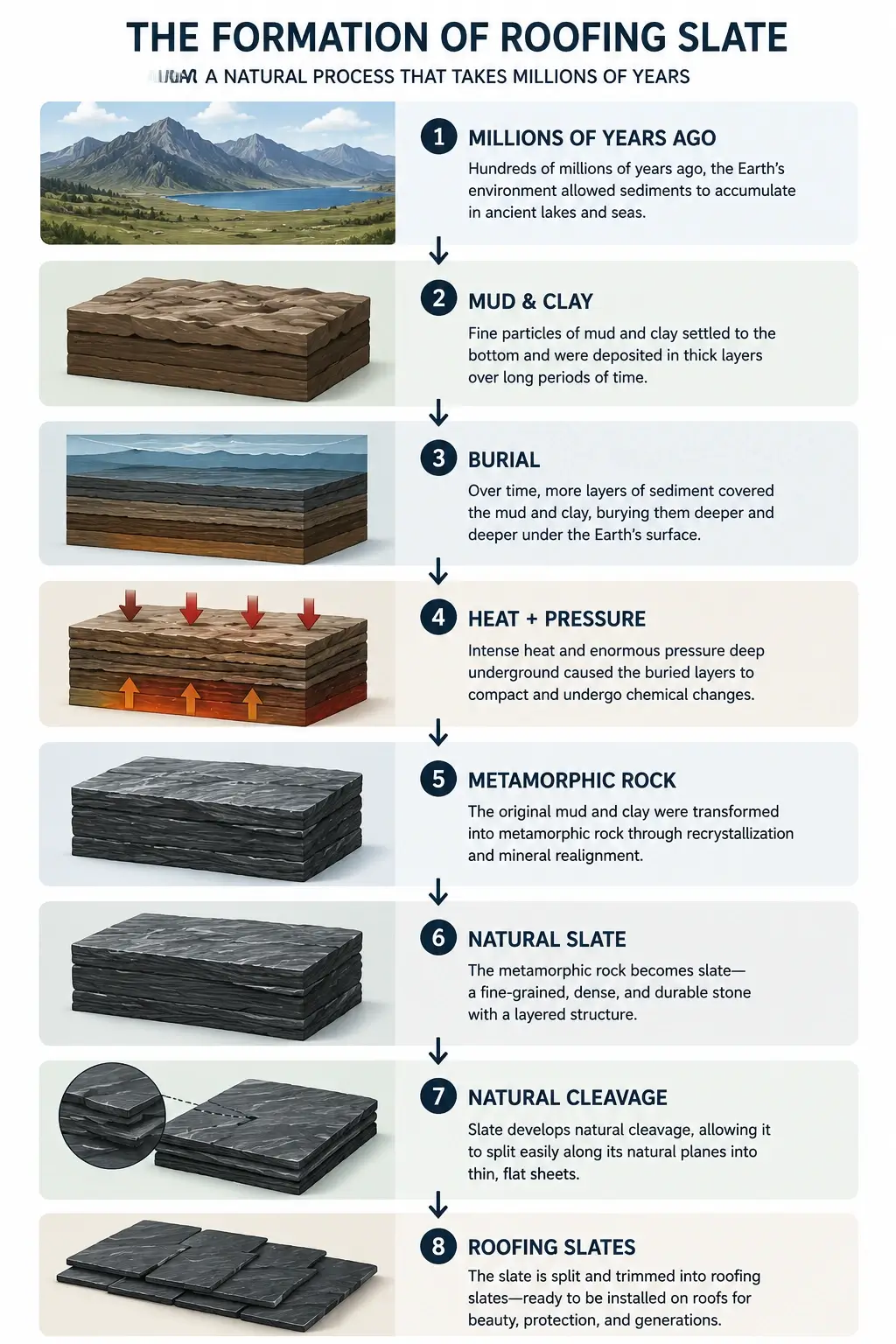
What Is Natural Cleavage?
Natural cleavage is the ability of slate to split naturally into thin, flat layers along its mineral structure. This unique property makes slate ideal for producing durable roofing tiles without artificial manufacturing.
Did You Know?
Most high-quality roofing slate used today is between 300 and 500 million years old. This extraordinary geological history is one of the reasons natural slate offers exceptional durability and can protect buildings for more than 100 years.
What Is Roofing Slate Made Of?
Natural roofing slate is made primarily of naturally occurring minerals that were compressed and transformed over millions of years during the metamorphic process. These minerals determine the slate’s strength, durability, texture, and color, making every piece of roofing slate unique.
Unlike manufactured roofing products, the composition of slate roofing material is entirely natural. No artificial pigments, resins, or cement are added during production. The final appearance and performance of the slate are determined by its geological origin.
The Main Minerals Found in Roofing Slate
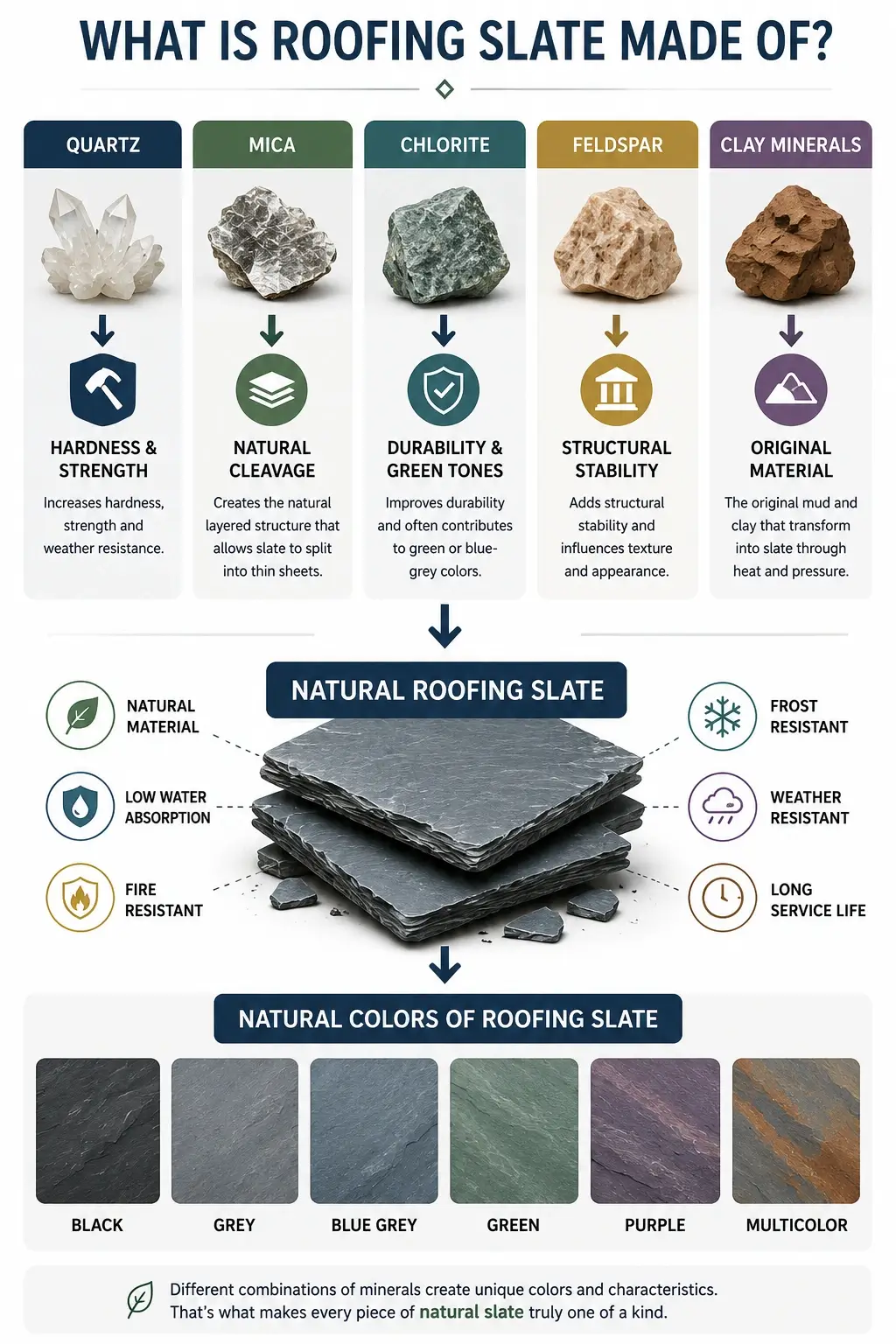
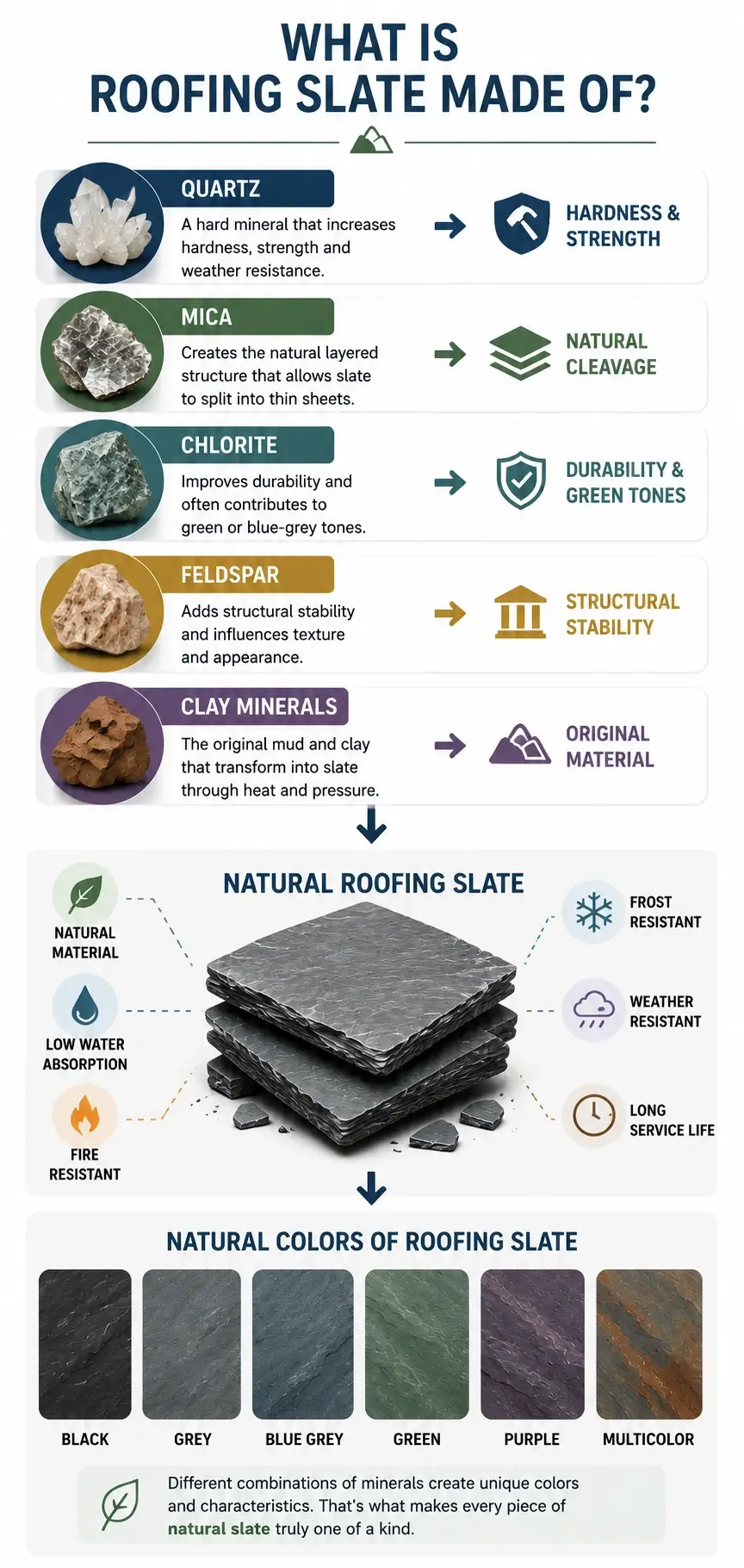
Although the exact composition varies from one quarry to another, high-quality natural roofing slate typically contains the following minerals:
| Mineral | Contribution to Roofing Slate |
|---|---|
| Quartz | Increases hardness, strength, and weather resistance. |
| Mica | Helps create the natural layered structure, allowing slate to split into thin sheets. |
| Chlorite | Improves durability and often contributes to green or blue-grey tones. |
| Feldspar | Adds structural stability and influences texture. |
| Clay Minerals | Form the original material that transforms into slate during metamorphism. |
Note: The mineral composition varies naturally between different slate deposits, which is one reason roofing slate from different regions has distinct colors and characteristics.
Why Do Roofing Slates Have Different Colors?
One of the most attractive features of natural roofing slate is its wide range of natural colors. Unlike painted or coated roofing materials, the color of slate comes directly from the minerals inside the stone.
Common roofing slate colors include:
- Black
- Grey
- Blue Grey
- Green
- Purple
- Multicolor
Different combinations of minerals create these natural variations. For example, chlorite may contribute to green shades, while carbon-rich minerals often produce black slate. Because the color is part of the stone itself, it does not peel, fade, or wear away like surface coatings.
Learn more in our complete guide: Roofing Slate Colors.
(这里以后加内部链接。)
Why Mineral Composition Matters
The minerals inside roofing slate do much more than determine its appearance. They also influence the performance of the finished roof.
High-quality slate roofing material with a dense mineral structure typically offers:
- Excellent strength and durability
- Low water absorption
- Superior frost resistance
- Outstanding weather resistance
- Long service life
- Consistent color and natural beauty
These characteristics are why natural roofing slate continues to be one of the world’s most trusted roofing materials for residential, commercial, and heritage buildings.
Did You Know?
Two roofing slates may look similar on the surface, but their mineral composition can affect durability, water absorption, and long-term weather resistance. This is why the geological origin of the slate is just as important as its appearance.
Although all natural roofing slates contain similar mineral groups, the exact mineral composition varies by quarry. This is why roofing slate from different regions may differ in color, density, water absorption, and durability. Understanding the source of the slate is an important part of selecting the right material for your project.
How Roofing Slate Is Manufactured
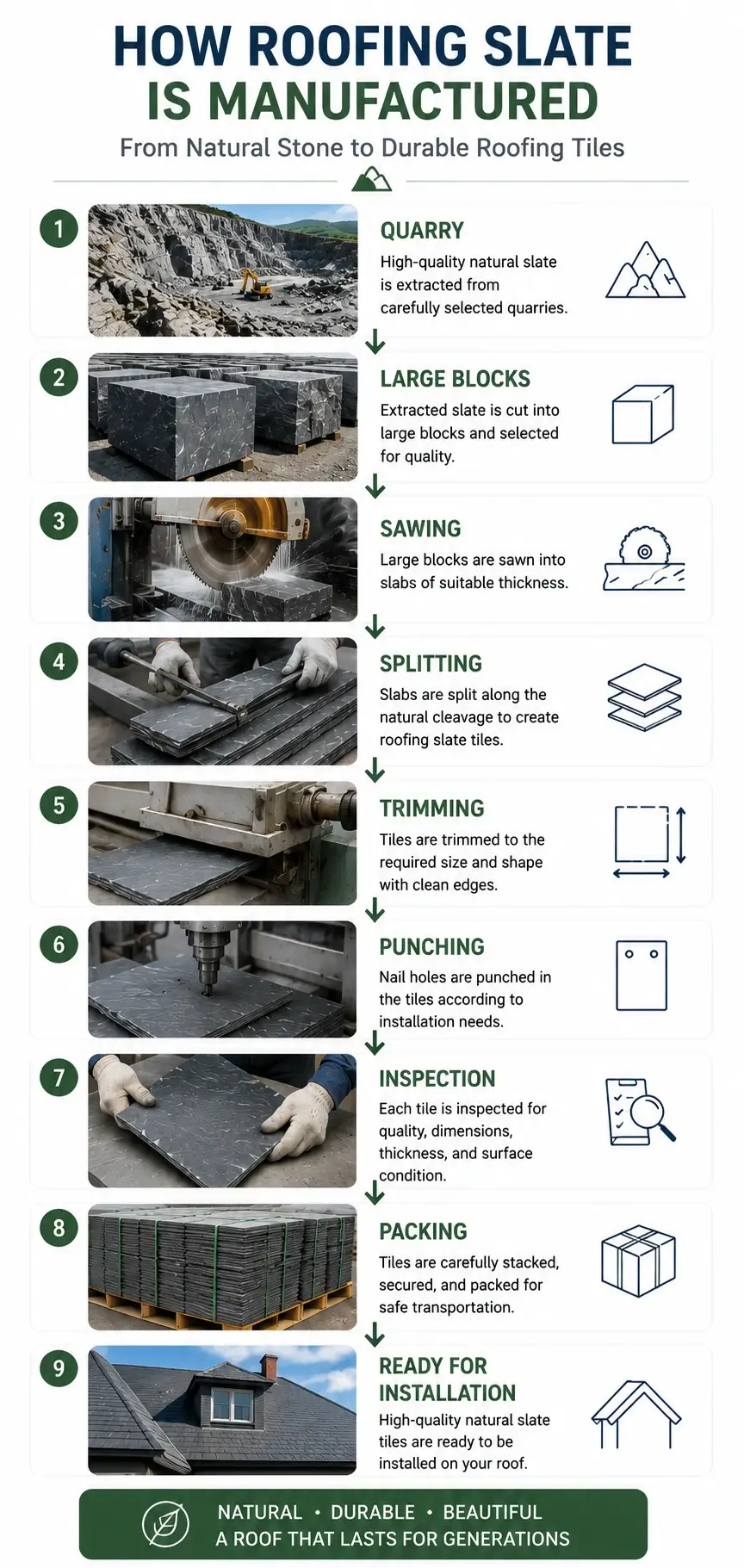
Unlike concrete tiles or synthetic roofing products, natural roofing slate is not manufactured from artificial ingredients. Every roofing slate begins as solid natural stone extracted from carefully selected slate quarries. Through a combination of skilled craftsmanship and precision processing, each block of slate is transformed into durable roofing tiles while preserving its natural strength and beauty.
The manufacturing process is designed to maintain the stone’s natural structure rather than alter it. This is one of the key reasons why natural roofing slate offers exceptional durability, low water absorption, and a service life of over 100 years.
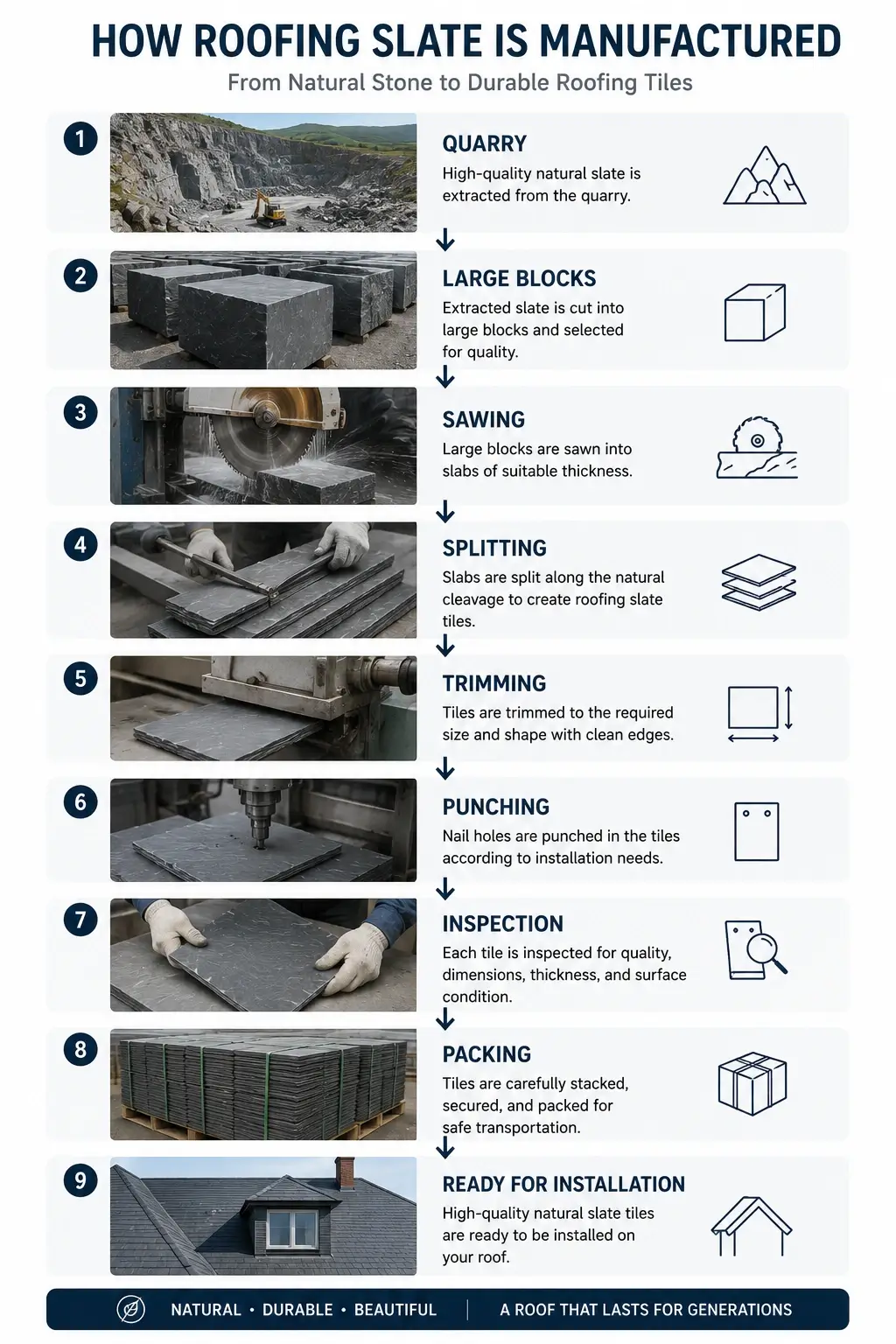
The Roofing Slate Manufacturing Process
The production of high-quality roofing slate involves several carefully controlled steps.
1. Quarrying
Large blocks of natural slate are extracted from the quarry using controlled cutting and splitting methods. Only sound, high-quality stone with consistent geological characteristics is selected for roofing applications.
2. Large Block Selection
The extracted blocks are inspected and sorted according to quality, size, and natural cleavage. Inferior material is removed before further processing begins.
3. Sawing
Large slate blocks are cut into manageable slabs using precision stone-cutting equipment. This step prepares the stone for accurate splitting while minimizing waste.
4. Splitting
This is the most important stage.
Using the slate’s natural cleavage, experienced workers or specialized machines split the slabs into thin roofing pieces without damaging the stone’s internal structure.
Unlike factory-made roofing products, every slate tile retains its natural texture and layered appearance.
5. Trimming
Each slate is trimmed to the required dimensions and shape, ensuring consistent size and clean edges for easier roof installation.
6. Punching
One or two nail holes are punched according to the roofing system and installation requirements. Accurate hole positioning ensures secure fixing and proper overlap during installation.
7. Inspection
Every roofing slate is visually inspected for thickness, dimensions, flatness, surface quality, edge condition, and natural defects before packing.
8. Packing
Finished roofing slates are carefully stacked, palletized, and securely packed to protect the stone during transportation and international shipping.
Why Manufacturing Matters
Although roofing slate is a natural product, the manufacturing process has a significant influence on its final quality.
Accurate splitting preserves the stone’s natural strength, while precise trimming and punching ensure faster installation and a better finished roof. Careful inspection also helps maintain consistent quality throughout every shipment.
For architects, contractors, distributors, and importers, choosing a manufacturer with strict quality control is just as important as selecting high-quality slate from the quarry.
Did You Know?
Unlike artificial roofing products that are molded or pressed into shape, every natural roofing slate is split along its natural cleavage. This preserves the stone’s original structure and is one of the reasons slate roofs can last for more than a century.
Manufacturer’s Insight
High-quality roofing slate depends on three factors: the geological quality of the quarry, the skill of the splitting process, and strict quality inspection. Even slate from the same quarry can vary in performance if it is not processed correctly. This is why experienced manufacturers place equal importance on raw material selection and precision manufacturing.
Types of Roofing Slate
Although all roofing slate serves the same purpose—providing a durable and weather-resistant roof—it is available in a wide range of materials, origins, and shapes. Each type has its own characteristics, appearance, and applications.
Understanding these differences can help homeowners, architects, contractors, and importers choose the most suitable natural roofing slate for their projects.
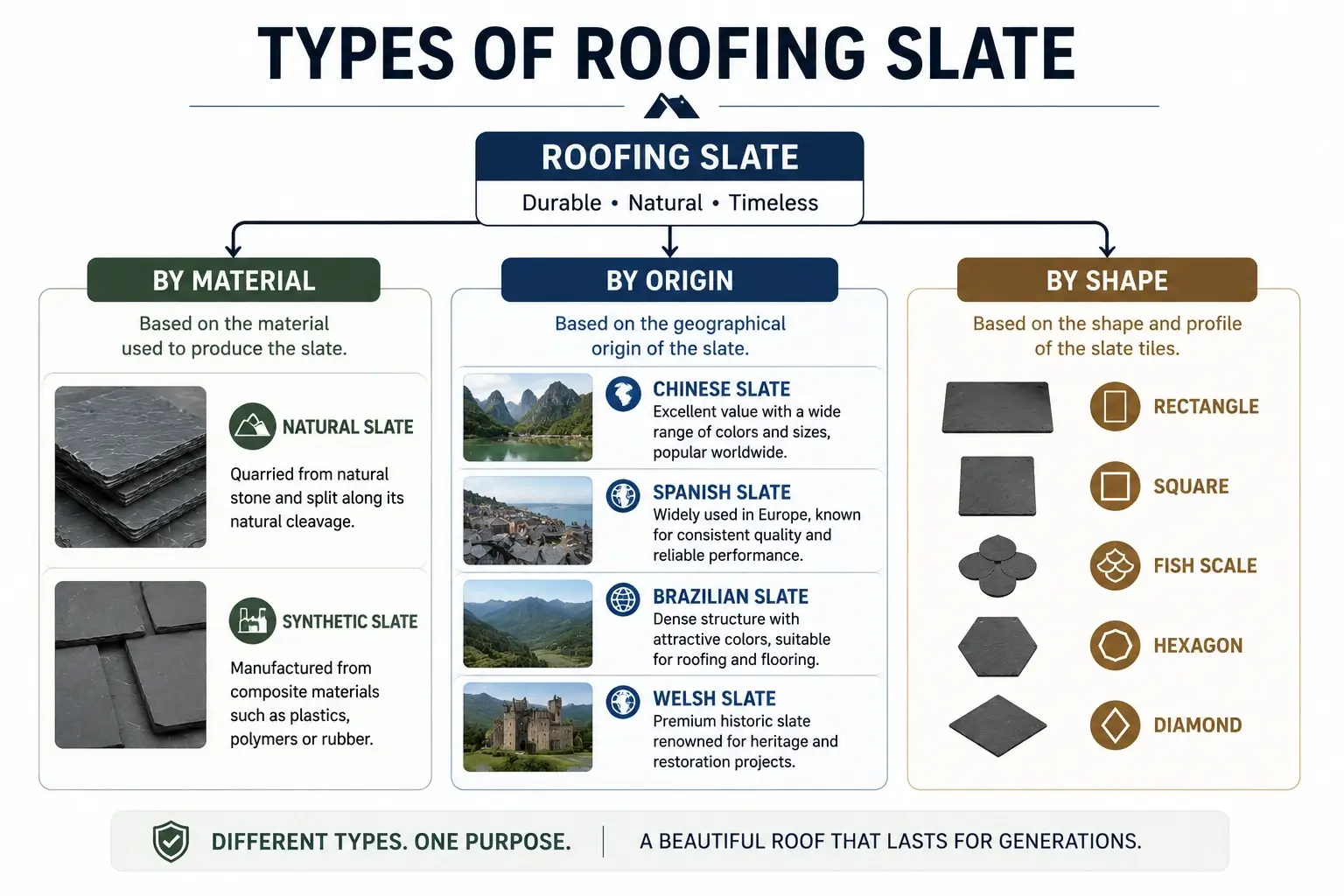
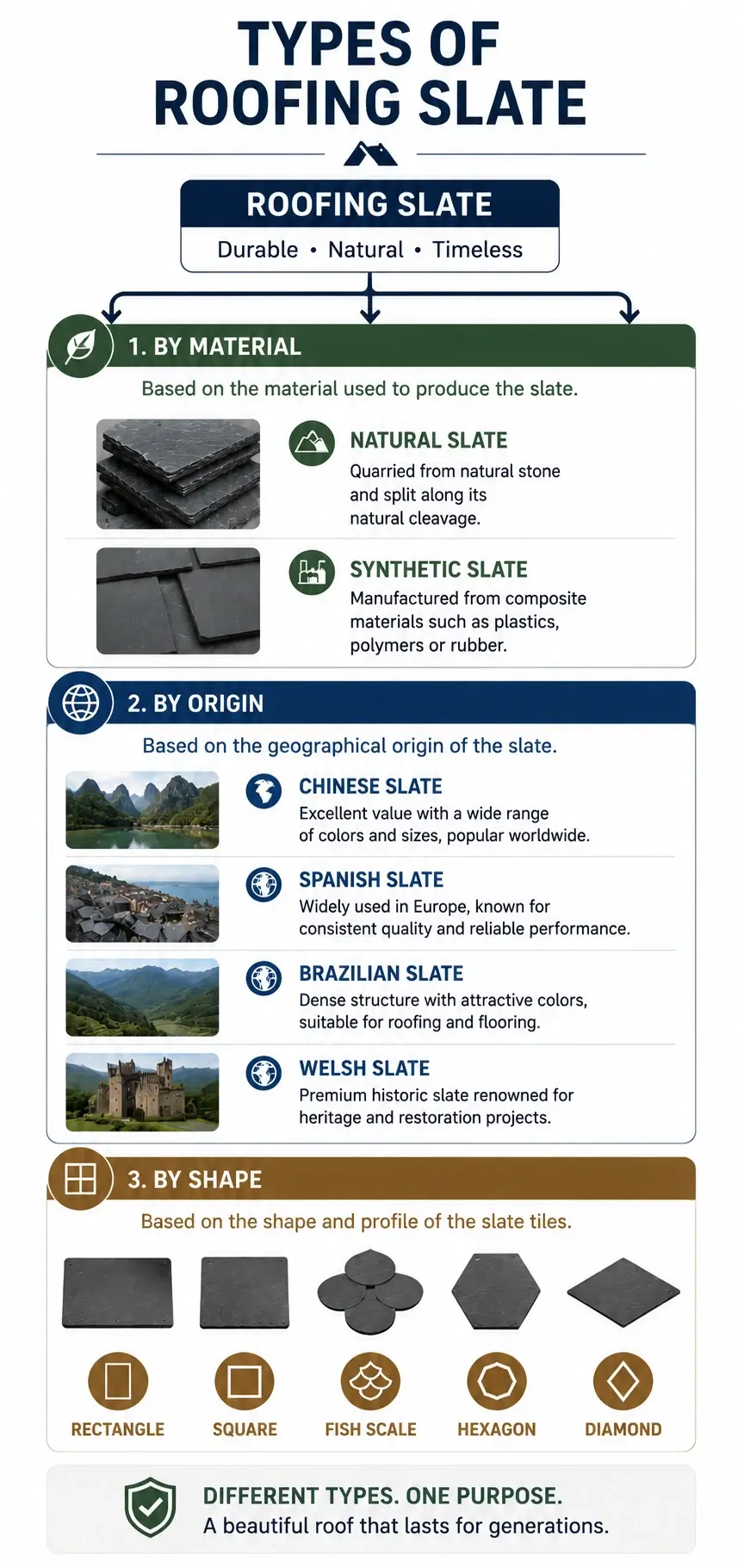
The three most common ways to classify roofing slate are by material, origin, and shape.
1. By Material
The first and most important classification is based on the material used to produce the roofing tile.
Natural Slate
Natural roofing slate is quarried directly from metamorphic rock and split along its natural cleavage. It is valued for its exceptional durability, timeless appearance, low maintenance, and service life of over 100 years.
Best for:
- Luxury homes
- Heritage buildings
- Churches
- Villas
- High-end residential and commercial projects
👉 Learn more: Natural Slate vs Synthetic Slate
Synthetic Slate
Synthetic slate is manufactured from composite materials such as recycled plastics, rubber, or polymers. It is lighter in weight and often less expensive than natural slate, but generally has a shorter lifespan.
Best for:
- Lightweight roof structures
- Budget-conscious projects
- Decorative applications
👉 Learn more: Natural Slate vs Synthetic Slate
2. By Origin
Different slate-producing regions have unique geological conditions, resulting in differences in color, texture, durability, and performance.
Common sources of roofing slate include:
| Origin | Characteristics |
|---|---|
| Chinese Slate | Excellent value, wide range of colors and sizes, popular in international markets. |
| Spanish Slate | Widely used in Europe, known for consistent quality and roofing applications. |
| Brazilian Slate | Dense structure with attractive colors, suitable for roofing and flooring. |
| Welsh Slate | Premium historic slate renowned for heritage and restoration projects. |
👉 Learn more: Roofing Slate by Origin
3. By Shape
Roofing slates are manufactured in a variety of shapes to complement different architectural styles.
Popular shapes include:
- Rectangle
- Square
- Fish Scale
- Hexagon
- Diamond
Each profile creates a distinctive roof appearance while maintaining the durability and weather resistance of natural roofing slate.
👉 Learn more: Roofing Slate Shapes
Quick Comparison
| Category | Common Types |
|---|---|
| By Material | Natural Slate, Synthetic Slate |
| By Origin | Chinese, Spanish, Brazilian, Welsh |
| By Shape | Rectangle, Square, Fish Scale, Hexagon, Diamond |
Expert Tip
When selecting roofing slate, don’t focus on appearance alone. Material quality, geological origin, dimensions, thickness, and installation requirements all influence the long-term performance of a slate roof. Understanding these classifications is the first step toward choosing the right roofing slate for your project.
Why Roofing Slate Is So Popular
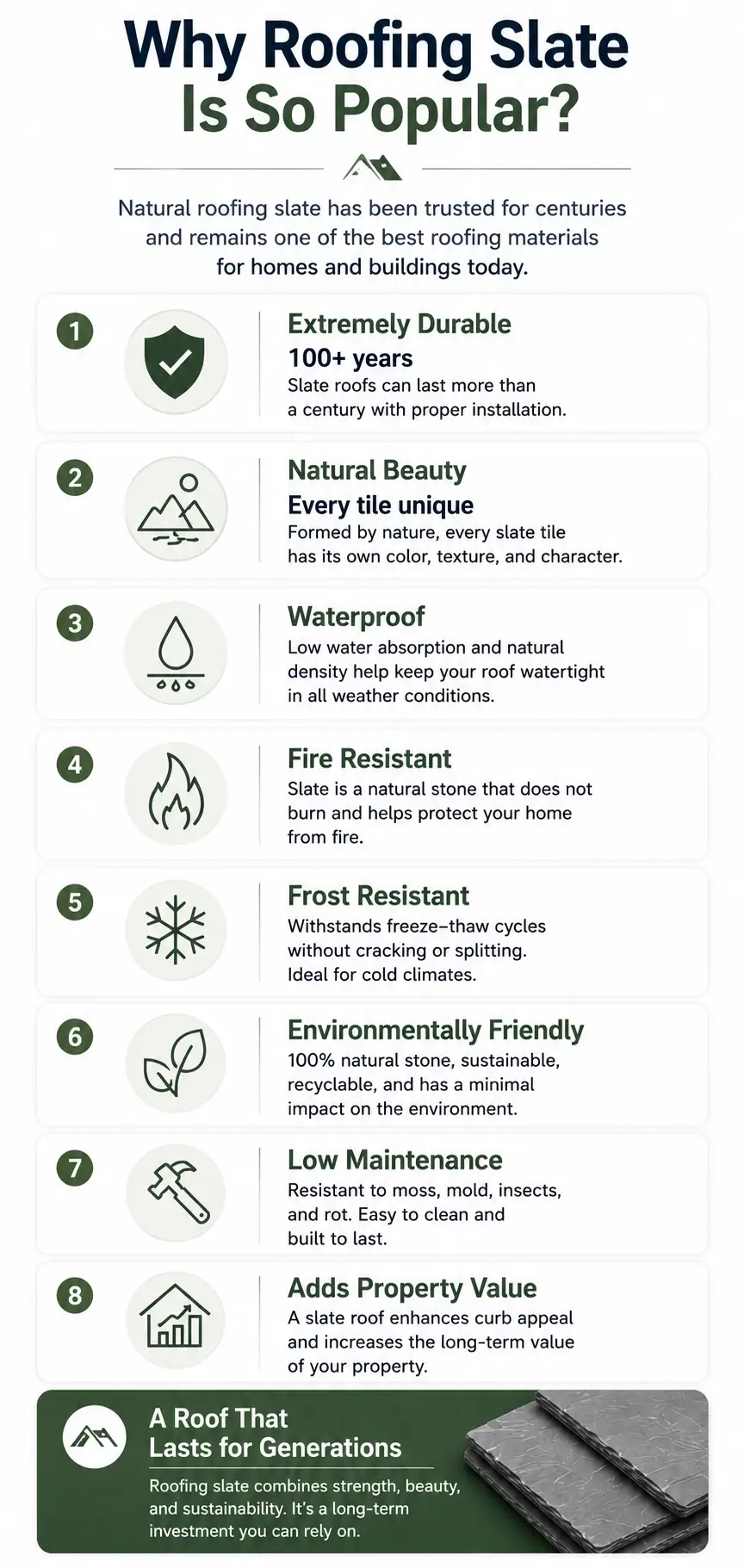
For centuries, natural roofing slate has been the preferred roofing material for castles, churches, historic landmarks, luxury homes, and modern architectural projects around the world. Its popularity is not based on appearance alone—it is the result of exceptional durability, reliable performance, and long-term value.
Unlike many manufactured roofing materials, roofing slate is formed naturally over millions of years. Its dense structure and unique mineral composition make it one of the most durable, weather-resistant, and environmentally friendly roofing solutions available today.
Here are the key reasons why homeowners, architects, contractors, and distributors continue to choose natural roofing slate.
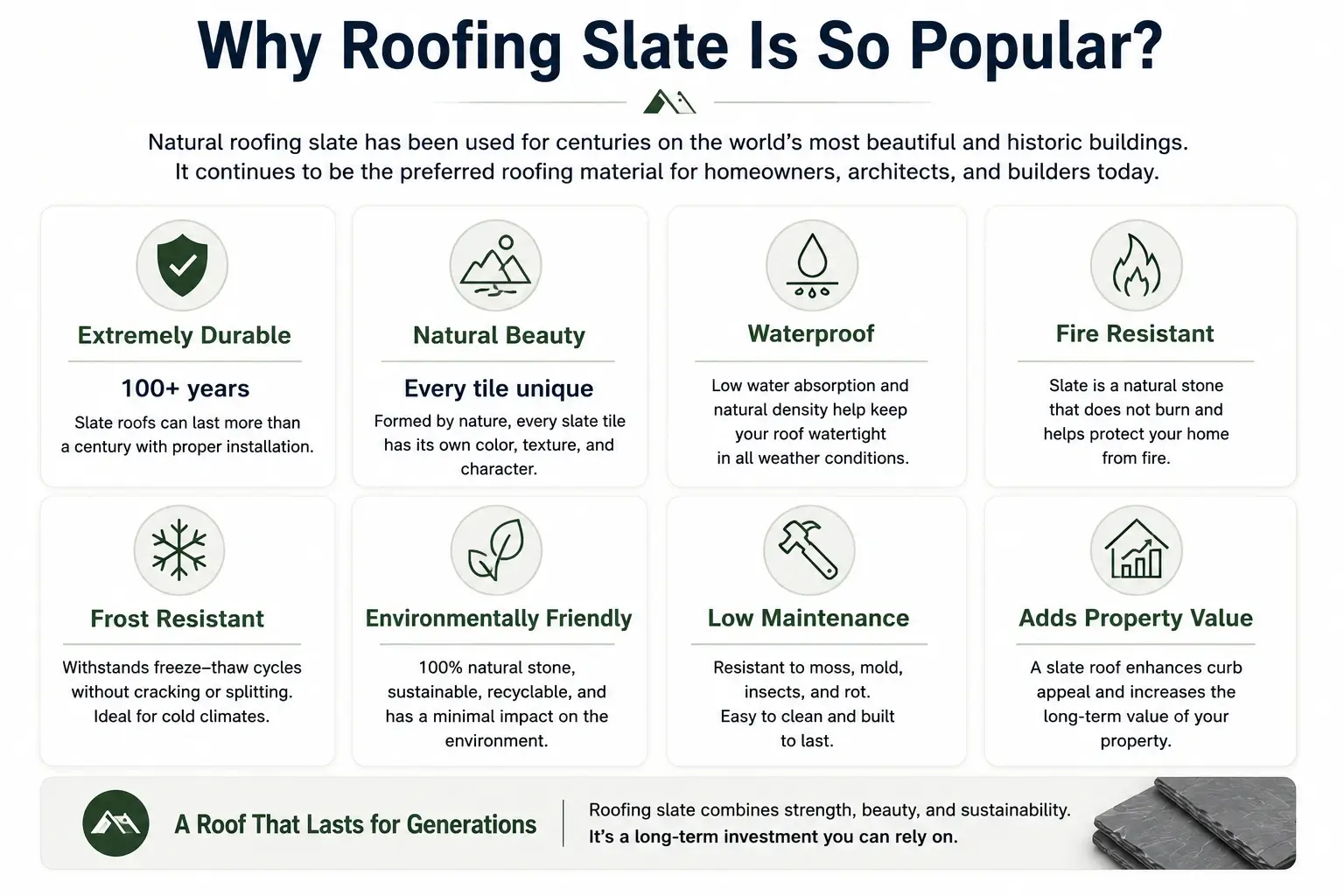
①🛡️Extremely Durable
One of the biggest advantages of roofing slate is its exceptional lifespan. A professionally installed slate roof can last more than 100 years, making it one of the longest-lasting roofing materials available.
Unlike asphalt shingles that may require replacement every 20–30 years, natural slate offers decades of reliable protection with minimal deterioration.
② 🏔️ Natural Beauty
Every piece of natural roofing slate is unique. Because it is created by nature rather than manufactured in a factory, each tile has its own texture, color, and character.
This creates elegant, timeless roofs that complement both traditional and contemporary architecture.
③ 💧 Waterproof
Slate has a dense structure and naturally low water absorption, making it highly resistant to rain and moisture.
When properly installed, overlapping roofing slates create a durable waterproof roof that performs reliably in a wide range of climates.
④ 🔥 Fire Resistant
As a natural stone, roofing slate is non-combustible and provides excellent fire resistance.
Unlike wood shingles or some synthetic materials, slate does not burn or release harmful fumes, making it a safer roofing option.
⑤ ❄️ Frost Resistant
High-quality natural roofing slate withstands repeated freeze–thaw cycles without cracking or delaminating.
Its low water absorption helps prevent frost damage, making it an excellent choice for cold and snowy regions.
⑥ 🌿nvironmentally Friendly
Natural slate is a sustainable building material with minimal processing requirements.
Because it lasts for generations and is completely natural, slate roofing material reduces waste and has a much lower environmental impact than roofing products that require frequent replacement.
⑦ 🔧 Low Maintenance
A properly installed slate roof requires very little maintenance over its lifetime.
It resists rot, insects, mold, and weathering, helping homeowners reduce repair costs while enjoying long-term peace of mind.
⑧ 📈 Adds Property Value
A natural slate roof is widely recognized as a premium roofing system.
Its timeless appearance, outstanding durability, and long service life can enhance curb appeal and increase the long-term value of residential and commercial properties.
Closing Summary
Choosing roofing slate is more than selecting a roofing material—it’s investing in a roof that combines natural beauty, exceptional durability, and lasting performance.
Although the initial investment may be higher than some alternative materials, the long lifespan, low maintenance, and enduring appearance make natural roofing slate one of the most cost-effective roofing solutions over the life of a building.
Expert Tip:
When comparing roofing materials, look beyond the initial purchase price. Consider the total lifetime cost, including maintenance, repairs, and replacement. A high-quality natural slate roof can deliver outstanding long-term value by lasting more than a century with minimal upkeep.
Where Is Roofing Slate Used?
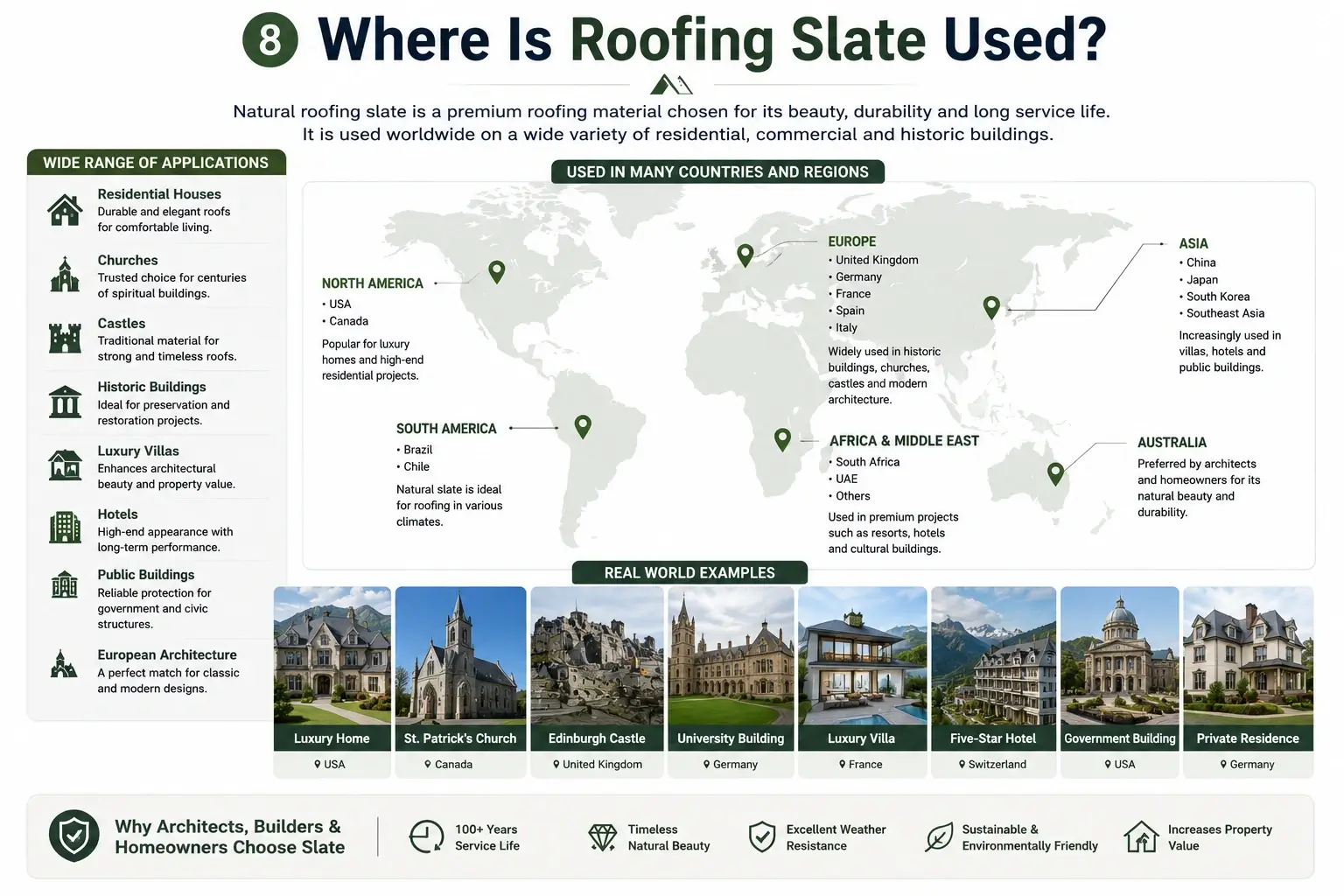
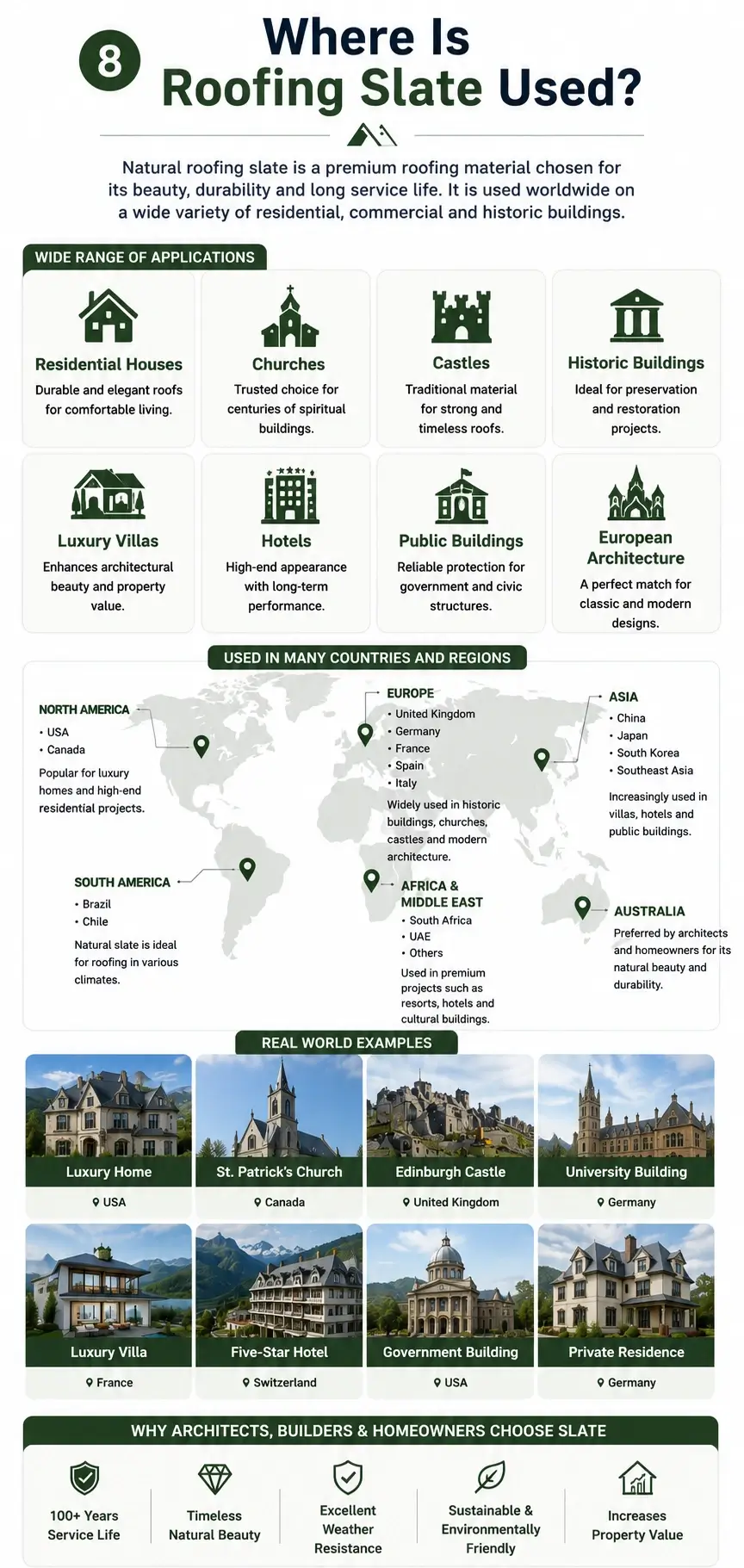
Thanks to its exceptional durability, timeless appearance, and outstanding weather resistance, natural roofing slate has been used on some of the world’s most iconic buildings for centuries. Today, it remains a preferred roofing material for a wide range of residential, commercial, institutional, and heritage projects.
From luxury homes in North America to historic churches in Europe, roofing slate continues to protect buildings while adding lasting beauty and value. Whether the goal is preserving architectural heritage or creating a premium modern design, slate roofing offers a solution that combines performance with elegance.
Common Applications of Roofing Slate
Natural roofing slate is suitable for many different types of buildings, including:
🏡 Residential Houses
Slate roofs are widely used on private homes because of their long lifespan, low maintenance requirements, and classic appearance. Homeowners often choose natural roofing slate as a long-term investment that enhances both protection and curb appeal.
⛪ Churches
Many churches around the world have been protected by slate roofs for well over a century. Slate’s durability, fire resistance, and timeless character make it an ideal roofing material for religious buildings.
🏰 Castles
Historic castles have relied on natural roofing slate for generations. Its strength and weather resistance help preserve these landmark structures while maintaining their authentic architectural appearance.
🏛 Historic Buildings
Because roofing slate closely matches traditional construction materials, it is widely specified for restoration and heritage conservation projects. Many architects select slate to preserve the original character of historic buildings.
🏠 Luxury Villas
Modern luxury villas often feature natural slate roofing to achieve a premium appearance. The unique texture and natural color variations of each slate tile create elegant roofs that stand out from conventional roofing materials.
🏨 Hotels
High-end hotels frequently choose roofing slate because it combines architectural beauty with exceptional durability and low maintenance, helping reduce long-term operating costs.
🏢 Public Buildings
Government buildings, museums, schools, and civic structures often use slate roofing material because of its long service life, fire resistance, and ability to withstand demanding weather conditions.
🏛 European Architecture
Throughout Europe, natural roofing slate has become an iconic roofing material for both traditional and contemporary architecture. It is especially common on churches, universities, public buildings, and historic city centers.
Roofing Slate Around the World
Today, roofing slate is used in a wide range of climates and architectural styles across the globe.
🇺🇸 United States
Natural slate is a popular choice for luxury homes, custom residences, universities, churches, and restoration projects. Many premium properties in the northeastern United States continue to feature traditional slate roofs.
🇨🇦 Canada
Canadian homeowners and architects value roofing slate for its excellent freeze–thaw resistance, making it well suited to harsh winter conditions.
🇬🇧 United Kingdom
The United Kingdom has one of the world’s richest traditions of slate roofing. Historic churches, castles, universities, and heritage buildings have relied on natural slate for centuries.
🇩🇪 Germany
German villas, public buildings, and contemporary homes frequently incorporate natural roofing slate, combining traditional craftsmanship with modern architectural design.
🌍 Many Other Countries
Natural roofing slate is also widely used throughout France, Spain, Belgium, Switzerland, Ireland, Japan, South Korea, Australia, and many other regions where durability, sustainability, and timeless aesthetics are highly valued.
Why Architects Choose Roofing Slate
Architects and designers often specify natural roofing slate because it offers an ideal combination of:
- Timeless architectural beauty
- Exceptional durability
- Outstanding weather resistance
- Sustainable natural material
- Design flexibility
- Long-term value
- Low maintenance
- Premium appearance
These advantages make slate roofing material suitable for both historic restoration and contemporary architectural projects.
Architect’s Insight
Roofing slate is one of the few roofing materials that complements both traditional and modern architecture. Whether used on a centuries-old church or a newly built luxury villa, natural slate delivers the same combination of durability, elegance, and long-term performance.
Learn More About Roofing Slate Applications
- Roofing Slate for Residential Homes
- Roofing Slate for Churches
- Roofing Slate for Historic Buildings
- Roofing Slate for Luxury Villas
- Roofing Slate for Hotels
- Roofing Slate for Public Buildings
- Roofing Slate in European Architecture
- Roofing Slate Around the World
How Long Does Roofing Slate Last?
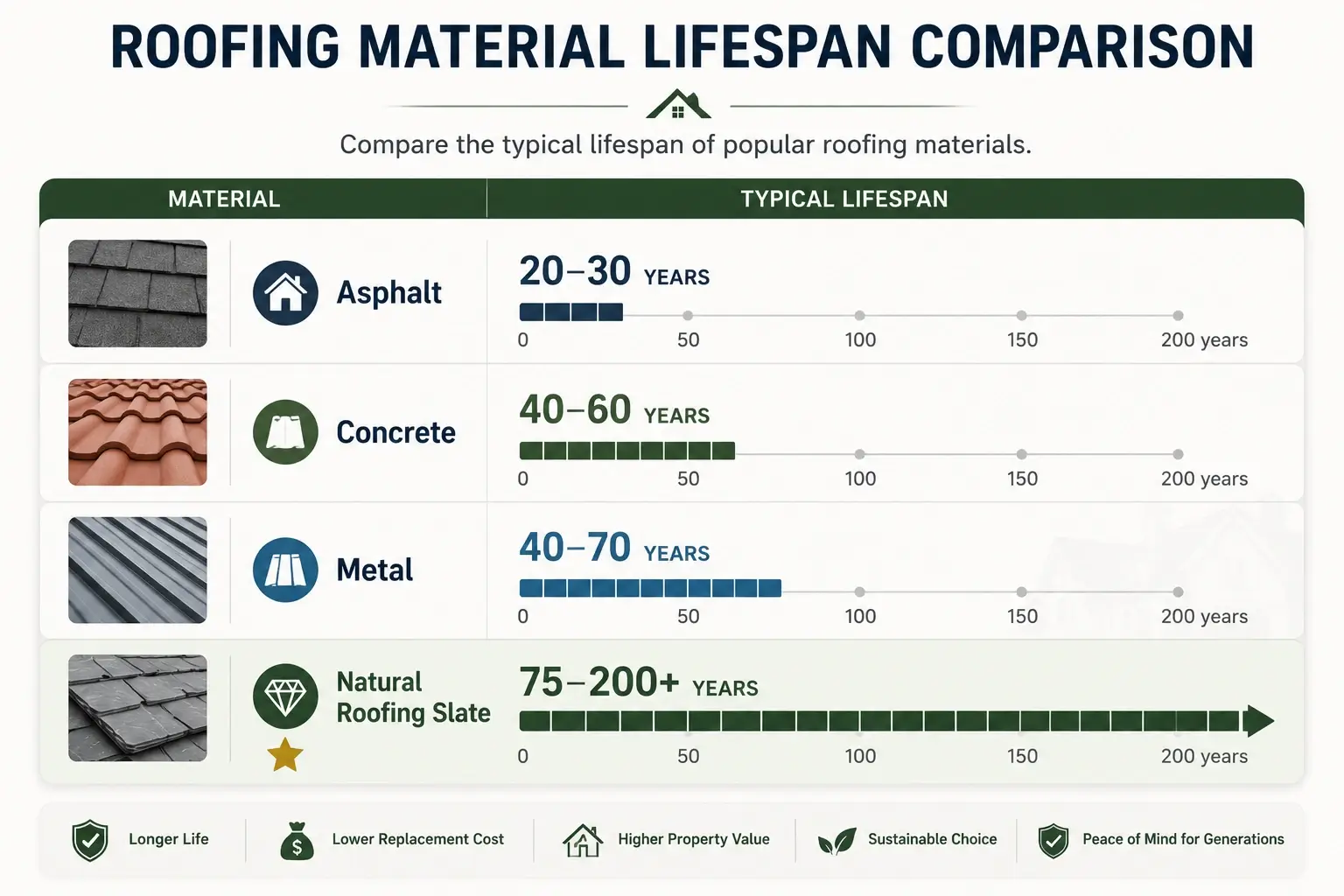
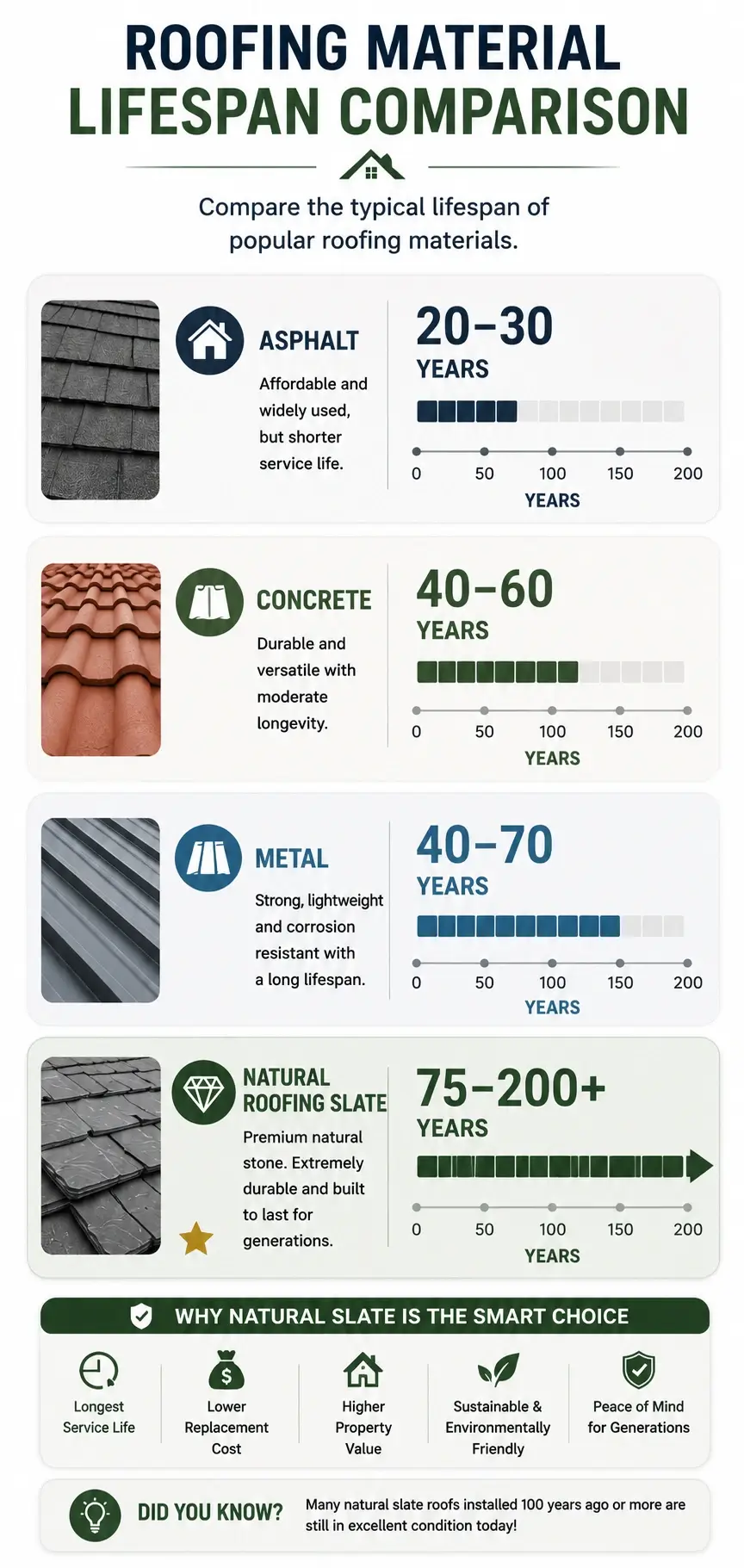
One of the biggest advantages of natural roofing slate is its extraordinary lifespan. Unlike many roofing materials that require replacement every few decades, a properly selected and professionally installed slate roof can protect a building for 75 to more than 200 years.
In fact, many historic churches, castles, universities, and public buildings throughout Europe still retain their original slate roofs after more than a century of service. This exceptional longevity is one of the main reasons why roofing slate is considered a premium, long-term roofing investment.
Typical Lifespan of Roofing Slate
Although the lifespan varies depending on slate quality, climate, installation, and maintenance, the following ranges are generally accepted:
| Roofing Material | Typical Lifespan |
|---|---|
| Asphalt Shingles | 20–30 years |
| Concrete Roof Tiles | 40–60 years |
| Metal Roofing | 40–70 years |
| Natural Roofing Slate | 75–200+ years |
Natural roofing slate consistently offers the longest service life of all commonly used roofing materials.
Why Does Roofing Slate Last So Long?
The remarkable durability of roofing slate is no coincidence. It results from the unique properties of natural metamorphic stone.
Several factors contribute to its exceptional lifespan:
- Dense natural structure with very low water absorption
- High resistance to freeze–thaw cycles
- Excellent weather resistance
- Non-combustible and fire resistant
- Resistant to rot, insects, and corrosion
- Individual slate tiles can be replaced without removing the entire roof
Together, these characteristics enable a slate roof to maintain its strength and appearance for generations.
What Affects the Lifespan of a Slate Roof?
Even the highest-quality natural roofing slate performs best when combined with proper installation and maintenance.
The most important factors include:
- Quality of the slate itself
- Correct roof design and slope
- Professional installation
- Suitable fixing system (nails or hooks)
- Local climate and environmental conditions
- Periodic roof inspection and maintenance
A premium slate installed correctly can often outlast the building beneath it.
Is Roofing Slate Worth the Investment?
Although natural roofing slate has a higher initial cost than many alternative roofing materials, its exceptional lifespan often makes it the most economical choice over the long term.
Instead of replacing an asphalt roof three or four times during the life of a building, a single slate roof may continue protecting the property for more than a century.
For homeowners, architects, and property developers, this means:
- Lower lifetime replacement costs
- Reduced maintenance expenses
- Higher property value
- Greater sustainability
- Long-term peace of mind
Expert Tip:
The lifespan of a slate roof depends not only on the stone itself but also on proper installation. Even the highest-quality natural roofing slate should be installed with the correct overlap, fixing method, and ventilation to achieve its full service life.
Did You Know?
Some natural slate roofs installed in Europe during the 18th and 19th centuries are still in service today. With high-quality slate, proper installation, and regular maintenance, a slate roof can often last longer than the building it protects.
Is Roofing Slate Better Than Other Roofing Materials?
Choosing the right roofing material is one of the most important decisions for any building project. While natural roofing slate is widely regarded as one of the most durable and attractive roofing materials available, every roofing system has its own advantages depending on budget, climate, architectural style, and maintenance requirements.
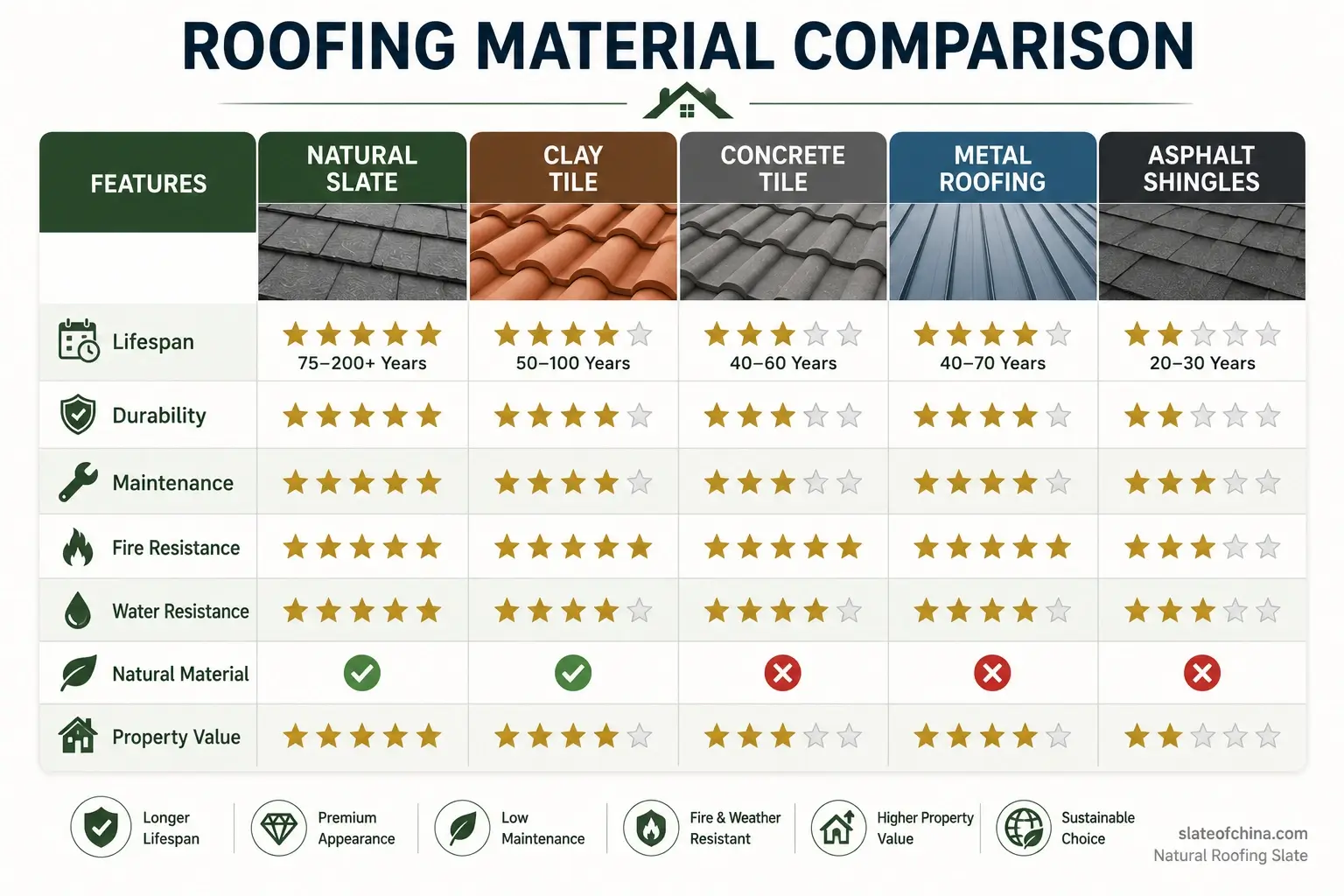
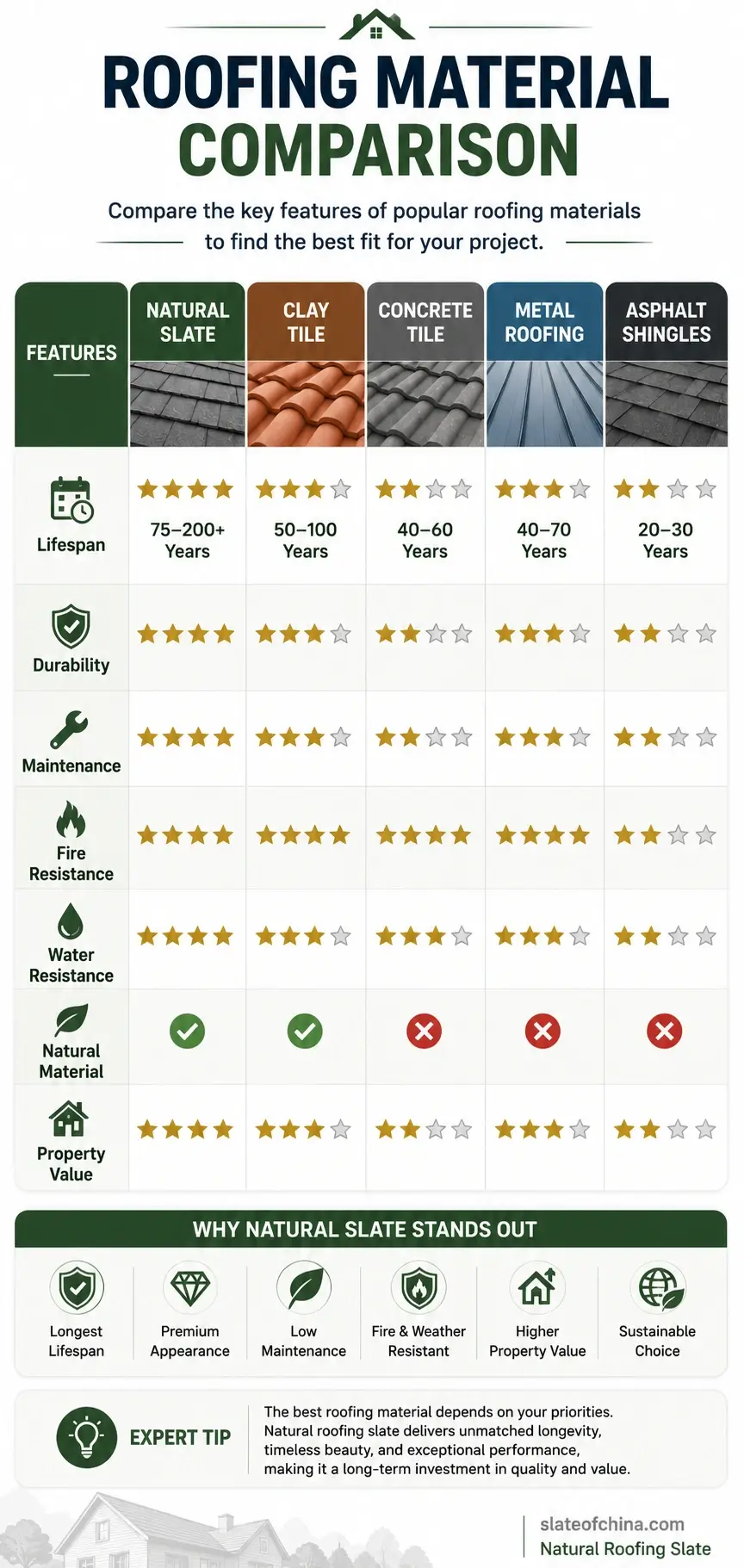
The table below compares roofing slate with several of the most commonly used roofing materials to help you understand their key differences.
Roofing Material Comparison
| Feature | Natural Slate | Clay Tile | Concrete Tile | Metal Roofing | Asphalt Shingles |
|---|---|---|---|---|---|
| Durability | ⭐⭐⭐⭐⭐ | ⭐⭐⭐⭐ | ⭐⭐⭐ | ⭐⭐⭐⭐ | ⭐⭐ |
| Typical Lifespan | 75–200+ Years | 50–100 Years | 40–60 Years | 40–70 Years | 20–30 Years |
| Natural Material | ✅ | ✅ | ❌ | ❌ | ❌ |
| Waterproof Performance | ⭐⭐⭐⭐⭐ | ⭐⭐⭐⭐ | ⭐⭐⭐⭐ | ⭐⭐⭐⭐ | ⭐⭐⭐ |
| Fire Resistance | Excellent | Excellent | Excellent | Excellent | Moderate |
| Frost Resistance | Excellent | Good | Good | Excellent | Moderate |
| Maintenance | Low | Low | Moderate | Low | Moderate |
| Appearance | Premium Natural Stone | Traditional | Modern | Contemporary | Standard |
| Property Value | Very High | High | Medium | High | Medium |
| Sustainability | Excellent | Good | Moderate | Good | Moderate |
Which Roofing Material Is Best?
The answer depends on your priorities.
Choose Natural Roofing Slate if you want:
- The longest possible roof lifespan
- A premium natural appearance
- Exceptional durability
- Minimal maintenance
- Excellent weather resistance
- Higher property value
- A sustainable natural roofing material
Natural roofing slate is often the preferred choice for luxury homes, heritage buildings, churches, public buildings, and high-end architectural projects where long-term performance is more important than the lowest initial cost.
Other Roofing Materials May Be Suitable If:
- Budget is the primary concern
- Lightweight roofing is required
- A modern industrial appearance is preferred
- Local building styles commonly use clay or concrete tiles
Every roofing project has different requirements, and selecting the right material should take into account climate, roof structure, design goals, maintenance expectations, and project budget.
Why Many Architects Still Choose Roofing Slate
Despite the availability of many modern roofing materials, natural roofing slate continues to be specified by architects, designers, and property owners around the world.
Its combination of exceptional longevity, timeless beauty, fire resistance, low water absorption, and sustainable natural composition makes it one of the few roofing materials capable of protecting a building for well over a century while maintaining its original appearance.
For projects where quality and long-term value are the priorities, slate roofing remains one of the industry’s benchmark materials.
Expert Tip:
The best roofing material is not always the cheapest one. When comparing roofing options, consider the total lifetime cost—including installation, maintenance, repairs, replacement frequency, and property value. In many cases, a natural slate roof provides the lowest cost over the entire life of the building despite its higher initial investment.
Learn More
This comparison provides a general overview. To explore each material in greater detail, read our dedicated guides:
- Natural Slate vs Synthetic Slate
- Roofing Slate vs Clay Tiles
- Roofing Slate vs Concrete Tiles
- Roofing Slate vs Metal Roofing
- Roofing Slate vs Asphalt Shingles
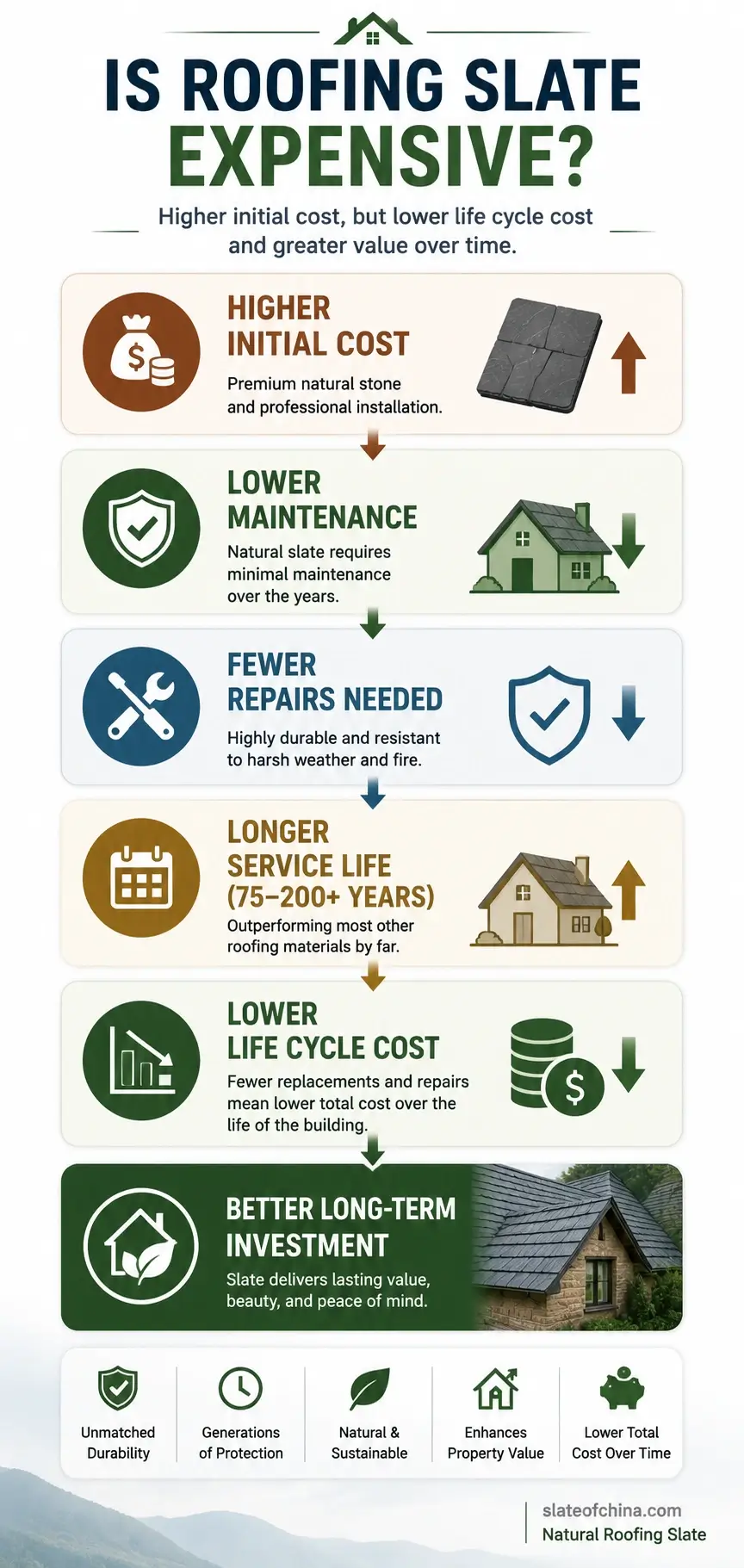
Is Roofing Slate Expensive?
Many homeowners and project owners ask the same question before choosing natural roofing slate:
Is roofing slate expensive?
The answer is yes—but only if you look at the initial purchase price.
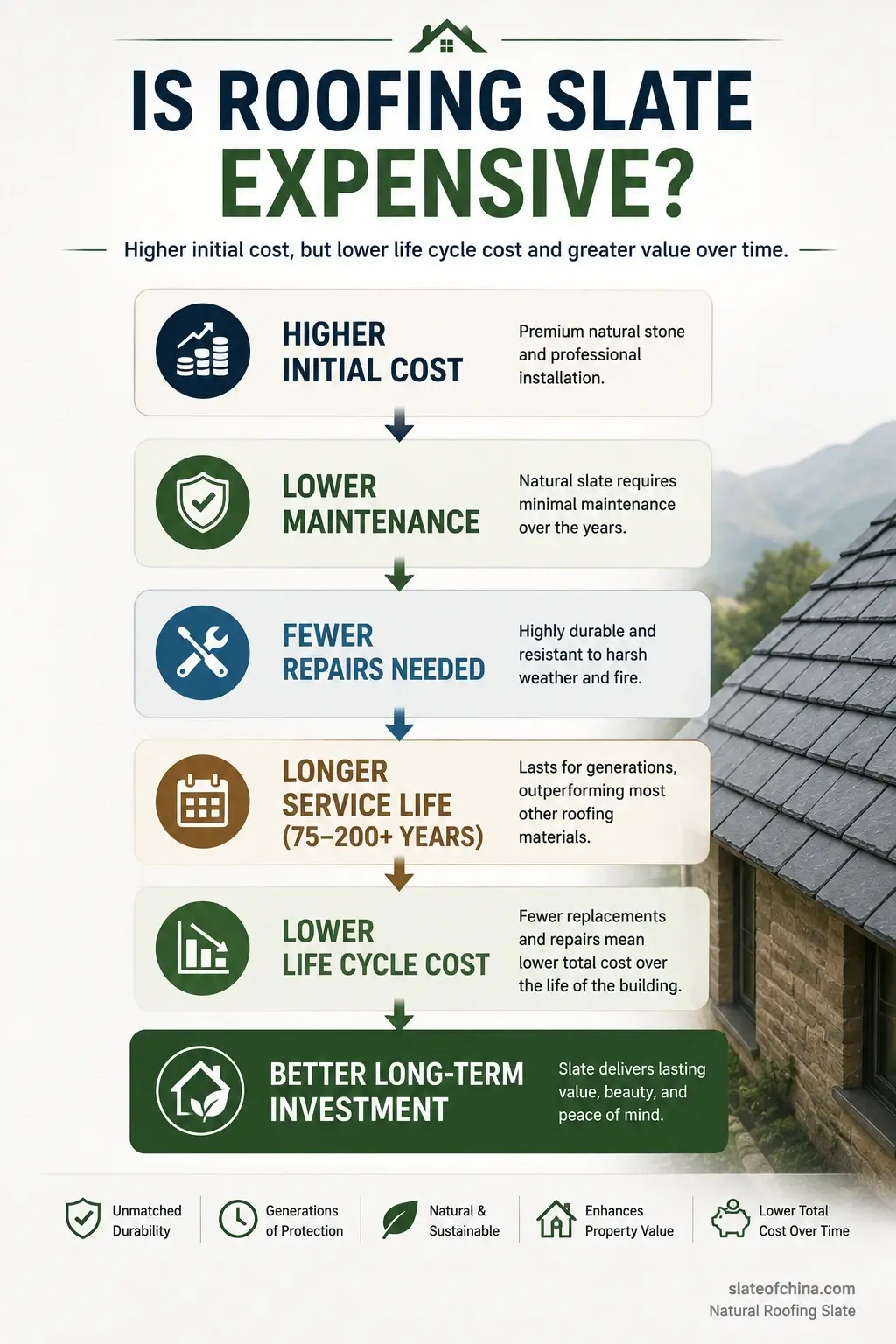
When you consider the complete life cycle cost, including maintenance, repairs, replacement, and service life, roofing slate often proves to be one of the most economical roofing materials over the lifetime of a building.
Initial Cost vs Lifetime Value
Compared with asphalt shingles, concrete tiles, or some metal roofing systems, natural roofing slate generally has a higher upfront cost.
This higher initial investment reflects:
- Premium natural stone
- Long manufacturing process
- Professional installation
- Exceptional durability
- Long service life
However, the purchase price is only one part of the total cost of owning a roof.
Understanding Life Cycle Cost
Instead of focusing only on installation cost, architects and building owners often evaluate roofing materials using Life Cycle Cost (LCC).
Life Cycle Cost includes:
- Initial material cost
- Installation cost
- Maintenance expenses
- Repair costs
- Replacement frequency
- Expected service life
A roofing material with a higher purchase price can still offer the lowest total cost if it lasts significantly longer and requires fewer repairs.
Simple Comparison
| Cost Factor | Asphalt Roof | Natural Roofing Slate |
|---|---|---|
| Initial Cost | Lower | Higher |
| Maintenance | Moderate | Low |
| Repairs | More Frequent | Less Frequent |
| Replacement | Every 20–30 Years | 75–200+ Years |
| Life Cycle Cost | Higher | Lower |
Although roofing slate requires a larger initial investment, its exceptional durability and long lifespan often result in lower ownership costs over several decades.
Why Roofing Slate Can Save Money
A natural slate roof may remain in service for more than 100 years.
During the same period, an asphalt roof may need to be replaced three or four times.
Each replacement includes:
- New roofing materials
- Labor costs
- Waste disposal
- Construction disruption
By avoiding repeated replacements, roofing slate can provide substantial long-term savings while maintaining its premium appearance throughout its service life.
Who Benefits Most from Slate Roofing?
Natural roofing slate is an excellent investment for:
- Luxury homes
- Historic restoration projects
- Churches
- Public buildings
- Hotels
- Long-term property owners
- High-value residential developments
For these projects, long service life and reduced maintenance often outweigh the higher initial installation cost.
Expert Tip:
Don’t compare roofing materials based only on today’s installation price. Compare the total cost over the next 50 to 100 years. In many cases, a natural slate roof becomes the more economical choice because it requires fewer repairs and significantly fewer replacements.
Conclusion
If your priority is the lowest upfront cost, roofing slate may not be the best option.
However, if you are looking for long-term value, exceptional durability, minimal maintenance, and a roof that can last for generations, natural roofing slate is one of the smartest investments available.
Learn More
Continue exploring our roofing slate guides:
- Roofing Slate Cost
- Roofing Slate Installation Cost
- Roofing Slate Maintenance
- Roofing Slate Lifespan
- Roofing Slate vs Asphalt Shingles
- Is Roofing Slate Worth It?
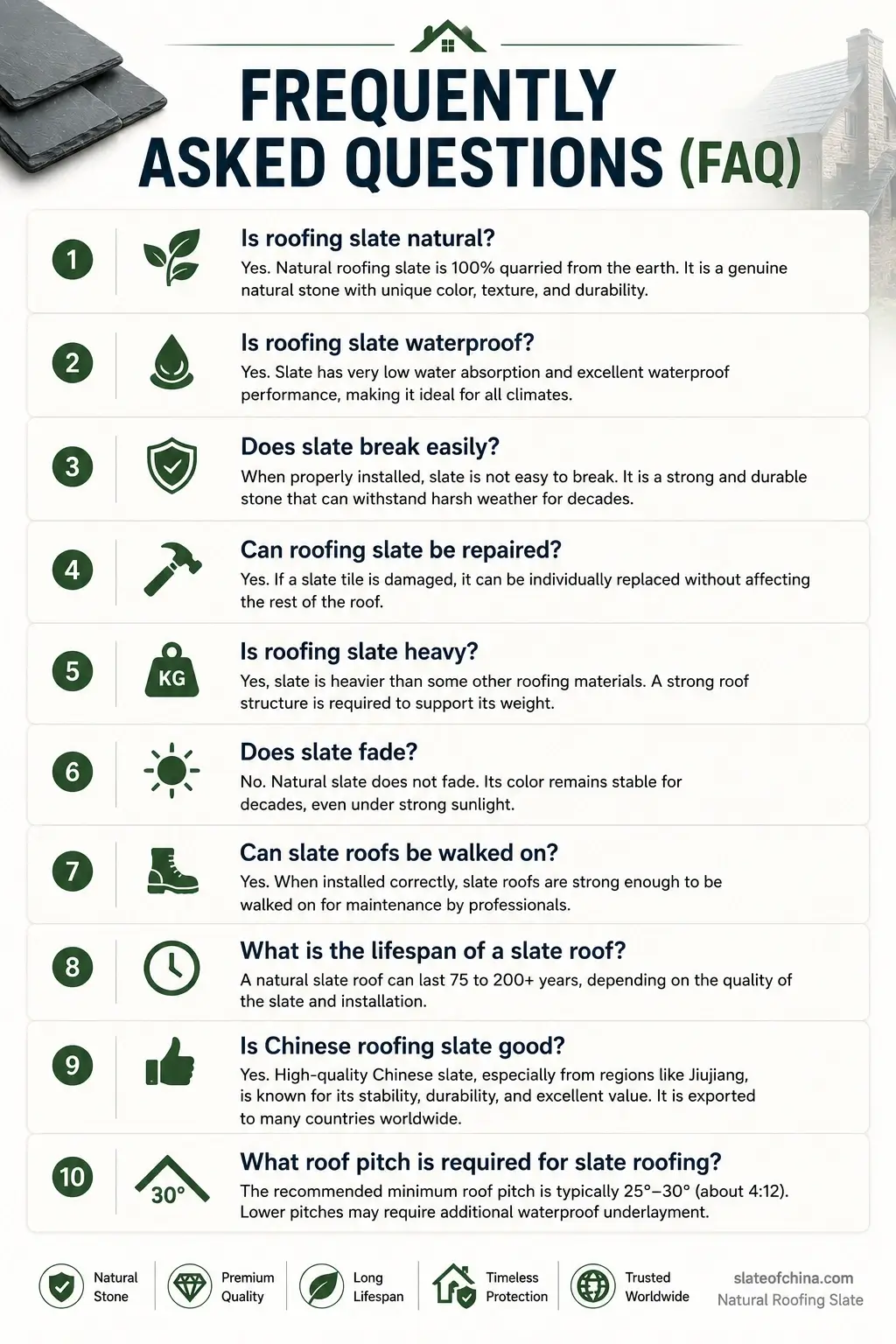
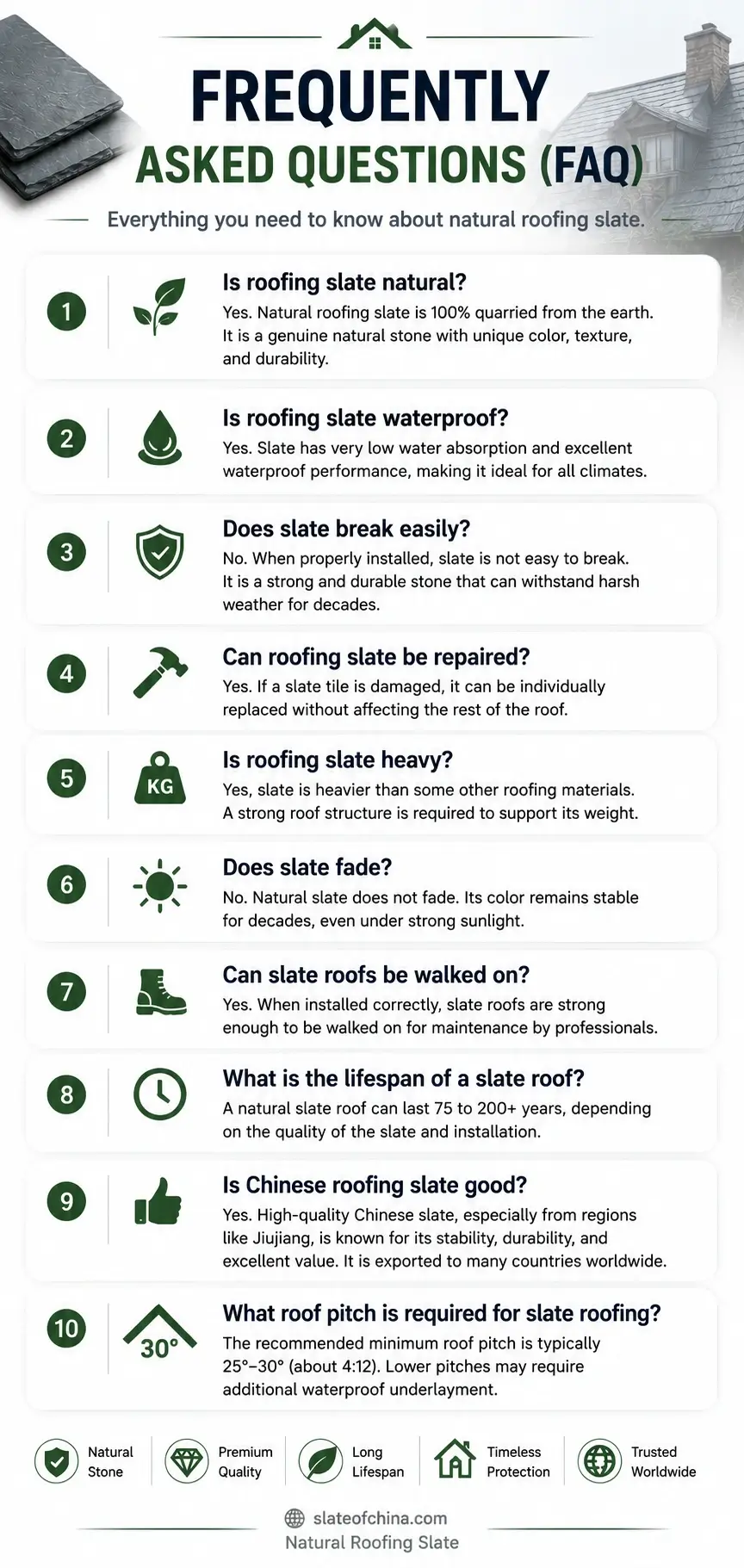
Frequently Asked Questions About Roofing Slate
If you’re considering natural roofing slate for your next roofing project, you may have some common questions. Below are answers to the questions we hear most often from homeowners, architects, contractors, and distributors.
Still Have Questions?
Every roofing project is different. Factors such as roof pitch, climate, slate size, installation method, and local building codes can all influence the best roofing solution.
If you have questions about selecting the right natural roofing slate for your project, feel free to contact our team. We’re happy to provide technical advice, product recommendations, and export support based on your specific requirements.
Need Help Choosing Roofing Slate?
Whether you’re a homeowner, architect, contractor, or distributor, our roofing slate specialists can help you select the right slate for your project.
Related Beginner Guides
If you’re just getting started with natural roofing slate, the guides below will help you build a solid understanding of the material before choosing, specifying, or installing a slate roof.
Each guide explores one topic in greater detail, covering everything from how roofing slate is formed to its sizes, colors, thickness, installation methods, and long-term performance. Together, these articles form a complete Roofing Slate Beginner Guide designed for homeowners, architects, contractors, distributors, and importers.
Beginner Guide Series
📖 What Is Roofing Slate?
Learn what roofing slate is, how it is formed, and why it has been used for centuries as one of the world’s most durable natural roofing materials.
🏔 How Roofing Slate Is Made
Explore the complete journey from quarrying natural slate to splitting, trimming, punching, inspection, and packing finished roofing slates.
📏 Roofing Slate Sizes
Discover the standard dimensions, regional formats, and how different slate sizes influence roof appearance, installation, and material consumption.
📐 Roofing Slate Thickness
Understand common slate thicknesses, grading systems, and how thickness affects strength, weight, durability, and roof performance.
🎨 Roofing Slate Colors
Learn about the natural colors of roofing slate, what causes color variations, and how to choose the right slate color for your project.
⭐ Roofing Slate Grades
Compare commercial grades, quality classifications, and inspection standards used to evaluate natural roofing slate.
🔨 Roofing Slate Installation
Learn the basic principles of slate roof installation, including roof pitch, overlap, fixing methods, and best installation practices.
⚖ Roofing Slate Weight
Understand how much natural roofing slate weighs, how roof weight is calculated, and why structural support is important.
⏳ Roofing Slate Lifespan
Discover why high-quality slate roofs can last 75 to more than 200 years and what factors influence their service life.
⚔ Natural Slate vs Synthetic Slate
Compare natural roofing slate with synthetic slate in terms of appearance, durability, maintenance, lifespan, sustainability, and overall value.
Continue Learning
These beginner guides are the foundation of our complete Roofing Slate Knowledge Center.
As you continue learning, you can also explore our advanced guides covering:
- Roofing Slate Buying Guide
- Roofing Slate Installation Guide
- Roofing Slate Maintenance Guide
- Roofing Slate Comparison Guide
- Roofing Slate Technical Guide
- Roofing Slate Design Guide
Whether you’re planning a new roof, restoring a historic building, or sourcing roofing slate for international projects, these guides will help you make informed decisions with confidence.
Expert Tip:
Roofing slate is a long-term investment. Understanding its properties, installation requirements, and quality standards before purchasing can help you select the right slate for your project and avoid costly mistakes.
| Guide | Status |
|---|---|
| ✅ What Is Roofing Slate? | You’re Here |
| ➜ How Roofing Slate Is Made | Read Guide |
| ➜ Roofing Slate Sizes | Read Guide |
| ➜ Roofing Slate Thickness | Read Guide |
| ➜ Roofing Slate Colors | Read Guide |
| ➜ Roofing Slate Grades | Read Guide |
| ➜ Roofing Slate Installation | Read Guide |
| ➜ Roofing Slate Weight | Read Guide |
| ➜ Roofing Slate Lifespan | Read Guide |
| ➜ Natural Slate vs Synthetic Slate | Read Guide |
Reviewed by
Slate of China Technical Team
20+ Years of Natural Slate Manufacturing
Updated:
July 2026