
Roofing Slate FAQ: The 20 Questions Every Buyer, Builder and Homeowner Asks
The five questions that start every phone call and email — answered in one line each:
- Cost — Material £15–45/m², installed £80–150/m². More upfront than concrete, less over 75 years. Full cost guide →
- Lifespan — 75–150 years for S1/A1/T1 grade. The slate outlives the nails, battens and flashing. Lifespan guide →
- Weight — 19–24 kg/m² for 7–9mm slate. Lighter than concrete tiles (35–70 kg/m²). Weight guide →
- Colours — Black, grey, green, purple, multicolour. Natural mineral colour, not dye. Colour guide →
- Walking on slate — Yes, but carefully. Soft boots, step on the lower third, never when wet. Walking guide →
Twenty years on the enquiry desk. The phone rings, the emails come in, and after a while you notice something: nobody asks a new question. They ask the same twenty questions in a thousand different voices. A homeowner in Devon wants to know if slate is too heavy for her cottage. An architect in Manchester needs the grade spec for a planning submission. An importer in Rotterdam is trying to work out how many square metres fit in a container. The words change, the accents change, the currency changes — the questions don't.
I've kept a log for twenty years. Fifteen thousand enquiries, give or take. Cost comes up in eight out of ten first contacts. Lifespan is always the follow-up. Weight is third — people have heard slate is heavy and want to know if their roof will collapse. After that, the questions split by profession: homeowners ask about colours and walking on the roof; architects ask about grades, sizes and pitch; importers ask about documents, timing and samples; everyone asks about maintenance.
This page is the log, distilled. Twenty questions, grouped by who tends to ask them. Each answer is short — two to four sentences — because if you wanted the deep dive, there's a full guide for that. The links take you there.
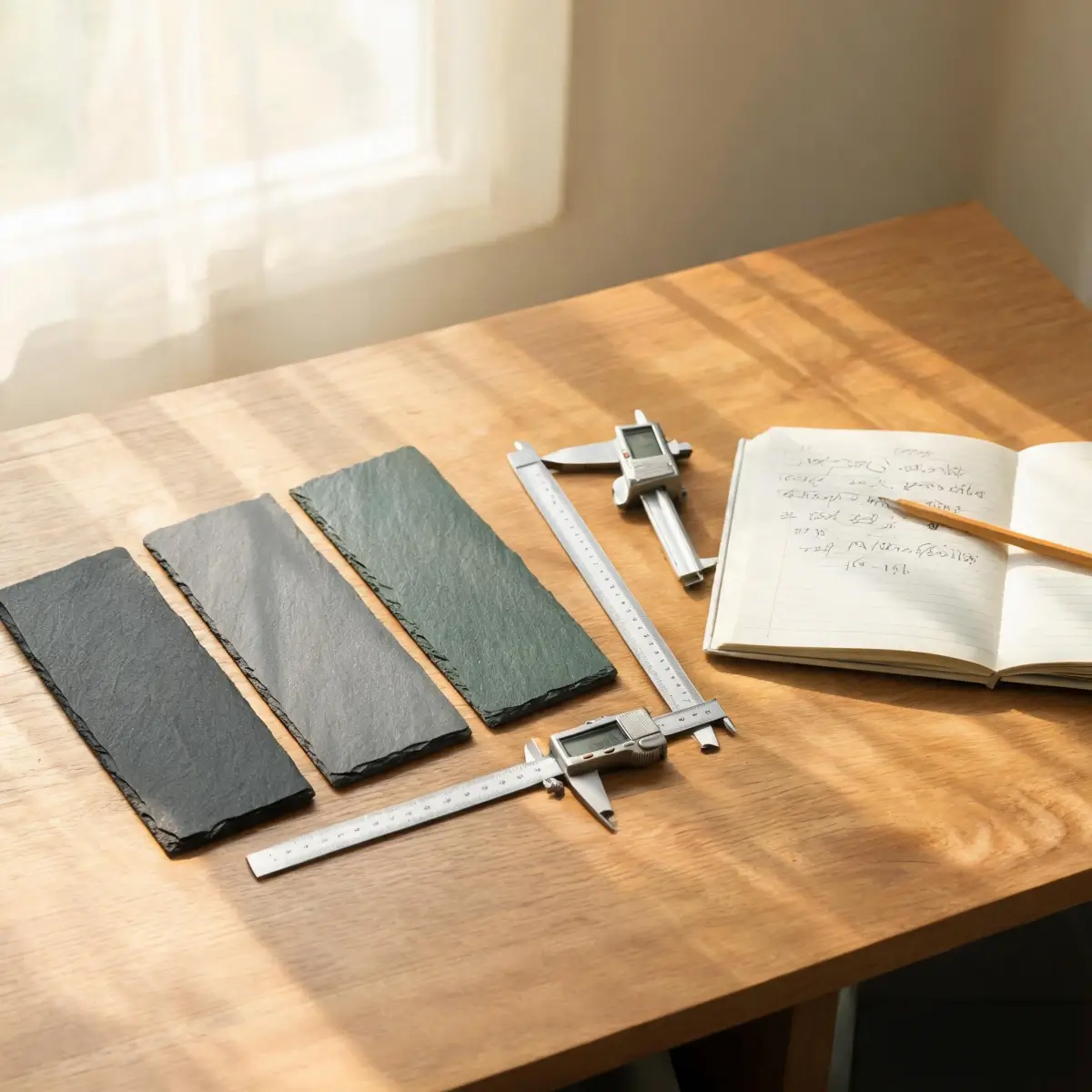
The Five Questions Everyone Asks First
These cut across every profession. Whether you're a homeowner, an architect or a container buyer, these five come up first. I've put them at the top because if you only read one section, read this one.
1. How much does a slate roof cost?
Material alone runs £15–45/m² depending on size, thickness and origin. Installed, expect £80–150/m² in the UK — more for complex roofs, less for straightforward pitches. Slate costs more upfront than concrete tiles or asphalt shingles, but over 75 years it's cheaper because you install it once, not three times. For a full price breakdown including labour, waste and import factors, see the roofing slate cost guide.
2. How long does a natural slate roof last?
75–150 years for quality slate graded S1 (ASTM) or A1/T1 (EN 12326). The stone itself can outlast the building — I've seen 1904 Welsh slate pulled off and sold twice. What usually fails first isn't the slate but the nails, battens or flashing around chimneys and valleys. Buy the right grade and you'll be replacing the building before you replace the roof. The lifespan guide explains what actually determines service life.
3. Is slate too heavy for my house?
Probably not. Standard 7–9mm roofing slate weighs 19–24 kg/m² — which is lighter than concrete tiles at 35–70 kg/m². Most roofs built for concrete tiles can accept slate without reinforcement. But if your roof was built for lightweight felt or asphalt, have a structural surveyor check the joists. The weight guide has the numbers per size and thickness.
4. What colours does roofing slate come in?
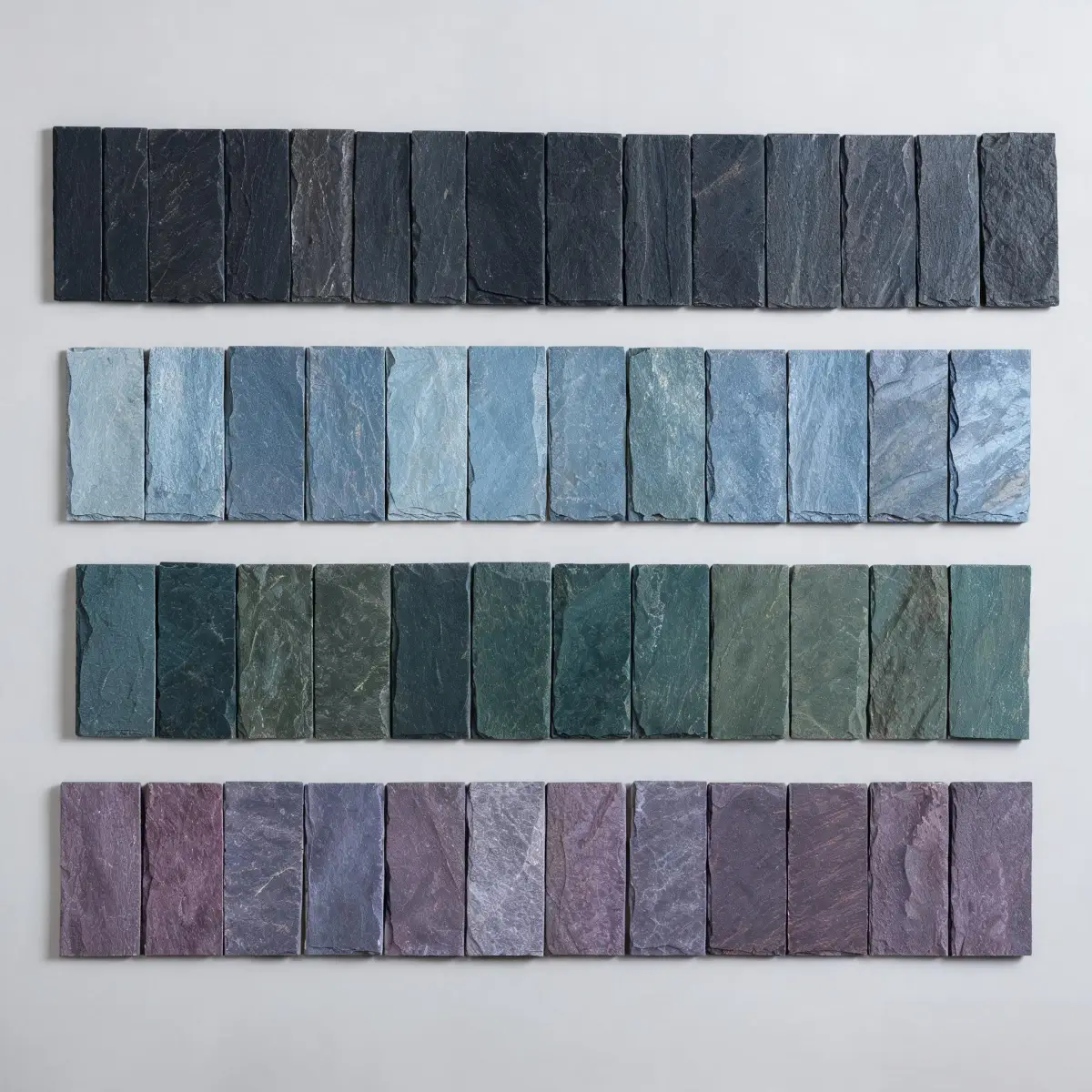
Black, grey, green, purple, red and multicolour — all natural, all from minerals in the rock (carbon, chlorite, hematite, and so on). No dye, no coating. Slight variation between tiles is normal and looks better than uniformity once the roof weathers in. The colour guide shows the full range and how to match colours to your building exterior.
5. Can I walk on a slate roof?
Yes, but carefully. Step on the lower third of the tile — that's where it sits on the batten and has the most support. Wear soft-soled boots, never go up in wet conditions, and use a roof ladder for anything beyond a quick look. A 70 kg person in soft boots won't crack a properly installed slate; a 70 kg person in hard boots on a wet roof almost certainly will. The walking guide covers the safe method in detail.
Choosing and Specifying Slate
Architects and builders ask different questions. They already know slate is stone; they want the specifications. These six come up in nearly every project submission and tender document.
6. What sizes are available for roofing slate?
From 300×200mm up to 600×400mm. The most common in the UK and Europe are 500×250mm and 400×250mm. Larger slates cover more area per tile, look cleaner on modern roofs and are faster to install. Smaller slates suit traditional or heritage buildings. The sizes guide has a full dimension chart with effective coverage and pieces per m².
7. What thickness should I choose?
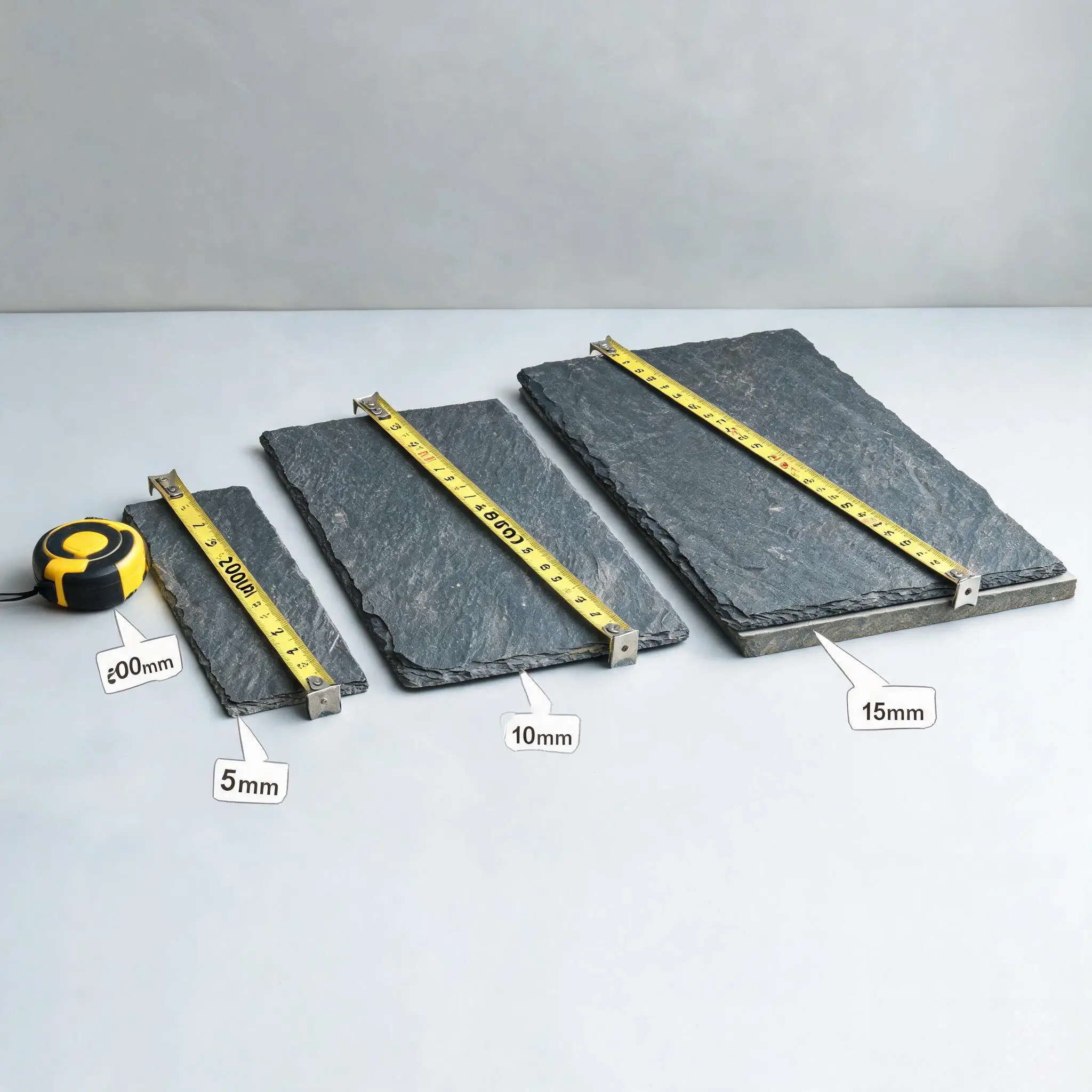
For most UK and European residential projects: 7–9mm. For standard domestic roofs in milder climates: 5–8mm. For high-wind or heavy-snow regions: 9–11mm or thicker. Thicker slate is stronger and more wind-resistant but also heavier and more expensive. The thickness guide explains how thickness interacts with pitch, climate and structural load.
8. What do S1, S2 and T1–T3 grades mean?
Two systems. ASTM C406 (US) grades slate by lifespan: S1 = 75+ years, S2 = 40–75, S3 = 20–40. EN 12326 (Europe) grades by weathering: T1 = no visible change, T2 = oxidising minerals may change colour slightly, T3 = pyrite may rust. Always ask for the test report behind the grade label — a supplier claiming "S1" without a lab certificate is just claiming.
9. What's the minimum roof pitch for slate?
Typically 20° in the UK, 25° in many European codes. Below 20°, you need wider slates, extra headlap and a perfect underlayment. Below 18°, slate is not recommended — water can be driven uphill by wind faster than the lap can stop it. The minimum pitch guide has the full breakdown by pitch, slate size and exposure.
10. Should I use nails or hooks to fix slate?
Both work. Nails (typically copper or stainless steel) are traditional in the UK and cheaper. Hooks (stainless steel) are common in Europe and make single-tile replacement easier — you unhook, swap, rehook without disturbing the tiles above. In high-wind coastal areas, use double nailing or hooks for extra security. The fixing methods guide compares both in detail.

11. How many slates do I need per square metre?
It depends on size and headlap. A 500×250mm slate with 75mm headlap needs about 8–9 tiles/m². A 400×250mm with the same headlap needs about 10–11 tiles/m². Smaller slates, more tiles — that's the trade-off. Use the quantity calculator for an exact number, and always add 5% waste allowance.
Buying, Importing and Shipping
Importers and contractors ask the most practical questions. They've decided on slate; now they need to know how to get it from a quarry in China to a rooftop in Europe. These six come up in nearly every buying conversation.
12. What's the minimum order quantity for roofing slate?
A full 20ft container is the most cost-effective — typically 1,130–1,450 m² for 7–9mm slate. Below that, partial loads (LCL) are possible above roughly 300 m², but LCL costs more per m² due to fixed handling charges and higher breakage risk (4–5% vs 1–3% for full containers). For a first order, request a 30–80 m² trial pallet. The MOQ guide breaks down the economics.
13. How long does an order take to arrive?
Standard sizes: 8–12 weeks from order to arrival at your port. Custom sizes or specific colours: 13–16 weeks. That's production (4–6 weeks), drying (1–2 weeks, longer in rainy season), and ocean shipping (3–5 weeks to northern Europe). Factor in customs clearance: 3–5 days if your documents are clean. The lead times guide has a week-by-week breakdown.
14. How many square metres fit in a 20ft container?
For 7–9mm slate: approximately 1,130–1,450 m². For 6–8mm: 1,270–1,700 m². For 13–15mm thick slates: about 670–780 m². The limit is weight, not volume — a 20ft container has a working load of about 27.5 tonnes, and slate is dense (2.7–2.8 g/cm³). The container capacity guide has the density formula so you can calculate for any thickness.
15. How do I verify quality before the container leaves?
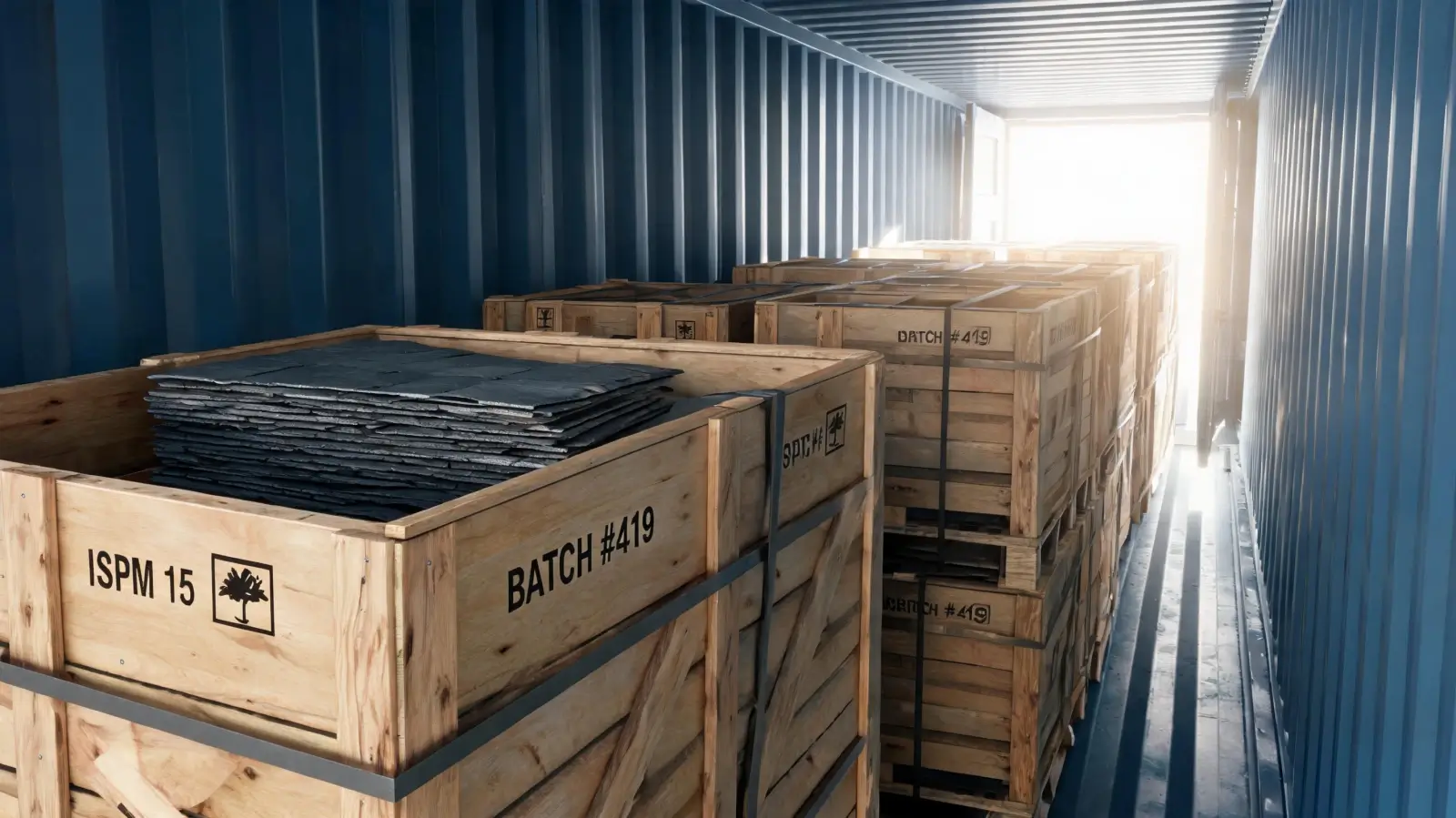
Book a pre-shipment inspection (PSI). The inspector checks: batch numbers on the test report, packing list and crate stencil all match; dimensions within tolerance; ring test (tap each tile — a clear ring means sound, a dull thud means internal cracking); moisture content below 0.5%. Costs a few hundred pounds, saves you from a container full of problems. The PSI checklist covers everything to check.
16. How do I get and approve samples?
Request three physical tiles: one reference sample to keep, one factory copy for the supplier to match against during production, and one to seal in a bag with the date and batch number. Write the specification on a card — length, width, thickness, colour band. When the bulk order arrives, compare three tiles against the sealed sample. If they match, the order matches. The sample approval guide walks through the full process.
17. What documents do I need for importing roofing slate?
Six essentials: commercial invoice, packing list, bill of lading, certificate of origin, ISPM 15 mark on the wooden crates (proves the timber is heat-treated), and the slate test report. The most common cause of customs delays isn't a missing document — it's the same number written differently on different documents. Make sure the total weight, crate count and batch number are identical on every sheet. The import documents guide explains each one.
Maintenance and Repair
Once the roof is up, the questions change again. Homeowners and property managers ask about inspection, broken tiles and moss. These three come up most — usually after the first winter.
18. How often should I inspect a slate roof?
Visual check from the ground once a year — use binoculars, look for slipped tiles, gaps at ridges and valleys, and any change from last year. Professional inspection every 2–3 years for roofs under 20 years old, and annually after age 20. Always inspect after severe storms, heavy snow, or any time someone has been on the roof. The inspection frequency guide has a full schedule by roof age and exposure.
19. How do I replace a broken slate?
Use a slate ripper — a thin hooked tool that slides under the tile and cuts the nails. Slide the broken tile out, insert a new one of the same size and colour, and re-nail (or re-hook). One tile takes about 10 minutes for an experienced slater. If you're replacing more than 5% of the tiles in a year, it's not individual breakage — it's a systemic problem. The repair guide covers the step-by-step method, and the repair-or-replace guide helps you decide.
20. How do I remove moss from a slate roof?
Soft brush first, working downwards. If that's not enough, low-pressure water from a garden hose — never a pressure washer, which can force water under the laps. Moss doesn't damage the slate surface itself (its root-like rhizoids don't penetrate stone), but it holds moisture that accelerates freeze-thaw damage to the nails and battens underneath. The moss and algae guide explains when to act and when to leave it alone.
Six Questions That Come Up Less Often — But Matter
Can I mix natural and synthetic slate on the same roof?
I wouldn't recommend it. They weather differently, have different lifespans (100+ years vs 25–50), and the colour match will shift over time as the synthetic fades and the natural slate develops a patina. If budget is tight, use natural slate on the visible side and a cheaper material on hidden pitches — but don't mix them on the same slope. The natural vs synthetic guide compares both materials honestly.
Does a slate roof increase property value?
Yes — typically 3–7% in mid-to-high-end areas. Estate agents and surveyors recognise slate as a quality signal; it tells a buyer the roof won't need replacing for generations. In conservation areas, natural slate may be a planning requirement rather than a choice. The property value guide has the evidence from RICS surveyors.
Is natural roofing slate sustainable?
Slate is split and cut, not manufactured — no kilns, no chemical additives, no firing. With a 150-year lifespan, its per-year carbon footprint is the lowest of any roofing material. At end of life, 65–80% of tiles can be salvaged and reused. The sustainability guide runs the full life-cycle assessment.
Can old roofing slate be reused?
Yes — this is one of slate's best qualities. 65–80% of slates from a typical roof can be salvaged, graded by ring test (tap each tile: a clear ring means it's sound), and reinstalled. Sound slate doesn't degrade with age; it can serve two or three lifetimes. The reusing slate guide explains the salvage and grading process.
Does slate contain asbestos or attract lightning?
No to both. Natural slate is a metamorphic rock composed of muscovite, quartz, chlorite and hematite — no asbestos. The two are completely different minerals that happen to be mined similarly. And slate is a non-conductive dielectric material; it doesn't attract lightning any more than any other roof surface. These are two of the most common myths about natural roofing slate — both debunked by geology and physics.
Does slate fade or change colour over time?
Slate doesn't fade — its colour comes from minerals in the stone, not from dye or coating. What does happen is a slow weathering or patina: a slight darkening or textural change over decades that most people find attractive. This is natural ageing, not degradation. A 100-year-old slate roof often looks better than a new one because the colour has settled in. The colour guide explains how natural colours form and age.
Related Reading
Have a question that isn't answered here?
After twenty years on the enquiry desk, I can tell you two things: your question is probably less unusual than you think, and the answer is always better with a physical sample in your hand.