
Is Natural Roofing Slate Sustainable?
"Sustainable" may be the most overworked word in building materials. Roofing manufacturers print it on brochures for products that last twenty years and end up in landfill. So before answering whether natural roofing slate deserves the label, it helps to ask a sharper question: sustainable compared to what, over what timeframe, and at what cost to whom?
This is not a marketing piece. It is a stage-by-stage audit of natural roofing slate across its entire life cycle — from the geological formation of the rock through quarrying, manufacturing, transport, a century or more on the roof, and finally what happens when the building itself reaches the end of its life. Each stage is assessed honestly, including the parts that are less flattering.
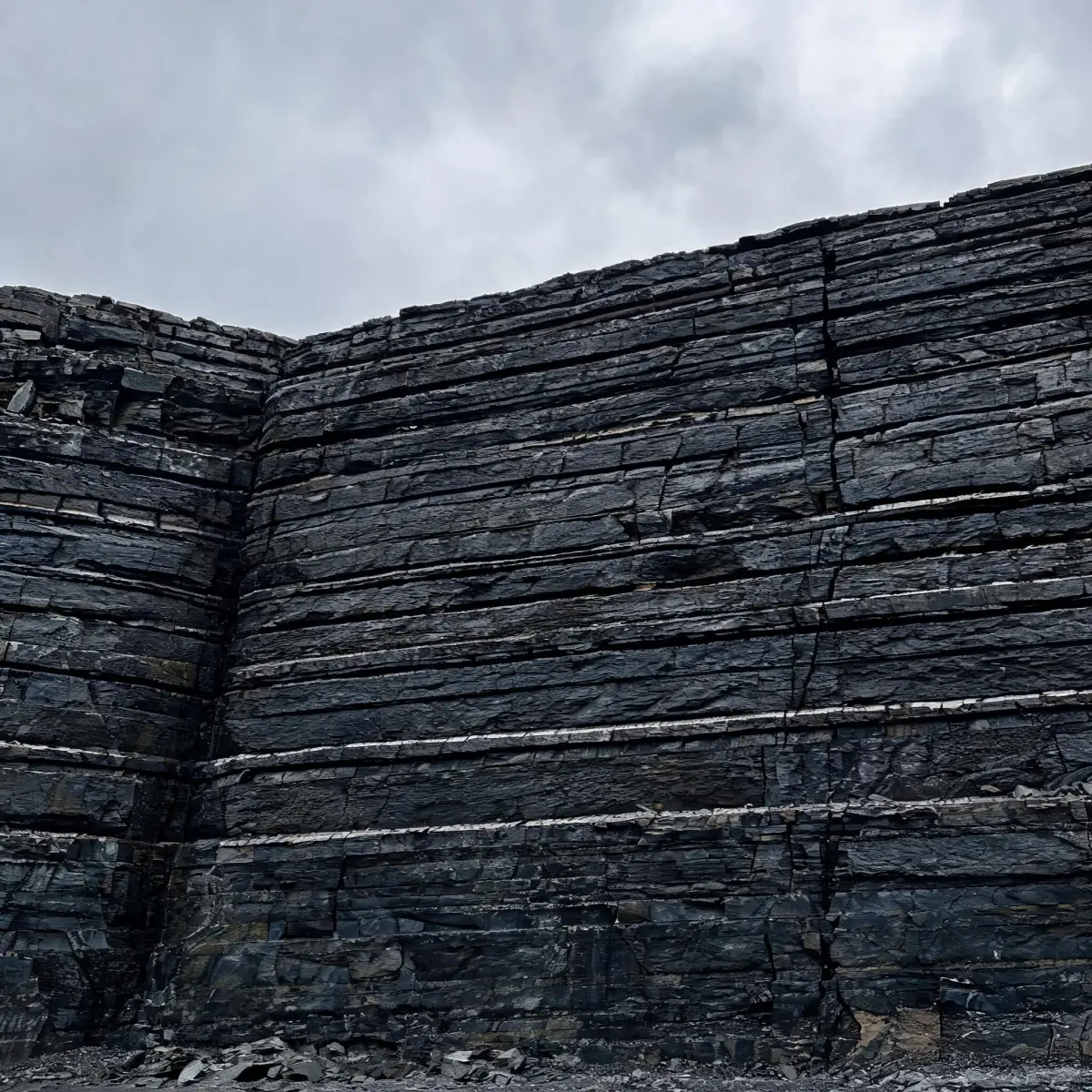
Stage 1 — Extraction: What Came Out of the Ground
Natural roofing slate is a metamorphic rock. It began as marine sediment — clay and volcanic ash settled on an ancient ocean floor — and was transformed over hundreds of millions of years by heat and pressure deep in the earth's crust. The slate quarried today in Jiujiang, Jiangxi Province, dates from the Silurian period, roughly 400 million years ago. No human process created it. No factory can accelerate its formation. What comes out of the quarry is already what it needs to be.
This geological origin matters for sustainability in a way that is easy to overlook. Unlike concrete tiles, which require limestone to be calcined at 1,450°C, or clay tiles, which must be fired in kilns at 1,000°C for hours, or synthetic slate, which is extruded from fibre-cement or polymer compounds in energy-intensive plants, natural slate is simply split from the rock face. The energy input at the extraction stage is diesel for excavators and compressors — measurable, finite, and orders of magnitude lower per square metre than any manufactured alternative.
The splitting itself requires no heat and no chemicals. Slate's defining characteristic is its cleavage — the ability to break along natural planes into thin, flat sheets. A skilled splitter places a chisel along the grain, strikes once, and the rock separates. The energy that opened that cleavage plane was geological, stored in the stone since the Silurian. The human contribution is a hammer and an experienced hand.
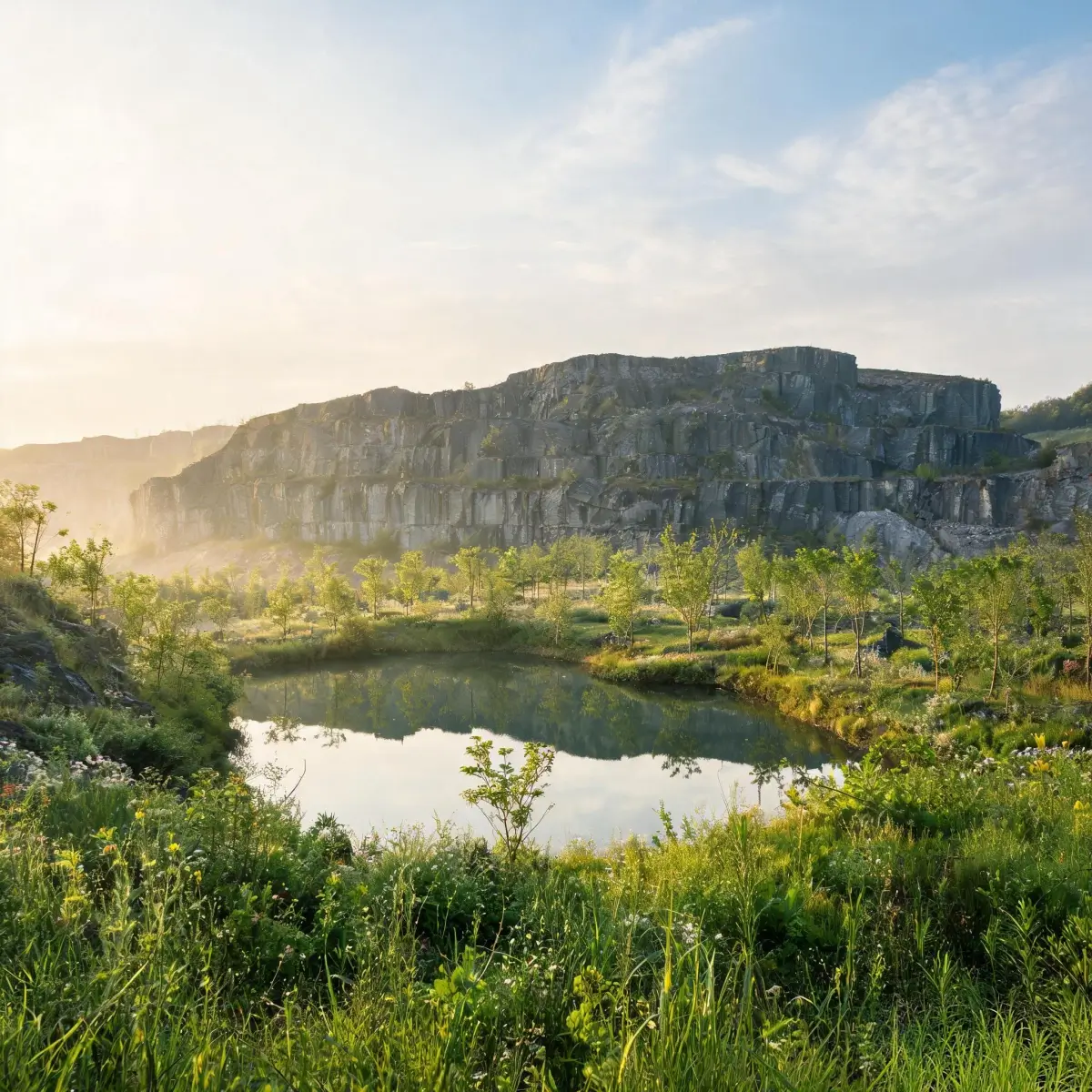
Quarrying does alter the landscape. A working quarry is not a nature reserve. But serious quarry operators — and this includes the quarries supplying the European and North American markets under EN 12326 and ASTM C406 standards — operate under restoration plans that are legally binding in most jurisdictions. When a quarry face is exhausted, the site is graded, revegetated, and returned to public use. A worked-out quarry in Wales or Jiangxi does not remain an open scar. It becomes a lake, a nature reserve, or a climbing wall, sometimes within a generation.
Stage 2 — Manufacturing: Split, Cut, Inspect
Once blocks of slate are extracted, the manufacturing process is remarkably simple — and this simplicity is the second pillar of slate's sustainability case.
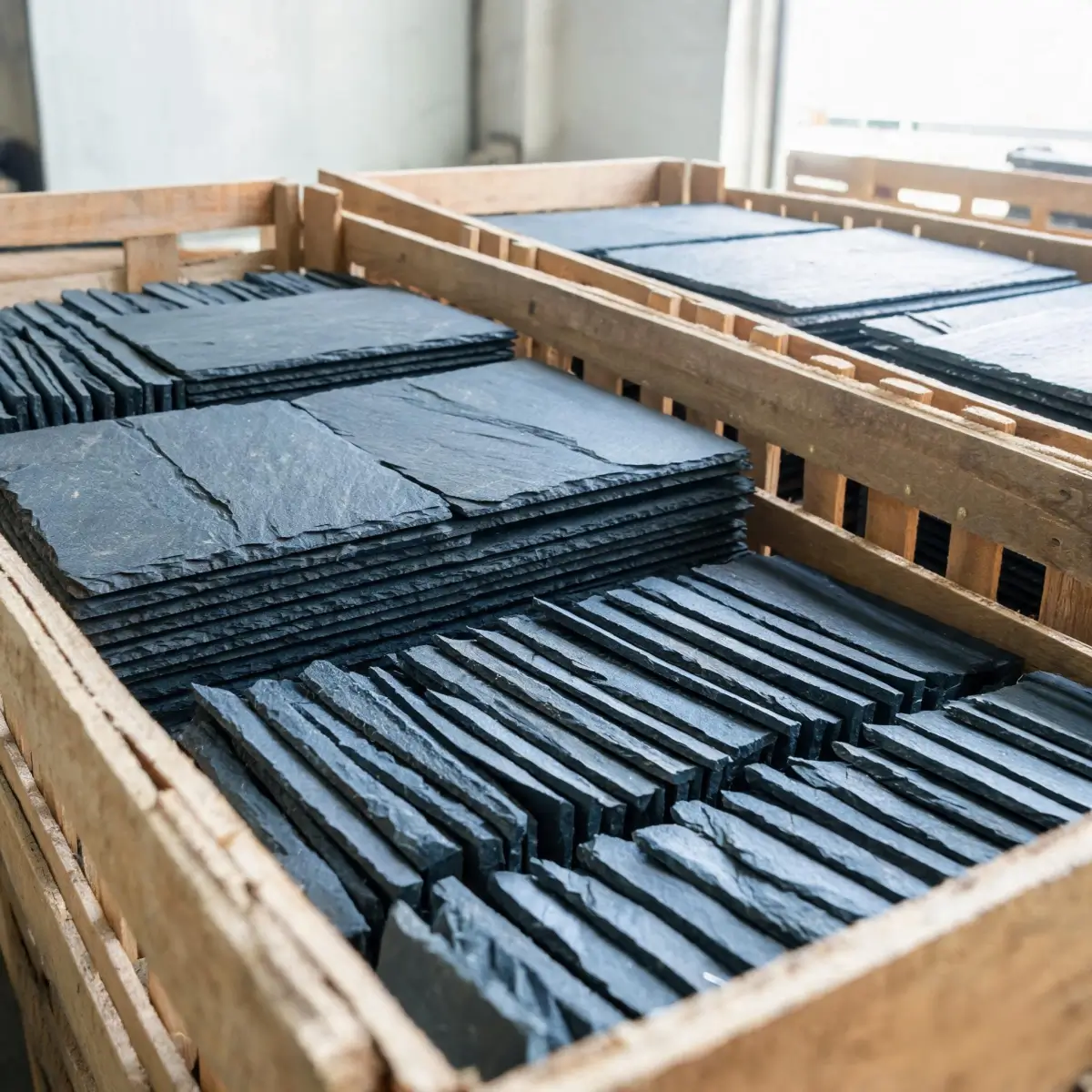
The raw block is first sawn into manageable slabs using diamond-blade saws cooled by water. The slabs are then split by hand or by mechanical splitter along the cleavage plane into individual tiles of the required thickness — typically 5 to 8 mm for standard roofing slate. The tiles are then cut to final dimensions using CNC cutting machines that achieve tolerances of ±0.2 mm. Every tile is individually inspected for size, thickness, flatness, and soundness before being packed into wooden crates.
The key point: there is no kiln in this process. No firing. No curing. No chemical treatment. No polymer bonding. The water used for saw cooling is recirculated in a closed-loop system. The wood crates are made from sustainably sourced timber, heat-treated to ISPM 15 standards for export. The only waste material — offcuts and slate dust — is inert and is either reused as aggregate or returned to the quarry.
To put this in perspective: producing one square metre of concrete roof tiles requires approximately 2 to 3 MJ (megajoules) of embodied energy. Clay tiles require 3 to 5 MJ per square metre because of the kiln firing. Synthetic fibre-cement slate requires roughly 4 to 6 MJ. Natural roofing slate, from quarry face to packed crate, comes in under 1 MJ per square metre. The difference is not incremental. It is structural.
Stage 3 — Transport: The Honest Deduction
Here is where the audit turns less flattering, and any honest assessment must acknowledge it.
For European buyers, most roofing slate is imported — from Spain, from Wales (for the minority who can afford Welsh slate), from China, or from other producing countries. The slate produced by Slate of China in Jiujiang travels approximately 18,000 km by sea to reach a UK port. A 20-foot container carrying roughly 1,000 to 1,400 square metres of roofing slate will consume fuel for that journey, and that fuel has a carbon cost.
How significant is this cost? Ocean freight is, by tonne-kilometre, the most energy-efficient form of transport ever devised by humans. A container ship moves one tonne of cargo 1 km on approximately 0.003 litres of fuel. For a 20-foot container of slate weighing roughly 25 tonnes, the fuel consumed on an 18,000 km voyage is in the order of 1,300 to 1,500 litres. Spread across 1,200 square metres of roof, that is roughly 1.2 litres per square metre — not trivial, but not disqualifying.
Compare this to the transport cost of local alternatives. A concrete tile lorry travelling 300 km within the UK burns diesel at roughly 0.03 litres per tonne-kilometre — ten times less efficient than sea freight per tonne-kilometre, though the distance is shorter. When you also factor in that the concrete tile will need replacing two or three times over the lifespan of a single slate roof, the freight argument becomes more nuanced than "local is always better."
This is the one area where slate's sustainability case is weakest, and it should be stated plainly. If a buyer has access to a domestic slate source — Spanish slate for a Spanish project, Welsh slate for a Welsh project — the transport deduction shrinks dramatically. For buyers without that option, Chinese slate remains a strong environmental choice because the service-life dividend (discussed next) is so large that it overwhelms the transport cost over a full life cycle.
Stage 4 — Service Life: Where the Maths Does Itself
This is the stage that decides everything, and it is the stage that most "eco-friendly" roofing assessments skim over.
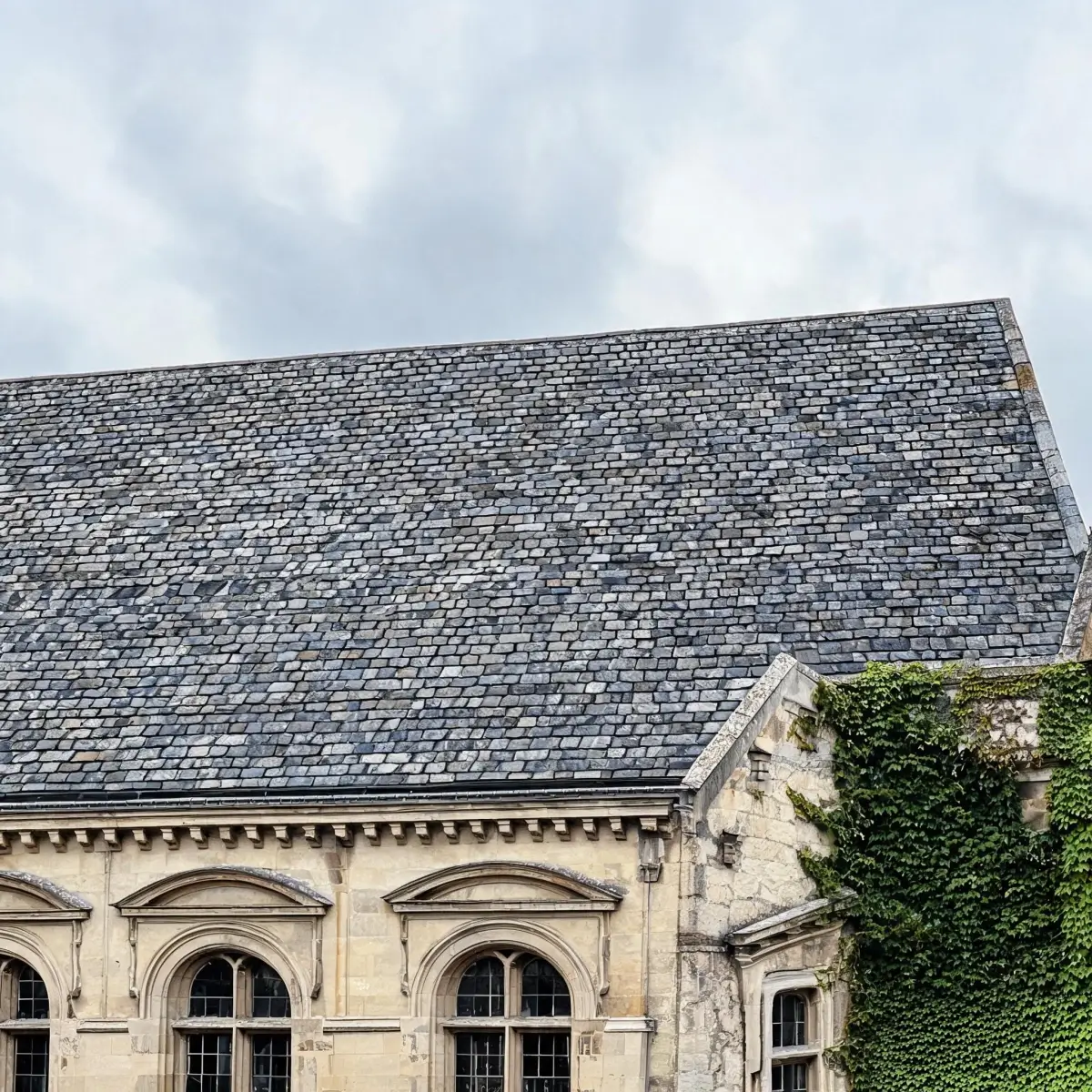
A natural slate roof lasts 100 to 150 years. Some Welsh slate roofs are still in service after 200 years. This is not a manufacturer's claim; it is an observable fact, documented on buildings across Europe. The roof of the Church of St. Mary in Staffordshire, England, was re-slating in the 1830s using slate that had already been quarried decades earlier. It is still there.
By comparison, a concrete tile roof lasts 30 to 50 years. A synthetic fibre-cement slate roof lasts 25 to 40 years. An asphalt shingle roof lasts 15 to 25 years. A metal roof — depending on the coating — lasts 40 to 70 years before the coating fails and the panel needs replacement.
The sustainability implications of this lifespan gap are not linear. They are exponential, because of what engineers call the life-cycle denominator effect: every environmental cost incurred at extraction, manufacturing, and transport is divided by the number of years the roof actually lasts. A slate roof that lasts 150 years spreads its environmental cost across a denominator of 150. An asphalt roof that lasts 20 years spreads the same kind of cost across a denominator of 20 — and then incurs it again, and again, and again.
Over a 150-year period — the conservative lifespan of a quality slate roof — here is what the replacement cycle looks like for other materials:
| Material | Service Life | Replacements in 150 Years | Total Material Cycles |
|---|---|---|---|
| Natural slate | 100–150 | 0 | 1 |
| Metal (coated steel) | 40–70 | 1–2 | 2–3 |
| Concrete tile | 30–50 | 2–3 | 3–4 |
| Synthetic fibre-cement | 25–40 | 3–4 | 4–5 |
| Asphalt shingles | 15–25 | 5–6 | 6–7 |
Each replacement cycle means extracting new raw materials, manufacturing new tiles, transporting them, and disposing of the old roof. An asphalt shingle roof replaced six times over 150 years generates six times the extraction cost, six times the manufacturing emissions, six times the transport fuel, and six times the landfill waste of a single slate roof.
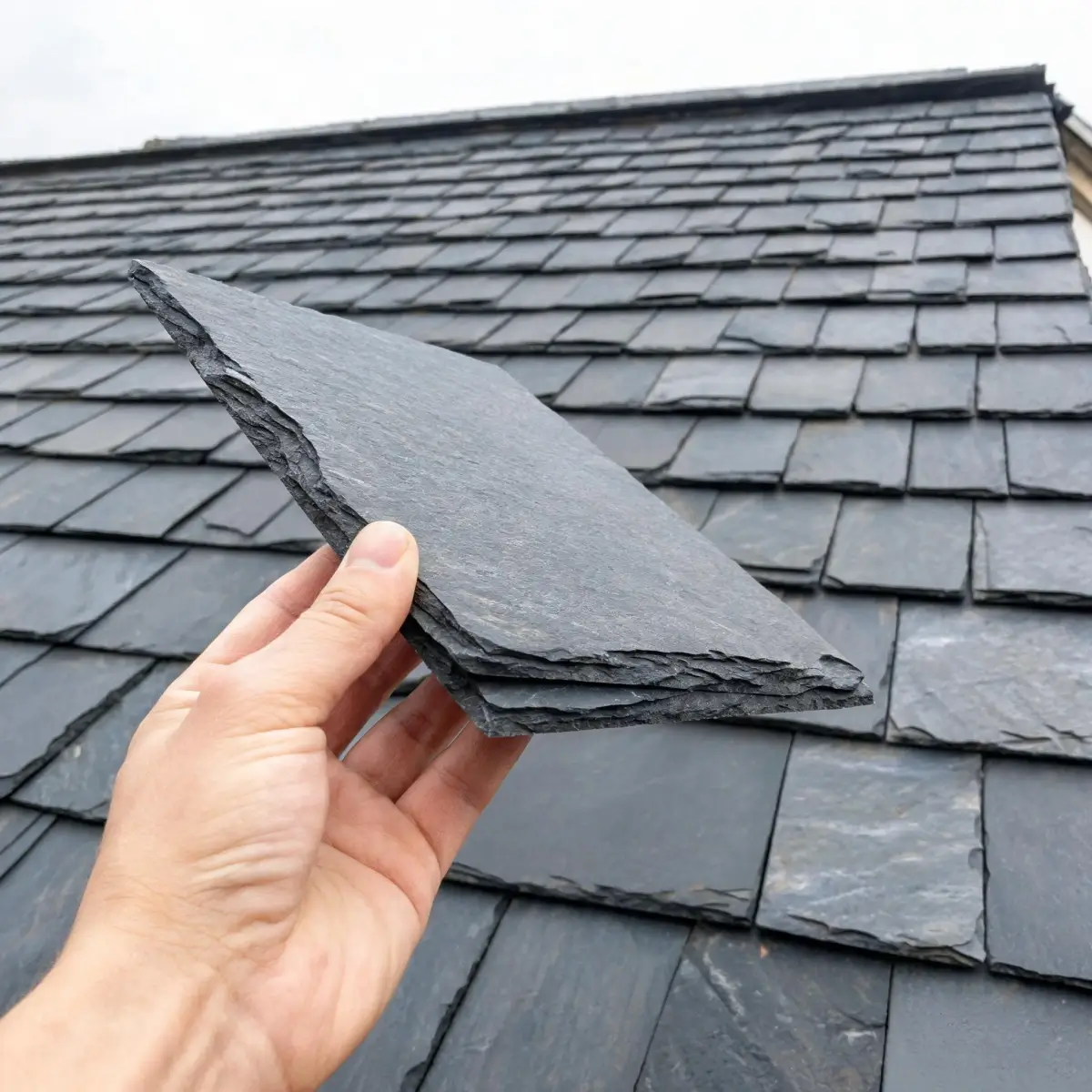
There is a second sustainability dividend during the service life itself: natural slate requires no chemical maintenance. No biocides, no algaecides, no protective coatings, no sealants. The density of quality slate — water absorption below 0.3%, in the case of Jiujiang slate as low as 0.2% — means the surface is too dense for biological growth to penetrate, and too inert for weathering to degrade. Moss and algae may settle on the surface but can be brushed off without chemicals. The roof does its job for a century without consuming a single gram of maintenance product.
Stage 5 — End of Life: What Happens When the Building Comes Down
Here is where slate outperforms every manufactured alternative so decisively that the comparison almost seems unfair.
When a slate roof reaches the end of its service life — which, in most cases, means the building underneath it has reached the end of its service life, not the slate itself — the tiles are not waste. They are a resource. Reclaimed slate is a mature market in the UK and Europe. Salvaged Welsh slate from demolished buildings routinely sells for a premium over new slate because the weathering process has already proven the tile's durability. A slate that has survived 80 years on a roof is, by definition, a slate that will survive another 80.
This is not recycling in the modern, energy-intensive sense — melting, shredding, or reconstituting. It is direct reuse. The tile comes off one roof and goes straight onto another. No processing, no energy input, no loss of material quality. Slate is one of the very few building materials for which this is true. You cannot directly reuse a 30-year-old concrete tile — it has carbonated and lost strength. You cannot directly reuse an asphalt shingle — it has oxidised and embrittled. You can, and people do, reuse a 100-year-old slate tile.
Even if slate is not reclaimed for reuse, it is inert. It does not leach chemicals. It does not decompose. It does not release microplastics. If it ends up as fill material on a construction site, it is doing exactly what it did in the ground for 400 million years: being a rock. Landfill is the wrong word for it. Slate in a hole in the ground is just geology resuming.
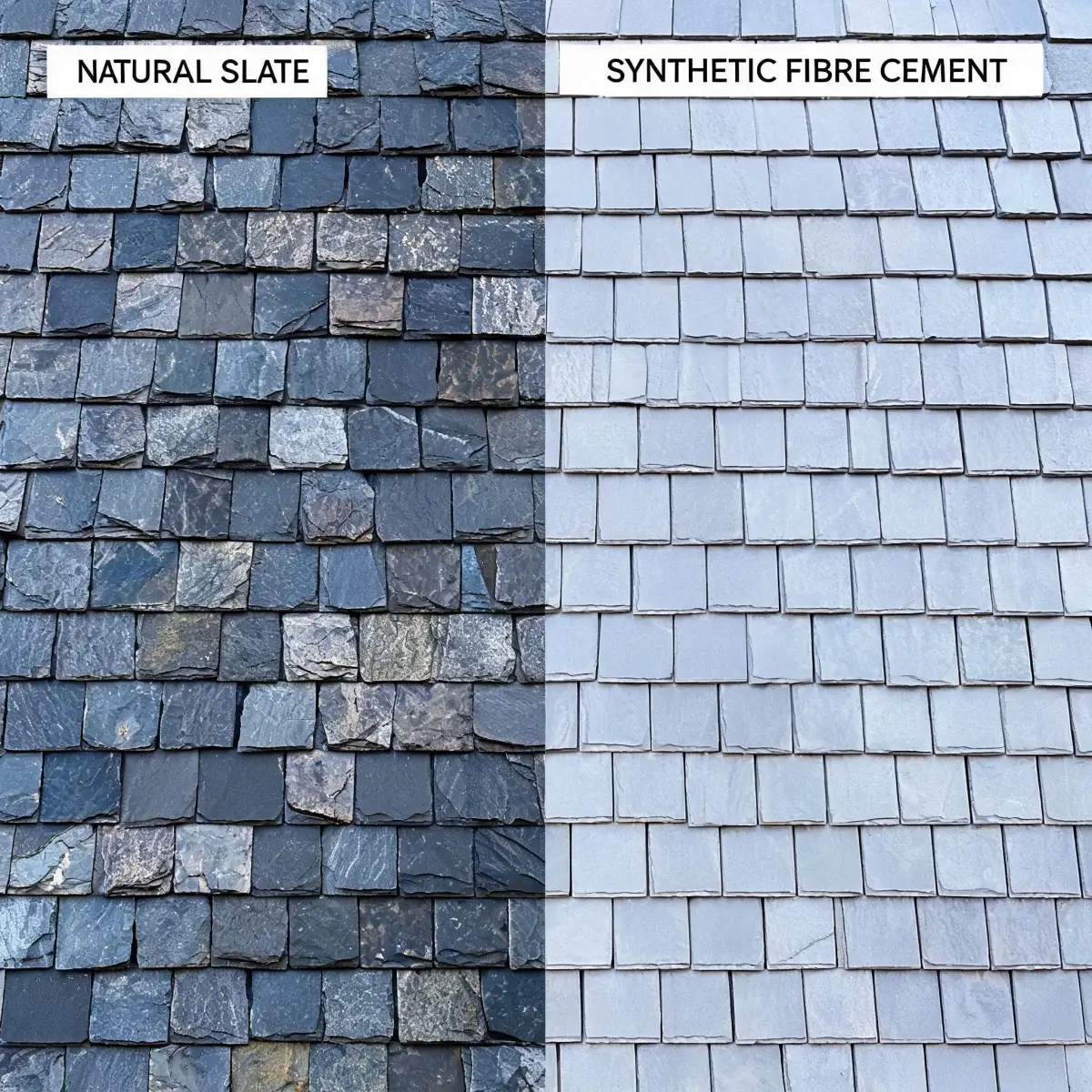
Compare this to the end-of-life profile of synthetic roofing: fibre-cement tiles contain cement, cellulose, and synthetic fibres that cannot be separated for recycling. They are either landfilled — taking up volume and potentially leaching additives — or crushed as low-grade aggregate, which is recycling of a sort but not reuse. Asphalt shingles can be recycled into road pavement in some markets, but the process requires energy, and in most of the world they go to landfill, where the bitumen slowly degrades over centuries.
The One Problem With This Audit (and Why It Still Holds)
Every sustainability audit has a weakness, and this one is no exception. The weakness is this: the numbers above assume quality slate, properly installed, on a roof that is maintained at a basic level of competence.
Poor quality slate — slate with high carbonate content, high water absorption, or pyrite inclusions — can fail in 20 to 30 years, at which point the sustainability case collapses. A slate roof that lasts 25 years and then needs full replacement is no more sustainable than a synthetic slate roof. The lifespan dividend is the entire argument, and it depends entirely on the quality of the slate and the quality of the installation.
This is why EN 12326 and ASTM C406 test results are not just a quality control exercise. They are a sustainability document. A batch of slate with water absorption below 0.3% and a T1 weathering classification is a 100-year material. A batch with water absorption above 0.6% and a T3 classification is a 30-year material wearing a 100-year disguise. The test report is what tells you which one you are buying.
Similarly, poor installation can destroy the lifespan dividend. Slates fixed with the wrong nails, inadequate headlap, or improper batten spacing will fail regardless of the quality of the stone. A roof that leaks after 15 years because the installer used galvanised nails instead of copper is not a sustainability failure of the slate — it is a sustainability failure of the fixing. But the result is the same: the roof is replaced early, and the environmental cost is incurred twice.
The honest conclusion is this: slate is sustainable if and only if it is good slate, properly fixed. The audit holds — but the precondition is non-negotiable.
EPD: The Document That Proves It
In recent years, the building industry has developed a standardised way to compare the environmental impact of construction products: the Environmental Product Declaration, or EPD. An EPD is a third-party-verified document that quantifies the embodied carbon, energy use, water consumption, and waste generation of a product across its full life cycle, from cradle to grave.
EPDs exist for concrete tiles, clay tiles, fibre-cement slate, metal roofing, and asphalt shingles. They also exist for natural slate. The consistent finding across EPDs for roofing materials is that natural slate has the lowest embodied carbon per square metre per year of service life — not because its manufacturing is zero-impact (it is not), but because its service life is so long that the per-year impact is vanishingly small.
If you are specifying roofing for a project that requires EPD documentation — as many public building and BREEAM/LEED projects now do — natural slate's EPD will typically show an embodied carbon figure in the range of 1 to 3 kg CO₂e per square metre per year. Concrete tiles come in at 5 to 10 kg, clay at 8 to 15 kg, and asphalt at 15 to 30 kg. The difference is the denominator: 150 years of service life versus 30.
If your supplier cannot provide an EPD, that is a signal. Not necessarily a fatal one — many excellent Chinese slate producers are still in the process of obtaining EPD certification — but it means you are relying on general industry data rather than product-specific verification. Ask for it. The producers who can provide it are the ones who have invested in transparency.
Slate vs. "Eco-Labelled" Alternatives: A Caution
Some synthetic roofing products carry green certifications — recycled content labels, low-VOC certifications, energy efficiency ratings. These labels are real and the improvements they represent are genuine. But they measure the manufacturing stage, not the life cycle. A synthetic slate made from 30% recycled plastic has a lower manufacturing impact than the same product made from virgin plastic — but it still lasts 30 years and still ends up as waste. The recycled content reduces the numerator slightly. It does nothing for the denominator.
This is not an argument against recycled-content products. It is an argument for reading the label carefully. "Made from recycled materials" and "sustainable over a 150-year life cycle" are two different claims, and only the second one accounts for what happens after the roof needs replacing.
Natural slate carries no eco-label because it does not need one. It does not contain recycled content because it was never manufactured in the first place. Its sustainability is not a feature added during production — it is an intrinsic property of the material. The rock was already there. It will still be there, doing the same job, long after the certificate has yellowed.
How to Specify Slate for a Sustainability Audit
If you are an architect, specifier, or buyer preparing a sustainability assessment for a project, here is what to request from your slate supplier:
1. A current test report from an accredited laboratory, covering EN 12326-1 or ASTM C406, with water absorption below 0.3%, flexural strength above the standard minimum, and a T1 weathering classification. This report is your evidence that the slate will achieve its projected lifespan. Without it, the sustainability case is an assumption, not a fact.
2. Quarry location and restoration plan. A responsible producer can tell you where the slate comes from and what happens to the quarry when it closes. If they cannot, the supply chain is opaque, and the Stage 1 audit cannot be completed.
3. An EPD, if available. If the producer has one, it will give you product-specific embodied carbon figures for your assessment. If they do not, use industry average data for natural slate — but note the limitation in your report.
4. Container loading and freight distance. The transport stage of the audit requires the actual sea route distance, not a generic estimate. A container from Jiujiang to Rotterdam is a different calculation from one to Felixstowe or to Hamburg. Ask your supplier for the port of loading and the typical vessel route.
5. Installation specification. The sustainability audit does not end at the factory gate. Specify copper or stainless steel nails, adequate headlap for the roof pitch, and a properly ventilated roof deck. A slate roof that fails at year 20 because of galvanised nails is a sustainability failure, regardless of the quality of the stone.
The Verdict
Is natural roofing slate sustainable? The audit says yes — with one condition and one honest deduction.
The condition is quality. Slate is sustainable only if it is good slate, tested to recognised standards, installed by competent contractors using appropriate fixings. Poor slate installed poorly is no more sustainable than any other poorly executed building project.
The deduction is transport. For buyers distant from the source, ocean freight adds a carbon cost that local materials do not carry. This cost is real, measurable, and should not be dismissed.
But when you divide the total environmental cost of a natural slate roof — extraction, manufacturing, transport, 150 years of zero-maintenance service, and direct reuse at the end of life — by the number of years it actually lasts, the result is a number that no manufactured alternative can match. Not because slate is magical, but because it was already in the ground, it needs no processing to become a roof, and it lasts longer than the building it sits on.
That is not greenwashing. That is geology.
Frequently Asked Questions
Does natural slate have a green building certification or EPD?
Some slate producers hold EPDs (Environmental Product Declarations) verified by third parties. These document the embodied carbon and energy of the product across its life cycle. Natural slate does not typically carry labels like "recycled content" because it is a raw material, not a manufactured composite. If you need documentation for a BREEAM or LEED project, ask your supplier for an EPD and the EN 12326 or ASTM C406 test report — together they cover both the environmental footprint and the quality assurance.
What is the carbon footprint of a slate roof compared to other materials?
Per square metre per year of service life, natural slate typically has the lowest embodied carbon of any roofing material — in the range of 1 to 3 kg CO₂e/m²/year. This compares to 5 to 10 kg for concrete tiles, 8 to 15 kg for clay tiles, and 15 to 30 kg for asphalt shingles. The low figure is driven by the 100 to 150 year service life, which spreads all one-time environmental costs across a very large denominator.
What happens to a slate quarry when it is no longer productive?
In most jurisdictions, quarry operators are legally required to submit and follow a restoration plan before extraction begins. When a quarry is exhausted, the site is graded, replanted, and returned to public or ecological use. Former slate quarries have been successfully restored as nature reserves, recreational lakes, and climbing sites. A responsible supplier should be able to describe their quarry's restoration plan.
Can roofing slate be recycled or reused?
Yes — and this is one of slate's strongest sustainability advantages. Reclaimed slate is a mature market: tiles removed from demolished buildings are directly reused on new roofs without any processing. A slate tile that has served 80 years on one roof can serve another 80 on a different roof. Even if slate is not reclaimed, it is chemically inert and does not leach or decompose, so it can be used as inert fill without environmental harm.
Is natural slate more sustainable than synthetic fibre-cement slate?
Over a full life cycle, yes. Synthetic fibre-cement slate requires energy-intensive manufacturing (cement curing, fibre bonding), lasts 25 to 40 years, and cannot be directly reused. Natural slate requires only splitting and cutting, lasts 100 to 150 years, and can be reclaimed for direct reuse. The sustainability gap widens over time: one slate roof equals four to six synthetic roofs over a 150-year period, meaning four to six times the manufacturing, transport, and disposal impact.
Does shipping slate from China to Europe cancel out its sustainability benefits?
It reduces the score but does not cancel the benefit. Ocean freight is the most energy-efficient transport mode per tonne-kilometre, and the fuel cost of shipping a container of slate 18,000 km is roughly 1.2 litres per square metre of roof. When spread across a 100 to 150 year service life, the transport carbon is a small fraction of the total life-cycle cost. If a domestic slate source is available (Spanish, Welsh, or other), the transport deduction shrinks further. The key comparison is not slate vs. local materials, but slate-and-its-freight vs. shorter-lived materials that need replacement multiple times.
Related Reading
Specify Slate That Lasts a Century
EN 12326 and ASTM C406 tested. CNC-processed. 100% individually inspected. Request test reports, samples, and EPD documentation for your sustainability assessment.
View Roofing Slate Products Request Samples & Reports