
Reusing Existing Roofing Slate
People phone my yard and the first question is always the same: what do you pay for old slate? The second question, if they get that far, is the one that actually matters — is my slate worth saving at all?
Twenty-three years in the reclamation trade have taught me that those are two different questions with two different answers, and that most roofs get the second one wrong. Good slate comes off roofs that deserved it, and skips fill with slate that deserved better. Somewhere in between sits a decision that this guide is built to help you make honestly: when your roof comes apart — for an extension, a conversion, a repair that got out of hand, or a house that is simply coming down — which tiles should ride to my yard in the truck, and which ones should honestly stay on the ground?
I will take you through it the way I would walk a new customer through the yard itself: how a roof should be stripped if the tiles are to live again, what happens to them on my sorting bench, how we decide which are worth selling and which are not, what it costs and what it saves, and the honest limits — the times when reusing existing roofing slate is false economy dressed up as virtue.
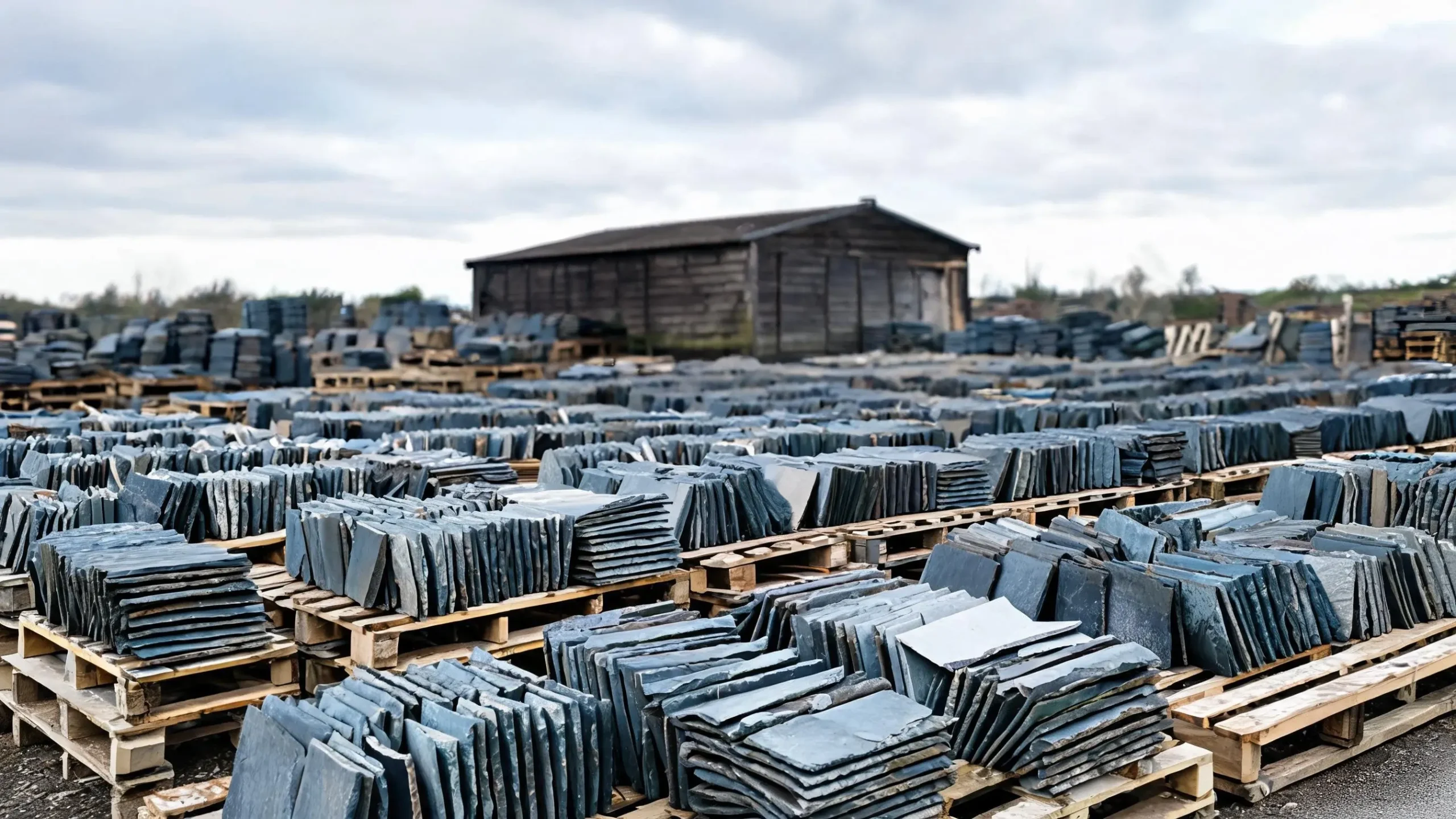
The short version: most sound roofs yield far more reusable slate than owners expect — from a healthy, hand-stripped roof I would expect to buy 65–70% of the tiles. The tiles are worth keeping when they pass three tests: they ring when tapped at the corners, they show no delamination along their layers, and their size still matches a market (or your own new roof). They are worth replacing when they flake, thud, crumble at the nail holes, or come off a roof that was nailed through soft, swelling slate with the wrong fixings.
The one rule under all others: reuse must be planned before stripping starts. A roof stripped by hand pays for its own scaffolding twice over; a roof stripped with a crowbar and a skip pays for nothing.
Strip It Like It Matters — Because It Does
Salvage value is not created at my yard. It is created — or destroyed — in the first hour of stripping. A slate tile is a thin stone sheet with two fragile corners and a nail hole that has been quietly working for eighty years, and it forgives exactly one careless move: none.
The method matters more than the muscle. Slates come up one at a time, the way they went down. Cut or draw the nail, lift the tile with a slate ripper or a flat bar working from the side — never levered hard against its own headlap — and pass it down by hand. The tiles travel down the scaffold stacked flat or on edge in handling lots, never thrown, never slid across each other face to face, because face-to-face sliding is how good slate learns to be gravel. Anything loose or cracked goes in its own pile; do not let one broken tile ride in a bundle of two hundred sound ones and shift the whole lot in transit.
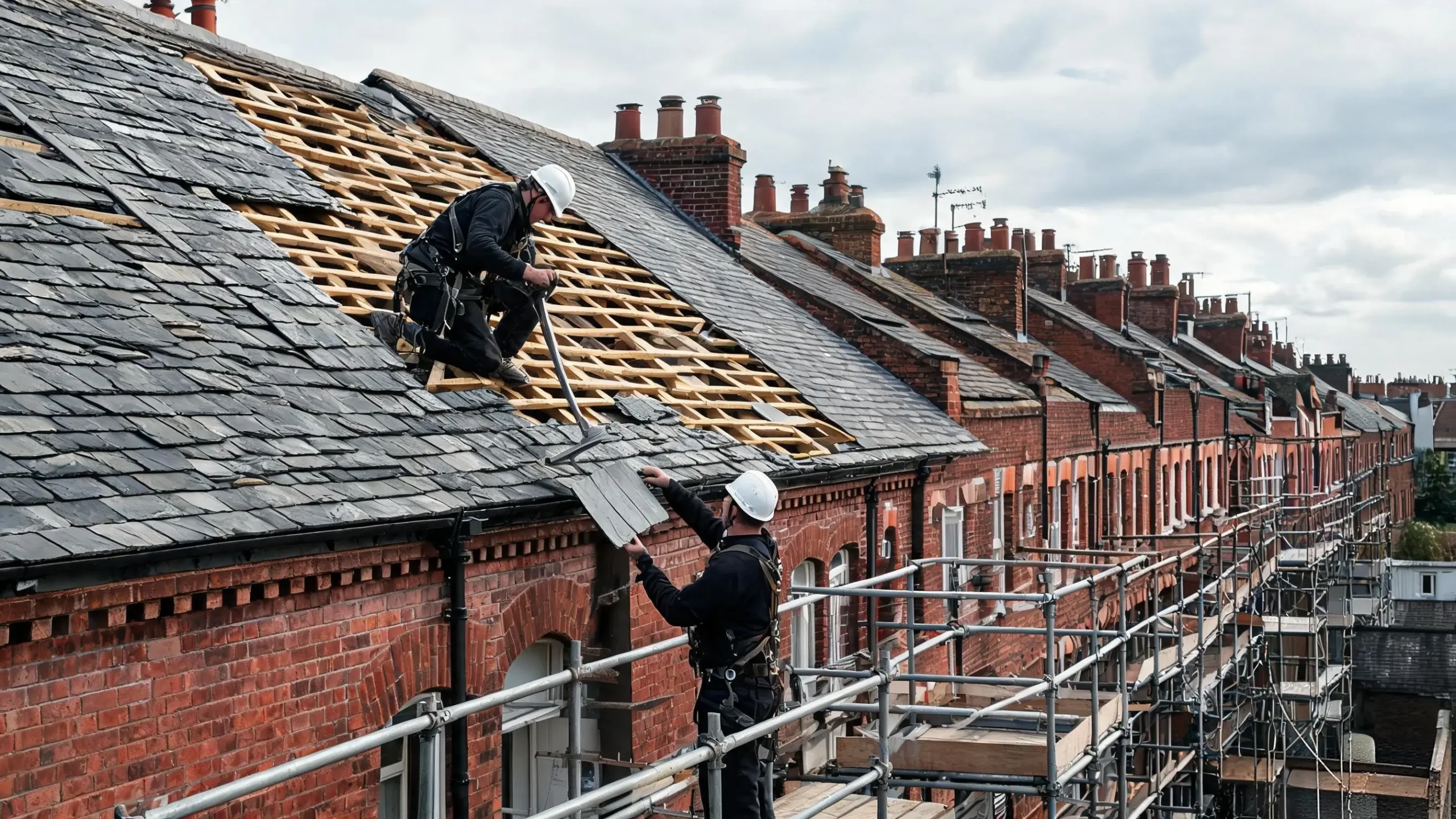
I can tell within a scaffold's distance how a roof was stripped, because stripped slate tells on its stripping. Tiles that came off a careful job arrive in the yard square-edged and calm. Tiles from a demolition job arrive with three signatures I see again and again: snapped corners from levering against the headlap, face scars from tiles dragged across grit, and a strange half-moon bruise where a boot decided a scaffold was too slow. The trade calls the careful version hand stripping and the other version skip-filling, and the difference between them is measured in pounds per square metre, not style points.
One practical note worth its own paragraph: the fixings tell you how the whole salvage job will go. Roofs fixed with hooks come apart gently — unhook, lift, done. Roofs fixed with copper nails draw out cleanly after decades. Roofs fixed with cheap wire nails from a bad patching era are the hardest work: the nail shank is rusted into the hole, the tile wants to fight, and every fourth tile snaps at the hole as the nail comes out. If your roof went through one of those patch-happy decades, strip slowly and expect to lose more tiles at the nail than anywhere else — and know that the nail did it, not the slate. Why fixings decide tile lifespans is worth reading before you strip, not after.
The Sorting Bench: What Happens to Old Slate at a Yard Like Mine
So the truck comes in and the tiles land on the sorting bench — and this is where an honest yard earns its money, because everything I paid the roofer gets decided again, tile by tile, in about three seconds each.
First gate: the ring test
I hold the tile loosely on my fingertips — never flat on a bench, never gripped — and tap each corner with a knuckle, then the middle. A sound slate answers like a church bell's quieter cousin: a clear, slightly glassy ring that hangs in the air. A tired slate answers like an empty bucket: a short, dead thud with no tail to it. The thud is delamination announcing itself — the stone's layers have quietly let go of each other, and a tile whose layers have separated is a tile whose weatherproofing days are over, no matter how good it looks on the face.
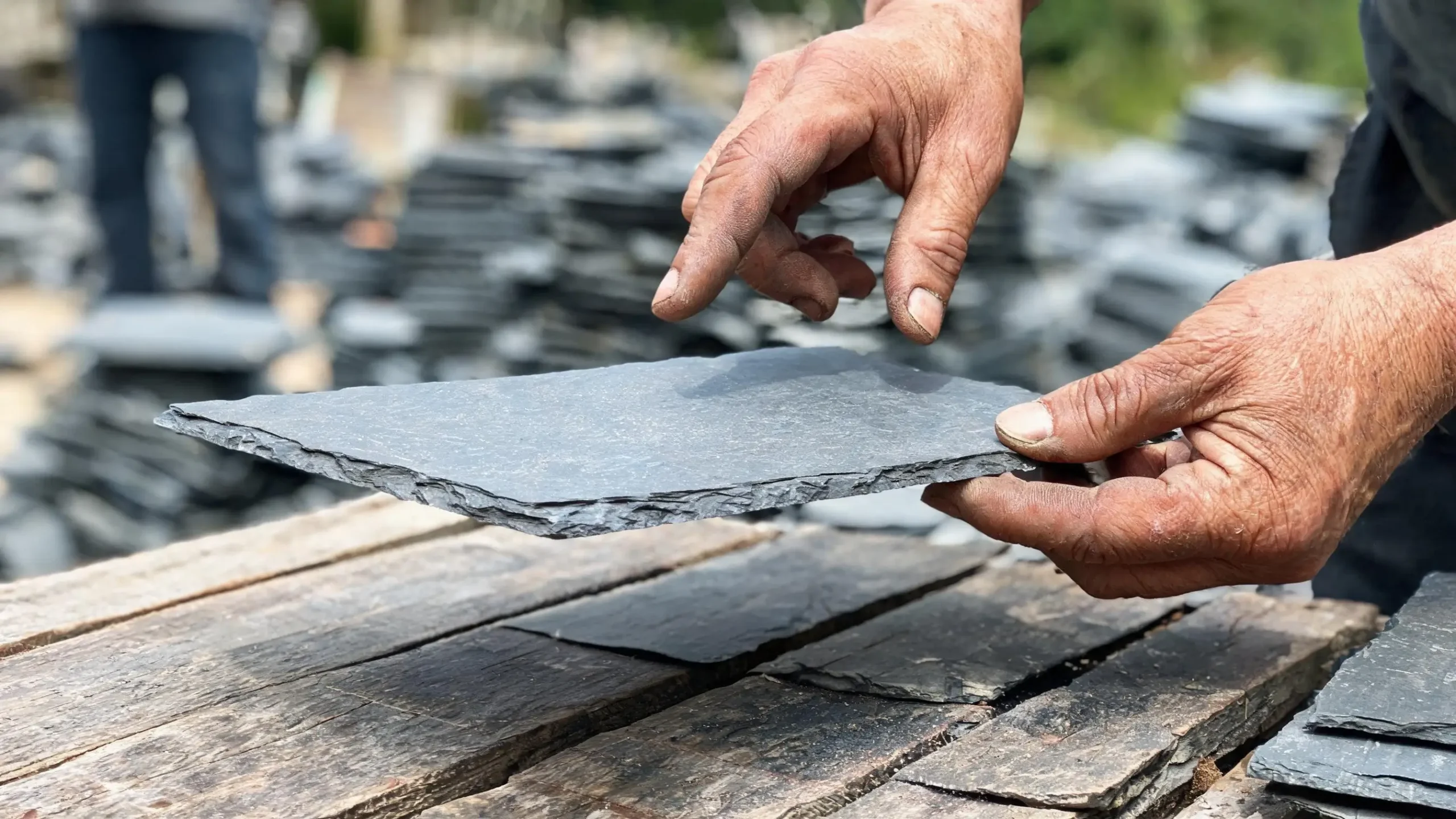
The ring test is the single most useful skill in this whole trade, and it is free, and you can learn it in a morning. My advice to any roofer or owner selling slate: tap every tile before it goes in the truck. You will keep my sorting fee down, you will keep your own credibility up, and you will develop an ear that makes the rest of this guide unnecessary.
Second gate: eyes and edges
After the ear, the eyes. I am looking for four things in a few seconds each. Layered flaking at the edges — slate that is shedding its own thickness will not stop because it has been re-sold. Crumbling around the old nail holes — a hole that has gone soft or furred with rust cannot be trusted with a new nail, and one soft hole condemns the tile unless the punch can move. Deep soft spots on the face — a chalky, porous patch where the stone has weathered differently is an invitation for frost. And hairline cracks — some of them ring perfectly well and still live under the surface; I look for them across the corners where the stress of lifting gathers.
Third gate: the tape and the ledger
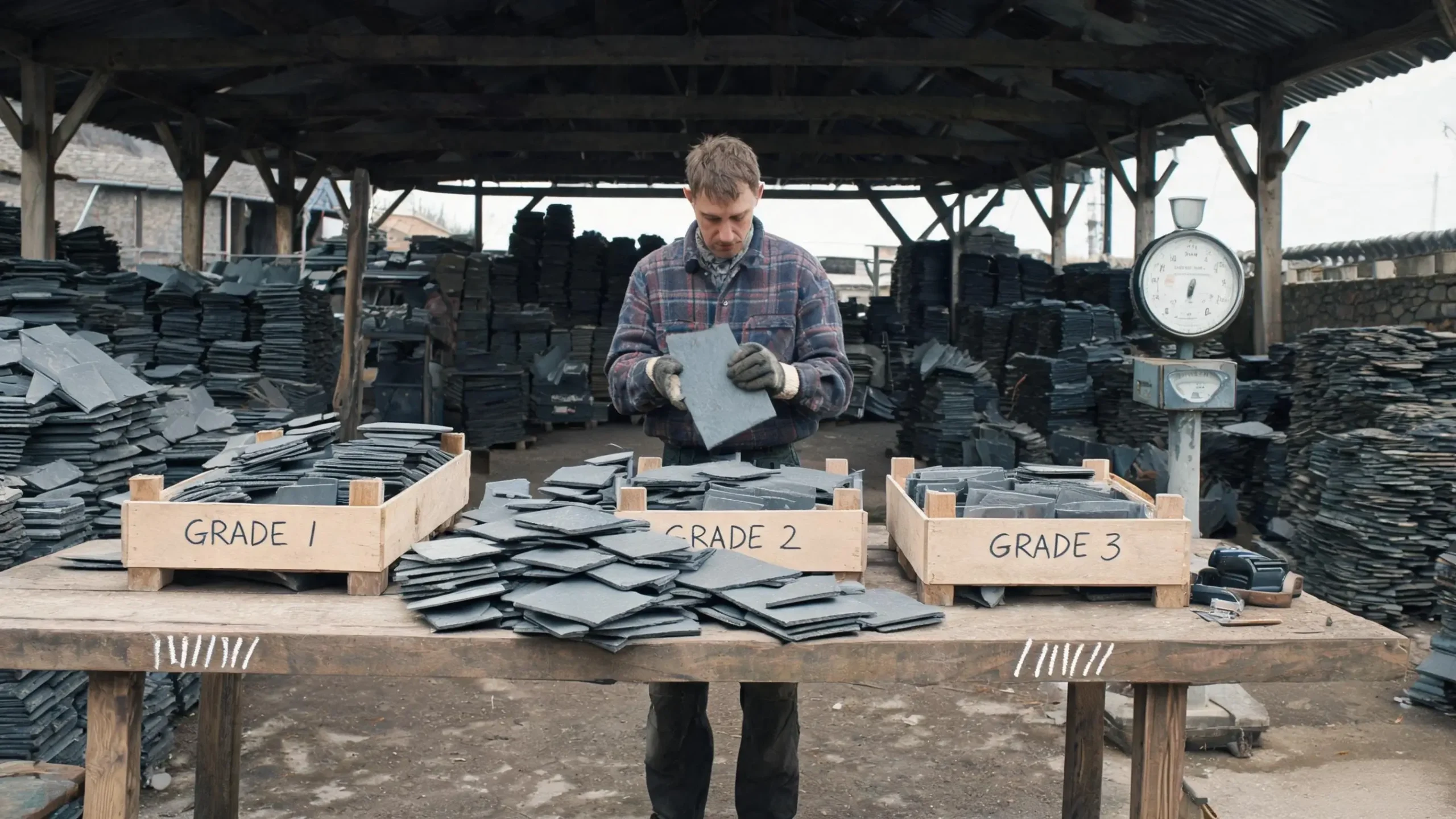
The tiles that pass the ear and the eyes get measured — length, width, and thickness, because old roofs were laid to the sizes their quarry happened to cut that decade, and my customers buy to match their courses, not my convenience. A yard that does not measure its own stock is a yard that sells surprises. Then the last thing every tile gets before it earns a pallet is a decision I make perhaps a hundred times a day: which crate does it belong in?
The Four Grades Every Buyer Should Know
Not all "reclaimed slate" deserves the name, and the difference is not the age — it is the sorting. When I buy a stripped roof, every tile lands in one of four grades, and when you buy reclaimed slate, you should ask which grade the price refers to, because the honest yards publish their rules and the lazy yards have one grade called "it's all good slate, mate".
- Grade A — ready to relay. Rings clear, no edge flaking, sound holes, square corners, consistent thickness. These tiles go straight onto the next roof. They carry the price of proof: every tile was individually judged, not batch-assumed.
- Grade B — relay with small prep. Rings clear but needs one or two corners dressed, or a new nail hole punched clear of the old one, or a light clean. Honest work, honest price — most healthy roofs yield more B than A.
- Grade C — the patch pile. Sound but ugly: heavy weathering face, lime mortar stains from an old ridge, chips from its stripping. Not for a front slope, ideal for sheds, outbuildings, hidden repairs, garden use. Every yard has one and every owner should be glad it exists.
- Skip — the honest grade. Thuds, flakes, crumbled holes, cracks, tiles that were barely slate anymore when they came down. I pay nothing for these and I am doing you a favour by saying so early.
From a genuinely healthy roof — say a 3,000-tile house being stripped for a loft conversion — I would expect to buy somewhere around 65–70% of the tiles as A or B, with another modest tranche as C. From a demolition job with machines and no care, the same roof might yield a third of that. The slate did not change. The stripping did.
Why Old Holes Can Never Be Trusted Again
Here is the detail that separates people who have actually relayed salvaged slate from people who have only talked about it: you never re-nail through the old hole.
Eighty years of a nail working in that hole has done three things. It has furred the hole edge with rust, which keeps working like a slow saw blade. It has worn the hole oval, which lets the new nail wobble. And it has stressed the stone in a ring around the hole, which is exactly where tired tiles snap when the wind gets serious. A salvaged tile relaid through its old hole is a tile holding on by a thread and calling it a nail.
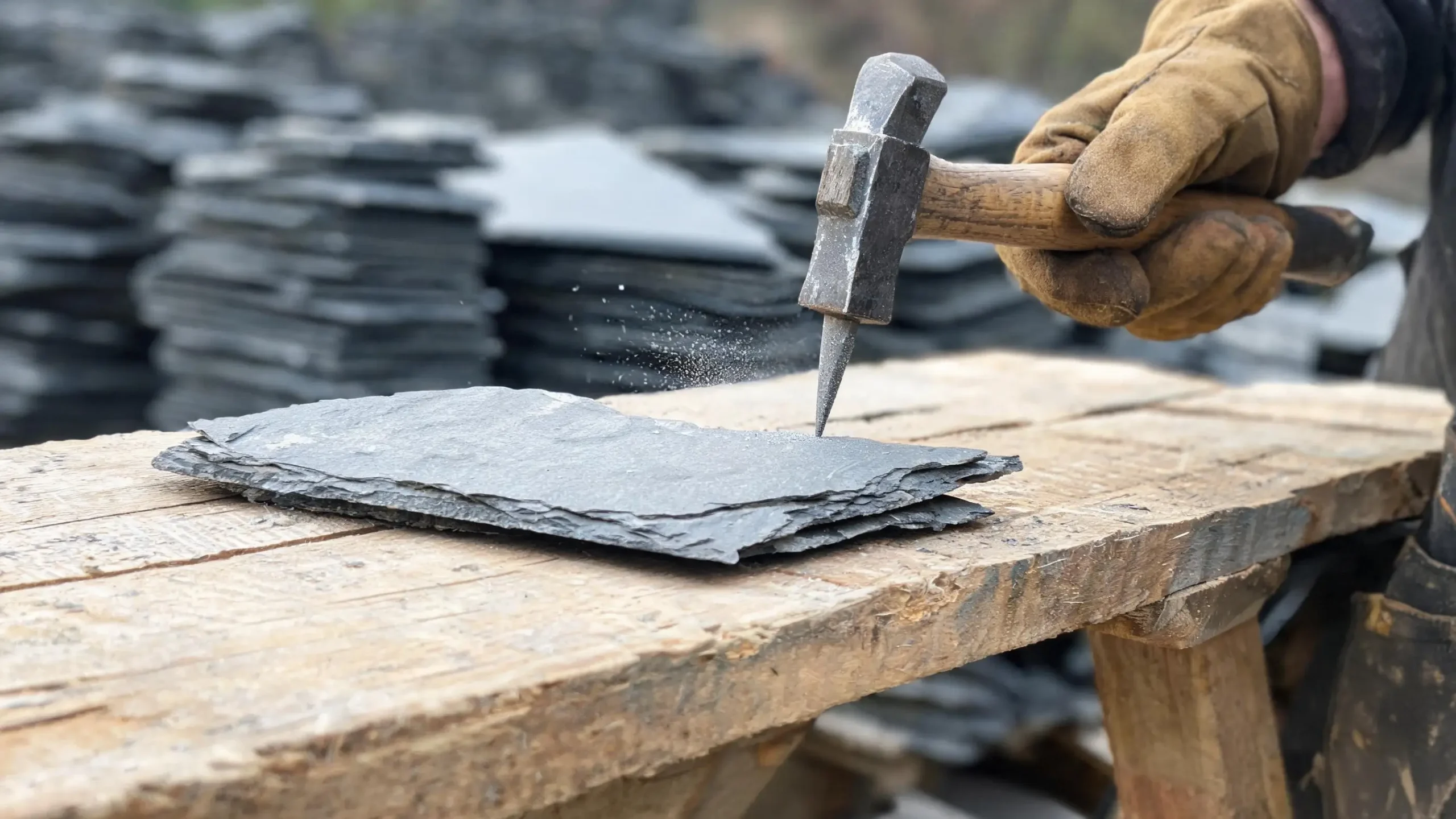
So every salvaged tile gets a fresh hole punched a safe distance from the old one — clear of its stress ring, in sound stone, positioned for the gauge the new roof actually runs. It is quick work with the right tool and it is the single strongest argument for buying from a yard that preps its stock rather than one that sells tiles "as stripped". If you are doing the work yourself, read up on fixing methods first — the nail-holes conversation is really a fixing-systems conversation, and hooks give old slate a second chance that nails struggle to.
What Reuse Actually Costs — and Saves
Now the part my customers' accountants ask about, so let me put honest numbers on the table. Reclaimed slate in the UK trades broadly in the region of half to two-thirds of the price of comparable new slate, depending on size, grade and how fashionable the county is. On top of the purchase price, budget for the prep that honest reuse requires — re-punching, some corner dressing, and the slower laying rhythm of tiles that are individuals rather than clones. A strip-and-relay job on the same house saves the material cost twice over, because the client is being paid for their old roof instead of paying for a new one.
The economics that decide everything, in one small table:
| Scenario | What you pay | What you get |
|---|---|---|
| Buy new slate, skip the old roof | Full material price + skip hire | Uniform, warranted, zero character |
| Buy Grade A/B reclaimed | Roughly 1/2 to 2/3 of new price | Proven 80-year-old stone, instant patina |
| Strip and relay your own roof | Labour + battens + fixings only | Material cost mostly cancelled; roof value often raised |
Two warnings from the ledger, though, because honest numbers have two edges. First, reclaimed slate carries no manufacturer's warranty — my warranty is my reputation and my grading, and that is worth exactly as much as the yard behind it. Second, the labour on salvage work runs slower than on new slate, because every tile is an individual: a roofer laying new slate reads one tile and has read the whole pallet, while a roofer laying reclaimed slate reads every tile, every time. If a quote for reclaimed work comes in at new-slate speed, the roofer has not understood the material.
When Salvaged Slate Should Not Be Reused at All
I sell old slate for a living, so listen carefully when I tell you the times I talk a customer out of it, because this is the part a salesman would cut.
When the stone itself has failed. If a high share of the tiles thud, flake at the edges or crumble at the holes, the roof is telling you its geology has finished before its roof-timber did. This is common with slate from poor-quality veins laid thin and nailed cheap in the mid-century decades — the classic pattern being tiles that fail in layers, a quarry's bad years written onto a whole street. Salvage cannot out-engineer stone that has started letting go of itself. What failed slate looks like close-up is worth studying if you suspect yours; a delaminating roof is not a salvage opportunity, it is a replacement conversation.
When the fixings, not the slates, were the problem — and the roof was stripped badly anyway. A roof that lost 40% of its tiles to careless stripping has had its answer already. Salvage economics run on yield; strip a fragile roof roughly and the yield is gone before the sorting bench ever sees it.
When the sizes do not exist on the other side. Odd imperial sizes with no buyers, mixed-size roofs laid by someone with a very independent spirit, tiles thicker than any course a modern roofer will lay — all of this is stone that deserves reuse and probably will not get it, because the market's courses do not match. If your roof is unusual, phone a yard before stripping; a half-hour conversation can save a truck of heartbreak. This is also the moment to check whether reuse is even the right decision at roof level — sometimes the honest answer is that the whole roof has reached the replacement side of the ledger, and the tiles should be graded for the skip, not for my pallets.
The Payoff: What a Relayed Reclaimed Roof Looks Like
Let me finish with the order I always come back to when someone asks whether reuse is worth it. A Hampshire barn conversion, four years ago: 4,100 tiles of Welsh slate laid in 1924, stripped by a roofer who worked like the tiles were his own, and brought to my yard in the sort of order that makes a yard owner emotional. We graded out 2,700 tiles of A and B — a 66% yield from a roof nearly a century old — re-punched every one, and sent them back out to the same conversion. The builder blended the grades the way you blend shades before laying, laid them to a fresh gauge with copper nails, and the finished roof has what I can only call a settledness that money cannot buy new: tones from silver to deep charcoal distributed by ninety years of weather rather than by a designer, with no two faces exactly alike.

One detail from that order says more about reuse than my whole trade does: several tiles still carried their original nail holes from 1958 — the date stamp of a re-nailing — and the stone around those holes was as sound as the day it was quarried. That is the quiet argument for the whole exercise. Old slate is not second-hand material; it is material that has passed a hundred-year test your new roof has not started yet. When the geology held and the fixings were honest, eighty-year-old slate outlasts new roofs of lesser stone, and every roofer who has worked both knows it.
Plan Reuse Before the Scaffold Goes Up
If you take one operational lesson from my yard, let it be timing. The reusable value of a slate roof is decided in a window of about two weeks, between the day stripping starts and the day the skip is ordered. So: get a roofer who strips by hand; get the tiles to a sorting bench while they are still yours to sell; tap every corner and let the thuds go; measure what survives; punch fresh holes for a fresh life. And if you are buying reclaimed rather than selling it, buy the grade, not the adjective — ask the yard for its A/B/C rules in writing, and walk away cheerfully from anyone whose grade is a smile and a price. Slate has been answering honest questions for three hundred years. It will answer yours.
Frequently Asked Questions
Can you reuse slate tiles from an old roof?
In most cases, yes — a healthy, hand-stripped slate roof typically yields 65–70% of its tiles in grades fit for relaying. The tiles must pass three tests: they ring clearly when tapped at the corners (a dull thud means delamination), their edges show no layered flaking, and the stone around the old nail holes is still sound. Tiles that pass can serve another lifetime; tiles that thud, flake or crumble should not be reused at any price.
Is reclaimed roofing slate as good as new slate?
When the stone is sound, yes — arguably better in one respect: reclaimed slate has already proven itself through decades of weather, freezing and wind that new slate has not yet faced. It also carries a weathered patina no new tile can imitate. The honest trade-offs: reclaimed slate has no manufacturer's warranty, must be re-holed before relaying, and lays slower because every tile is an individual. From a reputable yard that grades honestly, these costs are real but small against the price saving.
How much is second-hand roof slate worth?
As a seller, expect a yard to buy sound, hand-stripped tiles at a fraction of their resale value — typically the resale price of reclaimed slate runs about one-third to one-half of comparable new slate, and the buying price is below that. As a buyer, Grade A reclaimed slate usually costs half to two-thirds of new slate. The price moves with size, origin and how fashionable the region is; odd imperial sizes can be worth less because fewer buyers can use them. Phone a yard before stripping — a short conversation fixes expectations on both ends.
Do you have to re-drill or re-punch salvaged slate tiles?
Yes — never re-nail through the old hole. Decades of a nail working in the hole have furred the edges with rust, worn the hole oval, and stressed the stone in a ring around it; re-nailing through it is the fastest way to lose the tile in the first wind. Every salvaged tile should get a fresh hole punched in sound stone, a safe distance from the old one, positioned for the gauge of the new roof. Yards that prep their stock do this before resale; yards that sell "as stripped" leave the work — and the risk — on your scaffold.
When should old slate NOT be reused?
Three honest situations. First, when the stone itself is failing — tiles that thud, flake in layers or crumble at the holes signal geology that has finished, and salvage cannot out-engineer bad stone. Second, when the roof was stripped carelessly and most corners or holes are already broken — the yield is gone before sorting starts. Third, when the sizes are so unusual that no market can lay them again. In each case the responsible route is grading for salvage what survives and specifying new slate for the rest, rather than relaying stone that is already telling you it is tired.
Can I strip and relay my own slate roof to save money?
Done properly, a strip-and-relay can largely cancel the material cost of a new roof: you are paid for the old tiles or you reuse them yourself, and you pay mainly for labour, battens and fixings. The catch is discipline — hand stripping, per-tile testing, re-punching holes, and blending grades before laying all take time that a quote at new-slate speed has not accounted for. If most of your tiles ring true, the economics usually work; if a third of them thud, they usually do not. Get the roof assessed before the scaffold goes up, not after it comes down.
Buying New? Ask for Test Results First
Reclaimed slate proves itself through decades on a roof. New slate has to prove itself on paper before it earns yours — EN 12326 / ASTM C406 test data, CNC-cut consistency and 100% individual inspection come standard with ours.