
How Many Square Metres Fit in a Container?
The short answer. A 20ft container of roofing slate carries roughly 670–2,030 m² if only the stone is counted. A crated shipment carries less, because 1–1.5 tonnes of packaging comes off the cargo weight first; for 7–9 mm slate the practical figure is about 1,080–1,390 m² — typically 18–23 crates.
Every number below comes from three inputs: the container's permitted cargo weight, slate's density at 2.7 t/m³, and the weight of the crates. Subtract the crates, divide by the slate's weight per square metre, and the load follows.
Buyers usually ask this question with a quotation already open on the desk: a supplier has offered "1,400 m² in a 20ft" for 500 × 250 mm slate at 7–9 mm, and the buyer wants to know whether the figure is arithmetic or optimism. It is almost always arithmetic — but the inputs behind it are not always the ones the buyer assumes.
What the Question Is Really Asking
A container is a box with two ceilings. One is weight: the permitted cargo weight stamped on the unit and accepted for the route. The other is volume: about 33 m³ inside a standard 20ft box, roughly 5.9 m by 2.35 m by 2.39 m. For roofing slate, the weight ceiling normally arrives first, because the stone is dense and the box fills by mass long before it fills by cube. The answer to "how many square metres" is therefore a division, not a packing puzzle — although the packing still has to work.
The weight ceiling is not a single universal number. A 20ft payload commonly falls between about 21 and 28 tonnes, depending on the unit's tare weight and its rated maximum gross mass; road axle limits, terminal rules and the shipping line's own accepted figure can pull it lower still. The limit that counts is on the container's data plate, confirmed for the route. This page uses 27.5 tonnes as a worked example, in the way a drawing uses a nominal dimension: useful for the arithmetic, not a substitute for the actual unit.
The stone side of the division is simpler. Slate runs at about 2.7 t per cubic metre, so one millimetre of thickness weighs about 2.7 kg per square metre of roof. A 6 mm slate is about 16.2 kg/m², an 8 mm slate about 21.6 kg/m², a 10 mm slate about 27 kg/m². The full table sits in the roofing slate weight guide; for container work, this one line is enough.
The useful question, then, is not "how much fits" but "what does a square metre weigh, and how much cargo weight is left after the crates?"
Thickness Sets the Load — the Comparison Table
The table below runs the same division across the thickness bands that roofing orders actually use. The third column counts stone only. The fourth deducts 1.2 tonnes of crating, bearers, dunnage and strapping — an illustrative allowance, not a standard — and shows what is left for slate.
| Thickness band | Weight per m² | Stone only (27.5 t ÷ kg/m²) | Crated estimate (26.3 t of stone) | Crates |
|---|---|---|---|---|
| 5–6 mm | 13.5–16.2 kg/m² | ~1,700–2,035 m² | ~1,620–1,950 m² | 27–32 |
| 6–8 mm | 16.2–21.6 kg/m² | ~1,270–1,700 m² | ~1,215–1,625 m² | 20–27 |
| 7–9 mm | 18.9–24.3 kg/m² | ~1,130–1,455 m² | ~1,080–1,390 m² | 18–23 |
| 9–11 mm | 24.3–29.7 kg/m² | ~925–1,130 m² | ~885–1,085 m² | 15–18 |
| 13–15 mm (thick board) | 35.1–40.5 kg/m² | ~680–785 m² | ~650–750 m² | 32–37 (20 m² crates) |
Crate counts assume 60 m² per crate, except the 13–15 mm band, which ships in 20 m² crates. The crated estimate uses one packaging allowance; thick-board crates use more timber per square metre, so their figure should be recalculated from the packing list.
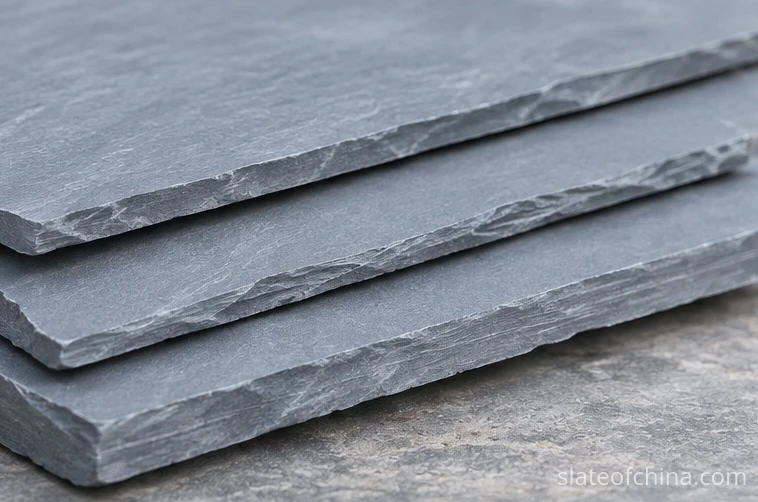
Read the table as a range, not a promise. The same box carries three times more area at 5–6 mm than at 13–15 mm, and that spread is entirely the density rule: thickness is the one specification that moves the load by a factor rather than a few per cent. It is also why a quote that names a size but not a thickness cannot be compared with anything.
One caution before the numbers are used: a band is not a target. 7–9 mm slate is sold within a range, and the batch's mean thickness — not the lower edge — decides the weight; the thickness guide covers how bands are measured. Packaging allowance also moves with crate design, so both inputs belong in the order, not in an assumption.
Weight vs Volume — Which Ceiling Binds First
The volume side is easy to underestimate and hard to make binding. Take the 26.3 tonnes of stone left after crating in the example above: at 2.7 t/m³ that is about 9.7 m³ of solid rock. The box offers roughly 33 m³. The stone occupies less than a third of the cube; crates, bearers, gaps and air take the rest.
That is why a full roofing slate load is usually weight-limited. It is not a law of nature, though. Very thin slate crated in bulky packaging, an inefficient crate footprint, a part-load built around mixed sizes, or a route with a low axle limit can all make space or configuration the deciding factor. The practical test is not an assumption but a layout: crate dimensions against the container floor, stack heights against the door opening, and the last row against the requirement to brace and close.
The centre aisle and the door gap are real, and they cost cube. A 5–8% allowance for unused volume is reasonable for a crated load, but it is an allowance, not a measured constant: a plan that ignores it will not close the doors, and one that treats it as fixed will leave weight on the table.
For most full-container roofing slate shipments, the permitted cargo weight is the primary constraint. Crate dimensions, loading configuration, weight distribution and securing requirements must still be checked before the final quantity is confirmed.
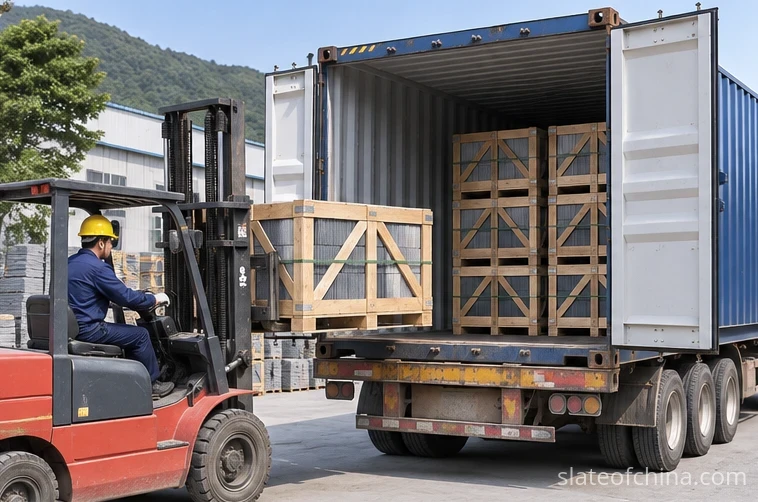
The Crate Is Where the Square Metres Are Counted
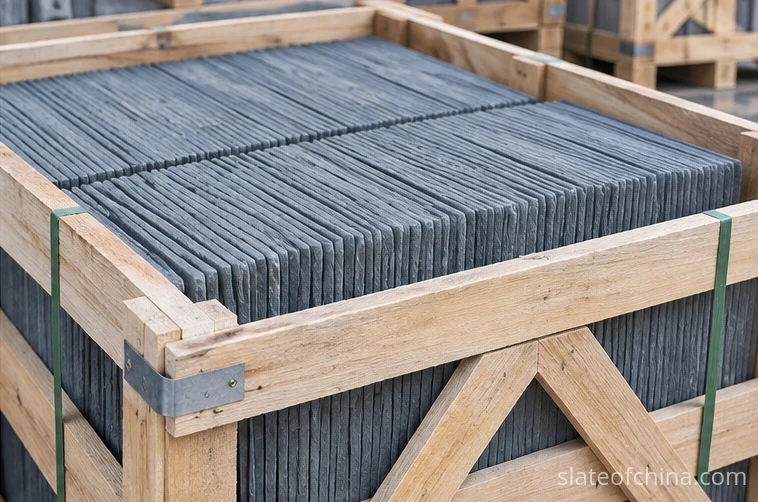
Container plans are written in crates, not tiles. The crate count, its footprint and its stack height decide the layout; the square metres are the crate count multiplied by the area inside each crate. For 500 × 250 mm slate, one of the standard sizes, one square metre is eight tiles of 0.125 m², so a 60 m² crate holds roughly 480 pieces. The per-size counts are in how many slates per square metre.
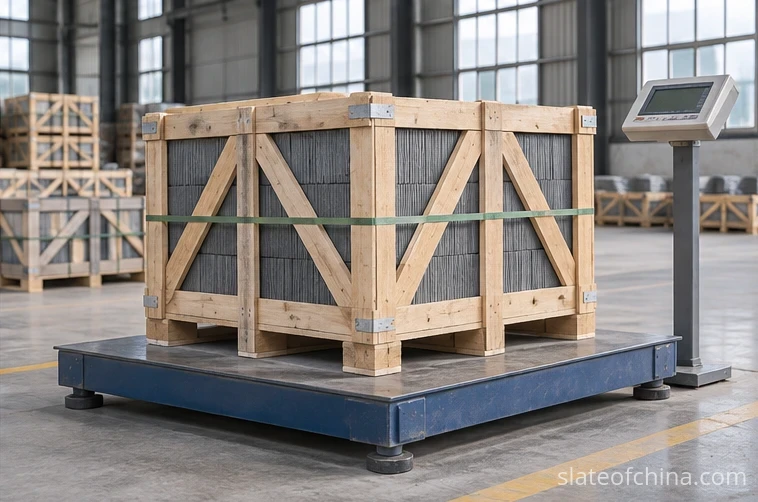
The crate also carries weight that is easy to forget. At 7–9 mm, 60 m² of stone weighs about 1.1–1.5 tonnes before the timber. Add the crate, bearers and strapping and the gross weight sits above that figure, which is why the packing list — not the stone calculation — is the document that settles a load. The packaging and crate standards set out what each crate should declare.
A figure that appears in supplier documents as "0.8–1.2 t per crate" belongs to a smaller crate, not to the 60 m² standard. A 20 m² thick-board crate of 13–15 mm slate holds about 0.7–0.8 tonnes of stone, and its gross weight falls at the bottom of that band. The lesson is not that one number is wrong and the other right; it is that crate area and crate weight have to be quoted together. A 60 m² crate cannot weigh less than the stone inside it.
Three figures should be on the table before any container quantity is accepted:
- Area per crate — for example 60 m² for standard slate, 20 m² for thick board.
- Gross weight per crate — from the weighbridge or the packing list, not from an average.
- Crate dimensions — length, width and height outside the timber, because they decide the floor plan and the stack.
With those three, the container quantity becomes a layout as well as a division: crates across the floor, rows to the door, and a gross total under the unit's permitted cargo weight.
Worked Example — 500 × 250 mm at 7–9 mm
Take the specification that generates most enquiries: 500 × 250 mm, 7–9 mm, a mean thickness of about 8 mm. The slate weighs 8 × 2.7 = 21.6 kg/m². The container is allowed 27,500 kg of cargo; the crates for a load of this size are assumed to weigh 1,200 kg in total.
| Line | Figure | Where it comes from |
|---|---|---|
| Permitted cargo weight | 27,500 kg | worked example — confirm on the container data plate |
| Crating allowance | −1,200 kg | crates, bearers, dunnage and straps (typically 1–1.5 t) |
| Stone available | 26,300 kg | 27,500 − 1,200 |
| Slate weight per m² | 21.6 kg/m² | 8 mm × 2.7 |
| Loadable area | ~1,215 m² | 26,300 ÷ 21.6 |
| Crates at 60 m² | 20 crates | 1,215 ÷ 60, rounded down |
| Stone in 20 crates | 25,920 kg | 1,200 m² × 21.6 |
| Load with crating | ~27.1 t | 25,920 + 1,200, inside the 27.5 t example |
The last line is the one that matters. Twenty crates carry 1,200 m² of stone, and with their packaging the load comes to about 27.1 tonnes — inside the 27.5-tonne example, with roughly 400 kg of margin. Twenty-one crates would carry 1,260 m² and about 28.5 tonnes gross, past the same ceiling. That is how a loading plan stops: not at the square metres the buyer wants, but at the last crate that keeps the scale legal.
Now the quotation from the opening. A supplier offering 1,400 m² for this specification is not inventing the number; the arithmetic produces it if the mean thickness is taken at 7 mm (18.9 kg/m²) and the crates are left out: 27,500 ÷ 18.9 = 1,455 m². Deduct the packaging and the same calculation lands near 1,390 m², and 1,400 m² would sit at or slightly above the ceiling once the crates are counted. The quote is a stone-only figure at the thin edge of the band. It is not dishonest; it is incomplete. Ask which mean thickness was used and whether the crates are inside the number, and the two quotes become comparable.
Calculate Your Own Container Quantity
The whole method is four lines on a calculator. It works for any size, any thickness and any container, provided the two inputs at the start are real.
- Slate weight per m². Mean thickness in millimetres × 2.7 = kg/m². A 7–9 mm band at 8 mm mean gives 21.6 kg/m².
- Stone available. Permitted cargo weight − packaging weight = kg of stone. Use the data plate and the packing list, not 27.5 t by default.
- Loadable area. Stone available ÷ kg/m² = m². 26,300 ÷ 21.6 = about 1,215 m².
- Crate count. m² ÷ area per crate = crates; then multiply back to check gross weight against the ceiling.
Written as one line: m² = (permitted cargo weight − packaging) ÷ (mean thickness × 2.7). The order matters. Subtracting the packaging at the end, or ignoring it, is the most common reason two suppliers quote different loads for the same box.
A supplier who can show these four lines is giving a checkable quotation. A round number without a thickness, a crate weight or a packaging allowance may still be honest, but it cannot be verified — and on a full container the gap between 1,215 and 1,400 m² is about four tonnes of stone that will not fit.
Practical Limits the Formula Does Not Show
Four things sit outside the arithmetic, and each one can change the final quantity after the division is done.
- The unit's rating. Maximum gross mass minus tare gives the payload. The figure is marked on the container's data plate; a booking confirmation that quotes a different number should be queried before loading.
- The route. Road axle limits, bridge restrictions, terminal rules and the line's accepted cargo weight can all sit below the container's rating. The forwarder's accepted figure is the one the driver will be measured against.
- The layout. Crate footprint, stack height and the door row decide how many crates physically go in. A plan that fits by weight but not by floor area is not a plan.
- The record. The packing list, the weighbridge ticket and the bill of lading should carry the same gross weight, crate count and area. A discrepancy between them is a port delay waiting to happen. The container loading guide covers the loading side and the inspection checklist covers arrival.
One sentence in the order prevents most of the argument: "approximately 1,215 m² in 20 crates, gross weight about 27.1 t, weighbridge-verified, loading plan attached." It turns a discussion about optimism into a check against a document. If a supplier cannot write that sentence, the question to ask is what they can write instead.
FAQ
How many square metres of roofing slate fit in a 20ft container?
Roughly 670–2,030 m² by thickness if only the stone is counted. A crated load carries less, because the packaging comes out of the permitted cargo weight first: with 1–1.5 t of crating, 7–9 mm slate lands at about 1,080–1,390 m², typically 18–23 crates. The formula is (permitted cargo weight − packaging) ÷ (mean thickness × 2.7).
Why do two suppliers quote different square metres for the same container?
Usually three inputs differ: the mean thickness used, whether the packaging weight was deducted, and the area per crate. For 7–9 mm slate, an 8 mm mean gives about 1,215 m² after crating, while a 7 mm mean gives about 1,390 m² — a difference of more than 10% from thickness alone. Ask for the thickness, the packaging allowance and the crate weight; comparable quotes use the same three.
How much does packaging reduce the load?
A full crated slate load typically uses 1–1.5 t of crates, bearers, dunnage and straps. At 21.6 kg/m², one tonne of packaging costs about 46 m², so the reduction is roughly 46–70 m². Thick-board crates use more timber per square metre, so the allowance should be taken from the packing list rather than assumed.
Does slate thickness change how many m² fit in a 20ft container?
Yes — it is the largest single factor. At 2.7 kg/m² per millimetre, 5–6 mm slate allows roughly 1,620–1,950 m² in a crated load, while 13–15 mm board allows about 650–750 m². A quote that names a slate size but not a thickness cannot be compared.
Why is roofing slate usually shipped in 20ft containers rather than 40ft?
Because the cargo is dense. A 40ft box adds volume, but not legal payload in proportion, and route limits often decide the accepted weight before the box's rating does. For crated slate the extra cube is usually paid for and left empty. A 40ft container can make sense for mixed loads or lighter products, not for a single dense slate order.
How do I calculate the container quantity for my own specification?
Four steps: mean thickness × 2.7 = kg/m²; permitted cargo weight − packaging = stone available; stone available ÷ kg/m² = m²; m² ÷ area per crate = crates. Then check the gross weight of the crate count against the ceiling. The worked example on this page runs it for 500 × 250 mm at 7–9 mm.
Is 27.5 tonnes the payload of every 20ft container?
No. It is a worked example. Payloads commonly fall between about 21 and 28 t depending on the unit's tare and rating, and road, terminal and line limits can reduce the accepted figure further. The number to use is the one on the data plate and in the booking confirmation.
Related Reading
Send the Spec — Get the Loading Plan Back
Every roofing slate quotation we issue includes the four lines above: the thickness used, the crate weight, the loadable area and the container plan for the batch. Send the size, thickness and roof area, and the arithmetic comes back with the offer. Ask for a loading plan · see the roofing slate range · view our test results