
Moss and Algae on Slate Roofs
30-second take
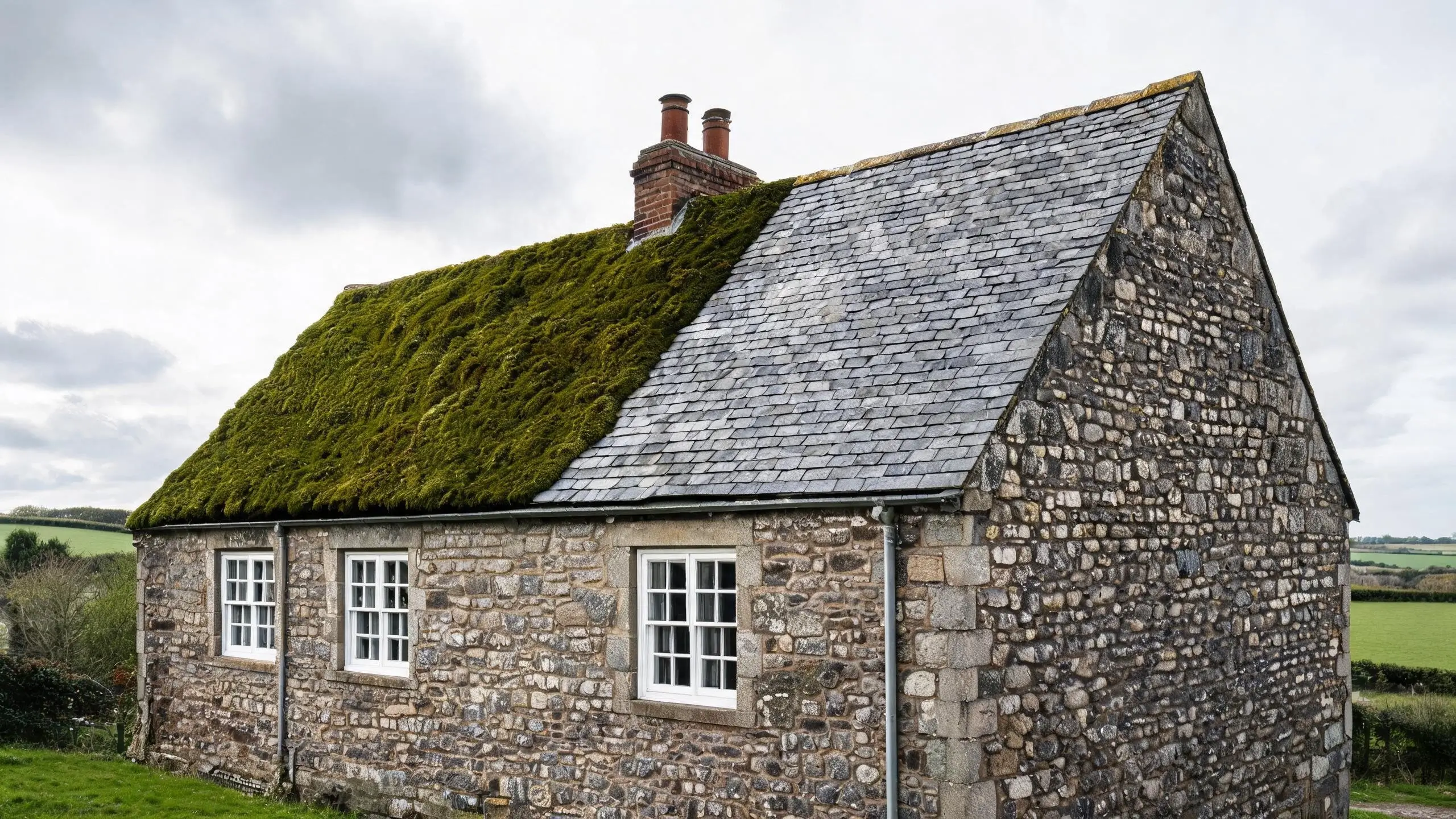
Moss does not eat slate. A slate roof can sit under a carpet of moss for a decade and come out of it with sound tiles — provided the moss stays out of the joints. The damage story is never "moss ate the slate"; it is "moss held water, redirected runoff, and hid the fixings until something under the tiles gave way".
Green light — moss covers under 30% of the slope, sits on the surface, and the joints between slates are clean. You can leave it this year.
Amber light — moss is spreading into the joints, or covering 30–60% of the roof. Plan a careful clean this autumn, and go round the roof while you are up there.
Red light — moss is packed into a valley, blocking a gutter run, or you have ever had a leak on the mossy slope. Do not clean first. Open up the suspect area, check the flashings and fixings, then clean. Cleaning hides, it does not fix.
What Is Actually Growing on Your Roof?
Three different things grow on slate, and they are not the same creature. Getting them straight saves you from treating the roof for the wrong problem.
Moss
Moss is the soft, cushiony green stuff that holds water like a sponge — roughly ten times its own weight in moisture. Its roots are not roots at all but tiny threads called rhizoids that grip the surface texture of the slate. They do not penetrate, they do not prise the tile apart, and they take no food from the stone. Slate is a metamorphic rock, denser than the tooth of almost anything on a roof; a moss plant simply cannot hurt it. Our own Jiujiang slate runs about 0.2% water absorption, and you can watch moss slide across a smooth face without ever getting a real hold — it colonises the edges, the joints, and the rough parts instead.
Algae
Algae is the black, smoky staining that runs down the roof in streaks, usually on the north side and under the eaves. Most of it on roofs in the UK is a cyanobacterium called Gloeocapsa magma, and it spreads by water splash and airborne spores. It looks worse than it is: on slate it is cosmetic. But it is also a humidity map — where algae streaks, water runs, and where water runs is where the roof is doing something worth watching.
Lichen
Lichen is the grey-green, crusty, slow patch you find on older roofs — the flat one that looks fossilised to the tile. It grows at a glacial pace and is almost universally harmless. On an old property, a light frosting of lichen is usually read by surveyors as a badge of age, not a fault. Leave it alone.
If you want the full framework for what these growths do over a roof's lifetime, the slate roof maintenance guide covers the wider cleaning and care routine these observations fit into.
What the Moss Is Telling You
Here is the mental shift that saves people the most money: treat moss as a weather station, not as a weed. The pattern of growth on the roof is a report on what that roof has been living through for the last five or ten years.
- Moss heavy on the north slope and under trees — the roof is shaded and damp. The problem is the environment, not the moss.
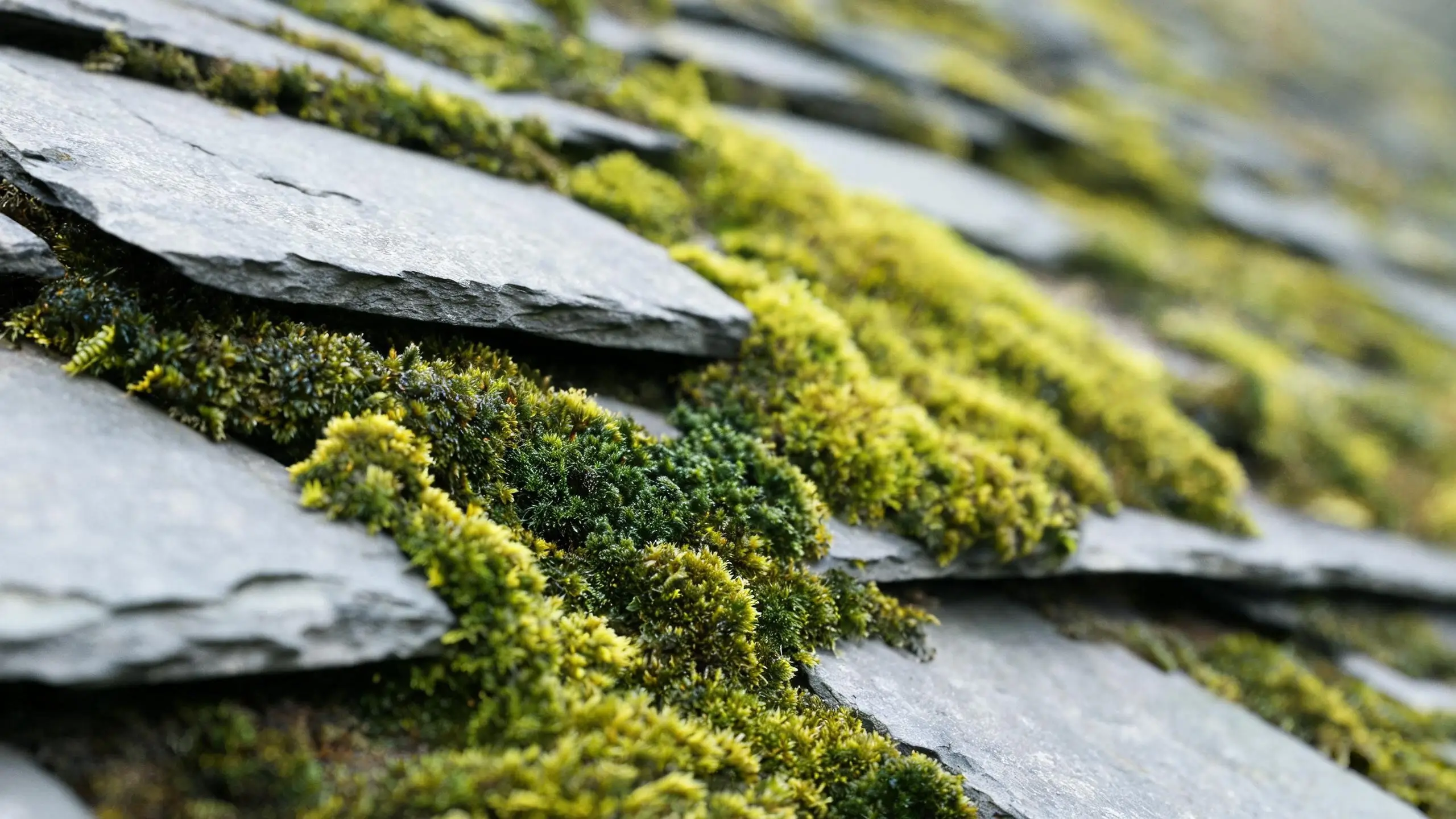
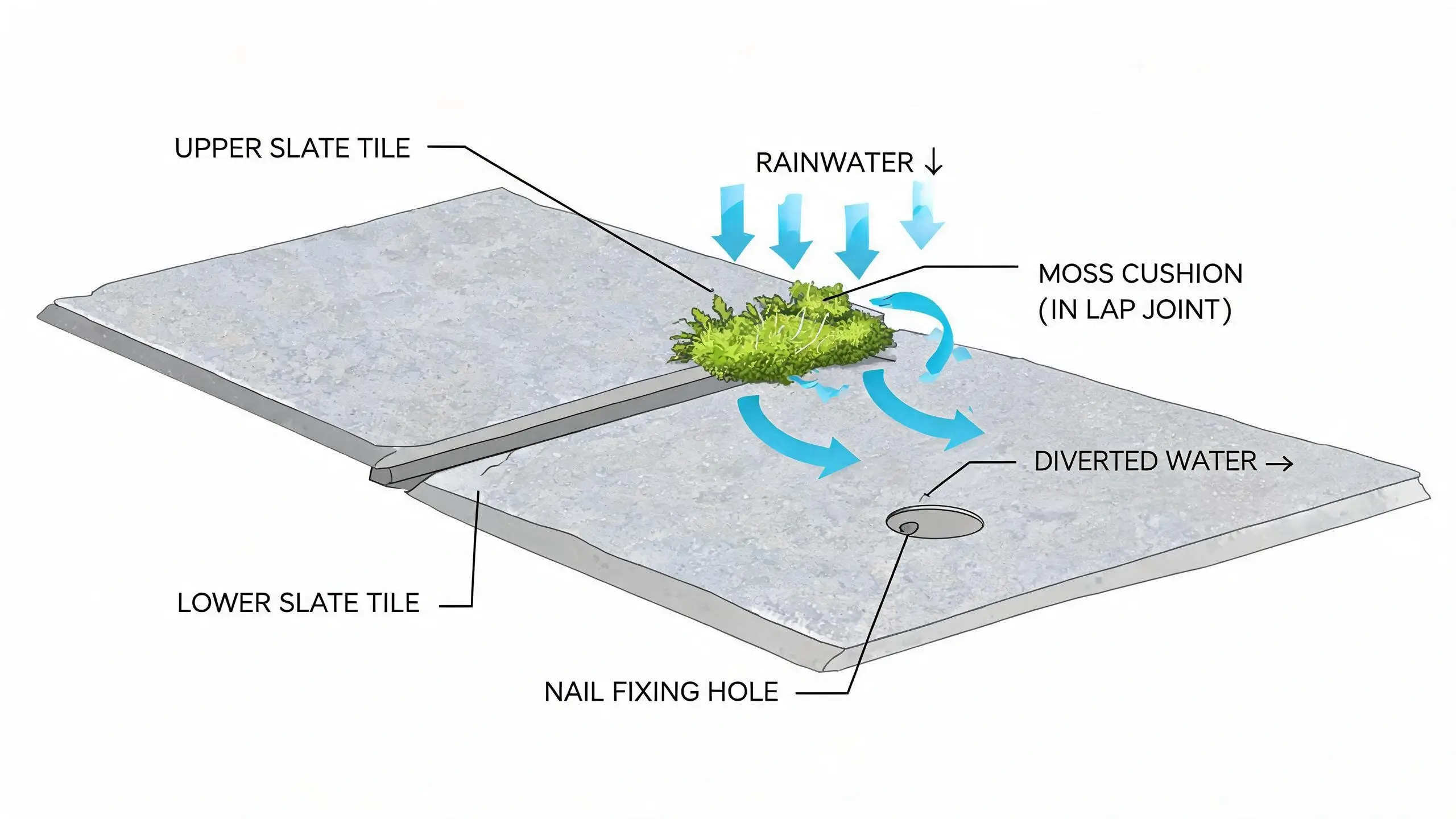
- Moss filling the joints between slates — this is the one to watch. Clean joints are the roof's drainage system; moss in them acts like a sponge that holds water against the underside of the slates and the fixings.
- Moss in a valley, or at the base of a chimney — water gathers there by design, and moss tells you it gathers there more than the design allows. Check the flashings before you blame the moss.
- Black streaks running down the slope — a sign that runoff is following one channel, which usually means a blocked or damaged joint is forcing the water into a single route.
- An even, complete sheet of moss over the whole slope — on an old roof this can mean the surface has weathered porous and now holds water that it used to shed. That is a slate quality question, and the numbers that matter are the ones in the water absorption guide and our EN 12326 / ASTM C406 test results.
My rule of thumb after thirty years: moss at 30% coverage is a feature. Moss at 60% coverage that has started to grow into the joints is a process. And moss in the valley of a roof you have already had a leak on is a symptom you want to treat as urgent.
When Moss Actually Starts to Hurt a Slate Roof
Not by itself — always by what it does to the water. Four mechanisms are worth memorising, because they are the four ways I have watched moss damage roofs in a long career of replacing slates.
1. It hoards water, and freeze–thaw does the rest
A moss carpet holds roughly ten times its own weight in water against the slate. On a cold night that water freezes into the cracks and the open joints, and every freeze pushes a little further. One mossy joint will see more freeze cycles than the rest of the roof put together. Slate that would have survived a hundred winters dies in twenty when a moss pad keeps a joint wet all autumn. The physics of that cycle is covered in detail in our freeze–thaw resistance guide, which is the piece I send people who want the numbers, not the story.
2. It blocks the drainage, and the water finds a new route
Water always goes somewhere. When moss plugs a joint or a gutter, the runoff is forced sideways, up under a slate, or down into a fixing hole. In practice, the most common leak I see on a mossy roof is not a damaged slate at all — it is water being diverted by moss to a valley flashing, a nail hole, or a junction that never expected to see water. The next time water appears indoors, the question is not "is my slate cracked" but "where did the moss send it". That is the same principle as the leak-tracing walk-through we wrote about slate versus flashings.
3. It hides what you need to see
A thick moss cover is an effective blindfold on your roof. Every inspection you skip because "you can't see anything anyway" is a year of a slipped slate, a rusted nail, or a popped flashing staying invisible. Cleaning moss is not gardening, it is an inspection revealed. We have a whole article on how often a slate roof should be inspected — the honest answer is "more often than it looks like you need when the roof is covered in moss".
4. It keeps the flashings damp
Metal flashings last 20–25 years when they stay dry. Keep them wrapped in a wet moss sponge and they rust years early — and rust is what starts most flashing leaks, not the slate beside them. On a mossy roof, the flashings die first; the slates are usually innocent, which is why the replacement bill feels so unfair.
The slate itself, in other words, is the last thing that suffers. If you have ever found a broken roofing slate on a mossy roof, do not point at the moss — take the slate down and read the break, because nine times out of ten the moss was a bystander to the cause.
How to Remove Moss and Algae Without Damaging the Slate
The cleaning is simple, the damage is almost always from the cleaning. Here is the order I use, and the tools I reach for from softest to strongest:
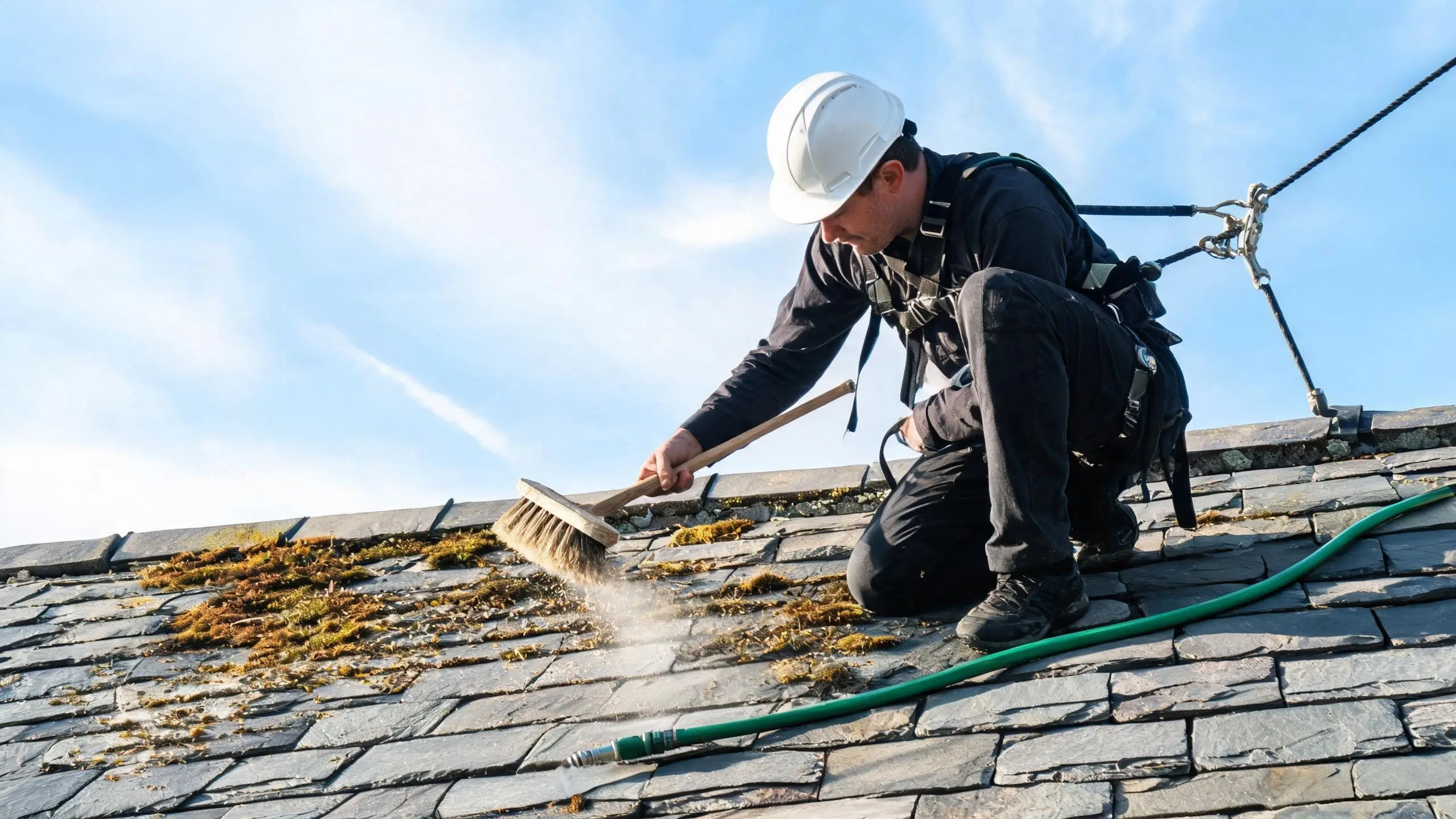
- Soft brush first, always. A long-handled, stiff-bristle brush (plastic or natural, never metal wire). Work on a dry day after 2–3 days of no rain — moss at that point is crisp and comes off in flakes rather than smearing. Brush uphill, from the eaves towards the ridge, so the loose material drops off the roof instead of being pushed under the slates.
- Garden hose, low pressure. A wide, gentle spray from the hose will wash the loosened bits off. Hold the nozzle at least 30 cm from the slates, spray across the slope — never straight up under the tiles, and never at the joints at a hard angle.
- Slate-safe cleaner for stubborn patches. There are roof cleaners formulated for natural slate — usually zinc- or ammonium-based products, sold for exactly this job. Follow the label, dilute correctly, and rinse thoroughly. Two things I never do: never use hydrochloric acid on slate (it eats the surface and the colour with it), and never use a pressure washer to the point where you can hear the water hissing off the stone.
- Pressure washer, only as a last resort. If a pressure washer is the right tool for the job, keep it under around 1500 psi with a wide fan nozzle, stand back so the spray is soft, and never direct it at the joint between two slates. A slate lifted by a pressure washer is a slate you will be replacing.
Never clean in freezing weather — moss with frost in it is a skating rink and the risk of slipping is not worth any roof. And whatever you clear, sweep the wet moss out of the gutter afterwards; moss stuffed into a blocked gutter is how an otherwise fine clean finishes as a flashing and leak job instead.
While you are up there with a brush, you are effectively doing a free inspection. Look for the four things we wrote about in how often to inspect: rusty nail heads, popped slates, cracked or chipped tiles, and flashings that are going. Write them down, photograph them, and fix them before the moss regrows and hides them again.
The Prevention Plan: What to Do So You Never Have to Fight Moss
Cleaning a slate roof is like cutting weeds in the garden — you will be doing it forever. The clever part is changing the conditions, not just the surface.
- Trim the canopy. The single biggest cause of a mossy roof is a tree shading it. Cut back anything that keeps the slope in permanent shade and you will slow the moss by 60–70%. This sounds obvious and nobody does it.
- Keep the gutters open and the drainage clear. Moss grows where water lingers; water lingers where drains are blocked.
- Let the roof breathe. A roof that cannot dry out grows moss, and the drying matters most at the ridge and the eaves — the two places people seal up in the name of "finishing" the roof.
- Zinc or copper strips at the ridge. A thin strip of zinc — or, for the same purpose, copper — fixed along the ridge will, over a couple of seasons, release metal ions that wash down the slope with every rain and suppress algae and moss growth. They are cheap, unobtrusive, and last as long as the roof. Copper is the stronger algae-killer on the north face; zinc is gentler and better value for moss. Neither is magic on an already-mossy roof — strip the roof first, then fit the metal as a prevention, not a cure.
On older, character properties, there is a strong argument for leaving a reasonable moss on the roof alone entirely. A slate roof with a light moss halo looks like what it is — a roof that has been there a hundred years and will be there a hundred more. The mistake is never "I left the moss on"; it is "I left the moss on and never looked underneath".
One Roof I Will Never Forget
In a Yorkshire Dales valley, a slate roof on a 19th-century farmhouse had a north slope carrying a heavy moss carpet for decades. When the owner finally cleaned it, the slates underneath were perfectly sound — but the roof had a slow leak that had never been traced. We pulled the moss off the joints, and there it was: the moss had been sitting in the joints like a wet sponge, holding runoff against the fixings and slowly rusting the nails that held the slates down. The tiles were innocent all along; the roof had failed because the moss kept the water where the iron could die. We cleaned, replaced three tiles, cut back the sycamore that shaded the slope, and fitted a ridge strip. Eight years later, that north face carries about 15% moss and no leak has come back.
That is the pattern in nearly every moss-related failure I have seen: not the moss on the stone, but the moss between the stones. Keep the joints clear and let the roof breathe, and the green will stay on the surface where it belongs — decoration, not demolition.
FAQ — moss and algae on slate roofs
Does moss damage a slate roof?
Moss itself does not eat or corrode slate — it has no mechanism to harm the stone. What moss does is hold water against the joints, the fixings and the flashings, which speeds up freezing cycles, rusting nails, and rot in wooden battens. Moss under 30% coverage and out of the joints is harmless; moss filling the joints or covering 60% of the slope is a process that will eventually show up as a leak. The risk is about the joints, not the carpet.
How do I remove moss from a slate roof?
Soft brush when the moss is dry (2–3 dry days after rain), brushing uphill so the debris falls off the roof; then a gentle garden-hose rinse, holding the nozzle 30 cm from the slates and never spraying up under the joints. For stubborn patches, use a slate-safe cleaner and follow the label. Never use a metal scraper, never clean in freezing weather, and never hit the joints with high pressure.
Can I pressure wash my slate roof?
You can, but a slate roof is the last surface in the world that a pressure washer should touch. If you must, keep the machine under about 1500 psi, use a wide fan nozzle, stand well back, and never aim directly at the joint between two slates or up under a lifted slate. If a slate is already loose, the washer will finish it. For most roofs, a soft brush and a hose do the same job with far less risk.
What are the black streaks on my slate roof?
Those streaks are almost always algae — a cyanobacterium commonly called Gloeocapsa — not moss and not a stain in the slate. It spreads with water splash and wind, so it streaks on the shaded side and under the eaves. On slate it is cosmetic, but it is a useful map: wherever the streaks run, water runs, so they point to the joints and drains worth watching.
Do zinc or copper strips really stop moss?
They work, but slowly and as a prevention rather than a cure. Rain washes a trace of metal ions down the roof and suppresses algae and moss growth, typically over 1–2 seasons. Copper is the stronger algae stopper on the north face; zinc is gentler and better value for moss. Fit the strip only after cleaning a mossy roof — on a roof that is already green they do very little.
Should I worry about moss on the north side of my roof?
The north slope of any roof is naturally the dampest and moss grows there first — a thin, joint-cleaning growth on the north face is expected and rarely a problem. Start to worry when the moss fills the joints, climbs over the valleys, hides the fixings, or follows a leak. That is when the north slope stops being "the damp side" and starts being "the wet side that is costing you the roof".
Related Reading
Is your roof sending you a signal?
If the moss is winning and the slates underneath have been wet for years, start with slate that can prove it can take the wet. Our roofing slate is tested to EN 12326 and ASTM C406, with water absorption around 0.2% — a roof surface that refuses to feed the moss and freeze.