
Can You Walk on a Slate Roof?
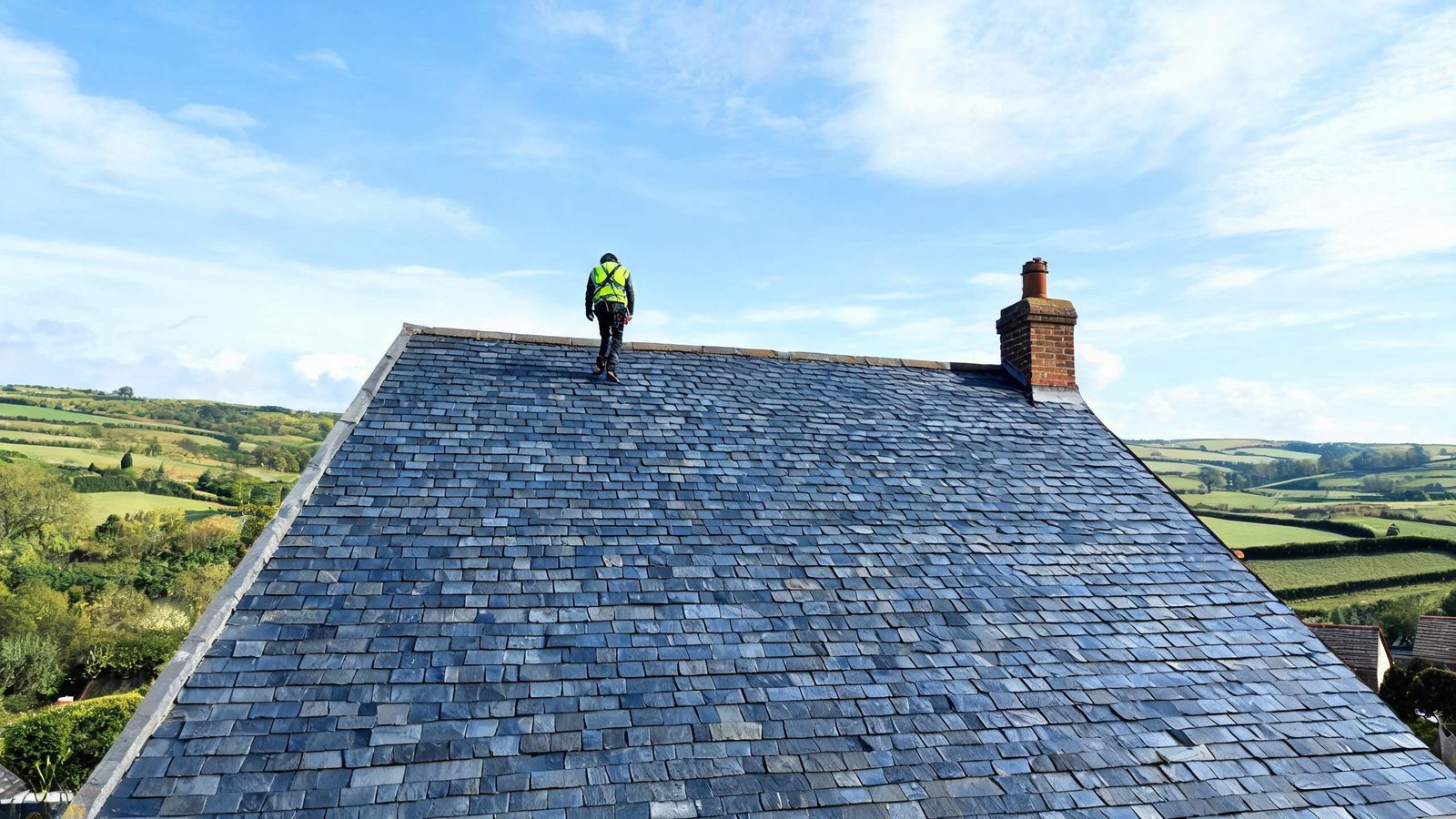
Here is a number that surprises everyone who has never held a roofing slate. In a laboratory, a standard 6 mm roofing slate tested in three-point bending fails at about 3.8 kilonewtons — roughly 390 kilograms of force. Here is the other number: an adult standing on one foot on a roof applies about 0.8 to 1.2 kilonewtons of concentrated load. Do the maths and you should be fine. You are not fine. Every slater alive has watched a tile crack clean in half under a single misplaced boot. So the answer to "can you walk on a slate roof" is not yes or no — it is under what conditions.
Quick answer — when can you?
| You CAN walk on a slate roof when… | You should NOT walk on a slate roof when… |
|---|---|
| You step on the lower overlapping edge (the head) where the batten sits underneath | You step on the exposed centre of the tile — the unsupported span |
| You wear soft-soled boots and distribute weight across both feet | You wear hard boots, work boots with steel toe caps, or trainers with hard lugs |
| The roof is dry and the pitch is moderate (under 40°) | The roof is wet, frosty, mossy, or steeper than 40° |
| You use a roof ladder or crawl board for upper slopes | You are not wearing a harness clipped to a ridge anchor |
| You know the five rules (below) and have done it before | You are a homeowner doing a one-off DIY job with no training |
If you only remember three words from this article, make them these: step on the overlap, not the open face. The tile breaks where it is unsupported, and it holds where the batten sits beneath it.
Why a Slate That Holds 390 kg in the Lab Breaks Under One Boot
The paradox has a simple explanation, and understanding it is the difference between a roof you walk once and a roof you walk for thirty years without incident.
In a three-point bending test, the slate rests on two steel rollers 200 mm apart, and a third roller presses down dead-centre between them. The force is applied evenly, the slate is flat, and the stone does what stone does: it holds until it reaches its breaking load, then snaps. On a roof, none of those conditions are true. The tile is not resting on two neat rollers — it is hanging from one or two nails at its head, with its tail overlapping the tile below. The batten sits underneath the head, but the exposed middle of the tile — the part you see from the ground — spans the gap between one batten and the next, with nothing under it but air. That gap is called the gauge, and on a typical roof it is somewhere between 75 and 150 mm.
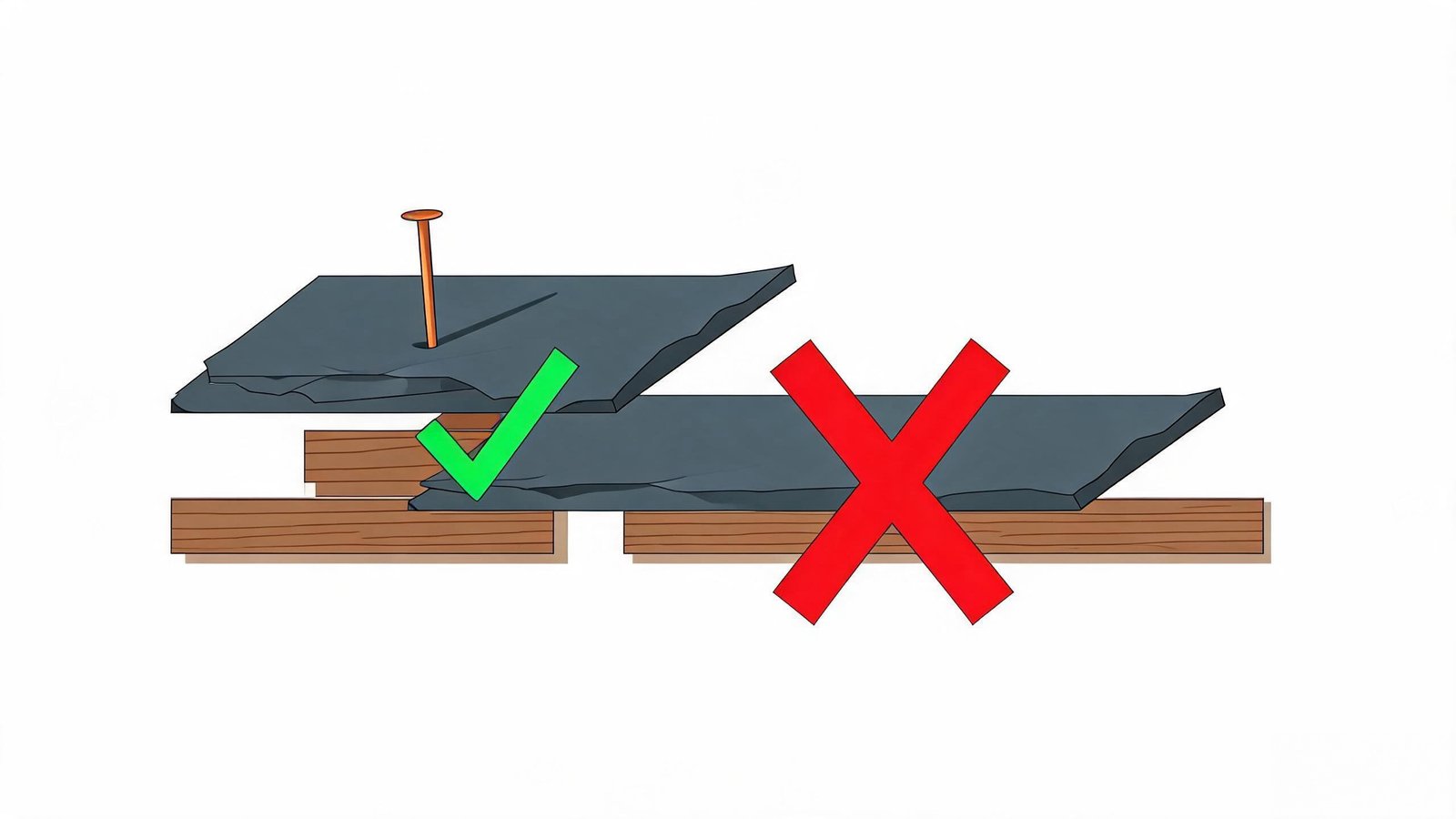
Now put your boot on that exposed centre. The tile is not loaded evenly — it is loaded at one point, somewhere between the nailed head and the free tail, with your entire body weight concentrated on a circle of rubber about 80 mm across. The stone is trying to bend, but it cannot bend, because it is brittle. Instead of flexing like a piece of timber, it cracks. The load that does this is not 3.8 kN. It is frequently under 1 kN, because the geometry of the roof — the nail, the overlap, the unsupported span — concentrates the stress far more efficiently than any lab jig.
In other words: the lab tests the material; the roof tests the system. You are not standing on a piece of stone. You are standing on a tile that hangs from a nail, spans a gap, and breaks when the gap flexes. If you want the full technical framework for how those spans, gauges and overlaps are calculated, the headlap, gauge and exposure guide breaks it down with the exact numbers. For walking, what matters is this: step where the support is, and the tile holds. Step where it is not, and it does not.
The Five Rules of Walking on a Slate Roof
I teach these to every apprentice who works with me. Not because they are on a training card, but because each one corresponds to a cracked tile I have had to pay for.
Rule 1 — Step on the overlap, not the open face
The lower third of every slate — the part tucked under the tile above — sits directly on the batten. That is where the timber is, and timber takes your weight. The upper two-thirds, the part you can see from the garden, is hanging in the air between two battens. Step on the bottom, you are standing on wood. Step on the top, you are standing on a stone bridge with nothing underneath. The three-word version I repeat on site: step low, not high.
Rule 2 — Soft soles, always
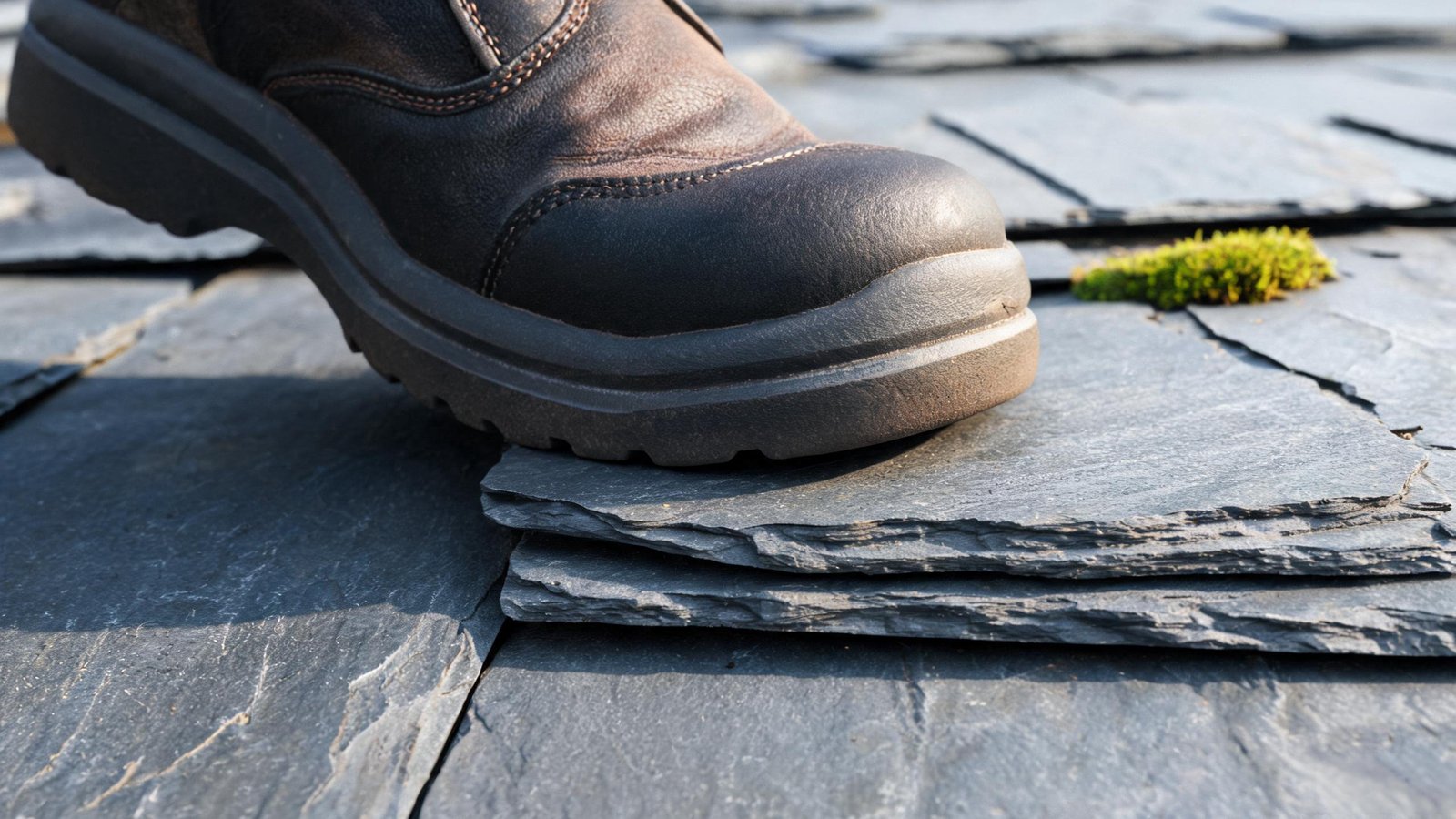
The boot matters more than people think. A soft-rubber-soled boot spreads the load across a wider contact area and grips the slate surface; a hard-soled boot or a steel-toe work boot concentrates the force into a smaller, stiffer patch and slides more easily on the smooth cleft face. I have seen a slate survive a 90 kg roofer in soft trainers and crack under a 70 kg roofer in rigid hiking boots on the same slope, the same day. Soft sole, flat foot, full sole contact. No heel walking, no toe digging.
Rule 3 — Distribute your weight across both feet and the ladder
Never put all your weight on one foot if you can avoid it. When you stop to work, keep at least one foot on the ladder or a roof crawler, and transfer weight gradually — never drop a foot hard onto a tile. The more of your weight that goes through a ladder resting on padded bearers, the less goes through any single slate. A well-installed slate roof with properly spaced battens gives every tile the same support; the job of the walker is to not defeat that support by loading one point.
Rule 4 — Never walk a wet, frosty, or mossy roof
Slate is smooth. Wet slate is an ice rink. Frosty slate is a death trap. And mossy slate hides the surface texture that your soft soles need to grip. Beyond the safety risk, a slip on a slate roof almost always ends with a cracked tile — you catch yourself with a knee or an elbow, and the point load does the damage. If the roof is anything but dry, clean it first or come back another day. The most common cause of foot-traffic breakage on the roofs I inspect is not a bad step in good conditions — it is a panicked step in bad ones.
Rule 5 — Use a roof ladder for anything above eaves height
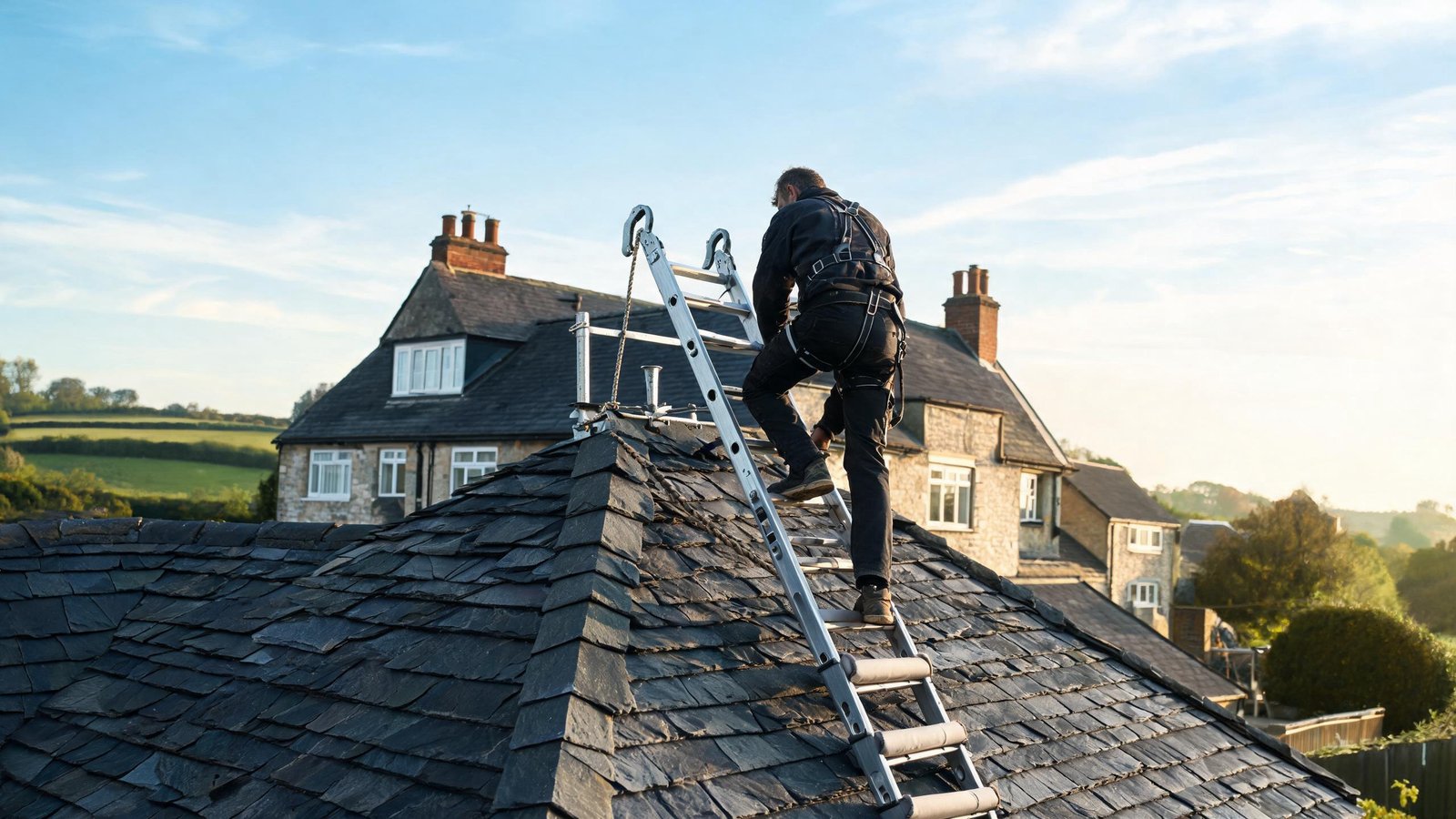
A roof ladder — also called a crawl board or roof crawler — hooks over the ridge and rests on padded bearers that spread your weight across several tiles at once. It is the single most effective tool for walking a slate roof safely, and the one most homeowners do not own. For a chimney repair, a flashing check, or anything more than a quick look at the eaves, a roof ladder is not optional. It converts your point load into a distributed load, and it does it without you having to think about where your foot lands.
When You Should Not Be on the Roof at All
There are situations where the question is not "how do I walk on this roof" but "why am I on this roof". If any of these apply, step back:
- The pitch is steeper than 40 degrees. Above this angle, the mechanics shift — your weight is no longer pressing down through the tile but sliding along it. Even a professional slater uses a roof ladder and a harness on pitches this steep. If you are asking the question, you should not be answering it on the roof.
- The roof is more than 60 years old. Old slates are not necessarily fragile — many are superb — but the nails may be rusting, the battens may be soft, and a tile that looks intact can crack the moment you transfer weight to it. An inspection from below — a ladder at the eaves, binoculars from the ground — tells you more than a walk.
- You are alone. Nobody should be on a slate roof without someone on the ground who knows they are there. This is not a training rule — it is a survival rule.
- You are carrying something heavy. A bundle of slates, a tool bag, a roll of underlayment — every extra kilogram you carry is another kilogram concentrated on one foot at a time. Sling materials up on a rope; do not carry them on your shoulder.
- You are in a hurry. Almost every tile I have ever seen broken by foot traffic was broken by someone who was rushing. The last tile on the way down. The quick step across to the chimney. The five-minute job that cost a two-hour repair.
What Boots, What Tools, What Gear
If you have to go up, go up equipped. Here is the short list:
| Item | Why it matters | What to look for |
|---|---|---|
| Boots | Spread load, grip the surface, do not mark the slate | Soft rubber sole, flat profile, no steel toe, no deep lugs |
| Harness | Stops a slip from becoming a fall | Full-body harness, lanyard to a ridge anchor, not to the slates |
| Roof ladder | Distributes weight across multiple tiles | Padded hooks over ridge, padded bearers under rungs |
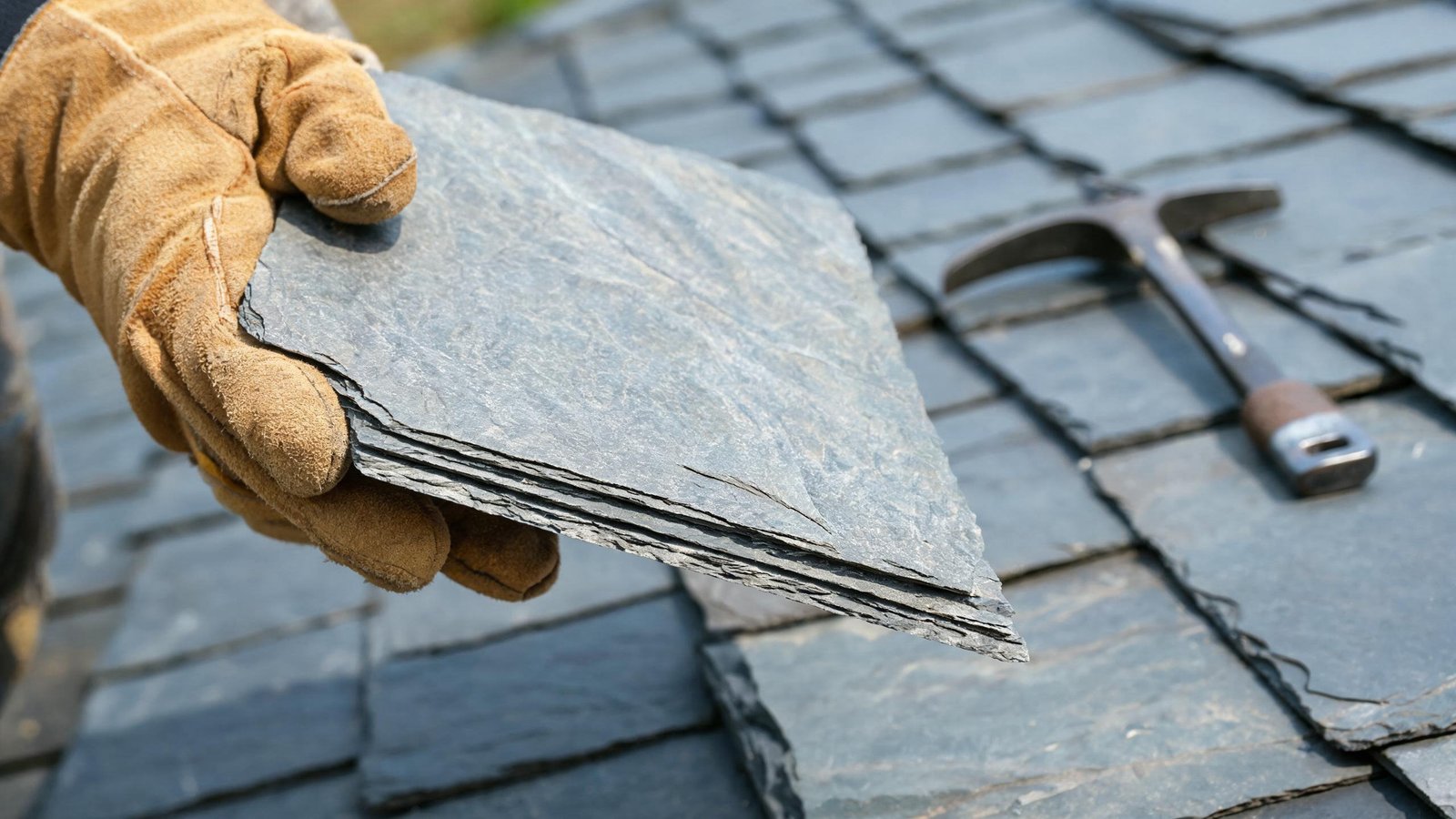
| Slate ripper | Cuts the nail behind a broken tile without lifting its neighbours | A flat, hooked blade on a long handle; a slater's essential tool |
| Slate hammer | Drives nails, punches nail heads, cuts slate edges | Specialised tool with a spike at the back for making nail holes |
The harness point deserves emphasis: clip your lanyard to a ridge anchor — a metal bracket fixed into the roof structure at the ridge — never to a slate, a nail, or a batten end. A slate will pull out under your body weight. That is exactly what it is designed to do when the load is wrong, and your body weight is always the wrong load for a single fixing point.
What If You Already Cracked One?
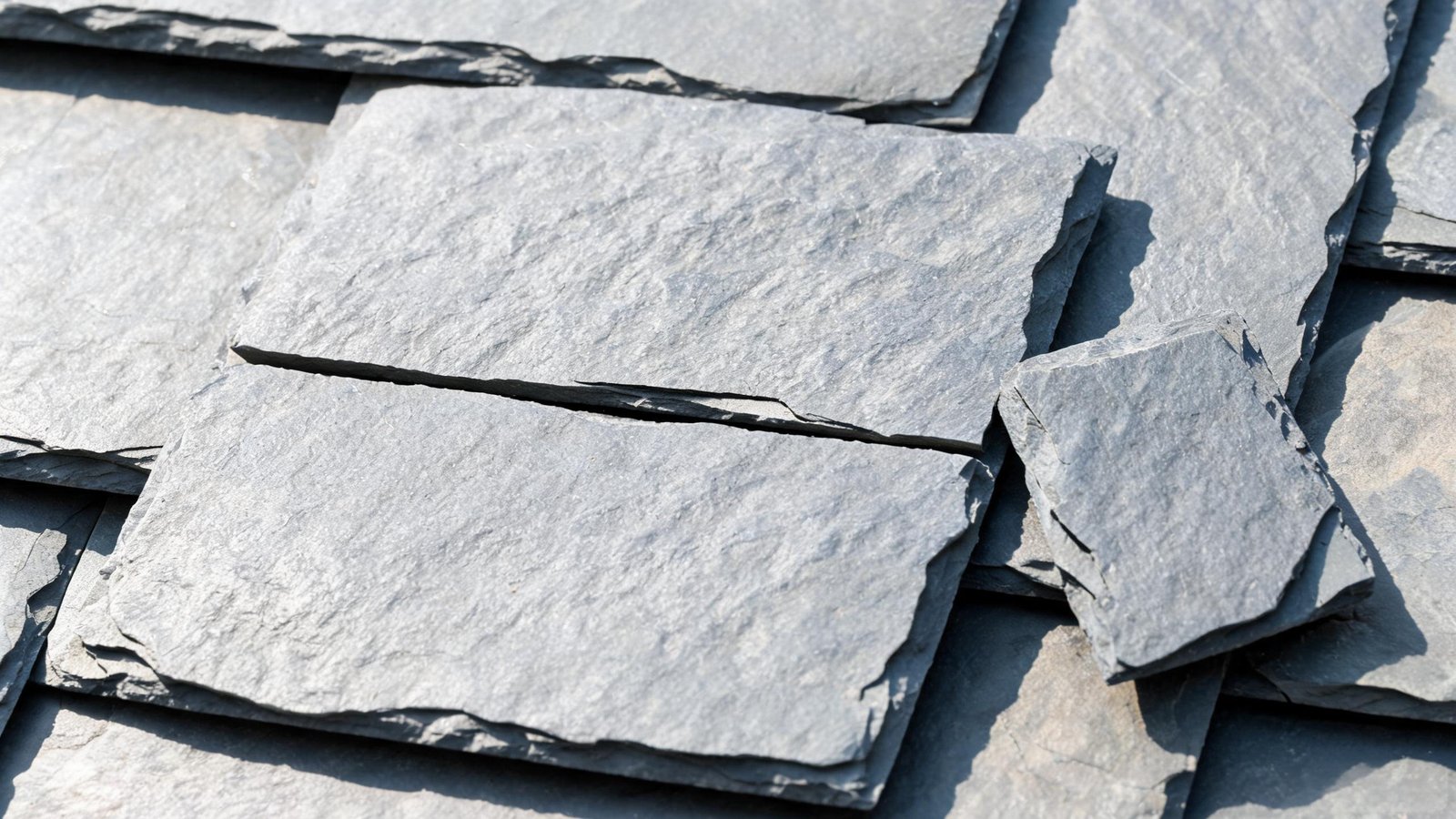
A tile cracked by foot traffic has a signature: a clean, straight crack running across the width of the slate, usually somewhere near the middle of the exposed face. It is not the jagged, scalloped break of a hail impact, the meandering, whitened edge of frost damage, or the radial crack spreading from a nail hole. It is a straight line, and it is in the middle, because that is where your foot was. If you want to read the difference, the fracture-reading guide covers every crack pattern and its cause.
The good news: one cracked slate is a twenty-minute repair if you have the right tool and know the technique. The individual slate replacement guide walks through the full process — cutting the nail behind the broken tile without disturbing its neighbours, sliding in the replacement, and fixing it with a hook or a nail. The bad news: if you cracked one by walking, you probably do not have the tool, the technique, or the confidence to replace it yourself, and the repair will cost you a call-out fee from a slater who does.
That is the real cost of walking on a slate roof without knowing how. Not the cracked tile — a tile is cheap. The call-out. The scaffold. The hour of a professional's time to fix what a five-minute walk broke. If the reason you went up was to inspect the roof, you have now created a repair job that requires another inspection to confirm it was done properly. The inspection schedule we recommend is designed to minimise the number of times anyone needs to walk the roof at all.
The Real Question: Do You Need to Walk It at All?
Most of the time, no. A slate roof is one of the few building elements that is better inspected from a distance than from the surface. Binoculars from the ground, a ladder at the eaves, a drone flight, an annual look from the loft — these tell you almost everything you need to know about a slate roof without a single boot touching a tile. The view from the roof is rarely better than the view from the ground, and the risk of being on it is always worse than the risk of not being on it.
When someone does need to walk the roof — to repair a flashing, replace a broken slate, or check a valley — that someone should be a slater who knows the five rules, owns the tools, and is insured for the work. If your roof is leaking, the question is not whether you can walk on it. The question is whether you are going to find the leak, or make it worse. The leak-tracing guide starts in the loft, not on the roof.
And if the roof needs new slates — if the old ones have served their century and the time has come — the quality of the replacement matters more than anything you do on top of the old one. A slate that is tested to EN 12326 and ASTM C406, with a water absorption under 0.2% and a flexural strength that holds up to the lab numbers, is a roof that the next generation will walk on — carefully, by a professional, once every twenty years.
Can you walk on a slate roof without breaking the tiles?
Yes, but only if you step on the lower overlapping edge of each tile — where the wooden batten sits underneath — wear soft-soled boots, keep your weight on both feet or a roof ladder, and the roof is dry. Stepping on the exposed centre of a slate, where it spans unsupported between battens, is what cracks tiles. A trained slater follows these rules; a homeowner doing a one-off job usually does not.
What shoes should I wear on a slate roof?
Soft rubber-soled boots with a flat profile — no steel toe caps, no deep lugs, no rigid hiking soles. The soft sole spreads your weight across a wider contact area and grips the smooth cleft surface of the slate. Hard-soled boots concentrate the load into a smaller, stiffer patch and slide more easily. The boot matters as much as where you step.
When should you never walk on a slate roof?
Never walk a slate roof that is wet, frosty, or mossy — the surface is too slippery to grip safely, and a slip almost always cracks a tile. Do not walk a pitch steeper than 40 degrees without a roof ladder and harness. Do not walk alone, do not carry heavy materials on your shoulder, and do not walk if you are in a hurry. If any of these apply, inspect from the ground or the loft instead.
How do you fix a slate cracked by walking?
A foot-traffic crack is a clean, straight break across the middle of the tile. The repair involves cutting the nail behind the broken tile with a slate ripper, sliding out the pieces, and inserting a replacement slate fixed with a hook or nail — without lifting the neighbouring tiles. It takes about twenty minutes for a professional with the right tools. If you do not own a slate ripper, the repair requires a call-out.
Do I need a roof ladder for a slate roof?
For anything above eaves height, yes. A roof ladder (crawl board) hooks over the ridge and rests on padded bearers that spread your weight across several tiles at once, converting a point load into a distributed load. It is the most effective tool for walking a slate roof safely, and the one most homeowners do not own. For chimney repairs, flashing work, or ridge inspections, a roof ladder is not optional.
Can I inspect my slate roof without going on it?
Yes, and you should. Binoculars from the ground spot slipped, cracked, or missing tiles. A ladder at the eaves lets you check the lower rows and the gutter line. A look from the loft reveals water stains, daylight through gaps, and the condition of the underside. A drone gives a full roof survey without anyone touching a tile. A slate roof is one of the few building elements better inspected from a distance than from the surface.
Related Reading
Building a roof people can trust for a century?
A slate roof is only as walkable as the system beneath it — proper battens, proper gauges, proper fixing. Our roofing slate is CNC-processed to tight tolerances so every tile sits flat, every batten is evenly loaded, and every step lands where the support is. EN 12326 and ASTM C406 tested, 100% individually inspected.