
📏Weight by Size & Thickness
Compare the weight of popular roofing slate sizes and thicknesses.
🏠 Weight per m²
Calculate roof loads using weight per square meter and coverage.
🚢 Shipping & Packaging
Estimate pallet weights, container loading and freight costs.
🏗 Roof Structure
Ensure your roof can safely support natural slate tiles.
Roofing Slate Weight Guide: Weight by Size, Thickness & Coverage
Discover how much natural roofing slate weighs by tile size, thickness and roof coverage. Learn how slate weight affects roof structure, installation, transportation, shipping costs and project planning, with practical charts and expert guidance.
Roofing slate is one of the most durable roofing materials available, but it is also heavier than asphalt shingles or metal roofing. Whether you’re designing a new roof, replacing an existing one or importing slate for your next project, understanding roofing slate weight is essential. This guide explains how slate weight varies by size, thickness and coverage, and how it affects roof design, installation, transportation and overall project costs.
Table of Contents
Why Roofing Slate Weight Matters
Natural roofing slate is renowned for its exceptional durability, timeless appearance and service life of over 100 years. However, it is also one of the heaviest roofing materials available, making roofing slate weight a critical factor in every roofing project.
Whether you’re a homeowner planning a new roof, a roofing contractor estimating materials, an architect designing a roof structure, or an importer calculating shipping costs, understanding slate roof weight helps you make informed decisions from the start.
The weight of natural slate influences many aspects of a project, including roof structural requirements, installation methods, labor efficiency, material planning, pallet and container loading, transportation costs, and even the long-term performance of the roof. Choosing the right slate size and slate thickness ensures the roof remains both structurally safe and cost-effective throughout its lifespan.
In this guide, you’ll learn how roofing slate weight is calculated, compare the weight of different slate tile sizes and thicknesses, understand weight per square meter (kg/m²), and discover practical tips for roof design, shipping and installation.
Before buying roofing slate, understanding its weight is just as important as knowing its size or thickness.
📌 Key Takeaways
- Roofing slate weight depends mainly on tile size, thickness and stone density.
- Heavier slate requires stronger roof structures and careful installation planning.
- Weight affects transportation costs, pallet loading and container capacity.
- Calculating weight per square meter helps estimate total roof loads accurately.
- Selecting the right slate can improve both installation efficiency and long-term roof performance.
What Determines Roofing Slate Weight?
Many people assume that all roofing slate weighs the same, but that’s not the case. The weight of a natural roofing slate tile can vary significantly depending on its size, thickness, and the density of the stone. Even two slate tiles with the same dimensions may differ slightly in weight because natural stone is not a manufactured product.
Understanding these three factors helps you estimate slate roof weight, calculate roof loads, compare products from different suppliers, and choose the most suitable slate for your roofing project.
The three most important factors are explained below.
1. Slate Size
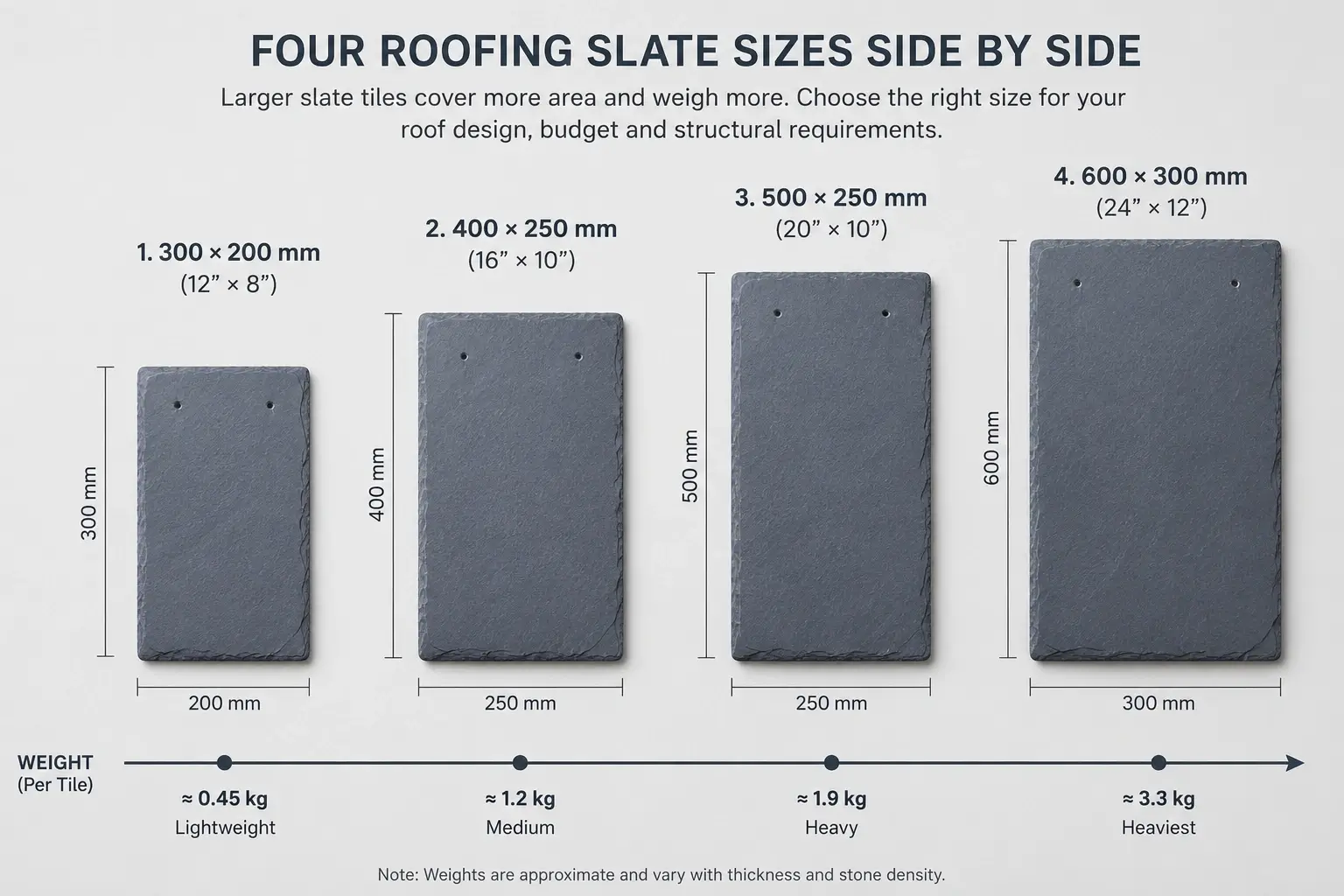
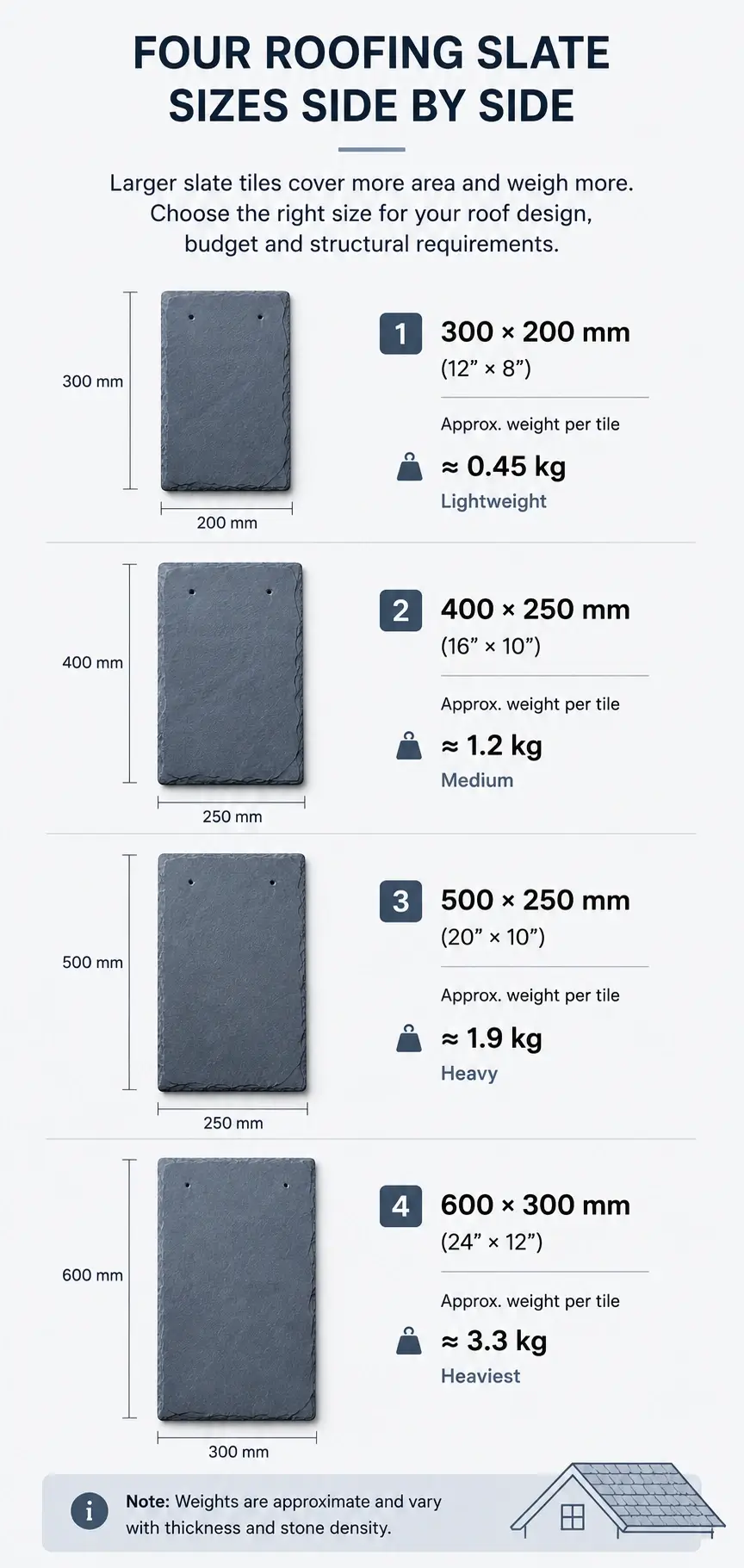
The size of a roofing slate tile is one of the biggest factors affecting its weight. Simply put, a larger tile contains more natural stone and therefore weighs more than a smaller one.
For example:
| Slate Size | Typical Weight Trend |
|---|---|
| 300 × 200 mm | Lightweight |
| 400 × 250 mm | Medium |
| 500 × 250 mm | Heavy |
| 600 × 300 mm | Heaviest |
Larger slate tiles are often selected for large roof areas because they can reduce the number of tiles required and create a cleaner appearance. However, their greater weight means the roof structure, installation method and transportation should all be considered during project planning.
Key Point
Larger roofing slate tiles generally weigh more because they contain a greater volume of natural stone.
2. Slate Thickness
After tile size, slate thickness has the greatest influence on roofing slate weight. Even if two tiles have identical dimensions, a thicker slate contains more stone and will naturally weigh more.
Common roofing slate thicknesses include:
| Thickness | Typical Application |
|---|---|
| 4–6 mm | Standard residential roofing |
| 5–7 mm | Premium roofing projects |
| 7–9 mm | Heavy-duty and traditional roofing |
Thicker roofing slate usually offers greater strength and durability, making it suitable for demanding weather conditions or historic restoration projects. However, increased thickness also adds more weight to the roof, requires stronger supporting structures and can increase transportation and installation costs.
If you’re unsure which thickness is suitable for your project, see our Roofing Slate Thickness Guide for detailed recommendations.
Key Point
A small increase in thickness can significantly increase the overall weight of a slate roof.
3. Slate Density
The third factor is stone density, which refers to how much a given volume of slate weighs. Different geological formations produce slate with slightly different densities, which explains why roofing slate from different regions may vary in weight even when the size and thickness are identical.
Most high-quality natural roofing slates have a density between:
2,700–2,900 kg/m³
Jiujiang roofing slate typically falls within this range, providing an excellent balance of strength, durability and manageable weight. This makes it suitable for residential, commercial and heritage roofing projects while helping optimize transportation and installation efficiency.
Although density has less impact than size or thickness, it still plays an important role when calculating roof loads, shipping weights and container capacity.
Jiujiang roofing slate is valued for its consistent density, reliable strength and excellent workability, making it easier to install and more efficient to transport compared with many heavier slate varieties.
Key Point
Higher-density slate is generally stronger, but it also increases the total weight of the roof.
Three Factors That Determine Roofing Slate Weight
| Factor | Effect on Weight |
|---|---|
| Tile Size | Larger tiles weigh more. |
| Slate Thickness | Thicker slate significantly increases weight. |
| Stone Density | Denser stone increases overall roof weight. |
Before looking at actual roofing slate weights, it’s important to understand that every combination of tile size, slate thickness and stone density produces a different result. In the next section, you’ll find practical weight charts showing the approximate weight of popular roofing slate sizes used around the world.
Jiujiang roofing slate is valued for its consistent density, reliable strength and excellent workability, making it easier to install and more efficient to transport compared with many heavier slate varieties.
Average Roofing Slate Weight by Size
The weight of a roofing slate tile varies depending on its size, thickness and stone density. Larger and thicker tiles naturally contain more stone, resulting in a higher individual tile weight.
The table below shows the approximate weight of common natural roofing slate sizes used in residential and commercial roofing projects. These values provide a practical reference for estimating roof loads, calculating material quantities, planning shipping, and selecting the right slate for your project.
If you are designing a roof or comparing different slate options, use these figures as a general guide before requesting the exact specifications from your supplier.
Average Roofing Slate Weight Chart
| Slate Size (mm) | Typical Thickness | Approx. Weight per Tile | Typical Application |
|---|---|---|---|
| 300 × 200 | 4–6 mm | 0.45 kg | Small roofs, decorative areas |
| 400 × 250 | 5–7 mm | 1.20 kg | Residential roofing |
| 500 × 250 | 5–7 mm | 1.90 kg | Residential & commercial roofs |
| 600 × 300 | 7–9 mm | 3.30 kg | Large roofs, traditional buildings |
Note: The weights shown above are approximate. Actual tile weight may vary slightly depending on natural stone density, manufacturing tolerances and edge finishing.
How to Use This Table
Choosing the correct roofing slate size is not only about appearance. Tile weight also affects roof performance, installation efficiency and transportation costs.
- 300 × 200 mm – Lightweight and easy to handle, ideal for steep roofs or decorative details.
- 400 × 250 mm – One of the most popular sizes for residential roofing, offering a balance between coverage and weight.
- 500 × 250 mm – Covers more roof area with fewer tiles while maintaining manageable installation weight.
- 600 × 300 mm – Provides maximum coverage per tile but requires stronger roof structures due to its higher weight.
Which Slate Size Is Right for Your Roof?
| If you need… | Recommended Size |
|---|---|
| Easier installation | 300 × 200 mm |
| Standard residential roofing | 400 × 250 mm |
| Faster installation with fewer tiles | 500 × 250 mm |
| Large roofs with a traditional appearance | 600 × 300 mm |
Expert Tip: Never choose roofing slate based on tile weight alone. Always consider roof pitch, slate thickness, roof structure, headlap requirements, local building codes, and weather conditions to achieve the best roofing performance.
While individual tile weight is useful for estimating material handling and transportation, roofing professionals usually calculate the total roof load using weight per square meter (kg/m²). In the next section, you’ll learn how much a completed slate roof weighs based on its actual roof coverage.
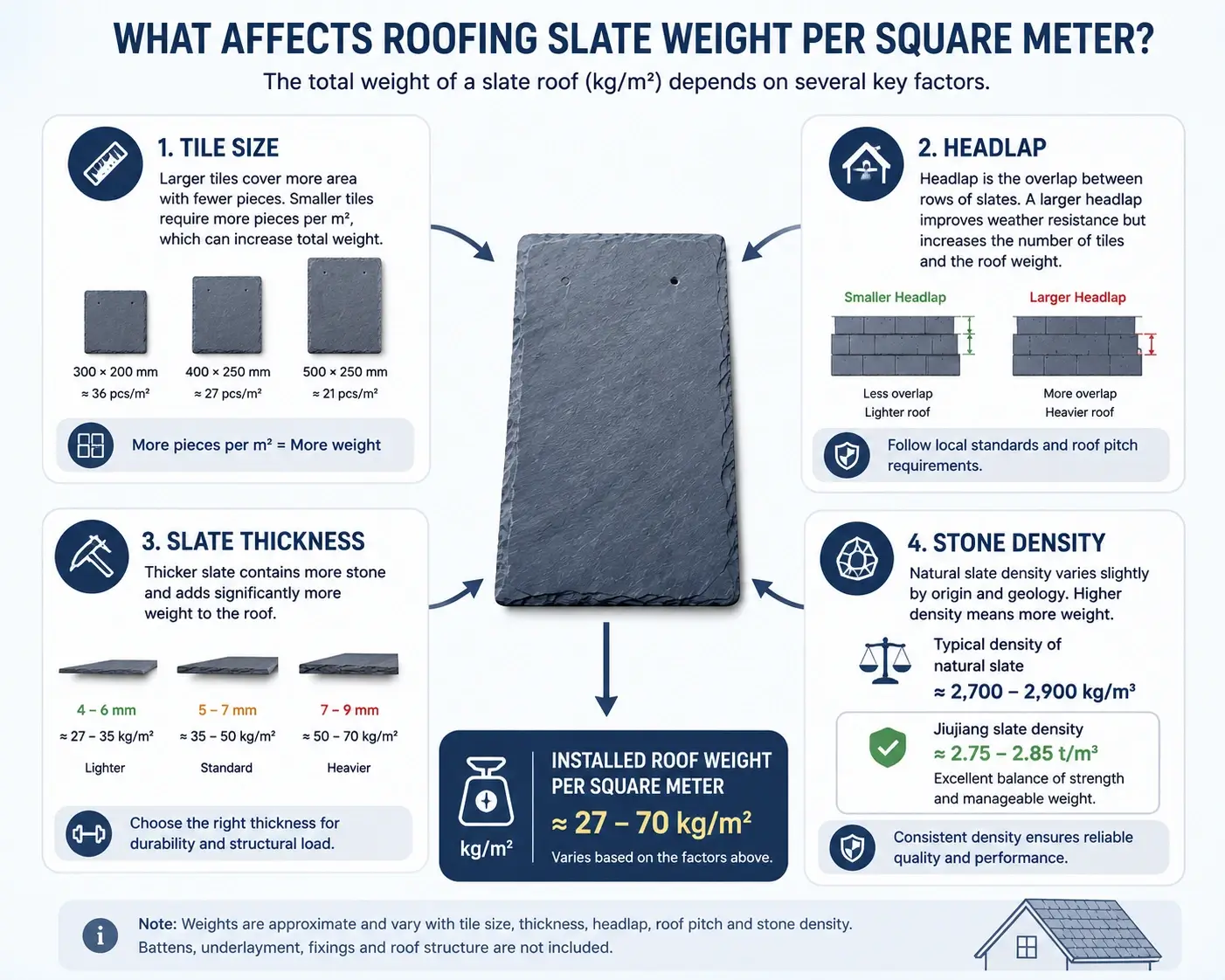
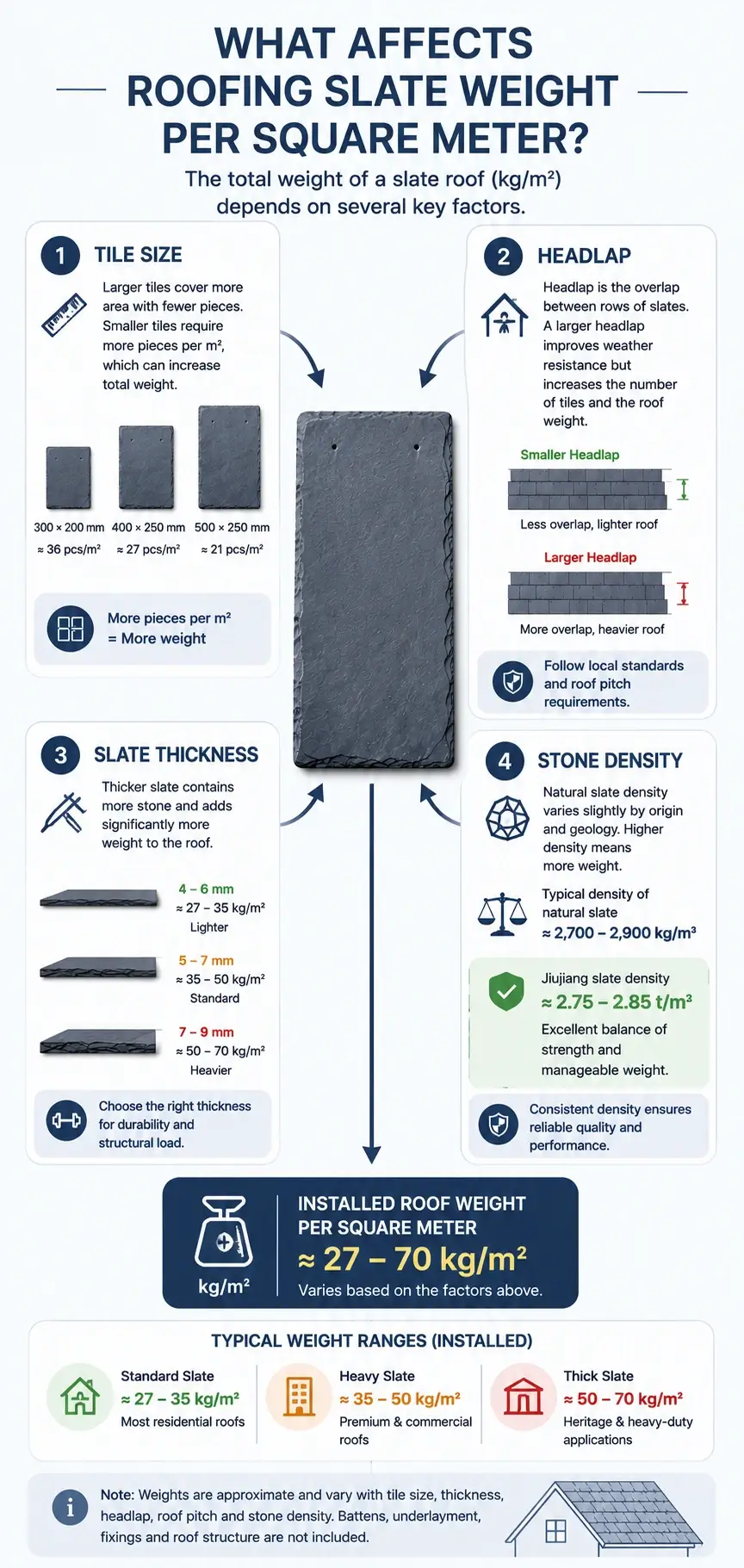
Roofing Slate Weight per Square Meter (kg/m²)
While the weight of an individual roofing slate tile is useful for handling and transportation, roofing professionals usually calculate roofing slate weight per square meter (kg/m²) when designing a roof.
The total weight of a completed slate roof depends on more than just the tile itself. It is influenced by the tile size, slate thickness, headlap, roof pitch, and the number of tiles required to cover one square meter. Understanding these factors helps homeowners, architects and contractors accurately estimate roof loads, verify structural capacity and calculate material quantities.
The figures below provide typical weight ranges for completed natural slate roofs installed using standard roofing practices.
Typical Roofing Slate Weight per Square Meter
| Slate Type | Typical Weight (kg/m²) | Typical Applications |
|---|---|---|
| Standard Roofing Slate | 27–35 kg/m² | Most residential roofs |
| Heavy Roofing Slate | 35–50 kg/m² | Traditional and premium roofing |
| Thick Roofing Slate | 50–70 kg/m² | Heritage buildings and heavy-duty applications |
Note: These values refer to the approximate weight of installed natural roofing slate only. Battens, underlay, fixings and roof structure are not included.
What Affects Roofing Slate Weight per m²?
1. Roof Coverage
The number of slate tiles required to cover one square meter directly affects the total roof weight. Smaller slate tiles generally require more pieces per square meter than larger tiles. As the number of tiles increases, the total installed weight also changes.
Choosing the right tile size helps balance appearance, installation efficiency and structural performance.
2. Headlap
Headlap is the overlap between successive rows of roofing slate tiles. It is one of the most important factors in determining roof coverage.
A larger headlap:
- Improves weather resistance
- Increases the number of tiles required
- Raises the overall roof weight per square meter
Smaller headlaps reduce material usage but must always comply with local roofing standards and roof pitch requirements.
3. Slate Thickness
Slate thickness affects every individual tile. When thicker slate is used across an entire roof, the increase in total weight becomes significant.
For example:
- 4–6 mm slate produces a lighter roof.
- 5–7 mm slate offers a balance between durability and weight.
- 7–9 mm slate creates a heavier roof designed for demanding environments and traditional architecture.
Selecting the appropriate thickness ensures the roof achieves the required durability without adding unnecessary structural loads.
What Increases Roof Weight?
✔ Larger headlap
✔ Thicker roofing slate
✔ Higher stone density
✔ More tiles per square meter
✔ Additional roofing accessories
Expert Tip: When calculating the total weight of a slate roof, always use the installed weight per square meter rather than simply multiplying the weight of one tile. Roof coverage varies with tile size, headlap and installation method, making kg/m² the most accurate measurement for structural design.
Which Weight Range Is Best?
| Project Type | Recommended Weight |
|---|---|
| Residential roofing | 27–35 kg/m² |
| Premium residential | 35–45 kg/m² |
| Commercial roofing | 35–50 kg/m² |
| Historic restoration | 50–70 kg/m² |
Why This Matters
Understanding roofing slate weight per square meter helps you:
- Calculate roof structural loads.
- Estimate transportation and shipping costs.
- Plan pallet and container loading.
- Compare different roofing slate products.
- Select the right slate size and thickness for your project.
- Avoid unexpected installation costs.
Now that you understand the installed weight of a slate roof, let’s look at how roofing slate weight is measured in the United States using the roofing square system.
Roofing Slate Weight per Roofing Square
If you’re working on a roofing project in the United States, you’ll often see roof areas measured in roofing squares rather than square meters.
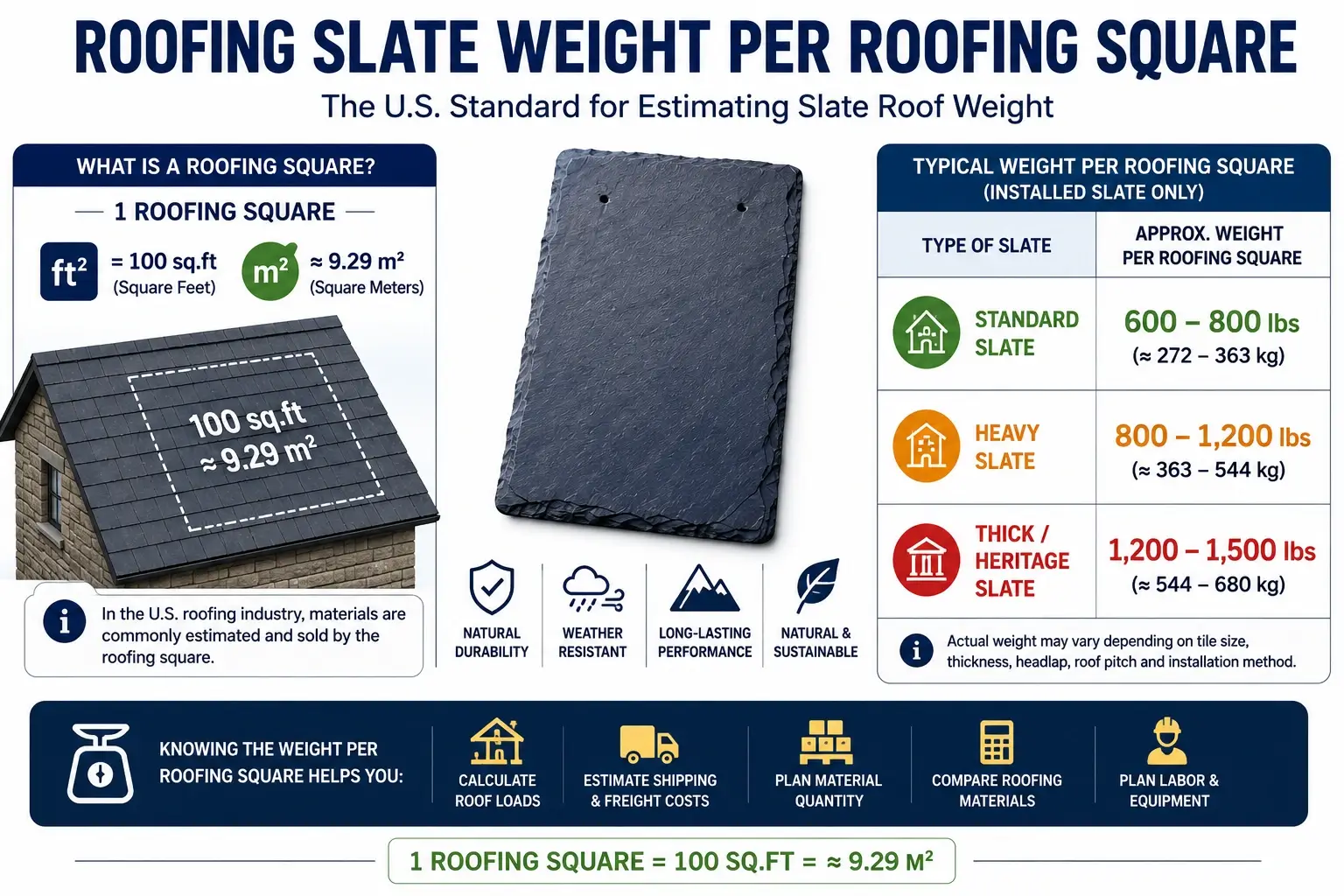
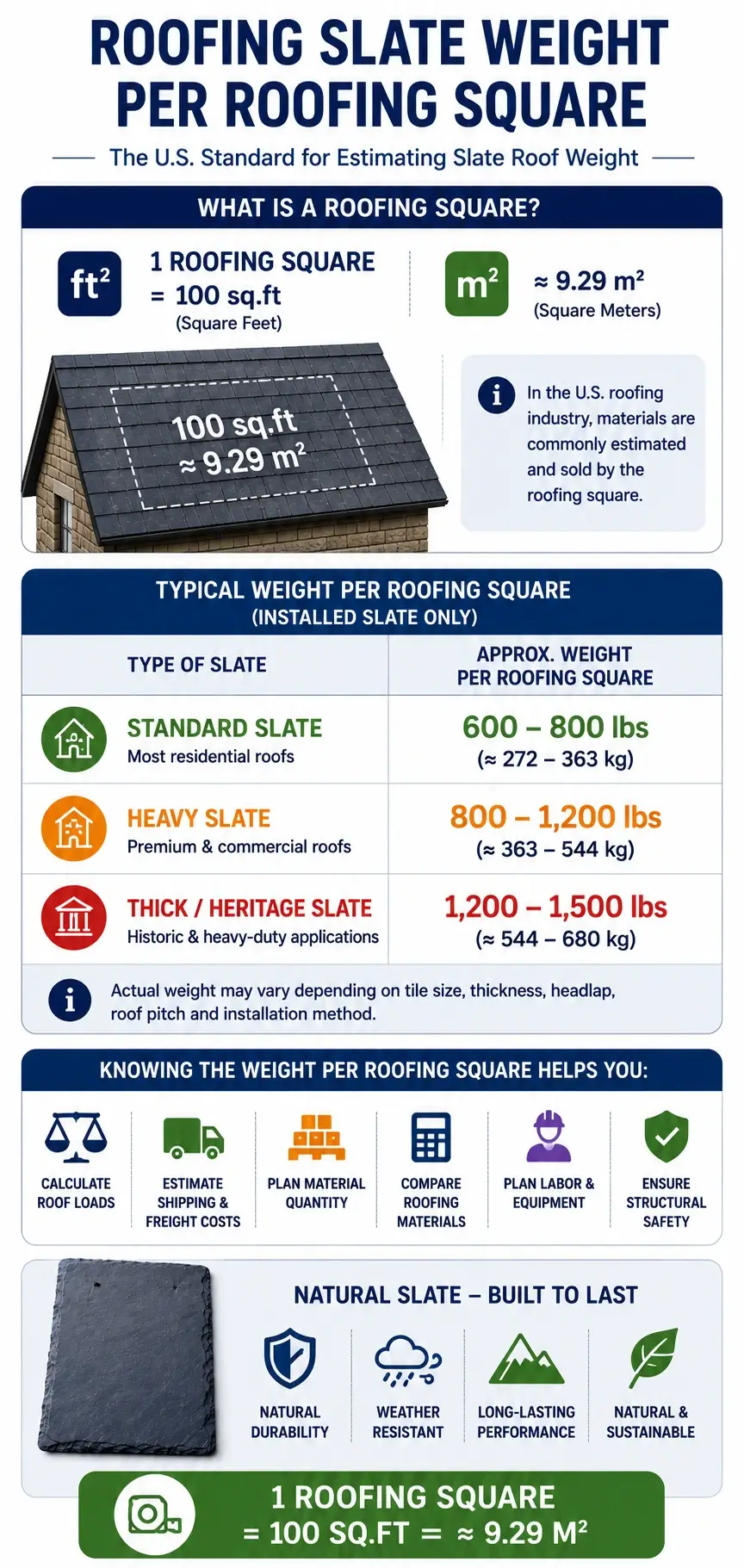
A roofing square is the standard unit used by American roofing contractors, architects and suppliers. One roofing square equals 100 square feet (ft²), or approximately 9.29 square meters (m²).
Knowing the roofing slate weight per square makes it much easier to estimate roof structural loads, compare roofing materials, calculate freight costs and order the correct quantity of slate for your project.
Although the exact weight varies depending on slate size, slate thickness, headlap and roof coverage, the table below provides typical weight ranges for installed natural slate roofing.
What Is a Roofing Square?
| Measurement | Equivalent |
|---|---|
| 1 Roofing Square | 100 sq.ft |
| Metric Equivalent | ≈ 9.29 m² |
Quick Tip: In the U.S. roofing industry, materials such as natural slate, asphalt shingles and metal roofing are commonly estimated and sold by the roofing square rather than by square meter.
Typical Roofing Slate Weight per Roofing Square
| Slate Type | Approx. Weight per Roofing Square |
|---|---|
| Standard Natural Slate | 600–800 lbs (≈ 272–363 kg) |
| Heavy Natural Slate | 800–1,200 lbs (≈ 363–544 kg) |
| Thick / Heritage Slate | 1,200–1,500 lbs (≈ 544–680 kg) |
Note: These values represent the approximate installed weight of natural roofing slate. Actual weight may vary depending on tile dimensions, thickness, headlap, roof pitch and the selected installation method.
Why Roofing Square Weight Matters
Understanding roofing slate weight per square helps you:
- Estimate roof structural loads before installation.
- Compare natural slate with other roofing materials.
- Calculate shipping and freight costs more accurately.
- Determine pallet and container loading capacity.
- Plan labor and equipment for handling heavier slate.
- Prepare accurate material estimates for residential and commercial roofing projects.
Buying Tip for U.S. Customers
When requesting a quotation from a roofing slate supplier, it’s helpful to provide your roof area in roofing squares as well as the preferred slate size and thickness. This allows the supplier to calculate the required quantity, pallet weight and container loading more accurately.
Quick Comparison
| Unit | Typical Use |
|---|---|
| kg/m² | Europe, UK, Australia and most international projects |
| Roofing Square (100 sq.ft) | United States and Canada |
Now that you understand slate roof weight in both kg/m² and roofing squares, the next step is learning how to calculate the total weight of your own roof based on its size, slate dimensions and installation method.
Why Roofing Slate Weight Matters
The weight of natural roofing slate affects far more than the appearance of your roof. It influences structural safety, installation efficiency, transportation costs, and the overall success of your roofing project.
Whether you’re building a new home, renovating a historic property, or importing slate for commercial projects, understanding roofing slate weight helps you choose the right slate size and thickness while avoiding unnecessary costs and structural issues.
Below are the four key reasons why roofing slate weight should always be considered before purchasing or installing natural slate roofing.
① Roof Structure
🏠 Roof Structure & Safety
The first question many homeowners and architects ask is:
Can my roof support natural slate?
Because natural slate is heavier than asphalt shingles or metal roofing, the roof structure must be designed or assessed to safely carry the additional load.
Structural evaluation is especially important for:
- Older buildings
- Timber (wood-frame) roof structures
- Roof renovations and re-roofing projects
- Buildings changing from lightweight roofing materials to natural slate
Modern steel and reinforced concrete structures usually provide greater load capacity, but every project should be assessed according to local building codes.
Key Takeaway
A structural assessment helps ensure your roof can safely support the weight of natural roofing slate for decades to come.
② Installation
🔨 Installation & Labor Costs
Roofing slate weight has a direct impact on installation efficiency.
Heavier slate tiles require more lifting, more careful positioning and additional handling during installation. As tile weight increases, labor requirements and installation time generally increase as well.
Simple workflow:
Heavier Slate
↓
More Labor
↓
Longer Installation Time
↓
Higher Installation Cost
Choosing the appropriate slate size and thickness can improve installation efficiency without compromising roof performance or appearance.
Key Takeaway
Selecting the right slate weight can reduce labor time and improve installation productivity.
③ Shipping & Transportation
🚢 Shipping & Freight Costs
For international buyers, shipping weight is one of the most important factors affecting total project cost.
Roofing slate weight influences:
- Container loading capacity
- Pallet weight
- Ocean freight costs
- Inland transportation
- Loading and unloading efficiency
A heavier slate reduces the number of pallets or square meters that can be loaded into one container, potentially increasing freight costs per project.
Jiujiang roofing slate offers an excellent balance between strength, durability and manageable weight, helping maximize container utilization while maintaining outstanding roofing performance.
Key Takeaway
Optimized slate weight improves shipping efficiency and helps reduce transportation costs.
④ Handling & On-Site Safety
👷 Handling & Jobsite Efficiency
The weight of individual slate tiles also affects daily handling on the jobsite.
Heavier roofing slate:
- Requires more lifting effort
- May need additional workers for large-format tiles
- Is more difficult to carry on steep roofs
- Can slow installation in challenging weather conditions
Conversely, lighter and appropriately sized slate is easier to transport across the roof, improving productivity and reducing worker fatigue.
Key Takeaway
Balanced slate weight makes installation safer, easier and more efficient—especially on steep or complex roofs.
Why Roofing Slate Weight Is Important
| Factor | Why It Matters |
|---|---|
| 🏠 Roof Structure | Ensures the building can safely support the roof load. |
| 🔨 Installation | Affects labor, installation time and overall project cost. |
| 🚢 Shipping | Influences pallet weight, container loading and freight expenses. |
| 👷 Handling | Impacts worker safety, lifting effort and installation efficiency. |
Expert Tip: The best roofing slate is not necessarily the lightest or the heaviest. The ideal choice is a slate that provides the right balance of strength, durability, weight, and installation efficiency for your specific project.
Now that you understand why roofing slate weight matters, let’s see how natural slate compares with other popular roofing materials such as asphalt shingles, clay tiles and concrete roof tiles.
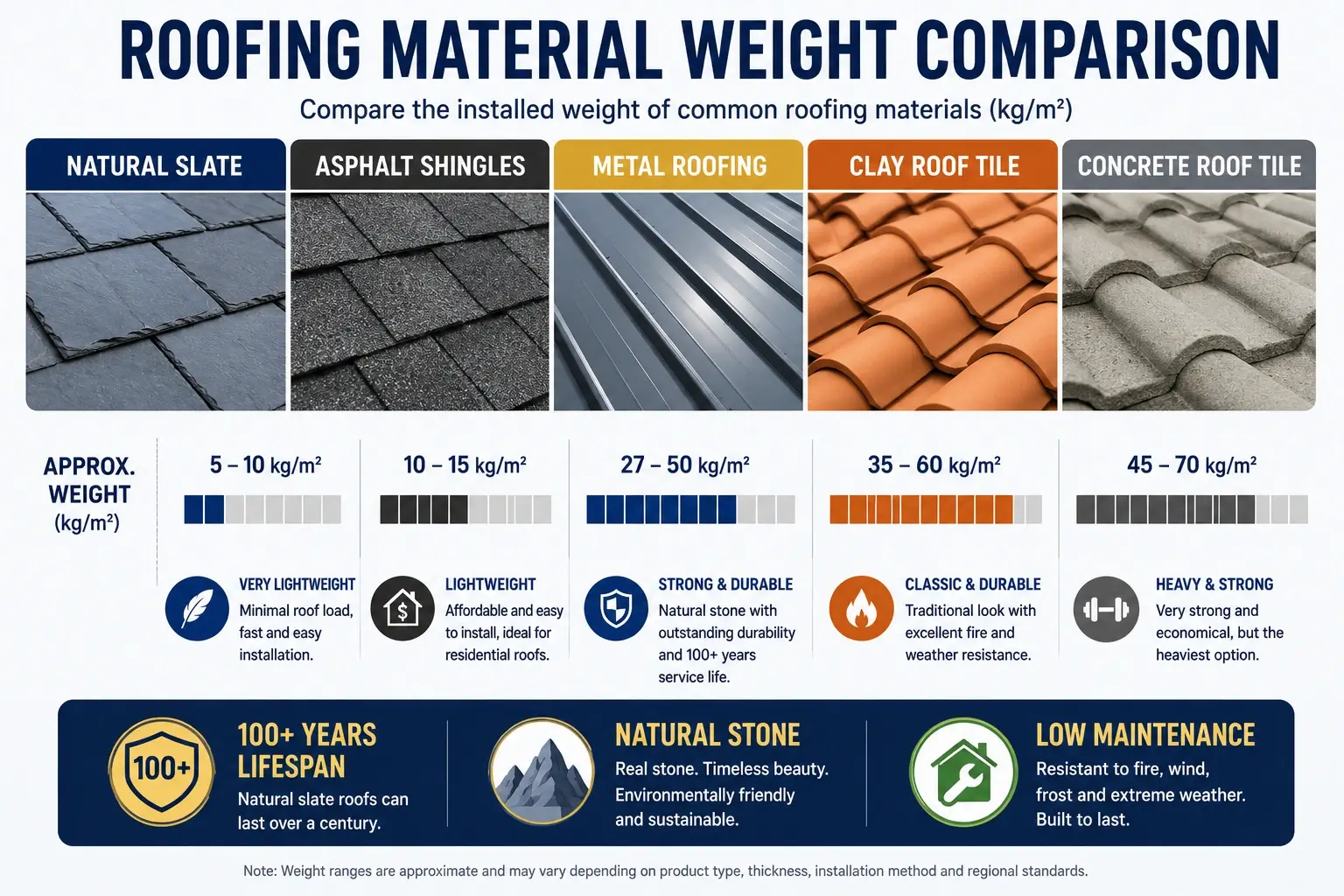
Roofing Slate Weight vs Other Roofing Materials
When choosing a roofing material, weight is one of the most important factors to consider. It directly affects roof structural design, installation methods, transportation costs, and the long-term performance of the roof.
Many homeowners assume that the lightest roofing material is always the best option. In reality, each roofing material offers a different balance of weight, durability, lifespan, weather resistance, and maintenance requirements.
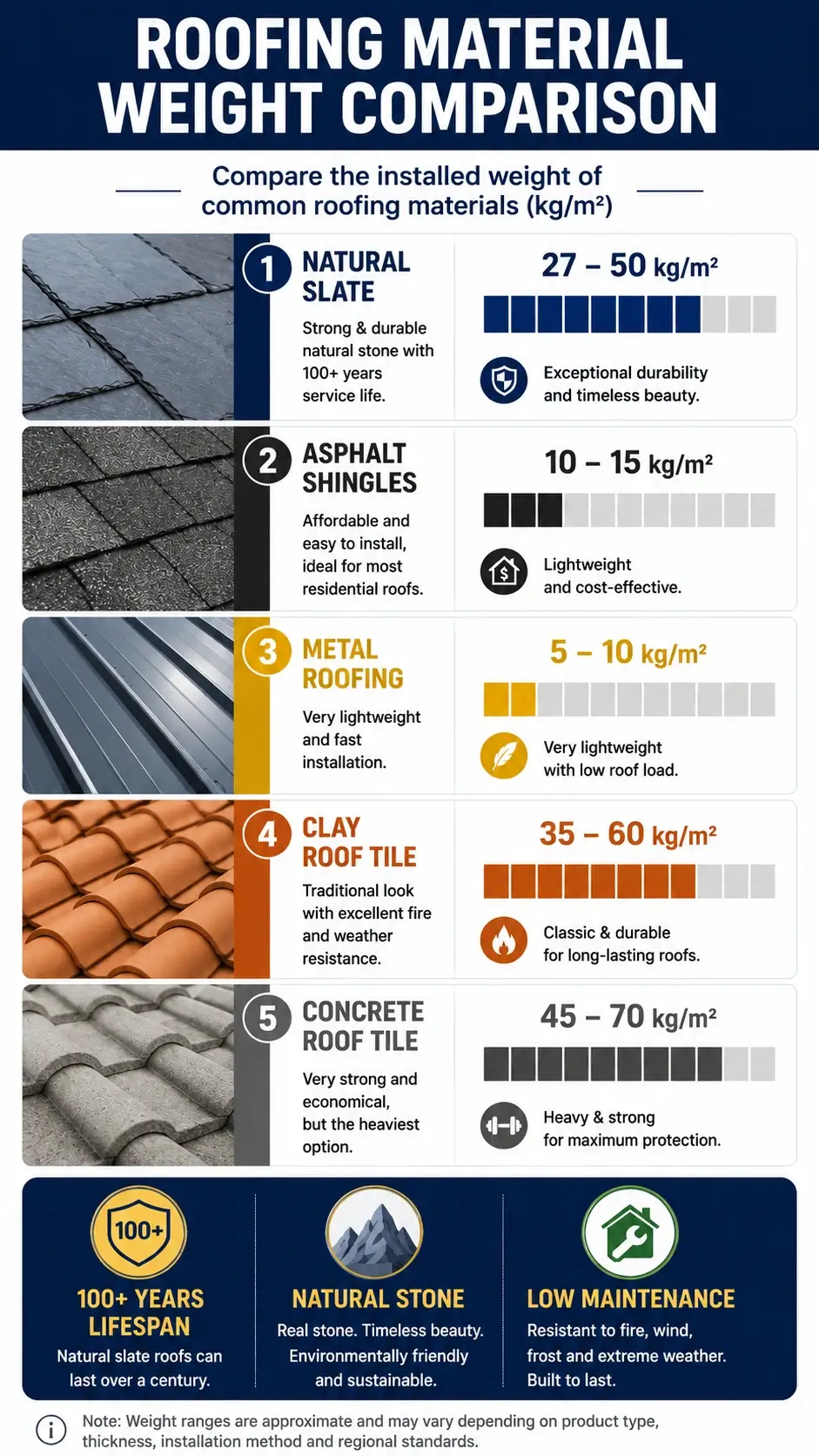
Natural roofing slate is heavier than asphalt shingles and metal roofing, but it is significantly more durable and can last well over 100 years. Compared with clay and concrete roof tiles, slate often provides a better balance between strength, longevity and installed weight.
The table below compares the approximate installed weight of the world’s most common roofing materials.
Roofing Material Weight Comparison
| Roofing Material | Approx. Weight (kg/m²) | Typical Lifespan | Advantages | Considerations |
|---|---|---|---|---|
| Metal Roofing | 5–10 | 40–70 years | Very lightweight, fast installation | Can be noisy during heavy rain and may dent under impact |
| Asphalt Shingles | 10–15 | 20–30 years | Affordable, easy to install | Shorter lifespan and higher replacement frequency |
| Natural Roofing Slate | 27–50 | 100+ years | Exceptional durability, natural beauty, low maintenance | Requires adequate roof structural support |
| Clay Roof Tiles | 35–60 | 50–100 years | Traditional appearance, excellent fire resistance | More brittle and generally heavier than standard slate |
| Concrete Roof Tiles | 45–70 | 40–70 years | Strong and economical | Heaviest option, increasing roof load and transportation costs |
Note: Weight ranges are approximate and may vary depending on product specifications, installation methods and regional standards.
What Does This Comparison Mean?
Choosing a roofing material is about more than finding the lightest option.
🏠 Metal Roofing
Metal roofing places minimal load on the roof structure and is easy to install. It is often selected for modern buildings where lightweight construction is a priority.
🏡 Asphalt Shingles
Asphalt shingles are widely used because they are inexpensive and lightweight. However, they generally require replacement much sooner than natural slate.
🪨 Natural Roofing Slate
Natural roofing slate offers one of the best combinations of strength, durability, weather resistance, and service life. Although it is heavier than metal roofing and asphalt shingles, it is usually lighter than many clay and concrete roof tile systems while providing exceptional long-term value.
🏛 Clay Roof Tiles
Clay tiles create a classic architectural appearance and perform well in warm climates. Their weight and brittleness, however, require careful handling during installation.
🏗 Concrete Roof Tiles
Concrete roof tiles are among the heaviest roofing materials. They offer good strength but place greater demands on roof structures, transportation and installation.
Quick Comparison
| If you want… | Best Choice |
|---|---|
| Lowest roof weight | Metal Roofing |
| Lowest initial cost | Asphalt Shingles |
| Best lifetime value | Natural Roofing Slate |
| Traditional Mediterranean appearance | Clay Roof Tiles |
| Heavy-duty economical roofing | Concrete Roof Tiles |
Why Many Premium Homes Choose Natural Slate
Natural roofing slate continues to be the preferred roofing material for luxury homes, historic buildings and premium commercial projects because it offers an outstanding balance of:
- Long service life (100+ years)
- Excellent weather and frost resistance
- Natural color that won’t fade
- Low maintenance requirements
- Sustainable, environmentally friendly material
- Moderate installed weight compared with many heavy roof tile systems
For many projects, Jiujiang roofing slate provides an excellent combination of consistent quality, reliable strength, and manageable weight, helping homeowners, architects and contractors achieve durable roofs without unnecessary structural loads or excessive shipping costs.
Expert Tip: Weight should never be the only factor when selecting a roofing material. Always consider the complete balance of lifespan, structural requirements, weather resistance, maintenance, installation cost, and long-term value before making a decision.
Now that you’ve compared roofing slate with other roofing materials, let’s look at how to accurately calculate the total weight of a slate roof based on tile size, roof area and installation method.
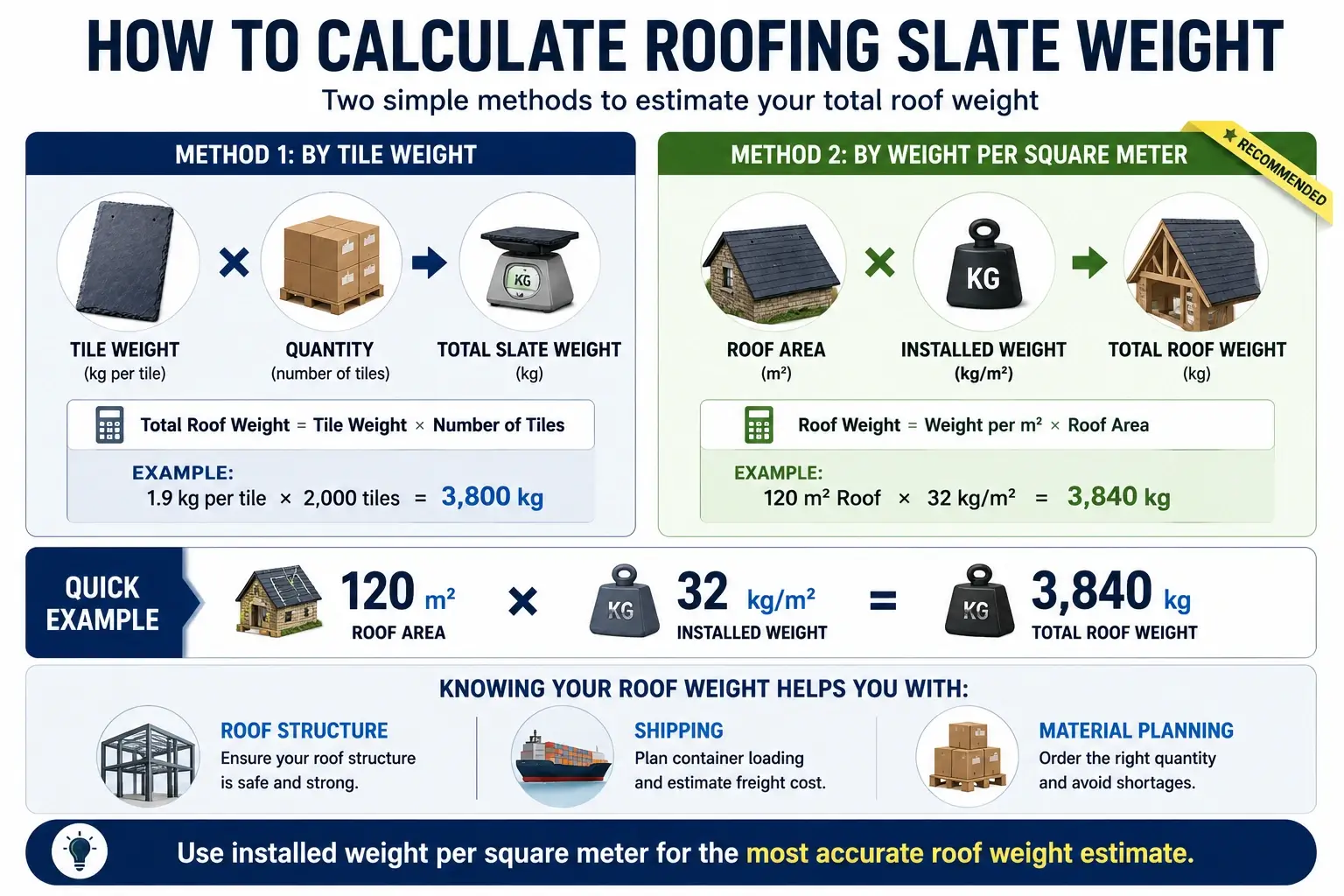
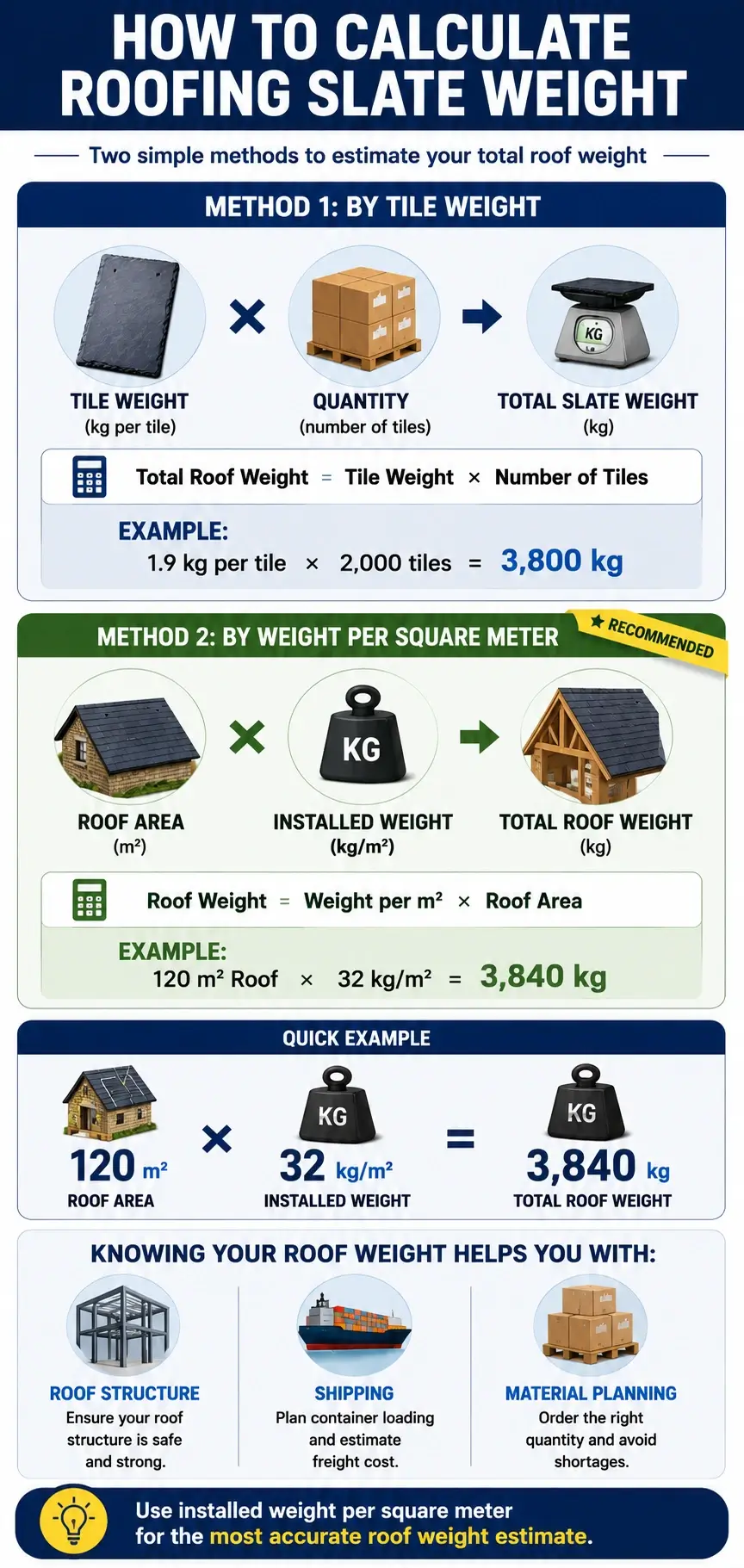
How to Calculate Roofing Slate Weight
Calculating roofing slate weight is an important step when planning a roofing project. Whether you’re estimating roof structural loads, arranging shipping, ordering materials or comparing roofing products, knowing the approximate roof weight helps you make informed decisions before installation begins.
Fortunately, calculating slate roof weight is straightforward. In most cases, you only need to know either the weight of an individual slate tile or the installed weight per square meter (kg/m²).
The two simple methods below are widely used by roofing contractors, architects and suppliers around the world.
Method 1: Calculate by Tile Weight
If you know the weight of one slate tile and the total number of tiles required, use this formula:
Formula
Total Roof Weight = Tile Weight × Number of Tiles- Weight per tile = 1.9 kg
- Quantity required = 2,000 tiles
Calculation
1.9 kg × 2,000 = 3,800 kgEstimated roof weight: 3,800 kg
This method is ideal when purchasing roofing slate by the piece.
Method 2: Calculate by Weight per Square Meter
This is the most common method used by architects, engineers and roofing professionals.
Formula
Roof Weight = Weight per m² × Roof AreaRoof Area
120 m²
×
Installed Weight
32 kg/m²
=
3,840 kg
Estimated roof weight = 3,840 kg
This approach provides a fast and accurate estimate for structural planning and material calculations.
Which Method Should You Use?
| If You Know… | Recommended Method |
|---|---|
| Weight of one slate tile | Tile Weight × Quantity |
| Installed weight per square meter | Weight per m² × Roof Area |
| Roof area only | Use Weight per m² after selecting slate size and thickness |
What Should Be Included?
Many homeowners only calculate the weight of the slate tiles themselves. In practice, the total roof load may also include:
- Roofing slate tiles
- Battens
- Underlay or roofing membrane
- Nails or hooks
- Ridge and hip accessories
- Snow or temporary maintenance loads (where applicable)
For structural design, always calculate the complete roof system rather than the slate alone.
Quick Calculation Example
| Roof Area | Slate Weight | Estimated Roof Weight |
|---|---|---|
| 80 m² | 30 kg/m² | 2,400 kg |
| 120 m² | 32 kg/m² | 3,840 kg |
| 180 m² | 35 kg/m² | 6,300 kg |
| 250 m² | 40 kg/m² | 10,000 kg |
This table helps visitors quickly estimate roof weight without using a calculator.
Common Mistakes to Avoid
Don’t calculate roof weight using only:
❌ Roof area
❌ Tile dimensions
❌ Tile quantity
Instead, always consider:
✔ Slate size
✔ Slate thickness
✔ Headlap
✔ Installed weight per square meter
✔ Roof pitch
✔ Roofing accessories
Expert Tip: For the most accurate estimate, use the installed roofing slate weight per square meter (kg/m²) rather than the weight of individual tiles. This method accounts for tile coverage, headlap and installation practices, making it the preferred approach for roof design and structural calculations.
Need a Faster Calculation?
Don’t want to calculate manually?
Use our Roofing Slate Weight Calculator to estimate:
- Total roof weight
- Weight per square meter
- Number of slate tiles required
- Pallet quantity
- Container loading estimate
Simply enter your roof dimensions, slate size and thickness to receive an instant estimate.
👉 Try the Roofing Slate Calculator
Now that you know how to calculate roofing slate weight, let’s answer some of the most frequently asked questions about slate roof weight, roof loads and material selection.
Does Jiujiang Roofing Slate Have an Advantage?
When selecting natural roofing slate, weight should never be considered in isolation. The ideal roofing slate is not simply the lightest or the heaviest—it should offer the right balance of strength, density, durability, workability, and long-term performance.
Different slate quarries around the world produce stone with varying mineral compositions and densities. As a result, roofing slate from different regions can differ in weight, installation characteristics and transportation efficiency, even when the tile size and thickness are the same.
Jiujiang roofing slate, quarried in Jiangxi Province, China, is widely used in residential, commercial and heritage roofing projects. It is valued for its consistent quality, moderate density and excellent weather resistance, making it a practical choice for projects that require both durability and efficient installation.
Rather than being the lightest slate available, Jiujiang roofing slate offers a well-balanced combination of performance and manageable weight.
Why Many Buyers Choose Jiujiang Roofing Slate
| Feature | Practical Benefit |
|---|---|
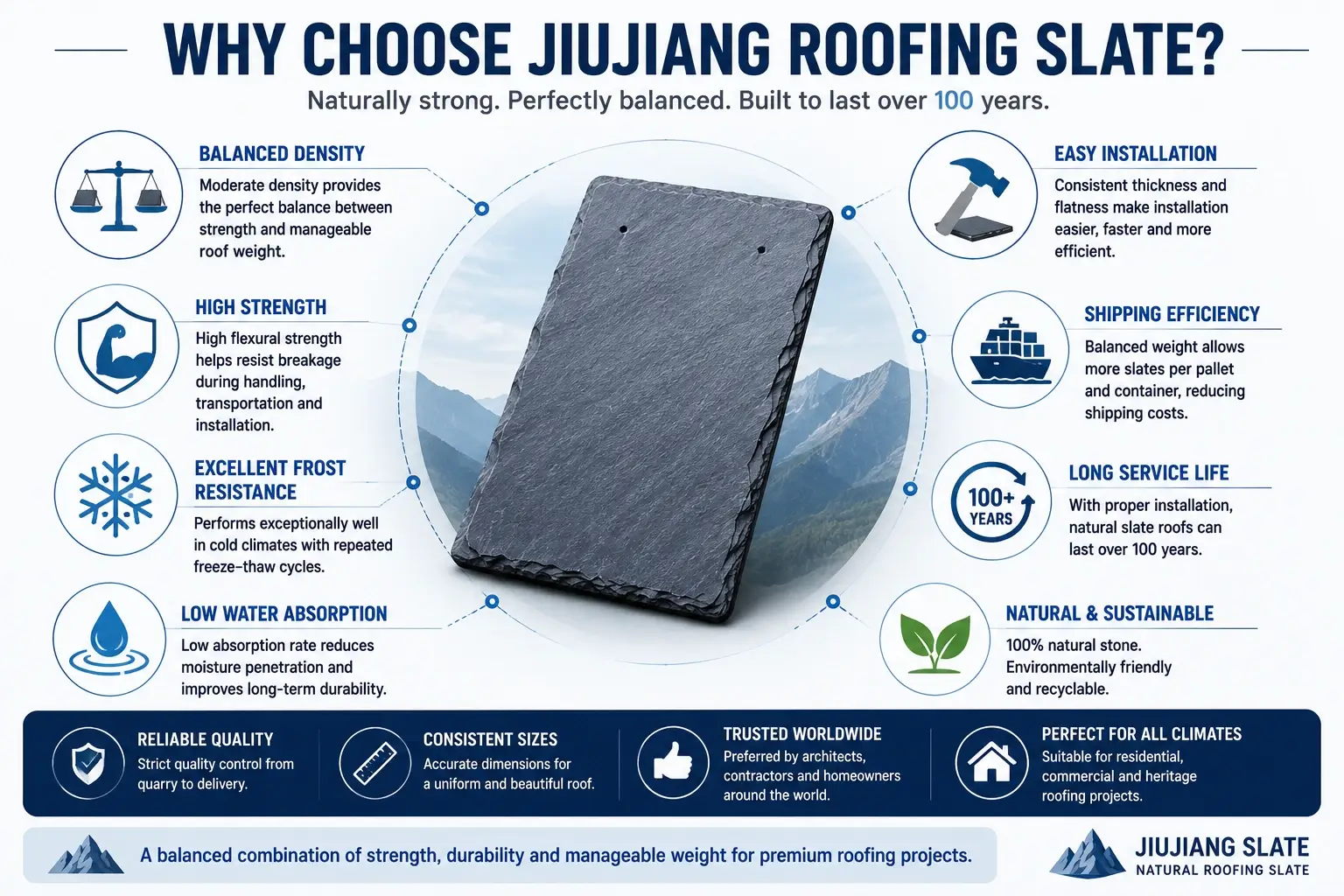
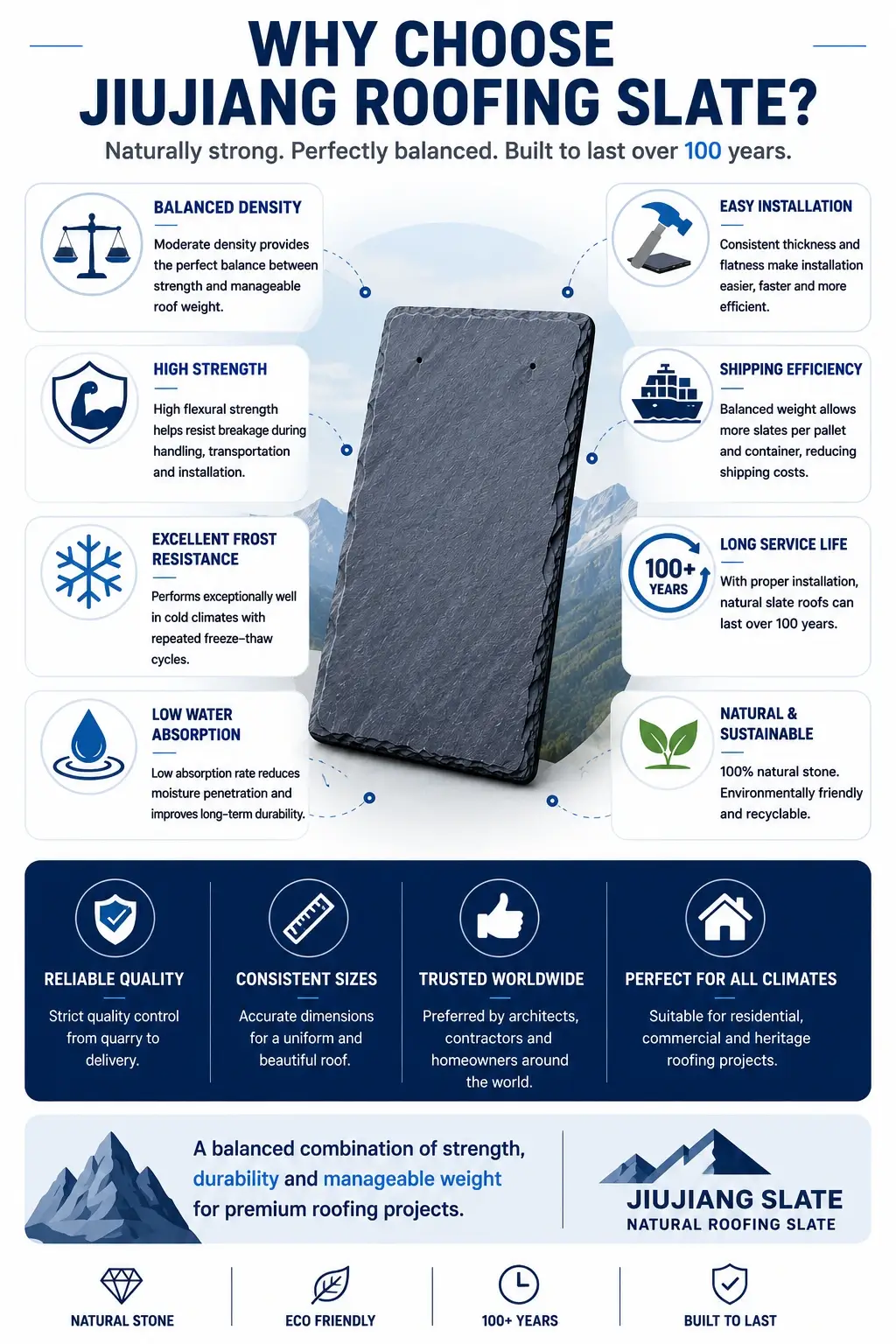
| Moderate Density (≈2.75–2.85 t/m³) | Provides an excellent balance between strength and manageable weight. |
| High Flexural Strength | Helps resist breakage during handling, transportation and installation. |
| Excellent Frost Resistance | Performs well in cold climates with repeated freeze–thaw cycles. |
| Low Water Absorption | Reduces the risk of moisture-related damage and improves long-term durability. |
| Consistent Thickness & Quality | Makes installation easier and creates a more uniform roof appearance. |
| Long Service Life | With proper installation, natural slate roofs can last over 100 years. |
Why Does This Matter?
For homeowners, choosing roofing slate with balanced physical properties means:
- A roof that remains durable for decades.
- Reliable performance in harsh weather.
- Reduced maintenance over its lifetime.
For architects and contractors, it means:
- Easier installation due to consistent tile quality.
- More predictable roof load calculations.
- Fewer damaged tiles during handling.
For importers and distributors, it offers:
- Better pallet stability.
- Efficient container loading.
- Competitive shipping costs without sacrificing product quality.
Balanced Weight Creates Better Value
One of the advantages of Jiujiang roofing slate is its balanced weight.
Compared with some heavier slate varieties, it is easier to transport and handle on site, while still providing the durability expected from high-quality natural roofing slate.
This balance can help:
- Improve installation efficiency.
- Reduce handling effort.
- Increase container loading efficiency.
- Lower transportation costs per project.
- Maintain excellent long-term roof performance.
Rather than focusing solely on achieving the lowest possible weight, Jiujiang roofing slate is engineered by nature to deliver the combination of strength, durability and workability that many professional roofing projects require.
Key Advantages at a Glance
Why Choose Jiujiang Roofing Slate?
✔ Moderate density for balanced roof weight
✔ High strength and reliable durability
✔ Excellent frost and weather resistance
✔ Low water absorption
✔ Easier handling and installation
✔ Efficient pallet and container loading
✔ Long service life of over 100 years
✔ Natural blue-grey appearance with lasting color
Expert Insight: When comparing roofing slate from different sources, don’t focus on weight alone. A high-quality slate should combine appropriate density, high flexural strength, low water absorption, excellent durability and consistent manufacturing quality. These factors work together to determine long-term roof performance and overall project value.
Choosing the right roofing slate is about achieving the best balance between weight, strength, durability and installation efficiency. For many residential and commercial roofing projects, Jiujiang roofing slate offers a combination of consistent quality, practical weight and long-lasting performance that makes it a dependable choice for architects, contractors, distributors and homeowners around the world.
Common Mistakes When Estimating Roofing Slate Weight
Estimating roofing slate weight may seem straightforward, but small calculation mistakes can lead to inaccurate roof load estimates, incorrect material orders and unexpected installation or shipping costs.
Whether you’re planning a new roof, renovating an existing building or importing natural roofing slate, avoiding the common mistakes below will help you achieve a more accurate estimate and make better project decisions.
Common Mistakes to Avoid
❌ 1. Calculating Only the Weight of Individual Slate Tiles
Many people simply multiply the weight of one slate tile by the number of tiles. While this provides a rough estimate, it does not represent the actual installed roof weight.
✔ Best Practice: Use the installed roofing slate weight per square meter (kg/m²) whenever possible, as it reflects the real roof load after installation.
❌ 2. Ignoring Headlap
Headlap determines how much each slate overlaps the tile below. A larger headlap means more tiles are required per square meter, increasing the overall roof weight.
✔ Best Practice: Always include the correct headlap when estimating roofing slate weight and material quantities.
❌ 3. Forgetting Battens and Underlay
Slate tiles are only one part of a complete roofing system. Timber battens, roofing underlay and fixing components also contribute to the total roof load.
✔ Best Practice: Include all roofing system components when performing structural calculations.
❌ 4. Ignoring Ridge, Hip and Roofing Accessories
Ridge tiles, hip details, flashings, fixings and other roofing accessories add extra weight that is often overlooked during planning.
✔ Best Practice: Consider all permanent roofing components when estimating the total installed roof weight.
❌ 5. Using Generic Weight Values for Every Project
Natural roofing slate varies in size, thickness, density and installation method, so one standard weight does not suit every project.
✔ Best Practice: Use the actual product specifications provided by your slate supplier whenever available.
| ❌ Common Mistakes | ✔ Best Practice |
|---|---|
| Calculate only tile weight | Use installed weight (kg/m²) |
| Ignore headlap | Include actual overlap |
| Forget battens & underlay | Calculate the complete roofing system |
| Ignore accessories | Add ridge, hips and flashings |
| Use generic values | Use your supplier’s product specifications |
Before Calculating Roofing Slate Weight, Make Sure You Know:
✔ Roof area (m² or roofing squares)
✔ Slate size
✔ Slate thickness
✔ Installed weight per square meter
✔ Headlap requirements
✔ Roofing accessories
✔ Roof structure and load capacity
Expert Tip: The most accurate way to estimate roofing slate weight is to calculate the installed roof system rather than the weight of the slate tiles alone. Considering headlap, battens, underlay and accessories provides a more reliable estimate for structural design, transportation and project planning.
With these common mistakes in mind, let’s answer some of the most frequently asked questions about roofing slate weight.
Frequently Asked Questions About Roofing Slate Weight
Still Have Questions About Roofing Slate Weight?
Choosing the right roofing slate involves more than simply comparing tile weights. Roof structure, slate size, thickness, installation method and shipping requirements all play an important role in selecting the best product for your project.
If you’re unsure which roofing slate is right for your roof, our team can help you calculate the estimated roof weight, recommend suitable slate sizes and thicknesses, and provide professional advice for your specific project.
👉 Contact us for expert guidance or request a free roofing slate quotation today.
Continue Learning About Roofing Slate
Looking to learn more about natural roofing slate? Our expert guides cover everything from slate sizes, thickness, colors and installation to roofing costs, weight calculations and material comparisons.
Whether you’re a homeowner planning a new roof, an architect specifying materials or an importer sourcing premium roofing slate, these practical guides will help you make informed decisions and choose the right slate for your project.
Roofing Slate Beginner Guides
📘 Roofing Slate Basics
What Is Roofing Slate?
Learn what natural roofing slate is, how it is formed, why it lasts for over 100 years and why it remains one of the world’s most durable roofing materials.
Best for: Beginners, homeowners and architects.
Roofing Slate Sizes
Discover standard roofing slate dimensions, international size options and how tile size affects roof appearance, coverage, weight and installation.
Best for: Material selection and roof design.
Roofing Slate Thickness
Understand common slate thicknesses, their applications and how thickness influences strength, weight, durability and project cost.
Best for: Choosing the right slate specification.
Roofing Slate Colors
Explore the natural colors of roofing slate, including blue-grey, black, green, purple and multicolored slates, and learn how to choose the best color for your project.
Best for: Architects and homeowners.
👉 Read the guide
Installation & Planning
Roofing Slate Installation
Step-by-step guidance on installing natural roofing slate, including fixing methods, headlap, roof pitch, tools and best practices.
Best for: Contractors and DIY enthusiasts.
👉 Read the guide
Roofing Slate Calculator
Calculate roof area, estimate the number of slate tiles required, determine total roof weight and plan pallet or container quantities.
Best for: Estimating materials and project planning.
👉 Use the calculator
Roofing Slate Cost
Learn what influences roofing slate prices, including material quality, tile size, thickness, transportation and installation costs.
Best for: Budget planning and quotation comparison.
👉 Read the guide
Roofing Material Comparisons
Roofing Slate vs Asphalt Shingles
Compare natural slate with asphalt shingles in terms of lifespan, durability, appearance, maintenance, installation and long-term value.
Best for: Residential roofing decisions.
👉 Compare materials
Roofing Slate vs Clay Roof Tiles
Discover the differences between natural slate and clay roof tiles, including weight, strength, weather resistance, maintenance requirements and architectural style.
Best for: Traditional and premium roofing projects.
👉 Compare materials
Reviewed by
David Zhang
Natural Roofing Slate Specialist
15+ Years in Slate Manufacturing & Export
Specialized in
• EN12326 Roofing Slate
• Slate Roof Installation
• Export Packaging
• Container Loading