
Roofing Slate Types
Choosing the right roofing slate type is one of the most important decisions when planning a slate roof. Natural roofing slate is available in a wide variety of types, each offering unique characteristics in appearance, performance, durability, and cost. Roofing slate can be classified by material, installation method, thickness, size, color, edge finish, quality grade, and even country of origin. Understanding these different classifications helps homeowners, architects, roofing contractors, and distributors select the most suitable slate for residential, commercial, or historic restoration projects. In this complete guide, you’ll learn about every major type of roofing slate, compare their features and applications, and discover how to choose the best slate roofing solution for your project.
Table of Contents
What Are Roofing Slate Types?
The term roofing slate types refers to the different ways natural and manufactured roofing slates are classified. While many people think roofing slate is simply one type of roof covering, it actually comes in a wide range of options designed to suit different architectural styles, climates, budgets, and installation requirements.
Some roofing slates are classified by material, such as natural slate or synthetic slate. Others are categorized by size, thickness, installation method, surface finish, edge style, color, quality grade, or country of origin. Each classification affects the roof’s appearance, durability, weight, installation process, maintenance requirements, and overall cost.
Understanding these different roofing slate types makes it much easier to compare products and select the best solution for your home, commercial building, or restoration project. Whether you are a homeowner, architect, roofing contractor, or building supplier, knowing how slate is classified helps you make a more informed investment.
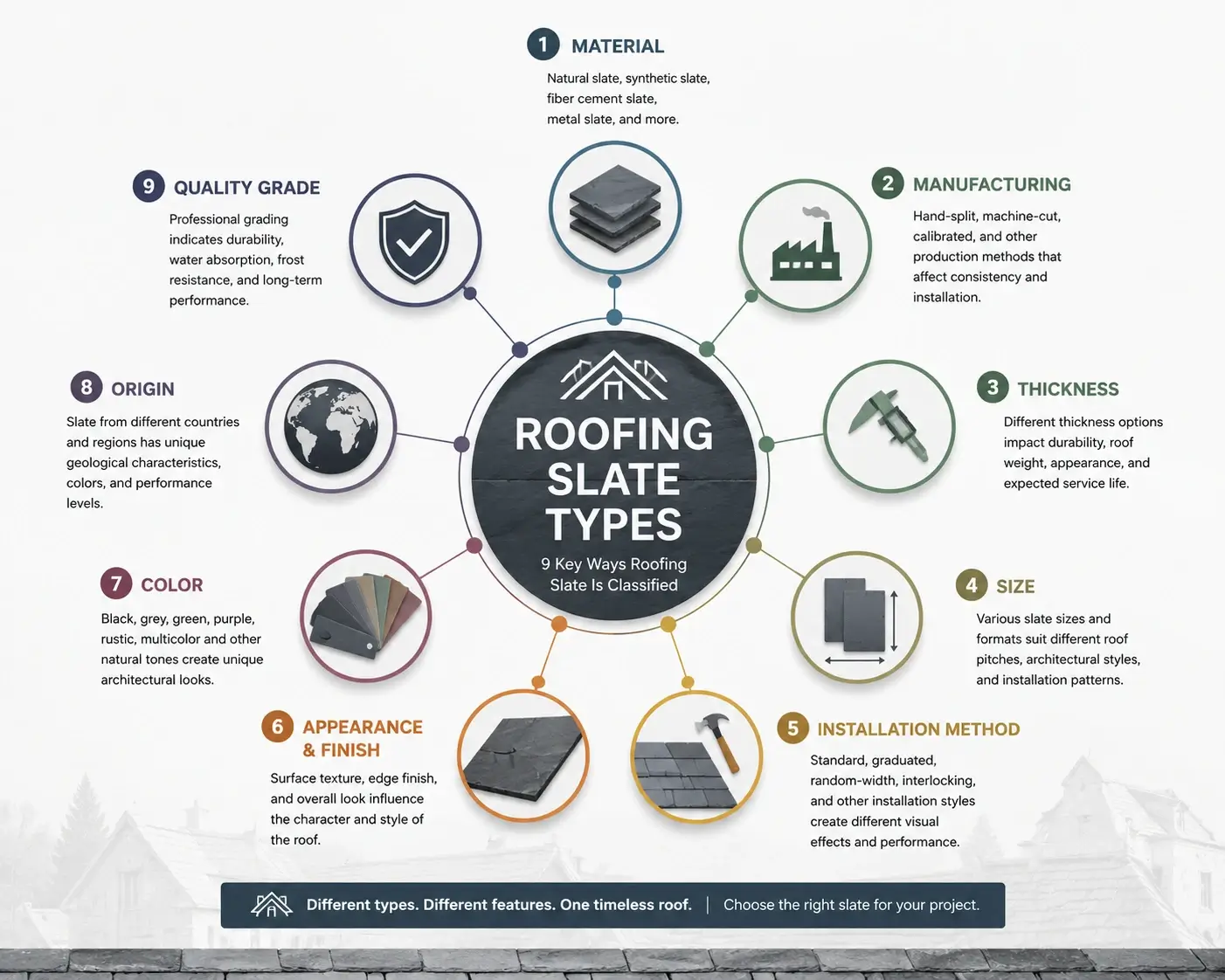
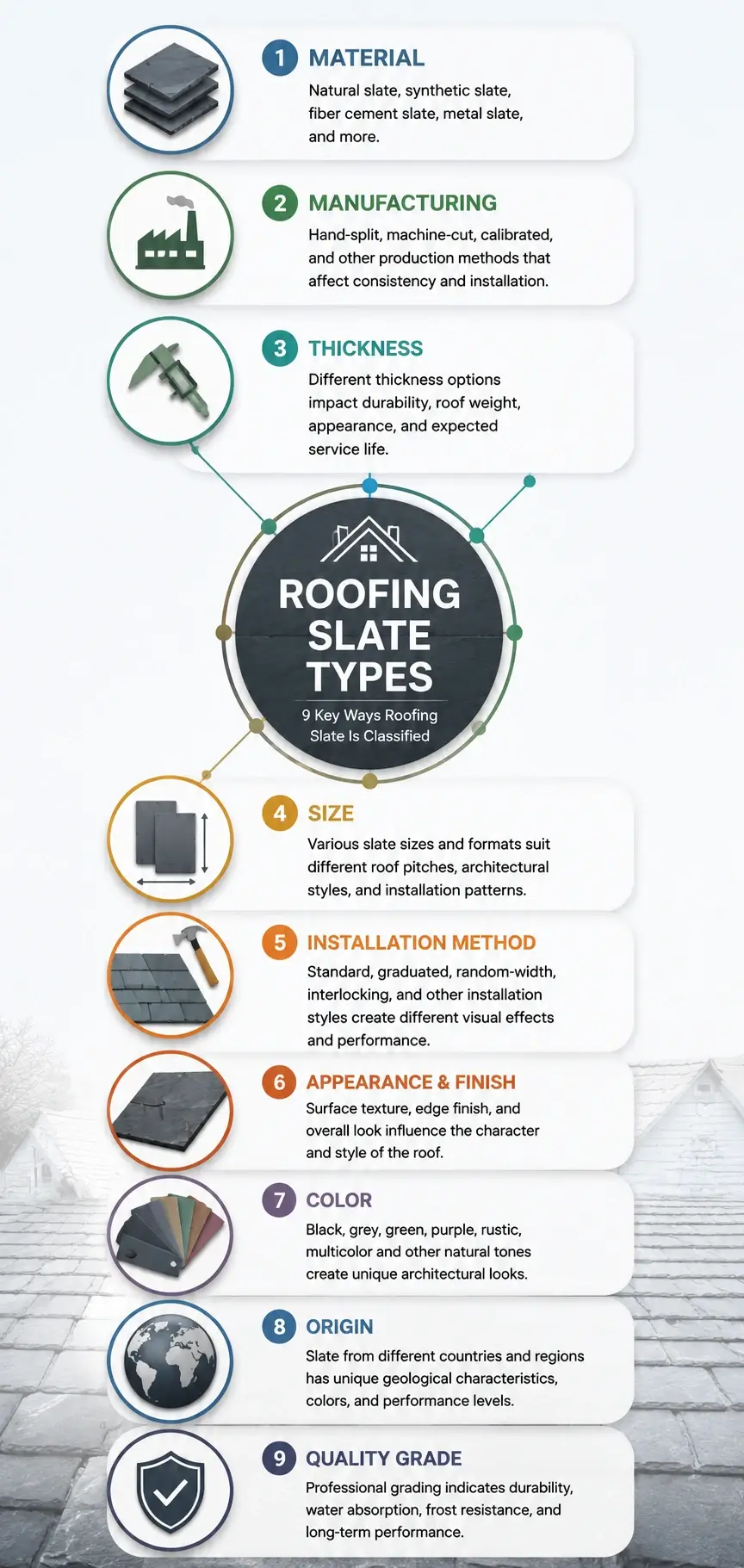
The Main Ways Roofing Slate Is Classified
Roofing slate is commonly classified into the following categories:
| Classification | Why It Matters |
|---|---|
| Material | Determines whether the slate is natural stone, synthetic, fiber cement, or metal, affecting durability, appearance, and lifespan. |
| Manufacturing Method | Distinguishes hand-split, machine-cut, calibrated, and other production methods that influence consistency and installation. |
| Thickness | Affects roof weight, strength, appearance, and expected service life. |
| Size | Different slate sizes suit different roof pitches, architectural styles, and installation patterns. |
| Installation Method | Includes standard, graduated, random-width, and other roofing systems that create different visual effects. |
| Appearance & Finish | Covers natural cleft surfaces, edge finishes, textures, and overall aesthetic style. |
| Color | Black, grey, green, purple, multicolor, and weathering slates each create a unique architectural look. |
| Country of Origin | Slate from China, Spain, Wales, Vermont, Brazil, and other regions varies in geological characteristics, color, and performance. |
| Quality Grade | Professional grading standards indicate durability, water absorption, frost resistance, and long-term performance. |
Why Understanding Roofing Slate Types Matters
Choosing the right roofing slate involves much more than selecting a color. The wrong slate type can increase installation costs, shorten the roof’s lifespan, or create a style that doesn’t complement the building.
Before making a decision, consider the following questions:
- Are you looking for natural roofing slate or a synthetic alternative?
- Which slate type offers the best balance between durability and budget?
- What thickness and size are suitable for your roof pitch?
- Which installation style best matches your home’s architectural design?
- Do local climate conditions require higher frost resistance or lower water absorption?
- Which slate origin and quality grade provide the performance you expect?
The following sections explain each roofing slate classification in detail, helping you compare every option and confidently choose the best roofing slate for your project.
Types of Roofing Slate by Material
One of the most common ways to classify roofing slate is by the material it is made from. While all slate roofing products are designed to protect buildings and enhance their appearance, they differ significantly in durability, maintenance, weight, cost, and service life.
Today, roofing slate generally falls into four main categories: Natural Slate, Synthetic Slate, Fiber Cement Slate, and Metal Slate. Understanding the advantages and limitations of each material helps homeowners, architects, builders, and distributors choose the most suitable roofing solution for their specific project.
Comparison Table
| Roofing Slate Type | Material | Typical Lifespan | Main Advantages | Best For |
|---|---|---|---|---|
| Natural Slate | Natural metamorphic stone | 75–150+ years | Long lifespan, authentic beauty, fireproof, eco-friendly | Premium homes, historic buildings, luxury projects |
| Synthetic Slate | Composite polymers and recycled materials | 30–50 years | Lightweight, lower cost, easier installation | Residential renovations and budget-conscious projects |
| Fiber Cement Slate | Cement reinforced with fibers | 30–50 years | Uniform appearance, moderate price | Residential and commercial buildings |
| Metal Slate | Steel or aluminum | 40–70 years | Lightweight, weather resistant, recyclable | Modern architecture and lightweight roof structures |
Quick Tip: If long-term durability, natural beauty, and property value are your priorities, natural roofing slate remains the industry benchmark.
Natural Roofing Slate
Natural roofing slate is considered the highest-quality roofing material available today. Formed naturally over millions of years under heat and pressure, it is carefully split from solid stone into individual roofing slates without artificial manufacturing processes.
Unlike imitation roofing products, every natural slate tile features unique textures, subtle color variations, and a timeless appearance that cannot be replicated by synthetic materials. Properly installed natural slate roofs have protected homes, churches, castles, and public buildings for more than a century.
Key Benefits of Natural Roofing Slate
- Exceptional lifespan of 75–150 years or more with proper installation.
- Authentic natural beauty, with unique textures and color variations in every slate.
- Excellent weather resistance, including frost, rain, wind, and UV exposure.
- Fireproof and non-combustible, providing superior safety.
- Low maintenance compared with many other roofing materials.
- Environmentally friendly, as it is a natural stone requiring minimal processing and can be recycled or reused.
- Adds long-term property value thanks to its premium appearance and durability.
Why Choose Jiujiang Natural Roofing Slate?
Jiujiang, China, is one of the world’s leading sources of premium natural roofing slate. Our slate is quarried from carefully selected deposits and manufactured using advanced processing techniques to ensure consistent quality and excellent performance.
Our Jiujiang roofing slate offers:
- High density and low water absorption
- Excellent frost resistance for cold climates
- Stable color and natural cleft surface
- Precise dimensions and thickness tolerance
- Available in a wide range of sizes, thicknesses, and finishes
- Exported worldwide for residential, commercial, and heritage restoration projects
Whether you’re building a new home or restoring a historic property, Jiujiang natural slate provides a durable, elegant, and sustainable roofing solution.
Recommended for: Luxury homes, villas, heritage restoration, churches, public buildings, and premium architectural projects.
Synthetic Roofing Slate
Synthetic roofing slate is manufactured from engineered polymers, recycled plastics, or composite materials designed to imitate the appearance of natural slate.
Its lighter weight and lower installation cost make it popular for projects where the roof structure cannot support the weight of natural stone. However, synthetic slate generally has a shorter lifespan and may fade or age differently over time.
Best suited for:
- Residential remodeling
- Budget-conscious projects
- Lightweight roof structures
Fiber Cement Slate
Fiber cement slate is produced by combining cement with reinforcing fibers to create a roofing tile that resembles natural slate.
It offers a uniform appearance and moderate durability but does not provide the same longevity, natural texture, or prestige as genuine slate.
Best suited for:
- Residential developments
- Commercial buildings
- Mid-range roofing projects
Metal Slate
Metal slate roofing is manufactured from steel or aluminum panels shaped to resemble traditional slate tiles.
It is lightweight, corrosion-resistant, and highly recyclable, making it a practical choice for modern construction. However, it lacks the natural texture and character of real stone.
Best suited for:
- Contemporary architecture
- Lightweight structures
- Coastal regions with appropriate protective coatings
Which Roofing Slate Material Is Best?
There is no single roofing material that suits every project. The best choice depends on your budget, architectural style, climate, and long-term expectations.
If your priority is maximum durability, timeless beauty, and the lowest lifetime maintenance cost, natural roofing slate remains the preferred choice of architects and roofing professionals worldwide. Although the initial investment is higher than synthetic alternatives, its exceptional lifespan and enduring appearance often make it the most cost-effective roofing material over the life of the building.
| Material | Pros | Cons |
|---|---|---|
| Natural Slate | Longest lifespan, authentic appearance, eco-friendly | Higher initial cost, heavier |
| Synthetic Slate | Lightweight, affordable | Shorter lifespan, may fade over time |
| Fiber Cement Slate | Uniform appearance, moderate cost | Less durable than natural slate |
| Metal Slate | Lightweight, recyclable | Different appearance from real slate |
Best Overall: Natural Roofing Slate ⭐⭐⭐⭐⭐
Best Budget Option: Synthetic Slate
Best Lightweight Option: Metal Slate
Best for Historic Buildings: Natural Slate
Natural Slate
⭐⭐⭐⭐⭐
Synthetic
⭐⭐⭐
Metal
⭐⭐⭐
Fiber Cement
⭐⭐⭐
Overall Winner
🏆 Natural Roofing Slate
Learn More
Want to understand the differences in greater detail?
👉 Read our complete guide: Natural Slate vs Synthetic Slate
Types of Roofing Slate by Installation Method
The way roofing slates are installed has a significant impact on the roof’s appearance, performance, material usage, and overall installation cost. Different slate roofing installation methods have been developed over centuries to suit various architectural styles, climates, and project requirements.
Some installation methods focus on efficiency and uniformity, while others are designed to create a traditional or decorative appearance. Understanding these roofing slate installation styles helps homeowners, architects, and roofing contractors choose a roof that balances beauty, durability, and budget.
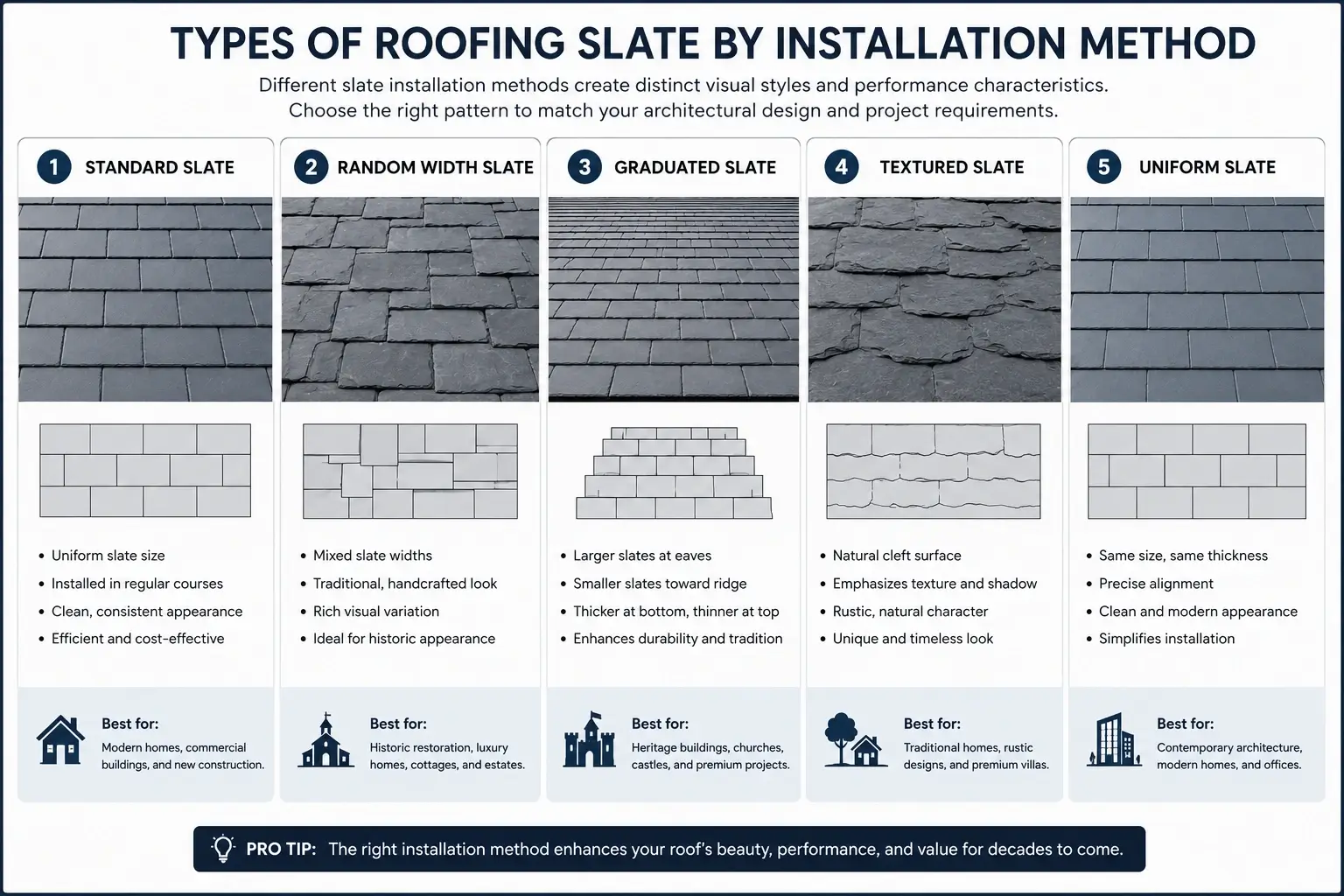
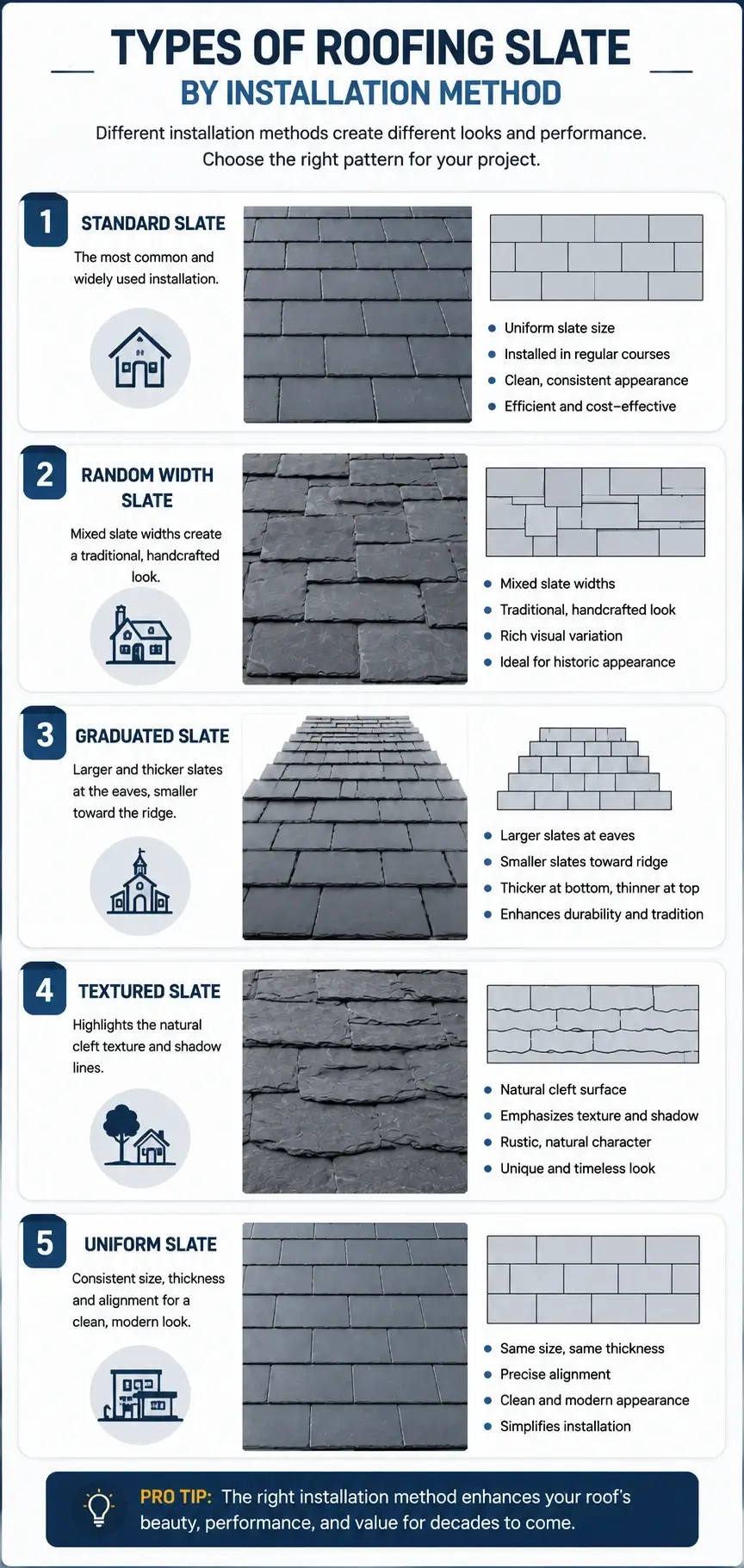
Comparison of Common Slate Roofing Installation Methods
| Installation Type | Characteristics | Best For |
|---|---|---|
| Standard Slate Roof | Uniform slate size and regular courses | Modern residential and commercial buildings |
| Random Width Slate Roof | Mixed slate widths create a traditional appearance | Historic restoration and luxury homes |
| Graduated Slate Roof | Larger, thicker slates at the eaves and smaller slates near the ridge | Heritage buildings and premium projects |
| Textured Slate Roof | Emphasizes natural surface texture and shadow lines | Rustic and traditional architecture |
| Uniform Slate Roof | Consistent size, thickness, and alignment | Contemporary and minimalist designs |
Standard Slate Roof
The standard slate roof is the most widely used roofing slate installation method worldwide. All slates are manufactured in the same size and thickness and installed in evenly spaced horizontal courses.
This method provides a clean, symmetrical appearance while simplifying installation and material estimation. It is also the most cost-effective solution for many residential and commercial roofing projects.
Advantages
- Fast and efficient installation
- Consistent appearance
- Easier material planning
- Lower installation cost
- Suitable for most roof designs
Best suited for: New homes, commercial buildings, schools, offices, and modern architectural projects.
Random Width Slate Roof
A random width slate roof combines slates of different widths while maintaining a consistent length and exposure. This installation style creates a handcrafted appearance that reflects the character of traditional European and North American slate roofs.
Random width roofing is commonly seen on historic churches, manor houses, country estates, and restoration projects where authenticity is important.
Advantages
- Traditional handcrafted appearance
- Rich visual variation
- Authentic historical character
- Popular for restoration work
Best suited for: Historic buildings, luxury residences, cottages, and heritage restoration.
Graduated Slate Roof
A graduated slate roof is one of the most prestigious traditional slate roofing methods, particularly popular in the United Kingdom.
Instead of using identical slates throughout the roof, larger and thicker slates are installed along the eaves, while progressively smaller and thinner slates are used toward the ridge.
This technique was originally developed to maximize durability where rainwater is heaviest while reducing roof weight near the top. It also creates an elegant visual proportion that is difficult to achieve with standard installations.
Advantages
- Outstanding traditional appearance
- Enhanced durability at the roof base
- Efficient use of natural slate
- Highly valued in heritage restoration
Best suited for: Churches, castles, listed buildings, and premium architectural projects.
Textured Slate Roof
Unlike installation methods that focus on uniformity, a textured slate roof highlights the natural cleft surface and slight variations in thickness found in genuine natural slate.
The uneven texture creates attractive shadow lines that change throughout the day as sunlight moves across the roof, giving the building a more natural and timeless appearance.
Although texture comes primarily from the slate itself rather than the installation technique, it is often considered an important part of traditional slate roofing design.
Advantages
- Rich natural character
- Excellent visual depth
- Distinctive handcrafted appearance
- Highlights the beauty of genuine natural slate
Best suited for: Traditional homes, luxury villas, and rustic architectural styles.
Uniform Slate Roof
A uniform slate roof uses roofing slates with identical dimensions, thickness, and exposure to create a clean and orderly appearance.
This style is widely used in contemporary architecture because it emphasizes precision, symmetry, and simplicity. It also reduces installation complexity and produces a modern aesthetic.
Advantages
- Clean architectural lines
- Modern appearance
- Simplified installation
- Consistent roof pattern
Best suited for: Contemporary homes, commercial buildings, and modern architectural designs.
Which Slate Roofing Installation Method Is Best?
The ideal installation method depends on the building’s architectural style, project budget, and desired appearance.
| Project Type | Recommended Installation Method |
|---|---|
| Modern Homes | Standard Slate Roof |
| Historic Restoration | Graduated Slate Roof |
| Luxury Villas | Random Width Slate Roof |
| Contemporary Buildings | Uniform Slate Roof |
| Traditional Architecture | Textured Slate Roof |
If your goal is to achieve a timeless, premium appearance with long-lasting performance, graduated or random width slate roofing offers exceptional visual appeal. For most residential and commercial projects, a standard slate roof provides the best balance of aesthetics, durability, and cost.
Types of Roofing Slate by Thickness
Roofing slate is available in a range of thicknesses to meet different structural, architectural, and performance requirements. While thickness may seem like a simple specification, it has a direct impact on roof weight, durability, appearance, installation, and overall project cost.
In general, thicker slates provide a more substantial appearance and can offer greater durability in demanding environments, while thinner slates reduce roof weight and simplify installation. Selecting the appropriate slate thickness ensures the roof performs well and complements the building’s architectural style.
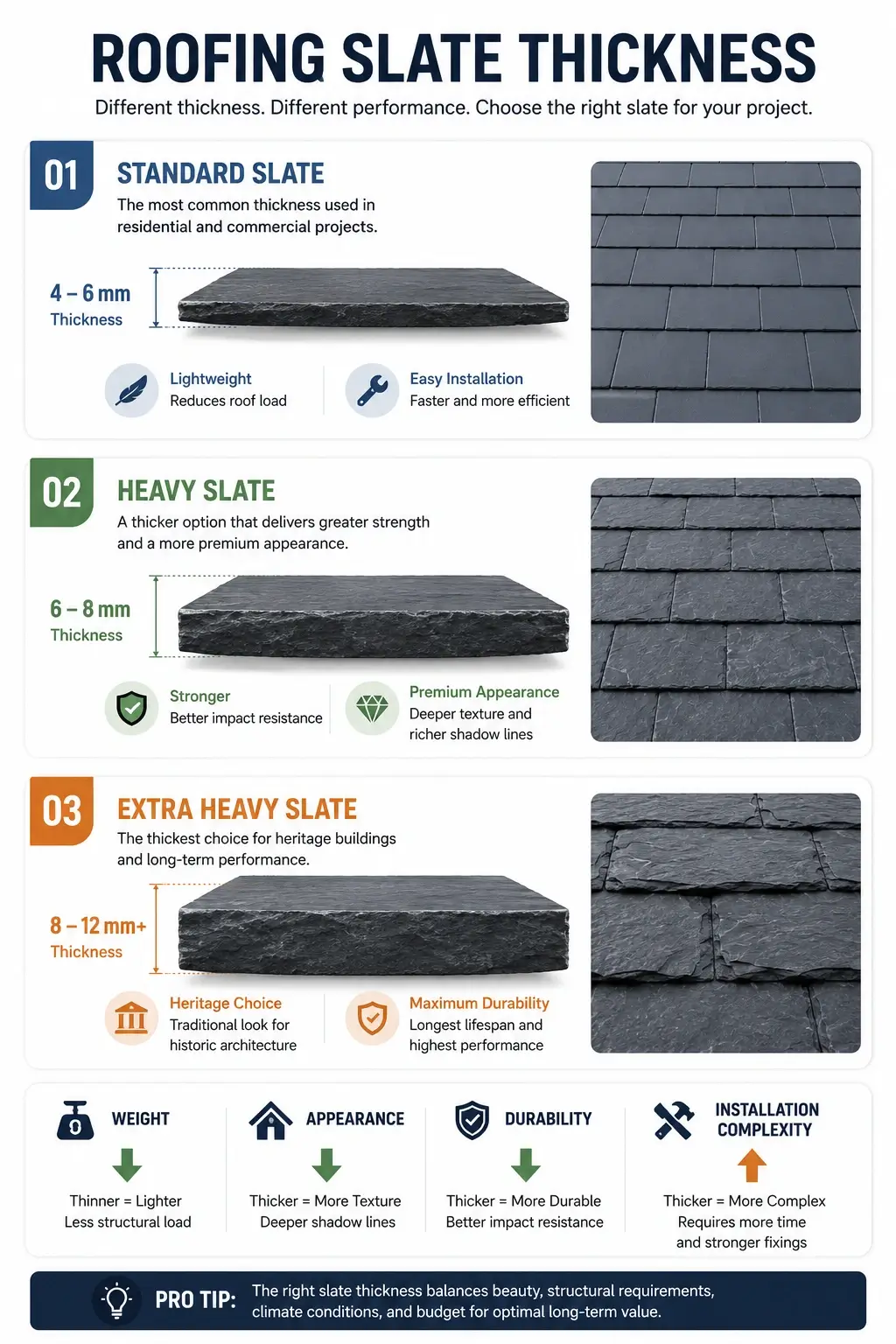
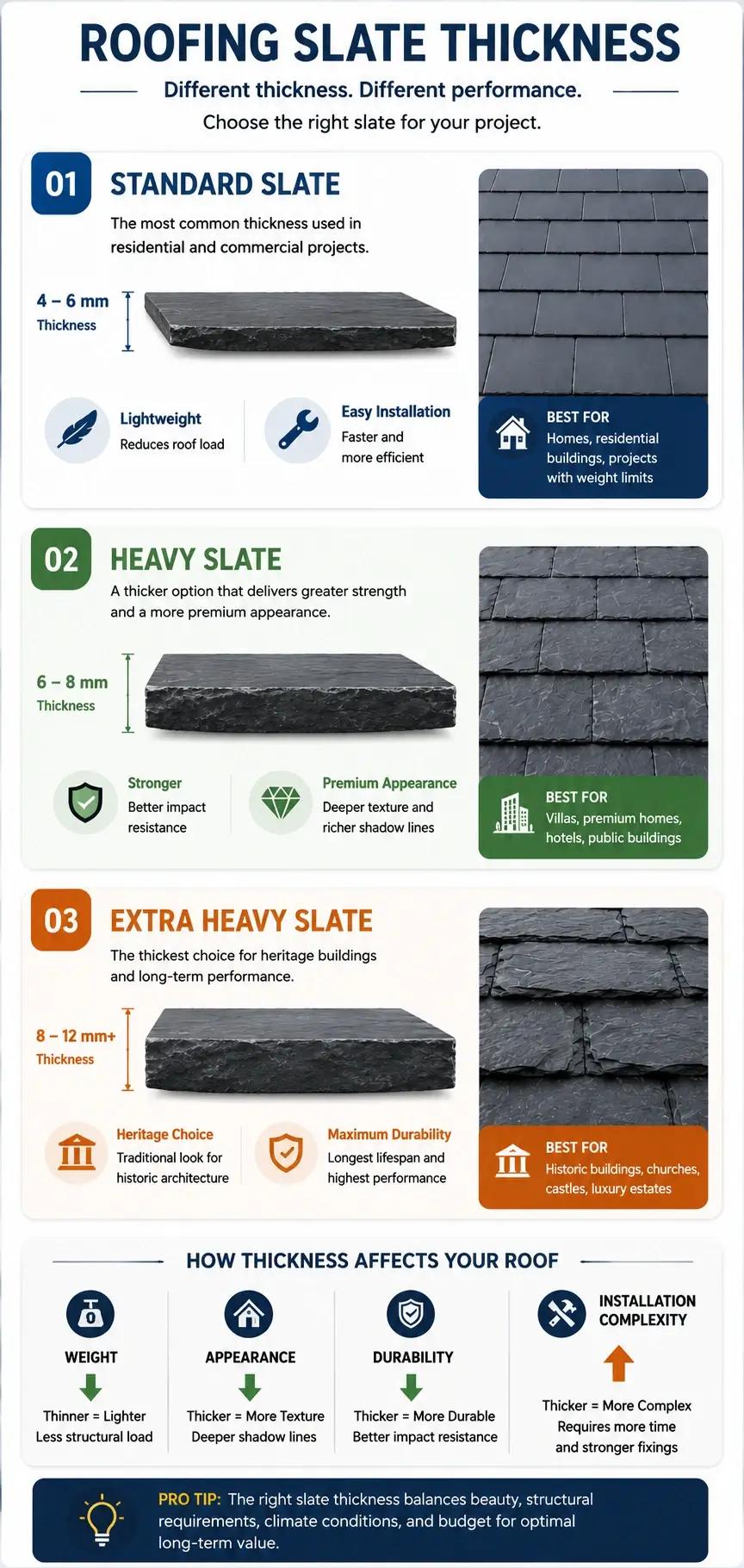
Comparison of Roofing Slate Thickness Types
| Slate Type | Typical Thickness* | Characteristics | Best For |
|---|---|---|---|
| Standard Slate | 4–6 mm | Lightweight, economical, easy to install | Residential homes, commercial buildings |
| Heavy Slate | 6–8 mm | Stronger, deeper texture, longer service life | Premium homes, villas, public buildings |
| Extra Heavy Slate | 8–12 mm or more | Maximum durability and dramatic appearance | Heritage restoration, churches, castles, luxury estates |
*Typical thickness ranges may vary depending on quarry, product specifications, and project requirements.
Standard Roofing Slate
Standard roofing slate is the most commonly used thickness for modern slate roofing projects. It offers an excellent balance between durability, weight, and installation efficiency.
Because it is lighter than thicker alternatives, it places less load on the roof structure while still providing the long lifespan expected from quality natural slate.
Advantages
- Lower roof weight
- Faster installation
- Cost-effective solution
- Suitable for most residential projects
- Available in the widest range of sizes
Recommended for: New homes, residential developments, offices, schools, and commercial buildings.
Heavy Roofing Slate
Heavy roofing slate provides greater thickness and a more substantial visual appearance. The increased thickness creates deeper shadow lines and a more traditional architectural character.
It is often selected for premium homes and buildings where appearance and long-term durability are priorities.
Advantages
- More pronounced natural texture
- Improved impact resistance
- Premium architectural appearance
- Longer expected service life under demanding conditions
Recommended for: Luxury residences, villas, hotels, public buildings, and high-end architectural projects.
Extra Heavy Roofing Slate
Extra heavy roofing slate is traditionally used on prestigious and historic buildings. These slates are considerably thicker than standard products and create a bold, timeless roof profile.
Because of their additional weight, the roof structure must be designed to support the increased load. Installation also requires experienced slate roofing professionals.
Advantages
- Exceptional durability
- Traditional heritage appearance
- Strong visual depth and shadow
- Suitable for long-term restoration projects
Recommended for: Historic churches, castles, museums, government buildings, and architectural restoration.
How Slate Thickness Affects Roof Performance
Choosing the right thickness is not simply about selecting a heavier or lighter slate. It influences several important aspects of roof performance.
Weight
Thicker slates increase the overall roof weight. Before selecting heavy or extra heavy slate, the roof structure should be evaluated to ensure it can safely support the additional load.
Lifespan
Higher-quality natural slate offers an exceptionally long service life regardless of thickness. However, thicker slates generally provide greater resistance to physical damage and may perform better in demanding environments when correctly installed.
Appearance
Thickness has a significant influence on the visual character of the roof.
- Standard slate creates a clean and uniform appearance.
- Heavy slate produces stronger shadow lines.
- Extra heavy slate creates a bold, traditional architectural style often seen on historic buildings.
Installation
Thicker slates require longer nails, stronger battens, and more installation time. Proper installation is essential to ensure long-term performance and weather resistance.
Which Slate Thickness Should You Choose?
The best roofing slate thickness depends on your building design, local climate, structural capacity, and project budget.
| Project Type | Recommended Thickness |
|---|---|
| Residential Homes | Standard Slate |
| Modern Commercial Buildings | Standard or Heavy Slate |
| Luxury Villas | Heavy Slate |
| Historic Restoration | Heavy or Extra Heavy Slate |
| Churches & Heritage Buildings | Extra Heavy Slate |
For most modern residential projects, standard roofing slate provides the best balance between durability, appearance, and cost. Where a more traditional or prestigious architectural style is desired, heavy or extra heavy slate offers greater visual impact and long-term performance.
Learn More
Want detailed information about slate thickness, including standard dimensions, tolerances, roof weight calculations, and recommended applications?
👉 Read our complete guide: Roofing Slate Thickness
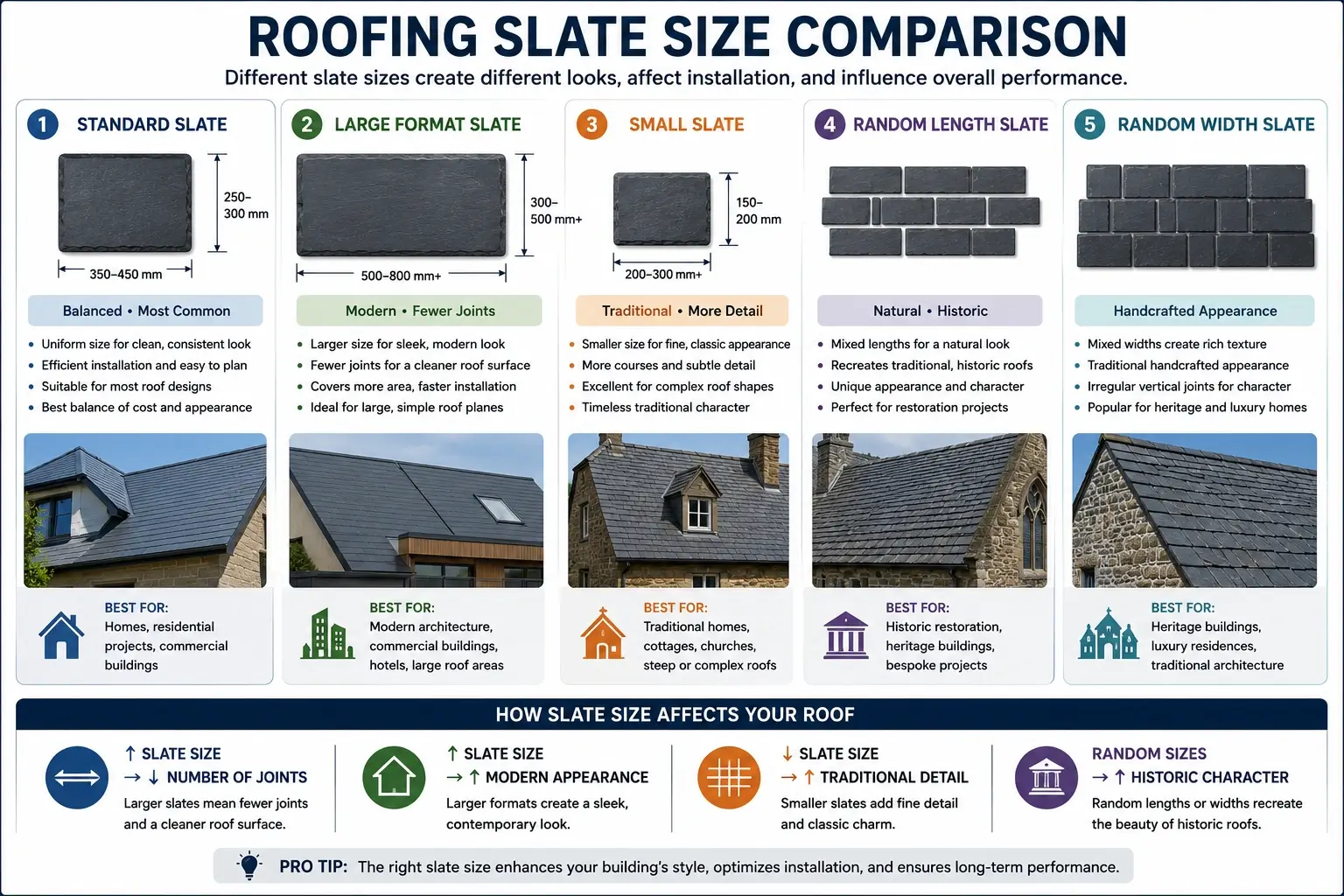
Types of Roofing Slate by Size
Roofing slate is manufactured in a wide range of sizes to suit different architectural styles, roof pitches, and installation methods. The size of a roofing slate influences not only the appearance of the finished roof, but also installation efficiency, material consumption, and overall project cost.
Large slates create a clean, contemporary look with fewer joints, while smaller slates produce a more traditional appearance with greater visual detail. In addition, some projects use random lengths or random widths to recreate the handcrafted character of historic slate roofs.
Choosing the right slate size ensures the roof complements the building’s design while meeting structural and performance requirements.
Comparison Table
| Slate Size Type | Characteristics | Best For |
|---|---|---|
| Standard Slate | Uniform dimensions with balanced appearance | Residential and commercial buildings |
| Large Format Slate | Larger tiles with fewer joints | Contemporary architecture and large roofs |
| Small Slate | Compact tiles creating finer roof detail | Traditional homes, cottages, steep roofs |
| Random Length Slate | Mixed slate lengths for a natural appearance | Historic restoration and bespoke projects |
| Random Width Slate | Mixed slate widths creating handcrafted character | Heritage buildings and luxury residences |
Standard Roofing Slate
Standard roofing slate is the most widely used size category in modern construction. All slates are produced in consistent dimensions, making installation faster, material estimation easier, and the finished roof more uniform.
Standard sizes are suitable for most residential and commercial roofing applications and are available in a wide range of lengths and widths.
Advantages
- Clean, symmetrical appearance
- Efficient installation
- Easy material calculation
- Cost-effective solution
- Suitable for most roofing projects
Recommended for: Residential homes, offices, schools, and commercial buildings.
Large Format Slate
Large format roofing slates have greater length and width than standard products, reducing the number of visible joints across the roof.
This creates a sleek, contemporary appearance while reducing the number of slates required per square meter. Because each slate covers a larger area, installation can be more efficient, although the larger pieces require careful handling during installation.
Advantages
- Modern architectural appearance
- Fewer joints and cleaner roof lines
- Faster roof coverage
- Suitable for large roof areas
Recommended for: Modern homes, commercial buildings, hotels, and contemporary architecture.
Small Slate
Small roofing slates create a more intricate roof pattern with a greater number of courses and joints. This traditional appearance has been used for centuries on cottages, churches, and historic buildings.
Smaller slates also adapt well to complex roof shapes such as turrets, dormers, valleys, and curved roof sections.
Advantages
- Classic traditional appearance
- Excellent for complex roof geometry
- Greater design flexibility
- Timeless architectural character
Recommended for: Heritage buildings, cottages, churches, and restoration projects.
Random Length Slate
Random length roofing uses slates of different lengths while maintaining a coordinated installation pattern.
The variation creates a natural, handcrafted appearance that reflects traditional slate roofing practices. This style is commonly specified for restoration projects and high-end architectural designs seeking a more authentic look.
Advantages
- Natural visual variation
- Authentic historic character
- Unique roof appearance
- Suitable for bespoke architectural designs
Recommended for: Heritage restoration, luxury homes, country estates, and architectural conservation.
Random Width Slate
Random width roofing combines slates of different widths to produce a roof with greater visual interest and individuality.
Unlike standard installations where every slate has the same width, random width layouts create irregular vertical joints that enhance the handcrafted appearance of natural slate roofs.
This installation style is particularly popular in Europe and North America for restoration work and premium residential architecture.
Advantages
- Traditional handcrafted appearance
- Rich visual texture
- Authentic historic style
- Premium architectural character
Recommended for: Historic buildings, luxury residences, churches, and restoration projects.
How Slate Size Affects Roof Performance
The size of roofing slate influences more than just appearance.
Appearance
- Large slates create bold, clean roof lines.
- Small slates produce finer detail and a more traditional appearance.
- Random sizes provide natural variation and historic character.
Installation
Larger slates cover more area, reducing the number of pieces required, while smaller slates require more installation time but offer greater flexibility on complex roof designs.
Material Efficiency
Selecting the appropriate slate size can reduce cutting waste and improve installation efficiency, particularly on roofs with simple geometries.
Cost
Larger slates may reduce labor time, whereas smaller or random-sized slates often require more craftsmanship and higher installation costs.
Which Roofing Slate Size Should You Choose?
The ideal slate size depends on your building style, roof shape, and project goals.
| Project Type | Recommended Slate Size |
|---|---|
| Modern Homes | Standard or Large Format Slate |
| Commercial Buildings | Large Format Slate |
| Luxury Villas | Large Format or Random Width Slate |
| Historic Restoration | Small Slate or Random Length Slate |
| Churches & Heritage Buildings | Small Slate with Random Width or Random Length |
For most residential projects, standard roofing slate sizes offer the best balance between appearance, installation efficiency, and cost. If your goal is to recreate the timeless beauty of traditional slate roofs, small, random width, or random length slate provides a more authentic architectural character.
Learn More
Need detailed information about standard slate dimensions, imperial and metric sizes, coverage calculations, and recommended applications?
👉 Read our complete guide: Roofing Slate Sizes
Types of Roofing Slate by Edge Finish
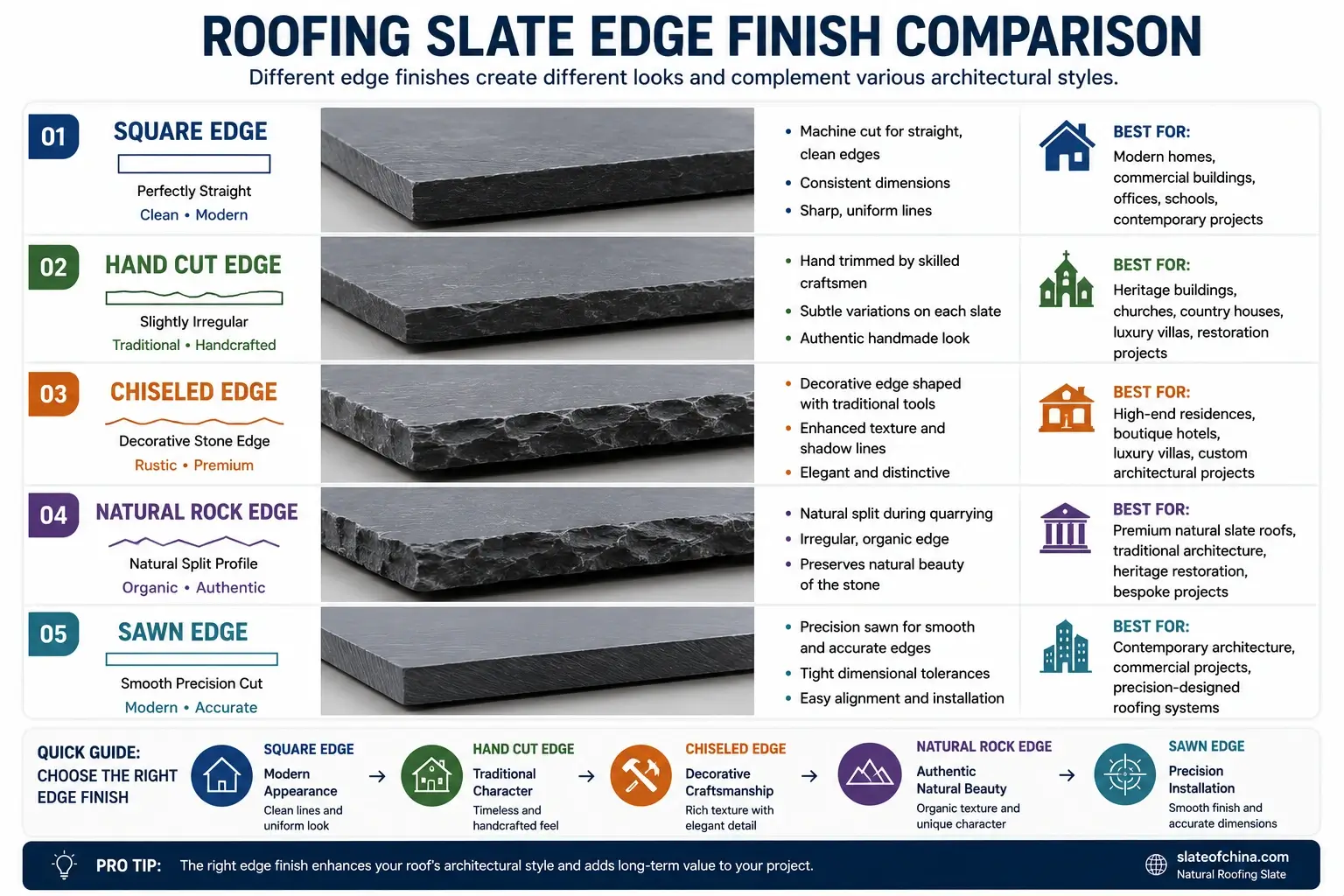
The edge finish of a roofing slate plays an important role in the roof’s overall appearance and architectural style. Although it does not significantly affect the weather resistance of properly installed slate, the edge treatment influences visual character, craftsmanship, installation style, and compatibility with traditional or contemporary designs.
Natural roofing slate is available with several edge finishes, ranging from perfectly straight machine-cut edges to handcrafted finishes that preserve the authentic beauty of natural stone. Choosing the right edge finish helps create the desired architectural effect while complementing the building’s design.
Comparison Table
| Edge Finish | Characteristics | Typical Style | Best For |
|---|---|---|---|
| Square Edge | Straight, machine-cut edges | Contemporary | Modern homes and commercial buildings |
| Hand Cut Edge | Individually hand trimmed | Traditional | Heritage restoration and luxury homes |
| Chiseled Edge | Decorative hand-chiseled edge | Rustic | High-end residential architecture |
| Natural Rock Edge | Preserves the natural split edge | Organic | Premium natural slate projects |
| Sawn Edge | Smooth sawn finish with precise dimensions | Modern | Architectural and custom projects |
Square Edge Slate
Square edge roofing slate features accurately cut, straight edges that create clean horizontal and vertical roof lines.
Because of its precise dimensions, square edge slate is the most common choice for modern roofing projects where consistency and installation efficiency are priorities.
Advantages
- Clean and uniform appearance
- Excellent dimensional accuracy
- Faster installation
- Suitable for modern architecture
- Most economical production method
Recommended for: Residential developments, commercial buildings, offices, schools, and contemporary homes.
Hand Cut Edge Slate
Hand cut edge slate is individually trimmed by skilled craftsmen rather than being completely machine finished.
Each slate has subtle variations that give the roof an authentic handcrafted appearance, making it particularly suitable for historic restoration and traditional architecture.
Advantages
- Authentic handcrafted character
- Traditional architectural appearance
- Every slate is unique
- Premium visual quality
Recommended for: Heritage buildings, churches, country houses, luxury villas, and restoration projects.
Chiseled Edge Slate
Chiseled edge slate features decorative edges shaped with traditional stone-working tools.
The slightly irregular edges create stronger shadow lines and emphasize the natural beauty of genuine slate, giving the roof a distinctive handcrafted appearance.
Advantages
- Elegant decorative edge
- Rich natural texture
- Traditional craftsmanship
- Premium architectural finish
Recommended for: High-end residential projects, boutique hotels, luxury villas, and custom-designed buildings.
Natural Rock Edge Slate
Natural rock edge slate retains the original split edge created during the natural splitting process.
Instead of producing perfectly straight edges, this finish celebrates the organic character of natural stone and creates a roof with exceptional texture and authenticity.
Advantages
- Preserves natural stone character
- Highly authentic appearance
- Unique edge on every slate
- Environmentally friendly processing
Recommended for: Premium natural slate roofs, traditional architecture, heritage restoration, and bespoke residential projects.
Sawn Edge Slate
Sawn edge slate is produced using precision cutting equipment to achieve smooth, consistent edges and exact dimensions.
It is widely used in projects requiring tight dimensional tolerances and a minimalist architectural style.
Advantages
- Precise dimensions
- Clean architectural appearance
- Easy alignment during installation
- Suitable for custom fabrication
Recommended for: Contemporary architecture, commercial projects, and precision-designed roofing systems.
Which Edge Finish Should You Choose?
The best edge finish depends on the architectural style you wish to achieve.
| Building Style | Recommended Edge Finish |
|---|---|
| Contemporary Homes | Square Edge or Sawn Edge |
| Modern Commercial Buildings | Square Edge |
| Traditional Homes | Hand Cut Edge |
| Heritage Restoration | Hand Cut Edge or Natural Rock Edge |
| Luxury Villas | Chiseled Edge or Natural Rock Edge |
| Rustic Architecture | Chiseled Edge |
For projects where precision and a modern appearance are priorities, square edge and sawn edge slates are ideal. If you’re aiming for timeless elegance and authentic craftsmanship, hand cut, chiseled, or natural rock edge slates provide a more distinctive and premium finish.
Learn More
Edge finish is just one factor in selecting the ideal roofing slate. To explore standard dimensions, coverage calculations, and recommended applications, continue with our detailed guide:
👉 Read our complete guide: Roofing Slate Sizes
Types of Roofing Slate by Surface Finish
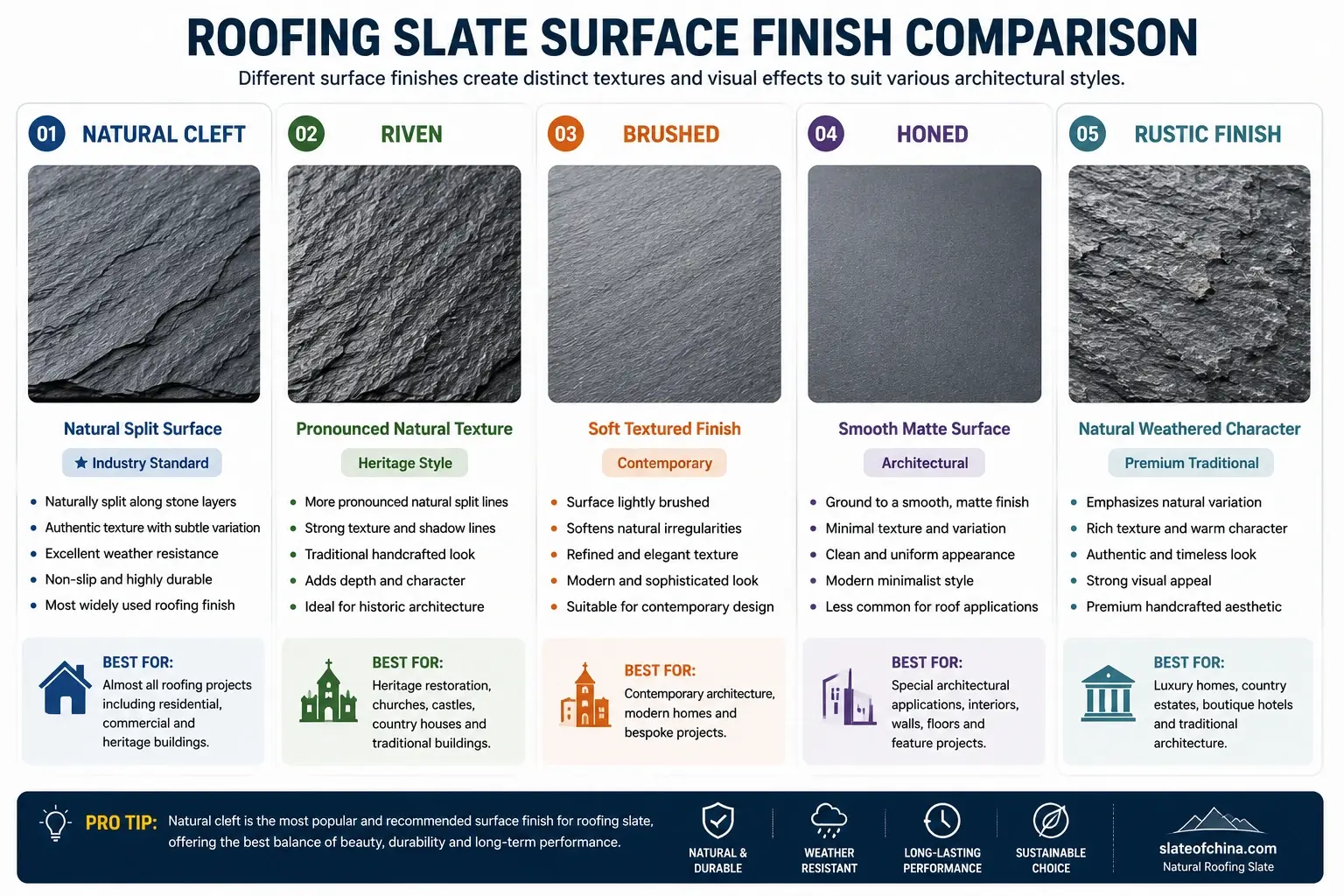
The surface finish of roofing slate has a significant influence on the roof’s appearance, texture, and architectural style. Unlike edge finishes, which define the outline of each slate, the surface finish determines how the face of the slate reflects light, creates shadow, and expresses the natural character of the stone.
Most natural roofing slate is supplied with a natural cleft surface, formed during the natural splitting process. However, specialized finishes such as brushed or honed surfaces are also available for selected architectural applications.
Choosing the right surface finish helps achieve the desired balance between traditional authenticity, contemporary design, and long-term visual appeal.
Comparison Table
| Surface Finish | Characteristics | Typical Application | Popularity |
|---|---|---|---|
| Natural Cleft | Naturally split surface with authentic texture | Traditional and modern roofing | ★★★★★ |
| Riven | Pronounced natural split texture with deeper relief | Heritage and rustic architecture | ★★★★☆ |
| Brushed | Lightly textured by brushing the stone surface | Contemporary architectural projects | ★★★☆☆ |
| Honed | Smooth, matte surface created by grinding | Special architectural applications | ★★☆☆☆ |
| Rustic Finish | Natural weathered appearance with strong character | Luxury homes and traditional architecture | ★★★★☆ |
Natural Cleft Slate
Natural cleft is the standard surface finish for premium roofing slate and the most widely used finish throughout the world.
During production, the slate is naturally split along its geological layers without polishing or artificial texturing. This process preserves the authentic beauty of the stone while creating subtle variations that make every slate unique.
Natural cleft slate also provides excellent weather resistance and a timeless appearance that has been admired for centuries.
Advantages
- Authentic natural stone appearance
- Excellent weather resistance
- Traditional architectural character
- Non-slip textured surface
- Minimal processing and environmentally friendly
Recommended for: Nearly all residential, commercial, and heritage roofing projects.
Riven Slate
Riven slate features a more pronounced natural split texture, creating stronger shadow lines and a richer visual effect.
Although closely related to natural cleft slate, the term riven is commonly used in the UK roofing industry to describe slates with a distinctly textured natural surface.
Advantages
- Rich natural texture
- Traditional handcrafted appearance
- Enhanced visual depth
- Excellent for historic buildings
Recommended for: Churches, castles, country houses, and restoration projects.
Brushed Slate
Brushed slate is produced by lightly brushing the stone surface to soften natural irregularities while retaining much of the original texture.
Although uncommon for traditional roofing, brushed slate is occasionally specified for contemporary architectural projects seeking a refined natural appearance.
Advantages
- Soft textured finish
- Contemporary appearance
- Reduced surface irregularity
- Elegant architectural style
Recommended for: Modern architectural projects and bespoke residential designs.
Honed Slate
Honed slate is ground to produce a smooth, matte surface with very little natural texture.
Because polished or honed surfaces can reduce the traditional character of roofing slate, this finish is rarely used for pitched roofs. It is far more common for interior flooring, wall cladding, stair treads, and architectural stone applications.
Advantages
- Smooth, refined appearance
- Consistent surface finish
- Modern minimalist style
Recommended for: Special architectural applications rather than conventional slate roofing.
Rustic Finish Slate
Rustic finish slate emphasizes the natural variations of the stone, including texture, color movement, and handcrafted character.
Instead of producing a perfectly uniform appearance, rustic slate celebrates the individuality of each piece, creating roofs with exceptional warmth and timeless charm.
Advantages
- Strong natural character
- Authentic traditional appearance
- Rich texture and shadow
- Premium handcrafted aesthetic
Recommended for: Luxury homes, country estates, boutique hotels, and traditional architecture.
Which Surface Finish Is Best?
For the vast majority of roofing projects, Natural Cleft remains the preferred surface finish because it combines authentic beauty, durability, and excellent weather performance.
| Project Type | Recommended Surface Finish |
|---|---|
| Residential Homes | Natural Cleft |
| Commercial Buildings | Natural Cleft |
| Heritage Restoration | Riven or Natural Cleft |
| Luxury Villas | Rustic Finish or Natural Cleft |
| Contemporary Architecture | Brushed or Natural Cleft |
If your goal is a roof with timeless beauty and the authentic character of genuine stone, natural cleft roofing slate is the industry standard and the finish specified by architects around the world.
Learn More
Surface finish works together with slate thickness, edge finish, and color to define the overall appearance of a slate roof.
👉 Read our complete guides:
Types of Roofing Slate by Color
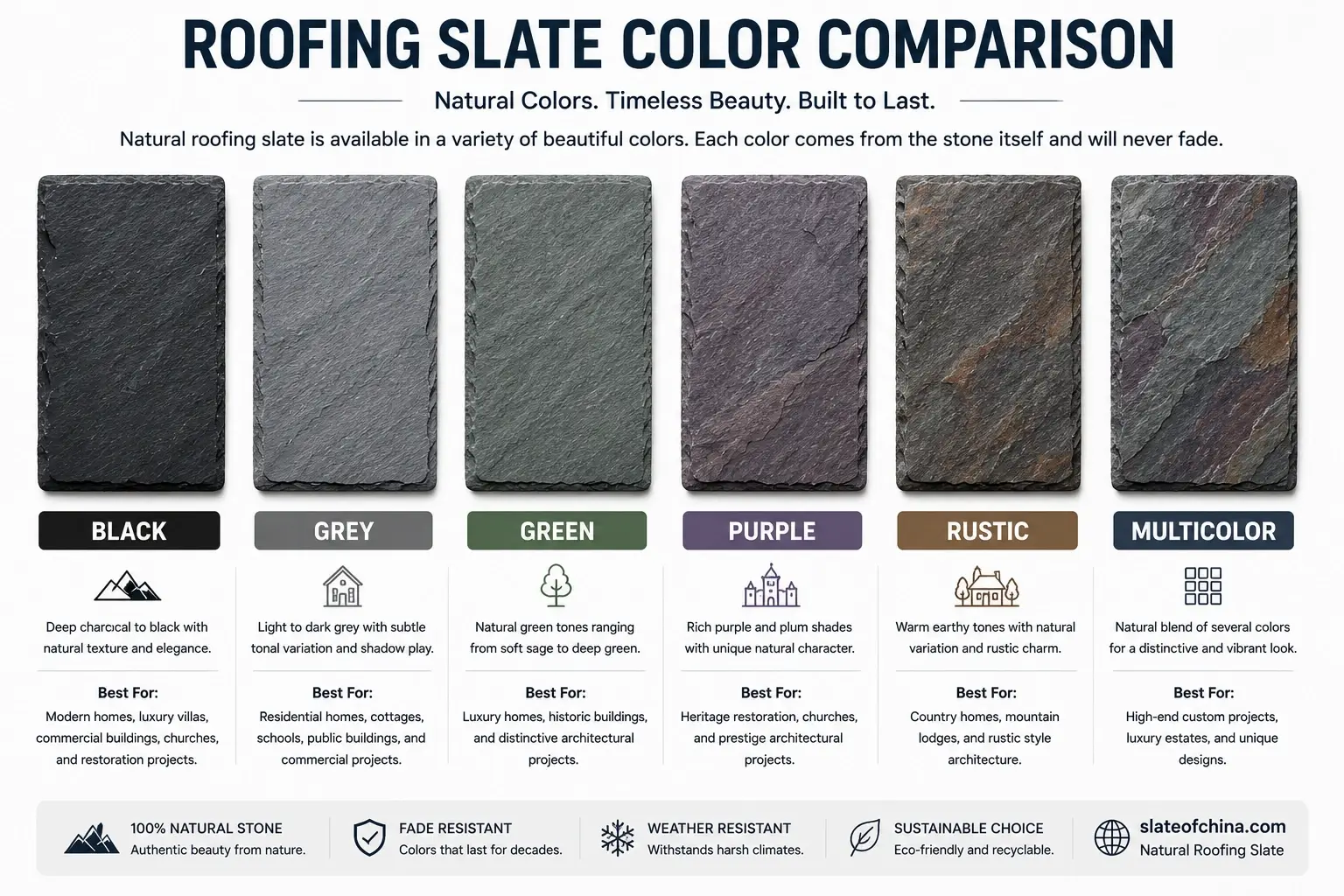
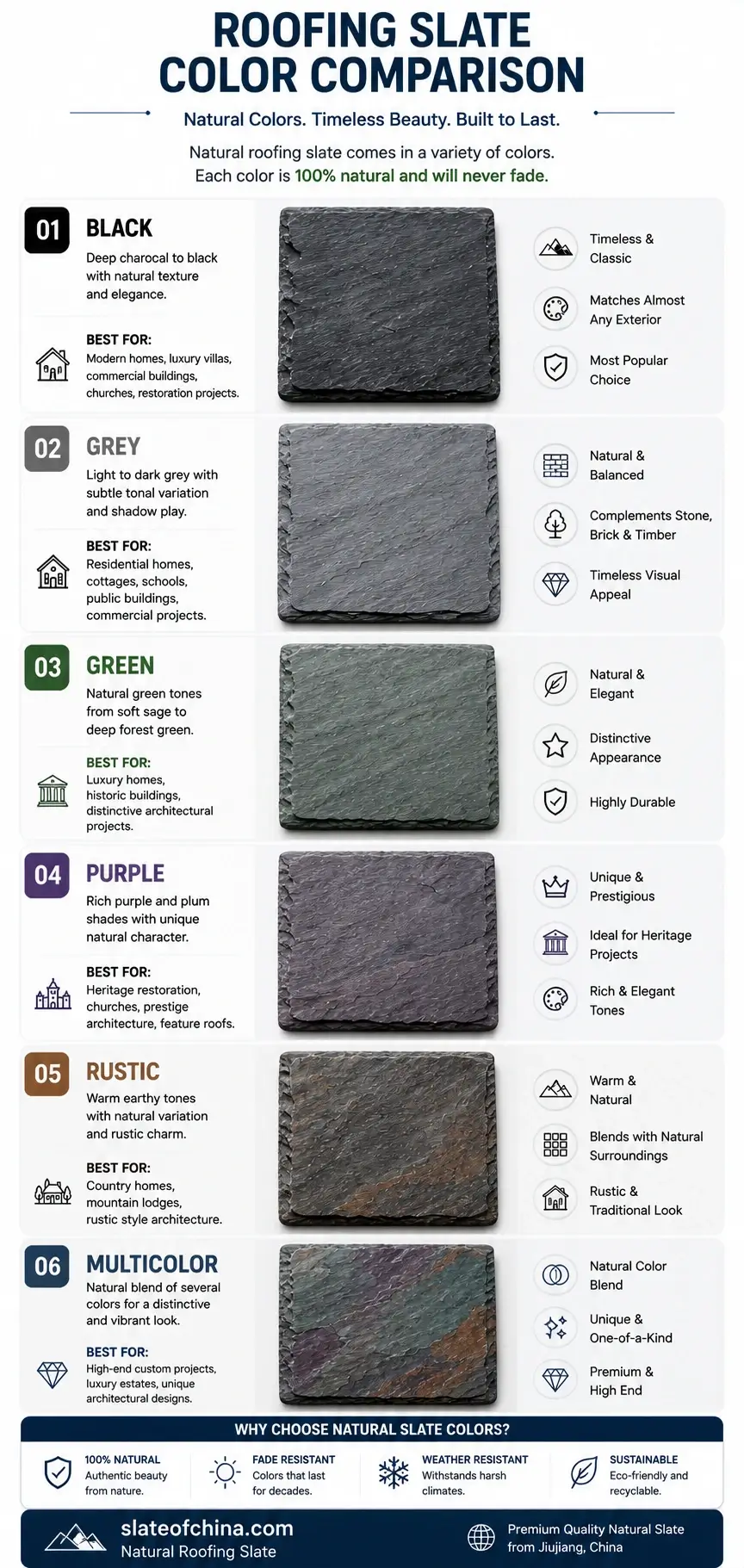
Color is one of the most noticeable characteristics of a natural slate roof. Unlike painted roofing materials, the color of natural roofing slate comes directly from its mineral composition, giving each slate a permanent, fade-resistant appearance that lasts for decades.
Natural roofing slate is available in a variety of colors, including black, grey, green, purple, rustic, and multicolor. Each color creates a different architectural style and complements different building designs, from modern homes to historic restoration projects.
Choosing the right roofing slate color is not only a matter of personal preference—it also influences the building’s visual character, resale value, and compatibility with the surrounding environment.
Comparison Table
| Slate Color | Appearance | Best For | Popularity |
|---|---|---|---|
| Black Slate | Deep charcoal to black | Contemporary and traditional architecture | ★★★★★ |
| Grey Slate | Light to dark grey with natural variation | Residential and commercial buildings | ★★★★★ |
| Green Slate | Natural green tones | Luxury homes and historic buildings | ★★★★☆ |
| Purple Slate | Rich purple and plum shades | Heritage restoration and feature roofs | ★★★☆☆ |
| Rustic Slate | Mixed earthy tones | Country homes and rustic architecture | ★★★★☆ |
| Multicolor Slate | Natural blend of several colors | High-end custom projects | ★★★★☆ |
Black Roofing Slate
Black roofing slate is the most popular choice worldwide because of its timeless elegance and versatility.
Its deep charcoal color complements both modern and traditional architecture while providing a clean, sophisticated appearance that never goes out of style.
Advantages
- Classic architectural appearance
- Matches almost any exterior color
- Elegant and timeless
- Most widely specified roofing slate
Recommended for: Modern homes, luxury villas, commercial buildings, churches, and restoration projects.
Grey Roofing Slate
Grey roofing slate offers a softer, more natural appearance than black slate while maintaining the durability and beauty of genuine natural stone.
Subtle tonal variations create attractive shadow effects that enhance the roof’s character without appearing overly bold.
Advantages
- Natural, balanced appearance
- Complements stone and brick buildings
- Suitable for traditional and modern architecture
- Timeless visual appeal
Recommended for: Residential homes, cottages, schools, public buildings, and commercial projects.
Green Roofing Slate
Green slate develops from unique mineral compositions that create elegant green tones ranging from soft sage to deep forest green.
It is widely used in premium residential projects and historic architecture where distinctive natural colors are desired.
Purple Roofing Slate
Purple roofing slate provides a unique architectural statement with rich plum and purple hues.
Although less common than black or grey slate, it is often selected for prestigious restoration projects and distinctive architectural designs.
Rustic Roofing Slate
Rustic slate combines natural color variations to produce a warm, weathered appearance.
Its mixture of earthy tones makes it an excellent choice for traditional homes, country estates, and rustic architecture.
Multicolor Roofing Slate
Multicolor slate combines several naturally occurring colors within the same roof, creating a distinctive and highly decorative appearance.
Every roof becomes unique because no two slates are exactly alike.
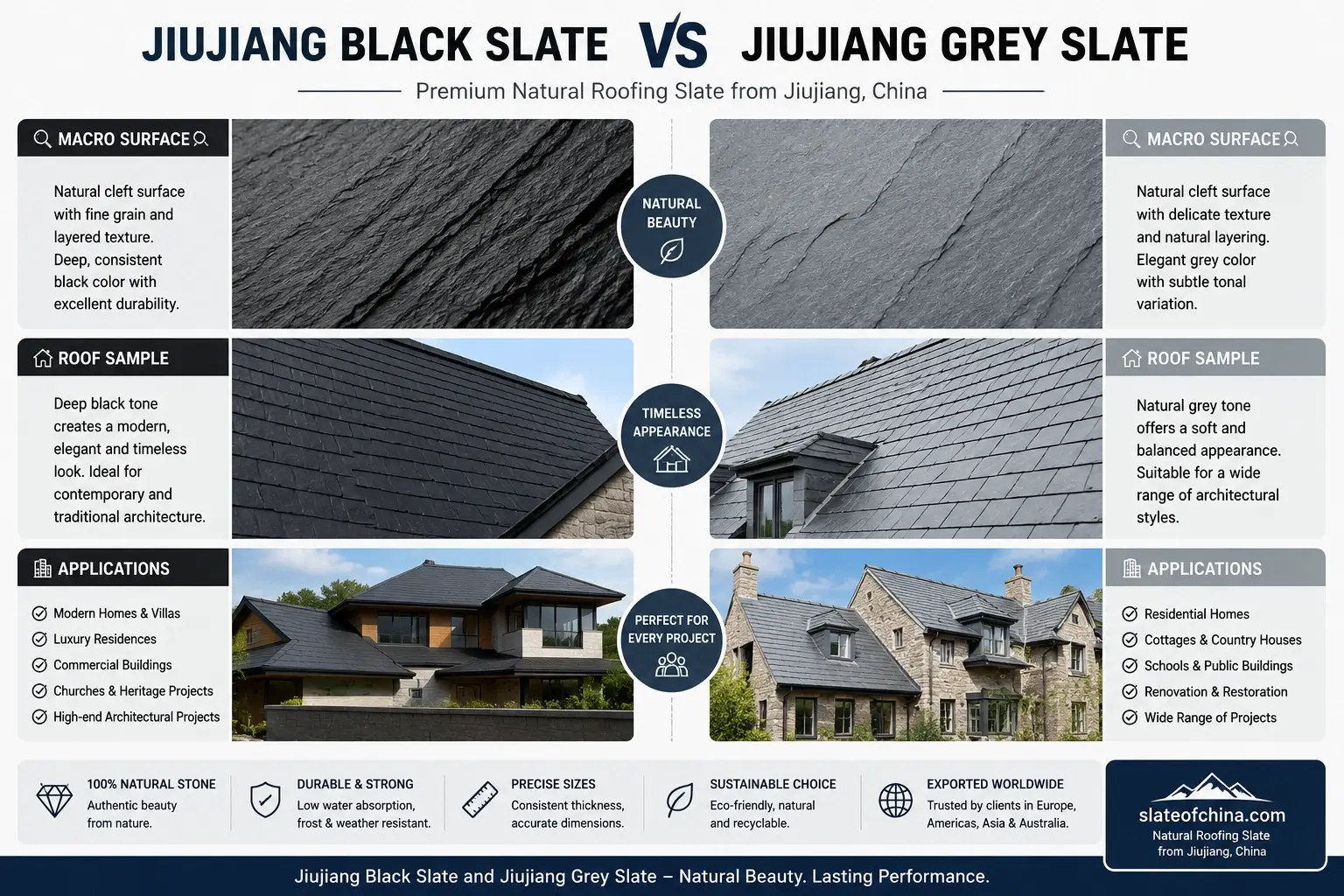
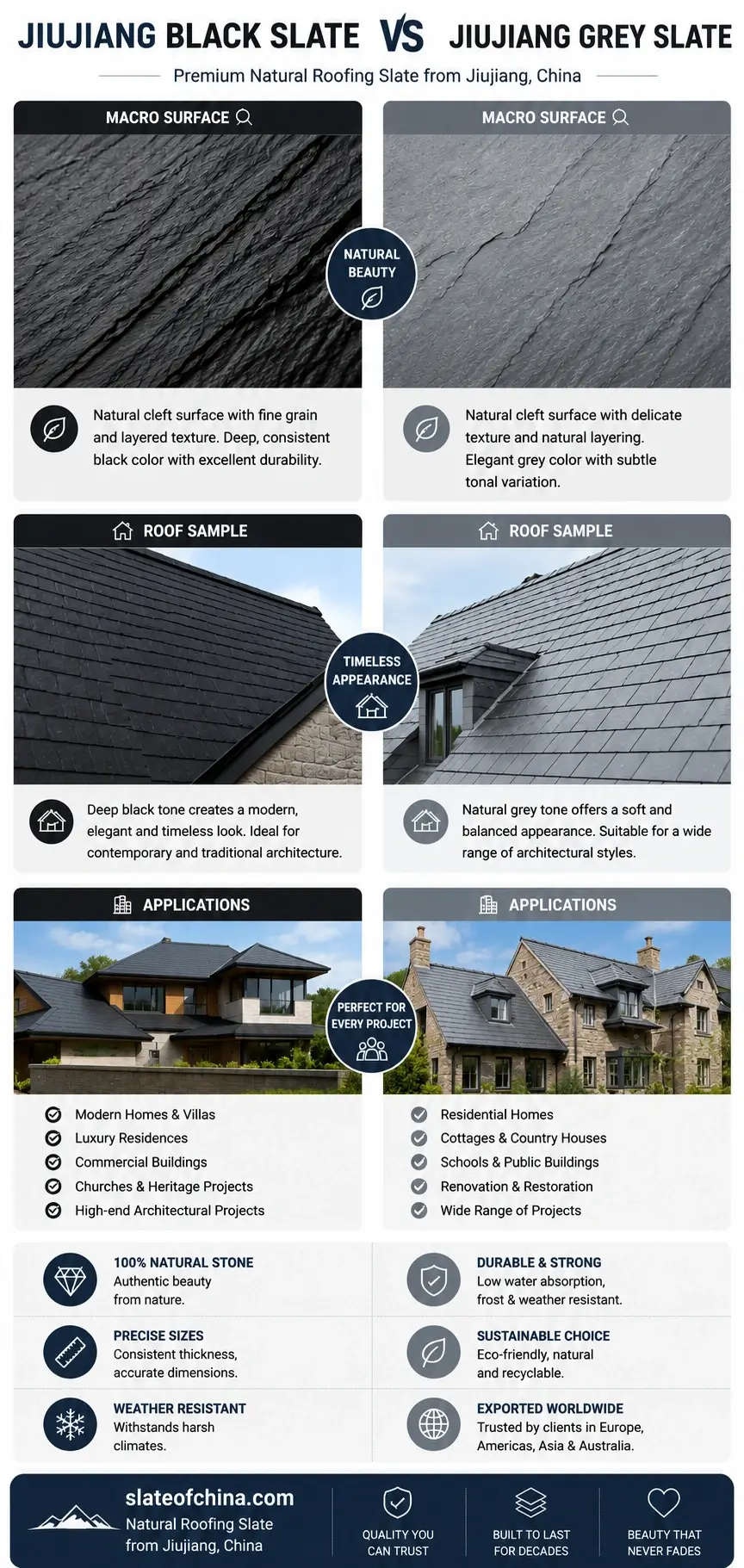
Why Choose Jiujiang Black Slate?
Jiujiang Black Slate is one of the most popular natural roofing slates exported from China. Quarried from high-quality deposits in Jiujiang, Jiangxi Province, it is valued for its consistent color, fine-grained structure, and outstanding durability.
Key Features
- Deep charcoal black color
- Natural cleft surface with authentic texture
- Low water absorption
- Excellent frost resistance
- Precise dimensions and stable quality
- Suitable for residential, commercial, and heritage roofing projects
Jiujiang Black Slate has been successfully exported to Europe, North America, Australia, and other international markets, where it is widely recognized for its excellent balance of quality and value.
Why Choose Jiujiang Grey Slate?
Jiujiang Grey Slate is appreciated for its elegant natural grey tones and subtle color variation.
Its refined appearance blends beautifully with brick, stone, timber, and contemporary building materials, making it one of the most versatile roofing slates available.
Key Features
- Natural light to medium grey color
- Fine natural cleft surface
- Excellent weather resistance
- Stable mineral composition
- Long service life
- Available in multiple sizes and thicknesses
Jiujiang Grey Slate is widely used for residential developments, luxury homes, heritage restoration, and architectural roofing projects around the world.
Which Roofing Slate Color Is Best?
The best roofing slate color depends on the architectural style, surrounding landscape, and personal preference.
| Building Style | Recommended Color |
|---|---|
| Contemporary Homes | Black or Grey Slate |
| Traditional Homes | Grey or Rustic Slate |
| Luxury Villas | Black, Green, or Multicolor Slate |
| Heritage Restoration | Grey, Purple, or Green Slate |
| Country Houses | Rustic or Grey Slate |
For most roofing projects, black and grey natural roofing slate remain the most popular choices because they offer timeless beauty, excellent versatility, and broad architectural compatibility.
Learn More
Looking for detailed information about roofing slate colors, weathering characteristics, and color selection tips?
👉 Read our complete guide: Roofing Slate Colors
Types of Roofing Slate by Country of Origin
Natural roofing slate is quarried in several countries around the world, each offering unique geological characteristics, colors, textures, and performance. The country of origin can influence the slate’s appearance, availability, price, and historical reputation.
Some regions are known for premium heritage slate used in landmark buildings, while others have become leading global suppliers thanks to consistent quality, large production capacity, and competitive pricing.
Understanding the strengths of each producing country helps homeowners, architects, distributors, and roofing contractors select the most suitable roofing slate for their projects.
Comparison Table
| Country | Characteristics | Typical Applications |
|---|---|---|
| China | Cost-effective, stable quality, large production capacity | Residential, commercial, export projects |
| Spain | World’s largest natural slate exporter | European residential and commercial roofing |
| Wales (UK) | Historic premium slate with exceptional longevity | Heritage restoration and landmark buildings |
| Vermont (USA) | Traditional North American slate in multiple colors | Historic homes and institutional buildings |
| Brazil | Colorful slate with attractive natural variations | Residential roofing and architectural projects |
| Canada | Limited production with regional applications | Restoration and local construction |
Chinese Roofing Slate
China is one of the world’s leading producers and exporters of natural roofing slate, supplying high-quality slate to Europe, North America, Australia, and many other international markets.
Chinese roofing slate has earned a strong reputation for its consistent quality, wide range of sizes and colors, reliable supply, and competitive pricing. Modern quarrying techniques and advanced processing equipment enable manufacturers to produce roofing slate that meets international standards while maintaining excellent value.
For many distributors, importers, and roofing contractors, Chinese slate provides an ideal balance between performance, availability, and cost.
Advantages
- Competitive pricing
- Stable product quality
- Wide range of sizes and thicknesses
- Reliable supply chain
- Large export capacity
- Suitable for residential and commercial roofing worldwide
Jiujiang Roofing Slate — China’s Premium Natural Slate
Located in Jiujiang, Jiangxi Province, one of China’s most important natural slate-producing regions, Jiujiang Slate is widely recognized for its fine-grained structure, consistent geological formation, and excellent splitting properties.
Thanks to millions of years of geological stability, Jiujiang slate can be naturally split into thin, durable roofing slates with clean edges and an authentic natural cleft surface. These characteristics make it an excellent choice for both modern roofing projects and heritage-style architecture.
Today, Jiujiang roofing slate is exported to customers across Europe, North America, Oceania, and Asia, serving distributors, roofing contractors, builders, and architectural projects around the world.
Why Choose Jiujiang Slate?
- Stable geological formation for consistent quality
- Excellent natural splitting and fine layering
- Authentic natural cleft surface
- Low water absorption and high frost resistance
- Long service life of 75–150+ years
- Wide range of sizes, thicknesses, and edge finishes
- Large production capacity for bulk orders
- Extensive export experience and international quality standards
As a professional manufacturer and exporter, SlateofChina specializes in supplying premium Jiujiang natural roofing slate for residential, commercial, and restoration projects worldwide.
Spanish Roofing Slate
Spain is the world’s largest exporter of natural roofing slate and has supplied European markets for decades.
Spanish slate is known for its consistent quality, dark color, and widespread use in residential and commercial construction throughout Europe.
Best For
- Residential housing
- Commercial developments
- European roofing projects
Welsh Roofing Slate
Welsh slate is internationally renowned for its exceptional durability and historical significance.
It has been used on castles, churches, universities, and heritage buildings for centuries and is often regarded as one of the world’s most prestigious roofing slates.
Best For
- Historic restoration
- Heritage architecture
- Landmark buildings
Vermont Roofing Slate
Vermont slate represents the traditional slate roofing industry of North America.
Available in several natural colors, including grey, green, purple, and black, Vermont slate has been widely used on homes, churches, schools, and public buildings throughout the United States and Canada.
Best For
- Historic homes
- Institutional buildings
- Restoration projects
Brazilian Roofing Slate
Brazil produces natural slate with attractive color variations and has become an important supplier for architectural roofing and building materials.
Its competitive pricing and decorative appearance make it popular in residential and commercial projects.
Best For
- Residential construction
- Decorative architectural projects
Canadian Roofing Slate
Canada has a relatively small slate industry, with production mainly serving domestic restoration and regional construction projects.
Although production volumes are limited, Canadian slate continues to play an important role in preserving historic architecture.
Which Country Produces the Best Roofing Slate?
There is no single “best” roofing slate. The ideal choice depends on your project requirements, architectural style, budget, and supply priorities.
| Project Requirement | Recommended Country |
|---|---|
| Best Value for Money | China |
| Large Quantity Supply | China |
| Historic Restoration | Wales or Vermont |
| European Projects | Spain |
| Decorative Color Options | Brazil |
| Local North American Restoration | Vermont or Canada |
For many international buyers, Chinese roofing slate—particularly Jiujiang Slate—offers one of the best combinations of quality, durability, availability, and value, making it an increasingly popular choice for projects around the world.
Learn More
Interested in learning more about China’s premium natural roofing slate?
Explore our dedicated pages:
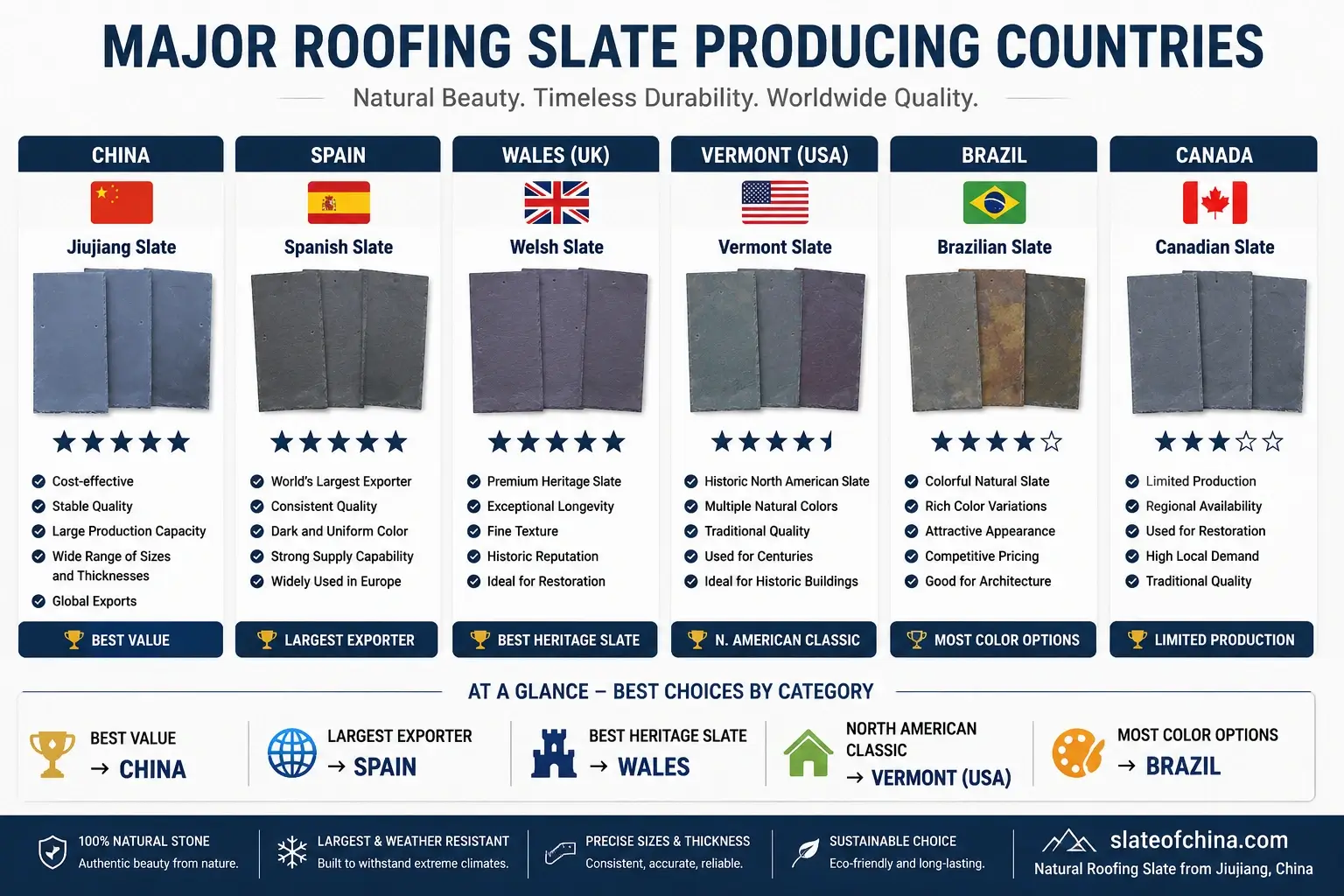
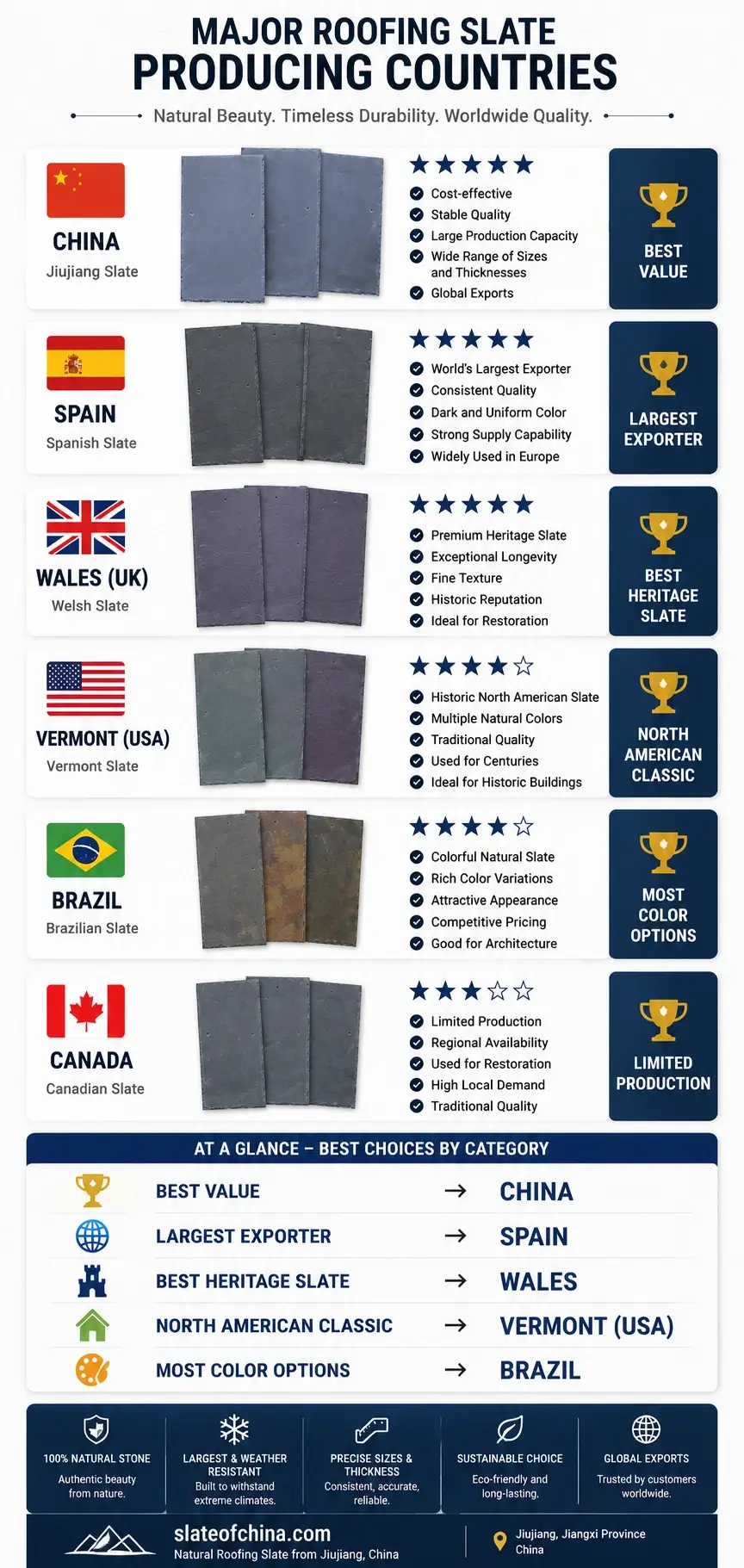
World Roofing Slate Producing Countries at a Glance
Natural roofing slate is produced in several well-known regions around the world, each offering unique geological characteristics, colors, and architectural styles. As shown in the comparison above, China, Spain, Wales, Vermont (USA), Brazil, and Canada are among the world’s most recognized roofing slate producing countries.
Today, Chinese roofing slate has become one of the fastest-growing choices in the international market thanks to its reliable quality, competitive pricing, and large production capacity. Among China’s leading slate-producing regions, Jiujiang Slate is especially valued for its stable geological formation, excellent natural splitting properties, low water absorption, and authentic natural cleft surface.
While Spanish roofing slate remains the world’s largest export category and Welsh roofing slate is famous for prestigious heritage buildings, Jiujiang natural slate from China offers an outstanding balance of durability, appearance, availability, and value. This makes it an ideal solution for residential roofing, commercial construction, architectural projects, and historic restoration around the world.
As a professional China roofing slate manufacturer and natural roofing slate exporter, SlateofChina supplies premium Jiujiang roofing slate to customers across Europe, North America, Australia, and many other international markets. Whether you are an importer, distributor, architect, or roofing contractor, selecting the right country of origin is an important step toward choosing the best natural roofing slate for your project.
Frequently Asked Questions
Which country produces the best roofing slate?
There is no single best choice for every project. Welsh slate is renowned for heritage buildings, Spanish slate leads global exports, while Jiujiang roofing slate from China offers an excellent combination of quality, durability, production capacity, and competitive pricing.
Why is Chinese roofing slate becoming more popular?
Chinese roofing slate is widely chosen because it combines stable quality, consistent supply, multiple size and thickness options, and attractive pricing. Premium Jiujiang Slate is exported worldwide and meets the requirements of residential, commercial, and restoration projects.
Is Jiujiang Slate suitable for international projects?
Yes. Jiujiang natural roofing slate has been successfully supplied to Europe, North America, Australia, and other international markets. Its excellent splitting characteristics, frost resistance, and long service life make it suitable for a wide range of roofing applications.
Types of Roofing Slate by Grade
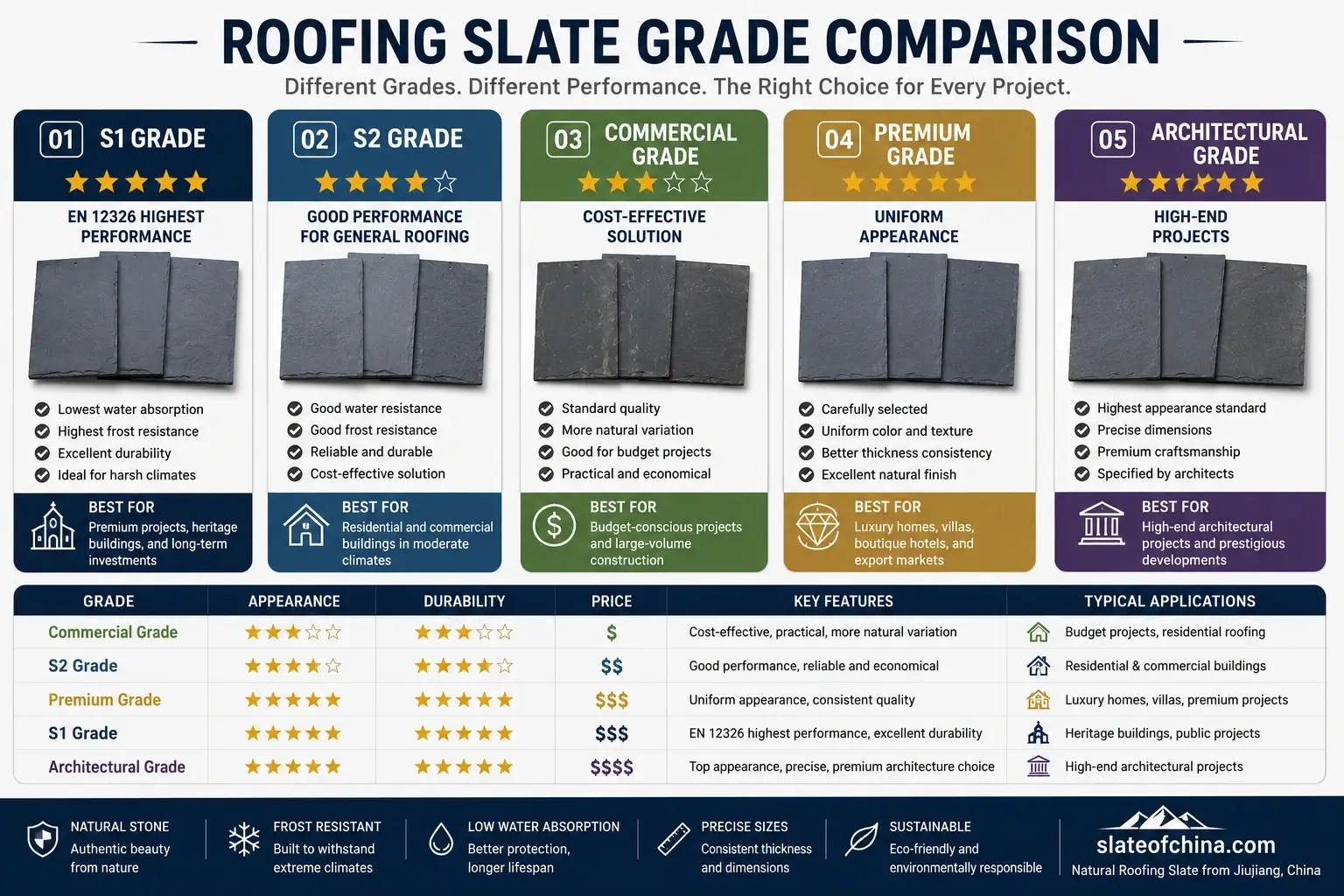
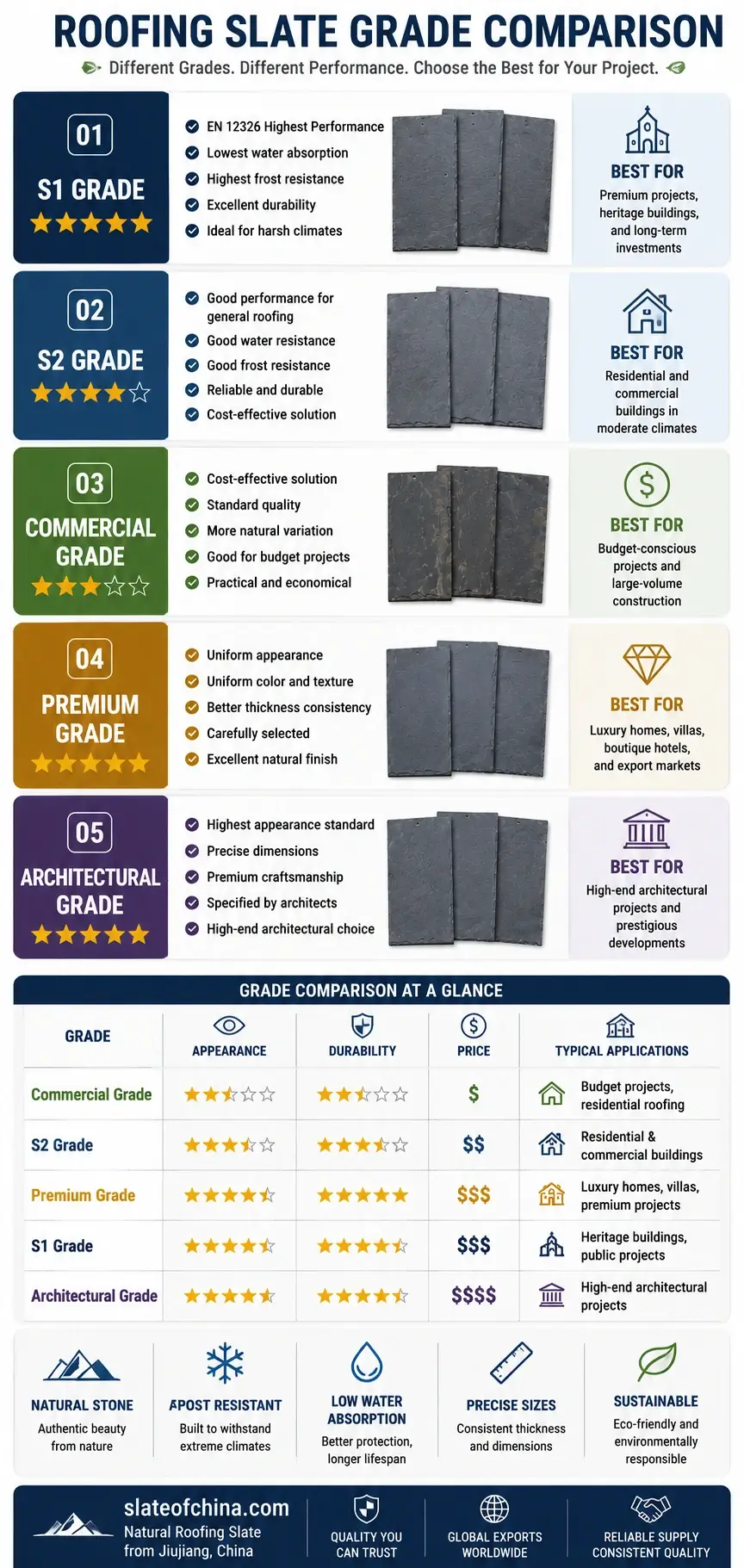
Not all roofing slate offers the same level of quality. Roofing slate grades help buyers evaluate durability, weather resistance, dimensional accuracy, and long-term performance before selecting a product.
In the international roofing industry, slate is commonly classified using two systems:
- EN 12326 Classification (S1, S2, etc.), based on laboratory testing and European standards.
- Commercial Grades, such as Premium Grade, Architectural Grade, and Commercial Grade, which are widely used by manufacturers and suppliers.
Understanding these grading systems helps homeowners, architects, distributors, and roofing contractors choose the most suitable natural roofing slate for their projects.
Comparison Table
| Grade | Description | Typical Applications |
|---|---|---|
| S1 Slate | Highest performance under EN 12326 | Premium residential, commercial, heritage projects |
| S2 Slate | Good performance for general roofing | Residential and commercial buildings |
| Commercial Grade | Cost-effective standard quality | Budget-conscious projects |
| Premium Grade | Carefully selected for appearance and consistency | Luxury homes and export markets |
| Architectural Grade | High-quality slate specified by architects | High-end residential and commercial buildings |
S1 Roofing Slate
S1 is the highest classification defined by EN 12326, the European standard for natural roofing slate.
To achieve an S1 rating, slate must demonstrate excellent performance in laboratory tests, including:
- Low water absorption
- High frost resistance
- Excellent thermal durability
- Stable mineral composition
- Long-term weather resistance
Because of its outstanding durability, S1 roofing slate is widely specified for premium residential projects, public buildings, churches, and heritage restoration.
Advantages
- Meets the highest European performance standard
- Exceptional durability
- Suitable for harsh climates
- Long expected service life
S2 Roofing Slate
S2 roofing slate also complies with EN 12326 but is intended for less demanding environmental conditions than S1.
It provides reliable performance for many residential and commercial roofing applications while offering a more economical solution.
Advantages
- Good weather resistance
- Reliable long-term performance
- Cost-effective option
- Suitable for most roofing projects
Commercial Grade Slate
Commercial Grade roofing slate is produced to provide an economical balance between appearance, durability, and cost.
Although it may exhibit greater natural variation in color, thickness, or texture, it remains suitable for many standard roofing applications.
Best For
- Residential developments
- Budget-sensitive projects
- Large-volume construction
Premium Grade Slate
Premium Grade roofing slate is carefully selected for its consistent color, thickness, edge quality, and overall appearance.
This grade is preferred for projects where aesthetics are just as important as long-term performance.
Advantages
- Uniform appearance
- Better dimensional consistency
- Excellent natural texture
- Premium architectural finish
Best For
- Luxury homes
- Villas
- Boutique hotels
- Export markets
Architectural Grade Slate
Architectural Grade roofing slate is manufactured to meet the demanding requirements of architects, designers, and prestigious building projects.
It combines high dimensional accuracy with excellent appearance and durability, making it suitable for projects where visual quality is critical.
Advantages
- Excellent appearance
- Precise dimensions
- Premium craftsmanship
- Long service life
Best For
- Architectural projects
- Commercial landmarks
- Government buildings
- Luxury residential developments
Jiujiang Roofing Slate Quality
Premium Jiujiang Roofing Slate is produced from carefully selected natural slate deposits with a stable geological structure and excellent splitting characteristics.
Each slate is processed under strict quality control to ensure consistent dimensions, natural cleft surfaces, and reliable long-term performance. Many products are manufactured to comply with international standards, making them suitable for export to Europe, North America, Australia, and other demanding markets.
Why Choose Jiujiang Slate?
- Stable geological formation
- Excellent natural splitting
- Fine-grained texture
- Low water absorption
- High frost resistance
- Consistent thickness and dimensions
- Strict quality inspection
- Reliable export quality
Which Roofing Slate Grade Should You Choose?
The right slate grade depends on your project requirements, climate, and budget.
| Project Type | Recommended Grade |
|---|---|
| Luxury Homes | Premium Grade / S1 |
| Heritage Restoration | S1 |
| Commercial Buildings | Architectural Grade or S1 |
| Residential Projects | S2 or Premium Grade |
| Budget Projects | Commercial Grade |
For projects where long-term durability and architectural appearance are priorities, Premium Grade or S1 roofing slate is the preferred choice. Commercial Grade products offer a practical solution when budget is the main consideration.
Learn More
Want to understand roofing slate quality standards in greater detail?
👉 Read our complete guide: Roofing Slate Grades
Which Roofing Slate Type Is Best?
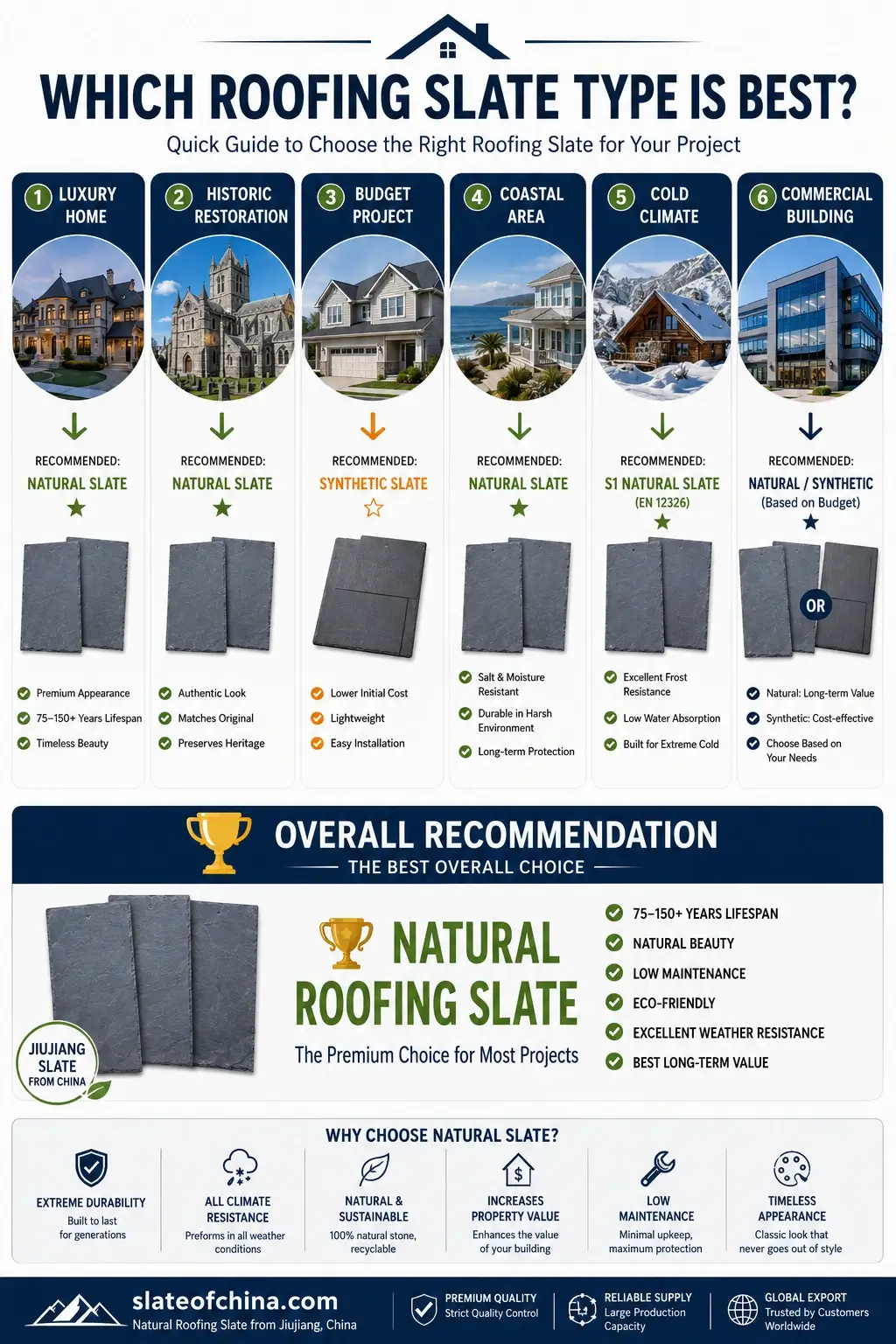
With so many types of roofing slate available, choosing the right one can seem overwhelming. The best option depends on your project’s budget, architectural style, climate, expected lifespan, and long-term maintenance goals.
While natural roofing slate remains the premium choice for durability and timeless beauty, synthetic and other alternatives may be suitable for specific budgets or applications.
The following recommendations can help you quickly identify the best roofing slate type for your project.
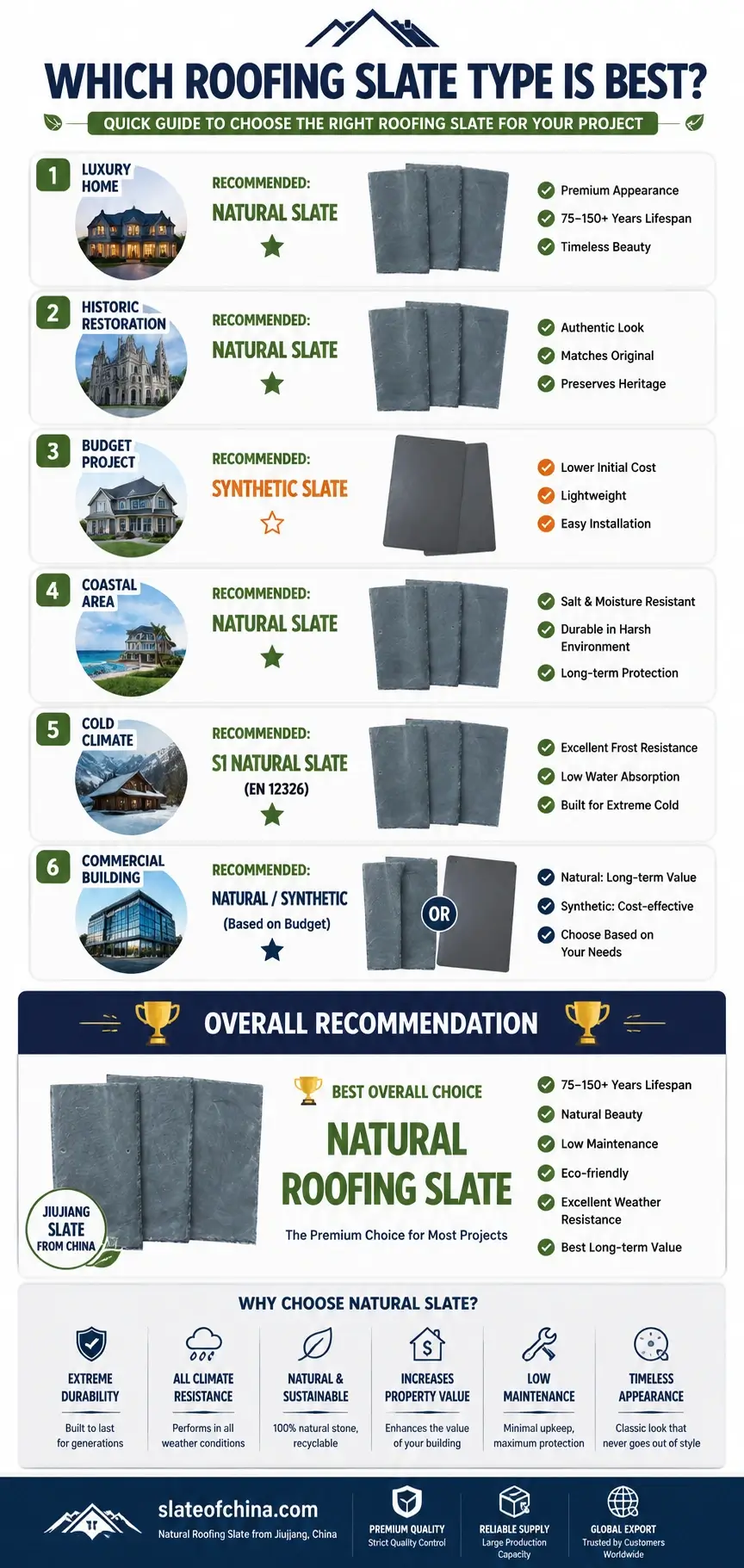
Quick Recommendation Table
| Application | Recommended Roofing Slate | Why It’s the Best Choice |
|---|---|---|
| Luxury Homes | Natural Roofing Slate | Premium appearance and 75–150+ year lifespan |
| Historic Restoration | Natural Roofing Slate | Authentic appearance matching traditional architecture |
| Budget Projects | Synthetic Roofing Slate | Lower initial cost and lightweight installation |
| Coastal Areas | Natural Roofing Slate | Excellent moisture and salt-weather resistance |
| Cold Climate | Natural Roofing Slate (S1 Grade) | Outstanding frost resistance and durability |
| Commercial Buildings | Natural or Synthetic Slate | Depends on project budget, design, and lifespan requirements |
Best Roofing Slate for Luxury Homes
Luxury homes deserve roofing materials that combine beauty, durability, and long-term value.
Natural roofing slate creates a distinctive architectural appearance while offering one of the longest service lives of any roofing material. Its authentic texture, natural colors, and timeless elegance make it the preferred choice for high-end residential projects.
Recommended: Premium Natural Roofing Slate
Best Roofing Slate for Historic Restoration
When restoring churches, heritage buildings, castles, or period homes, authenticity is essential.
Natural slate closely matches the original roofing materials used on historic buildings and preserves their architectural character while providing exceptional durability.
Recommended: Natural Roofing Slate with traditional sizes and installation patterns
Best Roofing Slate for Budget Projects
If minimizing the initial investment is the primary goal, synthetic roofing slate can be an economical alternative.
Although it does not match the lifespan or natural beauty of genuine slate, it offers a lightweight solution with relatively simple installation and reduced upfront costs.
Recommended: High-quality Synthetic Slate
Best Roofing Slate for Coastal Areas
Coastal environments expose roofing materials to high humidity, salt-laden air, and frequent storms.
Natural roofing slate is highly resistant to moisture, frost, UV exposure, and corrosion, making it one of the most reliable roofing materials for coastal regions.
Premium natural slate with low water absorption provides excellent long-term performance even under demanding weather conditions.
Recommended: Natural Roofing Slate (Low Water Absorption)
Best Roofing Slate for Cold Climates
Regions with freezing temperatures require roofing materials capable of withstanding repeated freeze-thaw cycles.
High-quality S1 natural roofing slate offers exceptional frost resistance, low water absorption, and outstanding durability, making it ideal for snowy and mountainous regions.
Recommended: S1 Grade Natural Roofing Slate
Best Roofing Slate for Commercial Buildings
Commercial projects often balance aesthetics, durability, maintenance costs, and budget.
For prestigious commercial developments, natural roofing slate provides outstanding long-term value and minimal maintenance. For budget-sensitive projects, synthetic slate may offer an acceptable compromise.
Recommended:
- Premium projects → Natural Roofing Slate
- Budget projects → Synthetic Roofing Slate
Our Recommendation
After comparing all major roofing slate types, natural roofing slate remains the best overall choice for most residential and commercial roofing projects.
It offers significant advantages over alternative materials:
Why Natural Roofing Slate?
- Authentic natural stone appearance
- Service life of 75–150+ years
- Excellent frost and weather resistance
- Low maintenance requirements
- Environmentally friendly and recyclable
- High property value
- Timeless architectural beauty
For customers seeking the best combination of quality, durability, and long-term value, Jiujiang Natural Roofing Slate is one of the most reliable choices available. Its stable geological structure, consistent quality, natural cleft surface, and competitive pricing have made it a trusted solution for projects across Europe, North America, Australia, and many other international markets.
Decision Matrix
| Your Priority | Best Roofing Slate Type |
|---|---|
| Longest Lifespan | ⭐ Natural Roofing Slate |
| Best Appearance | ⭐ Natural Roofing Slate |
| Lowest Initial Cost | Synthetic Slate |
| Heritage Projects | ⭐ Natural Roofing Slate |
| Coastal Climate | ⭐ Natural Roofing Slate |
| Cold Climate | ⭐ S1 Natural Roofing Slate |
| Lowest Maintenance | ⭐ Natural Roofing Slate |
| Best Long-Term Value | ⭐ Natural Roofing Slate |
Learn More
Need help selecting the ideal slate for your project?
Explore our complete roofing slate guides:
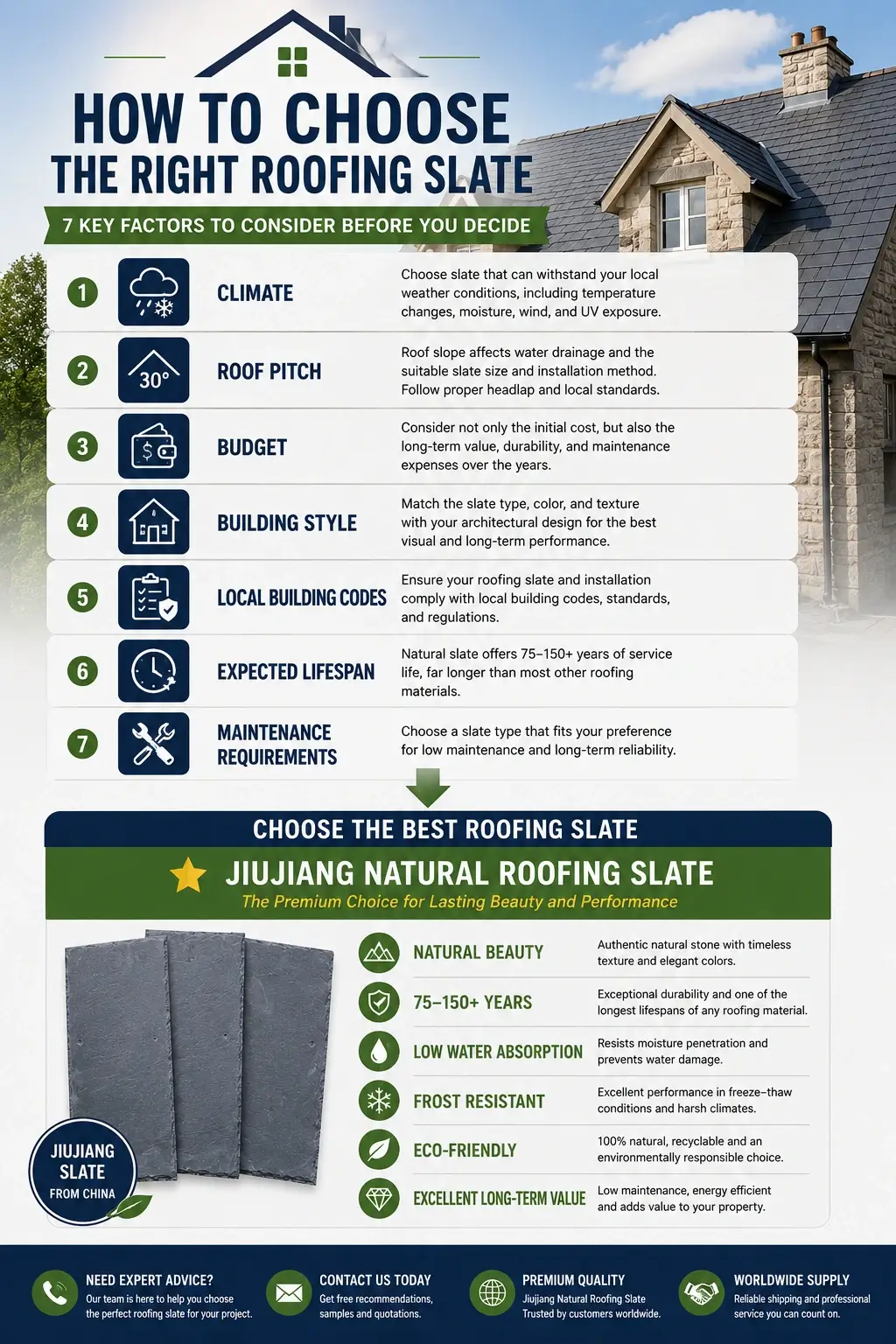
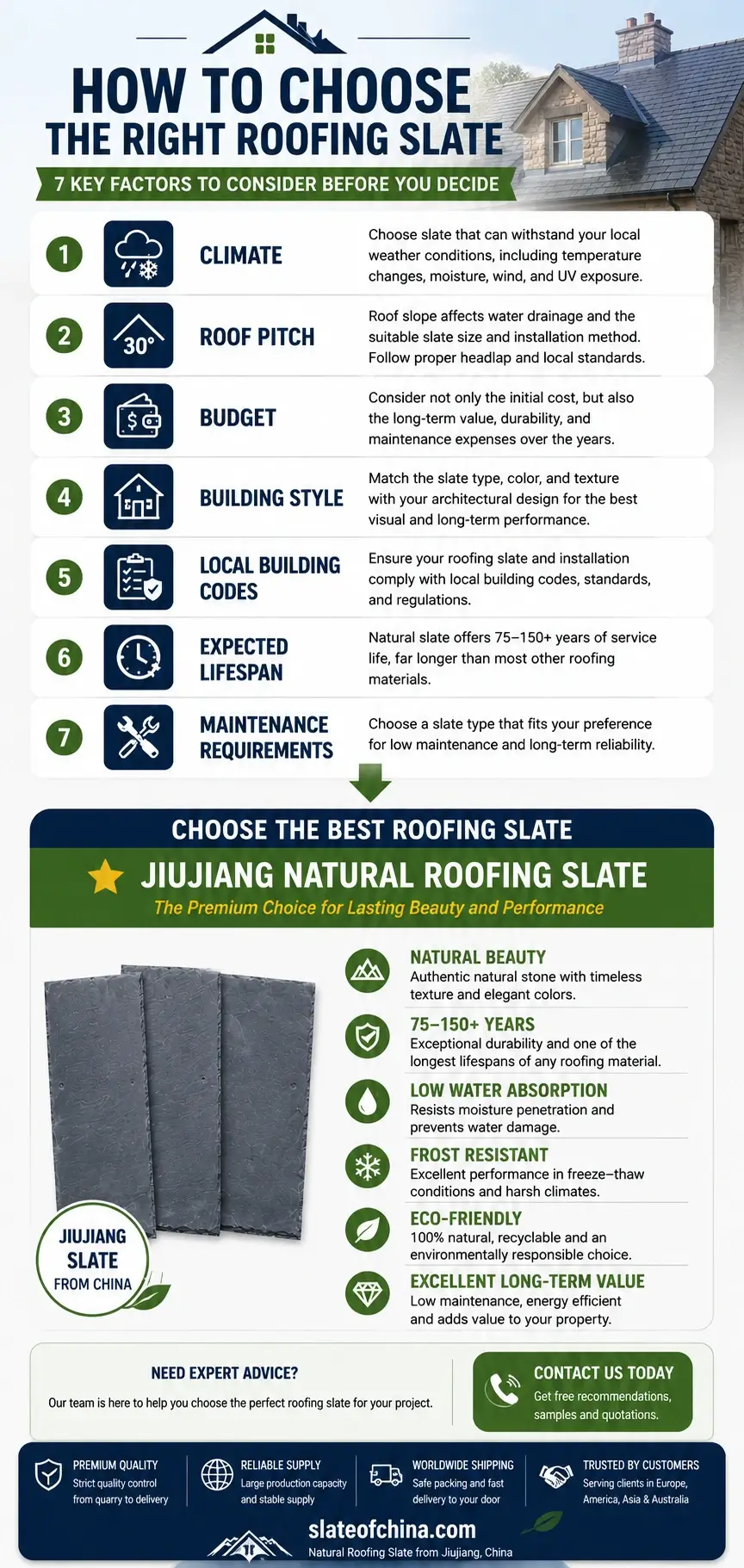
How to Choose the Right Roofing Slate Type
Choosing the right roofing slate type involves much more than selecting a color or size. The ideal slate should match your building’s architectural style, local climate, roof design, performance expectations, and budget.
By carefully evaluating the factors below, homeowners, architects, builders, and roofing contractors can select a natural roofing slate that delivers the best balance of beauty, durability, and long-term value.
1. Consider Your Local Climate
Climate is one of the most important factors when choosing roofing slate.
Areas with heavy snowfall, frequent freeze-thaw cycles, coastal salt exposure, or intense UV radiation require slate with excellent weather resistance and low water absorption.
For harsh environments, high-quality natural roofing slate—particularly S1-grade slate—offers outstanding durability and long-term performance.
Best Choice
- Cold climates → S1 Natural Slate
- Coastal regions → Low water absorption Natural Slate
- Mild climates → Most natural roofing slates perform well
2. Match the Roof Pitch
The slope of your roof affects both water drainage and the suitable slate size and installation method.
Steeper roofs often accommodate a wider range of slate sizes, while lower-pitched roofs generally require greater headlap and careful installation to ensure weather resistance.
Always select slate dimensions that comply with local roofing standards.
Consider
- Roof pitch
- Slate size
- Headlap
- Installation pattern
3. Set a Realistic Budget
Natural roofing slate represents a higher initial investment than synthetic alternatives, but it also provides one of the lowest lifetime ownership costs.
When comparing roofing materials, consider not only the purchase price but also maintenance, replacement frequency, and long-term value.
| Budget Level | Recommended Roofing Slate |
|---|---|
| Premium | Natural Roofing Slate |
| Medium | Premium Chinese Roofing Slate |
| Limited | Synthetic Roofing Slate |
4. Match the Architectural Style
Different slate types complement different architectural designs.
Traditional buildings often benefit from hand-cut edges, graduated slates, and natural cleft surfaces, while modern homes typically favor square-edge slate with consistent dimensions.
| Building Style | Recommended Slate |
|---|---|
| Modern Homes | Black or Grey Natural Slate |
| Traditional Homes | Natural Cleft Slate |
| Heritage Buildings | Graduated or Random Width Slate |
| Luxury Villas | Premium Natural Slate |
5. Check Local Building Codes
Many regions have building regulations governing roofing materials, installation methods, fastening systems, fire resistance, and structural loading.
Before selecting roofing slate, verify that your project complies with local building codes and consult qualified roofing professionals when necessary.
This is especially important for commercial developments and public buildings.
6. Think About Lifespan
One of the biggest advantages of natural roofing slate is its exceptional longevity.
While synthetic products may require replacement after several decades, premium natural slate can remain in service for 75–150+ years with proper installation and maintenance.
Choosing a longer-lasting material often reduces total lifecycle costs.
7. Consider Long-Term Maintenance
Natural roofing slate requires very little maintenance compared with many other roofing materials.
Routine inspections, occasional replacement of damaged slates, and regular gutter cleaning are generally sufficient to keep a slate roof performing for generations.
If minimizing maintenance is one of your priorities, natural slate is one of the best roofing investments available.
Quick Selection Checklist
Before making your final decision, ask yourself these questions:
✔ What climate will the roof experience?
✔ What is the roof pitch?
✔ What is my total project budget?
✔ Which architectural style am I trying to achieve?
✔ Do local building regulations specify any requirements?
✔ How long do I expect the roof to last?
✔ Do I want the lowest long-term maintenance?
If you can confidently answer these questions, you’ll be well prepared to choose the most suitable roofing slate for your project.
Need Expert Advice?
Every roofing project is unique. Factors such as climate, roof structure, architectural style, and budget all influence the ideal roofing slate selection.
At SlateofChina, we specialize in supplying premium Jiujiang natural roofing slate to customers around the world. Whether you’re planning a private residence, a commercial building, or a heritage restoration project, our experienced team can recommend the most suitable slate size, thickness, color, grade, and installation solution based on your specific requirements.
We Can Help You With
- Selecting the right roofing slate type
- Choosing the best size and thickness
- Color and edge finish recommendations
- Product specifications and samples
- Project quotations and shipping solutions
- Technical support for international projects
Contact us today for professional advice, free product recommendations, or a customized quotation. We’re ready to help you choose the ideal natural roofing slate for your next project.
Frequently Asked Questions (FAQ)
Need Help Choosing the Right Roofing Slate?
Selecting the right roofing slate is about more than just appearance. The ideal slate should match your project’s climate, roof pitch, architectural style, budget, performance requirements, and expected lifespan. With so many options available, expert guidance can help you make a confident and cost-effective decision.
At SlateofChina, we specialize in supplying premium Jiujiang natural roofing slate for residential, commercial, and heritage restoration projects worldwide. With years of manufacturing and export experience, we help architects, distributors, roofing contractors, builders, and homeowners choose the most suitable roofing slate for every application.
Whether you’re looking for advice on roofing slate types, sizes, thicknesses, colors, grades, edge finishes, or installation methods, our experienced team is ready to provide professional recommendations tailored to your project.
We Can Help You With
- Choosing the right roofing slate type
- Selecting the best slate size and thickness
- Recommending suitable colors and finishes
- Understanding quality grades and specifications
- Product samples and technical documentation
- Project quotations and international shipping solutions
- OEM and custom manufacturing services
Why Choose SlateofChina?
- Premium Jiujiang Natural Roofing Slate
- Stable quality from carefully selected quarries
- Natural cleft surface with authentic stone beauty
- Competitive factory-direct pricing
- Large production capacity and reliable supply
- Export experience serving customers worldwide
- Professional technical support before and after your order
Contact Our Roofing Slate Specialists
Planning a new roofing project or sourcing natural roofing slate for your business?
Contact our team today for expert advice, free product recommendations, samples, or a customized quotation. We’ll help you find the ideal Jiujiang natural roofing slate solution that combines beauty, durability, and long-term value.
👉 Get in touch today and let us help you choose the perfect roofing slate for your next project.
Reviewed by
Slate of China Technical Team
20+ Years of Natural Roofing Slate Manufacturing
Updated:
July 2026
18 min read