
Custom Billiard Slate Manufacturing: How to Order Non-Standard Slate From Your Drawing
Consider a common custom-slate scenario: a table factory sends a drawing for a new 9 ft model. Overall dimensions: correct. Thickness: correct. Three-piece configuration: correct. Hole positions: all marked. The factory machines the slate exactly as drawn.
But when the prototype goes onto the table frame, the cushion nose won't seat flush against the pocket cut. The gap is small — you can slide a fingernail under it — but it is enough to make the table unplayable.
The drawing specifies the pocket opening width. It doesn't specify the pocket entry angle — the geometry that determines how the cushion nose meets the slate at the pocket mouth. The machining is perfect. The drawing is incomplete.
That scenario is the reason this guide exists. Custom billiard slate manufacturing is not about cutting a piece of stone to a different size. It is about engineering a complete specification — one that accounts for how the slate fits inside the table, how the cushion system interfaces with the pocket cut, and how the same specification can be reproduced across production batches. If you have a non-standard table design, a proprietary pocket layout, or a drawing that doesn't match any catalogue product, this guide walks you through the process: what to put on the drawing, how to prepare an RFQ, how MOQ works, why a prototype matters, and how to keep the specification consistent from the first set to the hundredth.
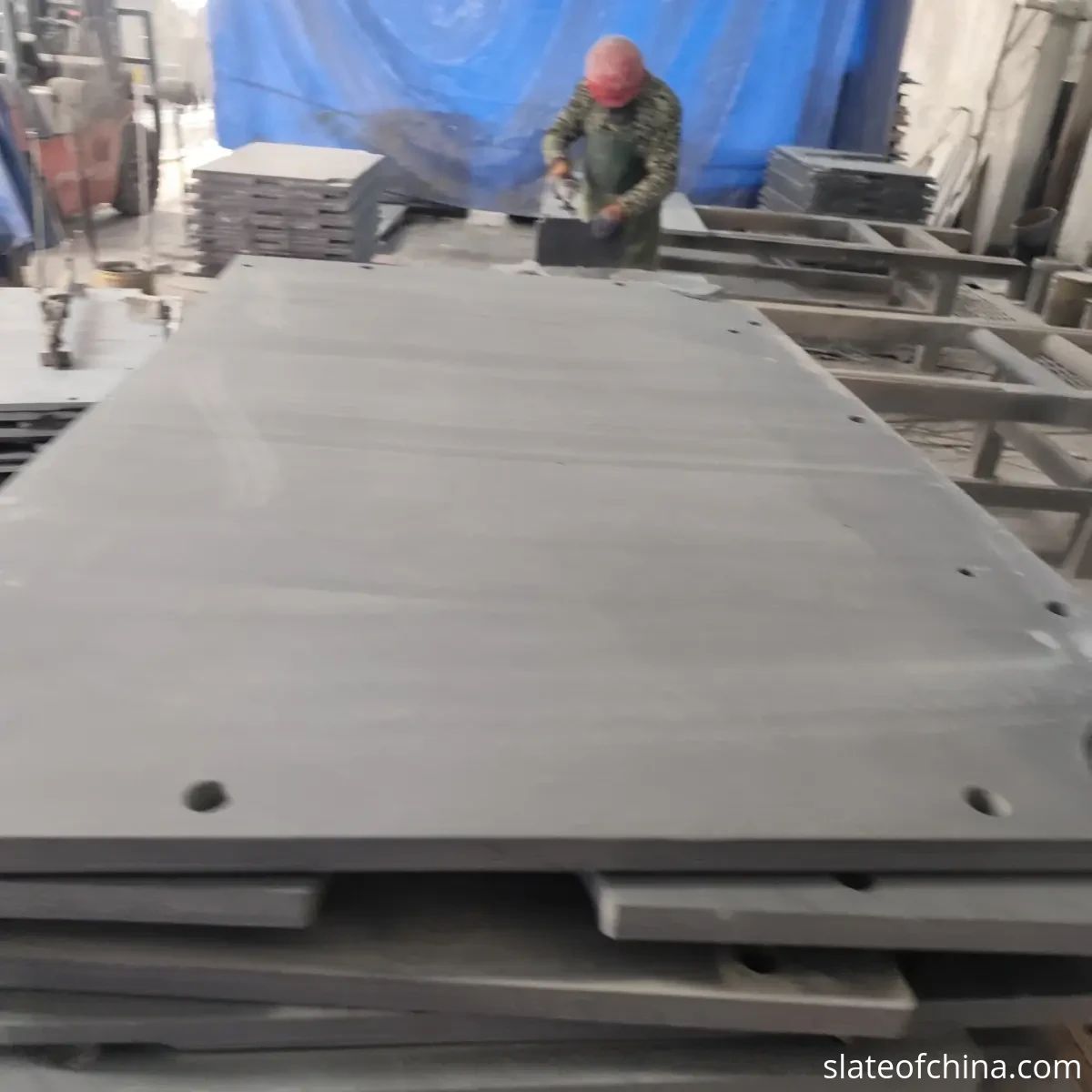
When you need custom slate — and how the project runs:
You need custom when: your table dimensions don't match any standard size · you have a proprietary pocket layout · your rail system requires non-standard hole positions · you're developing a new model · you need replacement slate for a discontinued table.
The project runs in seven stages: Drawing → Engineering Review → Quotation → Prototype → Trial Assembly → Drawing Approval → Mass Production.
MOQ depends on complexity: a non-standard size alone may need only a small quantity; a fully custom CNC-machined design with new tooling needs a larger commitment to justify setup.
This guide covers the procurement process. For what our factory can manufacture, see Custom Pool Table Slate. For managing ongoing OEM supply, see OEM Billiard Slate for Table Manufacturers.
When Do You Need Custom Billiard Slate?
Standard slate sizes work when you are building a table around an established design or buying a replacement for a current model. But many table manufacturers need something different — and the decision to go custom usually comes from one of five situations.
Your table dimensions don't match any standard slate size. This is the most straightforward trigger. You have a specific playing area, a specific cabinet, and the slate outline has to fit both. A standard 9 ft slate won't work if your frame design calls for a different outline or a different playing-area-to-slate-edge ratio.
You have a proprietary pocket layout. Your cushion system, pocket castings, or pocket liners require a specific pocket geometry that doesn't match any standard cut. The pocket opening, pocket depth, entry angle, and shelf geometry all need to come from your drawing.
Your rail system requires non-standard mounting-hole positions. Hole positions are easy to underestimate. A slate can have the correct length, width and thickness, and still fail to install because one hole is 5 mm off. If your rail-bolt pattern or slate-bolt layout is proprietary, the hole positions must be custom-machined.
You are developing a new table model. A new design means a new specification. Even if the table is nominally "9 ft," the slate outline, thickness, piece configuration, and machining all need to be defined from scratch. For U.S. table builders, the American Pool Table Slate Buying Guide covers the additional specification details that the U.S. market requires.
You need replacement slate for a discontinued table. The original manufacturer may no longer produce the slate, and a custom order can match the old specification from a physical sample. The full specification reference for standard sizes across table types is on our Billiard Slate Technical Specifications page; for dedicated replacement slate products, see our billiard slate category.
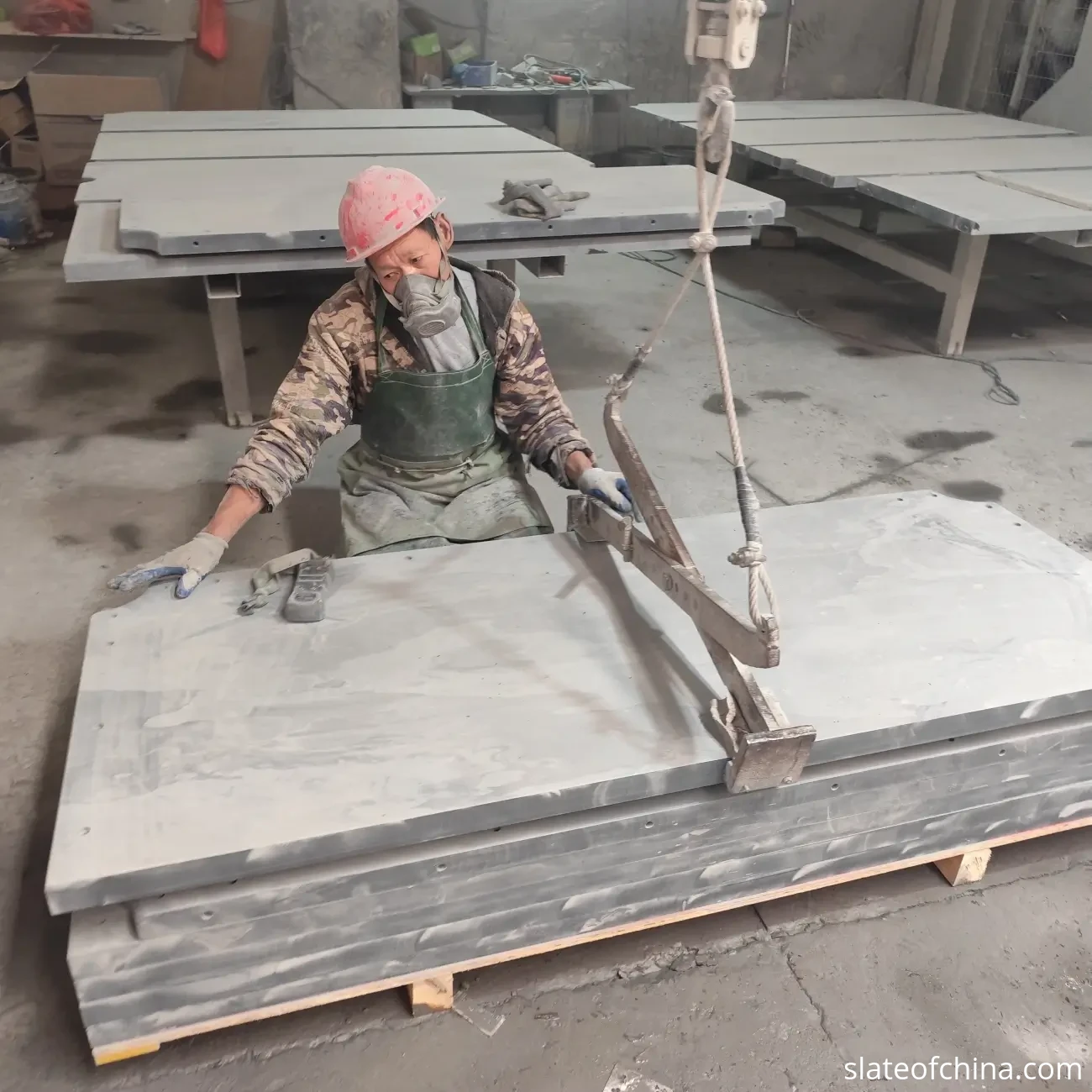
If none of these situations applies, standard slate is usually the faster and more economical choice. But if any one of them does, the rest of this guide explains how to move from a concept to a production-ready specification.
What Your Drawing Must Tell the Slate Factory
The drawing is the single most important document in a custom slate project. Not the email, not the phone call, not the product name — the drawing. A table name like "9 ft pool table slate" is a label, not a specification. Two manufacturers can use completely different slate dimensions for the same nominal table size, and both would be correct for their own design. The drawing is what makes your slate different from anyone else's.
Here is what a complete drawing should contain, and why each item matters:
| Drawing Item | What to Specify | Why It Matters |
|---|---|---|
| Overall slate dimensions | Length and width of the full slate outline | Determines whether the slate fits inside the cabinet |
| Playing-area dimensions | The finished playing surface — cushion nose to cushion nose | Not the same as the slate outline. Controls the actual game |
| Slate thickness | Target thickness and acceptable tolerance if known | Affects weight, table structure, and support requirements |
| Number of pieces | 1-piece, 3-piece, 5-piece or custom configuration | Affects transportation, installation, and joint alignment |
| Joint locations | Exact position of every joint — not just "divide into three" | The factory should not guess where to split the slate |
| Pocket centre positions | Distance from reference edges to each pocket centre | Determines where the pocket cut begins |
| Pocket openings | Width and shape of each pocket mouth | Must match the cushion nose and pocket casting |
| Pocket entry angle | The angle at which the cushion nose meets the slate at the pocket | Often missing from drawings — and often the reason slate won't fit |
| Bolt-hole positions | Centre position, diameter, depth, countersink for every hole | A small shift can make the slate difficult or impossible to install, depending on the rail system |
| Edge profile | Square, chamfered, or per drawing | The rail system may require a specific edge to seat correctly |
| Surface finish | Ground, calibrated, or as specified | The playing surface must meet the flatness the table demands |
| Reference edges | Which edge is the datum for all measurements | Without a reference, every dimension is ambiguous |
| Tolerances | Acceptable variation for critical dimensions | Better to agree before production than argue after delivery |
Not every dimension on this list has the same weight. Playing-area dimensions, pocket centres, and bolt-hole positions are critical — a small error in any of these can prevent the slate from installing. Overall dimensions and thickness are important but more forgiving. If you are not sure which dimensions are critical for your table, mark them on the drawing and discuss them during the engineering review.
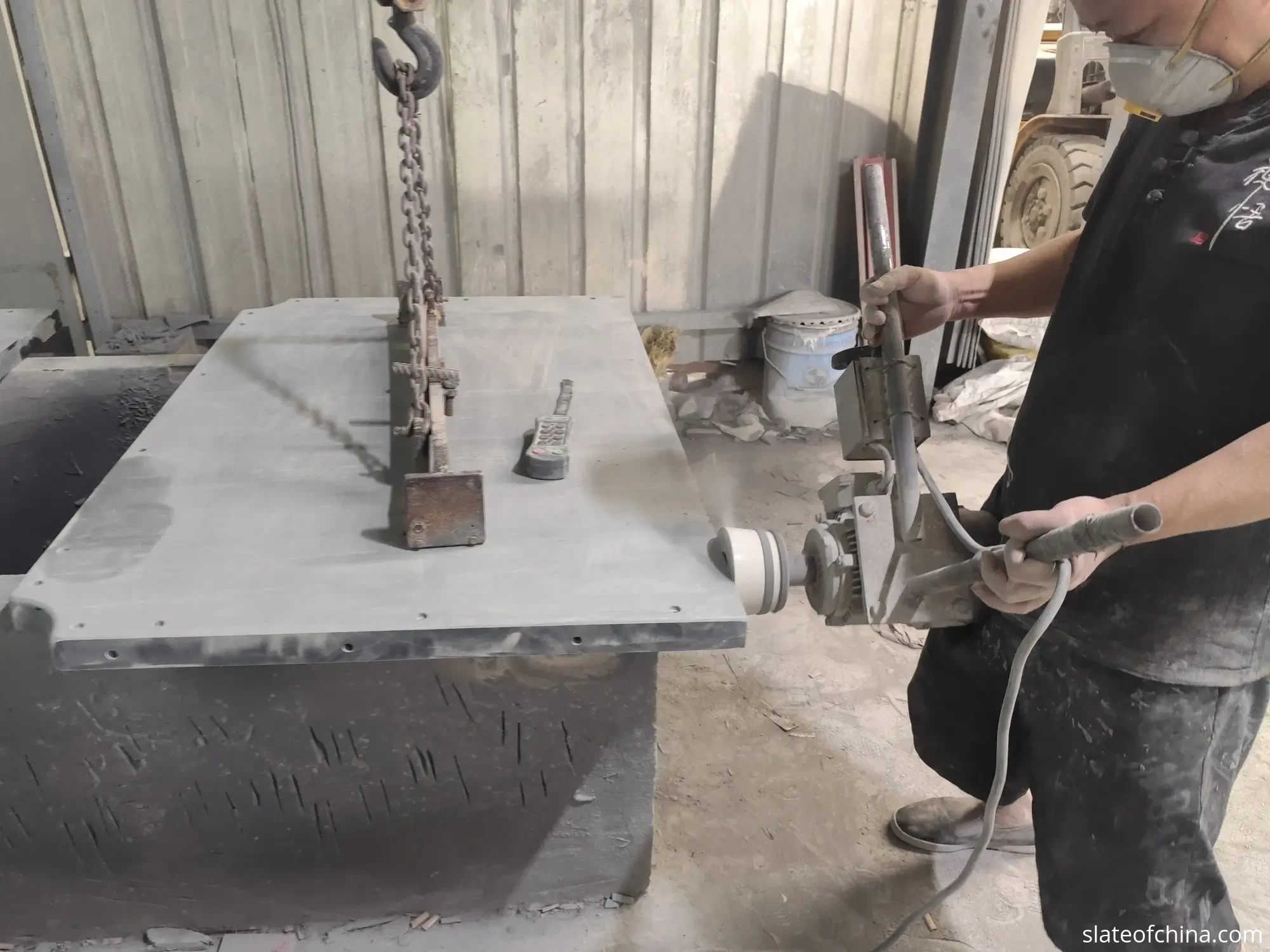
If your drawing contains a coordinate system or a grid of reference dimensions, that makes CNC programming and inspection significantly easier. A PDF is useful for initial review, but an editable CAD file — DWG, DXF or STEP — is preferable when complex machining is involved.
Drawing vs Physical Sample vs Verbal Description
A slate factory can work with several types of input, but they are not equally reliable. Understanding the difference helps you choose the right starting point — and understand why the factory asks for more information than you initially sent.
Best: CAD drawing plus physical sample. A CAD file defines every dimension, and a physical sample — even a broken piece of the old slate — confirms the material, the edge profile, and the "feel" of the finish. This combination leaves the least room for interpretation.
Good: CAD or PDF engineering drawing. A dimensioned drawing with all pocket positions, hole locations, and tolerances is sufficient for production. The factory can program CNC machining directly from a CAD file. A clearly dimensioned PDF can work for simpler projects, but an editable CAD file is normally preferred for complex machining.
Acceptable for initial review: Photos plus key dimensions. If you have a prototype table or a physical sample but no formal drawing, photographs from multiple angles plus the critical dimensions (overall size, playing area, thickness, pocket centres) can get the conversation started. But this is not enough for final production.
Risky: Hand sketch only. A hand drawing can be useful for an initial quotation — it communicates the concept. But a rough sketch is normally not sufficient for final production. The practical path is: hand sketch → technical drawing → sample → approval → mass production.
Not usable: "Same as our old table." This is not a production specification. Memory is not a drawing. If the original drawing is lost, the best approach is to measure the physical slate and create a new drawing. A slate factory can help with this process, but the final approved dimensions should be documented in an engineering drawing — not in an email thread.
For identifying the correct slate type for your table before you start the custom process, Types of Billiard Slate explains the differences between pool, snooker, carom and Chinese 8-ball slate.
From Drawing to Mass Production: The Custom Slate Project Workflow
A custom slate project is not a single transaction. It runs through a sequence of stages, and each stage has a specific purpose. Skipping a stage is the most common reason custom projects go wrong.
Stage 1 — Send the Drawing
Provide the latest version of your technical drawing with all the dimensions listed in the table above. If you have a physical sample, send it or bring it to the factory. The more complete the initial information, the faster and more accurate the quotation.
Stage 2 — Engineering Review
The factory checks every dimension and machining requirement against what is practical to produce. This is where the factory identifies potential problems before any stone is cut. Can the thickness be achieved with the available raw material? Are the pocket positions feasible given the joint locations? Are the tolerances realistic for the machining method? Anything unclear is resolved at this stage.
Stage 3 — Quotation
Based on the agreed specification, the factory provides pricing. The quotation should reflect the quantity, the complexity of machining, and the packaging requirements. This is also when MOQ is confirmed — see the next section.
Stage 4 — Prototype
For a new custom design, a prototype set is produced. One set, or a small number of sets, is manufactured to the drawing. This is not mass production — it is a test piece. The prototype may cost more per set than mass production because the setup, CNC programming, and tooling are amortised over a small quantity.
Stage 5 — Trial Assembly
This is the stage that the opening story was about. The prototype slate goes onto the actual table frame — not just a visual check on the factory floor. You verify that the cushion nose seats flush against the pocket cut, the bolt holes line up with the rail bolts, the joints close without a gap, and the surface is level. This is where specification gaps become visible.
A custom slate should not be approved only because its dimensions match the drawing. The drawing itself may be incomplete — as the opening story showed, a pocket opening width without a pocket entry angle is a drawing that looks correct but produces an unplayable table. The first sample is not only a quality check. It is part of the engineering process: it reveals what the drawing missed, what the machining method actually delivers, and what the table structure demands that no two-dimensional drawing can fully communicate.
Stage 6 — Drawing Revision
If the trial assembly reveals issues — a pocket angle that needs adjustment, a hole position that needs shifting, an edge profile that needs changing — the drawing is revised. This is why revision control matters: the revised drawing supersedes the original, and the revision number is updated. For example, a drawing originally marked Rev. A becomes Rev. B after the first round of corrections. The factory should never produce from an outdated revision.
Stage 7 — Final Approval
Once the prototype installs correctly, the drawing and the approved sample become the production reference — sometimes called the "golden sample." Every future batch is measured against this reference. The approved drawing always takes priority over any verbal instruction, email, or memory of a previous order.
Stage 8 — Mass Production
With the approved drawing and sample in place, production runs are manufactured to the agreed specification. Pre-shipment inspection confirms that each batch matches the approved reference before packing. For ongoing OEM supply, the OEM Billiard Slate guide covers how to maintain consistency across repeat batches.
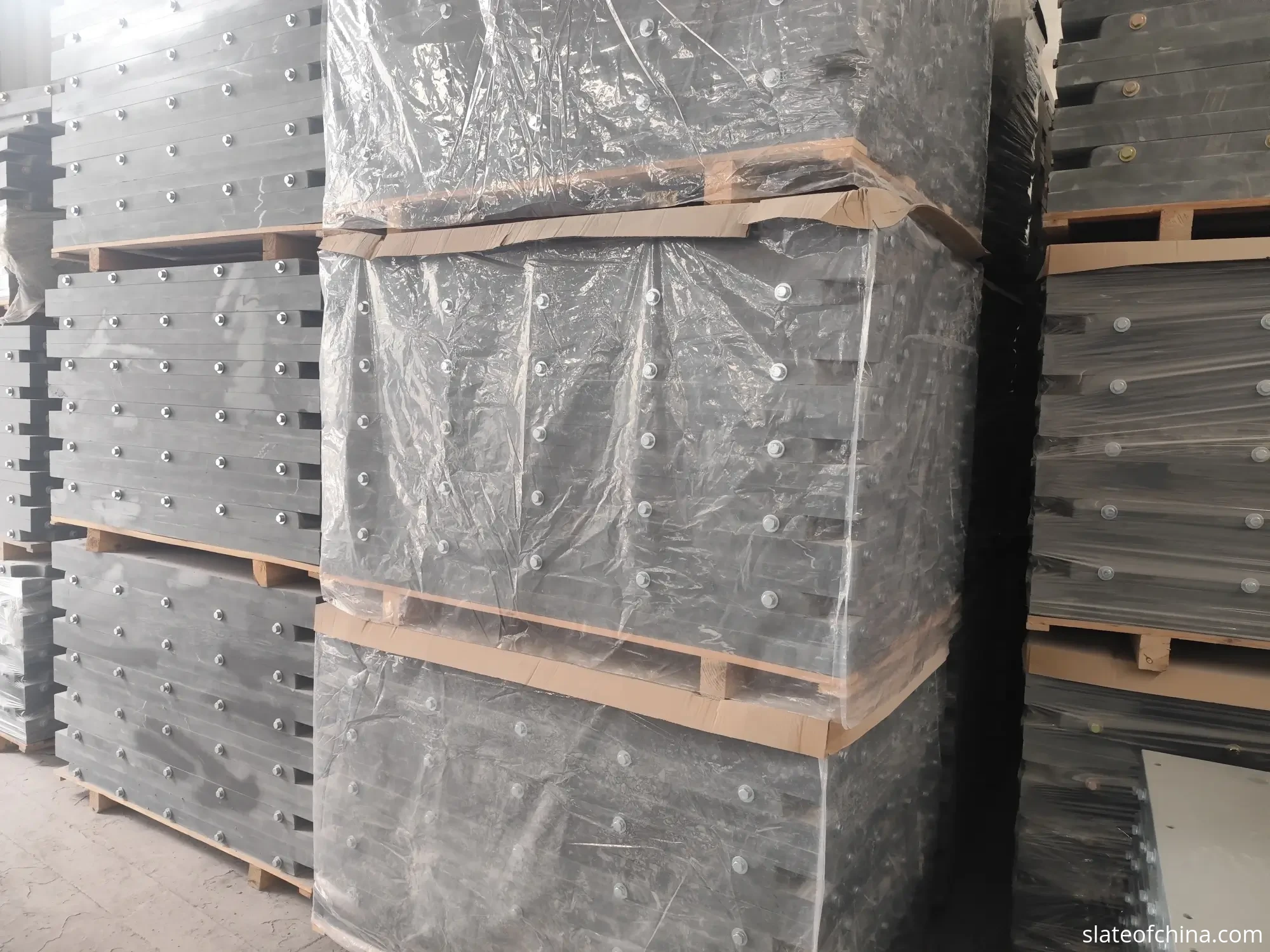
Custom Billiard Slate MOQ: How Quantity Shapes the Production Method
There is no fixed MOQ for every custom billiard slate project. The practical minimum depends on whether the project requires only non-standard cutting or also new CNC machining, special fixtures, sampling and inspection.
A simple way to think about it: the more preparation the factory needs — CNC programming, custom fixtures, new tooling, special inspection protocols — the higher the quantity needed to justify the setup. A non-standard size that uses standard machining has a lower barrier than a fully custom design with proprietary pocket geometry and non-standard hole patterns.
| Customisation Level | What It Involves | Typical MOQ Consideration |
|---|---|---|
| Level 1: Non-standard size | Standard machining, different overall dimensions | Lower — setup is minimal |
| Level 2: Custom thickness or piece configuration | Production planning for material and joint locations | Moderate — material preparation needs commitment |
| Level 3: Custom holes and pocket layout | CNC programming for hole positions and pocket geometry | Moderate — programming cost is amortised over quantity |
| Level 4: Complete drawing-based machining | Full engineering review, CNC programming, fixtures, sample | Higher — setup and prototype cost need volume to justify |
| Level 5: New OEM design with repeat production | Full development plus ongoing batch production | Sample approval first, then production MOQ applies to repeat orders |
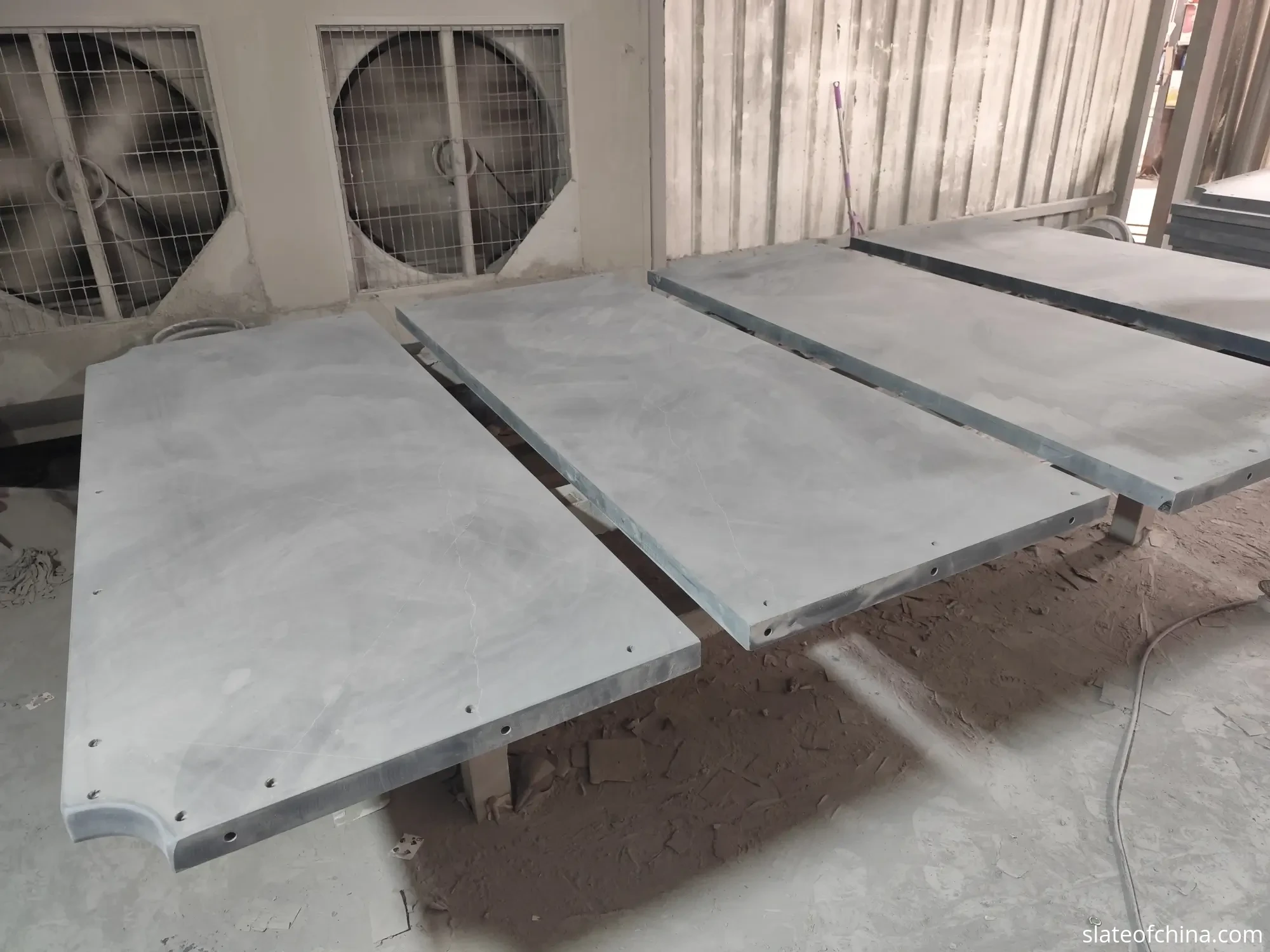
In practice, custom slate orders fall into three quantity tiers, and each carries a different MOQ expectation:
Prototype. One or a few sets, used to develop a new table model. The factory treats this as a sampling order, not mass production. The unit price is higher because CNC programming, fixtures, and tooling are amortised over a small quantity. This is normal — and it is not the price you should use to evaluate the long-term OEM cost.
Trial order. A small production batch, used to confirm that the approved specification can be reproduced consistently before committing to volume. The per-set cost is lower than a prototype but higher than full production, because the setup is still spread over a limited quantity.
OEM production. Repeat orders against an approved drawing. The factory can organise production efficiently: better material planning, more efficient CNC programming, improved packaging, and more consistent batch production. The per-set cost typically decreases as quantity increases.
A prototype quantity and a production MOQ are not necessarily the same. The prototype price reflects one-off setup. The production price reflects repeat manufacturing. If the gap between the two seems large, ask the factory to quote both — prototype pricing and estimated production pricing — so you can budget the full project, not just the first sample. Do not judge the final OEM price from the prototype quotation.
For a broader guide to sourcing billiard slate, including supplier evaluation and sample protocols, see the Billiard Slate Buying Guide. For guidance on evaluating a slate factory before committing to a custom project, How to Choose a Billiard Slate Manufacturer covers the questions worth asking.
Why a Prototype Costs Less Than the Problem It Prevents
For a new custom slate design, a prototype is not optional — it is the cheapest insurance in the project. The cost of producing one sample set is small compared to the cost of receiving a container of slate that won't install.
Consider what happens if you skip the prototype and go straight to mass production. The slate arrives. The dimensions are correct on paper. But when it goes onto the table frame, the pocket cut doesn't match the cushion profile. Or a bolt hole is 3 mm off. Or the joint gap is wider than expected. Now you have a container of slate that needs rework, replacement, or negotiation — and a production timeline that just slipped by weeks.
A prototype lets you catch these problems when the cost of correction is one set, not a container.
What should you check during trial assembly?
- Pocket alignment: Does the cushion nose seat flush against the slate at every pocket? Is there a gap, and if so, where?
- Rail alignment: Do the rail bolts pass through the slate holes without force? Are the holes in the correct positions for the rail system?
- Joint matching: Do the pieces of a multi-piece set meet without a step? Is the surface continuous across the joints?
- Thickness and leveling: Is the surface level when the slate is placed on the frame? Does the thickness match what the table structure expects?
- Installation procedure: Can the installation team handle the panels? Are the pieces too heavy, too large, or too awkward for the intended installation process?
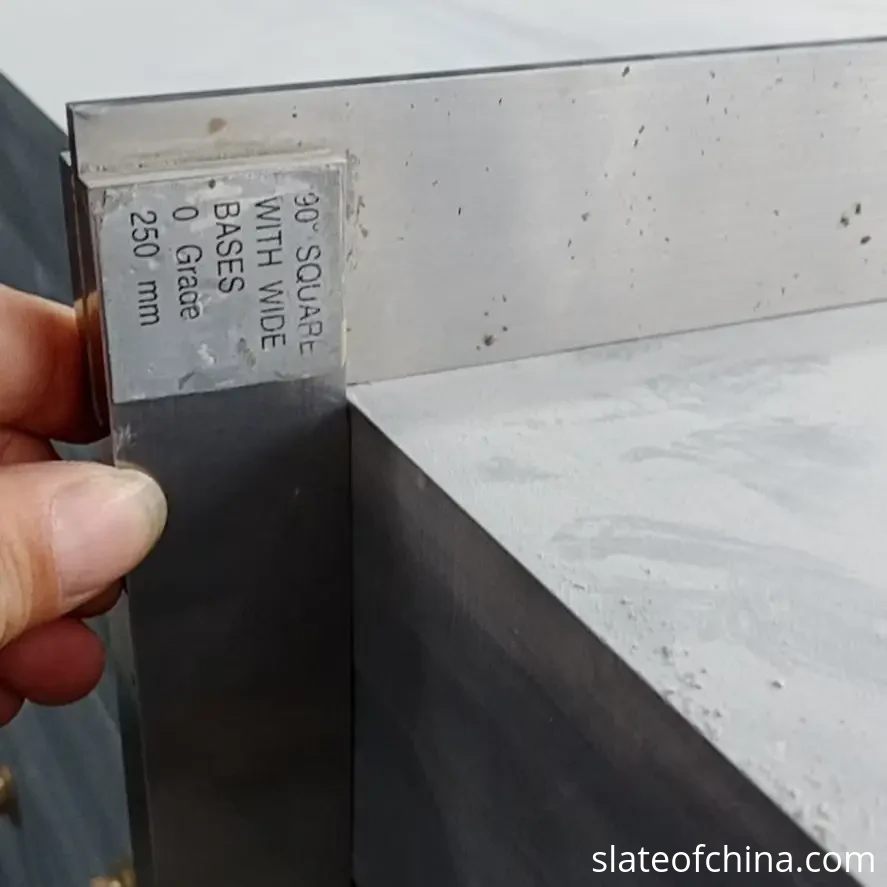
If the prototype passes all of these checks, the drawing and sample become the production reference. If it doesn't, you revise the drawing, produce a corrected sample, and re-test. The cost of a second prototype is still less than the cost of a container of slate that doesn't fit.
Eleven Things to Verify Before You Approve Mass Production
Before you give the factory the go-ahead for mass production, run through this checklist. It takes ten minutes with a tape measure, a straightedge, and the approved drawing — and it prevents the most common problems.
- Overall dimensions: Length and width match the drawing.
- Playing area: The finished playing surface measures correctly — cushion nose to cushion nose.
- Thickness: Measure at five points (four corners and centre). The variation should be within the agreed tolerance.
- Diagonal dimensions: Measure both diagonals. If they match, the slate is square. If they don't, something is out of alignment.
- Pocket centre positions: Distance from the reference edge to each pocket centre matches the drawing.
- Pocket openings: The width and shape of each pocket mouth match the cushion system.
- Pocket entry angle: The angle where the cushion nose meets the slate is correct — this is the dimension most commonly missing from drawings.
- Bolt-hole positions: Every hole is in the correct position, with the correct diameter and countersink.
- Joint positions and gap: For multi-piece sets, the joints are in the correct locations and the pieces meet without a step.
- Edge machining: The edges match the specified profile — square, chamfered, or per drawing.
- Surface condition: No cracks, chips, or surface defects. The ground surface meets the flatness the table demands.
For factory-side QC data, including flatness, thickness and CNC accuracy figures from our production records, see Billiard Slate Quality & Test Data.
Custom Billiard Slate RFQ Checklist
The faster you can provide complete information, the faster the factory can evaluate the project and prepare an accurate quotation. Use this checklist before sending your RFQ — it covers everything a slate manufacturer needs to give you a meaningful response.
- ☐ Table type (pool, snooker, carom, Chinese 8-ball, or other)
- ☐ Table size (nominal)
- ☐ Playing-area dimensions (cushion nose to cushion nose)
- ☐ Slate thickness
- ☐ Number of slate pieces (1, 3, 5, or custom)
- ☐ Individual panel dimensions (if different from overall)
- ☐ Pocket layout (centre positions, openings, entry angles)
- ☐ Bolt-hole positions (diameter, depth, countersink)
- ☐ Joint positions (for multi-piece sets)
- ☐ Edge profile (square, chamfered, or per drawing)
- ☐ Required tolerances for critical dimensions
- ☐ Machining drawing (CAD, PDF, or hand sketch for initial review)
- ☐ Physical sample or photos (if available)
- ☐ Required quantity (prototype and/or production)
- ☐ Destination port
The more complete the initial specification, the faster the supplier can evaluate the project and prepare an accurate quotation. A hand sketch with the key dimensions is enough to start the conversation — but the drawing must be completed before any machining begins.
Keeping the Specification Consistent Across Repeat Orders
The challenge of custom slate is not making one set. The challenge is making the next hundred sets the same way.
Once the prototype is approved and mass production begins, three tools keep the specification consistent across batches:
Drawing revision control. Every drawing should carry a revision number — Rev. A, Rev. B, Rev. C — and a date. When the drawing is revised after a prototype correction, the revision number changes. The factory produces from the latest approved revision, and the previous revision is superseded. This prevents the factory from manufacturing an outdated version of the specification. If you have multiple table models that use similar but not identical slate, the revision number also prevents the wrong drawing from being used for the wrong model.
Part numbers and set numbers. Each custom slate design should have a unique part number. Each set produced should have a set number or batch number that traces it back to the production date, the drawing revision, and the inspection record. If a problem appears in a later batch, the part number and set number let you trace it to the source.
The approved sample as golden reference. The approved prototype — or a reference piece from the first approved batch — stays with the factory as the "golden sample." Every future batch is compared against this reference during pre-shipment inspection. If a dimension drifts, the comparison catches it before the slate leaves the factory.
These three tools — revision numbers, part numbers, and the golden sample — are what separate a one-off custom order from a repeatable OEM production program. For a deeper look at how to manage ongoing OEM supply, including batch consistency and brand-specific packaging, see OEM Billiard Slate for Table Manufacturers.
Six Problems That Cause "Dimensions Right, Slate Won't Fit"
Most custom slate problems are not machining errors. They are specification gaps — things the drawing didn't say, or things that were communicated verbally but never documented. Here are the six most common ones, and how to prevent each.
1. Pocket entry angle not specified. This is the problem from the opening story. The drawing specifies the pocket opening width but not the angle at which the cushion nose meets the slate. The factory machines the pocket exactly as drawn, but the cushion doesn't seat flush. Prevention: Include the pocket entry angle on the drawing, or provide the cushion profile so the factory can calculate it.
2. Mounting-hole position drift between batches. The first batch is correct. By the third batch, a hole has drifted 2–3 mm — enough to make the bolt hard to insert. Prevention: Use an approved production drawing with hole positions defined from a reference edge, and compare every batch against the golden sample.
3. Joint gap from thickness variation. In a three-piece set, one piece is slightly thicker than the others. The joint creates a step that affects ball roll. Prevention: Specify the thickness tolerance, and measure all pieces in a set together — not independently.
4. Edge profile mismatch with rail system. The drawing says "square edge" but the rail system requires a small chamfer to seat correctly. The slate is made to spec, but the spec is wrong. Prevention: Test the edge profile during trial assembly. If the rail doesn't seat, revise the drawing before mass production.
5. Tolerance ambiguity. The drawing says "approximately 25 mm" for thickness. The factory produces 24.5 mm. The buyer expected 25.0 mm. Neither is wrong — the tolerance was never agreed. Prevention: Define the acceptable tolerance range for every critical dimension before production begins. It is better to agree on the range than to argue about it after the slate arrives.
6. "Same as last order" without a drawing. The buyer says "same as last time." The factory tries to match the previous order from memory or from a production record that may not capture every detail. Something is different. Prevention: Always reference the approved drawing and revision number — never a verbal description of a previous order. The drawing is the specification. The previous order is history.
Frequently Asked Questions
Can I send a hand drawing for a quotation?
Yes — a hand drawing can be useful for an initial quotation. It communicates the concept and the basic dimensions. However, a hand sketch is normally not sufficient for final production. The practical path is: hand sketch for initial review → technical drawing for production → prototype for trial assembly → approved drawing for mass production. If you only have a hand drawing, the factory can help convert it into a formal engineering drawing, but the final approved dimensions should always be documented.
What is the MOQ for custom billiard slate?
There is no universal MOQ. The practical minimum depends on the level of customisation. A non-standard size with standard machining may have a relatively low MOQ. A fully custom design with proprietary pocket geometry, non-standard hole patterns, and new CNC programming requires a larger commitment to justify the setup and tooling. For prototype or sampling orders, the factory may produce one or a few sets at a higher unit price. For repeat OEM production, the MOQ and per-set cost are typically lower because the setup is amortised over a larger quantity. Ask the factory to quote both prototype and estimated production pricing so you can budget the full project.
Can you produce from a physical sample instead of a drawing?
In many cases, yes. If you have a physical slate panel from an existing table — even a broken piece — the factory can measure it and reverse-engineer the dimensions into a production drawing. This is common for replacement slate where the original drawing is lost. However, the physical sample is a starting point, not a final specification. The factory should create a dimensioned drawing from the sample, send it to you for confirmation, and produce a prototype before mass production. The approved drawing — not the physical sample — becomes the production reference.
How long does a custom slate project take from drawing to mass production?
The timeline depends on the complexity of the design and the number of revision rounds. A straightforward non-standard size with standard machining may move from drawing to approved prototype in a few weeks. A fully custom design with proprietary pocket geometry, new CNC programming, and multiple prototype revisions can take longer. The engineering review and quotation stage is typically fast — a few days to a week. The prototype production and trial assembly stage is where the timeline is least predictable, because it depends on how many corrections the trial assembly reveals. Once the drawing is approved, mass production lead time depends on quantity and factory scheduling.
What if the prototype doesn't fit my table?
This is exactly what the prototype stage is for. If the trial assembly reveals a problem — a pocket angle that needs adjustment, a hole position that needs shifting, an edge profile that needs changing — the drawing is revised and a corrected prototype is produced. The cost of a second prototype is far less than the cost of a container of slate that doesn't fit. The revision process is normal: the original drawing becomes Rev. A, the corrected version becomes Rev. B, and the factory produces from the latest approved revision. The key is to identify and fix the problem before mass production begins.
How do I keep the same specification across repeat orders?
Three tools maintain consistency: drawing revision control, part numbers, and the approved sample. Every drawing carries a revision number and date. When the specification changes, the revision number updates — the factory always produces from the latest approved revision. Each custom design has a unique part number, and each production batch has a batch number that traces back to the drawing revision and inspection record. The approved prototype — the "golden sample" — stays with the factory as the reference for every future batch. For a full guide to managing ongoing OEM supply, see our OEM Billiard Slate page.
Related Reading
Ready to Start a Custom Slate Project?
Have a custom billiard slate project? Send us your drawing, physical sample, or specifications. We can review the machining requirements, confirm production feasibility, and quote both prototype and repeat OEM production.
If you are ready to discuss a specific project, see our Custom Pool Table Slate page for manufacturing capabilities, or browse billiard slate products by category.