
Pool vs Snooker vs Chinese 8-Ball Slate Thickness: 25mm, 45mm and 50mm
A 50 mm slate is not an upgraded 25 mm slate. It is a different component, machined for a different table — and once that idea lands, the thickness question answers itself. What follows is the comparison most buyers actually need: not a ranking, but the reason each number exists and what changes when you move between them.
Thickness is the question I answer most often, and it rarely arrives alone. It comes attached to a table project: a 9 ft pool cabinet, a 12 ft snooker frame, a Chinese 8-ball table that a brand wants to feel like tournament equipment. The buyer usually asks "which is better — 25, 45 or 50?" and the honest answer is that better is the wrong word. Each number exists because a different engineering brief calls for it, and the table's drawing — not a price list or a reputation — decides which one is correct.
If you want the full specification comparison between the three table types — outline, pockets, mounting holes, piece count — that has its own page: Pool vs Snooker vs Chinese 8-Ball Slate: Key Differences. This page deals with one number: thickness — a cross-table comparison, not another thickness guide for each table type. The grade-by-grade detail for each format lives on its own dedicated page.
Quick answer: in our production experience, many pool table designs use 19–25 mm slate, while some heavier or tournament-oriented designs specify thicker. 12 ft snooker and Chinese 8-ball tables run 38–50 mm, and 45 mm is the most commonly manufactured heavy thickness in our production. 50 mm is a heavy-duty option that must be confirmed against frame and floor loading before it is ordered. Slate thickness is a design specification, not a quality grade.
25 mm
a common commercial pool specification
45 mm
the snooker & Chinese 8-ball workhorse
50 mm
heavy-duty & tournament designs
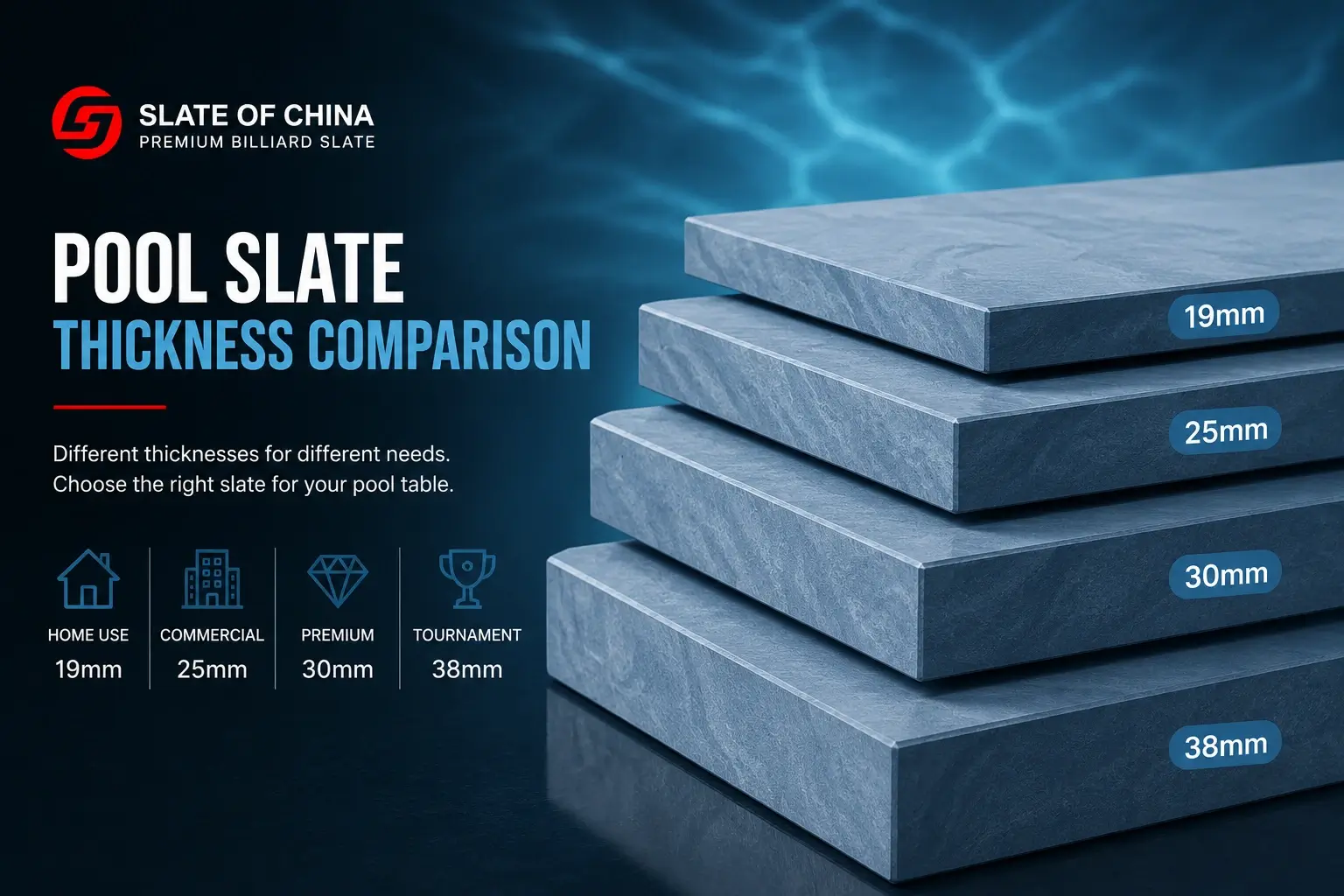
25 mm vs 45 mm vs 50 mm at a Glance
This is the thickness question in one table — read the last row first; it is the whole point of this page.
| 25 mm | 45 mm | 50 mm | |
|---|---|---|---|
| Typical application | Pool | Snooker / Chinese 8-ball | Heavy-duty / custom designs |
| Relative stone volume (same footprint) | 1.0× | about 1.8× | 2.0× |
| Main advantage | Lower weight, lighter handling | High rigidity | Maximum thickness |
| Main drawback | Not the choice for every large bed | Heavy | Very heavy |
| Must match the frame? | Yes | Yes | Yes |
| Automatically better? | No | No | No |
The relative volume is pure geometry at the same footprint: 45 mm carries about 1.8× the stone of 25 mm, and 50 mm exactly 2×. What those multiples mean in freight, floor loading and handling is worked out later in this guide.
Pool vs Snooker vs Chinese 8-Ball Slate Thickness at a Glance
Where each table type sits on the thickness scale — read the last column first; it is the reason the other columns look the way they do.
| Table Type | Common Slate Thickness | Typical Configuration | What Drives the Number |
|---|---|---|---|
| Pool | 19–25 mm; some designs to 38 mm | 3-piece on most tables | Weight, handling and cost on a small-to-mid bed |
| Snooker | 35 / 45 mm (50 mm on some tournament designs) | 5-piece on 12 ft tables | The large playing span and frame stiffness |
| Chinese 8-ball | 38–50 mm; 45 mm most commonly requested in our production | Multi-piece, per table design | Heavy cabinet construction and market positioning |
| Heavy-duty / special designs | 45–50 mm and above | Manufacturer-specific | Frame strength, floor loading and tournament requirements |
These are market and production ranges, not universal standards. Two table brands can build the same nominal size around different thicknesses, so a figure on any website — including this one — never overrides the table manufacturer's drawing. The complete dimension-by-dimension reference, including 10 ft snooker, carom and Russian pyramid beds, lives on Billiard Slate Technical Specifications.
Real Billiard Slate Thickness Specifications from Our Production
Ranges are abstract. Orders are concrete. Below are the configurations that actually move through our production floor — the same numbers our quotations are built from:
| Order Type | Typical Slate Outline | Thickness as Produced | Pieces | Approx. Finished Weight |
|---|---|---|---|---|
| 7 ft pool | approx. 2169 × 1170 mm | 19 mm | 3 | 130–140 kg |
| 8 ft pool | approx. 2413 × 1295 mm | 19 / 22 / 25 mm | 3 | 160–210 kg |
| 9 ft pool | approx. 2718 × 1448 mm | 25 mm | 3 | 250–270 kg |
| 12 ft snooker | approx. 3658 × 1867 mm | 45 mm (35 mm on some designs) | 5 | approx. 800 kg at 45 mm |
| Chinese 8-ball | commonly approx. 2640 × 1360 mm, per drawing | 38–50 mm; 45 mm most ordered | multi-piece | per drawing |
| Heavy-duty / tournament designs | per drawing | 50 mm | per drawing | heaviest class — confirm frame and floor loading |
Weights are approximate finished weights from our production reference. Raw stone runs higher — a 9 ft set at 25 mm calculates to roughly 266 kg before pocket cut-outs and machining remove their share — and the finished figure for a specific order depends on the drawing, cut-outs and machining. These are production references, not universal standards: final dimensions and thickness should follow the table manufacturer's drawing.
Two of these rows dominate our export quotations: the 9 ft pool set at 25 mm and the 12 ft snooker set at 45 mm. They also happen to be the cleanest illustration of why the two markets never agree on thickness — same material, same factory, completely different structural problems. For per-piece weights, the 9 ft pool set breaks into three panels of roughly 80–90 kg; the 12 ft snooker set into five panels of roughly 160–170 kg. Those per-piece numbers, not the totals, decide what a warehouse crew can handle and what each crate has to be planned for.
Why Pool Slate Stays at 19–25 mm
A pool bed is a small-to-medium span carried by a cabinet that was drawn around it. On a 7 ft, 8 ft or 9 ft table, the frame and cross-supports sit close enough together that a 19–25 mm panel already delivers the stiffness the design needs. Adding stone past that point does not make the table play better — it makes the table heavier for the room floor, harder to install and more expensive to ship.
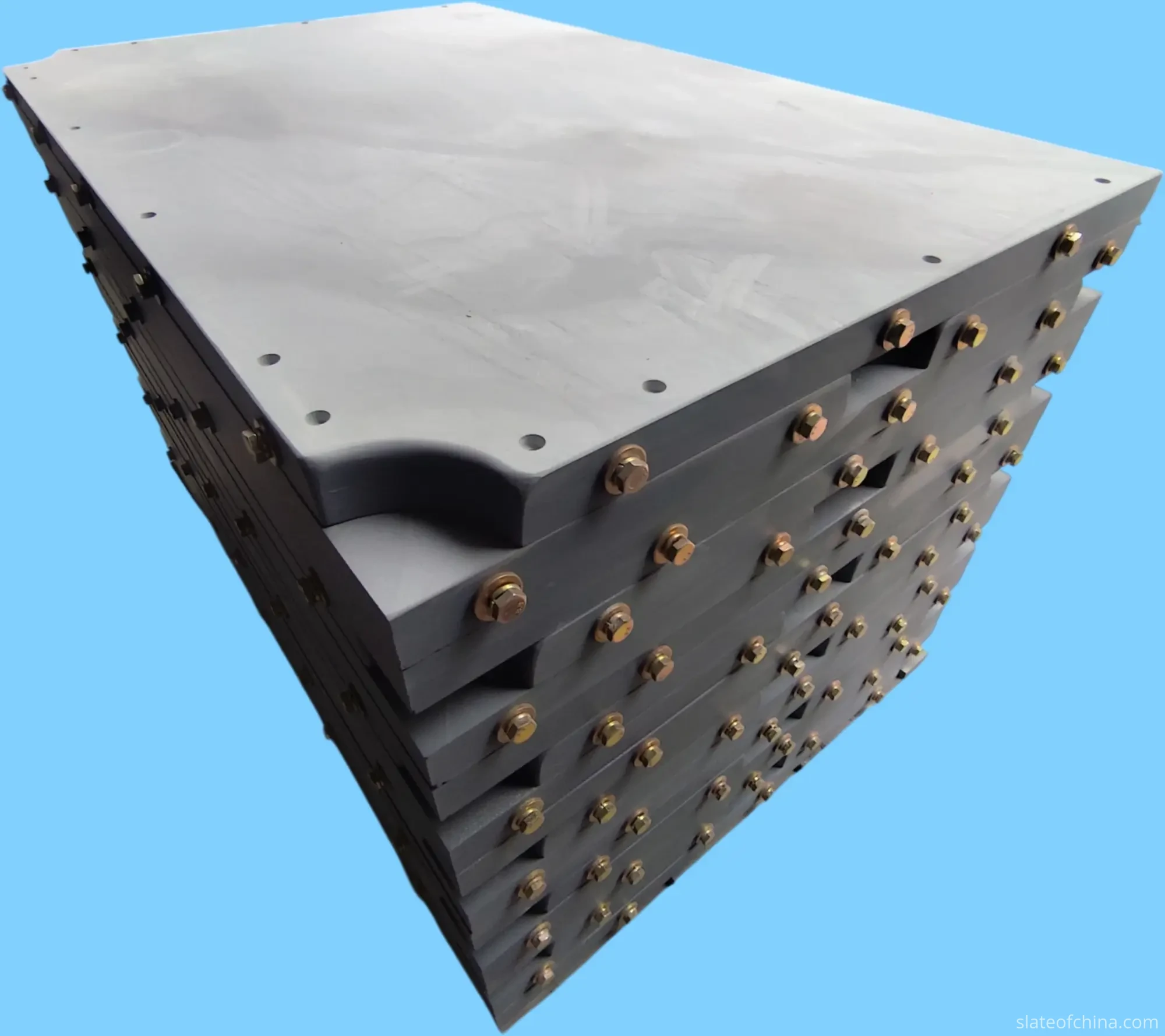
The weight economics are easy to feel in the numbers above. A 9 ft set at 25 mm lands at 250–270 kg finished, which is three panels of roughly 80–90 kg. Panels of this weight should be moved with appropriate lifting equipment and trained handling during installation. The thinner 19 mm specification appears on lighter 7 ft and 8 ft cabinets where the whole table has to stay friendly to home floors and residential staircases; 22 mm and 25 mm show up as cabinet designs get more commercial. And on some tournament-grade pool designs the drawing calls for more — up to 38 mm — because that particular cabinet was engineered for it, not because somebody wanted a "better" number.
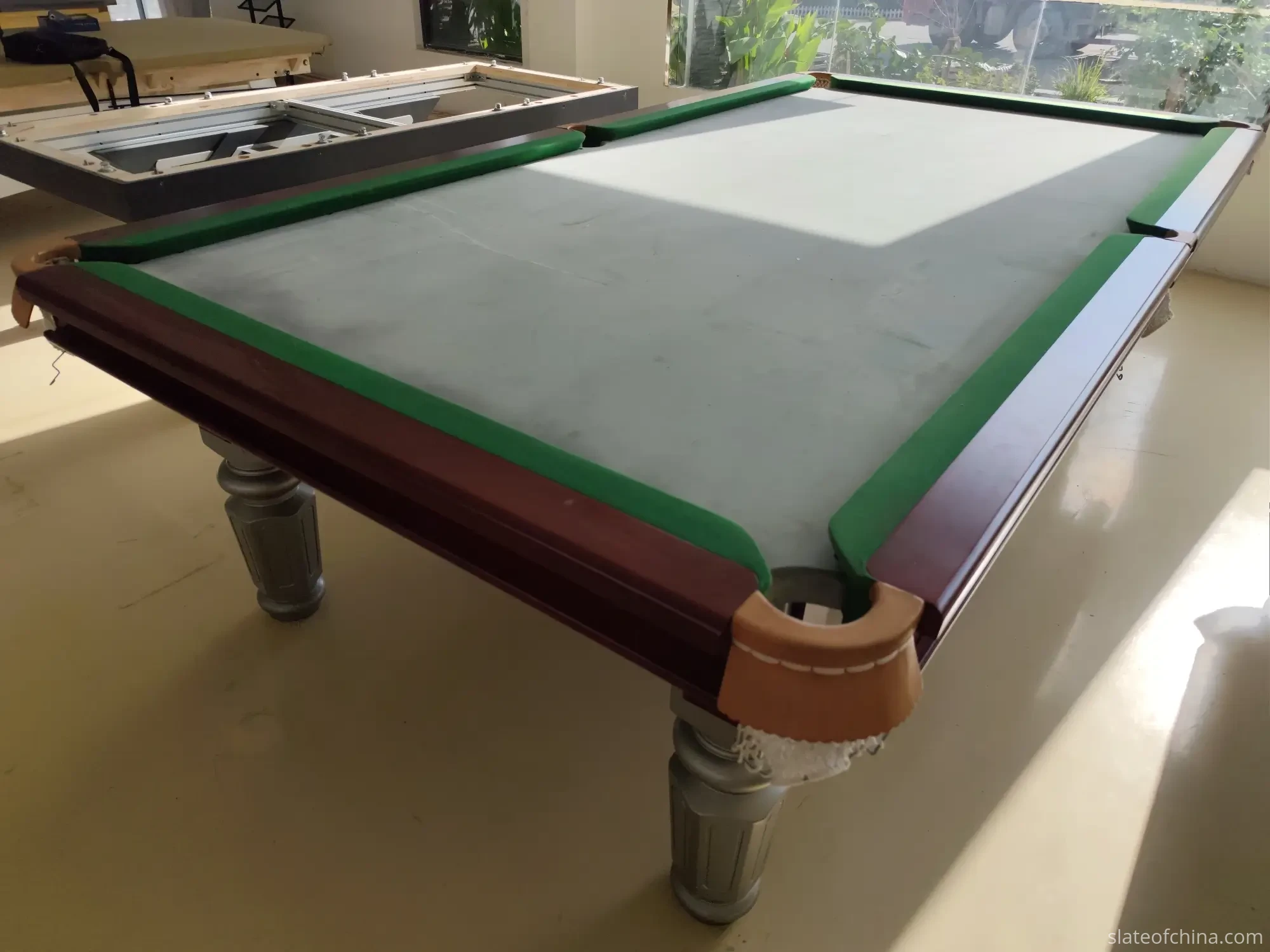
So does 25 mm mean a lesser table? Within its design, no — 25 mm is a common specification for commercial and larger pool-table designs, and it is fully professional when it is what the drawing calls for. Bolt lengths, rail heights and support spacing all assume the drawn thickness, which is exactly why thickness is not a free upgrade. What each pool thickness grade is for, size by size, is covered in the pool table slate thickness guide.
Why 12 ft Snooker Slate Runs at 45 mm
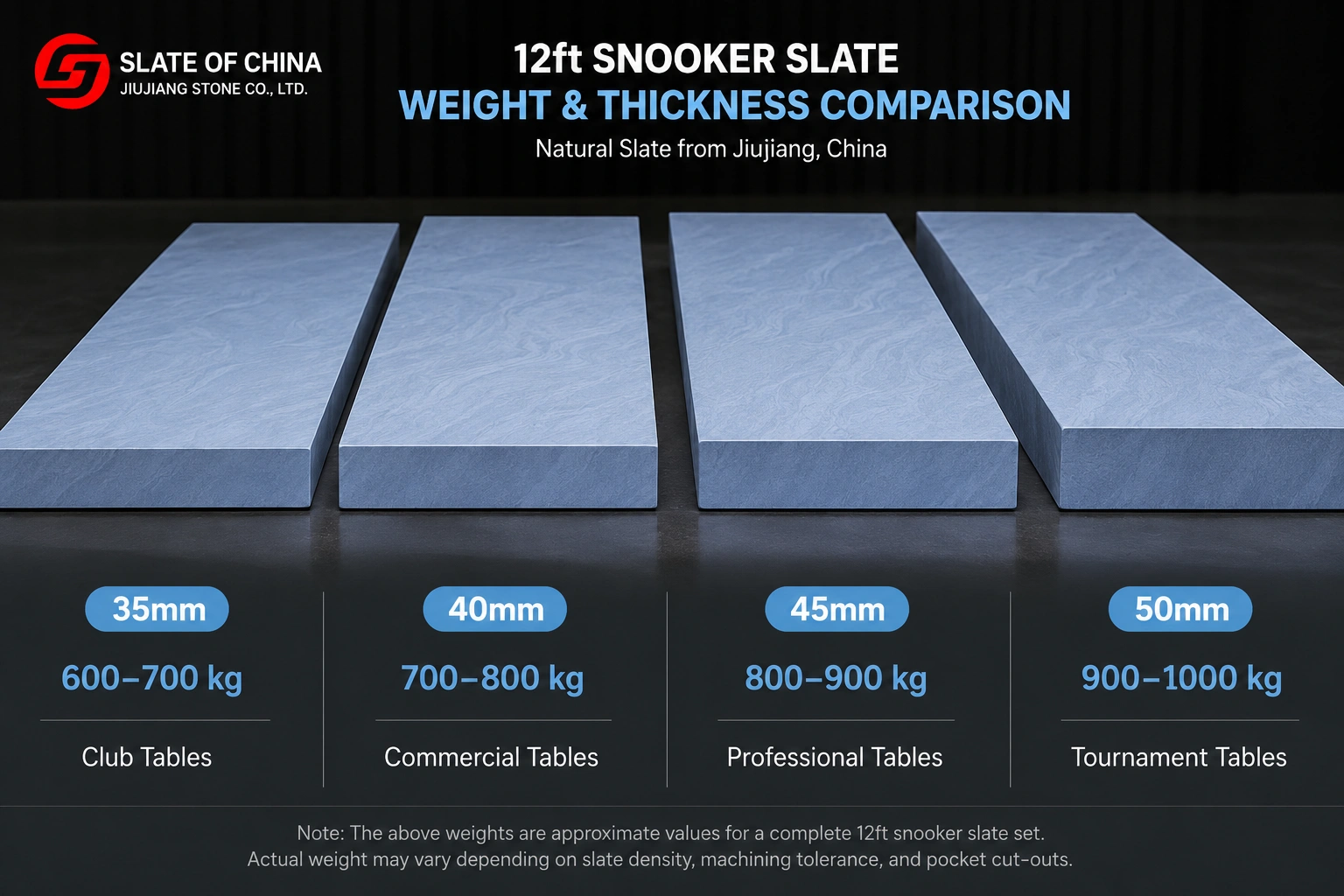
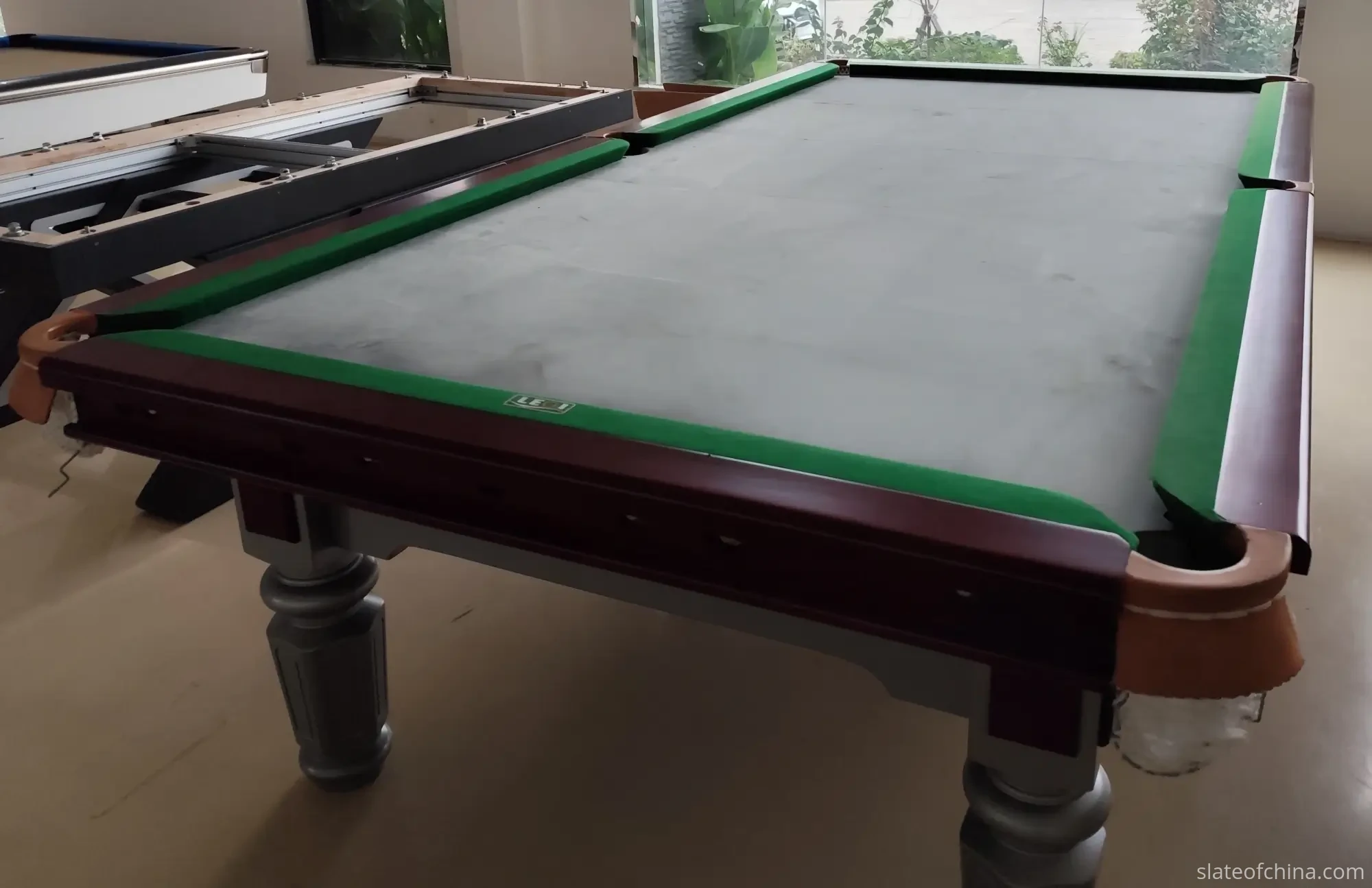
Snooker changes the structural problem. A 12 ft table carries a playing surface of roughly double the area of a 9 ft pool bed, and much of that span sits further from the nearest support. The stiffness has to come from somewhere, and on a full-size snooker table a large share of it comes from the stone itself. That is the engineering logic behind 45 mm: at that thickness the bed behaves as a rigid plate across a very large outline, and the weight — about 800 kg finished at 45 mm, depending on cut-outs and machining — lands on a frame that was designed to carry exactly that.
In our production, 45 mm is the thickness most commonly manufactured for 12 ft snooker tables, supplied as a five-piece set of roughly 3658 × 1867 mm. Five pieces are not a compromise; they are how 800 kg of stone becomes five panels of 160–170 kg that a professional crew can move, crate and install with appropriate lifting equipment. Some 12 ft designs are drawn lighter, at 35 mm, and 50 mm appears on tournament-class builds — but those are drawing decisions, not quality decisions. Smaller 10 ft snooker tables commonly run 38 mm, the same logic scaled down.
If you are choosing between snooker thicknesses rather than comparing across table types, the snooker slate thickness guide covers the grade-by-grade detail.
Chinese 8-Ball Slate Thickness: 45 mm Most Ordered
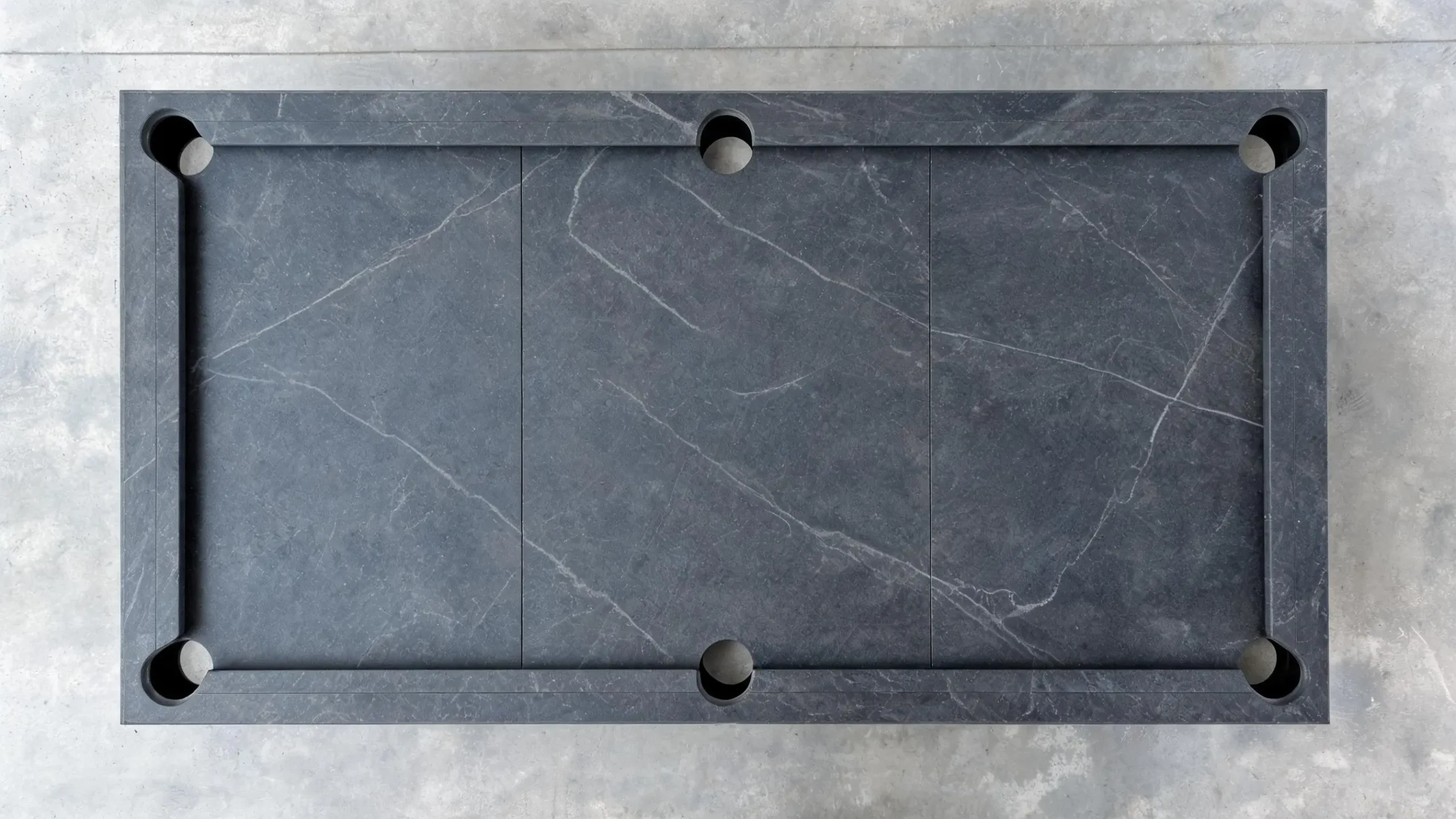
Chinese 8-ball is the newest of the three formats and the clearest case of thickness following positioning. The tables are engineered like heavy snooker-class equipment built on a smaller outline: strong cabinet, serious commercial use, a product that is meant to feel substantial in a club. The slate follows that brief. In our production experience, 45 mm is the most commonly ordered thickness for Chinese 8-ball slate, while 38 mm, 40 mm, 42 mm and 50 mm are also produced according to table design — the same heavy panel as a full-size snooker bed, applied to a smaller table.
Because the outline varies by brand, a common Chinese 8-ball production drawing runs around 2640 × 1360 mm — although final dimensions should follow the table manufacturer's drawing. At 45 mm, that outline represents roughly 0.17 m³ of stone — a calculated estimate of about 460 kg before allowing for the exact piece layout, machining and cut-outs, roughly 150 kg per piece at raw stone. The pocket openings and piece layout follow the table brand's rail geometry, which is why the full specification, pockets included, lives on the Chinese 8-ball table slate page rather than here. What matters on this page is the pattern: a thick bed on a strong frame, because the table was designed that way — and beyond these three formats, Russian pyramid and Korean carom tables also run 45 mm and above for the same structural reasons.
25 mm vs 45 mm vs 50 mm: What Actually Changes
Put the marketing language aside and look at the practical ledger. Thickness drives a chain — weight, then rigidity, then frame requirements, then handling, freight and installation — and when the number changes, every link in that chain moves with it:
| Factor | 25 mm | 45 mm | 50 mm |
|---|---|---|---|
| Rigidity | Matches pool cabinet engineering | High — engineered for large spans | Very high — must suit the frame and floor |
| Handling | Panels around 80–90 kg on a 9 ft set — lifting equipment recommended | Mechanical handling (160–170 kg panels on a 12 ft set) | Planned lifting equipment |
| Freight and container impact | Lower | Higher | Highest |
| Floor loading at the destination | Lighter beds, easier on floors | Heavy — floor loading must be checked | Heaviest — frame and floor loading must be confirmed |
| Cost impact | Lower | Higher | Higher |
The weight line deserves a picture of its own, because it is pure arithmetic — no marketing in it. Same footprint, same stone, thickness is the only variable:
25 mm — baseline
45 mm — about 1.8× the stone
50 mm — about 2× the stone
Same footprint, same material: how the stone in one slate bed scales with thickness.
For a manufacturer, that multiple does not stay in the quarry. It travels: per-piece weight decides crate design and forklift capacity, total weight decides the container loading plan, and at the destination it becomes floor loading in the client's building. And notice the last step of the ladder — 50 mm over 45 mm adds only about 11 percent more stone, but every gram of it lands on the frame, the floor and the freight quote. That is why 50 mm is a specification to confirm, not a box to tick. The sourcing side of that arithmetic — containers, packing, documents — is walked through in the billiard slate buying guide, and finished slate products by table type are listed under billiard slate products.
Does Thicker Slate Mean a Better Table?
No — and the fact that everyone asks is the best argument for writing this page.
The instinct is understandable. In most products, "heavier grade" means "better grade". Slate is different: the nominal thickness was chosen by the table's engineer, in the same stroke as the cabinet, the rails and the support layout. Once that choice is made, the difference between a good table and a poor one lives somewhere else entirely — in flatness across the playing surface, in how consistently thickness is held from panel to panel, in joint faces that meet without a step, in pocket cuts and bolt holes machined to the drawing, and in the support structure underneath. Those are measured, recorded and reported things, which is why our quality and inspection data has its own page: Billiard Slate Quality & Test Data.
A heavier slate does not automatically produce better ball performance when the table was not designed for that thickness. Flatness decides how the ball runs, and machining accuracy decides flatness — not the nominal thickness. An accurately machined 25 mm pool set on the frame it was drawn for will outplay a poorly machined 50 mm set every day of the week. The piece-count question follows the same logic, by the way: whether a bed ships in one piece, three or five is a handling and configuration decision, not a quality ranking — the manufacturer's cost view is on 1-piece vs 3-piece for manufacturers.
Which leaves a practical rule worth keeping: for a properly engineered table, the correct thickness matters more than simply choosing the thickest slate available. If a supplier pitches a thickness to you without asking about the table, that is the pitch to be wary of — slate thickness is a design specification, not a quality grade.
What to Send When You Ask About Slate Thickness
"Need 12 ft snooker slate, 45 mm" is a perfectly good opening line — we answer it every week. But it is a conversation starter, not a production document. Thickness alone cannot be machined: pocket positions and radii, bolt-hole layout, joint faces and edge treatment all come from the table drawing, and CNC slate production runs on the drawing. That is why a CNC billiard slate quotation is built from the drawing, never from the thickness line alone.
A thickness question becomes a fast, accurate answer when it arrives with six things: the table type, the slate outline (or playing area, stated as such), the thickness as drawn, the pieces per set, the quantity, and the destination port. If a drawing exists — even a photograph of an old print — attach it. A workable inquiry reads like this:
We need CNC-machined slate for a [pool / snooker / Chinese 8-ball] table, [size]. Drawing attached. Please confirm the slate thickness against the drawing, together with thickness tolerance, flatness, dimensions, pieces per set, pocket and hole machining, packing and container loading quantity.
That message gets a specification back, not a catalogue number. Before the order is placed, confirm the thickness as drawn (never as a menu choice), ask how flatness and thickness are measured and recorded, request the weight per piece as well as the total, and — for a new OEM project — ask for a sample set to verify dimensions, machining and joint fit on your own frame. The full sourcing sequence, from sample to shipment, is in the buying guide, and the complete specification reference is one click away on Billiard Slate Technical Specifications.
Frequently Asked Questions
What thickness slate is used for a pool table?
Many pool designs use 19–25 mm: 19 mm appears on lighter 7 ft and 8 ft cabinets, while 25 mm is a common commercial specification on 9 ft and 10 ft tables. Some heavier or tournament-oriented designs specify thicker, up to 38 mm. The thickness for a specific table is confirmed against its drawing.
What thickness is 12 ft snooker slate?
45 mm is the thickness most commonly manufactured for 12 ft snooker tables in our production, usually as a five-piece set of roughly 3658 × 1867 mm weighing about 800 kg finished, depending on cut-outs and machining. Some 12 ft designs use 35 mm instead, and 50 mm appears on tournament-class builds — the table drawing decides.
Is 45 mm slate better than 25 mm slate?
Not in itself. The two numbers belong to different engineering briefs: a pool cabinet designed around a 25 mm bed, and a snooker or Chinese 8-ball frame designed around 45 mm. Within its own table design, an accurately machined 25 mm pool slate is a fully professional component.
Is 50 mm slate better than 45 mm slate?
Only when the table was engineered for it. Moving from 45 mm to 50 mm adds roughly 11 percent more stone, and the difference lands on the frame, the floor and the freight quote. A 50 mm specification always needs confirmation against frame and floor loading.
What thickness is Chinese 8-ball slate?
In our production experience, 45 mm is the most commonly ordered thickness for Chinese 8-ball slate, while 38 mm, 40 mm, 42 mm and 50 mm are also produced according to table design. The outline, piece count and pocket machining follow the table brand's drawing, so thickness is confirmed per design, not assumed.
Can I upgrade a pool table by installing thicker slate?
Generally no. If your table was engineered around 25 mm slate, moving to 45 mm or 50 mm changes the weight, support requirements, rail geometry and installation conditions — do not change thickness without checking the table design. Cabinet strength, rail height, bolt lengths and support spacing all assume the drawn thickness, so a thickness change belongs at the table-design stage, confirmed by the table manufacturer.
How do I choose the correct billiard slate thickness?
Start from the table, not the number. Confirm the table type, the slate outline or playing-area dimensions, and the table manufacturer's drawing — the drawing carries the support structure, the drawn thickness and the CNC machining requirements for pockets, holes and joint faces. Once the drawing is confirmed, the thickness is already decided. Send it with your inquiry and ask the supplier to confirm the specification before production.
Related Reading
Not Sure Which Thickness Your Table Needs?
You do not need to know the answer — you need the drawing. Send us the table type, slate dimensions, thickness, pieces per set and quantity, and we will confirm the specification against the drawing before anything is cut. If the drawing calls for 25 mm, we will tell you 25 mm; if it calls for 50 mm, we will tell you what that means for your frame and your floor.