
1-Piece vs 3-Piece Pool Table Slate for Manufacturers
The first slate I ever saw break was a finished one-piece slab, and it did not break in the quarry or on the CNC bed. It broke in our own loading yard, three metres from the truck.
It was a 7 ft one-piece, already through the bed, edges ground, bolt holes drilled, ready to crate. Two timber battens were set under it and the gap between them was a few centimetres too wide. When the slab was shifted sideways for banding, the stone flexed just enough across that unsupported span, and a crack ran cushion edge to cushion edge. Nobody was hurt, and that is the only good thing about the morning. The loss was not the stone alone — it was the finished machining, the two shifts already spent on it, the raw block it came from, and a customer deadline that now had to be rebuilt out of another block from another part of the yard.
That morning is when piece count stopped being a drawing question for me and became a production-system question. A homeowner ordering one table reasonably asks, which plays better? A manufacturer shipping dozens or hundreds of tables asks something different: which configuration keeps my yield, my warehouse, my crates, my container, my assembly line and my installer's hands all working in the same direction? The buyer's-side comparison — playing performance, transport, installation, "which should you choose" — sits on our one-piece vs three-piece pool slate page. This one is the manufacturer's account.
Eight stations decide the comparison, and the two configurations do not win the same ones:
1-piece wins the front of the production line — fewer cuts, no matching, simpler assembly. 3-piece wins everything after it — handling, packing, container flexibility, site access and replacement. Neither wins on price per set: the real comparison is total cost per delivered table, matched to your table size, your export model and your installation channel.
Quick manufacturer comparison — this is a production comparison, not a quality ranking.
| Factor | 1-Piece | 3-Piece |
|---|---|---|
| Raw block requirement | Higher — one large, clean slab | More flexible — smaller usable blocks |
| Sawing | Simpler — one panel | More cuts per set |
| Joint machining | None | Four ground joint faces required |
| Set matching | Not needed | Required — panels checked as a set |
| Individual handling | Difficult for large sizes | Easier per panel |
| Warehouse | Larger floor positions | More set management |
| Packing | One large crate | Smaller sections |
| Container loading | Less flexible | More flexible |
| Factory assembly | Simpler, fewer steps | More steps, more process control |
| Site installation | Difficult for large tables | Easier — frame first, slate follows |
| Replacement | Whole playing surface | Single section possible |
Every row is a station in the account below — read on for why each one moves the way it does.
Where the Two Configurations Actually Diverge
Table size alone does not determine slate configuration. The table drawing, cabinet structure, installation method and shipping model all matter — a 9 ft table does not imply one universal slate size or piece count. Confirm against the table drawing before choosing.
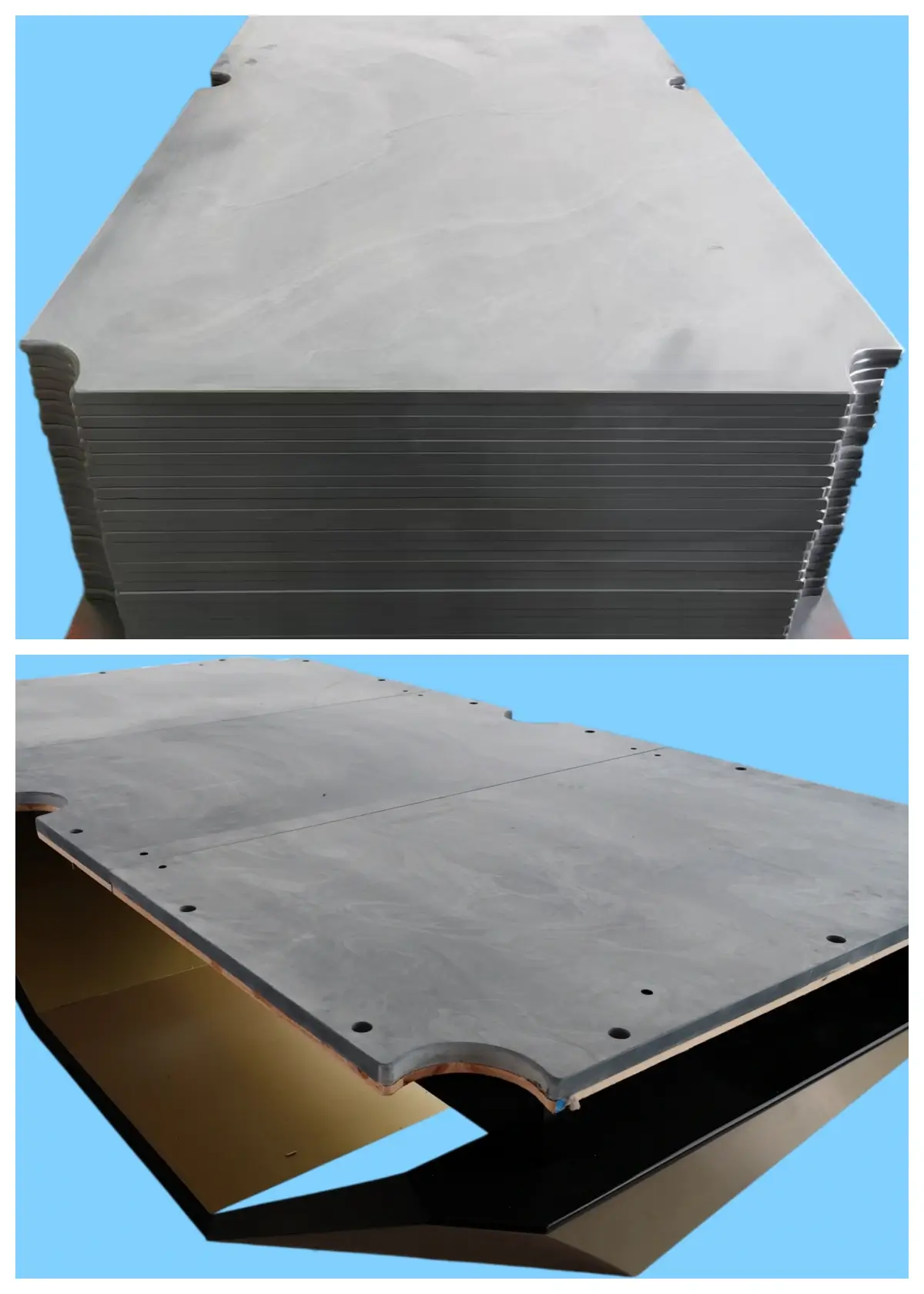
The basic split is small and worth stating plainly. A 1-piece slate is one continuous slab covering the whole playing area in a single block of stone. A 3-piece slate covers the same playing area in three precision-machined sections, joined and levelled during installation. (For the material basics and why slate is used at all, see what billiard slate is; for the cutting dimensions and piece counts by table size, see the pool slate size guide.)
From a player's seat the two can look identical under the cloth. From a maker's bench they are not the same product. Three-piece means two joint lines, and two joint lines mean four machined joint faces — every one of them sawn, ground, checked against the agreed tolerance and matched to its neighbour. One-piece means none of that joint work, but it does mean one very large, very heavy, very breakable single stone. The two configurations are not a quality grade; both, made and installed to specification, give an acceptable playing surface. They are two different production and logistics systems wearing the same name.
Fig. 1 — The same playing area as one slab or as three panels. The three-panel set carries two joints and four ground joint faces that the one-piece set does not.
Raw Slate Yield: Where the Account Opens
The economics of billiard slate start long before the CNC bed; they start in the raw block. A block is not a flat rectangle of usable stone — it is a piece of ground with natural fractures, soft veins, iron lines and zones that will never hold a tolerance. The job at the saw is to get the required finished panel out of what the block actually offers. (The full route from block to finished slate is on our quarry-to-table process page.)
A one-piece slab asks the block for one thing: a single piece large enough and clean enough to cover the whole playing area in one go. As the required finished size grows, the pool of blocks that can deliver it shrinks fast. A block can be big enough in length and width and still be wrong — a fracture running where the playing surface should be, a soft patch in the corner that will not hold a ground edge. Three-piece changes the question. The same total area can be drawn from a wider pool of blocks, because each panel only has to be big enough and clean enough for its own section.
It is tempting to read that as "three-piece has better yield, full stop." It is not that simple. Three-piece introduces two saw kerfs that the one-piece route does not, each one eating a few millimetres of stone. It carries machining allowance on four joint faces. It carries the matching loss — the material trimmed away to make three panels line up as one surface. The real yield depends on the block dimensions, the natural fractures in that block, the thickness, the finished size, the cutting and machining allowances, the rejection rate and the customer's tolerances, not on the number of pieces alone.
This is why yield cannot honestly be quoted as a fixed percentage. The same question answered from two different blocks gives two different results:
| Raw Block A | Raw Block B | |
|---|---|---|
| Block character | Large, clean, one long clear zone | Mid-sized, two usable zones separated by a fracture line |
| 1-piece route | Covers the full playing area in one slab | Cannot — the fracture crosses the playing surface |
| 3-piece route | Possible, but adds two kerfs and four joint faces to a block that did not need them | Each usable zone yields a panel; the fracture falls on a joint line |
| Outcome | One-piece is the efficient use of this block | Three-piece is the only way to use this block |
Same factory, same specification, opposite conclusions. That is why a percentage claim — "three-piece saves 15% in stone" or the reverse — is not something a manufacturer should trust from anyone. What matters is the block you actually have, the fracture map inside it, the thickness, the machining allowances and the agreed rejection criteria. A supplier who evaluates yield from real production data, block by block, is answering the question. A supplier who quotes a universal percentage is guessing.
The useful question for an OEM buyer is not "is 3-piece cheaper in stone?" but a narrower one: how much raw material does one finished set actually consume in your shop, and what is the normal rejection rate behind it? A supplier who can answer that from production data is a different animal from one who quotes from finished square metres.
Decision rule: do not price slate from finished square metres. Price it from the raw block, through sawing, machining, rejection and final inspection. The configuration with the lower ex-factory line can still be the one that costs you more by the time it reaches your warehouse.
Machining and Set Matching: The Cost That Grows with Piece Count
A pool table slate is not just cut to size. Depending on the table it may need precision thickness machining, surface grinding, squared edges, pocket openings, bolt or mounting holes, joint preparation and reference positioning. The eight-step detail of how our shop does this lives on the billiard slate manufacturing process page; here the point is only how piece count changes the machining account.
A one-piece slab has no internal joint faces. There is one thickness to hold, one surface to grind, one outline to square. A three-piece set has, in addition to all of that, the work of making three panels behave as one surface: thickness consistency across the set, the four ground joint faces, the hole and pocket positions read against the same datum, and the panel-to-panel checks that confirm the set will line up. The three panels are not three unrelated pieces of slate. They are a matched set, and the match has to survive the shipping and the installer's floor, not just the inspector's bench.
That matters most for OEM programmes running repeat orders across hundreds of sets. A one-off three-piece set can be matched by a careful operator. A few hundred sets a year of "the same" three-piece specification asks for something more repeatable than operator care — the same datum, the same joint-prep routine, the same inspection plan agreed up front. (The tolerance ranges and the measured flatness and thickness data sit on our tolerance guide and quality & test data pages; this page stays on the cost, not the numbers.)
| Cost line | 1-Piece slate | 3-Piece slate |
|---|---|---|
| Raw material | Depends on one large, clean block | Drawn from a wider pool of usable blocks |
| Sawing | One large panel, one bed setup | More cuts, more saw time per set |
| CNC machining | No joint faces to prepare | Four joint faces per set, plus set matching |
| Inspection | One panel against the drawing | Every panel, plus panel-to-panel checks |
| Handling | One heavy unit per move | Lighter moves, more of them |
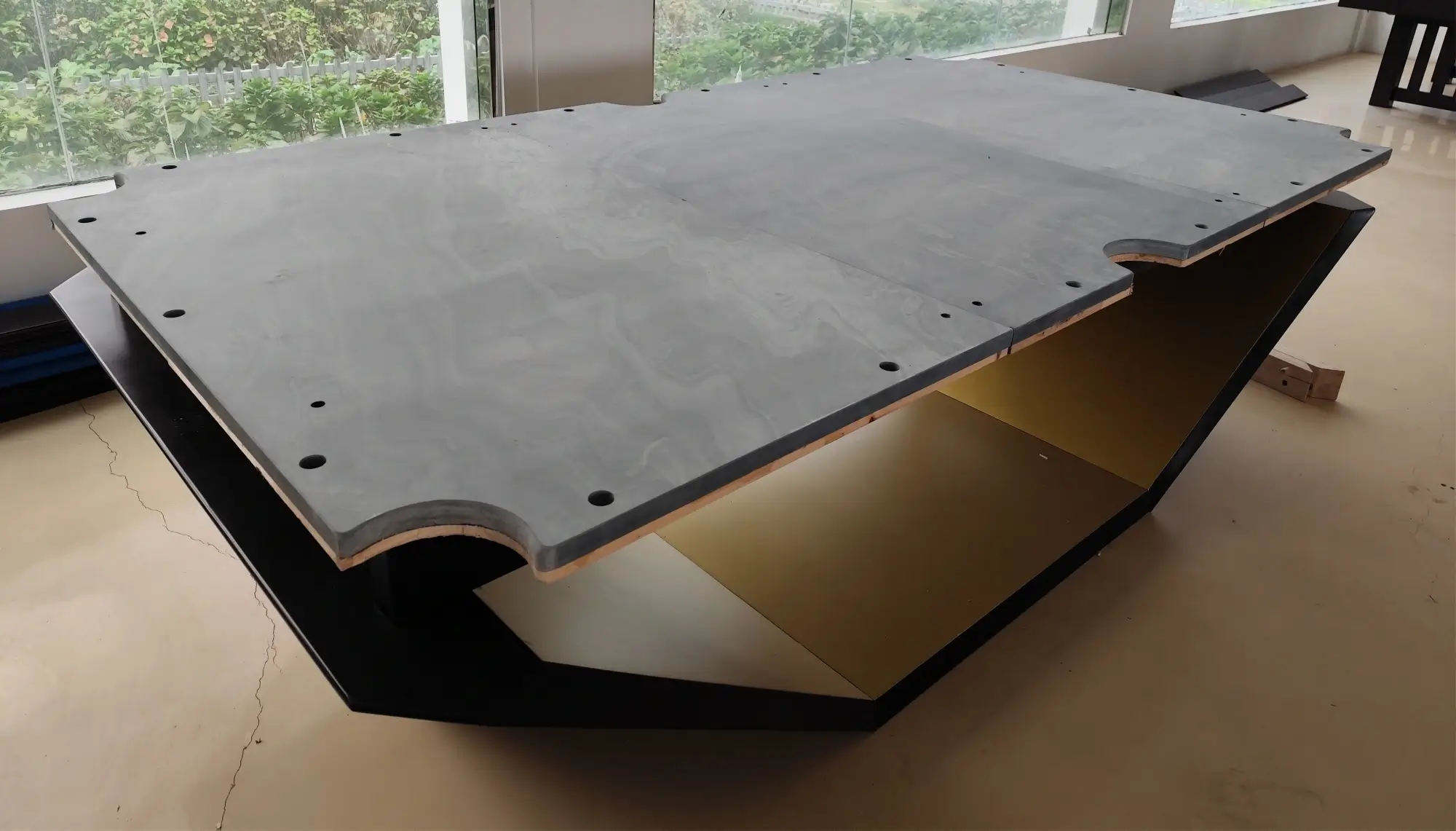
None of this means three-piece is "more expensive" in the only sense that matters. It means the machining account for three-piece is heavier at the front, and the question is whether the stations further down the line earn that cost back. The next few sections keep the running total.
Warehousing: Floor Positions and Set Discipline
Warehouse cost is the station people most often skip when they choose a slate configuration, and it is the one that bites the hardest once a factory runs more than one table model at once.
One-piece slate has the simple SKU story: one finished panel per table, one storage unit, one thing to find. The price it pays is physical. A large slate panel cannot be stacked like cartons; it needs wider positions, stronger support, more careful forklift work and more clear floor around each unit. A warehouse with plenty of square metres on paper can still run out of usable positions, because the big slabs eat the aisles as well as the racks.
Three-piece is the mirror image. The individual panels are lighter and easier to move, so the floor is more forgiving. The price it pays is set integrity. Three panels that belong to one table have to stay together — shipped together, crated together, replaced together if one is damaged. The practical way we hold this is a set mark on every panel: model, set letters (A / B / C), thickness and order number. It looks bureaucratic. It is the thing that stops a left section from one order travelling under the centre section of another, which is the kind of mistake that turns one damaged panel into a whole re-made set.
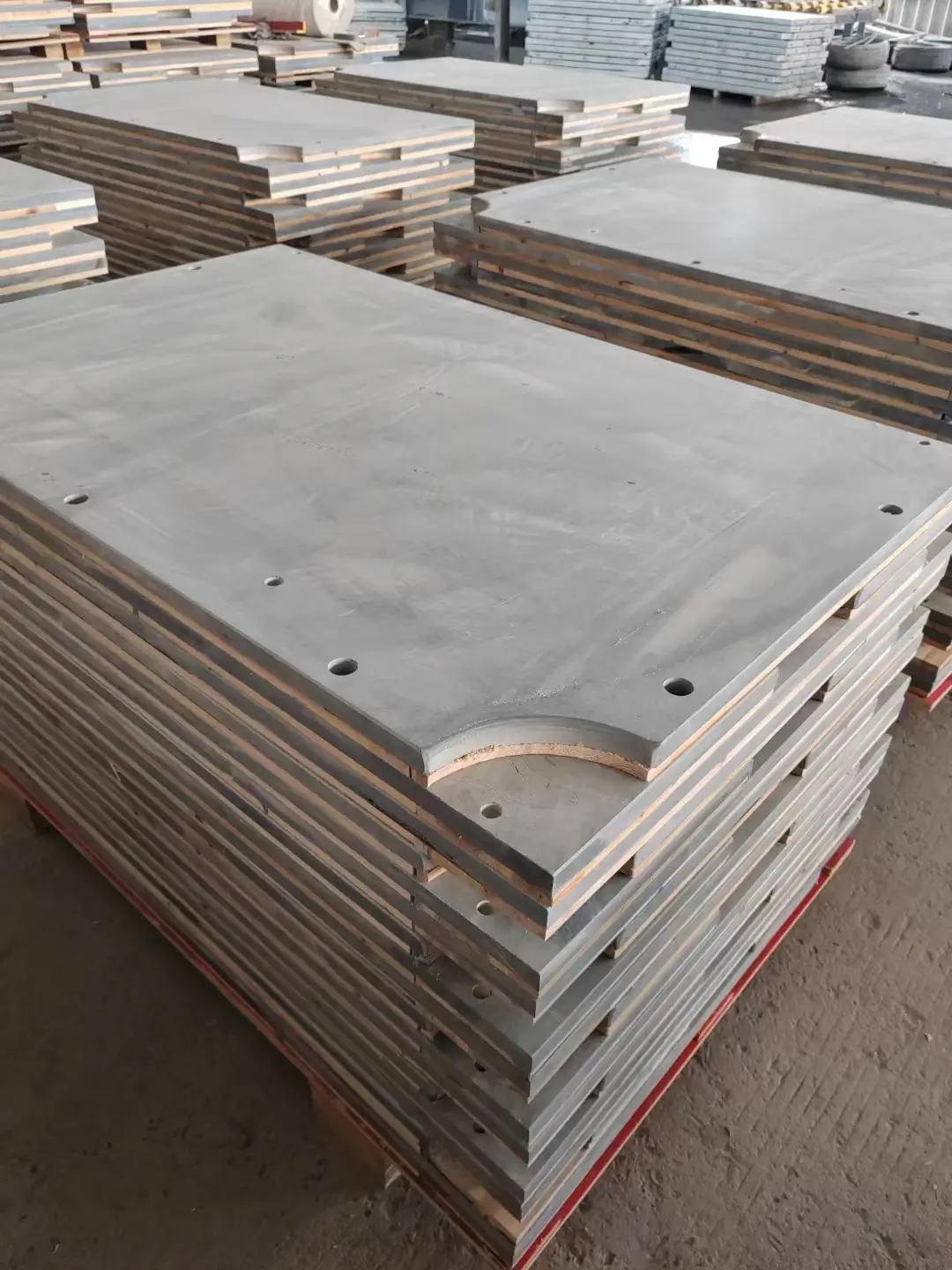
For an OEM running several customers on near-identical dimensions, set discipline is not a nicety; it is the difference between a clean shipment and a warranty call.
Decision rule: one-piece spends more on floor positions; three-piece spends more on set discipline. Budget for both whichever you choose, and weigh the one against your own warehouse, not against a generic cost table.
Crate and Container: The Freight Account
Packaging is where the configuration starts to talk to export reality. A large one-piece slab needs one crate strong enough to survive forklift handling, trucking, container movement, ocean freight and the repeated handling at the other end — all on one big, heavy box. For large tables the crate itself can become the logistics problem: its footprint is large, its weight is concentrated, and there are fewer ways to arrange it inside a container.
A three-piece set breaks the same load into smaller, more handleable packages, which gives the loading plan more options — useful when a shipment carries table frames, legs, hardware, cloth and accessories alongside the slate. We ship slate crated, never palletised; the crate is part of the slate supply chain, not an accessory, and the corners, edges and panel-to-panel contact all have to survive the handling chain. The interior has to stop edge damage, corner damage, panel movement and the moisture problems that come from poor contact between slate and packaging.
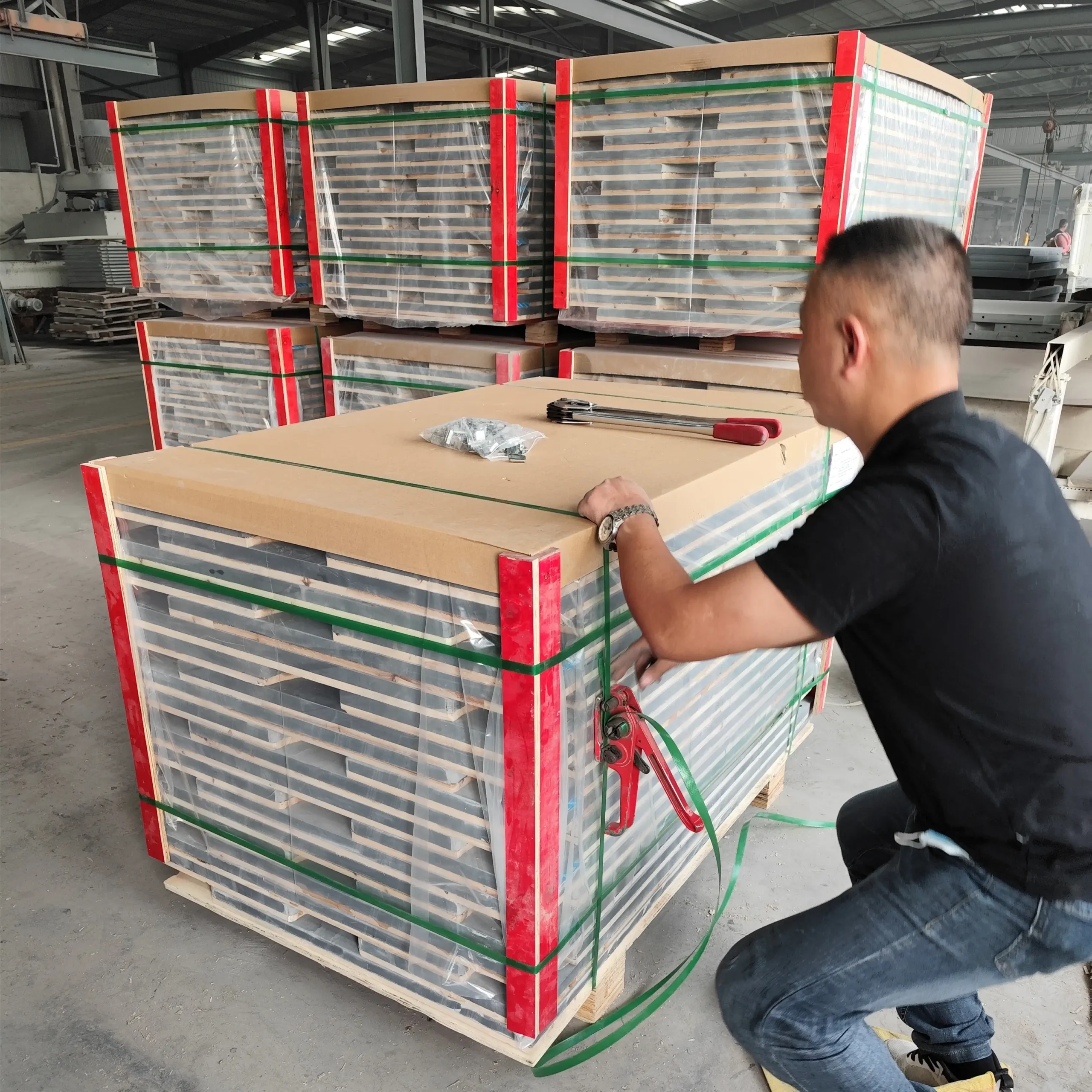
One note from how our export actually runs: the empty container is trucked from Jiujiang port into our yard, the crates are loaded at the factory, and the sealed box goes back to the port. That is about a forty-minute run each way. It means the loading plan has to be settled before the container turns up at the gate — there is no second chance at a port warehouse. So we treat the packed dimensions and the loading sketch as part of the order, not something to sort out on the day. (The full export workflow is on our packing & shipping guide and import guide.)
It is also wrong to assume three-piece automatically cuts freight. Smaller crates give more loading options, yes — but more individual crates also mean more edges to protect and a different stow. Compare the actual packed dimensions, crate weights and loading plan, not the finished slate dimensions, before you read a freight quote.
Decision rule: a configuration that packs smaller is only cheaper to ship if the loading plan confirms it. Always ask for the packed dimensions and a container loading sketch — never read freight off the finished slate size.
Assembly Labour: The Factory Line and the Installation Site
This station splits in two, and the split is a business decision, not a craft one. There is the assembly that happens in your factory, and the assembly that happens at the customer's address, and they pull the slate configuration in opposite directions.
On a high-volume factory line, a one-piece slate is the simpler station: one panel to position, no slate-to-slate joints to align, no seam treatment. When a line builds hundreds of tables a month, even a few minutes saved per table becomes a real shift. Three-piece on the same line asks for more steps — position each section, align the joints, level the whole surface, treat the seams, re-inspect, then cloth — and more process control to do it repeatably.
But the moment the table is not assembled in your factory and shipped as a finished unit, the calculation flips. A one-piece slate makes a complete table extremely heavy and awkward to move and install — through doorways, up stairs, into a club or a hotel. For many international export and site-assembled applications, three-piece construction can simplify handling and installation: the frame goes in first and the slate follows in manageable sections. The appropriate configuration still depends on the table design, the shipping method and the installation model. (Site work is covered on our installation guide.)
The slate configuration should be chosen with the installation model, not after it. A factory that ships complete tables and a factory that ships flat-pack for site assembly are answering two different questions, and the right slate answer is not the same for both.
Decision rule: decide the configuration together with the installation channel. Factory-assembled tables lean one-piece for line speed; site-assembled, exported or upstairs installations lean three-piece for handling.
Total Weight vs Handling Weight
Here is the most misunderstood number in the whole comparison, and it is worth a section of its own. The total weight of a one-piece slate and a three-piece set of the same specification is usually very close — the same stone, the same area, near enough the same thickness. The difference is not how much the table weighs. The difference is how much any single person, trolley or forklift has to move at once.
Take a 9 ft, 25 mm set as the running example — the same numbers our pool slate weight guide uses. As one slab it is roughly 270 kg in a single move. As a three-piece set the same ~270 kg is split into three panels of about 90 kg each (the slate density is around 2.7 t/m³, so the arithmetic is straightforward). The stone has not got lighter. The handling has.
Fig. 2 — Total slate weight and handling weight are not the same thing. For a manufacturer, handling efficiency often matters more than total weight reduction.
That changes what the equipment and the site have to be ready for: forklift capacity, manual lifting, truck loading, installation access, stairways and doorways. A floor that takes a 270 kg slab in one piece and a floor that takes it in three 90 kg pieces are not the same specification. For a manufacturer, handling efficiency is frequently worth more than shaving total weight, because the total weight barely moves between the two configurations in the first place.
After-Sales: One Section vs One Surface
The last station in the account is the one that arrives years after the sale, and it tends to be forgotten at order time. A one-piece slate is a single component: if it is seriously damaged, the replacement is the whole playing surface. A three-piece design leaves the door open to replacing one section — left, centre or right — provided the replacement is made to the original dimensions and matched to the surviving panels.
"Provided" is doing work in that sentence. A replacement section is only useful if the supplier still holds the drawing, the datum and the agreed tolerances for that set, so the new panel lines up with the old ones rather than just fitting the hole. This is why an OEM running a long-term spare-parts programme should ask, before the first order, whether the supplier will keep the specification on file and be able to reproduce a matched single section several years later. It is also why some manufacturers stock replacement components at the section level — left, centre, right — rather than holding a complete large slab for every model.
Replacement compatibility is not free and it is not automatic. It is a decision taken at the first order, not after the damage.
The Manufacturer's Total Cost Model
Put the eight stations together and the cost of a slate set stops being a single line on a quote. It becomes an account:
Slate cost = raw material + sawing + CNC machining + set matching + storage + crate + freight + assembly + installation + after-sales provision.
This is why a three-piece set with a higher ex-factory line can still land as the cheaper table, and a one-piece set with the lower line can still cost more by the time it reaches the customer's floor. The two routes spend their money at different stations:
| 1-Piece route | 3-Piece route |
|---|---|
| Lower at the front — one cut, no matching, simpler assembly on the line. | Higher at the front — more cuts, four joint faces, set matching, more inspection. |
| Higher at the back — large handling, large crate, fewer container options, harder site access, full-surface replacement. | Lower at the back — lighter moves, flexible packing, easier container stow, easier site access, section-level replacement. |
The configuration that wins is the one whose total — not whose first line — is lowest for your table and your channel. For a sense of how that lands across real situations, the table below is read from our own production mix, not from a universal rule:
| Manufacturing situation | What usually decides the configuration |
|---|---|
| 6–7 ft home tables | Simplicity and price; one-piece common. |
| 7 ft coin-operated lines | Fast factory assembly; one-piece common. |
| 8 ft commercial tables | Logistics and site access; three-piece usual. |
| 9 ft professional tables | Handling plus site access; three-piece usual. |
| Export OEM programmes | Crate and container plan; three-piece usual. |
| High-volume lines | Minutes per table — whichever trims assembly time. |
| Custom / bespoke tables | Flexibility of the cutting plan. |
| Tournament venue projects | Installation model and precision. |
| Replacement parts programmes | Section-level availability. |
| Mixed-brand importers | SKU strategy across several sizes. |
Typical practice in our production mix, not a rule. A 9 ft table does not imply one universal slate size or configuration — confirm against the table drawing.
Notice the shape of it. There is no row that says "always choose one-piece" or "always choose three-piece". The right answer moves with the table, the channel and the volume, which is exactly why the comparison has to be run as an account, not a slogan.
1-Piece vs 3-Piece Pool Slate: When Each Makes Sense
Pulled out of the stations and into one place, the pattern is easier to see. Neither list is a recommendation — each is a set of conditions where one configuration tends to make the account work out.
| 1-Piece tends to make sense when… | 3-Piece tends to make sense when… |
|---|---|
| The table is 6–7 ft and the finished slab stays manageable | The table is 8–9 ft commercial or professional |
| Tables are assembled in your factory | Tables are assembled at the customer's site |
| Delivery is short-distance with easy ground-floor access | The route involves elevators, stairs, doorways or difficult site access |
| Handling equipment for a heavy single unit is available at both ends | Container shipping is part of the model |
| Installation is simple and one-step | A replacement-parts strategy is planned at the section level |
| The line values assembly speed above all | Export OEM programmes with mixed cargo loads |
Most real table ranges end up using both configurations across different models, and that is a normal industry outcome rather than a compromise — the configuration is chosen per model, against the drawing and the channel, not once for the whole brand.
What to Ask a Slate Supplier Before the Order Goes In
Most of the cost in this article is avoidable before the first cut, with questions that cost nothing to ask and are hard to fake answers to. Before placing a production order, an OEM buyer should walk four areas. (A wider sourcing checklist is on our billiard slate buying guide.)
Raw material. What natural slate is used, and what thickness can you supply consistently? What are the normal dimensional tolerances, and how is raw material selected? How much raw block does one finished set actually consume, and what is the normal rejection rate behind it?
Machining and matching. Is CNC machining available, and how are flatness and thickness checked? Are the joining edges precision-ground? Can pocket positions follow the customer's drawing? For three-piece: are the three sections produced and marked as one matched set, and can a replacement section be reproduced later to the same datum?
Packing and loading. What are the crate dimensions and the packed weight per set? How many sets fit a 20GP or 40HQ with the actual stow? How are corners, edges and panel-to-panel contact protected against the handling chain?
Production control. What is the normal lead time, the minimum order, and — the one that separates a real factory from a trading desk — can you hold the same specifications across repeat orders a year apart?
A supplier who answers those from shop data is giving you the inputs to the account above. A supplier who answers only in price per set is asking you to take the rest on faith.
The Bottom Line for a Table Manufacturer
For a manufacturer, one-piece and three-piece pool table slate are not two grades of stone. They are two production and logistics systems. One-piece simplifies the front of the line — fewer cuts, no matching, faster assembly on a factory floor where the finished slab stays manageable. Three-piece takes more machining, more matching and more installation work, but divides the slate into sections that are easier to handle, pack, ship, install and, years later, replace.
So the useful question is not "is one-piece or three-piece better?" It is: which configuration gives our table design the most efficient total production and delivery cost at the required playing-surface specification? That is the question worth answering before a production spec is chosen — and the slab that broke in our yard is the reason it is worth answering early rather than after the first cracked shipment.
Before locking a slate configuration into a new table model, confirm the ten things that actually move the account:
- Finished table size and playing-area dimensions
- Slate thickness and the slate outline (not the table size alone)
- Joint positions, if three-piece — and where they fall against pockets and holes
- Set marking and set-integrity plan in the warehouse
- Crate dimensions and packed weight per set
- Container loading plan, drawn from packed dimensions
- Factory assembly time per table
- Installation channel — factory-assembled or site-assembled
- Replacement-part requirement, and whether the spec will stay on file
- Expected annual volume and the repeat-order tolerance you can accept
A manufacturer that works through those ten before ordering makes a far better decision than one that compares only the price per slate set. If you are deciding between 1-piece and 3-piece for a table line, the cleanest next step is to send your table drawing — table size, playing area, slate outline, thickness, pocket layout and joint positions — and have the slate supplier review the configuration against the full production chain: yield, machining, matching, packing, container, assembly and installation. You can start that from our custom pool table slate page or directly through contact.
Frequently Asked Questions
Does a three-piece set use less raw slate than a one-piece slab?
Not automatically. Three-piece draws from a wider pool of usable blocks, which helps on large tables, but it also adds two saw kerfs, joint-face allowance and matching loss. Real yield depends on the block, the fractures, the thickness, the finished size and the rejection rate — not on the piece count alone. Ask the supplier how much raw block one finished set actually consumes, and the normal rejection rate behind it.
Is three-piece slate always cheaper to freight than one-piece?
No. Smaller crates give more loading options, but more crates also mean more edges to protect and a different stow. The freight comparison has to be run from the actual packed dimensions and a container loading sketch, not from the finished slate size. On small tables a one-piece crate can still load more efficiently than three smaller ones.
Can the same table drawing be produced both ways?
For most table sizes, yes. The switch needs the joint positions confirmed — they should not fall on a pocket line or a bolt row — and the slate outline and datum re-checked against the table frame. Many drawings can be quoted either way; the configuration is a production and logistics choice, not a redraw.
How much heavier is a one-piece slab to handle?
The total weight is usually very close — the same stone, the same area. A 9 ft, 25 mm set runs about 270 kg whether it is one slab or three panels. The difference is per-move weight: roughly 270 kg in one lift versus about 90 kg per panel. The full piece-by-piece figures are on our pool slate weight guide.
Can we replace one damaged section years after delivery?
Often, yes — if the supplier kept the drawing, datum and tolerances on file so the new panel matches the surviving ones. This is a question to settle at the first order, not after the damage: ask whether the supplier will hold the specification and reproduce a matched single section later.
We are launching a new table line. Which configuration should we start with?
Match it to the table and the channel. Six-to-seven-foot home tables and coin-op lines commonly run one-piece for assembly speed; 8–9 ft commercial and export tables commonly run three-piece for handling and site access. Running both across a range, with the configuration chosen per model, is normal industry practice rather than a compromise.
Related Reading
Deciding between 1-piece and 3-piece for a table line?
Send your table drawing and we will review it against the full production chain:
Table size · Playing area · Slate thickness · Slate outline · Pocket layout · Joint positions · Annual volume · Shipping model
Get a 1-Piece vs 3-Piece Manufacturing Review →