
American Pool Table Slate Buying Guide for Manufacturers
A U.S. pool table manufacturer sends an email: "We need slate for a 9 ft American pool table, 1 inch, three-piece. Please quote."
That sentence sounds specific. It isn't. It still does not contain enough information to make a single cut.
For OEM pool table production, there is no general U.S. government "approved slate" certificate that replaces the table manufacturer's own engineering approval of a specific slate design. There is no universal slate outline that fits every 9 ft table. And the difference between a playing surface and a finished slate outline is not a technicality — it is the single most common reason OEM orders go wrong. This guide explains what U.S. pool table manufacturers, OEM factories and importers actually need to specify when sourcing slate from China: sizes, thickness, three-piece construction, pocket cutouts, hole layouts, CNC machining, the approval process, and the inspection steps that prevent costly surprises.
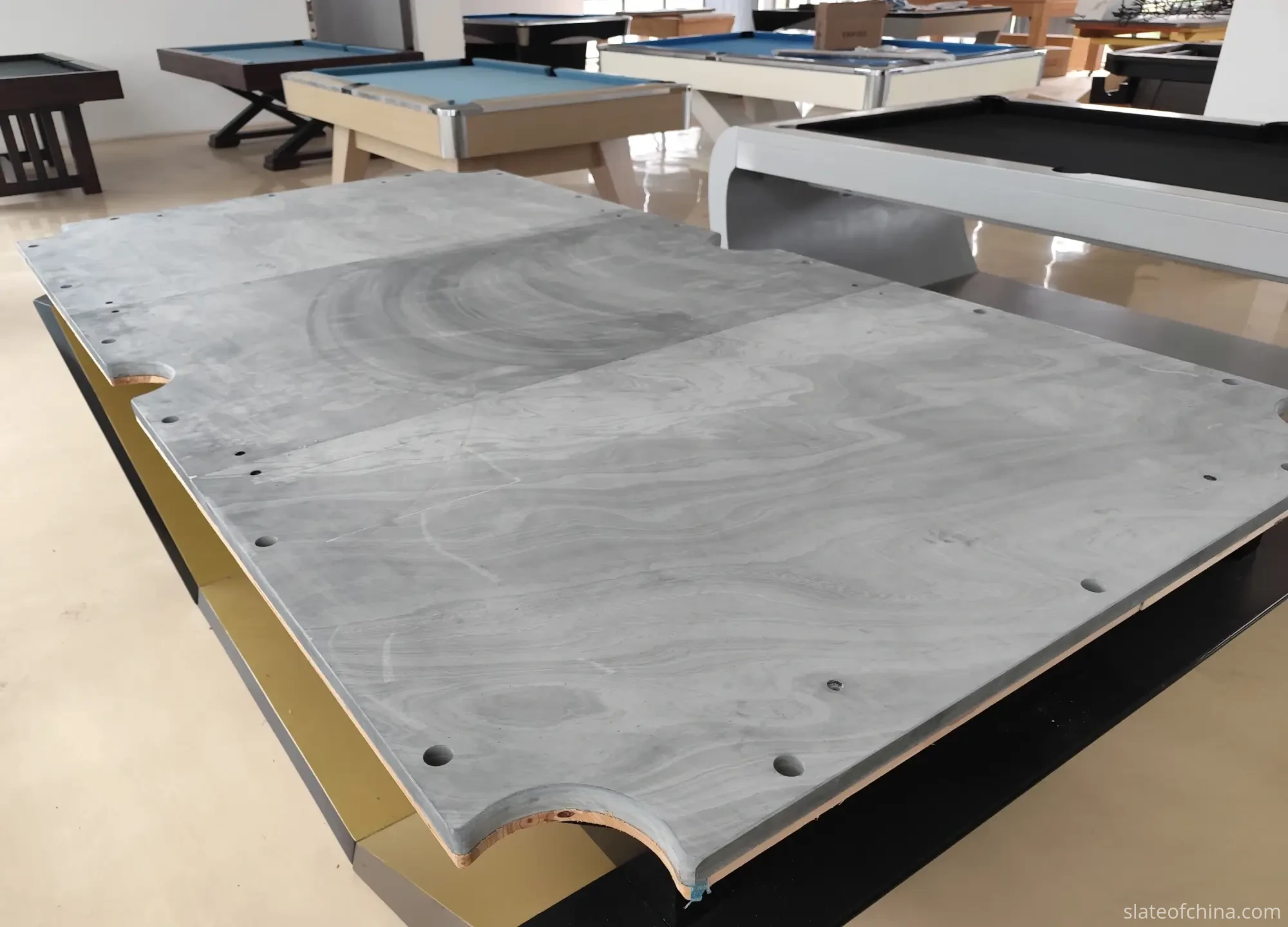
The U.S. OEM slate approval process, in eight steps:
- Drawing — The table manufacturer provides a CAD or PDF production drawing with all dimensions, hole coordinates, pocket geometry and tolerances.
- Review — The slate supplier checks whether every dimension and machining requirement is technically achievable.
- Confirmation — Both sides freeze the production drawing. No machining begins from an email description alone.
- Sample — For a new table model, a prototype set is produced and shipped for trial assembly.
- Trial assembly — The U.S. builder installs the sample into the actual cabinet and verifies rail fit, hole alignment and pocket position.
- Corrections — If adjustments are needed, the drawing is revised and reconfirmed.
- Final approval — The customer approves the final drawing and/or sample as the production reference.
- Production — Future orders are manufactured to the approved specification, with pre-shipment inspection before packing.
This is the real "approval" process — not a certificate, but a manufacturer-to-supplier engineering workflow that protects both sides.
What "Approved" Actually Means in the U.S. Market
Many first-time OEM buyers assume that importing slate into the United States requires some form of government certification. For OEM pool table production, it does not. When a U.S. table builder talks about "approved slate," they are almost always referring to their own internal approval — the process of confirming that a specific slate specification fits a specific table model and can be reproduced consistently.
This distinction matters because it changes what a supplier needs to deliver. The supplier is not trying to meet a published national standard. The supplier is trying to match a drawing — exactly — and then reproduce that same specification across every future production batch. The approval lives in the drawing, the sample, and the trial assembly, not in a certificate number.
For a deeper look at the material itself and why natural slate became the standard playing surface, see What Is Billiard Slate?. For identifying pool, snooker and carom slate at a glance, Types of Billiard Slate covers the differences.
American Pool Table Slate Sizes: The Numbers That Matter
The three most common American pool table categories are 7 ft, 8 ft and 9 ft. But these labels describe the table, not the slate — and the two are not the same dimension.
A useful starting reference, drawn from our current production records:
| Table Size | Typical Playing Area | Configuration | Common Thickness | Production Slate Outline* | Approx. Set Weight* |
|---|---|---|---|---|---|
| 7 ft | approx. 39 × 78 in | 3-piece | 19 mm | approx. 2169 × 1170 mm | 130–140 kg |
| 8 ft | approx. 44 × 88 in | 3-piece | 19 / 22 / 25 mm | approx. 2413 × 1295 mm | 160–210 kg, varies by thickness |
| 9 ft | approx. 50 × 100 in | 3-piece | 25 mm / 25.4 mm (1 in) | approx. 2718 × 1448 mm | 250–270 kg |
| 10 ft | per table design | 3-piece | 25 mm | per drawing | per drawing |
*Production references, not universal standards. Two table brands can build the same nominal "9 ft" table around different slate outlines. The approved drawing always takes priority.
The 9 ft, 25 mm, three-piece set is one of the most frequently requested configurations in our export pool-table business. At around 25 mm thickness, a 9 ft three-piece set typically falls in the roughly 250–270 kg range in our production references. The exact finished weight depends on slate density, outline dimensions, thickness and the material removed during pocket and hole machining. That total splits into three panels of roughly 80–90 kg each — the per-piece figure that determines whether two people can carry the panel onto a table frame.
The 8 ft table is the most variable: some cabinet designs stay at 19 mm to keep the table light for home floors, while others go to 22 mm or 25 mm for commercial durability. On a 10 ft table the outline depends heavily on the brand, so we treat 10 ft pool slate as a drawing-first product rather than a catalogue item.
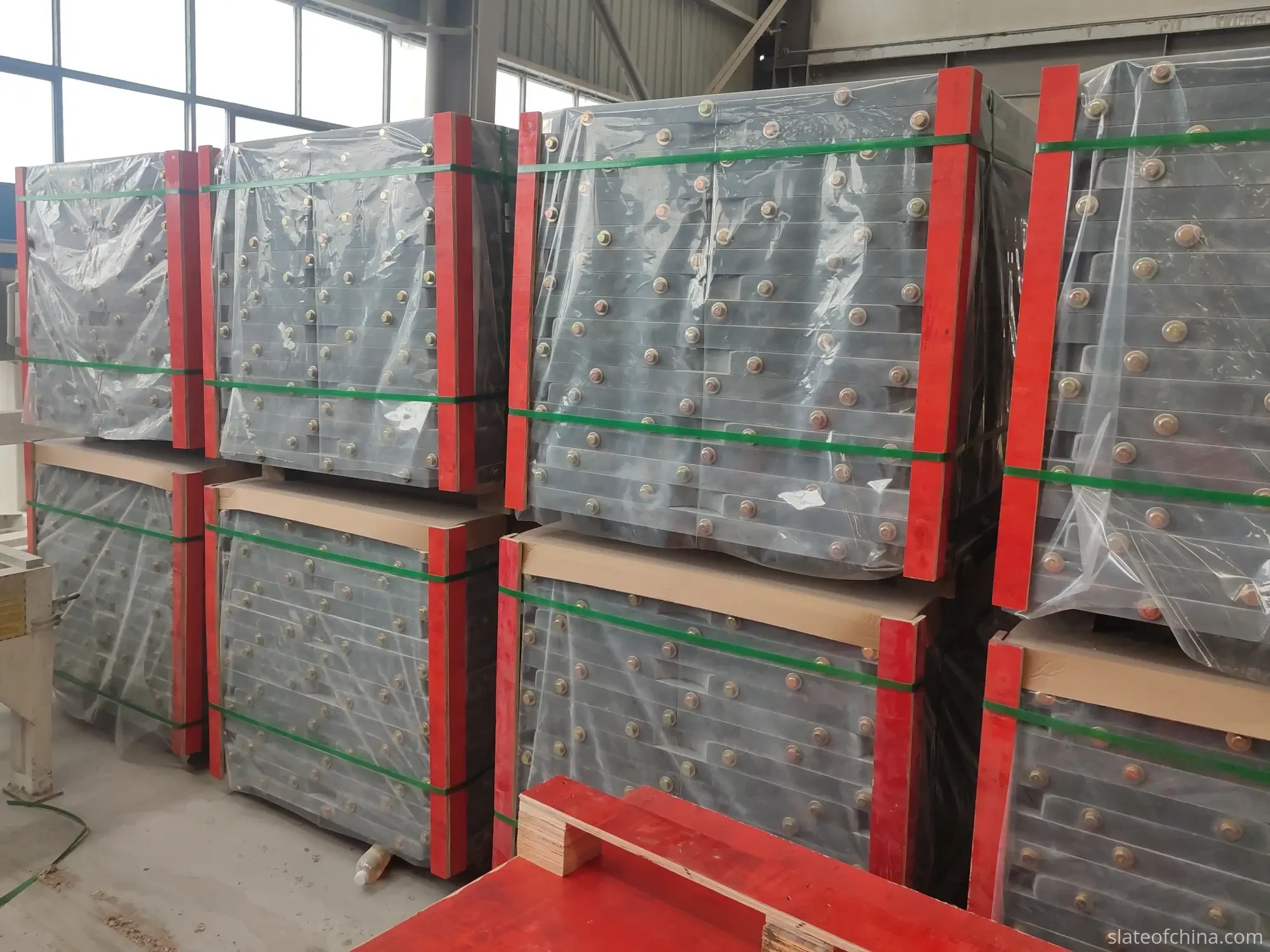
For the full specification table covering pool, snooker, carom, Chinese 8-ball and Russian pyramid slate in one reference, see Billiard Slate Technical Specifications. For ready-to-order pool slate products, see our pool table slate category.
American Pool vs English Pool: Different Slate for Different Tables
When a buyer says "pool table slate," they might mean an American pool table or an English pool table — and the two take completely different slate.
| American Pool | English Pool | |
|---|---|---|
| Common sizes | 7 ft, 8 ft, 9 ft, 10 ft | 6 ft, 7 ft |
| Playing area (9 ft ref.) | approx. 2540 × 1270 mm | Smaller — typically 6–7 ft tables |
| Common thickness | 19–25.4 mm | Often thinner, per table design |
| Piece configuration | Commonly 3-piece for 8–10 ft | Often 1-piece or 3-piece for smaller tables |
| Pocket style | Larger corner and side pockets | Smaller pockets, different geometry |
| Intended market | USA, North America | UK, Europe |
The key point: do not order "pool slate" without confirming whether the table is American or English design. The pocket geometry, rail system and mounting-hole layout are not interchangeable. A 7 ft English pool table and a 7 ft American pool table may share a nominal size label, but the slate drawings are different. For a broader comparison across pool, snooker and Chinese 8-ball, see Pool vs Snooker vs Chinese 8-Ball Slate.
1-Inch Pool Table Slate: 25.4 mm and Its Limits
If you search for American pool table slate 1 inch, you will find that 25.4 mm slate is strongly associated with premium U.S. pool tables. Some established table manufacturers specify 1-inch, three-piece slate on their higher-end models. The reason is straightforward: a thicker slate provides a more rigid playing bed when the table frame and support system are engineered for it.
But manufacturers should avoid a common mistake: thicker slate does not automatically mean better slate for every table.
A 19 mm slate designed for a properly engineered 7 ft or 8 ft cabinet is not an inferior product. It is a different specification. The correct thickness depends on the table size, cabinet construction, frame support spacing, rail system, intended application, transportation requirements and overall table weight. A well-designed 19 mm table plays true. A poorly designed 25 mm table does not.
This is particularly important for OEM buyers developing a new table model. Choosing 1-inch slate because "that is what the premium brands use" — without confirming that the cabinet, frame and support structure are designed for the extra weight — creates problems downstream, not upstream. The slate is one component in a system, and the system has to carry it.
Three-Piece Construction: Why American Builders Choose It
Three-piece slate is a common configuration for commercial and residential pool tables, particularly where the table design is intended for easier handling, installation and transport. Instead of shipping one extremely heavy slab, the playing bed is divided into three matched panels. The advantages are practical:
- Transportation — Three panels are substantially easier to ship, handle and move than one large slab. A 9 ft one-piece slate would weigh over 250 kg as a single object; the three-piece version splits that into manageable panels.
- Installation — Each panel can be positioned and leveled individually on the table frame, then joined at the seams.
- Manufacturing — Individual panels can be machined, inspected and identified before assembly. A defect in one panel is caught at the factory, not on the customer's floor.
- Packing and logistics — Three-piece sets pack more efficiently into export pallets and containers.
But three-piece construction introduces a requirement that one-piece does not: the three panels must work together as one continuous surface. That means the manufacturer needs to control panel dimensions, joint straightness, joint alignment, thickness consistency across all three panels, surface flatness, and the matching of hole and pocket positions from one panel to the next. A three-piece set is not three unrelated pieces — it is one assembly.
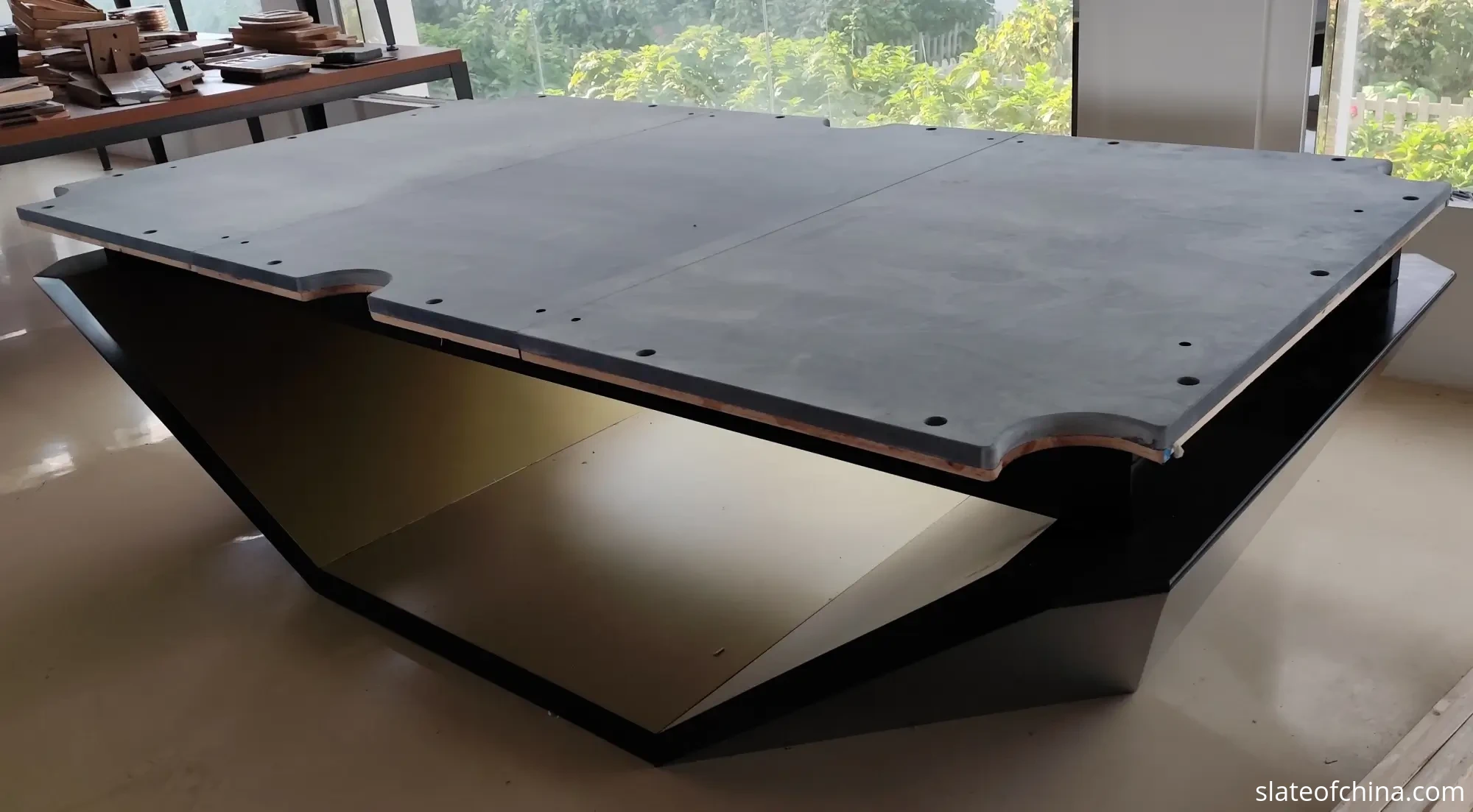
For a manufacturer's perspective on the yield, warehousing and assembly cost trade-offs between one-piece and three-piece configurations, see 1-Piece vs 3-Piece for Manufacturers.
Playing Surface vs. Slate Outline: Where Spec Errors Begin
This is the single most important concept for anyone sourcing American pool table slate from overseas — and the one most often misunderstood.
Suppose a U.S. manufacturer tells a supplier: "We need slate for a 9 ft pool table." That is not enough information to start production.
A 9 ft table commonly has a playing surface around 100 × 50 inches (2540 × 1270 mm). But the finished slate is larger because it extends under the cushions and includes the areas required for pockets, mounting and rail installation. A representative 9 ft production slate outline is around 2718 × 1448 mm — nearly 18 cm longer and 18 cm wider than the playing surface. The two numbers describe different things, and a purchase order that does not distinguish between them is an order that leaves the factory guessing.
A common ordering mistake looks like this:
| Buyer says | Factory still needs |
|---|---|
| "9 ft pool slate" | Exact finished slate dimensions (e.g. 2718 × 1448 mm) |
| "25 mm" | Thickness tolerance and measurement method |
| "3 pieces" | Individual panel dimensions and joint locations |
| "6 pockets" | Pocket opening, radius and center position |
| "American pool" | Mounting-hole coordinates and rail-bolt pattern |
| "20 sets" | Destination port, packing spec and inspection requirements |
A nominal table size is not a manufacturing drawing.
Three dimensions that buyers should never confuse:
Nominal table size — 7 ft / 8 ft / 9 ft
Playing area — the ball-playing surface (cushion nose-to-nose)
Finished slate outline — the actual stone dimensions, which are larger than the playing area
Never manufacture from the nominal table size alone.
This simple distinction prevents the most expensive production mistake in OEM slate sourcing: ordering a slate that matches the playing area but is too small for the cabinet.
Pocket Cutouts and Hole Layouts: The Details That Determine Fit
A slate set can have the correct overall length and width and still fail to install. The reason is almost always in the details: the pocket cutouts and the hole pattern do not match the rail system.
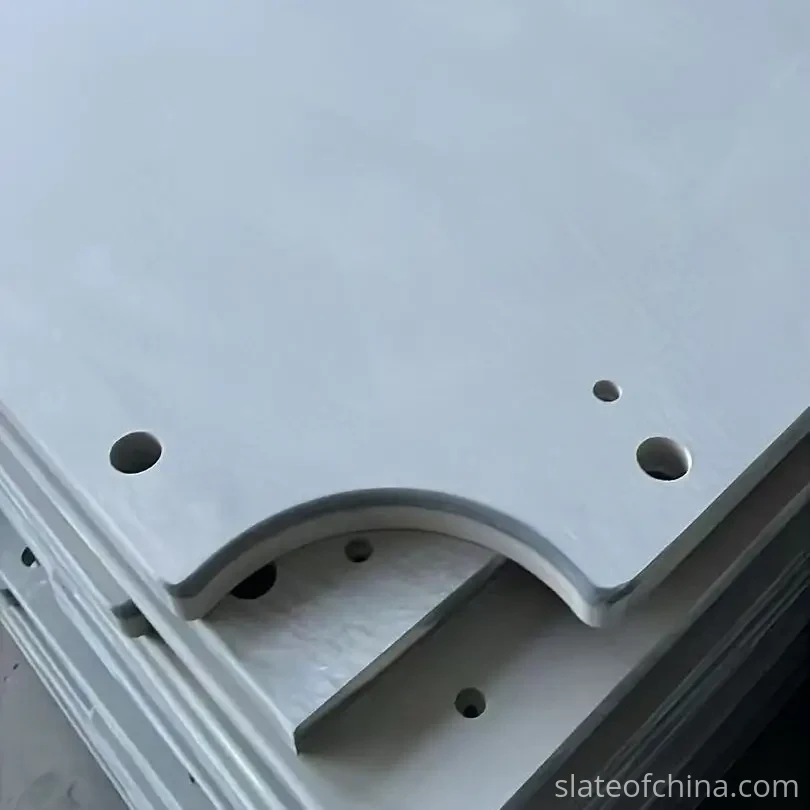
Pocket machining is one area where generic dimensions cause the most problems. The slate may need to accommodate corner pockets, side pockets, pocket openings of specific widths, pocket radii, and cushion nose geometry. Two tables can have the same nominal playing surface but use completely different pocket construction. The exact pocket shape should always be taken from the customer's drawing or verified sample.
Hole layout is equally critical. Pool table slate may require holes for rail bolts, frame mounting, slate screws, pocket components and other table-specific hardware. For every critical hole, the manufacturer should ideally specify the hole diameter, center position, depth, whether it is a through-hole or blind hole, countersink requirements, and the distance from the slate edge.
For CNC production, coordinates are much safer than verbal descriptions. Instead of saying "drill six holes near the rail," a production drawing should identify the exact center coordinates. This is why we recommend that U.S. table manufacturers send a CAD drawing, PDF engineering drawing or original slate sample whenever possible.
| Drawing Item | What to Specify |
|---|---|
| Hole diameter | mm |
| Hole center | X / Y coordinates from datum |
| Hole depth | mm (or through-hole) |
| Hole type | Through / blind |
| Countersink | Diameter + depth |
| Datum | Reference edge / centerline |
| Edge distance | Minimum distance from slate edge |
| Pocket cut | Opening dimensions + profile + center position |
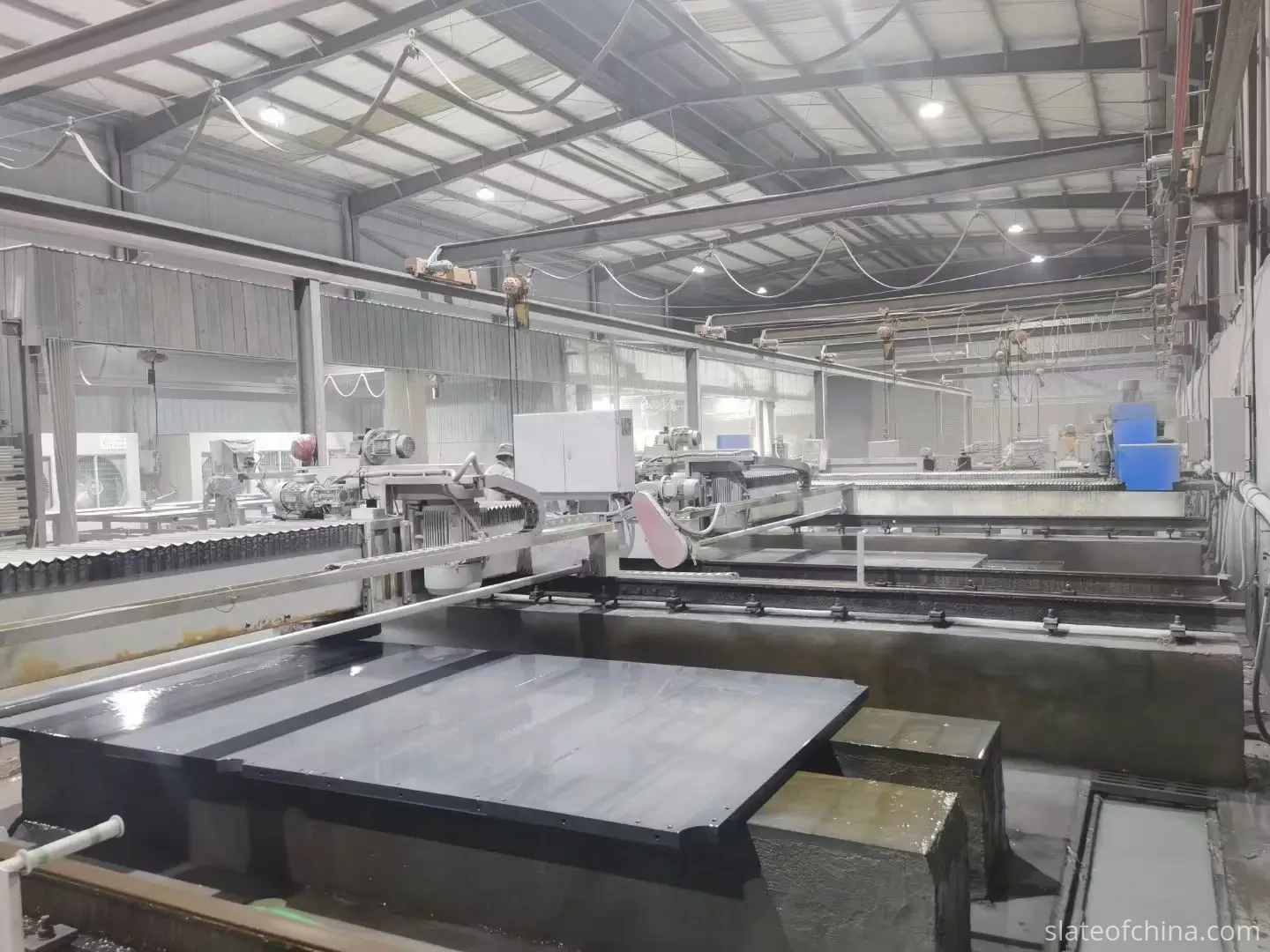
Our three-piece pool slate production can be customized according to customer drawings, including pocket cutouts, rail bolt holes, mounting holes, dimensions and edge processing. For more on custom machining capabilities, see Custom Billiard Slate Manufacturing and OEM Billiard Slate for Table Manufacturers.
What a U.S. Pool Table Slate Drawing Should Contain
A good production drawing answers nearly every question the factory would otherwise have to guess. At minimum, include:
| Category | Details to specify |
|---|---|
| Overall dimensions | Total length, total width, individual panel dimensions |
| Thickness | Finished thickness, permitted tolerance |
| Playing area | Length, width, reference centerline |
| Pocket geometry | Pocket center, opening, radius, cutout profile |
| Hole pattern | Hole coordinates, diameter, depth, countersink specs |
| Joint design | Joint location, joint edge geometry, panel orientation |
| Edge details | Edge treatment, chamfers, cutouts, special machining |
| Reference marks | Front, back, left, right, center, panel numbers |
The reference marks become especially important when a three-piece slate set is packed, shipped and assembled at another factory. If the panels are not clearly numbered and oriented, the installer is working blind.
For a full specification reference covering all table types, see Billiard Slate Technical Specifications. For guidance on evaluating whether a supplier can actually produce to your drawing, How to Choose a Billiard Slate Manufacturer walks through a ten-question verification process.
The OEM Approval Process: From Drawing to Production
This is where the concept of "approval" becomes concrete. A typical OEM workflow for American pool table slate looks like this:
Step 1 — The manufacturer provides requirements. The table manufacturer sends the table model, slate dimensions, thickness, hole pattern, pocket design, and a drawing or sample. The more complete this package is, the fewer clarification rounds follow.
Step 2 — The supplier reviews the drawing. The slate manufacturer checks whether every dimension and machining requirement is technically achievable. Not every drawing is producible as-is — sometimes a pocket radius is too tight for the available tooling, or a hole position sits too close to the edge. These issues are better caught at review than at machining.
Step 3 — Drawing confirmation. Both sides confirm the final production drawing. The supplier should not begin CNC machining based on an ambiguous email description such as "9 ft American pool table slate, 1 inch." That sentence is a category, not a specification.
Step 4 — Sample production. For a new table model, the manufacturer may order a sample set or prototype slate. This is the first time the specification meets the material.
Step 5 — Trial assembly. The U.S. table builder installs the slate into the actual cabinet. This is one of the most valuable stages in the entire process. The manufacturer can verify rail installation, hole alignment, pocket alignment, panel fit, joint position, slate support, cushion relationship and overall assembly — all before a single production set is cut.
Step 6 — Corrections. If adjustments are needed, the drawing is revised and reconfirmed. This is normal. A sample that reveals a 2 mm hole offset saves a container of slate that would have had the same offset.
Step 7 — Final approval. The customer approves the final drawing and/or sample. From this point forward, the specification is frozen: Approved Slate Drawing — Revision A.
Step 8 — Mass production. Future orders are produced according to the approved specification. Pre-shipment inspection checks dimensions, thickness, flatness, holes, machining and panel matching before packing.
This workflow is much safer than trying to establish every dimension from the nominal table size. It also makes repeat orders straightforward — the supplier references the approved drawing, not a new round of emails.
One concept keeps the process disciplined over time: drawing revision control. If the customer changes a dimension after approval — a hole position shifted, a pocket radius adjusted — the drawing is reissued as Approved Slate Drawing — Rev. B, and Rev. A is archived. A repeat order should not be produced from an outdated revision. This is the same version-control discipline that an engineering team applies to any production component.
The objective of approval is not just to make one successful set. It is to make the next 100 sets the same way.
Pre-Shipment Inspection: Who Checks What
Inspection has two layers. The supplier checks the slate before it leaves the factory; the buyer checks the slate when it goes into the cabinet. Both are necessary — factory QC does not replace customer trial assembly.
Supplier pre-shipment inspection:
- Thickness — Multiple points per panel, not one location
- Overall dimensions — Each panel against the approved drawing
- Hole positions — Diameter, depth, countersink against drawing coordinates
- Pocket geometry — Position, dimensions, shape, symmetry
- Flatness — Playing surface, agreed method and tolerance
- Edge condition — Joint edges straight, clean; no chips or cracks
- Panel matching — Left / center / right panels match; numbers and orientation marks clear
- Packing condition — Panel separation, edge protection, stretch film integrity
Buyer trial assembly (at the customer's factory):
- Cabinet fit — Does the slate sit properly on the frame?
- Rail alignment — Do the rails install without forcing?
- Mounting-hole alignment — Do the bolt holes line up?
- Cushion relationship — Is the cushion nose position correct relative to the slate edge?
- Pocket alignment — Do the pocket cutouts match the pocket hardware?
- Joint fit — Do the three panels meet flush at the seams?
Factory inspection confirms that the slate matches the approved drawing. Trial assembly confirms that the approved drawing matches the table. Both are required — one does not substitute for the other. For the measured side of these checks — flatness, thickness and machining accuracy records — see Billiard Slate Quality & Test Data.
How to Request a Quote That Gets an Accurate Answer
A good RFQ makes the quotation process faster and more accurate. Instead of "Please quote 9 ft American pool table slate," send something like this:
Example RFQ:
Product: 9 ft American pool table slate
Table brand / model: [Your model name or "new OEM model"]
Material: Natural billiard slate
Configuration: 3-piece
Thickness: 25.4 mm / 1 inch
Quantity: 100 sets
Slate drawing: Attached (CAD / PDF)
Pocket machining: According to drawing
Rail holes: According to drawing
Surface: Precision ground
Inspection: Dimensional + thickness + flatness
Packing: Export seaworthy
Destination: USA
What to send depends on where you are in the process:
- New OEM model? — Send the drawing.
- Existing model? — Send the model number plus a sample or photos.
- Replacement? — Send the original slate or detailed measurements (see below).
Before requesting a quotation, prepare these ten items:
- Table size — 7 ft / 8 ft / 9 ft / 10 ft
- Playing area — e.g. 2540 × 1270 mm
- Slate outside dimensions — e.g. 2718 × 1448 mm
- Thickness — 19 / 22 / 25 / 25.4 mm
- Piece configuration — 1-piece or 3-piece
- Pocket openings — Corner and side pocket dimensions
- Mounting holes — Diameter and coordinates
- Rail interface — Rail-bolt pattern and edge profile
- Quantity — Sets per order or per month
- Destination — Port and country
If you have a CAD drawing, send it with your inquiry — it covers items 1 through 8 in one file.
For a new table model, also provide the CAD drawing, PDF drawing, original slate sample if available, photos of the cabinet, rail system information and pocket hardware information. The more accurately the buyer defines the specification, the less room there is for production errors.
For a structured approach to requesting and comparing quotations, see How to Request a Billiard Slate Quotation.
Replacement Slate Without a Drawing
This is common with replacement projects. If you are replacing an existing slate set and do not have the original engineering drawing, provide as much information as possible:
Option 1 — Send the original slate. This is usually the safest option. The manufacturer can inspect the original piece and reproduce the required dimensions and machining. Even a broken panel is useful — the intact edges and hole positions are enough to reverse-engineer the specification.
Option 2 — Send detailed measurements. Provide overall dimensions, thickness, pocket positions, hole positions, hole diameters, joint positions and edge details. A caliper, tape measure and a simple dimensioned sketch are usually enough to begin the evaluation.
Option 3 — Send photographs with measurements. Photos alone are not sufficient for precision production, but photographs combined with accurate measurements can help establish the geometry. Place a ruler or reference object in each photo for scale — but do not rely on the photo alone.
Option 4 — Create a replacement drawing. For repeated replacement orders, it is worth creating a proper engineering drawing after the first successful sample. This converts a one-time replacement into a repeatable product — and makes the next order faster, cheaper and more consistent.
For more on matching and ordering replacement slate, see Replacement Slate for Existing Billiard Tables.
Export Packing
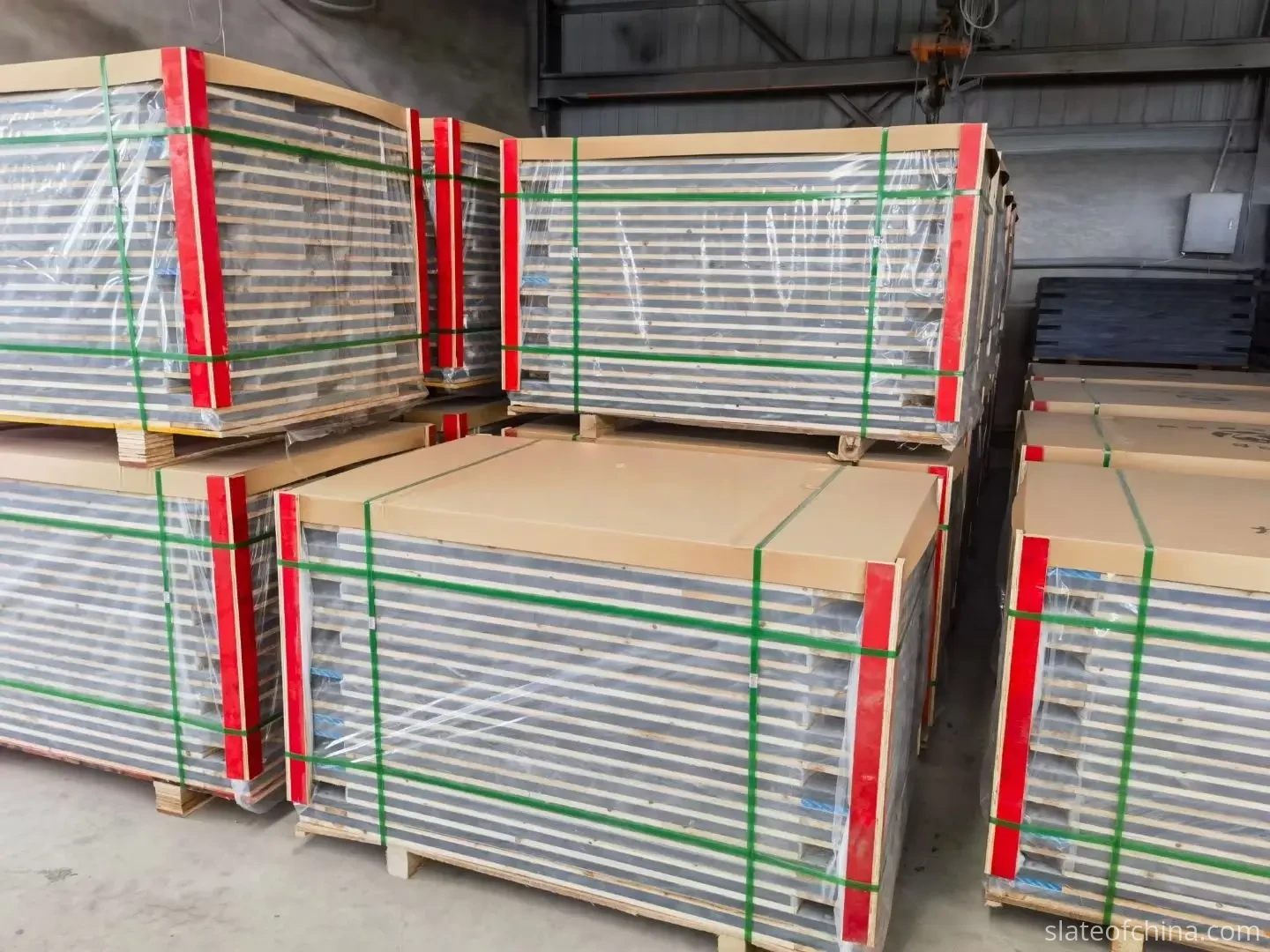
Natural slate is strong under compression but vulnerable to edge and corner impact. For U.S. shipments we use wood-framed pallet packing: a timber base pallet, vertical corner bracing, stretch film to prevent movement, and panel separation between layers. Panel numbering and orientation marks on each piece reduce installation mistakes at the destination.
For the full packing specification, container loading plans and import documentation, see Billiard Slate Packing & Shipping Guide and How to Import Billiard Slate from China.
Pre-Order Checklist
Before placing an order for American pool table slate, confirm these items:
| Category | Confirm |
|---|---|
| Table specification | 7 ft / 8 ft / 9 ft / other; playing surface dimensions; table model |
| Slate specification | Natural slate; number of pieces; finished thickness; overall dimensions; individual panel dimensions |
| Machining | Pocket cutouts; rail bolt holes; mounting holes; countersinks; edge machining; joint machining |
| Quality | Thickness tolerance; flatness requirement; dimensional tolerance; surface inspection; panel matching |
| Approval | Production drawing approved; sample produced; trial assembly completed; corrections done; final specification approved |
| Export | Panel numbering; packing specification; shipping weight; container loading plan; destination port |
For OEM buyers who want to evaluate a supplier before reaching this stage, How to Choose a Billiard Slate Manufacturer provides a ten-question verification process. For custom and OEM production capabilities, see OEM Billiard Slate for Table Manufacturers and Custom Billiard Slate Manufacturing.
FAQ: American Pool Table Slate for Manufacturers
What size slate do I need for a 9 ft American pool table?
A commonly produced 9 ft American pool table slate is a three-piece set with an overall outline of approximately 2718 × 1448 mm at 25 mm or 25.4 mm (1 inch) thickness, weighing roughly 250–270 kg total. The playing surface is smaller — around 2540 × 1270 mm — because the slate extends under the cushions. Different table brands use slightly different outlines, so the approved drawing takes priority over any reference figure.
Is 1-inch slate required for all American pool tables?
No. 1-inch (25.4 mm) slate is common on premium American pool tables, but not universal. Many 7 ft and 8 ft tables use 19 mm or 22 mm, and some 9 ft tables use 25 mm. The correct thickness depends on the cabinet construction, frame support and rail system — not a market-wide rule.
How does a U.S. pool table manufacturer get slate approved?
There is no general government certification for billiard slate imported into the United States. Approval in this context means a manufacturer-to-supplier engineering process: the table builder provides a drawing, the supplier produces a sample, the builder trial-assembles the sample in the actual cabinet, and any corrections are made before mass production begins. The approval lives in the drawing and the trial assembly — not in a certificate.
Can I order replacement pool table slate without the original drawing?
Yes. The safest approach is to send the original slate panel to the manufacturer, who can inspect it and reproduce the dimensions and machining. If sending the original is not possible, provide detailed measurements (overall dimensions, thickness, pocket positions, hole positions and diameters, joint positions, edge details) or photographs combined with accurate measurements. After the first successful replacement, it is worth creating a proper engineering drawing for future orders.
What should I include in an RFQ for American pool table slate?
At minimum: table type, configuration (3-piece), thickness, quantity, and the production drawing. Adding your tolerance requirements, inspection plan, packing specification and destination port makes the quotation faster and more accurate. For a new table model, also provide photos of the cabinet, rail system information and pocket hardware. The more complete the RFQ, the fewer clarification rounds are needed before production.
How are three-piece slate sets kept consistent across repeat orders?
Once a sample is approved and the drawing is frozen as Approved Slate Drawing Revision A, future orders reference that same specification. The supplier produces to the approved drawing, not to a new round of emails. Pre-shipment inspection checks each set against the approved dimensions before packing. This is why the sample approval stage is more important than any catalogue specification — it converts a one-time order into a repeatable product.
How is billiard slate packed for export to the United States?
For billiard slate, we use wood-framed pallet packing: a timber base pallet, vertical wood bracing at the corners to protect the edges, and stretch film wrapping to secure the panels against movement. This is not a sealed wooden crate — it is an open-frame structure that protects edges and corners while keeping the pack visible for inspection. Panel numbering and orientation marks on each piece reduce installation mistakes at the destination.
Related Reading
American Pool Table Slate for OEM Production
We manufacture 7 ft, 8 ft, 9 ft and 10 ft American pool table slate to customer drawings:
- 1-piece and 3-piece configurations
- 19–25.4 mm common thickness range
- CNC pocket machining to drawing
- Mounting holes to coordinates
- Custom dimensions and edge processing
- Wood-framed export packing
Where are you in the process?
Have a CAD drawing? Send it for specification review and quotation.
Have an existing table? Send dimensions, photos or an original slate sample for reproduction.
Developing a new OEM model? Send the preliminary design and required table size — we confirm production feasibility before you commit.
Request a Slate Specification Review
Prefer email? Send your drawing — we confirm specifications within one working day.