
Chinese 8-Ball Table Slate: Sizes, Thickness & Pocket Specs
A practical specification guide for table builders, OEM manufacturers and importers.
Stand at the corner of a Chinese 8-ball table before the cloth goes on, and the first thing you notice is not the size of the bed. It is the curve. Where a conventional American pool pocket runs straight into the opening, the jaws here sweep in a smooth arc — snooker-style, cut into the stone itself. That curve is the whole format in one detail: an eight-ball game on a table that took its pocket geometry from snooker and its pace from pool. For anyone who has to source the bed underneath, it is also the first warning that Chinese 8-ball table slate is not a standard order.
I have quoted this format for years, and the file it creates looks like no other on my desk. Chinese 8-ball slate was once almost entirely a domestic sale to Chinese table factories; today the enquiries arrive from overseas table builders, distributors and OEM customers — often in English now, and always asking for the same things: the sizes, the thickness, the pocket machining, and a price that means something.
What follows is that specification in working order — from the first email to the loaded container.
Short answer: a Chinese 8-ball table is a 9-foot class table, but its slate is ordered to the builder's drawing, never to the table name. The reference playing area is 2,540 × 1,260 mm, with a permitted tolerance of ±9 mm under current WPA Heyball rules — and that is the field the balls live on, not the size of the stone, which runs larger again for cushion beds and pocket jaws. Three-piece construction is the norm at this size. 45 mm is the thickness we manufacture most often — 38, 40, 42 and 50 mm are all made for different table designs — and the rounded snooker-style pocket contours are CNC-machined to the drawing, the pieces ground and inspected as one matched set. Send the drawing; every other number follows from it.
Chinese 8-Ball Table Slate Specifications
The Chinese 8-ball table dimensions a slate order actually runs on, collected in one place:
| Specification | Typical / reference requirement |
|---|---|
| Table type | 9 ft class Heyball / Chinese 8-ball |
| Internal playing area | 2,540 × 1,260 mm, tolerance ±9 mm under current WPA Heyball rules |
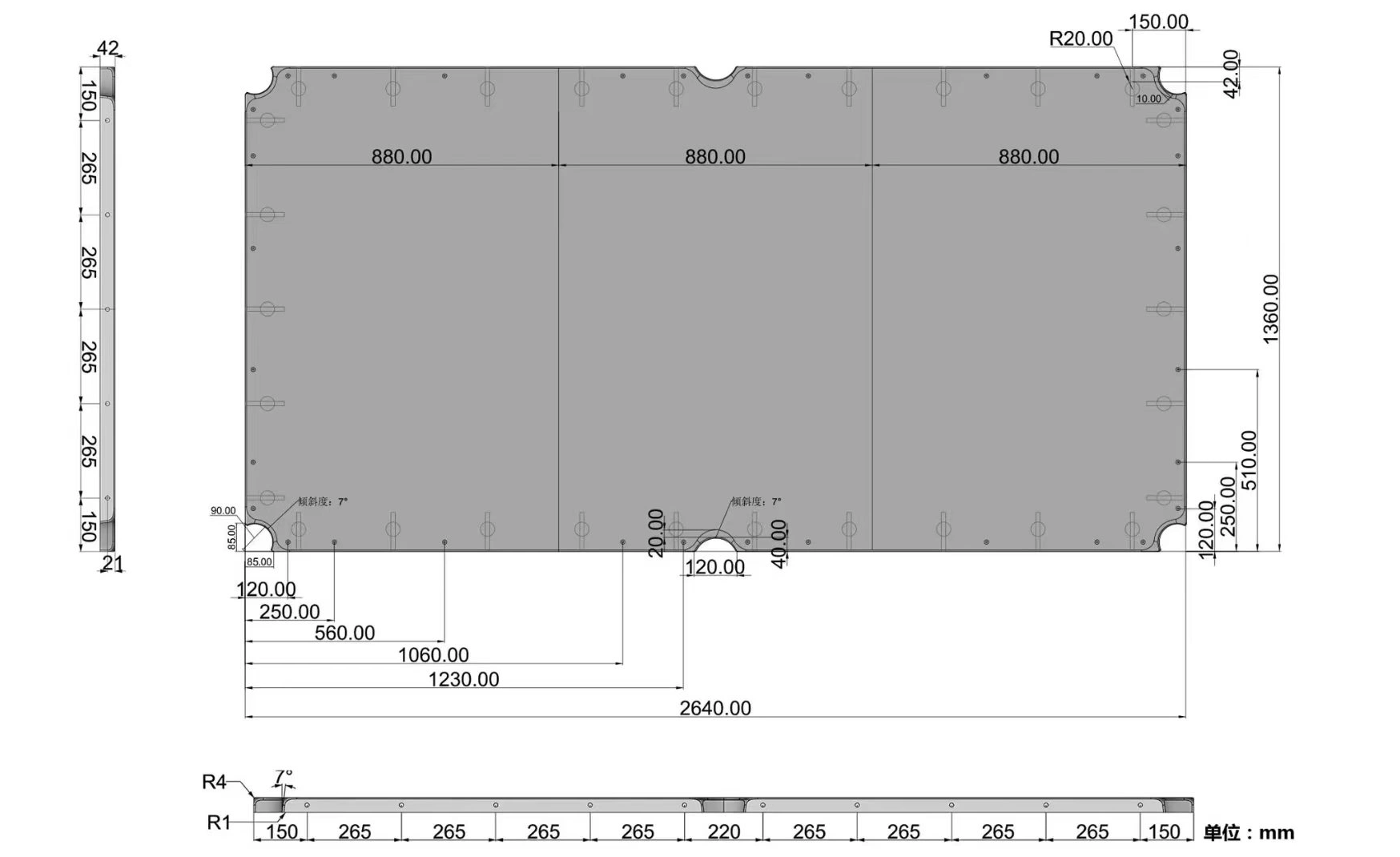
| Overall slate size | 2,640 × 1,360 mm on the production drawing shown |
| Slate configuration | 3 pieces × 880 mm on the production drawing shown |
| Finished slate thickness | 42 mm on the drawing shown; 45 mm is the option we manufacture most often |
| Other thicknesses | 38, 40, 42 and 50 mm, according to table design |
| Playing surface | Precision ground |
| Pocket profile | Rounded, drawing-controlled |
| Pocket machining | CNC according to approved drawing |
| Mounting holes | CNC according to approved drawing |
| Section joints | Matched and ground |
| Flatness | Agreed tolerance and inspection method |
| Customization | Size, thickness, pockets, holes and edge machining |
Important: the 2,540 × 1,260 mm dimension is the internal playing area specified in current WPA Heyball rules — not the size of the stone. The 2,640 × 1,360 mm outline and the other production-drawing figures on this page are an example from one of our three-piece drawings, not a universal Chinese 8-ball slate standard. Two builders can run different outlines and thicknesses off the same playing area; the approved table construction drawing always decides.
Why Chinese 8-Ball Became an Export Order
Chinese 8-ball — Heyball, in most of the English-speaking world — grew up in Chinese pool halls around equipment of its own: a 9-foot class bed, American-sized 57 mm balls, and pockets cut with the rounded, tight-entry jaws more often associated with snooker. Tight openings on a fast table made a game that punishes sloppiness, and a substantial playing and table-manufacturing market grew around it at home — one that now turns up regularly in international sourcing inquiries.
For a slate factory, the interesting part is what happened next. Beds that once moved inland between Chinese companies now ship to table manufacturers building Chinese 8-ball models of their own, to importers equipping clubs, and to OEM programmes that need the bed as a component. Where this format sits among the four billiard slate families is mapped on Types of Billiard Slate; this page continues where that overview stops — at the specification the order runs on.
And that specification has a gatekeeper: the drawing. Everything below — size, thickness, piece count, pockets, inspection, packing — is either written on that drawing or follows from it. The rest of this page takes those one at a time, in roughly the order they turn up in a real order.
Chinese 8-Ball Slate Size: The Playing Area Is Only the First Number
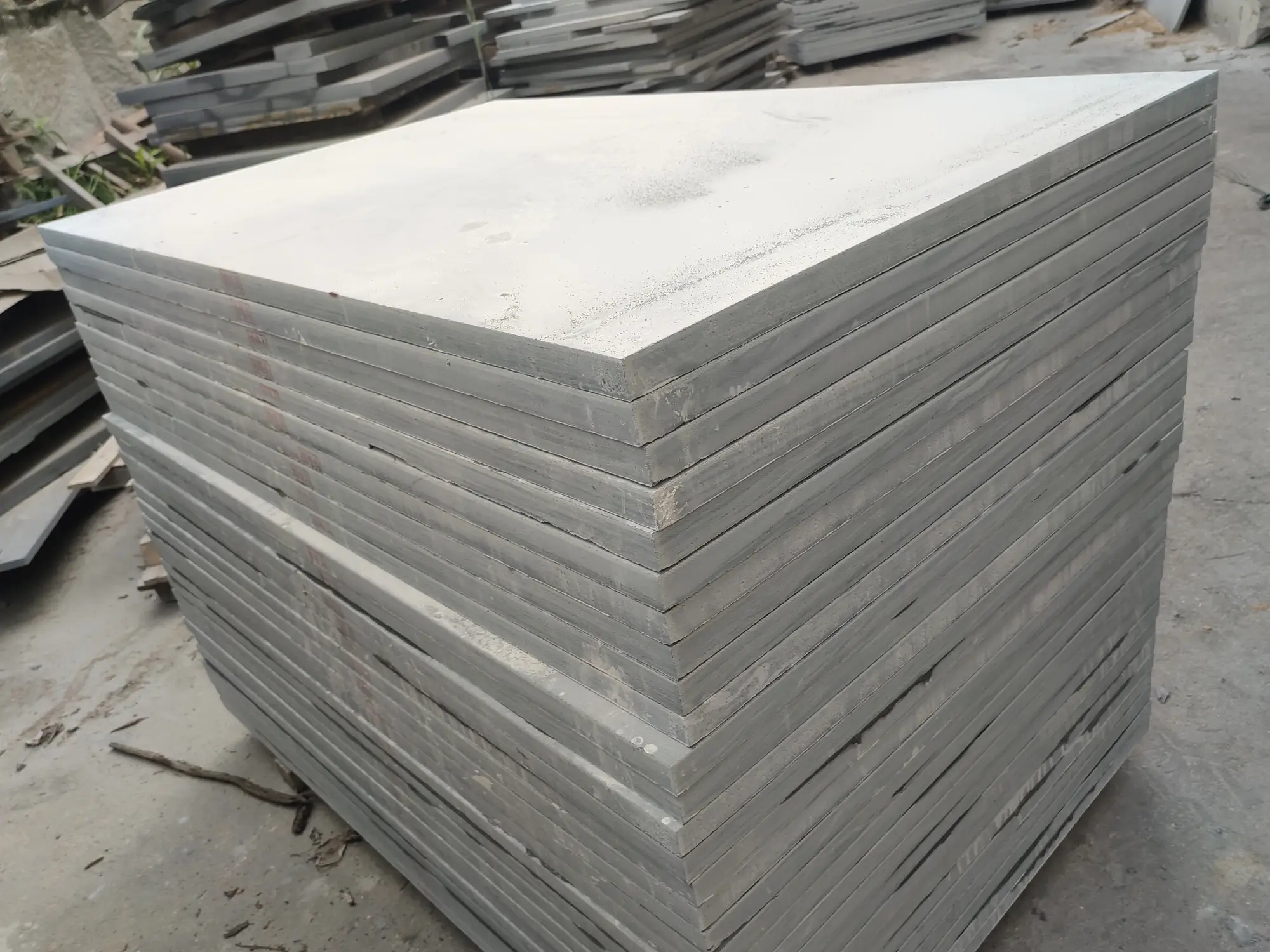
Telling a slate factory you need "9-foot Chinese 8-ball slate" tells it which family the order belongs to. It does not tell it what to cut. The number that starts the specification is the playing area — commonly quoted near 2,540 × 1,260 mm on competition examples of this format, though builders differ and the drawing overrules everything. The finished slate is larger again: the outline has to carry the cushion beds, the pocket zones at all six openings, and the ledge the cabinet sits on. How much larger is not a guess a buyer should make. It is set by the table's engineering, and it changes from one builder's cabinet to the next — two models can share an identical 2,540 × 1,260 mm playing area and still take different finished outlines.
In practice the order needs three size numbers, all from the drawing: the playing area, the overall outline, and the finished length × width of each piece once the bed is divided. On the production drawing shown above, the outline works out at 2,640 × 1,360 mm in three 880 mm pieces — a bed that frames a 2,540 × 1,260 mm playing field once the cushions go on. The full mapping from table classes to finished slate dimensions — worked examples and all — is on the Pool Table Slate Size Guide; the method there applies to this format unchanged.
Chinese 8-Ball Slate Thickness: The Number That Separates the Formats
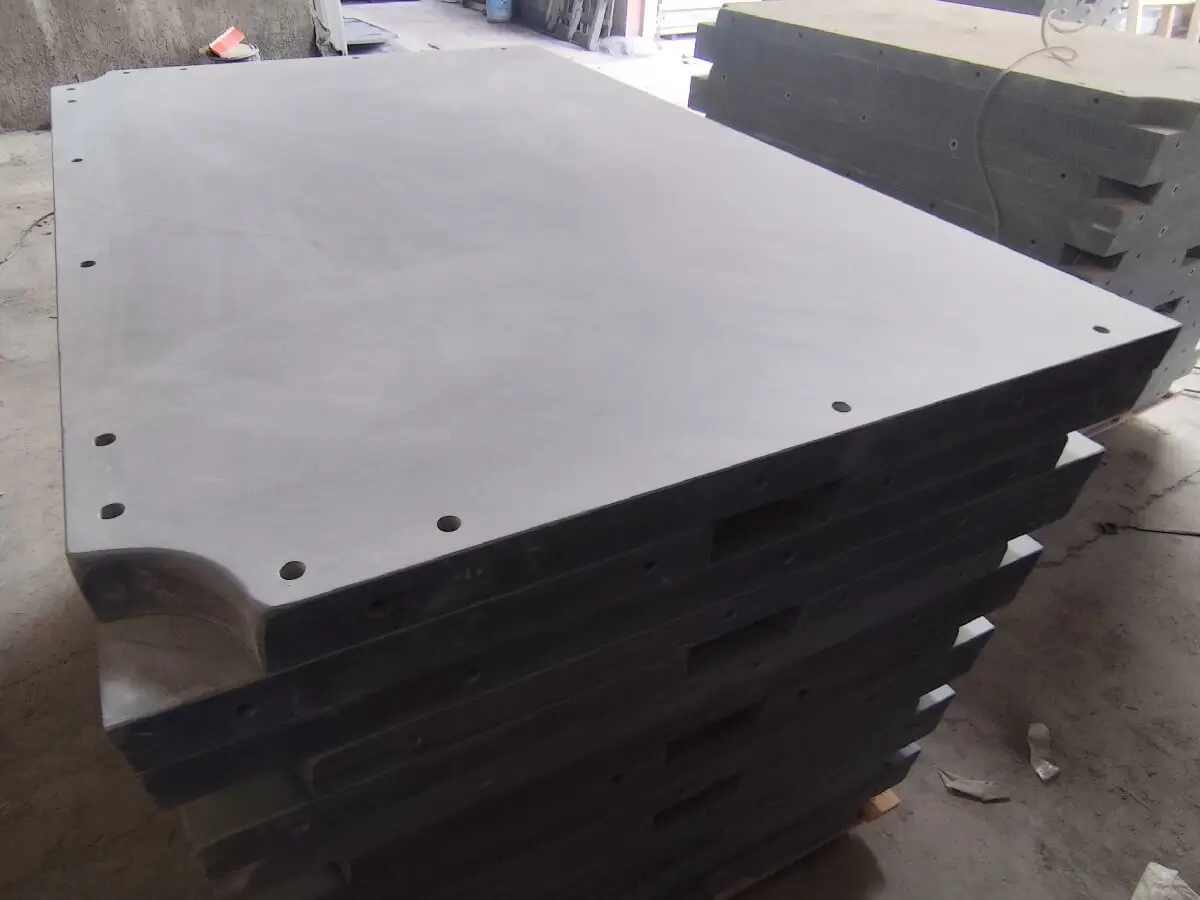
If size puts a slate set in a family, thickness gives away the format. American-style pool beds commonly run 19–25 mm; Chinese 8-ball beds sit far above that band. 45 mm is the most commonly requested thickness in our Chinese 8-ball production — but no single figure applies to every table: we also manufacture 38, 40, 42 and 50 mm according to the customer's table design, and the production drawing shown on this page is a 42 mm example. Competition tables in this format are heavy, deliberately over-built pieces of furniture, and the bed is where much of that weight lives.
Why so much thicker than a pool bed of the same footprint? Structure, not prestige — and not an isolated number either. Thickness rides with the frame, the support spacing and the rail system: a 50 mm bed on a frame engineered for 45 mm adds weight and bolt depth the cabinet never asked for, while a thinner bed on a heavy commercial table saves stone and gives back flex. A thicker bed is not automatically a better bed, and thickness alone never turns a pool slate into a Heyball slate — final thickness should follow the approved table drawing.
The other half of the thickness question is consistency. The nominal figure matters less than the agreement between the pieces of one set: matched closely, the joints close invisibly; let one piece run out relative to the others and the table carries a ridge at the seam for the rest of its life, however carefully it is levelled. Thickness is checked at reference points across each section and recorded to the agreed inspection plan; the three-format comparison — pool, snooker and Chinese 8-ball side by side — is on Pool vs Snooker vs Chinese 8-Ball Slate Thickness.
One Piece or Three? On This Format, Three Wins Nearly Always
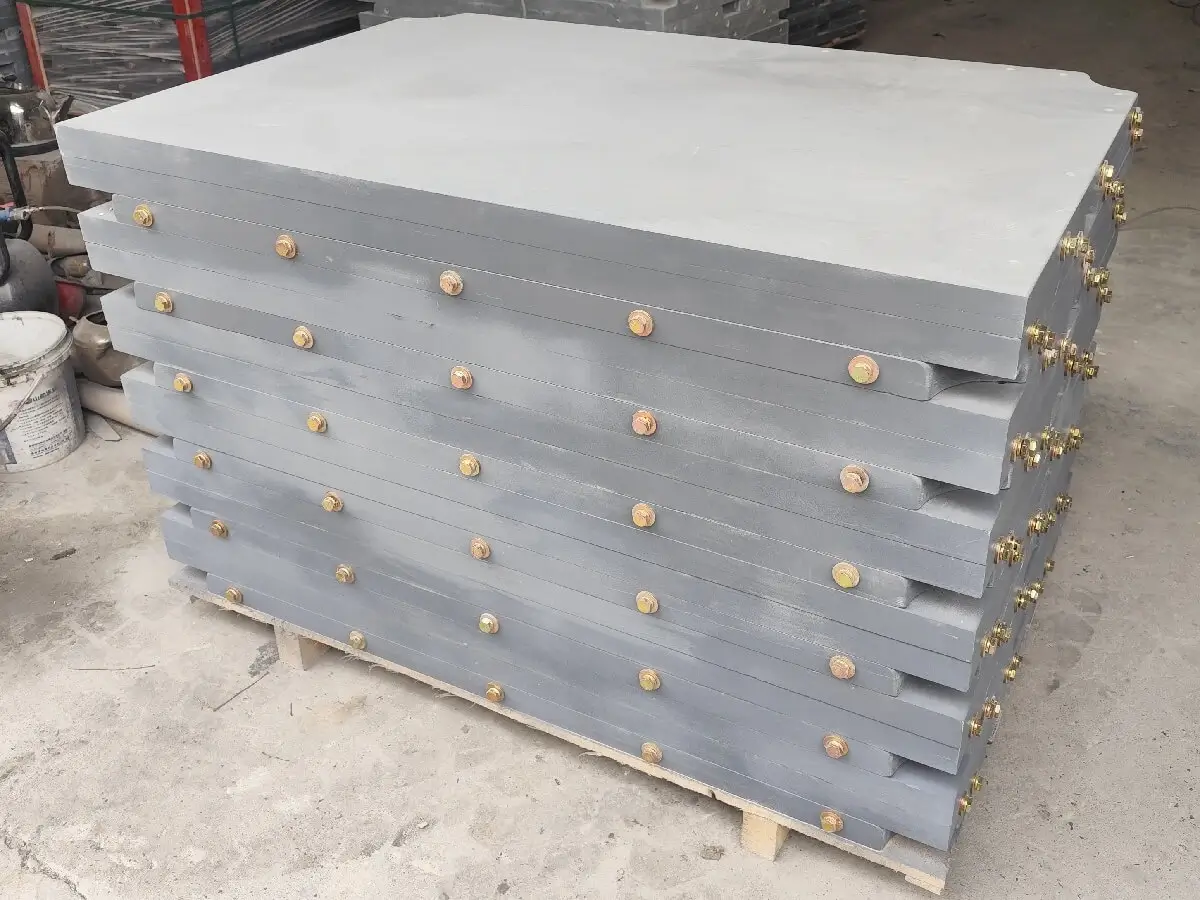
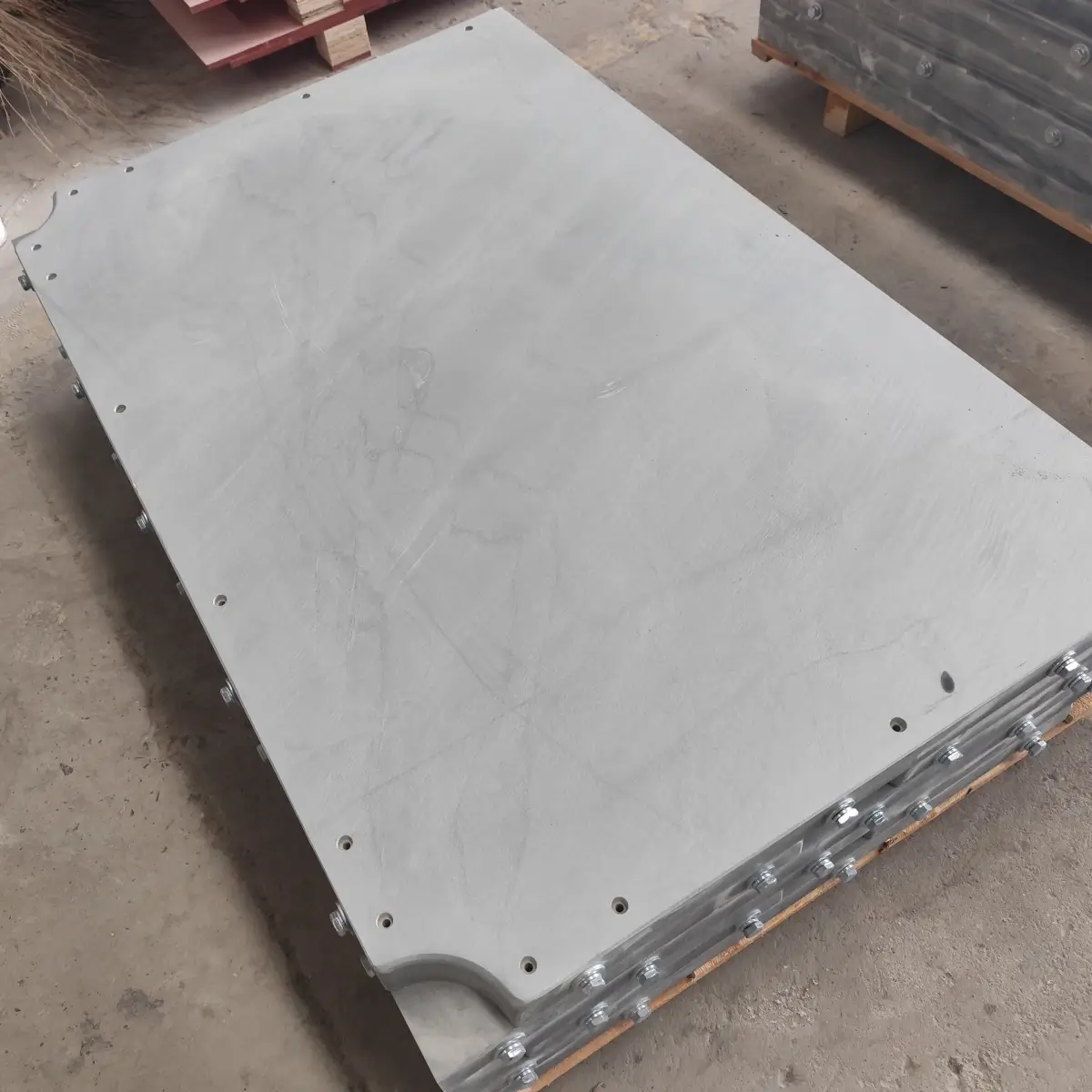
At this size class the bed goes out in three pieces almost every time, and the reason is weight arithmetic rather than workshop preference. On the 42 mm production drawing shown above, one piece of the three-piece bed runs to roughly 135 kg — the worked example below shows where the figure comes from. Three pieces of that size can be crated, trucked and manoeuvred into a club building with appropriate handling equipment. A single slab of the same bed, on most installation routes, cannot.
The piece count is a transport decision, never a quality grade — but it creates the one quality demand unique to multi-piece beds: the set must behave as a single plane after joining. That is a manufacturing discipline, not a lucky outcome. The pieces of a set are machined together, their joint faces ground as a pair, and the finished set assembled and checked flat before packing — to the tolerance agreed in the inspection plan, not to an adjective — and each piece carries its set number so a matched set never gets mixed at dispatch. The wider trade-offs are argued out on One-Piece vs Three-Piece Pool Table Slate.
Chinese 8-Ball Pocket Geometry: The Cut-Out Is Not the Finished Pocket
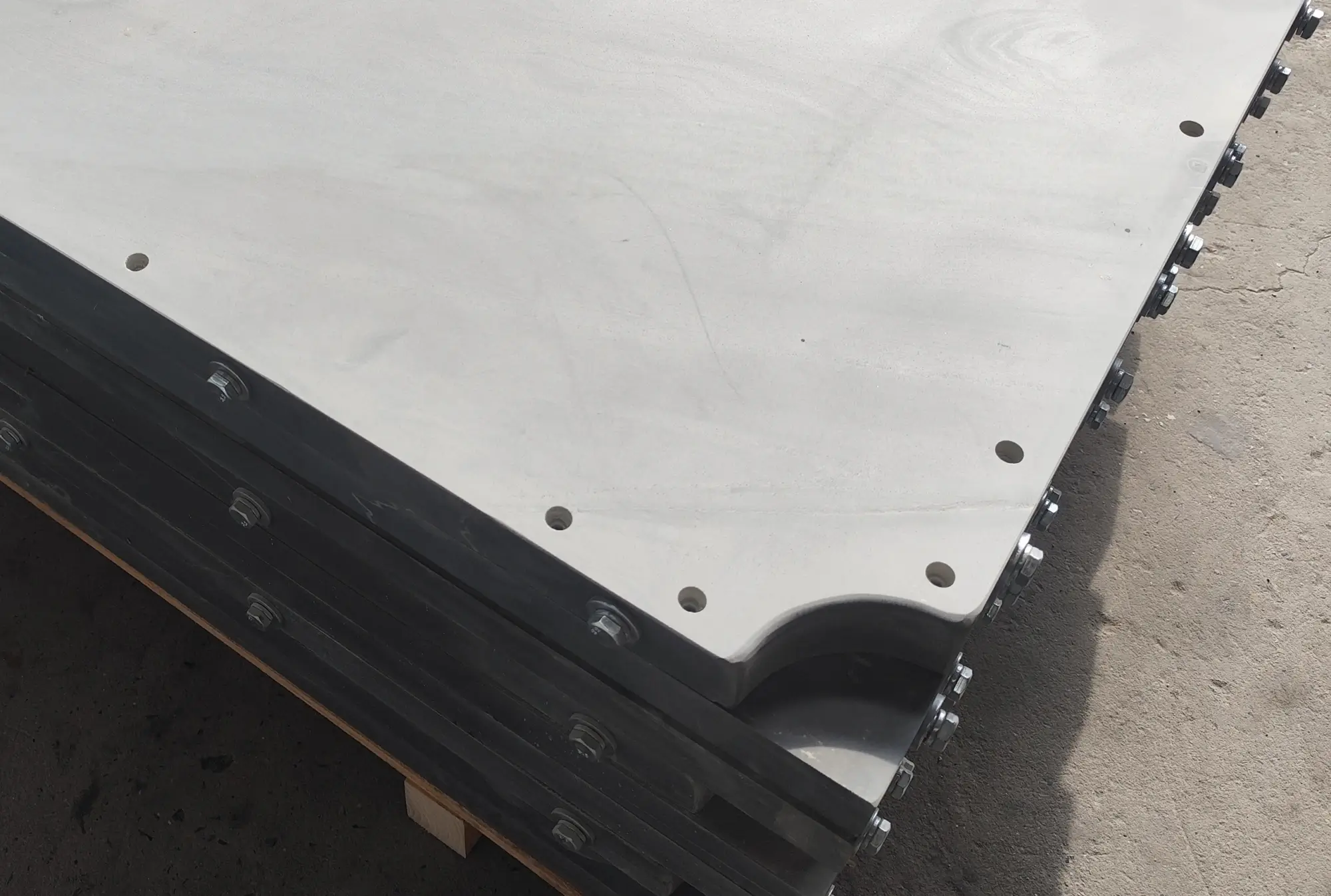
Back to the curve from the first paragraph. On a conventional American pool slate, the pocket opening is a mostly straight affair and the jaws above do the shaping. On a Chinese 8-ball table the pocket is an arc: the cushion ends sweep into the opening in a radius, and the stone beneath has to carry that contour, along with the mounting pattern for the jaw sections that bolt on above. Six openings, each a curved, dimensioned feature — radius, entry width, drop depth — and every one of them a playability setting rather than decoration.
One distinction does more work here than any other: the opening the balls fall through is not the opening we cut. The finished pocket entrance is a combined geometry — the slate cut-out sets the footprint, and the cushion noses, rail facings and pocket assembly above the stone complete the entrance. Two tables can share an identical cut-out and play nothing alike, because the cushion noses sit differently. It follows that Chinese 8-ball pocket dimensions cannot travel as a single number: what a factory needs is the cut-out contour, the reference centreline, the cushion nose positions and the rail facing profile — the four elements that turn stone, rubber and hardware into one entrance.
That is why the pocket pages of the drawing matter more here than on a standard pool order. An arc that drifts by a millimetre or two changes the entry width, and entry width is the setting this format is famous for keeping tight. Cut by hand, six arcs across twenty sets will not agree with each other. Cut on the CNC, they will agree with the prototype, with the sample, and with each other — within the tolerances the drawing and its inspection plan call for.
On the slate side of that geometry, the drawing has to carry the cut-out contour and radius, the entry width, the drop-through depth, and the bolt holes or recesses for the jaw and throat hardware.
Example, from the production drawing shown above: its pocket cut-outs carry an R20 corner radius and a 7° cut inclination, machined into a 42 mm bed — manufacturing dimensions for one table design, not universal Heyball pocket standards; a different model can carry different radii, which is exactly why the pocket pages travel with the order.
How those features are confirmed between buyer and factory before machining starts — drawing checks, first-article approval and the rest — is laid out on CNC Pocket Cuts and Drawing Confirmation, and the cutting methods themselves on Pocket Opening Machining.
Flatness, Tolerances and What to Ask to See
A tight-pocketed table is an unforgiving table: a ball rolling the length of the bed has nowhere to hide. Flatness across the whole playing area is the specification that decides whether the finished table plays true — and it is worth asking any supplier, us included, how exactly they check it.
The answer should be a method, not an adjective. On our floor: a calibrated straightedge and feeler set run across the midlines and diagonals of each piece, thickness taken at reference points on every panel, and three-piece sets assembled and checked as one plane before packing. The scope of inspection — every piece in the order, or an agreed sampling plan — is written into the order, and so is the record: the readings can travel with the shipment. What such measurements look like as data, on real batches, is shown on Billiard Slate Quality & Test Data; how to re-check a delivery on your own floor is on How to Check Billiard Slate Flatness on Incoming Inspection.
Chinese 8-Ball Slate vs Standard Pool Slate
The two beds are close cousins — same stone, similar footprint — which is exactly why the confusion gets expensive. The short version of the difference:
| Chinese 8-ball | American pool | |
|---|---|---|
| Typical table class | 9 ft | 7 / 8 / 9 ft |
| Reference playing area | 2,540 × 1,260 mm | Varies by table |
| Pocket style | Rounded, tight-entry, snooker-style jaws | Straight-cut pool pockets |
| Common slate thickness | 45 mm most common (38, 40, 42, 50 mm to order) | 19–25 mm |
| The set | Both drawing-controlled and model-specific — the finished sets do not interchange | |
The full comparison — pool, snooker and Chinese 8-ball side by side — has a page of its own on Pool vs Snooker vs Chinese 8-Ball Slate.
Five Common Mistakes When Ordering Chinese 8-Ball Slate
Order-desk experience, ranked roughly by how expensive they are to undo:
1. Ordering by "9 ft" alone. The class names the family; it does not cut stone. Without the outline, the per-piece sizes and the hole pattern, the factory is left quoting a guess.
2. Confusing the playing area with the slate size. The 2,540 × 1,260 mm figure is the field the balls live on; the stone runs larger, and the two numbers answer different questions.
3. Fixing the thickness before the frame. 45 mm is the option we manufacture most often, but the number belongs to the frame, the support spacing and the rail system — not to a habit.
4. Sending one pocket number instead of pocket geometry. A single entry-width figure leaves the cut-out contour, the cushion noses and the rail facings to guesswork, and the finished entrance is the combined result of all of them.
5. Expecting a generic pool set to fit. Same stone, similar footprint, different product: the pool set that arrives will miss the rounded pocket contours, the bolt pattern and the frame ledge.
Every one of these is a drawing problem wearing an order-form costume — and every one disappears the moment the drawing arrives.
How to Write a Chinese 8-Ball Slate RFQ That Gets a Real Quote
The inquiry this format generates most often is one line long — table name, quantity, "please quote best price" — and the honest reply is a request for the drawing. A drawing only carries the order, though, if it carries the right items. This is the short list, and what each item decides:
| What the order needs | What it tells the factory | What it decides |
|---|---|---|
| Playing area | The true playing field — e.g. the 2,540 × 1,260 mm reference above | Confirms the format and the footprint |
| Outline and per-piece sizes | Finished length × width of the stone, divided into pieces | The cutting list — nothing is sawn without it |
| Thickness | The nominal figure, plus the consistency the set must hold | Rigidity, weight, frame loading |
| Piece count and joints | Where the bed divides, and how the joints must match | Crating, transport route, installation crew |
| Pocket geometry | Contour, radius, entry width, drop, jaw hardware holes | The CNC programme — and the table's playing character |
| Machining file | CAD drawing (.dwg / .dxf / dimensioned PDF) with tolerances | Which features are CNC-controlled and which are ground |
| Quantity and destination | Sets per order, and the receiving port | Batch production, container plan, FOB price |
A professional inquiry can be as short as this — copied, pasted, drawing attached:
Example RFQ (example only — replace the numbers with your own drawing)
We are looking for Chinese 8-ball / Heyball table slate according to the attached drawing:
Overall slate: 2,640 × 1,360 mm
Configuration: 3 pieces × 880 mm
Finished thickness: 42 mm
Playing area: 2,540 × 1,260 mm
Pocket machining and hole pattern: according to drawing
Quantity: XX sets — Destination: XX
Please quote the finished slate set including CNC machining, inspection and export packing.
A factory can price that in a day, because nothing in it needs guessing. If there is no drawing yet, naming the table model or brand gives the factory a known pattern to start from — but on a first order, expect a sample or first-article set to be approved before volume production. The full quotation routine has its own walkthrough on How to Request a Billiard Slate Quotation, the custom-production information form is on Information Required for Custom Production, and the complete sourcing route lives in the Billiard Slate Buying Guide. The specification above, as a manufactured product — sizes, thickness options, CNC work and export packing — is on the 9 ft Heyball Table Slate product page.
A Chinese 8-ball slate set is not pool slate in a bigger box. It is an engineered component for one specific table — outline, thickness, piece count and six curved pocket contours, all set by the builder's drawing. Quote it that way, and the price that comes back is for the product you will actually receive.
What a Set Costs: Price, Weight and the Container Plan
Two numbers mislead buyers on this format. The first is a price per square metre — useful for raw slab, useless for a finished bed, because it prices none of the work: the grinding, the pocket CNC, the joint matching, the inspection, the crate. Ask instead for the price per complete finished set, FOB, crated and inspected. That is the only unit two quotations can be compared on honestly.
The second is weight — or rather, the weight buyers forget to run. The arithmetic is straightforward on the production drawing shown above: a 2,640 × 1,360 mm outline at 42 mm finished thickness is about 0.15 m³ of stone per set. At roughly 2.7 tonnes to the cubic metre, that is around 405–410 kg of slate per set, or about 135 kg a piece before crating — a twenty-set order is eight tonnes of stone before a single crate is built. Actual shipment weight varies with slate density, machining and packing.
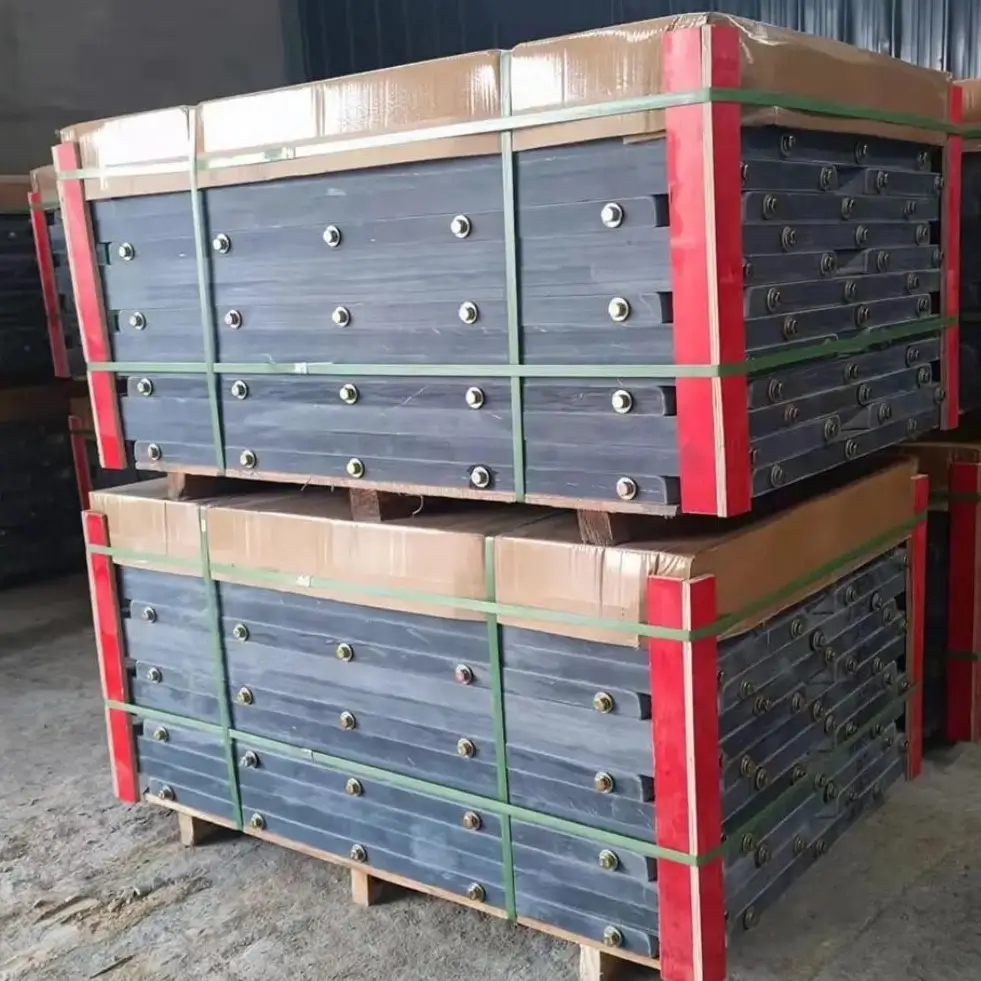
Which brings the order to its last engineering decision: the container. Slate fills a 20 ft container by weight long before it fills it by volume, so the loading plan is arithmetic — packaged weight per set against the container's payload, then crate dimensions, stacking pattern and lifting plan, all run from the drawing. Chinese 8-ball beds usually travel one set per crate, pieces separated by foam sheet with edge protection at the corners, and the plan is confirmed before production rather than improvised at the gate. The import mechanics — ports, documents, arrival inspection — are on How to Import Billiard Slate from China, and the stacking logic that keeps stone safe in transit on Billiard Slate Container Loading.
Back at the corner of that unclothed table, the curve is still the first thing you see. By the time the order ships, it is also the last thing that got checked: radius to drawing, entry width to drawing, six pockets identical, one plane. That is what "Chinese 8-ball slate" means once the paperwork is done — a matched, machined component for one specific table. The drawing decides everything else.
The Questions Behind the Quotation
Six questions that come up again and again on this format:
Why are Chinese 8-ball pockets rounded instead of straight-cut?
The format grew up around snooker-style pocket geometry, and the rounded jaw is its signature. On the slate it means each of the six openings is a curved, dimensioned contour rather than a straight cut — radius, entry width and drop depth all specified — with the CNC holding the arc so every pocket, and every set, matches the drawing.
What thickness should I order for a Chinese 8-ball table?
The table builder's design decides. 45 mm is the most commonly requested thickness in our production, with 38, 40, 42 and 50 mm also manufactured for different table designs — and the consistency across the set matters more than the nominal figure itself. The side-by-side comparison with pool and snooker is on Pool vs Snooker vs Chinese 8-Ball Slate Thickness.
Is a Chinese 8-ball slate set heavier than a 9-foot pool set?
Usually, and by a wide margin. At a comparable 9-foot outline, going from 25 mm to 42 mm is close to 1.6 times the stone — in the worked example above, roughly 405–410 kg per set against the 250–270 kg typical of a 25 mm pool bed. The difference decides crate design, handling equipment and how many sets a container legally carries.
Can I order a single replacement piece for an existing Chinese 8-ball table?
It can be done, but the new piece must match the set it joins: thickness, joint faces, hole pattern and pocket geometry. The safe route is to measure the old piece or work from the original drawing — and where the old set is worn or unlabelled, replacing the complete set is usually the better repair. Replacement Slate for Existing Billiard Tables covers the measuring routine.
How many Chinese 8-ball slate sets fit in a container?
There is no universal count — it is a weight calculation, not a volume one. Packaged weight per set, multiplied against the container's payload, sets the ceiling; the crate plan and stacking pattern set the practical figure. Run it per order, from the drawing, and the factory's loading plan will show exactly what sails and what waits for the next container.
Do I need my own drawing, or can the factory quote from the table model?
A known table model or brand gives a factory a pattern to quote from, and for recognised Chinese 8-ball designs that is a workable start. But a first order should still end with a confirmed drawing and an approved sample or first-article set before volume production — and on an OEM build, your own drawing is the only document that protects both sides.
Related Reading
Building to the Chinese 8-Ball Spec?
Send the drawing — or the table model and the numbers you have. We will confirm the outline, thickness, piece count and pocket machining before anything is cut, and quote per finished set with inspection records and export packing included.
Request a Chinese 8-Ball Slate Quotation →
Or browse the billiard slate range.