
Roofing Slate Repair Guide: How to Fix Damaged Slate Roofs Properly
Natural roofing slate is widely recognized as one of the longest-lasting roofing materials available. A professionally installed slate roof can protect a building for more than 100 years, and many historic slate roofs have remained in service for well over a century. However, even the most durable roofs may experience occasional damage caused by severe weather, falling branches, aging flashings, or accidental foot traffic.
The good news is that most slate roof problems can be repaired without replacing the entire roof. Unlike many modern roofing materials, natural slate roofs are designed to be repaired, not replaced. Because individual slates can usually be removed and replaced without disturbing the surrounding roof, professional repairs can restore both the appearance and performance of the roof while preserving its original character.
Slate is also one of the easiest premium roofing materials to repair because damaged slates can usually be replaced individually. When repairs are carried out using matching natural slate and proper installation techniques, the repaired area can continue to perform for decades—often lasting as long as the surrounding roof itself.
In this guide, you’ll learn how to identify common slate roof problems, understand the most effective repair methods, estimate repair costs, and discover practical maintenance tips that help extend the life of your natural slate roof.
Why Trust This Guide?
As a professional roofing slate manufacturer and exporter from Jiujiang, China, we have supplied high-quality natural roofing slates to roofing contractors, distributors, and construction projects worldwide for many years. Drawing on both manufacturing expertise and real-world roofing applications, this guide combines practical repair knowledge with industry best practices to help homeowners, architects, and roofing professionals make informed decisions about repairing and maintaining natural slate roofs.
Table of Contents
Why Do Slate Roofs Need Repair?
Natural slate is one of the most durable roofing materials available, but no roof is completely maintenance-free. Although the slate itself can last for over 100 years, the roof is a complete system made up of slates, nails, flashings, ridges, valleys, and underlayment. Damage to any of these components can eventually lead to water infiltration and the need for repair.
Fortunately, most slate roof problems are localized rather than widespread. A broken slate, slipped tile, or deteriorated flashing can usually be repaired without replacing the entire roof, helping homeowners preserve both the beauty and value of their investment.
Below are the most common reasons why slate roofs require repair.
1. Storm Damage
Storms are one of the leading causes of slate roof repairs. While natural slate is highly resistant to rain, snow, and freezing temperatures, extreme weather can still damage individual slates or roofing components.
Common storm-related damage includes:
- Broken slates caused by falling tree branches
- Cracked slates from large hailstones
- Missing slates after strong winds
- Dislodged ridge tiles during severe storms
- Flashing damage around chimneys, skylights, and valleys
After major storms, it’s advisable to inspect the roof from the ground or arrange a professional roof inspection. Early repairs can prevent minor damage from developing into costly leaks.
Recommended image: Broken slate after storm damage, missing slate, fallen branch on roof.
2. Improper Installation
Even the highest-quality natural slate cannot perform well if it is installed incorrectly. In fact, many slate roof failures are caused by poor workmanship rather than defective slate.
Common installation mistakes include:
- Incorrect nail placement
- Using unsuitable roofing nails
- Insufficient headlap
- Incorrect side lap
- Poor flashing installation
- Improper slate alignment
- Inadequate roof pitch for the slate size
These installation errors may not become visible immediately but can lead to water penetration, slipped slates, and premature roof failure years later.
A professionally installed slate roof should remain structurally sound for decades with only minimal repairs.
Recommended image: Incorrectly installed slates beside properly installed slates.
3. Aging Roofing Components
Natural roofing slate often outlasts the materials used to secure and waterproof it.
While the slate itself may remain in excellent condition after 100 years, components such as nails, flashing, and underlayment gradually deteriorate over time.
Common aging components include:
- Copper flashing
- Lead flashing
- Zinc flashing
- Roof nails
- Roofing felt or underlayment
- Ridge mortar (traditional roofs)
One of the best-known problems is nail sickness, where steel or iron nails corrode and lose their holding strength. As the nails fail, slates begin to slip, creating gaps that allow water to enter the roof.
Replacing worn components at the right time can significantly extend the service life of an existing slate roof.
Recommended image: Corroded nails, deteriorated flashing, slipped slates.
4. Foot Traffic and Human Damage
Walking directly on a slate roof is one of the most common causes of cracked or broken slates.
Unlike asphalt shingles, natural slate is extremely durable when installed but can fracture if excessive point pressure is applied. People unfamiliar with slate roofing often step on unsupported areas, causing invisible cracks that later develop into leaks.
Common causes include:
- Contractors installing solar panels
- Chimney maintenance
- Antenna installation
- Window cleaning
- Roof inspections performed incorrectly
Whenever work is required on a slate roof, experienced slate roofing professionals should use appropriate access equipment and walk only where the roof structure provides adequate support.
Recommended image: Person standing incorrectly on slate roof causing cracked slate.
5. Natural Aging and Weathering
Although natural slate has an exceptionally long lifespan, decades of exposure to sun, rain, snow, freeze-thaw cycles, and temperature changes can gradually affect roofing materials.
Over time, you may notice:
- Surface weathering
- Minor edge damage
- Moss and lichen growth
- Slight movement of individual slates
- Deterioration of mortar at ridge and hip sections
These changes are generally normal and do not necessarily indicate roof failure. Regular inspections and timely repairs can prevent minor issues from becoming major problems.
Recommended image: Old slate roof with moss and weathered flashing.
6. Accidental Impact
Physical impacts are another common reason for slate roof repairs.
Examples include:
- Falling branches
- Sports equipment
- Construction materials
- Ice falling from higher roof sections
- Heavy objects dropped during maintenance
Because slate roofs consist of individual tiles, accidental damage is usually confined to a small area and can often be repaired by replacing only the affected slates.
Recommended image: Single broken slate caused by falling branch.
Summary Table
| Cause of Damage | Typical Problems | Can It Be Repaired? |
|---|---|---|
| Storm damage | Broken, cracked or missing slates | ✅ Yes |
| Poor installation | Leaks, slipped slates | ✅ Yes |
| Aging components | Nail sickness, flashing failure | ✅ Yes |
| Foot traffic | Cracked or broken slates | ✅ Yes |
| Natural weathering | Moss, minor deterioration | ✅ Usually |
| Accidental impact | Localized slate damage | ✅ Yes |
Expert Tip
Natural slate rarely fails before its supporting components. In most cases, leaks are caused by deteriorated flashing, corroded nails, or improper installation—not by the slate itself. This is why a professional inspection should focus on the entire roofing system rather than simply replacing damaged slates.
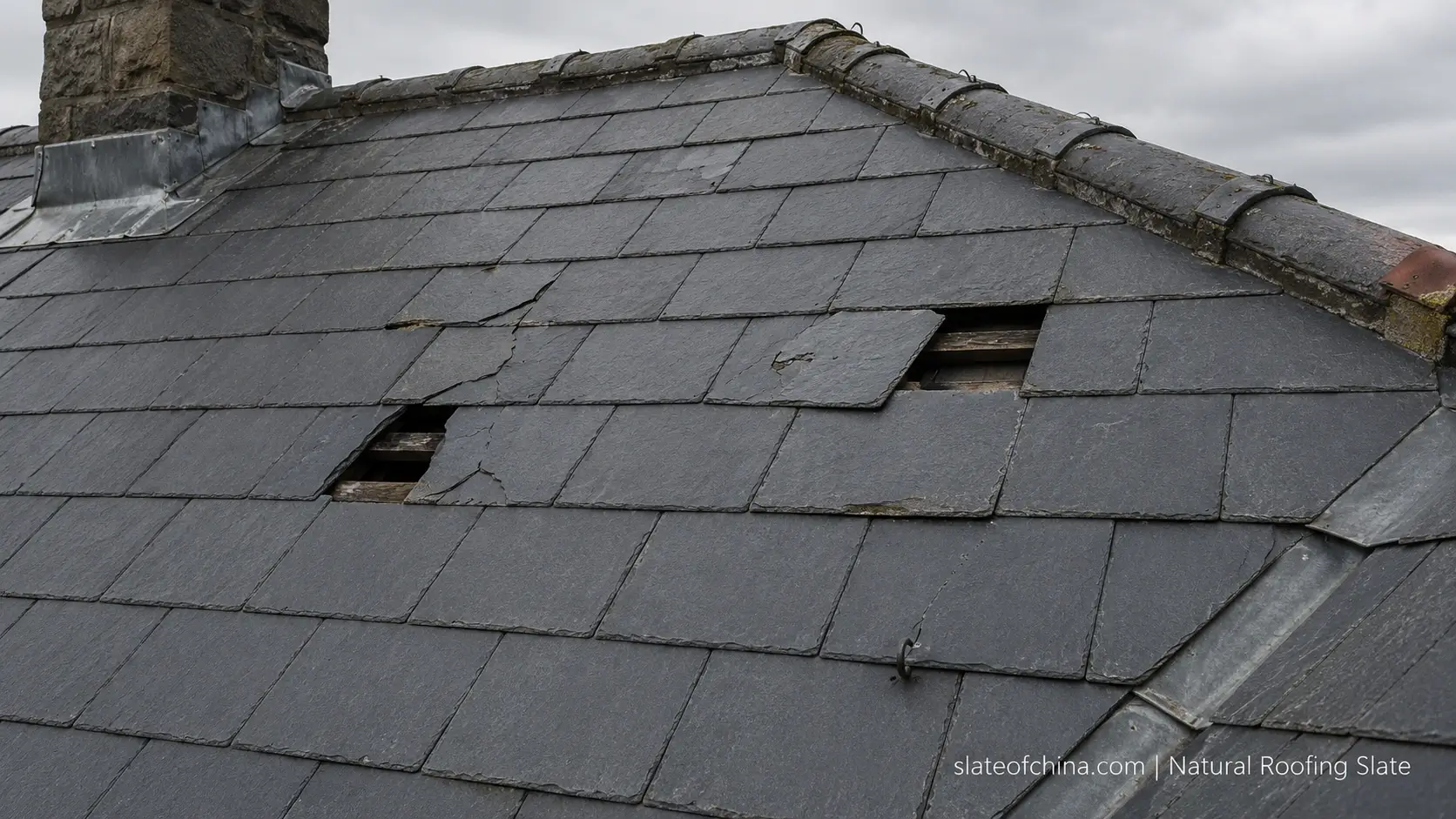
Common Slate Roof Problems
Although natural slate is one of the most durable roofing materials available, no roof is immune to damage. Over time, weather exposure, aging components, poor installation, and accidental impacts can lead to localized problems that require professional attention.
The good news is that most slate roof issues affect only a small area of the roof. Identifying these problems early can prevent leaks, reduce repair costs, and significantly extend the life of your slate roof.
The following table summarizes the most common slate roof problems, their typical causes, and the level of repair difficulty.
Common Slate Roof Problems at a Glance
| Slate Roof Problem | Typical Cause | Repair Difficulty | Risk if Ignored |
|---|---|---|---|
| Broken Slate | Falling branches, hail, impact | ⭐ Easy | Water penetration |
| Slipped Slate | Nail failure (Nail Sickness) | ⭐⭐ Medium | Roof leaks |
| Missing Slate | Strong wind, storm damage | ⭐ Easy | Exposed underlayment |
| Nail Sickness | Corroded steel nails | ⭐⭐⭐ Difficult | Multiple slipping slates |
| Flashing Failure | Aging lead or copper flashing | ⭐⭐ Medium | Persistent leaks |
| Chimney Leaks | Damaged flashing around chimney | ⭐⭐ Medium | Interior water damage |
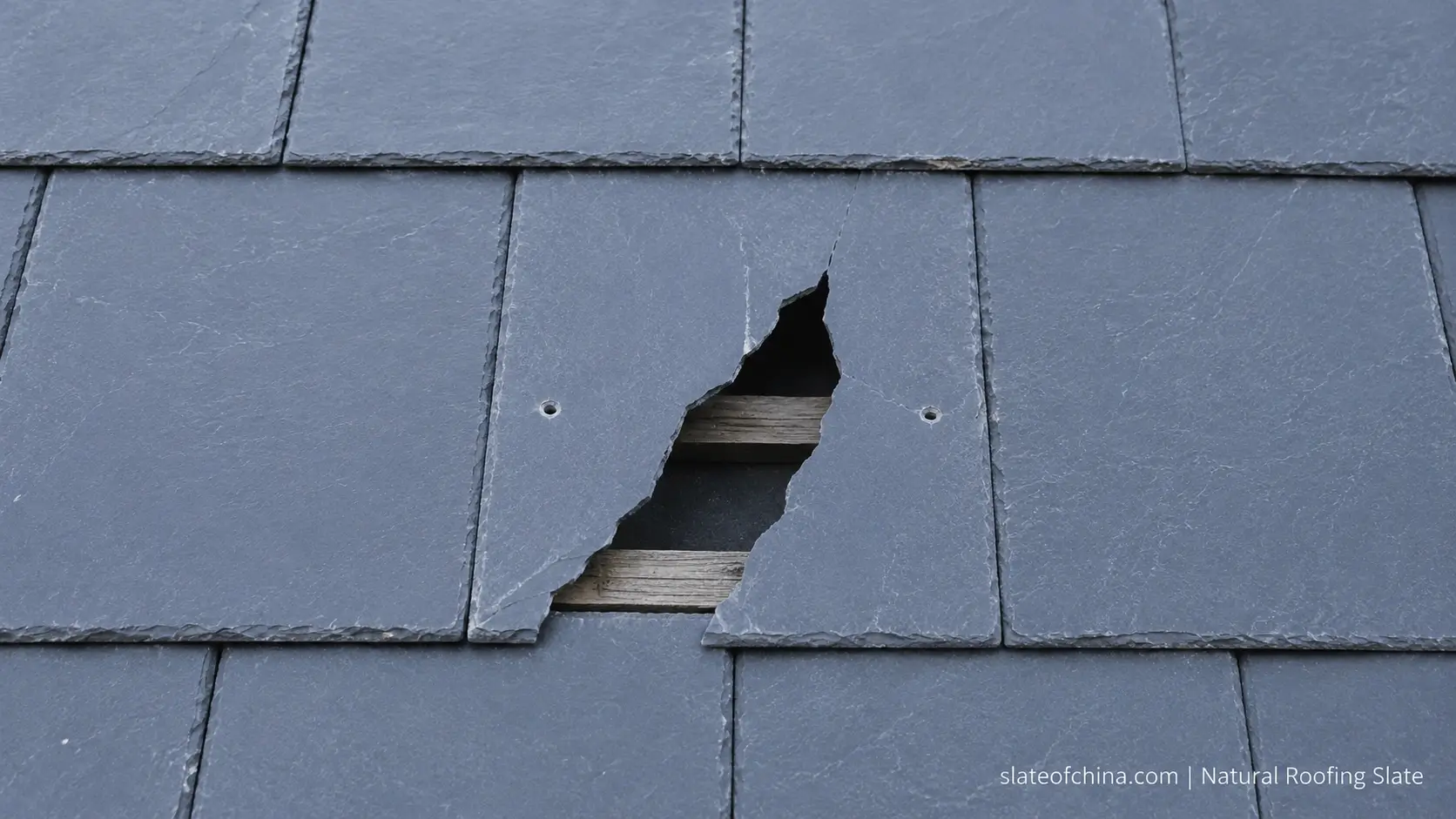
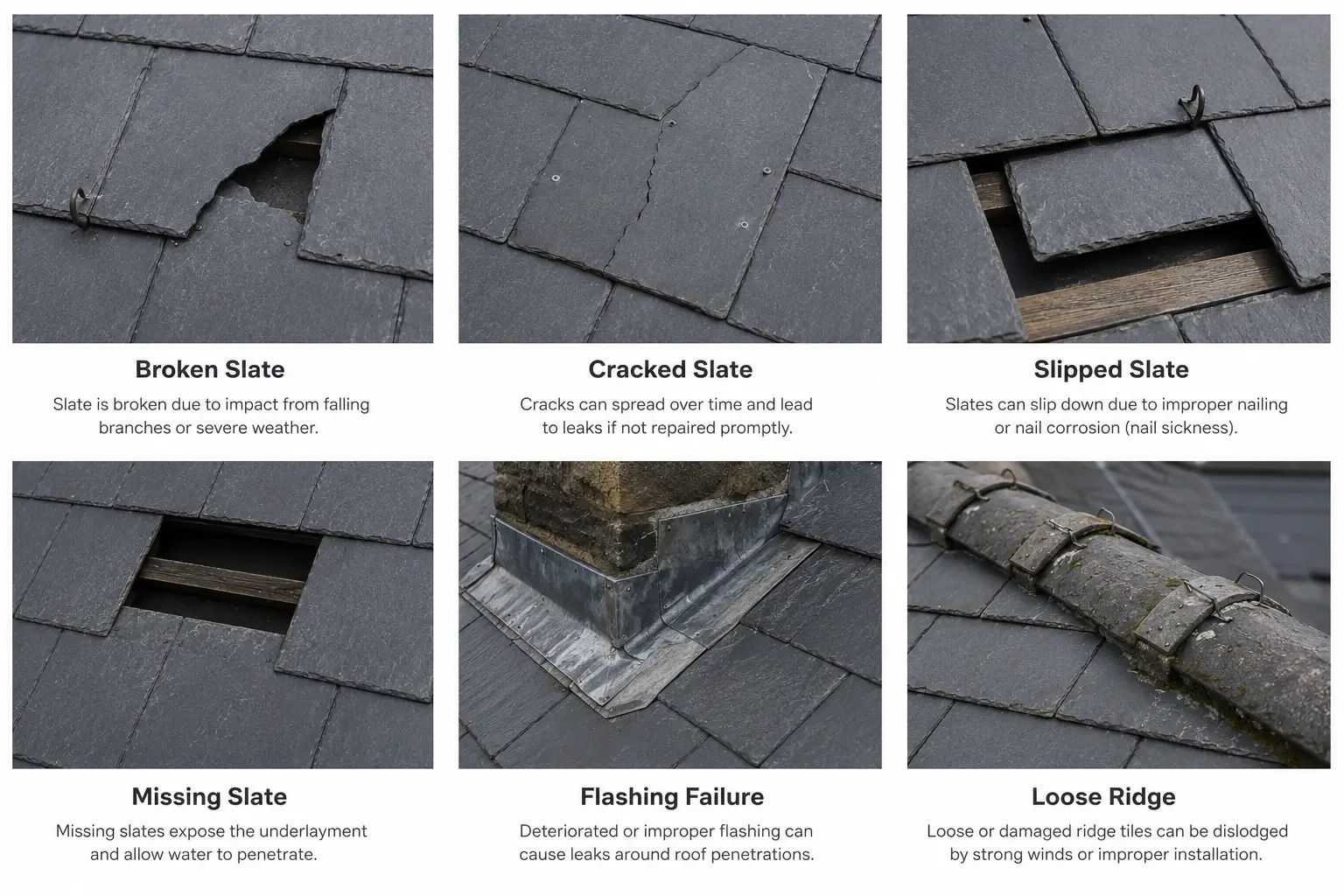
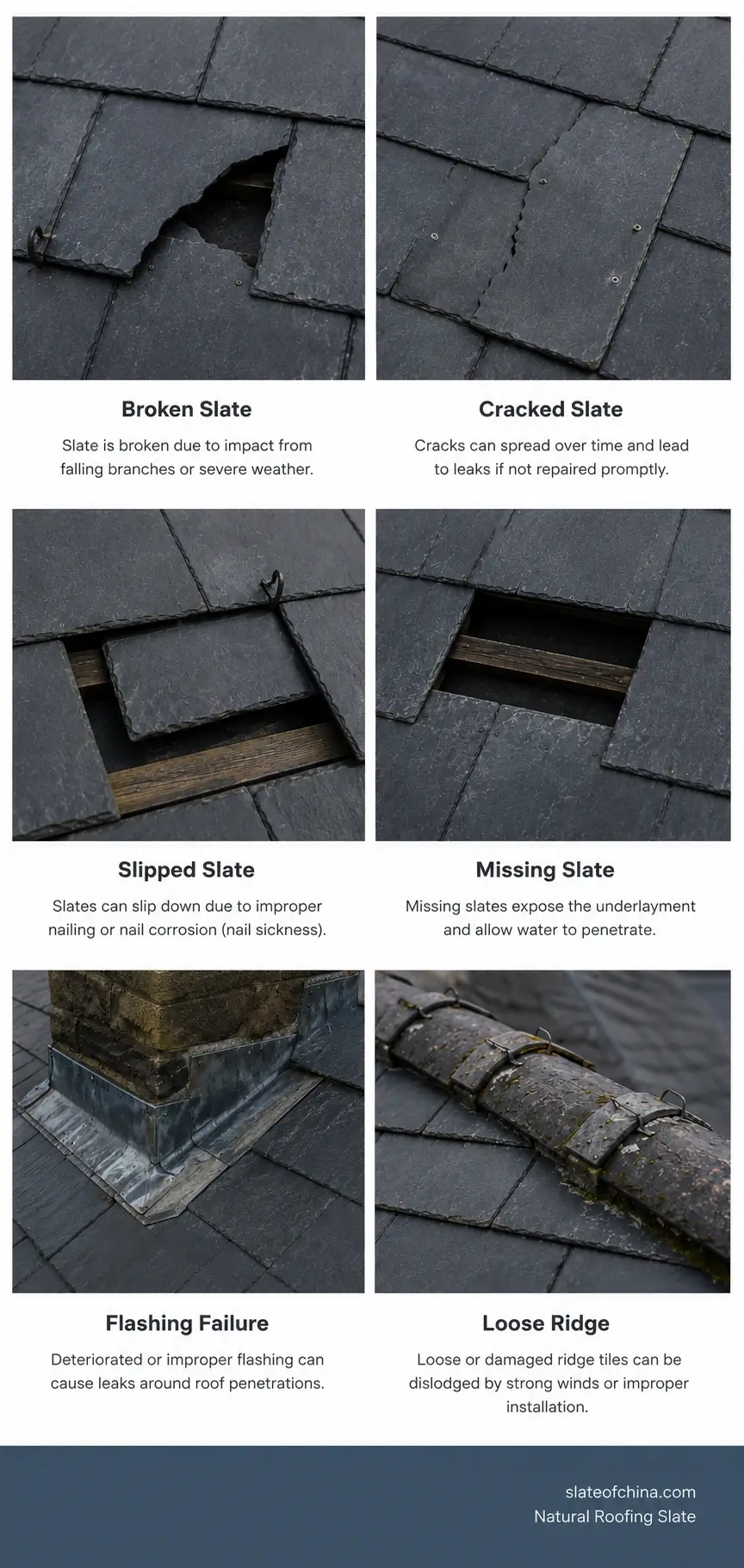
Broken Slate
Broken slates are one of the most common slate roof problems. They are usually caused by falling tree branches, hailstorms, accidental foot traffic, or construction work on the roof.
Even a single broken slate can expose the underlayment to moisture, eventually causing leaks if left unrepaired.
Common signs
- Visible cracks or missing corners
- Fresh slate fragments in gutters
- Water stains after heavy rain
Typical repair
Individual slate replacement using matching natural slate.
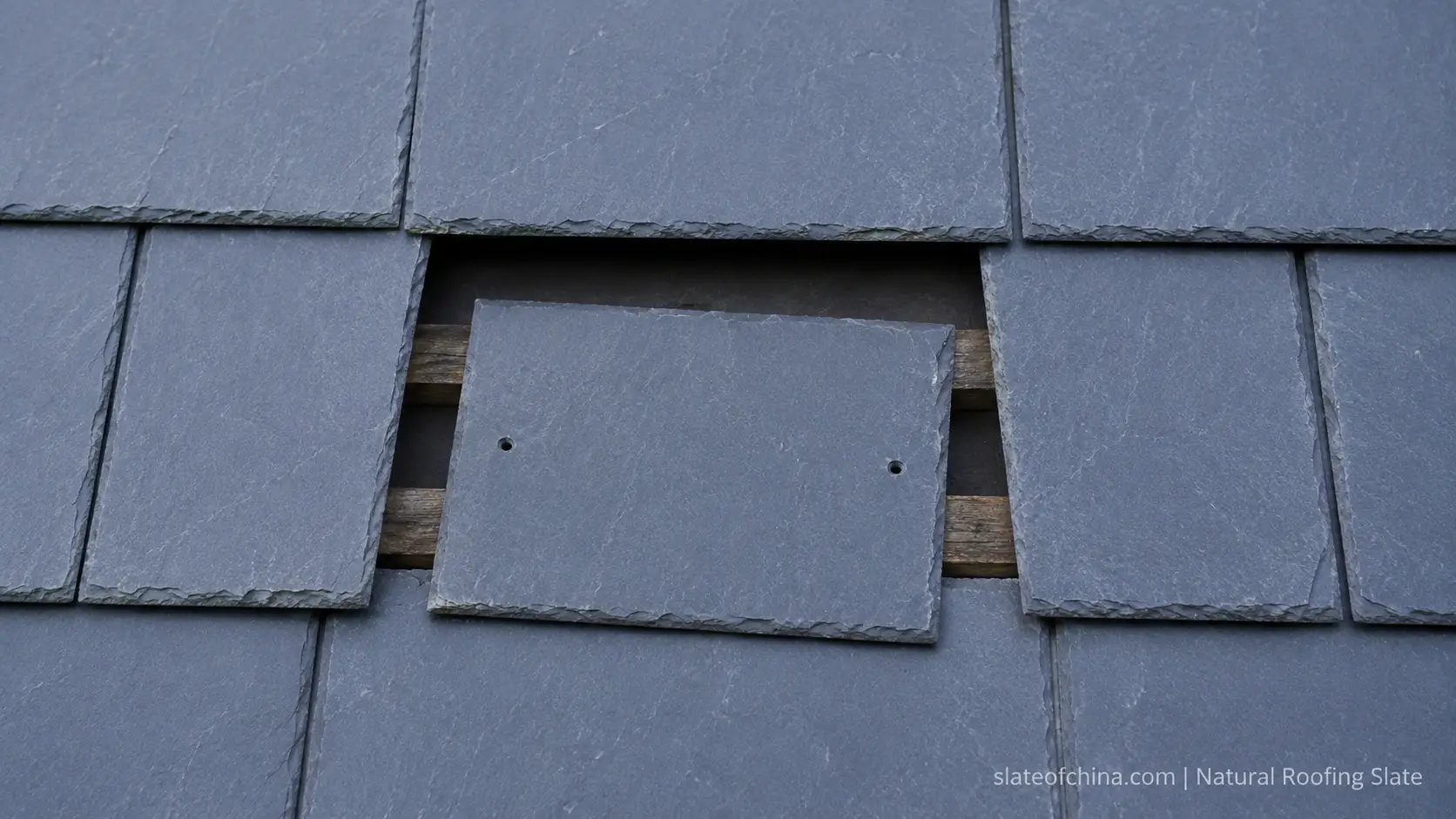
Slipped Slate
A slipped slate occurs when the fixing nail loses its grip or corrodes over time. The slate gradually slides out of position, leaving the roof vulnerable to water penetration.
This problem is particularly common on older slate roofs.
Common signs
- Slate sitting lower than surrounding slates
- Uneven roof lines
- Visible gaps between slates
Typical repair
Replace the failed fixing using a copper nail or stainless steel slate hook.
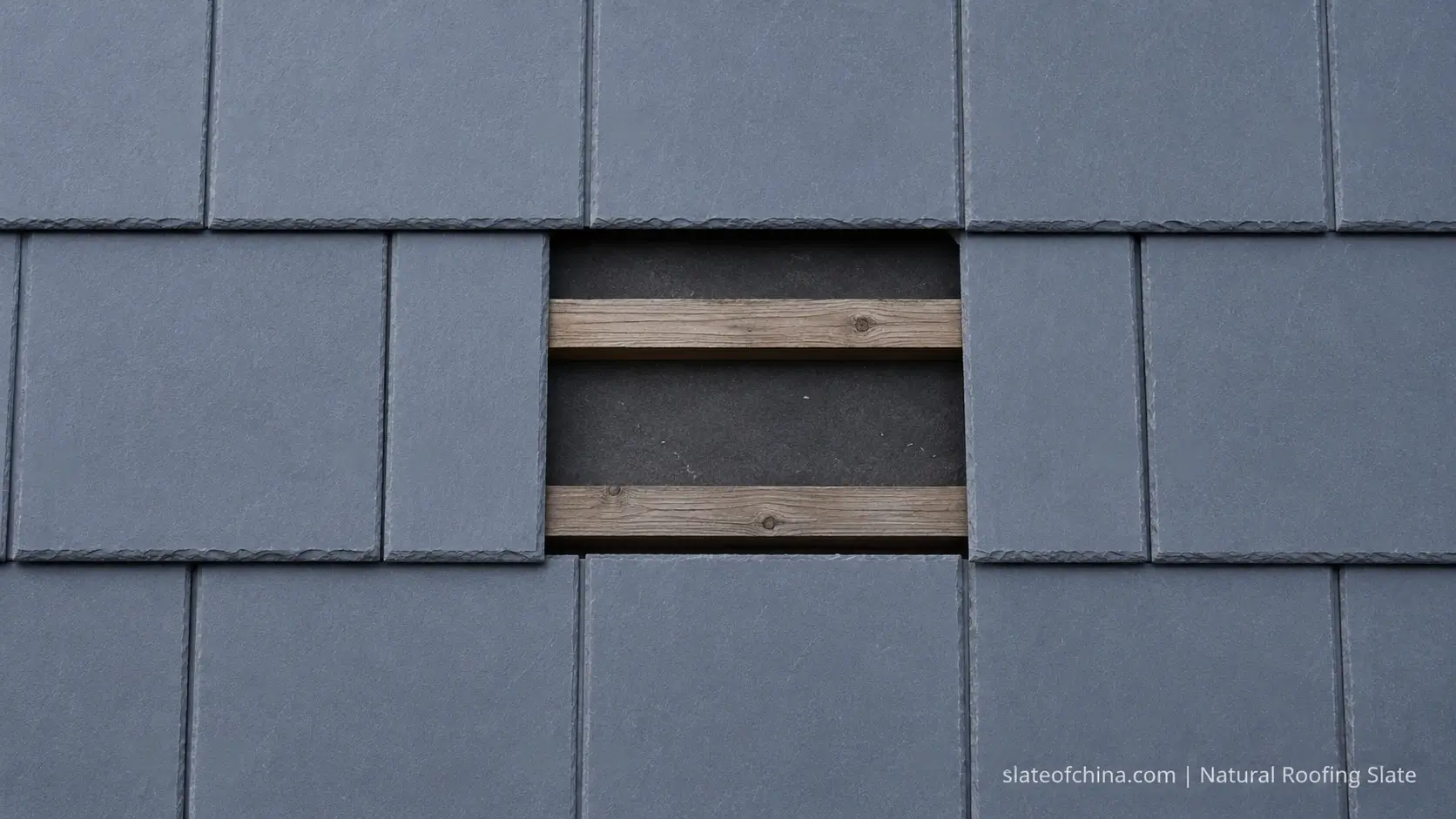
Missing Slate
Strong winds, storms, or previous poor repairs may completely remove one or more slates.
Missing slates should always be repaired promptly because they expose the roof structure directly to rainwater.
Common signs
- Obvious opening in the roof
- Visible roofing felt or battens
- Water entering after storms
Typical repair
Install a replacement slate matching the original size, thickness, and color.
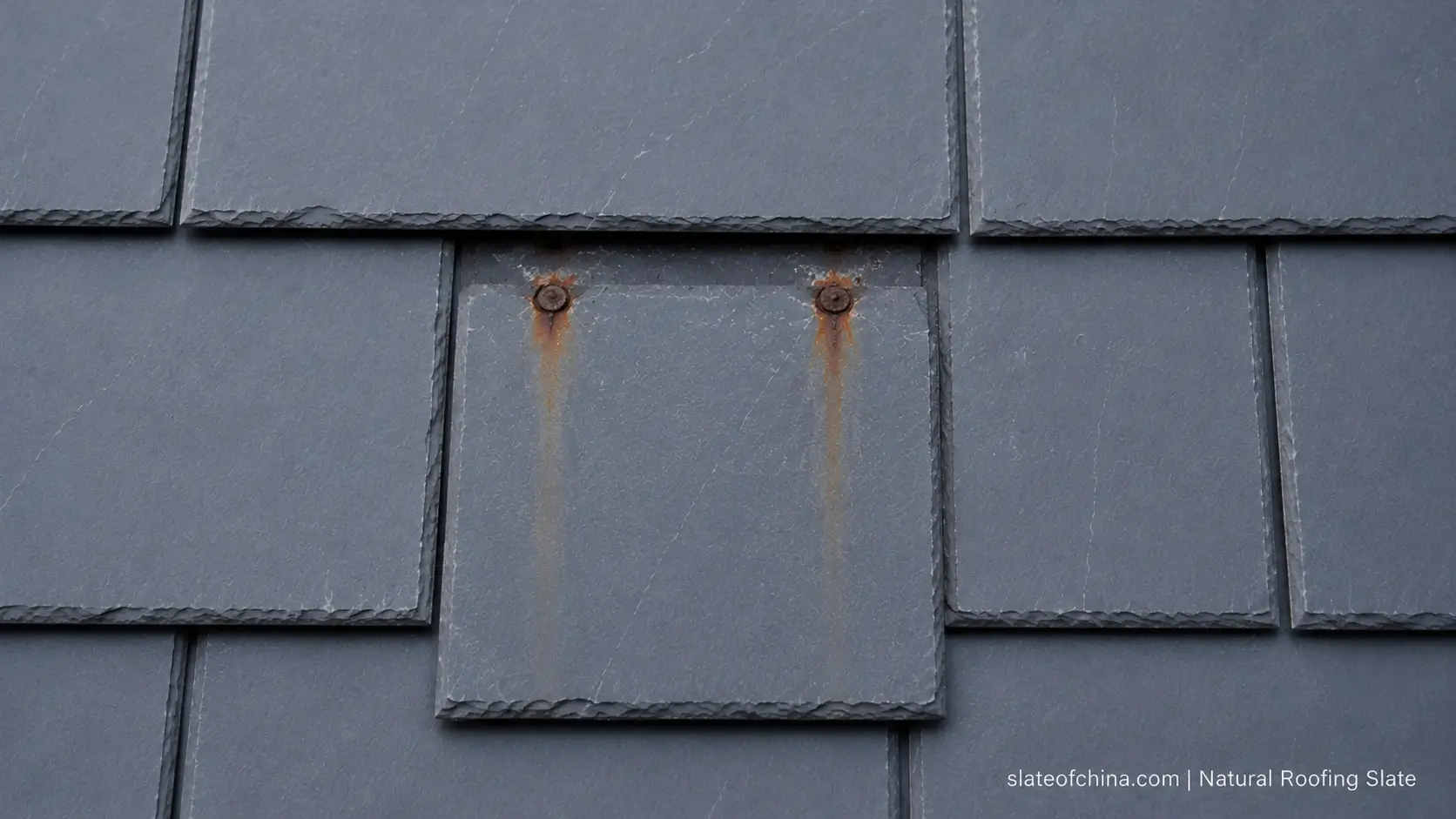
Nail Sickness
Nail sickness is one of the most serious issues affecting older slate roofs.
Unlike broken slates, the slate itself usually remains in excellent condition. The problem is caused by corroded steel or iron nails that lose their holding strength.
Once the nails fail, multiple slates begin slipping across the roof.
Common signs
- Several slipped slates
- No visible impact damage
- Roof over 60–80 years old
Typical repair
Replace failed fixings or re-roof affected sections.
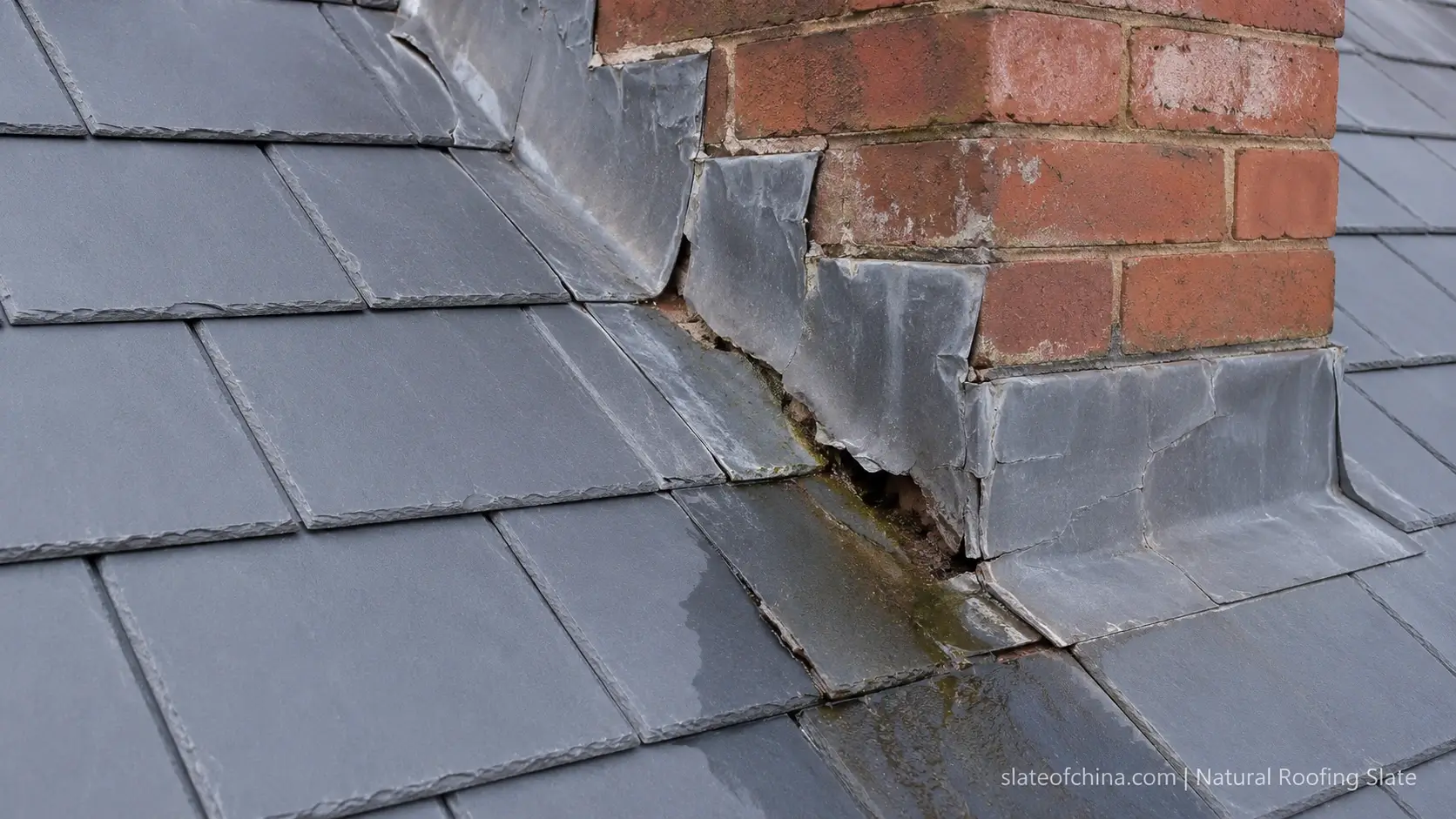
Flashing Failure
Flashing protects vulnerable roof areas such as chimneys, valleys, skylights, and roof junctions.
Over decades, lead, copper, or zinc flashing can crack, separate, or deteriorate, allowing water to enter beneath the slates.
Many roof leaks are actually flashing problems—not slate problems.
Common signs
- Damp patches around chimney
- Rust or corrosion
- Water entering after heavy rain
Typical repair
Repair or replace damaged flashing.
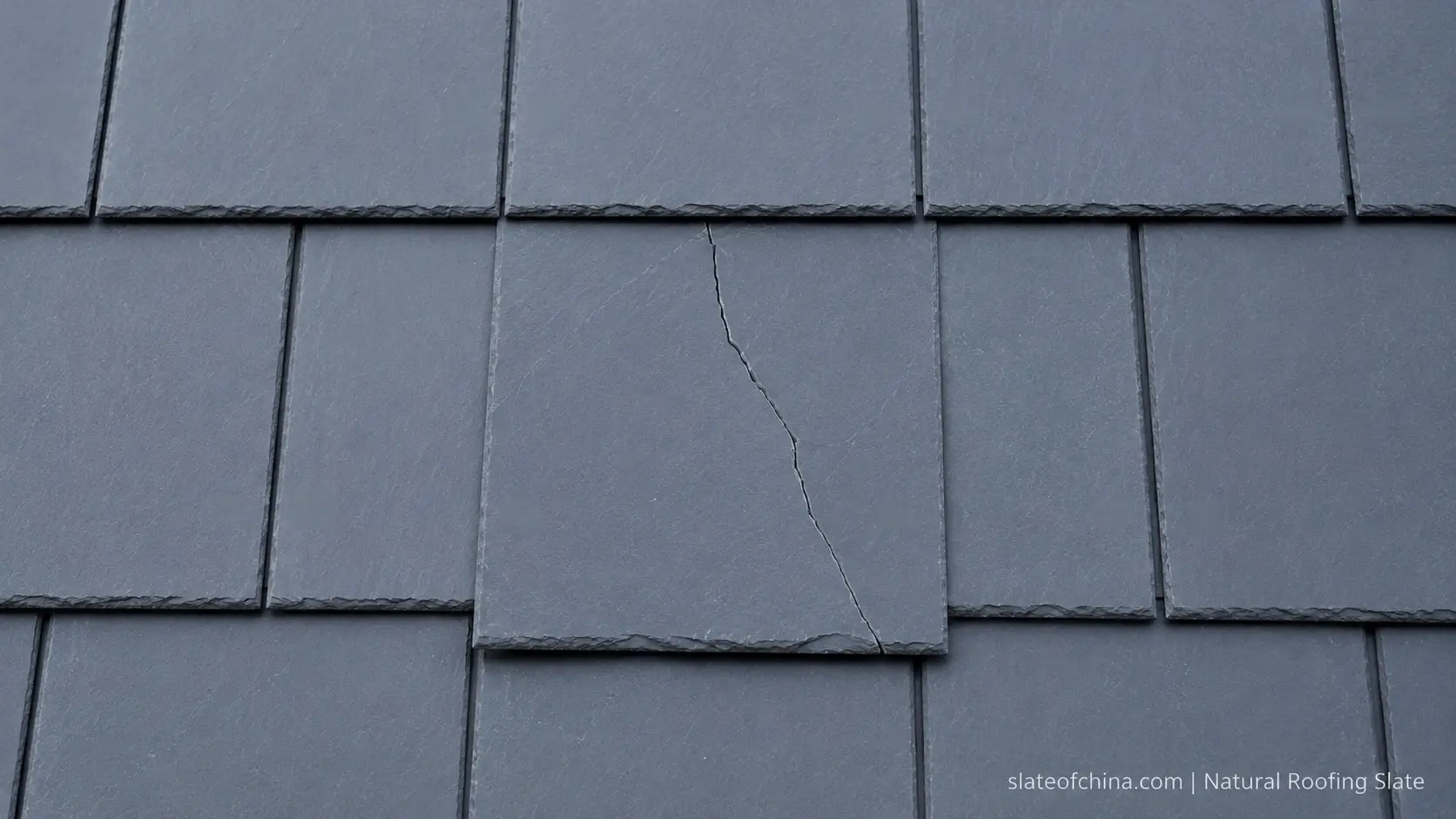
Cracked Slate
Unlike broken slates, cracked slates may appear to be intact while allowing water to penetrate through fine fractures. Cracks are commonly caused by hail, falling branches, accidental foot traffic, or impact during roof maintenance. If left untreated, a small crack can gradually widen due to freeze-thaw cycles, eventually leading to leaks and further roof damage.
Common Signs
- Visible hairline or diagonal cracks across the slate
- Small chips around the impact point
- Damp spots or water stains after heavy rain
- Cracks becoming larger over time due to freeze-thaw weather
Typical Repair
Replace the cracked slate with a matching natural slate using the correct repair method, such as a copper nail or slate hook, to restore the roof’s weatherproof performance.
Expert Tip
Most slate roof leaks are not caused by the slate itself. In professional inspections, damaged flashing, corroded nails, poor installation, and missing slates are far more common causes than failure of the natural slate. Identifying the true source of the problem can save significant repair costs and help preserve the original roof for decades.
How to Identify Slate Roof Damage
Early detection is one of the best ways to reduce slate roof repair costs. Most slate roof problems begin as small, localized defects that are easy to repair if discovered in time. However, if left unnoticed, a single cracked slate or damaged flashing can eventually lead to water infiltration, timber decay, and more extensive repairs.
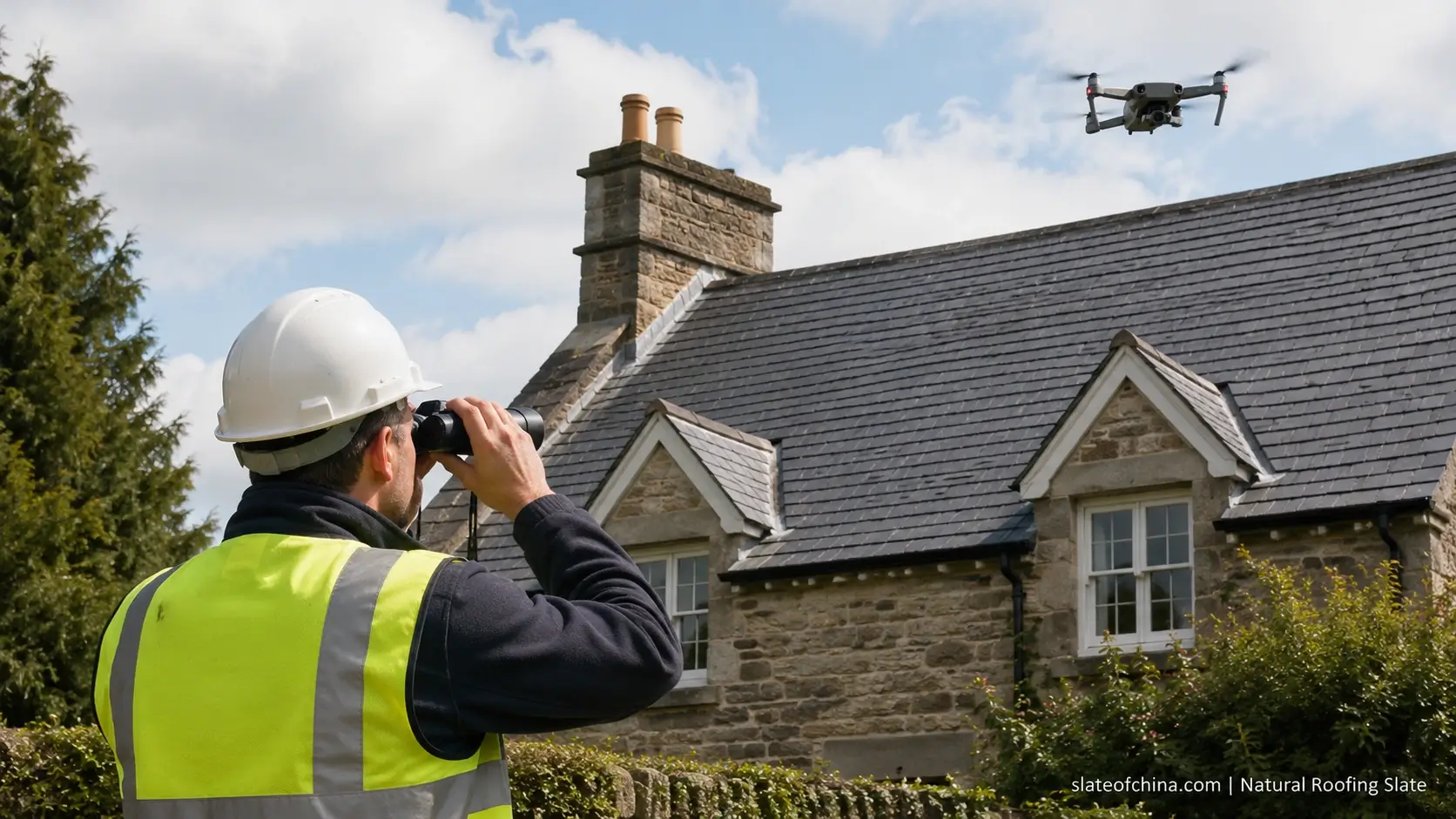
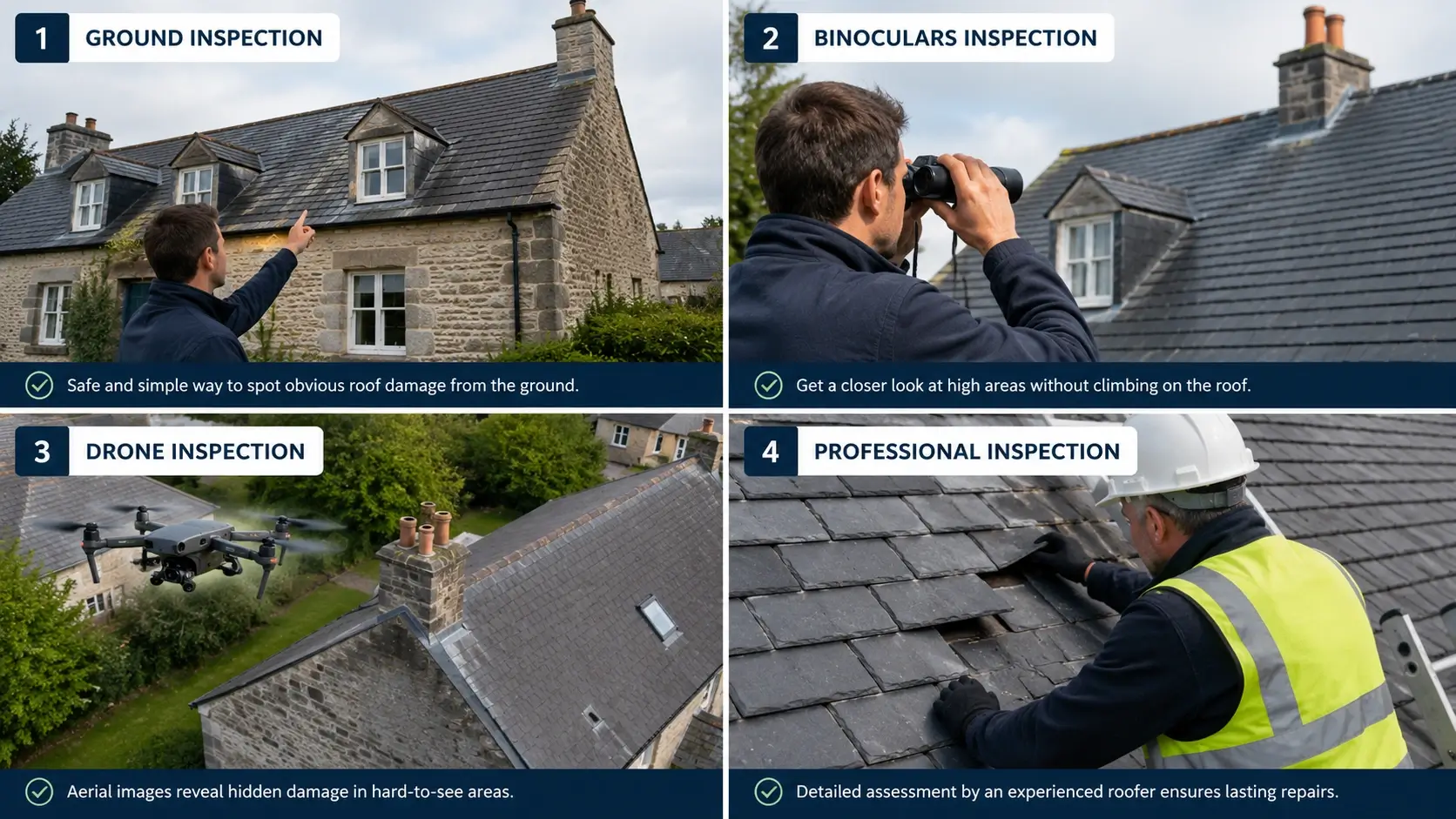
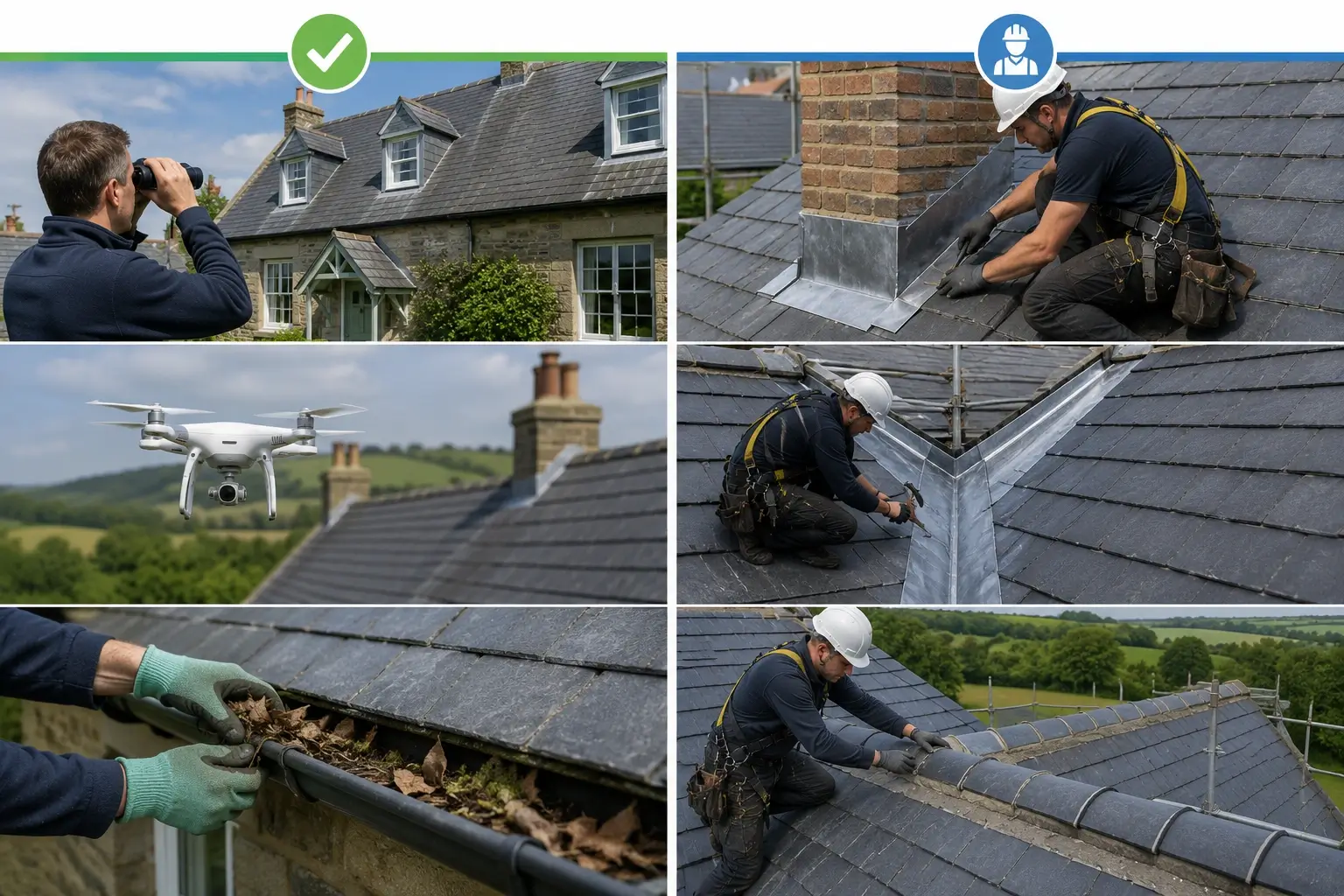
Fortunately, you don’t need to climb onto the roof to spot many common signs of damage. A careful inspection from the ground, combined with binoculars or a drone, can often reveal obvious problems while keeping you safe.
Use the checklist below to identify whether your slate roof may need professional attention.
Slate Roof Damage Checklist
Signs You May Need Roof Repair
✔ Missing slates after strong winds or storms
✔ Cracked or broken slates
✔ Slipped slates creating uneven roof lines
✔ Loose ridge or hip tiles
✔ Damaged or lifting lead flashing
✔ Water stains on ceilings or attic walls
✔ Damp patches around chimneys
✔ Moss or vegetation lifting individual slates
✔ Rust stains from exposed roofing nails
✔ Slate fragments found in gutters or on the ground
Recommended image: A checklist-style hero image showing several typical slate roof defects on one roof (or your Damage Gallery image as a visual reference).
Inspect the Roof Safely from the Ground
The safest way to begin is with a visual inspection from ground level. Walk around the building and look for obvious signs of damage such as missing slates, slipped slates, damaged ridges, or displaced flashing.
Ground inspections are especially useful after:
- Heavy storms
- Strong winds
- Hail events
- Falling branches
- Freezing winters
Never assume that a slate roof is undamaged simply because no leaks are visible indoors.
Use Binoculars or a Drone for a Closer Look
Binoculars allow homeowners to inspect high roof areas without climbing onto the roof. Modern drones provide an even better view by capturing high-resolution images of chimneys, valleys, ridges, and flashing.
Pay particular attention to:
- Broken or cracked slates
- Missing slates
- Slipped slates
- Corroded flashing
- Loose ridge tiles
- Moss growing beneath lifted slates
Aerial inspections are becoming one of the safest and most effective ways to assess slate roof conditions.
Check for Signs Inside the Building
Not all roof problems are immediately visible from the outside. Interior symptoms often provide the first indication that repairs are needed.
Look for:
- Water stains on ceilings
- Damp attic insulation
- Mold or mildew
- Peeling paint
- Dripping water during heavy rain
- Damp chimney breast
These signs usually indicate that water has already penetrated the roofing system and should be investigated promptly.
Avoid Walking on a Slate Roof
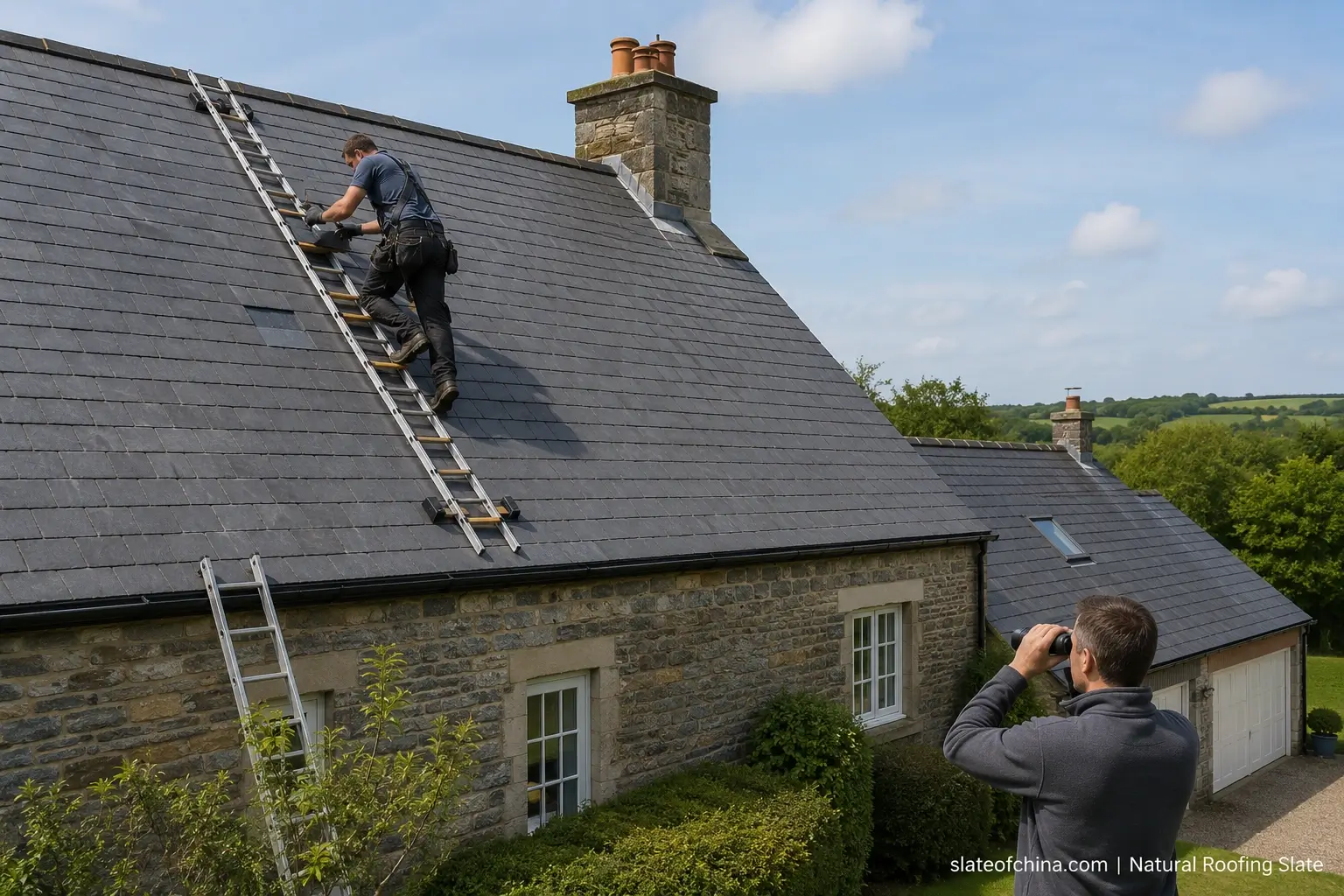
One of the biggest mistakes homeowners make is attempting to inspect a slate roof by walking directly on it.
Natural slate is extremely durable under normal service conditions, but concentrated foot pressure can crack or break individual slates. Inexperienced foot traffic is a common cause of unnecessary roof damage.
For this reason:
- Never walk on a slate roof unless absolutely necessary.
- Use roof ladders and proper access equipment if roof access is required.
- Leave close-up inspections to experienced slate roofing professionals.
Expert Advice: Walking on a slate roof is one of the most common causes of cracked slates—not a recommended inspection method.
When Should You Call a Professional?
Arrange a professional slate roof inspection if you notice any of the following:
- Several missing or slipped slates
- Repeated roof leaks
- Loose ridge tiles
- Damaged chimney flashing
- Signs of nail sickness
- Large areas of moss lifting the slates
- Roof age exceeding 50–70 years without inspection
A professional roofer can safely determine whether only localized repairs are needed or whether larger sections of the roof require attention.
Inspection Methods Comparison
| Inspection Method | Safety | Accuracy | Best For |
|---|---|---|---|
| Ground Inspection | ⭐⭐⭐⭐⭐ | ⭐⭐ | Initial visual check |
| Binoculars | ⭐⭐⭐⭐⭐ | ⭐⭐⭐ | Missing or slipped slates |
| Drone Inspection | ⭐⭐⭐⭐⭐ | ⭐⭐⭐⭐⭐ | Comprehensive roof assessment |
| Roof Access by Professional | ⭐⭐⭐ | ⭐⭐⭐⭐⭐ | Detailed repair planning |
Expert Tip
Most slate roof repairs begin with a simple visual inspection. Finding a damaged slate or loose flashing early can prevent expensive structural repairs later. If you’re unsure about the condition of your roof, use binoculars or a drone—and avoid walking directly on the slate.
Slate Roof Repair Methods
One of the greatest advantages of a natural slate roof is that most repairs can be carried out without replacing the entire roof. Because slate roofs are made from individual tiles, damaged components can often be repaired locally while preserving the surrounding roof.
The appropriate repair method depends on the type of damage. A broken slate requires a different solution from a slipped slate, while flashing failure or valley leaks usually involve repairing the waterproofing system rather than replacing the slate itself.
The following sections explain the most common slate roof repair methods and when they are typically used.
Common Slate Roof Repair Methods
| Roof Problem | Typical Repair Method | Difficulty | Replace Entire Roof? |
|---|---|---|---|
| Broken Slate | Replace individual slate | ⭐ | No |
| Cracked Slate | Replace individual slate | ⭐ | No |
| Slipped Slate | Re-fix or replace fixing | ⭐⭐ | No |
| Flashing Failure | Replace lead/copper flashing | ⭐⭐⭐ | No |
| Loose Ridge | Re-bed or install dry ridge system | ⭐⭐ | No |
| Valley Leak | Repair or replace valley lining | ⭐⭐⭐ | No |
Can You Repair Instead of Replace?
Yes. In most cases, damaged natural slate roofs can be repaired by replacing individual slates or worn components rather than replacing the entire roof.
Replace Individual Slate
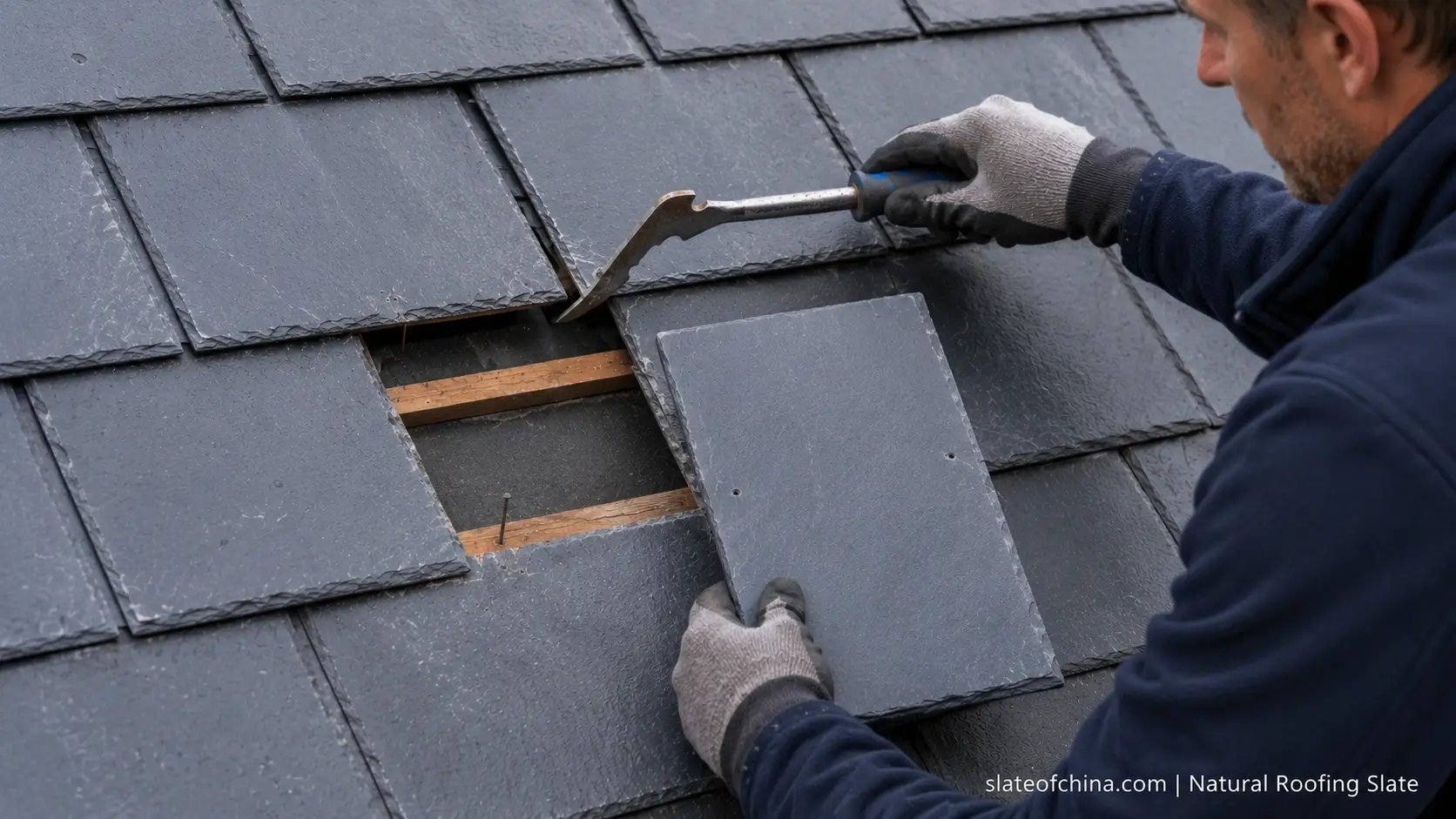
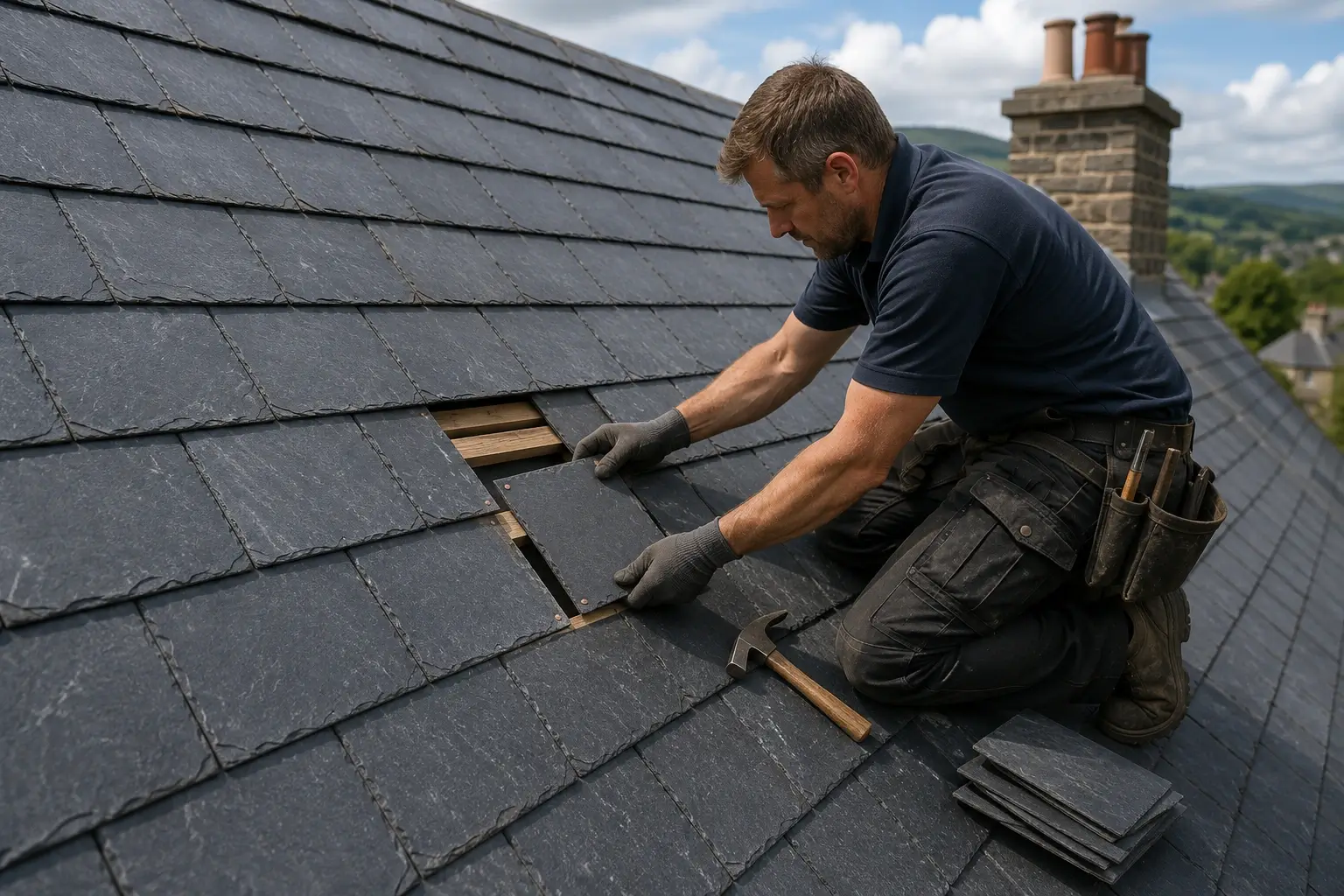
Replacing an individual slate is the most common repair carried out on natural slate roofs. When only one or a few slates are broken or cracked, the surrounding roof can usually remain untouched.
Professional roofers typically remove the damaged slate using a slate ripper, then install a matching replacement slate secured with an appropriate fixing method.
Common materials and tools include:
- Matching natural replacement slate
- Slate ripper
- Copper roofing nails
- Stainless steel or copper slate hook
The replacement slate should match the original roof in size, thickness, colour, and surface texture to maintain both appearance and weather resistance.
Repair Slipped Slates
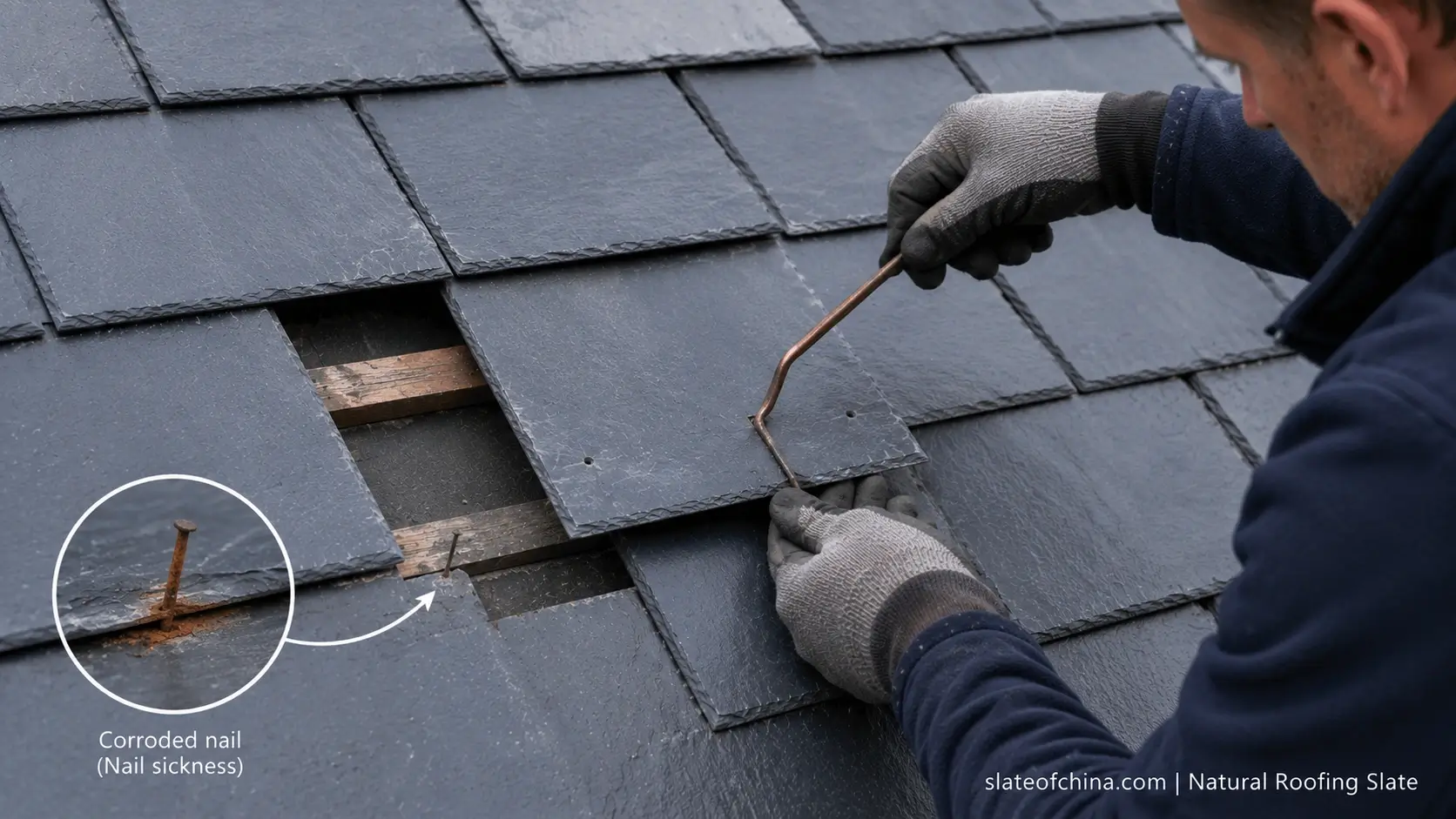
Slipped slates are usually caused by corroded nails, known as nail sickness, rather than damage to the slate itself.
The repair involves removing or stabilising the loose slate and securing it using an appropriate fixing method, such as:
- Copper nail (where access allows)
- Stainless steel slate hook
- Copper slate hook
Prompt repair helps prevent water penetration and stops neighbouring slates from becoming displaced.
Replace Damaged Flashing
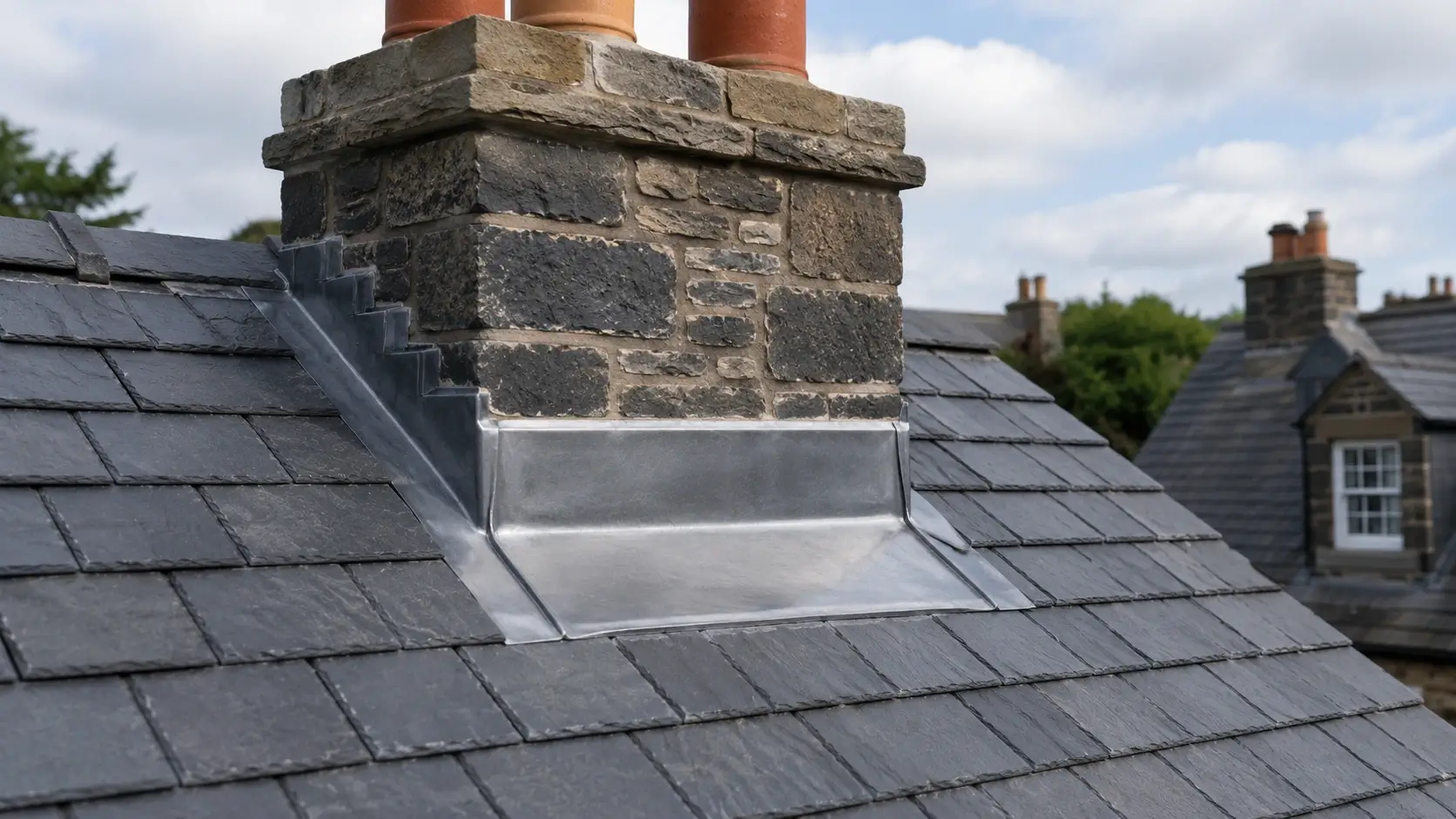
Flashing protects vulnerable roof junctions where water is most likely to enter the building. Over time, lead, copper, or zinc flashing may crack, split, or separate from the masonry.
Instead of replacing surrounding slates, roofers usually replace only the damaged flashing.
Common flashing materials include:
- Lead flashing
- Copper flashing
- Zinc flashing
Properly installed flashing restores the roof’s waterproof performance while preserving the existing slate roof.
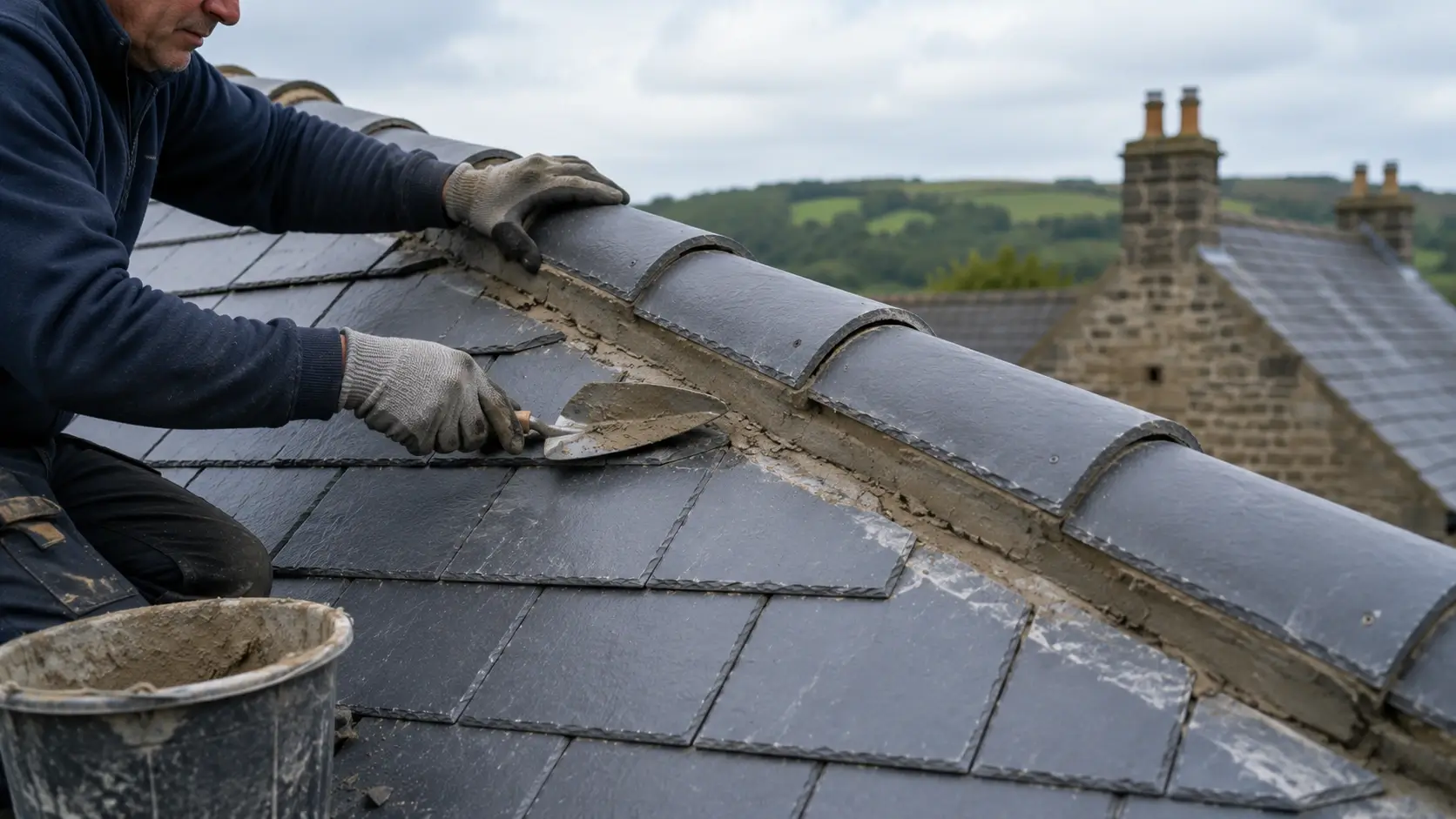
Repair Loose Ridge Tiles
Loose ridge tiles may develop as traditional mortar deteriorates or after severe weather.
Depending on the roofing system, repairs may include:
- Re-bedding ridge tiles with fresh mortar
- Re-pointing deteriorated joints
- Installing a modern dry ridge system for improved durability and ventilation
Early repairs help prevent wind damage and water ingress at the roof ridge.
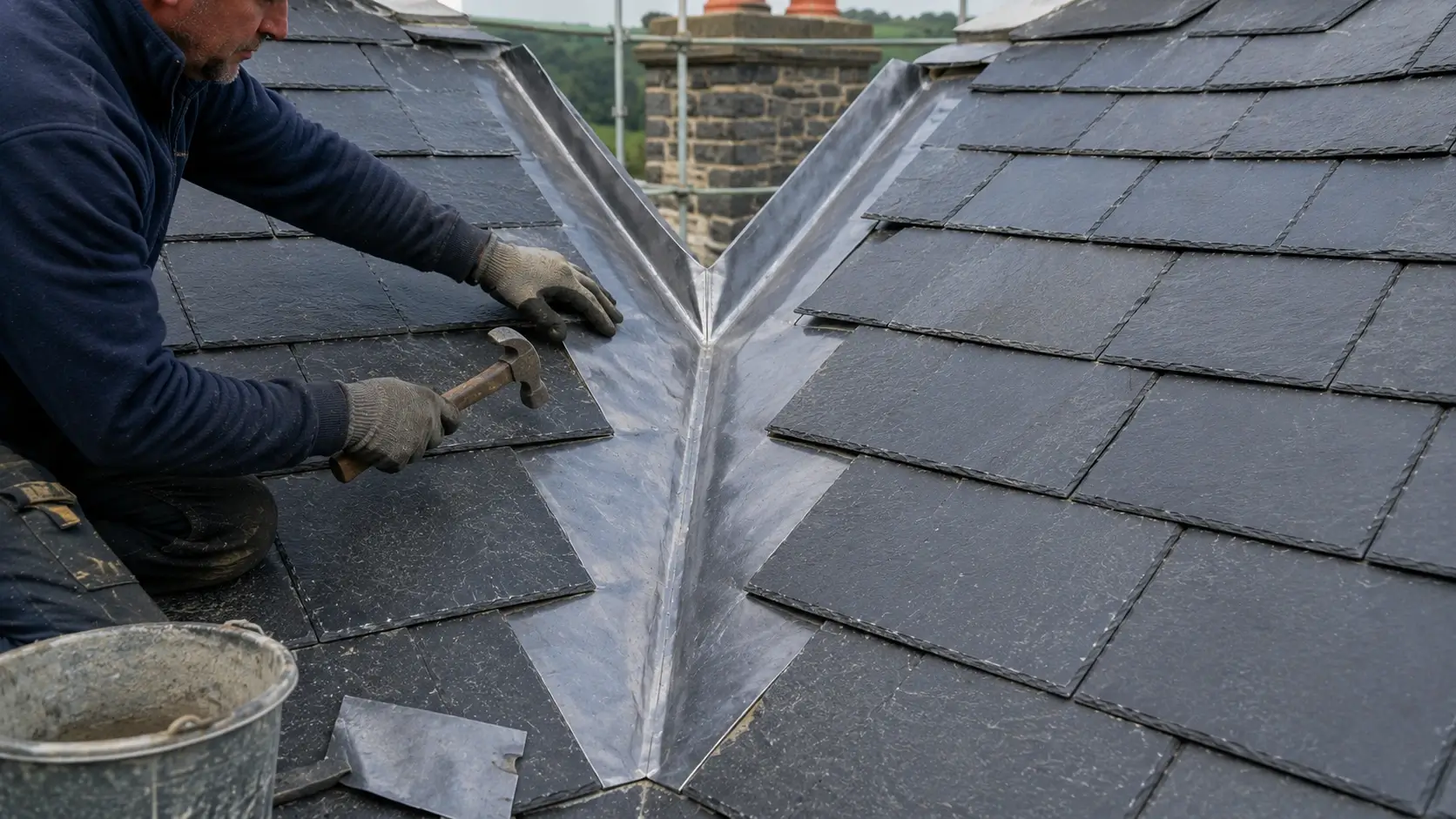
Repair Roof Valleys
Roof valleys collect large volumes of rainwater and are among the most critical waterproofing areas on a slate roof.
Valley repairs usually involve replacing damaged lead lining or repairing the valley flashing rather than replacing the surrounding slates.
Typical valley materials include:
- Lead valleys
- Zinc valleys
- Copper valleys
Maintaining a watertight valley is essential for preventing leaks and protecting the roof structure.
What Makes a Successful Slate Roof Repair?
A high-quality repair depends on more than simply replacing a damaged slate. Professional slate roof repairs should always aim to preserve the roof’s original appearance and long-term performance.
A successful repair should:
- Use matching natural slate
- Maintain the original slate size and thickness
- Use corrosion-resistant fixings
- Preserve the correct headlap and sidelap
- Restore the roof’s waterproof integrity
- Blend seamlessly with the surrounding roof
Expert Tip
Replacing the entire roof is rarely necessary when only a few slates are damaged. In most cases, professional slate roof repairs focus on replacing individual slates or renewing failed components such as flashings or fixings, allowing the original roof to continue performing for many decades.
Can You Repair a Slate Roof Yourself?
Natural slate roofs are designed to be repaired, and many homeowners wonder whether they can carry out repairs themselves. The answer depends on the type of repair, your roofing experience, and—most importantly—your ability to work safely at height.
Simple inspection and maintenance tasks may be suitable for homeowners, but most slate roof repairs require specialist tools, proper fixing techniques, and an understanding of traditional slate roofing practices. An incorrect repair can lead to leaks, cracked slates, or even permanent damage to the roof.
Before attempting any repair, it’s important to understand what can be done safely—and when it’s best to call a professional slate roofer.
DIY Slate Roof Repairs: What You Can and Shouldn’t Do
| Task | DIY Suitable? | Recommendation |
|---|---|---|
| Ground inspection | ✅ Yes | Use binoculars or a drone for safe inspection. |
| Clean leaves and debris from gutters | ✅ Yes | Keep valleys and gutters free of blockages. |
| Inspect after storms | ✅ Yes | Look for missing or slipped slates from the ground. |
| Replace one damaged slate | ⚠️ Only if experienced | Requires specialist tools and correct fixing methods. |
| Repair slipped slates | ❌ Not recommended | Incorrect fixing may cause further damage. |
| Replace chimney flashing | ❌ No | Requires professional flashing installation. |
| Repair roof valleys | ❌ No | Critical waterproofing area requiring specialist skills. |
| Structural roof repairs | ❌ No | Always use an experienced slate roofing contractor. |
DIY Tasks Suitable for Homeowners
Some routine maintenance can be carried out safely without walking on the roof.
Suitable tasks include:
- Inspecting the roof from the ground
- Using binoculars or a drone to identify damage
- Cleaning leaves from gutters and downpipes
- Checking for missing slates after storms
- Looking for interior signs of water leaks
These simple inspections can help detect problems early and reduce future repair costs.
Repairs Best Left to Professionals
Although replacing a single slate may appear straightforward, most slate roof repairs require specialist knowledge and tools.
Professional roofers understand:
- Correct slate headlap and sidelap
- Matching slate size and thickness
- Copper nail and slate hook installation
- Traditional lead flashing details
- Valley waterproofing systems
Improper repairs often create new leaks that are more expensive to fix than the original problem.
Why Walking on a Slate Roof Can Cause Damage
One of the most common mistakes is walking directly on a slate roof without the proper equipment.
Natural slate is exceptionally durable in service, but individual slates can crack under concentrated foot pressure. Inexperienced roof access is a frequent cause of broken slates and unnecessary repairs.
If close access is required, professional roofers use:
- Roof ladders
- Roof hooks
- Safety harnesses
- Appropriate access equipment
Avoid climbing onto a slate roof unless you have the necessary training and equipment.
When You Should Always Call a Professional
Professional slate roofing contractors are recommended whenever the repair involves:
- Multiple broken or missing slates
- Slipped slates caused by nail sickness
- Damaged lead flashing
- Roof valleys
- Ridge tile repairs
- Persistent roof leaks
- Historic or heritage slate roofs
- High or steep roofs
These repairs require specialist skills to preserve both the appearance and waterproof performance of the roof.
DIY vs Professional Slate Roof Repair
| Factor | DIY | Professional Roofer |
|---|---|---|
| Safety | ⭐⭐ | ⭐⭐⭐⭐⭐ |
| Repair Quality | ⭐⭐ | ⭐⭐⭐⭐⭐ |
| Waterproof Performance | ⭐⭐ | ⭐⭐⭐⭐⭐ |
| Long-Term Reliability | ⭐⭐ | ⭐⭐⭐⭐⭐ |
| Cost | Lower upfront | Better long-term value |
Expert Advice
Replacing a single slate may be within the capabilities of experienced homeowners, but most slate roof repairs should be carried out by qualified professionals. Proper repair techniques help preserve the roof’s original appearance, prevent water ingress, and extend its service life for decades.
Can you repair a slate roof yourself?
Yes—for simple inspections and routine maintenance. However, repairs involving slates, flashing, valleys, ridge tiles, or structural components should normally be carried out by an experienced slate roofing professional.
How Much Does Slate Roof Repair Cost?
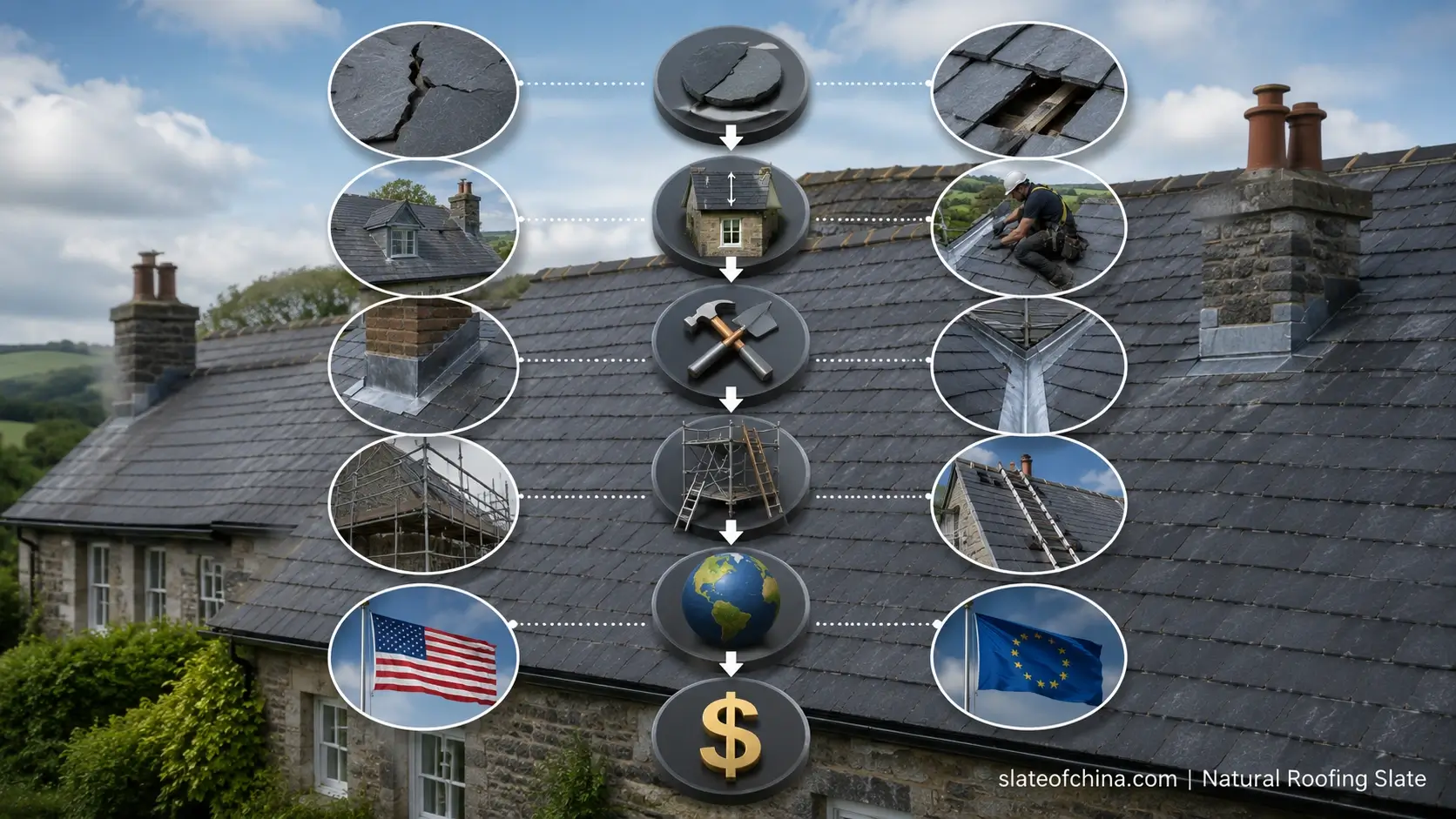
Slate roof repair costs vary considerably depending on the type of damage, the number of slates affected, roof height, access conditions, local labour rates, and whether scaffolding is required.
Replacing one damaged slate is usually a relatively small repair. However, work involving chimney flashing, roof valleys, ridge tiles, widespread nail sickness, or structural damage can cost significantly more because it requires specialist skills and additional access equipment.
In the United States, current published estimates commonly place a typical slate roof repair at approximately $785–$3,257, although small localized repairs may cost less and extensive work may cost considerably more.
The figures below are intended only as general planning guidance. Actual slate roof repair prices should always be confirmed by an experienced local roofing contractor.
Slate Roof Repair Cost at a Glance
Last updated: 2026
| Repair Type | Relative Cost | Main Cost Driver |
|---|---|---|
| Replace one broken or cracked slate | $$ | Minimum call-out, access and matching slate |
| Repair one slipped slate | $$ | Fixing method and roof access |
| Replace chimney flashing | $$$ | Metalwork, chimney size and scaffolding |
| Repair loose ridge tiles | $$$ | Length of ridge and mortar condition |
| Repair a roof valley | $$$$ | Waterproofing detail and surrounding slate removal |
| Repair widespread nail sickness | $$$$ | Number of affected slates and extent of re-slating |
How to explain the symbols
- $$ — Localized repair: Normally limited to one or several slates.
- $$$ — Specialist repair: Involves flashing, ridge details or more difficult access.
- $$$$ — Complex repair: Involves valleys, widespread fixing failure or extensive dismantling.
Cost to Replace One Slate
Replacing one broken, cracked, or missing slate is normally one of the least expensive types of slate roof repair. However, homeowners are rarely paying only for the replacement stone. The quotation may also include:
- Roofer call-out charges
- Safe roof access
- Removal of the damaged slate
- A matching replacement slate
- Copper nails or a slate hook
- Inspection of the surrounding roof area
In the United States, published contractor estimates commonly place a single-slate replacement at around $200–$500, while the final cost can rise when the roof is steep, high, difficult to access, or requires special equipment.
In the United Kingdom, replacing a small group of up to five roof tiles is currently estimated at approximately £170–£500, with scaffolding or additional repairs charged separately. Slate-specific work may cost more where specialist labour or matching natural slate is required.
Important: The price per slate is often misleading. For a one-slate repair, access and labour may cost substantially more than the replacement slate itself.
Cost to Repair or Replace Flashing
Flashing repairs generally cost more than replacing an individual slate because the roofer may need to remove surrounding slates, form new metalwork, and create a watertight junction around the chimney, wall, skylight, or roof intersection.
Typical cost factors include:
- Lead, copper or zinc selection
- Size and shape of the chimney
- Condition of mortar joints
- Amount of slate that must be lifted
- Scaffolding or specialist access
- Whether the flashing is patched or completely replaced
Published U.S. estimates commonly place slate-roof flashing work between roughly $800 and $2,500, depending on its extent and complexity.
UK pricing guides quote general lead-flashing repairs at approximately £50–£70 per metre, but a complete chimney-flashing repair can cost considerably more once access, removal and reinstatement are included.
Ireland-based pricing examples place re-flashing work at approximately €500–€1,500, depending on complexity and accessibility. These figures can be used only as a broad European indication because labour costs differ substantially between countries and cities.
Ridge Tile Repair Cost
Loose ridge tiles may only require local re-pointing, but badly deteriorated mortar may require the ridge tiles to be removed and re-bedded. A dry ridge conversion is generally a larger project.
The cost depends on:
- Number of loose ridge tiles
- Total ridge length
- Condition of the old mortar
- Traditional mortar or dry ridge system
- Height and accessibility of the roof
A UK cost guide currently estimates common ridge tile repairs at approximately £50–£70 per metre, before allowing for unusual access requirements or extensive rebuilding.
For homeowners, the key question is not simply the price per tile, but whether the mortar failure is localized or extends along the entire ridge.
Roof Valley Repair Cost
Roof valley repair is normally one of the more expensive slate roof repairs because valleys carry large volumes of rainwater and must remain continuously watertight.
The repair may involve:
- Carefully removing surrounding slates
- Removing deteriorated valley lining
- Installing new lead, copper, zinc or another approved system
- Re-cutting and reinstating adjacent slates
- Correcting defective falls or drainage
- Replacing damaged underlayment or battens
Ireland-based repair estimates place valley work at approximately €400–€1,100, while costs may be higher for long valleys, heritage roofs, complex intersections, or extensive hidden damage.
Avoid presenting a universal “cost per metre” for natural-slate valleys unless the material, valley design and access conditions are clearly defined.
Typical Slate Roof Repair Costs by Region
| Region | Indicative Published Range | Notes |
|---|---|---|
| United States | $785–$3,257 for many typical slate repairs | Complex repairs may exceed this range |
| United Kingdom | £150–£3,000+ across minor to major roof repairs | London, scaffolding and specialist slate work may cost more |
| Europe | €500–€5,000 as a broad repair indication | Costs vary considerably by country; obtain local quotations |
Current U.S. guides broadly support the $785–$3,257 range for common slate repair projects. UK sources place general roof repairs from roughly £150 into several thousand pounds, while Ireland-based sources provide a broad €500–€5,000 indication for roof repair work. These figures are not directly interchangeable because their scope and local labour markets differ.
Recommended disclaimer below the table
Price Notice: These figures are approximate regional estimates for budgeting purposes only. Actual slate roof repair costs vary by location, roof condition, access requirements, material specification, contractor experience, taxes, and permit or scaffolding requirements.
What Affects Slate Roof Repair Cost?
1. Roof Height and Access
A low, easily accessible roof generally costs less to repair than a steep, multi-storey roof requiring scaffolding, lifting equipment, or additional fall protection.
2. Type and Extent of Damage
One broken slate is a localized repair. Nail sickness, valley failure, structural decay, or repeated leaking can involve a much larger working area.
3. Matching Replacement Slate
The replacement should match the existing slate in:
- Size
- Thickness
- Colour
- Texture
- Edge finish
Custom cutting, unusual historic sizes, or difficult colour matching can increase both material and labour costs.
4. Metal Used for Flashing
Lead, copper and zinc have different material costs, forming requirements and expected service lives. Complex custom-made flashing costs more than a small local patch.
5. Scaffolding and Safety Equipment
For small jobs, scaffolding can represent a large percentage of the total quotation. This explains why replacing one slate may cost much more than the value of the slate itself.
6. Hidden Damage
Water penetration may damage the underlayment, battens, roof deck or structural timber. These problems are often only discovered after the surrounding slate has been removed.
7. Historic or Listed Buildings
Heritage properties may require traditional materials, approved repair details and specialist craftsmanship, increasing both project time and cost.
How to Get an Accurate Slate Roof Repair Quote
Ask the contractor to provide a written quotation that clearly separates:
- Roof inspection
- Labour
- Replacement slate
- Flashing or valley materials
- Scaffolding and access
- Disposal of damaged materials
- Timber or underlayment repairs
- Taxes and permits
- Repair warranty
Where possible, obtain two or three comparable quotations from contractors with proven natural-slate experience. The cheapest quotation is not always the best value if it relies on visible sealants, incorrect fixings, mismatched slate, or short-term patch repairs.
Questions to Ask a Slate Roofer
- Is the leak caused by the slate, flashing, valley or roof structure?
- How many slates need to be removed?
- Will the replacement slate match the existing size and thickness?
- Are copper nails or suitable slate hooks being used?
- Is scaffolding included in the quotation?
- Could hidden timber damage increase the final price?
- Is the repair covered by a workmanship warranty?
What Affects Slate Roof Repair Cost?
🏠 Roof Size & Access
Higher or steeper roofs usually require more labour and safety equipment.
🪨 Type of Damage
Replacing one slate costs far less than repairing valleys or flashing.
🧰 Repair Complexity
Simple slate replacement is quicker than structural roof repairs.
🧱 Materials
Lead, copper, zinc and matching natural slate all influence cost.
👷 Labour & Scaffolding
Access equipment often represents a significant part of the quotation.
🌍 Your Location
Labour rates vary greatly between countries and even between cities.
Professional inspection is the only reliable way to estimate slate roof repair costs accurately.
Expert Tip
For small slate roof repairs, labour and safe access usually influence the quotation more than the cost of the replacement slate. A professional localized repair may appear expensive per slate, but it can preserve the original roof and avoid the much greater cost of premature replacement.
Quick Answer
How much does slate roof repair cost?
A localized repair may cost a few hundred dollars, pounds or euros, while flashing, ridge, valley or widespread fixing repairs can cost several thousand. The most accurate price can only be determined after inspecting the damage, roof access and surrounding components.
How Long Does Slate Roof Repair Last?
How long does slate roof repair last?
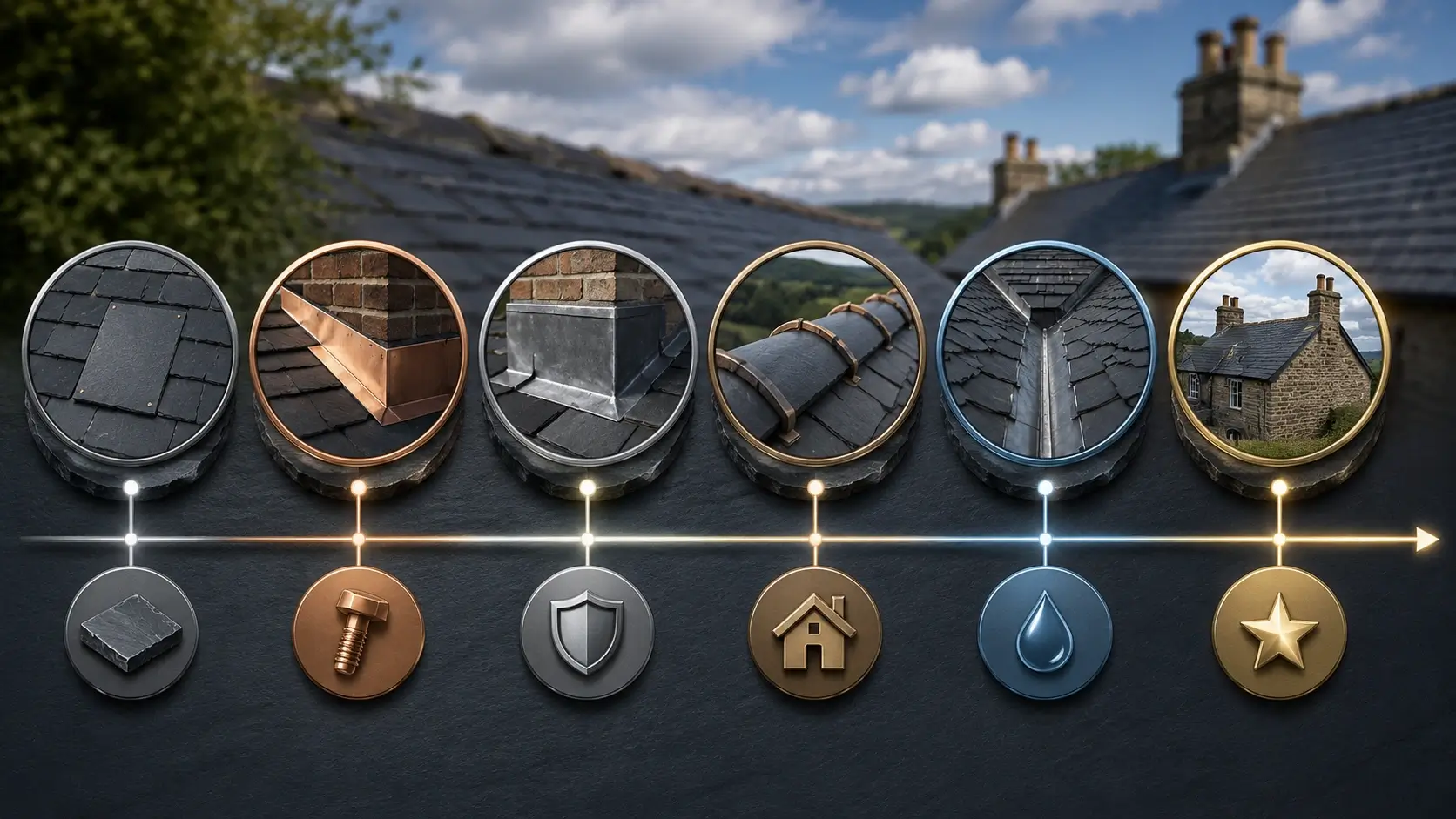
A professionally repaired natural slate roof can often last several decades. Replacing individual slates may provide 50–100+ years of service, while new copper or lead flashing typically lasts 40–80 years, depending on the material, workmanship, and local climate.
One of the most common questions homeowners ask is whether a slate roof repair is a temporary fix or a long-term solution.
In most cases, a properly completed slate roof repair should last for decades, especially when high-quality natural slate, corrosion-resistant fixings, and appropriate flashing materials are used.
Unlike temporary patch repairs or roof sealants, professional slate roof repairs are designed to restore the roof’s original performance rather than simply stop a leak for a short period.
Proper repairs restore the original service life of a natural slate roof.
For this reason, replacing a damaged slate or renewing worn flashing is often far more cost-effective than replacing the entire roof.
Expected Lifespan of Common Slate Roof Repairs
| Repair Type | Typical Service Life* | Notes |
|---|---|---|
| Replace one natural slate | 50–100+ years | When a matching high-quality slate is correctly installed. |
| Replace several slates | 50–100+ years | Individual repairs can last as long as the surrounding roof. |
| Copper flashing replacement | 50–80 years | Excellent durability and corrosion resistance. |
| Lead flashing replacement | 40–70 years | Depends on lead thickness, workmanship and exposure. |
| Ridge tile repair | 20–40 years | Traditional mortar may require maintenance over time. |
| Dry ridge system | 30–50 years | Less maintenance than traditional mortar bedding. |
| Roof valley repair | 40–70 years | Proper installation and drainage are essential. |
| Professional slate roof repair | Several decades | Often comparable to the remaining lifespan of the original roof. |
Actual service life depends on climate, workmanship, maintenance, roof exposure, and material quality.
Replacing a Damaged Slate
Replacing a single broken or cracked slate is one of the most durable repairs that can be made to a natural slate roof.
If the replacement slate matches the original in:
- Size
- Thickness
- Surface texture
- Weather resistance
and is installed using appropriate copper nails or a slate hook, it can often perform for 50 to 100 years or more.
In many cases, the new slate will last as long as the surrounding roof.
Flashing Repairs
Although natural slate may last well over a century, flashing materials generally have a shorter service life.
Typical expectations are:
- Copper flashing: 50–80 years
- Lead flashing: 40–70 years
- Zinc flashing: 30–50 years (depending on local climate)
Professional installation is just as important as the material itself. Poorly detailed flashing can fail long before the metal reaches the end of its expected lifespan.
Ridge and Valley Repairs
Roof ridges and valleys experience constant exposure to wind and rain.
Their lifespan depends largely on:
- Waterproof detailing
- Drainage performance
- Mortar quality
- Installation workmanship
- Roof movement over time
Modern dry ridge systems generally require less maintenance than traditional mortar bedding.
Similarly, a correctly installed lead-lined valley can provide decades of reliable waterproof performance.
What Determines How Long a Repair Will Last?
The lifespan of a slate roof repair depends on much more than simply replacing the damaged component.
The most important factors include:
- Quality of the replacement slate
- Correct headlap and sidelap
- Copper or stainless-steel fixings
- Professional installation
- Roof ventilation
- Climate and weather exposure
- Regular roof inspections
Even the highest-quality natural slate cannot perform well if it is installed incorrectly.
Temporary Repairs vs Professional Repairs
Not all roof repairs are designed to last.
Temporary emergency repairs—such as roof sealants, roofing cement, or adhesive patches—may stop a leak for a short period, but they do not restore the original roofing system.
A professional slate roof repair replaces failed components with suitable materials and correct installation methods, providing a much longer service life.
| Repair Type | Expected Performance |
|---|---|
| Temporary patch or sealant | Short-term emergency solution |
| Proper slate replacement | Long-term repair |
| Professional flashing replacement | Long-term waterproof protection |
| Complete professional repair | Restores long-term roof performance |
How to Extend the Life of Slate Roof Repairs
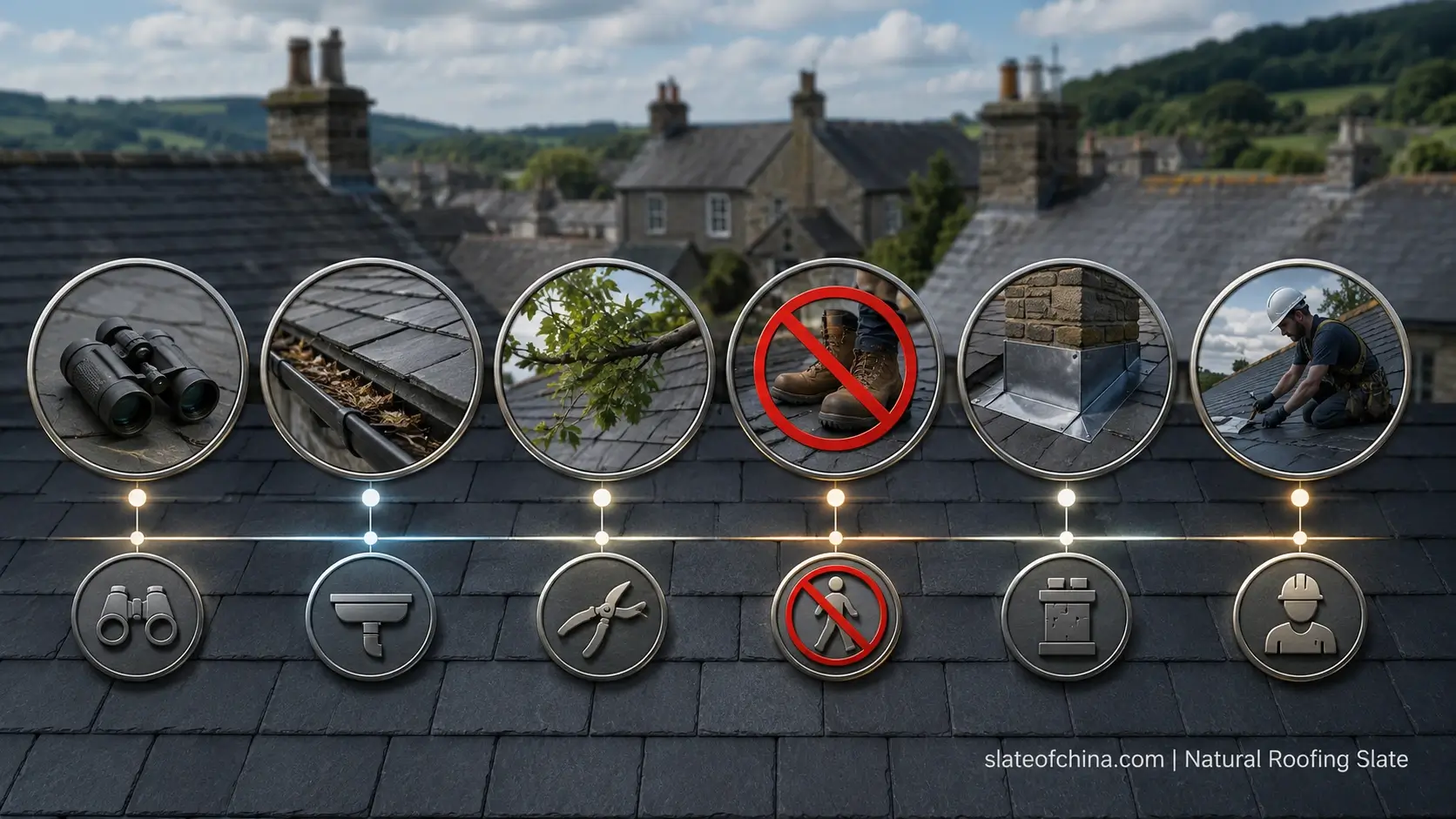
Homeowners can maximise the lifespan of repairs by following a few simple maintenance practices:
- Inspect the roof after severe storms.
- Keep gutters and roof valleys clear of leaves and debris.
- Avoid walking directly on slate roofs.
- Repair damaged flashing promptly.
- Replace slipped or broken slates before water penetration occurs.
- Schedule periodic inspections by an experienced slate roofing contractor.
Preventive maintenance is often the most cost-effective way to protect both the repair and the original roof.
Expert Tip
A professional slate roof repair is not a temporary patch—it is a restoration of the original roofing system. When matching natural slate, durable fixings, and correct installation methods are used, many repairs can perform for several decades and, in some cases, as long as the surrounding roof itself.
How long does slate roof repair last?
A professionally repaired natural slate roof can often last several decades. Replacing individual slates may provide 50–100+ years of service, while new copper or lead flashing typically lasts 40–80 years, depending on the material, workmanship, and local climate.
How to Prevent Future Slate Roof Damage
Natural slate is one of the most durable roofing materials available, but even the highest-quality slate roof can suffer damage if routine maintenance is neglected.
Fortunately, most common slate roof problems—including broken slates, slipped slates, flashing failure, and roof leaks—can be prevented through regular inspections and timely maintenance.
A proactive maintenance plan not only reduces repair costs but also helps preserve the beauty, weather resistance, and exceptional lifespan of your slate roof.
Preventive maintenance is always more affordable than major roof repairs or premature roof replacement.
Preventive Maintenance Checklist
| Maintenance Task | Recommended Frequency | Benefit |
|---|---|---|
| Inspect the roof from the ground | Twice a year | Detect damage before leaks develop |
| Check the roof after storms | After severe weather | Identify broken or missing slates early |
| Clean gutters and valleys | At least once a year | Prevent water backup and overflow |
| Trim overhanging tree branches | As needed | Reduce impact damage from falling limbs |
| Inspect flashing and roof junctions | Every 2–3 years | Prevent water penetration around chimneys and valleys |
| Replace damaged slates promptly | Immediately after discovery | Stop minor damage from becoming major repairs |
| Schedule a professional roof inspection | Every 3–5 years | Identify hidden problems before they worsen |
Inspect Your Roof Every Year
Routine inspections are the simplest way to identify small problems before they become expensive repairs.
Without climbing onto the roof, look for signs such as:
- Broken or cracked slates
- Missing slates
- Slipped slates
- Loose ridge tiles
- Damaged flashing
- Debris collecting in roof valleys
Annual inspections help detect problems while repairs are still straightforward and cost-effective.
Keep Gutters and Roof Valleys Clean
Leaves, moss, twigs, and other debris can block gutters and roof valleys, preventing rainwater from draining properly.
Poor drainage may lead to:
- Water backing up beneath the slates
- Flashing deterioration
- Valley leaks
- Freeze-thaw damage in colder climates
Cleaning gutters regularly is one of the easiest ways to protect the waterproof performance of a slate roof.
Trim Overhanging Trees
Tree branches hanging over a roof present several risks:
- Falling branches can crack or break individual slates.
- Leaves and seeds can clog gutters and valleys.
- Excessive shade encourages moss and algae growth.
- Branches rubbing against the roof during high winds may damage the slate surface.
Maintaining a safe clearance between trees and the roof helps reduce storm-related damage.
Avoid Walking on Slate Roofs
Walking directly on a slate roof is one of the most common causes of cracked and broken slates.
Natural slate is exceptionally durable under normal service conditions, but concentrated foot pressure can crack individual tiles.
Unless you have professional roofing experience and appropriate access equipment, inspections should be carried out from the ground using:
- Binoculars
- A drone
- Professional roof inspection services
Avoid unnecessary foot traffic to preserve the roof’s appearance and long-term performance.
Replace Damaged Flashing Before Leaks Develop
Many slate roof leaks are caused by failing flashing rather than damaged slate.
Inspect areas around:
- Chimneys
- Roof valleys
- Dormers
- Skylights
- Wall intersections
Replacing deteriorated lead, copper, or zinc flashing early can prevent extensive water damage to the roof structure.
Choose Experienced Slate Roofing Professionals
Natural slate roofing requires specialist knowledge that differs significantly from asphalt shingles, metal roofing, or concrete tiles.
Experienced slate roof contractors understand:
- Correct slate overlap (headlap and sidelap)
- Matching replacement slate
- Traditional fixing methods
- Lead flashing installation
- Valley waterproofing
- Historic and heritage roof repairs
Professional workmanship helps ensure repairs last for decades rather than only a few years.
Best Practices for Long-Term Slate Roof Performance
✔ Inspect the roof regularly.
✔ Keep gutters, valleys, and downpipes clear.
✔ Replace damaged slates promptly.
✔ Repair flashing before leaks occur.
✔ Avoid walking directly on the roof.
✔ Hire experienced slate roofing professionals for repairs.
Following these simple practices can significantly reduce the likelihood of costly repairs and help your natural slate roof continue performing for more than a century.
Expert Tip
Most slate roof failures are not caused by the slate itself. They result from neglected maintenance, aging flashing, blocked drainage, or damaged fixings. Regular inspections and timely repairs are the most effective way to maximise the lifespan of a natural slate roof.
Continue Learning About Slate Roof Care
Repairing damage is only one part of protecting a natural slate roof. Routine maintenance plays an equally important role in preserving its waterproof performance, appearance, and exceptional service life.
For a complete maintenance checklist, seasonal care tips, and professional maintenance recommendations, continue reading our Slate Roof Maintenance Guide.
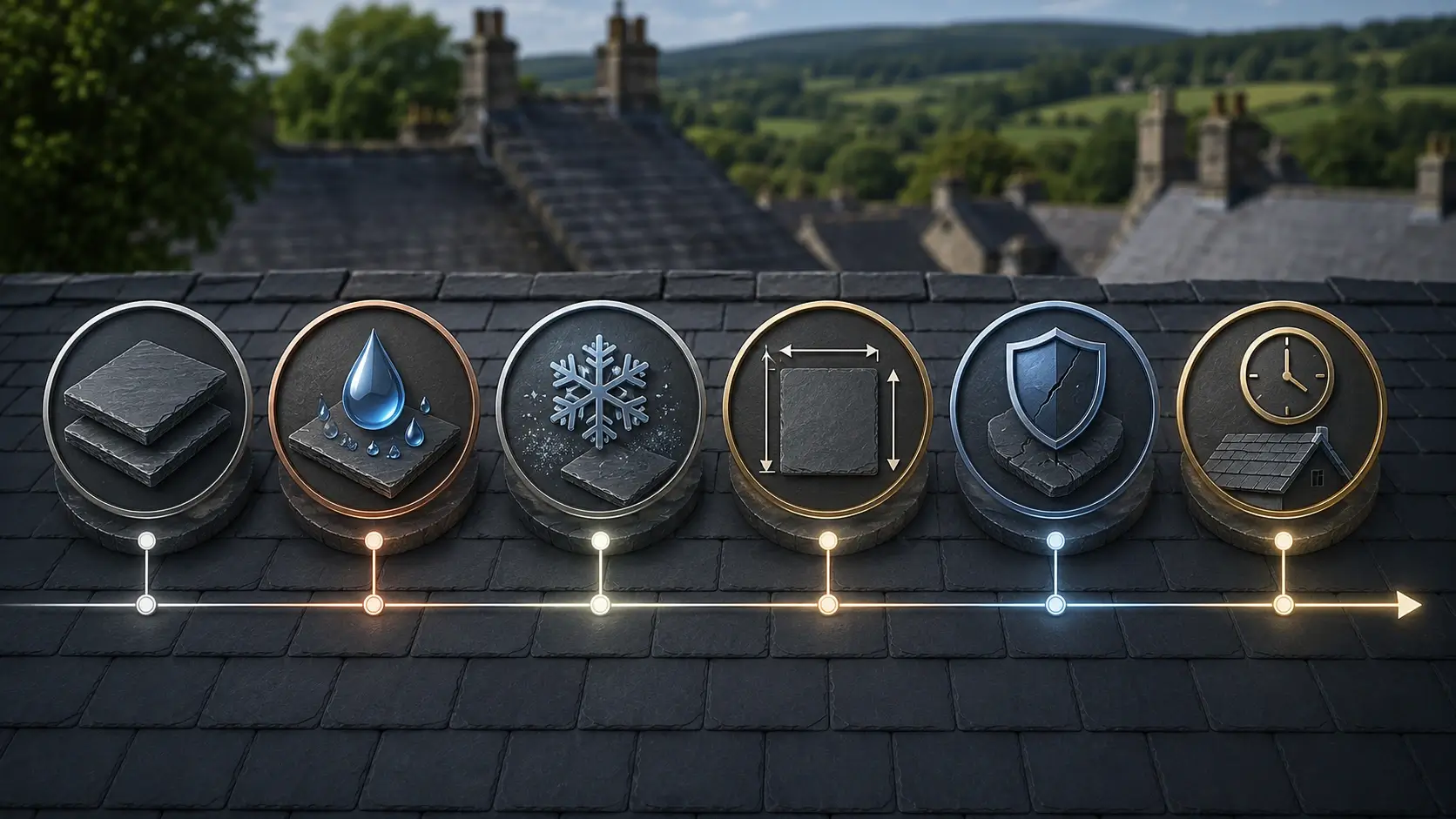
Why Quality Slate Matters
Not all natural slate performs the same.
The frequency of future repairs depends not only on installation quality and maintenance but also on the quality of the slate itself. Dense, durable roofing slate with low water absorption and excellent dimensional stability is less likely to crack, delaminate, or deteriorate over time.
Choosing high-quality natural roofing slate at the beginning of a project can significantly reduce maintenance requirements, extend the roof’s service life, and lower long-term repair costs.
A high-quality slate roof is not only built to last—it is built to require fewer repairs throughout its lifetime.
Why Material Quality Influences Roof Repairs
| Slate Quality Factor | Benefit | Effect on Future Repairs |
|---|---|---|
| High density | Stronger and more durable | Less breakage and impact damage |
| Low water absorption | Reduced moisture penetration | Better freeze–thaw resistance |
| Excellent freeze–thaw resistance | Withstands repeated winter cycles | Fewer cracks and delamination |
| Dimensional stability | Maintains consistent shape | Easier replacement and better roof alignment |
| High splitting quality | Accurate thickness and smooth installation | More reliable weatherproof performance |
| Long natural durability | Longer service life | Lower lifetime maintenance costs |
High-Density Slate Resists Breakage
High-density natural slate has a compact internal structure that provides excellent strength and durability.
Compared with lower-quality stone, dense slate is generally more resistant to:
- Impact from falling branches
- Hail damage
- Edge chipping
- Surface wear
- Everyday weather exposure
Greater strength means fewer broken slates and fewer replacement repairs over the lifetime of the roof.
Low Water Absorption Improves Durability
Water absorption is one of the most important indicators of roofing slate quality.
When a slate absorbs very little moisture, it is less susceptible to:
- Freeze–thaw damage
- Internal cracking
- Delamination
- Surface deterioration
- Premature weathering
This is particularly important in regions with cold winters and repeated freeze–thaw cycles.
Excellent Freeze–Thaw Resistance
In cold climates, moisture trapped inside poor-quality slate can expand when frozen, gradually weakening the stone.
High-quality roofing slate with excellent freeze–thaw resistance maintains its structural integrity even after many years of seasonal temperature changes.
As a result, the roof requires fewer repairs caused by cracked or deteriorated slates.
Dimensional Stability Makes Repairs Easier
Consistent dimensions are often overlooked, but they are essential for both installation and future repairs.
Quality roofing slate maintains:
- Uniform thickness
- Accurate width and length
- Stable shape over time
When repairs are required many years later, matching replacement slates fit more easily without disrupting the surrounding roof.
This helps preserve both appearance and waterproof performance.
Less Breakage Means Lower Lifetime Costs
Every broken slate represents:
- A repair visit
- Labour costs
- Roof access expenses
- Potential water ingress
Reducing the number of damaged slates throughout the roof’s life can significantly lower total ownership costs.
For many homeowners, investing in better-quality slate at the beginning is more economical than paying for frequent repairs later.
Why Jiujiang Roofing Slate Is Widely Used
Jiujiang roofing slate has been supplied to international roofing markets for decades and is widely used in residential, commercial, and heritage projects.
Its popularity is largely due to a combination of practical performance characteristics, including:
- High natural density
- Low water absorption
- Excellent freeze–thaw resistance
- Good dimensional consistency
- Attractive blue-grey appearance
- Long-term durability in demanding climates
These characteristics help reduce the likelihood of premature deterioration and support reliable long-term roof performance when the slate is correctly installed and maintained.
Long-Term Value Beyond Initial Cost
The lowest-priced roofing slate is not always the most economical choice.
When evaluating roofing materials, it is important to consider:
- Expected service life
- Frequency of repairs
- Maintenance requirements
- Replacement costs
- Long-term appearance
A roof that requires fewer repairs over many decades often provides better overall value than a lower-cost roof needing repeated maintenance.
Expert Tip
High-quality natural slate does more than improve the appearance of a roof—it helps reduce future repairs, extends service life, and lowers lifetime ownership costs. Selecting durable roofing slate from a reliable supplier is one of the most effective ways to protect your long-term investment.
Related Reading
To learn more about selecting durable roofing slate, explore these guides:
Frequently Asked Questions (FAQ)
Continue Exploring Our Roofing Slate Guides
Whether you’re planning a new roof, repairing an existing slate roof, or comparing different roofing materials, our expert guides can help you make informed decisions.
You may also find these resources useful: