
Slate Placemats & Tableware Accessories: Natural Stone Placemats, Cheese Boards & Serving Slates
One stone, three jobs at the table — and the most expensive mistakes in slate tableware begin the day those jobs are treated as one product. Natural slate placemats are bought to protect the table and frame the plate. Slate cheese boards and serving slates are bought to present food. Small table accessories are bought to carry the look of the family. None of them is a chopping board. The formats can be identical and the finishes can match, but each job imposes its own surface treatment, its own care regime and its own line on the purchase order — which is why this guide keeps the three apart section by section, and closes each section with what those distinctions mean in writing.
This is the range page of the Crafts & Giftware section of the Jiujiang Slate Guide. Where the coaster page follows a single object through a careful buyer's hands, this page works the other way around: it maps the whole product family, because placemats, boards and accessories are usually sourced together — quoted in one programme, packed in one shipment, ranged together by homeware importers, hospitality groups, gift and kitchenware retailers, and private-label brands building a stone tableware collection. The readers range from a restaurant group comparing serving formats to a brand owner deciding whether slate fits next season's range. What they share is that none of them can afford to buy the words "natural slate" and assume the rest.
Two words need handling before anything else: heat-resistant and easy-clean. Both sit in this page's own description, both are used loosely across the industry, and both are true only in narrow, testable ways. Slate tolerates ordinary dinner-service temperatures better than most table surfaces — and "tolerant at dinner temperatures" is a very different claim from "rest any pot from the stove on it". A smooth, well-finished slate face wipes down readily — and that is a different statement from "stain-proof" or "dishwasher-safe". The sections below take both words seriously, as claims to be specified, evidenced and written onto an order, not as properties inherited from the stone.
Slate placemats protect the table; slate cheese boards and slate serving boards present food; none of the three doubles as a cutting board. Specify each product for one declared use — finish, edge, thickness and tolerances are set per product, never per material. Treat "heat-resistant" and "food-safe" as claims about a finished article (stone plus any sealer, pads and adhesive) under the rules of the market it ships to — not as properties of natural slate in general. And assume hand washing with mild detergent until a supplier's evidence supports anything stronger. The eleven sections below walk each position in turn and translate it into order language.
Explore Slate Tableware Products
The current range runs from cheese boards to serving pieces; placemats and table mats are developed against a specification. Browse what is available now, or read on for the specification language behind every product in this family.
- Slate cheese boards — bamboo-framed and creative shapes, from the current range
- Slate serving trays and tabletop pieces for dining and presentation
- Slate table mats and placemats — developed to your specification
- Custom shapes, finishes and retail packaging for brand programmes
One Stone, Three Jobs: What Counts as Slate Tableware
Slate tableware accessories are products cut and finished from natural slate for dining, food presentation and tabletop decoration: placemats, cheese boards, serving slates and small table pieces such as trays and boards that belong to a set without touching a plate. They are supplied as individual pieces, as coordinated sets, or as custom programmes for retail ranges and hospitality operations. The material is shared; the specification is not.
A placemat works under a warm dinner plate and takes the table's daily abuse, and nothing more is asked of it. A serving slate presents food directly, and inherits everything that follows from that — finish decisions, cleaning regimes, food-contact questions. A decorative piece answers to neither demand, only to its own appearance and its place in the range. The format can be identical across all three; the specification never is.
| PRODUCT | THE JOB YOU ARE BUYING | WHAT IT IS NOT | WHAT THE ORDER MUST DECLARE |
|---|---|---|---|
| Slate placemat | Protects the table and frames each place setting | Not a trivet for unrestricted heat; not a prep surface | Dimensions with tolerances, thickness, corner profile, feet if fitted |
| Slate cheese board | Presents cheese with its accompaniments | Not a cutting board — spreading yes, chopping no | Declared use, face finish, edge profile |
| Slate serving slate / board | Presents prepared, ready-to-eat food | Not cookware, not ovenware, not dishwasher-safe by default | Food-contact position, finish, care instruction |
| Small table accessory | Carries the range's look — trays, small boards, set pieces | Not load-bearing tableware | Role in the set, finish, packaging |
The most common mislabel in this category is the "slate cutting board". Cutting on stone is bad for both parties: knives leave grey scratches across the face, and a blade edge meets stone the way blades prefer not to. A presentation board can host a spreading knife; it is not built for the work of a chef's knife, and a product genuinely marketed for food preparation is a different class of goods with its own testing, not a sturdier version of a serving slate. Buyers who intend a real prep product develop it as its own project.
ON THE ORDER: a declared intended use on every product line — protection, presentation or decoration. Finish, inspection criteria and packaging all follow from that one word.
What Slate Brings to the Table — and What It Doesn't
Natural slate arrives at the table with a colour range drawn from its geology: charcoal, grey and the blue-grey family that runs through the Lushan–Xingzi slate belt. Dark, quiet and mineral, it sits comfortably under white porcelain and bright linen, and it complements wood, stainless steel and glass without competing with any of them. No two pieces from one order are perfectly identical, and that variation is part of what customers buy — up to the limit the buyer defines. The difference between authentic character and a problem batch is a written variation standard plus an approved reference sample, and nothing else.
As a working surface, slate is a dense natural stone that gives plates and serving dishes a firm, flat, stable footing, in thin formats that printed stone-look imitations never quite reproduce honestly. The weight is part of the product's argument: a slate placemat stays where the service puts it. That same rigidity is why the care questions in the later sections exist — thin stone is confident under a plate and needs packaging and handling designed around it.
Ranges are built as families. Placemats, cheese boards, serving slates and coasters can share one finish and edge language and be sold side by side; for private-label brands, a consistent appearance across a collection is usually worth more than the number of designs in it. What slate does not bring, and what no supplier should be allowed to assume on the buyer's behalf, is automatic heat immunity (Section 5), automatic stain-proofing or dishwasher safety (Section 6), and automatic food-contact clearance (Section 7). The material earns none of those words; products can, with evidence.
Placemats: Shapes, Sizes and the Flatness That Matters
Rectangular placemats match conventional place settings and are produced in coordinated sizes for residential dining, restaurants and hotel tables. Squares pair symmetrically with round or square plates. Rounds soften the geometry of angular tables, which makes dimensional consistency more visible and more important. Custom shapes differentiate a range, at a cost: narrow waists and sharp inside corners concentrate breakage risk and add cutting time, and the more complex the outline, the more of the specification has to be pinned down before anything is cut.
There is no universal placemat size. The format follows three inputs: the diameter of the plates it frames, the room each diner is given at the table, and the market the pieces sell into. For sampling, rectangles around 300 × 400 mm and squares around 300 × 300 mm are common starting points — illustrative evaluation formats, not industry standards. From a starting format, the working specification is length, width and thickness with tolerances agreed per order. 'As per sample' without numbers is how two people end up holding different products.
Flatness decides whether the placemat does its job at all. It is judged on the table surface the pieces will actually stand on, not in a neat sample stack: check each piece for flatness and stability on a level surface, because pieces that rock during service reduce dining comfort and point to inadequate dimensional control. Thickness trades weight against fragility — thinner pieces read light and modern and chip sooner at the corners; thicker pieces survive handling and read closer to paving. Neither extreme is correct in the abstract; the number belongs to the product and its packaging, together.
Soft feet and pads reduce scratching and sliding on polished surfaces, and they quietly join the product's heat and cleaning story: whatever material and adhesive they use must survive the same care regime as the stone (Sections 5 and 6). Feet are not an accessory detail — they are a component, specified like one.
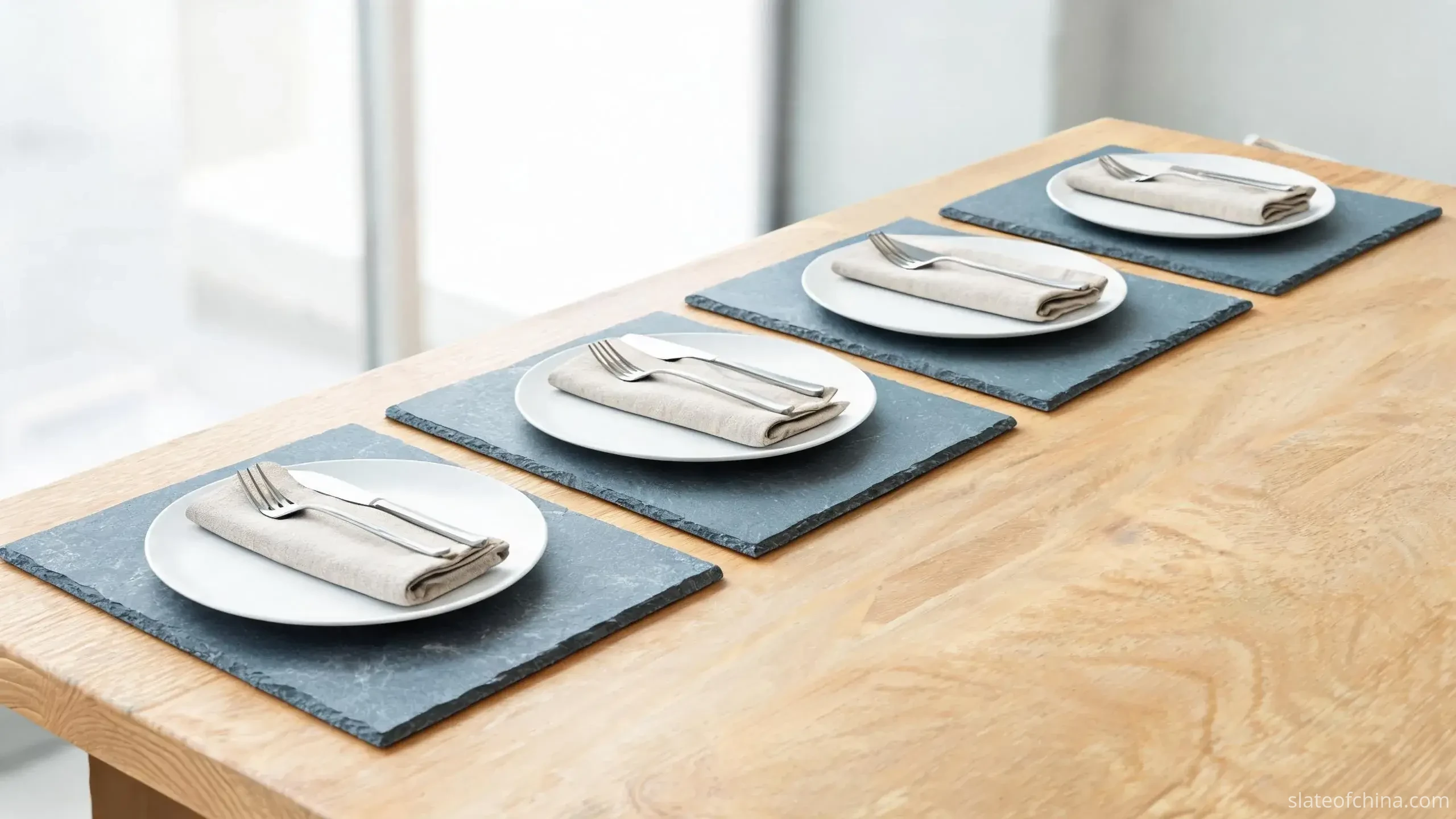
Before a placemat order goes to production, five checks belong on paper: overall dimensions with tolerances; thickness and its acceptable variation; flatness on the intended table surface; corner shape and edge finish; and whether feet, sleeves or pads form part of the product. Each of them is cheaper to write than to discover.
ON THE ORDER: length and width with tolerances, thickness with its band, the named corner profile, the named edge finish, and the feet — material and attachment method — if the design uses them.
Cheese Boards and Serving Slates: Presentation First
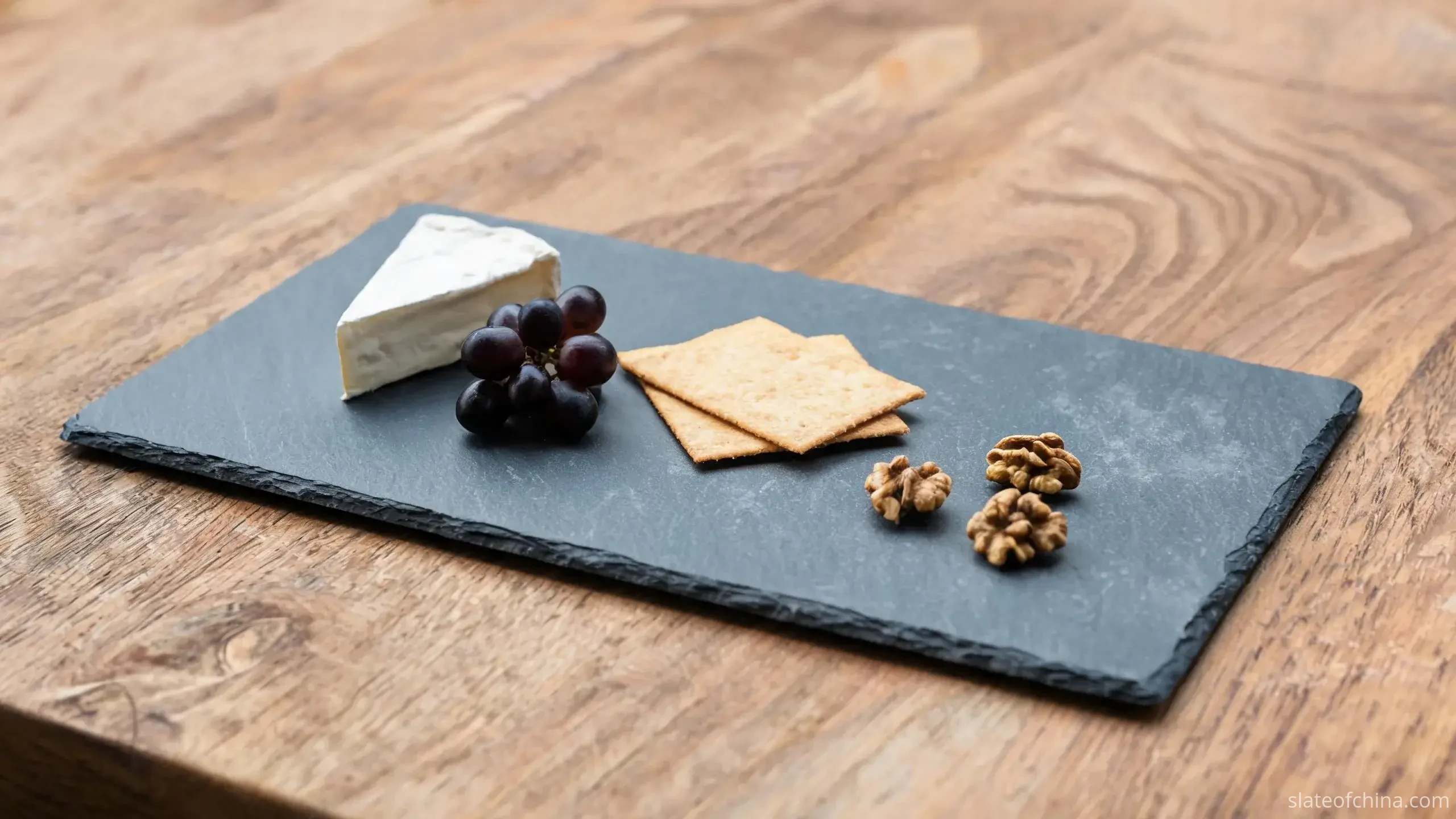
The reason slate serving boards for restaurants keep getting specified is contrast. Slate food presentation boards put a dark, neutral canvas under pale cheeses, breads, fruit and pastries, and under coloured appetisers the dark field works as a frame rather than a rival. Buffet counters, menu photography and tableside presentation all lean on the same effect, and no manufactured surface reproduces it with the same credibility, because the surface being trusted is visibly stone.
A cheese board presents its subject with accompaniments — crackers, fruit, nuts — and its character is decided largely at the edge: a natural-look edge carries rustic character, a straight machine-cut edge reads clean and contemporary. The choice is a design decision with handling implications, and Section 8 gives it vocabulary. Serving slates run rectangular, square, round and custom, and their common ground is that food is already prepared when it arrives: the kitchen arranges, the board carries, the guests eat, the board retires to the pass. That rhythm is where the material performs.
For hospitality buyers, six requirements decide whether natural slate serving boards hold up in daily service: a surface that does not rock on the table; edges smooth to the hand and the linen; resistance to the knocks of normal handling; a finish matched to the venue's agreed cleaning procedure; unambiguous care and food-contact instructions for the staff who will use them; and packaging that protects corners through distribution. Protective packaging preserves the edge quality the other five items assume, through storage, handling and transit.
Heat Resistance, Read Honestly
"Heat-resistant" is the most consequential phrase in this category and the least defined. Read plainly and fairly: a slate placemat is a rigid surface beneath plates, and it may help protect a table finish from routine contact and minor spills. How much heat it actually slows depends on the thickness of the piece, the temperature and contact duration, and the construction of the complete product — including any treatment, pads or adhesive. That is where an honest version of the claim ends, and no comparison between material categories substitutes for evidence about the finished product.
What breaks natural stone is rarely temperature itself — it is rapid temperature change acting on a piece with existing weaknesses. A hot, heavy pot set suddenly on a cold, thin placemat asks the surface and the core of the stone to move at different speeds, and any crack, inclusion or chipped edge stands ready to concentrate that stress. The factors that decide the outcome: the stone's composition and condition; the thickness and format of the piece; the temperature of the item placed on it; the rate at which that temperature arrives; the surface underneath; and any sealer, foot or adhesive, which respond to heat in their own ways. Heat resistance is a property of a finished product, not of a mineral. The stone may shrug at temperatures its glue does not.
There is no tableware-wide heat standard standing behind commercial claims. The roofing slate test regimes grade slate for roofs: EN 12326 and ASTM C406 describe roofing-slate performance, and their results do not certify a placemat under a casserole. A heat claim travels only with test evidence of its own — the product, the temperature range, the contact duration, the supporting surface. A range planning to market heat-resistant placemats or trivets tests to the intended use and writes the claim for the tested product, or leaves the word off the packaging. For ordinary dining, the plainer specification is also the accurate one: table protection and presentation at dinner temperatures — not unrestricted trivet duty.
Can you put a hot pan or a dish straight from the oven on a slate placemat?
Not as a general rule. A placemat assessed for hot cookware can be used with it; a placemat bought as presentation and table protection cannot. Sudden heat on a cold, thin stone is precisely the thermal stress natural slate tolerates least, and any sealer, cork foot or adhesive on the piece may reach its limits before the stone does. Before the behaviour is assumed, ask what the specific product was assessed for — temperature, contact time, and the surface underneath. With no answer, the placemat is a placemat, not a trivet.
ON THE ORDER: a temperature claim, if one is made at all, written against the tested product and its tested conditions — otherwise the placemat is specified for what it is: protection and presentation at dinner temperatures.
Cleaning and Care Without the Folklore
Routine care for a well-finished piece is unglamorous: remove food residues promptly; wipe with a soft cloth or sponge and a mild cleaning solution; wipe the residues away; dry before stacking or storage; and keep abrasive pads and aggressive chemicals away from the face unless the finish's compatibility is confirmed. If a care regime is more complicated than that, the complication should have been a specification decision, discovered on a sample rather than on a shipment.
The real opponents are oils, acidic foods, coloured liquids and standing moisture, and how much they matter depends on the finish an order actually carries. An absorbent natural face, a honed face and a sealed face age differently, and a factory-applied treatment may need renewal on a schedule the end user should be told about. The material-side behaviour behind this — how slate takes in and releases water — sits on the water absorption page of this guide; the product-side behaviour belongs in the care instruction, and the care instruction belongs in the retail box as a printed insert, not improvised by the customer afterwards.
For venues, cleaning is not an aftercare footnote — it is an operating specification. The procedure a restaurant will actually run (chemical, cloth, pace, machine or hand) is agreed before production, so the delivered finish survives the regime it will meet. A board specified for mild hand washing but run through an industrial sanitiser every night is a warranty dispute with a date already set.
Can slate placemats and serving boards go in the dishwasher?
Not automatically, and not without product-specific evidence. A machine cycle combines heat, aggressive detergents and prolonged water exposure, and those act on the stone, on any sealer, and on attached pads and adhesives at different speeds. Hand washing with a soft cloth and mild detergent is the default care assumption for natural slate tableware, and it is the instruction most suppliers will write until a finished piece has been tested through full cycles without damage.
Food Contact: the Question Is the Finished Article
Natural stone earns no automatic food-safety standing from being natural. Food safety is established for the finished article — the stone plus every sealer, coating, adhesive, foot and pad that ships with it — under the conditions its market requires. It is not inherited from the rock.
Before boards are bought for direct food presentation, five questions clear the ground: is the product intended for direct food contact, or for presentation only; what coating, sealer or treatment, if any, is on the food face; what evidence supports the intended contact conditions; will the piece survive the proposed cleaning and sanitation procedure; and which food-contact requirements apply in the destination market. Requirements differ by market and by product construction, and no single certificate covers every slate product. Importers verify the applicable rules and ask for the supporting documents by name.
Where a claim cannot be supported, the product is sold for what the evidence does support — decorative use, or presentation with a liner between stone and food. That is a market position, not an admission of defeat: plenty of strong slate ranges run exactly that way, with the liner as the food-contact surface and the stone carrying the appearance.
Is unsealed natural slate safe for serving food?
Some commercial presentation programmes do run on unsealed stone, but the safety answer attaches to the product, not the material. What makes a board suitable is the specific stone, the finish it carries, the foods and contact times involved, and the requirements of the market it is sold into — documented by whoever stands behind the claim. Without that documentation, unsealed slate is better sold as presentation with a food-grade liner, so that the liner, not the stone, is the food-contact surface.
ON THE ORDER: the food-contact position stated per product — direct, lined, or decorative — with the supporting documents named for the destination market.
Faces and Edges: a Small Vocabulary That Decides Quality
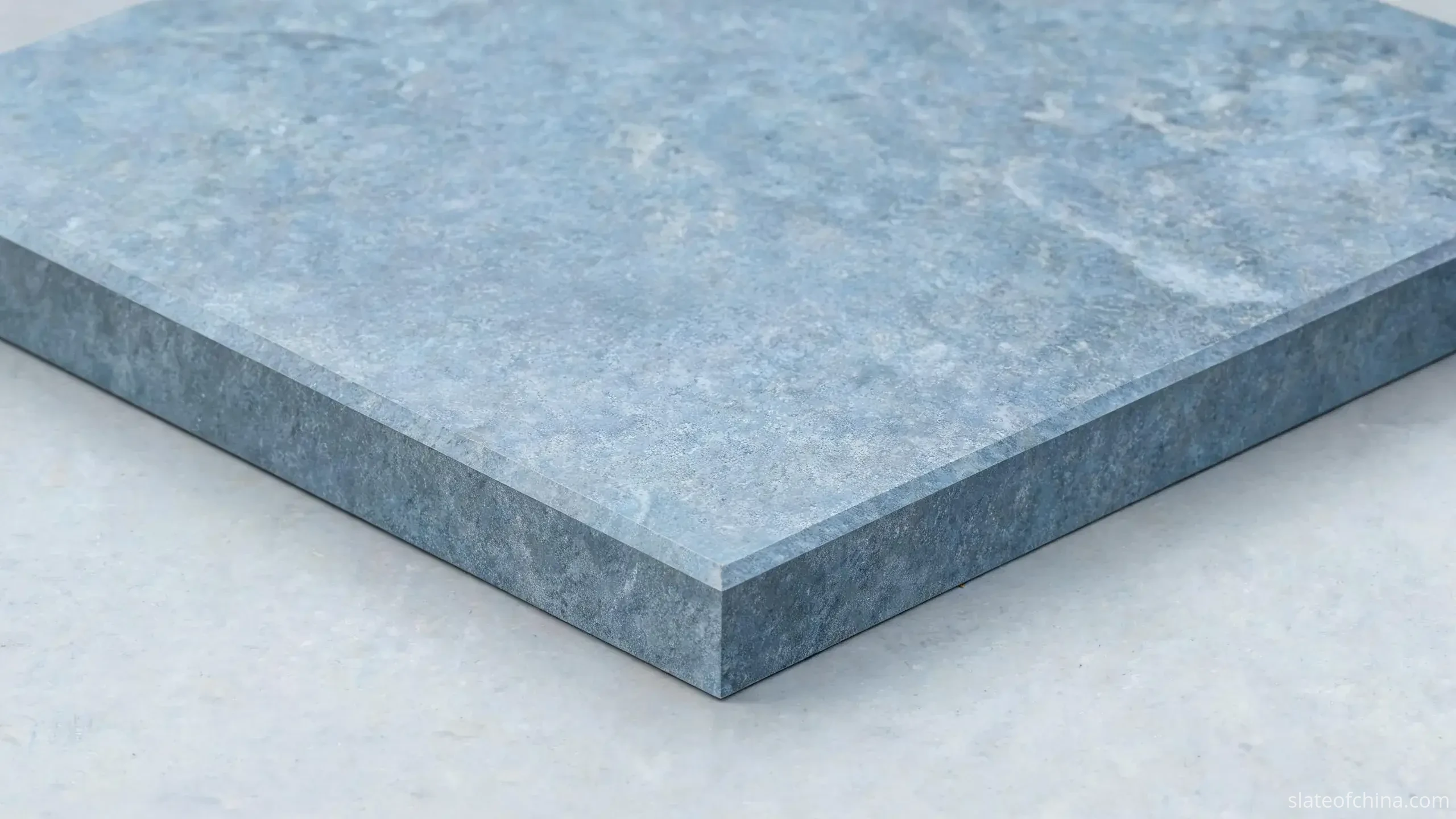
Three surface families cover most of what is sold. A natural split face keeps the stone's original character and belongs to rustic ranges, at the price of wider variation in texture and thickness, which the approved sample must be allowed to define. A honed or calibrated face is the workhorse: consistent in appearance and feel, predictable in contact and cleaning, and the usual choice for pieces that wipe down at service pace. A treated face — oiled, waxed or sealed — changes colour depth, stain behaviour, the cleaning regime and the food-contact chain from Section 7; if a treatment is used, the order records what it is, what it does, and how it is renewed.
Edge language is just as short. Straight machine-cut edges read crisp and contemporary; eased or chamfered edges soften the line and are kinder to hands and linen; rounded corners buy real resistance to the chipping that handling and transit inflict; decorative profiles add character and fragility in roughly equal parts. On any edge, the inspection questions are constant: sharp projections, loose flakes, chipped corners — thin stone announces damage at its edges first. The full cutting-and-finishing chain behind these words, at slab scale, is described on how Jiujiang slate is made.
Slate Against Wood, Ceramic, Glass and Silicone
A fair comparison is worth more than a flattering one, because ranges that work often mix materials on purpose: wood boards beside slate placemats is a long-standing retail pattern, not a betrayal of either. Each material wins somewhere, and pretending otherwise is how buyers end up with the wrong surface in the wrong slot.
| MATERIAL | WHERE IT WINS | WHAT IT COSTS YOU |
|---|---|---|
| Natural slate | Distinctive dark stone character; firm, flat presentation canvas; natural variation that reads authentic | Breakable at corners; care regime must be spelled out; heat and food claims need product-level evidence |
| Wood | Warm, familiar, light; a deep repair and re-sanding tradition | Moisture, staining and warping need managing; knife marks are permanent |
| Ceramic | Enormous colour and pattern range; glazed surfaces clean easily | Chips and shatters when dropped; weight grows quickly with format |
| Glass | Inert, visually clean, easy to inspect | Breakage profile is unforgiving; smudges demand constant attention |
| Silicone | Flexible, light, essentially unbreakable in tabletop service | Nothing about it reads as stone; the look is synthetic by design |
| Composite stone boards | Consistent dimensions and repeatable designs; engineered properties on spec | Uniformity is the point and the cost — natural character is manufactured in |
The selection, in a working range, is made on intended use, price position, maintenance regime, replacement rate, packaging efficiency and what the customer expects to see on the table — appearance comes last among those, not first. Slate earns its slot where the buyer is specifically buying stone: a natural dark canvas, a firm surface, and the family look of real stone — the thing a printed imitation can imitate but never deliver.
The Wholesale Order: Lines That Make Quotations Comparable
Importers range products and watch landed cost; gift and kitchenware retail buys sets, stories and packaging; hospitality groups buy at operating scale and to an agreed cleaning regime; distributors buy codes, cartons and consistency; private-label brands buy development programmes. This section is written for all of them — the mechanics read the same whether the buyer is ranging one shop or buying at container scale — slate placemats wholesale, wholesale slate cheese boards and serving slates — because custom slate placemats, boards and accessories all end up specified the same way: on lines that make quotations comparable.
A comparable inquiry carries ten lines: the product class and its declared use; length, width and thickness with tolerances; shape and corner design; the named surface finish and edge profile; the acceptable-variation standard; quantity and order frequency; the packaging requirement; destination market and applicable compliance; the food-contact position; and the care instruction as a printed deliverable. For custom formats, a drawing or a reference sample replaces paragraphs of description with one object — and of the two, the sample is stronger, because it settles colour and texture as well as dimension.
Quality control in this family is mostly the discipline of separating natural variation from processing defects. The inspection list: dimensional accuracy and thickness consistency; flatness checked on the table it will stand on, not by eye; cracks, weak areas and corner damage; surface defects that affect use; edge finish and handling safety; consistency of feet, sleeves or pads; and packaging condition at arrival. Repeat orders keep an approved reference sample and a written visual standard, so that consistency is maintained without demanding that every natural stone piece look identical. What a full inspection regime looks like at scale is described on the 100 percent inspection page, and the questions that separate serious suppliers are collected in what buyers should ask for — a pallet of samples is not a reference sample.
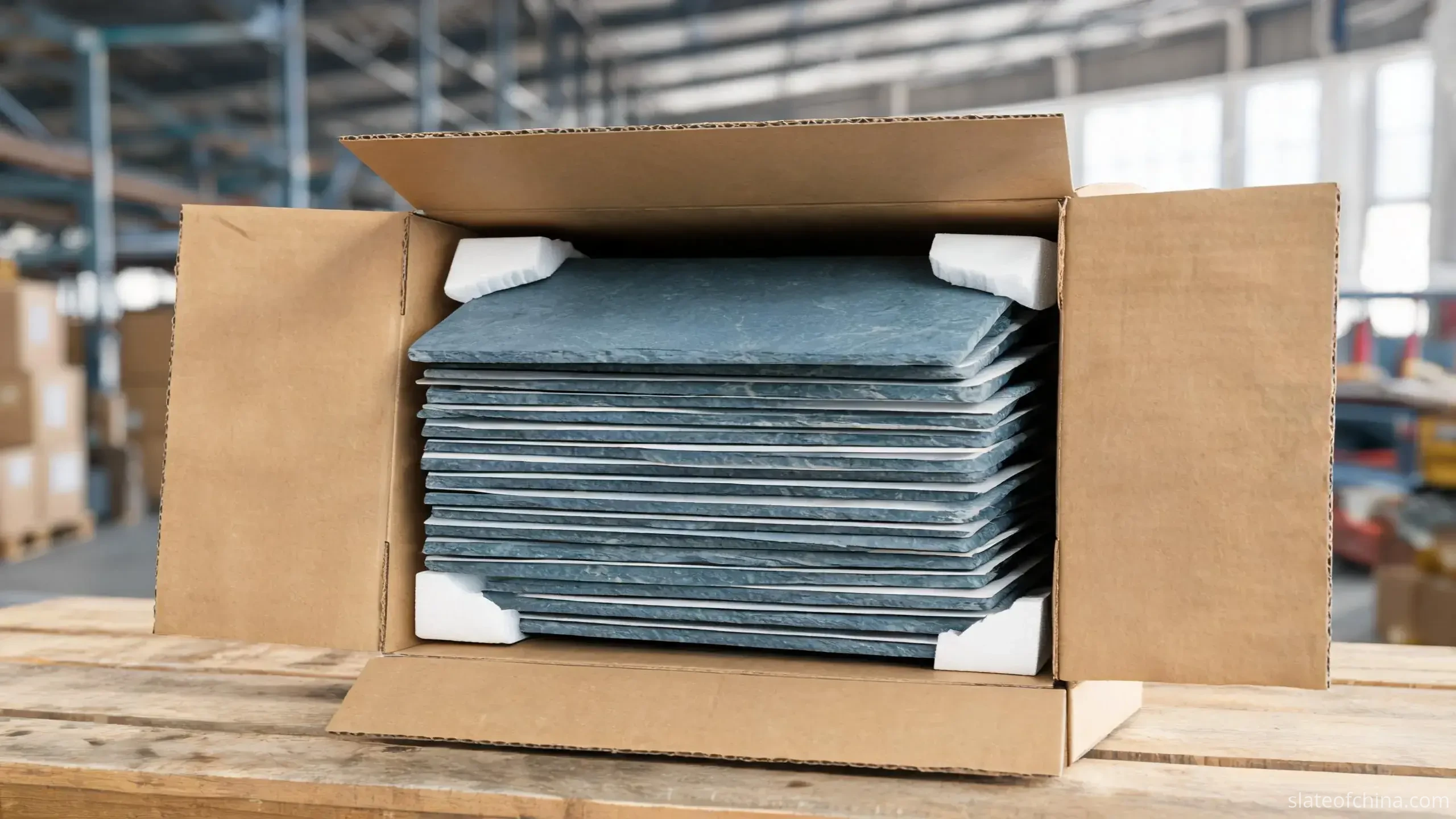
Packaging is where tableware formats differ most from every other slate product in this guide: thin rigid pieces, corners exposed, stacked by the dozen. Sleeves or paper interleaves stop faces rubbing; cushioning and reinforcement protect the stack; carton design follows the pieces-per-carton figure and the stacking the shipment will actually see. The arithmetic is short — the cheapest carton plus breakage costs more than the better carton the moment the losses land on the buyer's side of the ledger. The freight and delivery page covers the container-side of that arithmetic.
OEM and private-label programmes extend the same ten lines: dimensions, shapes, finishes and coordination with the coaster family; branded packaging and printed inserts; a logo or marking on the face, subject to the marking process and any surface finish being suited to the intended use. Every such programme gates on an approved production sample, not a drawing. Quantities and setup economics belong to the supplier and the project — which is why the quotation is requested on the actual specification, not on a material name.
Listen for five phrases on the way in, and know what each one is worth:
| WHAT YOU HEAR | WHAT IT CAN MEAN | WHAT TO ASK INSTEAD |
|---|---|---|
| "Heat-resistant" | The stone tolerates warmth | What temperature and duration was this finished product assessed for? |
| "Food-safe slate" | Stone is used in food presentation somewhere | Which market's food-contact requirements does this finished article meet, with what documents? |
| "Sealed" | Some treatment has been applied | What treatment, on which face, and how is it renewed? |
| "Dishwasher-safe" | A machine wash was survived somewhere, by something | How many cycles, on the finished piece, with its pads and adhesive? |
| "Easy to clean" | Wipes down in normal use | Which cleaning products and procedure are confirmed compatible? |
ON THE ORDER: the ten lines above, and no borrowed phrases — where a claim matters, it moves from the quotation to the specification, with its evidence named alongside it.
Where Jiujiang Fits: a Shortlist, Not a Verdict
Jiujiang and the surrounding Lushan area in Jiangxi Province are a working centre of China's natural slate industry, and the blue-grey family used across this guide comes out of that ground. For tableware buyers, the origin is a supplier shortlist — a region with the quarries, cutters and finishing workshops to make small-format stone at all — and nothing more. It cannot settle a specification, and it never certifies a finished product for a food-contact or heat claim.
One structural caveat before the checklist. The phrase "slate tableware manufacturer" describes an operation with a finished-goods line, and not every architectural slate supplier is one: a quarry or slab producer can be an excellent partner for the roofing and cladding families and still have no finished-goods line. A tableware offer is therefore checked the way every supply relationship is — directly sourced and properly verified — with questions specific to this product class, whatever the origin:
- Representative samples of the actual proposed material — what a tableware line is cut from, not what the catalogue shows at slab scale.
- Available dimensions, thicknesses and finishes for the requested product class.
- Production and inspection capability seen on the requested product, not on another format.
- The details of any coating, sealer or added component, and what each is there to do.
- Food-contact documentation wherever a food claim is intended, per destination market.
- A packaging sample or a written packaging specification.
- A quotation built on the actual quantity and destination.
At Slate of China, the working base behind this guide is the Jiujiang architectural slate business — roofing, cladding and billiard slate, quarried and processed in the region. Finished tableware, from the placemats above to the accessories around them, is best discussed against a specific application: format, finish, quantity and destination in the first message. What current samples and production support is a question the reply answers directly; this page makes no supply assumptions for you. The current natural stone offerings are collected on the natural stone products pages of this site.
A slate tableware range succeeds on small disciplines: one declared use per product, one approved sample per range, packaging designed for thin stone. None of it is difficult, and all of it is cheaper before production than after arrival.
Frequently Asked Questions
What sizes do slate placemats come in?
There is no industry-standard slate placemat size. The format follows the plate it frames, the room each diner is given at the table, and the market the pieces sell into. Rectangles around 300 × 400 mm and squares around 300 × 300 mm are common starting points for sampling and evaluation — illustrative formats, not mandatory dimensions. From a starting format, the working specification is length, width and thickness with tolerances agreed with the supplier and confirmed on an approved sample.
What is the difference between slate placemats and slate serving boards?
The job, and everything that follows from it. A placemat protects the table and frames the setting; it stays under plates through service. A serving board presents food — the food touches or nearly touches its face, so finish, food-contact position and cleaning regime all rise in importance. The two may share one finish language so they can be sold as a family, but they are specified separately: two product classes, two lines on the order.
Why do the pieces in a slate tableware set look slightly different from each other?
Because they are natural stone, and natural slate varies in tone, texture and cleavage from piece to piece — the variation customers accept, and often buy slate for, lies within a range the buyer defines. The dividing line between authentic character and a problem batch is the approved reference sample plus a written acceptable-variation clause. Without those, every batch negotiates its own standard on arrival.
Can slate placemats or serving boards be customized for a brand?
Dimension, shape, thickness, finish, edge profile, set configuration and packaging are the customization axes — the available combinations depend on the supplier's actual processing capability and the quantities of the project. A logo or mark on the face is possible subject to the marking process and any surface finish being suited to the intended use. The gate for every custom programme is the same: approve a production sample, not a drawing, before the run.
What should a first wholesale order of slate tableware include?
The specification lines — product class and declared use, dimensions with tolerances, finish, edge, variation standard, packaging — plus an approved sample retained as the reference, written inspection criteria, the food-contact position with its documents where relevant, the care instruction, and a destination-market compliance check. Quantities, setup economics and lead times come from the supplier against that specification. A trial order on those lines is the low-risk opening of a range.
Related Reading
Planning a slate tableware range?
Slate of China works from the Jiujiang quarrying and processing base behind this guide. Send the products you have in mind — class and intended use, format, finish, edge, set configuration and packaging — with estimated quantity and destination. The reply sets out what current samples support, what the specification should lock, and where a first order should start.